

Introduction
In the aftermath of the global financial crisis, securitization was among the first financial products to step onto the dock, in front of governments, regulators, and the public opinion, charged with the sub-prime meltdown and related excesses in the run-up to the worst economic disaster since the Great Depression. In the pre-crisis years, securitization was magnified as a successful financial technology, allowing banks and investment firms to pool loans and other receivables to sell them to investors, dividing them into tranches according to their different riskiness and related yields. Thanks to the broad range of increasingly complex asset-backed securities (ABS), financial institutions could remove assets from their balance sheets so as to lower the related internal capital requirements, boost their lending capabilities, raise higher profits through fee-based income, and offer investors more diversified investment opportunities. However, as the credit risk mitigation and dispersion were supposed to be the primary qualities of these financial instruments, they turned out to increase systemic risk on a global scale. As the president of the British Financial Services Authority, Adair Turner, plainly put at the time, “the development of securitized credit has ended up producing the worst financial crisis for a century.”Footnote 1 The ensuing years saw a collapse in the global securitization markets, as a result of a public stigma to the eyes of the investors and a parallel wave of tightening regulatory reforms at the international and domestic levels. However, ten years later, in May 2017, an agreement was reached on a comprehensive regulatory package “to revive the EU's securitization market,” as a central pillar of the Juncker Commission's (hereafter the Commission) initiative of a Capital Markets Union (CMU), aimed at broadening investment opportunities, as well as lending to households and business.Footnote 2 What happened in the meantime?
The emerging scholarly literature largely agrees in pointing at the financial industry as the main (according to some, the only) beneficiary of the new securitization regulatory framework. Surprisingly, a study of the industry's influence on the policy-making process leading up to the regulation on “simple, transparent and standardized” (STS) securitization is still lacking. This paper intends to fill this gap in the story by assessing if, and to what extent, the alleged industry beneficiaries played an active role in shaping the securitization reform agenda and the final regulations of December 2017. Its central argument is that the political entrepreneurship of the cross-border securitization industry has been a critical factor in explaining the emergence of the CMU agenda on the reform of securitization and its legislative outcomes. The transnational market incumbents reacted to competitive and regulatory threats in the hostile post-crisis environment, building up a broad consensus around the relaunch of “safe” securitization. This study thus aims at contributing to the ongoing debate on the industry lobbying re-orientation in post-crisis “hard times,” by providing an original account of the interactions between structural determinants, the industry coalition-making capabilities, and the contextual policy issue saliency in the different stages of the EU policy-making process.
The paper is structured as follows. The first section reviews the existing literature on the securitization reform. Then, the theoretical framework and the related expectations of this study are introduced. The subsequent parts provide an empirical analysis of industry lobbying in the different stages of the reform process, from the agenda setting-stage up to the formulation of the Commission proposal, the trilogue negotiations, and the final regulations. Lastly, the conclusion evaluates the initial expectations with the results of the empirical analysis.
Literature review
The existing literature broadly agrees in considering the European banks and investment firms as the real winners in the CMU. Some scholars depicted the CMU project as the re-establishment of a pre-crisis, “market-building” regulatory approach and stressed the actual market-friendly profile of the subsequent Commission proposal for a supposedly “high-quality” securitization framework.Footnote 3 The works of Dorn and Engelen, in particular, interpreted the CMU as the (re)constitution of a public-private partnership within a “business as usual” approach to financial regulation.Footnote 4 Other studies highlighted, on the contrary, the potential impact of the legislative proposals in opening a leeway for financial industry arbitrageFootnote 5 and for a new round of financialization in the EU,Footnote 6 without resolving Europe's “investment malaise.”Footnote 7 Focusing on the Commission consultations, Quaglia, Howarth, and Liebe identified the likely winners and “foot-draggers” of the CMU. According to them, cross-border banks and the city of London were the likely winners, with respect to domestic-oriented financial sectors in Germany and France.Footnote 8 Moreover, in a subsequent contribution, Quaglia and Howarth highlighted the strategic use of policy narratives by the Commission to frame the CMU as positive sum-game to gain consensus both from the financial industry, the member states’ governments, and the general public.Footnote 9 While tracing the fundamental interest coalitions, as well as the narratives supporting them, these works mainly assumed an exclusive top-down perspective, without investigating if—and, in which case, how—the industry organized interests were proactively engaged in the same definition of the policy problem and narrative.
Looking at the embeddedness of central banks in financial markets, a group of scholars identified in the structural market power as the grounding condition for the relaunch of securitization.Footnote 10 This literature shed lights on the ECB efforts in championing favorable capital treatment for securitization, as needed requisite to restore the liquidity of securitization markets.Footnote 11 While this approach offers a valuable contribution in framing the dependence of public authorities on markets as governance infrastructure, the lobbying activity of transnational financial industry in the policy-making process falls beyond its scope. This research aims at complementing the above coalition-based, policy-narrative, and governing-through-market perspectives, by looking at the financial industry policy entrepreneurship in the securitization reform as the flip side of the financial markets’ structural power.
Theoretical approach
As various strands in the IPE literature agree upon, cross-border market players were a determinant constituency in championing integrated European markets in financial services. On the contrary, views differ on the actual role of industry influence as an explanatory variable. A significant strand in the literature shed light on a dominant market-friendly regulatory approach in Europe before 2007 and on its continuities after the crisis,Footnote 12 in line with the regulatory capture arguments.Footnote 13 However, according to some scholars, the post-crisis period brought suspicion and distrust in financial industry claims, thus questioning the pre-crisis approach.Footnote 14 From a different point of view, other researchers revived the attention to the structural power of the banking industry in the international financial regulationFootnote 15 and, more recently, in the case of the post-crisis bank bailouts in Europe and the United States.Footnote 16 If this literature shed light on the strategic use of the structural position by individual firms, what it misses is the actual interaction between industry and policy-makers, alongside the stages and contexts of the policy-making process. At the opposite, institutionalist, neo-functionalist, and constructivist studies highlighted the entrepreneurship of supranational institutions in steering the private actors as allies in the construction of a European single market.Footnote 17 If the question of the real influence exerted by private interests is indeed a matter of empirical investigation, this literature theoretically excludes the possibility of an industry political entrepreneurship in setting the policy agenda.
In order to unravel the conditions and forms of financial industry influence, this research adopts a Critical IPE approach, looking at the interplay between structural and political power dimensions in the constitution of conflicting socio-economic coalitions striving to shape the governance of financial markets.Footnote 18 If the structural dimension set the vested interests, patterns of interdependence, and power resources of the actors involved,Footnote 19 then the political scope, timing, and context of regulation shape the patterns of corporate influence in EU policy-making.
First, in order to induce or prevent policy change, a minimum degree of intersectoral industry coordination—according to structural and path-dependent dynamics—is a preliminary condition to win the disruptive pressures of inter-firm competition. Then, the influence of a corporate coalition hinges upon the presence and strength of competing socio-economic demands and the related attention of policy-makers. The literature on issue-saliency showed how a low saliency, “quiet politics” environment would allow market incumbents to entertain elite-level regulatory partnership with policy-makers.Footnote 20 On the contrary, an increased political saliency in issues normally absent from the public debate opens short-term windows of opportunity for the mobilization of weaker economic and social groups to offset against dominant insiders.Footnote 21 Indeed, a relative high saliency of policy issue fosters public scrutiny, the broadening of stakeholders, and consequent responsiveness by both elected politicians (directly accountable to their constituencies) and regulators (who take into account the preferences of the former, as well as the views of relevant socio-economic interests). In such a contested scenario, the main condition for influence is the capability by market incumbents to forge broader alliancesFootnote 22 and to frame their demands in terms of a general societal interest,Footnote 23 so as to potentially include the demands of different socio-economic sectors and rebuild policy-makers’ trust. If the transnational financial industry had vested interests in promoting the EU securitization markets and structural power resources to advance its demands, the post-crisis environment constrained the former to build up a broader private-public coalition as the basis for a renewed hegemonic position in financial regulation. In facing a “noisy politics” battlefield,Footnote 24 corporate interests are thus induced to acting as policy entrepreneurs,Footnote 25 so as to spur policy change in a hostile environment. The latter is meant here to indicate a lobbying strategy, according to which interest groups call for policy initiatives, rather than reacting to them, thus striving to set the ideational framing conducive to the formulation of problems, the definition of a policy agenda, and the formation of a supportive coalition.
Regarding the methodology, industry influence is here analyzed through a combination of process-tracing and preference-attainment methodologies,Footnote 26 by comparing the actors’ initial preferences with the final policy outcomes and then searching for pieces of evidence to reconstruct the causal connections between them. I thus compare and triangulate the following sources: A) public position papers, declarations, and letters; B) stakeholders’ responses in official public consultations; C) interest groups’ initiatives involving EU public officials or are explicitly endorsed by them in relation to the policy outcomes here scrutinized; and D) five in-depth interviews with representatives of the private and public subjects involved in the securitization reform.
The next section depicts the contexts and interests at stake in the EU post-crisis securitization, so as to draw some expectations to be tested in the empirical analysis.
Main expectations
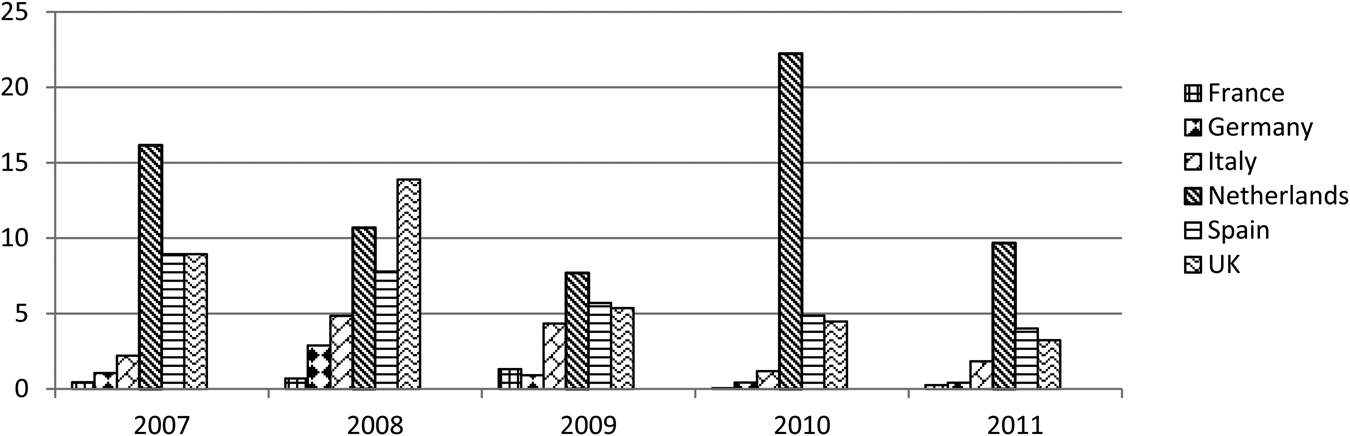
European cross-border banks, insurance groups, and asset-management firms were struck by the steep decline of securitization in the EU after the crisis. From 2006 to 2007 the estimated revenues from securitization amounted to about $19.9 billion in the United States and $7.5 billion USD in the EU; the top four European banks’ revenues stood at more than $1 billion USD, and Deutsche Bank emerged as undisputed leader, gaining almost 11 percent of its pre-tax group profits from the ABS business.Footnote 27 From the outburst of the financial crisis up to the euro-zone sovereign debt crisis, the European ABS markets plummeted (figure 1).
Securitization issuance as a proportion of GDP (selected countries)

Large EU banks suffered the worst blow. In 2014 (soon before the launch of the CMU Action Plan), the profitability of EU banks declined to an average return on equity (RoE) between 3 and 4 percent. The net income average amounted to 1.3 as a percentage of total assets, pairing with increased cost-to-income ratio (at 63 percent in 2014), soaring non-performing loans level and higher capital requirements (with the tier 1 ratio at 17 percent of risk-weighted assets in 2014, in respect of 8 percent in 2008). The level of loans in 2014 lagged at the level of 2008.Footnote 28 The city of London registered the most dramatic fall in profits. According to the Financial Times, “British banks are making nowhere near as much as they did pre-crisis, with profits at the UK's biggest banks 63 percent lower in 2015 than in 2007, when banking profits peaked.”Footnote 29 Even if less pronounced, the European insurance sector also registered a fall in profitability since the financial crisis: particularly in France, with about -11 percent in RoE for both life and non-life sectors, from 2008 and 2010,Footnote 30 and a contraction of investments of €117 billion, from 2009 to 2011, for the top thirty insurance companies.Footnote 31 Moreover, the EU cross-border banks were threatened by their U.S. competitors, whose profits soared with a “combined net income of J.P. Morgan, Citigroup, Bank of America, Goldman Sachs and Morgan Stanley annually averaged $41.73 billion,” from 2009 to 2014, in respect to an “annual average of $25.08 billion from 2002 to 2008.”Footnote 32
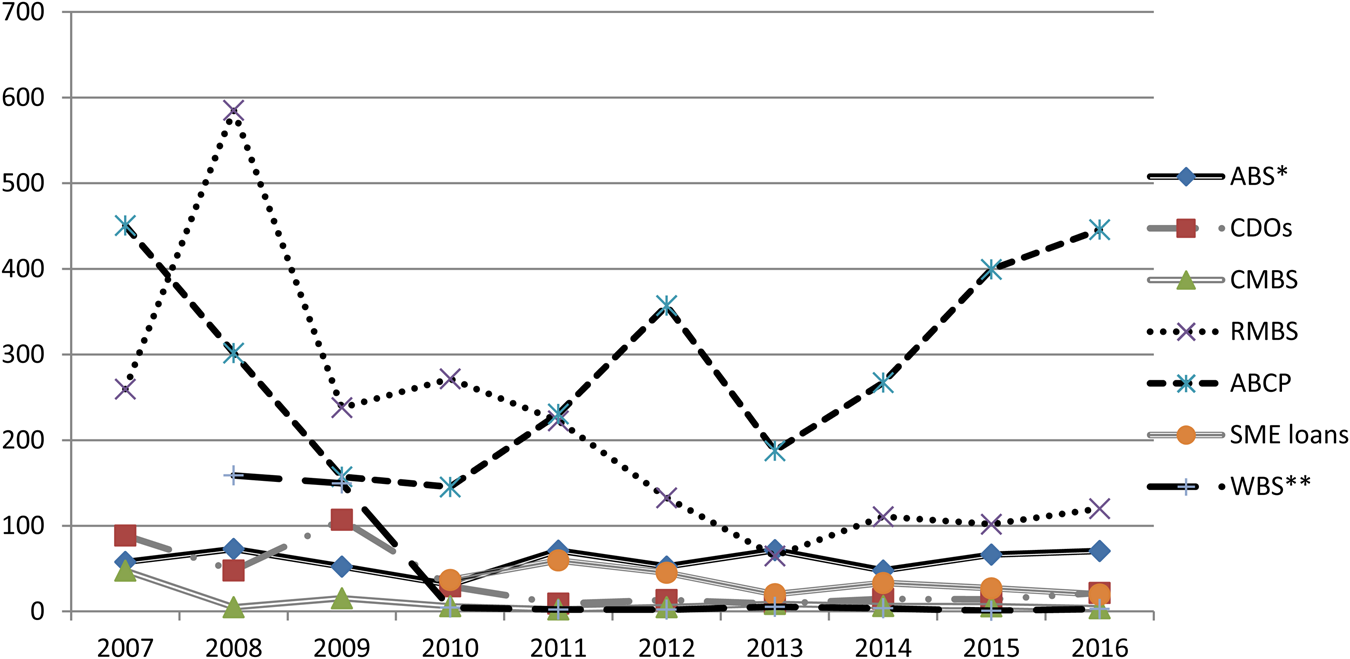
Looking at the different securitization issuance by collateral (figure 2), we observe the rapid decline of residential mortgage-backed securities (RMBS), the fall of ABCPs from 2007 to 2010, and the almost disappearance of whole business securitization (WBS), CDOs, and commercial mortgage-backed securities (CMBS). SME loans issuance lightly improved between 2010–11—mainly thanks to national and EU post-crisis supporting programs—while remaining relatively low.
European Issuance by Collateral (€ billions)

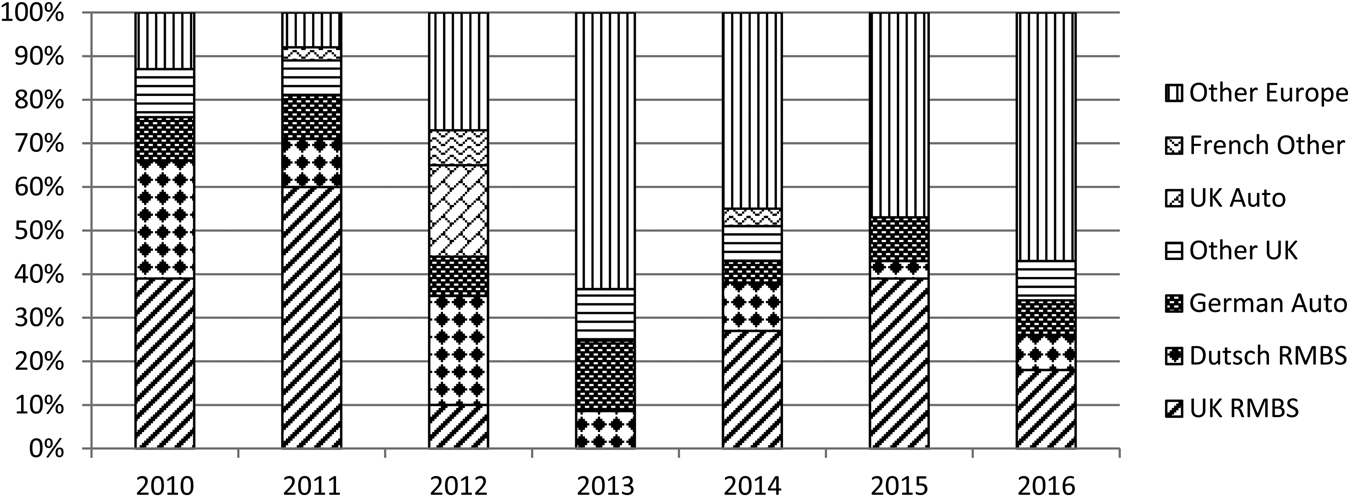
A breakdown of the placed securitization for selected countries helps us to map the domestic business sectors affected by the collapse of securitization markets. Figure 3 sheds light on the significance of securitized products like residential mortgage-backed securities (RMBS), with about €821 billion (mostly concentrated in the Netherlands, the UK, and Spain) and ABS (including auto loans and credit cards receivables), with about €172 billion mainly concentrated in Italy and Germany. Securitization was relevant in funding the German automotive sector (with an issuance at €2.1 billion in first quarter of 2014), in sustaining consumer loans (with the largest share, €1.4 billion, again in Germany), residential mortgages (led by the Netherlands, with €5.3 billion), and SME loans (€1.6 billion at pan-European level).Footnote 33
Breakdown Placed Securitization (Q4) (percentage of total)

From the above data and considerations, we can expect, firstly, the cross-border banking and financial industry organizations to be the key policy entrepreneurs in the relaunch of securitization in the EU, as those having the primary interest in it. Regarding the patterns of coalition-making, the whole EU private banking and insurance sectors are expected to be supportive of a revitalization of securitization, together with sizeable real estate and business sectors mostly benefiting from it.
On their part, the European public authorities had to reactivate the funding channels to the real economy under the fiscal restraints of the austerity-based management of the crisis. While the share of bank funding in total NFCs financing stood at around 70 percent between 2002 and 2008, in 2016, such a percentage contracted to 50 percent. The export-oriented large firms compensated the reduced bank lending with a corresponding increase in financial market financing, while SMEs remained primarily reliant on bank lending.Footnote 34 The low-interest rates environment favored the issuance of corporate bonds and equities by large non-financial corporates, but—as the Commission noticed—such issuance “has also been concentrated in larger markets, rather than markets where corporate funding problems have been most severe.”Footnote 35 Initiatives to unlock bank lending to companies and households would have responded thus to a pressing concern by the Commission and the member states with large securitization markets. Moreover, in line with Braun's argument,Footnote 36 as the ECB became the “dealer of last resort” in the EU securitization markets after the crisis, it acquired a vested interest in reviving the securitization market.
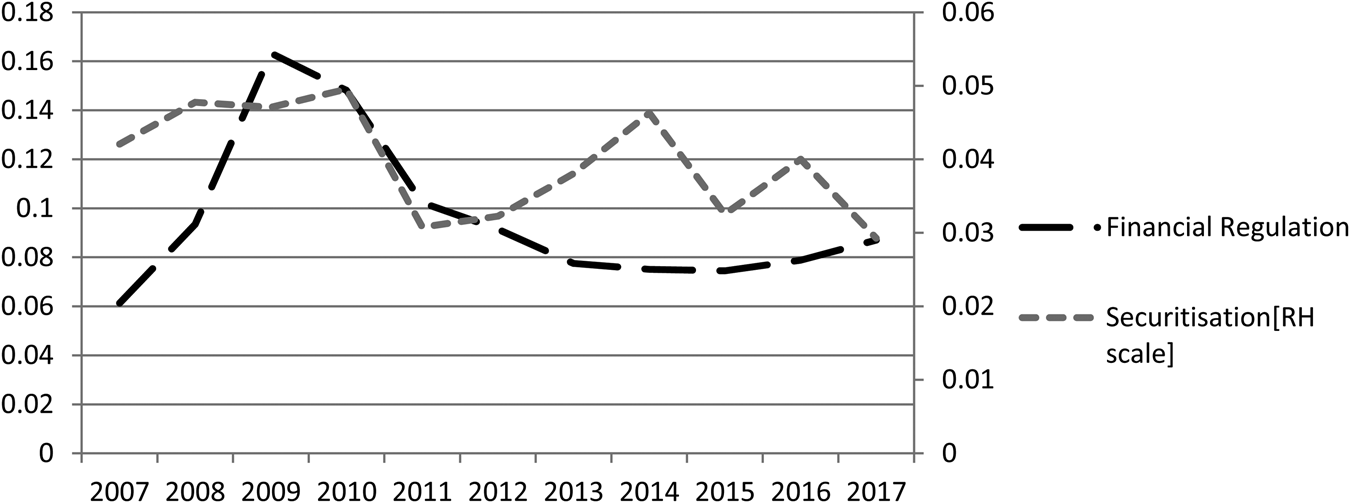
Nevertheless, the crisis triggered an “alarmed discovery” of banking issues,Footnote 37 thus opening a season of regulatory tightening. As noticed above, fingers pointed at securitization as a primary cause of the financial turmoil. The economic disruption, together with the regulatory reform initiatives, triggered the increase in the saliency of financial policy issues in Europe. By taking the frequency of the keywords “financial regulation” in general news at the EU levelFootnote 38 as a proxy for the public attention towards financial issues, we notice a peak from 2008 to 2010, then followed by an abrupt reversal to about the levels of 2008 (figure 4). By taking into account the news referring to “securitization,” we observe a far lower amount of news. However, we find two peaks in correspondence with the post-crisis regulatory wave in 2009–10 and then back in 2014 and 2016, the same years as the launch of the CMU project and the negotiations on the securitization regulation.
News coverage of “Financial Regulation” and “Securitization” 2007–17, percentage relative to total articles

The relative high saliency of issues related to financial regulation and securitization in the aftermath of the financial crisis allows us to suppose a contested political environment, substantively hampering the corporate capture of the financial policy-making. It is thus possible to formulate the following expectations regarding the industry influence in the three main stages of the reform process. In the agenda-setting phase (2009–14), corresponding to the peak in issue saliency, we would expect the industry coalition to adapt and frame their demands to anticipate and win the resistances of the EU decision-makers (foremost, the Commission), by forging a broad supportive coalition. In the policy-formulation and trilogue negotiation stages (2014–17), on the contrary, the relative steep lowering in saliency of financial regulation would signal a corresponding less distrustful approach by the policy-makers towards industry, though possibly counteracted by a policy-making phase with a higher saliency in “securitization” issues, which fully included the European Council and the Parliament as legislators, together with their broader constituencies. Moreover, as the international Basel standards and the Commission policy proposals were drafted during the high saliency period, it could be expected that their hard-regulatory stance would not be dismissed easily in the later and lower issue-saliency stages of the policy-making process. The post-crisis regulatory legacy could have thus represented an enduring counteracting force against the financial industry lobbying efforts.
The following sections assess the above expectations in the empirical analysis of the whole policy-making process that lead to the securitization regulation in the EU, from the agenda-setting to the final legislative outcomes.
The path towards a “high-quality” securitization
In the aftermath of the global financial crisis, the transnational financial industry took the hit of an international regulatory agenda under the political mandate of the G20 summits. The final Basel III agreement, setting strengthened standards for banks’ capital requirements, confirmed harsher capital charges and risk-weightings for securitization.Footnote 39 The Basel III principles were then incorporated in the final Commission proposals for a revised capital and liquidity adequacy framework for banks.Footnote 40
Before that, the European financial industry was already engaged in an alternative battle. During 2009, the European Financial Services Roundtable (EFRFootnote 41) and the Association for Financial Markets in Europe (AFMEFootnote 42) united their efforts to set out a market-led initiative aimed at enlivening securitization. As of December 2009, the Handelsblatt gave notice of a confidential document by the EFR containing a proposal for an industry-led scheme to define high-quality securitized products, called the “Prime Collateralised Securities” (PCS), to be launched in 2010.Footnote 43 In an interview of September 2012, Fabrice Sussini, global head of securitization at BNP Paribas—member of both the EFR and AFME—declared that the initiative “borne out of a mixture of frustration and bemusement at European policy-makers’ response to the global financial crisis,” in particular regarding a burdensome regulation on securitization.Footnote 44 As he put it:
Alongside other financial institutions and market participant, BNP Paribas’ involvement in what were the origins of the PCS initiative began in 2009. Discussions were started on the need to revive the product in Europe […] The question for this small working group centered on “how to get it started, how to restore the confidence lost, what are the lessons we should factor in and the messages from investors and regulators we should listen to?” Ultimately, the various initiatives taken at different levels in different countries converged and, under the leadership of AFME and EFR, the work continued and resulted in the PCS initiative.Footnote 45
The PCS initiative aimed at creating a label to qualify credit-worthy classes of ABS, which meet standards defined by an independent private body. The challenge was, indeed, to convince the regulators to recognize those high-quality ABS in order to grant them a preferential regulatory treatment.Footnote 46 With this move, the financial industry intended to pander to the policy-makers’ willingness to draw a line with the pre-crisis subprime-like securitization, by offering at the same time a solution to revive securitization markets on a safe basis, as well as to free up credit to the real economy. As Ian Bell, then head of the PCS Secretariat, put it:
After the crisis, you cannot tell the policy-makers: let us return to the past just because European securitization performed comparatively well. The ECB was prepared to help us in reviving securitization, but we had to convince all the policy-makers, that we were not going to use securitization to bring them to another crisis. If you ensure that, you will be forgiven. … We had then to come up with a definition of good securitization that was actionable in a regulatory sense. Second thing: we had to show that we were doing good securitization, not just defining it. We needed to show that the industry was committed, dedicated, to this high-quality securitization.Footnote 47
From the very outset, the PCS had a primary political target: to create a “bifurcated” regulatory treatment to favor high-quality securitization.Footnote 48 As explained by Rick Watson, head of capital markets and securitization at AFME: “if the label is combined with some regulatory changes over time, it could be a potentially significant benefit to the entire market.“Footnote 49
The PCS project soon started to gain consensus among regulators and policy-makers. In a keynote address at the third annual structured credit products summit co-hosted by AFME and the European Securitization Forum in March 2010, Michel Stubbe (head of the market operations analysis division at the ECB) focused on the priority to devise “securitization structures that are transparent, simple, and easy for investors to compare” as key to restoring confidence and recovery in the ABS markets.Footnote 50 In June 2010, González-Páramo (member of the executive board of the ECB) referred to the on-going industry initiative to develop “transparent, comparable and simple securitization structures” as “a sine qua non condition for a return to self-sustaining securitization markets,” thus “invit[ing] the industry to continue and to strengthen its efforts in this vital area of work.”Footnote 51 In its Report on asset securitization incentives, issued in July 2011, the BIS Joint Forum welcomed the EFR-AFME initiative as an “example of how incentives to standardize disclosure and structures could be provided.”Footnote 52
At the peak of the Eurozone sovereign debt crisis in June 2012, the EFR and the AFME officially launched the PCS Label to be awarded to securitized products “which meet best practice in terms of quality, transparency, simplicity, and standardization.”Footnote 53 An industry-led PCS Association was created, responsible for the ABS qualification process and the implementation of the quality standards by the subscribing market participants. The PCS eligibility criteria referred to instruments “that are backed by asset classes that have performed well through the financial crisis” and being “of direct relevance to the real economy,” with the exclusion of complex securities like “CMBS, CDOs, synthetic securitizations, re-securitizations and residential mortgages which do not meet defined quality criteria.”Footnote 54 In this way, the PCS met the demands of regulators for discontinuity with pre-crisis, highly complex and risky securitization, while opening at the same time a window to set a regulatory haven for securitization.
As reported by the PCS promoters, the development of the label had been followed and welcomed by the European Investment Bank, the European Banking Authority, and the ECB. In his comments, ECB president Draghi declared that “[t]he ECB has been able to follow this project since 2009 and we are pleased to see you are ready to launch the labeling process.”Footnote 55 Although the ECB approach towards ABS remained somewhat restrictive until the second half of 2011, in those same years, key officials of the central bank already pushed for a better environment for securitization.Footnote 56 In a speech to the Global ABS Conference in June 2011, the head of ECB market operations division, Francesco Papadia, openly supported the industry demands for the inclusion of the ABS in the liquidity requirements to be set in the CRD IV legislation.Footnote 57 One year later, Papadia was appointed as the first chairman of the PCS board.Footnote 58 The latter represents a compelling case of “revolving-doors,” which adds to a changed context wherein the ECB was signaling a change of mind on its approach to the regulatory treatment of securitization.
Together with the PCS label, the major organizations of the securitization industry started to issue policy proposals to imprint a decisive turn to the hard-regulatory approach adopted after the financial crisis. In November 2012, the EFR published a report advancing an overall approach and a list of policy recommendations aimied at making regulation fit to “preserve the contribution of financial firms to economic growth.”Footnote 59 The report denounced the effects of the EU post-crisis regulatory overburdening on the financial sector in stifling investments and growth, by curbing financial risk-taking and so restricting the bank- and market-based channels of funding to the real economy. The EFR recommended the establishment of a policy-framework incentivizing the “provision of more long-term finance via the capital markets,” while referring to the PCS label and the regulatory bifurcation as the best solution to ensure financial markets’ stability and unleashing banks and market funding to the EU business.Footnote 60
From the analysis of this section, we can conclude that AFME and EFR were able to coordinate the leading EU securitization players around a regulatory option, as that envisaged by PCS label, setting the path for a revitalization of the ABS markets. A winning strategy that soon paid off. The EFR-AFME initiative constituted a forerunner of the Commission Green Paper on “long-term financing of the European economy.”
The making of the CMU agenda on securitization
In March 2013, the Commission issued a Green Paper for stakeholder consultation on the possible initiatives to broaden and differentiate the sources of long-term funding for non-financial companies in the EU. As convincingly argued by Braun and Hübner, with this move, the Commission intended to harness financial markets as macro-economic stabilization tools, while ensuring fiscal discipline and austerity-led policies at the EU level.Footnote 61 The European securitization industry offered a sound policy solution and narrative to sustain such objectives. That is why Commission openly endorsed existing “market-based initiatives” to “develop simple securitization products,” then locking in the revitalization of securitization as policy objective.Footnote 62
As the primary target of the consultation, 178 out of a total of 292 respondents came from industry,Footnote 63 including just five SMEs’ representatives. Cross-border banks and financial firms, together with their national and European associations, were the primary supporters of a revision of the regulatory framework to boost high-quality securitization.Footnote 64 At the opposite, the European Trade Union Confederation, the European association of financial users, and Finance Watch—the most significant advocacy group for employees, consumers and alternative finance—questioned a revitalization of securitization, thus pushing to severely restrict it, while asking for the development of simpler and sustainable financing channels.Footnote 65
Soon before the end of its mandate and the elections of the European Parliament, in March 2014, the final Commission communication on “Long-term financing” confirmed revitalization of high-quality securitization as a pillar of a plan to relaunch the European capital markets. The PCS labeling was explicitly mentioned as a valuable contribution to the objective of relaunching safer securitization markets.Footnote 66
This initiative was further supported by the ECB and the Bank of England (BoE), whose influential voices proved to be decisive to relaunch the securitization agenda.Footnote 67 The ECB-BoE then issued a paper detailing the benefits derived from “prudently designed” ABS. It echoed the concerns expressed by the industry coalition about the Basel III proposed changes in the regulatory treatment, still in discussion at the time, as well as on the treatment of securitization in the EU implementation of the liquidity coverage ratio and the CRD IV.Footnote 68 One month later, the ECB and the BoE launched a stakeholder consultation on the foundations of a “robust securitization market in the European Union,” alongside the principles already traced by the PCS label.Footnote 69
In response to the ECB-BoE consultation, soon before the election of the president of the Commission, AFME presented its program to build up “large and liquid capital markets.”Footnote 70 Interestingly, the paper referred to the call made by the German Association of the Automotive Industry (VDA) and the German Industry Federation (DBI) for a revision of the prospected new capital adequacy regulation. According to the industrialists, the latter would have had “serious negative repercussions for the refinancing and therefore the sales, of the German automotive industry,” consequently demanding “the adoption of a differentiated treatment of the most important securitization segments, to which Auto ABS clearly belong.”Footnote 71 The German and EU business then came into play as a vital ally of the European financial industry. As a representative of the Association of German banks put it: “after the financial crisis it would never have been enough to have baking associations arguing for securitization. It was very important that business associations argued that securitization was important to finance the economy. It was the only argument that really mattered for the Commission and the European Parliament.”Footnote 72
After candidate Juncker's pledge in July 2014 to work on a “Capital Markets Union” as a primary initiative of his Commission presidencyFootnote 73 and soon before the parliamentarian vote on it in October 2014, AFME published a detailed policy proposal. The industry agenda for a CMU then covered a set of specific proposals: at the top of the list, there was the relaunch of “high-quality” securitization.Footnote 74 The plan was soon endorsed by the member states hosting the major European financial centers. At the informal Ecofin in Milan, September 2014, a joint German and French paper called for “safer and more robust securitization market” to ensure “long-lasting and sustainable” growth, thus supporting the development of “high-quality securitization” as a policy priority for the new Commission.Footnote 75 Among the documents quoted in the annex to the report on the financial ministers’ meeting, we find an informal (not disclosed) paper by the British government titled “Finance for Growth,” whose first main proposal was that of “reviving securitization.”Footnote 76
However, the main turning point in the affirmation of the “high-quality” PCS-like framework came soon before the launch of the CMU. Responding to the Commission call for advice on the ways of promoting a safe and stable securitization market, in October 2014, the European Banking Authority (EBA) published a paper on “simple, standard and transparent securitizations,” which set the subsequent regulatory framework. According to Ian Bell, head of the PCS secretariat, the EBA paper broadly shared the basic tenets of the PCS approach, representing the main achievement in the industry efforts to set the path for a revitalization of the securitization markets.Footnote 77 The EBA document effectively quotes and assumes the PCS four elements of the “bad” pre-crisis securitization and the opposite principles for the “safe” one, deserving favorable capital treatment. They were the reliance on the “originate-to-distribute” model of business; the use of highly leveraged instruments; the structured investment vehicles embedding maturity transformations—that is, relying on refinancing within narrow windows of time (like the CMBSs); lack of transparency related to too complex structures (like the CDOs cube).Footnote 78
With the election of Juncker as Spitzenkandidat of the European Popular Party in October 2014, the CMU was locked in as flagship initiative of the new Commission in the EU financial governance. Commissioner Hill and his Directorate General (DG) soon showed a dialoguing approach towards the financial industry.Footnote 79 The ensuing Green Paper on CMU paired it with the Commission proposal on the establishment of a framework for “simple, transparent and standardized” securitization and the correspondent revision of the capital treatment in the CRD IV/CRR.
As it is shown in this section, the EFR and AFME were the crucial policy entrepreneurs in advancing an approach to relaunch securitization, which gathered a broad consensus among the European business community and the EU public authorities. The relative salience of financial regulatory issues obliged the leading organizations of the EU securitization industry to build up a solution responding to the policy-makers’ needs of “breaking the ties” with the pre-crisis world, though leading to a revitalization of an important market for the banking and business sectors. In this sense, the “high-quality” securitization narrative was able to hegemonize the EU overall approach to the issue. However, as the policy-making process went ahead from the agenda-setting stage to the negotiations with the Council and the European Parliament, the industry lobbying efforts faced severe threats.
The trilogue negotiations and the STS package
Building on the on-going work of the BCBS-IOSCO task force, as well as the recommendations issued by the EBA, in February 2015, the Commission issued its proposal for an STS securitization framework for the stakeholders’ consultation.Footnote 80 A look at the statistics reveals a net prevalence of industry interests: 82 out of 120 total responses came from the corporate sector.Footnote 81 Mirroring the responses to the EBA consultation, the financial industry associations and large banks generally pushed to broaden the scope of eligible products for qualifying securitization. They asked to include in the STS criteria a range of short-term synthetic securities, while generally preventing the exclusion, in principle, of any specific type of securitization.Footnote 82 Both financial industry and business organizations firmly pushed, in particular, for ensuring the eligibility of short-term securitizations of trade and lease receivable, in particular the ABCPs (BDI; along the same line VDA and MEDEFFootnote 83). Germany notably defended the call for an inclusion of ABCPs and other short-term securitizations embraced by the British and French authorities. Regarding the requirements for risk retention, the respondents from the financial sector generally pressured for lower risk retention requirements, especially for qualifying securitizations and for privileged treatment of trade receivables (EBF, GBIC, IMA, FBF, AFME, EFAMAFootnote 84). The public authorities here considered were, on the contrary, divided: the British Treasury supported the industry demands for a reduction of the risk retention requirements, while France and Germany defended the Commission approach.
Contrasting the demands of the corporate interest groups, NGOs and consumer representatives welcomed the mandatory exclusion of complex securitization and strived for a more restrictive definition of the qualifying criteria and higher risk retention.Footnote 85
The Commission's final proposal included in the STS definition only “true-sale” securitization, thus excluding synthetic products, although “further work” was prospected on complex securities that “performed well.”Footnote 86 However, a special STS regime for ABCPs was included, as broadly demanded by both corporate interests and public authorities.Footnote 87 The proposal foresaw a direct risk retention requirement of no less than 5 percent, together with reporting obligation on the originator, sponsor, or the original lenders.Footnote 88 The Basel III approach was recalibrated in order to grant lower capital charges for assets qualifying under the STS criteria.Footnote 89
The ensuing trilogue negotiations saw a contrast between a broad corporate coalition striving to relax the STS criteria and reduce the related capital charges and the more onerous requirements advocated foremost by the European Parliament and public advocacy groups. The Council agreement on the negotiating position came swiftly, in December 2015, with amendments mainly pointing at the containment of the coordinating powers of the European Securities and Markets Authority and the relaxation of the disclosure requirements.Footnote 90
The corporate coalition united the front in view of the discussions in the European Parliament, by issuing, in March 2016, a joint note signed by thirty-two organizations and firmsFootnote 91 and a letter from four international and EU associations.Footnote 92 Contrary to the industry demands, the report of the European Parliament introduced both more stringent provisions, like an explicit ban on re-securitization and a substantive increase of the risk retention requirement up to 10 percent of the interest in underlying exposures of the securitization.Footnote 93 On the contrary, the ECON committee embraced the industry demands by mandating the Commission to issue a proposal on the inclusion of synthetic instruments and proposing a crucial amendment aimed at changing the Basel III hierarchy of approaches to securitization risk assessment, by inverting the order of the external ratings-based method with the standardized one.Footnote 94 In this way, the EP intended to further discourage the use of external ratings in the securitization risk assessment, while granting at the same time flexibility in the methods of calculation, so as to possibly generate lower capital charges in line with the industry demands.
In the consultation on the CMU mid-term review in January-March 2017, as well synthesized by AFME, the financial industry and business organizations voiced their concern that with the current proposals “all securitization […] could become prohibitively burdensome in Europe.”Footnote 95 The corporate coalition thus lobbied to obtain a reduction of the proposed capital charges, to prevent an increase of the risk retention requirement advanced by the EP report, to water down or to limit the ban on re-securitization, and to obtain the inclusion of synthetic products in the STS securitization.
The lobbying efforts proved to be successful, at least in watering down the most worrisome amendments of the EP. In the final legislation, approved in December 2017, the financial industry brought home significant successes on all the main issues at stake. The certification of securitized products as eligible STS criteria was left to the originators, sponsors, and securitization special purpose entities (SSPEs), which were allowed to recur to an authorized third party to check securitization compliance.Footnote 96 If the penalty regime was correspondingly embittered for infringements with the STS framework, the self-certification approach—combined with the lack of a centralized EU CMA—risks to “confe[r] a private quasi-regulatory power to market-players.”Footnote 97 Moreover, the STS regulation allows member states to gold-plate their remedial measures, with a general obligation to ensure that sanctions are “effective, proportionate and dissuasive.”Footnote 98 The ban on re-securitization was softened by confirming derogations “for certain cases of re-securitizations that are used for legitimate purposes” and with the exclusion of the ABCPs, which were subject to dedicated STS criteria.Footnote 99 Nevertheless, the list of securitized products excluded from the STS comprehended securitizations of non-performing loans and CMBSs.Footnote 100 However, partially embracing the industry demands, the regulation mandated the EBA to publish a report on STS criteria for synthetic securitization by July 2019.Footnote 101
In line with the calls from the EU banks, the final text of the amended capital requirements for securitization confirmed the shift of the securitization External Ratings Based Approach as a last option in the calculation of the risk exposures, as well as the risk retention at 5 percent and the lower capital requirements for STS securitizations.Footnote 102 Against the calls of the securitization industry, however, the eligibility to STS framework was confined to securitization transactions involving EU originators, sponsors, or SSPEs: a lacking third country equivalence regime, which will put a strain on UK originators, as they will be non-EU parties post-Brexit.
Conclusions
The analysis of the different stages of the legislative process shows mixed results in relation to our expectations. The cross-border financial industry appeared to be significantly influent at the agenda-setting stage of the regulatory approach to securitization and the CMU—by establishing a policy coalition with the ECB, the BoE, and the Commission—but they fell short in achieving some significant demands in the policy-formulation phase and subsequent trilogue negotiations.
Under the constraints of an initially high saliency environment on financial regulatory issues, the cross-border banks and their organizations acted as key policy entrepreneurs. During the agenda-setting stage, they successfully advanced a market-led benchmark for “high-quality” securitization—the PCS label—as a linchpin for the relaunch of the securitization markets in the EU and loosed the grip of the on-going regulatory reforms. They successfully coalesced with the other involved sectors of the European securitization industry and with the large European business, foremost the German automotive industry, soon finding the crucial support of the ECB, which had a vested interest in restoring liquid and regulated markets for ABS. As we have reconstructed in the first empirical section, the timing of the events and the linkages between the corporate lobbying activity and the regulators’ responses amounts to evidence that the PCS initiative constituted the first proposed approach to differentiate bad and good securitizations and to relieve the related capital charges. It soon gained consensus among international and EU policy-makers, as well as the key member states.
Although the firm opposition of different pro-regulatory groups, the idea of a significant overhaul of securitization in Europe was locked-in, thanks to the commitment of the president of the Commission towards the CMU: a project mainly based on the previous communication on “Long-term financing” of the outgoing Barroso presidency. In this case, the building up of a broad and diversified coalition of corporate interests under the aegis of the EU transnational market players revealed to be successful in putting the revitalization of securitization markets as priority policy to boost investments and growth in Europe. The low public saliency environment regarding securitization issues and the reduced number of consumers and non-corporate pro-regulatory interest groups participating in the consultations—together with the little space of contestation on the very assumptions of the Green Paper—significantly compromised the lobbying capacity of these actors in respect to corporate ones.
However, from the Commission proposals to the regulations of the STS framework, the industry coalition went down a bumpy road. The final legislation felt short of some relevant industry demands, like the further reduction of capital charges and the widening of the STS eligibility to include synthetic securitization. Despite the reduced saliency of financial regulatory issues, we could explain these outcomes by looking at the relatively increased saliency of securitization in the crucial legislative stage involving the European Parliament and its responsiveness to pro-regulatory groups. Moreover, the legacy of the post-crisis regulatory approach mattered: the higher requirements for securitization under the Basel III standards represented the basis for the Commission proposal, thus limiting the extent of preferential treatment under the STS label. On the contrary, the Brexit referendum did not affect the policy outcomes significantly, because the agreement was already achieved before June 2016.Footnote 103
However, while being frustrated by higher capital charges than demanded,Footnote 104 the corporate coalition was successful in watering down the more stringent provisions advanced by the Parliament, like the higher risk retention requirements and a full ban to re-securitization.
In conclusion, our analysis showed the critical role played by cross-border banks and financial firms in setting the terms of the STS legislation and in influencing most of its parts, by building up a shared consensus with other financial and economic interests. Those private actors identified by the existing literature as the primary beneficiaries of the securitization reform were at the same time the chief architects of it. Nevertheless, our research shows at the same time how the financial industry has been compelled to find a “compromise” solution for the revitalization of securitization, fitting the policy-makers’ demands to signal a discontinuity from the most discredited securitized instruments. The proposed analytical framework, focusing on the agency of industry entrepreneurs in conjunction with the structural and political conditions enabling them to establish supportive private-public coalitions, is thus intended to contribute to the debate on corporate lobbying and regulatory capture, as well as on their legitimacy.
Interviews
• Ian Bell, Head of the PCS Secretariat, 12 February 2018.
• Almoro Rubin de Cervin, Head of Unit FISMA E3, European Commission, 15 March 2018.
• Antoine Garnier, Head of institutional relations, French Banking Federation, 10 February 2018.
• Richard Gardiner, Head of Public and Regulatory Affairs, Federation of European Securities Exchange, 10 March 2018.
• Hendrik Hartenstein, Head of Public Affairs, German Association of Private Banks, 4 May 2018.