


1. Introduction
In democracies, an election deposit system is often established. Its origin can be traced to the United Kingdom’s Representation of the People Act of 1918, which sought to prevent citizens from running for office indiscriminately and becoming what were termed ‘frivolous candidacies’. Under this rule, candidates for the House of Commons were required to pay a deposit of £150, refundable only if they secured at least 12.5% of the vote. By 1985, the amount had been raised to the current £500, while the threshold for reimbursement was lowered to 5% of the vote (Mellows-Facer, Reference Mellows-Facer2005). Regardless of whether the election deposit system carries symbolic or practical significance today, its original purpose was to filter potential candidates. From Black’s (Reference Black1972) perspective, the election deposit is intended to increase the costs for potential candidates.
However, it is surprising that, with few exceptions (Stratmann, Reference Stratmann2005; Harada and Smith, Reference Harada and Smith2014; Faravelli et al., Reference Faravelli, Khalil and Ponnusamy2023; Karekurve-Ramachandra et al., Reference Karekurve-Ramachandra, Singh and Stommes2024), there is almost no empirical research examining how election deposits deter candidacy. Most studies instead focus on how factors such as electoral competition (e.g., Osborne and Slivinski, Reference Osborne and Slivinski1996; Congleton and Steunenberg, Reference Congleton and Steunenberg1998), incumbency (e.g., Kazee, Reference Kazee1983, Reference Kazee1994; Fowler, Reference Fowler1993; Stone et al., Reference Stone, Maisel and Maestas2004; Gordon et al., Reference Gordon, Huber and Landa2007; Hirano and Snyder, Reference Hirano and Snyder2009), and parties (e.g., Broockman, Reference Broockman2014; Karpowitz et al., Reference Karpowitz, Monson and Preece2017; Fiva et al., Reference Fiva, Halse and Smith2021) influence the deterrence of candidacy.
Indeed, institutions matter. From the perspective of rational choice institutionalism, institutions shape the rules of the game (Hall and Taylor, Reference Hall and Taylor1996: 5–10), and electoral institutions, in turn, naturally influence the willingness to participate in the game of elections (e.g., Melusky et al., Reference Melusky, Loepp and Kanthak2020; Avis et al., Reference Avis, Ferraz, Finan and Varjão2022; Li, Reference Li2022). Duverger (Reference Duverger1954) may be considered the pioneering work in this area. Although his theory focused on the effects of electoral systems on the number of effective candidates or the party system, the underlying mechanism lies in how electoral systems consolidate or deter candidates. Nevertheless, although the election deposit system was originally designed to deter candidacy, many empirical studies do not examine such an effect (Tavits, Reference Tavits2008; Rashkova, Reference Rashkova2014; Kapoor and Magesan, Reference Kapoor and Magesan2018; Rashkova and Su, Reference Rashkova and Su2020).
The scarcity of research on the deterrent effect of election deposits is not difficult to understand: it is inherently challenging to evaluate counterfactuals. Unless a country suddenly introduces an election deposit system or changes the amount required (Stratmann, Reference Stratmann2005; Harada and Smith, Reference Harada and Smith2014), it is impossible to identify the direct impact of the deposit itself; even then, it remains difficult to establish causal effects. Recent studies primarily employ indirect methods to examine this causal relationship, specifically by using the regression discontinuity design (RDD) to observe whether defeated candidates receive an election deposit refund and run again in subsequent elections (Harada and Smith, Reference Harada and Smith2014; Faravelli et al., Reference Faravelli, Khalil and Ponnusamy2023; Karekurve-Ramachandra et al., Reference Karekurve-Ramachandra, Singh and Stommes2024). Faravelli et al. (Reference Faravelli, Khalil and Ponnusamy2023) and Karekurve-Ramachandra et al. (Reference Karekurve-Ramachandra, Singh and Stommes2024) focus on state and local elections in India, which are conducted under a single-member district (SMD) system, while Harada and Smith (Reference Harada and Smith2014) analyse Japan’s House of Representatives elections before 1994, which were held under a single non-transferable vote (SNTV) system.
Notably, the studies discussed above not only examine the effects of election deposits through indirect empirical strategies but also contribute to the less developed subfield of electoral re-contestation, particularly by investigating how election deposits, as an institutional factor, shape defeated candidates’ decisions to return to electoral competition. Existing research on political ambition has traditionally focused more on individuals who already hold political office (Schlesinger, Reference Schlesinger1966). Apart from the aforementioned studies on election deposits, recent research agendas have increasingly turned their attention to defeated candidates (e.g., Taylor and Boatright, Reference Taylor and Boatright2005; Dolan and Shah, Reference Dolan and Shah2020; Bernhard and De Benedictis-Kessner, Reference Bernhard and De Benedictis-Kessner2021; Baskaran and Hessami, Reference Baskaran and Hessami2022; Nzabonimpa, Reference Nzabonimpa2023; Janusz and Vallejo, Reference Janusz and Vallejo2026). This shift matters because defeated candidates who re-contest can accumulate campaign experience, local networks, name recognition, and organizational support, all of which may shape future electoral success and political career development. Thus, rather than being merely an individual behavioural outcome, electoral re-contestation also affects the future candidate supply in democratic competition. Accordingly, this paper contributes in two ways: it provides evidence on the effects of election deposits in another institutional context, and it examines how election deposits affect defeated candidates’ political persistence after electoral defeat.
Although existing research has produced findings across different electoral levels and electoral systems, this paper argues that important gaps remain. First, while Faravelli et al. (Reference Faravelli, Khalil and Ponnusamy2023) and Karekurve-Ramachandra et al. (Reference Karekurve-Ramachandra, Singh and Stommes2024) examine local council elections, their classification of parties is limited to categories such as national parties and local parties. We still do not know how election deposits affect different types of parties in countries without such party classifications. Moreover, given that India has a relatively low degree of party institutionalization, whether the effects of party types on candidacy deterrence are consistent in countries with similarly institutionalized party systems remains a question. Second, Harada and Smith (Reference Harada and Smith2014) focus on national-level elections under the SNTV system, but they classify candidates into ‘serious’ and ‘fringe’ based on the distribution of their parties’ vote shares. This paper contends, however, that whether a party has governing capacity or has previously entered parliament also shapes the effect of election deposits on candidates’ willingness to run again.
Accordingly, this paper takes Taiwan’s local council elections as a case to examine whether receiving an election deposit refund affects candidates’ willingness to run again. Taiwan, which democratized in the 1990s, is generally regarded as a democracy with a relatively high degree of party institutionalization, and its local council elections are conducted under the SNTV system. Although Taiwan’s democratization has spanned only a little over three decades, the multi-candidate nature of SNTV enables this paper to analyse the effects of the election deposit system with a relatively large sample. At the same time, the rigidity of Taiwan’s election deposit system allows us to rule out institutional variation and directly assess its effect.
For the main analysis, this paper finds that receiving an election deposit refund increases defeated candidates’ probability of re-contesting elections by 4 percentage points. However, the placebo tests also reveal statistically significant differences at alternative cutoffs, indicating that this finding is not robust. To engage with existing research, this paper also conducts subgroup analyses by party affiliation and gender. The results show that receiving an election deposit refund significantly increases the probability that independent candidates re-contest elections by approximately 13 percentage points, and this finding is statistically significant. In the gender subgroup analysis, this paper does not find any statistically significant effect of election deposit refunds.
2. Overview of Taiwan’s election deposit system
Compared with the turbulent history of elections in Taiwan, the election deposit system has undergone little change. Most of the institutional developments and examples discussed in this section focus on local council elections, though cases from other electoral levels are also noted; unless otherwise specified, the rules apply generally to all public offices. In 1980, the Public Officials Election and Recall Act during the Period of National Mobilization for Suppression of the Communist Rebellion was enacted, consolidating all types of elections except the presidential election. It should be noted that even before the enactment of this law, Taiwan’s limited electoral practices already included an election deposit system, though the relevant rules were scattered across different regulations. This complexity stemmed from the Kuomintang (KMT) government’s view at the time that Taiwan was only a small part of the national territory (Taiwan Province), and thus, provincial election regulations did not need to be codified together with those for central-level elections. From the outset, the threshold for receiving an election deposit refund was already established and has remained unchanged to this day: ‘the deposit shall not be returned under the following circumstances: … who was not elected also received votes from less than 10% of the result of the total number of voters in the electoral district divided by the quota of candidates to be elected’ (then Article 38, Paragraph 2; now Article 32, Paragraph 4, Subparagraph 3). As in most countries with an election deposit system, the legislative rationale in Taiwan was likewise to prevent frivolous candidacies.
The threshold for receiving an election deposit refund may appear complicated in legal wording, but it is much simpler when expressed mathematically:Footnote 1
 $$x_{i,d}={{\rm votes}_{i} \over {\rm voters}_{d}/M_{d}}={{\rm votes}_{i} \over {\rm voters}_{d}}\times M_{d}$$
where x i, d denotes candidate i’s vote ratio in district d, votes i is the number of votes obtained by candidate i, voters d is the number of eligible voters in district d, and M d is the district magnitude. First, the election commission calculates the proportion of votes obtained by candidate i in district d relative to the total number of eligible voters in that district. It is important to note that the denominator is the number of eligible voters, not the number of valid votes. Thus, this measure differs from the conventional vote share, and for the purposes of this paper, it is referred to as the absolute vote share (AVS). However, in Taiwan, elections are not only conducted under SMD but also under SNTV, such as in local council elections, indigenous constituencies for legislative elections, and legislative elections prior to 2004. Under the SNTV system, multiple representatives are elected in a district, and candidates are ranked by the number of votes they obtain. SNTV is now exceedingly rare worldwide. Japan, South Korea, and Taiwan all once adopted this system for their parliamentary elections but have long since abandoned it. In SNTV, because districts are multimember but vary in their magnitude M, the potential number of candidates also differs by district. Mathematically, this implies that, on average, candidates’ vote shares tend to be lower in districts with larger M. In this sense, applying a uniform nationwide threshold appears inequitable. Therefore, as a second step, the election commission multiplies AVS by M. This paper refers to the resulting measure as the weighted absolute vote share (WAVS). If WAVS exceeds 10%, the candidate receives an election deposit refund; otherwise, the deposit is forfeited. In fact, in Japan’s House of Representatives elections before 1996, which also used SNTV, the threshold for receiving an election deposit refund was calculated in a similar way (see Harada and Smith, Reference Harada and Smith2014). The difference, however, lies in the definition: in Japan, the calculation was based on the weighted vote share, that is, the conventional vote share multiplied by M, whereas in Taiwan, what is weighted is AVS.
In 1986, during the KMT’s authoritarian rule, the long-standing opposition movement known as the Dangwai (‘outside the party’) held its founding meeting at the Grand Hotel in Taipei, establishing what is today the Democratic Progressive Party (DPP). In 1987, the KMT lifted martial law, and in 1991, the KMT government formally ended the ‘Period of National Mobilization for Suppression of the Communist Rebellion’. Since then, Taiwan’s democratization has gradually moved onto the right track. Throughout these years, the election deposit system itself has undergone relatively few changes. In the 1989 amendment to the law, preferential treatment was granted to candidates with party affiliation: such candidates were required to pay only half of the legally stipulated deposit, while independent candidates were required to pay the full amount (then Article 38, Paragraph 2). Given that political parties were prohibited during the martial law period,Footnote 2 it is not difficult to see how this rule favoured the KMT in the early stage of democratization. For example, compared with 26 political parties contesting the 2022 local council elections, only 5 parties competed in the 1994 city council elections, and 8 parties in the 1998 county council elections. In the Appendix, Figure C1 illustrates the participation of political parties across local council elections over time. Because this provision violated the constitutional principle of equality, it was declared unconstitutional in early 1994.Footnote 3 In addition, elections for grassroots public offices such as village and ward chiefs were previously exempted from the requirement to pay an election deposit. However, following the 2005 amendment, such candidates were also required to pay. The legislative rationale stated: ‘[The original provision] caused an excessive surge in the number of candidates for village and ward chiefs. In order to prevent candidates from registering indiscriminately, thereby conserving social resources and public funds while maintaining fairness, the proviso in the latter part of Paragraph 1 exempting deposits was deleted’.
Interestingly, except for presidential elections, the amounts of election deposits in Taiwan are not stipulated by law. From the outset, the deposit amounts have been determined by the Central Election Commission (CEC). This creates a curious paradox: institutionally, the commission has the flexibility to set deposit amounts that reflect the prevailing standards of the time; politically, however, this very flexibility discourages the commission from making changes. On the one hand, it lacks democratic representativeness; on the other, it fears criticism that its calculations may be problematic. As a result, over the past three decades, the amounts of election deposits across various types of elections in Taiwan have changed very little. Apart from the 2005 amendment requiring deposits for village and ward chief elections, adjustments made by the election commission include raising the deposit for town representatives from NT$30,000 (US$987.49) to NT$50,000 (US$1,645.82) in 2014 and reducing the deposit for city mayors from NT$2 million (US$67,147.91) to NT$1.5 million (US$50,360.93) in 2022. For presidential and vice-presidential candidates, the system shifted in 2003 from a floating amount tied to population changes to a fixed amount of NT$15 million (US$467,318.84 during the 2024 presidential election), though this was likewise implemented through legal amendment.
Within the scope of this paper (city and county council elections from 1994 to 2022), the amounts of election deposits have remained entirely unchanged: candidates for city councils are required to pay NT$200,000 (US$6,418.5), while candidates for county councils must pay NT$120,000 (US$3,851.1). The county councillor deposit is comparable to that for township mayor and indigenous chief elections, whereas the city councillor deposit is comparable to those for legislators and county mayor elections. In the Appendix, Table C1 presents the deposit amounts for all elected public offices in the most recent local and national elections. Strictly speaking, however, there have been some changes in local council election deposits. First, some districts were merged, which led to increases in the required deposit. For instance, when Kaohsiung County and Kaohsiung City were merged into a single city in 2010, candidates from the former Kaohsiung County district were required to pay higher deposits in subsequent elections.Footnote 4 Second, the real value of deposits has declined over time in relation to per capita GDP or other income indicators. In the Appendix, Table C2 presents the deposit amounts for each local council election along with the corresponding US dollar exchange rate at the time. To illustrate the relationship between election deposits and prevailing economic indicators, this paper plots deposit amounts relative to per capita GDP and the median of disposable income in each election year (Figure C2, Appendix).Footnote 5
As shown in the Appendix, although the real value of Taiwan’s election deposits has declined with economic development, the amounts still represent a considerable sum – especially when we take campaign expenditures in local elections into account. Using the 2022 elections as an example, Figure C3 illustrates the campaign expenditures of winners (Panel A), defeated candidates who received an election deposit refund (Panel B), and defeated candidates who did not (Panel C). It should be noted that these amounts exclude the deposit itself, and because campaign expenditures are highly skewed, this paper presents medians. When the election deposit is added, its impact on winners is minimal, as they can receive a refund upon election. For defeated candidates who received a refund, the deposit accounted for 10.51% of their expenditures in city council elections and 18.35% in county council elections. For defeated candidates who did not receive a refund, the deposit accounted for 33.69% of their expenditures in city council elections and as much as 50.83% in county council elections.
The rigidity of Taiwan’s election deposit system is not its only source of criticism. In other countries, the threshold for receiving a deposit refund is typically set as a certain proportion of valid votes; in Taiwan, however, the story is much more complicated. First, Taiwan’s local council elections are conducted under the SNTV system. The greatest problem SNTV poses for the deposit system is that it makes the calculation considerably more complex. Within the scope of this paper, the smallest district magnitude is 1, which is no different from SMD, while the largest can reach as many as 18 seats. (In the Appendix, Figure C4 shows the distribution of district magnitudes for the cases analysed here as well as for the most recent election, in 2022; note the difference in the scale of the y-axis.) Although in a district with magnitude M, the number of viable candidates tends to converge towards an equilibrium of M + 1 (Duverger, Reference Duverger1954; Reed, Reference Reed1990, Reference Reed2003; Cox, Reference Cox1994, Reference Cox1997), as was also the case in Taiwan’s past legislative elections (Hsieh and Niemi, Reference Hsieh and Niemi1999), the large disparities in district magnitude in Taiwan’s local elections impose an additional burden on potential candidates when assessing the electoral landscape.
Second, and perhaps more troubling, Taiwan does not base the calculation of the threshold for receiving an election deposit refund on valid votes. In most countries with an election deposit system, the refund threshold is typically determined by whether a candidate secures a certain proportion of valid votes. In Taiwan, however, as noted in the provision discussed earlier, the calculation is based on the total number of eligible voters. In other words, to receive an election deposit refund in Taiwan, candidates must not only estimate how many votes they are likely to obtain and the magnitude of the district but also assess the overall level of electoral turnout.Footnote 6
Let us consider a scenario: in a district with magnitude 5, the total number of eligible voters is 100,000. Voter turnout is 70% in the election at time t and 65% in the election at t + 4. A candidate in this district has a support rate of about 3%. Under Taiwan’s rules, this candidate must obtain (100,000/5) × 10% = 2,000 votes to receive an election deposit refund. In the election at time t, the candidate would succeed (100,000 × 3% × 70% = 2,100), but in the election at t + 4, the candidate would fail (100,000 × 3% × 65% = 1,950). In other words, as turnout decreases, it becomes increasingly difficult to receive an election deposit refund. Thus, compared with many other countries (see the appendix of Harada and Smith, Reference Harada and Smith2014), Taiwan’s threshold of 10% might appear relatively unchallenging at first glance. Yet because the actual figure is affected by voter turnout, the effective threshold is much higher. For instance, in the most recent 2022 local council elections, the threshold was in effect 10%/60% = 16.67%.
Finally, the combination of the above factors makes the situation even worse. The SNTV system is an electoral system that places extreme emphasis on candidate-specific attributes. Because votes are non-transferable, candidates from the same party are also in competition with one another (Carey and Shugart, Reference Carey and Shugart1995). Although parties often call on their supporters to distribute votes evenly among their candidates, the outcome is rarely ideal (Nathan, Reference Nathan1993; Cox, Reference Cox1994; Cox and Niou, Reference Cox and Niou1994; McCubbins and Rosenbluth, Reference McCubbins, Rosenbluth, Cowhey and McCubbins1995; Hsieh, Reference Hsieh and Hung-Mao1996; Reed, Reference Reed2009; Fujimura, Reference Fujimura2017: 432–433). In the Appendix, given that few studies and electoral systems employ AVS, Figure C5 presents, for each election, the average gap between the top-winning candidate and either the runner-up or the last winning candidate in terms of vote share (Panels A and B) and AVS (Panels C and D).Footnote 7 While the observed gaps may not appear large, it must be remembered that SNTV is a multimember system. In the Appendix, Figure C6 illustrates how the candidate-centred and competitive nature of the SNTV system produces a highly skewed distribution of votes, with the vast majority concentrated among the winners. As a result, for defeated candidates, most of the votes are already captured by winners, leaving them to compete with other defeated candidates for only the ‘scraps’. When voter turnout is also taken into account, receiving an election deposit refund can hardly be considered easy.
From this paper’s perspective, Taiwan’s institutional arrangement makes it a particularly suitable case for evaluating the effects of the election deposit system. First, Taiwan’s local council elections have long been conducted under the SNTV system. Compared with SMD, parties nominate multiple candidates, which means that even candidates from major parties may fail to receive an election deposit refund. This allows this paper to assess the impact of election deposits across candidates of different party affiliations. Second, unlike SMD, SNTV also enables the examination of a greater number of defeated candidates, thereby alleviating the problem of insufficient within-bandwidth sample size in RDD. In the Appendix, Figure C7 shows the distribution of average district magnitudes and extra candidates (i.e., defeated candidates) across years within the scope of analysis. Third, this paper not only evaluates whether the findings of Harada and Smith (Reference Harada and Smith2014) also apply to Taiwan but also tests whether the same effects hold at the local electoral level. Finally, the rigidity of Taiwan’s election deposit amounts and thresholds provides a relatively stable temporal and institutional context, allowing this paper to examine the effects of receiving, or not receiving, an election deposit refund.
Constrained by Taiwan’s electoral arrangements, this paper cannot assess whether the findings of Harada and Smith (Reference Harada and Smith2014) also apply to Taiwan’s national-level elections. In 2005, Taiwan implemented an electoral reform, adopting a mixed-member majoritarian system composed of 73 SMD seats, 6 SNTV seats, and 34 seats elected through closed-list proportional representation (CLPR). The four elections prior to 2005 do not provide sufficient data for analysis. Elections after 2005 are even more problematic: small parties can realistically secure seats only through CLPR. However, under Taiwan’s electoral rules, unless a party has obtained at least 3% of the party vote in any of the three most recent parliamentary elections, it must nominate 10 candidates in SMD in order to be eligible to contest CLPR. These 10 candidates have no substantive electoral significance; they exist solely to enable their party to participate in CLPR, and they are almost certain to fail to receive an election deposit refund. By contrast, major parties almost always succeed in receiving refunds. For this reason, unlike Karekurve-Ramachandra et al. (Reference Karekurve-Ramachandra, Singh and Stommes2024), this paper cannot examine whether the findings of Harada and Smith (Reference Harada and Smith2014) also hold for SMD elections.
3. Research design
3.1. Model identification
To analyse the causal effect of election deposit on the decision to run for office again, this paper employs an RDD that focuses on lost candidates who narrowly met the election deposit threshold. In this design, the WAVS serves as the running variable, the 10% threshold represents the cutoff point, and the possibility of running again is used as the outcome variable. This paper estimates the treatment effect using local linear regression with a triangular kernel and mean squared error (MSE)-optimal bandwidth selection. We choose a triangular kernel since it is a common choice in RDD, as it weighs higher to observations closer to the cutoff and lower weights to others farther away (Cattaneo and Titiunik, Reference Cattaneo and Titiunik2022: 20). Therefore, it provides better estimates for observations that are more comparable near the cutoff.
About bandwidth selection, to ensure the robustness of our analysis, we present the results using the MSE-optimal bandwidth as well as fixed bandwidths of 3% and 5%. Bandwidth selection often involves a trade-off between bias and variance, and the MSE-optimal bandwidth minimizes the MSE of the RDD point estimator (Imbens and Kalyanaraman, Reference Imbens and Kalyanaraman2012; Cattaneo and Titiunik, Reference Cattaneo and Titiunik2022). In our model, the combination of a triangular kernel and an MSE-optimal bandwidth achieves the MSE-optimality property for point estimation (Cattaneo and Titiunik, Reference Cattaneo and Titiunik2022: 20).
To account for institutional changes that may introduce estimation bias, we address several potential sources of contextual variation. These include increases in election deposits following administrative upgrades of counties to special municipalities, municipal mergers (e.g., Kaohsiung, Tainan, and Taichung), as well as status upgrades (e.g., New Taipei and Taoyuan), all of which may alter the electoral environment. To mitigate these concerns, we exclude from the estimation sample candidates whose subsequent election coincides with administrative restructuring.
3.2. Data and measurement
Utilizing official data from Taiwan’s CEC from 1994 to 2022, this paper examines the effect of election deposit on the possibility of defeated local council candidates running for office again. As noted earlier, under the SNTV system, parties often nominate multiple candidates in the same district. This increases the likelihood that even candidates from major parties may fail to retain their election deposit, enabling us to assess the deposit’s impact across different party affiliations. Furthermore, compared to the SMD system, the SNTV system provides a larger pool of defeated candidates, which helps mitigate the issue of small sample sizes within the bandwidth in RDD estimation.
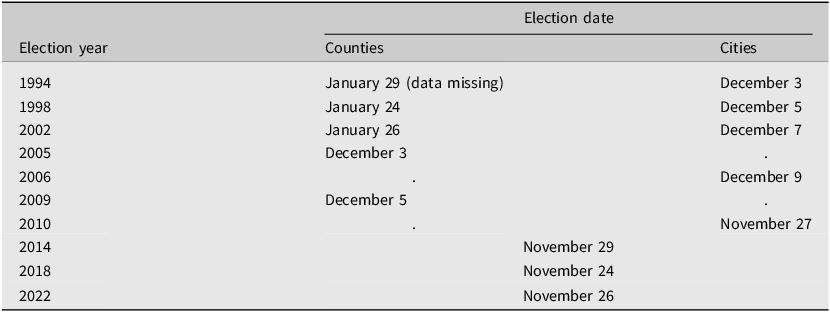
The scope of the data is presented in Table 1. Although counties held council elections in 1994, the CEC does not provide data for that year. Before 2014, elections for counties and cities were not conducted simultaneously. In Taiwan, citizens who transfer their household registration to an electoral district at least four months before an election obtain both the right to vote and the right to run for office in that district (Article 15). This institutional arrangement creates a challenge: between 1994 and 2010, candidates defeated in county council elections could, in principle, participate in city council elections either later in the same year or in the following year. However, the data contain only one case of same-year cross-election candidacy and no cases of cross-election candidacy in different years. This single case is excluded from the sample. This paper assumes that such cases occur scarcely, on the grounds that defeated candidates were unlikely to possess the necessary resources, whether psychological or material, to mount another campaign immediately.
Election date

Table 1. Long description
A table with three columns and nine rows. The columns are labeled Election year, Counties, and Cities. The rows list the election years and corresponding election dates for counties and cities. Row 1: Election year 1994, Counties January 29 (data missing), Cities December 3. Row 2: Election year 1998, Counties January 24, Cities December 5. Row 3: Election year 2002, Counties January 26, Cities December 7. Row 4: Election year 2005, Counties December 3, Cities not listed. Row 5: Election year 2006, Counties not listed, Cities December 9. Row 6: Election year 2009, Counties December 5, Cities not listed. Row 7: Election year 2010, Counties not listed, Cities November 27. Row 8: Election year 2014, Counties November 29, Cities not listed. Row 9: Election year 2018, Counties November 24, Cities not listed. Row 10: Election year 2022, Counties November 26, Cities not listed.
Source: Central Election Commission; compiled by the authors.
Accordingly, elections between 1994 and 2002 are treated as occurring within a single electoral round. For the period between 2005 and 2010, the 2005 and 2006 elections are considered as one round, as are the 2009 and 2010 elections.
The outcome variable is whether a defeated candidate seeks office again in the subsequent local council election. Repeated candidates are identified by exact matches on both name and year of birth. This outcome therefore captures same-level re-contestation in local council elections.
We evaluate the validity of the RD design. Specifically, we test for potential manipulation around the election deposit threshold using the McCrary density test and density continuity tests across multiple bandwidths. In addition, we perform local randomization inference tests (see Appendix A).
We further assess the plausibility of the RD design by examining covariate balance around the cutoff. This paper performs several covariate balance tests to ensure that these covariates do not exhibit discontinuities on either side of the cutoff. At the individual level, we examine gender, age, education level, the party categories used in this paper, campaign finance variables (including income, expenditures, and balance), vote share, whether the candidate received an electoral campaign subsidy, and whether the candidate came from a political family. At the district level, we examine the number of eligible voters and district magnitude. The results of the balance tests are reported in Table B1, Appendix. Political family background violates the requirement of covariate balance in the RD analysis, but we explain in the appendix that this result is driven by sparse observations. In addition, because of legal and data-availability constraints in Taiwan, some covariates do not cover the full analytical scope of this paper. Finally, this paper examines the effect of another institutional factor: electoral campaign subsidies. We consider electoral campaign subsidies because they may overlap with the election deposit system. This paper treats subsidy eligibility as an alternative running variable and finds that whether candidates qualify for electoral campaign subsidies does not affect electoral re-entry (Table B2, Appendix).
3.3. Hypotheses
This paper focuses on defeated candidates in council elections, that is, individuals who do not possess the advantage of incumbency. For these candidates, obtaining an election deposit refund may significantly influence their ability to sustain future political participation. From a resource mobilization perspective, candidates who are refunded their deposit likely have more financial flexibility and symbolic validation, both of which can lower the perceived cost of re-entering the electoral arena. Additionally, a cost–benefit framework suggests that receiving a deposit refund signals a relatively better performance, increasing the candidate’s confidence or their party’s willingness to support another run. Conversely, those who fail to meet the threshold may interpret the outcome as a discouraging signal and face greater resource constraints.
H1: Defeated candidates who receive an election deposit refund are more likely to run for office again than those who do not.
In the context of Taiwan politics, local elections feature a wide range of small parties and independent candidates. These small parties typically lack the capacity to win seats in the national legislature and often fail to garner enough votes to meaningfully dilute the vote share of major parties. This distinguishes them from third parties in national-level elections, which often possess the electoral strength to erode the vote share of dominant parties and exert substantial political influence.
Accordingly, this paper classifies candidates into four categories: (1) major parties, defined as parties that have previously held governing power; (2) legislative parties, defined as parties that held seats in the legislature after the most recent national legislative election; (3) small parties, defined as all other parties not included in the previous two categories; and (4) independent candidates. This party classification is time-varying and is based on party status after the most recent legislative election. Major parties are the only exception: once a party has won the presidency, it is treated as a major party thereafter. For example, before 2000, the DPP was classified as a legislative party; after 2000, it was classified as a major party, even after losing the presidency to the KMT in the 2008 presidential election.
Our hypothesis differs from Harada and Smith’s (Reference Harada and Smith2014) empirical finding, but it is consistent with their theoretical expectation. They find that election deposits are particularly important for major-party candidates. This paper questions the generalizability of those findings. If major parties truly care about electoral performance, what they value should be whether a candidate wins, not whether the candidate receives an election deposit refund. Regardless of whether a refund is obtained, a loser remains a loser, and major parties always maintain a larger pool of potential candidates. This paper contends that receiving an election deposit refund provides a motivational boost especially for weaker candidates. Clearing the refund threshold signals that their popularity is sufficient to at least secure a refund, and under the high uncertainty of SNTV elections, they may plausibly win a seat in the next contest. The question, then, is how to explain legislative-party and small-party candidates. While these parties possess organizational structures, they do not command candidate pools as extensive as those of major parties, making performance-based screening less stringent. They are therefore more willing to give defeated candidates another chance, and among them, those who receive a refund naturally constitute ‘better losers’. In sum, this paper argues that Harada and Smith’s (ibid.) findings are a Japan-specific pattern. It is valuable and merits further inquiry but should not be treated as a general result.
Furthermore, disparities in political resources may play a critical role in shaping candidates’ decisions to re-contest elections across party types. Major and legislative parties generally possess greater organizational capacity and financial resources. In contrast, small parties and independent candidates often receive limited campaign support. To illustrate these disparities, this paper conducts Tukey pairwise comparisons using candidate-level political finance data released by the Control Yuan for the 2018 and 2022 elections (Table C3, Appendix). The results show that candidates from major parties enjoy significantly higher levels of political income than candidates from legislative parties, small parties, and independent backgrounds. Accordingly, this paper argues that election deposit refunds can meaningfully reduce financial constraints and lower barriers to re-entry for disadvantaged candidates.
In conducting this subgroup analysis, however, this paper excludes the Non-Partisan Solidarity Union because the party strongly emphasizes its decentralized and non-partisan nature. For the party subgroup analysis, we exclude candidates who changed party affiliation between the focal election and the subsequent election because such changes would make it difficult to attribute re-contestation behaviour to a single party type. We identify potential party switchers by first comparing candidates’ classifications across the four party categories defined above. We then verify whether candidates whose category changed remained affiliated with the same political party. Candidates who retained the same party affiliation are not treated as party switchers, even if their party moved across categories over time, for example, because it gained or lost legislative representation. Only candidates who actually changed party affiliation, including moves between a party and independent status, are classified as party switchers and excluded from the party subgroup analysis.
H2: The positive effect of receiving an election deposit refund on the possibility of running for office again is greatest for independent candidates, followed by other party candidates and legislative party candidates, and weakest or nonexistent for ruling party candidates.
Next, this paper considers the role of gender. Female candidates often encounter higher entry costs and social barriers in electoral politics. The ‘double bind’ refers to the tension between perceived leadership traits and stereotypical female traits (Jamieson, Reference Jamieson1995). This tension may lead voters to question whether a woman can be a ‘good’ politician, thereby reducing her electoral prospects. Studies of electoral re-contestation have also examined gender gaps, although their findings remain mixed (Bernhard and De Benedictis-Kessner, Reference Bernhard and De Benedictis-Kessner2021; Baskaran and Hessami, Reference Baskaran and Hessami2022; Nzabonimpa, Reference Nzabonimpa2023; Peveri and Sangnier, Reference Peveri and Sangnier2023). In the context of election deposits, studies that examine gender heterogeneity find that failing to receive an election deposit refund does reduce women’s likelihood of re-contesting.
Although female candidates face psychological and social barriers to entering electoral competition, Taiwan has implemented institutional measures to promote gender equality in elections. In particular, there is a gender quota system (reserved seats for women). According to Article 33 of the Local Government Act (Taiwan), in elections for local representative bodies – such as city and county councillors and township representatives – at least one seat must be allocated to a female candidate when the district magnitude is four or more. Following a recent amendment, this requirement has been further strengthened: districts with three or more seats must now elect at least one female candidate.
In other words, Taiwan’s institutional design provides guaranteed representation for women in local council elections, which helps mitigate structural and psychological barriers to political participation. This quota system not only lowers the effective entry cost for female candidates but also creates institutional incentives that support their electoral success. Under such a system, especially in local council elections held under SNTV, women’s electoral participation has been quite active. On the one hand, the system encourages women to enter electoral competition; on the other hand, parties also have incentives to nominate female candidates in order to prevent their opponents from winning seats through the quota. Over time, fewer and fewer female candidates have relied on the system to win office (Huang, Reference Huang2019).
Therefore, although Faravelli et al. (Reference Faravelli, Khalil and Ponnusamy2023) and Karekurve-Ramachandra et al. (Reference Karekurve-Ramachandra, Singh and Stommes2024) find that election deposit refunds significantly affect women’s re-contestation, this paper argues that the receipt of such a refund may be less decisive for female candidates when considering whether to run again. Because institutional protections already reduce barriers and provide incentives, female candidates may be less sensitive to financial signals such as deposit refunds compared to male candidates.
H3: The positive effect of receiving an election deposit refund on the possibility of running for office again is greater for male candidates than for female candidates.
4. Results
Between 1994 and 2022, Taiwan’s local council elections produced a total of 12,092 candidates, of whom 5,799 were defeated (47.96%). These defeated candidates constitute the population of interest in this study. Because the 2026 local council elections have not yet taken place, this paper examines whether candidates defeated between 1994 and 2014 entered the subsequent election. After applying the sample-selection procedures described above, the main analytical sample contains 4,811 candidates, while the subgroup analysis testing the party-based hypothesis includes 4,488 candidates. The following analysis examines whether receiving an election deposit refund changes these candidates’ likelihood of re-contesting an election.
4.1. The impact of election deposit
Figure 1 visualizes the estimated effect of receiving an election deposit refund on the possibility of running for office again. The x-axis represents the election deposit threshold used to determine whether a candidate qualifies for a refund, with the vertical line at the 10% threshold marking the cutoff point. The y-axis indicates whether the candidate ran in a subsequent election.
Effect of election deposit refunds on re-contesting. Source: Authors.

A visible upward shift in the fitted regression line at the cutoff suggests a discontinuous increase in the probability of running again for candidates who narrowly surpassed the 10% threshold. While the magnitude of the jump is modest, indicating a positive and potentially meaningful effect of receiving an election deposit refund on future candidacy.
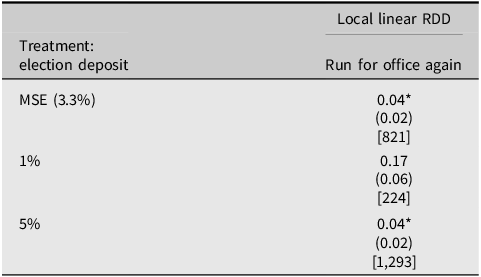
Table 2 presents the estimated effect of receiving an election deposit refund on the possibility of running for office again, using a local linear RDD. Across specifications, the results suggest a positive effect between securing a deposit refund and future candidacy.
Estimated effect of election deposit on run for office again

Table 2. Long description
A table with three rows and three columns. The columns are labeled Treatment: election deposit, Local linear RDD, and Run for office again. The row labels are MSE (3.3 percent), 1 percent, and 5 percent. The values in the table are as follows: Row 1: MSE (3.3 percent), 0.04, (0.02), [821]. Row 2: 1 percent, 0.17, (0.06), [224]. Row 3: 5 percent, 0.04, (0.02), [1,293].
Notes: Heteroskedasticity-robust nearest-neighbour variance estimator with triangular kernel density. Standard errors are clustered by party affiliation status (affiliated vs. unaffiliated).
*p < 0.05.
Source: Authors.
Under the MSE-optimal bandwidth (3.3%), the estimated treatment effect is positive (+0.04) and statistically significant. This suggests a potential increase in the likelihood of running again among defeated candidates who received an election deposit refund.
To assess robustness, this paper also reports estimates using narrower (1%) and wider (5%) bandwidths. The estimated effects remain positive across these alternative bandwidths, indicating a consistent directional pattern. To verify that the effect exists only at the actual cutoff, this paper tests six placebo cutoffs ranging from 0.07 to 0.13, excluding the true cutoff of 0.10 (Table B3, Appendix). If a treatment effect is observed at placebo cutoffs, it would be difficult to claim that the estimated treatment effect is robust (Cattaneo et al., Reference Cattaneo, Idrobo and Titiunik2020: 89–92). As shown in Table B3, one of the six placebo cutoffs yields a statistically significant estimate. This result suggests that the main findings should be interpreted with caution, as they are not fully robust to placebo tests.
4.2. Subgroup analysis by party type
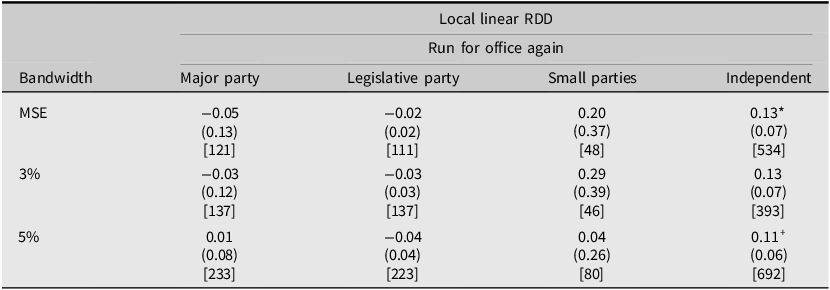
Table 3 reports the heterogeneous treatment effects of election deposit refunds on the probability of running for office again, disaggregated by party affiliation. We classify candidates into four party categories: major parties, legislative parties, small parties, and independents. The results reveal meaningful variation across party categories, but the statistically reliable effect is concentrated among independent candidates.
Subgroup effects of deposit refund eligibility across party types

Table 3. Long description
The table presents the heterogeneous treatment effects of election deposit refunds on the probability of running for office again, categorized by party affiliation. The table has four rows and five columns. The columns are labeled Bandwidth, Major party, Legislative party, Small parties, and Independent. The rows are labeled MSE, 3 percent, and 5 percent. Each cell contains values representing the effects of deposit refund eligibility. Row 1: MSE, Major party: -0.05 (0.13) [121], Legislative party: -0.02 (0.02) [111], Small parties: 0.20 (0.37) [48], Independent: 0.13* (0.07) [534]. Row 2: 3 percent, Major party: -0.03 (0.12) [137], Legislative party: -0.03 (0.03) [137], Small parties: 0.29 (0.39) [46], Independent: 0.13* (0.07) [393]. Row 3: 5 percent, Major party: 0.01 (0.08) [233], Legislative party: -0.04 (0.04) [223], Small parties: 0.04 (0.26) [80], Independent: 0.11* (0.06) [692]. The table shows that the statistically reliable effect is concentrated among independent candidates.
Note: Standard errors are computed using a heteroskedasticity-robust nearest-neighbour variance estimator with a triangular kernel. The sample excludes candidates who switched party affiliation.
+p < 0.1, *p < 0.05.
Source: Authors.
For candidates affiliated with major parties, the estimated treatment effect is close to zero (−0.05) and statistically insignificant. Similarly, legislative-party candidates exhibit a negative estimated treatment effect, but this estimate is also statistically insignificant and should not be interpreted as evidence that refunds reduce re-contestation. Among candidates affiliated with small parties, the estimated treatment effect is positive and relatively large in magnitude, but it is imprecisely estimated and does not reach levels of statistical significance.
Lastly, the effect is positive and statistically significant for independent candidates. Under the MSE-optimal bandwidth, independent candidates who received an election deposit refund were approximately 13 percentage points more likely to re-contest than those who did not. This finding suggests that the election deposit refund is most consequential for candidates who lack formal party affiliation and therefore may be more directly exposed to the financial and symbolic implications of deposit forfeiture. For independent candidates, receiving a refund may signal that their previous electoral performance was sufficiently viable to justify another attempt, even though they failed to win office.
Consistent with the main analysis, this paper conducts placebo cutoff tests over the same range for independent candidates (Table B4, Appendix). None of the placebo cutoffs yield statistically significant treatment effects, indicating that the estimated effect is specific to the true cutoff and exists only at the actual threshold.
Taken together, these findings provide partial support for Hypothesis 2. The evidence is consistent with the expectation that election deposit refunds matter most for independent candidates. However, the results do not provide clear evidence of a graded pattern across the remaining party categories, since the estimates for major-party, legislative-party, and small-party candidates are not statistically significant. Thus, the party subgroup analysis should be interpreted as showing a concentrated effect among independents rather than a full ordering of effects across all party types.
These findings highlight how party affiliation conditions the effect of electoral institutions on political persistence. Election deposit refunds appear to have their clearest mobilizing effect among independent candidates, for whom the refund may carry both financial and informational significance.
4.3. Subgroup analysis by candidates’ gender
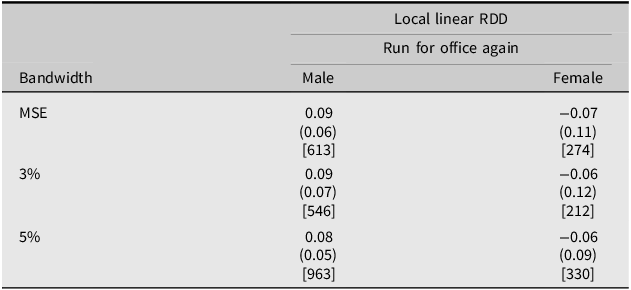
Table 4 presents the gender-based subgroup analysis results, showing the effects of election deposit refund eligibility on the probability of running for office again, disaggregated by candidate gender. The results show some directional differences between male and female candidates, but these estimates are not statistically significant and therefore do not provide strong evidence of gendered treatment effects.
Subgroup effects of deposit refund eligibility across candidates’ gender

Table 4. Long description
The table presents the effects of deposit refund eligibility on the probability of running for office again, disaggregated by candidate gender. It has three rows and three columns. The columns are labeled Bandwidth, Male, and Female. The rows are labeled MSE, 3 percent, and 5 percent. For Male candidates, the values are 0.09 with a standard error of 0.06 and a sample size of 613 for MSE, 0.09 with a standard error of 0.07 and a sample size of 546 for 3 percent, and 0.08 with a standard error of 0.05 and a sample size of 963 for 5 percent. For Female candidates, the values are -0.07 with a standard error of 0.11 and a sample size of 274 for MSE, -0.06 with a standard error of 0.12 and a sample size of 212 for 3 percent, and -0.06 with a standard error of 0.09 and a sample size of 330 for 5 percent.
Notes: Standard errors are computed using a heteroskedasticity-robust nearest-neighbour variance estimator with a triangular kernel.
Source: Authors.
For male candidates, the treatment effect is positive across specifications, but it does not reach levels of statistical significance. The point estimate suggests that receiving an election deposit refund is associated with an approximately 9-percentage-point increase in the probability of running again among male candidates. However, because the estimate is statistically insignificant, this result should be interpreted as suggestive rather than as evidence that election deposit refunds increase male candidates’ re-contestation.
In contrast, for female candidates, the treatment effects are negative across specifications, but they are also statistically insignificant. This indicates that female candidates who barely received a refund were not statistically distinguishable in their re-contestation behaviour from those who just missed the threshold. Therefore, the results do not provide evidence that receiving an election deposit refund affects female candidates’ decisions to run again.
These findings are directionally consistent with Hypothesis 3, which expects the effect of election deposit refunds to be greater among male candidates than among female candidates. However, because the results are not statistically significant, they should be interpreted cautiously. Rather than demonstrating a clear gendered effect, the analysis suggests that election deposit refunds do not have a statistically detectable effect on re-contestation for either male or female candidates.
5. Conclusion
The election deposit refund system influences political participation by decreasing the barriers of financial costs and offers encouragement for candidates. Employing an RDD that leverages the sharp 10% refund threshold, this paper examines how the effect of election deposits varies across politicians’ characteristics. Overall, this paper finds that receiving an election deposit refund significantly increases a defeated candidate’s probability of running for office again by approximately 4 percentage points. However, in the placebo cutoff tests, this paper finds a statistically significant treatment effect at one of the six placebo cutoffs, indicating that this finding is not robust. Although the treatment effect at this placebo cutoff may simply reflect statistical coincidence, this paper therefore interprets the estimated 4-percentage-point main effect with caution.
In the party subgroup analysis, this paper finds that receiving an election deposit refund has a statistically significant and substantively salient effect among independent candidates. Specifically, compared with independent candidates who did not receive an election deposit refund, those who did receive a refund were 13 percentage points more likely to run for office again, and this effect is statistically significant under the MSE-optimal bandwidth. This paper also confirms that this effect does not appear at any of the placebo cutoffs, ensuring that only the true cutoff – that is, the legally defined threshold for receiving an election deposit refund – affects candidates’ re-contestation behaviour. This means that, for other party categories, whether major parties, parties with legislative seats, or small parties, receiving an election deposit refund does not affect candidates’ decisions to run for office again. Finally, in the gender subgroup analysis, we do not find that receiving an election deposit refund affects the re-contestation behaviour of candidates of either gender.
Overall, this paper contributes to the literature by examining the effects of the election deposit system while linking it to the broader issue of electoral re-contestation. For defeated candidates, running for office again is not merely an individual choice but is also shaped by institutional factors. From this perspective, although the election deposit system was originally designed as a threshold to filter out frivolous candidates, its actual effects may also influence whether candidates with fewer resources can remain in electoral competition. This paper finds that the effect of deposit refunds is concentrated mainly among independent candidates, suggesting that this institution does not carry the same implications for candidates with different resource conditions.
This paper is subject to several limitations. First, although this paper treats the stability (or rigidity) of Taiwan’s election deposit system as an analytical advantage, this stability also entails an important limitation: unlike Harada and Smith (Reference Harada and Smith2014), this paper cannot exploit several exogenous changes to examine the effect of election deposits on electoral entry (or deterrence) directly. Second, this paper examines same-level re-contestation but does not analyse cross-level re-contestation. Therefore, our results should be interpreted cautiously as evidence of the effect of election deposit refunds on re-contestation in local council elections. Finally, regarding party heterogeneity, this paper lacks qualitative evidence on the financial support that parties provide to their candidates, which prevents us from analysing candidates’ access to organizational financial resources.
In terms of data, this paper also faces several limitations. First, our identification of repeated candidates is based on candidates’ names and years of birth. It remains possible that some candidates share both the same name and year of birth but are in fact different individuals. However, this paper does not consider this possibility likely to affect the analysis. In the coding process, we first defined repeated candidates based on identical names and then tightened the criterion by requiring identical years of birth additionally. Because the number of observations changes little, the additional benefit of adopting even stricter criteria is likely to be limited. Second, several balance tests in this paper are constrained by data accessibility. For example, our measure of political family background cannot be constructed as finely as in Batto (Reference Batto2018) and Batto and Read (Reference Batto and Read2024); campaign finance variables are available only from the 2018 election onwards; and education-level variables are available only from the 2014 election onwards.
Supplementary material
The supplementary material for this article can be found at https://doi.org/10.1017/S1468109926100371.
Acknowledgements
Shortly after this article was accepted for publication, on July 17, 2026, Taiwan’s Central Election Commission announced reductions in electoral deposit amounts, which had remained unchanged for more than three decades; for candidates in the city and county council elections examined in this article, the required deposits were reduced by NT$20,000–40,000 (approximately US$600–1,200). An earlier version of this article was presented at the Institute for Social Science Methodology (ISSM) at Academia Sinica and in the course Empirical Political Theory and Methodology at National Chengchi University. The authors are grateful to Professors Ronan Tse-min Fu, Karl Ho, Chi Huang, Tse-Min Lin, Adeline Lo, Yu-Hsien Sung, Austin Horng-En Wang, and Wen-Chin Wu, as well as Po-Chun Wu, the editor, and three anonymous reviewers for their valuable comments and suggestions.
Funding statement
No funding was received for this paper.
Competing interests
The author previously worked as an anonymous research assistant for a project commissioned by the CEC of Taiwan on the topic of election deposits. The project primarily employed comparative institutional analysis and in-depth interviews. Although some of the data generated by that project could have informed the writing of this article, the author has refrained from using any such data or analytical results in order to uphold academic ethics and avoid potential conflicts of interest.



 Open access

