1. Introduction
Individuals differ substantially on their beliefs regarding optimal economic policy. Supporters of economic freedom and free markets identify the numerous ways in which the intervention by the government into markets, with the goal of rent-seeking and redistribution, creates waste, inefficiencies, and a misallocation of resources. Alternatively, one can argue the prevalence of substantial market failures, due to poor information or high transaction costs, calls for welfare-enhancing corrections. Do differences in opinion on economic policy simply arise from conflicting information or does it derive from inherent differences in preferences? If indeed individuals contrast in their preference for economic freedom, does the difference affect their behavior in economic institutions?
Psychological research suggests that those who identify politically as libertarian have different personalities. Iyer et al. (Reference Iyer, Koleva, Graham, Ditto and Haidt2012) conduct surveys with the aim of differentiating the beliefs of libertarians. Self-reported libertarians showed a ‘cerebral rather than emotional’ cognitive style and a lower level of social relatedness. For example, libertarians scored lowest on the measurement of ‘other-orientated values’. Also, they find that self-identified libertarians were more capable of ‘rational ethics’ where costs and benefits are weighed. Do the lack of other-regarding choices and the use of cost-benefit calculations correlate with actual decisions in social settings? Carney et al. (Reference Carney, Jost, Gosling and Potter2008) investigate whether ideological differences are actually grounded in basic personality dispositions. They find significant personality differences between liberals and conservatives where the former are more creative and curious, while the latter are conventional and better organized. Hence, those with stronger beliefs in economic freedom have different psychological traits.
Do the differences in these traits translate into meaningful differences in behavior in economic decisions? While findings such as Bar and Zussman (Reference Bar and Zussman2012), which show that political party affiliation is correlated with the grade distribution given by college professors, suggest so, it is not obvious that, when personal financial gains are at stake, economic policy preferences correlate with behavior. Esarey et al. (Reference Esarey, Salmon and Barrilleaux2012) provide evidence suggesting that they do not. In an experiment where subjects, differing in endowments, voted for redistribution, personal gains, rather than stated ideological preferences for inequality aversion, dominate voting behavior.
To address the relationship between views on economic freedom and behavior, experiments of the Trust Game are conducted. The Trust Game puts into conflict personal gain from ‘pro-social’ behavior. In the Trust Game one individual must make a choice of how much of an endowment is to be given to another person. The transfer is tripled. The receiver is given the option to give back as much of the tripled amount as he desires. Since there is no repeated interaction and no external contract enforcement mechanism, any amount returned would come at the expense to the second-mover and hence, is a measurement of the individual's preference for reciprocation. Without an institutional framework enforcing a contract (or even communication in the experimental setting), the initial amount given is a measurement of the first person's trust. Hence, we extend the understanding of differences in policy preferences to the identification of behavioral dissimilarities using this game to determine whether those who exhibit a preference for economic liberty also behave differently in social settings.
Additionally, the subjects played the Dictator Game. It is identical to the Trust Game, except that the receiver is not allowed to give back anything. Since the possibility of a profitable investment is gone, the Dictator Game is able to measure an individual's altruistic preferences and aversion to inequality (Hoffman et al., Reference Hoffman, McCabe, Smith, Plott and Smith2008; List, Reference List2007).
To assess beliefs on economic policy, a simple 10-question survey is administered. Each question provides an example of a potential market failure. Subjects select either the government response or the private resolution option. The score on this assessment is used to identify correlation between policy preferences and decision-making.
It is found that the relationship between the score on the economic freedom survey and the amount contributed (both the trusting contribution and the amount reciprocated) exhibits a U-shape. Both individuals with strong preferences for government intervention and those with strong preferences for economic freedom trust and reciprocate more. Results from the Dictator Game present a significant inverse relationship between altruistic giving and a preference for private resolutions. Taken together, these results imply that those who prefer public responses to potential market failures give back more in the Trust Game due to an aversion to inequality, while those who strongly prefer private solutions are willing only to reciprocate trusting, wealth-generating investments.
While the focus here is on an individual's economic policy preference, research on economic freedom has focused on the cross-country analysis measured in the Economic Freedom Index (Gwartney et al., Reference Gwartney, Lawson and Block1996). The aggregation of this measurement is analyzed by Heckelman and Stroup (Reference Heckelman and Stroup2005). It has been used to understand the relationship between economic freedom and economic growth (Carlsson and Lundström, Reference Carlsson and Lundström2002; de Haan and Sturm, Reference de Haan and Sturm2000; Gwartney et al., Reference Gwartney, Lawson and Holcombe1999; Heckelman, Reference Heckelman2000), income (Gwartney et al., Reference Gwartney, Lawson and Holcombe1999, Reference Gwartney, Holcombe and Lawson2004), foreign direct investment in Latin America (Bengoa and Sanchez-Robles, Reference Bengoa and Sanchez-Robles2003), investment (Gwartney et al., Reference Gwartney, Holcombe and Lawson2006), corruption (Graeff and Mehlkop, Reference Graeff and Mehlkop2003), international trade (Berggren and Jordahl, Reference Berggren and Jordahl2005), entrepreneurship (Bjørnskov and Foss, Reference Bjørnskov and Foss2008; Nyström, Reference Nyström2008), and new business formation (Campbell and Rogers, Reference Campbell and Rogers2007). Farr et al. (Reference Farr, Lord and Wolfenbarger1998) and Hanson (Reference Hanson2000) discuss the advantages of institutions that promote economic freedom. Berggren and Jordahl (Reference Berggren and Jordahl2006) use a cross-country survey to look for the relationship between trust in institutions and economic freedom. Ashby (Reference Ashby2007) looks at measurements of economic freedom and migration within the United States. Also, Adkins et al. (Reference Adkins, Moomaw and Savvides2002) find that institutions which respect economic freedom promote efficiency. Thus, while a substantial and valuable literature has investigated the macroeconomic consequences of economic freedom, the work here begins the investigation of individual-level preferences for economic freedom and behavior.
Others have emphasized the role of markets as encouraging cooperation. Storr (Reference Storr2009) persuasively argues, for example, that markets act as both social spaces, building social bonds, and moral spaces, cultivating the bourgeois virtues (McCloskey, Reference McCloskey2006, Reference McCloskey2009).Footnote 1 A similar view is elaborated upon by Bruni and Sugden (Reference Bruni and Sugden2013). Stringham and Levendis (Reference Stringham, Levendis, Gwartney, Hall and Lawson2010) provide empirical evidence that increased economic freedom in a country is correlated with decreased homicide rates, which can be argued to act as a proxy for overall crime and other anti-social behaviors. Thus, we may view the work here as providing an experimental investigation into their hypothesis that market-based values correlate with cooperative behavior.
The Trust Game was originally introduced by Berg, Dickhaut, and McCabe (Reference Berg, Dickhaut and McCabe1995) and the Dictator Game was put forward by Cox (Reference Cox2004). A substantial literature has developed analyzing and applying them. Extensions to the basic environment have been conducted. Examples of extensions include allowing for the history of one's partners’ actions to be known (Bohnet and Huck, Reference Bohnet and Huck2004), repeated play (Sloof and Sonnemans, Reference Sloof and Sonnemans2011), uncertainty over the actual choice of the first-mover (Cox and Deck, Reference Cox and Deck2006), requests and threats (Houser et al., Reference Houser, Xiao, McCabe and Smith2008), partner selection (Slonim and Garbarino, Reference Slonim and Garbarino2008; Slonim and Guillen, Reference Slonim and Guillen2010), pairings made by previous trusting behavior (Rigdon et al., Reference Rigdon, McCabe and Smith2007), heterogeneous endowments (Anderson et al., Reference Anderson, Mellor and Milyo2006), and trust across individuals of different ages (Sutter and Kocher, Reference Sutter and Kocher2007). Similar to the analysis here, the standard Trust Game has also been applied in specific contexts to assess pro-social preferences. For example, it has been given as an assessment in villages in Zimbabwe (Barr, Reference Barr2003), comparison of trust in Sweden and Tanzania (Holm and Danielson, Reference Holm and Danielson2005), cross-country comparisons of behavior (Buchan et al., Reference Buchan, Croson and Dawes2002), identification of gender differences across countries (Croson and Buchan, Reference Croson and Buchan1999), investigation of behavior in virtual worlds (Fiedler et al., Reference Fiedler, Haruvy and Li2011), impact of an economics (McCannon, Reference McCannon2014a) and finance education (McCannon, Reference McCannon2014b), and as a tool to appreciate preferences of those in madrassas, Islamic colleges, and liberal universities in Pakistan (Delavande and Zafar, Reference Delavande and Zafar2011). In short, the Trust Game is a common tool used to assess social interaction. Thus, the work presented here provides a new contribution to this research by linking these behaviors to economic policy preferences.
The work most closely related to ours is that of Anderson et al. (Reference Anderson, Mellor and Milyo2004). They surveyed subjects on their political party affiliation and found that it is unrelated to both the amount of trusting investments made and the amount reciprocated. Those who identify as more liberal make greater trusting contributions. Reciprocation is concentrated in those who identify themselves as liberal when the show-up fees paid were unequal. What is unclear from their method is what dimension of liberalness is driving the results? Here, I consider beliefs regarding market failures rather than, for example, expenditures on publicly provided private goods. Second, motives of the respondents in their study are unclear. By incorporating results from the Dictator Game, giving with the expectation of a return can be differentiated from altruistic motives. Finally, we illustrate that non-linearities are important where those whose policy preferences are at the extremes behave similarly, but for differing reasons. Thus, allowing for only a linear relationship may explain their insignificant and weakly significant results.
Similarly, Fitzgerald and Wickwire (Reference Fitzgerald and Wickwire2012) have subjects report their political party affiliation and were randomly assigned a color (blue or yellow). The decision to trust and reciprocate was made, but the only information known with regards to the recipient was their color and party affiliation. They show that Democrats contribute more to Democrats and Republicans contribute more to Republicans (both trusting and reciprocating contributions) than to those of the other party or those of the other color. Their design does not allow for amounts of trusting contributions to be chosen and does not investigate the source of the decision-making.Footnote 2
2. Experimental design
Experiments with undergraduate students at a small, private university in upstate New York were conducted. Subjects were recruited from general education classes along with classes from within the business school. An online reservation manager was used to schedule the sessions.
Five experimental sessions were conducted in November 2012. The number of participants in each session ranged from 12 to 17. There were a total of 72 subjects. Each session lasted approximately one hour.Footnote 3 Subjects completed a background information questionnaire, a survey eliciting their economic policy preferences, and engaged in the experiment.
The subjects played the Trust Game. In this game, the subjects were randomly paired. One person in the group was randomly selected to be ‘Player A’, while the other became ‘Player B’. Player A is endowed with 5 experimental dollars (E$) and chose how much to give to Player B. The subjects were instructed that any amount, 0, 1, 2, 3, 4, or 5, could be given. The subjects were informed that the amount given to Player B tripled. Player B then is given the choice of how much of the tripled amount to give back.Footnote 4
In all five sessions the subjects played five rounds. In each round a new random pairing was made. Subjects were informed of their earnings from one round before making their selections in the next. Before the experiment began they were informed that the more experimental dollars they were able to earn in the rounds, the more real dollars they obtained.Footnote 5 The average monetary payment to a subject in the experiment was $22.50.
In each round each subject provided a full contingency plan. They first had to respond to the question, ‘if you are selected to be Player A how much of your 5 E$ would you like to give to Player B?’ The random pairings for each round occurred after the selections and, therefore, every individual's first-mover choice is available. The amount selected by a player in a round is denoted, Trust, in the analysis. Second, each subject had to respond to a series of five questions, ‘if you are selected to be Player B and Player A gives you 5 E$ (which triples to 15 E$), how much of your 15 E$ would you like to give back?’ The amount selected for this question is the variable R5. The following four questions were phrased identically, except the amount given was 4, 3, 2, and 1 respectively, creating the variables R4, R3, R2, and R1 accordingly. In each round, responses were collected, the random pairings were made, and the amount earned was reported.Footnote 6 Along with printed instructions, PowerPoint slides were presented providing the rules. A short proficiency survey was administered before the first round of play to ensure that the rules of the game were understood.
Along with playing the Trust Game, the subjects also played one round of the Dictator Game. In it the subjects were informed that they would be randomly paired with someone in the session and one of the two in the pairing would randomly be selected to be Player A, while the other is Player B. Player A is given 5 E$ and asked how much of it he would like to give to Player B. Again, the amount given was tripled. The subjects were informed that in this game, Player B was not allowed to give anything back. Again, along with printed instructions, PowerPoint slides were presented providing the rules. Each subject was asked, ‘if selected as Player A how many of the 5 E$ do you want to give to Player B?’ The amount selected defines the variable Dictator.
Finally, at the end of the experimental session a 10-question survey was administered. Each question was in regards to a current or proposed government intervention in a market. They are examples one commonly uses in an introductory microeconomics course to discuss positive and negative externalities, common resources, and public goods. Each question begins with a premise (i.e. a problem). On the survey the first option follows the premise with a government response. Scenarios include government bans, regulation, subsidies, Pigouvian taxes, etc. The second option to select from on each survey question follows the premise with a private solution response to the problem. The third option allows the survey-taker to disagree with the premise. The questions do not focus on redistribution or inequality, but rather proposes the possibility of a market failure that may be dealt with publicly or privately. A copy of the survey is provided in the appendix.
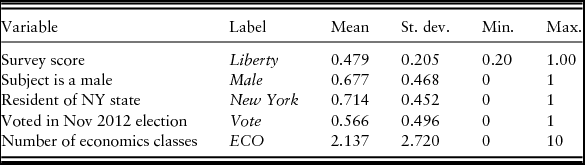
The proportion of responses in which the free-market, private resolution was selected becomes the Liberty variable for that subject.Footnote 7 The mean value of Liberty is 0.479. Hence, the typical subject preferred the free-market solution in 48% of the questions and the regulatory solution in 52% of the questions. The fact that the mean rate is near 0.5 is taken as evidence that the range of questions is not too lop-sided. In other words, the survey is not loaded with obvious market failures requiring government intervention or situations with obvious successful private resolutions (to the subjects at least). Furthermore, the standard deviation on Liberty is 0.205. Hence, there is a significant amount of volatility in respondents. Consequently, we are confident that the survey developed provides the ability to differentiate between ideologically divided subjects regarding economic freedom and the value of government interventions into markets.
With regards to the background information collected, common demographic control variables were considered. They include gender, nationality, residence, major, and year in school. Furthermore, subjects were asked how many economics and finance courses they had taken.Footnote 8 Finally, given that the experiments occurred in November 2012, each subject was asked whether or not he had voted in the recent election. Table 1 provides descriptive statistics on the backgrounds of the subjects.
Descriptive statistics
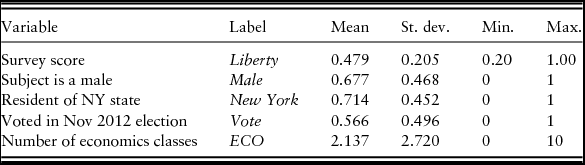
While about two-thirds are the subjects are male (which comes from the recruitment strategy of using courses from the business school), a high proportion of students are from the state of New York. The voter turnout rate is slightly above national average,Footnote 9 but not very high. The typical student experimental subject has taken slightly more than two economics courses (the median is two), but there is a significant amount of variation in the sample.
3. Results of the experiment
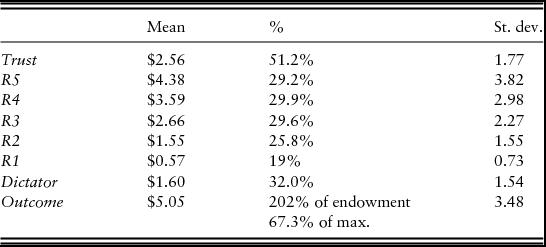
Table 2 presents information on the decisions made by the subjects and the outcomes that arise. Subjects gave 51.2% of their endowment on average. In comparison, in the Dictator Game, they were willing to provide 32.0%. Interestingly, the Dictator choice would result in 4.80 E$ received by Player B, while the donator earns only 3.40. Thus, there is a strong altruistic preference of aversion to inequality in the subject pool. One can interpret the gap between the two, 0.96 (= 2.56 – 1.60) as the amount given strategically with the objective to obtain a profit.
Average amounts chosen in the experiment
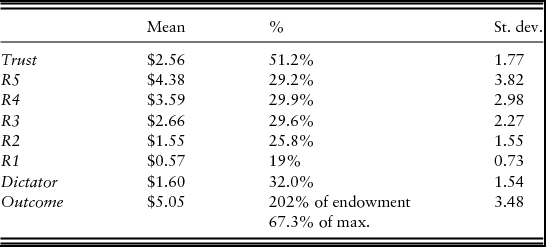
With regards to reciprocation, a stark result arises. On average a ‘tax’ is levied for engaging in trusting behavior. If 1 E$ is given, then only 57 E₵ is returned. The marginal return for each additional experimental dollar invested is close to one. For example, while investing one dollar returns 57 E₵, investing 2 E$ returns 1.55 E$ on average, so that the marginal return is 98 E₵. As a consequence, at the mean each trusting investment can be expected to lose Player A money and the wealth-maximizing response would be to give nothing. Consistently, if in the role of Player B, approximately 30% of the money is returned.
As a result of the trusting and reciprocating behavior, the average subject in each round in each session earned 5.05 E$. Given that one subject is endowed with five and the other zero in each round, this implies that there is a 102% return. As points of reference, while an average payment of 2.50 E$ would be earned if no trusting behavior occurred, an outcome of 7.50 E$ arises with a full investment made. Thus, two-thirds of the wealth that could have been generated was. (= 5.05/7.50 = 67.3%).
These findings are rather consistent across experimental sessions and across rounds. As will be shown, much of the volatility that does exist can be explained by the difference in the background of those participating in the session. The econometric analysis, though, will control for sessions and rounds to guarantee that both adaptation across the repeated play or session-specific effects are not driving the results.
Is there a relationship between the Liberty score and behavior? While for the overall sample trusting contributions average 2.56, those with the lowest scores, Liberty ≤ 0.3, who frequently selected the government solution to the proposed issues on the survey, contributed on average 2.78, which is a 9% increase. Alternatively, those with the highest scores, Liberty ≥ 0.8, invest on average 3.02, which is an 18% increase on the full sample average. Hence, a non-linear relationship seems to exist.
We now turn to an econometric analysis of the experiment to determine which factors drive trusting investments and investigate more formally the patterns described. First, consider the trusting contributions made. A fixed-effects specification is considered with both round and session controls. Since the dataset is made up of subjects repeatedly playing a game, one should be concerned of biased standard errors arising from non-independence of play of a subject across rounds (e.g. round 5 plays closely mimicking round 4 decisions). Thus, standard errors clustered by the round of play are presented. Each specification includes a constant term which is not reported.
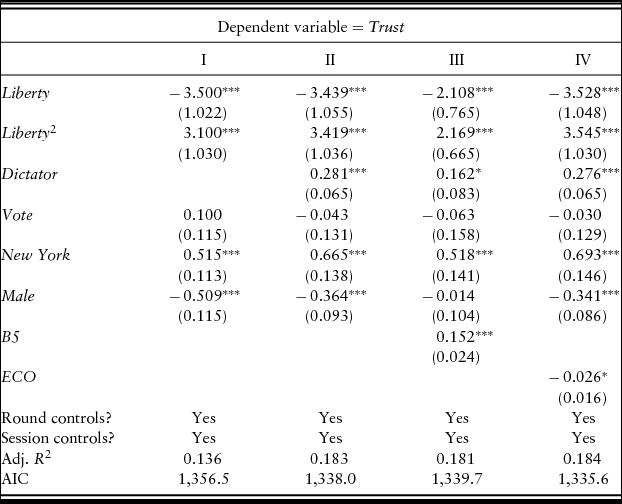
The score on the survey shows a U-shape relationship between trusting behavior and one's preferences regarding economic policy confirming the descriptive statistics presented. Those with centrist positions on economic freedom contribute the least. If one ignored the non-linearity (dropping Liberty 2) a negative but statistically insignificant coefficient arises on Liberty, which is similar to the findings of Anderson et al. (Reference Anderson, Mellor and Milyo2004) regarding self-identified liberalism.Footnote 10 Hence, not taking into consideration this non-linearity obscures the relationship between economic policy preferences and behavior.
The result continues to hold if the Dictator Game contribution is considered (Column II), if the degree of reciprocation is included (Column III), and if one's training in economics is controlled for (Column IV). While not presented, including additional controls for academic major and year in school also preserve the statistical significance of the relationship between Liberty and Trust. Given the estimated coefficients, trusting investments are minimized for those with survey scores of between 0.49 and 0.56, which is slightly greater than the mean value but surrounds the median.
While not reported here, the results continue to hold if an ordered logit or ordered probit is estimated rather than ordinary least squares (OLS; since Trust only takes values of 0, 1, 2, 3, 4, or 5). Similarly, the results hold if a count data model is estimated. Also, clustering at rounds takes into consideration, as stated, any problems that may arise due to the repeated nature of play, but if instead heteroskedastic-robust standard errors are calculated, the significance of the variables remains. Hence, the outcomes presented in Table 3 are not sensitive to the econometric method employed.
Trust

AIC, Akaike information criterion.
Notes: The standard errors reported in parentheses are clustered by round.
***1%; **5%; *10%.
N = 350.
Control variables for both rounds and sessions are jointly significant in every specification and, therefore, the results with these fixed effects are reported.
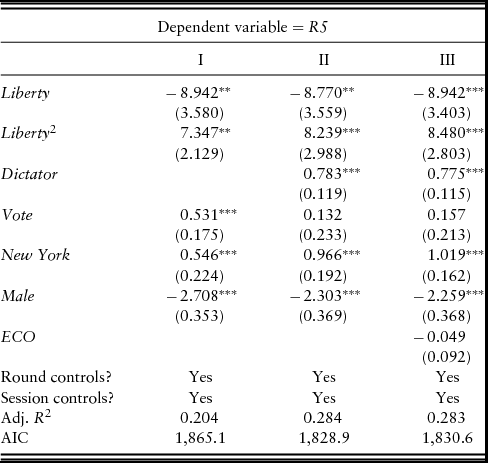
Along with trusting behavior, one would like to know whether economic ideology is correlated with trustworthiness. To address this, Table 4 presents the results with the primary measurement of reciprocity, R5, as in the dependent variable.
Reciprocity
AIC, Akaike information criterion.
Notes: The standard errors reported in parentheses are clustered by round.
***1%; **5%; *10%.
N = 350.
Controlling for background characteristics of the respondents, the survey generates a U-shaped relationship between its score and the measured behavior. Using the estimates provided, reciprocation is minimized at liberty-score measurements between 0.519 and 0.609. Whether or not one's altruistic preference or educational background is included as a control, the relationship persists. Thus, it seems that individuals who exhibit strong preferences for private resolutions to potential market failures (in either direction) are those most willing to reciprocate trusting investments.
Both session and round controls are jointly significant factors in each specification and are included. Their exclusion, though, does not affect the significance of the Liberty and Liberty 2 variables. Again, the results persist if an ordered logit or ordered probit, along with a count data model, is alternatively estimated. Similarly, the statistical significance of the survey score remains if heteroskedastic-robust standard errors are calculated. Finally, similar results arise if alternative measurements of reciprocity, such as the amount given back with different contributions (e.g. R4), are given. These additional results are available from the author upon request.
Rather than consider the amount initially given and the amount reciprocated, one may be more interested in those who choose to fully invest all of the endowment, Trust5, along with those who give nothing, Trust0. Such individuals have selected corner solutions and represent those who have not ‘hedged their bets’. One with homo economicus’ preferences selects Trust = 1, while an individual solely interested in aggregate wealth chooses Trust = 5. The mean value of Trust0 and Trust5 are 0.200 and 0.189 respectively.
Furthermore, while it is interesting to identify the amount given back, what is of crucial importance for a player in the game is when they provide an investment, at least the principal is returned – and potentially some profit as well. Therefore, define Reciprocate5 as a dummy variable equal to one if a subject was willing to return at least five if they were given five. The mean value of Reciprocate5 is 0.506.
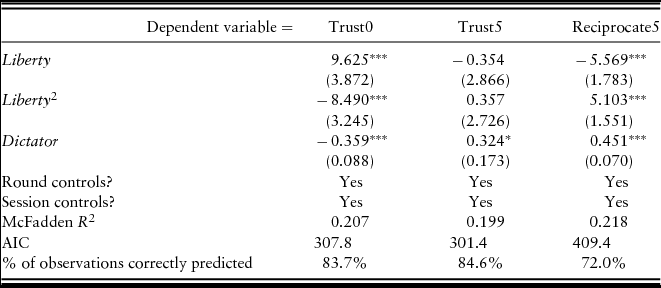
Logit models are estimated to identify the impact of a preference for economic freedom on these variables. The results are reported in Table 5. While not reported, each specification also includes a constant term and the control variables: Dictator, Vote, Male, and New York. Clustered standard errors are reported.
Binary logit results
AIC, Akaike information criterion.
Notes: The standard errors reported in parentheses are clustered by round.
***1%; **5%; *10%.
N = 350.
Similar to the results in Table 3, there is a non-linear relationship between the survey score and trusting behavior. It is those with the lowest and the highest scores who are least likely to provide no contribution. No significant relationship between the survey score and the chance of making a full investment can be found though.
With regards to reciprocation a similar pattern emerges. Those with high economic freedom preferences and those with low ones are the individuals willing to reciprocate. The statistical significance (and insignificance) of the independent variables is unchanged if quasi-maximum likelihood (QML) standard errors are alternatively calculated.
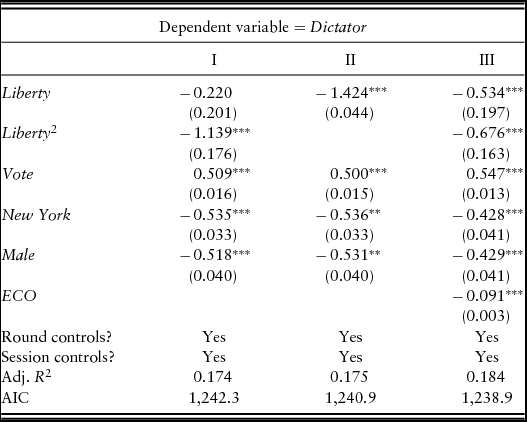
What might distinguish those with extreme values favoring economic freedom from those favoring strong regulation? The behaviors of individuals in these two groups have thus far mirrored each other. Results from the Dictator Game provide insight into how these two groups contrast.
Hence, while previous evidence suggests that those with stronger preferences regarding economic freedom both trust and reciprocate more, the results in Table 6 illustrate that there is less of a preference for altruism amongst those who prefer free-market responses. The non-linear relationship here implies that the rate of decrease in contributions escalates for those with large values of Liberty. Giving in the Dictator Game is driven by one's preference for giving without a corresponding behavioral decision by the recipient. Trust and reciprocity investments are done in a strategic setting where actions (or anticipated responses) can influence one's decision-making. This is evidence, then, that those with strong preferences for private resolutions to potential market failure contribute strategically and reciprocate trusting investments. Those with strong preferences for public intervention give altruistically.
Altruism
AIC, Akaike information criterion.
Notes: The standard errors reported in parentheses are clustered by round.
***1%; **5%; *10%.
N = 350.
4. Conclusion
Do those who prefer private, free market responses to economic dilemmas actually behave differently in economic settings? Experiments of both the Trust Game and Dictator Game are conducted to gauge decision-making. A straightforward survey built from common examples of potential market failures is given to assess one's preference for economic freedom.
Striking results arise. Both individuals who exhibit strong preferences for economic freedom along with those who exhibit a strong preference for government intervention in markets choose to make larger investments that improve group wealth. Similarly, both those with a strong preference for economic freedom and those with a strong preference for government intervention are very willing to give back to those who make a trusting investment. Individuals with mixed feelings regarding government intervention both trust little and reciprocate poorly. The primary difference between the extreme groups is in their altruistic behaviors. Those who prefer public solutions to potential market failures also are willing to give away money to others. Thus, both their initial contributions and amounts returned in the Trust Game may not be due to reciprocation or strategic profit-generation, but rather by an aversion to inequality. Those who prefer private solutions to potential market failure, while unwilling to provide ‘unearned’, altruistic donations, do reciprocate investments that generate wealth.
There exist different moral responses between the two extreme groups which translate, measurably, in the behavior exhibited in the experimental economic setting. Thus, this calls for future research, using different economic environments, to more fully elaborate upon the differences in the behaviors of the two groups. The advantage of using micro-level, experimental methods is that rather than relying on survey responses of preferences and choices, actual behaviors can be observed where individuals are actively balancing personal financial gain from non-monetary, ethical gains. Along with conducting future work using different economic environments, consideration may be given to the impact of education, life experiences, etc. on both beliefs on economic freedom and behavior. Finally, by focusing on a specific dimension to ideology – prevalence and responses to market failure – finer detail into the link between preferences and behavior arises.
As a final consideration, the work ties in with those that assess the impact of culture on behavior. For example, Vollan (Reference Vollan2012) conducts experiments of the Trust Game using subjects in South Africa and Namibia. Significant differences arose between behaviors of those in the two countries. He argues that this is explained by supportive societal norms in Namibia, along with a history of corrupt local institutions in South Africa. Similarly, the extensive study conducted by Henrich et al. (Reference Henrich, Boyd, Bowles, Camerer, Fehr and Gintis2004, Reference Henrich, Ensminger, Boyd, Smith, Bowles, Hill, Camerer, Gil-White, Fehr, Gurven, Gintis, Marlowe, McElreath, Patton, Alvard, Tracer and Barr2005) evaluates play in experimental games amongst small-scale societies across 15 countries. They show that the variation in behavior is far greater than thought and is due to differences in social structure in the groups. Research such as this points to the fact that social preferences are culturally dependent. Therefore, it may be the case that the relationship between pro-social behavior and preferences for economic freedom is specific to the population studied. One may, though, argue that in attempting to measure these preferences the research design is drilling into the black box of culture's impact.
Appendix
The following is a copy of the quiz given to the research subjects.
I.
Which of the following statements would you MOST agree with?
[] Since cigarettes are harmful to not only the health of the smoker but to those nearby who breathe second-hand-smoke, it is best for the government to implement smoking bans in restaurants.
[] Cigarettes are harmful to not only the health of the smoker but to those nearby who breathe second-hand-smoke. Since restaurant owners can choose whether to allow or not allow smoking and customers are free to choose to go to another restaurant or eat at home, it is not best for the government to implement smoking bans in restaurants.
[] Cigarettes are not harmful to those nearby who breathe second-hand-smoke.
II.
Which of the following statements would you MOST agree with?
[] Since an unhealthy diet of cheeseburgers, greasy French fries, foods with trans-fats, sugary soda, etc. causes health problems and leads to increased expenditures on health care that must be paid for by taxpayers, it is a good idea for the government to implement a tax on unhealthy food to make these foods expensive (so that less will be consumed).
[] An unhealthy diet of cheeseburgers, greasy French fries, foods with trans-fats, sugary soda, etc. causes health problems and leads to increased expenditures on health care that must be paid for by taxpayers. It is a bad idea, though, for the government to implement a tax on unhealthy food to make these foods expensive (so that less will be consumed).
[] A diet of cheeseburgers, greasy French fries, foods with trans-fats, sugary soda, etc. does not cause health problems that lead to increased expenditures on health care that must be paid for by taxpayers.
III.
Which of the following statements would you MOST agree with?
[] Since music downloaded online does not reduce anyone else's ability to enjoy it, people should be able to freely shared and download music without being punished by the government.
[] Music downloaded online does not reduce anyone else's ability to enjoy it, but people should not be able to freely shared and download music without being punished by the government since it is the musicians who create and sell it.
[] Downloading music online does reduce other's ability to enjoy it.
IV.
Which of the following statements would you MOST agree with?
[] Since the maintenance of one's home and property affects the beauty of a neighborhood, zoning laws should require homeowners to regularly mow their lawn.
[] The maintenance of one's home and property affects the beauty of a neighborhood. If a homeowner chooses to not mow their lawn regularly it is up to neighbors to either convince them to mow, volunteer to mow for them, or choose to do nothing.
[] The maintenance of one's home and property does not affect the beauty of a neighborhood.
V.
Which of the following statements would you MOST agree with?
[] Since fish in the ocean are a scarce resource, the possibility exists of overfishing. Government must regulate the amount of fishing to ensure sustainability.
[] Fish in the ocean are a scarce resource so that the possibility exists of overfishing. Fisherman, though, have sufficient incentives to not fish too much and, hence, government does not need to regulate.
[] There is no possibility of overfishing.
VI.
Which of the following statements would you MOST agree with?
[] Since bungee-cord jumping is a risky activity, the government needs to regulate it to ensure the safety of the consumers.
[] Bungee-cord jumping is a risky activity, but the companies that offer the experience have the incentive to ensure its safety. Thus, the regulation is un-necessary.
[] Bungee-cord jumping is not a risky activity.
VII.
Which of the following statements would you MOST agree with?
[] Since when a business plants trees, bushes, and flowers everyone in the area benefits from a better-looking city, the city government should compensate the business for their expenditures and efforts (maybe through, for example, tax breaks).
[] When a business plants trees, bushes, and flowers, everyone in the area benefits from a better-looking city. The business, though, benefits from customers being more willing to shop at their store or use their services. Thus, the city government should not compensate the business for their expenditures and efforts (maybe through, for example, tax breaks).
[] A business planting trees, bushes, and flowers does not contribute to a better-looking city.
VIII.
Which of the following statements would you MOST agree with?
[] Since a college education allows for individuals to be more productive workers and creates more informed citizens, which are both valuable to the country, the government should find ways to subsidize student loans (like compensating lenders when students do not repay or provide from public funds low-interest loans).
[] A college education allows for individuals to be more productive workers and creates more informed citizens, which are both valuable to the country. The government, though, should not interfere with student loans so that lenders can charge the interest rate that reflects the risks of non-repayment and students can choose whether to go to college based only on the anticipated benefits and costs.
[] A college education does not lead to more productive workers and more informed citizens.
IX.
Which of the following statements would you MOST agree with?
[] Since a high-school education is valuable (and maybe even necessary) to get a job, government should require that everyone go to school until they are 18 years old.
[] A high-school education is valuable (and maybe even necessary) to get a job. The government, though, should not require everyone to go to school until they are 18 years old since it is up to each person to make the decision for themselves.
[] A high-school education is not valuable for getting a job.
X.
Which of the following statements would you MOST agree with?
[] Since the investment of money into medical research leads to knowledge and cures that can help each one of us, it is necessary for the government to fund the research.
[] The investment of money into medical research leads to knowledge and cures that can help each one of us. Because of the money that can be generated form medicines and medical procedures, though, private businesses have the incentive to make this investment and the government does not need to fund it.
[] The investment of money into medical research does not lead to knowledge and cures that can help each one of us.