Although a great deal of literature exists on the parasites of fishes, our understanding of such basic matters as species distributions and host–parasite specificity remains incomplete, and this presents a barrier to more complex studies. The elasmobranch fishes are the most basal of the jawed vertebrates and are therefore of particular interest with regard to host–parasite evolutionary relationships. However, investigations into elasmobranch parasites are geographically patchy, particularly within the Indian Ocean and, furthermore, such basic investigations have fallen out of favour in recent decades.
In this study, parasitic copepods were opportunistically collected from the skin of elasmobranchs encountered at landing sites throughout the Sultanate of Oman, as well as from those captured during research cruises off the Oman coast. The parasites were removed from the host and stored in 70% ethanol until a detailed examination could be undertaken. All specimens were subsequently identified to species following Cressey (Reference Cressey1967b, Reference Cressey1972), Dojiri (Reference Dojiri1983), Pillai (Reference Pillai1985), Cressey & Simpfendorfer (Reference Cressey and Simpfendorfer1988), Boxshall & Halsey (Reference Boxshall and Halsey2004) and Ho et al. (Reference Ho, Lin and Chang2007).
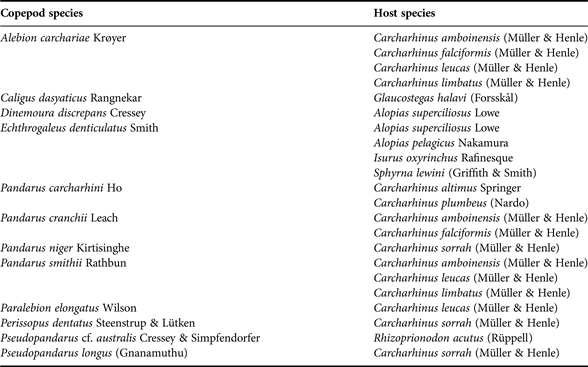
Twelve parasitic copepod species from two families (Pandaridae and Caligidae) were recorded from a total of 13 elasmobranch host species, during the present study (Table 1). The most frequently observed copepod species were Alebion carchariae and Echthrogaleus denticulatus, both of which were recorded on four host species. The former has been previously reported from at least 14 shark species, primarily off Florida (Cressey, Reference Cressey1970), but also in the Atlantic Ocean (Vaissière, Reference Vaissière1959; Rokicki & Bychawska, Reference Rokicki and Bychawska1991; Luque & Tavares, Reference Luque and Tavares2007), off South Africa (Oldewage & Smale, Reference Oldewage and Smale1993; Oldewage, Reference Oldewage1995), the Hawaiian Islands (Lewis, Reference Lewis1966), the western coast of India (Pillai, Reference Pillai1985) and off Western Australia (Newbound & Knott, Reference Newbound and Knott1999). The occurrence of this species on Carcharhinus amboinensis represents a new host record. Echthrogaleus denticulatus has a wide distribution, having been reported from at least seven different shark species, in the Atlantic, Pacific and Indian Oceans (Shiino, Reference Shiino1954; Cressey, Reference Cressey1967a; Hewitt, Reference Hewitt1979; Pillai, Reference Pillai1985; Oldewage & Smale, Reference Oldewage and Smale1993; Izawa, Reference Izawa2010). However, the occurrence of this species on Alopias superciliosus and Sphyrna lewini during the present study also represents two new host records.
Parasitic copepods recorded on the skin of elasmobranch hosts from the coastal waters of Oman.

The only other copepod species to be recorded from more than one host species during the present study were Pandarus carcharhini, Pandarus cranchii and Pandarus smithii. The former has been reported from at least eight shark species in the Indian and Pacific Oceans (Cressey, Reference Cressey1967a, Reference Cresseyb; Newbound & Knott, Reference Newbound and Knott1999). The recording of this species on Carcharhinus altimus during the present study represents a new host record. Pandarus cranchii and P. smithii are known primarily from carcharhiniform sharks, but also to a lesser extent from orectolobiform and lamniform sharks, across the Indian, Pacific and Atlantic Oceans (Cressey, Reference Cressey1967a, Reference Cresseyb, Reference Cressey1970; Kensley & Grindley, Reference Kensley and Grindley1973; Pillai, Reference Pillai1985; Rokicki & Bychawska, Reference Rokicki and Bychawska1991; Oldewage & Smale, Reference Oldewage and Smale1993; Adams et al., Reference Adams, Mitchell and Parsons1994; Luque & Tavares, Reference Luque and Tavares2007; Izawa, Reference Izawa2010). However, neither P. cranchii nor P. smithii has been recorded from C. amboinensis previously.
Two further new host records were established during the present study: Pseudopandarus longus on Carcharhinus sorrah, and Caligus dasyaticus on Glaucostegas halavi. The former species has been recorded from a variety of carcharhinid sharks in the Indian Ocean (Cressey, Reference Cressey1967b; Dippenaar, Reference Dippenaar2005), while the latter species has been previously recorded from Himantura uarnak (as Dasyaticus uarnac) in the Indian Ocean (Rangnekar, Reference Rangnekar1957), Dasyatis akajei (as Dasyatis akajeii) from Japan (Shiino, Reference Shiino1960), and Dasyatis navarrae (Steindachner) from Taiwan (Ho et al., Reference Ho, Lin and Chang2007). The validity of a record of this copepod from Pristis sp. (Pillai, Reference Pillai1968) has been challenged by Ho et al. (Reference Ho, Lin and Chang2007). Although the genus Pseudopandarus is represented in the Indian Ocean by at least four species, P. australis has previously been reported from only eastern Australia (Cressey & Simpfendorfer, Reference Cressey and Simpfendorfer1988; Simpfendorfer, Reference Simpfendorfer1993). Thus, the presence of this copepod on Rhizoprionodon acutus from the Arabian Sea marks a significant range extension for this species.
The fact that eight new host records and one large range extension are reported here highlights the need for continued studies on the basic parasitology of elasmobranchs, particularly in regions, such as the Arabian Sea, which have received little or no previous attention. Furthermore, while the present study deals only with copepods parasitic on the skin, it seems highly likely that investigations into other ectoparasites, as well as endoparasites, would reveal additional new records.
ACKNOWLEDGEMENTS
The authors are grateful to T. Al-Mamari, and to the captain and crew of RV ‘Hamour', for their assistance in the field.