


Introduction
Individuals with social anxiety disorder have significant and persistent fear in one or more social conditions (American Psychiatric Association, 2000). According to the cognitive-behavioural therapy models (e.g. Clark and Wells, Reference Clark, Wells, Heimberg, Liebowitz, Hope and Schneider1995), fear of negative evaluation (FNE) is a core feature of social anxiety. Clark and Wells (Reference Clark, Wells, Heimberg, Liebowitz, Hope and Schneider1995) posit that people with social anxiety have some attentional processing bias, which prevents them from collecting evidence that they do much better than they imagine, and maintains the cycle.
Considerable evidence shows that social anxiety is maintained in part by the decreased processing of positive social stimuli. For example, using an eye movement-based method, Chen, Clarke, MacLeod and Guastella (Reference Chen, Clarke, MacLeod and Guastella2012) found that socially anxious individuals show faster attentional disengagement from positive stimuli, and their lower total fixation times to positive stimuli are associated with higher levels of state anxiety. Using a dot-probe paradigm, Taylor, Bomyea and Amir (Reference Taylor, Bomyea and Amir2010, Reference Taylor, Bomyea and Amir2011) found that socially anxious participants show diminished attentional allocation for positive social words compared with neutral words at 500 milliseconds, after a speech task. In line with this notion, Silvia, Allan, Beauchamp, Maschauer and Workman (Reference Silvia, Allan, Beauchamp, Maschauer and Workman2006) also reported that participants with social anxiety take longer to recognize happy faces. Socially anxious participants also selectively neglect positive responses from audiences (Perowne and Mansell, Reference Perowne and Mansell2002). Vassilopoulos and Banerjee (Reference Vassilopoulos and Banerjee2010) also found that participants with social anxiety might disqualify positive social events, which leads to the experience of low positive affect.
Although the available literature supports the association between social anxiety and the avoidance of positive stimuli, it remains unknown whether the avoidance is a result of initial allocation of spatial attention or a result of controlled strategies for sustained attention. Various possibilities for socially anxious individuals’ avoidance of positive stimuli have been debated. Some researchers support the idea of strategic processing. Researchers found that high socially anxious individuals worry about the initial positive appraisal, which may lead to future negative appraisal, so they choose to perceive others’ friendliness in a negative way (Alden, Taylor, Mellings and Laposa, Reference Alden, Taylor, Mellings and Laposa2008; Weeks, Rodebaugh, Heimberg, Norton and Jakatdar, Reference Weeks, Rodebaugh, Heimberg, Norton and Jakatdar2009). However, others support the initial allocation of spatial attention hypothesis. They suggested that social anxiety is maintained by a deficit in the attentional processing of positive information. Participants with social anxiety ignore others’ positive social signals and direct their attention to negative ones (Veljaca and Rapee, Reference Veljaca and Rapee1998; Cooper and Langton, Reference Cooper and Langton2006).
To test which possibility is more reasonable, we should clarify when the avoidance of positive stimuli happens. For decades, several studies explored the time-course of attentional bias for negative stimuli in social anxiety by using a dot-probe paradigm (Bradley, Mogg, Falla and Hamilton, Reference Bradley, Mogg, Falla and Hamilton1998; Mogg, Philippot and Bradley, Reference Mogg, Philippot and Bradley2004). In the present study, we manipulated the stimuli presentation times in the probe task to compare the attentional differences for positive social words. Three presentation times were widely used in previous studies: initial attentional biases in dot probe tasks to threat faces with presentation times below 200 ms might reflect the initial covert target selection (Stevens, Rist and Gerlach, Reference Stevens, Rist and Gerlach2011). Therefore, 100 ms, which is too short to shift the attention, is likely to reflect automatic initial shifts in attention, rather than controlled strategies involved in sustained attention (Cooper and Langton, Reference Cooper and Langton2006; Koster, Verschuere, Crombez and Damme, Reference Koster, Verschuere, Crombez and Damme2005); 500 ms, which allows one or more attention shifts between the locations, may not be optimal to indicate the initial allocation of attention (Cooper and Langton, Reference Cooper and Langton2006); 1250 ms, which allows interpretation and judgment to influence participant responses (Staugaard, Reference Staugaard2010), is usually used to determine whether attentional biases are sustained over this longer time interval (Bradley et al., Reference Bradley, Mogg, Falla and Hamilton1998; Mogg et al., Reference Mogg, Philippot and Bradley2004).
Moreover, one potential limitation of prior research is the choice of positive, neutral and negative stimuli. Dimberg and Christmanson (Reference Dimberg and Christmanson1991) mentioned that participants with low speaking fear showed differential EMG for different emotional faces (i.e. smiling when viewing happy faces and frowning when viewing angry faces). When focused only on the attentional bias for positive stimuli, the adding of negative stimuli may arouse unrelated emotion, which results in interference with the outcome of trials. Therefore, our study compared only positive and neutral words, excluding unnecessary interference. We chose words (rather than faces) for two reasons: first, although facial stimuli may have better ecological validity, their meaning can be more complex and lead to explanatory confusion (Yoon and Zinbarg, Reference Yoon and Zinbarg2007); second, words can express a wider range of positive emotional states than faces (Pishyar, Harris and Menzies, Reference Pishyar, Harris and Menzies2004).
The primary goal of the present study was to investigate the time course of attentional bias for positive social words, and to try to clarify whether previous evidence of avoidance of positive social stimuli is an initial allocation of spatial attention (i.e. is present at 100 ms), or the consequence of controlled strategies for sustained attention (i.e. exists beyond 100 ms), during which time positive social words may be interpreted as threatening stimuli. Given their social-evaluative concerns, we hypothesized that individuals with high social anxiety would show avoidance beyond 100 ms and sustain this over some time. As positive stimuli can enhance positive affect and decrease anxiety, we also predicted that people without social anxiety would show preference for positive social words at the three presentation times.
Method
Participants
Sixty-two students from Peking University completed the Fear of Negative Evaluation Scale (FNE: Watson and Friend, Reference Watson and Friend1969, revised by Ye, Qian, Liu and Chen, Reference Ye, Qian, Liu and Chen2007). We invited those who scored ≤63 (bottom 27%) or ≥86 (top 27%) to participate in the study. They were assigned to LSA and HSA groups based on the FNE scores. The HSA group consisted of 18 participants (11 male, 7 female), ranging from 18 to 24 years old, and the LSA group consisted of 17 participants (9 male, 8 female), ranging from 18 to 26 years old. The two groups were matched for gender, χ 2 (1, N = 35) = 0.24, p = .63, d = .08, but differed significantly in age, t (33) = −2.32, p = .03, d = .78, with the HSA group being younger than the LSA group. HSA participants scored significantly higher on three social anxiety-related scales (FNE, Watson and Friend, Reference Watson and Friend1969; Social Interaction Anxiety Scale, SIAS, and Social Phobia Scale, SPS, Mattick and Clark, Reference Mattick and Clark1998) than the LSA group (see Table 1).
Anxiety level of sample (standard deviations in parentheses)

Notes: HSA = high social anxiety; LSA = low social anxiety
*** p < .001 (two tailed)
Materials
The stimuli consisted of 32 word-pairs. We first created a list of 112 Chinese words that seemed positive and highly relevant to social situations (e.g. like, appreciate). In the second step, we paired these words with neutral words according to their length and frequency based on the Dictionary of Modern Chinese Language High Frequency Words (Liu, Reference Liu1990). Third, five clinical psychology graduates were asked to rate each word on 5-point Likert-type scales according to its positive sociality (0 = not at all fit; 4 = very fit) and emotionality (0 = very negative; 4 = very positive), which resulted in 32 most representative word pairs, with mean positive sociality 3.40 and emotionality 3.65 for positive social words, and mean positive sociality 0.06 and emotionality 0 for neutral words.
Measures
Fear of Negative Evaluation Scale (FNE; Watson and Friend, Reference Watson and Friend1969)
This scale is a 30-item self-report measure of fear and distress related to negative evaluation from others, which is one of the hallmark criteria for the diagnosis of social phobia. Items are rated on “yes or no” in the original scale, but a 5-point Likert-type scale in the Chinese version, ranging from 0 (not at all characteristic of me) to 4 (extremely characteristic of me). The Chinese version was revised by Ye et al. (Reference Ye, Qian, Liu and Chen2007), with Cronbach α coefficient .90 and retest reliability .90. The Cronbach's alpha in the current sample was .91.
Social Interaction Anxiety Scale (SIAS; Mattick and Clark, Reference Mattick and Clark1998)
This scale measures anxiety when meeting and talking with others. It consists of 20 items, scored on a 5-point Likert-type scale, ranging from 0 (not at all characteristic or true of me) to 4 (extremely characteristic or true of me). The Chinese version was revised by Ye et al. (Reference Ye, Qian, Liu and Chen2007), with Cronbach α coefficient .87 and retest reliability .86. The Cronbach's alpha in the current sample was .88.
Social Phobia Scale (SPS; Mattick and Clark, Reference Mattick and Clark1998)
This scale measures anxiety when being observed by others. It consists of 20 items, scored on a 5-point Likert-type scale, ranging from 0 (not at all characteristic or true of me) to 4 (extremely characteristic or true of me). The Chinese version was revised by Ye et al. (Reference Ye, Qian, Liu and Chen2007), with Cronbach α coefficient .90 and retest reliability .85. The Cronbach's alpha in the current sample was .94.
Procedure
The experiment was conducted in three steps. On arrival, the subjects were asked to complete the FNE, SIAS and SPS measures. Next was preparation for a speech to be given later, to evoke anxiety and obtain a better effect (Garner, Mogg and Bradley, Reference Garner, Mogg and Bradley2006). Then, the dot-probe task was executed.
Anxiety-evoking task
The following instructions were given: “Thanks for taking part in our experiment which assesses your social skills and public speaking ability. After the computerized task, you will be asked to make a 3-minute speech on a given topic. Experimenters will stay here to watch your speech and give you a rating. This video camera will record your speech so that more experts can watch it later in order to give you a more comprehensive assessment of your performance and your social skill. You have 30 seconds to prepare before the camera begins to record.”
Dot-probe task
The dot-probe task was a modified version of the original task (MacLeod, Mathews and Tata, Reference MacLeod, Mathews and Tata1986), to detect any attention bias in participants. Participants were seated with their eyes approximately 60 cm from the computer screen. At the beginning of each trial, a black cross (2 × 2 cm) was presented in the centre of the screen for 1000 ms. Then a word-pair appeared (1 × 1 cm; 3 cm apart, within 1.0° visual angle for each word and 4.0° visual angle for the centre-to-centre distance of the two words) with one word above and the other below the centre of the screen. One word of the pair was socially positive, and the other was a matched neutral word. The word pair presentation time varied randomly among 100, 500 and 1250 ms. Participants were told that a probe would randomly replace either of the displayed words. The probe could be either an “E” or an “F”. Participants were instructed to press the left mouse button when seeing “E”, and the right button when seeing “F”. Participants were also asked to respond as quickly and accurately as possible. After their response, the probe disappeared and the next trial began. The inter-trial interval was 500 ms. There were 32 word-pairs and each pair was shown six times (i.e. a total of 192 trials), to counterbalance the location of the probe (upper or lower), the location of either word (upper or lower), and the presentation time (100, 500, 1250 ms). Participants had 10 trials for practice. Each trial took 3 s and all of the tasks took 10 min without a break.
After finishing the last dot-probe task, the rationale for the deception was explained and participants were asked whether they had believed that they had to give a speech. They then received 30 RMB as compensation for their time.
Results
Manipulation check
Eighty-nine percent of the participants believed the speech requirement and reported their anxiety, which showed the success of the anxiety-evoking task. There was no difference between the two groups in believing or disbelieving the speech requirement, t (33) = 0.29, p = .77, d = .10; but the two groups reported a significant difference in anxiety level, t (33) = 2.38, p < .05, d = .80.
Data reduction
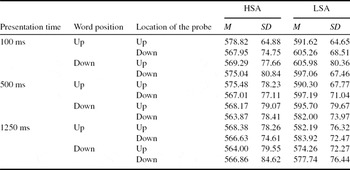
Trials with errors, participants’ response latencies less than 100 ms or greater than 2000 ms, and an average reaction time more than three standard deviations below or above the mean latencies were excluded from the analyses. Each participant had a low error rate (< 1%) and the data were normally distributed. Mean reaction times on the presentation time (100/500/1250 ms), word position (upper/lower), and location of the probe (upper/lower) for the HSA and LSA group were presented in Table 2.
Mean reaction times on the presentation time (100/500/1250 ms), word position (upper/lower), and location of the probe (upper/lower) for the HSA and LSA group

Dot-probe task
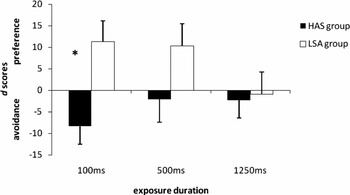
The data were entered into a 3 × 2 × 2 × 2 repeated measures ANOVA, with presentation time (100/500/1250 ms), word position (upper/lower), and location of the probe (upper/lower) as within-subjects variables, and group (LSA/HSA) as between-subject variable. This revealed a significant effect of presentation time, F (2, 66) = 3.28, p = .04, η2 = .09, and a significant three-way interaction of word position × location of the probe × group, F (1, 33) = 10.67, p = .003, η2 = .24. All other effects were not significant (p > .05). To simplify the three-way interaction, a bias score (d) was calculated by subtracting the reaction time for probes following the positive words from the reaction time for probes following the neutral words (Koster et al., Reference Koster, Verschuere, Crombez and Damme2005). Thus, negative bias scores indicated that attention was directed away from positive words (i.e. towards neutral words), whereas positive bias scores indicated attention to positive words (i.e. away from neutral words).
All the d scores were entered into a 2 × 3 mixed design analysis of repeated measures AVOVA with group type (HSA versus LSA) as a between-subject variable and exposure duration (100 vs 500 vs 1250 ms) as a within-subject variable. There was no significant interaction of Group × Exposure Duration, F (1, 33) = 0.33, p = .57, η2 = .01, and no significant main effect of exposure duration, F (1, 33) = 2.87, p = .10, η2 = .08, but a significant main effect of group, F (1, 33) = 10.67, p < .01, η2 = .24. We also conducted repeated measures ANCOVA with age as the covariate. The group effect remained significant, F (1, 32) = 8.48, p < .01, η2 = .21, indicating that the difference in attention between the groups was not due to the group difference in age. The non-significant interaction between Group and Exposure Duration meant that no evidence supported the difference of attentional bias between two groups varied at the different levels of Exposure Duration. However, the main aim of our study was to investigate the time-course of attentional bias for positive social words between the HSA and LSA groups. Therefore, an independent-samples t-test of d scores was carried out in each exposure condition. The two groups differed significantly in the 100 ms condition (M = 8.31, SD = 17.82; M = −11.28, SD = 20.08, respectively), t (33) = 3.06, p < .01, d = 1.03, whereas there were non-significant trends at 500 ms (M = 2.09, SD = 22.61; M = −10.29, SD = 21.09, respectively) and 1250 ms (M = 2.30, SD = 17.50; M = 0.88, SD = 21.01, respectively), t(33) = 1.67 and 0.22, p = .10 and p = .83, d = .57 and .07 respectively (see Figure 1).
The d scores for the two groups at three presentation times. Attentional bias scores for word-pairs involving positive social words and neutral words. A negative bias score denotes avoidance attentional bias for positive social words. Scores above 0 indicate preferential attentional bias for positive social words.
p < .05 (two tailed)

To clarify whether attentional bias did exist at different exposure durations, one-sample t-test between the d scores and the value of zero were performed within each group in different conditions, and the d scores of the HSA group were significantly higher than zero in the 100 ms condition, t (17) = 1.98, p = .06, d = .47, indicating a tendency to avoid positive social words. In the 500 and 1250 ms conditions, no significant difference from zero was found, t (17) = 0.39, p = .70, d = .09, t (17) = 0.56, p = .58, d = .13. The d scores of the LSA group were significantly lower than zero at 100 ms, t (16) = −2.32, p = .03, d = .56, and at 500 ms, t (16) = −2.01, p = .06, d = .49, indicating preferential attention to positive social words, but no evidence of a bias in the 1250 ms condition was found, t (16) = 0.17, p = .87, d = .04.
Discussion
Empirical findings indicate that people with social anxiety show less preference for positive information than normal people in social situations (Hirsch and Mathews, Reference Hirsch and Mathews2000; Kashdan, Weeks and Savostyanova, Reference Kashdan, Weeks and Savostyanova2011). The present study extended this research by using three different presentation times to detect the difference. We found that participants with high social anxiety appeared to exhibit initial avoidance from positive words (i.e. at 100 ms), but the inverse was found in the LSA group. These findings added another explanation for the association between attentional bias for positive stimuli and social anxiety.
The initial avoidance and absence of attentional bias at a longer exposure (i.e. 500 ms) are in line with Cooper and Langton's (Reference Cooper and Langton2006) research, in which attention away from the happy face in neutral/happy pairs at 100 ms (but not longer) was also detected in a high-anxiety group. However, our results are inconsistent with those of Taylor et al. (Reference Taylor, Bomyea and Amir2010). The real speech task versus the pretended speech task may contribute to the difference. No matter when the avoidance happens, it may inhibit fear and anxiety in the short-term (Koster et al., Reference Koster, Verschuere, Crombez and Damme2005), and this safety behaviour may contribute to maintaining the negative belief system and enhance the social anxiety (Clark and Wells, Reference Clark, Wells, Heimberg, Liebowitz, Hope and Schneider1995).
Similarly, our results are congruent with the report of Rossignol et al. (Reference Rossignol, Campanella, Maurage, Heeren, Falbo and Philippot2012), which examined P1, N170 and P3b to consider different stages of cognitive processing using ERPs. Interestingly, in contrast to the well-known hypothesis of impairment in the ability to disengage attention from threat (Buckner, Maner and Schmidt, Reference Buckner, Maner and Schmidt2010), socially anxious individuals produce enhanced P1in response to all emotional faces (regardless of anger, fear, disgust or happiness) as compared to neutral ones, but N170, P3b and behavioural responses are not modulated by social anxiety. Individuals with social anxiety tend to exhibit increased pre-attentive detection mechanism for emotional cues in general, and not only for threat.
Alden et al. (Reference Alden, Taylor, Mellings and Laposa2008) proposed that individuals may experience anxiety and avoid positive stimuli because of their concern that initial positive appraisal may lead to future negative appraisal, which means that the attentional bias may be a result of cognitive avoidance. However, in our study, we found that the HSA group already avoided positive social words at 100 ms, which suggested that this may exist well before complex cognitive processing (e.g. predicting the negative evaluation). Therefore, the avoidance of positive social words is more like automatic processing than conscious avoidance after recognizing the future risk. Wallace and Alden's (Reference Wallace and Alden1995, Reference Wallace and Alden1997) proposal (i.e. fear of ultimate negative evaluation) cannot explain the current results, suggesting alternative mechanisms for the fear and avoidance of positive social stimuli other than complex processing. Participants never focused their attention on positive stimuli, because they automatically neglected them.
Enhanced preferential attention for positive social words at 100 and 500 ms (but not at 1250 ms) in the LSA group was partly in line with our hypothesis. Positive stimuli as safe signals easily attract the attention of normal people at the early stage (Wieser, Pauli, Weyers, Alpers and Mühlberger, Reference Wieser, Pauli, Weyers, Alpers and Mühlberger2009), but the attraction may later be gradually lost. The process can help them receive positive feedback and increase positive experience. In real life, this preferential tendency may make a person seem more warm and friendly. Unlike the LSA group, the HSA group relatively lacked initial attention to and processing of positive social words. Unable to figure out the fact might contribute to the maintenance of pathological social fear in social anxiety (Taylor et al., Reference Taylor, Bomyea and Amir2010). Their experience of frequent social failure, low positive affect and high anxiety ultimately support their negative hypothesis, which in turn influences the development of bias in the processing of positive information, and leads to automatic responses to positive social stimuli gradually. A circle forms and is self-maintaining.
The findings are consistent with recent cognitive models of social phobia that emphasize the role of reducing processing of external social cues in maintaining social anxiety (e.g. Clark and Wells, Reference Clark, Wells, Heimberg, Liebowitz, Hope and Schneider1995). If patients can choose to attend to social cues or not, they show biased attention away from faces, which may avoid interaction with others (Chen, Ehlers, Clark and Mansell, Reference Chen, Ehlers, Clark and Mansell2002). Existing models specify that selective attention to threatening social information heightens anxiety (e.g. Rapee and Heimberg, Reference Rapee and Heimberg1997). However, these models focus less on the processing of positive cues and their fundamental role of maintaining pathology. Our study adds an empirical literature to supplement current cognitive models of social anxiety. The current findings demonstrate initial avoiding to positive social cues may prevent patients from seeing that they are more positive than they thought, which maintains their negative belief system.
Further, our results also extend in several ways recent research that focuses on positive social information processes and uses positive stimuli to develop attention training programs (Li, Tan, Qian and Liu, Reference Li, Tan, Qian and Liu2008; Wiener, Perloe, Whitton and Pincus, Reference Wiener, Perloe, Whitton and Pincus2012). First, Heeren, Reese, McNally and Philippot (Reference Heeren, Reese, McNally and Philippot2012) found that increasing vigilance for slightly positive faces (relative to angry faces) via attention training can reduce self-reported, behavioural, and physiological responses to social stressor, which suggested that attending to non-threatening cues can reduce the disengaging attention from threat. Conversely, Li et al. (Reference Li, Tan, Qian and Liu2008) used a 7-day of attention training toward positive faces (relative to negative faces), and their results showed that the socially anxious participants focus more on positive faces and reduce self-reported fear of social interaction. In accordance with our results, one alternative explanation for this effectiveness would be that such training also reduces the avoidance of positive cues (not merely vigilance for threat). Second, recent research demonstrated that manipulation of attention away from negative social stimuli reduces the symptoms of social anxiety (Amir et al., Reference Amir, Beard, Taylor, Klumpp, Elias and Burns2009). However, attentional bias away from positive social cues may contribute to the maintenance of social fear (Taylor et al., Reference Taylor, Bomyea and Amir2010). Taken together with our results, directing patient's attention to positive social cues as well as away from negative social ones may obtain a better effect than using only one strategy. Third, detecting the differences in attentional bias at different presentation times supplements the theory and has implications for the potential refinement of existing interventions for people with social anxiety. The results of our study suggested that 100 ms, at which time participants with high social anxiety avoided positive words, cannot be used to train attention to positive stimuli, and the absence of any difference between 500 ms and 1250 ms suggested that a presentation time more than 500 ms is not useful. In addition, the different levels of anxiety aroused by the anxiety-evoking task meant that the high anxious group felt anxiety more easily, and were under greater social stress than low anxiety group, which suggested that interventions using attention training should not only focus on the exposure time, but also be implemented before the exposure in order to decrease the anxiety.
Several limitations of the current study need to be addressed. First, the failure to detect attentional bias at 500 and 1250 ms might be due to the long exposure duration, where multiple attentional shifts between the words in each pair could take place (Mogg et al., Reference Mogg, Philippot and Bradley2004). It is important to extend the study by using eye tracking to investigate the precise time of the attention shift. Second, the present data were obtained in participants with high social anxiety rather than clinical patients. Further research should investigate the attentional bias for positive social words in patients with social phobia. Third, we did not use the negative words for the strict manipulation, so the interpretability of the findings may be limited by the lack of an “emotional/negative” comparison condition. It seems appropriate to take this into account in future research. Finally, the materials used in the dot-probe task were “positive social to neutral non-social” word-pairs. It is difficult to determine whether the attentional bias in the HSA group was a response to the emotional valence (i.e. positive vs neutral) or to the social-related characteristic (i.e. social vs non-social). It may be helpful to compare the “positive social word vs positive nonsocial word” and “positive social word vs neutral social word” to determine which factor contributes more to the attentional bias detected in the present study.
To summarize, in the HSA group, the avoidance of positive social words was detected at an early stage (100 ms), suggesting that this involves initial allocation of spatial attention rather than controlled strategies for sustained attention (i.e. interpreting the positive social information negatively or discounting positive social events). Compared with the LSA group, participants with social anxiety lacked initial attention and processing of positive social words.
Acknowledgments
The authors thank Dr I. C. Bruce and the anonymous reviewers for their helpful comments on an earlier version of this manuscript. This work was supported by National Science Foundation of China (Project 31170991).
Appendix
Appendix: Material of word-pairs
We used the Chinese version in the study. Because of the cultural differences, there may be different meanings for some words in British culture.





Comments
No Comments have been published for this article.