


1 Introduction
To-contraction as it is generally understood in the literature is typically illustrated by the examples wanna and gonna. In essence, the idea is that wanna is a contraction of want + to and gonna is a contraction of going + to. The prevailing view is that to-contraction affects a small group of verbs with auxiliary-like properties + to. Some authors acknowledge that to-contraction is somewhat more extensive (e.g. Bresnan Reference Bresnan1971; Emonds Reference Emonds, Culicover, Wasow and Akmajian1977; Sag & Fodor Reference Sag, Fodor, Aronovich, Byrne, Preuss and Senturia1994; Pullum Reference Pullum1997; Hudson Reference Hudson2006, amongst others); however, the extension is always limited to other auxiliary-like verbs and it is never entirely clear what is meant by ‘contraction’. The term ‘contraction’ implies ‘cliticisation’, and clitics are widely assumed not to be selective in their choice of host. It is therefore intriguing that the clitic in to-contraction should be so selective. Pullum (Reference Pullum1997) utilises this apparent selectivity in order to pursue an analysis in which to is a derivational affix rather than a clitic. Pullum's analysis should be set within the context of earlier work on the difference between clitics and affixes (Zwicky & Pullum Reference Zwicky and Pullum1983). In that article, six diagnostic criteria were set out to differentiate clitics from affixes, though it is clear that Pullum's (Reference Pullum1997) diagnosis is essentially based on two criteria: criterion 1 (affixes are highly selective of the host they attach to; clitics are not selective) and criterion 3 (affixation can trigger idiosyncratic morphophonological processes; clitics do not trigger idiosyncratic morphophonology).
The present article arises from a lack of satisfaction with the explanations offered for the nature of to-contraction and with the severely restricted data set used. Most of the early work was syntactic in nature and, indeed, the debate surrounding to-contraction and trace theory was so extensive that in 1986 the editor of Linguistic Inquiry declared a moratorium on the phenomenon. There have been morphological analyses and our critique of the literature will focus on Pullum's (Reference Pullum1997) morphological analysis. Regardless of whether the approach has been essentially syntactic or morphological in nature, the data have often been restricted to one or two forms: wanna and gonna. We will argue that it is a mistake to focus on wanna and gonna to the exclusion of other examples. What makes them most eye-catching also makes them unsuitable. We agree with the claim that wanna and gonna are no longer cases of synchronic to-contraction (see Sag & Fodor Reference Sag, Fodor, Aronovich, Byrne, Preuss and Senturia1994; Anderson Reference Anderson2005, for example). Our point of departure will be phonological evidence, and we will claim that t-reduction, which has been largely ignored in the standard literature, reveals the true nature of to-contraction: it is phonological. On the basis of our data, we will argue that to-contraction is far more extensive than has previously been acknowledged. One purpose of the present article is to explore precisely what is meant by contraction for this particular linguistic phenomenon. The empirical part of the article will show that to-contraction involves encliticisation and not affixation. We will consider more closely what to-encliticisation involves and we will follow Booij (Reference Booij1996) and Anderson (Reference Anderson2005) in assuming that encliticisation is phonological and takes the form of prosodic incorporation. The article is structured as follows. In section 2, we will introduce to-contraction and consider what is meant by contraction and cliticisation. We will conclude this section with a consideration of how appropriate it is to assume wanna and gonna to be synchronic to-contractions. In section 3 we will consider Pullum's affixation account which will provide the clue as to the kind of data we should be searching for when studying to-contraction. Section 4 sets the scene for the introduction of our data. Specifically, we will outline what prosodic conditions are required in order for t-lenition (in the form of glottalling) to occur in British English varieties. With this in place, our data are presented in section 5. In section 6, we will consider the type of cliticisation process evidenced by to-contraction. Finally, section 7 will return to the question posed in the title: to-contract(ion) or not to-contract(ion)?
2 Contraction and cliticisation
2.1 To-contraction
As a result of contracting with to to form wanna, Bolinger (Reference Bolinger, Brettschneider and Lehmann1980, Reference Bolinger1981) observes that want has become the single most written-about verb in English Syntax. A number of different syntactic accounts have dealt primarily with the cases of wanna and gonna, and the data in which these forms are permissible. This is illustrated in examples (1)–(4) below:
(1) I want to/wanna see you.
This first example demonstrates the grammaticality of both I want to see you, and I wanna see you. The standard claim is that wanna cannot inflect:
- (2)
(a) He wants to/*wanna win the game.
(b) He wanted to/*wanna win the game.
Syntacticians have argued that to-contraction can be blocked in cases where want is not immediately followed by to. So in (3a) the alternation between want to and wanna is acceptable, but the alternation is not permissible when the object of want (e.g. Bill) intervenes between want and to, as in (3b):
- (3)
(a) You want to/wanna meet Bill.
(b) You want/*wanna Bill to meet you. (Hudson Reference Hudson2006: 607)
In the early days, syntacticians focused on forms such as those in (3a–b), together with other cases where empty categories were thought to occur between the want and to as in (4).
- (4)
(a) Does Kimi want PROi to (wanna) go to the movies?
(b) Whoj does Kimi want PROi to (wanna) go to the movies with tj?
(c) Whoj does Kimi want tj to (*wanna) go to the movies?
(Sag & Fodor Reference Sag, Fodor, Aronovich, Byrne, Preuss and Senturia1994: 366–7)
To-contraction and the adjacency requirements it was thought to impose was one of the main triggers for the advent of trace theory in Generative Grammar (see originally in Chomsky Reference Chomsky, Anderson and Kiparsky1973 and subsequently formalised in Chomsky Reference Chomsky1981). Ultimately, theoretical considerations such as these dominated and this is, perhaps, one of the reasons why the data used were so restricted. As Sag & Fodor (Reference Sag, Fodor, Aronovich, Byrne, Preuss and Senturia1994) have pointed out, to-contraction is one of those phenomena where theoretical development has ridden roughshod over the data. As a direct consequence, the nature of the phenomenon has ceased to be the central issue. Specifically, what happens when two elements ‘contract’? Bresnan (Reference Bresnan1971: 1) is perhaps the first researcher who identifies to-contraction as encliticisation and elaborates on precisely what this means. She states:
This rule, which I will refer to as ‘TO Contraction’, performs an operation as (very roughly) indicated in (a):
(a) [S NP V to V. . .] → [S NP [V + to] V. . .] (Bresnan Reference Bresnan1971: 1)
This is quite a significant amount of detail for an account of its time and kind, but we will argue below that more detail can be added. This is, however, a syntactic view of encliticisation and the remainder of the article is not concerned with syntax. Reference to it here is simply to acknowledge the vast syntactic literature on to-contraction and to signal where syntactic focus lay. The present article arises from a lack of satisfaction with all the accounts of to-contraction, whether they have a syntactic orientation or otherwise. At the heart of our dissatisfaction is the fact that phonological considerations have largely been ignored, as has any detailed discussion of the nature of contraction. We do not regard this as accidental. We claim that a satisfactory account of to-contraction can only be attempted if phonological evidence is foregrounded, because phonological evidence sheds considerable light on the nature of to-contraction. Specifically, in this article we will argue that to-contraction is a phonological phenomenon. To begin our exploration, the following section will consider the nature of contraction and the role of cliticisation within it.
2.2 Contraction
Radford (Reference Radford2004: 331), for example, defines contraction as
a process by which two different words are combined into a single word, with either or both words being reduced in form. For example, want to > wanna, going to > gonna, he is > he's, did not > didn't.
Harley (Reference Harley2006: 283), on the other hand, defines contraction as
a single phonological word that is created when a listeme that can be pronounced as an independent phonological word is reduced and attached to another independent word, as in can't, I'm, it's.
On the basis of these definitions, it is not clear how contraction is brought about. Radford's ‘process’ and Harley's use of ‘attached to’ could be syntactic or morphological, but they could equally be phonological. Both definitions refer to reduction, but differ in the precise location of that reduction. Harley suggests that reduction of the clitic precedes attachment, whereas Radford makes no such suggestion. Given Harley's reference to reduction of the clitic preceding attachment, it seems likely that she is referring to reduction of the clitic vowel. But what is the significance of the reduction of an initial consonant? Radford, on the other hand, refers to reduction in the clitic word and potentially in the host. It is interesting that wanna and gonna are taken to show reduction of both the host and the clitic. A comparison of the reduction sites given in these definitions raises an interesting question about the significance of the degree and location of reduction. In other words, why do we find clitic-specific reduction in some cases (e.g. he's, I'm) but more extensive reduction in other cases (e.g. wanna, gonna)? This in turn raises the issue of whether all the examples given above are actually examples of contraction. If wanna and gonna are no longer synchronic contractions, then they are not examples of to-contraction. We assume that the difference in location and degree of reduction is highly significant, and, in what follows, we will assume that reduction to the /t/ of to signals to-contraction. In section 4, we will present evidence that suggests that the encliticisation found in to-contraction facilitates phonological reduction of the initial /t/ in to. First of all, we will consider whether wanna and gonna are synchronic cases of contraction, or whether they detract from the kind of evidence we should be looking at: clitic-only reduction.
2.3 wanna/gonna – cases of synchronic to-contraction?
Anderson (Reference Anderson2005: 73) suggests that all the apparent restrictions imposed on the use of wanna can be explained away if wanna, and indeed gonna, are lexicalised portmanteaux. We take this to mean that rather than constructing wanna or gonna, for example, from want + to or going + to respectively, wanna, gonna have their own stored forms. The grammaticalisation of be going to and the more recent change to gonna have been very well documented and we do not intend to revisit this extensive literature here (see Brinton & Traugott Reference Brinton and Traugott2005; Bybee Reference Bybee2010; Garrett Reference Garrett, Dianne, Whitman and Garrett2012 for discussion). More recently, Krug (Reference Krug2000) has studied want to also as a case of grammaticalisation. He provides a detailed history of the development of want + to and notes that it was not until the nineteenth century that modal want + to infinitive started to appear (Krug Reference Krug2000: 118). Indeed, his search of the Helsinki Early Modern English corpus reveals that want of, for want of, want in and want for were the typical uses of want (Reference Krug2000: 128). Krug's corpus-based work demonstrates that the frequency of want + to has increased over the past 150 years or so. Furthermore, Krug (Reference Krug2000: 134) states that there has been a ‘substantial’ increase in modal want to over the past thirty years. This is based on a study of written corpora, including both fictional and press language. Krug illustrates the increase in a table which compares LOB (1961) with FLOB (1991), and Brown (1962) with Frown (1992) for both British and American English (2000: 135). As he notes, when the versions of each corpora are compared, an increase in the string frequency of want + to is notable in each case. He comments that this increase is more marked in American than in British English, though he notes that ‘wanna enjoys a higher degree of acceptability in British English today than a generation ago’ (2000: 155).
So, on the basis of Krug's work, it would appear that increased frequency of use has led to grammaticalisation in these cases and, as Brinton & Traugott (Reference Brinton and Traugott2005: 27) state: ‘prototypical examples of grammaticalisation involve boundary loss and morphosyntactical/phonological fusion or “bonding”’. Hence it seems logical to conclude that, as a result of the changes that have taken place during grammaticalisation, wanna and gonna are not cases of synchronic contraction, but are reanalysed stored forms. Indeed, at the height of the syntactic to-contraction debate, Chomsky & Lasnik (Reference Chomsky and Lasnik1978: 271, n. 4) considered the possibility that: ‘it might simply be that wanna has been lexicalised, with new and specific properties’.Footnote 2 More recently, Sag & Fodor (Reference Sag, Fodor, Aronovich, Byrne, Preuss and Senturia1994) have also taken this view.
If we set this discussion about the status of wanna and gonna against the definitions of contraction given above, then wanna and gonna should not be included in a list of examples to illustrate contraction. The reason why the host and clitic have reduced, rather than just the clitic, is that boundaries have been redrawn and the words have undergone fusion (Brinton & Traugott Reference Brinton and Traugott2005). Wanna and gonna may have demonstrated to-contraction at an early stage of their history, but as a result of grammaticalisation, they are stored forms. To consider them in any discussion of the nature of to-contraction is therefore misleading.
We commented above that for those who look beyond wanna and gonna, the data set is still highly restricted. This has led one researcher to consider what the restrictive nature might indicate. Indeed Pullum (Reference Pullum1997) assumes that this is key in that it indicates a distinct morphological process to be in operation: affixation. Therefore in what follows, we will consider Pullum (Reference Pullum1997).
3 Pullum (Reference Pullum1997): to-contraction as affixation
Pullum (Reference Pullum1997) provides a morphological analysis of to-contraction and an excellent example of the restrictive nature of the to-contraction inquiry designed to pursue a particular theoretical goal. Of particular relevance to the present article is the way the data are restricted. We will show that this is not justified, but dictates the direction that we then take in order to analyse to-contraction. Although Pullum (Reference Pullum1997) focuses on wanna and gonna, he also includes a number of other verbs, which he describes as the ‘therapy verbs’. These verbs are set out in (5) below:
(5)


It is not clear why Pullum calls this group ‘therapy verbs’, especially as he comments that they are essentially semi-auxiliaries.Footnote 3 Yet he focuses on a specific group of semi-auxiliaries, excluding others such as need to. Simply listing the therapy verbs, as in (5) demonstrates that Pullum (Reference Pullum1997) is extremely careful in the data he admits as possible to-contractions and those he rejects, and it is worth quoting him at length here.
Emonds Reference Emonds, Culicover, Wasow and Akmajian1977 claims that other predicates undergo to-contraction, writing nonce spellings like needa, certain'a, and happen'a to indicate purported contracted pronunciations of need to, certain to, and happen to, etc., and a few others (e.g. Barss 1995) have also taken such a view. But it is an error [our emphasis]. Pronunciations like [ˈnidə] for need to, or [ˈhæpəɾ ] for happen to occur only in rapid or very casual speech, reflect no influence of syntax, and are determined by automatic phonology (thus they would apply similarly to rhyming forms provided the speech style was the same). It is an important fact about the data treated here that they do NOT represent a phenomenon linked to rapid, casual, slovenly, or uneducated speech. Certain fast speech rules of English are relevant to understanding the etiology of the synchronic phonology, but that phonology is now lexeme-specific. (Pullum Reference Pullum1997: 82)
In this passage, Pullum justifies why he rejects some potential to-contraction forms but accepts others. It is not clear why ‘rapid, or casual speech’ is problematic, since Pullum is working with forms which could equally be described as ‘normal’ and ‘casual and informal’. Pullum states that ‘[i]t is an important fact. . .’, but it is not clear why, other than as a stipulation that we should pretend that the data are examples of formal, educated speech. It seems arbitrary to reject need to and happen to on these grounds, but accept any of the forms listed in (5). Similarly, it is not clear why it is problematic to ‘reflect no influence of syntax’, nor why need to and happen to fall foul of this, but [ɔɾə], [aɾə] ought to and [ɡaɾə] got to do not. But the comment we will focus on more closely is the seemingly arbitrary label of automatic phonology applying to need to and happen to, but identical phenomena applied to the therapy verbs are deemed to be lexeme-specific (idiosyncratic). In what follows we will consider first of all the motivation for Pullum's comments. Then we will look at the automatic/lexeme-specific division more closely as this will help us to pinpoint what we think indicates to-contraction.
Pullum offers a morphological analysis in which wanna is a single word, made up of the base want and the derivational suffix to. This claim has to be set in the context of Zwicky & Pullum (Reference Zwicky and Pullum1983), who focus on a rather different case of contraction and argue that a diachronic clitic (n't) has become an inflectional suffix synchronically. So, right at the heart of Pullum (Reference Pullum1997) is the difference between clitic and affix.
Zwicky & Pullum (Reference Zwicky and Pullum1983) list a set of criteria which enable clitics to be distinguished from affixes. Six criteria were given in total, but Pullum's analysis is underpinned by criteria 1–3, so we will restrict our discussion solely to these three criteria. The first criterion they propose is that clitics are not selective about the host they attach to, whereas affixes are highly selective. The second criterion concerns ‘accidental gaps’ found in affixation (e.g. the so-called amn't gap; see Hudson Reference Hudson2006, Broadbent Reference Broadbent2009 for discussion). The third criterion concerns the idiosyncratic morphophonology exhibited by affixed forms (e.g. will~won't). When Pullum (Reference Pullum1997) is set in the context of Zwicky & Pullum (Reference Zwicky and Pullum1983) it becomes clear why the data set is restricted to a subset of semi-auxiliaries. If to is selective, then Zwicky & Pullum's criterion 1 supports an affixal analysis. Furthermore, since some members of the set of semi-auxiliaries (e.g. need to) are not selected as hosts, there appears to be a gap in the paradigm; criterion 2 supports an affixal analysis. To further cement the analysis, if the morphophonology can be characterised as lexeme-specific (i.e. idiosyncratic), then criterion 3 also supports an affixal analysis. This is precisely why Pullum is so careful about the data he selects and why a rejection of Emonds (Reference Emonds, Culicover, Wasow and Akmajian1977) is so important to his analysis. Notice also that at the heart of the selection is the phonological shape of the words accepted as cases of contraction and those rejected. In essence, Pullum is faced with a problem: we can see evidence of exactly the same phenomena in both his data pool and in the rejected data.
It is Pullum's distinction between automatic and lexeme-specific phonology that allows criteria 1–3 to be met. Motivating automatic phonology for some cases but not others allows Pullum to dismiss Emonds’ data. If, however, the distinction between automatic and lexeme-specific phonology does not hold, then the criteria are not met and an affixal analysis is not motivated. If an affixal analysis is not motivated, then a clitic analysis is. Furthermore, if the distinction between automatic and lexeme-specific phonology is unsustainable, and if we can demonstrate that some aspects of the phonological behaviour exhibited relate the therapy verbs with need to, happen to etc., then we will be able to show that where such phonological behaviour is found it indicates to-contraction. This will allow us to show that to-contraction extends beyond therapy verbs and beyond semi-auxiliaries more generally. Hence, in what follows we will use this distinction between automatic and lexeme-specific to move the reader towards our own analysis of to-contraction. Our aim is to show that /t/ lenition pinpoints to-contraction. We will set out to show why /t/ lenition reveals to-contraction and then present data to illustrate this and to show that the analysis must be one of phonological encliticisation.
3.1 Automatic phonology
Automatic phonology has some unfortunate connotations: something that is ‘automatic’ seems obligatory, dismissible and unworthy of study. This is certainly an interpretation that falls out from Pullum (Reference Pullum1997). However, if the reader is persuaded by the argument developed below, then these ‘automatic’ phenomena are extremely worthy of close scrutiny. In fact, failure to do so leads to potential analyses being lost.
According to Bybee (Reference Bybee2001):
. . .phonetic processes as they first appear in a language tend to affect high frequency and highly automated sequences and only later extend to the whole lexicon of words and phrases. Once they are generalized to the whole lexicon (as in American English nasalization of vowels before tautosyllabic nasal consonants and flapping of alveolar stops . . .), they are sometimes described as automatic, meaning that as highly practiced components of the articulatory repertoire of native speakers, they tend to dominate a person's articulation. . . Bybee (Reference Bybee2001: 66)
Pullum (Reference Pullum1997: 87) writes:
the special phonology relating [ɡoɪŋtu] to [ɡənə] is not inherently surprising: nasal assimilation (or just the alveolarization seen in goin’), flapping or loss of [t] after the nasal, and vowel reduction yield the most common pronunciation. But neither is it part of the regular, automatic phonology of English; it is lexeme-particular morphophonology.
Pullum's characterisations appear to be directly at odds with Bybee's definition of automatic phonology, in that they both highlight flapping as a case in point. The problem for Pullum is that some of the therapy verbs exhibit flapping and some of the rejections exhibit flapping. For Pullum's analysis to work, either flapping is ‘automatic’ and general, or it is lexeme-specific, but it cannot be both. To put this in context, compare flapping with the putative idiosyncratic morphophonology exhibited by the will~won't alternation. The latter is clearly lexeme-specific. Pullum gives cases of got to and ought to transcribed with a flap [ɾ]: <gotta> [ɡaɾə] and <oughta> [ɔɾə], [aɾə] (Pullum Reference Pullum1997: 81). Arguably, what these forms demonstrate is that a prosodic word has been created and precisely because /t/ is now intervocalic it can flap. Hence, they are actually cases of everyday American flapping rather than instances of lexeme-specific phonology. Furthermore, Pullum's description of gonna as being pronounced with a flap would presumably be a case where a nasalised flap is produced, in which case if [ˈhæpəɾ] is automatic, why is [ɡəɾ] lexeme-specific? To press the case still further, based on Pullum's description it is difficult to determine why [ɡənə] is the result of lexeme-specific phonology but [ˈnidə] is the result of automatic phonology. It seems that vowel reduction and t-deletion have applied equally to both items; once again, either both cases are automatic phonology or both cases are lexeme-specific. We conclude, therefore, that flapping is not lexeme-specific, and no instance of idiosyncratic morphophonology has convincingly been established. Rather, Pullum's own data seem to suggest that flapping, a much more general phonological process, should be taken to indicate to-contraction. So, unless other evidence can be brought to bear, we conclude that need to and happen to do exhibit to-contraction. The failure to convincingly establish a distinction between the therapy verbs and other ‘predicates’ seriously undermines the tenuous link between the therapy verbs. To return briefly to Zwicky & Pullum's criteria outlined above, it is clear that criteria 1–3 do not support an affixal analysis, but, on the contrary, suggest that a more appropriate analysis is one in which to is a clitic.
One consequence of this discussion is that if one is studying American varieties of English when the initial /t/ of to is flapped, this is evidence of to-contraction. Phenomena closely related to flapping of /t/ might also reveal to-contraction if they affect the initial /t/ of to. In this article, our focus is on to-contraction in British English and the British equivalent to flapping is glottalling. Both flapping and glottalling are lenition processes which occur in specific prosodic positions. In the next section, we will consider where glottalling can occur, so that we can demonstrate why lenition processes such as this must be taken as evidence of to-contraction.
4 What do lenition processes tell us about to-contraction?
4.1 Crossing the pond: from American flapping to British glottalling
Kahn (Reference Kahn1976) characterised flapping as a connected, or fast, or normal-rate speech process for General American.Footnote 4 Indeed, he claimed that this phenomenon was not found in artificially slow speech (Kahn Reference Kahn1976). Flapping arises when /t/ is in an intervocalic position. It can occur within a word (e.g. letter, water) and between words (e.g. get it, hit Anne). Flapping is not a widespread feature of British English varieties but glottalling is. ‘Glottalling’ is used as a cover term to include both full glottal replacement and glottalisation. Glottalling is not obligatory in varieties of British English, though it is more likely in normal, fast rate, casual speech than in contexts where the speakers might feel more self-conscious. Glottalling is highly stigmatised, though it is perfectly possible to find highly educated speakers using extensive glottalling in their speech (we will make explicit what we mean by ‘extensive’ shortly). In the following section we will consider where glottalling arises in varieties of British English and we will consider what this reveals about to-contraction.
4.2 What does glottalling tell us about to-contraction?
In this section we will focus on the work of Leslie (Reference Leslie1983, Reference Leslie1989). His work is important, because it provided a classification of different glottalling systems in Britain. Leslie (Reference Leslie1983) identified a system which he labelled ‘narrow’ glottalling, whereby glottalling is only possible in the coda of a syllable as in cat and atlas, but not in wa.ter or con.test, for example (see also Broadbent Reference Broadbent2008). Speakers who employ this distribution can be called ‘coda-only glottallers’. RP would be an obvious coda-only system (Wells Reference Wells and Ramsaran1990), but such systems are found in other areas of Britain alongside more extensive glottalling systems (Leslie Reference Leslie1983; Broadbent Reference Broadbent2008). The existence of different glottalling systems in British communities is due, in part, to the spread of glottalling over the course of the twentieth century (see Andrésen Reference Andrésen1968, for example). Leslie (Reference Leslie1983, Reference Leslie1989) sets out a second system which he describes as ‘wide glottalling’. In this system a more extensive glottalling distribution is in evidence. So, glottalling is permissible in cat, at.las, wa.ter and con.test. Although this system was originally proposed for Central Scottish, glottalling following this pattern, or a version of this pattern, has been found in many regions in Britain such as Northeast England, London and the Southeast (see, for example, Docherty & Foulkes et al. Reference Docherty, Foulkes, Milroy, Milroy and Walshaw1997 and Trousdale Reference Trousdale2002 for detailed discussion of Northeastern/Tyneside varieties of English; Broadbent forthcoming for West Yorkshire English). In what follows, we will restrict the discussion to ‘wide’ or extensive glottallers because they are the type of glottallers represented in our data section and because coda-only glottallers are too restrictive to shed any light on the analysis developed below.
As Leslie (Reference Leslie1983) pointed out, when looking at a system in which glottalling is possible in cat, water and contest, the interesting question is what is the common site for glottalling given that /t/ can glottal finally in cat [kæʔ], and internally in letter [lɛʔə]? To be more specific, following basic syllabification (Kahn's rules I and II), the /t/ of letter, water and contest occupies the onset of the second syllable. However, following basic syllabification (Kahn's Rules I and II), cat has coda-t, whereas as the diagram in (6) reveals, letter has onset-t. Leslie (Reference Leslie1983) therefore asked how the two seemingly distinct contexts could be related and the generalisation captured.
(6)
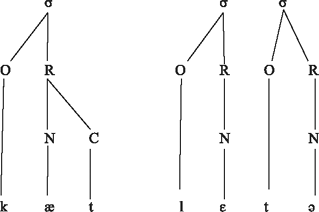
Leslie claimed that as a result of a fast speech syllabification rule, which he called ‘left-capture’ (Kahn's rule III), the onset-t of letter has been captured into the coda of the preceding syllable making it ambisyllabic. (Left Capture is represented in (7) below by the broken association line.) Notice that as a result of this resyllabification process the /t/ in both cat and letter occupies a coda position.
(7)

Although this captures the generalisation, the result is that the /t/ of /lɛtə/ letter is ambisyllabic. Ambisyllabicity is a controversial notion (see, for example, Jensen Reference Jensen2000)Footnote 5 and other accounts have placed the /t/ in a foot-internal position (see, for example, Carr Reference Carr1991). Common to all approaches, is the fact that word-initial-t cannot glottal and this is essential to the analysis to be developed below. We will adopt Leslie's assumptions in this article primarily because they allow us to say something interesting about to-contraction, whereas a foot analysis does not allow us to say anything about the different systems observed. Specifically, if the /t/ of to is word initial, it cannot glottal. In order to glottal, /t/ has to be in the coda of a syllable. This implies some kind of capture. Kahn (Reference Kahn1976) did motivate a fast-speech syllabification rule (rule V) which operated between words, and he used this to argue for flapping in cases such as hit Anne [hɪɾ æn].
(8)

However, notice that Kahn's rule V operates from left to right. Contrast this process with ‘Left Capture’ outlined above. Left Capture (LC) occurs within the prosodic word and applies right to left. Any hiatus of consonants created by LC resyllabification seems irrelevant, for example in contest ambisyllabification produces a coda cluster [nt].
(9)

The fact that the between-word resyllabification applies from left to right and the word-internal process applies in the opposite direction is crucial. If flapping or glottalling affect the initial /t/ of to then it must be located within the word. It is only by locating /t/o within a prosodic word that it can be captured to the left.
In some varieties of British English (London and the North East, for example) glottalling is not restricted to the voiceless alveolar plosive; it affects the natural class of voiceless plosives more generally. Our data did not provide any examples of initial /p, t, k/ glottalling other than cases already widely discussed within the literature (Leslie Reference Leslie1983; Docherty et al. Reference Docherty, Foulkes, Milroy, Milroy and Walshaw1997; Trousdale Reference Trousdale2002). So glottalling does not occur in the voiceless plosives in (10), but has been found in (11) and (12).
(10) did you phone Taˈmara?
She caused such a coˈmmotion.
Peel some poˈtatoes for us.
(11) sometimes, nineteen (Leslie Reference Leslie1983; Docherty et al. Reference Docherty, Foulkes, Milroy, Milroy and Walshaw1997)
Although Docherty et al. mention these cases as examples of word-initial glottalling, Leslie (Reference Leslie1983) does not treat them as such. For Leslie, the examples in (11) are word internal.
(12) Going today/tonight/tomorrow. (Leslie Reference Leslie1983; Docherty et al. Reference Docherty, Foulkes, Milroy, Milroy and Walshaw1997)
Leslie (Reference Leslie1983) assumed that glottalling in the data in (12) arose as a consequence of the encliticisation of to which was ‘feeding left capture’. The data in (10) through (12) are interesting, because they demonstrate that leftward realignment of the /t/ of to is not a general phenomenon affecting all voiceless plosives that are in initial position in an unstressed syllable. Following Leslie (Reference Leslie1983), we assume that the data in (11) are no longer cases of initial /t/ glottalling but are word-internal cases and, as such, sometimes and nineteen can be accounted for in the same way as letter, water, contest etc. If one is not persuaded by the arguments that we develop below, then the onus shifts to the reader to account for why glottalling can occur in /t/o, but not in /t/amara, for example.
To recap and move forward, resyllabification between words (e.g. hit Anne) is found to occur from left to right, whereas the direction is reversed within a word-sized unit. Since glottalling affects to, but no other stressless /tV/ forms, we are not looking at the development of a simple right-to-left between-word resyllabification. The point is that in order to glottal /t/ must be within a word such that it can be captured into the coda of a preceding syllable. In order to isolate this effect to to, we assume that to has been encliticised into the preceding word forming a new prosodic word. This is the background for why we think lenition affecting the /t/ of to is evidence of to-contraction. With this in mind, we can now present some new data to provide a snapshot of the extent of to-contraction.
5 New to-contraction data
We have seen above that the literature is often limited to wanna and gonna, or may encompass the ‘therapy verbs’ or semi-auxiliaries more widely. In this article, we have observed that reduction of the initial /t/ of to is providing evidence for to-contraction. Evidence of more extensive reduction may be indicative that reanalysis has taken place, and both wanna and gonna are cases in point. In the following section, we will present data that show reduction of /t/o in British English varieties. The data presented below clearly show that to-contraction cannot be restricted, as suggested in the literature. Furthermore, the data are set out to show that only a phonological solution will account for the lenition facts presented.
5.1 Methodology
On the basis of some initial observations which seemed to be counter to the general literature on to-contraction, we set about gathering some data to illustrate these observations. Intuitions were not available to the authors, so data had to be gathered from a range of sources both publically available (British Library sound archives, TV programmes) and from our own data collection (recordings and a collection of natural observation). The data were gathered by making a judgment about the presence or absence of lenition affecting the initial /t/ of to. This article presents a challenge to the restricted nature of to-contraction found in the literature, hence any degree of lenition was taken to indicate to-contraction. As the specific degree of lenition was not relevant to the argument, the symbol [ʔ] was used to represent both full glottal replacement and glottalisation.
We chose to represent speakers from both London and the Northeast, in part to limit the search but so that the data could be tied to specific varieties. This contrasts sharply with the literature referred to above which never gives any specific detail about the variety, even if different varieties are suggested (Pullum Reference Pullum1997 provides a perfect example of such practice). However, there is one advantage to these two varieties over a number of others: they both exhibit voiceless plosive glottalling. We had to rule out the possibility that lenition affected voiceless plosives more generally. As stated above, we found no cases of initial /p/ or /k/ glottalling to add to our /t/o glottalling cases. Furthermore, we did not find cases of initial /t/ glottalling other than those already widely documented in the literature.
Although the present data are restricted to London and the Northeast, the kinds of usages are not so restricted and can be found extensively elsewhere in the British Isles. In fact the initial motivation for the article was observations from Leeds, Manchester and London. The footnotes accompanying each block of data give more specific details about the source and subject. With this in mind, the following examples are taken from both Northern and Southern British English speakers and demonstrate that to-contraction is not as restricted as the literature suggests.
5.2 Data
In setting out our data, our first aim is to show that verbs more generally participate in to-contraction:
- (13)
(a) We need to eat it [ni:dʔəɹ i:ʔ ɪʔ]
(b) Come to the mosque [kʊmʔə ðə mɒsk]
(c) All of that fabric began to [bɪɡanʔu] degenerate.
(d) If I don't go to [ɡoːʔə] my lesson.
(e) They would still be to [biːʔə] feed.
(f) That's what I was trying to do [traɪnʔə du]
(g) And I went to [wɛnʔu] Michael's.Footnote 6
The data in (13) would not be categorised as therapy verbs by Pullum (Reference Pullum1997). As noted above, the therapy verbs are a group of semi-auxiliaries and it should be apparent that many of the examples above could be classified as auxiliaries of some type. Quirk et al. (Reference Quirk, Greenbaum, Leech and Svartvik1985) classify need to as a marginal modal; and be to as a modal idiom. They do not, however, classify trying to or begin to as auxiliaries, though some kind of auxiliary status could be attributed to these verbs too. The data are interesting because they indicate that we cannot simply expand the category of to-contraction participators from most semi-auxiliaries to auxiliaries of some kind. Come and go are very common verbs, but they are not auxiliary verbs in the examples given above. Furthermore, they are not followed by particle to, they are followed by prepositional to.
Focusing on go + to, consider the data in (14) below. The data do not exhibit lenition, but they do exhibit deletion which closely resembles that found in wanna and gonna.
(14) Variants of verb + to used in LondonFootnote 7
(a) before I went to [wɛnə] bed.
(b) Oh he's gone to [ɡɒnə] bed already.
(c) Everyone's sodding well gone to [ɡɒnə] work.
(d) When I went to [wɛnə] wee. . .(a cautionary tale about a collapsing cistern).
(e) Have you been to [biːnə] wee? (asked of a cat).
(f) When do you go to [ɡʌuə] school?
(g) Oh, she goes to [ɡʌuzə] work down. . .
Even been to here is a motion verb and is synonymous with gone to. Interestingly, how do we classify been to/went to wee/work? We could argue that they are auxiliary + to verb, but we could argue that they are the equivalent of bed and school. In other words, a main verb of motion + to-preposition phrase. These forms have been included because they are very common in London speech. Regardless, they are not forms of therapy verbs but they add more information to the go to example given above. Furthermore, another fascinating feature of these data is that they are closer in shape to wanna, gonna and Emonds’ example [nidə]. These data also provide a counterexample to claims in the syntactic literature that inflected forms do not show contraction: she goes to [ɡʌuzə] work. Finally, these common pronunciations further undermine the notion of lexeme-specificity and suggest that to-contraction is far more pervasive than attested in the literature.
So, if one accepts the assumption that phonological reduction of the /t/ identified with to indicates contraction, then one has to draw the following conclusions: to-contraction affects a wider group of verbs than previously acknowledged: one that encompasses both auxiliaries and main verbs. Secondly, verb + prepositional to also exhibit to-contraction. Therefore, to-contraction targets both particle and prepositional to. So on the basis of the new data presented above, and the assumption that phonological reduction can reveal to-contraction, it is already apparent that to-contraction is far more extensive than previously acknowledged. However, the extension of to-contraction to include verbs in (13), taken together with the cases in (14), would appear to be fairly conservative and it would not necessarily undermine an affixal analysis. With this in mind, consider the following:
- (15)
(a) Go get something to eat [sʌmfɪnʔəɹ iːʔ].
(b) Wait till you go home to [hoːmʔə] pray.
(c) If you give something to a [sʊmθɪnʔuː ə] good cause . . .
(d) But I think it was the wrong thing to do like [θɪŋʔə deː laɪk].
(e) The pressure to [pɹɛʃəʔə] make this lovely house a home.
(f) For Don to [dɒnʔu] escape to.
(g) they plan to [planʔə] use. . .
Footnote 8 On the basis of the data in (15), it would appear that to-contraction can also involve nouns. Examples (a, b, d, e, f, g) are all instances of noun + particle to, which is a close parallel to the verb cases considered above. However, the importance of (c) is that the to is, once again, prepositional. The data in (16) show that to-contraction is even more extensive:
- (16)
(a) She taught us how to [auʔu] work.
(b) I came right to [ɹаɪʔu] the top.
Footnote 9 This sample of data is taken to be illustrative of to-contraction, because in each instance some degree of lenition has taken place. Hence, the sample strongly suggests that the discussion of to-contraction has been far too restrictive and therefore misplaced. The data also raise further questions, which we pose here but will develop in our ongoing work on to-contraction. The data in (14), for example, offer some mundane everyday utterances and there is nothing in (14) that can be regarded as uncommon, unusual or learned. Therefore, we have begun a corpus-based project to determine precisely which word + to combinations allow to-contraction. Our hypothesis based on work so far is that it affects all commonly occurring word + to sequences, but we leave verification to future work. Further work is also required to study the degree and extent of lenition. For example, in varieties such as London and the Northeast, where reduction of the /t/ in to can occur in different degrees, what is the proportion of lenition-types found? Is the degree of lenition related to the preceding word-final sound? Alternatively, is the degree of lenition tied to frequency of use of the word? Does a greater degree of lenition accompany the most frequent word + to collocations? We assume that frequency almost certainly will condition the degree of lenition, but a full quantitative analysis is now needed to address questions such as these; questions which have only arisen because we have challenged the nature and extent of to-contraction.
In sum, the data presented in this section show that to-contraction is a far more extensive phenomenon than had previously been envisaged. It cannot be restricted to a subcategory of semi-auxiliary; indeed it cannot be restricted to the broader category of verb. Since the wider literature has focused on a narrow category of auxiliaries, there has never been a need to restrict the discussion to particle to. However, the present article demonstrates that to can contract even if it is a preposition. One consequence is that Pullum's affixal analysis can no longer be sustained. As a result, we conclude that the data indicate that a clitic analysis is the only possibility. Furthermore, since a very specific prosodic position is required for any degree of t-lenition to arise, this suggests that to-encliticisation is achieved by prosodic incorporation. We assume, therefore, that to is a phonological clitic. We can now pursue more carefully the details of phonological encliticisation. Again, following Booij (Reference Booij1996) and Anderson (Reference Anderson2005), we will assume that phonological encliticisation takes the form of prosodic incorporation and in the next section we will turn our attention to this matter.
6 To-contraction as encliticisation
In his discussion of simple clitics, Anderson (Reference Anderson2005, citing Selkirk Reference Selkirk, Beckman, Walsh Dickey and Urbanczyk1995) considers three possibilities: 1. Free clitic, 2. Internal clitic and 3. Affixal clitic. Anderson (Reference Anderson2005: 49) treats a reduced can as a free clitic in can aid whereas he assumes the relationship between saw us as being host (saw) and affixal clitic us. These two cases are illustrated in (17a, b) and are set alongside an illustration of an internal clitic structure in (17c).
(17)
The issue is which of these structures will permit sufficient prosodic incorporation so that ambisyllabification and glottalling can arise? In essence, both the free clitic and the affixal clitic structures would result in to being in a distinct prosodic word from the host, a [[host]pwdto]pwd structure. This is too remote, since the ambisyllabicity process would have to operate across a prosodic word boundary, and we have no evidence to suggest that it does so. In section 4.2 above, we rejected any left-to-right trans-word boundary ambisyllabification on the basis that between-word capture seems to operate from left to right. On the basis of considerations such as these, [host to]pwd is the only structure that provides the precise positioning of /t/o that allows it to be captured and lenited. Therefore, we are working on the assumption that to must be encliticised as an internal clitic in order to be able to undergo ambisyllabification and possible glottalling. This is illustrated for something to as the host and clitic in (18) below:
(18)
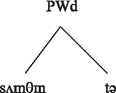
The assumption that to is an internal clitic in to-contraction places to in a prime lenition site: within a word. However, this is still not sufficiently specific. In his discussion of Dutch clitics, Booij (Reference Booij1996: 12) considers that prosodic incorporation could take one of three forms:
(19)

On the basis of both theoretical and language-specific considerations, Booij rejects structures (19b, c). He argues that (19a) is motivated by his data and it allows him to provide a unified account of both pro- and enclitics in Dutch. As we consider these three structures for our data, we will follow Booij (Reference Booij1996) in rejecting structure (19b) without further consideration. We reject this out of hand, because we cannot adduce any motivation for Foot recursivity. Structure (19c), though problematic, cannot be dismissed quite so readily.
The two plausible structures for prosodic words are set out in (20a, b) below:
(20)

The immediate problem with (20b) is that it suggests that to is not fully incorporated into the prosodic structure of the host word. Indeed, (20b) could be a more detailed structure for an affixal clitic rather than for an internal clitic. We assume that (20a) is the only permissible structure for cases such as got to, be to, went to etc. precisely because it is the only structure which places the target /t/ in a position where it can glottal. However, the structure in (20b) cannot be dismissed quite so readily when we consider cases such as wanted to, able to, happen to, something to, or trying to, for example.
(21)

For such examples, Foot Binarity (i.e. the requirement that all feet are binary branching) is violated. Unlike the structure in (20a), which maintains Foot Binarity, we now have cases which would violate this requirement if to is incorporated into the Foot. Hence, we have to consider (20b) as a possible prosodic structure. However, the problems posed by clitics for Foot Binarity are well known and this has lead Booij (Reference Booij1996) and Anderson (Reference Anderson2005) to assume that it cannot be an absolute universal. In what follows, and as a first approximation, we are going to assume that the structures in (20a) and (21a) capture the result of to-encliticisation. This means that incorporation into the prosodic word is thorough and complete. We do so for two reasons: first of all, it allows us to provide a unified account of the to-contraction data. In other words, we can assume one potential structure for got to and something to. Secondly, it will place the to in a structure where /t/ can be captured into a prime lenition position. This is illustrated in (22).
(22)
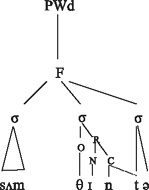
Not only will this unify the to-contraction data, but it will relate glottalling in these data with the more straightforward word-internal cases such as cat, letter and contest.
There is one further advantage to the assumptions promoted here: the proposed structure will also unify the distinct form of to-contraction considered above. More specifically, the London data presented in (14) above ([wɛnə] went to, [biːnə] been to, [ɡʌuzə] goes to, etc.) exhibit a more dramatic reduction but, arguably, the degree of prosodic incorporation is more easily determined as the internal clitic structure selected above and developed in Booij (Reference Booij1996):
(23)

To summarise so far, on the basis of an illustrative sample of data, we have claimed that lenition phenomena, such as glottalling, show that phonological encliticisation has taken place. We claim that t-lenition can be assumed to indicate encliticisation, and we have assumed that the prosodic requirements of t-glottalling suggest that to is an internal clitic.
7 Is every use of to a case of contraction?
We have already stated that we assume wanna and gonna are lexicalised or stored forms and not synchronic to-contractions, but we have not considered the remaining semi-auxiliaries, including the therapy verbs (hafta etc.). There is some evidence to suggest that other semi-auxiliaries may have undergone reanalysis. Krug (Reference Krug2000), for example, argues that have to and have got to may also be undergoing grammaticalisation, at least in some varieties of English. It is entirely possible that such forms have also become stored as lexical forms. However, Krug's work reveals that wanna and gonna are more established in American English than in British English. Based on this, we assume that the status of semi-auxiliaries, as synchronic to-contractions or reanalyses, is likely to be subject to considerable variation. At this point the discussion is in danger of becoming far too speculative. For now, in the absence of grammatical change, if there is evidence of /t/ lenition, the semi-auxiliary exhibits to-contraction.
The forms studied as cases of to-contraction (wanna and gonna) have ceased to be synchronic to-contractions, but what about cases such as:
(24) [wɒnʔə] want to
[ɡoɪnʔə] going to
The forms in (24) can be used alongside wanna and gonna. Indeed, speakers who use gonna and [ɡoɪnʔə], for example, will also use [ɡoɪn tə]. This is not surprising and does not compromise the analysis developed within this article; rather, this is precisely the kind of variation to be expected. When such a speaker uses gonna, for example, this is the selection of a stored form, but when the same speaker selects [ɡoɪnʔə] going to this is a case of synchronic to-contraction. In some respects the real question concerns alternations between the [ɡoɪnʔə] and [ɡoɪn tə] variants of going to. In the latter form the initial /t/ of to remains unchanged and this raises a question about the status of such forms. Unfortunately, it is impossible to judge here whether to-encliticisation has taken place but no lenition, since glottalling is optional, or whether the absence of lenition indicates that to-encliticisation has not arisen. It could also indicate that to-encliticisation has arisen, but perhaps as a free clitic rather than an internal clitic. We have argued above that free clitics lack the degree of prosodic incorporation necessary to facilitate glottalling. Clearly, it is impossible to resolve this issue here and, although we could speculate, it would be just that. In this article, what we can state with some certainty is that data from British English varieties strongly suggest that:
1. When a /t/ exhibits lenition, this is evidence that it has been prosodically incorporated and is an internal clitic. In this case, we have to-contraction.
2. Forms that have been reanalysed (and perhaps grammaticalised) such as wanna and gonna are not synchronic cases of to-contraction.
8 Conclusion
In this article, we set out to show that the extent and nature of to-contraction has not been captured by the literature to date, because researchers have been concerned with two dazzling fossils: wanna and gonna. Although these may have exhibited to-contraction diachronically, they do not do so synchronically. The extensive to-contraction literature has largely ignored phonological considerations, especially where the initial consonant of to is concerned. In this article, we have argued that reduction affecting the initial /t/ signals to-contraction. In essence, a form can be said to have undergone to-contraction if the clitic has been incorporated into its host as an internal clitic. Once it has been incorporated it can undergo reduction processes such as glottalling. Using our data, we have argued that to-contraction is far more extensive than the general literature has ever acknowledged. So in answer to the question ‘to-contraction or not to-contraction?’, look for reduction of the initial consonant of clitic to. If reduction is present, then you have found a case of to-contraction.
Sources
British Library Sound Archive
General links:
http://sounds.bl.uk/Browse.aspx?category=Accents-and-dialects&collection=Millennium-memory-bank
Links referenced in the data set:
Butterknowle, Durham:
http://sounds.bl.uk/View.aspx?item=021M-C0900×01567X-1000V1.xml
Daddry Shield, Durham:
http://sounds.bl.uk/View.aspx?item=021M-C0900×01516X-0100V1.xml
South Shields, South Tyneside:
http://sounds.bl.uk/View.aspx?item=021M-C0900×11105X-0600V1.xml
Stannington, Northumberland:
http://sounds.bl.uk/View.aspx?item=021M-C0900×11020X-0100V1.xml
or
www.bl.uk/learning/langlit/sounds/text-only/england/stannington/
Sunderland:
http://sounds.bl.uk/View.aspx?item=021M-C0900×11002X-0100V1.xml


