INTRODUCTION
Seedlings must recruit and make the transition to older life stages for plant populations to persist. The ability of plants to successfully recruit is limited by a wide range of biotic and abiotic factors (Kitajima & Fenner Reference KITAJIMA, FENNER and Fenner2000), including fruit production and seed dispersal (Nathan & Muller-Landau Reference NATHAN and MULLER-LANDAU2000, Russo et al. Reference RUSSO, PORTNOY and AUGSPURGER2006, Schupp et al. Reference SCHUPP, MILLERON, RUSSO, Levey, Silva and Galetti2002, Turnbull et al. Reference TURNBULL, CRAWLEY and REES2000). Cohorts of seedlings under reproductive trees are likely to experience strong distance- or density-dependent mortality as a result of increased intraspecific competition and/or pathogen and insect attacks (Alvarez-Loayza & Terborgh Reference ALVAREZ-LOAYZA and TERBORGH2011, Connell Reference CONNELL, den Boer and Gradwell1971, Harms et al. Reference HARMS, WRIGHT, CALDERON, HERNANDEZ and HERRE2000, Janzen Reference JANZEN1970, Terborgh Reference TERBORGH2012). Seed dispersal away from fruiting trees is expected to improve the chances for seedling establishment and transition to later life stages (Howe & Smallwood Reference HOWE and SMALLWOOD1982). As seed and seedling densities decrease with distance from fruiting trees, probability of survival is expected to increase, leading to greater recruitment at distances from the adult trees that vary with species and presence or absence of pathogens, as well as insects that kill seeds or seedlings. However, the distribution of new recruits may also be influenced by microclimatic conditions. Local depletion of critical nutrients, light and water availability, and increased temperature can severely impact seedling recruitment (Clark & Clark Reference CLARK and CLARK1989). With fragmentation of tropical forests occurring throughout the world, it is useful to distinguish expected density-dependent effects of biotic interactions from mortality by abiotic causes.
Current knowledge suggests poor regeneration of animal-dispersed trees in fragmented forests due to limited seed dispersal (Cordeiro & Howe Reference CORDEIRO and HOWE2001). Loss of primary seed dispersers is potentially catastrophic for tree populations, as lack of dispersal leads to higher seed mortality, which then reduces seedling establishment and survival of seedlings that do establish (Muller-Landau Reference MULLER-LANDAU2007, Wright Reference WRIGHT2003). Additionally, fragmented forests often experience altered microclimatic conditions such as elevated temperatures, reduced humidity, greater ambient light and increased evapotranspiration, often resulting in the loss of soil moisture (Kapos Reference KAPOS1989, Malcolm Reference MALCOLM1998). Drought-sensitive plant species may experience reduced seedling survival and growth in forest fragments as a result of physiological stress imposed by altered microclimatic conditions (Bruna Reference BRUNA2002). Many plant species may be missing from forest fragments as a result of unfavourable abiotic challenges to the recruitment process.
We report regeneration patterns of Poulsenia armata (Moraceae), a widespread animal-dispersed old-growth canopy tree, in a continuous forest and forest fragments in the lowland rain forest of Los Tuxtlas in southern Veracruz, Mexico. The Los Tuxtlas region is heavily fragmented by forest conversion to pastures, plantations and crops (Mendoza et al. Reference MENDOZA, FAY and DIRZO2005). Declines or local extinctions in Los Tuxtlas forest fragments are well known for the howler monkey (Alouatta palliata mexicana Merriam, 1902), quite likely the primary seed disperser of P. armata in continuous forests of the Los Tuxtlas region (Estrada & Coates-Estrada Reference ESTRADA and COATES-ESTRADA1984). Consistent with evidence elsewhere in the tropics (Benitez-Malvido Reference BENITEZ-MALVIDO1998, Bruna Reference BRUNA2002, Reference BRUNA2003; Cordeiro & Howe Reference CORDEIRO and HOWE2001), we predicted that regeneration of P. armata is negatively affected in forest fragments. We used densities of P. armata close to adult trees to test for poor regeneration in forest fragments due to strong density-dependent mortality. Additionally we predicted low seedling and juvenile survival and growth as a result of strong density-dependent effects. We included seedlings as well as juveniles as density dependence may also affect later life-stages. We hypothesized: (1) denser aggregations of seedlings near fruiting P. armata trees in forest fragments when compared with the continuous forest, (2) low densities in forest fragments due to greater seedling mortality, and (3) strong negative density-dependent effects on seedling survival and growth. Alternatively, we tested for evidence that seedling survivorship and growth might be the result of higher daily temperatures due to forest fragmentation.
METHODS
Study area
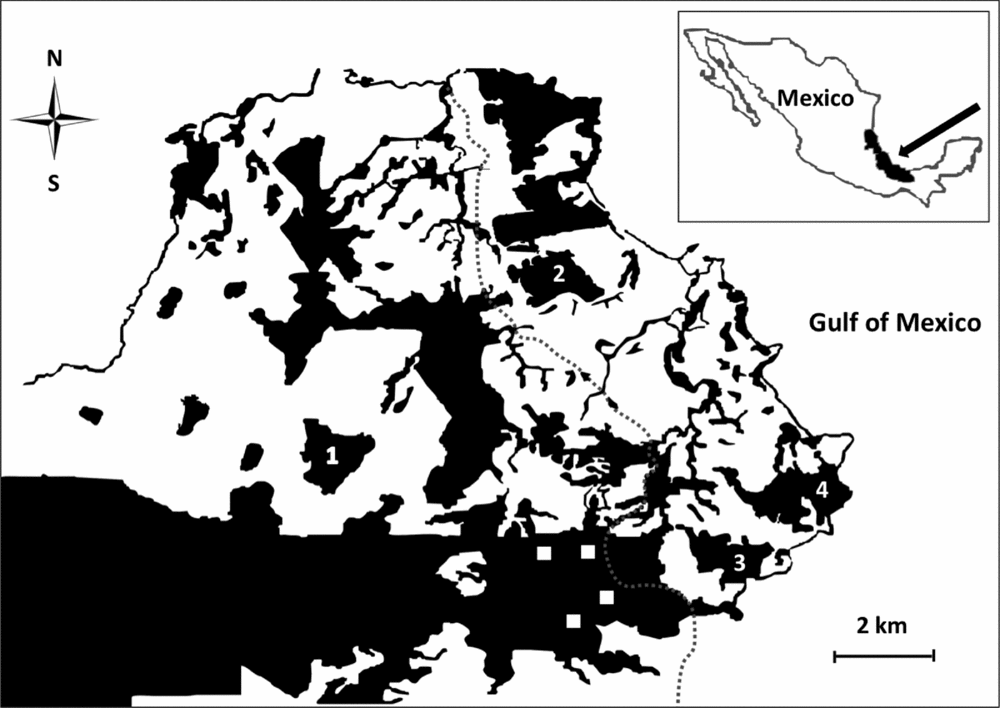
The Los Tuxtlas region represents the northernmost limit of Neotropical rain forest (18º30′N, 95º04′W) (Guevara et al. Reference GUEVARA, LABORDE and SANCHEZ-RIOS2004). Study sites were in lowland forest in a rugged landscape of volcanic origin, within the 118 km2 of forest remaining (García-Aguirre et al. Reference GARCIA-AGUIRRE, ALVAREZ, DIRZO, ORTIZ and ENG2010). The Los Tuxtlas forest experiences a dry season from March to June and a wet season from July to February (Bongers et al. Reference BONGERS, POPMA, CASTILLO and CARABIAS1988). The continuous forest of this study encompasses the 640-ha property of the Los Tuxtlas Biological Field Station created in 1967 by the Universidad Nacional Autonoma de Mexico; this reserve is embedded in 35000 ha of rain forest that forms part of the Los Tuxtlas Biosphere Reserve (Mendoza et al. Reference MENDOZA, FAY and DIRZO2005). Four forest fragments near the Los Tuxtlas Biological Station were selected for this study based on the presence of reproductive trees of P. armata (Figure 1). Forest fragment sites included here are Rancho Eugenia (19.4 ha), Playa Escondida (40 ha), Balzapote (34.6 ha) and Ruiz Cortinez (~20 ha). All forest fragments have been isolated for 30–40 y (Mendoza et al. Reference MENDOZA, FAY and DIRZO2005). As part of a demographic study of P. armata, four1-ha permanent vegetation plots were established within the continuous forest and four 1-ha plots in the selected fragments (Figure 1).
The northern area of Los Tuxtlas Biosphere Reserve. Continuous forest and forest fragments are depicted in black. White rectangles represent the area of study inside the Los Tuxtlas Biological Field Station. Forest fragments included in this study are Ruiz Cortinez (1), Balzapote (2), Rancho Eugenia (3) and Playa Escondida (4). Image was provided by Alejandro Estrada and modified by J. Zambrano.

Study species
Poulsenia armata (Miq.) Standl. (Moraceae) is a monoecious, shade-tolerant late-successional canopy tree (Croat Reference CROAT1978). This is an old-growth and moderately common species of moist and wet lowland tropical forests from Mexico to Bolivia (Aide & Rivera Reference AIDE and RIVERA1998, Brewer et al. Reference BREWER, REJMANEK, WEBB and FINE2003, de la Quintana Reference DE LA QUINTANA2005, Dick et al. Reference DICK, LEWIS, MASLIN and BERMINGHAM2013, Smith & Killeen Reference SMITH and KILLEEN1998). Despite low wood density (Chave et al. Reference CHAVE, MULLER-LANDAU, BAKER, EASDALE, STEEGE and WEBB2006, 0.35 g cm−3), growth is slow to a maximum stature of 20–40 m (Martínez-Garza et al. Reference MARTÍNEZ-GARZA, PENA, RICKER, CAMPOS and HOWE2005). Seedlings and later life-stages of P. armata are drought-sensitive (Martínez-Garza et al. Reference MARTÍNEZ-GARZA, BONGERS and POORTER2013a, b). Individuals produce separate male and female inflorescences; likely pollinators are thrips (Thysanoptera; Sakai Reference SAKAI2001). Bimodal fruit production occurs April–May and October–November. Medium-sized fleshy fruits (average width ~ 40 mm) hold 2–17 seeds with a thin, smooth coating. Seeds are 7–9 mm long and 5–8 mm wide, and weigh 0.146 ± 0.017 g. Seeds germinate in less than 30 d (Rodriguez et al. Reference RODRIGUEZ, OROZCO-SEGOVIA, SANCHEZ-CORONADO and VAZQUEZ-YANES2000).
The brownish P. armata fruit of moderate size appeals to a variety of mammals throughout its vast range. In large forest tracts of the Los Tuxtlas region, a particularly important seed dispersal agent for P. armata is the mantled howler monkey (Alouatta palliata mexicana) (Estrada & Coates-Estrada Reference ESTRADA and COATES-ESTRADA1984). Fruits are also consumed by fruit bats (Artibeus jamaicensis, A. lituratus) at this site. Seeds deposited in caves have dim prospects for survival (Vazquez-Yanes et al. Reference VAZQUEZ-YANES, OROZCO, FRANÇOIS and TREJO1975), but some are likely to be effectively dispersed. An additional study at Los Tuxtlas reports P. armata seeds recovered from captured brown jay (Psilorhinus morio) and ground dove (Leptotilia plumbeiceps), suggesting that fruit-eating birds are at least potential dispersal agents (Trejo-Pérez et al. Reference TREJO-PÉREZ, GOMEZ-COMPA, VASQUEZ-YANES, Gomez-Pompa, Vazquez-Yanes, del Amo Rodríguez and Butanda1976). Seed predators include small rodents (Heteromys desmarestianus; Dirzo et al. Reference DIRZO, MENDOZA and ORTÍZ2007, Martínez-Gallardo & Sanchez-Cordero Reference MARTINEZ-GALLARDO and SANCHEZ-CORDERO1993) and likely larger rodents (e.g. Dasyprocta mexicana, Cuniculus paca).
Data collection
To assess recruitment of P. armata in the continuous and fragmented forests, we established a 40º wedge-transect extending 30 m from the base of 22 fruiting trees. In 2010, we randomly sampled 11 adult individuals in the continuous forest and another 11 adults in forest fragments inside the vegetation plots. Wedge transects estimate recruitment as a consequence of dispersal away from fruiting trees. Initial direction of each transect was chosen randomly; to avoid confounded transects from different fruiting trees, transects were discarded and replaced if they approached another reproductive tree within 40 m. Study trees were located inside the forest fragments at least 100 m from the forest edge. We counted all the individuals of P. armata and classified these into seedlings with cotyledons and juveniles <150 cm in height. Seedlings were from the 2009 fruiting period. We measured, tagged and calculated the distance to conspecific adults for all individual seedlings and juveniles encountered along transects. For data analysis, we corrected by area the number of individuals, as area increased with distance from adults, and converted these to estimates of density (ind. m−2) of P. armata. To evaluate survival in the 2011 and 2012 censuses, we recorded the number of surviving seedlings and juveniles previously tagged in 2010. We identified causes of mortality as either tree fall, herbivory (insects or vertebrates), pathogen infestation, trampling or desiccation. Herbivory occurred mostly in seedlings that had not fully developed spines on the leaves.
To compare vertical plant growth between the continuous and forest fragments, height increment was calculated for each individual plant from 2010 to 2012. Height increment (cm) was estimated as:
 \begin{equation*}
{\rm (lnH}_{{\rm t2}} \;{\rm - }\;{\rm lnH}_{{\rm t1}} {\rm )/(t}_{\rm 2} \;{\rm - }\;{\rm t}_{\rm 1} {\rm )}
\end{equation*}
Where Ht2 = height recorded at t2, Ht1 = height recorded at t1, and t2 – t1 = time elapsed between measurement (1 y). Additionally, we recorded adult tree diameter at breast height (dbh) and canopy size. Estimates of canopy size were measured for each reproductive adult using a crown radius. Crown area was calculated as an ellipse and determined by:
 \begin{equation*}
{\rm 0}{\rm .25}\pi \times {\rm D}_{\rm 1} \times {\rm D}_{\rm 2}
\end{equation*}
Where D1 and D2 are two perpendicular cross-section diameters of the crown (Bongers et al. Reference BONGERS, POPMA, CASTILLO and CARABIAS1988). Fruit production was recorded from 2010 to 2012. We quantified fruit production by directly counting fruits on five randomly selected branches, estimating the average number per branch and multiplying by the total number of comparable branches on the tree.
HOBO data loggers (HOBO UA-002–08) were used to record daily temperature (°C) from May to July of 2010 to 2012. The temperature sensor has a range from −20° to 70°C with an accuracy of ± 0.53°C from 0° to 50°C. Loggers were attached at the height of standard dbh on the trunks of selected P. armata trees. Hourly measurements over the span of each day were averaged to compute daily means as well as daily maximum and minimum temperatures. Using temperature data during the dry period, when plants will be water stressed, may indicate a stronger correlation with plant survival and growth.
Statistical analyses
We conducted all the analyses using the R environment (version 2.15.1, 2012). A common feature of ecological data is the tendency to contain many zero values (Martin et al. Reference MARTIN, WINTLE, RHODES, KUHNERT, FIELD, LOW-CHOY, TYRE and POSSINGHAM2005), which was the case in this study. An alternative to analyse this type of data is to separately model the occurrence of zero values and positive values (Fletcher et al. Reference FLETCHER, MACKENZIE and VILLOUTA2005). Therefore, to analyse factors affecting density and distribution of P. armata with respect to distance from adult trees we used two complementary models, one including presence/absence data and the other one describing density data. We created two datasets: one indicating whether P. armata was present or not within vegetation transects (presence data), the other showing density data when P. armata was present (density data). Density data were logarithmically transformed and distance data were binned (e.g. 0–1 m, 1–2 m, etc.). We constructed two models; a generalized linear mixed model (GLMM), with a binomial distribution, to describe factors affecting the presence and absence of P. armata in the transects, and a linear model to describe density data. Results of both models were used to make inferences regarding which factors best explain the distribution and density of P. armata in forest fragments. In both models, we defined fixed factors as habitat type (continuous forest or forest fragments), life stage (seedlings or juveniles), distance to parental adults as a continuous variable, and reproductive trees (n = 22) as a random effect nested within plot (n = 8). We used the Akaike´s Information Criterion (AIC) for model selection. We then calculated the best-fit curves to represent the relationships between distance to adult trees and seedling and juvenile densities in both habitats to determine if dispersal limitation resulted in dense aggregation of seedlings under reproductive adults. Differences in fruit production, tree and crop size were determined using Student's t-tests. Furthermore, we applied an ANOVA to test for differences on mean daily temperature and the absolute range (differences between daily maximum and minimum temperatures) between habitat type and census year.
To determine potential relationships between density and distance from adult trees and recruitment success, we used a linear mixed model for plant growth and a generalized linear mixed model (GLMM) for plant survival. We included habitat type (continuous forest or forest fragments), life stage (seedlings or juveniles), mean daily temperature and census year (2011, 2012) as fixed effects. Reproductive tree (n = 22) was nested within plot (n = 8) and included as random effect. The GLMM assumed a binomial data structure (individuals either survive or die) and included a logit link function. Since density and distance from adult trees were highly correlated, we ran the models separately to avoid density and distance continuous variables. We used F-tests for linear mixed models and Wald Z-test for GLMMs to determine the significance of fixed effects. Each random effect was tested by comparing nested models with and without the random effect using a χ2 test. Best models fitting plant survival and growth data were selected using the AIC values to compare models including all fixed and random effects against more simplified models.
RESULTS
Fruit production and adult tree size
Trees in the continuous forest and forest fragments differed in crop and tree sizes. Fruit crop sizes of reproductive trees (mean ± SD) differed significantly between habitats (t = 2.70, P < 0.001), with greater fruit production in the continuous forest (123 ± 14.9 fruits) than in forest fragments (78.1 ± 12.7 fruits). Habitat type also differed in tree size (t = 2.04, P = 0.04) and crown size (t = 12.1, P < 0.01), with trees from the continuous forest larger in size (39.6 ± 7.76 cm dbh) than trees in forest fragments (29.5 ± 8.02 cm dbh). Similarly trees from the continuous forest had a larger crown area (225 ± 70.0 m2), than trees from forest fragments (128 ± 46.0 m2).
Temperature in the continuous forest and forest fragments
Average daily temperature differed 2°C between habitats and significantly varied between plots (F7, 377 = 25.0, P < 0.001). Mean daily temperature for the continuous forest (26.5°C ± 1.98°C) was generally lower than mean daily for forest fragments (28.5°C ± 1.80°C). However, a post hoc analysis revealed that differences between habitats were mainly explained by high temperatures found in the Balzapote (27.2°C ± 1.62°C), Playa Escondida (28.8°C ± 1.97°C) and Rancho Eugenia (28.5°C ± 1.43°C) plots. Absolute ranges in daily temperature significantly differed between habitat type (F1, 377 = 189, P < 0.001) and plots (F7, 377 = 31.9, P < 0.001). Absolute ranges in daily temperature were significantly lower in the continuous forest (5.56°C ± 2.26°C), than in forest fragments (9.82°C ± 3.99°C), implying a more even daily temperature condition in this environment. A post hoc analysis revealed that differences between habitats were mainly due to higher fluctuations of temperature in plots from the forest fragments, with the Balzapote plot displaying the highest fluctuation (11.6°C ± 2.53°C). Year had a significant effect on mean daily temperature (F1, 377 = 125, P < 0.001) and temperature absolute range (F1, 377 = 49.9, P < 0.001). In 2012, most of the vegetation plots experienced an increase in average temperatures (2012 = 28.3°C ± 2.02°C) and larger ranges (8.54°C ± 1.51°C) compared with the previous census year (average temperature = 26.6°C ± 1.89°C, absolute range = 6.79°C ± 1.32°C).
Poulsenia armata density
Presence of Poulsenia armata was significantly affected by habitat type (Z = −2.23, P = 0.025), with more individuals present in forest fragments. No significant variation was explained by reproductive tree (χ2 = 18.1, P = 0.99) or plot (χ2 = 0.21, P = 0.64). We found no effect of distance (Z = 1.65, P = 0.09) and life stage (Z = −1.30, P = 0.19). There was a significant interaction between habitat type and life stage (Z = 3.44, P < 0.001), with more seedlings present in forest fragments than in the continuous forest. Of 238 individuals tagged in 2010, 34% represented seedlings in the forest fragments while 15% of P. armata individuals were seedlings in the continuous forests.
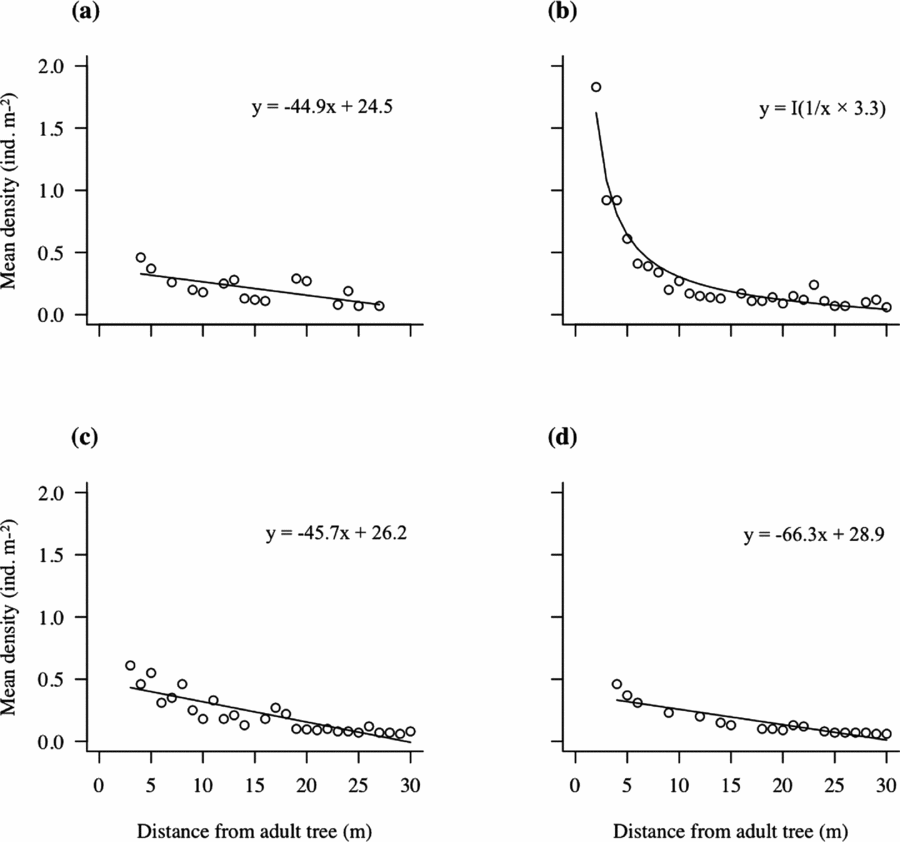
As expected, P. armata density was significantly affected by distance to adult tree (t = −10.7, P < 0.001). Overall recruitment occurred close to adult trees (Figure 2). We found a strong negative correlation between distance from adult tree and density of the species studied (R2 = −0.83, t = −19.3, P < 0.001). No significant variation was explained by reproductive tree (χ2 = 5.48, P = 1.00) or plot (χ2 = 0.56, P = 0.56). Plant density (mean ± SD) did not differ between habitats (continuous forest = 0.20 ± 0.03 ind. m−2, fragments = 0.24 ± 0.06 ind. m−2; t = −0.85, P = 0.39). However, there was a strong interaction between habitat type and life stage (t = 5.38, P < 0.001). Densities of forest fragments were mostly represented by seedlings (74%), while densities in the continuous forest were mainly represented by juveniles (73%). Moreover, we found a significant interaction between habitat type, life stage and distance to adult tree (t = 3.07, P < 0.01). Seedling densities were significantly higher close to adult trees in forest fragments compared with continuous forest sites (Figures 2a and 2b). Seedling distributions in forest fragments fitted a non-linear regression (Figure 2b, R2 = 0.51, F1, 16 = 14.8, P < 0.01), while seedlings in the continuous forest fitted a linear regression (Figure 2a, F1, 27 = 21.1, P < 0.001). Similarly, juvenile distribution was best described by simple linear regressions in the continuous (Figure 2c, R2 = 0.74, F1, 27 = 72.4, P < 0.001) and forest fragments (Figure 2d, R2 = 0.82, F1, 18 = 76.68, P < 0.001).
Relationship between density and distance from adult tree (m) of Poulsenia armata. Dots represent untransformed mean density for seedlings in the continuous forest (a) and forest fragments (b), and for juveniles in the continuous forest (c) and forest fragments (d) at Los Tuxtlas based on the density data. Distribution of seedlings in the fragmented forests best fitted a non-linear function, while seedlings in the continuous forest and juveniles fitted linear regression functions.

Plant survival and growth
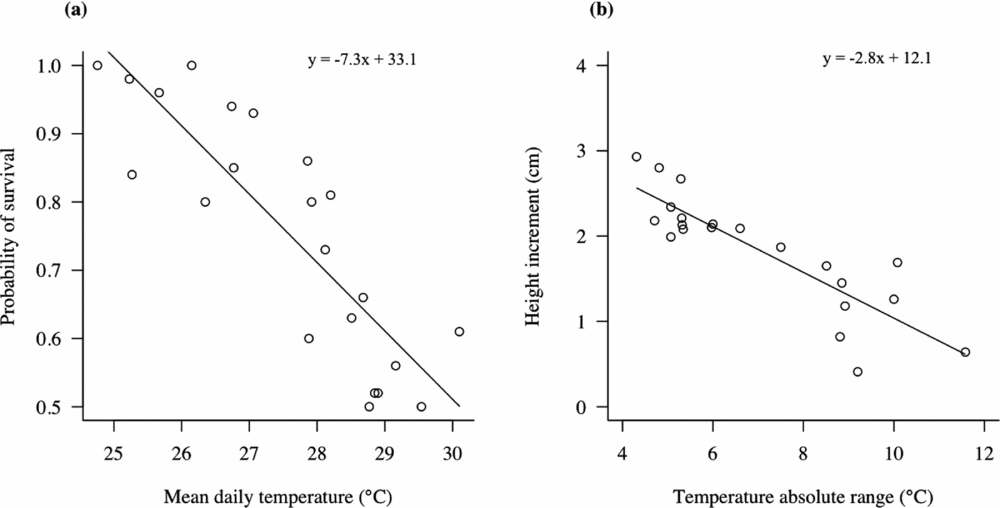
Probability of survival over 2 y was higher in continuous forest sites (0.93 ± 0.16) than in forest fragments (0.62 ± 0.28), and likelihood of survival was greater for juveniles (0.95 ± 0.12) than seedlings (0.61 ± 0.29). Fifty-four per cent of seedlings died in forest fragments, while 29% of seedlings died in the continuous forest. Neither reproductive tree (χ2 = 31.3, P = 0.94) nor plot (χ2 = 23.4, P = 0.99) explained any of the variation observed in the data. Plant survival was significantly affected by habitat type (Z = −4.33, P < 0.001), life stage (Z = −6.23, P < 0.001) and daily temperature (Z = −2.89, P < 0.01). Relationship between survivorship and daily temperatures was best described by a simple linear regression (Figure 3a, R2 = 0.73, F1, 22 = 54.5, P < 0.001). Contrary to expectation, survival was independent of plant density (Z = 0.50, P = 0.61) and distance from adult tree (Z = 0.30, P = 0.77). Census year had a significant effect on plant survival (Z = −2.89, P < 0.01), with lower plant survival in the year of 2012 (0.74 ± 0.24) when compared with the previous census year (0.83 ± 0.18)
Effects of temperature on survival and growth of Poulsenia armata. Dots indicate mean survival and plant growth after 2 y of census based on habitat type (a) and life stage (b). Survival likelihood was greater at lower mean daily temperature, and growth in height increments was higher at low absolute ranges of temperature (differences between daily maximum and minimum temperatures). Relationships between temperature and plant survival and growth were described by linear regressions

Seedling carpets close to conspecifics in forest fragments suggested little if any influence of insects or pathogens on seed mortality. We did not find evidence of trampling in either habitat. With 65% of dead individuals (n = 50), death by desiccation was the primary source of mortality for new recruits and juveniles in the forest fragments, while with 60% of dead individuals (n = 12), vertebrate herbivory was the source in continuous forest.
Similarly to plant survival, no significant variation in plant growth was explained by reproductive tree (χ2 = 0.06, P = 1.00) or plot (χ2 = 0.02, P = 1.00). Plant growth was lower in forest fragments (1.41 ± 0.49 cm) than in continuous forest sites (2.11 ± 0.27 cm) and was greater for seedlings (2.16 ± 3.34 cm) than juveniles (1.45 ± 0.42 cm). Plant growth was significantly affected by habitat type (t = −2.15, P < 0.001), life stage (t = −3.18, P < 0.01) and temperature absolute range (t = −2.02, P = 0.04). Relationship between plant growth and temperature absolute ranges was best described by a simple linear regression (Figure 3b, R2 = 0.74, F1, 22 = 56.2, P < 0.001). Census year had no significant effect on growth (t = 1.72, P = 0.09). As with survivorship, we found no patterns of density-dependent (t = −1.36, P = 0.18) and distance-dependent growth (t = 1.5, P = 0.14). Therefore, seedling and juvenile growth depended on habitat type, life stage and temperature absolute range.
DISCUSSION
Most mortality in the life cycle of trees occurs in the seed or seedling stages (Howe & Miriti Reference HOWE and MIRITI2004). Tree species vary widely in the extent to which this early mortality is density-dependent, with most species showing substantial negative density-dependent mortality in the seed stage (Harms et al. Reference HARMS, WRIGHT, CALDERON, HERNANDEZ and HERRE2000) or in dense cohorts of seedlings near fruiting conspecifics (Alvarez-Loayza & Terborgh Reference ALVAREZ-LOAYZA and TERBORGH2011). Here we predict that loss of key dispersal agents results in higher densities of seedlings and juveniles under fruiting trees in forest fragments than in continuous forest with a full complement of dispersal agents. Many dispersal agents in continuous forests are missing in fragments at Los Tuxtlas, and higher densities of P. armata seedlings do occur near fruiting conspecifics in forest fragments. As yet, however, there is no indication that diminished dispersal assemblages in fragments result in more density-dependent mortality than in continuous forest. Dense aggregations of seedlings near fruiting trees in forest fragments instead succumb to desiccation rather than mortality from biotic causes. The prediction that strong density-dependent mortality would be exacerbated in forest fragments due to disperser loss was not borne out in the case of P. armata. Absence of measurable negative density-dependent mortality, at least through the seedling and juvenile stages, suggests that P. armata may be tolerant to loss of some of its dispersal agents. However, negative effects of higher temperatures on seedling survival indicate that this tree may not be tolerant to abiotic changes due to forest fragmentation such as increased ambient temperature.
Despite potentially heavy use by bats and other fruit-eating mammals, P. armata is likely to be dispersal-limited where the howler monkey (Alouatta palliata mexicana) is no longer an effective dispersal agent at Los Tuxtlas. Primates play a well-recognized role in seed dispersal and plant recruitment for tree species in unbroken tropical forests (Anzures-Dadda et al. Reference ANZURES-DADDA, ANDRESEN, MARTÍNEZ and MANSON2011, Chapman & Chapman Reference CHAPMAN and CHAPMAN1995, Effiom et al. Reference EFFIOM, NUNEZ-ITURRI, SMITH, OTTOSSON and OLSSON2013, Nuñez-Iturri et al. Reference NUÑEZ-ITURRI, OLSSON and HOWE2008). Absence of a primary dispersal agent affects tree recruitment to different degrees. In Himalayan foothills, large-seeded Chisocheton paniculatus (Meliaceae) fails to recruit seedlings in areas where hornbills have been hunted out, while smaller-seeded Polyalthia simiarum (Annonaceae) shows substantial recruitment where hornbills, the usual dispersal agents, have been exterminated, but where the imperial pigeon persists (Sethi & Howe Reference SETHI and HOWE2009). Poor recruitment of large-seeded tree species also occurs in Africa and the western Amazon in areas where primates and large fruit-eating birds have been exterminated by hunting, as compared with similar sites where hunting with firearms does not occur (Effiom et al. Reference EFFIOM, NUNEZ-ITURRI, SMITH, OTTOSSON and OLSSON2013, Nuñez-Iturri et al. Reference NUÑEZ-ITURRI, OLSSON and HOWE2008, Terborgh et al. Reference TERBORGH, NUNEZ-ITURRI, PITMAN, VALVERDE, ALVAREZ, SWAMY, PRINGLE and PAINE2008). In this study, the observation that seedlings occur and survive in dense aggregations indicates a species that is initially resistant to immediate agents of seed and seedling mortality (Howe Reference HOWE1989). Substantially higher seedling densities under reproductive trees of P. armata in forest fragments in the absence of howler monkeys indicate loss of the primary dispersal agent, and failure of other fruit-eating animals to compensate for their loss.
As expected, our results show differences in survival patterns, with seedling survival significantly lower in forest fragments than in the continuous forest. Fewer seedlings surviving to older stages further confirm decreased recruitment success due to demographic differences in continuous forest as compared with fragmented forest habitats. The expectation that higher densities near fruiting trees and lower recruitment beyond the seedling stage results from density-dependent mortality (Connell Reference CONNELL, den Boer and Gradwell1971, Harms et al. Reference HARMS, WRIGHT, CALDERON, HERNANDEZ and HERRE2000, Janzen Reference JANZEN1970) was not supported in our study. For the census years of our study, individual survival is independent of plant density and distance to conspecifics.
Differences observed in P. armata seedling and young juvenile densities could be explained by other factors. Decreased fruit production observed in forest fragments could have negatively impacted plant recruitment by decreasing the number of potential recruits. Although P. armata fruit production was greater in the continuous forest, seedling densities were higher in forest fragments, which is inconsistent with an important effect of low fruit production for limited P. armata recruitment. Additionally leaves of P. armata sustained damage by pathogens (chlorotic spots) and herbivorous insects as previously described by García-Guzmán & Dirzo (Reference GARCÍA-GUZMÁN and DIRZO2004), this was not associated with plant mortality at the study sites.
Changes in the terrestrial mammal community are likely to account for differences in recruitment success observed in the continuous forest and forest fragments. The collared peccary (Pecari tajacu Linnaeus, 1758) may have an important negative impact on seedling establishment due to herbivory and trampling. Camera traps showed that this peccary is still present in the continuous forest of Los Tuxtlas area, but it is nearly extinct in forest fragments (Estrada et al. Reference ESTRADA, COATES-ESTRADA and MERRIT1994, Zambrano & Coates unpubl. data). The absence of potential herbivores makes herbivory an unlikely explanation for increased mortality in forest fragments. Greater seed predation in fragmented forest occurs for some tree species (Jorge & Howe Reference JORGE and HOWE2009, Wright & Duber Reference WRIGHT and DUBER2001), but we had no evidence of it in this study. Results from a removal experiment conducted in the same study sites showed that differences in the faunal communities were associated with reduced fruit removal and seed predation of P. armata in forest fragments (Zambrano & Coates, unpubl. data). The fauna of the fragmented forest was mainly represented by omnivorous species such as the coyote (Canis latrans Say, 1983), raccoon (Procyon lotor Linnaeus, 1758), opossum (Philander opossum Linnaeus, 1758), armadillo (Dasypus novemcinctus Linnaeus, 1758) and skunk (Conepatus semistriatus Boddaert, 1785). Frugivorous and seed-eating species such as the peccary, agouti (Dasyprocta mexicana, Saussure, 1860), paca (Cuniculus paca Linnaeus, 1766) and coati (Nasua narica Linnaeus, 1766) were only recorded in continuous forest. Presence of large frugivores and herbivores may explain the observation of reduced density of seedlings in the continuous forest, while their absence might have resulted in greater seedling densities in forest fragments.
Altered microclimatic conditions are another possible mechanism affecting recruitment success. In this study, differences in abiotic conditions in forest fragments were associated with lower survival and growth in P. armata. Forest fragments are generally characterized by increased temperatures (Benitez-Malvido Reference BENITEZ-MALVIDO1998, Bruna Reference BRUNA2002), paralleling our results. Elevated temperatures generally result in increased photorespiration reducing photosynthetic rates and carbon gains (Saxe et al. Reference SAXE, CANNELL, JOHNSEN, RYAN and VOURLITIS2001). Therefore, by limiting photosynthetic activity, higher temperatures have the potential to reduce plant growth (Higuchi et al. Reference HIGUCHI, SAKURATANI and UTSUNOMIYA1999), which may explain our observations in forest fragments. Limited growth may affect the capacity of water reserves and water transport (McDowell et al. Reference MCDOWELL, PHILLIPS, LUNCH, BOND and RYAN2002), reducing drought tolerance and seedling survival in forest with higher temperatures. Poulsenia armata is known to be drought-sensitive in Panama (Condit et al. Reference CONDIT, HUBBELL and FOSTER1995, Reference CONDIT, HUBBELL and FOSTER1996); excessive evapotranspiration at high temperatures may be the explanation for low survival in forest fragments. Moreover, high temperatures combined with poor soil conditions may significantly reduce survivorship and growth as plants experience abiotic stress (Laurance et al. Reference LAURANCE, FERREIRA, RANKIN-DE MERONA, LAURANCE, HUTCHINGS and LOVEJOY1998). Soils from forest fragments at Los Tuxtlas have significantly less nitrogen and water available to plants which, combined with the lack of plasticity of P. armata in allocation of biomass to roots (Zambrano and Meler, unpubl. data), may explain the differences in survival and growth patterns observed between both habitats. Increased survival suggests that the growth strategy observed in the continuous forest seems to be more advantageous for individuals of P. armata.
Finally, it should be noted that patterns of cohort mortality occur at different times in the life cycle in different tree species (Comita et al. Reference COMITA, MULLER-LANDAU, AGUILAR and HUBBELL2010). It is notable that seedlings were recorded in higher densities under fruiting P. armata in forest fragments than in continuous forest, but did not experience measureable distance- or density-related mortality in the first years after establishment. Long-term studies of tree demography in Panama indicate that few species show the same associations with different habitats (plateau, slope, streamside, swamp) as seedlings than as adults (Comita & Hubbell Reference COMITA and HUBBELL2009). The same study indicates that most species for which data are sufficient show stronger negative effects of conspecific neighbours than heterospecific neighbours. Mortality from desiccation, reported here for the first time linked to higher ambient temperatures in fragments than continuous forest, appears to be density-independent in early seedling and juvenile stages, but may or may not be density-dependent later in life.
CONCLUSION
As fragmentation of natural habitats in tropical regions continues to be a major threat to biodiversity, it is necessary to evaluate the consequences on the remaining flora and fauna of these areas. Results of this study are consistent with other studies conducted in Los Tuxtlas area where plant recruitment is affected by fragmentation (Arroyo-Rodriguez & Mandujano Reference ARROYO-RODRIGUEZ and MANDUJANO2006, Arroyo-Rodriguez et al. Reference ARROYO-RODRIGUEZ, AGUIRRE, BENITEZ-MALVIDO and MANDUJANO2007). The apparent sensitivity of this species to drought dims its prospects in highly fragmented landscapes, particularly in landscapes where temperatures are likely to increase over the foreseeable future.
ACKNOWLEDGEMENTS
We thank the staff of Los Tuxtlas Biological Station and members of the Laguna Escondida and Balzapote communities for their assistance in the field. We thank E. Arnold, L. Borghesio, K. Brausnkill, M. de la Peña, C. Guzman, M. Jorgensen, C. Seltzer, Y. Xiao and D. Zaya for their comments on earlier versions of the paper. Fieldwork was supported by grants from Rufford Foundation, NSF (DEB 0516259 to H. F. H), Idea Wild, Sigma Xi and a Hadley Award from the University of Illinois at Chicago.