Introduction
Drosophila suzukii (Matsumura) (Diptera: Drosophilidae) is an invasive insect pest on several continents, including Europe and North America (Walsh et al., Reference Walsh, Bolda, Goodhue, Dreves, Lee, Bruck, Walton, O'Neal and Zalom2011; Asplen et al., Reference Asplen, Anfora, Biondi, Choi, Chu, Daane and Isaacs2015). This insect is native to Southeast Asia (Benito et al., Reference Benito, Lopes-da-Silva and Sivori Silva dos Santos2016), and has been reported to attack fruits such as blueberries, strawberries, raspberries, blackberries, plums, guava, and apricots (Burrack et al., Reference Burrack, Fernandez, Spivey and Kraus2013; Mazzi et al., Reference Mazzi, Bravin, Meraner, Finger and Kuske2017; Lasa et al., Reference Lasa, Tadeo, Dinorín, Lima and Williams2017a; Cloonan et al., Reference Cloonan, Abraham, Angeli, Syed and Rodriguez-Saona2018). Drosophila suzukii adult females are able to pierce ripe fruits to oviposit (Harris et al., Reference Harris, Hamby, Wilson and Zalom2014), unlike other drosophila flies that prefer to lay their eggs in decaying or rotten fruits. Once the larvae emerge, they feed in the interior of the fruits, damaging them in such a way that they can no longer be commercialized, causing significant agricultural losses (Goodhue et al., Reference Goodhue, Bolda, Farnsworth, Williams and Zalom2011; Walsh et al., Reference Walsh, Bolda, Goodhue, Dreves, Lee, Bruck, Walton, O'Neal and Zalom2011). D. suzukii is one of the main pests of soft-skinned fruits in Mexico.
Worldwide, Mexico is one of the largest berry producers; for instance, it ranks first in blackberry production, third in blueberries and strawberries, and fourth in raspberry production (SENASICA, 2019). In this way, the berries represent one of the most important agricultural products for exportation, therefore berry crops are fundamental for the country's economy. Consequently, research is needed to identify better strategies for the management of D. suzukii. For example, a number of studies have reported that D. suzukii uses chemical and visual cues during the host location process (Cloonan et al., Reference Cloonan, Abraham, Angeli, Syed and Rodriguez-Saona2018); this knowledge has allowed the development of traps and attractants for monitoring this drosophilid fly.
It is known that D. suzukii is attracted to fermentation food sources (Cloonan et al., Reference Cloonan, Abraham, Angeli, Syed and Rodriguez-Saona2018). The baits used for trapping D. suzukii have generally been based on apple cider vinegar (ACV), wine, or yeast because these products are durable and inexpensive (Beers et al., Reference Beers, Van Steenwyk, Shearer, Coates and Grant2011; Lee et al., Reference Lee, Bruck, Dreves, Ioriatti, Vogt and Baufeld2011). Further studies found that the combination of wine and vinegar is a better attractant for D. suzukii compared to wine or vinegar single (Landolt et al., Reference Landolt, Adams and Rogg2012a, Reference Landolt, Adams, Davis and Rogg2012b). Based on this knowledge, Cha et al. (Reference Cha, Adams, Werle, Sampson, Adamczyk, Rogg and Landolt2014, Reference Cha, Hesler, Park, Adams, Zack, Rogg and Landolt2015, Reference Cha, Landolt and Adams2017, Reference Cha, Hesler, Wallingford, Zaman, Jentsch, Nyrop and Loeb2018) showed that a blend of four compounds: acetic acid (4%) and ethanol (8%) as a drowning solution, and acetoin and methionol as an attractive solution is highly effective for capturing D. suzukii. Also, volatiles from host fruits and leaves, organic acids and protein hydrolyzed (e.g. SuzukiiTrap®), or microorganisms have been evaluated as attractants for D. suzukii (De los Santos Ramos et al., Reference De los Santo Ramos, Bello, Gómez, Hernández and Iribe2014; Abraham et al., Reference Abraham, Zhang, Angeli, Abubeker, Michel, Feng and Rodriguez-Saona2015; Revadi et al., Reference Revadi, Vitagliano, Rossi-Stacconi, Ramasamy, Mansourian, Carlin, Vrhovsek, Becher, Mazzoni and Rota-Stabelli2015; Tonina et al., Reference Tonina, Grassi, Caruso, Mori, Gottardello, Anfora, Giomi, Vaccari and Ioriatti2018; Cloonan et al., Reference Cloonan, Abraham, Angeli, Syed and Rodriguez-Saona2018). On the other hand, some laboratory and field studies have been performed to evaluate the role of color in trapping D. suzukii adults, reporting contrasting results (Kirkpatrick et al., Reference Kirkpatrick, McGhee, Hermann, Gut and Miller2016; Rice et al., Reference Rice, Short, Jones and Leskey2016). However, little is known about how the combination of chemical and visual cues affects the captures of D. suzukii (Basoalto et al., Reference Basoalto, Hilton and Knight2013; Iglesias et al., Reference Iglesias, Nyoike and Liburd2014).
A number of commercial traps and attractants have been developed for trapping D. suzukii (Cloonan et al., Reference Cloonan, Abraham, Angeli, Syed and Rodriguez-Saona2018). However, these products should be evaluated before they are used in operational programs. In some instances, commercial products used in regions different from where they were developed can perform differently (Lasa et al., Reference Lasa, Tadeo, Toledo-Hérnandez, Carmona, Lima and Williams2017b; Cha et al., Reference Cha, Hesler, Wallingford, Zaman, Jentsch, Nyrop and Loeb2018). Although there are several available trap designs and attractants for D. suzukii, the optimal combination of these two components should be better investigated.
In this study, we evaluated five trap designs baited with Z-Kinol, an attractant based on acetoin and methionol, ACV enriched with 10% ethanol with the synergistic action of carbon dioxide (ACV + EtOH + CO2) (Lasa et al., Reference Lasa, Tadeo, Toledo-Hérnandez, Carmona, Lima and Williams2017b) or a food bait (SuzukiiTrap®) on the capturing of D. suzukii in berry crops.
Materials and methods
Traps
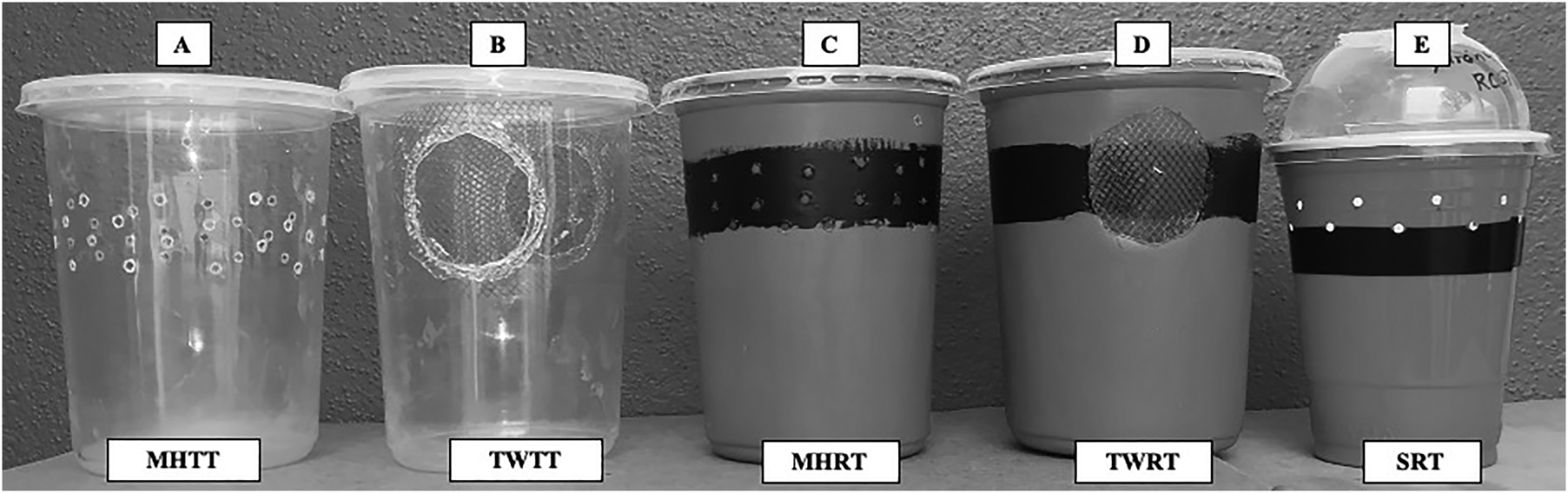
We evaluated five traps. The first model referred to as the multi-hole transparent trap (MHTT), consisted of a cylindrical plastic container (14 cm high × 10.5 cm diameter) with a flat lid (Plastics Adheribles del Bajío, León, Mexico) in which approximately 50 holes (2.5 mm diameter) were distributed on top of and around the container to allow insect entry (fig. 1a). The second model was the two-window transparent trap (TWTT), which consisted of a cylindrical plastic container (14 cm high × 10.5 cm diameter) with a flat lid (Plastics Adheribles del Bajío, León, Mexico) with two opposite circular windows (5 cm diameter) covered with a red mesh fabric (2.5 mm diameter) to allow insect entry (fig. 1b). The third model, referred to as the multi-hole red-black trap (MHRT), was identical to the first model except that it was painted red with vinyl-acrylic paint (Comex-Vinimex, Mexico). It was also surrounded by a black band (3 cm width) at the height of the holes (fig. 1c). The fourth model, referred to as the two-window red-black trap (TWRT), was similar to the second model but it was painted red and had a black band (3 cm width) at the height of the windows (fig. 1d). The fifth model was reported by Lasa et al. (Reference Lasa, Tadeo, Toledo-Hérnandez, Carmona, Lima and Williams2017b), referred to as the small red-black trap (SRT), consisted of red polyethylene glass (12 cm high × 9 cm diameter, WalMart Mexico, Santa Cruz Acayucan, Veracruz) and had a transparent dome-shaped lid. There were 20 holes (3.2 mm diameter) distributed on the top and around this container to allow insect entry. It also had a band of black tape at the height of the holes (fig. 1e).
Trap designs evaluated in this study: MHTT, multi-hole transparent trap; TWTT, two-window transparent trap; MHRT, multi-hole red trap; TWRT, two-window red trap; SRT, small red trap.

Lures
Three baits for the D. suzukii trapping systems were evaluated: Z-Kinol (Squid Biological and Pheromones SA de CV, Mexico), SuzukiiTrap® (Bioibérica, Barcelona, Spain), and ACV + EtOH + CO2 (Lasa et al., Reference Lasa, Tadeo, Toledo-Hérnandez, Carmona, Lima and Williams2017b). Z-Kinol is a product that was formulated in studies reported by Cha et al. (Reference Cha, Adams, Werle, Sampson, Adamczyk, Rogg and Landolt2014, Reference Cha, Hesler, Park, Adams, Zack, Rogg and Landolt2015, Reference Cha, Landolt and Adams2017). Thus, Z-Kinol is formulated with acetoin, methionol, acetic acid, and ethanol. Two components were placed into one polyethylene tube, and the other two compounds were loaded individually into separate dispensers. In traps baited with Z-Kinol, soapy water (0.5%) was added as a drowning solution. SuzukiiTrap® is a mixture of peptides and organic acids (De los Santos Ramos et al., Reference De los Santo Ramos, Bello, Gómez, Hernández and Iribe2014). In traps baited with SuzukiiTrap®, the attractive solution also acted as a drowning solution. The attractive solution of ACV + EtOH + CO2 bait was presented in a one-tube device containing a fermentation mixture of sugar and yeast (1.1 + 0.417 g, respectively, in 20 ml of water), which was inserted through the top of the trap. Dry active baker's yeast (Saccharomyces cerevisiae) (Tredi-Pan, Safmex SA de CV, Mexico-Toluca, Mexico) was used for all tests. ACV (5% acetic acid) (La Costeña, Ecatepec, Mexico) + 10% EtOH was used as a drowning solution (270 ml ACV + 30 ml ethanol) (Lasa et al., Reference Lasa, Tadeo, Toledo-Hérnandez, Carmona, Lima and Williams2017b). As positive control, we use ACV alone, that acts as attractant and as drowning solution.
Field tests
Field trials were performed on four different crops: blackberry (Rubus ulmifolius, Rosaceae), raspberry (Rubus idaeus, Rosaceae), blueberry (Vaccinium corymbosum, Ericaceae), and strawberry (Fragaria spp., Rosaceae), belonging to Koppert Development Institute Berries located in Tiripetío, Municipality of Morelia, Michoacán (19° 31′55″ N, 101° 22′10″ W). The distance between the crops was at least 0.5 km. In the four evaluated crops always, they exhibited ripe fruits at different levels at maturity at the time of the experiments. All combinations of the four lures and five trap designs were evaluated (20 treatments). In addition, we included five unbaited traps, one per each evaluated design as the negative control (with soapy water as a drowning solution). The treatments were displayed using a fully randomized block design replicated in three blocks, in a factorial scheme 5 × 4 × 4 (trap design × attractant type × crop type). Each block contained the 20 treatments plus the five control traps. The blocks were arranged in parallel lines approximately 30 m apart within the field berries crops. The traps were placed randomly at a 1 m height above ground within the plantations, except in the case of strawberry cultivation, where the traps were placed at the level of the plants (30 cm above the ground). The distance between traps was 30 m. The trial was carried out from 1 April to 31 June 2019. Traps were checked, emptied and rotated in a clockwise direction within the same block every 3 days. The captured insects were taken to the laboratory at the Instituto de Ecologia A. C. (Pátzcuaro, Michoacán, Mexico) to be identified, sexed, and counted. Means of the total, female, and male captures trap−1 day−1 were obtained from the three blocks. Species identification and sex differentiation were performed based on the identification characteristics provided by the ECOSUR Collection of Insects Associated with Cultivated Plants (Tapachula Unit) and Miller et al. (Reference Miller, Marshall and Grimaldi2017). Voucher specimens were deposited in the insect collection of ECOSUR and the Ecology Laboratory at the Instituto de Ecologia A. C.
Data analysis
Data were analyzed using the statistical software R version 3.6.1 (R Development Core Team, 2019). Data from unbaited traps (negative controls) were excluded from the analysis because they did not catch any flies. Thus, only data from 20 treatments were analyzed. The mean numbers of captures trap−1 day−1 were submitted to analysis of variance (ANOVA). In addition, the drosophillids caught were separated by sex and analyzed by a one-way ANOVA. When necessary, data were Box-Cox transformed to reach normality and homoscedasticity (Box and Cox Reference Box and Cox1964). The means were separated by Tukey's test P < 0.05. Descriptive graph of the capture pattern over time was also made for the attractants evaluated.
Results
Total number and identity of the specimens captured
In the blackberry, 18,117 drosophilids were captured over a period of 3 months; 92% of the insects captured corresponded to D. suzukii (53% females and 47% males). Eight percent of the total insects caught corresponded to D. busckii, D. melanogaster, D. deflecta, D. simulans, and D. melanica. In raspberry a total of 5135 drosophilids were caught, and 90% of the specimens captured corresponded to D. suzukii (56.4% female and 43.6% males). The remaining 10% of the total insects captured corresponded to D. busckii, D. melanogaster, D. deflecta, D. simulans, and D. melanica. In the blueberry crop, a total of 2148 drosophilids were captured, 91% of which corresponded to D. suzukii (66.5% females and 33.5% males). The remaining 9% of the total captured insects were individuals of D. busckii, D. melanogaster, D. deflecta, D. simulans, and D. melanica. In strawberry, a total of 7762 drosophilids were captured, 98.2% of which corresponded to D. suzukii (60.6% females and 39.4% males). The remaining 1.8% of the total insects captured corresponded to D. busckii, D. melanogaster, D. deflecta, and D. simulans.
Effect of trap design and attractant in the capturing of D. suzukii
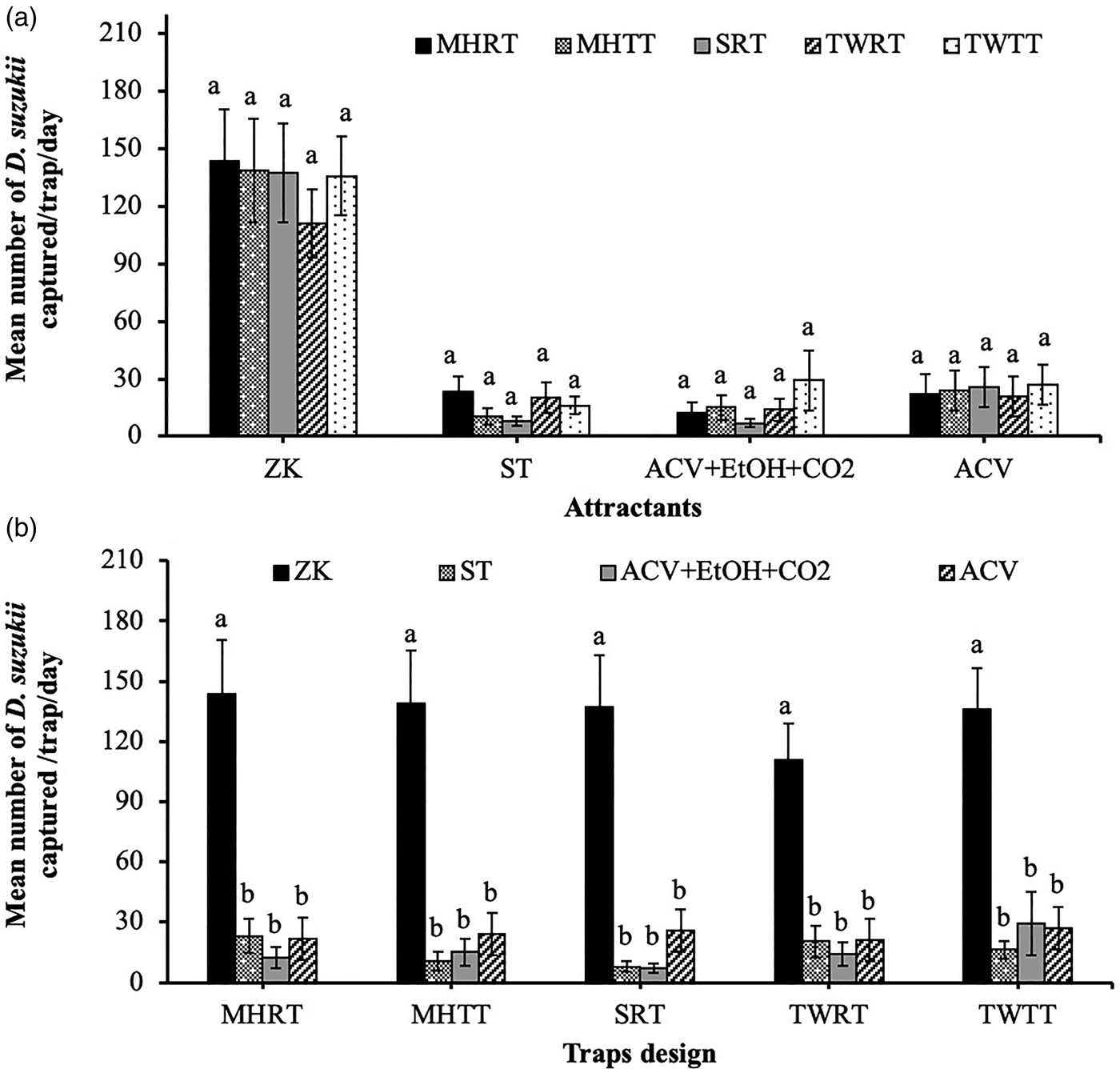
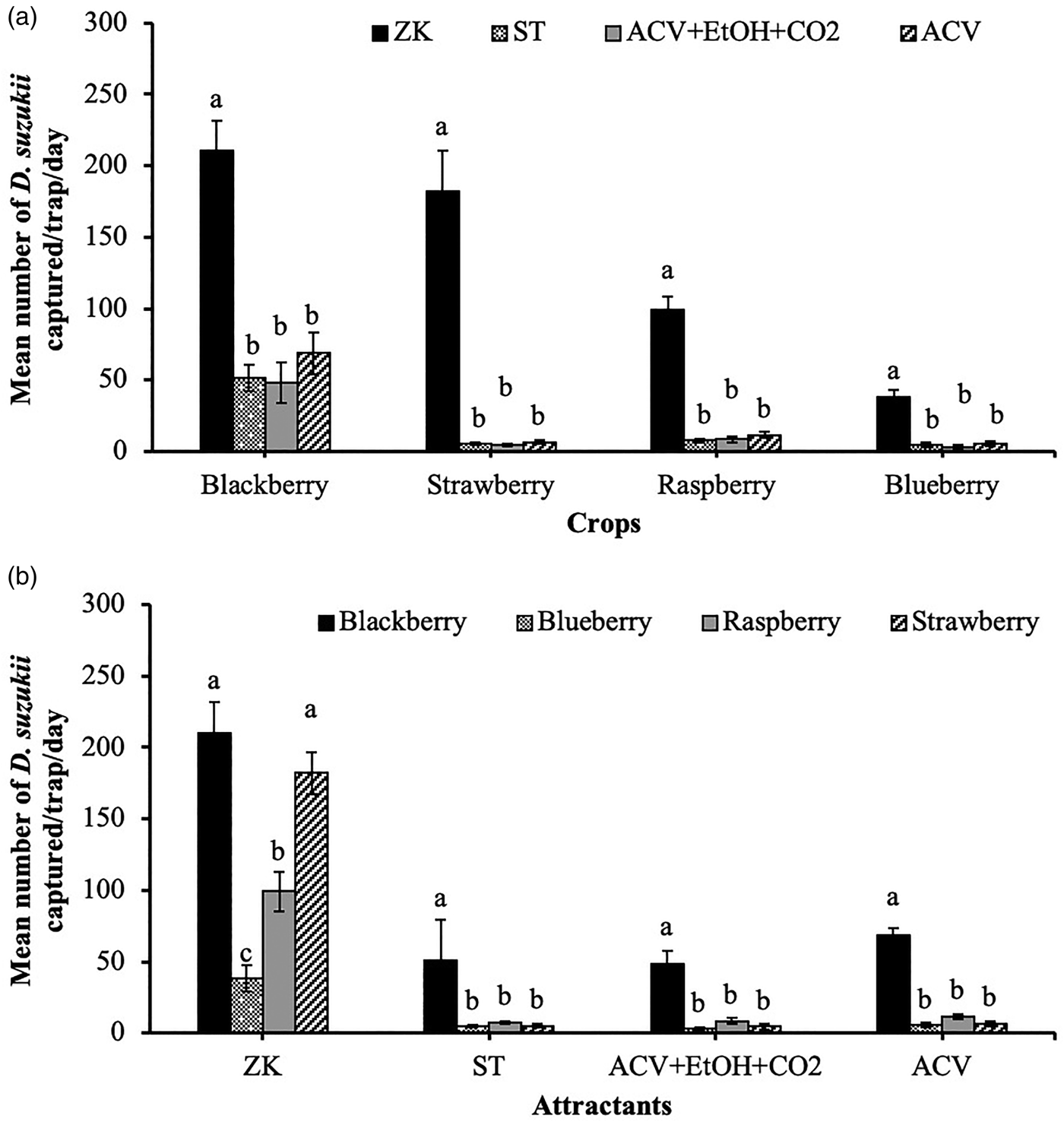
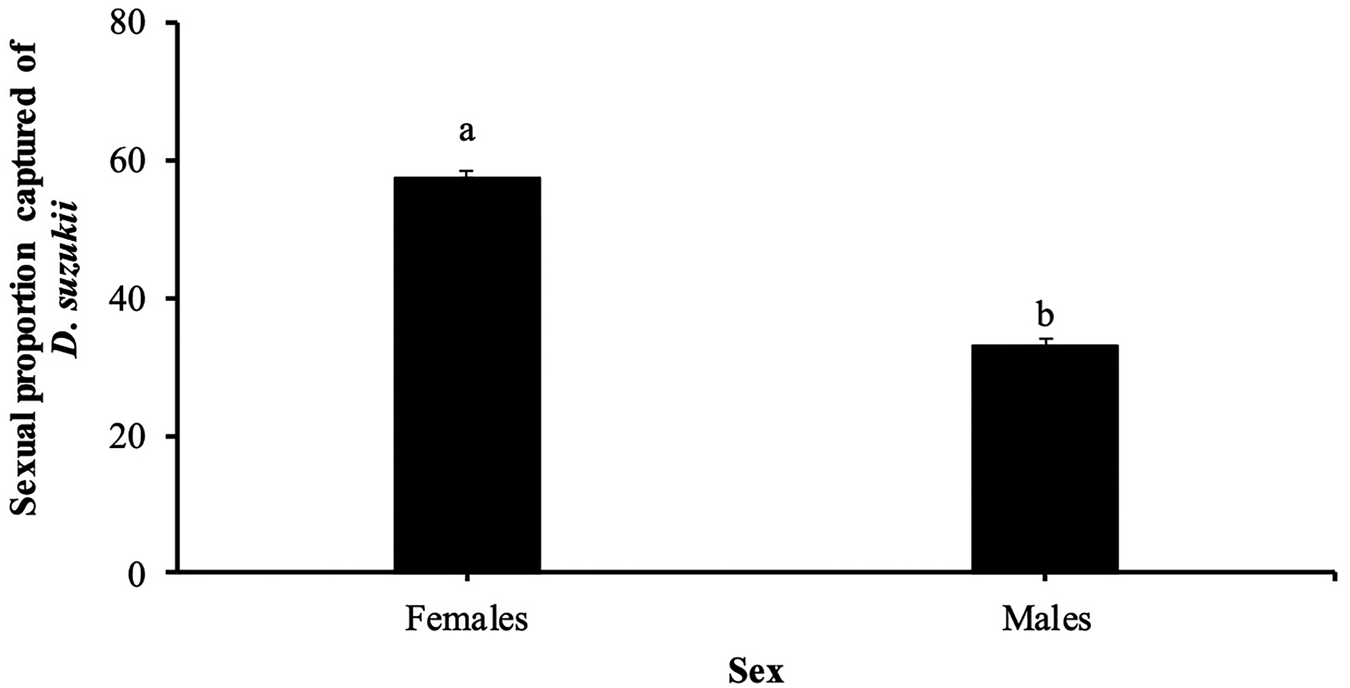
The captures of D. suzukii were affected by the attractant type (F 3, 160 = 150.08; P < 0.0001), and by the crop type (F 3, 160 = 71.12; P < 0.0001), but not by the trap design (F 4, 160 = 0.94; P = 0.60). The interactions between trap design × crop type (F 12, 160 = 0.57; P = 0.96), trap design × attractant type (F 12, 160 = 1.09; P = 0.68, fig. 2), and trap design × attractant type × crop type (F 36, 160 = 0.63; P = 0.99) were not significant. In contrast, the interaction of attractant type × crop type was significant (F 9, 160 = 1.87; P < 0.01) (fig. 3). The five trap designs evaluated captured similarly when they were baited with the same attractant (fig. 2a), but all the traps baited with Z-kinol showed the highest catches (fig. 2b). The attractant Z-kinol captured more D. suzukii than those caught by traps baited with other attractants in the four crops (fig. 3a). There were no significant differences in the number of D. suzukii captured by traps baited with SuzukiiTrap®, ACV + EtOH + CO2 or ACV alone (fig. 3a). In general, the highest captures of D. suzukii occurred in blackberry compared to those observed in strawberry, raspberry, and blueberry (fig. 3b). However, the number of D. suzukii captured by traps baited with Z-kinol was not significantly different in blackberry and strawberry crops. On the other hand, the results showed that more females than males of D. suzukii were captured by traps baited with the attractants (F 1, 478 = 220.92; P < 0.0001) (fig. 4).
Effect of trap design (a) and attractant type (b) on the capturing of D. suzukii. Values are mean ± SE. MHTT, multi-hole transparent trap; TWTT, two-window transparent trap; MHRT, multi-hole red trap; TWRT, two-window red trap; SRT, small red trap; ZK, Z-Kinol; ST, Suzukii Trap®; ACV + EtOH + CO2, apple cider vinegar with 10% ethanol more a device that releases carbon dioxide; and ACV, apple cider vinegar alone. The bars with the same letters are not significantly different (Tukey's test, α = 0.05).

Effect of attractant type (a) and crop type (b) on the capturing of D. suzukii. Values are mean ± SE. ZK, Z-Kinol; ST, Suzukii Trap®; ACV + EtOH + CO2, apple cider vinegar with 10% ethanol more a device that releases carbon dioxide; and ACV, apple cider vinegar alone. The bars with the same letters are not significantly different (Tukey's test, α = 0.05).

Sexual proportion (mean ± SE) of D. suzukii was captured in this study. The bars with the same letters are not significantly different (Tukey's test, α = 0.05).

Pattern of captures of the attractants through the time
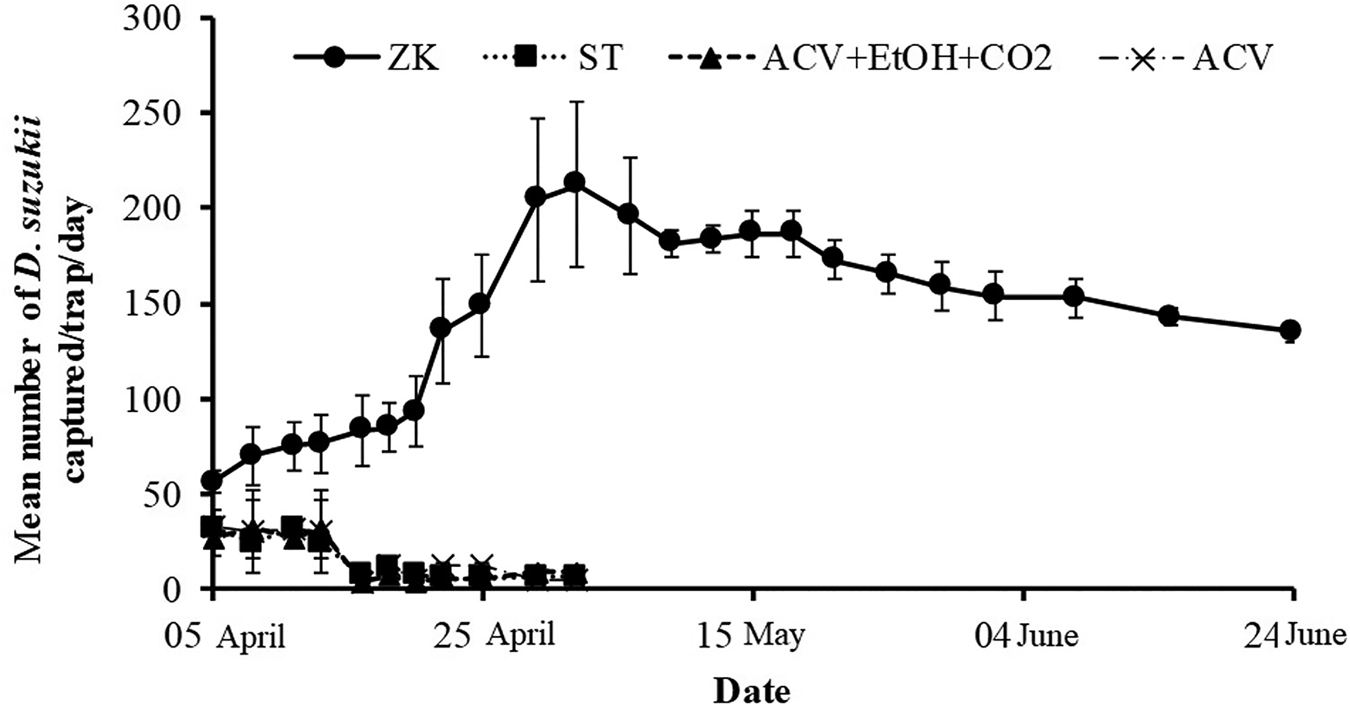
Traps baited with SuzukiiTrap®, ACV + EtOH + CO2 or ACV alone showed similar captures of D. suzukii at the beginning of the trial, but from the second week onwards, the captures began to decrease (fig. 5). The traps baited with Z-kinol showed high captures since the first day compared to the other three attractants. The captures of D. suzukii by traps baited with Z-kinol began to increase during the first month (April), remaining constant until the second month (May), and then diminishing slowly (fig. 5).
Pattern of captures of D. suzukii during the study period in soft-skinned fruit crops. The values are mean ± SE.

Discussion
In this study, we found that the attractant type affected significantly the capture of D. suzukii, while trap design seemed to play a modest role in the attraction and capture of D. suzukii in blackberry, raspberry, blueberry, and strawberry crops.
Host searching by herbivorous insects is predominantly thought to rely on attraction to olfactory cues emitted from the host plants (Conchou et al., Reference Conchou, Lucas, Meslin, Proffit, Staudt and Renou2019). Herbivorous insects are attracted to species-specific compounds or specific ratios of ubiquitous compounds, although the evidence favor the second scenario (Bruce et al., Reference Bruce, Wadhams and Woodcock2005). Visually-based attraction to hosts has been also demonstrated for a number of herbivorous insects (Hausmann et al., Reference Hausmann, Samietz and Dorn2004; Reeves, Reference Reeves2011). Several plant characteristics may be used as visual cues by herbivorous insects, including leaf color, leaf reflectance, size, and form (Prokopy and Owens, Reference Prokopy and Owens1983). Nevertheless, it is more likely that phytophagous insects use multimodal cues when searching for their host plant (Campbell and Borden, Reference Campbell and Borden2009; Patt et al., Reference Patt, Meikle, Mafra-Neto, Sétamou, Mangan, Yang, Malik and Adamczyk2011; Tasin et al., Reference Tasin, Lucchi, Ioriatti, Mraihi, De Cristofaro, Boger and Anfora2011). In this way, previous studies have suggested that host volatiles, color, maturity, firmness, and microbial communities on either the fruit or the plant can act as cues during the host searching process of D. suzukii (Abraham et al., Reference Abraham, Zhang, Angeli, Abubeker, Michel, Feng and Rodriguez-Saona2015; Kirkpatrick et al., Reference Kirkpatrick, McGhee, Hermann, Gut and Miller2016; Mazzetto et al., Reference Mazzetto, Gonella, Crotti, Vacchini, Syrpas, Pontini and Alma2016; Lasa et al., Reference Lasa, Tadeo, Toledo-Hérnandez, Carmona, Lima and Williams2017b).
We evaluated five trap designs, including transparent, red-black traps with two different insect access. However, our results show that trap design to play a modest for the capture D. suzukii (fig. 2). We also found that unbaited traps captured only a few specimens of D. suzukii. Together these results suggest that visual cues may be not relevant to catch flies. However, some studies reported that traps without attractants captured D. suzukii adults (Lee et al., Reference Lee, Shearer, Barrantes, Beers, Burrack, Dalton, Dreves, Gut, Hamby, Haviland, Isaacs, Nielsen, Richardson, Rodriguez-Saona, Stanley, Walsh, Walton, Yee, Zalom and Bruck2013; Rice et al., Reference Rice, Short, Jones and Leskey2016). The fact that in our study the visual cues seem to play a modest role for the capture of D. suzukii might be accounted for by at least three reasons. Firstly, D. suzukii only uses visual cues when detecting appropriate chemical cues. However, Rice et al. (Reference Rice, Short, Jones and Leskey2016), using unbaited traps, found that adult D. suzukii flies did not show a significant field preference for different shapes (spheres, cubes, pyramids, inverted pyramids, vertical or horizontal cylinders), but preferred red and black traps to blue, green, yellow or white traps. Secondly, D. suzukii may able to detect the visual cues at long-distance and approach traps and perceives the attractant at a very close-range. In the absence of chemical cues, D. suzukii may move away from the unbaited trap. A combination of cues may facilitate the finding of a target at different distances, where the detection of one sensory modality warns the insect to the presence of the other (Hebets and Papaj, Reference Hebets and Papaj2005). In a competitive situation, flies would prefer traps with chemical cues than unbaited traps. Further experiments will be designed to investigate the fly behavior toward traps baited with and without attractants. Thirdly, it is likely that model traps used were not effective in synergizing the attraction of D. suzukii. Lee et al. (Reference Lee, Shearer, Barrantes, Beers, Burrack, Dalton, Dreves, Gut, Hamby, Haviland, Isaacs, Nielsen, Richardson, Rodriguez-Saona, Stanley, Walsh, Walton, Yee, Zalom and Bruck2013) found that a yellow trap baited with ACV caught more D. suzukii flies than those captured by red, black, white, or transparent traps. Iglesias et al. (Reference Iglesias, Nyoike and Liburd2014) found that the addition of a yellow stimulus to transparent traps (a yellow card inside the trap) baited with sugar and yeast increased the attraction of D. suzukii compared to transparent traps without color stimuli in blueberry crops. Nevertheless, other studies show that red traps with a black band (fig. 1c, referred to as ‘Zorro’ traps) baited with ACV or ACV + EtOH + CO2 have been effective in capturing D. suzukii adults (Basoalto et al., Reference Basoalto, Hilton and Knight2013; Lasa et al., Reference Lasa, Tadeo, Toledo-Hérnandez, Carmona, Lima and Williams2017b).
The three attractants used in the present study have important differences in their mode of operation. For instance, the attractive solution of SuzukiiTrap® also acted as the drowning solution. In contrast, Z-Kinol uses soapy water as the drowning solution. It is important to note that baits in which the attractive solution also acts as a drowning solution are likely to become contaminated, and decomposition will occur because many insects will be trapped and drown in the bait during the period of capture (Hampton et al., Reference Hampton, Koski, Barsoian, Faubert, Cowles and Alm2014; Iglesias et al., Reference Iglesias, Nyoike and Liburd2014; Frewin et al., Reference Frewin, Renkema, Fraser and Hallett2017). Complex communities of microorganisms associated with D. suzukii in the field and their proliferation in baits could have the potential to modify the volatile profile of an attractant or food bait, particularly when the attractive solution also serves as a solution for drowning, making it less attractive to D. suzukii. In addition, volatile compounds in baits that act as a drowning solution may evaporate more easily and, in less time, because they are not contained within any release device (Cha et al., Reference Cha, Landolt and Adams2017).
The Z-Kinol is a product based on studies performed by Cha et al. (Reference Cha, Adams, Werle, Sampson, Adamczyk, Rogg and Landolt2014, Reference Cha, Hesler, Park, Adams, Zack, Rogg and Landolt2015, Reference Cha, Landolt and Adams2017). They found that four volatile fermentation products, including acetic acid, ethanol, acetoin, and methionol are main olfactory stimuli for D. suzukii when attracted to wine and vinegar (Cha et al., Reference Cha, Adams, Werle, Sampson, Adamczyk, Rogg and Landolt2014). A blend of these compounds was as attractive as the wine and vinegar blend to D. suzukii in wild blackberry and commercial blueberry crops in the USA (Cha et al., Reference Cha, Adams, Werle, Sampson, Adamczyk, Rogg and Landolt2014). More recently, Cha et al. (Reference Cha, Landolt and Adams2017) improved the effectiveness of this 4-component blend increasing the release rate of acetoin from polyethylene sachet releasers and increasing in the concentrations of acetic acid or ethanol when dispensed in the trap drowning solution. Z-Kinol used the same four compounds identified previously. However, all compounds are contained in polyethylene tubes, which permits a more controlled emission of the compounds and make them independent of the drowning solution (soapy water). Also, the formulation of compounds in polyethylene tubes extends Z-Kinol effectiveness over time (longer than three months). These characteristics may likely account for the good performance of Z-Kinol in attracting D. suzukii in the field. However, traps baited with the first formulation of Z-kinol, where the four compounds were loaded together in one dispenser, captured few flies compared to traps baited with ACV or SuzukiiTrap® in raspberry and blackberry crops growing in greenhouses (Lasa et al., Reference Lasa, Toledo-Hernández, Rodríguez and Williams2019). Traps baited with other commercial lures containing the same four compounds showed different performance in capturing D. suzukii, possibly due to distinct formulation (Cha et al., Reference Cha, Hesler, Wallingford, Zaman, Jentsch, Nyrop and Loeb2018). Previously, it has been shown that an increase in the trap capture is due to a synergistic interaction between the optimized emission of acetic acid and acetoin (Cha et al., Reference Cha, Landolt and Adams2017).
We found that the lowest captures of D. suzukii occurred in the blueberry compared to those found in blackberry, raspberry, and strawberry crops. Burrack et al. (Reference Burrack, Asplen, Bahder, Collins, Drummond, Guédot, Isaacs, Johnson, Blanton, Lee and Loeb2015) also found that captures of D. suzukii in blackberry and raspberry were higher than those in blueberry crops in the USA. These authors discussed that several factors could explain their results, including crop phenology, host preference, surrounding habitat, and plant architecture. In our case, the phenology and the surrounding habitat were similar in all crops. Thus, only plant architecture but mainly host preference may explain the lowest catch of D. suzukii in blueberry crops. Therefore, the lowest capture of D. suzukii in blueberry compared to other crops may be the outcome of low population densities of this species in this crop. This situation may be different whether the blueberry is growing alone. It is known that the D. suzukii female prefers to oviposit into softer fruits, making blackberry, raspberry, and strawberry more susceptible to fly infestation (Kinjo et al., Reference Kinjo, Kunimi, Ban and Nakai2013; Lasa et al., Reference Lasa, Tadeo, Dinorín, Lima and Williams2017a). Apparently, the exocarp firmness makes blueberry fruits less selective for being penetrated by D. suzukii gravid females (Steffan et al., Reference Steffan, Lee, Singleton, Vilaire, Walsh, Lavine and Patten2013; Burrack et al., Reference Burrack, Fernandez, Spivey and Kraus2013). However, when blueberry is the only available host, this may be highly damaged by the pest (personal observation), so it should not ignore the ability that this insect has evolved to oviposit this fruit.
An important characteristic of the traps used for capturing D. suzukii is the number of holes in the traps, which must be proportional to the size of the trap. Lee et al. (Reference Lee, Burrack, Barrantes, Beers, Dreves, Hamby and Stanley2012) reported that the more holes a trap has, the greater the number of D. suzukii it captures. Hole diameter is also an important variable to allow drosophilids to easily enter the traps and avoid the entry of nontarget insects. In our case, we observed high average captures of drosophilids, mostly D. suzukii, but nontarget insects such as pollinators or predators were not captured. Similar results were reported by Lasa et al. (Reference Lasa, Tadeo, Toledo-Hérnandez, Carmona, Lima and Williams2017b), who used traps with 3.2 mm-diameter holes. In contrast, other trap designs with a larger hole diameter have been reported to capture larger insects (Cha et al., Reference Cha, Hesler, Park, Adams, Zack, Rogg and Landolt2015) but only 33% D. suzukii (Lee et al., Reference Lee, Burrack, Barrantes, Beers, Dreves, Hamby and Stanley2012; Renkema et al., Reference Renkema, Buitenhuis and Hallett2014; Iglesias et al., Reference Iglesias, Nyoike and Liburd2014).
In summary, our results demonstrate that the trap designs that we tested did not influence the capture of D. suzukii as long as the traps are baited with an effective attractant, at least within the limits of our study. The economics of using Z-kinol to attract D. suzukii in the field may be high; the cost of the trap with the attractant is approximately 4 US dollars, but its effectiveness and durability of more than 3 months confer advantages over ACV, the product commonly used to capture D. suzukii in Mexico. The use of Z-Kinol is promising not only for the monitoring of D. suzukii populations but also for the mass trapping and management of this species for reducing fruit damage.
Acknowledgments
The authors thank Rodrigo Lasa for providing the SRTs; Daniel Martinez Onofre, José Manuel Cruz Palacios, and Jorge Murillo Guizar for their support in the field work; and Perla Marcelina Torres Ceja, Valentín Alonzo Servín, Sandra Sarabia Delgadillo, Luis Gerardo García Velázquez, and Jazmín Cortés Martínez for laboratory assistance.
Conflict of interest
The authors declare that they have no conflict of interest.
Ethical standards
All applicable international, national, and/or institutional guidelines for the care and use of animals were followed. All procedures performed in studies involving animals were in accordance with the ethical standards of the institution at which the studies were conducted.