Introduction
Tithes have been extensively used to estimate the evolution of agrarian output in modern times. Since the compilation of the international tithe series by Ladurie and Goy, the tax has been considered one of the main if not the only reliable source to estimate long term production in the primary sector (Ladurie and Goy, Reference Le Roy Ladurie and Goy1982). The study of the tithe has once again become a focus of attention for the scientific community recently, placing it in the middle of some of the most intense and rich academic debates in agrarian history.Footnote 2 Although the collection of the tithe was common practice in most of Europe, its enforcement and the quality of the records available differ from one country to the next. In this sense, Spain is a special case, and the quality of the tithe records kept by the Spanish Catholic Church has attracted the interest of scholars beyond its frontiers. Therefore, we believe that the creation of new tithe series for a country like Spain would significantly enrich the ongoing debate on pre-modern growth in Europe, adding new information to a key European case study.
Since the 1980s the number of studies of regional tithe series in Spain has increased considerably. In Old Castile we rely on long term tithe series for Segovia (Garcia Sanz, Reference Garcia Sanz, Le Roy Ladurie and Goy1982) and Leon (Sebastian Amarilla, Reference Sebastián Amarilla1992). In Andalusia the studies cover the west of the region (Ponsot, Reference Ponsot1969) and the province of Malaga (Sanchez-Blanco, 1982). There are also series for the coastland regions of Murcia (Lemeneunier, Reference Lemeneunier, Goy and Le Roy Ladurie1982), Valencia (Ardit, Reference Ardit Lucas1989 and Palop Ramos, Reference Palop Ramos, Goy and Le Roy Ladurie1982), Galicia (Eiras Roel, Reference Eiras Roel, Goy and Le Roy Ladurie1982) and the Basque Country (Bilbao and Fernandez Pinedo, Reference Bilbao, Fernández de Pinedo, Goy and Le Roy Ladurie1982). We also have good records for the island of Mallorca from the sixteenth until the eighteenth century (Vidal, Reference Vidal1978). Finally, the tithe series for the archbishopric of Toledo in New Castile from 1463 until 1699 have been examined by Lopez-Salazar and Martin Galan (Reference Lopez-Salazar Perez and Martin Galan1981). This paper attempts to build on the information available for the interior of Spain, presenting the new series for the province of Guadalajara in the north of New Castile. The series cover the whole eighteenth century, and include the four main grains that were cultivated in the region, namely wheat, barley, rye and oats, products that represented the bulk of the agrarian output in New Castile and especially in the province of Guadalajara (Santiago-Caballero, Reference Santiago-Caballero2011). They therefore connect with the end of the series for New Castile published by Lopez-Salazar and Martin Galan, and complete a very long-term vision of the evolution of grain production in the region. Together, they are representative of the evolution of grain production in New Castile from the times of the Spanish Reconquista to the climax of the Napoleonic wars. The series are also important given the proximity of Guadalajara to Madrid, at a time when the capital was growing at significant levels demanding an increasing amount of cereals from its hinterland. In this sense, this case study will contribute to the literature of growth poles in pre-modern times and their effect in the surrounding economies.
Guadalajara within Spain and the Crown of Castile

The first section of the paper describes the main primary sources of the study as well as the methodology used to create the production series. There is meticulous attention to detail in order to control the reliability of the source. The paper adopts as a comparative source the Catastro de la Ensenada, a general survey that took place in Castile in the mid eighteenth century, and which contains information regarding grain production in all the municipalities of the Crown. It then presents the production series of the four main grains cultivated in Guadalajara (wheat, barley, rye and oats) that were estimated from the tithe records and analyses the volatility of the series during the eighteenth century. The study concludes by comparing these results with the tithe series available for other regions in Spain.
Methodology and the nature of the source
From the Old English teotha (tenth), the tithe was first cited in the Old Testament and represented a yearly tax that had to be paid by every producer to the Church. It was a common feature in the economic framework of the Middle Ages and of modern European countries. In Spain the tithe survived until the Mendizabal's Desamortizacion, a process of confiscation of ecclesiastical properties led by the liberal Spanish government in 1837. In the case of Spain, its payment became widespread in the medieval period, from the north east of the Iberian Peninsula to the rest of the country. Traditionally considered one of the most important fiscal charges in pre-modern times, the tithe was a ten per cent flat tax that had to be paid every year by all agrarian producers to the Church. Although the tithes on staple products such as grain, wine or wool were the most important, virtually all production, from chickens to peas and honey, was taxed. The tax disappeared in the nineteenth century, but the thorough work of the ecclesiastical authorities produced an immense amount of records that can be used to trace the evolution of the primary sector back to the fourteenth century.
Spanish tithe records have been extensively used for the study of local and regional trends of agrarian production on account of their outstanding quality and quantity.Footnote 3 The way the records were created was fairly simple. Every year after harvesting, the peasant had to wait for the arrival of an official collector who measured the production and established the ten per cent that had to be paid. The Sinodal Constitutions of 1606 demanded that the tax had to be paid before any portion of the harvest had been extracted, for instance, as seeds for future use, to pay rents or other production costs (Melon Jimenez, Reference Melon Jimenez1987). The collector was usually a member of the local community whose salary was connected to the total amount of product taxed. All the grain collected was usually kept in a specific building in the parish from where the salary of the collector and other costs were paid. The rest of the product was then distributed between ecclesiastical and also civil authorities. Therefore, the good knowledge that the collector had of the community under his control, and the incentives that he had to carry out his work properly, guaranteed that the amount taxed would be correct. For this reason, the records are highly reliable. In addition to the control by the local collector, the Church also introduced mechanisms to reduce the levels of cheating. For instance, they usually asked the local priest to read in public the names of each producer and the tax that they paid. Any member of the community could make objections against possible cases of cheating, thus increasing control over the producers. The amounts collected were then carefully recorded by local priests in accounting books including the complete names of the producers.
Tithes reflect the evolution of real production trends when two basic conditions are met. Firstly, the percentage that the tithe represents has to be constant during the whole period. If that is not the case, then the estimations of real production would lead to erroneous conclusions and miscalculations. Secondly, the levels of cheating have to be small. If an important share of the harvest is hidden from the collector, the estimation of total production would again be seriously undermined. In response to the first condition, the tithe series estimated in this work always represented ten per cent of the total harvest. There was a wide range of information about ecclesiastical taxes in the tithe books that not only contained tithe records. For instance, apart from the ten per cent of the tithe, the books also included the payment of primicias, which did not represent a direct percentage of the harvest, but a fixed tax that was paid once the production of the peasant surpassed a certain threshold under which the producer was exempt from paying it. However, this information has been excluded from the estimations and does not influence the results in any way. The second important point is that the tithe remained at a flat ten per cent during the whole eighteenth century, and, therefore, miscalculations based on the movements of the tax should not represent a problem. In regard to the latter, the occultation of part of the harvest by the peasant, cheating was not a significant factor until the political and social turmoil created by the Napoleonic wars in the early nineteenth century (Garcia Sanz, Reference Garcia Sanz, Le Roy Ladurie and Goy1982). One of the ways of detecting cheating was the existence of trials for hiding part of the harvest, since this sort of trial was usually recorded. The lack of information on this reflects the fact that cheating was still not as common as it would be in the following century. Cheating was not just a risky choice, but also one normally condemned to failure in areas like Guadalajara where villages were very small, meaning that the control of the local priest and the collector was very high. The description of the tithes and the way the tax was defined was perfectly explained in the answers to the Catastro de la Ensenada:
To the fifteenth [question] they said that in this village of Alboreca there are several taxes, tithe rights and primicia, that in the case of wheat, barley and oats for every ten fanegas one is paid. In the case of wool one out of ten [units], one lamb out of every ten and also one cheese out of every ten, and that in the primicia one half fanega is paid for every eleven, for all these species and also for rye and peas if they are cultivated. If that amount is not reached everything that exceeds ten will be collected until the previously mentioned eleven. And although the harvest exceeded those eleven nothing else will be paid. And if the production does not reach ten half fanegas then nothing will be paid at all from this right of primicias, understanding that this right is not performed in the case of oats, and that it is a right that is property of the priest of the parish of the mentioned village of Alboreca and as such he receives it.Footnote 4
The tithe series presented in this thesis have been extracted from the tazmia books of every village and town included in the sample.Footnote 5 These were records of the tithes collected in every parish and which in the twentieth century were transferred and centralised in the Historical Diocesan Archive of Sigüenza. The books are a very rich source of information for economic historians, and include detailed records about the amount of tax paid to the Church by every peasant in every town and village. This level of detail is extremely rare in other tithe records that usually measure the total amounts collected by large institutions, like monasteries or bishoprics, and that are not generally homogenous over time in the sample of locations taxed. Therefore, the detail at local and even personal level of the tazmia books presents the opportunity to study the evolution of agrarian output with an extremely high level of accuracy.
Overall, information was gathered from twenty-five parishes between 1678 and 1811, although the amount of information available differs significantly depending on the parish. For methodological reasons, in order to obtain a representative sample, the years of the study were limited to the eighteenth century for which there are complete series for fourteen parishes. The results indicate that the trends followed by this sample match perfectly the evolution of the twenty-five parishes in those years for which there are complete series for all the locations. The existence of small information gaps was solved by using simple interpolation. In the case of longer periods of time like four or five years, the results were based on an estimation extracted from the other tithe series in all the cases with correlation coefficients higher than 0.7. We also took into account that between 1761 and 1775 and from 1796 the tithes of the biggest producer (excusado) in each location were directly collected by the Real Hacienda and not by the Church. Therefore, during those years we increased the production of our series by seven per cent, a lower bound estimation of the excusado that corresponds to Guadalajara given the small nature of its producers (Llopis and Mariscal, Reference Llopis Agelán and Gonzalez Mariscal2008).
Reliability of the series
Tithes can indicate how total agrarian production changed, but information about per capita output or productivity figures is more difficult to obtain. The number of producers changed over time, as did the amount of land that was put under cultivation. This relationship can, however, be checked with the information provided in the tazmia books taking as a case study the parish of Bañuelos, a location for which there is very detailed information. For every year of the eighteenth century, total production was divided by the number of producers in order to get an estimation of output per producer. This variable was then compared to the series of total production estimated from the tithes. The results are presented Figure 2.
Total Production v. Production per peasant (I) in Bañuelos, 1700–1800 Source: Tithe book of the municipality of Bañuelos.
The correlation between both variables is very high and statistically significant (r = 0.78), showing that the trends presented by the study of tithes are a good estimator of the evolution of output per producer. However, another important issue is deciding if output per producer is a good proxy of productivity. As stated before, the number of producers changed during the eighteenth century as, therefore, did the sample of producers, introducing noise in the estimation. This explains partially why the correlation was weaker during the second half of the century when the number of producers increased significantly. To solve the problem, the rich information provided in the tazmia books was used, where each producer being taxed was identified by his Christian name and two first surnames. Thus, it is possible to follow the output of a specific producer on a yearly basis. A sample was created with a fixed number of producers whose output was followed during the whole eighteenth century. The sample was carefully chosen to ensure that it included producers of different sizes and was, therefore, representative of the area as a whole. On the other hand, producers tended to disappear after a period of approximately twenty years, probably because they died. When this happened, the producer was immediately replaced by another, making sure that he shared the same characteristics as his predecessor in terms of total output. As a result, a consistent and diversified sample of producers was created and the evolution of their output was compared with the evolution of total production extracted from the tithes. Figure 3 shows that the correlation is again very high and statistically significant (r = 0.78), indicating that the evolution of tithes are a good estimation of the trends of output per producer and proving its utility as a representative proxy. Moreover the discrepancy at the end of the century that appeared in Figure 2 mostly disappeared.
Total Production v. Production per peasant (II) in Bañuelos, 1700–1800 Source: Tazmia book of the municipality of Bañuelos
The reliability of the tithe estimations can also be checked by comparing their results with those presented in the Catastro de la Ensenada. In the general survey, one of the questions enquired about the average production per year during the five years prior to its elaboration. As the survey in Guadalajara took place in 1751, the information provided in the Catastro includes the average production between 1747 and 1751, as one of the answers shows:
To the sixteenth [question] they said that for every year of the last five, that were counted from the year of seventeen forty seven until the year of seventeen fifty one, both inclusive, the tithe accounts.
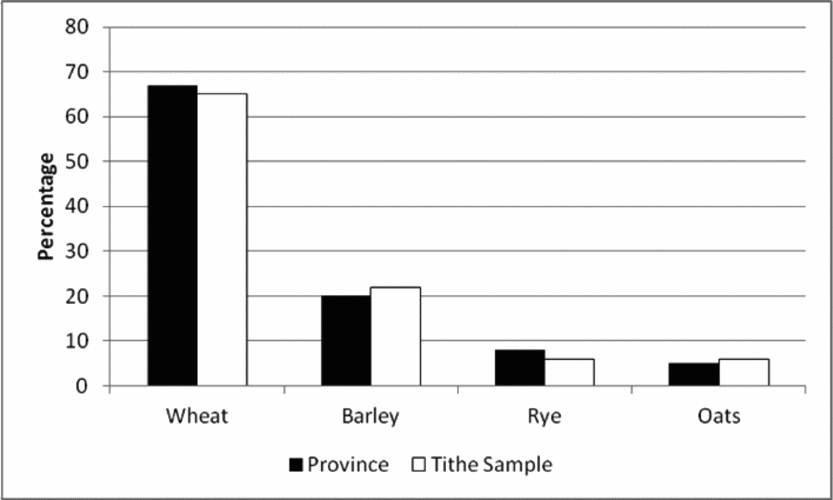
We can compare the information of the Catastro with the information obtained from the tithe series between 1747 and 1751. Figure 4 presents the shares of every variety of grain in the total production of grain for the period 1747 to 1751 presented in both the Catastro and the tithe series. The results are practically identical and, therefore, support the reliability of the estimations calculated from the tithes.
Distribution of grain production in volume 1747–1751 Source: Catastro de la Ensenada; Valencia (Ardit Lucas, Reference Ardit Lucas1989) and (Palop Ramos, Reference Palop Ramos, Goy and Le Roy Ladurie1982), Malaga (Benitez Sanchez-Blanco, Reference Benitez Sanchez-Blanco, Goy and Le Roy Ladurie1982), Basque Country (Bilbao and Fernandez de Pinedo, Reference Bilbao, Fernández de Pinedo, Goy and Le Roy Ladurie1982), Galicia (Eiras Roel, Reference Eiras Roel, Goy and Le Roy Ladurie1982), Segovia (Garcia Sanz, Reference Garcia Sanz, Le Roy Ladurie and Goy1982), Murcia (Lemeneunier, Reference Lemeneunier, Goy and Le Roy Ladurie1982), Toledo (Lopez-Salazar Perez and Martin Galan, Reference Lopez-Salazar Perez and Martin Galan1981), Andalucia (Ponsot, Reference Ponsot1969), Leon (Sebastian Amarilla, Reference Sebastián Amarilla1992) or Mallorca (Vidal, Reference Vidal1978).
The production of grain in eighteenth-century Guadalajara
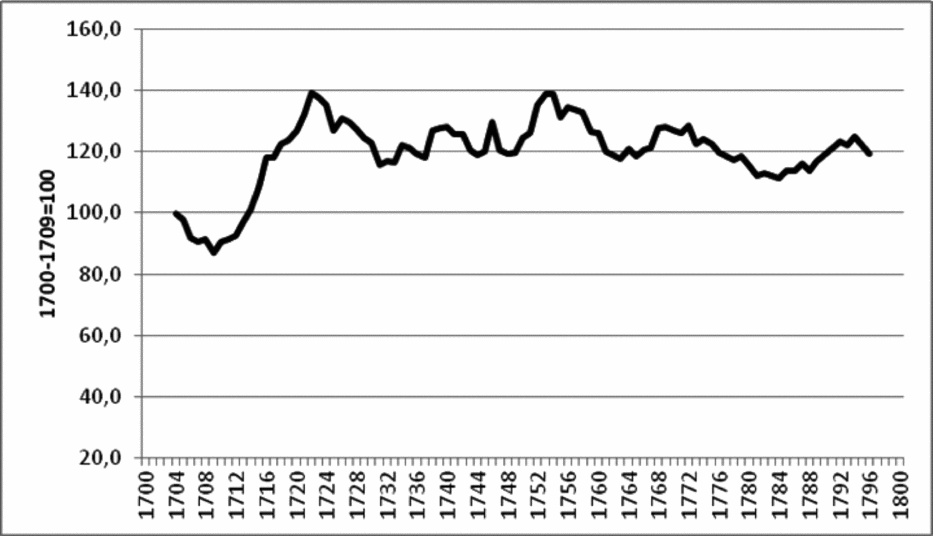
The first half of the eighteenth century was in general a period of economic growth and agrarian expansion in all Spain. However, some areas of the interior experienced a slower recuperation following the crisis of the seventeenth century and did not recover the production levels of the end of the sixteenth century until the mid, and in some cases even the late, eighteenth century (Marcos Martin, Reference Marcos Martin2000). While in the interior the increase in agrarian production was based on the extension of arable land (Anes Alvarez, Reference Anes Alvarez1970: 196), producers in the North of Spain and along the Mediterranean coast were able to improve productivity by introducing new products like maize. In order to estimate total grain output in Guadalajara, the production of all the grains was aggregated by volume. The results show that grain suffered a production crisis during the first years of the eighteenth century that was a continuation of a longer depression that started during the last decades of the seventeenth century.Footnote 6 The series show an absolute minimum in the last years of the 1710s and later a strong recovery when the production of grain increased by almost fifty per cent until the mid 1720s. Thereafter, the data attest a period of stagnation that lasted twenty-five years until the first half the 1750s. The last decades of the eighteenth century were characterised by the crisis of the late 1750s and the stagnation that followed it. In the case of Guadalajara, the production of grain fell by more than twenty per cent between 1754 and 1763 and the levels of production achieved in the early 1750s would not be reached again during the rest of the century. Figure 5 presents the evolution of total aggregated grain production of wheat, barley, rye and oats in volume in Guadalajara.Footnote 7
Grain production in Guadalajara 1700–1800 (nine years moving average) Source: Valencia (Ardit Lucas, Reference Ardit Lucas1989) and (Palop Ramos, Reference Palop Ramos, Goy and Le Roy Ladurie1982), Malaga (Benitez Sanchez-Blanco, Reference Benitez Sanchez-Blanco, Goy and Le Roy Ladurie1982), Basque Country (Bilbao and Fernandez de Pinedo, Reference Bilbao, Fernández de Pinedo, Goy and Le Roy Ladurie1982), Galicia (Eiras Roel, Reference Eiras Roel, Goy and Le Roy Ladurie1982), Segovia (Garcia Sanz, Reference Garcia Sanz, Le Roy Ladurie and Goy1982), Murcia (Lemeneunier, Reference Lemeneunier, Goy and Le Roy Ladurie1982), Toledo (Lopez-Salazar Perez and Martin Galan, Reference Lopez-Salazar Perez and Martin Galan1981), Andalucia (Ponsot, Reference Ponsot1969), Leon (Sebastian Amarilla, Reference Sebastián Amarilla1992) or Mallorca (Vidal, Reference Vidal1978).
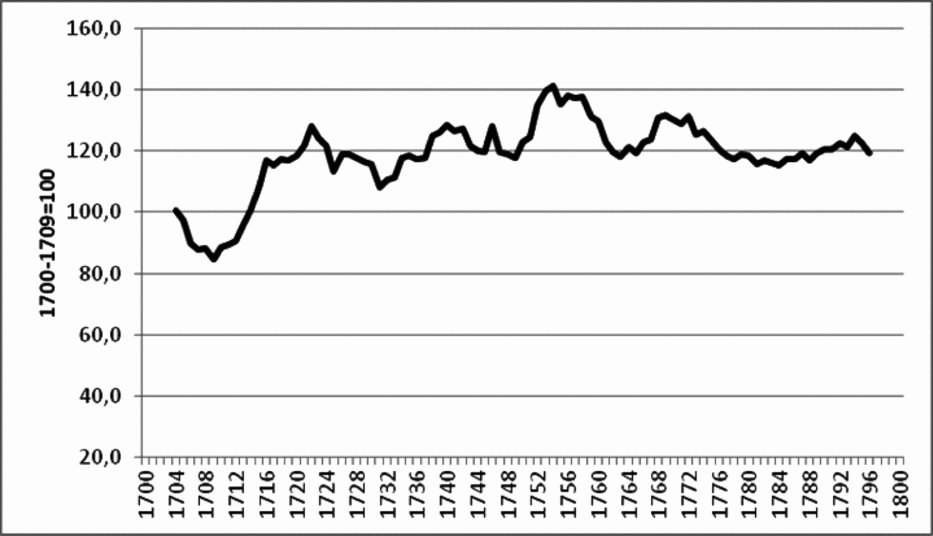
The analysis of the series by type of grain reveals that the four cereals did not follow the same trends. In the case of wheat the behaviour of the series is exactly the same as that described above. The reason is simply that wheat represented more than two thirds of the total production of grain and was, as a result, the most influential item in the aggregated sample. Taking the eighteenth century as a whole, wheat production increased by about twenty per cent, although most of the increase took place during the first half of the century when total production increased by forty per cent. The second half of the century was a period of crisis and stagnation that eroded half of the advances that had taken place in the previous decades.
Wheat production in Guadalajara 1700–1800 (nine years moving average) Source: Valencia (Ardit Lucas, Reference Ardit Lucas1989) and (Palop Ramos, Reference Palop Ramos, Goy and Le Roy Ladurie1982), Malaga (Benitez Sanchez-Blanco, Reference Benitez Sanchez-Blanco, Goy and Le Roy Ladurie1982), Basque Country (Bilbao and Fernandez de Pinedo, Reference Sebastián Amarilla1982), Galicia (Eiras Roel, Reference Eiras Roel, Goy and Le Roy Ladurie1982), Segovia (Garcia Sanz, Reference Garcia Sanz, Le Roy Ladurie and Goy1982), Murcia (Lemeneunier, Reference Lemeneunier, Goy and Le Roy Ladurie1982), Toledo (Lopez-Salazar Perez and Martin Galan, Reference Lopez-Salazar Perez and Martin Galan1981), Andalucia (Ponsot, Reference Ponsot1969), Leon (Sebastian Amarilla, Reference Sebastián Amarilla1992) or Mallorca (Vidal, Reference Vidal1978).
Barley production in Guadalajara 1700–1800 (nine years moving average) Source: Valencia (Ardit Lucas, Reference Ardit Lucas1989) and (Palop Ramos, Reference Palop Ramos, Goy and Le Roy Ladurie1982), Malaga (Benitez Sanchez-Blanco, Reference Benitez Sanchez-Blanco, Goy and Le Roy Ladurie1982), Basque Country (Bilbao and Fernandez de Pinedo, Reference Bilbao, Fernández de Pinedo, Goy and Le Roy Ladurie1982), Galicia (Eiras Roel, Reference Eiras Roel, Goy and Le Roy Ladurie1982), Segovia (Garcia Sanz, Reference Garcia Sanz, Le Roy Ladurie and Goy1982), Murcia (Lemeneunier, Reference Lemeneunier, Goy and Le Roy Ladurie1982), Toledo (Lopez-Salazar Perez and Martin Galan, Reference Lopez-Salazar Perez and Martin Galan1981), Andalucia (Ponsot, Reference Ponsot1969), Leon (Sebastian Amarilla, Reference Sebastián Amarilla1992) or Mallorca (Vidal, Reference Vidal1978).
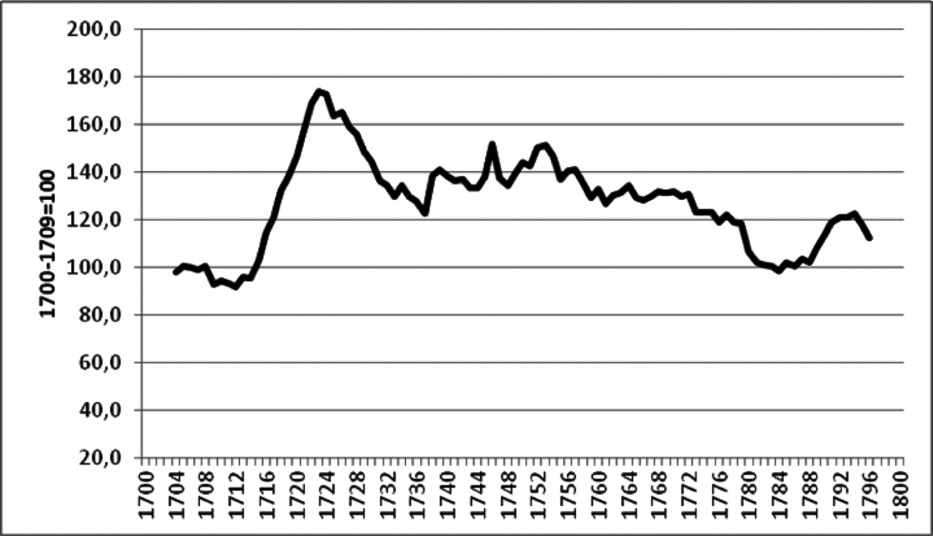
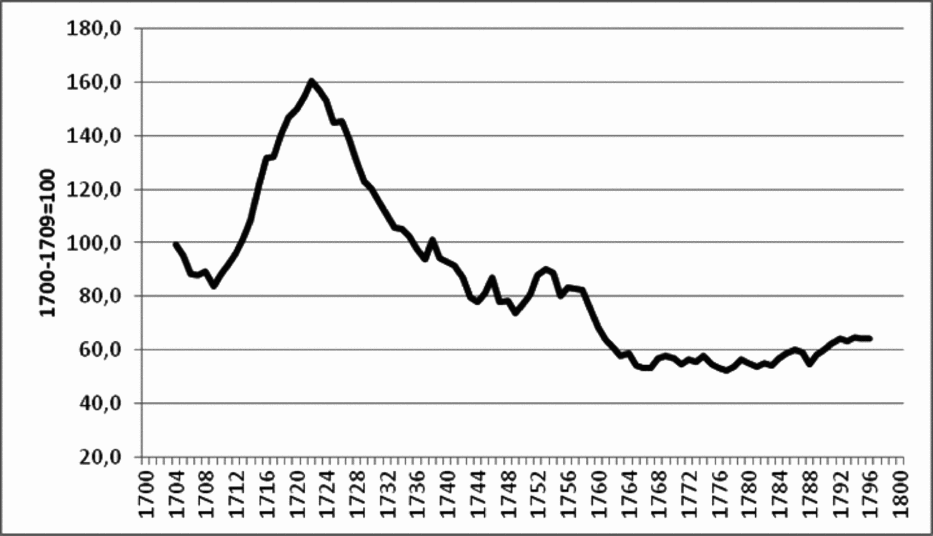
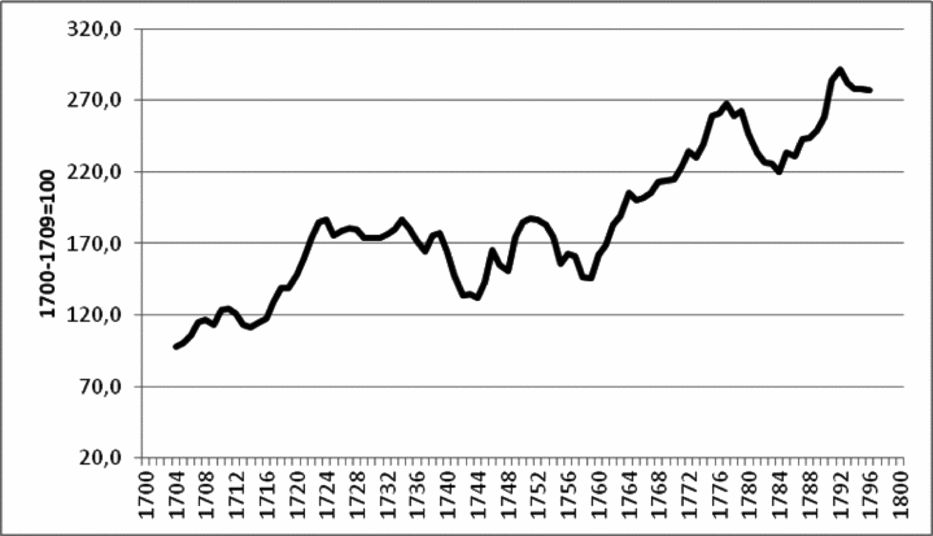
Barley was the second most important grain in terms of volume. The evolution of barley production was again similar to wheat, although in this case the changes were more intense and the series presented a higher volatility. The most significant movement in barley production was the sudden and intense growth during the first quarter of the century, when output increased by almost eighty per cent. However, the crisis that followed in the 1720s halved the advances that practically disappeared during the second half of the century. By 1800, the production of barley was slightly above the levels that had been achieved in 1700. Rye was one of the minor grains and also more volatile than wheat and barley. As in the case of barley, the most important feature in the production of rye was the intense increase during the first quarter of the century, when ouput increased by almost eighty per cent from the levels in 1710. The crisis that followed was harder than the one involving barley, and by 1750 production of rye had already halved. The fall continued during the rest of the century and by 1800 output was forty per cent lower than the initial levels in 1700.
Rye production in Guadalajara 1700–1800 (nine years moving average) Source: Valencia (Ardit Lucas, Reference Ardit Lucas1989) and (Palop Ramos, Reference Palop Ramos, Goy and Le Roy Ladurie1982), Malaga (Benitez Sanchez-Blanco, Reference Benitez Sanchez-Blanco, Goy and Le Roy Ladurie1982), Basque Country (Bilbao and Fernandez de Pinedo, Reference Bilbao, Fernández de Pinedo, Goy and Le Roy Ladurie1982), Galicia (Eiras Roel, Reference Eiras Roel, Goy and Le Roy Ladurie1982), Segovia (Garcia Sanz, Reference Garcia Sanz, Le Roy Ladurie and Goy1982), Murcia (Lemeneunier, Reference Lemeneunier, Goy and Le Roy Ladurie1982), Toledo (Lopez-Salazar Perez and Martin Galan, Reference Lopez-Salazar Perez and Martin Galan1981), Andalucia (Ponsot, Reference Ponsot1969), Leon (Sebastian Amarilla, Reference Sebastián Amarilla1992) or Mallorca (Vidal, Reference Vidal1978).
Oats production in Guadalajara 1700–1800 (nine years moving average) Source: Valencia (Ardit Lucas, Reference Ardit Lucas1989) and (Palop Ramos, Reference Palop Ramos, Goy and Le Roy Ladurie1982), Malaga (Benitez Sanchez-Blanco, Reference Benitez Sanchez-Blanco, Goy and Le Roy Ladurie1982), Basque Country (Bilbao and Fernandez de Pinedo, Reference Bilbao, Fernández de Pinedo, Goy and Le Roy Ladurie1982), Galicia (Eiras Roel, Reference Eiras Roel, Goy and Le Roy Ladurie1982), Segovia (Garcia Sanz, Reference Garcia Sanz, Le Roy Ladurie and Goy1982), Murcia (Lemeneunier, Reference Lemeneunier, Goy and Le Roy Ladurie1982), Toledo (Lopez-Salazar Perez and Martin Galan, Reference Lopez-Salazar Perez and Martin Galan1981), Andalucia (Ponsot, Reference Ponsot1969), Leon (Sebastian Amarilla, Reference Sebastián Amarilla1992) or Mallorca (Vidal, Reference Vidal1978).
The production of oats is the only one that can be clearly defined as a success story. The growth in the production of all grains that started around 1715 is also evident in the case of oats, whose production increased by more than seventy per cent compared to the levels of 1700. A period of stagnation followed until the explosive growth that rye experienced during the second half of the century when oats production practically doubled. Therefore, the balance during the whole century is clearly beneficial, with total ouput almost trebling between 1700 and 1800.
To summarise, at aggregate level during the first years of the eighteenth century, production series indicate the existence of a crisis that started in the last decades of the seventeenth century. The crisis was followed by a quick recovery of the levels lost in the previous decades that lasted until the early 1720s. However, the rest of the decade until 1731 experienced a second crisis with an average fall in the production of more than twenty per cent. The 1730s and 1740s were a period of recovery that continued through the first half of the 1750s when production grew by more than twenty per cent. The deepest recession of the century took place during the period 1755 to 1763 when grain production fell in Guadalajara by thirty per cent. The last third of the century can be defined as a period of sluggish growth. However, we should also take into account that the study of the individual crops also reveals important differences, like the sustained decline of barley and rye and the growing importance of oats.
Distribution of grains
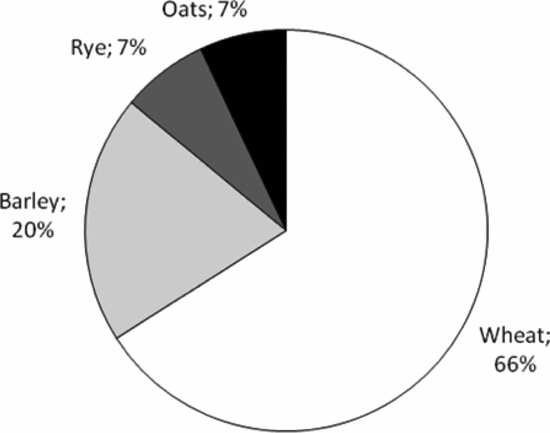
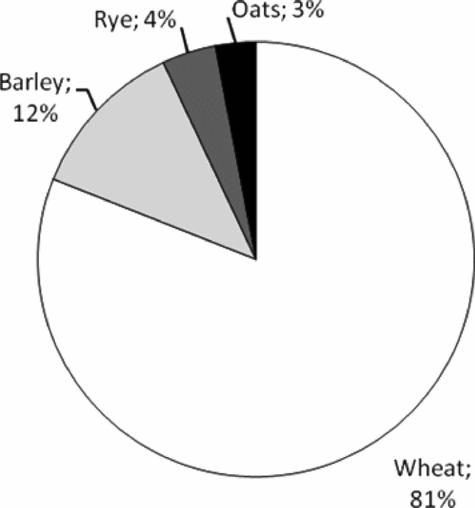
The production of grain was strongly dominated by the presence of wheat. In the sample collected, for the whole eighteenth century wheat represented two thirds of the total production of grain in volume, followed by barley with a share of twenty per cent and by rye and oats (seven per cent). However, if we transform the production from kind into cash, the share of wheat increases considerably as a consequence of being by far the most expensive of the four grains.Footnote 8 By transforming the numbers from volume into cash the share of wheat rises from sixty-six per cent to eighty-one per cent, while the value of the inferior grains is reduced. The share falls in the case of barley, rye and oats from twenty to twelve per cent, seven to four per cent and seven to three per cent, respectively.
Shares in Volume, mid eighteenth century Source: Valencia (Ardit Lucas, Reference Ardit Lucas1989) and (Palop Ramos, Reference Palop Ramos, Goy and Le Roy Ladurie1982), Malaga (Benitez Sanchez-Blanco, Reference Benitez Sanchez-Blanco, Goy and Le Roy Ladurie1982), Basque Country (Bilbao and Fernandez de Pinedo, Reference Bilbao, Fernández de Pinedo, Goy and Le Roy Ladurie1982), Galicia (Eiras Roel, Reference Eiras Roel, Goy and Le Roy Ladurie1982), Segovia (Garcia Sanz, Reference Garcia Sanz, Le Roy Ladurie and Goy1982), Murcia (Lemeneunier, Reference Lemeneunier, Goy and Le Roy Ladurie1982), Toledo (Lopez-Salazar Perez and Martin Galan, Reference Lopez-Salazar Perez and Martin Galan1981), Andalucia (Ponsot, Reference Ponsot1969), Leon (Sebastian Amarilla, Reference Sebastián Amarilla1992) or Mallorca (Vidal, Reference Vidal1978).
Shares in Value, mid eighteenth century Source: Valencia (Ardit Lucas, Reference Ardit Lucas1989) and (Palop Ramos, Reference Palop Ramos, Goy and Le Roy Ladurie1982), Malaga (Benitez Sanchez-Blanco, Reference Benitez Sanchez-Blanco, Goy and Le Roy Ladurie1982), Basque Country (Bilbao and Fernandez de Pinedo, Reference Bilbao, Fernández de Pinedo, Goy and Le Roy Ladurie1982), Galicia (Eiras Roel, Reference Eiras Roel, Goy and Le Roy Ladurie1982), Segovia (Garcia Sanz, Reference Garcia Sanz, Le Roy Ladurie and Goy1982), Murcia (Lemeneunier, Reference Lemeneunier, Goy and Le Roy Ladurie1982), Toledo (Lopez-Salazar Perez and Martin Galan, Reference Lopez-Salazar Perez and Martin Galan1981), Andalucia (Ponsot, Reference Ponsot1969), Leon (Sebastian Amarilla, Reference Sebastián Amarilla1992) or Mallorca (Vidal, Reference Vidal1978).
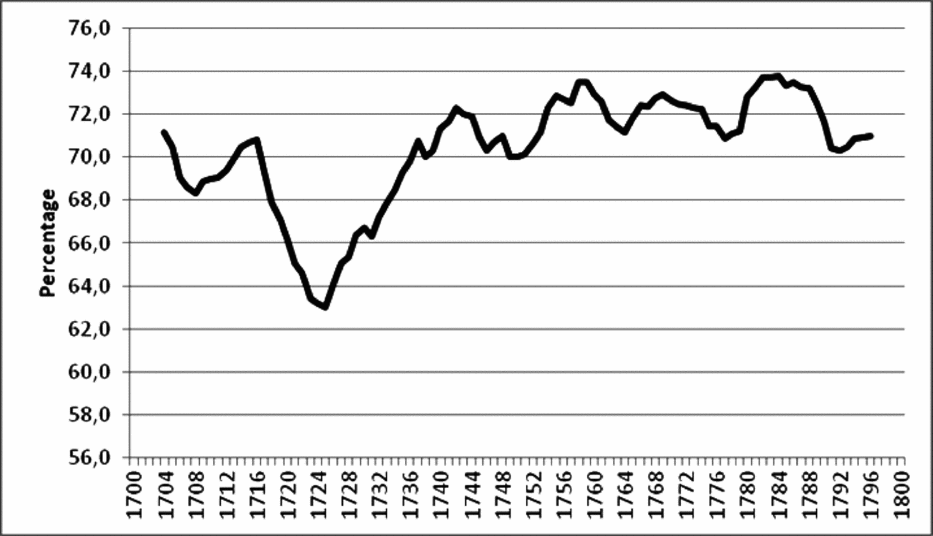
The share of wheat in total production is a key variable that has been closely examined by economic historians. This is because it reflects not just the influence of that grain in the productive structure of the economy, but also works as an indirect estimator of other variables such as demographic growth. In pre-industrial Spain white bread that was produced using wheat clearly dominated the consumption patterns of most of the population. In this respect, on account of limited resources, an increase in the share of wheat should take place as a result of intense demographic growth. The changes in the share of wheat in total grain production in Guadalajara are presented in Figure 12. The share of wheat in Guadalajara shows a sharp decline during the first third of the eighteenth century, falling ten points from sixty-eight per cent in 1705 to fifty-eight per cent in 1725. On the other hand, the weight of rye and above all of barley increased, representing twenty-seven per cent and fourteen per cent respectively of the growth in total production that took place between 1709 and 1722. Those weights were clearly larger than the shares they represented in the economy of Guadalajara. After the 1730s, the production of wheat rose more quickly than that of other grains, an increase related to the population growth in the province of Guadalajara after the demographic crisis of the 1730s.Footnote 9 The increasing demand combined with the resistance of wheat to the production crisis of the 1720s increased the share of wheat from fifty-eight per cent to seventy per cent. The second half of the eighteenth century did not see significant changes in the weight of wheat, which remained at very high levels, again probably influenced by the growing population that increased the demand for white bread and, therefore, wheat. These trends are very similar to the ones in other regions in the interior of Spain, like, for example, Segovia where the same decline in the share of wheat was evident in the early eighteenth century, followed by a recovery during the following decades (Garcia Sanz, Reference Garcia Sanz, Le Roy Ladurie and Goy1982). Most of the increase in the share of wheat between the late 1720s and the mid eighteenth century was as a consequence of the fall in barley and rye.
Distribution percentage of wheat in grain production (nine years moving average) in Guadalajara (1700–1800) in volume. Source: Valencia (Ardit Lucas, Reference Ardit Lucas1989) and (Palop Ramos, Reference Palop Ramos, Goy and Le Roy Ladurie1982), Malaga (Benitez Sanchez-Blanco, Reference Benitez Sanchez-Blanco, Goy and Le Roy Ladurie1982), Basque Country (Bilbao and Fernandez de Pinedo, Reference Bilbao, Fernández de Pinedo, Goy and Le Roy Ladurie1982), Galicia (Eiras Roel, Reference Eiras Roel, Goy and Le Roy Ladurie1982), Segovia (Garcia Sanz, Reference Garcia Sanz, Le Roy Ladurie and Goy1982), Murcia (Lemeneunier, Reference Lemeneunier, Goy and Le Roy Ladurie1982), Toledo (Lopez-Salazar Perez and Martin Galan, Reference Lopez-Salazar Perez and Martin Galan1981), Andalucia (Ponsot, Reference Ponsot1969), Leon (Sebastian Amarilla, Reference Sebastián Amarilla1992) or Mallorca (Vidal, Reference Vidal1978).
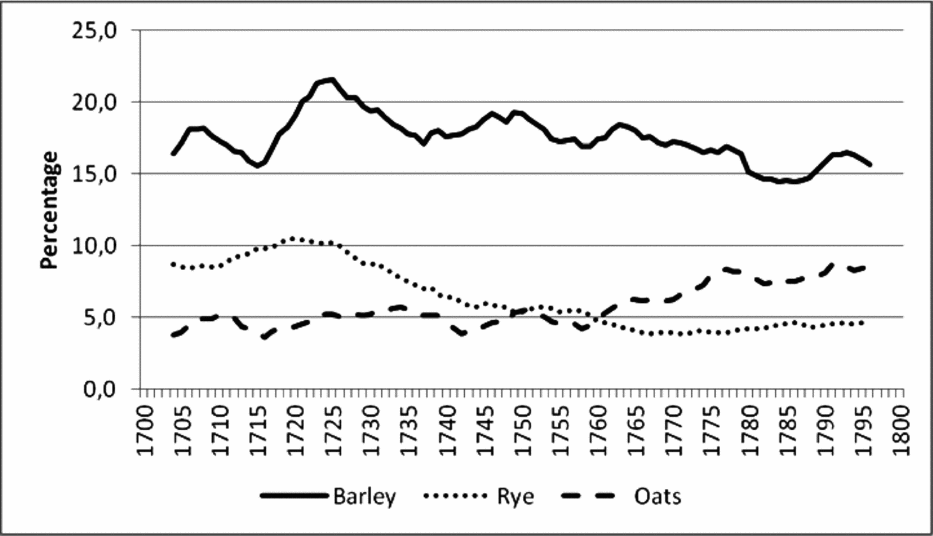
The evolution of barley, rye and oats was again very different. As the series of total output shows, the production of oats increased, while the other three grains stagnated or declined. The share of oats in grain production increased from less than five per cent in the early eighteenth century to ten per cent in the 1790s. Barley and rye show very similar trends reaching maximums in the mid 1720s and then intense decline during the rest of the century. Thus, the importance of wheat was clear during most of the eighteenth century, followed by the success of oats that doubled in production. The most plausible explanation for the changes described seems to be a trade-off between the production of wheat and barley, given that both crops were traditionally cultivated in the most fertile lands, while rye and oats were relegated to the soils of worst quality. Following the same argument, the increase in oats was possible at the expense of the reduction of rye.
Percentage of inferior grains in grain production (nine years moving average) in Guadalajara 1700–1800 Source: Valencia (Ardit Lucas, Reference Ardit Lucas1989) and (Palop Ramos, Reference Palop Ramos, Goy and Le Roy Ladurie1982), Malaga (Benitez Sanchez-Blanco, Reference Benitez Sanchez-Blanco, Goy and Le Roy Ladurie1982), Basque Country (Bilbao and Fernandez de Pinedo, Reference Bilbao, Fernández de Pinedo, Goy and Le Roy Ladurie1982), Galicia (Eiras Roel, Reference Eiras Roel, Goy and Le Roy Ladurie1982), Segovia (Garcia Sanz, Reference Garcia Sanz, Le Roy Ladurie and Goy1982), Murcia (Lemeneunier, Reference Lemeneunier, Goy and Le Roy Ladurie1982), Toledo (Lopez-Salazar Perez and Martin Galan, Reference Lopez-Salazar Perez and Martin Galan1981), Andalucia (Ponsot, Reference Ponsot1969), Leon (Sebastian Amarilla, Reference Sebastián Amarilla1992) or Mallorca (Vidal, Reference Vidal1978).
Volatility of the series
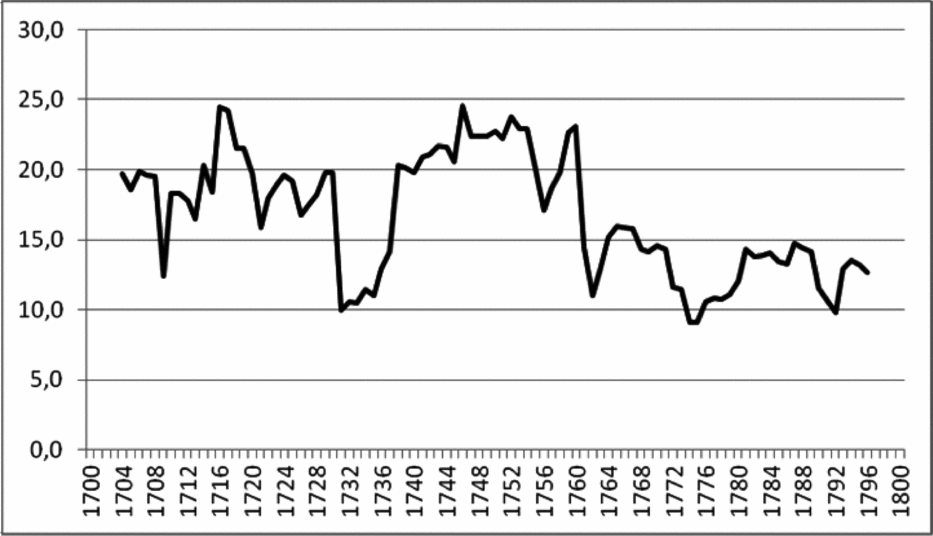
The volatility of grain production is also an important aspect to take into account. High volatility in output can be more damaging for the welfare of the population than a fall in total production (Persson, Reference Persson2000: 106). The coefficient of variation of the series was calculated with an eleven years moving average applied to the sixth year to measure the volatility of the production around it. The results indicate the existence of four main phases. In the first phase between 1712 and 1724, we observe a high volatility, followed by a sharp and short reduction in the early 1730s. The third phase is again characterised by an increase in the volatility of the production during the 1740s and the 1750s. Finally, the last quarter of the eighteenth century was marked by a reduction in the volatility of the series when the absolute minimums were reached.
Coefficient of variation in the production of grain (nine years moving average) in Guadalajara 1700–1800 Source: Valencia (Ardit Lucas, Reference Ardit Lucas1989) and (Palop Ramos, Reference Palop Ramos, Goy and Le Roy Ladurie1982), Malaga (Benitez Sanchez-Blanco, Reference Benitez Sanchez-Blanco, Goy and Le Roy Ladurie1982), Basque Country (Bilbao and Fernandez de Pinedo, Reference Bilbao, Fernández de Pinedo, Goy and Le Roy Ladurie1982), Galicia (Eiras Roel, Reference Eiras Roel, Goy and Le Roy Ladurie1982), Segovia (Garcia Sanz, Reference Garcia Sanz, Le Roy Ladurie and Goy1982), Murcia (Lemeneunier, Reference Lemeneunier, Goy and Le Roy Ladurie1982), Toledo (Lopez-Salazar Perez and Martin Galan, Reference Lopez-Salazar Perez and Martin Galan1981), Andalucia (Ponsot, Reference Ponsot1969), Leon (Sebastian Amarilla, Reference Sebastián Amarilla1992) or Mallorca (Vidal, Reference Vidal1978).
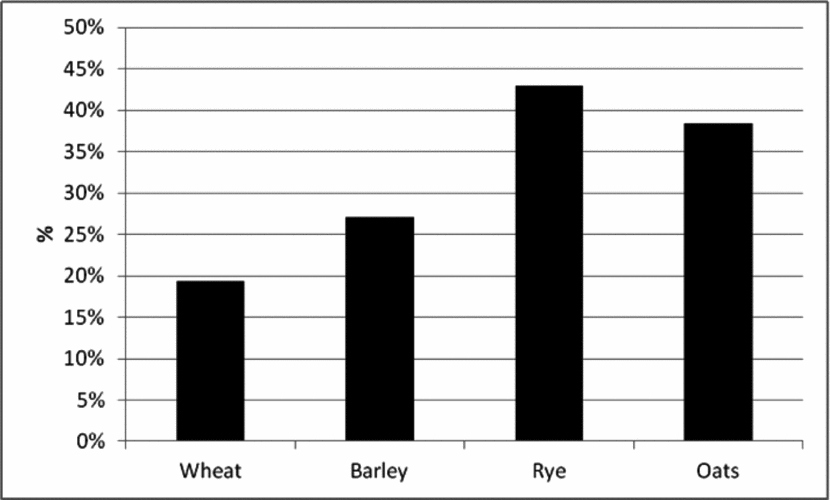
On average, during the whole century the more volatile grains were rye and oats with coefficients of variation of forty-three and thirty-eight per cent respectively, followed by barley with twenty-seven per cent. Wheat was the most stable of the three grains with a coefficient of variation of twenty per cent. The explanation for these differences depends on the sort of land that was used to produce each grain. The best lands were usually reserved for the production of wheat and barley, while the most marginal ones were used to produce inferior grains such as rye and oats. The information provided by the Catastro confirms that in the mid eighteenth century wheat was cultivated almost exclusively in the lands of better quality. Barley was the following grain in terms of the quality of the land used for its production, while inferior grains such as rye and oats were relegated to the use of less fertile soils.
Therefore, when grain producers had to make adjustments in their production levels, the first lands that were abandoned were those with lower fertility levels. For instance, if the amount of labour at the disposal of the producers was reduced, they would focus their resources on the cultivation of good quality lands, sacrificing the production of inferior grains like rye and oats, which were grown in less fertile soil and also cheaper to sell in the market. Another example would be the effect of climatic variability that affects more seriously marginal lands and the crops produced in them (Crowley, Reference Crowley2000). Demand side factors could also be important, like the increasing pressure on the producers from the increasing population to boost the production of wheat.
Coefficient of variation in the production of grains in Guadalajara during the eighteenth centuryFootnote 11
Source: Valencia (Ardit Lucas, Reference Ardit Lucas1989) and (Palop Ramos, Reference Palop Ramos, Goy and Le Roy Ladurie1982), Malaga (Benitez Sanchez-Blanco, Reference Benitez Sanchez-Blanco, Goy and Le Roy Ladurie1982), Basque Country (Bilbao and Fernandez de Pinedo, Reference Bilbao, Fernández de Pinedo, Goy and Le Roy Ladurie1982), Galicia (Eiras Roel, Reference Eiras Roel, Goy and Le Roy Ladurie1982), Segovia (Garcia Sanz, Reference Garcia Sanz, Le Roy Ladurie and Goy1982), Murcia (Lemeneunier, Reference Lemeneunier, Goy and Le Roy Ladurie1982), Toledo (Lopez-Salazar Perez and Martin Galan, Reference Lopez-Salazar Perez and Martin Galan1981), Andalucia (Ponsot, Reference Ponsot1969), Leon (Sebastian Amarilla, Reference Sebastián Amarilla1992) or Mallorca (Vidal, Reference Vidal1978).
Figure 16 shows the decadal averages of the coefficient of variation in the production of the four main grains produced in Guadalajara during the eighteenth century. The results illustrate in general the similar trends over the long run, with minimums in the volatility in the 1730s and a reduction during the last four decades of the century. The decrease in volatility was particularly intense in the case of wheat. On the other hand, the 1740s and the 1750s appear to be the most unstable decades in terms of production volatility, with coefficients of variation that doubled and in the case of oats almost tripled the levels reached in the 1730s.
Coefficient of variation in the production of grains per decade in Guadalajara, 1700–1800 Source: Valencia (Ardit Lucas, Reference Ardit Lucas1989) and (Palop Ramos, Reference Palop Ramos, Goy and Le Roy Ladurie1982), Malaga (Benitez Sanchez-Blanco, Reference Benitez Sanchez-Blanco, Goy and Le Roy Ladurie1982), Basque Country (Bilbao and Fernandez de Pinedo, Reference Bilbao, Fernández de Pinedo, Goy and Le Roy Ladurie1982), Galicia (Eiras Roel, Reference Eiras Roel, Goy and Le Roy Ladurie1982), Segovia (Garcia Sanz, Reference Garcia Sanz, Le Roy Ladurie and Goy1982), Murcia (Lemeneunier, Reference Lemeneunier, Goy and Le Roy Ladurie1982), Toledo (Lopez-Salazar Perez and Martin Galan, Reference Lopez-Salazar Perez and Martin Galan1981), Andalucia (Ponsot, Reference Ponsot1969), Leon (Sebastian Amarilla, Reference Sebastián Amarilla1992) or Mallorca (Vidal, Reference Vidal1978).
Comparison with other series in Spain
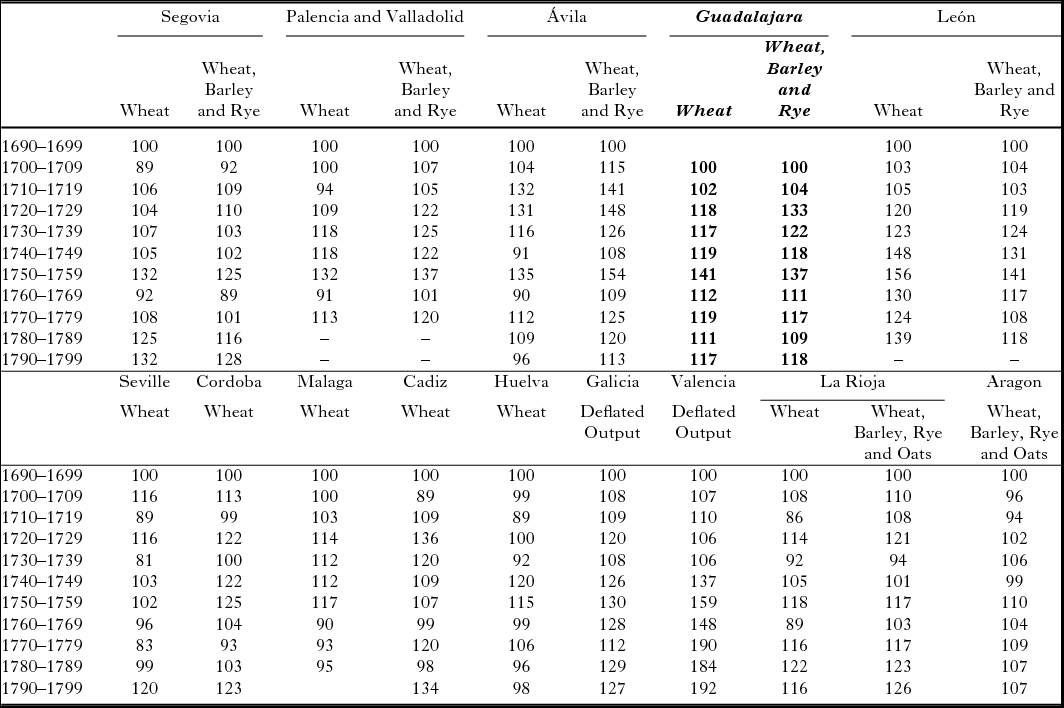
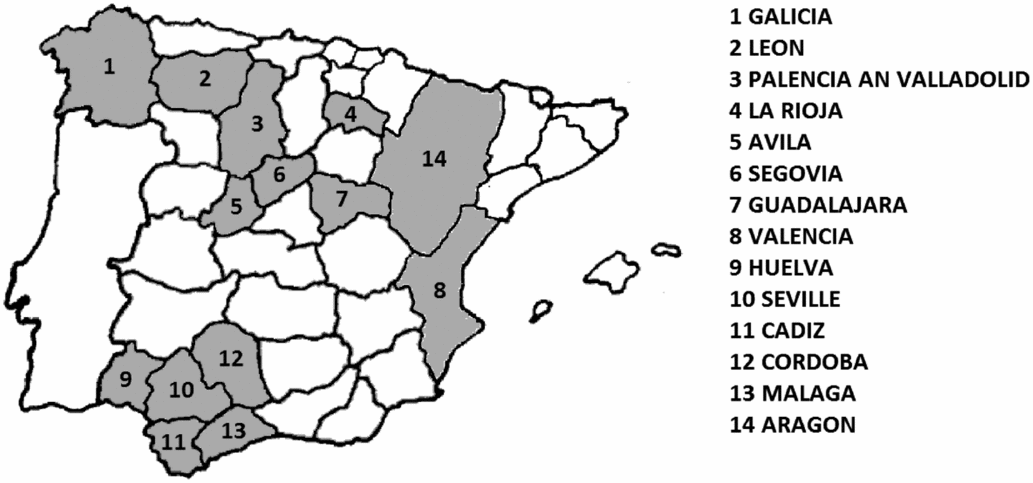
In order to understand better the meaning of the results obtained in Guadalajara, they have been placed within the broader context of the Spanish economy. Information has been gathered on grain tithes for the regions of Galicia, Leon, Palencia, Valladolid, La Rioja, Avila, Segovia, Seville, Huelva, Cordoba, Malaga and Cadiz in the Crown of Castile and Valencia and Aragon in the Crown of Aragon, for which production series have been counted. Figure 17 shows the location of the different areas included in the study. In almost all the cases the information provided is also based on tithe series collected in kind, which estimate real production by using the volume taxed. The series of Galicia and Valencia in the periphery are the exception and use the deflated evolution of the tithe that was paid in cash and not in kind. The decadal series of Guadalajara and the other regions are presented in Table 1.
Grain Tithe Series in Spain 1690–1800 (1690–1699 = 100)
Source: Llopis (Reference Llopis Agelán, Comín, Hernández and Llopis2002), Ponsot (Reference Ponsot1986), La Torre Ciria (Reference Latorre Ciria2007), Benitez Sanchez-Blanco (Reference Benitez Sanchez-Blanco, Goy and Le Roy Ladurie1982) and own estimations.
Geographical distribution of the series
The comparison with other regions reveals some common movements but also significant differences. For example, grain production fell in all the regions during the crisis of the 1760s. One of the possible explanations of the common decline is the appearance in Spain of a climatic anomaly that produced violent variability in weather conditions. Not even the most dynamic regions like Valencia on the eastern coast were able to avoid the decrease in production. Identified by Barriendos, the anomaly was characterised by periods of droughts that were followed by catastrophic floods in periods of time so short that adaptation by producers was extremely difficult (Barriendos, Reference Barriendos and Llasat2003). However, the recovery from the crisis of the 1760s was not so homogeneous. While regions like Valencia, La Rioja, Segovia or parts of the south such as Seville, Cordoba and Cadiz, recovered quickly, others, mostly in the interior or Malaga and Huelva, presented a more protracted recuperation. The example of Guadalajara was similar to the second group, with sluggish growth that was not able to compensate for the fall in production.Footnote 10
Conclusion
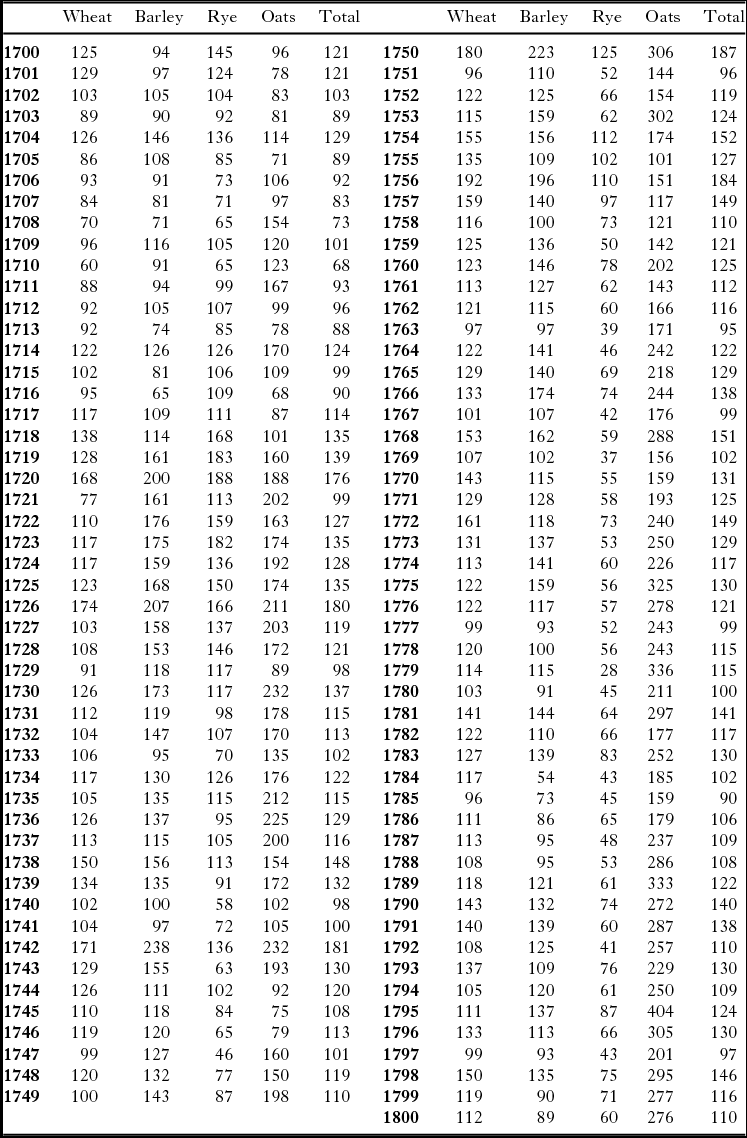
Tithes have proved to be one of the most reliable estimators of agrarian production in pre-modern times. It is hoped that the series presented in this paper will improve the picture of Spanish agrarian history contributing to the most recent debates on European pre-modern growth. The tazmia books that have been analysed in this paper provide an excellent source for the detailed study of total and per capita production. The reliability of the source has been checked with the support of the tithe books and comparison with alternative primary sources. The results seem to indicate that the tithes that are presented in the paper are highly reliable and, therefore, a good estimator of agrarian production in Guadalajara. The examination of the series suggests that the eighteenth century as a whole can be defined as a period of growth in the production of grain in Guadalajara, although the process was not continuous and stable. The recovery from the crisis of the late seventeenth century was intense and total output increased by almost fifty per cent during the first quarter of the century. The decline and stagnation that followed were compensated by the growth during the first half of the 1750s when the series reached its absolute maximums. However, the crisis of the 1760s and the last decades of the century characterised a stagnating economy that was not able to recover the positions achieved in the previous decades. While the production of wheat, barley and rye suffered during the crisis, that of oats was far more satisfactory with an intense growth during the whole period. Grain production was clearly dominated by the presence of wheat that averaged two thirds of total output during the eighteenth century, a share that increased to almost seventy per cent during the last decades. The weight of barley and rye also decreased, while the weight of oats gained importance. On average, the volatility of grain production was very high during the first two thirds of the century and was significantly reduced during the last decades. Wheat was the most stable grain followed by barley and oats, while rye presented the highest volatility. The comparative analysis with other series of grain production shows some similarities that were more common during the first half of the century, and the most important differences are related to the paths followed after the crisis of the 1760s. In this sense, Guadalajara behaved like a traditional agrarian economy of the interior of Spain, with a very slow recovery from the crisis and serious problems arising from the increasing demand of grain as a consequence of demographic growth.
Tithe series for Guadalajara 1700–1800 (1700–1709 = 100)