Implications
The offspring of domestic pigs and cattle is born without antibodies-specific protective proteins in their blood. During pregnancy the placenta of these species does not allow antibody transfer from the mother’s blood. The offspring acquires initial protection during the first day of life through colostrum (first mother’s milk) rich in antibodies. We demonstrated that oral application of gut active carbohydrates during 24 h following parturition enhances transfer of antibodies to piglet and calf blood. This treatment significantly improves their ability to combat microbes reducing the chances for infection and has an overall positive impact on health status and economy of production.
Introduction
Strong immune protection is essential for good animal health and performance. During the first few days of life, mammals depend on the passive immune protection from their dams, either directly or through colostrum, depending on the species. Maternal protection diminishes over time, and there is a lag period until the establishment of the animals’ own active immune defence. This leads to a gap in protection both in piglets and calves around the second and third weeks of age (Ewing and Cole, Reference Ewing and Cole1994). In order to minimize this immune gap, it is important that young mammals obtain a maximum concentration of immunoglobulins (Ig) through passive transfer from their dams.
Unlike humans, in pigs and cattle (as well as horses and sheep) the placenta is epithelichorial, whereby the foetal chorionic epithelium is in contact with the intact uterine epithelium. In this type of placentation, trans-placental passage of Ig is prevented, making the newborn offspring entirely dependant on antibodies received in the colostrum (Brandtzaeg, Reference Brandtzaeg2002). It is therefore particularly important that newborn mammals of this type receive adequate protection through initial colostrum feeding (Butler, Reference Butler1979).
The amount of Ig taken up by the neonate depends on the colostrum quality, the amount of colostrum consumed and the timing of consumption. Composition quality of colostrum depends on many different factors relating to the dam, including nutrition (Noblet and Etienne, Reference Noblet and Etienne1986; Göransson, Reference Göransson1990; Migdal, Reference Migdal1991), genetics (Fahmy, Reference Fahmy1972; Zou et al., Reference Zou, McLaren and Hurley1992), body condition at parturition (Klaver et al., Reference Klaver, van Kempen, de Lange, Verstegen and Boer1981), health status (Gooneratne et al., Reference Gooneratne, Hartmann and Nottage1982) and age. The composition of colostrum has been studied (Darragh and Moughan, Reference Darragh and Moughan1998) and is known to vary considerably between animals for the reasons stated above. In commercial practice it is difficult to completely control those aspects that affect the quality of colostrums; therefore any intervention or dietary strategies that may improve the available levels or uptake efficiency of immune factors within the colostrum may contribute considerably to the immune status of the progeny. This is an important consideration for the maintenance or improvement of their welfare and survival, especially during the first critical days post partum when the young animal is immunologically naive.
As the immature gut is only capable of effectively taking up Ig during the first day following birth, and because colostrum quality drops quickly post partum, it is important that the neonate consumes sufficient amounts of colostrum containing good levels of Ig as soon after birth as possible (Ewing and Cole, Reference Ewing and Cole1994).
Mannan-oligosaccharide is a gut active carbohydrate (GAC) derived from the cell wall of yeast, which has been shown to adsorb pathogens expressing type-1-fimbriae, reducing their ability to colonize the gastrointestinal tract (Spring et al., Reference Spring, Wenk, Dawson and Newman2000). Through this mode of action, GAC has been shown to improve animal health and performance. Published data have shown consistent improvements in piglet, sow, broiler and turkey performance (Miguel et al., Reference Miguel, Rodriguez-Zas and Pettigrew2002; Hooge et al., Reference Hooge, Sims, Sefton, Connolly and Spring2003; Sims et al., Reference Sims, Dawson, Newman, Spring and Hooge2004; Hooge, Reference Hooge2004a and Reference Hooge2004b; Rozeboom et al., Reference Rozeboom, Shaw, Tempelman, Miguel, Pettigrew and Connolly2005) where GAC has been fed over a continuous period of time. In many cases, this work has been focused on the practical replacement of antibiotic growth promoters in animal feeds, and maintenance of the performance of the groups of animals (Hooge, Reference Hooge2004a and Reference Hooge2004b). Many trials have focused on the ability of GAC to bind and eliminate pathogenic bacteria, including Salmonella spp. in challenged broilers (Spring et al., Reference Spring, Wenk, Dawson and Newman2000) and Clostridia perfringens in turkeys (Sims et al., Reference Sims, Dawson, Newman, Spring and Hooge2004) and broilers.
Studies conducted on the Ig levels expressed in colostrum and milk from mammals have shown that dams supplemented with GAC can show higher Ig status, which they pass onto their offspring. Trials have shown significantly increased levels of colostrum Ig and circulating IgG in piglets from sows fed GAC in their diet (O’Quinn et al., Reference O’Quinn, Funderburke and Tibbetts2001). Franklin et al. (Reference Franklin, Newman, Newman and Meek2005) showed a similar response in calves, with close to 20% increases in serum IgG1 for those from dams fed 10 g/h/d GAC. Similar findings have been reported in horses and sheep (Ott, Reference Ott2005).
Plasma Ig concentrations of piglets and calves may also be improved by feeding a low dose of GAC after birth. Piglets orally dosed with GAC 48 h after birth had 32% more serum IgG compared to saline dosed piglets (Hengartner et al., Reference Hengartner, Henggeler, Kohler and Spring2005). It is known that piglet plasma protein profiles change rapidly post partum (Martin et al., Reference Martin, Tesaro, Gonzalez-Ramon, Pineiro and Lampreave2005), and efficient establishment of immunocompetence is important to their ongoing protection from disease.
Both the action of binding and potentially altering the bacterial populations in the gut (Fioramonti et al., Reference Fioramonti, Theodoru and Bueno2003) and the activity of oligosaccharides as receptor analogues and their potential involvement in immune cross-talk interaction (Kelly, Reference Kelly2004) may play a role in the improvement of immune status in young animals supplemented with GAC. Although it is not clear what precise modes of action are involved in neonates, it can be speculated that GAC facilitates or promotes Ig uptake in the gut. As published data are limited, it is uncertain whether this effect can be observed on a consistent basis.
Preliminary investigations conducted by Lazarevic (Reference Lazarevic2005) have shown that GAC can enhance the absorption of Ig from colostrum in both calves and piglets. The objectives of these additional three trials were to evaluate whether GAC has the ability to affect plasma IgG concentrations in piglets and calves shortly after birth.
Material and methods
Piglet trials
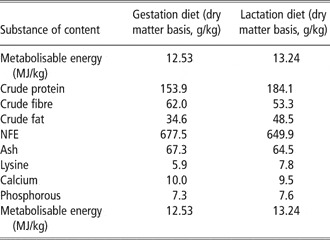
The two piglet trials were conducted using Swedish Landrace piglets with 48 in the first trial and 60 piglets in the second trial. Six litters were used in both studies, providing four piglets (giving a total of 24 piglets with an average weight of 0.90 to 1.25 kg, per treatment) in the first trial and six piglets per treatment (giving a total of 60) in the second. Second parity sows (average weight 150 to 170 kg) were housed in commercial crates measuring 2.4 m × 1.8 m, with standard creep access for piglets, allowing ad libitum suckling. Sows were fed wheat-soy based diets meeting commercial nutrient specifications (Table 1) according to the ‘Alimentation Équilibrée de Commentry’ tables (1993).
Composition of sow gestation and lactation diets in piglet trials

NFE = nitrogen free extract.
Piglet groups in both trials were randomly allocated to one of two treatments. The GAC treatment groups were orally dosed with 10 ml of a 75 g/l mannan-oligosaccharide suspension (Bio-MOS) in saline water at parturition and at 24 h after birth. The dose was selected to provide 0.75 g/kg body weight (BW), with a safety margin for losses during oral administration. The control group received 10 ml of physiological saline in place of the GAC treatment. Piglets were allowed to freely suckle the dam. Brachial plexus puncture was used to obtain 3 ml blood samples at 48 h after birth. Sera were frozen at −20°C until analysed for IgG by using anti-pig IgG plates (INEP, Zemun, Serbia).
In the second piglet trial, BW was monitored at day 0, to equalize groups, and on day 30 (late weaning). Piglets were offered commercial pre-starter feeds (Milkivit, Germany) containing 18.5% crude protein, 5.5% crude fat, 0.2% lysine, 1.3% methionine, 0.2% tryptophan, 0.4% threonine and supplemented with vitamins, minerals and phytase. Total pre-starter consumption was monitored for the whole group, and averaged 1.2 kg per piglet during the 30-day period. Each sow and her litter were considered one experimental blocking unit for the purposes of statistical analysis. Data were analysed by ANOVA, using general linear model (GLM) procedures of the Unistat computer package (Unistat, London, UK), with means separated by Tukey’s tests and confidence limits set at 5%.
Calf trial
The calf trial was conducted as a complete randomized design, using 24 Holstein calves. Cows (lactation range 2 to 5, average 3.6) were housed in barns and, during the non-lactation period, received a diet based on alfalfa hay (8 kg/head/day) combined with a balanced total mixed ratio (2 kg/head/day). After parturition, this diet was gradually changed to alfalfa hay (3 kg/head/day), corn silage (30 kg/head/day), barley malt sprouts dehydrated (4 kg/head/day) and sugar beet pulp dehydrated (3 kg/head/day) plus 1 kg/head/day of the complete ration for every 2 l of milk over 8 l produced. Diets were formulated based on NRC (National Research Council) nutritional requirements for dairy cattle (2001).
Immediately following birth, calves were removed from their dams and placed in individual straw pens measuring 1.6 m × 1.6 m. Six male and six female calves were each randomly allocated to either the control (group average calf weight 36.7 ± 2.57 kg) or GAC treatment (as per the piglet trial) according to birth order (average calf weight 37.9 ± 2.31 kg), giving 12 calves per treatment. All calves received colostrum from a pooled source of commercial dairy cows. The calf trial compared an unsupplemented control group against calves that received 22.5 g GAC mixed into 4.5 l of colostrum (to give 5 g/l) at 2, 12 and 24 h after parturition. This equated to 0.6 g GAC/kg BW (average calf birthweight was 37 kg). Colostrum was fed to the calves three times (at 2, 12 and 24 h post partum) during the first day of life. After this point, they were allowed to suckle their dam ad libitum.
Jugular blood samples were taken at 6, 12, 24 and 48 h following parturition, and then at 4, 7, 14 and 21 days of age. Blood samples of 5 ml were obtained by venipuncture and sera were stored at −20°C until analysis by radial immunodiffusion using anti-bovine IgG plates (INEP). Data for each time point were analysed by ANOVA, using GLM procedures of the Unistat computer package (Unistat, London, UK), with means separated by Tukey’s tests.
Results
First piglet trial
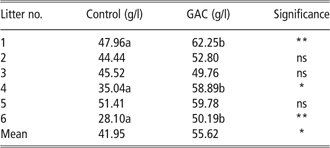
IgG plasma levels from piglets in this trial showed significantly higher sera IgG levels when receiving GAC (P < 0.001, Table 2). Overall, a difference of 32% was observed between the control and the GAC piglets, indicating a substantial increase in blood IgG concentration in groups receiving GAC by oral supplementation.
IgG concentration in 48-h-old piglets (4 + 4 piglets per litter) receiving either saline or GAC suspension orally at birth and 24 h of age
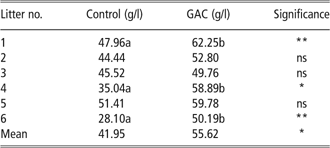
IgG = immunoglobulin type G concentrations; GAC = gut active carbohydrates.
ns = non-significant; *P < 0.05; **P < 0.01.
Means not sharing a letter differ significantly.
Second piglet trial
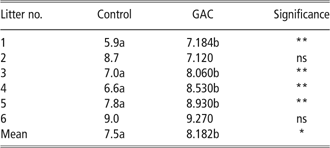
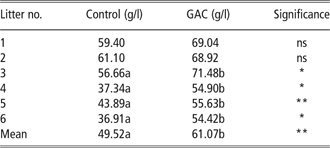
Table 3 shows piglet BW data at 30 days of age, and Table 4 gives the IgG concentration of the piglets 48 h after birth. Piglet BW was significantly improved in four out of six litters, resulting in an overall significant improvement in weight at weaning (P ⩽ 0.05). When analysed by sow, four out of six litters showed significant increases (P < 0.05) in IgG concentration when receiving the GAC suspension. When analysed together, this resulted in an overall significant improvement in IgG status (P < 0.01).
Body weight (kg) at 30 days for piglets receiving either saline or GAC suspension orally at 2 h and 24 h of age
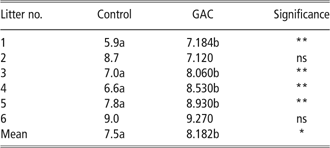
GAC = gut active carbohydrates.
ns = non-significant; *P < 0.05; **P < 0.01.
Means not sharing a letter differ significantly.
IgG concentration (g/l) in 48-h-old piglets (5 + 5 piglets per litter), piglets receiving either saline or GAC suspension orally at 2 h and 24 h of age
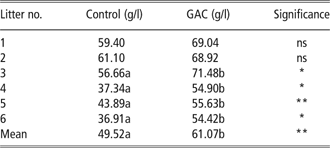
IgG = immunoglobulin type G concentrations; GAC = gut active carbohydrates.
ns = non-significant; *P < 0.05; **P < 0.01.
Means not sharing a letter differ significantly.
GAC supplementation increased piglet blood plasma IgG concentrations by an average of 23% at 2 days of age (P < 0.01), and all six litters showed consistent improvement in IgG status when receiving GAC treatment, although this was numeric only for two litters.
Calf trial
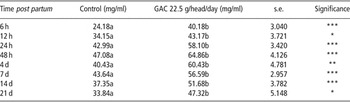
The calf data showed that supplementing colostrum with GAC resulted in consistently higher circulating IgG levels. Levels of IgG analysed in blood serum from calves receiving the GAC supplement were found to be significantly elevated for all time periods (P < 0.05), up to 21 days of age (Table 5).
IgG serum concentration in calves receiving either control or GAC in colostrum until 24 h of age

IgG = immunoglobulin type G concentrations; GAC = gut active carbohydrates.
ns = non-significant; *P < 0.05; **P < 0.01; ***P < 0.001.
Means not sharing a letter differ significantly.
During the experimental period IgG (independent of treatment) increased to a plateau level and then reduced, as the benefits of maternal antibodies increased to a maximum level of protection and then declined over time. The changes observed in immune status of the GAC-fed calves remained evident throughout the trial period. Calves fed GAC during their first day of age had 51% more (P < 0.001) circulating IgG compared with the control group. At the end of the blood sampling period (21 days of age) this difference was still evident, with 39% higher IgG levels recorded in the GAC group.
Discussion
Results from all three trials in both species demonstrated that improvements in IgG levels in newborn animals can be obtained when they are supplemented with GAC. IgG forms the largest group of Ig found in blood serum, and the G isotype is considered of major importance in the transfer of maternal antibodies to progeny (Devereux, Reference Devereux2002). The highly significant enhancement of IgG level in piglets and calves receiving GAC supports the theory that gastric exposure to GAC improves Ig uptake from the gut. These findings are in agreement with those of Hengartner et al. (Reference Hengartner, Henggeler, Kohler and Spring2005), who found 32% higher IgG concentrations in the serum of 2-day-old piglets fed GAC. The increase in IgG status supports the work of Franklin et al. (Reference Franklin, Newman, Newman and Meek2005), who found consistent increases in calves from dams fed GAC, although these were not significant and were lower in magnitude (20% increase in IgG v. 39% observed for this study). The faster establishment of IgG concentrations observed in the calf study indicated improved Ig uptake after birth rather than an actual increase in Ig available from colostrum. The larger effects seen in calves may be a result of the greater control in feeding applied in this trial, whereas in piglets, not all litters showed significant responses, as also observed by Hengartner et al. (Reference Hengartner, Henggeler, Kohler and Spring2005). This may be due to variation in colostrum quality or differences in suckling intake by the piglets.
Mechanisms that may be responsible for these effects have yet to be elucidated; however it is known that carbohydrates play an important role in communication between the gut and the immune system (Disney and Seeberger, Reference Disney and Seeberger2004; Kelly, Reference Kelly2004). GAC has been shown to prevent attachment of pathogenic bacteria, such as Escherichia coli, by competition for receptor sites (Spring et al., Reference Spring, Wenk, Dawson and Newman2000). Data from the current trial could support the theory that carbohydrates can play a role in regulating Ig uptake across the gut wall, which was previously put forward by Kelly (Reference Kelly2004) in her review of the influence of carbohydrates as signalling factors in the immune system associated with the gut. Enterocyte carbohydrate-based attachment systems are now known to communicate with underlying lymphoid cell populations, potentially acting as a conduit to influence the immune system (Kelly, Reference Kelly2004).
Interestingly, the calf trial data suggested that an improvement in immune status provided from the GAC-supplemented colostrum on the first day following birth could exert an influence over immunoglobulin levels for several weeks. This is a major factor to consider when devising strategies to reduce the problems associated with the ‘immunity gap’, that is that period when maternal antibodies are waning, and the animals’ own defences are still too immature to ward off disease threats. Such increases in Ig levels indicated a higher level of passive immunity in the supplemented animals, which, although not within the scope of these studies, could be expected to affect the individual’s ability to withstand disease challenge. A positive relationship between circulating IgG and disease resistance during early life has previously been established (Klobasa et al., Reference Klobasa, Werhan and Butler1981; Kelly, Reference Kelly1985). As disease exposure in the present trials was low, there was no opportunity to monitor potential protection from increased IgG in the animals. However, improved BW in the second piglet trial could be used as a gauge of increased health status, which translated into growth performance.
Supplementing neonates with GAC may provide a method for improving immune status and reducing risks of disease in piglet and calf-rearing operations. In order to examine this further, the ability of GAC-fed progeny to withstand disease in controlled challenge studies would need to be evaluated, and the effects of adding GAC to sow diets are currently under investigation. A review of six trials conducted in the USA, Italy, Croatia and Spain have shown significant improvements (P < 0.05) in the weaning weight of piglets when the sow received GAC-supplemented feed (Spring, Reference Spring2004). Weaning weight is partly dictated by the ability of piglets to combat enteric and other diseases. The ability for significantly increased expression of Ig A, G and M within colostrum from sows fed GAC has also been reported (O’Quinn et al., Reference O’Quinn, Funderburke and Tibbetts2001). A recent trial using over 1000 commercial sows has shown that sows fed GAC-supplemented diets gave heavier (P ≤ 0.05) piglet litter birth and weaning weights. Pre-weaning mortality was 24% less (P < 0.01) in litters from sows fed GAC-supplemented feed. Pre-nursing colostrum samples from GAC-fed sows had greater IgG (P = 0.007), IgM (P = 0.03) and IgA (P = 0.06) compared with the control group. The improved IgG serum concentrations observed from this study may be further increased in piglets where the dam has also been supplemented. It would also be useful to deduce whether other Ig isotypes were also affected by feeding GAC. Detailed immunological research is needed to investigate possible modes of action involved in bringing about changes observed in this trial series.