Introduction
Aggressive and violent behaviours are common reasons for admission to inpatient psychiatric treatment, so it is to be expected that this behaviour will continue after admission (Tishler et al. Reference Tishler, Gordon and Landry-Meyer2000). Treatment of severe agitation in psychiatric inpatients previously relied on a variety of methods, including mechanical restraint, isolation, and other more dramatic interventions such as water immersion therapies (Valenstein, Reference Valenstein1986). At present, physical restraint and seclusion are the most common physical interventions utilised in the management of agitated or aggressive behaviour. Reducing or eliminating the use of these interventions in inpatient facilities is seen as a priority by many regulatory agencies (Steinert et al. Reference Steinert, Eisele, Goeser, Tschoeke, Uhlmann and Schmid2008) and extensive and detailed programs are in place to monitor the occurrence of these events (Donat, Reference Donat2003). This is particularly important because even now in the era of extensive supervision of restraint and seclusion, Nunno et al. (Reference Nunno, Holden and Tollar2006) reported on 45 deaths of children and adolescents associated with restraint that occurred between 1993 and 2003 in the United States.
The prevalence of acute inpatients experiencing seclusion can approach 30% among adults in southern Australia (Hafner et al. Reference Hafner, Lammersma, Ferris and Cameron1989) and adolescents in the US (Scharko, Reference Scharko2010). In addition, one public sector study of child patients in (Crocker et al. Reference Crocker, Stargatt and Denton2010) found that 41 out of 70 children admitted to acute psychiatric care in Melbourne had violent episodes requiring physical intervention, with an average of six episodes per patient during their hospitalisation. To date, however, most of this research has focused on public institutions, including public sector emergency rooms, long-stay state hospitals, and forensic facilities. Limited information is available about the use of these interventions in younger patients, particularly in private facilities (Earle & Forquer, Reference Earle and Forquer1995). For example, De Hert et al. (Reference De Hert, Dirix, Demunter and Correll2011) found only seven studies in the literature on restraint and seclusion in patients under the age of 21. They noted that few data were available regarding the specific behaviours associated with seclusion and restraint and whether the interventions had any demonstrable efficacy.
In a recent analysis of two years of data from a large private psychiatric hospital in the US we (Pogge et al. Reference Pogge, Pappalardo, Buccolo and Harvey2013) found that the occurrence of restraint and seclusion was considerably higher in children than in adolescents and that the topography of these interventions was quite different. In the baseline assessment, 2411 unique children (i.e. 5 to 12 years of age) and adolescents (i.e. 13 to 17 years of age) were admitted to the hospital during that two year period and extensive records were maintained contemporaneously on all restraint and seclusion events. Children had many more occurrences (53% of the sample) than adolescent patients (19%) and every one of the potential verbal or physical precipitants of seclusion or restraint occurred more frequently in children. In addition, the duration of restraint and seclusion episodes was markedly shorter for children than for adolescents, leading us to conclude that these events were qualitatively different. In contrast, there were very few restraints of seclusions of adults in this same facility. Out of 1093 adult cases treated during this same period, only 35 (3%) experienced restraint or seclusion, suggesting even greater differences between adult psychiatric inpatients and younger individuals.
However, the previous analyses do not allow us to address the question of whether restraint and seclusion are, in fact, therapeutic or are simply management strategies applied under duress. We do not know if restraint or seclusion have any educational or maintenance effects over time. In this report, we examined the characteristics of the members of that sample who were readmitted to the same hospital during the same two-year period. In those readmitted cases, we examined the correlation between the occurrence of restraint and seclusion episodes during a first psychiatric admission and several subsequent clinical outcomes, particularly the frequency of restraint and seclusion at readmission and length of stay during readmission. The hospital in question is the largest provider of inpatient care for children and adolescents in its geographic region and the children and adolescents treated are largely seen under capitated care plans. Thus, most readmission other than admissions to the emergency room would occur at the same hospital. However, as other admissions were always possible at other locations, we chose to focus on whether restraint and seclusion at the index admission impacted the occurrence of restraint and seclusion at readmission, length of stay at readmission compared to the index hospitalisation, and satisfaction with treatment as reported either by the parents of children or by the adolescent patients. Satisfaction with treatment is measured at the time of discharge and all cases are provided with satisfaction forms and prepaid envelopes to return the survey forms. This final outcome may be particularly important, as restraint and seclusion can be characterized as intrusive and coercive interventions that risk creating emotional trauma for those experiencing them (Steinert et al. Reference Steinert, Eisele, Goeser, Tschoeke, Uhlmann and Schmid2008). If this is the case, this would be expected to have a negative impact on the satisfaction with care reported by those exposed to these interventions.
Methods
Subjects
Subjects were consecutive admissions to inpatient care at a private psychiatric hospital in the suburbs of the greater New York City metropolitan area. All patients in this study were admitted for the first time on or after January 1, 2008 and discharged on or before December 31, 2009. We reported on the first admission characteristics of this sample, including prevalence and correlates of restraint and seclusion, recently (Pogge et al. Reference Pogge, Pappalardo, Buccolo and Harvey2013). All patients were characterised as ‘minor voluntary’ admissions, meaning that they were signed into the hospital by their parents or guardians. For minors admitted to inpatient care under this status, the children and adolescents neither requested hospitalisation nor had the right to request their own discharge. Their parents could request that they be discharged at any time which the hospital could accommodate, but the hospital could refuse to comply and seek commitment in court. All treatment units are staffed similarly, with a unit director and a staff psychiatrist. There are also nurses and mental health technicians who work across all three shifts.
The present analyses focus on the patients’ characteristics at their second admission (first readmission) during this two-year period, regardless of how many readmissions occurred. Clinical services at this facility are organised by the age of the patients. Patients on the child units are 12 years of age or younger and patients on the adolescent units are 13 to 17 years of age. At the time these data were collected there were three child units, two adolescent units, and one adult unit. Because the number of adult patients was considerably smaller in comparison with the children and adolescents, and only 35 adult patients experienced restraint or seclusion over the two-year period, their data were not included in these analyses.
Recording methods
All data pertaining to the use of restraint and seclusion were taken from the Restraint and Seclusion Order Form that is placed in the patient's medical record at the time of each event. Briefly, this document was developed by the institution to be consistent with regulations regarding the use of restraint and seclusion and to capture all of the information relevant to these incidents. These records include input from both the nursing staff and from the attending psychiatrist, and must be signed by both. This form was created in accordance with Centers for Medicare and Medicaid Services (CMS) requirements section 42 CFR 482.13(e), (f) and (g), governing hospital use of restraint and seclusion (Department of Health and Human Services, 2006). Each Restraint and Seclusion Order Form recorded the kind of intervention (i.e. manual restraint, seclusion on the unit, seclusion off the unit), the duration of the intervention, the behaviours that precipitated the intervention, and other interventions that were attempted prior to or concurrently with the imposition of restraint or seclusion. Further, debriefing regarding the occurrence with the patient is also documented. These forms are reviewed by the Medical Director of the hospital each morning to insure completeness and accuracy, after which the information from these forms is collated in a general hospital database. Each of these interventions could occur multiple times during a patient's hospital stay. Consistent with their purpose, these forms only document incidents that resulted in restraint or seclusion, and did not document disruptive or unsafe incidents that did not result in restraint or seclusion.
Restraint
Mechanical restraint was not used at any time. Physical restraint is defined as any manual method that restricts a patient's freedom of movement or normal access to one's body. In this setting, staff are specifically instructed in techniques of manual restraint and that instruction includes methods for using the least amount of force required, the fewest number of personnel required, positioning the patient in a manner that is least distressing and least likely to cause physical harm, and talking to the patient throughout the event to explain what is being done, why it is necessary, and what the patient can do to bring the incident to a close.
Seclusion
Seclusion is defined as the involuntary confinement of a person in a room or an area where the person is either instructed not to leave or is prevented from leaving. In this hospital, patients are either secluded in a room on the unit or in a designated area of a separate building that is locked. The designated seclusion rooms are specifically constructed for the purpose of providing safe containment while allowing close visual supervision of individuals who are in seclusion. However, if a child is simply instructed to go to their room and stay there, this is designated as a seclusion event by New York Mental Health Law.
Satisfaction
As part of the ongoing quality assurance system that has been in place in this hospital for many years, all adolescent patients were asked to complete a satisfaction survey at the time of discharge, and the parents or guardians of all children are asked to complete this same survey form as it applies to their child. This scale consists of ratings on a five-point (0–4) scale, ranging from Very Unsatisfied to Very Satisfied. Respondents were asked to rate the quality of several different elements of the hospital stay, including admission process, the nursing staff, the safety of the setting, their psychiatrist, their primary therapist, other members of the hospital staff, and the quality of facility. Respondents are also asked to provide a global rating of the quality of their hospital stay and they are invited to write in any comments they might wish to share with the hospital administration. We examined the satisfaction ratings collected at discharge after the readmission.
Data analyses
We examined the occurrence of restraint and seclusion events at the first admission and related this to several variables: likelihood and number of restraint and seclusion events at the readmission; length of stay at the readmission; and satisfaction with treatment at the end of the readmission. Note that since this is an archival study, data are complete on all clinical variables for all patients at the readmission and missing data only occur for satisfaction data. We used parametric and nonparametric statistics to compare the length of stay and frequency of these events across admissions. We used between nonparametric tests to compare the satisfaction ratings of cases who did and did not experience these events at each of the two admissions. All analyses were completed with SPSS (IBM Corporation, 2011).
Results
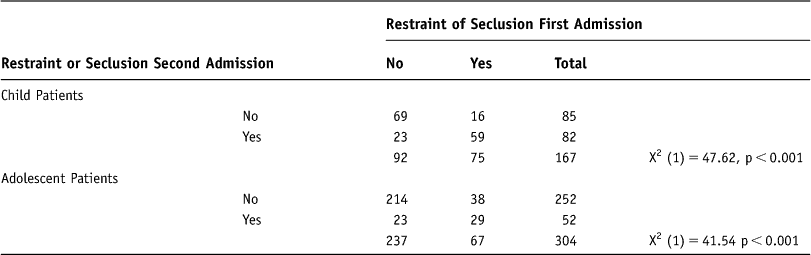
Table 1 presents the relationship between likelihood of restraint or seclusion at readmission as a function of experiencing this intervention at the first admission. The prevalence of seclusion or restraint overall (one or more occurrences) during the readmission was 49% for child cases and 22% for adolescent cases. For child cases with restraint or seclusion at their first admission, 79% experienced at least one restraint or seclusion at their second admission. Of the adolescent patients who had experienced restraint or seclusion during their first admission, 43% experienced restraint or seclusion again during their second admission. This does reflect a 21% reduction in risk for restraint or seclusion for child patients and a 57% reduction in risk for the adolescents in the cases who all were exposed to this intervention at the first admission.
Comparison of occurrence restraint and seclusion across child admissions

Cases that did not experience restraint or seclusion at their first admission were also at risk for exposure to this intervention at readmission. Twenty-five percent of child cases without a restraint or seclusion at their first admission experienced one or more occurrences at their readmission while 10% of adolescent cases who did not experience restraint or seclusion at the first admission experienced one at the readmission. As shown in Table 1 the distributions of cases receiving restraint or seclusion differed considerably from each other in both the child and adolescent inpatients (both p < 0.001), suggesting that cases who do and do not experience restraint are separable from each other. For children, the odds ratio for seclusion/restraint on the second occasion, by seclusion/restraint status on the first occasion, was 11.06 (95% confidence interval 5.35, 22.88). For adolescents, the odds ratio was 7.10 (95% confidence interval 3.72, 13.56). These two findings suggest that risk for restraint or seclusion tends to be stable over time and that the samples who do and do not experience restraint and seclusion are likely different from each other. There was, however, a modest reduction in risk for this experience in child patients and a substantial reduction in risk for adolescent samples at readmission.
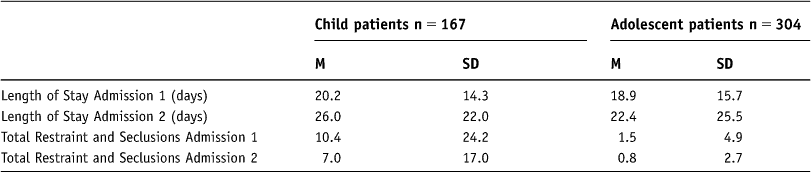
In Table 2, we present the number of restraint and seclusion experiences and the length of stay of the patients at their readmission. Paired t-tests within each sample were used to compare length of stay and number of restraint and seclusion events across the two admissions. Length of stay was significantly longer at readmission for both children, t(166) = 5.82, p < 0.001, and adolescents t(303) = 2.47, p < 0.02. However, the number of seclusions and restraints decreased significantly from admission 1 to admission 2 both for the entire sample of child patients, t(166) = 2.28, p < 0.05, and for the entire sample of adolescent patients, t(303) = 2.40, p < 0.05. When these analyses on number of restraints and seclusions were repeated with related-samples Wilcoxon rank-sum tests (because of the lack of normality of the distributions), both decreases were also significant for both child (p = 0.02) and adolescent samples (p = 0.01).
Characteristics of all readmitted child and adolescent patients

When the analysis was limited to cases who experienced restraint or seclusion at the first admission, there were no statistically significant differences in number of seclusions across admissions for child patients with either parametric, t(74) = 1.49, p = 0.14, or nonparametric (p = 0.35) statistics. Similar results were found for the adolescent patients, with essentially identical mean scores at each admission (M = 4.7 vs. 4.4). The readmitted child patients who had experienced restraint at first admission did have a five-day reduction in length of stay from the first to second admission, while the child patients who did no experience a restraint or seclusion at the first admission had a 7-day increase in length of stay at the readmission (14 days at admission 1 and 21 at readmission). As a result we performed a group (restraint or seclusion at first admission vs. no restraint or seclusion at first admission) by admission (first vs. second) repeated-measures ANOVA on length of stay in the child patients. With length of stay as the dependent variable, the 2-way interaction of experiencing restraint at the first admission (yes vs. no) x admission (1 vs. 2) was significant, F(1,165) = 12.10, p < 0.001. Thus, experience of restraint/seclusion at the first admission was associated with reduced lengths of stay at readmission compared to the other cases. The correlation between the number of restraints and seclusions at the first compared to second admissions was quite substantial in the child patients, r = .54, p < 0.001, although it was not significant for the adolescent patients, r = .16, p = 0.27.
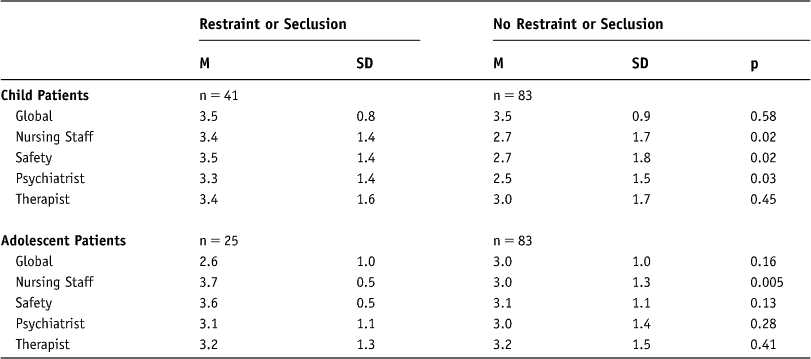
Satisfaction ratings are presented in Table 3. Consistent with the general rate of compliance with these ratings throughout the hospital, data were missing for 46% of the child cases who experienced restraint or seclusions and data were missing for 42% of the cases with restraint or seclusion in the adolescent sample. However, satisfaction data were also missing on 44% of child cases who did not experience seclusion or restraint and 65% of the adolescents who did not experience restraint or seclusion. Thus, data were as complete on the cases that experienced restraint and seclusion as those who did not. The nonparametric Mann-Whitney U test was used to compare these means. As can be seen in Table 3, whenever there were self-reported satisfaction differences between the adolescent cases that experienced seclusion or restraint and those who did not, or parent ratings of child cases that experienced seclusion or restraint and those who did not, cases who experienced this intervention were actually more satisfied. This applied to ratings of nursing staff, safety, and psychiatric care for child patients and satisfaction with nursing staff and safety on the part of adolescent patients. There was no rating scale item on which those adolescents who experienced restraint and seclusion, or the parents of those children who experienced these interventions, were less satisfied with their hospital care than those who did not.
Satisfaction with treatment at discharge from the second admission as a function of age and restraint status

Adolescent ratings are self-report and child ratings were provided by parents. Tests are Mann-Whitney U.
Discussion
In this study across a two-year period, 20% of recently discharged child and adolescent cases were readmitted, about four months after their discharge. There was evidence to suggest that the distributions of cases who experienced restraint or seclusion across admissions differed from each other. Among the cases who received restraint or seclusion at their first admission, the likelihood of experiencing restraint or seclusion at the second admission was reduced by 22% in the child group and 44% in the adolescent group. However, there were significant temporal correlations in terms of both the chances of experiencing restraint or seclusion and the number of these experiences across admissions, suggesting that these subpopulations were quite different from each other. There was some risk for the experience of restraint or seclusion during their second admission in the cases who did not experience restraint or seclusion at their first admission. One quarter of the child patients and 10% of the adolescent patients had this experience at readmission after not having it at the first admission.
While most patients who were readmitted during the period of this study experienced a longer length of stay during their second hospitalisation, child patients who had experienced a restraint or seclusion during their first hospitalisation actually had significantly shorter stays during their second hospitalisation compared to their first, while readmitted cases who did not experience restraint or seclusion actually had a 7-day increase in length of stay at readmission. A difference in reduction of hospitalisation of 12 days does appear likely to have financially important implications. Thus, there is a reduction in risk for seclusion in cases who experienced seclusion at their first admission accompanied by reduced lengths of stay, although there is a strong correlation across admissions in risk for restraint or seclusion.
What may be most notable about these findings are the data from the satisfaction ratings. Parents whose children experienced seclusion and restraint reported that they were at least as satisfied, and sometimes more satisfied, with their children's treatment than were the parents of children who did not experience restraint or seclusion. Even more striking is the fact that adolescent patients whose inpatient experience included seclusion or restraint actually reported higher levels of satisfaction with their treatment than did those who did not experience seclusion or restraint. Moreover, in both samples the level of satisfaction with the nursing care staff (who are the individuals who perform restraint and seclusion when those interventions are necessary) was actually higher for those cases that had experienced restraint or seclusion than those that had not; and those patients who experienced restraint and seclusion were more satisfied with the level of safety they felt in the hospital than those who did not. This suggests that the experience of restraint and seclusion as it is delivered in this setting to this age group does not uniformly create a feeling of danger nor does it appear to create the perception on the part of patients or parents that the nursing personnel involved in this intervention are malicious, coercive, or punitive. While these data do not specifically indicate how children and adolescents felt during the actual episode of restraint or seclusion, these data do not suggest that these patients are left with the sort of persistent dissatisfaction that one might predict if these interventions were experienced as violent or coercive.
Most children with diagnosable psychiatric conditions do not require hospitalisation; aggressive, explosive, and unmanageable behaviour is the most common cause for the hospitalisation of pre-adolescent children. It is agitation and failure to respond to the normal array of behaviour management techniques used by parents, regardless of diagnosis, that is likely to result in hospitalisation. In contrast to children, adolescents in this setting are more likely to be admitted for suicidal and self-injurious behaviours, and their aggressive acts are more likely to be instrumental and planned rather than the explosive outbursts of small children (Pogge et al. Reference Pogge, Insalaco, Bertisch, Bilginer, Stokes, Cornblatt and Harvey2008). This may explain both the lower frequency with which restraint and seclusion are applied to this age group and the increased likelihood that this experience is not repeated at a second admission. While it is impossible to tell from these data, it may be the case that the precipitants of restraint and seclusion in this age group are reactions to restrictions and rules imposed in the hospital setting rather than an inability to control their behaviour.
There are some clear limitations of these data. They come from a single private inpatient facility in the US. However, most previous studies of restraint and seclusion were also either from a single hospital or single care system. In addition, there were missing data for some satisfaction ratings, however, there was a higher proportion of data missing on cases who did not experience restraint and seclusion. The follow-up interval is relatively short and some of the 80% of cases who did not experience a readmission during this period may have been hospitalised again later. The treatment for 21% of the cases in this sample was paid for by public entitlement insurance such as Medicaid or Medicare, indicating a broad case mix. Moreover, the catchment area from which these patients were admitted included the city of New York, the nearby suburbs of New York, New Jersey and Connecticut, and the upstate New York region. Thus, these patients represent a diverse mix of urban, suburban, and rural populations, as well as a racially, ethnically, and socioeconomically mixed sample. The current dataset cannot address risk for readmission and behaviour after readmission over those longer intervals and is likely to underestimate readmission rates over all because some admissions may have occurred outside the standard managed care context for some of these cases.
While these factors may limit the extent to which these data can be generalised to other settings, these data provide evidence that the judicious and closely supervised use of restraint and seclusion in the inpatient treatment of children and adolescents may have benefits beyond the immediate value of bringing to a halt behaviours that injure or endanger these patients and the people around them. It appears that there is some reduction in the likelihood restraint and seclusion at subsequent readmissions, with this reduction being most substantial for adolescents. The fact that there is a strong correlation in risk for restraint and seclusion across psychiatric inpatient admission does call for innovative research in the management of these behaviours.
Acknowledgements
Dr Pogge had a grant from Bristol Myers Squibb in the past year. Dr. Harvey has received consulting fees from Abbott Labs, Amgen, Boeheringer Ingelheim, En Vivo, Genentech, Johnson and Johnson, Roche Pharma, Sunovion Pharma, and Takeda Pharma, during the past year. None of the other authors have any commercial interests to report. This research was not supported by outside funding.