INTRODUCTION
In the context of palliative care, patients with incurable illness are increasingly being cared for in their own homes. This trend has resulted in the increased importance of family members, who have been strongly encouraged to become family caregivers (Grande et al., Reference Grande, Stajduhar and Aoun2009; Stajduhar & Cohen, Reference Stajduhar, Cohen, Hudson and Payne2009). Family caregivers within the context of palliative care are defined as any relative, friend, or partner who has a significant relationship with and provides various forms of assistance to a person with an incurable illness (Hudson & Payne, Reference Hudson, Payne, Hudson and Payne2009). Family caregiving should be distinguished from general emotional care in the context of family relationships; rather, this type of caregiving emerges because of additional and particular needs for assistance (Seale, Reference Seale2000). Family caregivers in palliative home care often provide extensive help with such things as domestic chores, personal care and activities, medications, symptom relief, and emotional and existential support. They also have to cope with the impending loss of a family member (Stajduhar & Cohen, Reference Stajduhar, Cohen, Hudson and Payne2009; Stajduhar et al., Reference Stajduhar, Funk and Toye2010).
Studies have found that family caregivers in the home are usually motivated by love and duty and may also face expectations from the patient and health professionals that could lead them to take on the role of caregiver with feelings of doubt and ambivalence (Erlingsson et al., Reference Erlingsson, Magnusson and Hanson2012; Sand et al., Reference Sand, Olsson and Strang2010; Linderholm & Friedrichsen, Reference Linderholm and Friedrichsen2010). Being a family caregiver in palliative home care could be described as a great and complex responsibility that family caregivers often struggle to prepare for. This added responsibility could result in negative effects on their health and well-being, such as stress, anxiety, fear, guilt, and sleep disturbances (Funk et al., Reference Funk, Stajduhar and Toye2010; Stajduhar et al., Reference Stajduhar, Funk and Toye2010; Carlsson, Reference Carlsson2012). But family caregivers also report positive and rewarding feelings derived from their role as caregivers (Henriksson et al., Reference Henriksson, Carlander and Arestedt2013; Funk et al., Reference Funk, Stajduhar and Toye2010). The caregiving experience can range between a positive one of influence, support, and value and a more negative experience of hopelessness and powerlessness (Erlingsson et al., Reference Erlingsson, Magnusson and Hanson2012).
Caregiving is more likely to be a positive experience if family caregivers feel prepared to meet the multiple demands of providing care (Foley, Reference Foley, Back and Bruera2005). Preparedness has been defined as something done prior to a crisis to improve the response. It has been described as a condition or activity to foresee potential problems and project possible solutions. It involves the building of abilities and capabilities (McEntire, Reference McEntire2007; Eriksson, Reference Eriksson2008). The concept of preparedness for caregiving refers to a perceived readiness to manage the domains of the caregiving role, such as providing physical care and emotional support, setting up care in the home, and dealing with the stresses of caregiving. It has an anticipatory connotation that allows family caregivers to assess their readiness in advance (Schumacher et al., Reference Schumacher, Stewart and Archbold1998; Archbold et al., Reference Archbold, Stewart and Greenlick1990). Preparedness for caregiving has also been defined as having adequate practical, emotional, informational, and financial support (Foley, 2005).
Preparedness could serve as a moderator of negative effects related to caregiving in family caregivers (Schumacher et al., Reference Schumacher, Stewart and Archbold2007). In palliative care, it has been found that better-prepared family caregivers also feel more rewarded by their caregiving situation. They also have a higher sense of hope and experience, as well as less anxiety (Henriksson & Arestedt, Reference Henriksson and Arestedt2013). Studies have also demonstrated that caregivers who feel prepared experience less caregiver worry, fewer mood disturbances, and decreased levels of depression. Caregivers who perceive themselves as being inadequately prepared are prone to greater levels of burden (Schumacher et al., Reference Schumacher, Stewart and Archbold2008; Nolan et al., Reference Nolan, Grant and Keady1996; Archbold et al., Reference Archbold, Stewart and Greenlick1990). Feelings of preparedness may also protect caregivers from perceiving caregiving as becoming increasingly difficult as demand increases (Schumacher, 2007).
In summary, family caregivers face a great responsibility and play a fundamental part in palliative home care. Feelings of preparedness seem to have important consequences, as they are associated with more positive experiences and less negative effects from caregiving. Although preparedness has been confirmed to improve caregiver well-being, few studies have employed qualitative methods to explore this phenomenon in palliative care.
Aim
The aim of our study was to explore the experience of preparing for caregiving among family caregivers during specialized palliative home care.
METHOD
Design
In order to answer the research question, which sprang from clinical practice, interpretive description was chosen as the design. This design provides a way of displaying conceptual descriptions of different phenomena (Thorne, Reference Thorne2008)—in this case, family caregivers' preparedness for caregiving.
Setting
The participants were recruited for interviews from six different home care units in an urban area of Sweden. The units all specialized in palliative care and offered advanced caregiving, including infusions, symptom relief, and parenteral nutrition in the patient's home. The palliative care units belonged to the tax-financed healthcare system of Sweden, and the treatments provided were free of charge. The care organization allowed patients to freely choose in which team to enlist. The units were staffed 24 hours a day and consisted of multi-professional teams, including physicians, nurses, physical therapists, occupational therapists, nutritionists, and social workers. The teams paid visits to patients depending on patients' needs, ranging from daily to monthly. They did not offer such basic caregiving as washing, dressing, or food preparation, as these could be provided by the municipality if the patient was deemed to be in need of such.
Sample, Procedure and Data Collection
The inclusion criteria for the study were: (1) being a family caregiver for a patient in specialized palliative home care, (2) being over the age of 18, and (3) being able to read and understand the Swedish language. The sample was recruited from an intervention study aimed at supporting family caregivers. The intervention study included completing questionnaires at baseline where participants were asked to rate their situation as caregivers. The tool chosen for this data collection was the Preparedness for Caregiving Scale (PCS), an instrument that measures perceived preparedness in family carers through eight questions on a scale ranging from 0 to 4. Within the intervention study, patients were approached by healthcare professionals and given written information about the study from the researchers.
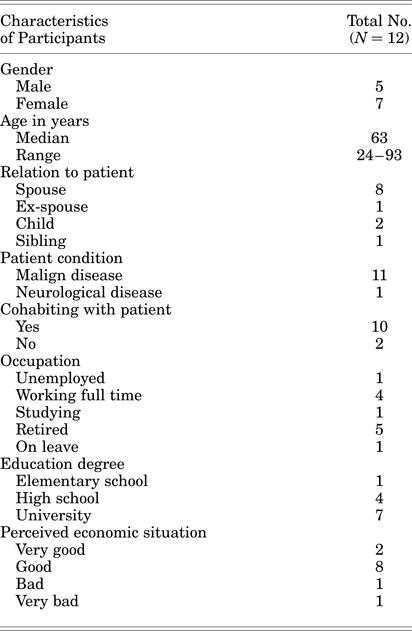
If patients gave their consent to participate, they were asked to nominate family caregivers to take part in the study. In sampling for the present study, a strategic sampling method was applied, focusing on women and men who were caregivers at different ages and socioeconomic situations who had scored high or low on the PCS. This selection process was intended to secure richness and variety in the dataset (see Table 1). The identified caregivers then received written information about the study and its purpose, along with a request to participate in an interview. This request was followed up by one of the researchers with a telephone call. In all, 14 family caregivers were asked to participate; 2 persons declined on the basis of the severe condition of the patient, so that individual interviews were completed with 12 family caregivers. Participants were given a choice of preferred setting for the interview. Nine chose to come to the research centre, two wished to be interviewed in their own homes, and one in a public place. The interviews lasted between 40 and 120 minutes and were all conducted by the first author. The interviews were following an interview guide, which included open-ended questions, starting with questions of the sort “Can you please tell me about your situation as a family caregiver?” and “In what way did you prepare for the current situation and the future?”
Characteristics of participants

Data Analysis
In order to determine patterns with respect to both commonalities and diversities among and between participants, a constant comparative analytic technique was applied in our study. Data collection and analysis took place concurrently, with the emerging results guiding further data collection (Thorne et al., Reference Thorne, Hislop and Kim-Sing2013). The interviews were transcribed verbatim and read several times to obtain a better sense of the whole piece. Coding of the material was carried out with the help of NVivo qualitative data management software. In line with the interpretive descriptive approach, initial coding was inductive and broad based, searching for patterns within the material. Memos were made during analysis, and these were continuously discussed and compared by the first author and her coauthors. This process included reading the transcripts from different angles and finding alternative interpretations of the material. In this way, a dialogue was established with the material to guide future interpretations. Using concurrent data collection and analysis, accounts were built up of family caregivers' experiences about preparing for caregiving to expand our understanding of the patterns and variations in underlying meanings (Thorne et al., Reference Thorne, Hislop and Kim-Sing2013).
The patterns found during initial coding implied that the experience of preparing for caregiving could be regarded as an ongoing process for family caregivers. A more focused data analysis was performed during the continued collection of data. Two questions guided the analysis: “How did participants describe their process of preparing for caregiving?” and “What influenced their process of preparing?” This further analysis resulted in identification of three different subprocesses found in the overall process of preparing for caregiving.
Ethical Issues
Family caregivers and patients in palliative home care could be viewed as a vulnerable group, making ethical issues, such as informed consent and confidentiality, of special importance. Written informed consent was obtained from both patients and family caregivers before enrollment. The information provided to them underlined that their consent could be withdrawn at any time and that personal information would be protected. Approval was also granted by the regional ethical review board in Stockholm (2012/377).
RESULTS
The accounts rendered by family caregivers reveal the experience of preparing for caregiving as an ongoing process through the entire illness trajectory and the palliative stages. The process was illustrated through three different subprocesses: “awaring” (realizing the seriousness of the situation), “adjusting” (managing a challenging situation), and “anticipating” (planning for the inevitable loss). These subprocesses can be described as the sometimes successful attempts to make it from one goal to another as a caregiver, as well as facing and managing challenges. Preparing was not a linear process, as the subprocesses could take place simultaneously and be both related and unrelated to each other. Preparing for caregiving in the context of palliative care was intimately related to family caregivers preparing for the death of the patient and their experience of grief. The processes would often have to be restarted, as changes in the patient's condition took place over time and family caregivers were forced to prepare for additional contingencies.
“Awaring”: Realizing the Seriousness of the Situation
Participants experienced a process of growing awareness about the severity of the patient's condition and were also emotionally confronted with the changes that came with the diagnosis. This progression could be described as a mostly mental and emotional process of preparing.
The disclosure of a patient's incurable illness was usually the initial step of the “awaring” process and embodied a realization that the participants had to start preparing for the caregiving of a dying family member. The disclosure sometimes led to feelings of denial that decelerated the process of growing awareness. Some family caregivers had experienced months and years of illness and had been balancing between hope and despair before they were finally forced to realize that that they had to prepare for the worst, as described by one participant caring for her husband:
Generally, I have passed through many phases of these, denial and all those things, and now we are in this situation that we have accepted the situation and know where it will lead, and we adapt to each day, so that's it.
The “awaring” process often had to be restarted during the illness trajectory as the family caregivers were confronted with changes in the symptoms experienced by the patient and were given additional notifications by healthcare professionals. Another participant described the process as a constant bracing for new and difficult challenges:
To me it's just, “Okay, here we go.” That's what I am thinking. Every time he is getting into more pain, I am thinking, “Here we go.” So that's what I am thinking all the time, and then it sort of plays down, but (. . .) then I am thinking, “Okay, here we go.” That's what I am thinking as soon as something happens.
Family caregivers had a growing realization that they were expected to become caregivers for the patient, when the need arose. They became increasingly aware of their responsibility, and they felt heavily depended upon for the care of the patient, who often preferred to be cared for at home. The “awaring” was also influenced by their sense of affection and obligation to the patient. However, the arrangements differed greatly between family caregivers, and patients were also at different stages of the palliative phase. All the family caregivers expressed a wish to be there for the patient, but not all of them wanted to be regarded as caregivers and so did not regard themselves as preparing for caregiving. This point was illustrated by one husband caring for his wife:
You can say, I look at it “von oben,” so I mean, of course, I am responsible. We promised each other that responsibility forty years ago. So it's there; it is. But I will not take responsibility for her care so that I would start lifting her and moving her around. Then we will depend on the home service, who are aces in that respect. Because I am not educated to care for someone who is sick.
Participants stressed the importance of finding time for themselves during the “awaring” process. They needed time to work through the constantly changing information they were receiving and to release feelings of grief and sadness. Processing these feelings could be done in privacy or with aid from professionals or friends. Feeling trust in the healthcare system was described as something that facilitated this difficult process of “awaring.” Establishing a good relationship with and being supported by health professionals was also a benefit in family caregivers' process of preparedness.
Adjusting: Managing a Challenging Situation
The patient's condition necessitated having to prepare for previously unknown challenges. Family caregivers faced their responsibilities as caregivers and the changed relationship with patients. Adjusting to these challenges was a continuous process of preparedness, which also included the struggle to balance their own needs with those of the patient. This process was described as the practical processes of dealing with physical changes to the home as well as mental and emotional processing.
Some family caregivers were less involved in caregiving for the patient, while others had the overall responsibility, with assistance from palliative home care teams. This responsibility included helping the patient with practical and medical chores, maintaining contact with the healthcare system, and providing emotional support. The situation as caregiver was described as exhausting and often very limiting. Some barely had the opportunity to leave their house, as the patient needed constant attention. Strategies were built around adjusting to caregiving situations. One man described the difficulties in adjusting to the role of a caregiver for his wife and how he learned to trust his body's system:
I can honestly admit that sometimes I get extremely tired and (. . .) almost passive in some way. And it's a struggle. And I try to work myself out of it, and it's not easy. But the body's own signal substances, when they are in action before lunch, it can be hard, but then it gets better during the day and the night, so then it's fine again.
Viewing caregiving as rewarding and meaningful seemed to facilitate the process of adjusting, even if it was described as limiting and tiresome. This view seemed to be related to a family caregiver's outlook on life and family. One participant described her background within a strong family culture as an important part of her preparedness for the caregiver role. To her, it was something natural to care for someone in the family and adjust to their needs:
That's why I am happy about it. I don't feel strained by caring for him, like it is unfair and I can't realize my dreams. You don't realize them at the age of 63. By then, you should have done it already.
The process of adjustment was dynamic, as the family caregivers were constantly faced with new challenges as caregivers. This continuous process was experienced as something that required a lot of energy. Some were more relaxed than others about finding solutions, feeling that their personal qualities made them better prepared for the situation, as illustrated by one participant caring for his wife:
I am a little used to looking out for myself, and I have made good contacts with the care administrator, and I can reason with her. I don't make demands. I can reason, and it all works fine. Arguing won't get you anywhere.
In the process of adjustment, family caregivers had to find ways to relate to their own needs. This was described as a process of constantly balancing their needs with those of the patient's. For example, a great need for information and knowledge about the illness was described, but family caregivers were also desperately trying to protect the patient, who they assumed would be hurt by knowing. A constant worry for patients was a desire to receive constant attention. Adjusting to the situation included learning to relax this control, as illustrated by another participant:
Since I was so keen on him being well, there was a lot of “How are you feeling?” “Have you been eating?” And that was bad for us both. I am not his mother. Somehow, he turned into (. . .) We both turned into the role where he was a child. And he is no child. He is my husband. So I think I have gotten better.
In order to prepare, family caregivers occasionally had the need to get away from the caregiving situation, doing something on their own, or just relaxing. While caregiving they were often in a constant state of adjusting to the needs of the patient, and being away allowed them to relax somewhat. Support from family, friends, and coworkers was also described as important. Having a religious faith was experienced as an important part of preparedness. Believing that God had a plan made it easier to adjust to caregiving, and the church was considered a place to find peace and time for reflection in order to prepare for future challenges.
Anticipating: Planning for the Inevitable Loss
During the process of preparedness, there was a need for family caregivers to think ahead, toward the inevitable death of the patient. This was described as a continuous mental process, as the view of the future changed with the fluctuating condition of the patient and changes in the caregiving situation. The process also included reflections about caregiving for a dying person and how to prepare for the loss.
The process of anticipating was complicated by the fact that family caregivers were living oblivious to how much time the patient would have left to live and how the incurable illness would play out. They had guesses and suspicions of their own, and some had been offered ideas by healthcare professionals, but their questions could not be answered completely. To manage this, family caregivers often chose the strategy of taking one day at a time. Not knowing what was ahead could be described as both a relief and a frustration. Family caregivers did not want to think about the death of the patient, but they were also frustrated by not knowing how much time was left and for what changes they had to prepare. A daughter caring for her mother found it hard not knowing how long the strenuous situation would last:
I feel that I would like to know how much time my mother has left to live, a little bit because (. . .) actually, because of these selfish, practical reasons, planning. Because I think it's damn hard not to be able to make plans. Not in detail, but (. . .) Will we be able to go anywhere at all this summer? Because we also feel that we need some time away from her, too—maybe a week at the time and just have telephone contact.
None of the family caregivers cared for a person who was confined to bed all the time. All participants described a limit to what they were prepared to cope with in the caregiving role, even if they were not always sure where the line was drawn. This could be a fear of not being able to manage a patient's care in the home until the end. One participant was aiming to keep her husband in their home but was still struggling with thoughts of how she would manage caregiving:
And then I have also tried to reconsider it a little, to drop the practical a little bit, but trying to think that, well, it is my husband lying in that bed that I am supposed to care for. What's that going to be like and those things? But I still want to so (. . .) But I can imagine that (. . .) I am not sure how he feels about it at all, actually.
The palliative care teams were mentioned as having an important role to play in preparing for the loss. Their information about the patient's condition was described as something family caregivers did not always like, but something that still initiated the preparatory process in their minds, as described by one woman:
They have tried to prepare me when it comes to these questions, even if you don't want to acknowledge it. Those sentences remain in your mind, and then you start processing these issues.
Despite their wish to live in the present, most participants had begun to think about their life in the future without the ill family member. Thoughts on practical issues concerning inheritance and testaments and how to organize funerals were going through their heads. There were also fears of a life of loneliness without the patient, especially for caregivers married to the patient. Having lived a long time with the illness and the threat of death seemed to make the process of anticipating easier. Family caregivers were mostly concerned for the well-being of the patient, hoping that the trajectory would not be too drawn out and painful.
DISCUSSION
The present study is, to our knowledge, the first study to investigate the experience of preparing for caregiving using qualitative methods. Our main finding is that family caregivers in the context of palliative home care prepare for caregiving as part of an ongoing process, as illustrated through three subprocesses: awaring, adjusting, and anticipating. This finding is somewhat in contrast to previous research, which has described preparedness for caregiving as an anticipatory condition (McEntire, Reference McEntire2007; Schumacher et al., Reference Schumacher, Stewart and Archbold1998). Although anticipation was an important part of the results in our study, as family caregivers were anticipating caregiving for a dying patient, the results also demonstrate the experience of preparing as something taking place continuously throughout the illness trajectory and the challenges of caregiving. This process is illustrated in our study, not only in family caregivers' practical preparedness, but also in the managing of emotional and mental processes. Our findings could be compared to those of a study by Stajduhar et al. (Reference Stajduhar, Funk and Outcalt2013), who found that family caregivers go through a process where they are actively learning and reflecting throughout the experience of caregiving. It could also be compared to the model of Penrod and colleagues (Reference Penrod, Hupcey and Shipley2012), describing family caregivers' situation in palliative care as a form of transition where caregivers strive to uphold a sense of normality throughout the illness trajectory.
The first subprocess found in our analysis; “awaring,” illustrated family caregivers' growing awareness not only of the patient's condition, but also of being faced with the responsibilities of a caregiver. However, participants were not always emotionally inclined to take up this role. Previous studies have discussed the problematic nature of labeling family members as caregivers, because they might not consider themselves to be that, but rather husbands, wives, children, or friends (Carlander et al., Reference Carlander, Sahlberg-Blom and Hellstrom2011). Experiences of becoming a caregiver could be affected by whether it was an active choice or something that family caregivers felt was imposed on them (Wallerstedt et al., Reference Wallerstedt, Andershed and Benzein2013). In the “awaring” process, participants in our study had found expectations on them to provide caregiving, not just from the patient, but also from the healthcare system. Preparing to take on the role of caregiver seemed to be rooted mainly in love and concern for the patient, which has also been found in earlier research (Sand et al., Reference Sand, Olsson and Strang2010).
The subprocess of “adjusting” included adjusting to many different changes in both the practical and emotional sense. This has been viewed as a form of coping strategy (Epiphaniou et al., Reference Epiphaniou, Hamilton and Bridger2012). Adjusting to caregiving has previously been described in negative terms, as family caregivers may feel obliged to arrange their lives around the patient, ignoring their own needs (Erlingsson et al., Reference Erlingsson, Magnusson and Hanson2012). Being a family caregiver in palliative care has been described in terms of a “modifying of the self” with decreased personal space and a struggle to keep the situation under control (Munck et al., Reference Munck, Fridlund and Martensson2008; Carlander et al., Reference Carlander, Sahlberg-Blom and Hellstrom2011). However, the family caregivers in the present study were also trying to find strategies to balance their own needs to that of the patient's, rather than focusing on just the patient. Finding relief away from the caregiving role was highlighted as an important strategy, which has also been found in an earlier review of the literature (Stajduhar et al., Reference Stajduhar, Funk and Toye2010). Many things seemed to affect how family caregivers dealt with the process of adjustment. Support from friends and family as well as from healthcare professionals, was mentioned as an important factor by family caregivers. It has been suggested that family caregivers lacking social support would be in need of more formal support from healthcare professionals in order to adjust to the caregiving situation (Erlingsson et al., Reference Erlingsson, Magnusson and Hanson2012; Stajduhar & Cohen, Reference Stajduhar, Cohen, Hudson and Payne2009; Milberg & Strang, Reference Milberg and Strang2011). Other factors—such as cultural background or religious faith—also seemed to influence family caregivers' preparedness for adjusting to caregiving.
In the third subprocess, “anticipating,” there was an intense focus, not only on preparedness for caregiving, but also on preparedness for death and grief. However, grief for the patient's incurable illness was present throughout the entire process of preparedness, from the time of first notification. Anticipatory grief is known to occur before death and involves physical, emotional, cognitive, and/or spiritual symptoms similar to grief responses following a death (Simon, Reference Simon2008). From the results of our study, it could be assumed that the process of preparing for caregiving in the context of palliative care and the process of anticipatory grief are intertwined. Caregiving has been described as a part of the anticipatory grieving process as a way of showing love for the dying person (Clukey, Reference Clukey2008). Anticipatory grief could be viewed as an important part of preparedness for death, as it might allow for the development of coping skills during bereavement (Simon, Reference Simon2008). However, grief does not have to be connected to a person's death; it can be described as a reaction to any kind of loss (Friedman, Reference Friedman2003). During the process of preparedness, family caregivers faced unexpected and unwanted changes to their lives and relationships and, consequently, were going through a process of grief to begin with.
METHODOLOGICAL CONSIDERATIONS
To ensure good quality of results, representative credibility is an important component of data sampling. This means ensuring a sample that represents the research topic in a credible manner (Thorne, Reference Thorne2008). The strategic sampling method employed in our study was intended to ensure variety in the data by focusing on high and low scorers on the Preparedness for Caregiving Scale. Sampling provided the opportunity to record family caregivers' diverse experiences in preparing for caregiving. However, feelings of being prepared or unprepared seemed to fluctuate with the illness trajectory and as the patient's condition changed. Because scoring was carried out days or weeks before the interviews took place, it is very likely that family caregivers' ratings could have changed in the interim.
All but one of our participants was a family caregiver for a person with cancer, as the authors did not have the opportunity to find out about patients' diagnoses before sampling. This could be considered a weakness, but it is also consistent with the situation in Sweden, where a majority of those enrolled in palliative home care suffer from cancer.
CONCLUSION AND IMPLICATIONS
Being a family caregiver in palliative home care may involve the process of preparing for caregiving. In contrast to the traditional definition of preparedness as something done in advance, to build up capabilities, preparedness for caregiving was revealed to take place continuously, throughout the course of the illness. Family caregivers were not just preparing for caregiving in advance, they were preparing through the challenges of caregiving.
Because preparedness for caregiving has been found to be an important factor in terms of family caregiver health and well-being, it should be important for health professionals to know how to promote feelings of preparedness in family caregivers in palliative home care. Our study provides valuable knowledge about preparedness as a process, and thus something that needs to be supported continuously. Because preparedness for caregiving seems to fluctuate among family caregivers, it should be important to utilize scores like those on the Preparedness for Caregiving Scale regularly, and not just on enrollment into palliative home care. It could also be assumed that intervention studies need to focus not only on how to promote feelings of preparedness but also on how to manage the process of preparing for caregiving and its subprocesses.
ACKNOWLEDGMENTS
This work was supported by the Erling-Persson Family Foundation and the Swedish Cancer Society.