Introduction
Late one Sunday afternoon in 2014 in Wamena, the hub of the Central Highlands of Indonesia's easternmost province of Papua, I heard about a confrontation that had taken place earlier that day at one of the open-air markets on the town's periphery. The regent (bupati) for the area had reportedly led a group of security officers to disperse market participants—produce vendors, shop owners, and an assortment of drivers, conductors, shoppers, idlers, porters, and gamblers.Footnote 1 This action enacted the regency administration's (kabupaten) new policy that banned market activity on Sundays. A witness to the dispersal described officers shouting at vendors and kicking their vegetables aside. During subsequent weeks, life at the markets—and the adjoining minivan terminals that connect the markets with the villages of the Balim Valley surrounding Wamena—would be suspended every Sunday to uphold the Christian day of rest.
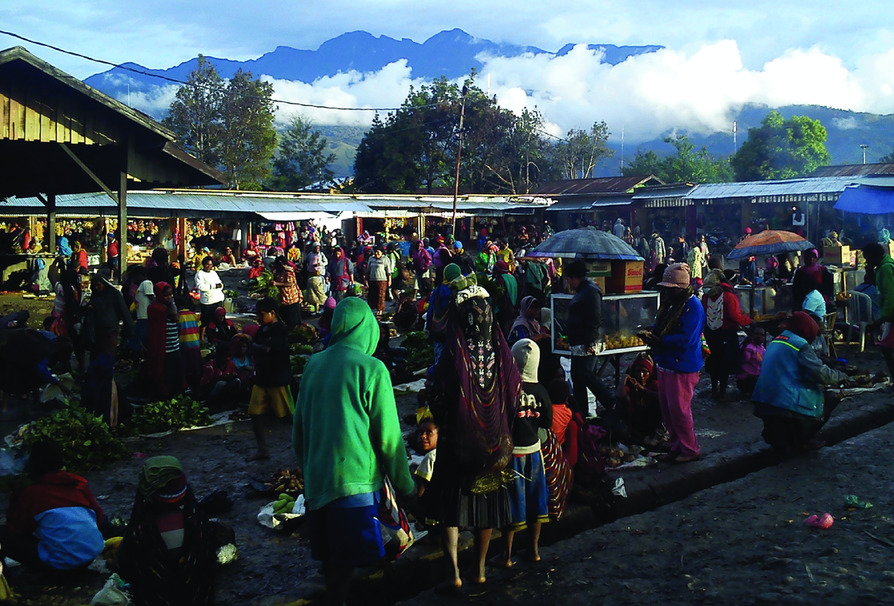
My acquaintance who witnessed the argument was an indigenous Dani man involved in a development project aimed at empowering Dani women to succeed in petty trade. He lamented the regent's aggressive action against market vendors and complained that the administration lacked sympathy for ordinary people trying to make a living. At the time, I was working with a group of Papuan researchers, part of the Wamena Economic Observation Project (WEOP), to document the transactions, trajectories, and aspirations that constitute the area's peri-urban markets.Footnote 2 We were especially interested in the livelihood strategies of indigenous women produce vendors. Many of these women commute from rural villages in crowded minivans, carrying bundles of produce to be sold to pay their children's school fees and to buy household goods such as rice, cooking oil, or dish soap from shops owned by migrants from other parts of Indonesia (see Figure 1). Our discussions were mainly focused on indigenous vendors’ struggles amid a decline in regional farming and different kinds of insecurity at the market, and how these dynamics were affected by a government decentralization reform measure known as ‘Special Autonomy’. This World Bank-supported package of measures was intended to reconcile West Papuan independence aspirations with Indonesian sovereignty. Autonomy had been negotiated in the wake of pro-independence protests that had swept across Papua some 15 years earlier. The protest movement had called attention to the marginalization of indigenous Papuans in an economy dominated by merchants and corporations from outside Papua. In response, Special Autonomy increased development funding at all levels of the administration within Papua, from the province down to regency, district (kecamatan), and village (desa) levels; it also reserved positions of regent for indigenous Papuans.Footnote 3 Knowing that my WEOP research partners did not hesitate to question the Wamena-based regent's policies, I expected strong criticism of the Sunday market closure. Instead, I found significant support for the new measure.
Vendors gather in the open area between the road and rows of shops at one of the markets on the outskirts of Wamena. Source: Photo by the author.

One supporter among my associates—all (at least nominal) Christians of various denominations—explained that the Sunday ban was a worthwhile means of upholding a weekly day of rest, as instructed by the Bible (alkitab). Another remarked that the market closure would reduce the number of church congregants skipping Sunday services. A third argued that enforcing the ban would counter a pattern of residential theft that occurred on Sundays during church services, when rural homesteads tended to be empty of inhabitants, leaving household items and crops as easy targets. According to this argument, the gathering space of the market provided the crowds, transactional arena, and transportation services required for thieves to resell stolen goods and make a clean getaway. In general, supporters agreed that unless the market and terminal were regularly suspended, problems such as theft—and other problematic activities known to take place in and around markets, such as gambling and consumption of intoxicants—would continue unabated, preventing communities from gathering to cultivate positive values. The participants in the discussion expressed a view of the market-terminal as a place that draws the indigenous Balim population into relations and transactions that threaten the endurance and morality of the indigenous population. Without denying that the Sunday closure would cause some difficulties, supporters greeted the decision as a worthwhile effort to regulate the market by subordinating its patterns of mobility, labour, and consumption to a moral rhythm.
This article examines patterns of inequality and morality that run through commerce in the Balim region and traces how these patterns have crystallized in forms of disruption, distinction, and regulation. It argues that market regulation can find support among a population whose livelihoods have been relegated to the margins and whose contributions to a regional economy have been obscured within the dominant discourse. I interpret contestations around what I call the ‘terminal economy’, an arrangement of commodity distribution and human mobility centred on Wamena. This arena of transactions gathers around what is called the ‘terminal’ in Indonesian: the informal station, return loop, and transit node in regional transit networks. In and around Wamena, minivans and pickup trucks ply routes between peri-urban markets and the rural hinterland where the majority of the indigenous population resides. A terminal is both an endpoint in a circuit and an interface connecting spheres of activity. The notion of a terminal economy highlights how marginal commercial hubs are both end points in dominant networks and gathering sites for connections and tensions.
I conceptualize the terminal economy as a set of relations that gather at mobility and distribution nodes, and as a structuring of space, power, and aspiration through which the Balim region—and other sites with similar histories—relate to encompassing national and global systems. The Balim region is located at the limits of Indonesia's national network of transport and commerce. This end-point quality shapes the consumption and livelihood possibilities found in peri-urban markets and terminals around Wamena. Such an end-point character is common to marginal hubs worldwide, especially in the southwest Pacific where infrastructural connections to global trade circuits are notoriously patchy and incomplete, and where human mobility has historically expanded in the wake of the entry of commerce. These historical patterns are reflected in tendencies for trade to be dominated by in-migrating groups and for indigenous participation in trade to occupy interstices in urban and peri-urban space. The notion of a terminal economy points to how the double ‘end point’ and ‘gathering-space’ character of regional commerce produces marginalization and moral concerns that motivate contestations.
The growth of commerce in the Balim region has historic roots in a mid-twentieth century Dutch colonial project to lift the Papuan population into modernity. In the Balim's brief colonial period, Western Christian missionaries acted as precursors to the Indonesian migrant traders who would follow under post-colonial conditions. In their efforts to replace indigenous religion with Christianity, missionaries saw indigenous ritual exchange practices as antithetical to Christian morality and civilized progress. These colonial judgements have left a legacy of moral scrutiny that lives on in contemporary discourses and policies. As indigenous protesters have contested inequalities, they have also confronted a discourse that blames the culture of indigenous people for their marginalization. Regional economic governance is thus involved in a scene of systemic inequality and forms of scrutiny that shape how inequalities are interpreted and contested.
Indigenous contestations of the marketing system draw attention to the domination of commerce by newcomers. Categories of indigenous (orang asli) and newcomer (pendatang) are experienced in transactions at marketplaces, as newcomer traders occupy state-registered kiosks, while indigenous vendors sell produce from unofficial sites on the ground. The region's main ethnic distinction aligns with gradations of what economic anthropologists refer to as ‘formality’: inclusion in bureaucratic schema for ordering and recognizing participation in economic life.Footnote 4 Regulation agendas thus confront an arena in which inequalities map onto differences of ethnicity and degrees of formality. As in towns and cities worldwide, Balim regional administrations have a history of seeking to contain and regulate informal commercial activity. Special Autonomy's reservations for indigenous representation have put a new class of indigenous politicians and bureaucrats in the position of overseeing the state's containment tactics towards informal indigenous vending. These tactics often operate in tension with protesters’ demands for the valorization of indigenous participation in the economy. As I will show, measures such as the Sunday market closure are part of a series of regulation initiatives that have oscillated in emphasis from containment of disruptions to protection of indigenous life.
My analysis of the politics of commerce in a marginal hub engages with scholarly debates about ethnicity, morality, and regulation in relation to marketing systems that cross divides between formal and informal spheres. First, there is debate among anthropologists and sociologists over how to understand ethnic differentiation in commerce. Furnivall analysed the ‘plural economy’ as a product of colonial displacement and accumulation, and scholars working from a world-systems perspective extended this insight beyond the colonial context.Footnote 5 Meanwhile, Evers and Schrader interpreted ethnic distinctions in markets as solutions to the ‘trader's dilemma’ according to which merchants adopt distinct identities so as to evade moral sanction against accumulation.Footnote 6 These contrasting understandings reflect differences in analytical priority and specific regional histories. The Balim context, where newcomer traders enact the region's integration into wider commercial circuits, recalls descriptions of the plural economy. At the same time, the trader's dilemma approach suggests attention to moral anxieties that run through marketing systems and across inter-ethnic constellations in marginal hubs of commerce.
Moral anxieties have been a major focus of studies of trade and informal economies in the southwest Pacific.Footnote 7 In a world region where cash-based markets are relatively recent historical institutions, commercial practices of competition and accumulation may stand as foils to customary values of mutuality. Some authors emphasize how markets offer—or evoke—a measure of freedom from customary constraint.Footnote 8 An emphasis on relatively ‘free’ markets also informs works that conceptualize regulation primarily as an imposition by powerful states or transnational actors.Footnote 9 This notion of imposed regulation runs through much writing on informal livelihood practices, especially critiques of efforts to ‘formalize’ informal sectors by bringing them within state enumeration.Footnote 10 Departing from these approaches, I trace how regulation has emerged as a popular demand among a population that is highly involved in informal transactions. To interpret the appeal of regulation, it is necessary to historicize the discourses that devalue the informal sector. This involves tracing the colonial scrutiny of indigenous expenditure (described above) to show how a commercial regulation agenda can offer a means to contest such devaluation, thereby offering what Jane Collins terms ‘revaluation’.Footnote 11 Inter-ethnic tensions in a marginal commercial hub may thus be seen not as an essential feature of regional politics, but as a historically produced anchor of moral critique and as a pivot towards the revaluation project. Before developing this line of argument, however, it is necessary to trace the historical expansion of commerce in the Balim region and discuss how this history has produced a moralized binary ethnic distinction.
A Balim marginal hub: organization, history, and division of labour
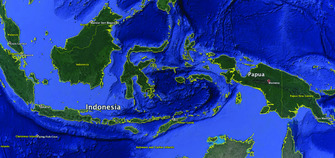
Wamena, with a population of approximately 30,000, is the urban centre of a wider Balim region whose population numbers approximately 400,000 people (see Figure 2). This population (overwhelmingly indigenous in the rural hinterland) represents nearly half of the total indigenous population of Papua and roughly one-fifth of Papua's total population. The region is home to Papua's most populous indigenous ethno-linguistic group, the Dani. They are conventionally divided into Grand Valley Dani, who occupy the region immediately around Wamena, and Western Dani, who live to the north and west of the Balim Valley. The indigenous Balim population also includes groups such as the Yali, Nduga, and Mek, who originate in areas more distant from Wamena.Footnote 12 Wamena is a cosmopolitan meeting place for these groups and for newcomers from different parts of Indonesia. The open-air markets that surround Wamena, and other Papuan towns, feature a division of labour between indigenous Papuans, on the one hand, and traders from other Indonesian regions such as Java, Sumatra, Sulawesi, and Maluku, on the other.Footnote 13 Distinctions between ‘original Papuan people’ (orang asli Papua) and ‘newcomers’ (pendatang) are a routine element of regional discourse, and markets are key sites where these distinctions are experienced in practice.
Map of Papua within Indonesia, showing the location of Wamena. Source: Google Earth, 2017.

In the vicinity of newcomer-owned shops, Dani women sit unsheltered on the ground waiting for buyers to inspect their produce. Nearby, drivers consult with minivan owners who shuttle indigenous vendors and other commuters between the market and the villages. Dani youth known as ‘terminal kids’ (anak terminal) work as conductors, hollering at potential passengers, calling them to be seated, and loading their cargo onto the minivan roof. Once every inch of passenger space is full, minivans leave—with conductors typically standing on the back bumper, clutching the vehicle, ready to unload rooftop cargo when passengers disembark. Around the edges of the market, Dani men and women sell piles of firewood. Next to Wouma Market (Pasar Wouma), one of the three main markets around Wamena,Footnote 14 Dani men and women dig gravel from the Uwe River and load it onto trucks that ferry the gravel to a cement factory outside the town limits. The flows of raw materials and wealth reflect the economic pattern of Papua's incorporation within Indonesia, marked by an extractive development paradigm and a large petty commerce sector dominated by newcomers. The split between indigenous suppliers and newcomer traders is not absolute: most markets feature indigenous intermediaries (penadah) who buy produce from farmers on arrival in the morning which they sell at a mark-up. Intermediaries somewhat complicate a market structure in which urban-based traders sell imported, mass-produced goods, while indigenous rural landholders sell produce and resources.
The Balim Valley runs approximately 55 kilometres long on a northwest to southeast axis. Wamena sits southeast of the geometric centre of the valley floor, west of the Balim River. Its urban space is organized along a regular grid pattern. There are three main markets located around the edges of Wamena. The largest is Jibama, a few kilometres northwest of the town limits. In addition, there are two major markets on the southern and southwestern edges of Wamena, respectively: Wouma and Sinakma. Each of the three main markets adjoins a terminal from where minivans ply routes linking Wamena to parts of the hinterland.
In terms of its occupation of space, indigenous market participation shows an improvisatory aspect that expresses its informality. Key spaces of operation include the rocky ground that women adapt with jute bags or cardboard boxes to sit on, with umbrellas for rain or sun; the rusty minivans that ‘terminal kids’ perch on; and small wooden tables where Dani consumers buy and chew areca palm nut (pinang). At Wouma Market, a new building has been erected to house shops and produce sales. This building causes constant shade (in a cold highland climate) and obstructs visibility from the roadside. Consequently, it is underused; instead, the crowded outdoor space between the road and the shops is where most produce vendors set up (at the mercy of weather); a few squeeze in under shop awnings. Indigenous vendors tend to occupy interstitial areas between roads, parking lots, and shops—tactical positions in relation to flows of human traffic.
Relations among shopkeepers, vendors, customers, and various young idlers and helpers feature code switching and borrowing between multiple Indonesian and indigenous languages, dialects, and accents. Dani women congregate amid mounds of fruit and vegetables, sharing gossip in one or another of the highland Papuan languages, occasionally calling out prices in regionally accented Indonesian. A Javanese shop owner might address a young indigenous helper by the customary Dani appellation nayak, teasingly ask how many girlfriends he has, and instruct him to unload 50-kilogram sacks of rice from a pickup truck. Such ‘vernacular cosmopolitanism’ is familiar to marginal hubs around the world.Footnote 15 Moments of awkwardness and humour punctuate what is at times an uneasy alertness to possible tension.
The peri-urban market-terminal places situated around Wamena's edges function as transactional interfaces for the regional economy and as microcosms of a broader process through which Indonesia's commercial networks have entered the Balim region. Wamena is where indigenous rural residents go to access commodities imported from outside Papua—notably the sacks of rice that the government has promoted as a substitute for the customary Dani staple, sweet potato. Shops selling packaged foods, clothes, or mobile phones form the spatial core of the terminal-adjoining market; further into town, more shops and wholesalers line the main roads. From an urban perspective, the terminal is the ‘end of the line’ of transport routes and the mainstream national economy—an outer frontier of the commercial possibilities that draw migrants to Papua.Footnote 16
Markets play host to the most visible encounters between newcomer and indigenous livelihoods. This set of encounters has historically enacted the Balim region's gradual integration into Indonesia. During the past decades, the regional food regime has slowly transitioned towards dependence on rice imported from elsewhere in Indonesia, which is distributed both via shops and a variety of food aid programmes. The latter have increased their reach with the implementation of Special Autonomy and the associated proliferation of regional and local government offices. Indigenous customary organizations regularly express concern about the waning of indigenous horticultural production.Footnote 17 The region's marketplaces, organized as interfaces between formerly separate economic orders, carry associations with the displacement of indigenous production and the growing dependence on both state and market distribution arrangements.
History of encompassment
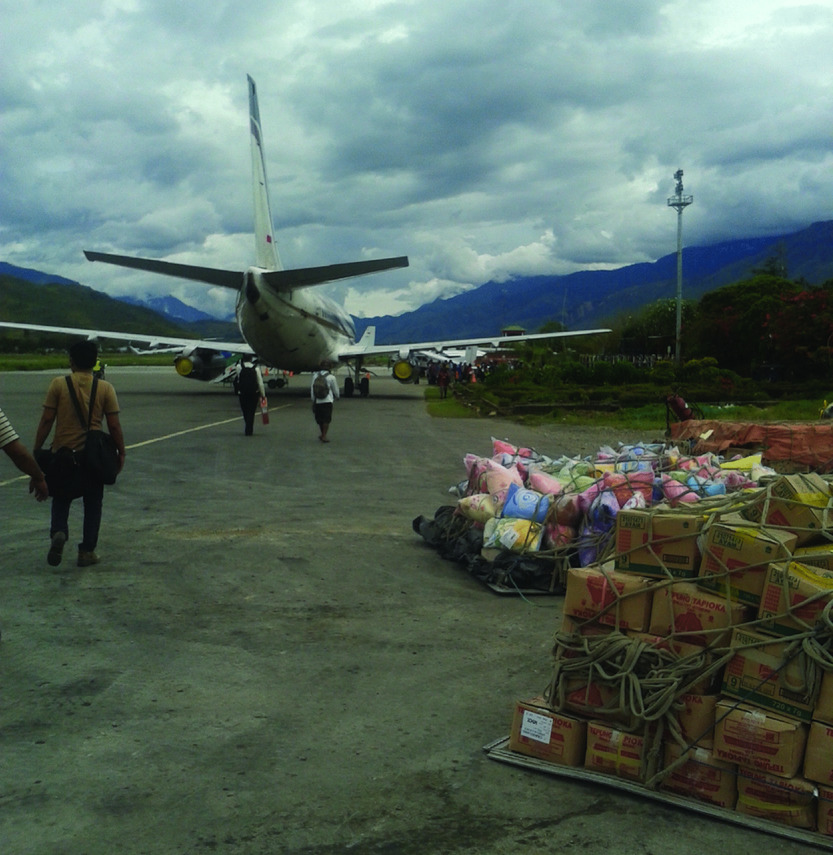
The precolonial Balim economy was not subordinate to wider national or global orders. Archaeological work suggests intensive crop cultivation in the region dating back at least 10,000 years, with major intensification of horticulture and animal husbandry roughly 2,000 years ago.Footnote 18 There is a history of small-scale trade in non-staple goods with actors from outside the region, such as the trade with adjacent areas for ritual stones and the nineteenth-century exchange of bird feathers destined for European fashion markets. The subordination of the regional economy to encompassing commercial networks is a more recent development, initiated when North Atlantic powers designated Papua as a margin of commercial monopolies and colonial states.Footnote 19 After governing coastal regions for several decades, the mid-twentieth century Dutch colonial state deployed Christian missionaries to the Balim region, aiming to turn the Dani and other indigenous residents into modern citizens.Footnote 20 Distance and landscape obstacles stood in the way of provisioning missions with supplies. The Dutch-founded provincial capital on the coast, now called Jayapura, is separated from the Central Highlands by vast, forested, swampy lowlands and the mountain range that surrounds the Balim Valley. These obstacles, inflating road construction costs, have long delayed plans for a road from Jayapura to Wamena. While Wamena is the hub for the Balim region road network, it remains without ground transportation links to Papua's other regions. With the dubious distinction of being the world's most populous town without a road, railway, or navigable river to a coast, Balim commerce depends on the inbound air transport of mass-produced goods (see Figure 3).
Goods of many kinds are delivered daily to Wamena's airport. Source: Photo by the author.

When the Dutch colonial state founded an administrative command centre in Wamena in the 1950s, this anchored the logistical operations that underpinned communication, provision, and the ‘pacification’ of the Balim population by missions and the colonial police.Footnote 21 Indonesia annexed Papua in the 1960s, after which Indonesian traders began to migrate to Papua and Wamena became the Balim region's commercial hub. While the bulk of the newcomers reside in larger coastal cities such as Jayapura or Manokwari, a small segment of this population has settled in the Balim region, predominantly in Wamena.Footnote 22 While the non-indigenous population is a small minority in the Balim region overall, newcomer traders are among the most visible demographic segments within Wamena's town limits. Thus the ethnic division of labour in the regional economy is visibly associated with the growth of the region's urban centre and with Indonesia's contested sovereignty over Papua.
In recent years, the Indonesian state has sought to consolidate the integration of Papua into Indonesia, especially in the Balim region, which national security forces and policymakers understand as the rebellious heartland of the West Papuan independence movement. Government investment in infrastructure and buildings generates knock-on opportunities in construction and commerce, drawing increasing numbers of migrants from many other regions of Indonesia. Merchant and contractor power blocs compete and collaborate as they seek to profit from these investments. The largest merchants are involved in a shifting set of alliances and competition, along with commanders of the various military and police units present in the region (the military being deployed to uphold national unity by combating separatism). Wamena's airport, with daily deliveries of merchandise, building materials, machinery, and vehicles, is a key site of contestation among these alignments over control of shipping profits and rents.
Tensions among commercial power blocs are part of the structure of the regional marketing system. This system reflects Papua's historical relegation to an end-point position in trade, characterized by the import of mass-produced goods and the extraction of raw materials.Footnote 23 The absence of industrial production or resource processing in Papua combines with the private control of major outbound primary resource shipping to inflate the costs of shipping to Papua, driving up prices of commodities and materials.Footnote 24 Prices of food, fuel, and other commodities are far higher than those in more densely populated Indonesian islands.Footnote 25 One of Indonesia's most impoverished populations is thus in the bind of facing the country's highest prices for consumer goods. Meanwhile, given the inadequacy of infrastructures and the sheer distances involved in transporting goods from Indonesia's metropolitan shipping centres to the Papuan highlands, the goods that are marketed there tend to be lesser brands or older models (in the case of clothing or electronics, for example) or nearing expiry (in the case of perishable foods).
Politicized distinctions in the market
The regional marketing system contains a division of labour between newcomer merchants and traders who market mass-produced goods at inflated prices, and indigenous vendors who sell raw produce at comparatively low prices. The price discrepancy embedded in this division of labour flows from the gap between far-ranging distribution paths of imported goods as opposed to local primary products. For local products, the costs of production and transport are effectively subsidized by the household organization of horticultural labour and by the dual function of the Balim transport network—mobility and distribution. The minivan terminal hosts intersecting trajectories of people and goods, varying widely in scale, speed, and profitability. These include merchants separated from their families thousands of miles away; rice and eggs delivered to Papua after a week at sea; teens driving cycle rickshaws, having walked for days from remote Yali country to relocate to Wamena; motorcycle taxi (ojek) drivers ferrying passengers around town; indigenous women hoping their vegetables sell before the last minivan leaves the terminal; and various individuals hanging out at the terminal, waiting to run into an acquaintance or an opportunity of some kind. Inequalities of range and speed produce a relative motion that is part of a characteristic indigenous experience of relegation. In focus group discussions and interviews, indigenous market participants often expressed a sense of being ‘left behind’ (tinggal nonton, lit. ‘left to watch’), while newcomers profit and progress. Indigenous scholarship and activist literature frequently evoke this sentiment.Footnote 26
The terminal's pattern of relative motion acts along a hierarchical chain of terminals. This relativity is expressed as a pattern of recursion. As a wholesaler in Wamena works in routine communication with suppliers in Jayapura or Makassar, a small shop owner in a district in the hinterland will depend on one or another Wamena wholesaler. As Wamena's markets are peripheral to Papua and the Papuan commercial economy to Indonesia, so too a rural district in the Balim hinterland is itself on the periphery in relation to Wamena. In a hinterland district, the price progression steps repeat recursively, in line with the cost of transport embedded in price: local produce is sold more cheaply than in Wamena and shop products are far more expensive than in town.Footnote 27 The rare indigenous trader in these districts able to access a little capital may buy cheap produce and pay for transport to Wamena to sell it at a mark-up. Vehicle ownership is at a premium and shop owners with pickup trucks command power. At each step in the chain, mobility is a visible condition for the capacity to draw value from commerce.
The political charge that surrounds market-terminal spaces is rooted in their function as nodes in the movement of people and commodities, and as interfaces bridging the arrangements of production, distribution, and consumption that underpin the marketing system—and consequently as sites that gather people across highly meaningful axes of social difference. These distinctions have been produced and politicized through the installation of regional commerce. The newcomer category is diverse in terms of class, ethnicity, and religion: it includes large-scale wholesalers and contractors as well as small shopkeepers; speakers of Bugis, Javanese, Minangkabau, and Batak; and Muslims as well as Christians of various denominations. Many newcomer traders have found in Papua an exit from situations of high unemployment and economic stagnation in their home regions.Footnote 28 The indigenous collective is diverse as well, with numerous linguistic groups and growing intra-indigenous inequality (connected to Autonomy's promotion of the growth of an indigenous bureaucratic class). Notwithstanding such internal differences and disparities, the indigenous/newcomer distinction has become a rallying point for contestations.Footnote 29 The next section turns to the pattern of turbulence and disruption that has characterized Balim marketplaces.
Market confrontations
Marketplaces in Wamena are broadly understood to be sites of tension and potential conflict. Among indigenous women produce vendors, a common worry is that intoxicated Dani youth will engage in fights with one another and incite larger-scale conflicts among neighbouring indigenous groups where there are histories of mutual hostility—or pick a fight with a shop owner and trigger punitive police or army action against the market as a whole. The likelihood of such incidents is known to increase as the sun sets, when straggling produce vendors become anxious about unloading remaining merchandise—and whatever consumption of intoxicants is going on in back alleys or back rooms increases its effects. On those occasions when I visited a market close to sunset, I sensed heightened tension. I also experienced the power of rumour to mobilize. One evening, shopping for dinner ingredients, I noticed heads turning in the same direction and heard murmurs about a fight being triggered when a drunken Dani youth overturned a shop owner's areca nut vending table. After hearing someone in the distance say that—or ask if—soldiers (tentara) were on their way, I repeated what I had heard. My companion reacted with alarm, ‘tentara!?’ As the rumour of soldiers’ approach spread, I stumbled through piles of cabbage and sweet potatoes, causing the very loss of produce and revenue that vendors fear.
Indigenous commentary about sporadic incidents of conflict at markets tends to perceive the possibility of intervention by state security forces as the most dangerous possibility. Security forces have not consistently secured their hegemony in the region's market-terminal spaces. In 2012, a police post adjacent to the Wouma terminal was burned down and three years later it was yet to be rebuilt. The action was reported to be a response to police violence against a suspect in the burning of a police post in a hinterland district—itself in response to a security forces crackdown on members of a pro-independence student organization. The market fire came after police had themselves burned down the nearby headquarters of the Balim regional branch of the Dewan Adat Papua (DAP), a customary organization known for mass mobilizations in favour of Papuan independence. These sporadic episodes of violence give weight to the ambient expectation of turbulence at the market, and show how market tensions may express the conflict around Indonesia's contested sovereignty in Papua.
At the time of my fieldwork between 2012 and 2014, I found the temporary lack of a patrolling force at Wouma Market to be noteworthy, given its history of unrest. In 2000, Wamena's markets hosted major pro-independence mobilizations that were part of a broader pan-Papuan mobilization known as the Papuan Spring. At each of the main market-terminals around Wamena, partisans set up posts flying the Morning Star (Bintang Kejora) flag of the West Papua movement. Wouma Market was the site of an incident known as Bloody Wamena (Wamena Berdarah), when police action to remove the flag posts and arrest those guarding them triggered a large counter-attack by Dani men from the rural district beyond the market. This resulted in several deaths, including police, shop owners and their families, and a number of indigenous participants.Footnote 30 This first-ever reported incident of collective indigenous violence against newcomer civilians intensified the crisis in Wamena. Military reinforcements responded with arrests of independence movement leaders and punitive sweeps in villages, and many newcomer merchants, teachers, and health workers fled rural outposts to seek refuge in army and police compounds or left Papua altogether. Indonesian news reports used a discourse of ‘social jealousy’ (kecemburuan sosial), a psychological spin on a structure of antagonism, flowing from the economic inequalities that work through the binary ethnic opposition of indigenous to newcomer.
My interviews with participants and witnesses of the 2000 incident underline how the market-terminal functioned as a nexus for politicized talk about difference. One participant recounted the killing of a Javanese man—a motorcycle taxi driver known for treating indigenous people with kindness and respected for sympathizing with the Papuan cause. He explained that those who killed the taxi driver were men who hailed from the rural hinterland and rarely spent time at the market, and were acting on suspicions that state intelligence agents had gone undercover to monitor pro-independence activities. While visual recognition of ethno-racial difference had enabled the killing of newcomers at the market, this was linked to stories of surveillance circulated from the market, to the hinterland, and back again. The terminal's space of sociability had enabled a limited degree of cross-ethnic solidarity to complicate the dominant pattern of antagonism, but it also allowed such solidarity to be erased in favour of the overarching opposition.
Bloody Wamena brought the Balim region to the attention of organizations concerned about ethnic violence in Indonesia. It has been noted that, contrary to sensationalized media descriptions of senseless violence, indigenous attacks against non-indigenous traders were incited by state security forces who, after attacking flag posts, sought refuge from a counter-attack by hiding in nearby shops and merchants’ homes.Footnote 31 I understand the indigenous violence as, additionally, a response to the power relations and moral critiques that had crystallized through the expansion of regional commerce. Newcomer commercial hegemony in the Balim region had grown with increased migration to Papua in the wake of the Asian economic crisis of 1997–1998, which caused mass unemployment in many of Indonesia's most densely populated regions.Footnote 32 The role of global financial pressures intensified migration to Papua, thus further politicizing the regional ethnic constellation. This resonates with work by anthropologists who argue that capitalist expansion produces and politicizes ethnic difference. Such effects are especially marked in the internal peripheries of large states such as Indonesia. In this optic, state manipulation of distinctions is effective to the extent that it seizes on such historically produced patterns.Footnote 33
In the years after the events of 2000, other episodes highlighted the tendency of the market to facilitate the circulation of politicized talk that latched onto the marketing system's ethnic division of labour and incited collective indigenous action. In 2007, reports of poisoned food (makanan beracun) being sold at shops circulated widely among the indigenous population in and around Wamena. As text messages warned against consuming food bought from shops, indigenous residents held impromptu meetings throughout the town. Soon, hundreds of indigenous men gathered at each of the major markets and demanded the closure of all shops. Participants accused the Indonesian state of using shops to distribute poisoned food as part of a deliberate campaign to kill Papuans. The uprising shut down virtually all commerce in Wamena for a whole week.
At the time of the uprising, I had recently arrived in Wamena to work for an international NGO that was involved in human rights and conflict resolution. I learned from local friends and community activists of the reports that were circulating. In one story, a father bought a few kilograms of rice from a shop; later, after eating the rice, several family members fell ill. Some reports were more dramatic. A young man was said to have purchased a single cigarette from a shop and to have died immediately after smoking it. The ‘poisoned cigarette’ story was accompanied by an indication of direct merchant intention: the seller was said to have sprinkled white powder on the cigarette just before passing it to the buyer, while he was not looking. Many of the text messages speculated about other methods being used to intentionally poison indigenous consumers, such as injections into frozen chickens. Others warned of the addition of formaldehyde (formalin) to tofu.
The activists with whom I discussed these theories noted that the problem of an inadequate cold storage infrastructure—both in the Papuan highlands and along the distribution chains leading to Wamena from Jayapura and beyond, in Sulawesi and Java—contributed to the toxicity of foods sold in local shops. An intermittent electrical supply and unrefrigerated transport meant that cargo such as frozen chickens or frozen sweets, shipped from Java, were more likely to develop toxic germs. In this context, merchants might feel justified in using cheap, toxic preservatives such as formaldehyde to mitigate spoliation and repel insects.Footnote 34 Some participants and activists I spoke to claimed that companies select specific batches of lower-quality products, such as cans of soda, for sale in Papua and that this can be observed in the identifying codes printed on product containers.Footnote 35 Merchants were also accused of unscrupulously selling past-due products, taking advantage of lower literacy and product knowledge among indigenous consumers.
Some indigenous activists favoured an analysis that downplayed any intentional agency on the part of newcomer merchants and emphasized a broader systematic pattern—inadequacy of infrastructures, unscrupulous companies, and market pressures on merchants to cut costs—that led to harmful products being marketed to Papuans. These activists promoted this line of structural analysis of the regional marketing system in its wider context among their constituents and protest organizers. Eventually, the movement that had forced the closure of shops shifted to organizing protests at the regency office, where the discourse of ‘poisoned food’ (makanan beracun) made way for demands that the regency administration test products sold in shops and crack down on the sale of ‘expired products’ (produk kadaluarsa). In this way, an uprising that called attention to the immoral practices of newcomer commerce transitioned into a campaign for the regional-level government apparatus to regulate the marketing of mass-produced food commodities.
Consumption and domination
The 2007 ‘food poisoning’ uprising tapped into long-simmering critiques and concerns. The reports that circulated by word of mouth and text message attributed intentional motives to merchants or to state agencies sponsoring them from the shadows.Footnote 36 This talk and action focused on markets as paradigmatic spaces, on mass-produced consumable goods as potentially dangerous objects, and on merchants as field agents in a larger agenda of collective violence. The rapid uptake of rumours about poisoning suggests an ambient readiness to endorse theories that state and merchant actors were plotting to commit violence against Papuan people. This readiness had developed gradually, over the decades during which indigenous livelihoods had been progressively integrated into a regional marketing system visibly dominated by newcomer commerce.Footnote 37
The products that surfaced most often in the stories of poisonings were imported goods seen as pleasurable luxuries or whose consumption is an object of concern. Cigarettes are widely consumed, though forbidden by the evangelical churches that have gained in regional prominence in recent years. Soda is an expensive treat that generally appears in households only as a gift from a wealthy guest at a gathering such as a wedding. Rice is the staple food of Indonesia's most populous regions, cultivated in faraway regions such as Java, and whose growing hegemony in the Balim Valley is lamented by indigenous traditionalists, such as the DAP's members, as a threat to the customary local staple, the sweet potato. Meanwhile, the white powder supposedly sprinkled on a deadly cigarette recalls the lime powder into which betel is dipped and chewed with areca nut for a brief narcotic sensation and whose distribution is mostly controlled by non-indigenous traders. The focus on pleasurable non-staple goods, or on the staple of an encompassing Indonesia, suggests that the stories of poisoning served both to accuse newcomers of tempting and exploiting indigenous consumers and to call attention to the complicity of indigenous desires in succumbing to such temptation.
In conversations with indigenous residents with diverse political perspectives (including pro-independence partisans and others with reservations about the independence movement), I have heard that Indonesia is killing indigenous Papuans ‘softly’ (secara halus). This action is said to consist of tempting the youth with unhealthy products high in sugar and additives but low in nutrients, and replacing Balim traditions with the locally inappropriate staples of faraway Java. Food commodities—and the forms of desire and dependence generated through their commercial distribution—were at the centre of discussions about the subordination of the indigenous population. These interpretations highlight the power of the newcomer traders who occupy dominant roles in key sites in regional marketing and the role of indigenous consumption in enabling this domination.
Seven years before the food poisoning incidents, Bloody Wamena—with its climactic confrontation at Wouma Market—had gripped the region. It had led many non-indigenous traders, teachers, and other government and private employees to leave the Balim region.Footnote 38 This temporary exodus had interrupted the incorporation of the Balim economy into the Indonesian mainstream.Footnote 39 Special Autonomy, with its commitment to indigenous economic empowerment and political representation, itself responded to the disruptions of Bloody Wamena (and of the wider Papuan Spring) by incorporating indigenous leaders into an expanded system of state distribution, upon which indigenous livelihoods would increasingly come to depend.Footnote 40 This process was well under way by the time of the uprisings against toxic foods. I suspect that the increased level of dependence of indigenous livelihoods on the distribution of non-indigenous foods had intensified anxieties about collective endurance, expressed through accusations of intentional schemes. The disruptions that acted on these sentiments pointed to the marketplace as an expression of an ethnic pattern of inequality, of its associated encompassing Indonesian sovereignty, and as a site of dangerous desires that enabled these disempowering patterns.
The series of uprisings, which disrupted market expansion and emphasized ethnic distinctions, have constituted the recent historical backdrop against which regulation policies (such as the Sunday market closure) have become salient among large segments of the indigenous population. Both the uprisings and the closure have expressed a moral critique of newcomer commerce—calling attention to a clash between, on the one hand, indigenous endurance and morality, and, on the other, commercial practices of profit seeking. In order to interpret the broad turn to regulation, the next section contextualizes the moral register of the indigenous critique of commerce by tracing the development of a powerful regional discourse to which this critique has responded: the residual colonial scrutiny that has devalued indigenous economic life.
Market moralities and the history of devaluation
Indigenous critiques of newcomer commerce, expressed through uprisings or support for regulation, highlight how market expansion has historically layered moral binaries into the regional ethnic constellation. These moralities take on multiple valences. The critique of commerce expresses concern for the possibility of endurance amid declining indigenous production and expanding non-indigenous market domination. At the same time, indigenous moralization of the market expresses self-criticism, directed at indigenous consumption practices and their complicity in the domination of newcomers. The historical backdrop of this critique and auto-critique is another mode of moralization, through which the agents of the region's economic encompassment have historically disciplined the indigenous population. This is a pattern of scrutiny that problematizes indigenous consumption and expenditure practices for supposedly being antithetical to standards of Christian morality or capitalist enterprise. Such scrutiny of the indigenous economy runs through the history of interventions by colonial missionaries and post-colonial development experts.
When the 1950s Dutch colonial state deployed Catholic and Protestant missionaries to manage the civilizational uplift of a Balim population that lacked any merchant class or infrastructural connections to the wider global economy, it put missionaries in the position of depending on a combination of air-dropped supplies and products, and materials provided by the local population. Airstrips and proto-markets that developed adjacent to the region's missions were the precursors to the terminal economy. Missions distributed goods that were not previously available in the region, such as packaged salt, steel axes, and manufactured clothing. The distribution of new goods was entangled with the moral education and modernizing development agenda of the missions and the colonial state. Participating in proto-commercial interactions with local residents, missionaries developed critiques of the supposed shortcomings of indigenous Balim culture.Footnote 41 Missionaries, especially evangelical Protestants, identified a contradiction between, on the one hand, customary ritual consumption and distribution—such as life-cycle gatherings that demanded the slaughter of pigs and allocation of meat portions according to ancestral histories of alliance—and, on the other, logics of accumulation and investment required for commercial enterprise.Footnote 42
Contemporary development initiatives associated with evangelical churches have broadened the missionary critique of collective ceremonial expenditure. I have witnessed missionary development workers lecture indigenous employees about how customary ritual redistribution is ‘animist’ and thus irrational. The corollary of this allegation is that the large-scale redistribution of resources for ceremonial purposes overvalues momentary consumption, at the expense of future-oriented savings and investment—a common lament among church-affiliated development advisers in and around Wamena.
The discourse of indigenous economic empowerment, promoted under Special Autonomy, has agitated the question of whether customary cultural values stand in the way of development. The provincial government in Jayapura, and numerous regency administrations, have announced increased sourcing and contracting from indigenous-owned business for development projects such as road and building construction. Indigenous enterprise advocates, such as the Customary Chamber of Commerce of Papua (Kamar Adat Papua) have welcomed such initiatives. However, media reports have signalled slow progress in their implementation and a practice of indigenous-fronted companies gaining contracts under quotas for indigenous provision, only to subcontract to newcomer-owned companies. The media has greeted such developments as reflecting a lack of an entrepreneurial culture among Papuans. In my conversations with aspiring indigenous entrepreneurs, echoes of this opinion were voiced auto-critically, combined with descriptions of institutional obstacles to indigenous enterprise, such as discrimination in the education and banking systems.
Whether framed in opposing terms of structural or cultural critique, there is a widespread tacit expectation that programmes to promote indigenous enterprise will fail. The discourse of ‘inability to compete’ (tidak mampu bersaing) haunts explanations of why secondary and tertiary sector businesses—mobile phone shops, food stalls, and so on—tend to be dominated by non-indigenous residents. In response, NGOs have carried out entrepreneurial empowerment projects that seek to teach indigenous Balim men and women accounting practices. In one NGO programme, designed by a trainer from Java, the key was to convince Dani women selling areca palm nuts to conceptualize their enterprise as an entity distinct from themselves or their families, thereby separating the personal from business cash flow. The challenge, as explained by trainers, was to reduce the possibility of revenue being diverted to non-business needs, rather than being treated as capital. When the Wamena Economic Observation Project (WEOP) interviewed the single indigenous shopkeeper at Jibama Market (at the time of research there were none at either of the two other main markets), he described the difficulty as such: ‘It's difficult to say “no” when someone comes to me needing help.’
WEOP focus group discussions helped clarify the interaction of residual colonial scrutiny and a range of material obstacles to indigenous enterprise. Some participants emphasized the unwillingness of banks to provide credit for aspiring indigenous entrepreneurs. I was able to verify this claim partially and indirectly, through acquaintances of bank employees. Another line of analysis pointed to how the kind of tactical occupation of high-traffic public space required for commercial success would also tend to make one available to relatives whose requests for assistance could stand in the way of accumulating capital. The response of the lone indigenous shopkeeper above highlights the ‘trader's dilemma’, where the accumulation imperative clashes with customary values of redistribution and reciprocity.Footnote 43 This dilemma is inherently less salient for newcomers conducting business at a great distance away from their extended families.Footnote 44 As one traditionalist organizer put it in a group discussion: ‘Newcomers (pendatang) can succeed here because they are far from their place of origin (tempat asal). They can be free (mereka bisa bebas). But we indigenous people always have obligations and demands (keperluan dan tuntutan) that we have to be responsible for.’
Such commentary illustrates an entanglement of opposing modes of moral critique: the indigenous critique of newcomer commerce and the residual colonial moralization of indigenous expenditure. This entanglement suggests a twisting historical trajectory between diverging moral evaluations of consumption: from the colonial scrutiny of ceremonial expenditure, to protesters’ lament of indigenous consumers’ complicity in subordination to newcomer commerce. The scrutiny of indigenous expenditure lives on as an explanatory framework that exacerbates the moral and material dilemmas many indigenous Balim people experience in their efforts to coexist or compete with newcomer enterprise.
Scholarship on markets and moralities in Oceania and eastern Indonesia has shown how populations who engage in informal commerce navigate parallel expectations that they will uphold moral codes for proper (e.g. reciprocal) economic relations with kin, affines, neighbours, and so on.Footnote 45 In many contexts, the morality of markets—whether they offer escape from such expectations or scrutiny of their satisfaction—is related to the degree to which commerce stands apart from, or mediates, spheres of customary expectation and modernist development. In the cosmopolitan towns on the Indonesian side of New Guinea, where commercial expansion has generated identities of indigenous and newcomer, some aspects of the ‘trader's dilemma’ literature might lead one to expect non-indigenous commerce to effectively spare the indigenous population from the moral quandaries of commerce. Instead, the newcomer merchant class, acting as a leading edge of national integration, provides both an object and foil for moralized critique and auto-critique.
This type of constellation, where an ethnic dimension infuses moral binaries layered into distinctions between formal and informal trade, characterizes the type of marginal hub that Wamena epitomizes: a turbulent frontier of national integration and commercial expansion, whose geographical remoteness, shallow colonial history, and corresponding infrastructural disconnection set conditions for newcomers to dominate a recently installed marketing system. While the Balim regional dramatizes these contextual features, its basic aspects are common to sites in numerous Asian state peripheries. The occurrence of inter-ethnic tensions and market uprisings is understandable in such contexts. Such turbulence is driven by conflicting moral anxieties: discourses of devaluation and their contestation. These moral critiques have motivated disruptions as well as regulation initiatives. In order to illustrate how regulation has been embraced as a means to contest devaluation, the next section traces how a regulation agenda, first rooted in a logic of containment, has come to include ideas about valorizing and protecting the indigenous informal sector.
Regulation at the intersection of containment and protection
Governing authorities at the regency level have shown concern about the tendency of the marketplace and terminal to host unrest and disruptions. In the years after the 2000 incidents, the Wamena-based Jayawijaya regency administration promoted a discourse of ‘Clean Wamena’ (Wamena Bersih). This idea linked values of order and cleanliness in Wamena with the importance of reining in apparently problematic activities taking place at markets and terminals. In addition to problems of rubbish, food waste, vehicle emissions, and so on, the ‘clean’ in the campaign signalled concerns about immoral, illegal, toxic, and dangerous activities known to take place at terminals, involving drinking, drugs, gambling, sex work, and theft. Eventually, the campaign led to a regency decision to move Wamena's central Town Market (Pasar Kota) out of town. The market was closed in 2003 and Jibama Market (Pasar Jibama), also known as Pasar Baru (New Market), opened several kilometres north of Wamena proper.
Some indigenous-led community organizations were supportive of the Clean Wamena campaign. I became aware of this support in 2008 during discussions with a group of activists who were generally in favour of the goal of an independent Papua. As one organizer, a woman in her late twenties put it, ‘At the terminal, people are gambling, drinking, getting in a lot of trouble. Young kids, terminal kids, sniffing glue and things like that. This ruins their future (merusak masa depan mereka). People started talking about cleaning up Wamena, and so we had to support that.’ The critique of newcomer commercial hegemony dovetailed with a concern that indigenous youth were falling into patterns of behaviour that put indigenous endurance in jeopardy. Clean Wamena articulated these concerns and coincided with the state's long-running anxiety about the terminal as a site of unrest.
Community organizers’ critique often highlighted the open secret of military and police sponsorship of the terminal's various shadow business operations. These were said to include numbers games, sex work, pornographic video screenings, and the sale of illicit alcohol. On occasions when I walked with a friend past a roadside car-wash spot manned by youth next to a stream near one of the main markets, I was told about drivers purchasing sex from young car-washers. Market-terminal spaces have been known to host ‘free sex’ (seks bebas) among indigenous youth.Footnote 46 The most dramatic example of youth harm was the inhalation of the vapour of the Aibon brand of glue from plastic juice bottles by youth nicknamed anak aibon (glue kids). In its dismay at the participation of Balim youth in such harmful and covertly state-sponsored activities, an activist aspiration to supervise and control the terminal economy found common ground with a governmental discourse of ‘cleaning’. Relocating Wamena's main market beyond the town limits extended this broad agreement on the need for containment.Footnote 47 In this tentative alignment, Clean Wamena anticipated the more recent support for the regent's Sunday market closure.
The expulsion of the market to the town's edges did not eradicate the youth consumption and labour practices that were seen as problematic. Jibama became the region's pre-eminent market—known to have the best selection, quality, and prices of produce—and where, in addition to shops selling food staples and clothing, stall vendors sell indigenous handicrafts, second-hand laptops, imported seafood, and live pigs. It also became the regional centre for street youth and the shadow economy lamented as a future-destroyer by community activists—the sprawling peri-urban location providing freer rein for illicit transactions. At the same time, moving the market beyond the town limits proved to be only a temporary means of removing irregular, indigenous vending activities from the town core. The commuting distance to the new market created new transportation challenges for vendors: while Jibama terminal serves commuters from a significant section of the central, northern, and northwest Balim hinterland, residents from other areas seeking to trade at Jibama now had to pay for an additional minivan trip from the town centre (or haul their goods by foot).Footnote 48 At the same time, the relocation of the market created a wide urban zone that now lacked fresh produce sales. Noting that this commercial vacuum created an opportunity for enterprise—or simply refusing to incur the extra transportation costs to Jibama—increasing numbers of indigenous women produce vendors set up their stalls on the side of busy streets in central Wamena, often directly in front of shops. This generated a practice known as pasar kaget (informal market, lit. ‘startled market’).Footnote 49
Building an indigenous market
The spread of informal indigenous commerce soon came to signal to regency planners and officials a need to regulate urban commercial space. On the one hand, this was a question of restoring order to the streets by restricting vending to specially earmarked sites—a broad regulatory orientation common to cities worldwide.Footnote 50 At the same time, the proliferation of informal vending by indigenous women communicated a popular demand for a ‘suitable place’ (tempat yang layak) for selling produce within town limits. The Special Autonomy moment provided political space to respond to this demand.Footnote 51 In response to Papuan grievances about inequality and discrimination, Autonomy had mandated regional administrations to promote indigenous economic empowerment and increased regency development funding authority. In early 2015, the regency administration unveiled a new ‘traditional’ market (pasar tradisional) within Wamena town limits, called Pasar Potikelek. This market was explicitly intended for use by indigenous (orang asli Papua, OAP) vendors only. The market was built at a cost of Rp. 34 billion (roughly US$ 2.5 million), drawing partly on Special Autonomy funds.Footnote 52 As reported by a Papuan news service, Jayawijaya regent Wempi Wetipo spoke at the unveiling ceremony:
‘My desire is to provide a suitable place for Papuan women and men to sell, and so starting tomorrow, no more will anyone sell on the side of the streets or sidewalks; everyone will enter Potikelek Market. And next year we will also rebuild Sinakma Market, build it better so people can sell in a suitable place,’ he said. The regent also thanked Papuan women who have consistently joined and competed in building the economy of Jayawijaya Regency with people from outside Papua. ‘[Indigenous] women also help the Jayawijaya economy. Therefore, the Agency for Industry, Trade and Cooperation will note the women who are buying and selling so the government can provide capital for women to build an even better economy moving forward,’ said Wempi.Footnote 53
The regent's words illustrate how the new market was intended to replace informal indigenous street vending, simultaneously solving the problem of unregulated use of urban space and valorizing the contribution of indigenous vending to the regional economy. This element of the commercial regulation agenda, as taken on by the Autonomy-era class of regional indigenous representatives, merged discourses of Clean Wamena and indigenous economic empowerment. This duality of regulation is expressed in the last part of Wetipo's statement. While acknowledging indigenous women vendors’ contribution to the regional economy, he announces that the regency bureaucracy intends to register data on women vendors so as to provide them with support. This tension illustrates the way an agenda of formalization—in this case, setting out to gather previously informal indigenous vendors into a newly earmarked market and submitting them to an enumeration process that will lead to financial support—interprets informal trade as a demand for inclusion.Footnote 54
After a few months of operation, reports emerged that the new OAP-only market was mostly empty. It was a fair distance from the town's main commercial arteries in the general vicinity of central Wamena, around one kilometre west of one of the town's secondary sites of small-scale commerce, where shops share space with an informal market for produce and timber (also known, previously, as Pasar Potikelek). Enclosed by a gate with a single street-front entrance, the new market was set off from the street, limiting the possibility of incidental customer traffic. Reporting on the failure of the new market to attract visitors, a local journalist interviewed a female areca nut vendor who complained about a crackdown by security agents on street vending on central streets. She criticized the regent's insistence on relocating vendors to a site lacking a minivan terminal and accused him of failing to live up to a promise to build a terminal adjoining the new Potikelek Market site. This vendor highlighted the dependence of indigenous livelihoods on being inserted into paths of incidental traffic that flows through transportation nodes.Footnote 55 Such a critique signals how the attempt to formalize the erstwhile indigenous pasar kaget practice sat in tension with informal vendors’ approach to urban and peri-urban spaces that characterize the terminal economy—a set of tactics through which indigenous vendors have participated in regional commerce. If the new market construction sought to respond to a perceived demand for inclusion, complaints about the lack of a terminal suggest that any inclusionary objective of formalization would be undermined without coordinated infrastructure planning.
It is unclear whether the failure to build a new transport terminal adjoining Pasar Potikelek was an oversight or a measure that lay beyond the regent's real authority. It is likely that the tactical desirability of vending in proximity to a transport terminal ran up against powerful anxieties about allowing a fully elaborated market-terminal site to sit within the urban core, near major administrative, military, and residential compounds of the region's power blocs. Even under Autonomy, indigenous representatives continue to be subject to imperatives of security, expressed in rigid terms as the ‘conflict area’ of the Papuan highlands. Regents manoeuvre at arm's length from the police, military, and intelligence agencies that are present in large numbers in and around Wamena. A regent such as Wetipo would be unlikely to launch programmes aimed at indigenous livelihoods without also addressing imperatives of formal spatial order and containment required by security forces and merchant power blocs. Still, as much as it may have spoken to powerful wishes to clear urban space of informal indigenous vendors, the construction of Potikelek Market expressed an intention to protect the primary produce vending of indigenous women. Formalization provided a potential means to bridge divergent imperatives of containment and protection, even as the areca nut vendor's complaint about the lack of a terminal raised questions about the possibility of such a bridging.
Regional trajectory of disruption, distinction, and regulation
I view regional commerce, regulatory policies, and indigenous uprisings together in a single trajectory. This is characterized by relations between two broad categories of actor: 1) various types of outsiders, in particular newcomer traders and officials (starting with colonial-era trading missionaries, and including both contemporary Jakartan and international policymakers who negotiated Special Autonomy with Papuan representatives) who have installed and expanded the modern distribution economy in the region, and 2) indigenous producers, vendors, workers, and protesters who have shadowed ‘formal’ commerce with ‘informal’ trade, and periodically contested the regional economy's inequalities by disrupting the operation of marketplaces and terminals. Special Autonomy legislation has responded to indigenous disruptions and demands, fostering the emergence of a third category of actor: the growing class of indigenous regional government representatives who mediate between the two previous forces, attempting to satisfy the accumulation and control imperatives of the former, while valorizing the labour and grievances of the latter. Commercial regulation has become an important intervention for indigenous politicians. Working through social distinctions in commerce has been a way to bridge contradictory allegiances to the military, the police, and merchant power blocs, on the one hand, and indigenous partisans, on the other.
Bupati Wetipo's construction of the new Potikelek Market, and the subsequent Sunday closure, were key moments in the regency administration's agenda of commercial regulation. Previously, the Wetipo administration's first intervention in regional commerce, shortly after his 2008 election, had consisted of a seemingly cosmetic rule concerning urban architecture. In 2009, the Jayawijaya regency issued a new regulation requiring all shops (ruko) to feature a regionally specific feature on the front of their roofs: an icon shaped as a honai (GVD), the round thatch-roofed men's hut characteristic of customary indigenous households in the Balim hinterland (see Figure 4).
A honai (customary Balim men's sleeping hut). Source: Photo by the author.

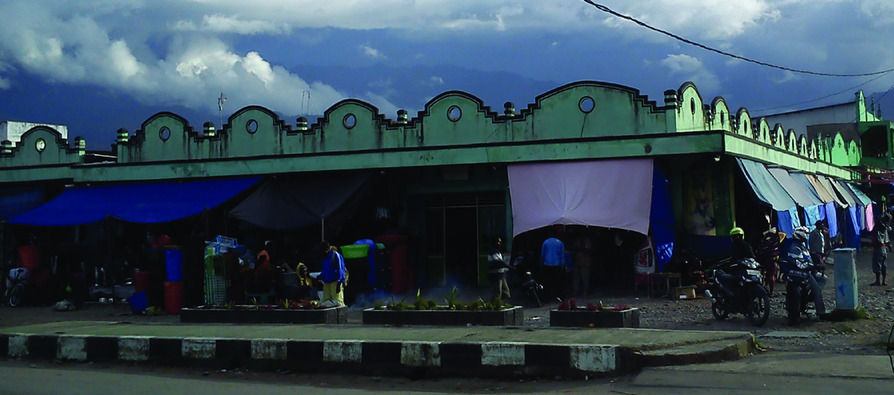
The new ruko design quickly made a mark on the public spaces of Wamena, as shops on all the main avenues and at the markets were retrofitted to adhere to the new regulation (see Figure 5). In the wake of this policy, I heard a range of criticisms. These included merchants complaining about the cost of the new installations and West Papua partisans dismissing the policy as performance devoid of substance. Still, the new regency administration had signalled its intention to regulate the terminal economy, by inscribing a recognizable figure of rural indigenous life onto the urban and peri-urban architecture of newcomer commerce. In this way, the regent enacted the stance of a mediator who would represent the interests of the indigenous population by appending customary Balim specificity to the structure of Indonesian commerce. The agenda of commercial regulation thus announced itself by valorizing indigenous identity and highlighting the major axis of difference inscribed in the economy.
Ruko on the main street of Wamena, retrofitted with variations on the mandated honai figure. Source: Photo by the author.

The regulatory imperative was initiated prior to the ascendance of the new class of Autonomy-empowered indigenous representatives. The 2005 relocation of the central market drew on ideas of commercial regulation that resonated with indigenous activist sectors. Subsequently, indigenous politicians and officials who came to power in the wake of regulations that concretized Autonomy's provisions for increased indigenous authority, elaborated this regulatory agenda. The Autonomy-era regulatory initiatives of Wetipo, from 2008 onwards, continued to show some orientation towards containing the turbulence and harm of the terminal economy in a way that has been amenable to state security forces as well as some indigenous pro-independence elements. At the same time, these more recent regulatory policies have expressed an intention to protect indigenous livelihoods and morality, and the assertion of indigenous specificity has been a key vehicle for this valorization.
The dual structure of moral anxiety and scrutiny surrounding commerce and ethnic difference reflects the Balim region's particular history of relations with encompassing economic and political systems. An important feature of this situation is the way in which the interface between the formal and informal economy has been positioned precisely at the edge of these historical processes, moral quandaries, and latent inter-ethnic tensions. The political weight of this nexus translates into the intensity of conflicts that sporadically grip Balim markets—and into these conflicts’ expression of the paramount issue of contested Indonesian sovereignty. In this context, for a range of regional actors to invest, even if cautiously and critically, in the potential value of regulatory initiatives that Autonomy has made possible suggests that commercial regulation can bridge divergent interests. In such contexts, inter-ethnic tensions may act as pivots in trajectories from disruption to regulation.
For civilizational, ethnic, and moral binaries to be projected onto the divide between the formal and informal economy is certainly not unique to Papua nor to the Balim context. Long before the term ‘informal economy’ was coined, Marx noted that political economists of his day saw no value in the ‘ghostly figures outside [their] domain’ and relegated them to a pathological status.Footnote 56 Colonial-era population displacements and post-colonial migrations have produced a range of contexts where this relegation acts across (and reproduces) axes of ethnic difference. Consequently, there is a long history of associating devalued moral and cultural dispositions with an impoverished and marginal informal sector.Footnote 57 These devaluations tend to obscure the way in which informal commerce often works to complete and sustain formal marketing arrangements.Footnote 58 Demands for the revaluation of informal economic life respond to such obscuring discourses.Footnote 59 Some authors question an institutional and scholarly tendency to interpret the informal as a demand for inclusion, emphasizing instead the informal as a critique and threat to dominant, moralizing economic rationalities.Footnote 60 In the Balim context, a notion of threat aligns more closely with the anxieties of military authorities, missionaries, and Western financial agencies than with the indigenous market participants and protesters who have shown critical support for regulation and even formalization. These supporters of regulation may redeploy moralities that have crystallized through colonial history and in relation to market expansion, towards objectives of protection and endurance.
Conclusion: commercial regulation in a marginal hub
The material and interpretations I have presented so far have emphasized the way in which the routine transactions hosted at market-terminal sites have generated fraught axes of distinction and incited forms of disruption, demands for revaluation, and agendas of commercial regulation. The disruptions that have been incited have prompted Jakarta bureaucrats and international advisers to roll out the governance reform of Special Autonomy. This reform has enabled indigenous representatives to function as a regional mediating force of commercial regulation.
I have identified the terminal economy as the set of routine practices and relations that express the Balim regional economy's encompassment within larger orders. This process has a recursive aspect, expressed in the way market-terminal spaces act as both the ‘end of the line’ for commercial networks at the margins of the Indonesian nation and as interfaces between this commercial structure and a rural economy that was previously largely self-sufficient. The recruitment of the indigenous population as consumers, vendors, and informal labourers in the terminal economy has incited a series of responses that, seen together, make visible an indigenous agenda of commercial regulation.
The regent Wetipo's interventions in regional commerce—mandating the honai-shaped emblem on shops, then building an indigenous-only market, and finally suspending market activity on Sundays—came on the heels of a recent history of uprisings that had asserted that the market threatens indigenous life. The Autonomy-era regulation agenda achieved significant legitimacy by channelling the moralizing critiques that drove these disruptions. By installing an indigenous imprint over the architecture of newcomer commerce, Wetipo gave symbolic expression to indigenous critiques of non-indigenous commercial dominance as a vector of Indonesian sovereignty over Papua. The Sunday ban, in turn, provided a regulatory framework to address anxieties stirred by peri-urban commerce and newcomer market dominance. While the Autonomy-era, indigenous-led regulation agenda announced itself by communicating ethnic distinction, the Sunday market ban shifted the focus away from indigenous identity per se towards the moral integrity of the indigenous collective.
This mode of somewhat superficial regulation has not, of course, directly confronted regional inequalities nor subsumed axes of difference; these remain anchored in durable divisions of labour and relations of power, and associated patterns of residence and mobility. Neither has this regulation agenda been immune from criticism: some pro-independence voices suspect indigenous government representatives of collaborating with dominant commercial power blocs, while using morality plays and symbolic performances to distract the indigenous population from the struggle for Papuan independence. These policies have nonetheless achieved a degree of legitimacy by tapping into a broadly shared indigenous aspiration to regulate the commercial arena into which indigenous livelihoods have been entangled. By drawing attention to this development, I have departed from a tendency in economic anthropology to view regulation as essentially inherited from colonialism or transmitted from national or transnational power centres and resisted by ordinary people pursuing livelihoods amid abandonment.Footnote 61 Instead, I have proposed that an agenda of regulation can be appealing to those relegated to informality and marginality because it offers the possibility of contesting the devaluation of those forms of economic life that have been so relegated, even though such contestation may be undermined by regional power blocs.
The Autonomy era in the Balim region has brought into view aspirations for regulation stirred by indigenous experiences of subordination to encompassing commerce. Indigenous government representatives have made the aspiration to regulate commerce visible by intervening, in limited but expressive ways, in the spatial and temporal organization of markets in and around Wamena. These representatives have attempted to mediate the mostly divergent interests of Indonesian and Papuan nationalisms, and newcomer commerce and indigenous livelihoods. In so doing, they have given visible expression to the aspiration that informal indigenous participation in the growth of regional commerce—as producers, vendors, workers, and consumers—be acknowledged and valorized. Against a residual colonial discourse that obscures the indigenous informal contribution to the regional economy—its completion and sustenance of formal commercial networks—Autonomy-era politicians have received a broad demand for revaluation of indigenous economic life and translated it into regulatory initiatives that receive broad, if critical, support.
Disruptions, distinctions, and attempts at regulation have intervened in the longer trajectory of regional encompassment, marked by a growing displacement of indigenous production in favour of a multifaceted system of distribution. This broad process of relegation incites anxieties and concerns that resonate with marginal hubs elsewhere. My analysis has aimed to appreciate the way in which indigenous representatives have tapped into such insecurities and traversed a narrow space of manoeuvre. The legitimacy of the regulation agenda illustrates how turbulent ‘ethnic’ politics, notably in internal peripheries of large Asian states, may be pivots in a wider process through which indigenous collectives seek a degree of authority over economic relations that express their marginalization. To some extent—as illustrated by the shift in focus away from an emphasis on ethnic distinctions and towards the moral integrity of the indigenous collective itself—it may be justified to understand this assertion as a retreat from confrontation. Such a move, however, does not imply retreating from an aspiration to address the systematic inequalities and moral quandaries that are produced through a history of encompassment.