INTRODUCTION
Rapidly growing threats to biodiversity render prioritizing species for protection essential. Despite recent increases in conservation efforts (Hamber et al. Reference Hamber, Henderson and Speight2011), factors such as invasive species, habitat destruction and climate change continue to cause global biodiversity loss (Pimm et al. Reference Pimm, Jenkins, Abell, Brooks, Gittleman, Joppa, Raven, Roberts and Sexton2014; McCallum Reference McCallum2015). Wildlife conservation relies heavily on the attitudes of the general public (Dickman Reference Dickman2010) because protecting wildlife requires human intervention (Ericsson et al. Reference Ericsson, Heberlein, Karlsson, Bjärvall and Lundvall2004; Gratwicke et al. Reference Gratwicke, Mills, Dutton, Gabriel, Long, Seidensticker, Wright, You and Zhang2008; Prokop & Fancovicova Reference Prokop and Fančovičová2013). The public's perception of animal species directly impacts the conservation of those species, and negative cultural biases towards certain wildlife paired with anthropogenic impacts have driven several species to near extinction (Fita et al. Reference Fita, Neto and Schiavetti2010; Brito et al. Reference Brito, Rebelo and Crespo2001).
Conservation plans have widely relied on criteria including population size, economic value, ecological significance and endemism to support decisions (Wilson et al. Reference Wilson, McBride, Bode and Possingham2006; Sodhi et al. Reference Sodhi, Posa, Lee, Bickford, Koh and Brook2010; Curnick et al. Reference Curnick, Head, Huang, Crabbe, Gollock, Hoeksema, Johnson, Jones, Koldewey, Obura and Rosen2015); however, they rarely consider people's perceptions of species, which can cause the plan to fail because of unanticipated public resistance or a lack of public support (Kaltenborn et al. Reference Kaltenborn, Bjerke, Nyahongo and Williams2006). Species-specific preferences, defined as a greater liking for one species over others, exist (Bjerke et al. Reference Bjerke, Østdahl and Kleiven2003; Schlegel & Rupf Reference Schlegel and Rupf2010; Ballouard et al. Reference Ballouard, Brischoux and Bonnet2011), and the public generally prefers birds and mammals over reptiles and invertebrates (Czech et al. Reference Czech, Krausman and Borkhataria1998). This bias has been attributed to the similarity principle, which suggests that humans prefer animals that are behaviourally or phylogenetically similar to themselves (Kellert Reference Kellert1985; Kellert Reference Kellert1993; Kellert Reference Kellert1996; Batt Reference Batt2009). Fear appears to influence species preferences, and may do so independently of danger posed by a certain species, especially in the case of invertebrates (Kaltenborn et al. Reference Kaltenborn, Bjerke, Nyahongo and Williams2006; Batt Reference Batt2009; Prokop & Fancovicova Reference Prokop and Fančovičová2013). Women's preferences are generally dictated more by fear and disgust than men, especially when a species poses a threat to humans, as with some snakes and parasites (Prokop et al. Reference Prokop, Fančovičová and Kubiatko2009a; Prokop et al. Reference Prokop, Özel and Usak2009b; Prokop et al. Reference Prokop, Usak and Fančovičová2010b; Prokop Reference Prokop and Fančovičová2013). Finally, people tend to favour animals with aesthetic value and ‘charisma’ (Kaltenborn et al. Reference Kaltenborn, Bjerke, Nyahongo and Williams2006; Schlegel & Rupf Reference Schlegel and Rupf2010; Prokop & Fancovicova Reference Prokop and Fančovičová2013).
In particular, scholars should focus on the species preferences of children, because conservation aims to protect resources for future generations and children tend to shape their parents’ environmental behaviours (Weiss Reference Weiss1990; Meine et al. Reference Meine, Soulé and Noss2006; Damerell et al. Reference Damerell, Howe and Milner-Gulland2013). Although bequest value, or the value of passing species on to future generations, is axiomatic to biodiversity conservation (Walsh et al. Reference Walsh, Loomis and Gillman1984; Meine et al. Reference Meine, Soulé and Noss2006), insufficient research has explored which species new generations are interested in or value. Species preferences among children may also be important because they influence parental preferences. This question has not been addressed, yet children influence a wide array of parental preferences and behaviours in similar domains, including purchasing decisions (Flurry & Burns Reference Flurry and Burns2005), information technology use (Hampshire Reference Hampshire2000) and pro-environmental behaviours (e.g. encouraging their parents to recycle) (Legault & Pelletier Reference Legault and Pelletier2000). Similarly, publishers capitalize on children's impacts on parental behaviour with animal-based story books focusing on popular species such as lions, tigers and elephants (More Reference More1979; Shapiro et al. Reference Shapiro, Erickson, Peterson, Frew, Stevenson and Langerhans2016). Further, children represent the most effective pathway to change their parents’ views on ideologically charged environmental issues, because their own perceptions are less driven by ideology (Stevenson et al. Reference Stevenson, Peterson, Bondell, Moore and Carrier2014) and because they influence their parents’ attitudes and behaviours (Duvall & Zint Reference Duvall and Zint2007). The latter is particularly important in ideologically charged conservation contexts (e.g. Peterson et al. Reference Peterson, Peterson, Peterson, Lopez and Silvy2002) in which adults may listen to their children, but filter out information from other sources (Uzzell et al. Reference Uzzell, Davallon, Bruun Jensen, Gottesdiener, Fontes and Kofoed1994; Leeming et al. Reference Leeming, Porter, Dwyer, Cobern and Oliver1997).
Research on children's species preferences has revealed several important patterns. Like adults, children rank mammals and birds higher than invertebrates and reptiles, favour exotic megafauna over local species and prefer less dangerous animals (Bjerke et al. Reference Bjerke, Ødegårdstuen and Kaltenborn1998; Ballouard et al. Reference Ballouard, Brischoux and Bonnet2011; Borgi & Cirulli Reference Borgi and Cirulli2015). Moreover, both children and adults who own pets tend to have greater knowledge of and more positive attitudes towards wild animals (Bjerke et al. Reference Bjerke, Østdahl and Kleiven2003; Prokop & Tunnicliffe Reference Prokop and Tunnicliffe2010). However, children favour certain species that are typically ranked low by adults, such as turtles, snails and butterflies (Borgi & Cirulli Reference Borgi and Cirulli2015). This may reflect the anthropomorphization of certain species through media targeting children (Bjerke & Ostdahl Reference Bjerke and Østdahl2004; Wagler Reference Wagler2010; Borgi & Cirulli Reference Borgi and Cirulli2015). Boys tend to favour animals that evoke fear and disgust over girls, and girls prefer more loveable or cute animals (Prokop & Tunnicliffe Reference Prokop and Tunnicliffe2010; Schlegel & Rupf Reference Schlegel and Rupf2010). Children appear to prioritize species groups in ways that are similar to conservation biologists by prioritizing importance in nature over other attributes (Frew et al. Reference Frew, Peterson and Stevenson2016; Shapiro et al. Reference Shapiro, Erickson, Peterson, Frew, Stevenson and Langerhans2016), whereas adults may place more emphasis on endemism and declining species (Czech et al. Reference Czech, Krausman and Borkhataria1998; Meuser et al. Reference Meuser, Harshaw and Mooers2009; Verissimo et al. Reference Verissimo, Fraser, Groombridge, Bristol and MacMillan2009). Although importance in nature is necessarily a general concept, children tend to view it as referring to a species’ overall significance and value to the natural system in which it resides (Shapiro et al. Reference Shapiro, Erickson, Peterson, Frew, Stevenson and Langerhans2016).
The growing body of research on species preferences has not yet addressed how preferences may differ under different biogeographic contexts that are critical to conservation. Several potentially valuable contexts exist (e.g. different biomes and different climates), but the difference between islands and continents may represent one of the most obvious biogeographic drivers of species threats and extinction (Simberloff Reference Simberloff2000). In continental locations, the leading causes of wildlife endangerment are habitat conversion, such as forests to agriculture, and suppression of natural processes, such as fire (Sharitz Reference Sharitz2003; Backer et al. Reference Backer, Jensen and McPherson2004; Kindall & Van Manen Reference Kindall and Van Manen2007). Conversely, the leading driver of species endangerment and extinction on islands is the spread of invasive exotic species (Duncan & Blackburn Reference Duncan and Blackburn2004; Clavero et al. Reference Clavero, Brotons, Pons and Sol2009). For instance, feral cats (Nogales et al. Reference Nogales, Martín, Tershy, Donlan, Veitch, Puerta, Wood and Alonso2004), feral hogs (Cruz et al. Reference Cruz, Donlan, Campbell and Carrion2005), the cane toad (Shine Reference Shine2010) and the brown tree snake (Rodda & Savidge Reference Rodda and Savidge2007) have caused multiple extinctions and endangerments of native wildlife on islands.
The aim of this paper was to compare species preferences among children in North Carolina (USA) and children in Andros Island (The Bahamas). North Carolina and Andros Island provide useful, representative study sites because extinction drivers in these regions match those that are generally expected on continental and island locations, respectively. In North Carolina, over 90% of the most common ecosystem type (longleaf pine forest) was eliminated by fire suppression and other land uses (e.g. pine plantations and urban areas), threatening the entire suite of species, including communities of carnivorous plants, amphibians and birds, such as the red-cockaded woodpecker and Bachman's sparrow (Lueck & Michael Reference Lueck and Michael2000; Van Lear et al. Reference Van Lear, Carroll, Kapeluck and Johnson2005). The main threat to native species on Andros Island comes from invasive species. Although harvesting of wildlife by humans as well as habitat destruction contribute to declining populations of native species on Andros Island, many native species face their greatest threats from feral cats and dogs and wild pigs (Carey et al. Reference Carey, Buckner, Alberts, Hudson and Lee2001; Knapp & Owens Reference Knapp and Owens2005; Knapp et al. Reference Knapp, Iverson, Buckner, Cant, Hailey, Wilson and Horrocks2011).
Here, we tested two hypotheses. First, grounded in islanders’ opposition to the eradication of non-native species (Fortwangler Reference Fortwangler2009; Lynch et al. Reference Lynch, Fell and McIntyre-Tamwoy2010; Ogden & Gilbert Reference Ogden, Gilbert, Veitch, Clout and Towns2011) and the fact that feral cats, dogs and pigs are more prevalent on Andros than in North Carolina, we tested the hypothesis that children on Andros (island) would prefer invasive or exotic species more than children in North Carolina (continental). Second, we evaluated differences between genders, testing the hypothesis that boys prefer animals that tend to invoke fear or disgust more than girls (Prokop & Tunnicliffe Reference Prokop and Tunnicliffe2010; Schlegel & Rupf Reference Schlegel and Rupf2010).
MATERIALS AND METHODS
Sampling
In North Carolina, we used a stratified random sample of elementary school children. We randomly chose 60 public schools with third- and fifth-grade classes (ages 8–11 years) from a list of all such schools in the state, compiled a list of all third- and fifth-grade teachers in those selected schools and randomly selected 118 teachers for participation. From these, 36 teachers responded (30.5% response rate), with 21 giving consent to participate in the study (58.3% compliance rate). We visited 16 classrooms (we could not visit five of them because of scheduling conflicts), and 433 students completed written surveys in March 2014.
On Andros Island, we did not have access to a valid sampling frame, so we used a combination of school sampling and intercept sampling (Stedman et al. Reference Stedman, Diefenback, Swope, Finley, Luloff, Zinn, San-Julian and Wang2004) to achieve broad coverage across the island. Andros comprises several islands, but our study focused on North Andros Island, which is the largest and most populous. The Bahamas National Trust facilitated sampling at primary schools; we visited three schools and 106 students in grades 2–5 (ages 7–11 years) completed written surveys. We used intercept sampling at seven additional locations: Mastic Point (n = 13), Stafford Creek/Blanket Sound (n = 7), Staniard Creek (n = 7), Love Hill (n = 9), Fresh Creek (n = 28), Bowen Sound (n = 12) and Cargill Creek/Behring Point (n = 15). Forfar Field Station staff facilitated the intercept sampling – as they were familiar with local households – by approaching households with children within the specified age range (5–12 years) to request participation from parents and children. Approximately 20% (n = 197) of all children aged 5–12 years on the island participated in the study (Department of Statistics of The Bahamas 2013). All research methods were reviewed and approved by the North Carolina State University Institutional Review Board for the Protection of Human Subjects (Protocol 5941).
Using different sampling methods in the continental and island locations could create unwanted bias in comparisons. However, the only expected bias associated with sampling differences between locations would likely result in our finding less support for children on Andros preferring invasive or exotic species more than children in North Carolina. This is because the Andros sample had greater representation (37%) of children who participated in an environmental education programme that was designed and demonstrated to promote preferences for endemic and threatened species (Shapiro et al. Reference Shapiro, Erickson, Peterson, Frew, Stevenson and Langerhans2016) than the North Carolina sample (near 0%). Specifically, these children on Andros participated in Discovery Club, an elective environmental club through which children learn about natural areas, species found in The Bahamas and the importance of conservation (Bahamas National Trust 2016). Previous research suggests Discovery Club members prioritize for conservation those native species whose numbers are rapidly declining, while non-members do not show this prioritization (Shapiro et al. Reference Shapiro, Erickson, Peterson, Frew, Stevenson and Langerhans2016). In North Carolina, there were no large biodiversity-centred environmental education curricula at the elementary level, and in a survey of 627 randomly selected teachers from kindergarten to fifth-grade classes (ages 5–11 years) in North Carolina, only 27% included any form of environmental education curricula in their instruction (Stevenson et al. Reference Stevenson, Carrier and Peterson2014). Our sampling approach could not generate age differences between locations, but 76% of students in both locations were between 8 and 11 years old, yielding high overlap. Further, the only age effects on wildlife preferences to have been previously identified were for more disparate ages than those observed in this study (e.g. ages 9–10 years versus 11–15 years) (Bjerke et al. Reference Bjerke, Ødegårdstuen and Kaltenborn1998).
Questionnaire design
Our brief questionnaire was pre-tested with third-grade (n = 37) and fifth-grade students (n = 32) from North Carolina. They were asked to circle any parts of the questions that were difficult to understand and to make any suggestions that could clarify the question. We then conducted cognitive interviews (Desimone & Le Floch Reference Desimone and Le Floch2004) with 12 students. We asked students to respond to different wordings until the responses supported the face validity of the question (Frew et al. Reference Frew, Peterson and Stevenson2016). We measured students’ wild animal preferences using a ranking exercise in which children were told that wildlife referred to “all animals that live in nature,” and then asked, “What are your five favourite kinds of wild animals that live in North Carolina (or in The Bahamas)? Remember to put your most favourite first. If you don't know the name of five animals, just list as many as you can.” Students were also asked to indicate whether they were a boy or a girl (see Supplementary Material online).
Statistical analysis
We assigned each species listed by students to one of 24 taxonomic categories. A single species received its own category if it occurred in at least 10% of surveys within either region. For all other species, we used relevant taxonomic groupings (e.g. fish or bird). For each child, a score of 1 (preferred species) was assigned to each taxonomic category listed by the child, while a 0 was scored for all others (i.e. presence/absence). Using the PRIMER 6 software package (Clarke & Gorley Reference Clarke and Gorley2006), we conducted analysis of similarities (ANOSIM; 9999 permutations) of the Bray–Curtis similarity matrix (Bray & Curtis Reference Bray and Curtis1957) to test whether children's native wildlife preferences differed between regions (Andros Island and North Carolina) and genders. We conducted two-dimensional non-metric multidimensional scaling (MDS) to visualize any differences in children's species preferences between regions and genders. We interpreted MDS axes using Spearman's correlation between preferences for each taxonomic category and the two axes (p-values adjusted to control for a false discovery rate of 5%) (Benjamini & Hochberg Reference Benjamini and Hochberg1995). We calculated overall percentage occurrences of preferences for three major groups of animals: invertebrates, aquatic species and invasive species (cats, wild hogs and lionfish). We only included species that were obviously invasive in the latter category, although the vast majority of dogs on Andros are feral.
RESULTS
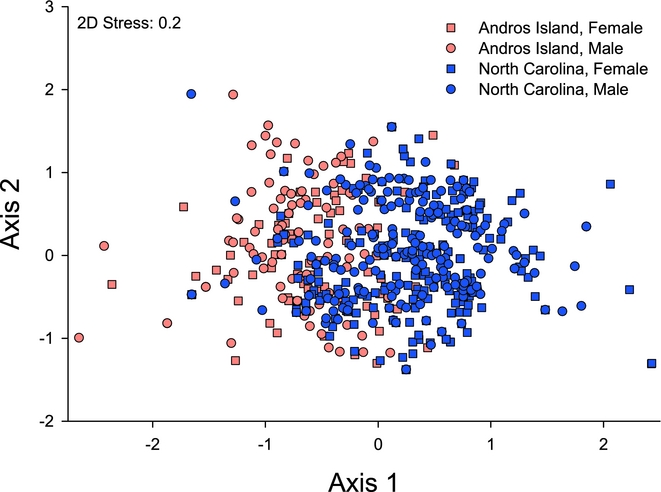
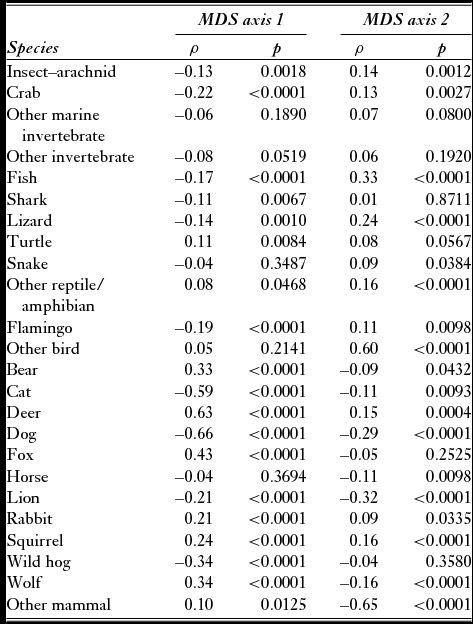
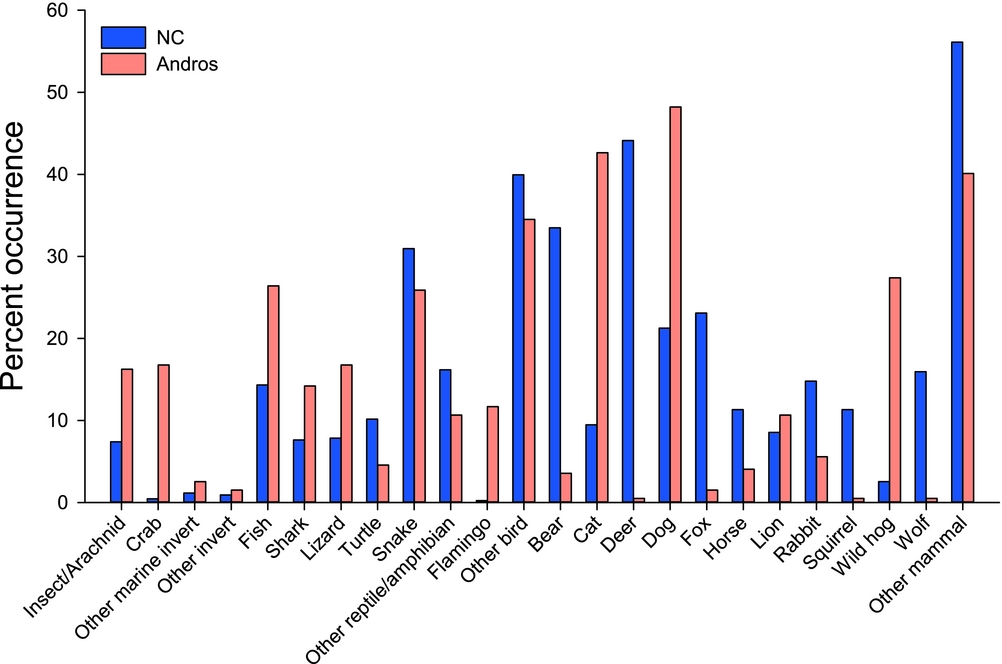
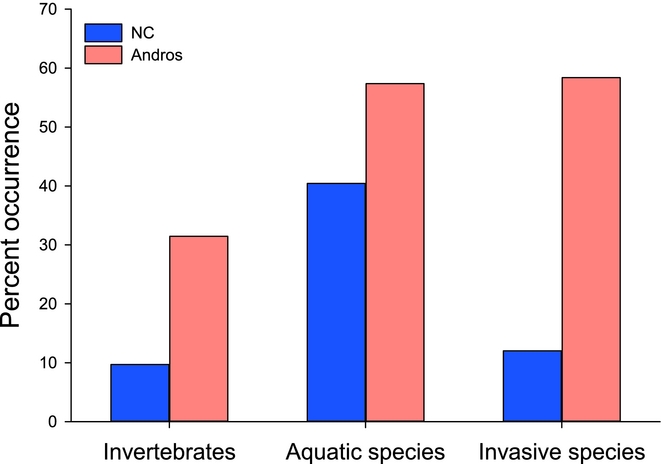
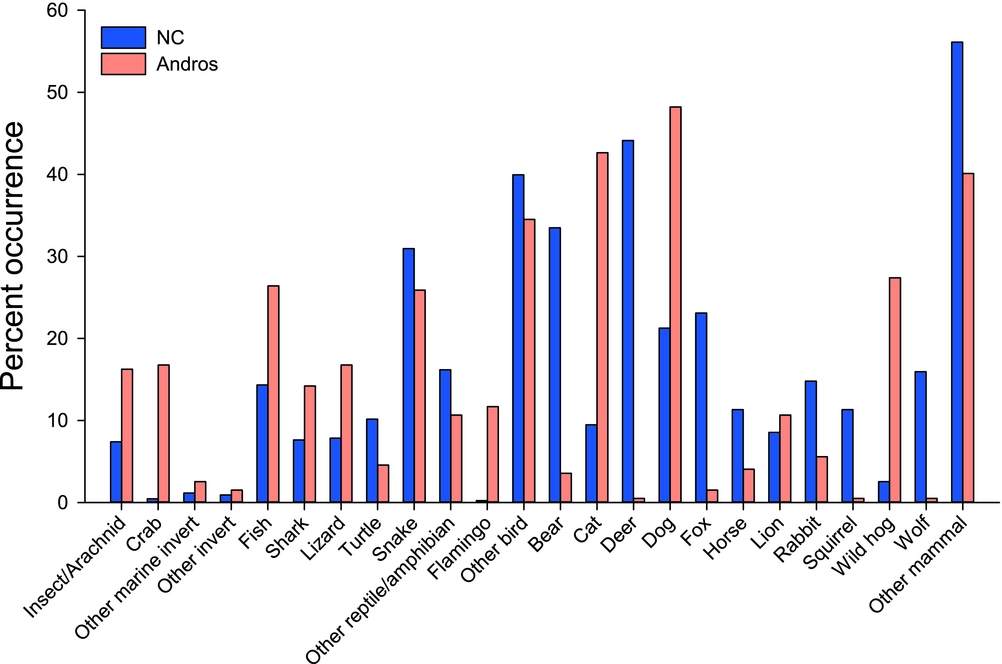
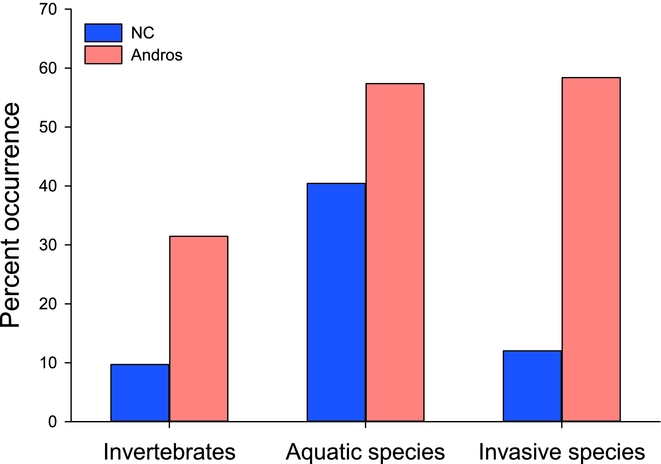
We had roughly equal representations of genders in both regions (53% female in North Carolina and 49% female in Andros), with a total of 630 completed surveys. In North Carolina, we surveyed children between the ages of 8 and 11 years. On Andros Island, we surveyed children between the ages of 4 and 14 years, with an average age of 8.9 years (±SD 1.8). Children's species preferences differed between regions (ANOSIM, R = 0.262, p < 0.0001) and genders (ANOSIM, R = 0.025, p < 0.0001). MDS revealed clear differences between regions, and weaker differences between genders (Fig. 1). Based on correlations between taxonomic groups and MDS axes, as well as percentage occurrences of children's preferences for the taxonomic groups, the strongest differences between regions were that preferences on Andros were stronger for dog, cat and wild hog, whereas preferences in North Carolina were stronger for deer, fox, wolf and bear (Table 1, Fig. 2). Andros children also showed greater preferences for crab, flamingo, fish, lizard and insect–arachnid, while North Carolina children had greater preferences for squirrel and rabbit (Table 1, Fig. 2). Boys in both regions had greater preferences for lizard and fish, while girls had stronger preferences for ‘other mammal’, rabbit and horse. Among the three major animal groups, island children had stronger preferences for invertebrate, aquatic and invasive species than continental children (Fig. 3).
Non-metric multidimensional scaling plot of children's species preferences. Loadings for the taxonomic groups along the axes are given in Table 1. Axis 1 correlates with location and axis 2 correlates with gender.

Associations between preferences for each taxonomic category and the non-metric multidimensional scaling (MDS) axes depicted in Figure 1 (p-values adjusted to control for a false discovery rate of 5%; ρ = Spearman's correlation coefficient). For MDS axis 1, positive correlations indicate stronger preferences for a given category in North Carolina compared to Andros Island. For MDS axis 2, positive correlations indicate stronger preferences for a given category in males compared to females.

Children's species preferences. Percentage occurrences of children's wildlife preferences for 24 taxonomic categories between an island location (Andros Island, The Bahamas) and a continental location (North Carolina, USA).
Children's preferences for three major species groups. Percent occurrences of preferences for three major species groups between an island location (Andros Island, The Bahamas) and a continental location (North Carolina, USA).
DISCUSSION
Children from Andros preferred non-native invasive species or taxa that are characteristic of islands with low species richness, whereas children from North Carolina preferred charismatic native species. These differences might arise for several reasons, some of which seem clearly related to the distinction between island and continental locations. Species assemblages and abundances fit the island versus mainland distinction, as feral cats and pigs often persist at high densities on islands relative to continents (D'Antonio & Dudley Reference D'Antonio and Dudley1995). Similarly, crabs and fish (notably saltwater fish species) would intuitively play a more central role in the lives of people living on small islands than in the lives of people distributed across a continental land mass. Conversely, there may be some elements of Androsian and North Carolina culture that impact species preferences without being related to the island versus continent distinction, which may be identified in future research with replication of island and continental locations.
Three of the most frequently preferred species on Andros Island were invasive species, and all reflect feral domesticated animals: dogs, cats and wild hogs. Most (65%) children surveyed on Andros Island mentioned at least one of these species. These three species also exhibited some of the strongest differences between regions, with North Carolina children much more rarely listing these species among their favourites, despite these species existing in North Carolina. The observed preference for invasive species by children on Andros corroborates previous findings that islanders view an invasive species more positively if that species serves some cultural or economic role in the society (Fortwangler Reference Fortwangler2009; Lynch et al. Reference Lynch, Fell and McIntyre-Tamwoy2010; Ogden & Gilbert Reference Ogden, Gilbert, Veitch, Clout and Towns2011). Feral dogs and cats are often viewed positively because of their likeness to pets, even in the face of negative impacts on native species (Ash & Adams Reference Ash and Adams2003; Prokop & Tunnicliffe Reference Prokop and Tunnicliffe2010), and wild hogs provide a source of recreation, hunting and food on the island. Another explanation for this preference is the lack of native charismatic mammals on Andros Island. Children often prefer mammals and exotic megafauna (Schlegel & Rupf Reference Schlegel and Rupf2010; Ballouard et al. Reference Ballouard, Brischoux and Bonnet2011; Borgi & Cirulli Reference Borgi and Cirulli2015). The absence of native charismatic mammals, coupled with the anthropomorphization of species non-native to Andros in media targeting children, could lead to their greater preference for non-native species (Bjerke & Ostdahl Reference Bjerke and Østdahl2004; Wagler Reference Wagler2010; Borgi & Cirulli Reference Borgi and Cirulli2015).
Our findings suggest that biodiversity conservation on Andros Island may face interacting challenges from both natural and social systems. Island wildlife populations are especially vulnerable to the negative impacts of invasive species, and conservation actions often focus on the eradication of invasive species in island situations (Mack & Lonsdale Reference Mack, Lonsdale, Veitch and Clout2002; Howald et al. Reference Howald, Donlan, Galván, Russell, Parkes, Samaniego, Wang, Veitch, Genovesi, Pascal, Saunders and Tersy2007). However, conservation plans can fail because of public resistance (Kaltenborn et al. Reference Kaltenborn, Bjerke, Nyahongo and Williams2006; Fortwangler Reference Fortwangler2009). Our finding that children on Andros had a strong preference for invasive species indicates that any plan to eradicate or reduce these popular species could be met with resistance. Although preference for the species does not necessarily translate to opposition to lethal management, the relationship is intuitive and will be important to explore in future research. To change children's preferences for non-native species, environmental education programs will need to both introduce children to native species and effectively convey the impacts of invasive species on the local environment. On Andros, participation in environmental education through Discovery Club did predict concern for native species experiencing population declines (Shapiro et al. Reference Shapiro, Erickson, Peterson, Frew, Stevenson and Langerhans2016), so tailoring education materials to help children understand how invasive species impact the declining native species seems like a logical first step. Once children learn about native species, their preference for them typically rises (Lindemann-Matthies Reference Lindemann-Matthies2005). Similarly, environmental education programmes that focus on knowledge of and direct experiences with natural places and native species can help increase appreciation for threatened species (Shapiro et al. Reference Shapiro, Erickson, Peterson, Frew, Stevenson and Langerhans2016).
Children tended to prefer locally abundant or charismatic native animals in both locations. The species preferences that were greater for children in North Carolina exclusively involved mammals native to North Carolina that do not exist on Andros: deer, fox, wolf, bear, squirrel and rabbit. Species with greater preferences by children on Andros either involved charismatic species native to Andros and not found in North Carolina (flamingo) or species commonly encountered on Caribbean islands: crab, fish, lizard and insect–arachnid. Island children exhibited much stronger preferences for the latter species, despite these taxonomic groups being native to North Carolina. With the absence of charismatic mammals on islands, insect–arachnid groups may be more noticeable. Children may exhibit preferences for common native species because they have an innate curiosity regarding the natural world (Maltese & Tai Reference Maltese and Tai2010; Kirikkaya Reference Kirikkaya2011) and learn about their surroundings through direct observation (Kellert Reference Kellert, Kahn and Kellert2002). Developmentally, young learners interpret the world through direct experiences, personal or egocentric concerns and local geographies (Kellert Reference Kellert, Kahn and Kellert2002). It follows that children are likely to name common native species among their favourites because those are the ones they observe directly and relate most to their own context.
Differences in species preferences between genders largely coincided with patterns found in previous studies (Prokop & Tunnicliffe Reference Prokop and Tunnicliffe2010; Schlegel & Rupf Reference Schlegel and Rupf2010). The fact that boys preferred fish, a species grouping with utilitarian associations (food and recreation) whereas girls preferred mammals such as rabbits and horses could reflect boys’ more utilitarian perspective towards non-human animals (Kellert & Berry Reference Kellert and Berry1987; Bjerke et al. Reference Bjerke, Ødegårdstuen and Kaltenborn1998; Tarrant & Cordell Reference Tarrant and Cordell2002). We acknowledge that horses and rabbits can have utilitarian associations, but such use of those species is essentially non-existent on Andros and certainly less common than the utilitarian use of fish species in North Carolina.
Our study uncovered clear differences in native wildlife species preferences of children between these island and continental locations. However, the ability to generalize these results is limited by not replicating the island and continental locations, and thus further research is needed to test whether the pattern observed here holds in other places. This replication would identify any impacts of unique cultural and geographic attributes that cannot be defined by the island–continent distinction. There is very limited research on the wildlife preferences of children, and there have been virtually no cross-culture studies conducted on these. Previous cross-cultural studies have focused on wildlife preferences for a specific, often unpopular species (Prokop et al. Reference Prokop, Özel and Usak2009b; Prokop et al. Reference Prokop, Tolarovičová, Camerik and Peterková2010a). In this context, research exploring whether children from other island nations prefer invasive species and why they do, as well as how to use environmental education to combat these predilections, would be particularly valuable. We need more research into which species children prefer, both because biodiversity conservation is for their benefit and because children directly influence the opinions of their parents (Hampshire Reference Hampshire2000; Legault & Pelletier Reference Legault and Pelletier2000; Flurry & Burns Reference Flurry and Burns2005). Understanding children's wildlife species preferences would help scientists to design better conservation strategies that incorporate all people's preferences into successful conservation plans.
ACKNOWLEDGEMENTS
We thank North Carolina State University's Department of Forestry and Environmental Resources for support and the teachers and students who participated in the study. We thank Forfar Field Station staff, particularly Kate Hammond and Lyndon Rolle, and the Bahamas National Trust, especially Portia Sweeting and Leslie Brace, for facilitating the surveys. We also thank Kenneth Erickson, Alayne McKnight and Haley Doty for assistance in conducting the surveys. This is publication #7 from the North Carolina State University Bahamas Field Course.
ETHICAL STANDARDS
The authors assert that all procedures contributing to this work comply with the ethical standards of the relevant national and institutional committees on human experimentation and with the Helsinki Declaration of 1975, as revised in 2008.
Supplementary Material
For supplementary material accompanying this paper, visit https://doi.org/10.1017/S0376892917000133