




Crossref Citations

This article has been cited by the following publications. This list is generated based on data provided by Crossref.
Gerber, Alan S.
Huber, Gregory A.
Doherty, David
and
Dowling, Conor M.
2011.
The Big Five Personality Traits in the Political Arena.
Annual Review of Political Science,
Vol. 14,
Issue. 1,
p.
265.
Gerber, Alan S.
Huber, Gregory A.
Doherty, David
Dowling, Conor M.
Raso, Connor
and
Ha, Shang E.
2011.
Personality Traits and Participation in Political Processes.
The Journal of Politics,
Vol. 73,
Issue. 3,
p.
692.
Mattila, Mikko
Wass, Hanna
Söderlund, Peter
Fredriksson, Sami
Fadjukoff, Päivi
and
Kokko, Katja
2011.
Personality and Turnout: Results from the Finnish Longitudinal Studies.
Scandinavian Political Studies,
Vol. 34,
Issue. 4,
p.
287.
Margetts, Helen Zerlina
John, Peter
Reissfelder, Stephane
and
Hale, Scott A.
2011.
Gallego, Aina
and
Oberski, Daniel
2012.
Personality and Political Participation: The Mediation Hypothesis.
Political Behavior,
Vol. 34,
Issue. 3,
p.
425.
Dietrich, Bryce J.
Lasley, Scott
Mondak, Jeffery J.
Remmel, Megan L.
and
Turner, Joel
2012.
Personality and Legislative Politics: The Big Five Trait Dimensions Among U.S. State Legislators.
Political Psychology,
Vol. 33,
Issue. 2,
p.
195.
Gerber, Alan S.
Huber, Gregory A.
Doherty, David
Dowling, Conor M.
and
Panagopoulos, Costas
2013.
Big Five Personality Traits and Responses to Persuasive Appeals: Results from Voter Turnout Experiments.
Political Behavior,
Vol. 35,
Issue. 4,
p.
687.
Weinschenk, Aaron
2013.
’Cause You’ve Got Personality.
Sage Open,
Vol. 3,
Issue. 4,
Margetts, Helen Zerlina
John, Peter
Hale, Scott A.
and
Reissfelder, Stephane
2013.
Ha, Shang E.
Kim, Seokho
and
Jo, Se Hee
2013.
Personality Traits and Political Participation: Evidence from South Korea.
Political Psychology,
Vol. 34,
Issue. 4,
p.
511.
허석재
2013.
The Big Five Factors, Negative Campaign, and Voter Turnout.
사회과학연구,
Vol. 21,
Issue. 2,
p.
110.
Dinesen, Peter Thisted
Nørgaard, Asbjørn Sonne
and
Klemmensen, Robert
2014.
The Civic Personality: Personality and Democratic Citizenship.
Political Studies,
Vol. 62,
Issue. 1_suppl,
p.
134.
Wang, Ching-Hsing
2014.
Gender differences in the effects of personality traits on voter turnout.
Electoral Studies,
Vol. 34,
Issue. ,
p.
167.
Canache, Damarys
Hayes, Matthew
Mondak, Jeffery J.
and
Seligson, Mitchell A.
2014.
Determinants of Perceived Skin-Color Discrimination in Latin America.
The Journal of Politics,
Vol. 76,
Issue. 2,
p.
506.
Weinschenk, Aaron C.
and
Panagopoulos, Costas
2014.
Personality, Negativity, and Political Participation.
Journal of Social and Political Psychology,
Vol. 2,
Issue. 1,
p.
164.
Weinschenk, Aaron C.
2014.
Personality Traits and the Sense of Civic Duty.
American Politics Research,
Vol. 42,
Issue. 1,
p.
90.
Ramey, Adam
Klingler, Jonathan
and
Hollibaugh, Gary E.
2014.
More than a Feeling: Personality and Congressional Behavior.
SSRN Electronic Journal,
Hollibaugh, Gary
Ramey, Adam
and
Klingler, Jonathan
2015.
Ramey, Adam
Klingler, Jonathan
and
Hollibaugh, Gary E.
2015.
Talking Heads: Measuring Elite Personality Using Speech.
SSRN Electronic Journal,
Margetts, Helen Z.
John, Peter
Hale, Scott A.
and
Reissfelder, Stéphane
2015.
Leadership without Leaders? Starters and Followers in Online Collective Action.
Political Studies,
Vol. 63,
Issue. 2,
p.
278.
To a substantial extent, political participation arises as a result of individuals’ interactions with aspects of the social and political environment. The resources people amass, the social connections they develop and the messages they receive combine to influence their propensity towards political action. However, building on recent research on personality and political behaviour,Footnote 1 we posit that attention to these factors alone yields an incomplete account of the origins of participation. Our claim is that by their nature, some people are open to new experiences and others are not, some are responsible, some are outgoing and so on. These factors constitute fundamental elements of personality. We contend that enduring psychological differences – differences in personality – influence patterns of political participation.
To incorporate personality in accounts of participation, a framework for the study of personality is needed, as are datasets that include indicators of both personality and political behaviour. For many years, viable personality taxonomies were lacking. Likewise, datasets on political participation that include measures of personality remain rare. Together, these circumstances assured that most research on political participation would omit attention to personality. But these circumstances are changing. Contemporary models of trait structure capture the breadth of psychological differences in parsimonious form, and, as a result, surveys on political behaviour have begun to include brief measures of central personality traits.
We capitalize on these changing circumstances in this research note. Recent studies have shown that personality influences participation in the British, American and Italian contexts,Footnote 2 but extant work has not tested the possible impact of personality outside of advanced democracies – contexts that often have highly fluid political arenas. Using data from national surveys conducted in Uruguay and Venezuela in 2007, we explore whether the ‘Big Five’ personality trait dimensions matter for patterns in political participation in those nations. The focus on these nations extends the breadth of research on personality and participation in three manners. First, the move beyond advanced democracies is an essential step in ascertaining whether the impact of personality reaches across contexts and cultures. Secondly, unconventional political participation, and especially political protest, is relatively common in Latin America, providing us with the opportunity to assess whether personality matters outside the realm of conventional participation. Thirdly, because the surveys of Uruguay and Venezuela are nearly identical in content and procedure, we have a built-in opportunity for replication within the confines of a single study.
Our analysis begins with a discussion of why we see contemporary models of trait structure as relevant to the study of civic engagement. We then address a few key elements of the Uruguayan and Venezuelan research contexts, and describe the central features of our two surveys. In our subsequent empirical analyses, we examine the possible impact of personality on an array of participatory acts.
Foundations of political participation
Research on political participation has produced much insight on the antecedents of civic engagement. Socio-economic variables are central in the most prominent works,Footnote 3 but studies also have considered the effects of factors such as social connectednessFootnote 4 and partisan mobilization.Footnote 5 Nothing in our thesis challenges the contributions of these types of factors to variance in levels of political participation. However, we believe that fundamental aspects of people’s personalities also may matter for which individuals participate in politics and for which they do not.
‘Personality’ defies simple definition, and political scientists have long lamented the fact that psychologists have struggled to reach a consensus regarding what personality entails.Footnote 6 Drawing on contemporary research in psychology, ‘personality’, as we conceptualize it, is a multifaceted and enduring internal or psychological structure. We further contend that this structure influences behaviour. Our strategy involves the selection of a viable broad-scale model of personality trait structure, followed by the utilization of that framework in an effort to determine if the core trait dimensions matter for political participation.
Although most work on political participation has not included attention to personality, those instances in which researchers have incorporated measures of personality in their models have yielded positive results. In the 1950s, Mussen and Wyszynski found that individuals who were least participatory exhibited general tendencies towards passivity, rigidity of thought and submissiveness to authority.Footnote 7 Two decades later, Sniderman’s research on self-esteem included an assessment of the impact of this trait on participation, generating evidence that participation is inhibited by low self-esteem.Footnote 8 Denny and Doyle have invoked a trait perspective in their recent study of interest in politics and voter turnout in Britain, and have found that several traits measured in youth correspond with heightened proclivities towards both political interest and electoral participation years later among adults.Footnote 9
Personality is rarely incorporated in models of political participation, but, as the above examples suggest, this does not imply that personality is inconsequential. The dearth of studies in this area reflects not a supposition that personality will be unimportant for participation, but rather the lack of a means to model trait structure in parsimonious form. Although such a means was lacking for many years, the situation is now improved with the emergence of the ‘Big Five’ approach. In the past two decades, two teams of researchers, Costa and McCrae, and Goldberg and his colleagues, have championed work on the Big Five. With only minor differences between them, the McCrae and Costa ‘Five-Factor Theory’ and Goldberg’s ‘Big Five’ posit that five trait dimensions combine to provide a highly comprehensive, hierarchical model of personality trait structure.Footnote 10 The convention in the field is to label these traits as openness to experience, conscientiousness, extraversion, agreeableness and emotional stability.Footnote 11
A few features of the Big Five warrant mention. First, it is not the claim of scholars in the field that the entirety of personality can be represented with only these five factors. Instead, advocates contend that these trait dimensions capture a large portion of the psychology of individual differences. A five-factor framework is useful both for the guidance it provides to first-order tests of the sort we report below, and as a means to anchor research on subsidiary traits. Secondly, traits are assumed to be stable and enduring. Changes in traits over time tend to be minimal, especially past age 30.Footnote 12 Costa and McCrae examined this matter with focus on five-factor models.Footnote 13 Using data drawn at six-year intervals, they found stability levels of 0.63 for agreeableness and an average of just over 0.80 for the remaining Big Five trait dimensions; these marks rose above 0.90 with introduction of corrections for reliability.
A final point of particular relevance for present purposes is that the reliability, validity and cross-cultural applicability of the Big Five have been studied exhaustively. Below, we employ indicators of the Big Five derived from survey respondents’ self-reports. Numerous studies have demonstrated the validity of self-ratings of personality, typically via comparison of self-ratings, spouse ratings and peer ratings.Footnote 14 Cross-cultural applicability is important because five-factor perspectives have developed primarily in Europe and the United States, whereas the data we examine are from Uruguay and Venezuela. Fortunately, evidence consistent with a five-factor depiction of trait structure has been reported with data from personality batteries administered in numerous languages from multiple language families.Footnote 15 Some evidence does suggest that other factors may be more consequential than the Big Five in specific cultural contexts,Footnote 16 but no research we have encountered has identified a context in which the Big Five failed to contribute to trait structure.
The research context
In Uruguay, the nation’s two-party system came to an end with the election of 2004, in which Tabare Vázquez, the candidate of the left-of-centre Broad Front coalition won the presidency and the majority in both chambers of the parliament. Between 1958 and 1993, much like Uruguay, Venezuela’s democracy was characterized by two-party system dominance. However, signs of political turmoil began to appear in the early 1990s, and by 1998 Hugo Chávez, a former military officer who led a failed military coup, was elected as president. The election of Chávez in Venezuela and Tabare Vázquez in Uruguay are part of the ideological turn to the left that has taken place throughout the region in recent years. In both countries, these elections put an end to the historical pattern of two-party system dominance, reshaped the partisan and political maps, and opened opportunities for social and political mobilization.
Our analyses assess whether personality influences the extent to which citizens of Uruguay and Venezuela responded to these opportunities for mobilization. The political fluidity in these nations differs from the relative political stability seen in most advanced democracies. As such, it is an open question whether personality – which itself is inherently stable – will be politically consequential in dynamic political contexts such as those in Uruguay and Venezuela.
Data are drawn from two 2007 surveys conducted as part of the AmericasBarometer by the Latin American Public Opinion Project (LAPOP). The first survey was fielded in Uruguay, and has a sample size of 1,200. The second survey, fielded in Venezuela, has a sample of 1,510.Footnote 17 The content of the surveys is similar, and all items used here were asked in identical form in both surveys. Both surveys included brief personality batteries, permitting development of simple indicators of the Big Five trait dimensions.
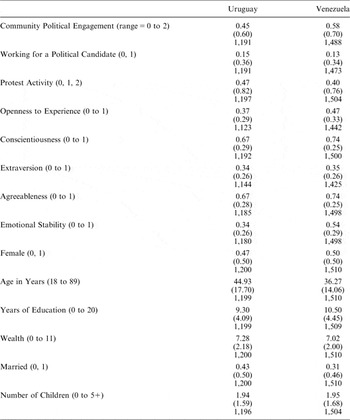
The personality items asked on the Uruguay and Venezuela surveys used an eleven-point bipolar format. Respondents were directed to rate themselves on 0 to 10 scales where the end points were marked with terms such as ‘introverted’ and ‘extraverted’. The adjective pairs are intellectual–pragmatic and thoughtful–impulsive for openness to experience, hard working–lazy and neat–sloppy for conscientiousness, introverted–extraverted and talkative–shy for extraversion, sympathetic–unsympathetic and kind–rude for agreeableness, and relaxed–tense and calm–nervous for emotional stability.Footnote 18 To minimize the impact of social desirability effects on item distributions, natural logs are used.Footnote 19 All the Big Five indicators used below have been recoded to range from 0 (lowest observed value on the final logged scale) to 1 (highest observed value). Descriptive statistics for all variables used in this paper are reported in Table 1.
Descriptive Statistics
Source: AmericasBarometer 2006–07 (Venezuela and Uruguay Surveys) by LAPOP.
Note: For each item, the table lists the item mean, standard deviation and number of valid cases.
Exploring the impact of personality on participation
The Uruguay and Venezuela surveys include data regarding multiple forms of political participation. We will examine whether the Big Five influence involvement in political action in the local community, working for candidates for national office and engagement in political protest. All dependent variables are derived from questions that were asked in identical form in Uruguay and Venezuela. With dependent variables representing several participatory acts, and with data from two nations, the analyses conducted below promise to provide valuable insight regarding the possible significance of personality for political behaviour.
The core properties of the Big Five trait dimensions suggest several hypotheses regarding the possible effects on political participation. People who are open to experience tend to be curious and analytical. They thirst for new information and encounters. These characteristics should heighten the likelihood of most forms of political participation.Footnote 20
Conscientiousness encompasses sub-dimensions such as industriousness, order and responsibility. Much of the research on this trait addresses its importance for the quality of performance in the workplace.Footnote 21 To the extent that successfully working in the political realm is analogous to achievement on the job, a positive link between conscientiousness and conventional participation might seem likely, but recent research has found mostly null effects, apparently at least in part because the conscientious do not see civic engagement as a duty on par with responsibilities towards work and family.Footnote 22 However, because conscientiousness corresponds with a strong tendency to abide by rules, a negative relationship between this trait and protest activity is expected.
By definition, extraverts are sociable, and they tend to fare well in group-oriented tasks. These effects very likely translate into success in social forms of political activity. People scoring high in agreeableness are warm, trusting and altruistic. Agreeableness may be positively related to social, and especially community-level, political engagement, but negative effects are expected for more conflictive forms of engagement.Footnote 23
The final Big Five trait dimension is emotional stability, which refers to a tendency to be calm and unflappable rather than nervous or impulsive. Here, we have the weakest basis to project effects on political engagement. Positive relationships between emotional stability and two relevant measures, psychological sense of community and participation in social learning environments, have been identified.Footnote 24 However, another work finds a negative connection between this trait and voluntary union membership,Footnote 25 and null results have been reported from participation models estimated in the United States and Italy.Footnote 26
In estimating the impact of personality on political participation, we include controls for an array of demographic attributes, but exclude political attitudes and predispositions. The demographic variables are female (1 = female, 0 = male), age (in years), years of formal education, wealth (scored 0 to 11),Footnote 27 married (1 if married, 0 if otherwise), and number of children (coded 0 to 4 for respondents with fewer than five children, and 5 for respondents with five or more children). Attitudinal variables are omitted for two reasons. First, in research on participation, inclusion of attitudinal indicators inevitably introduces problems of simultaneity. For instance, does the strong ideologue participate more in politics, or does participation influence the tendency to become a strong ideologue? Secondly, because many political attitudes and predispositions are influenced by personality, inclusion of political variables as predictors might obscure or mute the observed impact of personality on participation.
Dependent Variables
The dependent variables tap three facets of political participation: community-level civic engagement, working in the campaign on behalf of a partisan candidate, and participation in a social or political protest. The surveys include two items regarding the extent to which respondents participate in community-level political activities. The first item is a dichotomous indicator of whether the respondent had contributed to the solution of a problem in the community (1 = yes, 0 = no), and the second is a four-category measure of how often the respondent has attended meetings on community matters (0 = never to 3 = at least once a week). Data from the two items are correlated at a level of 0.32 in Uruguay and 0.45 in Venezuela. The second item was recoded to range from 0 to 1, and then data from the two items were summed (0 = low involvement in community political action to 2 = high involvement).Footnote 28 These indicators of community political engagement function as our initial dependent variables.Footnote 29
The second dependent variable captures a key feature of conventional participation in mainstream politics, working for a political candidate. Our variable is a dichotomous measure of whether the respondent worked in the campaign of a candidate during the course of the most recent presidential election (1 = yes, 0 = no).
The third dependent variable concerns protest activity. The specific item asked on Uruguay and Venezuela concerns the frequency with which respondents had participated in protests or demonstrations. The question used in both nations has three response categories, coded 0 (never) to 2 (sometimes). Not surprisingly, the modal response in both nations is ‘never’, with 72.5 per cent of respondents in Uruguay and 76.6 in Venezuela indicating that they had not joined a demonstration or protest.Footnote 30
As noted above, the Big Five trait dimensions are not expected to exert identical influences on the three dependent variables. Both openness to experience and extraversion are predicted to yield uniformly positive effects, but in both cases the magnitude of those effects should be greater for community and partisan activities than for participation in protest. Conscientiousness and agreeableness are expected to generate positive effects on the first two dependent variables, and especially community engagement. However, negative effects are projected for both of these traits in the models concerning protest activity.
Results
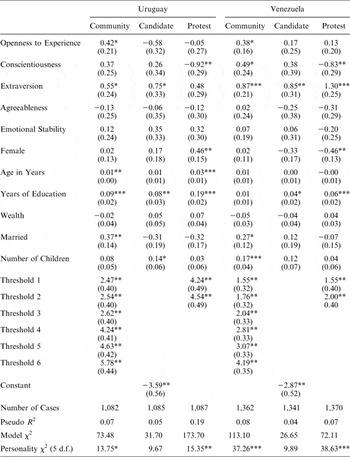
Table 2 depicts coefficient estimates for six statistical models, three for each nation. Ordered logistic regression is used for the community engagement and protest models, and binomial logistic regression is used for the model concerning working for a political candidate. Turning first to the community engagement models, we see that all six coefficients for the first three trait dimensions are positive, and five reach statistical significance. In contrast with expectations, coefficients for agreeableness are negligible, with opposite signs in the two nations. Together with marital status, openness to experience and extraversion are the only variables to produce coefficients that reach conventional levels of statistical significance in both Uruguay and Venezuela. The strongest personality effect is for extraversion in the second model. In Venezuela, 18.1 per cent of respondents have scores in one of the two highest categories on the community participation dependent variable. As extraversion rises from its lowest to its highest observed value, the predicted probability that a respondent will be in one of these top two groups doubles, rising from 0.12 to 0.24.Footnote 31 The personality variables exert especially strong collective effects. For instance, the predicted probability of being in one of the top categories on the participation scale in Venezuela is 0.31 for respondents with high levels of openness, conscientiousness and extraversion, versus a mark of only 0.07 for individuals possessing the opposite personality profile. Additional evidence of the collective impact of personality is seen in the last row in Table 2, which reports the χ2 statistic for the five personality variables as a group. This statistic contrasts the performance of the models in Table 2 with comparable models that include only the control variables. For community engagement, both test statistics are significant.
Personality and Political Participation in Uruguay and Venezuela
Notes: Cell entries are logistic regression coefficients, with standard errors in parentheses. Ordered logistic regression estimates are reported for community participation and political protest; binomial logistic regression estimates are reported for working for a political candidate. Pseudo R2 values are Nagelkerke. The final row reports the χ2 statistic associated with the five personality variables as a group, as compared with a baseline model that includes only the control variables. ***p < 0.001, **p < 0.01, *p < 0.05.
Source: AmericasBarometer 2006–07 (Venezuela and Uruguay Surveys) by LAPOP.
In contrast with results for community engagement, only extraversion yields the expected positive, significant effects in the two models concerning working for a political candidate. The substantive impact of extraversion is considerable. The predicted probability that a person worked for a political candidate roughly doubles as a function of extraversion in both nations, increasing from 0.12 to 0.23 in Uruguay, and from 0.11 to 0.22 in Venezuela. Despite these strong extraversion effects, the five personality variables as a group reach only the p < 0.10 significance level, due to the insignificant findings for the other four trait dimensions.
For protest activity, the third dependent variable, our strongest expectation regarding the Big Five, involves conscientiousness. Conscientiousness is defined in part by subsidiary traits such as order, responsibility and self-control,Footnote 32 the opposite of characteristics likely to incline one to join a protest. Individuals scoring high in conscientiousness also tend to be risk-averse and law-abiding. In the workplace, employees rating high on this trait exhibit honesty and integrity, and low levels of absenteeism and employee theft.Footnote 33 The highly conscientious score low in lifestyle risk behaviours such as alcohol consumption and involvement in automobile accidents.Footnote 34 It is noteworthy that conscientiousness, which produced modest positive effects in the community engagement models, is forecast to generate negative effects for protest activity. This nuance would be much more difficult to explore were our analyses limited to political contexts in which protest activity is less commonplace.
As expected, strong inverse relationships between conscientiousness and engagement in protest emerge in both nations. In Uruguay, the predicted probability that a respondent has participated in a protest drops by half, from 0.34 to 0.17, as conscientiousness rises from its lowest to its highest observed value. The corresponding marks in Venezuela are similar, a predicted probability of 0.29 for individuals at the low end of the conscientiousness scale, versus 0.15 at the high end.
Apart from conscientiousness, findings for the Big Five are mixed, although the contributions of the Big Five as a group reach statistical significance in both models. As expected, the coefficients for agreeableness are negative, but both fall well short of statistical significance. The coefficients for openness and emotional stability differ in sign between the two nations, and all four of these effects are insignificant. Consistent with expectations, extraversion yields a very strong positive effect in Venezuela. The coefficient for this trait dimension also is positive, and of modest magnitude, in Uruguay (p < 0.11).
Collectively, results for the six models in Table 2 reveal that the relationship between personality and participation is complex. First, it is clear that not all trait dimensions matter for all forms of political behaviour. Although past research has found that agreeableness and emotional stability influence political attitudes,Footnote 35 effects on participation are less common. In our models, all twelve coefficients for these trait dimensions are statistically insignificant. Secondly, the impact of personality is not constant across all forms of participation. Extraversion produced consistent effects across the six current models, and effects for extraversion also were significant in past research on political participation in Italy and the United States.Footnote 36 But only extraversion brings such uniform effects. In the current models, the coefficients for openness to experience reached statistical significance only for community civic engagement. Likewise, and in line with expectations, the impact of conscientiousness switched from positive to negative when the behaviour in question changed from community engagement to participation in protest activity.
Conclusions
The present study contributes to the accumulating evidence that differences in personality influence patterns in political participation. Three aspects of the tests conducted here warrant emphasis. First, whereas several recent studies have shown that personality is linked to participation in Europe and the United States, present results establish that this same relationship exists outside of advanced democracies. Secondly, by incorporating data on protest activity, we have revealed that personality effects are not limited to the sorts of conventional community-based and partisan forms of political engagement examined in past research. Results for protest are especially noteworthy in that conscientiousness emerged as a very strong deterrent to protest activity. Thirdly, because we have examined data from two nations, Uruguay and Venezuela, it has been possible to ascertain whether personality effects on participation exhibit any commonalities; and they do. Highly similar results were obtained in the two nations for all of the Big Five trait dimensions.
Looking forward, current results suggest clear implications for efforts to identify the antecedents of political behaviour. Past research on participation has been right to contemplate the effects of factors such as resources, networks and elite mobilization. Nonetheless, those factors tell an incomplete story. Together with recent research on the contributions of biological forces to patterns in political participation,Footnote 37 research on personality highlights the need to consider people’s stable, enduring attributes. People are not blank slates when they engage the political world, and political behaviour reflects more than just the sum of an individual’s interactions with environmental stimuli.
As research on personality and political behaviour proceeds, we see the greatest need for advancements in two areas. First, theoretical developments and corresponding empirical tests can help us to understand the structure of interrelationships among personality, political attitudes and participation.Footnote 38 Current findings and those from other recent studies reveal that personality influences patterns in political participation, but most work to date has contemplated only direct causal paths. By moving beyond this first step, our accounts will gain the much-needed nuance. The second and related matter is that personality and environmental factors should not be viewed as competing forces. Ample findings already exist to establish that both personality traits and environmental stimuli contribute to patterns in political participation. We believe that future research should embrace this point, and, ideally, should devote serious attention to possible interactions between the two sets of forces. By doing so, the next generation of scholarship promises to improve our understanding of how and why individuals come to respond differently, even when possessing comparable resources or when exposed to similar mobilization initiatives.