Introduction
At least since the European Enlightenment, Western theories of state formation have developed around a dichotomizing principle that distinguishes between a highly centralized non-Western “other,” the oriental despotic, versus a more liberal, democratic and market-driven Western form of the state (e.g., Sherratt Reference Sherratt1989: 164). More recently, another non-Western type, the loosely integrated segmentary state, has been identified in the anthropological literature (e.g., Asad Reference Asad and Asad1973), including many pre-modern states of sub-Saharan Africa, Southeast Asia, and Hindu South Asia (Southall Reference Southall1956: 248–49; Reference Southall1988: 64–65; Stein Reference Stein1980: 265–74, 339; Reference Stein and Kulke1995).
Neoevolutionists and other anthropologists interested in the development of early states focused most of their attention on non-Western forms (e.g., Harris Reference Harris1979: 102; Service Reference Service1975). From this perspective they constructed their causal models on the premise that state-building reflects primarily the emergence of a strategizing governing elite able to, variously, organize networks of redistribution (Service Reference Service1975), maintain an order of stratification (Fried Reference Fried1967: 235), provide irrigation services (Wittfogel Reference Wittfogel1957), reorganize managerial systems in response to socio-environmental stress (Flannery Reference Flannery1972), dominate commoners under conditions of resource stress (Carneiro Reference Carneiro1970; Sanders et al. Reference Sanders, Parsons, Logan and Wolf1976), or stage rituals confirming the centrality of rulers in a hierarchical cosmos (e.g., Geertz Reference Geertz1980).
The concept of a more democratic and market-driven Western state formation process incorporates a relatively greater role for commoner voices and strategic action in state building (e.g., Midlarsky Reference Midlarsky1999: 188–93), a causal element largely absent in theories of the non-Western state. In this paper, we present a collective action approach that provides a processual alternative to theories positing inherent differences between the West and the rest with regards to the comparative significance of commoner versus elite strategic behavior, and we provisionally evaluate the theory by comparing the nature of collective action in one non-Western (Aztec) and two Western states (England under Edward III and Renaissance Venice). Collective action theory provides a valuable analytical direction for explaining alternate pathways to state formation given that it specifies the conditions favoring the development of more centralized and despotic regimes versus the development of more egalitarian polities that allow for a greater degree of commoner strategizing and voice. According to the theory, the political institutions and cultural features of a state reflect the outcomes of the rational choices of both commoners (“taxpayers” below) and those who govern (“rulers” below), and the mutual bargains made between them. Yet, the nature of strategies on both sides of the social divide is variable depending on the nature of state revenues and other factors we describe.
The Strategies of the Rational Taxpayer
States based on collective action can fail “whenever mutually beneficial cooperation is threatened by individual strategic behavior” (Lichbach Reference Lichbach1996: 32). This is evident, in part, in the case of taxpayer “free riding” in which rational individuals able to benefit from group action fail to pay the required costs (Olson Reference Olson1965). Additionally, taxpayers may not comply if other taxpayers are seen to be free riding without detection or consequences (e.g., Levi Reference Levi1988: 198–204; Lichbach Reference Lichbach1996: 5, passim). Taxpayers may also withhold cooperation if persons in positions of state authority are perceived as benefiting themselves at the expense of the collective (the “agency problem”) (Lichbach Reference Lichbach1996: 218). Institution-building that allows for the monitoring of taxpayer compliance as well as the monitoring and control of ruler agency will be required in order for collective systems to thrive, and we looked for evidence of such social technologies. For example, the farming out of tax collection by rulers was judged as a low-cost but institutionally deficient method for taxpayer monitoring, by comparison with more bureaucratized systems staffed by accountable tax collection agents under more direct ruler control. And, since tax farmers have a vested interest in muting taxpayer complaints, we also judged it a poor system for the monitoring and control of tax collector agency by higher state officials and for accommodating taxpayer voice.
Noncompliance may also reflect taxpayer dissatisfaction, for example when rulers fail to provide adequate public goods (“goods which are consumed by all those who are members of a given community, country, or geographical area in such a manner that consumption or use by one member does not detract from consumption or use by another” [Hirschman Reference Hirschman1970: 101]). To comparatively evaluate public goods, we coded for the degree of state-sponsored transportation infrastructure, public water supplies, public security, and redistributive economy. And taxpayers may act on dissatisfaction beyond the act of noncompliance, including by exit (emigration), the expression of voice, and rebellion. Taxpayers will choose exit if they are not satisfied with government and believe that voice will be ineffective in bringing reforms (Hirschman Reference Hirschman1970: 37; Reference Hirschman1978: 102), but exit may not be a feasible option. In our coding, we assessed the opportunity costs of exit by evaluating the degree to which adjacent social formations could provide roughly equivalent public goods, whether environmental factors would allow for the replication of customary technologies of production, and whether most households based their production on costly agricultural or other capital they would be less likely to abandon.
We also collected information on the degree to which taxpayers were generally able to express voice. Voice implies that members of a polity, even commoners, can expect that complaints they make concerning the state and its officials, expressed as both petitions and appeals of legal decisions, will reach appropriate officials and be acted on. But making voice possible requires the sociocultural construction of costly and complex systems of information collection and analysis. Where both exit and voice have limited utility, we expect taxpayers to make use of rebellions or other unofficial mechanisms to express dissatisfaction.
The Strategies of a Rational Ruler
Rulers attempt to develop and maintain an acceptable level of tax or other revenues to support the state, while at the same time maintaining stable rule (e.g., Levi Reference Levi1988: ch. 2). To the degree that rulers are strongly dependent on large numbers of compliant taxpayers for state revenues (our “internal revenues”), they are predicted to curtail free riding, exit, and rebellion, and encourage compliance by providing acceptable levels of public goods, by building and maintaining institutions that allow monitoring of taxpayer compliance and official agency, by accommodating taxpayer voice, or even by providing selective incentives to compliers (Levi Reference Levi1988: 52–53, passim). Internal revenue sources (those revenues not directly controlled by the ruler, for example, as personal income, and collected from a large number of constituents) are varied, but the most important we coded included taxes and tributes on commoner land (or production) and labor, imperial tribute collected by the normal tax collecting apparatus, market taxes on ordinary goods transactions, inheritance taxes, and fees for state services. Additionally, social institutions and policies illustrating “corporate” political economy (Blanton Reference Blanton, Feinman and Marcus1998) are expected to be put into place that limit the ruler's ability to monopolize symbolic and material sources of power and that can make the ruler accountable in relation to moral codes and taxpayer voice.
With corporate governance in place, when public goods are provided, and when bargains made by both taxpayers and rulers are kept, we may conclude that collective action is the key process in the development of a state, but not all states reflect the playing-out of collective action processes. Where a state's revenues are significantly “external,” that is, drawn from sources other than taxpayers or from few taxpayers and/or are funneled into the ruler's personal treasury or purse, which is under his direct control, then there will be less impetus to develop and maintain institutions facilitating taxpayer compliance, that allow for voice, or to maintain controls over ruler agency, and rulers are not likely to provide significant levels of public goods. We collected information on the nature of state revenue sources, considering as external revenues state-controlled or ruler-owned land (including mines, animal herds, etc.), directly ruler-controlled labor (such as serf or slave labor), ruler controlled monopolies on international trade, war booty, taxation on international trade, and imperial incomes. The latter include tribute paid by conquered polities that remain outside the state's normal governmental apparatus of tax collectors, judges, and so forth. Tributes collected from conquered polities that have been incorporated into the state's official structure are considered internal revenues. We used sources that would allow us to estimate the relative importance of internal versus external revenues in a state's budget.
The Sample
We have selected three societies, fourteenth-century England, fourteenth-sixteenth century Venice, and the Aztec Triple Alliance from a.d. 1427–1519, from a larger more comprehensive study that is currently in press (Blanton and Fargher in press). Here we evaluate the theory using a qualitative comparison of a small number of well-described cases that allows for a detailed presentation of institutional development and cultural norms pertaining to collective action variables. We selected the three societies based on three criteria: (1) they are highly diverse, exhibiting different revenue sources and institutions of voice; (2) they exhibit various developments of corporate political economic strategies and administrative apparatuses; and (3) all three cases are well documented in terms of revenue sources, political organization, voice, and public goods.
England
History
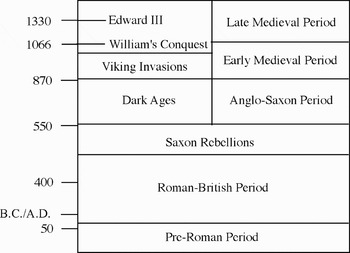
The first state we examine is England from a.d. 1327–1336, which spans the minority and early rule of Edward III (Figure 1). William the Conqueror established the basic framework of this government in 1066. After his conquest of the island, William redistributed land to his supporters based on military service requirements. These changes effectively empowered a few magnates and their wealthy tenants-in-chief at the expense of the common people. So, at the time of Edward III, the political landscape was torn by a violent struggle between the king and nobility for control of England, a struggle in which the peasantry remained largely silent (Waugh Reference Waugh1991: 167, 199).
Chronology of England.

Geography and Population
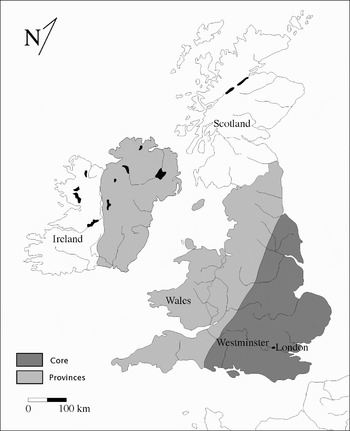
The English state under Edward III claimed sovereignty over 193,422 square kilometers, not including the king's fees in France (Figure 2) (Holmes Reference Holmes1962: 61, 98–101). Half of this area was ruled by relatively autonomous lords, and this made it difficult for the king to collect taxes, monitor officials, and curb abuses. Beyond this zone, the crown maintained nominal control over Wales and the eastern part of Ireland, but Scotland remained independent. The territory of England and Wales was populated by some 3.7 million potential taxpayers (Russell Reference Russell1948: 246). Finally, London was the most important international port in England during our period, and was an important source of revenue for the crown.
Map of Edward III's England.

Background to Political Economy
Political organization under Edward III was strongly exclusionary (in the sense of Blanton Reference Blanton, Feinman and Marcus1998: tables 5.1 and 5.3). Government was by the king; the sovereign was essential, supreme, and indispensable (Wilkinson Reference Wilkinson and Morris1940: 162, 163). To maintain their power, English kings relied on patron-client relationships, conspicuous consumption, and prestige-goods systems (Holmes Reference Holmes1962: 68; Morris Reference Morris and Morris1940: 8–9). Overall, there is little evidence of power sharing and the ruler's council was primarily subservient to him (Wilkinson Reference Wilkinson and Morris1940: 162). The king also exerted great influence over church appointments, and the head of the English Church was essentially his client (Morris Reference Wilkinson and Morris1940: 10; Wilkinson Reference Levi1988: 197).
Revenue
External sources dominated the revenue system of Edward III's England. One of the most important revenue sources for the crown was its own demesne lands and feudal holdings, including shire (county) farms, boroughs (towns), royal manors, escheats (lands that reverted to crown because their lords died without heirs), and wardships (lands held in trust by the king for lords still in their minority) (Strayer Reference Strayer, Morris and Strayer1947: 4). A second source of income would have been revenues collected during the regular operation of the government, including: amercements (varying amounts at the discretion of the inflictor), fines (fixed amounts for specific offenses), and profits from the seals (houses of salt works) and mints (Strayer Reference Strayer, Morris and Strayer1940: 4). The king also owned the gold and silver mines and received dues from people working these mines or had the mines worked by state officials (Salzman Reference Salzman, Willard, Morris and Dunham1950: 67, 68, 88). Together the revenue from feudal holdings, amercements, and mines amounted to about £18,000 per year (Strayer Reference Strayer, Morris and Strayer1940: 4; Waugh Reference Waugh1991: 178). Edward collected customs fees on imports and exports, which amounted to £13,000 in an average year (Strayer Reference Strayer, Morris and Strayer1940: 5; Waugh Reference Waugh1991: 179). Four times during our period the crown was able to extract a tenth from the church, worth about £18,900 (Lunt Reference Lunt, Morris and Strayer1947; Strayer Reference Strayer, Morris and Strayer1940: 5; Waugh Reference Waugh1991: 184).Footnote 1 So, external revenues amounted to more than £49,900 in the years that the crown collected the tax on the church. Edward also took loans from banks and merchants amounting to as much as £200,000 in his first decade in power (Strayer Reference Strayer, Morris and Strayer1940: 3; Waugh Reference Waugh1991: 183).
One of the few internal revenue sources the crown had access to was the lay subsidy. The lay subsidy was a tax on the moveable goods held by individual households, and was assessed at a fifteenth or twentieth for rural areas and a tenth for towns (Waugh Reference Waugh1991: 181). In a.d. 1334, its value was fixed at £37,430 (Strayer Reference Strayer, Morris and Strayer1947: 5; Waugh Reference Waugh1991: 181). This revenue source was large but unreliable, and Edward III only collected it four times between a.d. 1327 and 1336 (Waugh Reference Waugh1991: 184). Moreover, as Levi Reference Levi(1988) would predict, the sovereign had to negotiate heavily with parliament in order to collect the lay subsidy (Morris Reference Morris and Morris1940: 7, 29; Plucknett Reference Plucknett and Morris1940: 126; Strayer Reference Strayer, Morris and Strayer1947: 12; Waugh Reference Waugh1991: 195–96, 203). Parliament granted the subsidy on the belief that it would be used to fund military ventures along the border with Scotland and against the French (Strayer Reference Strayer, Morris and Strayer1947: 12; Waugh Reference Waugh1991: 209–10).
Tax Collection
The method of tax collection under Edward III was intermediate between tax farming and a centralized tax collection office. In most cases, the state selected members of the local nobility to assess and collect taxes (Johnson Reference Johnson, Morris and Strayer1947: 203; Strayer Reference Strayer, Morris and Strayer1947: 12, 36; Waugh Reference Waugh1991: 157). These collectors received no salaries for their services (Strayer Reference Strayer, Morris and Strayer1947: 4, 12, 36). Unpaid appointees were also used to collect customs or they were farmed out (Johnson Reference Johnson and Morris1940: 232; Strayer Reference Strayer, Morris and Strayer1947: 13, 27–28, 29). The practice of using unpaid assessors and collectors had three negative results. First, this procedure limited voice for taxpayers because there was no bureaucratic structure for tax collection or any mechanism for the transmission of complaints to higher levels of the government hierarchy. Second, the state had no way to monitor the agency of its tax collectors so taxpayers were easily oppressed and extorted (Strayer Reference Strayer, Morris and Strayer1947: 4; Waugh Reference Waugh1991: 159). Third, the system was complicated and ineffective, resulting in a high level of non-compliance and low returns for the state (Plucknett Reference Plucknett and Morris1940: 103; Waugh Reference Waugh1991: 181, 209).
Political Institutions and Commoner Voice
The government offices of the early fourteenth century tended to have overlapping responsibilities rather than being clearly divided among executive, legislative, and judicial sections (Morris Reference Plucknett and Morris1940: 12). We divide the government into three parts: the central government, the king's household, and the feudal hierarchy (Cam Reference Cam Hellen, Willard, Morris and Dunham1950: 143–83; Haven Putnam Reference Haven Putnam, Willard, Morris and Dunham1950: 185–217; Holmes Reference Holmes1962: 59–88; Morris Reference Morris and Morris1940: 3–81; Waugh Reference Waugh1991: 5, 153–69; Wilkinson Reference Wilkinson and Morris1940: 162–206). The central government consisted of the Chancery and the Exchequer. The officials of the Chancery were the chancellor, the keeper of the rolls, twelve higher clerks, twelve second-grade clerks, and cursitors (clerks that wrote routine writs), nearly ninety-eight officials in all (Wilkinson Reference Wilkinson and Morris1940: 199). The officials of the Exchequer included the treasurer, clerks, coroners, sheriffs, and those reporting to the sheriffs. The king's household contained his steward, keeper of the wardrobe, keeper of great wardrobe, butler, chamberlain, and a number of other lower offices. The feudal hierarchy had aristocrats (numbering 75), higher gentry (2,500), lesser gentry, and free-holders (Waugh Reference Waugh1991).
A series of courts ran parallel to these institutions. The court of common pleas and the king's bench (which heard cases related to royal concerns and some criminal cases), the county court held by the sheriff, and the hundred (subdivision of a county) court, presided over by the hundred bailiff (Cam Reference Cam Hellen, Willard, Morris and Dunham1950: 180; Morris Reference Morris and Morris1940: 60; 1947: 53, 55; Neilson Reference Neilson, Willard, Morris and Dunham1950: 259–85).
In some limited respects, commoner voice could be expressed, for example in the use of juries in shire and hundred courts. Sheriffs and bailiffs called juries to gather information when considering a case (see Flower Reference Flower1915 and Reference Flower1923 for examples), and the reports supplied by these juries sometimes identified problems with state administration or corrupt officials (e.g., Waugh Reference Waugh1991: 159). Petitions were another means to express dissatisfaction. Individuals could petition the king or parliament to achieve redress for a grievance (Baldwin Reference Baldwin and Morris1940: 153; Morris Reference Morris and Morris1940: 7). Although this right was available, the process was time consuming, expensive, and not often successful, especially when a petitioner directly challenged a decision of the king (Baldwin Reference Baldwin and Morris1940: 146, 153; Hallam Reference Hallam and Hallam1988: 847; Wilkinson Reference Wilkinson and Morris1940: 202–3).
But in other respects the absence of a well-developed bureaucracy impeded voice (e.g., Wilkinson Reference Wilkinson and Morris1940: 199, 202). During the early fourteenth century, the state was highly segmentary and few professional political officers existed. A large part of rural administration was handled through the system of feudal manors and their semi-autonomous lords. These lords controlled a unit of hand (which by this time had become hereditary) and had jurisdiction over its tenants (Holmes Reference Holmes1962: 13). They built sumptuous castles and mansions throughout their fees, and administered them with chanceries, judges, councils, sub-lords, treasurers, and bailiffs of their own (Holmes Reference Holmes1962: 67–68; Johnstone Reference Johnson and Morris1940: 251, 289; Platt Reference Platt1982: 90–107). Under this system, only major civil or criminal cases (i.e., felonies and murder) were outside the purview of the manorial lord. For most peasants, the manorial lord and his officials were the ultimate authority in their lives and they lacked recourse to voice at higher levels (Waugh Reference Waugh1991: 154). Coupled with the high degree of autonomy, this organizational pattern created a highly segmentary system that acted as a successful impediment to voice.
Moreover, most royal officials were drawn from the local gentry, the same people that held power in the feudal administration (Strayer Reference Strayer, Morris and Strayer1947: 12, 13). As a result, royal administration at the local level was ineffectual and rife with corruption. Many of the individuals selected for royal posts, such as sheriffs, tax collectors, or justices of the peace, used their positions for personal gain (Cam Reference Cam Hellen, Willard, Morris and Dunham1950: 165; Morris Reference Morris and Morris1940: 58; Waugh Reference Waugh1991: 153, 159; Wilkinson Reference Wilkinson and Morris1940: 202–3). Some even had been or were known criminals at the time of their selection (Morris Reference Morris and Morris1940: 41; Plucknett Reference Plucknett and Morris1940: 103; Strayer Reference Strayer, Morris and Strayer1947: 15).
The judicial system also impeded commoner voice. The medieval English court system rarely offered the possibility of appeal. As we stated above, the highest royal court, the king's bench, only heard cases involving the king or state and criminal cases involving felonies or murder (Swanson Reference Swanson1999: 81–82; Waugh Reference Waugh1991: 173). It did not function as a supreme court hearing appeals from lower level courts, and cases were only transferred by special writs (Waugh Reference Waugh1991: 156). A number of cases from our period make it clear that the jurisdictional lines between the king's bench and the court of common pleas were unclear and inconsistent (Neilson Reference Neilson, Willard, Morris and Dunham1950: 271). For many lesser civil cases and petty crimes, the manorial court, shire court, or hundred court had final say (Hilton Reference Hilton1992: 21; Holmes Reference Holmes1962: 17–18; Johnstone Reference Johnstone and Morris1940: 251; Neilson Reference Neilson, Willard, Morris and Dunham1950: 271; Swanson Reference Swanson1999: 82; Waugh Reference Waugh1991: 154, 156).
The courts did not offer impartial justice for all regardless of social rank, despite an ideology of equality in the law and the king's stated responsibility to minimize inequality (Brooke Reference Brooke1961: 222–23; Waugh Reference Waugh1991: 167). For example, the king “was entitled to a privileged position with respect to claims against him” (Morris Reference Morris and Morris1940: 6). The nobility also enjoyed preferential treatment over peasants in the royal courts (Morris Reference Morris and Morris1940: 21; Waugh Reference Waugh1991: 167; Wilkinson Reference Wilkinson and Morris1940: 202–3). For peasants, more than half were under the judicial control of feudal lords and essentially lacked access to the royal courts (Hilton Reference Hilton1992: 21; Neilson Reference Neilson, Willard, Morris and Dunham1950: 271; Waugh Reference Waugh1991: 154, 155). On a larger scale, the common law was based on custom and not a codified written system, which allowed for considerable manipulation of individual cases (Platt Reference Platt1982: 93).
Overall, the channels of voice were poorly developed in Edward III's government, leaving peasants with few options to express complaints. So, peasants were forced to turn to non-compliance, which took the form of tax evasion, protests, demonstrations, and riots. Because of the island setting, surrounding states, and technology of the era, exit was not an option. The literature for this period is replete with examples of peasant unrest and rebellion, including demonstrations outside parliament and tax riots (e.g., Hallam Reference Hallam and Hallam1988: 846–47, 849; 850–51; Platt Reference Platt1982: 90; Waugh Reference Waugh1991: 209). Vulgar literature from this period features poems calling for protests and rebellions; however, much of this voice was largely unsuccessful in bringing government reforms (Platt Reference Platt1982: 92–93).
Public Goods
The public goods system in early-fourteenth-century England was extremely poorly developed. The state offered none of the three main forms we are concerned with: government-maintained roads and bridges, public water supplies, and public safety. Private individuals, communities, or the church constructed and maintained the few roads and bridges present during this period (Flower Reference Flower1915; Reference Flower1923). When these features fell into disrepair, the local sheriff was ordered to call a jury to determine who was responsible for its upkeep. The responsible party was expected to repair the road or bridge without financial or corvée support from the government (Flower Reference Flower1915; Reference Flower1923). Not only did the state not fund the repairs, it also collected fines for failure to maintain the feature, which contributed to state revenues (Flower Reference Flower1923: 1).
An examination of public water supplies reveals that the state was not involved in supplying cities and communities with water and participated very little with regard to water for agriculture activities (Flower Reference Flower1915; Reference Flower1923). Most agriculture in England required the construction of drainage ditches (Rowley Reference Rowley and Cantor1982). Individuals were assigned the tasks of cleaning out and repairing drainage ditches that abutted their land (Flower Reference Flower1915; Reference Flower1923: xlii, passim). The state provided no financial support or labor for the construction and repair of such ditches (Flower Reference Flower1915; Reference Flower1923).
The one major public good the state was expected to provide was pubic security (Brooke Reference Brooke1961: 222–23). Even in this area, the state failed miserably (Haven Putnam Reference Haven Putnam, Willard, Morris and Dunham1950; Platt Reference Platt1982: 93; Waugh Reference Waugh1991: 158). The state did not provide an official police force and instead, beginning in 1285, made individuals responsible for their own protection (Brooke Reference Brooke1961: 70; Waugh Reference Waugh1991: 162). By the end of the century conditions had worsened and complaints about lawlessness in the countryside escalated, the state made several insincere attempts to bring the situation under control (Platt Reference Platt1982: 93). Originally, sheriffs were charged with some law enforcement roles as part of their responsibilities (Morris 1947: 53). However the sheriffs and their appointees were unable to maintain law and order, so additional officials were charged with keeping the peace (Haven Putnam Reference Haven Putnam, Willard, Morris and Dunham1950). The state appointed peacekeepers then rescinded their powers, appointed justices of the peace then stripped away their powers, formed special investigative commissions but quickly dissolved them (Haven Putnam Reference Haven Putnam, Willard, Morris and Dunham1950: 188; Platt Reference Platt1982: 93; Waugh Reference Waugh1991: 165).
The state's attempts to bring law and order to the countryside failed because the state constantly changed its policy (Platt Reference Platt1982: 93). Policy reversals in effect created chaos anew across England (Platt Reference Platt1982: 93). Furthermore, corruption was rampant among the wealthy local gentry who were appointed as law enforcement agents (Plucknett Reference Plucknett and Morris1940: 103; Waugh Reference Waugh1991: 159, 167). Instead of enforcing the law, these appointees used their positions for personal gain or to settle old scores (Platt Reference Platt1982: 93; Waugh Reference Waugh1991: 159, 167).
Summary
As we showed at the beginning of this section, the English government of the early fourteenth century was strongly ruler-centered and focused primarily on external revenue sources. Given the emphasis on external revenues under Edward III, collective action theory predicts decentralized forms of tax collection, poor development of voice and public goods, and a high level of non-compliance. The data follow this expected outcome: the English state relied on local tax collectors and it did not develop institutional mechanism for voice nor public goods during the early fourteenth century. Nor did it maintain roads and bridges, public water supplies, or public safety. Consequently, under this system non-compliance was high and protests, demonstrations, and rebellions were quite common.
Venice
History
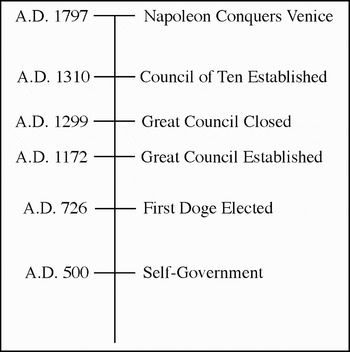
The second state we consider is the Republic of Venice from about a.d. 1300 through 1600 (Figure 3). This period follows the establishment and maturation of the Venetian system of government. Key institutions include the doge (leader), first elected in a.d. 726, and the Great Council, created in a.d. 1172–1173 (Norwich Reference Norwich1982: 12–13, 109). The Council of Forty was created in the late twelfth century and the Council of Ten in 1310. Thus, Venetian government had taken on its final form by the first decade of the fourteenth century, and it changed little before its demise in a.d. 1797 (Norwich Reference Norwich1982). However, after a.d. 1600 Venice experienced revenue problems, increased warfare, and corruption issues (Norwich Reference Norwich1982).
Chronology of Venice.

Geography and Population
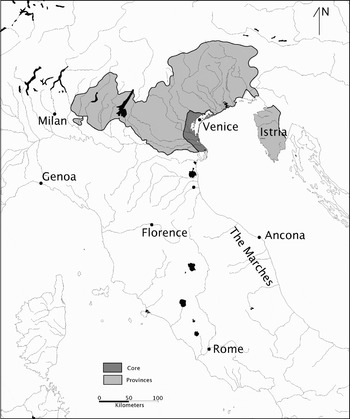
The core area of the Venetian state included only the Venetian Lagoon and the Dogado, which covered approximately 1,200 square kilometers on the adjacent mainland (Figure 4). Beyond the core, Venice built an empire on terra firma in northern Italy, and an insular empire spread along the coasts of Dalmatia and Peloponnesus, and across the eastern Mediterranean and Aegean Seas (Chambers Reference Chambers1970: fig. 30; Pullan Reference Pullan1971: 32). The empire on terra firma covered approximated 30,800 square kilometers in the modern Italian states of Veneto, Friuli-Venezia Giulia, and Lombardy (Pullan Reference Pullan1971: 32). Geographically, the terra firma empire extended west along the Po Valley and north into the piedmont and the Alps. Although Venice is an island, its proximity to the mainland, the commonality of transportation by boat, and the presence of other republics in northern Italy made exit very feasible.
Map of Venice and Terra Firma.

The capital of this empire was, of course, Venice. Before the onset of the plagues in a.d. 1348, the city's population numbered about 120,000 (Lane Reference Lane1973: 19; Romano Reference Romano1987: 28). Throughout this period, the population was divided into three social classes: nobles (4–5 percent of the population), citizens (5–8 percent), and commoners (76–79 percent) (Chambers and Pullan Reference Chambers and Pullan2001: 241; Romano Reference Romano1987: 28). Politically, the city was divided into about seventy parishes that were grouped into six larger districts (Romano Reference Romano1987: 15–21).
Background to Political Economy
The Venetian government during our period was highly complex with its overlapping committees and councils (Lane Reference Lane1973: 96–97; Norwich Reference Norwich1982: 282–83). At the apex of the government was the Great Council from which all power and authority flowed. Only the members of this council were eligible to hold high offices in Venice such as doge, ducal council, senator, grand savii, and positions on the Councils of Forty and Ten (Chambers and Pullan Reference Chambers and Pullan2001: 242; McClellan Reference McClellan1904: 160). Under the Great Council in authority were the Senate, Council of Forty, and the Council of Ten (Lane Reference Lane1973: 96–97; Norwich Reference Norwich1982: 282–83). The day to-day operation of the highest levels of government was in the hands of the Collegio and the Signoria (Lane Reference Lane1973: 96–97; Norwich Reference Norwich1982: 282–83). The Collegio was made up of six high officials (savii del consiglio) that acted as the state's prime ministers and ten lower level ministers (Lane Reference Lane1973: 96–97; McClellan Reference McClellan1904: 166; Norwich Reference Norwich1982: 282–83). The Signoria consisted of the doge, his six ducal councilors, plus the three heads of the Forty (Lane Reference Lane1973: 96–97; McClellan Reference McClellan1904: 87–88; Norwich Reference Norwich1982: 282–83). They dealt with various crises as they arose, directed business to the different councils, organized the election of lower level officials, and ensured that justice was done in the courts (Lane Reference Lane1973: 96–97; Norwich Reference Norwich1982: 282–83). As the administrative head of the government, the doge exercised power over state policy, the distribution of state revenues, and the flow of information to various councils. He could potentially use his position to enrich himself and his family, and manipulate information, elections, policing, and judging to increase his political power.
Much responsibility for enacting state policies fell on a series of magistracies (Lane Reference Lane1973: 266; McClellan Reference McClellan1904: 178–79). These magistrate positions were filled by groups of elected officials instead of single individuals (Lane Reference Lane1973: 266). The myriad of magistrates headed by multiple elected officials created an administration with little vertical complexity but much horizontal complexity within which many social actors had roughly equal power and status. All told, there were upwards of 700 or 800 elected officials and 142 different councils (from the Council of Ten to the council in charge of the state slaughterhouse) (Lane Reference Lane1973: 324; McClellan Reference McClellan1904: 160, 179).
The government of Venice was significantly more corporate than that of Edward III. In the case of Venice, we see a strong corporate cognitive code and the use of four strategies to limit individual power. There were limits on conspicuous consumption, including the use of plain black robes by adult males in the nobility and citizenry, and the tradition of tearing off the doge-elect's clothes during the accession ceremony (Chambers and Pullan Reference Chambers and Pullan2001: 177; Lane Reference Lane1973: 253; Muir Reference Muir1981: 282; Norwich Reference Norwich1982: 167; Queller Reference Queller1986: 238; Turner Reference Turner1969: 169–72). The ceremonial attack on the doge-elect was a symbolic enactment of the power of the people over the doge and his government. Writings by political officials couched the traits of leadership in humanity and clemency, saying rulers should strive to be loved by the people, to favor the poor, to ensure justice, to supply public goods, and to give an ear to voice (Chambers Reference Chambers1970: 98, 99). Lastly, the doge participated in mass rituals that created solidarity among the people and emphasized his link with them (Chambers and Pullan Reference Chambers and Pullan2001: 50; Muir Reference Muir1981: 189–92, 209; Norwich Reference Norwich1982: 158, 167).
The Venetians placed severe limits on the doge's access to sources of power (Chambers and Pullan Reference Chambers and Pullan2001: 47; Lane Reference Lane1973: 266; McClellan Reference McClellan1904: 160; Norwich Reference Norwich1982: 282). His actual exercise of power was controlled by the ducal councilors (Lane Reference Lane1973: 97; Norwich Reference Norwich1982: 283). An additional limit placed on the doge was that his position was elected not inherited (Lane Reference Lane1973: 97; Norwich Reference Norwich1982: 283). He was also bound by a powerful legal code of behavior, the ducal oath (Chambers and Pullan Reference Chambers and Pullan2001: 47; Muir Reference Muir1981: 253, 277–78). The doge could be removed from office at any time for violating this oath (Chambers and Pullan Reference Chambers and Pullan2001: 55; McClellan Reference McClellan1904: 105; Norwich Reference Norwich1982: 228, 292, 338), and at the end of his reign the state attorneys (avogadori di comun) investigated him for his adherence to it (Chambers and Pullan Reference Chambers and Pullan2001: 47; McClellan Reference McClellan1904: 164–65; Norwich Reference Norwich1982: 388–89). Lastly, committees controlled all aspects of the government, judicial, legislative, and executive (Lane Reference Lane1973: 266; McClellan Reference McClellan1904: 178–79). Overall, Venice showed a very strong corporate orientation in its political structure and culture, including a strong element of collective action (Lane Reference Lane1973: 218).
Revenue
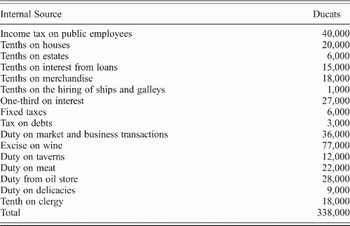
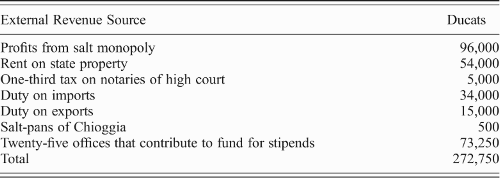
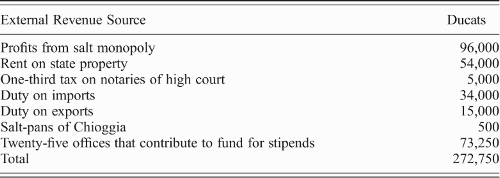
The Venetians relied on a mix of internal and external revenue sources to fund the state. The major internal revenues were formed from a variety of taxes—on market or business transactions, property, state employees' income, interest from loans, merchandise, and wine, meat, oil, and delicacies—and from forced loans and tributes from the conquered cities of terra firma and the insular holdings (coded here as internal because they did not enter the doge's personal holdings) (Chambers and Pullan Reference Chambers and Pullan2001: 134, 140–43, 138, 157; Lane Reference Lane1973: 151, 324; McClellan Reference McClellan1904: 179; Norwich Reference Norwich1982: 201, 252, 291, 348, 353). The external revenues included the sale of salt, rent on property owned by the state, duty on imports and exports, and revenue on the salt-pans of Chioggia (Chambers and Pullan Reference Chambers and Pullan2001: 140–43). Revenue returns from 1469 are summarized in Tables 1 and 2 (Chambers and Pullan Reference Chambers and Pullan2001: 139–43). In 1469 at least 52 percent came from internal revenue sources. That year the state also collected a forced loan yielding 200,000 ducats to fund the war against the Ottomans (Norwich Reference Norwich1982: 348), also an internal revenue, and this was not an unusual occurrence. Another internal revenue, tribute from the cities on terra firma that year supplied 236,220 ducats to the state treasury (Chambers and Pullan Reference Chambers and Pullan2001: 142). On the other side, the insular empire took in 180,000 ducats in 1469 and 200,000 ducats in 1500. However, the sea empire was operated at a loss, the difference being covered by the revenues from terra firma (Lane Reference Lane1973: 237–38). So, for example, of the 530,000 ducats collected by the empire in 1500, only about 240,000 entered state coffers. Taken together, Venice probably collected more than 50 percent of its total revenue from internal sources.
Venice's Internal Revenues in 1469 (adapted from Chambers and Pullan Reference Chambers and Pullan2001: 140–43)

Venice's External Revenues in 1469, Excluding Provincial Holdings (adapted from Chambers and Pullan Reference Chambers and Pullan2001: 140–43)
Tax Collection
The primary method of collecting taxes on income and property in Venice involved a centralized system. The process of taxation began with the Senate, which determined tax legislation (Bouwsma Reference Bouwsma1968: 61). Reporting to the Senate, a central office, staffed by elected and bureaucratic officials, developed a massive fiscal register to record household incomes (Chambers and Pullan Reference Chambers and Pullan2001: 134–35). Following assessment, taxes were collected by a different set of officials also employed by the state (Norwich Reference Norwich1982: 272). Market taxes and customs were collected with a mixed strategy. Many were collected by state officials, either at the weight house at Rialto or on customs patrols (Chambers and Pullan Reference Chambers and Pullan2001: 11, 20). In contrast, some market taxes and customs such as the excise duty on wine or the duty on imports by sea were farmed out (Chambers and Pullan Reference Chambers and Pullan2001: 144; Lane Reference Lane1973: 138).
Political Institutions and Commoner Voice
The Venetian state was partially bureaucratic. At the highest levels of government there were few professional political officers, and instead elected offices were filled by the nobility whose only qualification was their noble status (Lane Reference Lane1973: 266; McClellan Reference McClellan1904: 160; Queller Reference Queller1986: 40). Below the high-level elected officials, the government was more bureaucratized. Mid-level positions were filled by cittadini (citizens) (Lane Reference Lane1973: 151, 201). They were trained, appointed, promoted, and removed from office by the Council of Ten (Chambers and Pullan Reference Chambers and Pullan2001: 60–61, 87, 262; Lane Reference Lane1973: 180, 266). The other area that showed some bureaucratic development was the appointment of officials who administered the city of Venice (Lane Reference Lane1973: 98–99; Romano Reference Romano1987: 15–21).
Venice maintained the right for citizens to directly petition the doge with complaints of injustice. They could directly approach the doge with complaints, and he and his councilors were required to give audience once a week, normally on Mondays (Chambers and Pullan Reference Chambers and Pullan2001: 47). Appeals of decisions made by officials could also be directly addressed to the appropriate council, for example, the Senate, the Council of Ten, or the Council of Forty (McClellan Reference McClellan1904: 176).
The Venetian legal system was hierarchically organized and had several vertical levels and much horizontal complexity (Chambers and Pullan Reference Chambers and Pullan2001: 39; Lane Reference Lane1973: 96; McClellan Reference McClellan1904: 63). Citizens could appeal decisions or make complaints in the civil courts. Outside of Venice, special auditors toured terra firma and the insular empire to hear complaints (Chambers Reference Chambers1970: 97–98). If they deemed the complaints valid, the cases were referred to the civil courts in Venice (Chambers Reference Chambers1970: 97–98; McClellan Reference McClellan1904: 176). The complaints were then decided through vote by a panel of elected judges after the advocates had presented each side of the case, and the judges had minutely discussed the issue (Chambers and Pullan Reference Chambers and Pullan2001: 102; McClellan Reference McClellan1904: 176).
Another aspect of voice in the judicial system was the use of the avogadori di comun to monitor Venetian officeholders. They investigated violations of the maritime code, charges of bribery in the courts, and abuse of office (Chambers and Pullan Reference Chambers and Pullan2001: 53; Lane Reference Lane1973: 100). They were also required to “hear all complaints of personal assaults and [had] the power to propose penal sentences …” (Chambers and Pullan Reference Chambers and Pullan2001: 53).
One of the most important aspects of the Venetian civil courts was the concept of impartiality, the ideology that everyone was equal in the eyes of the law (Lane Reference Lane1973: 271; Romano Reference Romano1987: 8). The state made this ideology a reality because judges were appointed or elected for short terms, important cases were decided by collective judgment, and the avogadori and the doge monitored judges for bribery or corruption (Chambers Reference Chambers1970: 97–98; Lane Reference Lane1973: 97, 100). This aspect of the corporate cognitive code worked to some degree; for example patricians did not receive special treatment in terms of law enforcement and judicial hearings, much to their chagrin (Romano Reference Romano1987: 8; Queller Reference Queller1986: 234–39).
Even with a well-developed system of voice, protests and riots occasionally occurred (Chambers Reference Chambers1970: 101). The common people saw the doge as their prince and would cheer one they thought generous and jeer one they found oppressive (Muir Reference Muir1981: 273). On a few occasions these protests turned violent, such as a sacking of the state granary by the arsenal workers (Chambers Reference Chambers1970: 101). Despite the occasional demonstration or riot, the general impression is that the populace was satisfied with the nobility's rule and taxpayer non-compliance was low (e.g., Chambers and Pullan Reference Chambers and Pullan2001: 262).
Public Goods
The public goods system of Venice was probably one of the best developed in the pre-modern world. The state supplied roads, bridges, water, and public security, among other things. The paved streets and the bridges that crossed the innumerable canals throughout the city were constructed and maintained by the state (Chambers and Pullan Reference Chambers and Pullan2001: 6; Norwich Reference Norwich1982: 202; Roman Reference Romano1987: 18). For example, in the thirteenth century, the state established a ministry, the giudici del piovego, to manage the city's infrastructure (Romano Reference Romano1987: 22). The government also stipulated in official policy that the parish heads were responsible for maintaining the streets and bridges and gave them the power to assess taxes to pay for their maintenance (Roman Reference Romano1987: 18).
The state also took an active part in managing water in the city and in the adjacent Dogado, as well as in digging and maintaining the mass of canals that dissected the city, and in 1224 a magistracy of channels was created (Lane Reference Lane1973: 16; Norwich Reference Norwich1982: 26). By 1501, this magistracy had been replaced by the Magistrato all'Acqua, responsible for all the city's hydraulic issues (Lane Reference Lane1973: 16). The government also dug wells and cisterns to ensure that citizens had enough fresh water (Chambers and Pullan Reference Chambers and Pullan2001: 24; Norwich Reference Norwich1982: 202). Lastly, the state took part in constructing drainage and irrigation canals for agriculture on the adjacent mainland (Braudel Reference Braudel1972: 78–79).
The Venetian government excelled in the area of public security. By the early fourteenth century, the city had one police officer for every 350 residents (Romano Reference Romano1987: 9; Ruggiero Reference Ruggiero1980: 15). The Signoir di Notte and the Cinque alla Pace patrolled the streets, assisted by armed groups (custodi), and had the power to arrest robbers, rapists, fornicators, and individuals with illegal weapons (Chambers and Pullan Reference Chambers and Pullan2001: 88–89; Ruggiero Reference Ruggiero1980: 5–6). The heads of the city districts also helped patrol (Chambers and Pullan Reference Chambers and Pullan2001: 88–89). The state also patrolled the inland waterways and Adriatic Sea for smugglers and pirates (Chambers and Pullan Reference Chambers and Pullan2001: 20; Lane Reference Lane1973: 24, 62, 65, 125). The Venetians also oversaw law enforcement in the cities of terra firma through their rectors (Norwich Reference Norwich1982: 209).
Summary
The Venetian state relied heavily on internal resources, mostly collected through a centralized system with official assessors and collectors. This type of centralized tax collection allowed the state to monitor both tax collectors and free riders, and offered more opportunity for taxpayers to complain about unfair taxation. Collective action theory predicts that Venice would have well-developed systems of voice and public goods, and indeed both were well developed. The mechanisms for voice included group rulership, judicial voice, and direct petition. Not only did the state provide for voice, it also responded to it (e.g., Chambers Reference Chambers1970: 98, 100–1). It provided public goods, which included roads and bridges, public water supplies, and public security in abundance. Consequently, riots and demonstrations were few and there was relatively high compliance in taxation.
The Aztec Triple Alliance
History
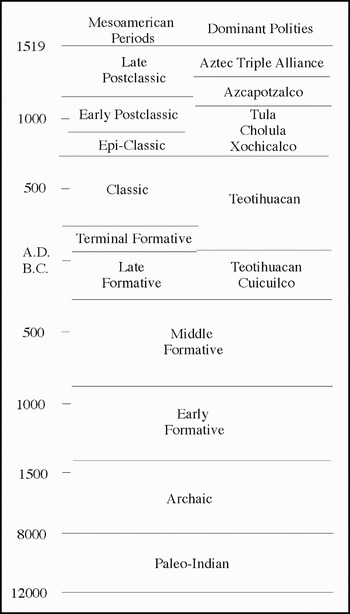
The third and final state we examine is the Aztec Triple Alliance from its formation in a.d. 1427 to the Spanish Conquest in a.d. 1521 (Figure 5). This polity grew out of a period of political competition and warfare between city-states in the Basin of Mexico during the Late Postclassic Period (Brumfiel Reference Brumfiel1983; Calnek Reference Calnek, Schaedel, Hardoy and Kinzer1978; Smith Reference Smith2003: 38; Smith and Berdan Reference Berdan and Berdan1996: 1). During this time, Azcapotzalco and its Tepanec allies became the dominant power on the west side of the Basin, and Huexotla-Coatlichan headed the Acolhua coalition to the east (Smith and Berdan Reference Berdan and Berdan1996: 2; van Zantwijk Reference van Zantwijk1985: 106). By a.d. 1427, the lords of Azcapotzalco had spread their empire over all of the Basin of Mexico, but the rulers of Tenochtitlan, Texcoco, and Tacuba forged the Triple Alliance and rebelled against them (van Zantwijk Reference van Zantwijk1985: 109–11). Together they consolidated power in the Basin and beyond it to build the largest empire in Prehispanic Mexico, conquering Mesoamerican territories in the Central Highlands, Southern Highlands, Gulf Coast, and Pacific Coast (Berdan et al. Reference Berdan and Berdan1996; Carrasco Reference Carrasco1999).
Chronology of Central Mexico.

Geography and Population
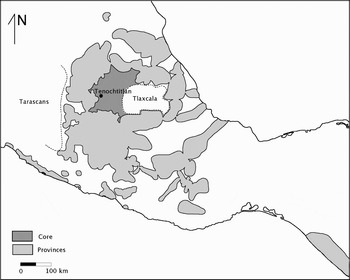
At the time of Spanish conquest, the Aztec Triple Alliance nominally controlled an area of about 278,852 square kilometers, of which about 40,000 square kilometers were more tightly administered, including the core area of the empire (Figure 6) (Barlow Reference Barlow1949; Berdan Reference Berdan1980; Berdan et al. Reference Berdan1996: 109–13, fig. II-1). When the Spanish arrived in a.d. 1519, the Triple Alliance's empire ruled some five to six million people (Sanders Reference Sanders, Sanders, Kovar, Chalton and Diehl1970; Sanders and Price Reference Sanders and Price1968: 208; Smith Reference Smith2003: 58). The core of this system, the Basin of Mexico, was populated by more than one million people with 150,000 to 200,000 in the capital, Tenochtitlan-Tlatelolco (Calnek Reference Calnek and Wolf1976; Sanders Reference Sanders, Sanders, Kovar, Chalton and Diehl1970). The core area was a closed hydrographic unit, the Basin of Mexico, which covered about 7,000 square kilometers (Sanders et al. Reference Sanders, Parsons and Santley1979: 81). Since there were independent political systems adjacent to the Basin (e.g., the Tarascan empire and Tlaxcala) that could have offered similar levels of voice and public goods (García Cook Reference García Cook, Sabloff and Andrews1981; Gibson Reference Gibson1952; Pollard Reference Pollard1993), exit was a viable option for dissatisfied constituents (e.g., Aguilera Reference Aguilera1991: 36; Isaac Reference Isaac1983: 425).
Map of the Aztec Empire.

Background to Political Economy
The political structure of the Aztec Triple Alliance was based on a military alliance between three tlatocayotin (sing. tlatocayotl, independent state): Tenochtitlan, Texcoco, and Tacuba.Footnote 2 The political system became more centralized, but each tlatocayotl retained a significant amount of autonomy within its individual domain (Lockhart 1992; van Zantwijk Reference van Zantwijk1985: 275, 277). At the same time, the power of Tenochtitlan expanded, mostly at the expense of Tacuba (Smith and Berdan Reference Berdan and Berdan1996: 2). Consequently, the Triple Alliance really became a binary confederacyFootnote 3 of Texcoco (Acolhuacan) and Tenochtitlan (Tenochca/Tepanec), with the latter forming the more powerful half.
The common form of government (altepetl) in Central Mexico divided responsibility for governance between social groups in such a way that it could only function if the member groups cooperated (Lockhart 1992; van Zantwijk Reference van Zantwijk1985: 25). The founders of Tenochtitlan followed this pattern to integrate the diverse subdivisions called calpultin that provided much of the polity's organizational fabric (van Zantwijk Reference van Zantwijk1985: 81). The different aspects of governance were divided between the calpultin; some took on military responsibilities, others administrative, and the remaining agricultural (van Zantwijk Reference van Zantwijk1985: 74, 79, fig. 4.9). Historically, administrative responsibilities were divided between an external ruler (tlacochcalcatl) and an internal ruler (cihuacoatl). Lastly, the chief ruling body of the altepetl was a council made up of the heads of the calpultin and the dual administrative officers (Durán Reference Durán and Heyden1994: 75–76, 264; van Zantwijk Reference van Zantwijk1985: 97).
When the Tenochca became a tlatocayotl (an independent state) in 1383, they elected a tlatoani (speaker) as their supreme external ruler (van Zantwijk Reference van Zantwijk1985: 99, 102). This new official became the head of external administration, especially for offensive military activities, and the most powerful official in the government. Nonetheless, the Tenochca retained their dual administrative structure, with power now split between the tlatoani and the cihuacoatl, and its ruling council (Davies Reference Davies1987; van Zantwijk Reference van Zantwijk1985).
The political structure of Tenochtitlan was modified again when the Triple Alliance was created about 1427. The offices of the tlatocayotl that were held by the noble heads of the calpultin were modified and given new responsibilities (van Zantwijk Reference van Zantwijk1985: 123). At the same time, the links between noble calpulli families and these offices were sometimes broken and the new imperial government appointed individuals (both commoners and nobles) to these positions based on merit (see Davies Reference Davies1987: 114, 115; van Zantwijk Reference van Zantwijk1985: 123; for discussions of social mobility in late pre-Hispanic Central Mexico see also Anguiano and Chapa 1976: 140, 151–52; Durán Reference Durán, Horcasitas and Heyden1971: 137; Hirth Reference Hirth2000: 254, 260; Muñoz Camargo Reference Muñoz Camargo and Chavero1947: 56–57; Nava Rodríguez Reference Nava Rodríguez1966: 37; and Offner Reference Offner1983).
Rulership in the Triple Alliance was conducted through councils and a hierarchy of bureaucratic officials. The most powerful council and supreme ruling body of the alliance was the tlatocan. The inner tlatocan (inner imperial council) consisted of three tlatoque, the cihuacoatl, and the four prime ministers of the empire (van Zantwijk Reference van Zantwijk1985: 111, 112, 117; see also Durán Reference Durán and Heyden1994). We also see an outer tlatocan that included all the lords of the kingdom, which probably included the high-level imperial officials and calpulli heads (Durán Reference Durán and Heyden1994: 208, 209, 253; van Zantwijk Reference van Zantwijk1985: 117–19; see Offner Reference Offner1983 for Texcoco: table 6.1). There was also a council of the Cihuacoatl with fifteen members, the Council of Acolhuacan, and various other ruling councils at lower levels (Davies Reference Davies1987: 117; Offner Reference Offner1983: 56–57, 60, 83, 155, 157, 161; van Zantwijk Reference van Zantwijk1985: 120, 121, 122).
Although local political systems of the Late Postclassic Basin of Mexico were not identical (e.g., Hodge Reference Hodge1984), they shared basic features so that most researchers refer to an Aztec political system, usually referring to the Triple Alliance partners. In the Aztec system of governance, although the key decision-making was in the hands of rulers and oligarchic councils, numerous corporate strategies are apparent, placing the Aztec somewhere between the Venetian and English systems described in this paper, but decidedly closer to Venice. That there was a goal of building a governing system with corporate features is evident in the way the Aztecs chose to emulate primarily the more egalitarian dimension of the dual system of rulership practiced by their Toltec imperial predecessors. Rather than the more elitist vision of governance found in the policies of Quetzalcoatl, the Aztecs identified more closely with Quetzalcoatl's counterpart, Huemac, whose more corporate-leaning policies included the integration of both commoners and the nobility into the system of governance (e.g., Davies Reference Davies1987: 114, 115; van Zantwijk Reference van Zantwijk1985: 96–97). Various policies, including restrictions on ruler agency, restrictions on ruler control over material and symbolic resources, controls on the agency of other governing officials, and the providing of channels for commoner voice, are corporate elements that we think are consistent with the predictions of collective action theory. We summarize these and other elements of corporate governance as follows:
(a) “The Aztec arrangement,” as van Zantwijk Reference van Zantwijk(1985) calls it, was a social construct that combined hierarchy, particularly in the bureaucratic system of governance, with heterarchy, the latter expressed through the functionally diverse social groups whose interdependencies reflected concepts of dual and other forms of structural oppositions and complementarity (van Zatwijk 1985: ch. 12; cf. Lockhart 1992: 436–42). Hierarchy and heterarchy were reinforced through ritual events and ritual cycles carried out in symbolically charged precincts (van Zantwijk Reference van Zantwijk1985: 213–16, 261) set apart from rulers' palaces (Blanton et al. Reference Blanton, Feinman, Kowalewski and Peregrine1996: 11).
(b) Rulers (tlatoque) played a role in the ritual events and cycles but were not considered part divine, as their Toltec predecessors had been (Davies Reference Davies1987: 101), and in other ways they were limited in the degree to which they could mobilize cognitive resources to justify their actions. Although rulers could be priests, and they occupied an office associated with considerable symbolic force, still, “the Tenochca tlatoani was not himself a god but rather the god's representative, or substitute” (Davies Reference Davies1987: 101), and the gods were even known to criticize the ruler (Durán Reference Durán and Heyden1994: 217, 484, 486, 488; van Zatntwijk 1985: 97).
(c) A well-developed moral code set clear limitations on how a ruler could treat his subjects, and it specified rulers' obligations to the body politic (Davies Reference Davies1987: 103), and “at his enthronement he was the object of interminable homilies, not upon his rights, but on his duties towards his less privileged subjects” (Davies Reference Davies1987: 124).
(d) The high council (tlatocan) apparently had the power to monitor, castigate, or even remove a ruler from office (Davies Reference Davies1987: 110; Durán Reference Durán and Heyden1994: 307, 371; van Zantwijk Reference van Zantwijk1985: 88).
(e) Ruler selection, especially in Tenochtitlan, was not based entirely on primogeniture. In some cases, the lords assembled and cast votes for the eligible princes (Davies Reference Davies1987: 108; Durán Reference Durán and Heyden1994: 70–71, 123, 309–11, 387, 467), while in other cases the election of the hueyi tlatoani was determined by rulers of Texcoco and Tacuba and the city's four highest-ranking officials (Davies Reference Davies1987: 109).
(f) Government by councils was common in the Aztec system (Davies Reference Davies1987: 110; van Zantwijk Reference van Zantwijk1985: 276–77), and we see this as a strategy to incorporate diverse voices in political decision-making. Minimally, the imperial council, the tlatocan, included eight members, but probably exceeded fifty in its complete form (e.g., Durán Reference Durán and Heyden1994: 208, 209, 253; van Zantwijk Reference van Zantwijk1985: 117–19: table 6.1). Below this level, there were many other more specialized councils whose memberships in some cases could include both nobility and commoners (Davies Reference Davies1987: 113, 114, 115, 117, 119; Durán Reference Durán and Heyden1994: 70–71, 116–17, 123, 130, 152, 176, 208–10, 253, 265, 309–11, 387, 467; Offner Reference Offner1983: 56–57, 59, 60, 83, 152, 161; van Zantwijk Reference van Zantwijk1985: 114, 120, 121, 122).
(g) The agency of lower officials could be discovered and punished, and commoner voice could be accommodated through petitions and a precise appeal hierarchy in a strongly bureaucratized governmental apparatus. For example, the state closely monitored its tax collectors to ensure that they fulfilled their responsibilities properly (e.g., Offner Reference Offner1983: 155). Tax collection was carried out by a central government office, the calpixcacalli (tax collector's building) (van Zantwijk Reference van Zantwijk1985: 275–76), and its staff included motititlanque, or investigative officers. The imperial administration of the Aztec Triple Alliance, which developed after 1427, showed a high degree of bureaucratic complexity, much more than did Edward III's England and Venice (cf. Hayden Reference Hayden, Schwartz and Falconer1994: 199). Imperial offices were specialized with clear duties and responsibilities (Davies Reference Davies1987: 114; Offner Reference Offner1983: 111–12; van Zantwijk Reference van Zantwijk1985: 216, 275–76). Appointment to office was based in part on merit and not always on social class or heredity, and officials were trained in schools for these positions (Offner Reference Offner1983: 111–12; van Zantwijk Reference van Zantwijk1985: 110, 114, 144). Departments were often directed by a combination of elite and commoner officials, such as the chief military and judicial councils (Davies Reference Davies1987: 113; Offner Reference Offner1983: 56–57, 152). Not only were officials appointed, they were monitored, and malfeasance was severely punished and diligence rewarded (Davies Reference Davies1987: 118; Offner Reference Offner1983: 155, 242, 251; Zorita Reference de Zorita and Keen1994: 128). Appointments to low- and middle-level offices were made for limited periods, usually one or two years (van Zantwijk Reference van Zantwijk1985: 91). Finally, these positions were salaried based on a system of appanage (Hicks Reference Hicks1978; Offner Reference Offner1983: 132, 136; van Zantwijk Reference van Zantwijk1985: 284; Zorita Reference de Zorita and Keen1994: 124–25).Footnote 4
The Aztec court system was highly sophisticated and exhibited a high degree of vertical complexity. During the reign of Motecuhzoma I, an order of judges was established in Tenochtitlan, which was directed by a supreme judicial council that oversaw a series of hierarchically arranged and linked courts (Durán Reference Durán and Heyden1994: 210). In Acolhuacan, Nezahualcoyotl established a series of courts that culminated in a supreme legal council overseen by two higher judges and the ruler (Offner Reference Offner1983: 148). In Texcoco, this council also acted as the supreme imperial court and cases were referred to it from other parts of the empire for final decisions (Offner Reference Offner1983: 84). Decisions could be appealed from lower to higher courts and could potentially be decided by the tlatoani or cihuacoatl (Davies Reference Davies1987: 119; Zorita Reference de Zorita and Keen1994: 126).
It is also clear that the state maintained a system of equal justice regardless of social class or position, both in ideology and practice (Offner Reference Offner1983: 77, 242; van Zantwijk Reference van Zantwijk1985: 280). Judges that decided minor cases incorrectly, took small gifts, or drank, were punished by their fellow judges (Offner Reference Offner1983: 251). For severe breeches of the public trust, including favoring the nobility over commoners, a judge could be executed (Offner Reference Offner1983: 77, 242, 251).
Direct petitions of the ruler were a common form of voice in Aztec society (Durán Reference Durán and Heyden1994: 199, 484). In all three imperial capitals special tribunals were established to hear the complaints of the common people (Durán Reference Durán and Heyden1994: 210; Offner Reference Offner1983: 60). These tribunes were staffed by four officials (oidores), who worked with the ruler and were housed in special rooms in the tecpan (administrative palace) (Durán Reference Durán and Heyden1994: 210; Offner Reference Offner1983: 60).
The effectiveness of voice appears to have limited taxpayer non-compliance, rebellions, and protests. We do occasionally see references to rebellions in the literature, but these were directed against oppressive nobles or merchants and not the state (van Zantwijk Reference van Zantwijk1985: 278). For example in 1432, native documents record a bread riot in which the peasants rose up and killed their local lords (van Zantwijk Reference van Zantwijk1985: 278).
Revenue
We categorized Aztec revenue as primarily internal, although the decision to do so was not straightforward. The revenues accruing from land appropriated by ruling families as a result of military conquest, or lands newly developed through state efforts (e.g., Hicks Reference Hicks, Harvey and Prem1984: table 7.1; Parsons Reference Parsons and Harvey1991), could perhaps be classified as external revenue sources. And there was a social category of tenant, “serf,” or “estate-based laborers” (mayeque), as well as “pawns, purchased slaves, or orphans” (i.e., people without kin)” attached to the palaces (Hicks Reference Hicks, Harvey and Prem1984: 163), who were under varying degrees of state control and represent categories distinct from free tax payers residing in urban parcialidades and rural calpulltin (calpuleque or macehualtin) (e.g., Carrasco Reference Carrasco, Ekholm and Bernal1971: 355–56; Hicks Reference Hicks, Harvey and Prem1984: 150). However, from our literature review, we concluded that the categories of state land and less free labor are problematic, and that the more state-controlled categories of land and labor evidently accounted for a minority proportion of the total revenue stream. For example, Calnek Reference Calnek, Hardoy and Schaedel(1975) was able to identify 100 state-controlled estates, and while this is not a complete list of all such lands, the area we estimate they represent would have been only a small fraction of the approximately 200,000 hectares of potentially cultivable land in the Late Postclassic Basin of Mexico (a conservative figure, since this value was calculated only from the archaeologically surveyed areas) (Sanders, Parsons, and Santley Reference Sanders, Parsons and Santley1979: table 9.3). Carrasco Reference Carrasco and Carrasco(1976: 104) found that the majority of persons contributing to tribute collected from Morelos (south of the Basin) were free taxpayers. And some recent research throws doubt on the utility of social distinction encoded in the terms macehual and mayeque. According to Hicks Reference Hicks and Carrasco(1976), both kinds of households were contributing to state tribute requirements through an overlord of some kind, and Brumfiel Reference Brumfiel and Harvey(1991) concluded that the macehual/mayeque distinction is not archaeologically obvious. Even if we were to consider mayeque as a form of state-controlled labor, still, very likely most commoners in the Basin of Mexico were free taxpayers. These households met their tax obligations through their contributions to tributes assigned to urban tax-collection organizations, the parcialidades, or to the rural calpulltin (e.g., Hicks Reference Hicks, Harvey and Prem1984: 150).
Other significant revenue sources in the internal category include a tax on ordinary market transactions (Cortés Reference Cortés and Pagden1986: 103; Durán Reference Durán1967, I: 79, 180; and II: 161–62, 264), which were so important to the state that laws were instituted specifying that market transactions should take place only in recognized market places (Anderson et al. Reference Anderson, Berdan and Lockhart1976: 138–49; Durán Reference Durán, Horcasitas and Heyden1971: 276; Hicks Reference Hicks, Claessen and van de Velde1987: 94; Offner Reference Offner1983: 281; Motolinía Reference Motolinía1971: 368; cf., Berdan Reference Berdan1975: 207). Corvée labor was required of commoner taxpayers (Davies Reference Davies1987: 117, 137; Durán Reference Durán and Heyden1994: 130, 155; Hassig Reference Hassig1985: 31, 56, 60; Zorita Reference de Zorita and Keen1994: 203), including, in some cases, the working of state agricultural lands or providing services to the palace (Hicks Reference Hicks, Harvey and Prem1984; Offner Reference Offner1983: 136; Zorita Reference de Zorita and Keen1994: 187). We would classify imperial tributes from the tributary provinces as internal, since they were collected through an extension of the regular tax-collection administration (calpixque) (Berdan Reference Berdan and Berdan1996: ch. 5; Davies Reference Davies1987: 117).
Public Goods
The Aztec state provided substantial public goods at least in and near the capital, Tenochtitlan. All three types of public goods were provided in abundance in the city. Away from the capital, the state also provided some public goods, but not always at the same level as within the city. The city of Tenochtitlan was connected to the mainland by four artificial earth and stone causeways built with corvée labor (Cortés Reference Cortés and Pagden1986: 102; Davies Reference Davies1987: 137, 153; Durán Reference Durán and Heyden1994: 110–11; van Zantwijk Reference van Zantwijk1985: 107). Inside the city, the state constructed wide avenues crosscut by streets and canal (Cortés Reference Cortés and Pagden1986: 102–3). All of its streets had openings to let the water pass among canals and across these openings the state constructed wide stone bridges (Cortés Reference Cortés and Pagden1986: 103; Davies Reference Davies1987: 137, 153; van Zantwijk Reference van Zantwijk1985: 121, 276; Zorita Reference de Zorita and Keen1994: 157). Outside Tenochtitlan, state directives required authorities in outlying towns to care for roads using corvée (Durán Reference Durán and Heyden1994: 155; Hassig Reference Hassig1985: 31, 56).
The Tenochca authorities invested heavily in public water supplies in and around the capital (Davies Reference Davies1987: 117). The state constructed stone aqueducts to bring drinking water into the city from Coyoacan (Cortés Reference Cortés and Pagden1986: 107; Durán Reference Durán and Heyden1994: 365). During the reigns of Itzcoatl and Motecuhzoma I, the state constructed the Dike of Nezahualcoyotl (9 kilometers long and 7 meters wide) and a series of dams, which separated the saltwater from the freshwater of the lakes, to replace the saltwater around Tenochtitlan with fresh water (Davies Reference Davies1987: 117; Hassig Reference Hassig1985: 52; van Zantwijk Reference van Zantwijk1985: 283). Away from the city, the state constructed canals and dikes to control flooding in the southern chinampa zone (Armillas Reference Armillas and Bennet1948, Reference Armillas1971; Davies Reference Davies1987: 117; Durán Reference Durán and Heyden1994: 110–11, 365; Parsons Reference Parsons and Harvey1991: 40; Parson et al. Reference Parsons, Parsons, Popper, Taft and Farrington1985: 88; Sanders and Price Reference Sanders and Price1968: 177; van Zantwijk Reference van Zantwijk1985: 283; Zorita Reference de Zorita and Keen1994: 160).
The state controlled crime and feuding through a well-developed criminal law code and a state-funded police force (Durán Reference Durán and Heyden1994: 210; Offner Reference Offner1983; Sanders and Price Reference Sanders and Price1968: 153; Zorita Reference de Zorita and Keen1994: 111–12). These forces were supplemented by low-level judges empowered to arrest offenders and police officers appointed and monitored by the calpulltin (Offner Reference Offner1983: 169–70; Zorita Reference de Zorita and Keen1994: 129). At the highest level, appellate judges were assisted by chief constables with power to arrest suspects, including patricians (Zorita Reference de Zorita and Keen1994: 129). Finally, the state maintained public prisons located in the tecpan to hold offenders (Davies Reference Davies1987: 117; Zorita Reference de Zorita and Keen1994: 131).
Summary
The Aztec Triple Alliance relied on a mix of internal and external revenues, with internal revenues providing a substantial amount of its income. Therefore, collective action theory predicts that the state would provide voice and public goods. As expected, they relied on a centralized tax collection system and compliance to obtain these funds. The tax collection system allowed them to monitor officials, and the state was able to accommodate voice to some degree through judicial appeals and tribunals to hear commoner complaints. Government policies included controls on ruler behavior and the provisioning of public goods such as roads, public water supplies, and public security in Tenochtitlan and Texcoco, and to a slightly lesser degree in rural areas. Rebellions or protests are rare in the literature.
Discussion
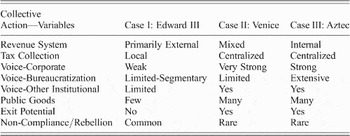
In summary, the data from our three cases, England, Venice, and the Aztec, tend to support the theoretical predictions of collective action theory as applied to the development of pre-modern states (Table 3). The idea that dependence on internal revenue sources will eventuate in the development of policies that provide for limits on the agency of rulers, commoner voice, and the dissemination of public goods, is supported by our data. Conversely, the theory also predicts that if a state relies on external revenue sources such policies will be limited or absent, and this, too, is supported with our examples. The data from England supported the expectations for a system based on external revenues. We have estimated that external revenues represented over 80 percent of that state's revenue. With the state's heavily reliance on external revenues, it did not seek to encourage channels of voice, compliance in tax collection, or the dissemination of public goods. Instead, the ruler was able to establish a highly exclusionary political system. This system was dominated by patron-client relationships, prestige-goods, and conspicuous consumption. These personal and individualizing strategies focused wealth and power in the ruler and a few other people, forming a highly asymmetrical system resting power in a small number of elite constituting no more than an estimated 0.2 percent of the population (Waugh Reference Waugh1991). Another aspect of exclusionary political strategies exhibited by the English system was corruption. The local gentry selected to fill royal positions in their communities used their appointments for personal gain or revenge. The state's inability to control these local officials allowed this corruption to continue unchecked, and local officials commonly enriched themselves at the expense of the peasantry. Finally, non-compliance was quite high during the focal period and rebellions and riots were common.
Summary of Collective Action in the Three Study Cases

In contrast, the data from Venice and the Aztec support the predictions of collective action theory for states that rely more heavily on internal revenue sources. While significant Venetian revenues accrued from taxes on foreign trade, still, the bulk of taxes came from internal sources, and an even larger portion of Aztec revenue was internal. As predicted, these states were better organized to accommodate commoner voice, to centralize tax collection, and to provide public goods. Venice and the Aztec instituted a range of corporate strategies to limit ruler agency, and both relied strongly on rule by council. Additionally, the Aztec opened official positions to both the nobility and commoners. The judicial systems and direct petitions facilitated voice in both societies. Also, unlike England, these states used government funds to construct and maintain roads, bridges, and to provide public water supplies and public security. Both states experienced official corruption but they were much more successful than England in controlling it. These strategies allowed Venice and the Aztec to achieve much higher levels of tax compliance with many fewer rebellions and protests than England. In the final analysis, our systematic comparison shows that the political structures of Venice and the Aztec were much more similar to each other than either was to England. Historians have referred to both Venice and the Aztec as oligarchies and have noted the similarities between the two systems (Davies Reference Davies1987: 110; McClellan Reference McClellan1904; Norwich Reference Norwich1982: 110, 282; van Zantwijk Reference van Zantwijk1985: 280).
We agree with Levi Reference Levi(1988) that when internal revenues are key to the state economy, rulers must negotiate with their taxpayers to extract revenue. Conversely, when states emphasize external revenue sources and do not tap a broad taxpayer constituency for revenue, the structural constraints on state building are very different. In these cases, rulers do not have to strike bargains with their constituents in order to achieve what Levi Reference Levi(1988: ch. 3) calls “quasi-voluntary compliance” among taxpayers. Rulers are much freer to develop exclusionary systems that vest considerable power in rulers and a few elites. These rulers also tend to show little interest in monitoring tax collection and abuse by officials. This was the situation in early-fourteenth-century England. Edward III had a near monopoly on sources of power and was not highly accountable to the people.
Despite the freedom from the constraints imposed by collective action, exclusionary systems with external revenues, like Edward's, experience other structural constraints. They still need a minimum number of people to participate in the system for it to function. So the question becomes, how do they get people to participate? The answer lies in individual or selective incentives (e.g., Olson Reference Olson1965). In these systems, rulers use patron-client relations, prestige-goods, and pay-offs or bribes to mobilize support from selected individuals or groups (e.g. Blanton et al. Reference Blanton, Feinman, Kowalewski and Peregrine1996: 4–5; Holmes Reference Holmes1962: 68). Generally, such strategies are deployed on an interpersonal basis. Even with a monopoly on the sources of power (political, economic, ideological, and military [e.g., Mann 1986]) vis-à-vis the peasantry, Edward III could not force taxpayer compliance; and the funds that finally were collected were subject to pilfering by tax collectors, sheriffs, and a range of other officials. Additionally, peasant riots occurred constantly because exit and institutional voice were absent. Individual riot leaders could be apprehended and punished by the state, but that did not solve the problem. Platt Reference Platt(1982) points out that there was a surge in castle building and manor fortification during the thirteenth and early fourteenth centuries because the state could do nothing to protect the wealthy from the constant peasant revolts.
We conclude that a processual theory of state formation based on collective action theory will transcend logical oppositions such as Western versus non-Western. Instead, depending on the nature of revenue sources, the rational behavior of social actors, both rulers and taxpayers, are seen to prompt systems of collective action that are played out in a variety of cultural and geographical conditions.