Implications
This study showed that early life conditions could contribute to the development of rearing hens that have a better capacity to cope with infectious agents in later life. This will not only benefit the well-being and performance of the hens, but could also lead to less medical treatments for pathogens present in the flock. As a result, production costs for the farmer will decrease, as well as the risk of development of resistant pathogens.
Introduction
Rearing hens in production systems are exposed to different challenges. One of these challenges is the exposure to various infectious agents. The traditional strategy to reduce the occurrence and spread of infectious agents in layer flocks is based on prevention management, by using feed additives, hygiene measures, vaccination programs and medication (Reid, Reference Reid1989; Van Immerseel et al., Reference Van Immerseel, Cauwerts, Devriese, Haesebrouck and Ducatelle2002). Although it has proven to be effective, prevention management also has disadvantages. Extensive use of vaccinations and medication will increase the production costs for the farmer as well as the risk for development of more resistant pathogens. An alternative strategy for prevention management is to increase the adaptive capacity of laying hens to cope with infectious challenges. By increasing the adaptive capacity, laying hens will be more able to combat infections before they spread to the flock, while maintaining their performance and welfare at a sufficient level.
The development of an animal’s adaptive capacity does not only have a genetic component, but is also influenced by experiences in pre- and early postnatal life (Star, Reference Star2008). Previous studies in different animal species (Vallee et al., Reference Vallee, Mayo, Dellu, LeMoal, Simon and Maccari1997; Vanbesien-Mailliot et al., Reference Vanbesien-Mailliot, Wolowczuk, Mairesse, Viltart, Delacre, Khalife, Chartier-Harlin and Maccari2007; Merlot et al., Reference Merlot, Couret and Otten2008) showed that environmental changes and stressors during certain critical periods in pre- and early postnatal life might exert a major impact on the development of important functional systems, including the immune system. The majority of these studies has been conducted in mammals, but there are also a few studies in poultry. For instance, Janczak et al. (Reference Janczak, Braastad and Bakken2006) simulated prenatal stress in chickens by an injection of corticosterone in the eggs. Chicks exposed to prenatal corticosterone were more fearful than controls after hatch, which are often considered as maladaptive behavior. Another example is given by Piestun et al. (Reference Piestun, Halevy and Yahav2009). The ability of broilers to cope with heat stress at market age can be influenced by thermal conditioning to high temperatures during embryonic development. In addition, and also important for the focus of the current study is that the development and functioning of the immune system as well as disease resistance in poultry can be stimulated by early feed provision directly after hatch (Dibner et al., Reference Dibner, Knight, Kitchell, Atwell, Downs and Ivey1998; Bar-Shira et al., Reference Bar-Shira, Sklan and Friedman2005), but also by early handling in the first 10-day posthatch (Huff et al., Reference Huff, Huff, Balog and Rath2001). The above-mentioned studies demonstrate that a variety of functional physiological systems, which are important for adaptation to challenges, can be affected by early life experiences. Laying hens in production systems vary substantially in their early life experiences due to differences in incubation, hatchery and rearing management. For proper functioning of the total production chain of laying hens, it is important to know whether and to what extent these differences in management systems and thereby in early life experiences, might affect the development of adaptive capacity to infectious challenges in the chicks.
The aim of this study was therefore to determine whether differences in early life experiences during pre- and early postnatal life of chicks (<8 weeks) can result in differences in the chicks’ capacity to adapt to infectious challenges later on (>8 weeks). Based on the knowledge from previous studies, we hypothesized that it would indeed be possible to create differences in adaptive capacity due to different early-life experiences. It was expected that an optimized incubation and hatch environment will reduce perinatal stress and will ultimately result in better developed chicks, which will be able to cope with challenges later in life. Furthermore, we hypothesized that a postnatal environment that stimulates the expression of natural behavior will also have positive effects on the development of the chicks and their adaptive capacity.
Material and methods
All experimental protocols were approved by the Animal Use and Care Committee of the Animal Sciences Group, Lelystad, the Netherlands.
Incubation plus hatch
Eggs (Lohmann Brown; flock age 42 weeks, Verbeek Hatchery, Lunteren, The Netherlands) were randomly assigned to one of two treatments, that is, suboptimal or optimized incubation plus hatch. Incubation occurred in two different climate respiration chambers (CRC), one for each treatment (Lourens et al., Reference Lourens, Molenaar, Van den Brand, Heetkamp, Meijerhof and Kemp2006). Egg shell temperature (EST) was used as treatment applied to the eggs, as a reflection of embryo temperature (Lourens, Reference Lourens2001).
The suboptimal incubation plus hatch treatment (S) was based on conditions that occur in practice. In commercial hatcheries, a relatively constant incubator temperature (±37.8°C) is often used as treatment applied to the eggs. However, there is an important difference between the incubator temperature and the actual embryo temperature. Due to the imbalance between embryonic heat production and (latent) heat transfer in early and late incubation, the embryo temperature during early incubation is lower than the incubator temperature. On the other hand, a higher embryo temperature compared with incubator temperature is observed at the end of incubation, when the embryo is producing heat itself (French, Reference French1997; Hulet et al., Reference Hulet, Gladys, Hill, Meijerhof and El-Shiekh2007). The aim of the suboptimal incubation plus hatch treatment (S) was to mimic embryo temperature during incubation and conditions after hatch in commercial hatcheries (especially multi-stage incubators). Therefore, eggs (n = 336) were exposed to a low EST (36.7°C) in week 1, an optimal EST (37.8°C) in week 2 and a high EST (38.9°C) in week 3 of incubation. Relative humidity (RH) was between 50% and 55%. On embryonic day (ED) 19, all eggs were placed in hatching baskets. On ED 20 and 21, dry hatchlings of both sexes were collected every 3 h and BW and chick length (Hill, Reference Hill2001; Molenaar et al., Reference Molenaar, Reijrink, Meijerhof and Van Den Brand2008) were measured in the CRC. To simulate posthatch conditions in commercial hatcheries, hatchlings were returned to their hatching baskets and remained in the CRC (ambient temperature (Ta) = 38°C and lights off) until all eggs within the treatment had hatched.
In the optimized incubation plus hatch treatment (O), 336 eggs were incubated at a constant EST of 37.8°C, which are considered as the optimal EST for chicken eggs (Lourens et al., Reference Lourens, Van den Brand, Meijerhof and Kemp2005). RH was set between 50% and 55%. On ED 19, all eggs were placed in hatching baskets. On ED 20 and 21, dry hatchlings of both sexes were collected every 3 h and BW and chick length were measured in the CRC. To optimize posthatch conditions, hatchlings were transported to another CRC with a more comfortable Ta (Ta = 34°C, 60%–65% RH, 24 h light) and had unlimited access to feed (175 g/kg crude protein, 11.31 MJ ME/kg, ileal digestible lysine: 0.37%), water and foraging material. In addition, chicks from the optimized incubation plus hatch treatment had a heating lamp available in their environment from hatch until day 10 of age to provide additional warmth if necessary.
Rearing environment
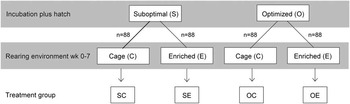
Before transportation to the rearing environment (referred to as day 1), all hatched chicks were vaccinated against Infectious Bronchitis (IB; Nobilis® IB Ma5, Intervet, Boxmeer, The Netherlands) and Newcastle Disease (Nobilis® ND Clone 30, Intervet, Boxmeer, The Netherlands). Thereafter, 176 chicks from both incubation plus hatch treatments were randomly selected and equally distributed over two rearing environments, which resulted in a 2 × 2 factorial arrangement (Figure 1).
Experimental design and treatment groups. SC, suboptimal cage; SE, suboptimal enriched; OC, optimized cage; OE, optimized enriched.

The cage environment (C) consisted of wired cages (75 × 65 cm), with the wires covered in the first 10 days of rearing to prevent foot damage. The enriched rearing environment (E) consisted of floor pens (100 × 75 cm) with wood shavings, peat dust and perches. Chicks from both cage and enriched environments had unlimited access to feed and water in storage feeders and drinking cups. Storage feeders had the same width as the cage/pen and there was enough space to allow simultaneous feeding of all chicks. Commercial phase 1 diet (175 g/kg crude protein, 11.31 MJ ME/kg, ileal digestible lysine: 0.37%) was fed during the first 7 weeks of rearing and commercial phase 2 diet (160 g/kg crude protein, 11.31 MJ ME/kg, ileal digestible lysine: 0.31%) from week 7 until the end of the experiment. Both rearing environments consisted of 16 cages/pens and 11 chicks were housed per cage/pen. The Ta was 30°C at day 1 and day 2, and declined with 1°C every 3 days until 20°C at day 36 and the remaining weeks of the experiment. At day 48 of age, the rearing environment contrast was ended and all chicks were housed in floor pens with wood shavings and perches until the end of the experiment (day 115 of age).
Infectious challenges
A phosphate buffered saline solution containing 25 000 sporulated Eimeria acervulina, 5600 Eimeria maxima and 3100 Eimeria tenella oocysts (Animal Health Service, Deventer, the Netherlands) was used for the infection. At day 53 of age, all chicks were inoculated in the crop with 1 ml of the mixed Eimeria species solution. To determine the dose, a pilot study was conducted with different compositions of Eimeria subspecies. At 4 and 7 days after inoculation, the intestines were scored for lesions. The severity of the lesions ranged from zero (no lesions) to four (severe lesions – Animal Health Service, Deventer, The Netherlands). The optimal dose was based on an average lesion score of 2, with a variation between score 0 and 4, but was not severe enough to cause mortality among chicks.
At day 92, all chicks were inoculated in the nostrils with a 1 ml solution (104 EID50, Animal Health Service, Deventer, The Netherlands) of the same IB virus strain they were vaccinated against. The aim of the IB challenge after vaccination was to investigate differences in the adaptive (humoral) immune response by determining IB antibody production.
Embryonic mortality and hatchability
At day 7 and 19 of incubation, eggs were candled and infertile eggs or eggs containing dead embryos were removed from the CRC. After completion of the hatching process, the remaining unhatched eggs were also removed from the CRC. All removed eggs were visually examined to determine true fertility or moment of mortality as described by Lourens et al. (Reference Lourens, Molenaar, Van den Brand, Heetkamp, Meijerhof and Kemp2006).
BW and feed intake
BW was recorded individually at day 1, 15, 22, 36, 50, 56, 57, 60, 64, 83, 96, 99 and 106. Feeders were weighed to determine feed intake on pen level at day 1, 8, 15, 22, 36, 48, 50, 53, 54, 55, 56, 57, 60, 61, 64, 71, 83, 95, 96, 97, 98, 99 and 106. The frequency of both BW and feed intake measurements was higher during the Eimeria (day 50 to 64) and IB (day 95 to 99) infection.
Blood and tissue sampling
Six chicks per cage/pen were used for blood sampling. The same chicks were used for all samplings. For plasma corticosterone measurements, four of these chicks per cage/pen were sampled from a wing vein at day 14, 21, 46, 57 and two of these four chicks per cage/pen at day 60. Blood was centrifuged at 3000 r.p.m. for 15 min to obtain plasma. Plasma samples were stored at −20°C for further analysis by a time-resolved fluoroimmunoassay (TR-FIA; De Jong et al., Reference De Jong, van Voorst, Erkens, Ehhardt and Blokhuis2001). The other two of the six sampling chicks per cage/pen were used for IB titer determination. Blood was drawn from the wing vein at day 14, 21, 34, 91, 98, 106 and left to coagulate overnight at room temperature. Serum was stored at −20°C for IB titer analysis with a hemagglutination inhibition assay (De Wit, Reference De Wit2000).
At day 4 and 7 after the Eimeria multi-species infection, one chick from each pen was dissected and the duodenum, jejunum and caeca were scored for lesions. The severity of the lesions ranged from zero (no lesions) to four (severe lesions – Animal Health Service, Deventer, The Netherlands). A section of the duodenum, jejunum, caeca and spleen (1 cm) was collected, snap frozen under liquid nitrogen and stored at −80°C for immunohistochemical analysis.
Immunohistochemistry
Immunohistochemical staining was done by an indirect immunoperoxidase staining (Nakane, Reference Nakane1975) on frozen tissue sections (8 μm) of duodenum and spleen, collected at day 4 and 7 after Eimeria inoculation. Endogenous peroxidase was inhibited by 2% NaN3 in TRIS-HCL 0.05 M (pH 7.5) + 0.06% H2O2 for 5 min at room temperature. Slides were subsequently incubated for 30 min with monoclonal antibodies against CD4+ T cells (1 : 400; CT-4 Southern Biotech, Birmingham, USA), CD8+ T cells (1 : 400; CT-8, Southern Biotech) and macrophages (1 : 100; KUL, Southern Biotech). Second antibody incubation occurred with peroxidase-conjugated rabbit anti-mouse Ig (1 : 100; P161, Dako, Glostrup, Denmark) for 30 min. Peroxidase activity was detected by 0.05% 3,3-diaminobenzidine in 0.1 M TRIS-HCL (pH 7.5) with 0.03% H2O2. After counterstaining with hematoxylin, two images of the duodenum and spleen were acquired per chicken with a Nikon Microphot FXA microscope (Nikon Instruments Europe B.V., Amstelveen, The Netherlands) with an Olympus DP50 camera (version FIVE, Olympus B.V., Zoeterwoude, The Netherlands) and analyzed with the software AnalySIS. The color thresholds of the software were adjusted to either match the color of stained or unstained cells. After this step, an area of 1 μm2 tissue was selected in duodenum and spleen and the area of stained and unstained cells was calculated by using the color thresholds.
Tonic immobility test
At day 47 of age, two animals per cage/pen were subjected to a tonic immobility (TI) test (Jones et al., Reference Jones, Mills, Faure and Williams1994) to investigate fear-related behavior. A manual restraint was applied to induce TI, by placing the chick on its back and restraining it with one hand over the sternum for 10 s. If TI could not be induced in the first restraint, the procedure was repeated until a maximum of four restraints to induce TI. If TI could not be induced, the score was 0 s. When induction was successful, the duration was recorded for a maximum of 300 s. The recording ended after the chicken righted itself, or when the time limit was reached. In the latter situation, the score given was 300 s.
Statistical analysis
The data were analyzed as a 2 × 2 factorial design with two incubation plus hatch treatments and two rearing environments. When means and residuals were not normally distributed, the data were log transformed before analysis. All analysis were performed with SAS software (SAS 9.0, SAS Institute Inc., Cary, NC, USA) Embryonic mortality and hatchability were analyzed with a logistic regression procedure (proc logistic) with incubation plus hatch treatment as class variable. Egg was the experimental unit.
BW and chick length at hatch were analyzed using generalized linear regression (proc glm) with incubation plus hatch treatment as class variable. For chick length, the person measuring was added to the model as class variable. Chick was used as experimental unit.
Both BW and feed intake throughout the experimental period, as well as corticosterone levels and IB titer were averaged per cage/pen and analyzed with a generalized linear regression for repeated measurements (proc mixed). Cage/pen was included as the repeated subject and the covariance structure (AR(1)) was the best fit. Incubation plus hatch treatment, rearing environment, age and their interactions were included as class variables. Percentage of males per cage/pen was added as covariate to the BW and feed intake model, to correct for effects due to the unequal distribution of the sexes over treatments. Non-significant interactions (P > 0.05) with age were excluded from all four models. The experimental unit was cage/pen.
BW gain during Eimeria and IB infection was determined for each individual chicken, but was subsequently averaged per cage/pen. Analysis was performed by a generalized linear regression (proc glm). Incubation plus hatch treatment, rearing environment and their interaction were class variables in the model. Percentage of males per cage/pen was added as covariate to correct for effects due to the unequal distribution of the sexes over treatments. Cage/pen was used as the experimental unit.
Intestinal lesion and TI induction data were analyzed by a logistic regression procedure (proc logistic) with incubation plus hatch treatment, rearing environment and their interaction as class variables. TI duration and immunohistochemistry data were analyzed by using generalized linear regression (proc glm) with incubation plus hatch treatment, rearing environment and their interaction as class variables. Chicken was the experimental unit. Data are expressed as means ± s.e.
Results
Embryonic mortality, hatchability and chick quality
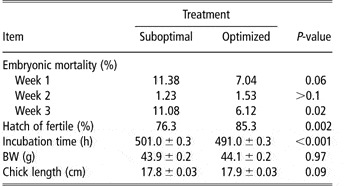
Suboptimal incubation treatment tended to increase embryonic mortality in the first week by 4.34% (P = 0.06; Table 1). Embryonic mortality in the last week of incubation was 5.94% higher in the suboptimal than in the optimized incubation treatment (P = 0.02). The suboptimal incubation treatment increased the incubation time with 10 h (P < 0.001) and resulted in a 9.00% lower hatchability (P = 0.001) compared with the optimized incubation treatment. At hatch, chick length tended to be shorter in suboptimal incubated chicks (P = 0.09), but there was no difference in hatching BW between incubation treatments (P = 0.97).
Effect of suboptimal and optimized incubation treatment on embryonic mortality, hatchability, incubation time, BW and chick length at hatch

Values are percentages or mean ± s.e.
Suboptimal = eggshell temperature (EST) of 36.7°C in week 1, 37.8°C in week 2 and 38.9°C in week 3 of incubation.
Optimized = EST of 37.8°C in week 1, 2 and 3 of incubation.
BW and feed intake
During the experimental period
No interaction was observed between the main effects incubation plus hatch treatment and rearing environment for BW and feed intake. Until day 22, chicks from the optimized incubation plus hatch treatment were heavier than the suboptimal incubation plus hatch chicks (an average of 129.7 ± 1.3 g v. 123.3 ± 1.7 g in this period, respectively, P = 0.0002). No difference in BW between incubation plus hatch treatments was observed after day 22. In addition, no difference in feed intake between incubation plus hatch treatments was observed over the experimental period.
Chicks reared in the enriched environment had a higher BW than cage-reared chicks at day 15 of age (136.9 ± 1.49 g v. 131.5 ± 1.35 g), whereas the opposite was observed at day 36, 50, 56, 83 and 96 of age (rearing environment × age interaction, P = 0.02). In addition, chicks reared in an enriched environment had a higher average feed intake (66.77 ± 1.12 g/day) compared with chicks reared in a cage environment (63.55 ± 1.03 g/day, P = 0.05) over the entire experimental period.
During Eimeria infection
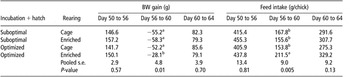
Chicks were inoculated with Eimeria at day 53 of age. BW gain and feed intake were determined from day 50 to 56, day 56 to 60 and day 60 to 64 of age (Table 2). Chicks that received the optimized incubation plus hatch treatment and were subsequently reared in an enriched environment lost the least weight and had the highest feed intake from day 56 to 60, compared with all other treatments (incubation plus hatch × rearing environment interaction, P = 0.01 for BW and P = 0.005 for feed intake).
Effect of suboptimal and optimized incubation plus hatch, followed by a cage or enriched rearing environment in week 0 to 7, on BW gain and feed intake during a multi-species Eimeria infectionFootnote *

Values are mean ± pooled s.e.
Within a column, different superscript letters indicate significant differences at P < 0.05.
* Chicks were inoculated in the crop at day 53 of age with a 1 ml phosphate buffered saline solution containing sporulated oocysts of E. acervulina (25 000), E. maxima (5600) and E. tenella (3100).
The effect of rearing environment was significant for BW gain and feed intake during infection from day 50 to 56. Enriched reared chicks lost 10.7 g less BW (P = 0.03) and had a slightly higher (+22.7 g) feed intake (P = 0.06) than cage-reared chicks. The higher feed intake in enriched reared chicks maintained during the period of day 60 to 64 (P = 0.005).
During IB infection
Chicks were inoculated with IB at day 92 of age. BW gain and feed intake were determined from day 83 to 96, day 96 to 99 and day 99 to 106 of age. No treatment effects were found in the periods day 83 to 96 and day 96 to 99. From day 99 to 106, chicks that received the optimized incubation plus hatch treatment and were subsequently reared in an enriched environment gained more weight (174.0 ± 6.9 g) than chicks in both cage-reared groups (132.0 ± 7.4 g for optimized-cage and 152.5 ± 7.7 g for suboptimal-cage; incubation plus hatch treatment × rearing environment interaction, P = 0.005). The suboptimal-enriched group was in between and did not differ from the other groups.
Plasma corticosterone levels
Plasma samples for corticosterone were collected before (day 14, day 21 and day 46 of age) and after Eimeria infection (day 57 and 60 of age). No interaction between the main effects incubation plus hatch treatment and rearing environment was observed for corticosterone levels. On average there were no differences in corticosterone levels between incubation plus hatch treatments or rearing environments. However, chicks of the optimized treatment tended (P = 0.08) to show higher corticosterone levels before infection (4.37 ± 0.23 ng/ml) compared with chicks of the suboptimal treatment (3.78 ± 0.20 ng/ml). This effect disappeared after Eimeria infection (results not shown).
IB antibody titer
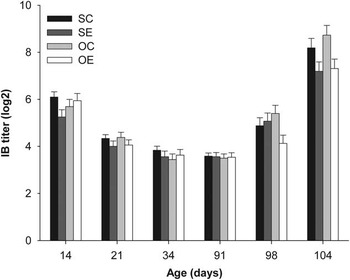
No interaction was observed between the main effects incubation plus hatch treatment and rearing environment for IB antibody titer. The main effect of incubation plus hatch treatment was not significant (Figure 2), but the enriched rearing environment significantly decreased the IB antibody titer (P = 0.009), compared with the caged rearing environment. This difference could mainly be attributed to the faster and larger increase of the IB antibody titer in cage-reared chicks after IB infection at day 92.
Effect of suboptimal (S) or optimized (O) incubation plus hatch in combination with a cage (C) or enriched (E) rearing environment from week 0 to 7 of age on IB antibody titer after vaccination and infection. Chicks were vaccinated against IB at day 1 and day 15 and IB infection occurred at day 92. SC, suboptimal cage; SE, suboptimal enriched; OC, optimized cage; OE, optimized enriched.

Intestinal lesions
Mixed manure samples from each cage/pen did not indicate an Eimeria contamination before the actual infection at day 53. Dissection of the intestines at day 4 and 7 post infection (p.i.) demonstrated intestinal lesions in the duodenum (E. acervulina) and some in the jejunum (E. maxima) and caeca (E. tenella). The lesions in the jejunum and ceaca were only very minimal and further analysis on these intestinal sections was not performed.
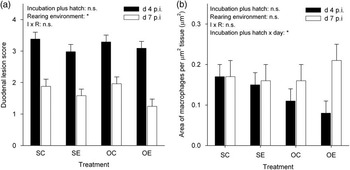
No interaction was observed between the main effects incubation plus hatch treatment and rearing environment with regard to intestinal lesions. The severity of the lesions was not affected by the incubation plus hatch treatment (P = 0.68) (Figure 3a). Chicks reared in the enriched environment had less severe duodenal lesions compared with chicks reared in a cage (P = 0.02). In addition, there was an effect of the day p.i. on lesion severity. At day 4 p.i. lesions were more severe than at day 7 p.i. lesions (P < 0.001).
Effect of suboptimal (S) or optimized (O) incubation and hatch in combination with a cage (C) or enriched (E) rearing environment from week 0 to 7 of age on the (a) intestinal lesions and (b) macrophage cell numbers in the duodenum, at day 4 and day 7 after a multi-species infection with sporulated oocysts of Eimeria acervulina (25 000), Eimeria maxima (5600) and Eimeria tenella (3100). Intestinal lesions were scored between 0 (no lesions) and 4 (severe lesions). SC, suboptimal cage; SE, suboptimal enriched; OC, optimized cage; OE, optimized enriched; p.i., post infection. *P < 0.05, n.s.=not significant.

Immunohistochemistry
No interaction was observed between the main effects incubation plus hatch treatment and rearing environment for the area of CD4+ and CD8+ T cell and macrophage populations in spleen and duodenum after Eimeria infection.
Chicks from the suboptimal incubation plus hatch treatment had a larger area of macrophages at day 4 p.i. than optimized treated chicks (Figure 3b), whereas this difference was absent at day 7 p.i. (incubation plus hatch treatment × day p.i. interaction, P = 0.03). Overall, incubation plus hatch treatment did not affect area of CD4+ and CD8+ T cell and macrophage populations in the spleen and duodenum (results not shown). Rearing environment did not affect area of CD4+ and CD8+ T cell and macrophage populations in the spleen and duodenum (results not shown).
Tonic immobility test
No interaction was observed between incubation plus hatch treatment and rearing environment for TI duration and the number of TI inductions. Chicks from the optimized incubation plus hatch treatment had a shorter duration of TI compared with chicks from the suboptimal treatment (87.47 ± 20.4 v. 133.45 ± 16.9 s, respectively; P = 0.05). Rearing environment did not affect TI duration and the number of TI inductions (results not shown).
Discussion
This results demonstrated that differences in incubation plus hatch as well as early rearing environment affect the development of adaptive capacity to infectious challenges in layer chicks. Based on the knowledge from previous studies on the effect of early life experiences (Weinstock, Reference Weinstock1997; Janczak et al., Reference Janczak, Braastad and Bakken2006), we hypothesized that an optimized incubation and hatch environment would reduce perinatal stress and result in better developed chicks, that would be able to cope with different challenges later in life. Furthermore, we hypothesized that a postnatal environment that stimulates the expression of natural behavior will also have positive effects on the development of the chicks and their adaptive capacity. The results in this study confirm our hypotheses.
Chicks that received the optimized incubation plus hatch treatment and were subsequently reared in an enriched environment had the best performance during the Eimeria and IB infection. Besides the interaction, the subgroups incubation plus hatch and rearing environment also affected the ability to cope with the infectious challenges separately, however, the combination of both treatments seemed to re-enforce the positive effects. Both the optimized incubation plus hatch treatment as well as the enriched rearing environment had a positive effect on BW and feed intake during the Eimeria infection. In addition, the optimized incubation plus hatch treatment resulted in reduced macrophage numbers in the duodenal tissue at day 4 after Eimeria infection, whereas the enriched rearing environment stimulated the recovery of intestinal damage caused by Eimeria and resulted in a decreased production of specific antibodies after IB infection.
The possible factors that caused the positive effects of optimized incubation plus hatch and enriched rearing on performance during the infections will be discussed below.
Suboptimal treated chicks were incubated at a low EST in week 1 (36.7°C), a normal EST in week 2 (37.8°C) and a high EST in week 3 (38.9°C). This treatment increased embryonic mortality and lengthened incubation time compared with optimized incubation. This is in correspondence with previous studies in broilers (Lourens et al., Reference Lourens, Van den Brand, Meijerhof and Kemp2005). The aim of the different incubation treatments was to create chicks differing in quality at hatch (Lourens et al., Reference Lourens, Van den Brand, Meijerhof and Kemp2005). Chick quality was estimated by chick length, which tended to be longer in optimized incubated chicks, indicating a better chick quality in this group (Molenaar et al., Reference Molenaar, Reijrink, Meijerhof and Van Den Brand2008). A better chick quality is assumed to result in better later life performance, which will most likely also affect the ability of chicks to cope with (infectious) challenges.
After hatch, optimized treated chicks were transported to a more comfortable Ta and had immediate and unlimited access to feed, water and foraging material. Early feed, water and foraging possibilities stimulate the natural behavior of chicks and together with the lower Ta this treatment was believed to reduce stress. Perinatal stress reduction is important, as previous studies have demonstrated that stress in early life can lead to increased emotionality, anxiety and subsequently maladaptive behavior in later life (Weinstock, Reference Weinstock1997). The optimized incubation plus hatch environment in this study resulted in less fearfulness behavior in 47 day old chicks exposed to the Tonic immobility test (Gallup, Reference Gallup1974). This indicates that the optimized incubation plus hatch treatment was indeed less stressful for the chicks. However, although perinatal stress is known to influence the capacity to adapt later in life (Weinstock, Reference Weinstock1997), the positive effects of the optimized incubation plus hatch treatment on early growth and response to the infections are probably more related to the early provision of feed in this treatment. Optimized incubation plus hatch resulted in a lower impact of the Eimeria infection on performance and decreased macrophage numbers after infection in the duodenum.
Previous studies demonstrated that early feed intake (immediately after hatch) enhances the functional development of the intestines in chicks that results in increased digestibility and thereby growth (Noy et al., Reference Noy, Geyra and Sklan2001; Friedman et al., Reference Friedman, Bar-Shira and Sklan2003). This explains the higher BW of optimized chicks in the first 3 weeks posthatch in this study. The functional development of the intestines as a digestive organ seems to be closely related to its development as a major lymphoid organ (Thompson et al., Reference Thompson, Mayrhofer and Cummins1996). Previous studies showed that early feed intake has a positive effect on the development and maturation of the gut associated lymphoid tissue (GALT), which includes the cecal tonsils, bursa of Fabricius, Peyer’s pathes and other lymphoid nodules, and provides both local and systemic protection in young chicks (Dibner et al., Reference Dibner, Knight, Kitchell, Atwell, Downs and Ivey1998; Friedman et al., Reference Friedman, Bar-Shira and Sklan2003; Kajiwara et al., Reference Kajiwara, Shigeta, Horiuchi, Matsuda and Furusawa2003). Delayed access to feed has shown to decrease bursa weight (Dibner et al., Reference Dibner, Knight, Kitchell, Atwell, Downs and Ivey1998) and to delay the development of T and B lymphocytes in the hindgut in the first 2 weeks of life (Bar-Shira et al., Reference Bar-Shira, Sklan and Friedman2005). Systemic and intestinal antibody response following rectal immunization with antigen were also continuously lower in chicks with delayed access to feed (Bar-Shira et al., Reference Bar-Shira, Sklan and Friedman2005). The possible mechanism by which early feed intake stimulates immune development in young chicks is previously discussed in the study of Dibner et al. (Reference Dibner, Knight, Kitchell, Atwell, Downs and Ivey1998), which hypothesized that early feed intake triggers the full differentiation of the primary immune cells (particularly the B-lymphocytes) by increasing the antigen levels in the gastrointestinal tract. After differentiation of the primary immune cells, the development of secondary immune structures (e.g. GALT) is stimulated. Besides the effect of early feed intake on GALT development, some studies showed that early feed intake stimulates the utilization of the yolk (Noy et al., Reference Noy, Uni and Sklan1996; Bhanja et al., Reference Bhanja, Devi, Panda and Sunder2009). The yolk is the major source of maternal antibodies for the chick and if the utilization of the yolk is stimulated it can result in better protection against infectious agents in the first few weeks after hatch (Larsson et al., Reference Larsson, Balow, Lindahl and Forsberg1993).
The optimized incubation plus hatch treatment did not affect the performance and immune responses of chicks during the respiratory IB infection. This suggests that the early feeding mainly contributed to better intestinal functioning and immunity, thereby reducing the effects of an intestinal pathogen, but not of a respiratory infection.
The positive effects of the enriched rearing environment on performance during the Eimeria and IB infection can probably mainly be attributed to the materials present in the environment. The environmental enrichment was used to create a more natural environment for the chicks, in which they were able to show and exploit more of their natural behaviors. Although behavior was not recorded in this study, we observed that chicks in the enriched environment showed more explorative behavior compared with cage chicks. In addition, chicks in the enriched environment were also dust bathing frequently, which was not possible for chicks in the cage environment. As enriched chicks seemed to be more occupied during the day, they possibly require more energy for body maintenance (Bell and Weaver, Reference Bell and Weaver2002), which can explain the higher feed intake (but not BW) in this group compared with the caged chicks. The enriched environment contained wood shavings and peat dust, in which numerous types of (harmless) microorganism are present, which can potentially trigger and stimulate the development of the immune system (Friedman et al., Reference Friedman, Bar-Shira and Sklan2003). Chicks can ingest some of the microorganisms present in the peat dust and wood shavings with their beak, as part of explorative behavior in the enriched environment. However, most contact with microorganisms in the environment occurs in the distal intestine and is mainly caused by the influx of bacteria through the cloaca. Earlier, it has been demonstrated that the presence of micro flora is associated with the development of lymphoid follicles in the gut (Honjo et al., Reference Honjo, Hagiwara, Itoh, Takahashi and Hirota1993). Therefore, it is possible that the enriched rearing environment in this study has stimulated the immune system in the gut and, as a consequence, decreased the impact of an Eimeria infection. In addition, the immune system might also be stimulated in a broader perspective, because feed intake and BW gain after the IB infection were also higher in enriched chicks than in caged chicks. In contrast, enriched chicks had a lower IB antibody titer after infection. These results suggest that the IB infection in cage-housed chicks was more severe than in enriched housed chicks, and more antibodies were needed to combat the infection. The increased infection severity would probably also result in less feed intake and consequently more weight loss, which can also be observed in the cage chicks.
In summary, optimized incubation plus hatch as well as enriched rearing influence the adaptive capacity of chicks to infectious challenges. When the two treatments are combined, the positive effects of both treatments are re-enforced, which can mainly be observed in a better performance of the chicks during the infections. In conclusion, this study showed that early life experiences could indeed affect the capacity of layers to cope with an Eimeria and IB infection at an older age. Although the contrasts in incubation plus hatch and rearing environment were not continued throughout the entire experiment, the effects remained present for weeks after the end of the contrasts. This suggests that the development of the ability to cope with infectious challenges can be influenced with management during a short period early in life and that the effect on the adaptive capacity lasts for a considerable time after cessation of the specific management.
Acknowledgements
The authors thank Marcel Heetkamp for technical assistance, Annemarie Rebel and Ingrid de Jong for their helpful suggestions, Leon de Jonge and his laboratory for corticosterone analysis, Teun Fabri and Sjaak de Wit from the Animal Health Service in Deventer and Poultry practice North and East in Slagharen for analyzing serum samples and scoring intestinal lesions. The authors also thank their animal caretakers in Wageningen and Lelystad and Henri Kolkman for their assistance with the practical work. This project was funded by the Dutch Ministry of Agriculture, Nature and Food Quality, in the framework of the KB-8 program (project number KB-08-002-007).