The cumulative risk associated with chronic exposure to stress during childhood and early adolescence can have devastating consequences for children's emotional and behavioral development (Garmezy & Masten, Reference Garmezy, Masten, Rutter, Henov and Taylor1994). Studies indicate that there may be qualitative differences between children who suffer episodic experiences of psychosocial stress, limited to a particular period, and those for whom exposure to stress is a chronic pattern in their lives (Kochenderfer & Ladd, Reference Kochenderfer and Ladd1996; Manly, Cicchetti, & Barnett, Reference Manly, Cicchetti and Barnett1994). The present study focuses on a relatively common psychosocial stressor during childhood: bullying victimization. The impact of victimization on children's mental health and well-being concerns youths, parents, school staff, mental health practitioners, and researchers alike (Arseneault, Bowes, & Shakoor, Reference Arseneault, Bowes and Shakoor2010). For the majority of bullied children, early experience of victimization is relatively transitory (Kochenderfer-Ladd & Wardrop, Reference Kochenderfer-Ladd and Wardrop2001). However, some children are persistently victimized by bullies over prolonged periods of time and even across different school contexts. This paper examines the etiology of chronic victimization over the transition from primary to secondary school.
School transitions represent key periods of change during childhood involving marked differences in social contexts. In the United Kingdom, the change from primary school (ages 5–10 years) to secondary school (ages 11–16 years) represents one such key transition in children's lives. This school transition involves numerous changes to social roles and the onset of new task demands. Secondary school students most often change classrooms and classmates for each school subject and hence encounter much larger peer groups than in primary school, in which students typically stay with one teacher and one peer group for the majority of the school day. Secondary school students also face multiple new task demands associated with different school and class organization, new teaching strategies and academic standards, and differences in teacher expectations (Eccles et al., Reference Eccles, Midgley, Wigfield, Buchanan, Reuman and Flanagan1993). School transitions may be a stressful experience as children lose their primary school peer groups and friendships, and establish new social relationships at a time when peer relationships become increasingly important (Brown, Reference Brown, Feldman and Elliot1990; Eccles, Wigfield, & Schiefele, Reference Eccles, Wigfield, Schiefele and Eisenberg1998).
Is Being Bullied Persistent Across School Transitions?
The transition to secondary school may represent an important turning point in the lives of children who have experienced victimization during the primary school years. Moving to a new social environment may present opportunities to escape classroom bullies. However, the move from the top of one hierarchy to the bottom of another as children transition from being the oldest children in primary school to the youngest in secondary school may represent new challenges, with some children becoming victimized during this time. For some, victimization by bullies remains stable across this school transition. The fact that some children remain chronically victimized across the transition from primary to secondary school despite major changes in the social environment suggests that stable factors in children's lives may increase their vulnerability for being victimized in different settings. For example, children's enduring individual characteristics such as a tendency to exhibit withdrawn or anxious behavior may increase their risk of being targeted by bullies in different settings. Stable factors in children's social environment may also increase their risk of being victimized by bullies. Previous studies have identified family factors that are associated with an increase in children's vulnerability to victimization (Baldry, Reference Baldry2003; Bowes et al., Reference Bowes, Arseneault, Maughan, Taylor, Caspi and Moffitt2009; Shields & Cicchetti, Reference Shields and Cicchetti2001). Family characteristics may also influence risk of persistent bullying victimization across different school settings. It is critical to identify effective targets for intervention for these vulnerable children at the earliest sign of victimization.
Evidence suggests that, for some children, victimization can last for sustained periods of time, despite the overall decrease in rates of victimization as children grow older. While much victimization at early ages is situational, some children become chronically victimized within the first years of formal education, experiencing victimization with increased regularity (Snyder et al., Reference Snyder, Brooker, Patrick, Snyder, Schrepferman and Stoolmiller2003). In early childhood, 4% of children experience chronic trajectories of victimization prior to school entry (Barker, Boivin, et al., Reference Barker, Boivin, Brendgen, Fontaine, Arseneault and Vitaro2008). In a study assessing victimization across the transition from primary to secondary school, 43% of children who were victims of bullying at the first assessment remained bullied at the second assessment 3 years later (Scholte, Engels, Overbeek, de Kemp, & Haselager, Reference Scholte, Engels, Overbeek, de Kemp and Haselager2007). In addition, substantial stability in victimization was observed over a 3-year period from Grades 4 to 7 (including the transition from elementary to middle school; Paul & Cillessen, Reference Paul and Cillessen2003). Stability in victimization has also been observed over a 6-year period that included the transition from primary to secondary school in classes with high hierarchical peer group structuring (as measured by a high disparity in peer-reported social impact among children compared to classes in which most children have similar social impact; Schafer, Korn, Brodbeck, Wolke, & Schulz, Reference Schafer, Korn, Brodbeck, Wolke and Schulz2005).
Is Chronic Victimization Associated With Negative Mental Health and Academic Outcomes?
Victimization has been repeatedly shown to be a risk factor for adjustment difficulties across development (Arseneault et al., Reference Arseneault, Bowes and Shakoor2010). However, studies suggest that children who experience chronic victimization are more vulnerable than children whose victimization experiences are limited to childhood. Chronically victimized children are at elevated risk for maladjustment (Kochenderfer-Ladd & Wardrop, Reference Kochenderfer-Ladd and Wardrop2001), may go on to bully others or self-harm (Barker, Arseneault, et al., Reference Barker, Arseneault, Brendgen, Fontaine and Maughan2008), are more disliked by their peers, and show signs of low self-confidence compared to childhood-limited victims and nonbullied children (Scholte et al., Reference Scholte, Engels, Overbeek, de Kemp and Haselager2007). A dose–response effect has also been observed between duration of victimization and risk of psychotic symptoms (Schreier et al., Reference Schreier, Wolke, Thomas, Horwood, Hollis and Gunnell2009). The present study extends the findings of increased vulnerability among chronic victims of bullying and compares the mental health and academic outcomes of persistently bullied children to children who escape chronic victimization (i.e., children bullied in primary school only) and nonbullied children. We also examine whether chronic victimization leads to greater adjustment difficulties than recent-onset victimization by comparing outcomes of chronically bullied children with those of children who were first bullied in secondary school. Analyses control for the potentially confounding effect of early child characteristics including children's preexisting adjustment difficulties and IQ, as well as family background.
Victimization and Child Adjustment: Direction of Effects
The direction of effects between victimization and child adjustment difficulties has been the focus of much debate. A recent meta-analysis of 18 longitudinal studies found that internalizing problems function as both antecedents and consequences of peer victimization (Reijntjes, Kamphuis, Prinzie, & Telch, Reference Reijntjes, Kamphuis, Prinzie and Telch2010). Such reciprocal influences suggest a vicious cycle in which victimization and maladjustment fuel one another (Hodges & Perry, Reference Hodges and Perry1999; Reijntjes et al., Reference Reijntjes, Kamphuis, Prinzie and Telch2010), increasing the risk for chronic victimization and mental health problems over time. Thus, while exposure to victimization may be harmful for children's development, preexisting characteristics of the children may increase their likelihood of being targeted by bullies. Physical aggression predicts chronic victimization at school entry (Barker, Boivin, et al., Reference Barker, Boivin, Brendgen, Fontaine, Arseneault and Vitaro2008; Ladd & Troop-Gordon, Reference Ladd and Troop-Gordon2003), while internalizing difficulties such as symptoms of depression, anxiety, or social withdrawal have been found to predict chronic victimization in middle to late childhood (Sourander, Helstela, Helenius, & Piha, Reference Sourander, Helstela, Helenius and Piha2000; Sweeting, Young, West, & Der, Reference Sweeting, Young, West and Der2006). Children's individual characteristics that increase their risk of victimization, including internalizing and externalizing symptoms, are partially influenced by genetic factors (Haberstick, Schmitz, Young, & Hewitt, Reference Haberstick, Schmitz, Young and Hewitt2005). It is likely that exposure to chronic victimization itself is partly heritable. Genetically informative studies can tell us about whether heritable factors influence individual differences in chronic victimization and provide key information about environmental influences. By identifying sources of influence in the etiology of chronic victimization, we can more effectively tailor intervention strategies aiming to break the cycle of victimization. For example, if children's heritable characteristics influence their risk for chronic victimization across different settings, this implies that intervention work would benefit from managing aspects of the victim's behavior in addition to targeting bullying behaviors. Shared environmental influence would imply that factors that make children growing up in the same family more alike are risk factors for chronic victimization, while nonshared environmental influence would suggest that environmental experiences unique to members of a family may be key. Both shared and nonshared environments may emanate from the family environment (i.e., those aspects of the family environment that are shared by twins growing up in the same family and serve to make them more alike and aspects of the family environment that are differentially experienced by each twin in a pair). Experiences outside of the family, including peer groups, life events, and educational experiences, can also be shared or not shared by twins.
Genetic and Environmental Influences on Persistence of Bullying Victimization Over Time
Cross-sectional studies have investigated the genetic and environmental influences on victimization by peers during early and middle childhood with mixed results. In a study of twins' experiences prior to school entry, peer victimization was found to be environmentally driven and largely unrelated to children's genetic predisposition for both boys and girls (Brendgen et al., Reference Brendgen, Boivin, Vitaro, Girard, Dionne and Perusse2008). In this study, peer victimization was assessed by peer nomination, with children asked to nominate peers who “get hit and pushed by other kids” or who “get called names by other kids.” At school entry, this type of peer victimization was not found to be an experience that was “evoked” as a function of children's heritable traits. A different pattern of findings emerged in a behavioral genetic study of victimization among 10-year-old twins in the sample reported here. Genetic influences were found to account for over two-thirds of individual differences in children's victimization at this age (Ball et al., Reference Ball, Arseneault, Taylor, Maughan, Caspi and Moffitt2008). The remaining variance was explained by nonshared environmental factors (i.e., environmental factors unique to each twin in a pair). This study used mother reports of victimization that encompassed direct (e.g., physical bullying or name calling) and indirect (e.g., excluding from the group) forms of bullying behaviors. The mixed cross-sectional findings may be the result of differences in the way victimization was assessed in the two studies (e.g., peer nomination versus mother reports). However, the divergent findings may also suggest heterogeneity in the etiology of victimization at different ages. It is possible that shared family environments may be particularly crucial risk factors for victimization at younger ages, but as children grow older, the influence of their heritable characteristics may become increasingly more important. Changing social contexts such as the transition from primary school to secondary school may also result in new environmental influences on risk for victimization. Cross-sectional biometric analyses of victimization cannot inform about the genetic and environmental factors that influence the persistence of victimization over time and across context. What are the influences on chronic victimization across childhood and early adolescence, a period that encompasses important school transitions? Do new genetic and environmental factors emerge to modify risk for victimization during early adolescence compared to during childhood? Longitudinal genetic analysis can go beyond cross-sectional estimates to investigate genetic and environmental influences on victimization status across key transitions. The current study is the first to utilize longitudinal biometric analyses to disentangle genetic and environmental contributions on the persistence of victimization from childhood through to early adolescence, including the transition from primary to secondary school. These analyses also permit investigation of the relative genetic and environmental influences on changes in victimization status over time, making it possible to test whether new genetic and environmental factors emerge to influence victimization during early adolescence. If children's families exert a true environmental and long-lasting effect on children's likelihood of being persistently bullied, results from twin model fitting should indicate environmental influences on chronic victimization. For example, over and above any genetic influences, environmental experiences shared by twins growing up in the same family should contribute to twins' resemblance in chronic victimization, or individual-specific experiences that produce differences between twins in a family should be evident.
What Factors Predict Chronic Victimization?
The importance of identifying risk factors early in children's lives in order to break the cycle of victimization for this group of vulnerable children is clear. Longitudinal studies have identified factors relating to children's individual characteristics and their home environment that increase their risk for being bullied. Young children who have elevated internalizing or externalizing problems are more likely to be bullied by peers in middle childhood (Arseneault et al., Reference Arseneault, Walsh, Trzesniewski, Newcombe, Caspi and Moffitt2006). However, even after controlling for the risk associated with children's individual characteristics, factors in children's home environments including harsh parenting and child maltreatment were found to increase risk for victimization (Barker, Boivin, et al., Reference Barker, Boivin, Brendgen, Fontaine, Arseneault and Vitaro2008; Bowes et al., Reference Bowes, Arseneault, Maughan, Taylor, Caspi and Moffitt2009). Children growing up in families with low or middle socioeconomic status (SES) have also been found to be at increased risk of victimization (Kim, Boyce, Koh, & Leventhal, Reference Kim, Boyce, Koh and Leventhal2009; Wolke, Woods, Stanford, & Schulz, Reference Wolke, Woods, Stanford and Schulz2001), as have children whose families participate in fewer social activities (Stevens, De Bourdeaudhuij, & Van Oost, Reference Stevens, De Bourdeaudhuij and Van Oost2002). Stable factors in a child's home environment may increase the risk of remaining persistently victimized over time. High levels of harsh and reactive parenting were found to be specific to groups of children showing high and chronic levels of victimization as opposed to other preschool trajectories of victimization. In addition, family poverty predicted high/chronic and moderate/increasing trajectories of victimization (Barker, Boivin, et al., Reference Barker, Boivin, Brendgen, Fontaine, Arseneault and Vitaro2008). We can identify potential targets for bullying intervention programs by comparing children who experience persistent victimization across different school contexts with children who manage to escape victimization. We extend the findings of our behavioral genetic analyses and test whether chronic victims of bullying differ in key individual and family characteristics measured prior to reports of bullying compared to children who escaped victimization (i.e., children bullied at primary school only) and nonbullied children.
Using prospective data from a nationally representative longitudinal study of children, this study aims to (a) test whether chronically bullied children differ in mental health and academic outcomes at age 12 compared to children who escape chronic victimization, children who become bullied during early adolescence, and nonbullied children, over and above any effects of children's preexisting individual characteristics and family background; (b) investigate the genetic and environmental influences on chronic victimization over the transition from primary to secondary school; and (c) examine whether chronic victims of bullying differ in key individual and family characteristics measured at age 5, prior to the experience of victimization, compared to children who are not bullied and those who escape being bullied.
Methods
Sample
Participants were members of the Environmental Risk Longitudinal Twin Study (E-Risk), which tracks the development of a nationally representative birth cohort of 2,232 British children. The sample was drawn from a larger birth registry of twins born in England and Wales from 1994 through 1995 (Trouton, Spinath, & Plomin, Reference Trouton, Spinath and Plomin2002). Details about the sample have been reported previously (Moffitt & E-Risk Team, Reference Moffitt2002). Briefly, the Environmental Risk Longitudinal Twin Study sample was constructed from 1999 through 2000, when 1,116 families with same-sex 5-year-old twins (93% of those eligible) participated in home-visit assessments. Families were recruited to represent the UK population of families with newborns in the 1990s, based on residential location throughout England and Wales and mother's age (i.e., older mothers having twins via assisted reproduction were underselected and teenaged mothers with twins were overselected). Follow-up home visits were conducted when the children were aged 7 years (98% participation), 10 years (96% participation), and 12 years (96% participation). The sample includes 55% monozygotic (MZ) and 45% dizygotic (DZ) twin pairs. Sex is evenly distributed within zygosity (49% were boys). Parents gave informed consent and children gave assent. Ethical approval was granted by the Joint South London and Maudsley and the Institute of Psychiatry NHS Ethics Committee.
Victimization by bullies
We assessed experiences of victimization by bullies using both mothers' and children's reports of victimization at primary and secondary schools. We explained, “Someone is being bullied when another child (a) says mean and hurtful things, makes fun, or calls a person mean and hurtful names; (b) completely ignores or excludes someone from their group of friends or leaves them out on purpose; (c) hits, kicks, or shoves a person, or locks them in a room; (d) tells lies or spreads rumors about them; and (e) other hurtful things like these. We call it bullying when these things happen often, and when it is difficult to make it stop. We do not call it bullying when it is done in a friendly or playful way.” Mothers were interviewed when children were 7, 10, and 12 years old and asked whether either twin had been bullied by another child, responding never, yes, or frequently. We combined mothers' reports at child age 7 and 10 to derive a measure of victimization during primary school. Mothers' reports at child age 12 indexed victimization during secondary school. Typically, relatively low levels of cross-informant agreement for bullying involvement are observed (Ronning et al., Reference Ronning, Sourander, Kumpulainen, Tamminen, Niemela and Moilanen2009; Wienke Totura, Green, Karver, & Gesten, Reference Wienke Totura, Green, Karver and Gesten2009). In keeping with other studies, the cross-informant agreement between mother and child reports of victimization during primary school and secondary school were modest: k = 0.20 during primary school and k = 0.29 during secondary school. Although interrater reliability between mothers and children was only modest, reports of victimization from both informants were similarly associated with children's emotional and behavioral problems, suggesting that each informant provides a unique but meaningful perspective on bullying involvement (Shakoor et al., Reference Shakoor, Jaffee, Andreou, Bowes, Ambler and Caspi2011). The test–retest reliability of victimization was 0.87 using a sample of 30 parents who were interviewed twice, 3–6 weeks apart. During private interviews with children when they were 12 years old, they indicated whether they had been bullied by another child during primary or secondary school. When a mother or a child reported victimization, the interviewer asked them to describe what happened. Notes taken by the interviewers were later checked by an independent rater to verify that the events reported could be classified as instances of bullying operationally defined as evidence of (a) repeated harmful actions (b) between children (c) where there is a power differential between the bully and the victim (Shakoor et al., Reference Shakoor, Jaffee, Andreou, Bowes, Ambler and Caspi2011). We summed mother and child reports of victimization across primary school and separately across secondary school to capture all instances of victimization during these two periods. As data were positively skewed for both the primary and secondary school measures, we divided each index of victimization to three category variables: (0) never victimized (primary school: N = 872, 39.4%; secondary school: N = 1,138, 53.0%), (1) reported by either mother or child as being occasionally victimized (primary school: N = 646, 29.2%; secondary school: N = 517, 24.1%), and (2) reported as being victimized by both informants, or as frequently victimized by mother or child (primary school; N = 696, 31.4%; secondary school: N = 491, 22.9%).
Age 12 outcomes of chronic victimization
Internalizing and externalizing problems at age 12 were assessed using the Child Behavior Checklist for mothers (Achenbach, Reference Achenbach1991a) and the Teacher's Report Form (Achenbach, Reference Achenbach1991b). Mothers were given the instrument at a face-to-face interview and teachers responded by mail. Both informants rated each item as being not true, somewhat or sometimes true, or very true or often true. The reporting period was 6 months before the interview. The internalizing problems scale is the sum of items on the withdrawn and anxious/depressed subscales, including items such as “cries a lot,” “withdrawn,” “does not get involved with others,” and “worries” (somatic complaints were not included, because this scale was not assessed at age 12). Mothers' scores for children's internalizing problems ranged from 0 to 34 (M = 6.45, SD = 5.71), and teachers' scores ranged from 0 to 43 (M = 4.51, SD = 5.50). The internal consistency reliabilities of the mothers and teachers at 12 years were 0.88 and 0.89, respectively. The externalizing problems scale is the sum of items from the delinquency and aggression subscales, including items such as “gets in many fights,” “lying or cheating,” and “screams a lot.” Mothers' scores for children's externalizing problems ranged from 0 to 55 (M = 10.14, SD = 8.84), and teachers' scores ranged from 0 to 56 (M = 5.51, SD = 9.50). The internal consistency reliabilities of the mother and teacher at 12 years were 0.92 and 0.96, respectively. Mothers' and teachers' reports at each age were standardized (z transformed) and summed to create cross-informant scales.
We assessed children's depressive symptoms at age 12 using the Children's Depression Inventory (Kovacs, Reference Kovacs1985, Reference Kovacs1992). The Children's Depression Inventory is a 27-item, self-report inventory used to measure depressive symptoms in children and adolescents between the ages of 7 and 17. Each of the 27 items in the inventory is a set of statements from which the respondent is asked to select three that best describe his or her thoughts and feelings in the past 2 weeks. Items were administered using flashcards that contained all three possible responses, which are coded between 0 and 2 in the direction of increasing severity. The total score is based on a five-factor solution. The factors are mood, interpersonal problems, ineffectiveness, anhedonia, and negative self-esteem. The total score range was 0 to 42 (M = 3.11, SD = 5.32). The internal consistency reliability for this scale was 0.90.
We assessed children's anxiety symptoms at age 12 using the Multidimensional Anxiety Scale for Children (March, Reference March1997). This 10-item self-report scale measures a wide spectrum of anxiety symptoms, corresponding with the diagnostic criteria for social phobia, selective mutism, separation anxiety, and generalized anxiety disorder. Each of the 10 items are graded in severity (0 to 2), with a total score range of 0 to 18 (M = 7.62, SD = 3.04) in this sample. The internal consistency reliability of this scale was 0.63.
We included questions about children's academic performance at age 7 in the teacher questionnaire. Teachers were asked whether children's current mathematical (M = 2.14, SD = 0.94) and English (M = 2.12, SD = 0.92) performances were (0) far below average, (1) somewhat below average, (2) average, (3) somewhat above average, or (4) far above average, compared with pupils of the same age.
Age 5 predictors of chronic victimization
Child characteristics
We assessed internalizing and externalizing problems at age 5 using the Achenbach family of instruments (see age 12 assessments). Mothers' scores for children's internalizing problems at age 5 year ranged from 0 to 36 (M = 6.70, SD = 5.60), and teachers' scores ranged from 0 to 43 (M = 5.43, SD = 5.39). The internal consistency reliabilities of the mothers' and teachers' reports of internalizing problems were 0.86 and 0.87, respectively. Mothers' scores for children's externalizing problems ranged from 0 to 55 (M = 12.89, SD = 9.14), and teachers' scores ranged from 0 to 59 (M = 5.41, SD = 8.10). The internal consistency reliabilities of the mother and teacher reports for externalizing symptoms were 0.89 and 0.93, respectively. Mothers' and teachers' reports were summed and standardized to create cross-informant scales.
To assess children's IQ, each child was individually tested at age 5, using a short form of the Wechsler Preschool and Primary Scale of Intelligence—Revised (Wechsler, Reference Wechsler1990) comprising vocabulary and block design subtests. IQs were prorated following procedures described by Sattler (Reference Sattler1992). The children's IQs ranged from 52 to 145 and were normally distributed (M = 100, SD = 15).
Family characteristics
SES was constructed from a standardized composite of income, parents' education, and social class when children were 5 years old. The three SES indicators were highly correlated (rs = .57–.67, all ps < .05) and loaded significantly onto one latent factor (M = 2.00, SD = 0.82; factor loadings = 0.80, 0.70, and 0.83 for income, education, and social class, respectively).
We assessed mothers' perceived social support during interviews when children were 5 years old (Simons & Johnson, Reference Simons, Johnson, Pierce, Sarason and Sarason1996). We measured three components or “provisions” of social support: financial support (whether financial support was provided in times of need), support with twins (how much help was provided with taking care of the twins in times of need), and emotional support (how much support was provided when the mother was upset, worried, or needed someone to talk to). Mothers were asked to rate the degree to which each of four different social relationships (parents, adult siblings, in-laws, and friends) supplied each of these provisions. Mothers responded to each item with no/not true, somewhat/sometimes, or yes/very true. The 12 items in this scale were summed to give a continuous measure of mother's perceived social support with a total score range of 0 to 24 (M = 15.28, SD = 5.62). Internal consistency reliability for this scale was 0.76.
We assessed maltreatment by an adult by interviewing mothers with the standardized clinical interview protocol from the Multi-Site Child Development Project (Dodge, Bates, & Pettit, Reference Dodge, Bates and Pettit1990; Lansford et al., Reference Lansford, Dodge, Pettit, Bates, Crozier and Kaplow2002). The protocol included standardized probe questions such as “When [name] was a toddler, do you remember any time when s/he was disciplined severely enough that s/he may have been hurt?” and “Did you worry that you or someone else [such as a babysitter, a relative, or a neighbor] may have harmed or hurt [name] during those years?” Interviewers coded the likelihood that the child had been harmed on the basis of the mothers' narrative. This classification showed intercoder agreement on 90% of ratings (κ = 0.6) in the Dodge et al. study (Dodge, Pettit, & Bates, Reference Dodge, Pettit and Bates1994; Dodge, Pettit, Bates, & Valente, Reference Dodge, Pettit, Bates and Valente1995) and ours. On the basis of the mother's report of the severity of discipline and the interviewer's rating of the likelihood that the child had been physically harmed, children were coded as having not been, probably been, or definitely been physically harmed. For this study, we examined children who experienced probable or definite harm by an adult (1) versus others (0). In our sample, 307 children (13.8%) were probably or definitely maltreated by the age of 5 years.
Statistical analyses
All regression analyses were conducted using STATA 10.0 (STATA, 2005). Participants in this study were pairs of same-sex twins, and, hence, each family contained data for two children. This resulted in nonindependent observations, which were adjusted for with tests based on the sandwich or Huber–White variance (Williams, Reference Williams2000). These tests adjust estimated standard errors to account for the dependence in the data.
Results
Is involvement in victimization persistent from primary to secondary school?
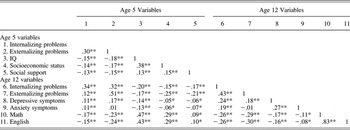
We examined correlations between our age 5 and age 12 measures (see Table 1). We calculated the percentage of children in each victimization category at primary school (not bullied, bullied occasionally, and bullied frequently) who were identified as being never, occasionally, or frequently bullied during secondary school. To measure the persistence of victimization over time, we examined the relative risk from regression models predicting victimization at secondary school from victimization at primary school.
Correlations among individual and family characteristics measured at age 5 and mental health and academic outcomes at age 12

*p < .05. **p < .01.
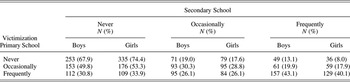
Boys experienced more victimization than girls in both primary school (χ2 = 9.5, p < .01) and secondary school (χ2 = 11.4, p < .01). Boys were also more likely to be chronically victimized (χ2 = 5.2, p < .05). Of the children who were frequently bullied during primary school, 43.1% of boys and 40.1% of girls remained frequently bullied during secondary school (boys: N = 157, girls: N = 129; Table 2). Chronic victimization was not infrequent; overall, 13.3% of children experienced frequent victimization at both time points (boys: 15.0%, girls: 11.7%). Victimization during primary school was significantly associated with victimization during secondary school (total: RR = 1.7, 95% confidence interval [CI] = 1.6–1.8; boys: RR = 1.6, 95% CI = 1.4–1.7; girls: RR = 1.8, 95% CI = 1.6–1.9).
Victimization status of children across primary and secondary school

Note: The number of children in each victimization category is presented. The values in parentheses represent percentage of children from each category in primary school identified as being never, occasionally, or frequently bullied during secondary school.
Is chronic victimization associated with negative mental health and academic outcomes?
To examine outcomes of chronic victimization, we divided our sample into four groups: chronic victims (frequently bullied at both primary and secondary school), primary school victims (frequently bullied at primary school only), secondary school victims (frequently bullied at secondary school only), and nonvictimized (children who experienced either occasional or no victimization at primary and secondary school). We tested whether chronic victims differed in mental health and academic outcomes relative to groups of nonvictimized children, primary school victims, and secondary school victims using linear regression models, with chronic victims as the comparison group. In order to determine whether children who escaped chronic victimization (i.e., primary school victims) were still at risk for mental health and school achievement difficulties at age 12, we further compared outcomes of primary school victims to nonvictimized children. All analyses controlled for the effects of potential confounds including children's preexisting characteristics assessed at age 5 (internalizing and externalizing problems and IQ) and family background at age 5 (SES, mother's social support, and child maltreatment).
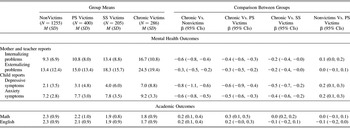
Victimization was a risk factor for adjustment difficulties (Table 3). Even children whose experiences of victimization were limited to primary school showed significantly higher levels of internalizing symptoms at age 12 compared to nonvictimized children, using mothers', teachers', and children's reports. However, children who experienced chronic frequent victimization from primary to secondary school were the most vulnerable group of bullied children. Chronically victimized children had significantly greater levels of internalizing and externalizing problems than children who escaped victimization and nonvictimized children. Chronic victims also self-reported more symptoms of depression and anxiety compared to primary school victims and nonvictimized children. Chronic victims differed significantly in their mental health outcomes compared to children who had recently become victimized at secondary school. The increased risk of mental health problems was significantly greater for chronic victims of bullying even after controlling for children's early internalizing and externalizing problems as well as IQ, and controlling for family background characteristics (e.g., SES, mother's social support, and child maltreatment) assessed at age 5, before victimization occurred. Children who experienced chronic victimization performed less well in mathematics and English at age 12 relative to primary school victims and nonbullied children. This decreased performance could not be accounted for by differences in IQ, adjustment difficulties, or family background measured at age 5.
Group means and comparisons of mental health and academic outcomes at age 12 for chronic victims of bullying, PS victims, SS victims, and nonvictimized children

Note: Means and standard deviations are presented as raw scores; betas from regression analyses are standardized. Adjusted regression analyses controlling for age 5 individual characteristics (internalizing and externalizing symptoms, gender, IQ) and age 5 family characteristics (Socioeconomic status, social support, and child maltreatment). To investigate whether gender differentially influenced the associations between each bullying victimization status and each outcome, an interaction term (gender by mental health or school achievement outcome) was included in regression models. None of the interaction terms yielded improvements in the fit of models above and beyond main effects only. Thus, analyses were conducted for the whole sample collapsed across gender. PS, primary school; SS, secondary school; CI, confidential interval.
Children who became bullied during secondary school did not differ significantly relative to children who experienced chronic victimization on their low academic performance. Associations between victimization status and mental health and school achievement outcomes did not differ according to gender.
What are the relative contributions of genetic and environmental influences on persistence in victimization from primary to secondary school?
In order to test the relative influence of genes and environment on persistence of victimization from primary through to secondary school we used twin methodology. MZ twins are genetically identical whereas DZ twins share, on average, only 50% of their segregating genes. By comparing the concordance of a particular phenotype within pairs of MZ and DZ twins, it is possible to estimate the relative influence of genetic and environmental factors on the observed variation in a measured phenotype. Twin methodology makes assumptions about the nature of the processes being estimated. A detailed discussion of these assumptions can be found elsewhere (Boomsma, Reference Boomsma and Peltonen2002; Martin & Machin, Reference Martin and Machin1997). We used Mx (Neale et al., Reference Neale, Boker, Xie and Maes2006) to calculate polychoric correlations and thresholds and to perform standard univariate and bivariate liability-threshold modeling (Falconer, Reference Falconer1965; Smith, Reference Smith1974). Liability-threshold modeling is the categorical equivalent of continuous twin model-fitting analyses.
In the standard univariate model, the phenotypic variation is decomposed into that explained by additive genetic (A), shared environmental (C), and nonshared environmental (E) factors. Shared environmental influences represent factors that have impacted both twins equally, while nonshared environmental influences represent factors that have impacted the twins differently. The relative magnitude of the model parameters (A, C, and E) is inferred by comparing observed between-twin correlations to correlations predicted from a hypothesized model. Error of measurement is partitioned into the E parameter (Neale & Cardon, Reference Neale and Cardon1992). We initially fitted these univariate models separately to victimization at primary school and at secondary school. To examine persistence in victimization over time, we then fitted a bivariate Cholesky decomposition model. Bivariate models follow the same principles as univariate models but decompose the covariance between measures, in this case of victimization at primary school and at secondary school, into bivariate A, C, and E parameters. These parameters are estimated using the cross-twin cross-trait correlations (i.e., victimization in primary school for Twin 1 correlated with victimization in secondary school for Twin 2).
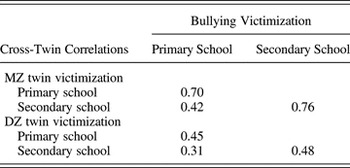
The relative contribution of genetic and environmental factors on victimization can be estimated by comparing intraclass correlations for MZ and DZ twin pairs (Table 4). Cross-sectional associations (polychoric within-pair correlations) were higher for MZ compared to DZ twins both at primary school (r = .70 vs. .45) and at secondary school (r = .76 vs. .48), indicating genetic influence on victimization at both time points. Within-pair correlations for MZ twins at both time points were less than 1.00, indicating nonshared environmental influence. DZ correlations were slightly more than half the MZ correlations, indicating relatively little influence of shared environment on cross-sectional measures of victimization at primary and secondary school. Twin correlations over time (cross-twin cross-time correlations) were slightly higher for MZ twins than for DZ twins (r = .42 vs. .31), suggesting a genetic contribution to the persistence of victimization. The DZ twin correlations were greater than half the MZ correlations, also indicating shared environmental influence.
Phenotypic and within-pair polychoric correlations for bullying victimization in primary school and in secondary school

Note: MZ, monozygotic; DZ, dizygotic.
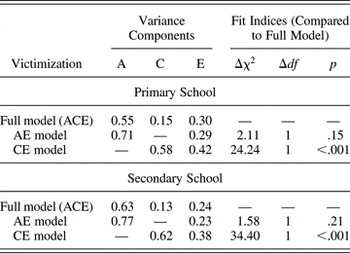
We applied biometric analyses to our data on victimization at both primary and secondary school to provide a more precise estimation of the genetic, shared, and nonshared environmental influences on victimization over time. We fitted separate univariate genetic models to victimization data at both time points (Table 5). Model parameters could be equated across gender without worsening the model fit, suggesting no difference in the relative influence of genetic and environmental influences for boys and for girls. For victimization in primary and in secondary school, the parameter estimates included small, nonsignificant shared environmental influences. The best fitting models at both time points were therefore AE models, including relatively large genetic influence (71% at primary school and 77% at secondary school) and a moderate influence of the nonshared environment (29% and 23%, respectively).
Genetic and environmental parameter estimates and fit indices for the sex-equated univariate model of victimization at primary school and secondary school

Note: For the model on primary school data, thresholds and parameters could be equated across gender without significant loss of model fit (Δχ2 = 8.3; Δdf = 4, p = 0.1). For the secondary school model, parameter estimates could be equated across gender without significant loss of model fit (Δχ2 = 3.0; Δdf = 2, p = 0.2), but thresholds could not (Δχ2 = 6.8; Δdf = 2, p = 0.03), reflecting the mean gender differences observed in victimization at secondary school. A, additive genetic; C, shared environment; E, nonshared environment.
Genetic and environmental influences on persistence of victimization over time
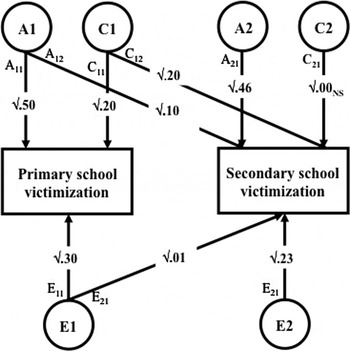
We estimated the relative contribution of genetic and environmental influences on the persistence of victimization from primary to secondary school. From the estimates presented in Figure 1, it is possible to calculate how much of the persistence in victimization over time (phenotypic correlation, r = .48) is due to genetic, shared environmental, and nonshared environmental influences. Genetic factors accounted for nearly half (47%) of the correlation in victimization over time ([a11 × a12]/r = [.71 × .32]/.48 = .47). Shared environmental influences accounted for 41% of the persistence in victimization, and the remaining 12% of the phenotypic correlation was accounted for by nonshared environmental factors. Thus, persistence of victimization from primary to secondary school was mainly due to genetic and shared environmental influences.
Bivariate Cholesky decomposition model showing relative genetic (A), shared environmental (C), and nonshared environmental (E) influence on stability and change in victimization from primary to secondary school. Thresholds and model parameters could be equated for males and females without significant loss of fit (Δχ2 = 12.3; Δdf = 7, p = 0.1). All other results shown were statistically significant at the .05 level. A1, C1, and E1 refer to influences at both time points; A2, C2, and E2 to influences only at secondary school.

The estimates in Figure 1 also indicate new genetic and environmental influences that uniquely contributed to victimization at secondary school. Secondary school specific effects were due primarily to genetic influences (66.7%; i.e., a21/[a21 + c21 + e21] = 0.46/[0.46 + 0.00 + 0.23]) and nonshared environmental influences (33.3%), with no effect of the shared environment on secondary school victimization. We found no significant gender differences in the relative influence of genes and environment on variance in chronic victimization.
What factors uniquely predict chronic versus transient victimization?
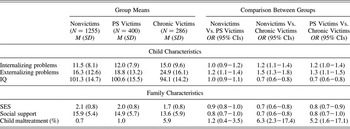
To examine predictors of chronic victimization, we tested whether early individual and, separately, early family characteristics (assessed at age 5) uniquely predicted children who became chronically victimized compared to children who escaped chronic victimization (primary school victims) and children who were never victimized using multivariate multinomial logistic regression models.
At age 5, before victimization occurred, bullied children, including those who later escaped victimization and those who became chronically victimized over time, showed higher levels of externalizing symptoms (Table 6). However, even at the age of 5, children who later became chronically victimized also showed elevated internalizing problems and a lower IQ compared to both nonvictimized children and children who experienced transitory victimization limited to primary school.
Group means and comparisons using multiple regression analyses testing separately the unique associations between age 5 individual and family characteristics with nonvictimized children, children who escape victimization (PS victims), and chronic victims of bullying

Note: Means and standard deviations are presented as raw scores; regression analyses use standardized estimates. Analyses controlled for the potential confounding effect of gender. To investigate whether gender differentially influenced the associations between each child or family level predictor and bullying victimization status, an interaction term (gender by child or family level predictor) was included in regression models. None of the interaction terms yielded improvements in the fit of models above and beyond main effects only. Thus, analyses were conducted for the whole sample collapsed across gender. PS, primary school; SES, socioeconomic status.
In terms of family characteristics, both chronic and transitory victims of bullying were more likely to have a mother who received low social support compared to nonvictimized children. Chronically victimized children were more likely to live in families with lower SES and to have experienced child maltreatment compared to nonvictimized children and children who experienced transitory victimization. Children whose experiences of victimization were limited to primary school did not differ from nonvictimized children in their early family SES and experience of child maltreatment.
Discussion
Using data from a large epidemiological longitudinal sample, we found that for some children victimization by bullies is persistent across a key school transition. According to multiple informants, children who experienced chronic victimization had poorer mental health and academic outcomes compared to nonvictimized children, those who escaped victimization, and children who became bullied at secondary school. The effect of chronicity of victimization on adjustment outcomes could not be explained by children's prospectively assessed individual characteristics and family backgrounds measured before victimization occurred. Twin model fitting revealed that chronic victimization over this period is influenced primarily by genetic and shared environmental factors. This is the first study to show that while children's heritable characteristics increase their likelihood of experiencing chronic victimization, factors in the environment common to children growing up in the same family are also important. We showed that early individual characteristics such as children's initial adjustment difficulties predicted chronic victimization compared to transitory victimization and nonvictimization. Family-level risk factors for chronic victimization included lower SES, low levels of maternal social support, and maltreatment. Such risk factors may be important targets in early intervention programs aiming to reduce the likelihood of children experiencing chronic victimization and subsequent adjustment problems.
Chronic victimization across the transition from primary to secondary school
Our study showed that victimization is a risk factor for mental health difficulties among transitory and chronically victimized children. However, in line with other studies (e.g., Kochenderfer-Ladd & Wardrop, Reference Kochenderfer-Ladd and Wardrop2001; Scholte et al., Reference Scholte, Engels, Overbeek, de Kemp and Haselager2007), children who experienced chronic victimization were the most vulnerable even after controlling for the effects of preexisting individual characteristics and family background. The increased risk of mental health problems among chronic victims of bullying could not be explained simply in terms of how recently children experienced instances of victimization. Children victimized in both primary and secondary school differed significantly in their mental health outcomes at age 12 compared to children who had recently become victimized at secondary school. The associations between chronic victimization and academic outcomes showed a somewhat different pattern. Chronically victimized children performed less well in mathematics and English compared to nonvictimized children. It remains unclear whether the duration of victimization is an important factor on academic outcomes. Chronic victims of bullying differed significantly from children who were victimized only during their primary school years in their mathematics performance but not from secondary school victims who were exposed to more recent victimization. Children who escaped chronic victimization also did not differ on their mathematics and English performances at age 12 from nonvictimized children. These findings suggest that the negative effects of victimization on children's academic performance may be limited to the actual period when victimization occurs. If this is the case, then improvements in academic performances would be expected when victimization stops. Further follow-up of academic performances as children move in and out of victimization status during the course of secondary school is necessary to support this hypothesis. Taken together, our findings show that the chronicity of victimization has an important influence on bullied children's adjustment and particularly in terms of mental health outcomes.
Genetic and environmental influences on chronic victimization
Our study is the first to utilize a genetically informative design in order to disentangle genetic and environmental effects on chronic victimization across the transition from primary to secondary school. We found that genetic effects accounted for nearly half of the persistence in victimization during this period, providing further support that children's heritable characteristics can influence their likelihood of being bullied (Ball et al., Reference Ball, Arseneault, Taylor, Maughan, Caspi and Moffitt2008). That children's genetic characteristics influence their exposure to stable victimization does not imply that exposure to chronic victimization is inevitable. Our findings suggest that intervention programs should consider the victims' role in the bully–victim relationship, in addition to the bullies'. By identifying and helping children manage heritable characteristics that may predispose them to victimization across different contexts, we can reduce the likelihood of children going on to experience future victimization when they enter new social environments.
Our findings also identified the importance of shared environmental influences in the etiology of chronic victimization. This is a novel finding; biometric analyses typically find little or no effect of the shared environment in child development (Pike & Plomin, Reference Pike and Plomin1996). It is possible that these contrasting findings reflect the fact that the current study identifies genetic and environmental influences on a long-lasting environmental exposure rather than a direct behavior. Longitudinal biometric analyses of measured behaviors indicate a large and significant influence of genetic factors on the persistence of a direct behavior but little or no shared environmental influence. However, biometric analyses of environmental exposures may, in contrast, indicate large shared environmental influences. For example, a significant effect of the shared environment on children's risk of exposure to parental maltreatment has been observed (Jaffee, Caspi, Moffitt, & Taylor, Reference Jaffee, Caspi, Moffitt and Taylor2004). Our findings indicate a significant effect of the shared environment on persistent exposure to victimization. However, we cannot rule out the possibility that our estimate of shared environmental effects may have been partially inflated by rater bias, because our measure of victimization included mother's reports for both twins at each assessment. Cross-twin cross-time correlations using only child reports of victimization (which are not influenced by rater bias effects) showed similar estimates, with correlations higher for MZ (r = .33) than for DZ (r = .27) twins. In order to reduce the impact of shared rater bias on our analyses and to capture all instances of victimization, we combined our child and mother reports of victimization. It is therefore unlikely that rater bias fully accounts for our finding of a significant effect of shared environment on persistence of victimization. Our finding of shared environmental influences was not observed in cross-sectional analyses of victimization at primary school and at secondary school where the small, shared environmental influences were nonsignificant. This highlights the importance of using longitudinal biometric analyses, which have greater statistical power. Cross-sectional measures of victimization capture both children who experience transitory victimization and the minority of children who experience chronic victimization over time. Our cross-sectional findings thus suggest that shared environmental influences are less important for more transitory experiences of being bullied in different social settings. Although shared environmental influences may exert only a small effect at any one time point, they have an important effect on the chronicity of victimization over time and across settings, a finding that could only be detected with longitudinal analyses.
Genetic and environmental changes in bullying victimization over time
Our biometric analyses also revealed that genetic and environmental influences contributed to change in victimization from primary to secondary school. New nonshared environmental and genetic factors uniquely influenced victimization during secondary school. This finding suggests different etiologies of transitory bullying victimization in primary as opposed to secondary school. It is perhaps unsurprising that new nonshared environmental factors uniquely influenced victimization during secondary school, given the changes in children's peer groups, classrooms, and school environment at this time. Our finding of genetic change at secondary school may suggest that different heritable characteristics may influence victimization in the different settings. This developmental period also reflects the transition from childhood into emerging adolescence, and the many physical and behavioral changes during this time may exert new influence on vulnerability to victimization. Different genetic factors may also influence the same heritable traits that increase risk for victimization in different contexts. For example, internalizing symptoms are known to be highly heritable (Haberstick et al., Reference Haberstick, Schmitz, Young and Hewitt2005) and to influence victimization in childhood and adolescence (Arseneault et al., Reference Arseneault, Walsh, Trzesniewski, Newcombe, Caspi and Moffitt2006; Bowes et al., Reference Bowes, Arseneault, Maughan, Taylor, Caspi and Moffitt2009). Longitudinal findings show evidence of uncorrelated age-specific genetic effects influencing internalizing disorders from childhood through to early adolescence (Bartels et al., Reference Bartels, van den Oord, Hudziak, Rietveld, van Beijsterveldt and Boomsma2004; Haberstick et al., Reference Haberstick, Schmitz, Young and Hewitt2005). The experience of being bullied may also result in new emerging internalizing difficulties, which may in part reflect underlying genetic vulnerability (Sugden et al., Reference Sugden, Arseneault, Harrington, Moffitt, Williams and Caspi2010). Thus, a cycle of victimization and emotional difficulties may develop, increasing children's vulnerability to persistent victimization across different contexts. Identifying whether the same or different heritable characteristics influence victimization at primary school and secondary school is an important goal for future research.
Identifying risk factors for chronic victimization
Our study identified family and individual risk factors for chronic victimization. Early experience of socioeconomic disadvantage, low maternal social support, and child maltreatment predicted chronic victimization relative to transitory victimization at primary school only and nonvictimization. These family risk factors represent important targets for intervention programs aimed at reducing children's risk of becoming chronically victimized and add to the growing evidence that family factors are important in the context of victimization (Baldry, Reference Baldry2003; Bowes et al., Reference Bowes, Arseneault, Maughan, Taylor, Caspi and Moffitt2009; Kupersmidt, Griesler, DeRosier, Patterson, & Davis, Reference Kupersmidt, Griesler, DeRosier, Patterson and Davis1995; Shields & Cicchetti, Reference Shields and Cicchetti2001; Stevens et al., Reference Stevens, De Bourdeaudhuij and Van Oost2002). Children's early internalizing and externalizing problems also predicted chronic victimization, as did children's cognitive difficulties (as indexed by lower IQ levels). Chronic victimization was associated with an increased risk of mental health difficulties over and above these preexistent problems, however. Taken together, these findings provide further support for a vicious cycle of victimization and maladjustment in which children's adjustment difficulties increase risk for victimization, which in turn increases risk of future adjustment difficulties (Hodges & Perry, Reference Hodges and Perry1999; Reijntjes et al., Reference Reijntjes, Kamphuis, Prinzie and Telch2010).
Limitations
This study has some methodological limitations. First, our findings cannot account for within-period variability; although we only classified those children who experienced frequent victimization as victims in each category, we did not measure when the victimization occurred during each period or the severity of the victimization. Such within-period variability would have exerted a conservative effect on our findings, however, making it more difficult to detect significant differences between groups. Second, it remains to be tested whether the risk factors for chronic victimization identified in the present study are genetically or environmentally mediated. It is not possible to partition variables measured at the level of the family such as SES or mother's social support into genetic and environmental components using the twin design (Turkheimer, D'Onofrio, Maes, & Eaves, Reference Turkheimer, D'Onofrio, Maes and Eaves2005), although by using child-specific family measures it has been shown that exposure to child maltreatment is largely driven by shared environmental factors (Jaffee et al., Reference Jaffee, Caspi, Moffitt and Taylor2004). Third, we also did not capture different types of victimization experiences during our assessments. At least one study has shown that persistence of victimization may depend on which type of bullying is assessed, with evidence that relational victimization may be more stable, at least within primary school (Wolke, Woods, & Samara, Reference Wolke, Woods and Samara2009). To date, no study has looked at the genetic and environmental influences on different types of victimization experiences over time. Fourth, children's reports of victimization in primary school were retrospective. Retrospective recall is more subject to error because participants may forget events, confuse timing of events, and recall may be biased by current attitudes or beliefs (Henry, Moffitt, Caspi, Langley, & Silva, Reference Henry, Moffitt, Caspi, Langley and Silva1994; Ross, Reference Ross1989; Squire, Reference Squire1989). By combining children's retrospective reports of victimization during this period with mother reports, the effects of such error may be reduced. Fifth, mothers' reports of age 12 victimization covered a 2-year period, encompassing the transition from primary to secondary school (which occurs at age 11 in the United Kingdom). Thus, mothers' reports may overestimate rates of secondary school victimization and may capture some experiences that occurred in the final year of primary school. Sixth, our sample comprised twins and thus we cannot be certain that our results generalize to singletons. One potential problem could arise if the victimization experiences reported were within twin pairs (i.e., if one twin was being victimized by his or her cotwin). In this instance, cross-twin cross-time correlations may be inflated for reasons other than genetic or environmental risks in the general population. However, mothers' and children's descriptions of victimization incidents implicated bullies outside the family in nearly all cases. Another potential problem is that chronic victimization may impact differently on twins compared to singletons. However, findings on the association between bullying and mental health outcomes in twins are similar to studies of singletons (Arseneault et al., Reference Arseneault, Walsh, Trzesniewski, Newcombe, Caspi and Moffitt2006; Nansel, Craig, Overpeck, Saluja, & Ruan, Reference Nansel, Craig, Overpeck, Saluja and Ruan2004).
Implications for research, practice, and policy
Our study focuses on a particularly vulnerable group of bullied children: those who experience chronic victimization across different school settings. These children are most at risk of developing mental health problems, including symptoms of anxiety, depression, and behavioral problems, and thus represent an important target for further studies and intervention efforts. These results therefore support the need to supplement antibullying intervention schemes with individualized strategies that take the differential needs of the victim role into account (Woods & Wolke, Reference Woods and Wolke2003). Understanding the mechanisms by which children's individual characteristics and shared environmental factors may increase their risk of being chronically victimized by bullies even across different school settings is crucial. Different etiological factors may also influence victimization in different school contexts. Identification of factors that mediate these effects will allow for more targeted bullying intervention programs aimed specifically for primary or secondary schools.
Our study focuses on the role of individual and family characteristics in influencing children's risk of exposure to chronic victimization. Understanding how such individual characteristics increase risk for chronic victimization across different school settings will be essential in developing appropriate interventions targeting the most vulnerable victims of bullying in primary and secondary schools. Our results suggest that bullying intervention programs should consider the role of the victims' own behaviors in increasing vulnerability to victimization in addition to targeting bullying behaviors themselves. Our study also further highlights the importance of widening antibullying interventions to include parents and families. Finally, our findings suggest that it may be possible to identify and target those bullied children most vulnerable to developing severe adjustment difficulties at as early as 5 years of age. Early interventions are crucial if we are to break the cycle of victimization by bullies in childhood.