

Introduction
What, if anything, can policy-makers do to increase support for taxes? In the wake of the “tax revolt” of the Reagan era (e.g., Sears & Citrin, Reference Sears and Citrin1985) and the more recent Tea Party movement (e.g., Skocpol & Williamson, Reference Skocpol and Williamson2012), this question has considerable stakes. While opposition to taxes may not be as “unvarying” as commonly assumed (Campbell, Reference Campbell2009; Williamson, Reference Williamson2017), long-term trends such as climate change and rising inequality will likely require large public expenditures that anti-tax attitudes could jeopardize. Mitigating negative attitudes toward taxes is therefore not just an academic concern, but an urgent policy challenge.
In this article, we describe and test a novel theory of public support for certain types of taxation. Our theory focuses on the practice of “earmarking,” or the designation of tax revenues for specific purposes. Earmarking is remarkably widespread (Perez, Reference Perez2008), though little understood. In particular, the existing literature lacks an empirically grounded account of the conditions under which earmarked taxes will elicit strong public backing.
Here, we hypothesize that earmarked taxes will be most popular when the source of the earmarked tax revenue is “aligned” with the use to which tax revenues are put. Our theory is premised on a simple intuition: voters’ views about taxes will likely accord with their views regarding marketplace transactions. Previous behavioral scholarship has shown that consumers react negatively when they believe a price increase is cross-subsidizing the provision of other goods or services (Kahneman et al., Reference Kahneman, Knetsch and Thaler1986) and that consumers engaging in marketplace transactions prefer that cost and price “align” with one another (Bolton & Alba, Reference Bolton and Alba2006). We examine whether this way of thinking extends to taxation. We posit that taxes will be more popular when the source of the tax revenue is rationally connected to its use – a condition we call source–use alignment. We identify two principles of alignment from the consumer context that may carry over into the tax domain: “you get what you pay for” (i.e., the notion that a tax on a particular activity should go toward expenditures that benefit participants in that activity) and “you break it, you buy it” (i.e., the idea that a tax on a particular activity should go toward mitigating harms that the activity causes). We go on to describe an experimental research design that allows us to measure the strength of preferences for source–use alignment. We then report evidence from two survey experiments involving samples of US adults matched to meet Census benchmarks that lend preliminary support for our theory.
This paper is structured as follows: we first review the practice of earmarked taxes and describe leading arguments put forth to explain earmarking's popularity. We then articulate our theory. Unlike the existing literature, our theory can account for the common practice of tying revenues from earmarked taxes to expenditures that are reasonably connected to the activity being taxed. Next, we describe the design and results of the two original experiments. We end with a discussion of our findings and consider implications for research and policy.
Earmarking in theory and practice
Every US state earmarks taxes. According to the most recent data from the National Conference of State Legislatures (Perez, Reference Perez2008), nearly a quarter of all state tax revenues are earmarked, with five states (Alabama, Michigan, Nevada, Tennessee and Wyoming) earmarking half or more of their revenues. Federal payroll taxes and federal excise taxes on motor fuel, jet fuel and passenger air fares are earmarked as well.
A common – though not universal – characteristic of earmarked taxes is that revenues are designated for uses that are related to the item or activity being taxed. In many cases, taxes are earmarked for expenditures that benefit the payers of the tax. For example, motor fuel taxes at the federal level and in 45 states are earmarked for highways, and federal taxes on jet fuel and passenger air tickets are earmarked for airports and air traffic control. Likewise, hotel and lodging taxes in nine states are earmarked for tourism-related programs, and watercraft taxes in four states are earmarked for waterway improvements and boating-related activities. In other cases, taxes are earmarked for expenditures that remediate a problem generated by the item or activity being taxed. For example, alcohol taxes in 11 states are earmarked for substance abuse treatment or for enforcement of alcohol-related laws, and tobacco taxes in eight states are earmarked for cancer research, treatment and prevention (Perez, Reference Perez2008). A federal tax on crude oil and petroleum products was earmarked for oil spill cleanup until Congress allowed the tax to lapse at the end of 2018 (Ramseur, Reference Ramseur2019).
The existing literature offers three explanations for the earmarking phenomenon. The first posits that “taxes are more acceptable when the taxpayer knows exactly what they are to be used for” (Rivlin, Reference Rivlin1989, p. 116). Earmarking increases the “salience” of public goods financed through taxation, and if those public goods are desired by voters, then earmarking will increase support for the tax (Listokin & Schizer, Reference Listokin and Schizer2013). A second explanation holds that earmarking revenues for a spending program favored by a well-organized interest group serves to enlist that group's support for the tax (Tahk, Reference Tahk2013, Reference Tahk2015). In this view, earmarking is a strategy that proponents of a tax can use to construct a winning coalition. A third explanation posits that politicians use earmarking as a way to constrain the spending choices of their successors (Brett & Keen, Reference Brett and Keen2000). Through earmarking, lawmakers can ensure that favored projects remain funded notwithstanding the vagaries of the appropriations process.
Notably, none of these explanations can account for the common practice of earmarking tax revenues for related uses. Consider first the salience theory, which suggests that earmarking should lead to higher support for taxes when the designated expenditure is one that voters support. If public spending on cancer research is popular, then the salience theory might predict that politicians would garner support for a tax by earmarking revenues for cancer research. But the salience theory does not explain why we might expect to see tobacco taxes earmarked for cancer research as opposed to, say, watercraft taxes earmarked for cancer research.
The second account, rooted in public choice theory, also offers no explanation for source–use matching. Public choice theory would lead us to expect that taxes will be earmarked for expenditures that benefit a concentrated constituency. If cancer patients are a well-organized interest group, then public choice theory might predict that tax revenues would be earmarked for cancer treatment. But as with the salience theory, the public choice account of earmarking offers no explanation as to why tobacco tax revenues – rather than revenues from any other tax that falls on a diffuse set of payers – might be earmarked for cancer research.
The same shortcoming befalls the third theory, which posits that earmarking is a way for policy-makers to tie their successors’ hands. Indeed, proponents of the hands-tying model acknowledge that their argument is “incomplete” because it fails to account for the feature emphasized here – the frequent match between the source of a tax and the expenditure for which it is earmarked (Brett & Keen, Reference Brett and Keen2000, p. 337). Insofar as earmarking serves a hands-tying function, it would seem to accomplish this function just as well regardless of whether the designated expenditure bears a subject-matter relationship to the revenue source.
Our alternative explanation for source–use alignment proposes that citizens will react to tax hikes and tax cuts in much the same way that consumers react to price increases and price reductions. That is, we expect to see a preference for source–use alignment in the tax realm that mirrors the alignment findings in the consumer setting (e.g., Bolton & Alba, Reference Bolton and Alba2006; Kahneman et al., Reference Kahneman, Knetsch and Thaler1986). Specifically, we predict that voters will react more favorably to a tax on an item or activity when revenues are earmarked for an expenditure that benefits consumers of the item or participants in the activity, or one that remedies a harm that the item or activity causes. Symmetrically, we expect that voters will respond less favorably when revenues from taxes on one item or activity are used to cross-subsidize spending in an entirely different area. While the salience theory directs our attention to the popularity of the designated expenditure and while public choice theory points us toward the distribution of costs and benefits among interest groups, this new perspective leads us to focus on the fit between the item or activity upon which a tax is imposed and the expenditure for which revenues from that tax are earmarked.
Alignment in theory
A cornerstone of the large and growing literature on consumer behavior is the finding that individuals rely on a principle of “dual entitlement” when assessing the fairness of price increases and similar changes (Chen et al., Reference Chen2017, pp. 2, 15). According to this norm, consumers believe that they are entitled to a reference price based on prior transactions and that firms are entitled to a reference profit based on their profit in previous periods. Consumers generally deem it fair for a firm to raise prices when its costs increase, assuming such price increases are necessary to preserve the firm's reference profit. Conversely, consumers generally deem it unfair for a firm to raise prices so as to increase its profit above the reference level. In “dual entitlement” terms, a purely profit-grabbing price increase violates the entitlement of consumers to a reference price (Kahneman et al., Reference Kahneman, Knetsch and Thaler1986).
While the first round of research on the dual entitlement principle focused on the quantitative relationship between price and cost, Bolton and Alba (Reference Bolton and Alba2006) introduce an additional qualitative dimension to the analysis. They posit that perceptions of consumer fairness are influenced by the “alignability” of costs and benefits; that is, “the relationship between the nature of costs and the locus of a price increase” (Bolton & Alba, Reference Bolton and Alba2006, p. 258). In a series of laboratory-based survey experiments, they find that when a vendor sells both goods and services, and the cost of goods rises, consumers tend to consider it fairer for the vendor to respond by raising the price of goods than by raising the price of services (and vice versa).
To illustrate: in one experiment, researchers presented participants with a scenario in which a specialty arts store sold supplies (e.g., brushes and paints) as well as services (e.g., art classes). Some participants were told that the cost of supplies had risen 25% in the previous year; others were told that the cost of providing services had increased by the same percentage. Participants who were told that the cost of supplies had risen judged it to be more fair for the store to pass on the cost to consumers by raising the price for supplies rather than raising the price for services; participants who were told that the cost of services had risen exhibited the opposite intuition. In other words, consumers responded more favorably to the price change that was better “aligned” with the increase in input costs (Bolton & Alba, Reference Bolton and Alba2006).
Subsequent studies provide further evidence of a consumer preference for price and cost changes to be aligned. For example, Ferguson et al. (Reference Ferguson, Ellen and Piscopo2011) find that when consumers are informed that a small grocery store's costs have risen because of a shortage of oranges in Florida, they judge it to be more fair for the store to respond by raising the price of Florida orange products than for the store to spread the price increase across all citrus products. Similarly, Ferguson and Ellen (Reference Ferguson and Ellen2013) find that consumers perceive a large increase in prices of coffee products to be more fair if a coffee shop attributes the price increase to a rise in coffee bean costs than if the shop attributes the price increase to a more general rise in transportation costs.
Our study considers whether a similar principle of alignment applies in the public finance context. There are several reasons to anticipate that it might. Taxes are often thought to be “the price of civilization” (e.g., Musgrave, Reference Musgrave, Thorndike and Ventry2002, p. 19).Footnote 1 If taxes are one type of price, we might expect for individuals to rely on familiar price-fairness norms when evaluating taxes. Moreover, other research on political attitudes has found that patterns of consumer decision-making – such as a preference for “operational transparency” – cross-apply to the public finance domain (Buell et al., Reference Buell, Porter and Norton2018). Our hypothesis regarding source–use alignment relies upon a similar linkage between consumer behavior and political attitudes.
Notably, we make no claim here regarding the causal linkage between consumer behavior and political attitudes. It is possible, for instance, that individuals who are habituated to thinking about product prices consciously or unconsciously rely upon familiar consumer fairness norms when evaluating taxes (i.e., that consumer fairness norms shape attitudes toward taxation). An alternative explanation is that individuals might draw upon the same common well of fairness norms in their consumer lives and in their tax lives. According to this latter view, consumer fairness norms do not directly affect attitudes toward taxation, but behaviors and attitudes in both contexts are influenced by the same background intuitions regarding justice and fair play.
In either case, we might expect that voters’ attitudes toward proposed taxes and expenditures will be affected by source–use alignment. We use the term “alignment” to refer to the relationship between the source of public funds and the end to which those funds are employed. Familiar examples of “aligned” taxes include motor fuel taxes dedicated to highways and jet fuel taxes dedicated to airports and air traffic control functions. An example of a misaligned tax is Alabama's tax on mobile communication services, the revenues from which are earmarked for public schools and higher education (Perez, Reference Perez2008). Unlike the fuel and airline taxes, there is no particular reason (or, at least, none we can think of) why responsibility for public school finance ought to lie with cell phone users.
More generally, we consider an earmarked tax to be “aligned” when the relationship between the tax and the expenditure can be justified according to one of two fairness norms familiar from the consumer context. The first such norm is, in everyday consumer terms, “you get what you pay for.” Taxes that approximate user fees fall into this category. Real-life instantiations of this principle include motor vehicle license, registration and titling taxes earmarked for transportation-related functions (Alabama, Arizona, Florida, Hawaii, Louisiana, Maryland, Michigan, Minnesota, Mississippi, Ohio and Tennessee), lodgings taxes used to fund tourism-related activities (Alabama, Illinois, Massachusetts, Montana, Nebraska, Nevada, Oklahoma, Oregon and Texas) and watercraft taxes used to fund the improvement of boating facilities and waterways (Arizona, Maryland, New Mexico and Virginia).
We also consider an earmarked tax to be “aligned” when the tax and expenditure are linked by a norm of “you break it, you buy it.”Footnote 2 An example of this sort of alignment at the federal level is the former federal excise tax on crude oil and petroleum products, the revenues from which were reserved for oil spill cleanups. Whereas earmarked taxes in the first category are targeted (more or less) at the beneficiaries of the associated expenditure, earmarked taxes in the second category are targeted (again, more or less) at the activities that generate the negative externality that the associated expenditure remedies.
These two types of alignment – “you get what you pay for” and “you break it, you buy it” – are not always distinct from one another. Consider, for example, the common practice at the state level of earmarking cigarette and tobacco taxes for cancer research and treatment (in effect in Arkansas, California, Colorado, Florida, Idaho, Nebraska, New Mexico and Oklahoma). One might characterize this connection between source and use as according with a benefit principle (“you get what you pay for”), given that smokers are more likely to develop cancer and therefore more likely to benefit from spending on cancer treatment and research. Alternatively, one might view this particular tax-plus-expenditure combination as an instance of “you break it, you buy it”: smokers, after all, increase not only their own risk of cancer, but also the risk borne by others around them (e.g., Asomaning et al., Reference Asomaning2008). Moreover, while here we treat “source–use alignment” as a binary variable, in reality it is continuous. In several states, for example, cigarette and tobacco taxes are earmarked for general public health expenditures – a connection that comes closer to “source–use alignment” than, say, the earmarking of cigarette and tobacco tax revenues for waterway improvements, but not as close as the earmarking of those dollars specifically for cancer research and treatment.
Earmarked taxes in the “you break it, you buy it” category bear a family resemblance to Pigouvian taxes, and in some cases the tax side of the equation may approximate Pigouvian prescriptions. Pigou himself, however, said nothing about the allocation of revenues from taxes on externality-generating activities (Pigou, Reference Pigou1932), and most modern reformulations of the Pigouvian insight are either silent as to the allocation of revenues (e.g., Baumol, Reference Baumol1972) or recommend that revenues be used to offset other distortionary taxes (e.g., Lee & Misolek, Reference Lee and Misolek1986; Parry & Bento, Reference Parry and Bento2001; Terkla, Reference Terkla1984; Tullock, Reference Tullock1967). Musgrave and Musgrave (Reference Musgrave and Musgrave1989), while embracing Pigouvian taxes overall, recommend earmarking only for “use taxes” like the US federal tax on gasoline dedicated for highways; they warn more generally that earmarking may rigidify the budgeting process.
We are not the first to suggest that taxes on externality-generating activities might be more acceptable to voters if revenues are earmarked for programs aimed at addressing the relevant externality. Wagenaar et al. (Reference Wagenaar2000) find higher support for alcohol taxes in the United States when subjects are told that revenues will be earmarked for alcohol abuse treatment and prevention than when subjects are told that revenues will be used to lower taxes or finance other government services. Steg et al. (Reference Steg, Dreijerink and Abrahamse2006) find that survey respondents in the Netherlands are more likely to support taxes on electricity and energy-inefficient appliances when revenues are earmarked for green technology projects than when revenues are earmarked for national debt reduction. Hsu et al. (Reference Hsu, Walters and Purgas2008) show that subjects in British Columbia are more likely to support a gas tax increase if they are told that revenues will be earmarked for research on electric vehicle technology, fuel cell technology and other alternative fuel sources than when the gas tax goes un-earmarked. And Saelen and Kallbekken (Reference Saelen and Kallbekken2011) find that Norwegian voters are more likely to support a fuel tax increase if revenues are earmarked for environmental measures (e.g., public transport, construction of bicycle and pedestrian paths and development of clean technologies) than if revenues are earmarked for redistribution to low-income households.
While these results are consistent with our source–use alignment hypothesis, none of these studies seeks to determine whether the observed results are driven by alignment per se or by attitudes toward the proposed expenditures. For example, the approach in Wagenaar et al. (Reference Wagenaar2000) cannot establish whether earmarking alcohol taxes for alcohol abuse treatment and prevention is popular because those expenditures are always popular or because spending on alcohol abuse treatment and prevention is particularly popular when aligned with an alcohol tax. Here, we present a novel empirical approach for isolating the effect of alignment on voter attitudes.
Experimental design
To evaluate the hypothesis that source–use alignment increases support for taxation, we conducted two studies using an Internet-based sample of US-based respondents matched to Census data. Across both studies, we provided subjects with descriptions of hypothetical earmarked taxes in which we randomly varied the level of source–use alignment. In Experiment A, we examined taxes that follow the basic rule of “you get what you pay for”: that is, taxes on an activity that are used to fund a service benefiting participants in that activity. In Experiment B, we considered taxes that conform to the norm of “you break it, you buy it”: that is, taxes on an activity that are used to fund efforts at mitigating negative externalities generated by that activity. In both studies, some subjects were randomly assigned to see a version of the tax that met the source–use alignment criterion. Other subjects were randomly assigned to see a “misaligned” version of the tax, in which the funds were spent on a distant use. And still other subjects, a control condition, saw only a description of the tax, with no details about its use.
In Experiment A, to examine “you get what you pay for” earmarked taxes, we presented subjects with hypothetical taxes on jet fuel and gasoline. Subjects were randomly assigned to one of six conditions. If they were assigned to an aligned condition, they were told either that:
Some people think we should have a new tax on jet fuel, the kind used in airplanes. The money generated from this tax would be used to fund airports.
or that:
Some people think we should have a new tax on gasoline, the kind used in automobiles. The money generated from this tax would be used to fund highways.
If they were assigned to a misaligned condition, subjects were told either that:
Some people think we should have a new tax on jet fuel, the kind used in airplanes. The money generated from this tax would be used to fund highways.
or that:
Some people think we should have a new tax on gasoline, the kind used in automobiles. The money generated from this tax would be used to fund airports.
And if they were assigned to a no-use condition (the control group), subjects were told either that:
Some people think we should have a new tax on jet fuel, the kind used in airplanes.
or that:
Some people think we should have a new tax on gasoline, the kind used in automobiles.
In Experiment B, to investigate source–use alignment of the “you break it, you buy it” variety, we examined taxes on alcohol and plastic bags. Again, subjects were randomly assigned to aligned, misaligned or no-use conditions. If they were assigned to an aligned condition, they were told either that:
Some people think we should have a new tax on alcohol. The money generated from this tax would be used to fund enforcement of anti-drunk driving laws.
or that:
Some people think we should have a new tax on plastic bags. The money generated from this tax would be used to fund enforcement of anti-littering laws.
Again, to create the misaligned conditions, we transposed source and use. Some subjects were told about a tax on alcohol that would go toward the enforcement of anti-littering laws, while others were told about a tax on plastic bags that would fund the enforcement of anti-drunk driving laws. Subjects in the no-use conditions were presented with the same language about taxes on either alcohol or plastic bags, but with no use specified.
Below the description of their assigned tax, subjects were asked to evaluate their attitudes toward the tax with a 0–100 feeling thermometer (FT). Specifically, after reading the description of the tax, subjects were presented with an adjustable slider, and told:
A number near 0 means you feel cold and negative about such a tax, while a number near 100 means you feel warm and favorable about such a tax.
On the following page, we asked subjects to state their preferred magnitude for the tax in question, this time providing them with a $0–$1.00 slider to answer (with $0.00 being the lowest possible response). Specifically, the language read:
Now, we need to know how much you think the tax should be. For every [gallon of jet fuel/gallon of gas/standard drink of alcohol/plastic bag], how much should be charged for taxes? Your answers can range from $0.00 to $1.00.
Exposure to treatment and measurement of the dependent variable occurred after collection of standard demographic data. Specifically, in each study, we asked subjects about their party affiliation, state of residence, household income, race, self-reported Hispanic affiliation and age. For party identification, we use a standard seven-point scale.Footnote 3
Subjects were recruited via Lucid, a provider of survey subjects in use across social science. In this case, the survey provider matched respondents to Census data on ethnicity, gender and age.Footnote 4
Results
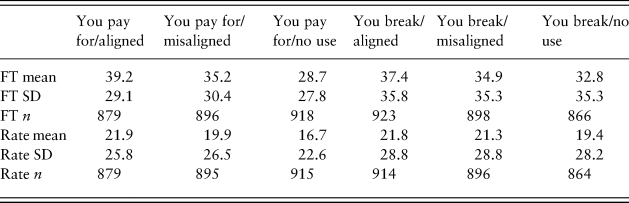
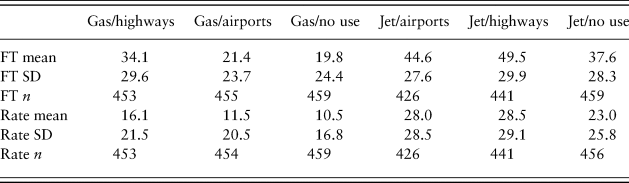
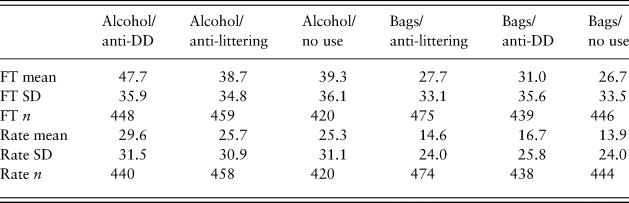
Table 1 presents means and standard deviations for the aligned, misaligned and no-use conditions and outcome variables across both experiments. Tables 2 and 3 provide means and standard deviations for each specific source–use combination across Experiments A and B, respectively. A number of observations emerge from casual inspection. As Table 1 shows, subjects report more positive feelings toward taxes and a willingness to tolerate higher tax rates in the aligned conditions as compared to the misaligned and no-use conditions. The regression analysis below elaborates on this point. As the balance tables in the Appendix (available online) make clear, randomization succeeded in minimizing any difference in our covariates across conditions.
Summary statistics across experiments.

FT = feeling thermometer.
Experiment A outcomes.

FT = feeling thermometer.
Experiment B outcomes.

DD = drunk driving; FT = feeling thermometer.
Tables 2 and 3 attest to the different responses that different taxes yield across conditions. All three conditions involving a jet fuel tax in Experiment A elicit higher mean FT scores and preferred rates than the three conditions involving a motor vehicle fuel tax. Subjects in Experiment A also show a preference for highway expenditures over airport expenditures and for airport expenditures over the no-use condition. The most popular source–use combination is thus the tax on jet fuel earmarked for highway expenditures – a misaligned condition. Note, though, that the positive effect on FT scores and preferred rates from earmarking a tax for highways (the most popular use) rather than airports (the less popular use) appears to be larger for an aligned tax on motor vehicle fuel (+13.3 mean FT score; +4.6 mean rate) than for a misaligned tax on jet fuel (+4.9 mean FT score; +0.5 mean rate). In other words, the highway-expenditure earmark boosts support by the most when the relevant tax is on motor vehicle fuel, as our theory would predict.
The results in Table 3 indicate that taxes on alcohol are more popular than taxes on plastic bags, and expenditures on the enforcement of laws against drunk driving are more popular than expenditures on the enforcement of laws against littering. This time, the most popular source–use combination is the (aligned) earmark of an alcohol tax (the most popular tax) for anti-drunk driving efforts (the most popular use). Again, the effect of earmarking a tax for the most popular use (here, the enforcement of laws against drunk driving) rather than the less popular use (here, anti-littering enforcement) is larger in the aligned condition (+9.0 mean FT score; +3.9 mean rate) than in the misaligned condition (+3.3 mean FT score; +2.1 mean rate).
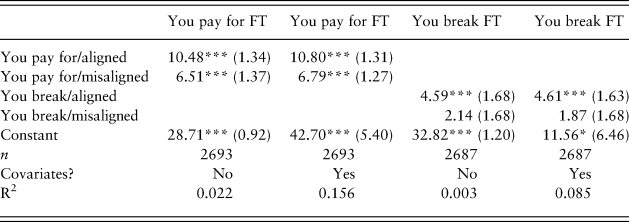
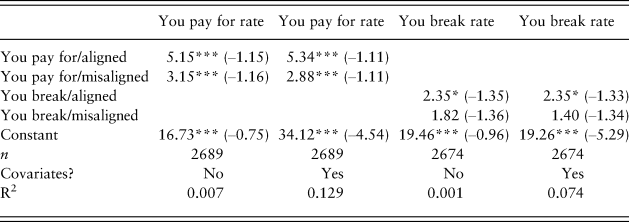
Tables 4 and 5 present the heart of our analysis. Table 4 displays effects on FTs for both experiments, while Table 5 displays effects on preferred tax rates. Both tables present results from ordinary least squares models in which we have omitted the “no-use” condition and rely on robust standard errors. In both tables, the first and third columns show effects without covariates, and the second and fourth columns present results with covariates. Pre-treatment covariates (including state-fixed effects) are included in the models with covariates. In addition, the models with covariates include dummy variables for the source of the tax in question, thereby better accounting for differential views toward taxing each source. In any event, the models with and without covariates yield substantively indistinguishable results.
Main feeling thermometer (FT) results (standard errors in parentheses).

*p < 0.10; **p < 0.05; ***p < 0.01.
Main rate results (standard errors in parentheses).

*p < 0.10; **p < 0.05; ***p < 0.01.
These straightforward models lend further precision to the conclusions apparent from Table 1. Whether one is being asked to evaluate a source–use combination of the “you break it, you buy it” or “you get what you pay for” variety, source–use alignment is associated with more positive attitudes toward the tax in question. As Table 4 shows, when accounting for covariates,Footnote 5 seeing an aligned “you get what you pay for” source–use combination causes FT responses to increase by 10.80 (p < 0.01). Meanwhile, seeing a misaligned “you get what you pay for” combination causes FT responses to rise by only 6.79 (p < 0.01). The difference between the effect of alignment and the effect of misalignment is substantively and statistically significant (p < 0.01).Footnote 6 To put these results in perspective, a one-point change in party identification is associated with a change of 1.56 in FT score (p < 0.01). The difference between the aligned and misaligned conditions is virtually equal to the estimate on a 2.6-point shift in party identification (i.e., greater than the effect of moving from “leans Republican” to “leans Democrat”).
For taxes and earmarks of the “you break it, you buy it” variety, the story is similar, though effect sizes are smaller. In the model with covariates, a “you break it, you buy it” source–use combination improves mean response to the FT outcome by 4.61 (p < 0.01), while seeing an earmark for a misaligned use has a more modest, statistically insignificant effect on attitudes. The difference between the aligned and misaligned conditions (p < 0.1) is now approximately equal to a 2.0-point shift on the partisan scale (i.e., from “lean Republican” to “lean Democrat”).
A broadly similar pattern is evident for the results from Experiment A in Table 5. There, we see that subjects’ preferred tax rates are higher for aligned source–use combinations than for misaligned combinations. In the model with covariates, an earmark of the “you get what you pay for” variety causes subjects’ preferred tax rates to increase by 5.34 cents (p < 0.01), as compared to a smaller, 2.88-cent effect of a misaligned earmark (p < 0.01). For Experiment B in Table 5, our analysis suffers from the lack of comparable unit sizes across conditions. The comparison between a tax per plastic bag and a tax per standard drink of alcohol is arguably apples-to-oranges, and so we might expect noise to obscure real effects. Although the effect of alignment is again in the expected direction, the error term is large, and we accord little weight to this finding.Footnote 7
In Appendix Tables A3 and A4, we report a suite of interaction models, in which we further investigate the relationship between partisanship and our effects. We find no substantively or statistically significant relationship between partisanship and preferences for alignment of the “you get what you pay for” variety. We do, however, observe a sharp, positive relationship between identification with the Democratic Party and warm responses to alignments of the “you get what you pay for” type. (Appendix Figures A1–A4 graphically display these models.) These findings are suggestive of possible links between consumer fairness perceptions and partisan leanings, though it would be premature to draw strong conclusions from this post hoc analysis. As Duhaime and Apfelbaum (Reference Duhaime and Apfelbaum2017) make clear, there seem to be strong connections between responses to information about taxation and political attitudes.
Discussion
Our study offers support for the notion that attitudes toward taxation are affected by source–use alignment – and, more specifically, that individuals are more likely to favor new or higher taxes when the source and use of funds are connected by familiar consumer fairness norms. While the effect of alignment on attitudes and rate preferences is more pronounced in Experiment A (“you break it, you buy it”), the appearance of a similar though smaller effect in Experiment B (“you get what you pay for”) leads us to believe that the phenomenon is not purely attributable to individuals’ affinity for a version of the benefit principle – the idea that taxes are (or ought to be) a price paid for benefits provided (Wicksell, Reference Wicksell, Buchanan, Musgrave and Peacock1958). These results lead us to believe that source–use alignment is potentially an important influence on public attitudes toward earmarked taxes.
Our results do not, importantly, suggest that source–use alignment (or lack thereof) is anywhere near a monocausal explanation for attitudes toward taxation. Coefficients of determination across all specifications are not high, indicating that views on taxation are influenced by a variety of idiosyncratic factors, including variables not captured here. Alignment, moreover, is not the only reason why earmarking elicits warmer attitudes toward taxation. Our results from Experiment A indicate that earmarking a tax for a misaligned purpose may have a positive effect on general attitudes toward the tax and on the preferred rate. The results in this regard from Experiment B are more mixed: earmarking a tax for the enforcement of laws against drunk driving appears to have a positive effect on attitudes and preferred rates irrespective of the alignment effect, but earmarking a tax for the enforcement of laws against littering has a slightly negative and imprecisely estimated effect.
Those results in particular may tell us more about attitudes toward individual expenditures than about alignment and misalignment overall. Expenditures on airports and highways appear broadly popular – the second more so than the first – and so attaching an earmark for airports or highways to a tax has the potential to increase support (consistent with the salience theory's prediction). Meanwhile, subjects back anti-drunk driving efforts more so than the enforcement of laws against littering, and may indeed have negative attitudes toward the latter expenditure, and so the earmarking of a tax for anti-drunk driving efforts seems to do more to boost support than an anti-littering earmark.
Source–use alignment is, to be sure, a subjective judgment. While we judged the tax on motor vehicle fuel in Experiment A to be aligned with highway spending and the tax on jet fuel in the same experiment to be aligned with airport funding, it is possible – for example – that some individuals evaluated alignment in Experiment A at a higher level of generality (e.g., viewing both taxes to be on transportation and both expenditures to be related to transportation infrastructure). Likewise, while we judged the tax on plastic bags in Experiment B to be connected by a “you break it, you buy it” rationale to the enforcement of anti-littering laws, it is possible that some individuals did not perceive plastic bags and litter to be closely linked. A challenge for future research will be to identify more precisely the conditions under which individuals perceive source and use to be aligned in ways that affect support for earmarked taxes.
Finally, we emphasize that our experiments included only US-based subjects, and we therefore cannot draw conclusions regarding preferences for alignment across countries and cultures. Chen et al. (Reference Chen2018) report substantial cross-cultural variation in consumer fairness perceptions, and we have no reason to believe that attitudes toward taxation are universal either. Beliefs about taxation are shaped by cultural norms, historical experiences and political contexts, and all of these factors may mediate views regarding the relationship between source and use. Subjects in experiments in Canada (Hsu et al., Reference Hsu, Walters and Purgas2008), the Netherlands (Steg et al., Reference Steg, Dreijerink and Abrahamse2006) and Norway (Saelen & Kallbekken, Reference Saelen and Kallbekken2011) all exhibit preferences that appear to be explicable on source–use alignment grounds, though – as noted above – it is impossible to say for sure that alignment is driving the results in those experiments. Moreover, while those studies are suggestive of source–use alignment preferences among residents of other Western industrial democracies, they certainly do not prove the existence of similar preferences in more culturally distant societies.
Conclusions and implications
Our results illustrate the potential relevance of the consumer behavior literature to the study of public opinion regarding taxation. We are far from the first to apply behavioral insights to the study of taxation (for reviews, see Congdon et al., Reference Congdon, Kling and Mullainathan2009; McCaffery, Reference McCaffery2014). However, only a small subset of the behavioral tax literature focuses on attitude formation (e.g., McCaffery & Baron, Reference McCaffery and Barron2004, Reference McCaffery and Barron2006), and an even smaller subset seeks to connect consumer behavior to tax preferences (e.g., Lamberton, Reference Lamberton2013). No other paper – to our knowledge – applies the principle of dual entitlement from the consumer pricing context to the tax context. Our findings suggest that the way individuals form opinions about tax may be linked to norms of consumer fairness, and thus that insights from the study of consumer behavior may assist policy-makers in developing taxes that achieve broad public support.
We envision that future research on source–use alignment will follow three paths. First, we plan to – and urge other researchers to – attempt to replicate our results using different combinations of taxes and expenditures. The taxes considered here are – for the most part – broadly based: nearly half of Americans have flown on an airplane in the past year (Heimlich & Jackson, Reference Heimlich and Jackson2018); the vast majority drive or ride automobiles and use plastic bags; and more than 70% of American adults have consumed alcohol in the past year (National Institute on Alcohol Abuse and Alcoholism, 2018). A fruitful avenue for future experiments will be to see whether preferences for alignment are stronger or weaker with respect to taxes that fall on narrower segments of the population.
Second, we hope to delve more deeply into the psychological foundations of voter preferences for source–use alignment. At present, our hypothesis is that preferences for alignment in the tax context are based on norms of fairness also common to the consumer context, but we have remained agnostic about causality. One potential way to isolate the causal effect of consumer norms on attitudes toward taxation is to evaluate whether individuals exhibit stronger preferences for aligned taxes and expenditures after seeing consumer-related primes, which have been shown to affect political preferences in previous studies (e.g., Whelan et al., Reference Whelan2016).
Finally, we look forward to future work that assesses the external validity of our findings. This will entail the collection and evaluation of data on referenda regarding earmarked taxes. More than 1300 tax- and revenue-related measures have appeared on ballots across 45 states since 1906 (National Conference of State Legislatures, 2018), and we have begun collecting information on these measures in order to test the hypothesis that earmarked taxes fare better at the polls when source and use are aligned. While the non-random nature of referendum proposals limits our ability to derive concrete conclusions from election results, the success and failure of aligned and misaligned tax-and-spending initiatives at the ballot box nonetheless may offer insights as to the relationship between laboratory results and voter behavior.
For policy-makers, the implications of our findings are nuanced, though potentially significant. Where tax-related measures are put to a popular vote, our findings provide guidance to legislators and initiative drafters on crafting earmarks likely to elicit broad support. In other states and at the federal level, where the link between public opinion and tax policy is more attenuated, earmarking tax revenues for aligned uses may elicit warmer attitudes toward taxpaying. Such perceptions may be important in their own right – independent of their effect on policy adoption – if, as other research suggests, tax compliance increases with overall tax morale (Lamberton et al., Reference Lamberton, De Neve and Norton2017; Luttmer & Singhal, Reference Luttmer and Singhal2014).
We caution that policy-makers still must weigh the perception benefits of source–use alignment against the rigidities that earmarking introduces to the budgeting process, and we do not suggest that the balance will tilt in favor of aligned earmarks in every case. Our more modest normative claim is that policy-makers who are designing tax regimes with a view toward public support and acceptability should do so with full information about the factors shaping lay attitudes. Alignment, we submit, is one such factor – potentially meaningful in many cases, and heretofore unappreciated in the scholarly literature.
Acknowledgments
We thank Yun-chien Chang, Alexander Hertel-Fernandez, William Howell, Lior Strahilevitz, Miranda Yaver, Thomas J. Wood, participants in the Psychology and Law Studies Lab at the University of Chicago Law School and the anonymous referees for their guidance and comments. All errors are our own.
Supplementary material
To view supplementary material for this article, please visit https://doi.org/10.1017/bpp.2019.20.