




No CrossRef data available.
A specialist nurse-function in neurooncology: A qualitative study of possibilities, limitations, and pitfalls
Published online by Cambridge University Press: 07 December 2005
Abstract
Objective: Brain tumors, a cancer that affects the cortical processes, have a substantial social impact. Typically, malignant glioma is a brain tumor with a poor prognosis; few patients survive more than two years after diagnosis. In the last several years, different groups have documented how this disease affects a patient's quality of life. These findings have resulted in new ways for nurses to improve the care for these patients and their spouses. However, these initiatives have not been studied in a systematic way. This study investigates how patients with malignant glioma and their families respond to a special nurse, a nurse specifically instructed to address the needs of the patient and the patient's family.
Methods: Sixteen patients and their next-of kin were included. At the time of diagnosis, the special nurse offered to serve as a resource to the patient and the patient's family. During the whole course of the disease, the nurse recorded her interactions with the patients and the patients' family. In addition, the spouses were interviewed after the patient's death. Data was analysed qualitatively with focus on tasks and relationships.
Results: Four relationships between the special nurse and the family were detected: 1) a resource for the whole family; 2) a parallel resource within the family; 3) a resource for the next-of kin; and 4) a resource for the patient. Most of the patients and their families found this program beneficial. The nurse provided the patient and family with several functions. In some cases the family and nurse interaction developed into a closer relationship, a relationship based on the nurse's availability and concern for the patient's and family's welfare.
Significance of Results: This close relationship underlines the importance of the nurse's professionalism and a systemic perspective for understanding the nurse's function within the milieu of a cancer patient's family.
Information
- Type
- Research Article
- Information
- Copyright
- © 2005 Cambridge University Press
INTRODUCTION
Recently, health care has transitioned from hospital care to home care, presumably to increase productivity and effectiveness (e.g., Given et al., 2001). This development involves both acute medicine and palliative medicine. This strategy increases the family's responsibility as caregivers. Until recently, research has focused on the patient. Gradually this focus has been supplemented by research that addresses the spouse (e.g., Keitel et al., 1990). A family member who provides palliative health care for a relative experiences a great deal of stress. Several studies note that healthy spouses of cancer patients may indeed feel worse than the patient (Keitel et al., 1990; Koop & Strang, 2003; Winterling et al., 2004). In palliative and homecare medicine, the concern for the family should be self-evident, a view that is part of the palliative philosophy; however, this is not the case for acute medicine. Specialist nurse-functions and support groups address the needs of the patient.
Although the functions of a specialist nurse are designed to improve the health care for patients, the definition of “specialist nurse” is unclear. In some countries a “specialist nurse” is related to educational level, but in this study we define it more broadly: a “specialist nurse” is a nurse who cares for certain types of patients. The term may refer to education and knowledge as well as experience and interest.
There are several types of specialist nurses. In cancer care, specialist nurses mainly care for breast cancer patients (Jary, 1996). Several studies conclude that specialist nurses can provide adequate information and caring for cancer patients during the disease and during rehabilitation (Jary, 1996; Hordern, 2000; Boxhall & Dougherty, 2003). Potential problems, however, with the specialist nurse-function are rarely scrutinized.
Brain tumor disease condenses much of the anguish associated with cancer diseases. Brain tumor diseases sooner or later result in physical as well as mental deficiencies that can change the patient's personality, a prognosis and outcome that adds stress to the family, especially when family members serve as care providers (Salander et al., 1996; Davies & Higginson, 2003; Sherwood et al., 2004). Therefore, brain tumors are a family matter and family members eventually become involved in the care for the sick family member (Wideheim et al., 2002). In spite of this, few studies address the role of a specialist nurse as a potential provider of support. The few studies conducted have mainly examined how telephone follow-up calls affect the patients and spouses. Sollner et al. (2001) found that a telephone service made it easier for patients and spouses to disclose emotional concerns, and Sardell et al. (2000) evaluated a nurse-led telephone clinic, a program that provided an appreciated service. The main finding is that additional nurse interventions are supportive (Davies & Higginson, 2003). Nevertheless, there are no systematic studies investigating how brain tumor patients and their families make use of a specialist nurse when she offers to serve as a resource for them.
This study investigates how the family responds to the implementation of a specialist nurse as a resource for the patient and family's needs. How do patients and next-of-kin respond to the invitation and what can we learn about the role of a specialist nurse? The study was conducted in a northern European context using an action research approach.
METHOD
Methodological Considerations
This study is part of a larger project: “Brain tumor, family and hospital staff—exposed positions and helping structure.” The prime focus of the study is not whether a specialist nurse function is valued as good or bad. That is, the study is not focused on attitudes but on activities. What happens when a specialist nurse is used? How do patients and next-of-kin respond to the invitation? Which tasks do they give the nurse? How can we understand the needs of the family and improve our response to these needs?
Action research designs bridge the gap between the clinician and the researcher (Morton-Cooper, 2000). It combines systematic registration of data with being close to the phenomena of interest. It is simultaneously a form of inquiry and a form of practical action. The perspective is anthropological, and the goal is to improve practices that benefit people who are vulnerable or oppressed. These people may find it difficult to secure their needs from health care and social care systems (Winter & Munn-Giddings, 2001). In this study, we examine how a specialist nurse assists patients with malignant glioma and their families. We collected data from everyone participating: the specialist nurse, patients, and family members.
The Specialist Nurse Presentation
In this study, the specialist nurse (SN) had 15 years of experience and was educated as a specialist in oncological care. After the patient was diagnosed at the department of neurosurgery, the SN contacted the patient and, if present, the next-of-kin. She presented herself as a resource for brain tumor patients and their families: a link between the patients and their families and the hospital. She gave them her phone number, and told them that she was available during the day. She ended this first contact by asking the patients if they preferred her to initiate the next contact or if they preferred to initiate the next contact. The approach was active, but respected the patient's integrity. People with severe diseases may become passive, making it difficult for them to ask for help.
The local committee on ethics approved the study (01-005).
Participants
At a university hospital in northern Sweden, sixteen consecutive patients with the diagnosis of malignant glioma (astrocytoma grade III-IV) were prospectively included in the years of 2001–2002. The inclusion criteria were as follows: age between 18 and 75 and a performance status of 0–2 according to the WHO scale. Only two patients failed the inclusion criteria and all included patients and their partners agreed to participate in the study.
Data
This study is based on following data.
Field Notes
The SN registered all contacts between herself and the patient, family members, or other staff members during the whole course of the disease: Who contacted whom, about what, and with what outcome. The nurse recorded her conversations in writing.
Interviews
Patients and next-of-kin were repeatedly and separately interviewed every third month. The interviews were conversational interviews that complemented the field notes and focused on certain themes: experiences of medical care; knowledge and ideas about the disease; relation to partner and family; interests and future plans. The second author interviewed the spouse after the patient's death. These interviews focused on the spouse's experience with the health care and the SN during the disease process. This study is based on field notes and interviews from 16 cases and summarizing interviews with ten spouses (at present three of the included patients were alive, one spouse was not contacted because of ethical reasons due to special circumstances and two spouses has not been available).
Data Analysis
Data was processed using the following steps:
- The first two authors read all field-notes and interviews and independently constructed summaries of each case (Polkinghorne, 1995). The summaries included a short descriptive case story and a reflective part. The summaries focused on the relationship between the SN and the patient and his/her family.
- The authors independently compared all descriptive stories to find similarities and differences (Strauss, 1987) in how the patient and/or next-of-kin made use of the SN. Four categories emerged after a discussion aimed at “dialogic intersubjectivity” (Kvale, 1996).
- The first two authors independently sorted all cases into the four categories. No disagreements were noted.
- The authors selected four case summaries representative of the four categories. These summaries were re-edited as narratives from the SN's perspective.
- From the notes of the final interview with the spouses, the second author collected expressions that revealed positive and negative experiences with the SN.
FINDINGS AND REFLECTIONS
When focusing on how the families made use of the SN, we identified four categories. Table 1 presents the participating patients and the frequency of contacts with the SN. Typically, she had one or two contacts with the patient or a member of the family every week. With the exception of the fourth category, “A resource for the patient,” it was more common that the SN had contacts with the next-of-kin than with the patient. Each category is presented with a case presentation as a narrative from the SN's perspective and with a summary of follow-up interviews with the next-of kin. In addition, we present some reflections regarding the course of events.
The participating patients (P) and next-of kin (N) in the four categories distributed according to age and sex: total number of contacts with the SN (Contacts), the number of family members the nurse was in contact with (Family members), the number of weeks until death the contact persisted (Weeks), and whether the contact with the next-of kin persisted after the patient's death (Contacts post-death).

A RESOURCE FOR THE WHOLE FAMILY (5)
This category includes the five cases where the SN function is characterized by a relationship with the family as a whole, i.e. being in contact with one family member implied being in contact with the whole family. There did not seem to be secrets. Instead, the family members openly shared information, concerns and worries. Linda and her family will be our example of this category.
Linda and Her Family
I met Linda, a 22 years-old woman, and her parents at the Department of Neurosurgery. When I introduced myself, the parents spontaneously responded “at last.” Because of other medical problems in the family, they had experienced many disappointments with other health care providers. This meant they were very interested in using the SN. At the beginning, the contacts were by telephone. The parents called me due to uncertainties and I informed them about planned visits, examinations, and treatments. Linda and her parents expressed that they also wanted me to phone them “just to be in touch.” Before the disease became too difficult, Linda and I regularly talked with each other on the phone. I attended at the physician-consultations and I clarified the information the family had received from physicians and from other members of the staff.
As the disease progressed, the family telephoned me to bring me up to date about their daughter's health and their own despair about Linda losing her dignity. They also invited me to their home to see a film about a journey they made together with Linda a few weeks ago. Her younger sister who lived by herself in another town also called me to talk about her sick sister, but she primarily talked about her own problems. When I arrived at the family's house, Linda's health had deteriorated. The father had panicked earlier that day, but as the mother wanted my opinion, he didn't go to hospital until I had showed up.
The following day Linda was admitted to the hospital. The father contacted me and urged me to accompany them to the ward. Linda died soon after this contact and after her death the father asked me to accompany Linda's mother when informing grandmother that her grandchild had died. One and a half years after Linda's death, her parents continue to contact me to tell me about their family.
Follow-up Interviews
Overall, these spouses expressed themselves in a very positive and appreciative tone. Some noted that their earlier experiences with health care providers had not been satisfying because they had felt left out. In contrast, they said they felt connected to the SN. She had no white coat, felt less distant and she anticipated their needs. As an example, the SN recommended that they should consider seeing a social worker, a consideration they had not entertained before meeting the SN. One of the spouses concluded, “We did not view her as a stranger…. In a sense, she was both private and professional.”
Reflections
The family wanted the nurse to arrange what they needed: to catalyze the health care system, to inform them of developments, and to help devise strategies for dealing with the health care system. In addition, they wanted emotional support. Through the SN, contacts with the health care system were facilitated, medical competence felt closer implying that the family felt more secure and time was left to family relationships.
The relationship between the SN and the family changed as she became closer to the family. Everyone in the family wanted to develop a relationship with her, even Linda's sister who talked about her own problems not directly connected to Linda. Her central position within the family was also evidenced by the importance of her attendance at Linda's deathbed and their desire to help them inform Linda's grandmother. Perhaps, the increasing importance of the SN depended on her “staying in touch.” In this way, the family successively got to know the SN as a concerned person and a reliable professional. Because the family continuously informed her about the situation she could assist them. By the time Linda died, the family was psychologically exhausted. They relied on the SN's concern, competence, and experience to deal with the situation.
Linda's father described the SN this way: “She has shared very important experiences with us which makes her our friend for the rest of our lives.” Indeed, the family still keeps in contact with the SN.
A PARALLEL RESOURCE WITHIN THE FAMILY (4)
In this category it seemed as if the patients and the spouses were co-operating well, but they did not share everything about the disease and the role of the SN. Each family member was aware of the other's contacts with the SN; some even discussed her role, but it seemed to be important for each family member to have an independent relationship with the SN. Maria and John will be our example.
Maria
Maria is a 58-year-old housewife; she is married to John and they have two adult children. She initially contacted me because she wanted “to talk to someone.” During her hospital stay she met me regularly to ask about the disease and to ask for assistance with practical tasks. She also wanted me to walk with her, exercise she needed to do to develop her muscles.
After being discharged, Maria wanted me to call her once a week. She often called with questions about her disease and concerns about her situation. Typically, when she was finished, she gave the phone to John, left the room, and closed the door. Maria and John also called on New Years Eve to wish me Happy New Year. Before leaving town for a few days, she told me where I could reach her.
Maria's health deteriorated and her medical care was taken over by the local hospital. When confronted with the palliative phase, she again contacted me and said “John says nothing, but I can talk to you about everything—I dare to tell you everything.” When unable to call on her own, Maria requested that her daughter and John call me.
John
When I first met John, he was not very talkative. Because he was unable to be around Maria during her treatment, he wanted me to phone him at home once a week. These phone calls dealt with different subjects, not the least his relationship with Maria and his own changed life situation. He let me know his worries about Maria, his difficulties with enduring her change in mental function, and the fact that their neighbors only asked him about his wife's illness and did not seem to relate to him as a person. He said, “It's nice to talk to you about other things than Marie's disease.” He felt he was taking part in spite of being absent. He said he felt as if our phone calls had linked him closer to the hospital and closer to Maria.
When his wife's health became worse, he shared his worries with me, but he also told me that he, in contrast to his wife, was prepared to accept the unacceptable. Just a few hours after Maria's death, John called to inform me about her death, but he also told me that he wanted to keep in touch.
Follow-up Interviews
These spouses stated that they and their partners appreciated the contact with the SN. They contacted her themselves to get information as well as “just to have a talk.” A majority of them also felt that they knew the SN well although they just had known each other for a limited time. One of the spouses said they got “to know each other under very specialist circumstances.”
Reflections
Even if the couple seemed to have a good relationship, it went without saying that each of them wanted their own contact with the SN. This may be because of different exposed positions and because of mutual unexpressed tacit knowledge about different ways of dealing with stress. Whereas Maria did not want to accept her approaching death, it was easier for John to accept this. He was more occupied with side effects influencing his own life. Similar to disease progression, these different crisis trajectories became more obvious.
We believe that the phone calls to the SN made John feel closer to Maria because the calls lessened his feelings of guilt for being absent. Leaving out moral valuations, we may propose that these conversations made it easier for him to go on living his own life.
A RESOURCE FOR THE NEXT-OF-KIN (3)
In these cases, the spouses telephoned the SN; this was the first contact. Dysphasia and/or paresis struck their sick partner; the spouses felt uninformed and left out. Greta will be our example of these spouses.
Greta
Greta, a 55-year-old bank clerk with two adult children, was eager to tell me her story. She was disappointed because of a lack of information and because they had to wait for treatment of her husband's brain tumor. She described the situation as chaotic. They wanted to change doctors and she wanted me to help her do this. At the same time, she wanted to tell me their life story.
In addition to direct questions, Greta contacted me when things became worse. For example, she telephoned me when her husband had headaches or seizures. She was burdened by the responsibility for the care of her husband and a central topic in our talk was the use of steroid medication. She also wanted me to meet her son and his girlfriend in order to explain the state of his father's health. After meeting his girlfriend, the son phoned to inform me that they felt shut out by Greta. At this time, I decided to intervene by trying to open up the communication between Greta and her adult children.
Later Greta asked me to accompany her when staff planned the further treatment for her husband. She also wanted me to call her at home every day her husband stayed at home. She always called me during his hospital stays as well as when he was admitted to the hospice. After he died at the hospice, she immediately called me to inform me what was happening. A week later she again called just to tell me that “I will be away for a weeks time—just want you to know.”
Follow-up Interviews
These spouses were primarily focused on how the SN helped them deal with the diseased relative's symptoms or problems. They noted that repeated contacts and advice concerning how to deal with seizures and steroid treatment helped them understand “the process.” They also mentioned that when the SN was asked to return a telephone call, she did: “you definitely knew she would.” One concluded that she was the most important person next to the surgeon. The same person, however, also told the SN that she had to prioritize, otherwise she would burn out. Another spouse said it would have been even better if they had met her earlier, when they arrived at neurosurgery.
Reflections
Greta was a competent person eager to be in control of her life. When a life-threatening disease struck her husband and they were given confusing information, she lost control and her life became chaotic. In a sense, the SN created order by supplying her with understandable information and practical advice.
Her husband's symptoms were difficult to control and to cope with. She felt guilty that she was unable to deal with her husband's symptoms at home and that she needed the help of a hospital or a hospice. Because Greta was continuously connected to the SN (and her physician), she was able to adjust the steroid doses to lessen hospital visits. These connections meant that the “hospital” was with them at home, increasing their autonomy.
The SN function gradually widened, from an instrumental function of giving information and putting things together for the next-of-kin to an advocate for the family who mediated between the healthy family members. She was expected to take part in decisions about the care for the sick family member.
Greta and the other next-of-kin in this group had early contact with the SN and were eager to tell their personal stories about the life they had lived with their sick partner. These stories may be the result of their feelings of being left alone. This may have corresponded to their need to be connected to a helping relationship. We think that the continuous contacts gave the professional relationship a personal touch, and it is reasonable to believe that this relationship helped to facilitate the spouses' grieving-process.
A RESOURCE FOR THE PATIENT (4)
In this category, the SN introduced herself to the four cases as in all other cases, but in this group the patients contacted her first, and she had few contacts with the spouse or other family members. These four patients had no obvious deficits and, initially, they were only affected by their disease to a very limited extent. They were reticent about their family's involvement with their disease, and they wanted to manage for themselves. David will be our example.
David
David is a 62-year-old businessman with two children and he had no experience with the health care system. I met him for the first time at a physician consultation before radiotherapy. He seemed interested in contacting me, and I assisted when he received his final diagnosis of malignant glioma. During his stay at the hospital, we met regularly. When we met, there was initially an exchange of medical information. As time passed, he began to share his story. He also wanted advice on how to exercise and how to approach his disease in order to get well. He talked about his leisure activities and his worries about the future.
He repeatedly expressed that he was unable to share his worries with his family. Since he was a strong person, it was impossible for him to show the family his despair and weakness. It was important for him to be an active person in charge of his own life, and he expressed himself as being convinced that the disease was to be no more than an inconvenience in his life. The contact continued after treatment; he called from home to talk about things that bothered him, but he also wanted to know how I managed in my life. He said, “I just wanted to call to hear how you are.”
With the exception of when he asked me to inform his wife about the final diagnosis, it was obvious that David did not want me to be in contact with his family. Actually, he only mentioned them in passing. The last time we had contact was when he called due to worries about symptoms. I arranged for a referral to the local hospital. David fell into coma for the last two months of his life. Except for the follow-up summary, I had no further contacts with his family.
Follow-up Interviews
The spouses declared that they understood that their diseased partner really appreciated the SN and the SN's regular visits. They had contacted her just a couple of times, and these contacts concerned practical matters. They had difficulties remembering. Obviously, the SN function did not have a great impact on their situation.
Reflections
Although David excluded his family, he let the SN share in his “secret.” There was a personal dimension in his way of relating to the SN, a relationship that might have substituted the SN for the wife. By this means he received support without changing his position within the family system.
DISCUSSION
It is obvious that different patterns in the relationships developed between the various families and the SN. Overall, she became an available link between the family and the hospital. She provided additional information about the disease, treatments, and appointments at the hospital, assisted during physician consultations, and provided new acute consultations. In addition, she was present at the ward when planning for care. She forwarded medical advice primarily concerning steroid treatment, stayed in touch, and provided support to patients and family members in despair. She mediated family conflicts, was present at time of death, and assisted relatives.
The case presentations demonstrate that the SN function should be understood as a relational function rather than merely as a service function. The significance of the SN's relationship to the family is made clear by the fact that the SN showed up at the time of diagnosis and was an active companion during the entire course of the disease. Within twenty-four hours after a patient died, the spouse called the SN. She entered when their lives were in existential plight (Weisman & Worden, 1976) and provided assistance and guidance. Although the impact of the SN function on the participating patients' and spouses' lives differed considerably, several spouses in the summarizing spouse interview spoke of her as “a good fairy.” They wanted her to “be in touch” and they related to her in a personal way as expressed in greetings at New Years Eve, invitations, and the like. Relating personally may be seen as a logical consequence when vulnerable people meet a person who is active and flexible in giving support. The SN was committed to actively taking responsibility for contacting her charges. She was flexible in the sense that she tried not to see obstacles but to find solutions to the specific problems. This closeness in some of the cases transformed the relationship qualitatively, from the spouses' perspective the relationship was professional, but also personal. The stereotyped barrier between hospital and patient, i.e. ‘impossible to get in contact and get some help’, was removed. Their vulnerability and the SN's engagement paved the way for the personal dimension. Previous studies note that patients understand the importance of being close to a care provider, feeling welcomed and acknowledged, and engaged in a personal relationship (Salander, 2003).
The function of the SN cannot be reduced to a compensating function for unsatisfactory patient-physician relationships. In fact, most patients and families were quite satisfied with their relationships with their physician; however, physicians are in their own organizational structure, a structure that does not allow for availability and flexibility. The SN may provide these functions for the patients and their families.
Possibilities
We believe that the SN function as a helping relationship is based on the close relationship that the SN developed with her patients and the patients' families as well as her knowledge and experience. These dimensions are closely linked. The fact that the patients and families experienced her as close to them made it easier for her to communicate potentially upsetting information such as believing that it is a good idea to contact the hospice: the helping relationship per se is seen as protective. To prepare without taking away hope (a positive expectation about the future) is always difficult. However, the spouses appreciated this tacit guidance from the SN. It seems to have given them a more secure base. The importance of this guidance by being a step ahead has recently been emphasized by others (Sherwood et al., 2004).
It is reasonable to believe that the crisis trajectories of the spouses who made use of the SN function were helped by their interaction with the SN. The closeness to the SN provided them with an outside perspective and a platform for continuous reflection about the situation. It is important for spouses of brain tumor patients to have vital relationships outside family relationships (job, close friends, health care, etc.) (Salander et al., 1996). It has also been shown that spouses experience stress when they cannot share the diseased partner's situation (Salander & Spetz, 2002). They are torn between loyalty to their partner and to themselves. The platform provided by the relationship with the SN may have made it easier for them to be loyal to their own needs, a loyalty that is often ignored when a loved one is ill.
The repeated telephone contacts with the available SN, not the least concerning a flexible regulation of steroid treatment, increased the family's autonomy. By keeping the patients close to health care, the SN made most patients and next-of-kin feel more safe and secure. Whether this decreased the trips to the hospital is unknown. This question is beyond the scope of the present study. However, the SN's relationship with the patients and the patients' families seemed to have helped reduce the number of physician consultations as well as trips to the hospital. In a study that focused on a specialist nurse function for patients with prostate cancer, Higgens (2000) noted that the use of a SN decreased the cost of health care while it increased the quality of health care.
Limitations
These findings focus on just one SN. She was an experienced nurse specialized in oncological care with an active and flexible approach acknowledging that exposed persons are not always capable of asking for help. The findings tell us that this approach was appreciated. However, the function cannot be regarded as separate from the person performing the function. We do not think that the present findings are consistent with a function carried out by an inexperienced, insecure, and passive nurse. Furthermore, the SN should be understood in the context of the SN's relationships with physicians and other staff members, an approach that requires an SN to be seen as a competent nurse.
Pitfalls
The tendency to idealize the SN is a sign of their exposed position. To be looked upon as “a good fairy” may be alluring. It is nice to receive appreciation, but it is risky in the sense that the SN may become too close to the patients and their families to keep up a professional approach. Out of the SN's own desire to be appreciated, the families' competence may be substituted with her own, implying that they loose initiative. For example, was it necessary for the SN to intervene between Greta and her younger relatives? What if Greta, with some support, dealt with the situation herself? The closeness to the family may also result in conflicts between the SN and other staff members. Patients or spouses may dislike other nurses because they appear less committed than the SN. One of the spouses hinted at the SN's tendency to over elaborate; she claimed the SN had to prioritize. The SN has to realize that her psychosocial competence is limited and that it is not her mission to perform the tasks of a psychologist, social worker, physiotherapist, or occupational therapist. Curren (2001) has identified the complex needs of this group of patients and stated that they cannot be dealt with by one person alone.
From a systemic perspective, we may also challenge the impact of the SN function. John and Maria had parallel contacts with her. John was at home, but expressed that his phone calls with the SN linked him to Maria at the hospital. Although he was quite satisfied, the SN function may have made him less eager to visit his wife. Is the category “a parallel resource within the family” a consequence of the implemented SN function per se? In a similar sense, we may scrutinize whether the contacts with the SN made David and the other patients in the “resource for the patient” category less interested in being in close contact with their next-of-kin?
The SN represented different primary family positions similar to those presented in transaction analysis (Berne, 2004). In the case of Linda and her family, the SN became the wise experienced person the whole family looked to in a crisis; she became the good parent providing guidance. In the parallel case, SN was the supportive sibling to Maria and John. Greta's relationship to the SN developed into an alter-ego. In the case of David, even if less apparent, she was a stand in for his wife. The fact that it is rather easy to associate to different family positions confirms the personal dimension in the SN function. This may also be looked on as a warning sign, a warning that we are in the transitional zone between being personal and being private. In our mind, being personal deepens the professional relationship, while being private confuses the relationship, a confusion that blurs the line between being a professional and being a friend. Being private implies that the focus of the interaction momentarily shifts from the patient to the nurse. The interaction loosens the asymmetry embodied in the professional relationship, placing the nurse and patient on the same level: their psychological needs are fulfilled by their mutual relationship. In professional relationships, the focus of the interaction never leaves the patient: the nurse responds to the patient's needs, not the nurse's needs. Because being alone is being vulnerable, the function of the SN should be performed by at least two people. Needless to say, a supporting working atmosphere promoting open discussion and reflection is important.
Conclusions
A specialist nurse who responded actively to the needs of brain tumor patients and their families was a great benefit for most of those concerned. She provided them with different instrumental functions, but her availability and willingness to assist created a relationship that had different meanings, a relationship that significantly reduced their stress. The potential interactional intensity and the evolved closeness in the relationships stresses the importance of the nurse's experience and actualizes reflection on her/his own professional integrity. There is a risk of being private, too engaged, an attitude that may negatively affect the relationships within the family and with other health care workers. Further research on similar specialist nurse functions should focus on the restraints of the function and the systemic consequences of the interventions.
ACKNOWLEDGMENTS
This study was supported by grants from the Research Foundation of the Department of Oncology, Umea University and the Swedish Association for Cancer and CTRF.
References
REFERENCES
Berne, E.
(2004).
Games People Play: The Psychology of Human Relationships.
London:
Penguine Books.
Boxhall, S. &
Dougherty, M.
(2003).
An evaluation of a specialist nursing role for men with prostate
cancer.
Urologic Nursing,
23,
148–152.Google Scholar
Curren, J.R.
(2001).
Support needs of brain tumour patients and their carers: The place
of a telephone service.
International Journal of Palliative Nursing,
7,
331–337.Google Scholar
Davies, E. &
Higginson, I.J.
(2003).
Communication, information and support for adults with malignant
cerebral glioma: A systematic literature review.
Supportive Care in Cancer,
11,
21–29.Google Scholar
Higgens, D.
(2000).
The role of the prostate cancer nurse specialist.
Professional Nurse,
15,
539–542.Google Scholar
Hordern, A.
(2000).
The emerging role of the breast care nurse in Australia.
Cancer Nursing,
23,
122–127.Google Scholar
Given, B.A.,
Given, C.W., &
Kozachik, S.
(2001).
Family support in advanced cancer. CA:
A Cancer Journal for Clinicians,
51,
213–231.Google Scholar
Jary, J.
(1996).
The role of the specialist nurse in breast cancer.
Professional Nurse,
11,
664–665.Google Scholar
Keitel, M.A.,
Cramer, S.H., &
Zevon, M.A.
(1990).
Spouses of cancer patients: A review of the literature.
Journal of Counselling and Development,
69,
163–165.Google Scholar
Koop, P.M. &
Strang, V.R.
(2003).
The bereavement experience following home-based family caregiving
for persons with advanced cancer.
Clinical Nursing Research,
12,
127–144.Google Scholar
Kvale, S.
(1996).
Inter Views: An Introduction to Qualitative Research
Interviewing.
Thousand Oaks:
Sage.
Morton-Cooper, A.
(2000).
Action Research in Health Care.
Oxford:
Blackwell Science.
Polkinghorne, D.E.
(1995).
Narrative configuration in qualitative analysis. In
Life History and Narrative,
Hatch, J.M. &
Wisniewski, R. (eds.), pp.
5–23.
London:
Falmer.
Salander, P.,
Bergenheim, T., &
Henriksson, R.
(1996).
The creation of protection and hope in patients with malignant
gliomas.
Social Science & Medicine,
42,
985–996.Google Scholar
Salander, P.
(2003).
Bad news from the patients perspective: An analysis of the written
narratives of newly diagnosed cancer patients.
Social Science & Medicine,
55,
721–732.Google Scholar
Salander, P. &
Spetz, A.
(2002).
How do patients and spouses deal with the serious facts of malignant
glioma?
Palliative Medicine,
16,
305–313.Google Scholar
Sardell, S.,
Sharpe, G.,
Ashley, S.,
et al.
(2000).
Evaluation of nurse-led telephone clinic in the follow-up of with
malignant glioma.
Clinical Oncology,
12,
36–41.Google Scholar
Sherwood, P.,
Given, B.A.,
Doorenbos, A.Z.,
et al.
(2004).
Forgotten voices: lessons from bereaved caregivers of persons with a
brain tumour.
International Journal of Palliative Nursing,
10,
67–75.Google Scholar
Sollner, W.,
DeWries, A.,
Steixner, F.,
et al.
(2001).
How successful are oncologists in identifying patient distress,
perceived social support, and need for psychosocial counselling.
British Journal of Cancer,
84(2),
179–185.Google Scholar
Strauss, A.L.
(1987).
Qualitative Analysis for Social Scientists.
New York:
Cambridge University Press.
Weisman, A. &
Worden, J.W.
(1976).
The existential plight in cancer: Significance of the first 100
days.
International Journal of Psychiatry in Medicine,
7,
1–15.Google Scholar
Wideheim, A.K.,
Edvardsson, T.,
Påhlson, A.,
et al.
(2002).
A family's perspective on living with a highly malignant brain
tumor.
Cancer Nursing,
25,
236–244.Google Scholar
Winter, R. &
Munn-Giddings, C.
(2001).
A Handbook for Action Research in Health and Social Care.
London:
Routledge.
Winterling, J.,
Wasteson, E.,
Glimelius, B.,
et al.
(2004).
Substantial changes in life: perceptions in patients with newly
diagnosed advanced cancer and their spouses.
Cancer Nursing,
27,
381–388.Google Scholar
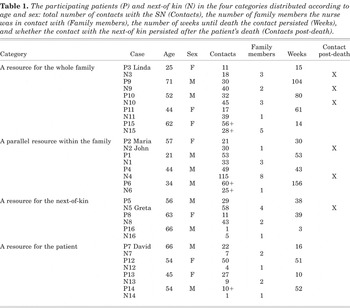
The participating patients (P) and next-of kin (N) in the four categories distributed according to age and sex: total number of contacts with the SN (Contacts), the number of family members the nurse was in contact with (Family members), the number of weeks until death the contact persisted (Weeks), and whether the contact with the next-of kin persisted after the patient's death (Contacts post-death).
 You have
Access
- 23
- Cited by