Late in 2016, the government of Portugal announced plans to introduce a sugar tax on soft drinks (Agence France-Presse, 2016). The proposed measure, which took effect in February 2017 (TPN/PA, 2017), imposes an excise duty on high-sugar drinks, with exemptions for certain beverages including milk, soya and rice-based drinks; fruit, vegetable and algae juices and nectars; drinks with cereals, almond, cashew and hazelnut; and drinks for special dietary needs or dietary supplements. The tax base and rates are established at 16.46 euros per hectolitre for beverages with sugar content equal to or more than 80 g/l, while beverages with sugar content lower than 80 g/l are taxed at 8.22 euros per hectolitre. The revenue for this tax will be utilised for public health purposes and specifically to improve the national health system (CITE, 2016). It has been reported that, six months post implementation of the tax, sales of the taxed products has dropped by up to 72% (TPN/PA, 2017).
Portugal is among a rising tide of countries that have either implemented or proposed plans to introduce taxes on sugar-sweetened beverage (SSBs) (World Cancer Research Fund International, 2017a). In 2011, Hungary introduced a Public Health Product Tax (PHPT), applying to products containing unhealthy levels of sugar, salt and other ingredients, including soft drinks with added sugar and energy drinks (WHO Regional Office for Europe, 2015). France introduced an excise tax on drinks with added sugar and artificial sweeteners that took effect in 2012. In 2016, Mauritius extended an existing excise tax on the sugar content of soft drinks to include any non-alcoholic beverages containing sugar, including juices and milk-based beverages. French Polynesia, Tonga and Fiji have all implemented taxes on SSBs (Snowdon, 2014; World Cancer Research Fund International, 2017a).
In 2014, Mexico sought to combat record levels of consumption of sugary drinks by implementing an excise tax on non-alcoholic beverages with added sugar. In June 2015, the government of Barbados passed a 10% excise tax on locally produced and imported sugary drinks, including carbonated soft drinks, juice drinks, sports drinks and others (World Cancer Research Fund International, 2017a). In March 2017, the UK Government announced plans to introduce a tiered levy on sugary soft drinks with tax rates dependent on the level of sugar content in drinks, and funds from the levy to be invested in school sports and healthy living programmes (UK Government, 2017). In December 2017, South Africa passed a bill to introduce a tax on sugary drinks in 2018 (WHO Regional Office for Africa, 2017).
This paper will examine the rationale and support for SSB taxes under key international instruments, explore the similarities between arguments raised by the food and beverage industry in response to SSB taxes and those raised by the tobacco industry to counter tobacco control measures and apply key lessons learned from legal challenges to tobacco control measures that will assist countries to design effective and robust SSB tax measures.
1 Why an SSB tax?
Evidence is mounting that fiscal policies, including taxes on SSBs, when effectively designed and implemented in conjunction with other policies, can result in reduced consumption of unhealthy food products [Thow et al., Reference Thow, Downs and Jan2014; Colchero et al., Reference Colchero, Popkin, Rivera and Ng2016; World Health Organization (WHO), 2016a].
The promotion of healthier eating is critical in light of statistics that, worldwide, at least 2.8 million people die each year as a result of being overweight or obese and an estimated 35.8 million (2.3%) of global Disability Adjusted Life Years are caused by overweight or obesity (WHO, 2017a). The World Health Organization (WHO) estimates that about 13% of the world’s adult population was obese in 2016, with obesity prevalence rates nearly doubling since the 1980s. In 2016, 39% of adults aged 18 years and over (39% of men and 40% of women) were overweight, and 41 million children under the age of 5 were overweight or obese (WHO, 2017b).
Overweight and obesity increase the risk of a range of non-communicable diseases (NCDs), including type 2 diabetes, cardiovascular disease and a number of cancers. Research has shown that overweight and obesity increases the risk of 11 cancers including oesophageal (adenocarcinoma), stomach cardia, kidney, gallbladder, liver, advanced prostate cancer, ovarian, endometrial, pancreatic, colorectal and postmenopausal breast cancer (World Cancer Research Fund International, 2017b).
Overweight and obesity are largely preventable. The fundamental cause of obesity and overweight is an energy imbalance between energy (calories/kilojoules as measurement units) consumed and energy expended. One of the contributing factors to obesity and overweight has been increased intake of energy-dense foods, including consumption of SSBs. SSBs are defined in the WHO Fiscal Policies for Diet and Prevention of Noncommunicable Diseases Report as follows:
[B]everages containing added caloric sweeteners, such as sucrose, high-fructose corn syrup, or fruit-juice concentrates. These include, but are not limited to, carbonates, fruit drinks, sports drinks, energy and vitamin water drinks, sweetened iced tea and lemonade (WHO, 2016a).
SSBs pose a particular risk to health due to the fact that they are high in calories while providing little or no nutritional value.
Tax policy measures work to address unhealthy diet consumption, and ultimately obesity and overweight, by creating incentives for consumers to decrease the purchase and consumption of the taxed ‘less healthy’ product in question and for producers and manufactures to reformulate unhealthy products. They also generate revenue for governments, which can be used for public health purposes. An impact evaluation of the 10% price increase of SSBs in Mexico indicated that, one year after implementation of the excise tax, there was an associated average decrease of 6% in taxed beverages purchased in 2014 (Colchero et al., Reference Colchero, Popkin, Rivera and Ng2016). An evaluation conducted two years after implementation of the SSB tax in Mexico revealed an average decrease of 9.7% in 2015 (Colchero et al., Reference Colchero, Popkin, Rivera and Ng2017). After the introduction of the PHPT in Hungary in 2011, an impact assessment was conducted by the National Institute for Health Development, published in 2013, indicating that manufacturer sales of products subject to the PHPT had fallen by 27% post implementation. The impact assessment also indicated that ~40% of unhealthy food product manufacturers had reformulated products to reduce or eliminate unhealthy ingredients after the introduction of the tax (National Institute for Health Development, Reference Mitchell and Voon2013). Furthermore, four years after its enactment, the tax has reportedly generated HUF 61.3 billion (~US $219 million) for public health spending in Hungary (WHO Regional Office for Europe, 2015). A second impact assessment conducted in 2014 of Hungary’s PHPT indicated that 59–73% of consumers had sustained reduced consumption of the target products, and the HUF 61.3 billion revenue generated by the tax had been utilised to increase the wages of 95,000 health care workers (WHO Regional Office for Europe, 2016).
International instruments have supported the introduction of fiscal policies, such as taxation and subsidies, to reduce the consumption of energy-dense foods and promote the consumption of healthy diets. The WHO Global Strategy on Diet, Physical Activity, and Health, endorsed by the 57th World Health Assembly in 2004, recognises that consumption choices are affected by prices, and that prices can be influenced through taxation, subsidies or direct pricing to encourage healthy eating (WHO, 2004).
In the 2011 United Nations Political Declaration on NCDs, Member States noted with concern the rising levels of obesity in different regions; that obesity, an unhealthy diet and physical inactivity have strong linkages with the four main NCDs; and committed to the promotion of the implementation of ‘multisectoral, cost-effective, population-wide interventions’ to reduce the impact of NCD risk factors, including unhealthy diet, through the use of measures including fiscal measures (United Nations General Assembly, 2011: 6).
The WHO’s Comprehensive Implementation Plan on Maternal and Infant and Young Child Nutrition recognises that taxes and subsidies, when used in conjunction with trade measures, effective nutrition labelling, responsible food marketing and health promotion, are important in facilitating easier access and choice of healthy diets (WHO, 2014).
The WHO Global Action Plan for the Prevention and Control of NCDs 2013–2020 (WHO Global Action Plan), endorsed by the World Health Assembly in 2013, calls on Member States to achieve nine voluntary global targets, including a 25% relative reduction in overall mortality from cardiovascular diseases, cancer, diabetes or chronic respiratory diseases and halt in the rise of diabetes and obesity, through evidence-based policy options including food taxes and subsidies to promote healthy diet and discourage the consumption of less healthy products (WHO, 2013). At the 70th World Health Assembly held in May 2017, Member States endorsed an update to Appendix 3 of the WHO Global Action Plan. Appendix 3 outlines cost-effective policy interventions for Member States to address NCDs. The update to Appendix 3 is based on new evidence and WHO recommendations released since the adoption of the WHO Global Action Plan (World Health Assembly, 2017). Effective taxation on SSBs to reduce sugar consumption has been incorporated into the updated Appendix 3 of cost-effective interventions to help countries meet global targets to prevent and control NCDs (WHO, 2017c).
The critical need to address childhood obesity was recognised at the World Health Assembly in 2014, with the announcement of a high-level Commission on Ending Childhood Obesity. The Commission released a report in 2016 with recommendations on specific approaches and interventions likely to be most effective in reducing childhood obesity, including recommendation 1.2 concerning the implementation of an effective tax on SSBs (WHO, 2016b).
2 Parallels between food and beverage industry and tobacco industry arguments
While recognition and support for the role of fiscal policies in combating overweight and obesity gains momentum, the food and beverage industry has been swift to counter the introduction of the taxes with threats of legal action.
In response to Portugal’s announcement of the fiscal measure, Coca-Cola reportedly denounced the proposed sugar tax on soft drinks as violating national, regional and international law, allegedly cancelling planned investment in a production unit in Portugal (Crisostomo, Reference Crisostomo2016; Reuters/Tsikas, 2016). Coca-Cola was reported to have expressed the view that the tax was unconstitutional, violated the company’s rights of commercial enterprise and the rights of consumers and jeopardised the free movement of goods in the European region. It also argued that the tax constituted discriminatory treatment by only applying to specific types of sugary products, effectively affording protection to nationally produced sugary drinks to the detriment of predominantly imported high-sugar soft drinks in violation of the World Trade Organization (WTO) General Agreement on Tariffs and Trade (GATT, 1994), which regulates international trade in goods between WTO Member States. Coca-Cola stated that the measure significantly reduced its financial return on investments, with threats to withhold further investment in the region (De Beer, Reference De Beer2016).
Other countries seeking to introduce taxes on unhealthy food products have also faced complaints that the taxes are unlawful. In Denmark, the world’s first saturated fat tax entered into force on 1 October 2011, to be later abolished on 1 January 2013. The tax was paid based on the weight of saturated fat in foods and on the weight of saturated fat used for food production where the level of saturated fat exceeded the threshold set of 2.3 g per 100 g (WHO, 2016a).
The factors purported to have led to the abolition of the tax include inadequately conceived design of the tax, negative media coverage and insufficient involvement and consultation of the health sector. In addition, legal action by the food and beverage industry has been identified as a cause for the demise of the tax, including threats of legal action under Articles 30 (customs duties), Article 107 (state aid which distorts or threatens to distort competition) and Article 110 (discriminatory internal taxation) of the Treaty on the Functioning of the European Union (TFEU) (Bødker et al., Reference Bødker, Pisinger, Toft and Jørgensen2015).
Specific features of the tax subject to a complaint to the European Commission included the threshold for taxation being set at 2.3%, thereby excluding certain dairy products from the ambit of the tax in the context of a large domestic dairy market, exemption of several food products from the scope of the Act despite containing more than 2.3% saturated fat (e.g. egg, nuts and seeds) and distinctions in the administration requirements of the tax between domestic and non-domestic products (European Commission, 2015).
The arguments raised by Coca-Cola against Portugal’s proposed SSB tax and by the food and beverage industry against Denmark’s fat tax are strikingly familiar to arguments raised by the tobacco industry in opposition to tobacco control measures. The forms of interference by the tobacco industry to tobacco control regulation have historically been wide-ranging and multifaceted, including political, economic, social, scientific and legal domains of influence and interference. This paper will focus on tobacco industry tactics in the form of legal challenges.
However, at the outset, it must be noted that there are a number of significant differences between tobacco and SSBs both in terms of their qualities as products and the applicable legal and regulatory frameworks. Tobacco smoking kills half of its users (WHO, 2017d). A further notable difference is the existence of an international treaty in the area of tobacco control. The WHO Framework Convention on Tobacco Control (WHO FCTC), the first international treaty negotiated under the auspices of WHO, entered into force on 27 February 2005 (WHO FCTC, 2005). The 181 PartiesFootnote 1 to the WHO FCTC have committed to implementing a range of effective measures contained within the ‘evidence-based’ (Foreword) treaty to “reduce continually and substantially the prevalence of tobacco use and exposure to tobacco smoke” (Article 3). The WHO FCTC has played a critical role for countries seeking to defend tobacco control measures against legal challenges in domestic, regional and international jurisdictions (McCabe Centre for Law and Cancer, 2017). While Member States endorsed an updated reference to SSB taxes in Appendix 3 of the WHO Global Action Plan at the World Health Assembly in May 2017, there is no international treaty regulating SSBs, nor diet and nutrition, more broadly. Despite these key differences, a number of lessons have emerged from tobacco control litigation that are pertinent generally to public-health-based policy design and implementation and will be critical for countries to consider when developing an SSB tax.
Governments seeking to adopt effective, evidence-based measures to regulate tobacco for public health purposes have faced domestic legal challenges based on arguments that the measures infringe the commercial rights of the tobacco industry, including rights to commercial expression and/or economic freedom, or infringe the personal rights of consumers (McCabe Centre for Law and Cancer, 2017). Tobacco control measures have also been challenged under regional trade agreements on the basis that the measures hinder the free movement of goods by having an effect equivalent to a quantitative import restriction.Footnote 2 Tobacco control measures implemented for public health purposes have been challenged under international trade law before the WTO on the grounds that the measures are more trade-restrictive than necessary to fulfil a legitimate objective, discriminate against imported ‘like’ products compared to domestic products or products imported from other WTO member countries and/or infringe intellectual property rights (US – Clove Cigarettes, 2011, 2012; Australia – Tobacco Plain Packaging, date pending).
Tobacco control measures implemented for public health purposes have been challenged under international investment law. International investment agreements that aim to promote and protect foreign investment and economic development by offering a broad range of protections to investors and their investments have been utilised to challenge tobacco control measures, including Australia’s plain packaging laws in the case of Philip Morris Asia v. Australia (2015) and Uruguay’s packaging laws in Philip Morris v. Uruguay (2016).
The Australian Government became the first country in the world to introduce plain packaging for tobacco products, with all tobacco products sold in Australia required to comply with tobacco plain packaging legislation since December 2012. The legislation bans the use of logos, brand imagery, symbols, other images, colours and promotional text on tobacco products and tobacco product packaging. Packaging must be a standard drab dark brown colour in matt finish. Packs are distinguished by brand and product name printed in a standard colour, position, font size and style. Graphic health warnings are required on 75% of the front and 90% of the back of tobacco packaging.
Uruguay’s packaging laws require graphic health warnings covering 80% of the front and back (known as the ‘80/80’ requirement) of tobacco product packaging and a ‘single presentation requirement’ for tobacco products prohibiting the manufacture and sale of more than one variant of a single brand of tobacco product.
Both measures have been challenged under international investment law, including on the basis that the measures ‘expropriated’ or deprived the tobacco company of the value, use or enjoyment of their investment; that the tobacco company investor was not afforded fair and equitable treatment; and the measures were discriminatory. Both legal challenges were unsuccessful, with the Australian plain packaging case dismissed on jurisdictional grounds without requiring a hearing on the merits (McCabe Centre for Law and Cancer, 2017).
A review of legal challenges to tobacco control measures indicates that there are a number of key lessons that can be drawn to assist countries withstand legal challenges when designing public health measures regulating other NCD risk factors. In light of the similarity between arguments raised by the food and beverage industry in response to SSB taxes and those raised by the tobacco industry in legal challenges to tobacco control measures, it is important to reflect on the lessons we have learned from tobacco control and consider the implications these have for the policy design and implementation of SSB taxes.
3 Applying the lessons learned from tobacco control legal challenges
Countries seeking to implement bona fide, well-designed fiscal policies to regulate unhealthy diets with the aim of protecting public health can draw important lessons from tobacco control cases in order to counter arguments posited by the food and beverage industry.
Four key lessons are that regulatory distinctions in tax coverage should be based on bona fide, evidence-based reasoning; SSB taxes should be evidence-based and tailored to countries’ public health objectives as part of a comprehensive strategy to address unhealthy diet consumption; procedural requirements and due process should be observed in design and administration of the tax; and countries can take comfort in judicial recognition of the sovereign right of states to regulate in the interests of public health. These four lessons will now be explored in more detail.
3.1 Regulatory distinctions in tax coverage should be based on bona fide, evidence-based reasoning
As previously stated, one of the claims made by Coca-Cola in response to Portugal’s SSB tax is that the measure constituted discriminatory treatment by only applying to specific types of sugary products, effectively affording protection to domestic products to the detriment of predominantly imported high-sugar soft drinks, in violation of the WTO GATT agreement.
Countries implementing fiscal measures to promote public health have been challenged over regulatory distinctions. After receiving a complaint that Denmark’s fat tax constituted a state aid measure under the TFEU, the European Commission indicated that it had not, at that stage, been provided with ‘any convincing arguments’ by Danish authorities why certain products containing significant amounts of saturated fat were exempt from the general tax on saturated fat. The European Commission requested that Danish authorities provide further details and expert recommendations explaining the rationale for establishing a 2.3% saturated fat threshold (European Commission, 2015).
Countries implementing or seeking to implement SSB taxes will inevitably make regulatory distinctions, including decisions to implement a sugar-based tax rather than targeting other unhealthy nutrients such as saturated/trans fats and salt; imposing a tax on beverages as opposed to other sugary products; determining which beverages will be included and excluded from the ambit of the SSB tax; and determining what threshold level of sugar will invoke the application of the tax.
Fiscal policies may be subject to claims that these regulatory distinctions are discriminatory. Under both international trade and investment law, claims may be made that the tax results in foreign products or investors being more negatively affected by the tax than domestic products or producers and/or products from third countries, therefore violating discrimination provisions under international trade and investment law.
While discriminatory treatment of imported products, investors and investments are prohibited under international trade and investment law, there is regulatory space available for countries to draw regulatory distinctions that are evidence-based and bona fide under both regimes.
3.1.1 Discrimination
Discrimination under international trade and investment law incorporates the concepts of both ‘de jure’ discrimination – discrimination on the face of the measure or origin-based measures – and ‘de facto’ discrimination applying to measures that, on their face, appear ‘origin-neutral’ and involve the application of formally identical legal provisions to domestic and imported products or producers, but would, in practice, accord less favourable treatment to certain imported products or investors (US – COOL, 2012). For example, claims may be made that a measure such as an SSB tax that is origin-neutral and applies to both domestic and imported products in effect discriminates in its operation against or between imports from other countries.
Under international trade law, the concept of discrimination in relation to an internal tax on SSBs is governed by the principles of national treatment and most-favoured nation treatment. Internal taxes are those that apply to both domestic and imported products, such as value-added taxes, sales taxes and excise duties, as opposed to purely border measures such as customs duties (Van den Bossche and Zdouc, Reference Van den Bossche and Zdouc2013). National treatment obligations embodied in WTO agreements prohibit a country from discriminating against other WTO Member States. Most-favoured nation treatment provisions prohibit a country from discriminating between other WTO Member States. The broad purpose of these provisions is to avoid protectionism and to ensure equality of competitive conditions.
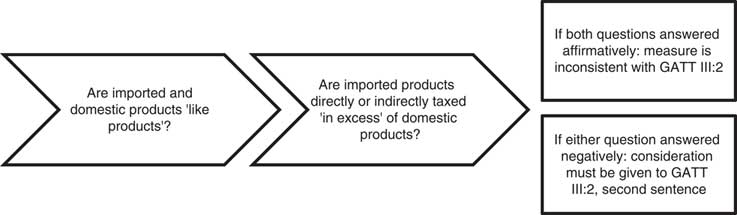
Article III:2 of the GATT enshrines the national treatment principle in relation to internal taxes. Under GATT Article III:2 first sentence, WTO Member States agree that they will not levy internal taxes on imported products or charges directly or indirectly ‘in excess’ of those applied to ‘like’ domestic products. This requires determination of whether imported and domestic products are ‘like’ products and whether the imported products are taxed ‘in excess’ of domestic products. If both of these questions are answered in the affirmative, the measure is inconsistent with Article III:2 (Canada – Periodicals, 1997). This can be seen in Figure 1.
General Agreement on Tariffs and Trade (GATT) III:2, first sentence

In determining whether domestic and imported products are ‘like’ products, the WTO panel and Appellate Bodies have stated that this should be construed narrowly and requires a determination of the nature and extent of the competitive relationship between and among products, including considerations such as product properties, nature and quality; end uses; consumer tastes and habits; and tariff classification.Footnote 3 In determining whether imported products have been taxed ‘in excess’ of domestic products, the WTO Appellate Body in Japan – Alcoholic Beverages II (1996) established a strict benchmark, with even the smallest amount of excess of tax leading to the conclusion that the tax is inconsistent with GATT III:2, first sentence.
To illustrate how Article III:2 of GATT operates, in the case of Mexico – Taxes on Soft Drinks (2005) the United States challenged Mexico’s tax measures that implemented, among a number of measures, a 20% tax on the transfer or, as applicable, importation of soft drinks and other beverages that used any sweetener [including high-fructose corn syrup (HFCS) and beet sugar] other than cane sugar and a 20% distribution tax on specific services (e.g. brokerage, consignment and distribution) provided for the purpose of transferring products such as soft drinks and other beverages that use any sweetener other than cane sugar. The differential taxation regime was not implemented for public health purposes but rather implemented by Mexico to ‘secure compliance’ by the United States with provisions in the North American Free Trade Agreement (NAFTA) regarding access of Mexican-produced sugar to the US market.
The WTO Panel examined the tax measures as imposed on beet sugar and HFCS as sweeteners, as it was the presence of non-cane-sugar sweeteners that triggered the tax and therefore non-cane-sugar sweeteners were indirectly subject to the soft drink tax when they were used for the production of soft drinks and syrups. The WTO Panel also examined the tax measures as imposed on the soft drinks and syrups that use any sweetener other than cane sugar.
The WTO Panel found that the tax measures, as imposed on beet sugar and on soft drinks and syrups, were inconsistent with Article III:2, first sentence. In examining compliance with GATT Article III:2, first sentence, the WTO Panel compared the physical properties, nature and quality; end uses; consumers’ perceptions and behaviours; and tariff classification of beet sugar (an imported product) and cane sugar (a domestic product). The Panel found these to be ‘like products’. The WTO Panel also compared soft drinks and syrups sweetened with non-cane sugars including HFCS and beet sugar (which were mostly imported) with those sweetened with cane sugar (which were mostly domestic). The Panel also found these to be ‘like products’. The Panel found that beet sugar and imported soft drinks and syrups sweetened with non-cane-sugar sweeteners were subject to internal taxes in excess of those applied to like domestic products. The WTO Appellate Body upheld the findings of the Panel (Mexico – Taxes on Soft Drinks, 2006).
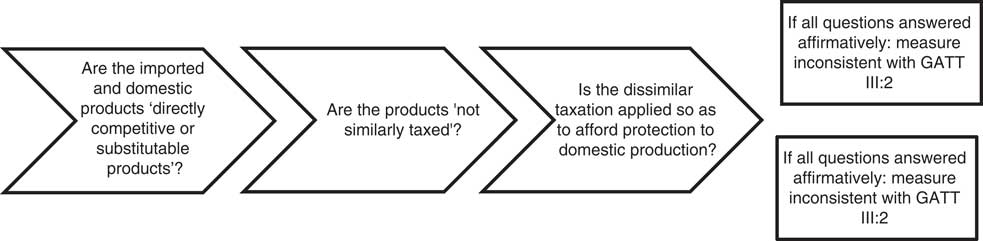
If an internal tax is found to be consistent with GATT Article III:2 first sentence, there is a need to examine whether the measure is consistent with the second sentence of GATT Article III:2, which prohibits internal taxes or charges where ‘directly competitive or substitutable products’ are ‘not similarly taxed’ so as to ‘afford protection to domestic production’. This can be seen in Figure 2. ‘Directly competitive or substitutable products’ have been defined more broadly than ‘like’ products for the purposes of Article III:2, applying to products that are ‘interchangeable’ or offer ‘alternative ways of satisfying a particular need or taste’ (Korea – Alcoholic Beverages, 1999: 33). Determining whether products are ‘directly competitive or substitutable products’ includes consideration of the competitive conditions between the products in the relevant market, in light of their physical properties, their common end uses including evidence of advertising activities, tariff classification, channels of distribution and price relationships including cross-price elasticities without placing an undue emphasis on the quantitative elements of a competitive relationship between products (Mexico – Taxes on Soft Drinks, 2005: 107; Korea – Alcoholic Beverages, 1999: 38). To be inconsistent with GATT III:2, second sentence, the tax burden on imported products must be heavier than on directly competitive or substitutable domestic products, and this burden must exceed a de minimis threshold. The de minimis threshold is determined on a case-by-case basis (Japan – Alcoholic Beverages, 1996: 27). The dissimilar tax must be applied so as to afford protection to domestic production with this protective application discerned from the design, architecture and revealing structure of the measure (Japan – Taxes on Alcoholic Beverages, 1996: 29).
General Agreement on Tariffs and Trade (GATT) III:2, second sentence

In the case of Mexico – Taxes on Soft Drinks and Other Beverages, the WTO Panel found that Mexico’s tax measures, as imposed on HFCS as a sweetener, were inconsistent with Article III:2, second sentence, as the measures imposed dissimilar taxation on directly competitive or substitutable products so as to afford protection to the Mexican domestic production of cane sugar. Mexico subsequently withdrew the measures in compliance with WTO Dispute Settlement Body recommendations (WTO, 2017a).
The concept of most favoured nation treatment with regard to internal taxes is contained in GATT Article I:1, which prohibits a member country from discriminating between countries by granting any advantage, favour, privilege or immunity to any like product from or for another country with respect to all matters referred to in Article III:2 of GATT (Canada – Autos, 2000). Therefore, governments must be cautious in designing SSB taxes to avoid protectionism with regard to not only domestic products but also to products of one WTO member country over another.
Under international investment law, although the terms of treaties vary, the obligation of non-discrimination is also commonly expressed under the principles of ‘national treatment’ where states agree to accord treatment to foreign investors, or its investment, no less favourable than that provided to domestic investors in ‘like’ circumstances and ‘most-favoured nation treatment’ where states agree to treat an investor from a party to an agreement, or its investment, no less favourably than an investor, or its investment, from any third country. The concept of non-discrimination is also an element of the fair and equitable treatment obligation in investment treaties, which will be discussed below. The NAFTA cases of Archer Daniels Midland and Tate & Lyle Ingredients Americas, Inc. v. United Mexican States (2007), Corn Products International, Inc. v. United Mexican States (2008) and Cargill, Incorporated v. United Mexican States (2009) concerned, in an investment law context, the imposition of Mexico’s 20% excise tax on soft drinks and syrups that used any sweetener other than cane sugar. The taxation regime was found to be discriminatory and contrary to the national treatment principle as it unreasonably afforded protection to domestic cane sugar producers, demonstrating an intention on the part of Mexico to treat US investors less favourably because of their nationality.
3.1.2 Legitimate distinctions
It is important to note that under both international trade and investment law, governments may draw regulatory distinctions against and/or between foreign products and investments if these distinctions are based on bona fide, evidence-based public health regulatory reasons.
In the context of international trade law, the Appellate Body has found that, in examining whether products are ‘like’ products for the purposes of discrimination, WTO Panels must consider all relevant evidence including evidence relating to the health risks associated with a product (EC – Asbestos, 2001). The protection of public health would also be relevant to show a measure is not applied ‘so as to afford protection’ for the purposes of GATT Article III:2, second sentence (Mitchell and Voon, 2011).
In addition, measures that are found to effect discrimination will not violate GATT if the measures are ‘necessary’ to protect human health by virtue of an exception under Article XX(b) GATT, provided the measures are designed and implemented in good faith and do not unjustifiably or arbitrarily discriminate or restrict international trade. In determining whether a measure is ‘necessary’ to protect human health, WTO panel and/or Appellate Body will conduct a weighing and balancing exercise, in light of the importance of the objective pursued by the government, of the contribution the measure makes to the objective of protecting human health and the degree of restriction the measure places on international trade. If this weighing and balancing process indicates that the measure is necessary, the decision-making bodies will consider whether there are less trade-restrictive alternative measures that are reasonably available that make an equal or greater contribution to the objective (Brazil – Retreaded Tyres, 2007: 71).
A small number of tobacco control measures have been challenged under WTO law on the grounds that they discriminate against imported products. In the case of US – Clove Cigarettes (2011, 2012), the WTO Panel, upheld by the Appellate Body, found that US measures prohibiting the sale of certain flavoured cigarettes, including clove cigarettes, but exempting menthol or tobacco-flavoured cigarettes, were discriminatory. The Panel found that clove cigarettes and menthol cigarettes were ‘like’ products and that the detrimental impact on competitive opportunities for clove cigarettes reflected discrimination against these ‘like’ products from Indonesia compared to menthol products predominantly produced in the United States.
One of the arguments proposed by the United States was that the regulatory distinction drawn between clove and menthol cigarettes was for legitimate public health reasons. The United States highlighted the potential development of a black market and burden on the health care system associated with treating withdrawal symptoms of the significantly higher numbers of menthol cigarette smokers if menthol cigarettes were also banned. In rejecting this argument, the Appellate Body noted that the addictive ingredient in menthol cigarettes was nicotine, not menthol. While recognising the right of members to enact measures to pursue legitimate public health objectives, the WTO Panel and Appellate Body found that the US measure violated the relevant discrimination provision under WTO law and the detrimental impact on imports did not stem from a legitimate public-health-based regulatory distinction.
In the context of international investment law, tribunal decisions have supported the differential treatment of foreign and domestic investors where this is justified for public policy reasons. Where a government can establish a reasonable or rational connection between the measure and the achievement of its objective, the state may be found not to have acted in a discriminatory manner [Saluka Investments BV (The Netherlands) v Czech Republic, Reference Tsikas2006: 94].
Drawing from these lessons, it is clear that governments seeking to implement an SSB tax need to consider whether the tax discriminates against and/or between imported products or foreign investors in its design, structure and application. Regulatory distinctions, including determining to implement a sugar-based tax rather than a tax on other unhealthy nutrients such as fats and salt, imposing a tax on beverages rather than other sugary products, determining which beverages will be included and excluded from SSB tax coverage, and the threshold levels of sugar required for the tax to apply, should be carefully considered and supported by legitimate, bona fide public health reasoning and/or evidence.
In determining coverage of an SSB tax, governments should consider the evidentiary basis justifying the coverage of products such as national dietary guidelines and/or international documents such as the WHO Guidelines on Sugars Intake for Adults and Children (WHO, 2015).
3.2 The importance of designing evidence-based measures tailored to public health objectives as part of a comprehensive strategy
Countries implementing public health measures such as SSB taxes are free to choose the level of protection they seek to achieve. However, even if a measure is invoked for public health reasons, with a clear public health objective, the measure should be tailored to the objective and level of protection the government is seeking to achieve.
Tobacco control measures have been challenged under international trade law and regional trade agreements purportedly for restricting trade in a manner that exceeds what is necessary to achieve a legitimate objective. In considering claims based on trade-restrictiveness and necessity under WTO law, WTO Panel and Appellate bodies have undertaken the weighing and balancing exercise outlined previously in the context of Article XX(b) GATT of the contribution the measure makes to the objective and the degree of trade-restrictiveness of the measure in light of the importance of the objective in question and the existence of reasonably available less trade-restrictive measures that make an equal or greater contribution to the objective (US – Tuna II, 2012).
In considering the importance of the objective in question, preservation of human life and health has been described by the WTO Appellate Body as ‘vital and important in the highest degree’ (EC – Asbestos, 2001: 63). However, countries implementing public health measures should also ensure that the measure is evidence-based and tailored to the public health objectives the government is seeking to achieve, and forms part of a comprehensive strategy to address unhealthy diet consumption.
3.2.1 Measures are evidence-based and tailored to public health objectives
One clear lesson to emerge from tobacco control cases is that it is good practice for countries to ensure that measures, including their objectives, are evidence-based and defined and tailored in a manner that is linked to evidence and public health goals, including, where relevant, commitments under domestic and international instruments. Objectives should be defined in a manner that enables the effects of the measure to be monitored to the extent possible since the contribution the measure makes to its objective may be considered by courts.
This has been observed in the context of claims that tobacco control measures are more trade-restrictive than necessary. Over the last few years, tobacco control measures have been discussed in the WTO’s Technical Barriers to Trade (TBT) CommitteeFootnote 4 and Trade-Related Aspects of Intellectual Property Rights (TRIPS) Council,Footnote 5 and claims have been brought against WTO Member States that tobacco control measures are more trade-restrictive than necessary to fulfil a legitimate objective (US – Clove Cigarettes, 2011, 2012; Australia – Tobacco Plain Packaging, date pending).
One of the measures currently facing such a claim before the WTO is Australia’s plain packaging measure. On 29 April 2010, the Australian Government announced that it would introduce mandatory plain packaging of tobacco products as part of a comprehensive strategy to reduce smoking rates in Australia. The Tobacco Plain Packaging Act was passed by the Australian Parliament in November 2011 and took full effect from 1 December 2012. The objects of the Tobacco Plain Packaging Act 2011, as outlined in Section 3 of the Act, specifically include improving public health by discouraging people from taking up smoking, or using tobacco products; encouraging people to give up smoking and to stop using tobacco products; discouraging people who have given up smoking, or who have stopped using tobacco products, from relapsing; reducing people’s exposure to smoke from tobacco products; and to give effect to certain obligations that Australia has as a party to the WHO FCTC by regulating the retail packaging and appearance of tobacco products in order to reduce the appeal of tobacco products to consumers, increase the effectiveness of health warnings and reduce the ability of the retail packaging of tobacco products to mislead consumers about the harmful effects of smoking or using tobacco products.
These objects were supported by extensive research evidence set out in the reports of the National Preventative Health Taskforce, a group of Australia’s leading public health experts (Commonwealth of Australia, 2009; Australian Government Department of Health, 2014). Australia’s plain packaging measure has been subject to extensive evaluation, with a Post Implementation Review of tobacco plain packaging released by the Australian Government on 26 February 2016 confirming that the measure had begun achieving the objectives of reducing smoking prevalence and exposure to tobacco smoke in Australia (Chipty, Reference Chipty2016).
While the outcome of the WTO dispute is pending, it has been reported that Australia has been successful in relation to the WTO challenge (ABC News, 2017). As outlined in the Integrated Executive Summary of Australia’s Submissions to the WTO, Australia has a ‘large body’ of qualitative evidence supporting the conclusion that tobacco plain packaging is apt to contribute to its clearly outlined public health objectives (Australia – Tobacco Plain Packaging, 2016: 5).
Countries implementing an SSB tax should similarly ensure that the objectives of the relevant legislation are drafted in a manner that reflects the evidence base.
States can bolster the formulation and design of SSB taxes by gathering the best available evidence base to support the measure. The WHO Fiscal Policies for Diet and Prevention of Noncommunicable Diseases Report states that there is growing evidence in relation to the potential impact of fiscal policies for promoting healthier diets, including evidence of the effects of SSB taxes in reducing consumption of the taxed products. In the Report, WHO recommends that governments conduct a situation analysis ‘using all existing relevant information’ to inform the design of the measure including the relevant objectives, and highlights the importance of monitoring and evaluation of measures in order to document their effectiveness in terms of achieving objectives, and monitoring the impact on purchase, consumption, product reformulation and substitution patterns (WHO, 2016a).
Monitoring and evaluation should be considered and planned in advance of design and implementation of the measure. Prior to introduction of Hungary’s PHPT, laboratory analyses of the salt, sugar and other unhealthy ingredient content of foods were collected to identify ‘unhealthy’ food and, in combination with data on consumption patterns of unhealthy food products, was used to prepare the legislation and served as a baseline for monitoring and evaluation of consumption and product reformulation patterns (WHO Regional Office for Europe, 2015).
One evidence gap highlighted in the WHO Fiscal Policies for Diet and Prevention of Noncommunicable Diseases Report is the quantification of the impact of SSB taxes on improving weight outcomes and other diet-related risk factors (WHO, 2016a). In the interim, there is clearly a need for governments to understand and establish clear indicators along the path to the overall objective of obesity and overweight reduction. Hawkes et al. (Reference Hawkes, Smith, Jewell, Wardle, Hammond, Friel, Thow and Kain2015) state that an assessment of the impact of a measure must be based on a clear comprehension of the mechanisms through which the measure could work, including what the expected outcomes would be and when they could be expected to occur. The authors highlight that this is pertinent in the area of public health due to a time lag or indirect relationship between food consumption patterns and overweight and obesity prevalence and health benefits, with the need for indicators to measure progress along the pathways of change towards reduced prevalence of overweight and obesity.
Tobacco control cases have also recognised that evidence in relation to the effects of public health regulatory measures is complex. Cases before domestic courts, the WTO and international investment tribunals have recognised that the impact of a public health measure may be difficult to determine in the short term, or where the measure is part of a complementary suite of measures (Brazil – Retreaded Tyres, 2007: 59–60; BAT v. Secretary of State for Health, 2016: 258–259; Philip Morris v. Uruguay, 2016: 87–88). The WTO’s Appellate Body has stated that the contribution a measure makes to the achievement of its objective may be demonstrated with quantitative projections or qualitative reasoning that the measure is apt to produce a material contribution to the achievement of its objective in the future.Footnote 6
Countries may not have the capacity to undertake additional studies or further research in relation to evidence. In such cases, it may be enough to rely on international experience. The international investment tribunal in the Philip Morris v. Uruguay case noted that states, particularly those with limited technical and financial resources, should be able to rely on international normative instruments, practices, studies and research to demonstrate the reasonableness of measures (Philip Morris v. Uruguay, 2016: 113). It is critical for countries to carefully consider the mounting evidence in relation to SSB taxes and the applicability of the evidence base to their domestic context in the design and administration of the SSB tax, including its objectives.
3.2.2 Less trade-restrictive ‘alternative’ measures considered and a comprehensive strategy adopted
As previously discussed, in assessing the ‘necessity’ of a measure under international trade law, WTO Panels and Appellate Bodies have considered the existence of any potential alternatives to the measure under challenge that are reasonably available, make an equal (or greater) contribution to the objective and are less trade-restrictive than the measure at issue. Governments should therefore consider whether there are less trade-restrictive alternatives to an SSB tax that make an equal or greater contribution to the identified public health objectives, noting that an import ban is “by design as trade-restrictive as can be” (Brazil – Retreaded Tyres, 2007: 59).
The WTO Appellate Body has held that an alternative measure may not be considered reasonably available “where it is merely theoretical in nature, for instance, where the responding Member State is not capable of taking it, or where the measure imposes an undue burden on that Member State, such as prohibitive costs or substantial technical difficulties” (US – Gambling, 2005: 102).
It should also be noted that decision-making bodies have made a distinction between ‘alternative’ measures and ‘complementary’ measures operating as part of a suite of measures designed to achieve a particular objective. The concept of complementarity has been recognised in WTO case law:
[C]ertain complex public health or environmental problems may be tackled only with a comprehensive policy comprising a multiplicity of interacting measures… Substituting one element of the comprehensive policy for another would weaken the policy by reducing the synergies between the components, as well as its total effect (Brazil – Retreaded Tyres, 2007: 59, 68).
In the context of tobacco control, Articles 4.2 and 4.4 of the WHO FCTC clearly recognise that effective tobacco control requires a comprehensive suite of measures. Measures claimed by tobacco industry advocates to be less restrictive ‘alternative’ measures have been successfully argued by governments to be complementary, not alternative, measures (US – Clove Cigarettes, 2011).
The lesson to adopt SSB taxes as part of a comprehensive suite of measures accords with nutrition policy and regulatory frameworks. In the context of nutrition policy, Hawkes et al. state that effective nutrition policies are not implemented as ‘single magic bullets’, but as part of “a combination of complementary and mutually reinforcing actions” (Reference Hawkes, Smith, Jewell, Wardle, Hammond, Friel, Thow and Kain2015: 2415). For example, Hungary’s PHPT was introduced as part of a ‘comprehensive set of measures’ targeting the promotion of healthy eating (WHO Regional Office for Europe, 2015).
The WHO Fiscal Policies for Diet and Prevention of Noncommunicable Diseases Report recognises the importance of policy coherence to ensure the most effective impact, providing examples of placing warning labels on taxed products and limiting marketing of these products (WHO, 2016a). The Lancet Public Health editorial states:
[A] fiscal policy such as a soft drinks levy should only be seen as part of a broad and multifaceted approach, combined with other interventions, including promotion of healthy lifestyle and diet, public awareness about the risks of being overweight, consumer education, food and nutrition labelling, regulation of marketing, and reformulation of industry products to reduce the amount of sugar, fat, and salt they contain. This is part of a larger battle against NCDs (Reference Snowdon2017).
This is embodied in relevant international documents. As outlined previously, WHO’s Comprehensive Implementation Plan on Maternal and Infant and Young Child Nutrition 2012 recognises that taxes and subsidies, when used in conjunction with trade measures, effective nutrition labelling, responsible food marketing and health promotion, are important in facilitating easier access and choice of healthy diets.
Implementing SSB taxes as part of a comprehensive strategy to combat overweight and obesity will ensure that governments are following best practice public health principles and provide support in response to claims that less trade-restrictive alternative measures are reasonably available that could make an equal or greater contribution to the public health objective.
3.3 Observation of procedural requirements and due process
Careful consideration should be given to the process adopted in the design and implementation of an SSB tax to ensure that the measure is robust in the face of potential legal challenges under domestic, regional and international laws and agreements.
Tobacco control measures have been challenged in domestic jurisdictions on procedural or administrative grounds including claims that the government has failed to follow required regulatory processes; does not have the authority to enact the measures; and/or has not undertaken adequate consultation in the development of the measures.
Under international investment law, claims have been made that states have violated fair and equitable treatment provisions by failing to protect an investor’s legitimate expectations; failing to act with procedural propriety; failing to act in good faith; engaging in harassment and coercion; and/or not observing due process (Schreuer, 2005).
Claims in relation to legitimate expectations have been successfully overcome where countries are exercising their sovereign right to regulate in the public interest and have not made specific commitments to investors. In Philip Morris v. Uruguay, Tribunal noted that:
…the requirements of legitimate expectations and legal stability as manifestations of the FET [Fair and Equitable Treatment] standard do not affect the State’s rights to exercise its sovereign authority to legislate and to adapt its legal system to changing circumstances (2016: 123).
In the absence of specific commitments, investors are not entitled to hold a legitimate expectation that the regulatory environment affecting an investment will remain unchanged, a principle that has been applied by international investment tribunals in the context of tax measure cases.Footnote 7
Governments should establish clear expectations with industry that NCD risk factors will be subject to ongoing regulation; ensure that they have the relevant authority to implement the measure; and allow flexibility in the legal structure of the measure in case minor changes are required. Hungary’s PHPT legislation was subject to multiple amendments to close loopholes and refine the measure to ensure its effectiveness (WHO Regional Office for Europe, 2015).
Government should ensure that due process is observed to the extent required in interactions with industry while being conscious that public health policies need to be protected from the vested interest of industry. This is clearly enshrined in tobacco control under Article 5.3 of the WHO FCTC. Governments interacting with the food and beverage industry do not have an equivalent principle established under international treaty. Nonetheless, it is important for governments implementing SSB taxes to balance the need to afford an opportunity for consultation to industry stakeholders with the potential for conflict of interest as the impact of public health policies can be derailed if the input of industry is disproportionate.
3.4 Recognition of the sovereign right of states to regulate in the interests of public health
An SSB tax may be designed and implemented in a robust and considered manner, yet still face legal challenge. Governments facing such a challenge can draw upon tobacco control jurisprudence where the rights claimed by industry have been successfully opposed and the sovereign right of states to regulate in the interests of public health recognised under domestic constitutions and laws, and international trade and investment agreements.
Governments have successfully defended legal challenges to tobacco control measures in domestic courts by demonstrating that any rights claimed by the tobacco industry are not absolute rights, and that limitations on their exercise are justified on the basis of other rights, interests and obligations. In a number of tobacco control cases, courts have recognised that any rights the tobacco industry has, such as rights to freedom of speech, freedom of commercial enterprise and property, must be balanced against rights to health and life.Footnote 8 States commit to the protection of human rights, including the right to health and life, through national constitutions and/or through domestic legislation, and as parties to international treaties such as the International Covenant on Economic, Social and Cultural Rights (United Nations General Assembly, 1966), which enshrines the right of everyone to the enjoyment of the highest attainable standard of physical and mental health under Article 12. Domestic courts have determined in a number of tobacco control cases that the right to health justifies limitations on economic freedoms of the tobacco industry.Footnote 9 A low level of value has also been attributed to the interests underlying the tobacco industry’s commercial rights in light of the significant potential benefits of the tobacco control measure for young people and society at large.
As already outlined, international trade and investment law also provides protections for governments to enact bona fide, non-discriminatory measures designed to protect public health. WTO agreements expressly acknowledge the sovereign right of states to regulate in the public interest, including for the protection of public health, in a number of ways. For example, the preamble to the TBT Agreement states that WTO Member States recognise that no country should be prevented from taking measures necessary for the protection of human health, provided they are not applied in a manner that would constitute a means of arbitrary or unjustifiable discrimination or a disguised restriction on international trade. WTO concepts, including those discussed earlier, such as ‘legitimate objective’, ‘necessity’, ‘legitimate regulatory distinction’, ‘unjustifiable’ and ‘arbitrary’, that are incorporated into key provisions of WTO Agreements provide governments with regulatory space in relation to bona fide, non-discriminatory public health measures. WTO Panel and Appellate Body decisions have confirmed regulatory space available to governments for the protection of human health (EC – Asbestos, 2001; US – Clove Cigarettes, 2012).
Regulatory space for public health has also been recognised in the context of international investment law. In addition to express provisions that may be contained in investment agreements protecting a sovereign right to regulate in the interest of public health, concepts relating to ‘legitimate public policy objective’, ‘legitimate expectations,’ ‘indirect expropriation’ and ‘proportionate/rational/reasonable/necessary’ provide regulatory space for governments to invoke public health reasons to justify measures.
One example is in the context of allegations that public health measures constitute indirect expropriation, due to an effective loss of an investor’s enjoyment or control over their investment. Indirect expropriation provisions have been interpreted in light of the police powers doctrine in customary international law, which holds that a non-discriminatory regulation for a public purpose, such as the protection of health, enacted with due process, will not be deemed to result in indirect expropriation (Methanex Corporation v. United States of America, 2005: Part IV, Chapter D, page 4). In the case of Philip Morris v. Uruguay (2016), the Tribunal found that Uruguay’s single presentation and 80/80 graphic health warnings measures were bona fide for the purpose of protecting the public welfare, non-discriminatory and proportionate, and were therefore a valid exercise by Uruguay of its police powers for the protection of public health and could not constitute an expropriation of the claimant’s investment.
Applying this to the context of SSB taxes, governments seeking to implement fiscal policies such as SSB taxes for the purpose of protecting public health can draw from tobacco control cases demonstrating recognition of the sovereign right of states to regulate in the interests of public health under domestic constitutions and laws, and international trade and investment agreements.
Recognition of the right of sovereign states to determine and establish taxation policies can also be found in international public health instruments including the 2011 UN Political Declaration on NCDs:
… reduce the impact of the common non-communicable disease risk factors, namely tobacco use, unhealthy diet, physical inactivity and harmful use of alcohol, through the implementation of relevant international agreements and strategies, and education, legislative, regulatory and fiscal measures, without prejudice to the right of sovereign nations to determine and establish their taxation policies (emphasis added) and other policies where appropriate, by involving all relevant sectors, civil society and communities, as appropriate … (United Nations General Assembly, 2011: 6).Footnote 10
Governments should nonetheless seek to be fully informed of relevant legal protections afforded to industry under applicable legal and regulatory frameworks prior to design and implementation of the measure.
4 Discussion
As the number of countries implementing SSB taxes increases, the food and beverage industry has responded with threats of legal challenges. The claims underlying these threats echo the arguments mounted by the tobacco industry in response to government regulation of tobacco products. While tobacco as a product, and its supportive legal and regulatory framework, differs from SSBs and its regulation, there are important lessons that can be gained from tobacco control cases, including ensuring that regulatory distinctions drawn between taxed and non-taxed products are for bona fide public health reasons, the importance of designing evidence-based measures tailored to clearly identified public health objectives as part of a comprehensive strategy to address unhealthy diet consumption and observation of due process in the development of the measure. Governments facing legal challenge can also take comfort from a number of domestic and international trade and investment law cases that have recognised the sovereign right of states to regulate in the interests of public health.
Ideally, the measure will be adopted as part of a comprehensive strategy ensuring multistakeholder involvement and engagement. In the 2011 UN Political Declaration on NCDs, Member States noted the need to promote implementation of ‘multisectoral, cost-effective, population-wide interventions’ to reduce the impact of the NCD risk factors (United Nations General Assembly, 2011: 6). It is critical that a multisectoral approach be undertaken in the formulation, design and implementation of the measure, including involvement of not only the relevant finance ministries but other relevant ministries including health, attorney-generals, trade and investment, foreign affairs and customs in order to ensure that measures are designed in accordance with obligations under domestic and international legal and regulatory frameworks. It is also important that input is sought from relevant public health professionals and civil society with sufficient opportunity allowed for their engagement in the policy design and implementation. This will ultimately lead to more robust, embraced and effective SSB taxes.
Acknowledgement
The author is grateful for the valuable input and feedback from Jonathan Liberman, Suzanne Zhou, Jo Jewell, Kathryn Bloom, Alison McAleese, Katarnya Hickey, and Mark Jennings.