Introduction
Several epidemics have occurred in the 21st century, including the Severe Acute Respiratory Syndrome (SARS), Influenza A (H1N1), Ebola Hemorrhagic Fever, and the Middle East Respiratory Syndrome (MERS). Epidemic outbreaks evoke considerable fear among the general public, including concern about disease transmission, unknown causes of the disease, and possible fatal outcomes from contracting the disease. The inherently uncertain and evolving nature of epidemics and infection-control techniques such as quarantine and isolation can accelerate this fear and could lead to stigmatization and discrimination. Reference Person, Sy, Holton, Govert and Liang1
A few systematic researches on infectious diseases and human mental health have shown that the fear of death, loneliness, and concern about infecting family members are common in SARS or Ebola epidemic patients. Reference De Roo, Ado, Rose, Guimard, Fonck and Colebunders2,Reference Maunder3 About 10% – 25% of SARS survivors, are likely to suffer from significant post-traumatic stress symptoms and depression. Reference Mak, Chu, Pan, Yiu and Chan4,Reference Wu, Chan and Ma5 In addition, family members of afflicted patients during an epidemic are likely to experience psychological symptoms of depression and social stigmatization. Reference Tsang, Scudds and Chan6 Elizarraras-Rivas, et al. interviewed 35 family members of Influenza A(H1N1)-infected patients and reported death anxiety in 88% and depression in 43% of family members. Reference Elizarrarás-Rivas, Vargas-Mendoza and Mayoral-García7
In 2015, the MERS outbreak in South Korea was caused by a citizen who had visited Saudi Arabia. This resulted in 186 infected patients and 38 deaths by July 28, 2015; It represented the most serious MERS outbreak outside of the Middle East. This event shocked most South Koreans, who had previously considered their country as an epidemic-free nation. In this study, we evaluated the psychological responses of Korean MERS survivors and bereaved family members, and analyzed the related factors for adverse reactions. Based on the results, we would like to propose that psychological support be provided to those in need and considered more seriously, in an epidemic disaster.
Methods
Study Population
Following the first MERS patient’s confirmation on May 20, 2015, the disease spread rapidly in South Korea. The number of victims surpassed 160 inpatients, 25 deaths, and 12000 quarantined people within a month; 38 of the total 186 MERS patients died and about 16700 people were quarantined by the time the government declared an end to the epidemic, on July 28, 2015. Based on the need for psychological support for MERS victims, the Ministry of Health and Welfare organized the MERS Psychological Support Team under the auspices of the National Center for Mental Health in June 2015. The team provided telephone counseling services to MERS survivors and bereaved families.
Out of 148 MERS survivors and families that experienced bereavement, 125 survivors and 91 bereaved family members were contacted through the Ministry of Health and Welfare. Some of them refused counseling and some people did not provide sufficient information to be included in the study; these data were excluded from the study. Finally, the records of 109 survivors and 80 bereaved family members (of 33 deceased patients) were included in the data analyses.
Most MERS survivors were infected following contact with MERS patients when the former visited family members in general hospitals afflicted with the disease. Of the MERS survivors, 25 were healthcare workers who cared for MERS patients. The average age of those who died from MERS was 67.54 (SD = 9.40), and 22 of the deceased (66.7%) were male. A total of 78.8% (26) of the deceased had a chronic medical condition such as cancer, cardiovascular or pulmonary disease, or diabetes mellitus.
Interviews
The MERS Psychological Support Team consisted of 3 psychiatrists and 8 trained mental health specialists, all of whom had experience in disaster-related, mental health management. Counseling for MERS survivors began after they were discharged from the hospitals; Counseling for the bereaved family members began after the funeral of the deceased MERS patient. All counseling began within a month from the date of MERS confirmation of MERS survivors or the date of death of the MERS patient. The subjects were informed about the purpose of the counseling service, and continuous counseling was conducted by trained mental health specialists only if subjects agreed to participate in this service. The counseling services were mainly based on psychological first aid and crisis intervention, focusing on psychological support and meeting urgent needs. If necessary, a psychiatrist visited each subject for an in-depth evaluation and referral as required by psychiatric hospitals or local mental-health centers.
During the counseling sessions, trained mental-health specialists gathered information about demographic characteristics and major psychological complaints of subjects through open-ended conversations and semi-structured questions (e.g., “Have you experienced insomnia since the MERS epidemic?”). Since most interviews were conducted over the telephone, mental health assessment scales were not used and only the presence or absence of psychological symptoms were briefly evaluated. The interview collected basic information, such as previous physical or mental illness, experience with quarantine and MERS infection, somatic responses (e.g., headache, fatigue, nausea, changed appetite, chest pressure), emotional responses (e.g., sadness, depression, anger, anxiety, fear, guilt), and behavioral responses (e.g., insomnia, avoidance, isolation). Because the purpose of this counseling service was to provide psychological support for MERS victims, acquisition of information that was not related to the psychological stability of the participants was minimized and participants were not pressured to answer personal questions. For each subject, the same mental health specialist assigned, continued the counseling until the end of service, and recorded all information on counseling forms. In this study, the information contained in these counseling records was analyzed retrospectively after the psychological support service was completed. All psychological responses described in this study indicate that MERS survivors and bereaved families had experienced these symptoms at any time during the counseling period.
The research and consent exemptions were authorized by the Institutional Review Board (IRB) of the National Center for Mental Health in South Korea.
Statistical Analyses
Demographic and MERS-related characteristics were compared between non-bereaved MERS survivors and bereaved family members using the chi square test and ANOVA analyses. To distinguish the impact of the bereavement and MERS infection, the bereaved group was classified into 2 groups: bereaved only and bereaved MERS survivors. Comparisons and post-hoc analyses between bereaved only, bereaved MERS survivors, and non-bereaved MERS survivors were conducted additionally. To determine the effect of demographic and MERS-related characteristics on the manifestation of psychological responses, binary logistic regression (forward LR) was performed and odds ratios (ORs) were calculated.
Data were analyzed using the Statistical Package for the Social Sciences (SPSS; version 21.0, SPSS Inc., Chicago, IL, USA).
Results
Demographic Characteristics
Among the 109 non-bereaved MERS survivors (61 males, 48 females; Mage = 48.9, SD = 15.3), 27 (24.8%) had underlying medical diseases and 10 (9.2%) had previous history of psychiatric conditions.
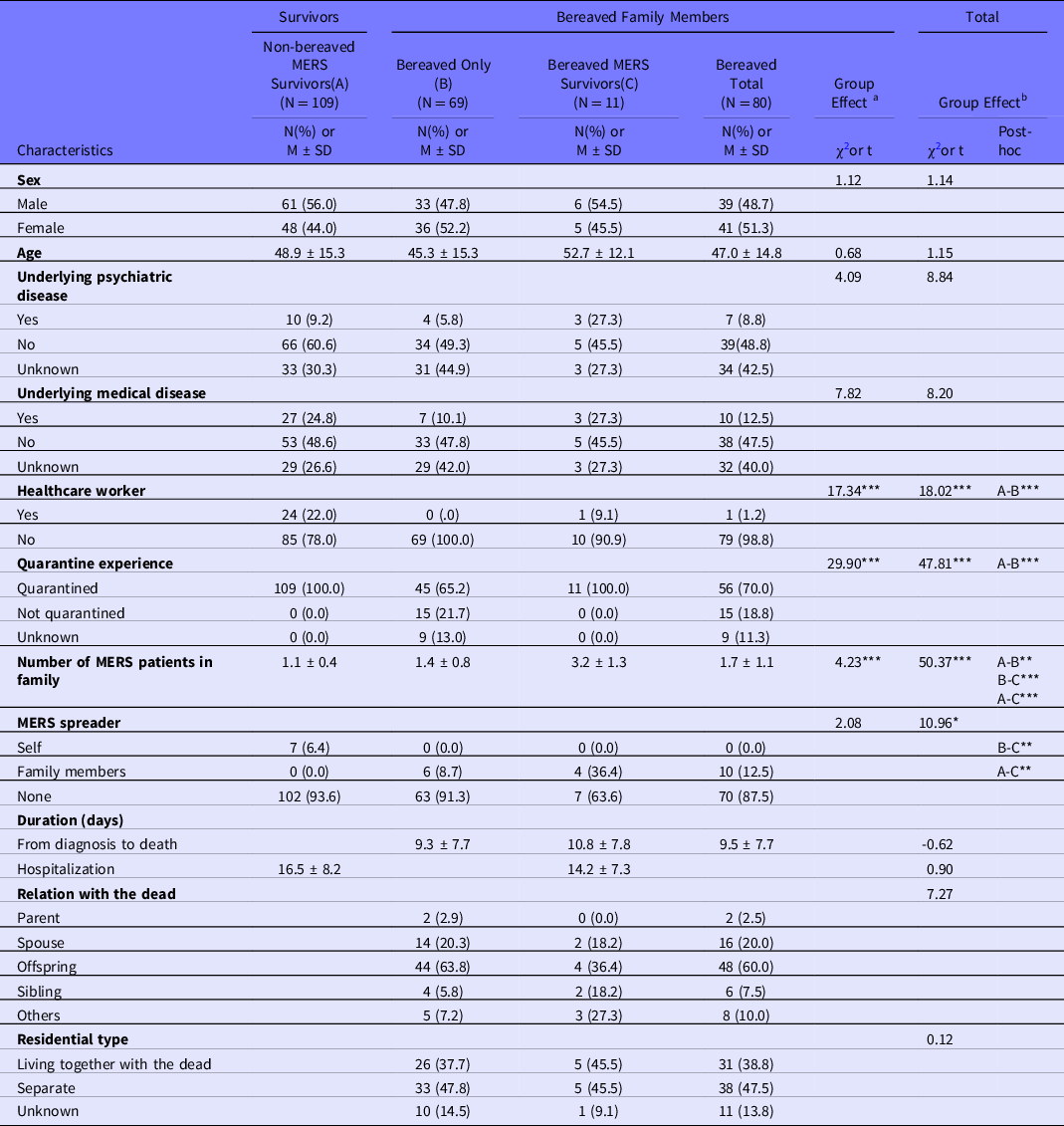
The 80 bereaved family members (39 males, 41 females; Mage = 47.0, SD = 14.8) consisted of 48 (60.0%) children of the deceased individuals and 16 (20.0%) spouses of the deceased. Among the bereaved family members, 56 (70.0%) had experienced quarantine.
There were more healthcare workers in the non-bereaved MERS survivors group than in the bereaved group. The bereaved MERS survivors group had more MERS patients and spreaders within the family compared to non-bereaved MERS survivors and bereaved only (Table 1).
Demographic characteristics of MERS survivors and bereaved family members

Abbreviations: MERS, Middle East Respiratory Syndrome; a, non-bereaved MERS survivors versus bereaved family; b, non-bereaved MERS survivors versus bereaved only versus bereaved MERS survivors or bereaved only versus bereaved MERS survivors or non-bereaved MERS survivors versus bereaved MERS survivors; A, non-bereaved MERS survivors; B, bereaved only; C, bereaved MERS survivors.
* P < 0.05, **P < 0.01, *** P < 0.001
Psychological Responses
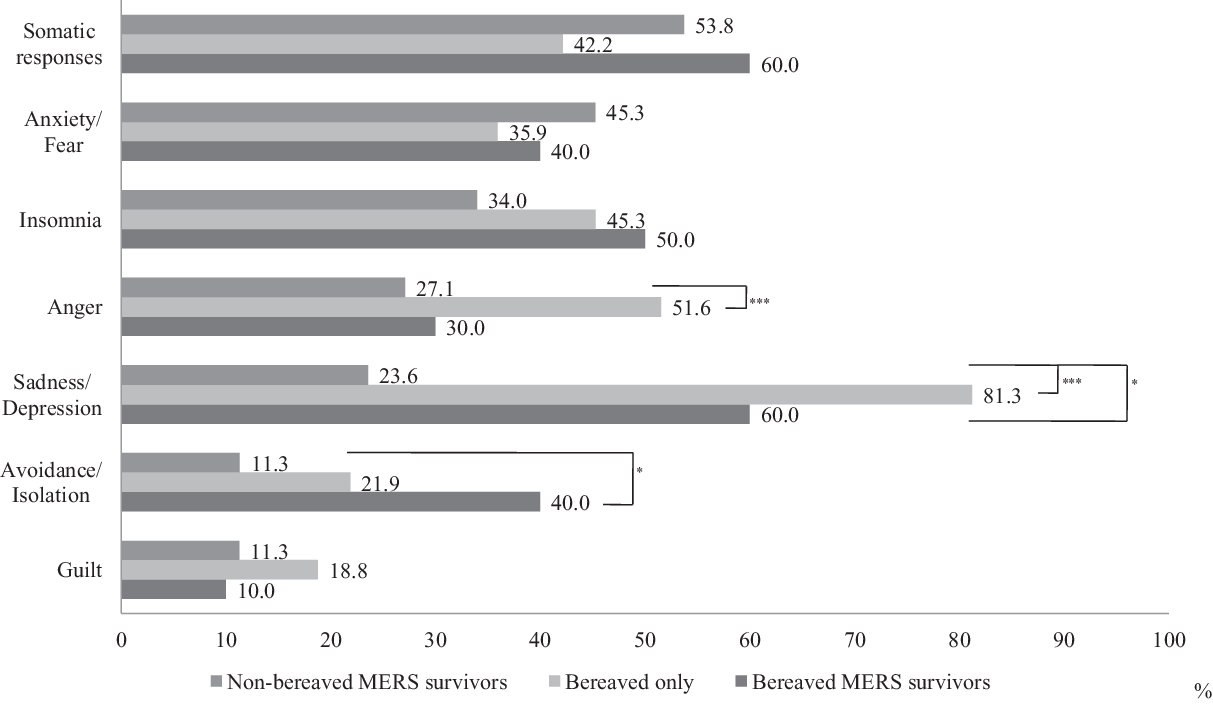
The frequency of major psychological responses among MERS survivors and bereaved family members is reported in Figure 1. Common psychological responses among non-bereaved MERS survivors were somatic responses and anxiety/fear (53.8% and 45.3%, respectively). Many bereaved family members showed sadness/depression; 81.3% of the bereaved-only group and 60.0% of the bereaved MERS survivors. These values were significantly higher than the 23.6% observed in non-bereaved MERS survivors (P < 0.001 and P = 0.022, respectively). Anger was frequently observed in the bereaved-only group compared to the non-bereaved MERS survivors (51.6% vs. 27.1%, P < 0.001). Bereaved MERS survivors showed more avoidance/isolation compared to non-bereaved MERS survivors (40.0% vs. 11.3%, P = 0 .031).
Frequency of major psychological responses among MERS survivors and bereaved family members. Abbreviations: MERS, Middle East Respiratory Syndrome. *P > 0.05, ***P > 0.001.

Risk Factors for Psychological Responses
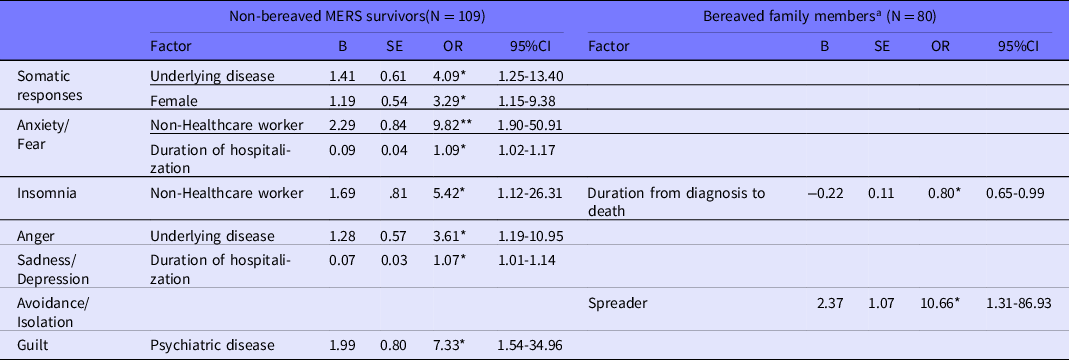
The risk factors of anxiety/fear in non-bereaved MERS survivors was non-healthcare workers and durations of hospitalization (OR = 9.82 and OR = 1.09, respectively). Being a non-healthcare worker also increased the risk of insomnia among non-bereaved MERS survivors (OR = 5.42). While underlying medical illness was associated with increased somatic responses (OR = 4.09), previous history of psychiatric conditions was associated with guilty feeling among non-bereaved MERS survivors (OR = 7.33). In the bereaved group, insomnia was increased when duration from diagnosis to death of infected family members was shorter (OR = 0.80), and avoidance/isolation increased when the deceased family member was a MERS spreader (OR = 10.66; Table 2).
Related factors of psychological responses among MERS survivors and bereaved family members

Abbreviations: MERS, Middle East Respiratory Syndrome; OR, odds ratio; CI, confidence interval; a, bereaved only and bereaved MERS survivors
* P < 0.05, **P < 0.01
Discussion
We found that bereaved families suffered from more psychological distress than non-bereaved survivors during the acute period of epidemic disasters. About 60% – 80% of bereaved family members experienced sadness/depression and anger within a month of the MERS epidemic; this was higher than bereaved families who had lost a family member in a chemical accident. Reference Yoo, Sim and Choi8 There have been some evidence that funeral ceremonies are helpful in the mourning process. Reference Irion9 During the MERS outbreak, many bereaved families couldn’t meet their deceased family member who was in the isolation room prior to death, and they were unable to hold a formal funeral process to control the MERS spread. Bereaved family members often talked about negative feelings regarding this situation during counseling. As is specific to epidemics, patients and families are not able to prepare for death, nor conduct traditional death-rituals and funerals; this disruption could have interfered with the normal grief processing. Reference Leong, Lee and Ng10
It is noteworthy that sadness/depression and anger were most common in bereaved-only family members, who did not contract the MERS infection themselves. Since bereaved MERS survivors showed additional concern about their physical recovery and long-term sequelae, we considered the possibility that their grief reactions, such as sadness and anger, might be disturbed or delayed. Instead, bereaved MERS survivors showed prominent avoidance/isolation, especially when their family member was a MERS spreader. Epidemic patients frequently suffer from negative attention from the public and rejection by neighbors and society. Reference De Roo, Ado, Rose, Guimard, Fonck and Colebunders2,Reference Robertson, Hershenfield, Grace and Stewart11,Reference Verma, Mythily, Chan, Deslypere, Teo and Chong12 Considering that bereaved MERS survivors had a greater MERS-related burden within family, their avoidance/isolation might be related to stigmatization.
Over 50% of MERS survivors showed somatic responses, which were 3.29 times higher in women and those with an underlying medical disease. Common somatic responses were pain, especially headache, fatigue, muscle tension, chest pressure/epigastric mass, changed appetite, respiratory difficulty, and gastrointestinal problems. When approaching the somatic response of MERS survivors, it is necessary to consider both psychological problems and physical effects of the disease and its treatment. Interestingly, 42.2% of the bereaved-only group also showed somatic responses. Since they did not have MERS, the effects of contracting the disease and its treatment could be ruled out. Previous studies have demonstrated actual deterioration of health, as well as the experience of sadness and anger, following bereavement. Reference Maddison and Viola13,Reference Marris14 These problems include pain, digestive issues, respiratory problems, cardiovascular problems, and immunological dysfunction, such as skin rashes or infections, which appear during the first 6 months and can last for more than a year after bereavement, sometimes causing chronic health problems. Reference Ott15,Reference Parkes16 Thus, our results implicate that physical health care also is needed among the bereaved family members.
During outbreaks of epidemics, the increased workload on healthcare workers and their constant exposure to the risk of infection can lead to high levels of stress. Previous studies have found that healthcare workers who treated patients during the SARS epidemic exhibited high rates of anxiety, depression, PTSD, and other psychiatric morbidities. Reference Chan and Huak17-Reference Tam, Pang, Lam and Chiu19 However, the current study found that healthcare workers were at a lower risk of anxiety/fear and insomnia compared to non-healthcare workers in the MERS-survivors group. Healthcare workers have accurate medical knowledge of infectious diseases, which could prevent them from experiencing psychological distress. This is consistent with previous findings showing severe PTSD symptoms following disasters in non-professional rescuers with less expertise and experience. Reference Dyregrov, Kristoffersen and Gjestad20-Reference Guo, Chen, Lu, Tan, Lee and Wang22 However, we should not interpret this to mean that healthcare workers are safer from disaster or epidemic-related mental health issues, than general victims. In studies about mental health of healthcare workers in Korean MERS disaster, healthcare workers at hospitals with MERS cases showed higher levels of posttraumatic stress or depressive symptoms, compared to those at hospital without MERS cases. Reference Um, Kim and Lee23,Reference Lee, Kang, Cho, Kim and Park24 As such, many healthcare workers in epidemic situations can suffer from infection anxiety or burnout. In such a situation, clear guidelines for infection prevention and adjusting strict protective measures for healthcare workers help to relieve stress. Reference Khalid, Khalid, Qabajah, Barnard and Qushmaq25 These results highlight the importance of providing accurate information and education not only to healthcare workers, but also to the public for efficient disaster management.
In this study, psychological responses were not associated with the number of MERS patients in the family, living together with a deceased family member, or quarantine experience. Considering the possibility of a heroic and honeymoon phase of disaster, which is a short time during which survivors feel grateful and relief for their survival, a long-term monitoring process is necessary for evaluating the psychological responses of MERS survivors. A third of the bereaved survivors continued to have psychiatric problems 6 years after the Southeast Asian Tsunami Reference Kristensen, Weisaeth, Hussain and Heir26 and 63.5% of MERS patients had more than 1 mental health problem such as post-traumatic stress symptoms, insomnia, or anxiety after 1 year of the outbreak. Reference Shin, Park and Kim27 An additional limitation was that this study was based on a review of initial psychological counseling records, not research data, so several information were omitted and the psychological responses were not assessed by a structured measure. Nevertheless, the data were derived from ongoing statements made by the participants and not later recollections, thus our findings are likely to reflect a realistic representation of the situation at the time of the epidemic.
Conclusions
This study showed that somatic responses and anxiety/fear of MERS survivors and sadness/depression and anger of bereaved family members were the main psychological problems experienced. Isolation and guilt with stigmatization increase with epidemic burdens within the family. The risk of psychological distress is affected by an underlying medical condition or increased duration of illness. These results suggest that psychological counselling for epidemic victims should be considered in the line with the characteristics and circumstances of the pandemic. Follow-up studies to prevent mental health problems and provide adequate psychological support during disasters should be continued.
Acknowledgements
We thank Jungha Shin, Jungil Yang, Okjoo Kim, Jiae Kim, Heejin Kim, Jiwon Lee and Ducksung Lee, and the members of MERS Psychological Support Team, National Center for Mental Health, Republic of Korea, for their commitment to psychological support that was the basis of this research.
Funding statement
This study was supported by a clinical research grant (No 2019-17) from the National Center for Mental Health, Seoul, Republic of Korea.