Bipolar disorder (BD) is a disabling, progressive mental disorder, in which increased number of recurrent episodes are marked by worse prognosis and poorer response to treatment (Berk, Reference Berk2009; Kapczinski et al., Reference Kapczinski, Magalhães, Balanzá-Martinez, Dias, Frangou, Gama, Gonzalez-Pinto, Grande, Ha and Kauer-Sant'Anna2014; Kessing and Andersen, Reference Kessing and Andersen2017). Patients with BD exhibit persistent impairments in cognitive function (Bora et al., Reference Bora, Yucel and Pantelis2009; Cullen et al., Reference Cullen, Ward, Graham, Deary, Pell, Smith and Evans2016). Associations between cognitive impairments and a worse illness course and poor functional outcomes have been found in BD, suggesting that deficits are linked with illness progression (Martínez-Arán et al., Reference Martínez-Arán, Vieta, Reinares, Colom, Torrent, Sánchez-Moreno, Benabarre, Goikolea, Comes and Salamero2004; Robinson and Nicol Ferrier, Reference Robinson and Nicol Ferrier2006). Nevertheless, the temporal progression of cognitive dysfunction in BD remains unclear (Cardoso et al., Reference Cardoso, Bauer, Meyer, Kapczinski and Soares2015). The identification of objective endophenotypes as measures of pathophysiological processes can inform the aetiology of BD, and further provide targets for the development of new and personalised treatments that ameliorate cognitive dysfunction, thereby preventing progressive illness-related decline (Kessing et al., Reference Kessing, Munkholm, Faurholt-Jepsen, Miskowiak, Nielsen, Frikke-Schmidt, Ekstrøm, Winther, Pedersen, Poulsen, McIntyre, Kapczinski, Gattaz, Bardram, Frost, Mayora, Knudsen, Phillips and Vinberg2017; Solé et al., Reference Solé, Jiménez, Torrent, Reinares, Bonnin, Torres, Varo, Grande, Valls and Salagre2017).
Endophenotypes are a disease-associated trait, that is independent of clinical state, and found in unaffected, first-degree relatives (URs) at greater extent than in the general population (Leboyer et al., Reference Leboyer, Leboyer, Bellivier, Jouvent, Nosten-Bertrand, Mallet and Pauls1998; Gottesman and Gould, Reference Gottesman and Gould2003). Indeed, patients with BD exhibit broad, trait-related neurocognitive difficulties both during acute stages and euthymic periods (Robinson et al., Reference Robinson, Thompson, Gallagher, Goswami, Young, Ferrier and Moore2006; Torres et al., Reference Torres, Boudreau and Yatham2007; Bora et al., Reference Bora, Yucel and Pantelis2009; Bourne et al., Reference Bourne, Aydemir, Balanza-Martinez, Bora, Brissos, Cavanagh, Clark, Cubukcuoglu, Dias, Dittmann, Ferrier, Fleck, Frangou, Gallagher, Jones, Kieseppa, Martinez-Aran, Melle, Moore, Mur, Pfennig, Raust, Senturk, Simonsen, Smith, Bio, Soeiro-de-Souza, Stoddart, Sundet, Szoke, Thompson, Torrent, Zalla, Craddock, Andreassen, Leboyer, Vieta, Bauer, Worhunsky, Tzagarakis, Rogers, Geddes and Goodwin2013), with medium to large effect sizes (Cohen's d = 0.5–0.8) within domains of executive function, verbal memory, sustained attention, and processing speed. These neurocognitive deficits are also evident at early stages of the disorder; poorer neurocognitive functioning across all cognitive domains are evident in first-episode BD relative to controls (Lee et al., Reference Lee, Hermens, Scott, Redoblado-Hodge, Naismith, Lagopoulos, Griffiths, Porter and Hickie2014; Bora and Pantelis, Reference Bora and Pantelis2015). Individuals at familial risk of BD also exhibit aberrant cognitive functioning; with impairments particularly within the domains of verbal memory and executive function – albeit to a lesser extent than their affected relatives – thereby rendering aberrant neurocognition as a promising candidate fulfilling some of the criteria for an endophenotype of BD (Arts et al., Reference Arts, Jabben, Krabbendam and van Os2008; Balanza-Martinez et al., Reference Balanza-Martinez, Rubio, Selva-Vera, Martinez-Aran, Sanchez-Moreno, Salazar-Fraile, Vieta and Tabares-Seisdedos2008; Bora et al., Reference Bora, Yucel and Pantelis2009; Miskowiak et al., Reference Miskowiak, Kjaerstad, Meluken, Petersen, Maciel, Kohler, Vinberg, Kessing and Carvalho2017b), although these are also prevalent in schizophrenia and consequently not specific for bipolar disorder (Kessing and Miskowiak, Reference Kessing and Miskowiak2018).
However, emerging evidence suggests that cognitive difficulties in BD are not limited to non-affective, neurocognitive deficits, but are also evident in affective cognition. Indeed, patients with BD and their URs exhibit behavioural and neural difficulties with emotion processing and regulation, including impairments in the recognition of facial displays of emotion, reduced ability to successfully down-regulate positive emotions, and increased cognitive interference of emotional stimuli (see Miskowiak et al., Reference Miskowiak, Kjaerstad, Meluken, Petersen, Maciel, Kohler, Vinberg, Kessing and Carvalho2017b; Kessing and Miskowiak, Reference Kessing and Miskowiak2018 for systematic reviews). Difficulties with affective cognition have been associated with aberrant fronto-limbic activity, specifically deficient top-down regulation of prefrontal areas on emotion-generating limbic regions in patients with BD compared to controls (see Phillips et al., Reference Phillips, Ladouceur and Drevets2008, Townsend and Altshuler, Reference Townsend and Altshuler2012 for systematic reviews). Our group has recently investigated aberrant cognition in monozygotic twins at-risk of affective disorders, and showed that twins at risk of affective disorders exhibit attentional avoidance of emotional faces (Meluken et al., Reference Meluken, Ottesen, Harmer, Scheike, Kessing, Vinberg and Miskowiak2018). However, the analyses did not allow for differentiation between those at risk of unipolar v. bipolar disorder, and it remains unclear whether aberrant processing of emotional faces is a feature of affective disorders in general, or could represent a putative endophenotype of BD, specifically. Also, studies on cognition, particularly those assessing affective cognition, in newly diagnosed BD patients are scarce. These studies tend to include small samples of first-episode BD patients (n = 16–87) (Lee et al., Reference Lee, Hermens, Scott, Redoblado-Hodge, Naismith, Lagopoulos, Griffiths, Porter and Hickie2014; Bora and Pantelis, Reference Bora and Pantelis2015; Bora et al., Reference Bora, Yalincetin, Akdede and Alptekin2018) who have recently recovered from a manic episode, hence neglecting BD type II patients thus not representing the full picture and heterogeneity of the disorder.
The present study is a part of the Bipolar Illness Onset (BIO) study an ongoing longitudinal study investigating biomarkers in BD (Kessing et al., Reference Kessing, Munkholm, Faurholt-Jepsen, Miskowiak, Nielsen, Frikke-Schmidt, Ekstrøm, Winther, Pedersen, Poulsen, McIntyre, Kapczinski, Gattaz, Bardram, Frost, Mayora, Knudsen, Phillips and Vinberg2017) that aims to identify objective biomarkers of BD. We sought to investigate a broad array of cognition using an extensive battery of behavioural tasks in a large sample of newly diagnosed patients with BD, and their unaffected, first-degree relatives, and healthy controls. Specifically, we aimed to assess (i) the pattern of non-affective and affective difficulties in patients newly diagnosed with BD in full or partly remission; and (ii) whether aberrant cognition represents a putative endophenotype of BD. Due to this study being exploratory in nature, no specific hypotheses were set a priori. Although, for cognitive impairments to represent a candidate risk endophenotype, we expected BD patients and their URs to exhibit greater cognitive impairments relative to healthy controls, with cognitive performance in URs at intermediate levels between BD probands and controls.
Methods
Study design and participants
The present study is a cross-sectional investigation of baseline data from the longitudinal BIO-study, work-package three, assessing brain-based biomarkers of bipolar disorder (Kessing et al., Reference Kessing, Munkholm, Faurholt-Jepsen, Miskowiak, Nielsen, Frikke-Schmidt, Ekstrøm, Winther, Pedersen, Poulsen, McIntyre, Kapczinski, Gattaz, Bardram, Frost, Mayora, Knudsen, Phillips and Vinberg2017). Recruitment for the present report took place from June 2015 to August 2018.
Newly diagnosed patients with BD were consecutively recruited from the Copenhagen Affective Disorder Clinic, Psychiatric Centre Copenhagen, Denmark, where they were invited to the study upon referral by their treating psychiatrist. All patients received treatment as usual, independent of study participation. Patients between 15 and 70 years of age were screened with the semi-structured Schedules for Clinical Assessment in Neuropsychiatry (SCAN; Wing et al., Reference Wing, Babor, Brugha, Burke, Cooper, Giel, Jablenski, Regier and Sartorius1990) interview to confirm the ICD-10 (World Health Organization, 1993) diagnosis of BD I or BD II given by their psychiatrist, and were rated with the Hamilton Depression Rating Scale-17 (HDRS-17; Hamilton, Reference Hamilton1967) and the Young Mania Rating Scale (YMRS; Young et al., Reference Young, Biggs, Ziegler and Meyer1978) to ensure full or partial remission (HDRS-17 and YMRS-scores ⩽14, respectively). Patients were excluded if they had a history of brain injury, severe somatic illness, or current substance abuse.
Patients’ unaffected, first-degree relatives (siblings and/or children, 15–40 years of age) were invited to participate in the study upon consent of the respective patient. The number of relatives participating in the study for each patient was unrestricted. Age- and sex-matched HCs, 15–70 years of age, were recruited at the University Hospital Blood Bank, Rigshospitalet, Copenhagen. The SCAN interview was used to ensure the absence of psychiatric disorders in URs and HCs. Exclusion criteria for both URs and HCs were having a history of treatment-required psychiatric disorder, and/or a current substance abuse disorder. Additionally, HCs were excluded if a first-degree relative had a history of treatment-required psychiatric disorder, including substance abuse.
Informed consent was obtained from all participants prior to inclusion of the study.
Assessment of non-affective cognition
All participants underwent the following neuropsychological tests: the Rey Auditory Verbal Learning Test (RALVT) (Corwin, Reference Corwin1994; Rey, Reference Rey1958), Coding and Digit Span Forward from the Repeatable Battery for the Assessment of Neuropsychological Status (RBANS) (Randolph et al., Reference Randolph, Tierney, Mohr and Chase1998), the Trail Making Test-A (TMT-A) and the Trail Making Test-B (TMT-B) (Army Individual Test Battery, 1944), the Letter-Number-Sequencing subtest from Wechsler's Adult Intelligence Scale 3rd edition (WAIS-III) (Wechsler, Reference Wechsler1997), verbal fluency with letters S and D (Borkowski et al., Reference Borkowski, Benton and Spreen1967), the Spatial Working Memory (SWM) test and the Rapid Visual Information Processing (RVP) test from the Cambridge Neuropsychological Test Automated Battery [CANTAB® (Cognitive assessment software). Cambridge Cognition (2018). All rights reserved. www.cantab.com]. Finally, premorbid IQ was estimated with the Danish version of the National Adult Reading Task (NART) (Nelson and O'Connell, Reference Nelson and O'Connell1978).
Assessment of affective cognition
Emotion reactivity and regulation to social scenarios was assessed with the Social Scenarios Task (Goldin et al., Reference Goldin, McRae, Ramel and Gross2008; Kjærstad et al., Reference Kjærstad, Vinberg, Goldin, Køster, Støttrup, Knorr, Kessing and Miskowiak2016), whereas facial emotion processing was assessed with the Facial Expression Recognition Task and the Faces Dot-Probe Task (the Emotional Test Battery; P1vital® Oxford Emotional Test Battery, 2017).
In the Social Scenarios Task, participants were presented with written descriptions of social situations and associated self-belief statements. The scenarios were either highly negative (e.g. you're at a friend's party where you don't know anyone) with associated negative self-beliefs (e.g. you don't fit in), or highly positive scenarios (e.g. you've started a new job, it's going really well) with associated positive self-beliefs (e.g. you are very good at your job). Each block was initiated by an instruction to either react naturally or dampen their emotional response, and consisted of 11 sentences describing the situation (3 s each), 10 associated self-beliefs (3 s each), followed by 10 emotion ratings in which participants were to rate their discomfort or pleasure on a visual analogue scale from 0 to 100. A total of nine blocks were presented. The initial block was a neutral condition, followed by two negative scenarios with alternate react/dampen conditions. To elicit the emotion regulation strategy participants' would most likely use in real life, participants were not specifically instructed as to which emotion regulation strategy to use during the ‘dampen’ conditions (Kjærstad et al., Reference Kjærstad, Vinberg, Goldin, Køster, Støttrup, Knorr, Kessing and Miskowiak2016). Given that some scenarios involved the attraction to/or rejection by men or women, respectively, sexual orientation was assessed prior to commencement of the test, and the respective version of the test was administered.
In the Facial Expression Recognition Task, participants were presented with faces featuring one of six basic emotions (happiness, surprise, anger, disgust, sadness, fear) morphed at 10% intensity levels from 0% (i.e. a neutral face) to 100% (i.e. full emotion) from Ekman and Friesen's Pictures of Facial Affect series (Ekman, Reference Ekman1976). Four images of each emotion at each intensity level, including one neutral face, were presented in a randomised order, yielding a total of 250 faces. Each facial stimulus was presented on a computer screen for 500 ms, immediately followed by a blank screen. Participants were instructed to indicate which facial expression was shown by pressing the respective key as quickly and accurately as possible (Harmer et al., Reference Harmer, Shelley, Cowen and Goodwin2004). Accuracy and reaction times were recorded.
The Faces Dot-Probe Task consisted of presentations of horizontal pairs of happy-neutral, fearful-neutral, or neutral-neutral faces. One of the faces was immediately substituted by either two vertical (··) or two horizontal (:) dots, and the participants were to indicate the direction of the dots by pressing the corresponding keys as quickly and accurately as possible. Trials were either unmasked (100 ms) or masked (17 ms), the latter in which the face pair was followed by a mask of a jumbled face. Eight blocks of unmasked and eight blocks of masked trials were presented, of which each block consisted of 12 trials (192 trials in total) presented in alternating order (Murphy et al., Reference Murphy, Downham, Cowen and Harmer2008).
The Social Scenarios task and the Faces Dot-Probe task were performed on a Lenovo T450s using E-Prime 2.0, whereas the Facial Expression Recognition task was carried out on a Dell PP181 using Superlab Pro version 1.05.
Measures of functional impairments, subjective cognitive complaints and quality of life
Participants were rated on functional impairment using the Functional Assessment Short Test (FAST) (Rosa et al., Reference Rosa, Sánchez-Moreno, Martínez-Aran, Salamero, Torrent, Reinares, Comes, Colom, Van Riel, Ayuso-Mateos, Kapczinski and Vieta2007), value >11 indicates functional impairment, and completed a set of questionnaires assessing subjective cognitive complaints (Cognitive Complaints in Bipolar Disorder Rating Assessment; COBRA) (Rosa et al., Reference Rosa, Mercadé, Sánchez-Moreno, Solé, Mar Bonnin, Torrent, Grande, Sugranyes, Popovic, Salamero, Kapczinski, Vieta and Martinez-Aran2013) and quality of life (the European Quality of Life 5 Domain; EQ-5D) (EuroQol, 1990).
Statistical analyses
Non-affective cognition: neurocognitive domains and composite scores
All neurocognitive test scores were standardised to z-scores (i.e. M = 0, s.d. = 1) using HCs' scores by the following formula: (test score − HC test M)/HC test s.d. (Field, 2018). Outlying z-scores for individual test scores of >4 s.d.s below HC mean were truncated at z = −4.0. A minimum z-score of −4 was selected as cut-off to limit the impact of the extreme scores, while still allowing adequate variability in the data, and is in accordance with previous studies from our group (Jensen et al., Reference Jensen, Knorr, Vinberg, Kessing and Miskowiak2016). The z-scores for TMT-A, TMT-B, SWM (‘between errors’ and ‘strategy’), and RVP (‘mean latency’) were inverted to ensure that lower scores reflect poorer performance. Six neurocognitive domains were created by averaging the z-scores comprising each domain:
(1) Processing speed: TMT-A and RBANS digit-symbol coding.
(2) Verbal learning: RAVLT (immediate recall trial I-V, list B recall, and 30 min delayed recall).
(3) Working memory: SWM (strategy and between errors), WAIS Letter Number Sequencing, and RBANS digit span forward.
(4) Executive control: TMT-B.
(5) Sustained Attention: RVP (accuracy and mean latency).
(6) Verbal fluency: Verbal fluency S and D.
Finally, a global cognitive composite score was calculated by averaging the six domains.
Affective cognition
For the Social Scenarios Task, emotion ratings were arcsine transformed, and emotion reactivity was calculated as the emotion rating for ‘neutral view’ v. ‘negative view’/‘positive view’ conditions, and emotion down-regulation was obtained from calculating the emotion rating for the ‘negative view’/‘positive view’ v. ‘negative dampen’/‘positive dampen’ conditions (Kjærstad et al., Reference Kjærstad, Vinberg, Goldin, Køster, Støttrup, Knorr, Kessing and Miskowiak2016).
For the Facial Expression Recognition task, reaction times were log-transformed, and a measure of discrimination accuracy of facial expressions (d′) was calculated for each facial expression using the formula: Pr = [(number of hits + 0.5)/(number of targets + 1)] − [(number of false alarms + 0.5)/(number of distractors + 1)], in which values that tend to 1 reflect better-than-chance and values that tend to −1 reflects worse-than-chance levels (Corwin, Reference Corwin1994). Response bias was calculated using the formula: β = y(1 − y) − x(1 − x)/y(1 − y) + x(1 − x) (where x = the probability of a false alarm (number of false alarms/number of distractors), and y = the probability of a hit (number of hits/number of targets) (Grier, Reference Grier1971). Vigilance scores for the Faces Dot-Probe Task were obtained by subtracting median RT in congruent trials from incongruent trials. Positive values reflect vigilance (i.e. attention towards the emotional face), and negative values reflect avoidance (i.e. attention away from the emotional face).
Group comparisons
Groups were compared using linear mixed model analysis with a familial relationship as random effect and group (patients with BD, URs, HCs) as a fixed factor. This analysis was chosen a priori to account for the genetic correlation between the patients and URs. Significant group differences were followed up with independent samples t tests comparing BD patients v. HCs and URs v. HCs, respectively. In the primary analyses, we applied an unadjusted linear mixed model analysis to assess differences between groups on non-affective and affective cognition. For non-affective cognition, the cognitive domains were entered as dependent variables. For affective cognition, the three groups were compared on the following variables of interest: (i) emotional reactivity and down-regulation of emotions to positive and negative social scenarios; (ii) discrimination of facial expressions and (iii) attentional vigilance to fearful and happy faces. With regards to the analyses for the Facial Expression Recognition Task, a linear mixed model analyses with the six emotions as repeated measures (for accuracy, reaction time, and response bias, respectively) was conducted to obtain a measure of general facial expression recognition performance. We also conducted an additional repeated-measures mixed models analysis to explore positive (happy, surprise) v. negative (anger, sad, disgust, fear) faces. Each independent emotion was then entered as a dependent variable, respectively, to look at selective impairments of facial expression recognition. If significant, follow-up analyses of the ten intensity levels of the relevant emotion were conducted using repeated measures mixed models. For our secondary analyses we employed similar linear mixed models analyses (with the same fixed factor, random effect, and dependent variables as in the primary analysis), but correcting for covariates. Three different adjusted models were conducted: one adjusting for age and gender, one accounting for premorbid IQ, and one adjusting for subsyndromal depressive and manic symptoms. Additionally, we conducted follow-up post hoc analyses limiting the BD sample to patients who met strict euthymia cut-off (HDRS-17 and YMRS ⩽7) criteria. Finally, tertiary analyses comprised exploratory post-hoc Pearson's correlational analyses between neurocognitive domains/affective cognition and (i) medication status (yes/no; antipsychotics, antidepressants, anticonvulsants, lithium) in patients with BD; (ii) functioning (FAST), subjective cognitive complaints (COBRA), and quality of life (ED-5Q) and (iii) illness duration and number of episodes. Each participants' EQ-5D index score was calculated using Danish norms with the EuroQol Crosswalk Index Value Calculator (Van Hout et al., Reference Van Hout, Janssen, Feng, Kohlmann, Busschbach, Golicki, Lloyd, Scalone, Kind and Pickard2012). Variables entered for the correlational analyses where only the ones where significant group differences were found in the primary analysis, and the correlational analyses were split by group. Analyses were two-tailed and significance-levels set to α = 0.05. Due to the study being exploratory in nature, the analyses were not corrected for multiple comparisons. Statistical analyses were performed in SPSS (version 22; IBM, New York, United States).
Results
Participants, demographics and clinical characteristics
Of the 338 participants who took part in the study, one BD patient was excluded because the diagnosis was not made recently, and three HCs were excluded due to having a first-degree relative with a treatment-required psychiatric disorder and/or substance disorder. Thus, the final sample consisted of 334 participants; 172 patients with newly diagnosed BD in full or partly remission, 52 of their URs, and 110 HCs. One hundred and ten patients met criteria for strict euthymia. Thirty-six patients with BD had one relative participating in the study, and eight patients had two relatives participating in the study. Premorbid IQ score was not calculated for participants diagnosed with dyslexia (six patients and two HCs).
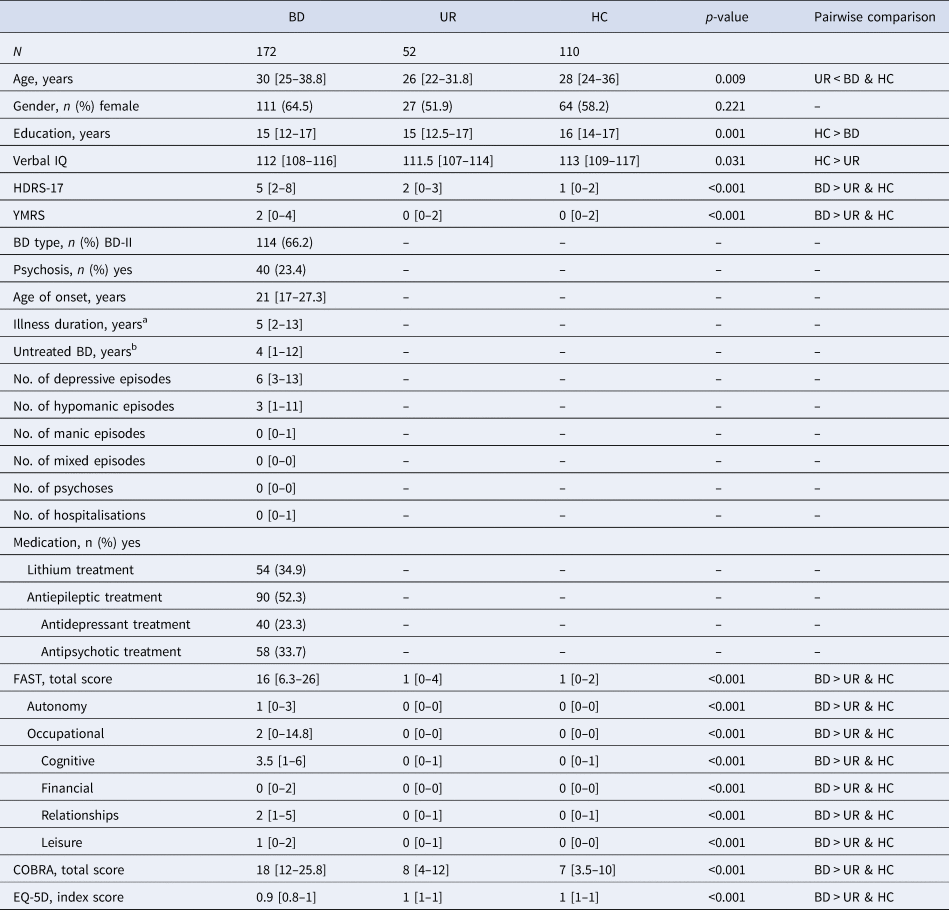
Groups were comparable for gender (p = 0.221). As anticipated, the relatives (i.e. children and siblings) were younger than their BD relatives and HCs (p = 0.009), and the patients with BD experienced more subsyndromal depression and mania symptoms compared to URs and HCs (ps < 0.001). The HCs also reported more years of education (p = 0.001) and had higher IQ (p = 0.031) (Table 1). Moreover, the newly diagnosed patients with BD reported functional impairment (all FAST domains: ps < 0.001), greater subjective cognitive difficulties (higher COBRA total score: p < 0.001), and poorer quality of life (EQ-5D: p < 0.001) relative to URs and HCs. A majority of patients (84%) were diagnosed within the preceding 12 months, whereas 94% of patients had received the diagnosis within the past 24 months. Only five patients were diagnosed between three and seven years before enrolment in the study. See Table 1 for demographic and clinical information.
Demographic and clinical variables in patients with bipolar disorder (BD), their unaffected first-degree relatives (UR) and healthy individuals (HC)

HDRS-17, Hamilton Depression Rating Scale with 17 items; YMRS, Young Mania Rating Scale; BD-II, bipolar disorder type II; FAST, Functional Assessment Short Test; COBRA, Cognitive Complaints in Bipolar Disorder Rating Assessment; EQ-5D, European Quality of Life with five dimensions.
Note: Continuous variables are presented as median [interquartile range].
a Illness duration was defined as the time from the first mania, hypomania, or mixed episode to the time of the first testing in BIO
b Untreated BD was defined as the time from the first mania, hypomania, or mixed episode to the time of the diagnosis
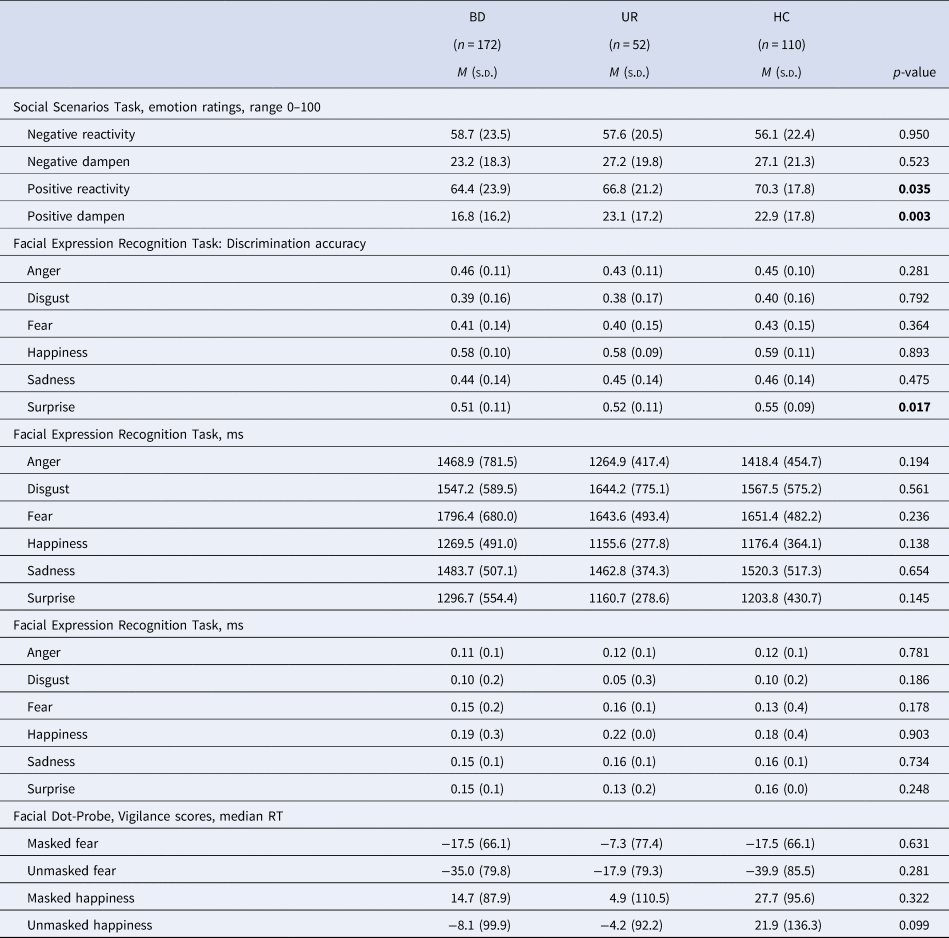
Affective cognitive in patients with bipolar disorder (BD), their unaffected first-degree relatives (UR) and healthy individuals (HC)

Between-group differences on non-affective cognition
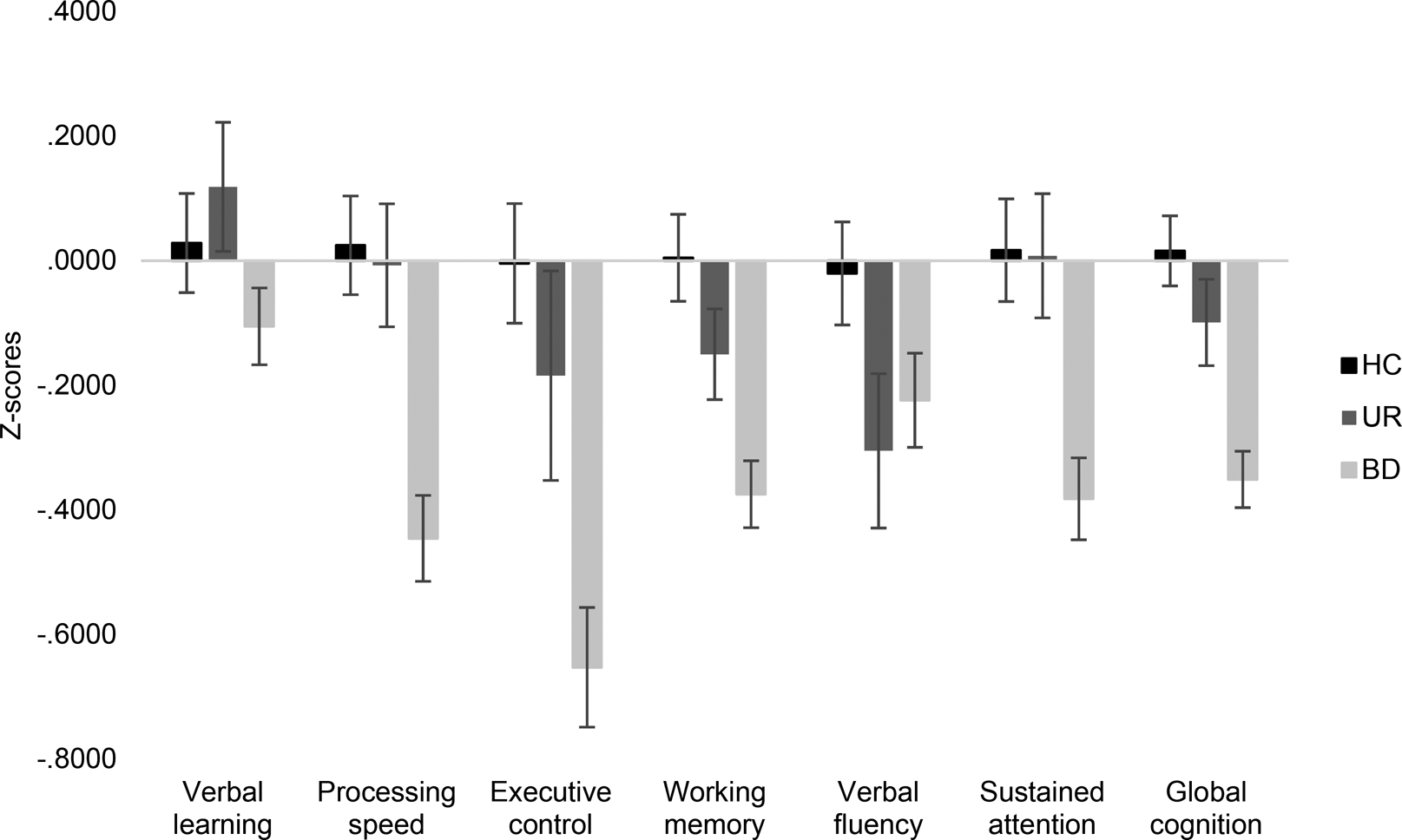
There was a statistically significant effect of group for processing speed (F (2,262) = 12.21, p < 0.001), executive control (F (2,280) = 10.95, p < 0.001), working memory (F (2,178) = 10.65, p < 0.001), sustained attention (F (2,195) = 9.87, p < 0.001) and global cognition (F (2,219) = 14.46, p < 0.001), driven by BD patients performing significantly lower than HCs (processing speed: t = −4.39, df = 280, p < 0.001, Cohen's d = 0.54; executive control: t = −4.55, df = 279, p < 0.001, Cohen's d = 0.57; working memory: t = −4.35, df = 280, p < 0.001, Cohen's d = 0.53; sustained attention: t = −3.80, df = 267, p < 0.001, Cohen's d = 0.47; global cognition: t = −5.10, df = 264, p < 0.001, Cohen's d = 0.64) (Fig. 1, Table S1). There were no significant differences between URs and HCs on the above neurocognitive domains (ps ⩾ 0.173). We found no statistically significant group differences for verbal learning and verbal fluency (ps ⩾ 0.124). The group differences remained when adjusting for age and gender, IQ, and mood symptoms, respectively (ps ⩽ 0.002) and when limiting the BD sample to strictly euthymic patients (ps ⩽ 0.001).
Neurocognitive profiles for patients with bipolar disorder, their unaffected relatives, and healthy controls. The X-axis denotes the mean cognition z-score for the three groups. Error bars represent standard error of the mean. UR, unaffected relatives; BD, bipolar disorder; HC, healthy control.

Emotional reactivity and regulation of emotion in social scenarios
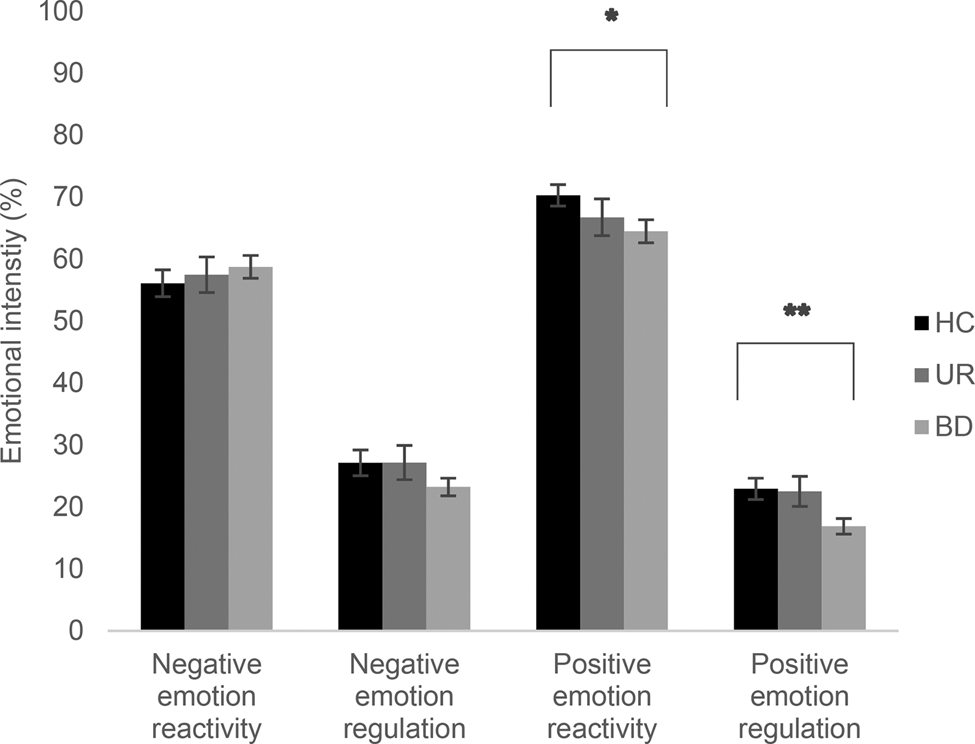
With regards to emotional reactivity, the analysis revealed a statistically significant effect of group on reactivity to positive social scenarios, F (2,236) = 3.38, p = 0.035. Follow-up t test showed that patients with BD reported lower emotional reactivity in response to positive scenarios compared to HCs, t = −2.55, df = 269, p = 0.011, Cohen's d = 0.32 (Fig. 2, Table 2). Emotional reactivity in positive social situations did not differ between relatives and HCs (p = 0.148). The significant group difference was unaffected by age and gender, IQ, and mood symptoms, respectively (ps ⩽ 0.046) and remained when limiting the BD sample to euthymic patients (p = 0.019). Results revealed no significant group main effect on participants' emotional reactivity to negative scenarios (p = 0.950).
Emotion reactivity (i.e. valenced look conditions minus neutral conditions) and down-regulation (i.e. look conditions minus dampen conditions) to negative and positive social scenarios, respectively in patients with bipolar disorder (BD), their unaffected first-degree relatives (UR) and healthy individuals (HC). Higher reactivity-values represent greater emotional reactivity, and higher emotion regulation values represent greater reduction of emotional intensity. Error bars represent standard error of the mean. *p < 0.05; **p < 0.01.

Analysis on emotion down-regulation revealed an effect of group on participants' ability to down-regulate their emotional response in positive scenarios, F (2,180) = 5.98, p = 0.003, driven by BD patients being less successful at dampening their emotional response in positive social scenarios relative to HCs, t = −2.89, df = 269, p = 0.004, Cohen's d = 0.36. We found no significant differences between URs and HCs in their ability to down-regulate emotional responses in positive social scenarios (p = 0.778). The group main effect remained significant after covarying for age and gender, IQ, and subsyndromal mood symptoms (ps ⩽ 0.005) and when excluding patients to those who met euthymic criteria (p = 0.004). There were no group differences in ability to down-regulate emotions to negative social scenarios (p = 0.523).
Attention to and recognition of emotional faces
With regard to general facial expression recognition performance, results revealed a main effect of general facial expression recognition accuracy (F (5,1565.0) = 144.79, p < 0.001), reaction time, (F (5,1559.4) = 123.42, p < 0.001), and response bias (F (5,1527.8) = 9.48, p < 0.001). Participants were overall more accurate, faster and had fewer false alarms when identifying positive (happy, surprise) compared to negative (sad, fear, anger, disgust) facial expressions (ps < 0.001). There were no differences between groups on general accuracy (p = 0.375), speed (p = 0.562) or response bias (p = 0.139) during facial expression recognition, nor were there any significant differences between groups on identification of positive v. negative facial expressions (accuracy: p = 0.287; RT: p = 0.379: response bias: p = 0.551).
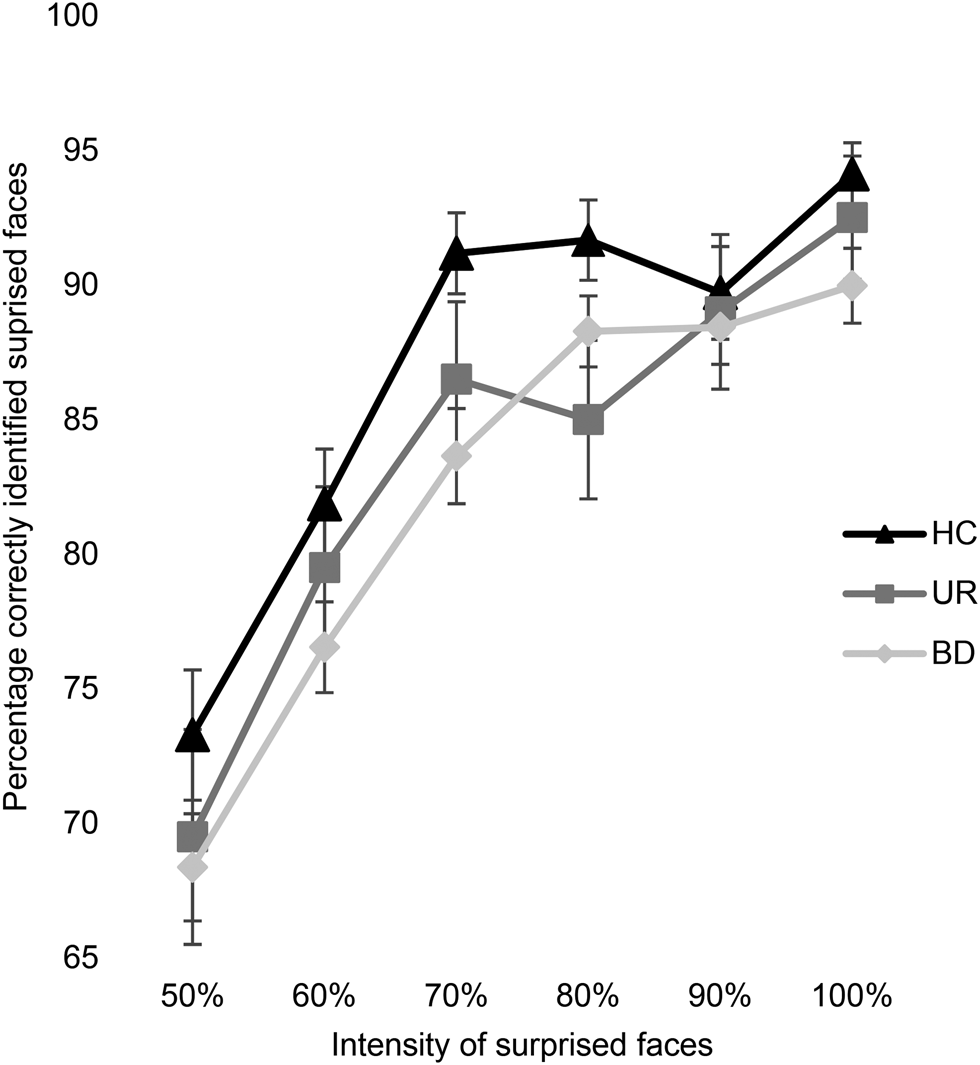
Analyses of selective impairments in facial expression recognition showed a group difference for surprised facial expressions, F (2,275) = 4.14, p = 0.017 (Table 2); BD patients were poorer at correctly identifying surprised faces compared to HCs, t = −2.87, df = 262, p = 0.004, Cohen's d = 0.37, whereas URs showed a trend towards decreased identification accuracy to surprised faces relative to HCs, t = −1.79, df = 150, p = 0.075, Cohen's d = 0.30. Moreover, groups showed differential recognition of the increasingly morphed surprised expressions, F (2,310.0) = 4.23, p = 0.015); patients with BD showed decreased recognition of medium to high intensity surprised faces: 60% (t = 2.0, df = 262, p = 0.048, Cohen's d = 0.25), 70% (t = 3.24, df = 260.73, p = 0.001, Cohen's d = 0.39), and 100% (t = 2.29, df = 261.3, p = 0.023, Cohen's d = 0.28), whereas the URs showed decreased recognition specific to high intensity surprised faces: 80% (t = 2.02, df = 74.97, p = 0.047, Cohen's d = 0.37) (Fig. 3). The group effects remained after covarying for age and gender, IQ and mood symptoms, respectively (ps ⩽ 0.030) and after limiting the BD sample to euthymic patients (ps ⩽ 0.035). The groups did not differ in discrimination accuracy of happy, angry, fearful, disgusted or sad facial expressions (ps ⩾ 0.281), nor on RT or response bias for the individual facial expressions (ps ⩾ 0.138).
Percentage of correctly recognised surprised facial expressions across the ten intensity levels in patients with bipolar disorder (BD), their unaffected first-degree relatives (UR) and healthy individuals (HC). Compared to the HCs, patients with BD showed decreased recognition of medium to high intensity surprised faces: 60% (p = 0.048), 70% (p = 0.001), and 100% (p = 0.023); the URs showed decreased recognition of high intensity surprised faces: 80% (p = 0.047). Error bars represent standard error of the mean.

Analysis of vigilance to fearful or happy faces assessed by the Faces Dot-Probe Task revealed a trend towards a significant group difference for supraliminal vigilance to happy faces (F (2,314.5) = 2.32, p = 0.099); patients with BD showed attention away (i.e. avoidance) of unmasked happy faces compared to HCs (t = 2.08, df = 267, p = 0.039, Cohen's d = 0.25). URs and HCs did not differ on vigilance towards unmasked happy faces (p = 0.219). However, this trend disappeared when controlling for age and gender (p = 0.109), IQ (p = 0.132), and subsyndromal depression and mania symptoms (p = 0.271), and when limiting the patient sample to euthymic patients (p = 0.293). Results revealed an absence of differences in vigilance to fearful faces and subliminal vigilance to happy faces (ps ⩾ 0.281).
Associations between cognition, medication and socio-occupational function
Exploratory correlational analyses between the neurocognitive domains and medication status in patients with BD revealed a statistically significant negative correlation between lithium and executive control (r = −0.18, df = 171, p = 0.019) and global cognition (r = −0.18, df = 158, p = 0.019), suggesting that the use of lithium was associated with lower executive control and general global cognition. There was a statistically significant negative correlation between antipsychotics and sustained attention (r = −0.16, df = 161, p = 0.044) and global cognition (r = −0.21, df = 158, p = 0.009), and a positive correlation between antipsychotics and executive control (r = 0.23, df = 171, p = 0.002), suggesting that the use of antipsychotic medication is associated with reduced sustained attention and global cognition, but improved executive control, in BD patients. Finally, analyses revealed a statistically significant positive correlation between antiepileptic medication and sustained attention (r = 0.17, df = 161, p = 0.034) and global cognition (r = 0.16, df = 158, p = 0.050), suggesting that the use of antiepileptic/anticonvulsant medication is associated with increased sustained attention and global cognition. Processing speed and working memory did not correlate with the use of psychotropic medication (ps ⩾ 0.065). The use of antidepressants did not significantly correlate with neurocognitive function (ps ⩾ 0.418).
Moreover, neurocognition was not associated with functioning (FAST), subjective cognitive difficulties (COBRA), nor quality of life (EQ-5D) or for patients with BD (ps ⩾ 0.128), their URs (ps ⩾ 0.129) or HCs (ps ⩾ 0.125). However, when limiting analyses to patients with BD who classify as functionally impaired (i.e. FAST total score ⩾11), functioning correlated negatively with working memory only (r = −0.21, df = 113, p = 0.029). The neurocognitive domains also did not significantly correlate with illness duration (ps ⩾ 0.072) or number of depressive/hypomanic/manic/mixed episodes (ps ⩾ 0.063).
With regards to affective cognition, correlational analyses revealed significant negative correlations between discrimination accuracy of surprised faces and lithium (r = −0.24, df = 162, p = 0.002) and antipsychotics (r = −0.20, df = 162, p = 0.010), suggesting that the use of lithium and antipsychotic medication was associated with poorer discrimination accuracy to surprised faces in patients with BD.
Discrimination accuracy of surprised faces also correlated positively with self-reported cognitive difficulties on the COBRA in patients with BD (r = 0.18, df = 162, p = 0.020), but not in URs or HCs (ps ⩾ 0.756), suggesting that the poorer discrimination of surprised faces in patients is associated with more subjective cognitive difficulties. Accuracy when identifying surprised faces also correlated positively with health-related quality of life in URs (r = 0.30, df = 47, p = 0.042), but not patients with BD or HCs (ps ⩾ 0.085), suggesting that the lower discrimination accuracy for surprised facial expression is associated with lower quality of life in relatives only. Accuracy when identifying surprised faces was unrelated to functional impairments (ps ⩾ 0.244), illness duration (p > 0.461), or number of episodes (ps ⩾ 0.240). Furthermore, emotional reactivity and regulation of emotion to positive social scenarios was unaffected by medication status (ps ⩾ 0.282), illness duration (ps ⩾ 0.207) or number of episodes (ps ⩾ 0.302) in patients, or functioning, subjective cognitive difficulties and quality of life in patients (ps ⩾ 0.213), their URs (ps ⩾ 0.185) nor HCs (ps ⩾ 0.443).
Discussion
This study investigated affective and non-affective cognition in patients newly diagnosed with BD in full or partly remission and their unaffected, high-risk relatives compared to HCs. Newly diagnosed patients with BD underperformed the HCs on generalised, global neurocognition; specifically, they exhibited neurocognitive deficits within processing speed, executive control, working memory and sustained attention. The patients with BD also demonstrated abnormalities at the behavioural level of emotion processing and regulation, including decreased emotional reactivity in positive social scenarios, impaired ability to down-regulate positive emotion, as well as a specific deficit in the ability to recognise surprised facial displays of emotion. Interestingly, similarly to their affected counterparts, the URs also exhibited difficulties identifying surprised faces – albeit to a trend level. No other cognitive differences were found for URs within neither affective nor non-affective cognition.
The broad impaired neurocognitive performance found in newly diagnosed patients with BD in full or partly remission is in accordance with meta-analytical evidence suggesting that patients with BD experience persistent neurocognitive deficits – both at early stages of the disorder as well as during remission after repeated illness episodes (Bourne et al., Reference Bourne, Aydemir, Balanza-Martinez, Bora, Brissos, Cavanagh, Clark, Cubukcuoglu, Dias, Dittmann, Ferrier, Fleck, Frangou, Gallagher, Jones, Kieseppa, Martinez-Aran, Melle, Moore, Mur, Pfennig, Raust, Senturk, Simonsen, Smith, Bio, Soeiro-de-Souza, Stoddart, Sundet, Szoke, Thompson, Torrent, Zalla, Craddock, Andreassen, Leboyer, Vieta, Bauer, Worhunsky, Tzagarakis, Rogers, Geddes and Goodwin2013; Lee et al., Reference Lee, Hermens, Scott, Redoblado-Hodge, Naismith, Lagopoulos, Griffiths, Porter and Hickie2014; Bora and Pantelis, Reference Bora and Pantelis2015; Demmo et al., Reference Demmo, Lagerberg, Aminoff, Hellvin, Kvitland, Simonsen, Haatveit, Andreassen, Melle and Ueland2017, Reference Demmo, Lagerberg, Kvitland, Aminoff, Hellvin, Simonsen, Haatveit, Andreassen, Melle and Ueland2018). However, the lack of neurocognitive impairments in URs is in contrast with previous research showing impairments, particularly within the domains of verbal memory and executive function, relative to HCs (Arts et al., Reference Arts, Jabben, Krabbendam and van Os2008; Balanza-Martinez et al., Reference Balanza-Martinez, Rubio, Selva-Vera, Martinez-Aran, Sanchez-Moreno, Salazar-Fraile, Vieta and Tabares-Seisdedos2008; Bora et al., Reference Bora, Yucel and Pantelis2009; Miskowiak et al., Reference Miskowiak, Kjaerstad, Meluken, Petersen, Maciel, Kohler, Vinberg, Kessing and Carvalho2017b). Differences in results may be due to sampling characteristics; for example, the UR sample in the present study included relatives of patients diagnosed with either BD types I and 2, of which a majority of the relatives (68.6%) had a BD-relative with BD type 2 diagnosis, and poorer verbal memory has been reported in relatives of BD type 1 compared to type 2 patients (Sobczak et al., Reference Sobczak, Riedel, Booij, Aan Het Rot, Deutz and Honig2002; Kosger et al., Reference Kosger, Essizoglu, Baltacioglu, Ulkgun and Yenilmez2015).
Moreover, the BD patients in the present study exhibited abnormalities within explicit affective cognition. Specifically, patients demonstrated decreased emotional reactivity to positive social scenarios, as well as difficulties dampening their positive emotions to positive social scenarios. This is the first study to examine emotional reactivity and regulation in newly diagnosed BD, hence it has not been investigated whether decreased emotional reactivity and down-regulation of positive emotion is unique to BD patients who have undergone fewer mood episodes. These abnormalities were, however, absent in patients' high-risk relatives. Behavioural studies on emotion regulation in remitted BD and URs have yielded inconsistent results, with some studies showing impaired regulation of positive emotions (Rive et al., Reference Rive, Mocking, Koeter, van Wingen, de Wit, van den Heuvel, Veltman, Ruhé and Schene2015; Kærsgaard et al., Reference Kærsgaard, Meluken, Kessing, Vinberg and Miskowiak2018), negative emotions (Rive et al., Reference Rive, Mocking, Koeter, van Wingen, de Wit, van den Heuvel, Veltman, Ruhé and Schene2015; Kjærstad et al., Reference Kjærstad, Vinberg, Goldin, Køster, Støttrup, Knorr, Kessing and Miskowiak2016), or no significant differences between patients and controls (Morris et al., Reference Morris, Sparks, Mitchell, Weickert and Green2012; Heissler et al., Reference Heissler, Kanske, Schönfelder and Wessa2014; Hay et al., Reference Hay, Sheppes, Gross and Gruber2015; Kanske et al., Reference Kanske, Schönfelder, Forneck and Wessa2015; Meluken et al., Reference Meluken, Ottesen, Harmer, Scheike, Kessing, Vinberg and Miskowiak2018). Behavioural measures of emotion regulation likely do not provide sufficient sensitivity to identify deficits. Indeed, studies using more sensitive assays of brain function during emotion regulation have found subtle deficits in remitted BD patients using a virtual reality task (Bobrowicz-Campos et al., Reference Bobrowicz-Campos, Pinho and Matos2016), an eye-tracking paradigm (Broch-Due et al., Reference Broch-Due, Kjærstad, Kessing and Miskowiak2018), as well as aberrant fronto-limbic neural response in BD patients and their URs during functional neuroimaging (Phillips et al., Reference Phillips, Ladouceur and Drevets2008; Townsend and Altshuler, Reference Townsend and Altshuler2012; Miskowiak et al., Reference Miskowiak, Kjaerstad, Meluken, Petersen, Maciel, Kohler, Vinberg, Kessing and Carvalho2017b).
Furthermore, both newly diagnosed patients with BD and their URs exhibited deficient explicit processing of emotional faces, as in accordance with previous findings in remitted patients (e.g. Addington and Addington, Reference Addington and Addington1998; Bozikas et al., Reference Bozikas, Tonia, Fokas, Karavatos and Kosmidis2006; de Brito Ferreira Fernandes et al., Reference de Brito Ferreira Fernandes, Gigante, Berutti, Amaral, de Almeida, de Almeida Rocca, Lafer and Nery2016; McCormack et al., Reference McCormack, Green, Rowland, Roberts, Frankland, Hadzi-Pavlovic, Joslyn, Lau, Wright, Levy, Lenroot and Mitchell2016), newly diagnosed patients with BD (Daros et al., Reference Daros, Ruocco, Reilly, Harris and Sweeney2014), and URs (Brotman et al., Reference Brotman, Guyer, Lawson, Horsey, Rich, Dickstein, Pine and Leibenluft2008a,Reference Brotman, Skup, Rich, Blair, Pine, Blair and Leibenluftb; Seidel et al., Reference Seidel, Habel, Finkelmeyer, Hasmann, Dobmeier and Derntl2012; Miskowiak et al., Reference Miskowiak, Kjaerstad, Meluken, Petersen, Maciel, Kohler, Vinberg, Kessing and Carvalho2017b). However, only two previous studies have found specific selective impairments for surprised faces in patients with BD (Summers et al., Reference Summers, Papadopoulou, Bruno, Cipolotti and Ron2006; Thaler et al., Reference Thaler, Strauss, Sutton, Vertinski, Ringdahl, Snyder and Allen2013), which is due to most paradigms assessing facial expression recognition neglecting to include surprised facial expressions. Interestingly, in line with previous studies, our results may suggest a negative influence of antipsychotics and lithium on the recognition of facial expressions in patients with BD (although these studies have found medication-specific effects on the recognition of angry, fear, and disgust, respectively) (Martino et al., Reference Martino, Strejilevich, Fassi, Marengo and Igoa2011; Samamé et al., Reference Samamé, Martino and Strejilevich2015; Bilderbeck et al., Reference Bilderbeck, Atkinson, Geddes, Goodwin and Harmer2017). It should, however, be emphasised that in such cross-sectional studies causality is unclear, and it may as well be the case that those treated with antipsychotics and lithium in our study suffer from the more severe bipolar disorder (e.g. bipolar disorder, type I rather than II) associated with cognitive dysfunction.
Indeed, neuroimaging studies show aberrant fronto-limbic activity to emotional faces in patients with BD and their URs (Miskowiak et al., Reference Miskowiak, Kjaerstad, Meluken, Petersen, Maciel, Kohler, Vinberg, Kessing and Carvalho2017b); specifically, exaggerated amygdala response to fearful and happy faces, respectively, (Surguladze et al., Reference Surguladze, Marshall, Schulze, Hall, Walshe, Bramon, Phillips, Murray and McDonald2010; Olsavsky et al., Reference Olsavsky, Brotman, Rutenberg, Muhrer, Deveney, Fromm, Towbin, Pine and Leibenluft2012; Dima et al., Reference Dima, Roberts and Frangou2016) coupled with increased activity in the medial prefrontal cortex (Surguladze et al., Reference Surguladze, Marshall, Schulze, Hall, Walshe, Bramon, Phillips, Murray and McDonald2010), suggesting that aberrant neural response during facial expression recognition is a trait marker of genetic risk for BD.
These findings may suggest that neurocognitive deficits and impairments within emotion processing and regulation are illness-related deficits of BD that present after the onset of full-threshold BD (Rosa et al., Reference Rosa, Magalhaes, Czepielewski, Sulzbach, Goi, Vieta, Gama and Kapczinski2014). Whereas our study yielded no support for non-affective, neurocognitive deficits to represent a putative endophenotype for BD, aberrant processing of emotional faces, on the other hand, was present in patients with BD and their unaffected relatives, and may therefore represent an early risk marker of BD. The identification of reduced discrimination accuracy as a putative endophenotype could aid in the diagnostics and treatment of BD, whereby the examination of such deficits could be used to identify those at risk of developing BD, differentiate between diagnoses (Kessing and Miskowiak, Reference Kessing and Miskowiak2018), and inform the diagnosis of BD in early stages (Glahn et al., Reference Glahn, Bearden, Niendam and Escamilla2004, Reference Glahn, Almasy, Barguil, Hare, Peralta, Kent, Dassori, Contreras, Pacheco and Lanzagorta2010). Also, the identification of endophenotypes for BD can guide personalised, early-stage treatment to prevent illness onset in those at risk of developing BD and delaying illness progression in those already diagnosed with BD (McGorry et al., Reference McGorry, Keshavan, Goldstone, Amminger, Allott, Berk, Lavoie, Pantelis, Yung and Wood2014).
The finding that aberrant affective cognition in BD is limited to explicit, effortful processing and regulation of affective stimuli, and not evident at the implicit, automatic level of affective processing, may indicate differential aetiological trajectories of explicit v. implicit affective cognition in BD. Specifically, this may suggest that whereas explicit affective processing is impaired even at early stages of BD, impairments within implicit affective cognition may represent progressive illness-related deficits that are only evident at later stages of the illness course after repeated, recurrent mood episodes (e.g. Kerr et al., Reference Kerr, Scott and Phillips2005, Malhi et al., Reference Malhi, Lagopoulos, Sachdev, Ivanovski and Shnier2005, Wessa et al., Reference Wessa, Houenou, Paillère-Martinot, Berthoz, Artiges, Leboyer and Martinot2007). The research on affective cognition in early-stages BD is, however, greatly lacking, which highlights the need for future research to investigate trajectory of affective cognition from premorbid to newly diagnosed and more chronic illness phases.
The present study included a large, well-defined sample of newly diagnosed patients with BD in full or partly remission and their unaffected, first-degree relatives. However, despite patients being newly diagnosed with BD, mean duration of untreated BD (time between first episode of hypomania/mania and time of diagnosis) was 7.5 years (median: 4; quartiles: 1–12). Even though the mean delay between onset and diagnosis in bipolar disorder tends to be 5–10 years (Baldessarini et al., Reference Baldessarini, Tondo, Baethge, Lepri and Bratti2007; Drancourt et al., Reference Drancourt, Etain, Lajnef, Henry, Raust, Cochet, Mathieu, Gard, MBailara and Zanouy2013), one cannot rule out the effect of untreated illness and repeated mood episodes experienced prior to being diagnosed on cognitive function. Nevertheless, patients in the present study were tested after diagnosis, hence rendering the total illness duration lower than that of other studies on cognition in BD (mean illness duration 7.6 years in the present study v. 14.6 years in previous meta-analysis) (Mann-Wrobel et al., Reference Mann-Wrobel, Carreno and Dickinson2011). Notably, the lack of deficits in URs is likely due to the inclusion of psychiatrically healthy relatives without a history of any psychiatric disorder – i.e. the ‘super’ healthy. Thus, it is possible that results do not generalise to relatives in general. Indeed, current recruitment of relatives for the BIO-study also includes relatives with Axis 1 disorders. Inclusion of psychiatrically affected relatives at risk of BD (i.e. the intermediate stage between unaffected, first-degree relatives at risk of BD and individuals newly diagnosed with BD) would further elucidate the cognitive development and prognosis of BD. Yet, for the current study, we specifically recruited URs with no history of a treatment-required psychiatric diagnosis to represent a direct match in the comparisons with HCs to rule out the potential confound of other psychiatric disorders, such as anxiety or personality disorders, on cognitive function in the evaluation of putative cognitive endophenotypes of BD. This exclusion criterion resulted in the sample size of URs being relatively modest (n = 52), which might have affected the statistical power in the study thereby erroneously yielding statistically non-significant results. Also, the use of cognitive composite scores presents some limitations. For instance, the different tests comprising each composite likely do not equally correlate with the underlying cognitive construct it aims to measure, and scores on individual tests may mask important differences that are lost due to the average of scores into composites (Song et al., Reference Song, Lin, Ward and Fine2013). Nevertheless, the use of cognitive composites based on standard scores (e.g. z scores) facilitates comparisons of outcome measures between studies and reduces type 1 error, as different cognitive tests differ in sensitivity and the number of cognitive domains they tap into (Riordan, Reference Riordan2017). Accordingly, the International Society for Bipolar Disorders Targeting Cognition Task Force recommends including a broad cognitive composite score (Miskowiak et al., Reference Miskowiak, Burdick, Martinez-Aran, Bonnin, Bowie, Carvalho, Gallagher, Lafer, López-Jaramillo and Sumiyoshi2017a). Moreover, we did not correct for multiple comparisons due to the exploratory nature of the study. It is therefore possible that the lack of correction for multiple comparisons may affect replicability of the results. Finally, the cross-sectional observational design of the study limits causal inferences to be drawn on the developmental trajectory for BD. Participants in the present study are currently undergoing follow-up assessments as a part of the longitudinal part of the BIO cohort study (Kessing et al., Reference Kessing, Munkholm, Faurholt-Jepsen, Miskowiak, Nielsen, Frikke-Schmidt, Ekstrøm, Winther, Pedersen, Poulsen, McIntyre, Kapczinski, Gattaz, Bardram, Frost, Mayora, Knudsen, Phillips and Vinberg2017). Future studies should further examine cognitive difficulties, particularly within affective cognition, in early-stage BD to elucidate putative cognitive endophenotypes for BD.
In conclusion, patients with newly diagnosed BD, but not their URs, had cognitive deficits in a broad range of non-affective, neurocognitive domains, as well as difficulties with explicit affective cognition by reduced emotion reactivity and difficulties down-regulating emotions to positive social scenarios. Findings provide no support for neurocognitive deficits being a candidate endophenotype of BD. Rather, BD patients exhibited impaired discrimination accuracy for surprised faces, with high-risk relatives performing at an intermediate level between patients and HCs, suggesting that this may be a putative endophenotype for BD. Longitudinal studies are needed to examine the link between cognitive impairments and illness progression in BD.
Supplementary material
The supplementary material for this article can be found at https://doi.org/10.1017/S0033291719001867
Financial support
HLK's Ph.D. salary was funded by Capital Region of Denmark Mental Health Services. The Lundbeck Foundation and Weimann Foundation contributed to KWM's salary between 2012 and 2021. CJH was supported by the NIHR Oxford Health Biomedical Research Centre. The views expressed are those of the authors and not necessarily those of the NHS, the NIHR or the Department of Health.
Conflict of interest
LVK has within the preceding three years been a consultant for Sunovion and Lundbeck. CJH has received consultancy fees from Lundbeck, Servier, Pfizer and P1vital. MV has received consultancy fees from Lundbeck in the past three years. KWM acknowledges the Lundbeck Foundation and Weiman Foundation for their contribution to her salary. KWM has received consultancy fees from Lundbeck, Allergan and Janssen in the past three years. The remaining authors declare no conflicts of interest.
Ethical standards
The authors assert that all procedures contributing to this work comply with the ethical standards of the Committee on Health Research Ethics of the Capital Region of Denmark (protocol no: H-7-2014-007) and the Danish Data Protection Agency, Capital Region of Copenhagen (protocol no: RHP-2015-023) and institutional committees on human experimentation and with the Helsinki Declaration of 1975, as revised in 2008.