Exploring SET From an Employee Engagement Perspective
In their focal article, Chernyak-Hai and Rabenu (Reference Chernyak-Hai and Rabenu2018) argue that the foundational assumptions of social exchange theory (SET) should be revisited and revised because of recent changes in the workplace and the workforce. Using employee engagement data from recent research projects conducted in applied settings, we investigated a series of questions based on Chernyak-Hai and Rabenu's working hypotheses.
Using Engagement Data to Explore Social Exchange Relationships at Work
In his review of the engagement literature, Saks (Reference Saks2006) uses SET to provide a theoretical framework for understanding both Kahn's (Reference Kahn1990) original conceptualization of engagement and Maslach, Schaufeli, and Leiter's (Reference Maslach, Schaufeli and Leiter2001) model of engagement. Saks says that “the amount of cognitive, emotional, and physical resources that an individual is prepared to devote in the performance of one's work roles is contingent on the economic and socioemotional resources received from the organization” (2006, p. 603). From a SET perspective, employees’ engagement levels vary depending on the amount of resources they receive from their employer. Although Chernyak-Hai and Rabenu (Reference Chernyak-Hai and Rabenu2018) do not focus specifically on employee engagement in their focal article, engagement data can be used as a limited indicator to investigate, albeit in a partial and tangential way, some of the questions they raise. Here we share findings from three research questions we explored.
Do Engagement Levels Vary Based on Employees’ Relationship to Work?
Chernyak-Hai and Rabenu (Reference Chernyak-Hai and Rabenu2018) posit that employees’ personal values and their relationship with work (e.g., freelancing) may influence the social exchange (e.g., leader member exchange (LMX), organizational citizenship behavior (OCB), organizational support) they experience at work. Consistent with these arguments, we recently explored how employees’ psychological relationship to work impacts their engagement and commitment levels. We based our work on research by Wrzesniewski, McCauley, Rozin, and Schwartz (Reference Wrzesniewski, McCauley, Rozin and Schwartz1997), who found that people relate to their work in three different ways. Some see their job as just a job to do in exchange for money; others see their job as a critical step in their career; others see their job as their calling or vocation.
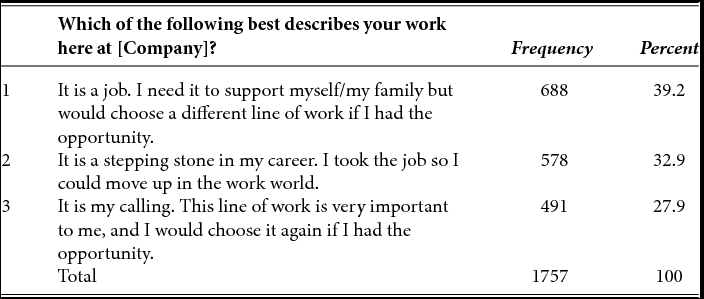
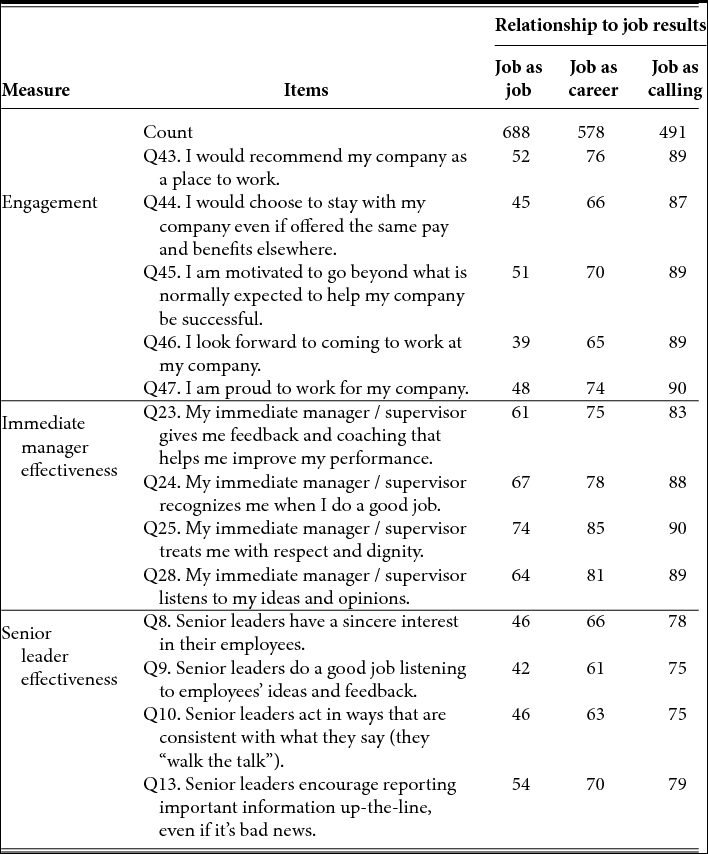
Building on this research, we developed a single item self-diagnostic question to evaluate the way employees think about their current job. We then administered this question, along with other employee engagement items, to an Amazon MTurk–sourced sample of over 1,700 employees working in small, medium, and large organizations (Chart 1). We found that engagement and commitment levels varied significantly based on the way people viewed their jobs. We also found that employee perceptions of their managers and leaders varied based on their psychological relationship to work (Table 1).
Chart 1.Descriptive Distribution of Overall Relationships to Jobs
Table 1.Attitudinal Results by Overall Relationships to Job
These results may provide preliminary support for Chernyak-Hai and Rabenu's (Reference Chernyak-Hai and Rabenu2018) proposed hybrid model of organizational support. Considered in the context of this model, our results suggest that employees form different exchange relationships with their leaders, managers, and organizations based on the way they think about their jobs. Employees who see their job as just a job invest less of themselves at work (as evidenced by their low engagement and commitment levels), and they also receive lower levels of leader and organizational support in return. Employees who see their job as their vocation—on the other hand—invest a lot of themselves at work, and they also experience a lot of leader and organizational support in return.
Although these results provide possible empirical support for Chernyak-Hai and Rabenu's (Reference Chernyak-Hai and Rabenu2018) hypotheses, it is important to note that we used a single item to measure employees’ psychological relationship to work. Future studies using a more robust assessment of this construct, along with other aspects of the social exchange relationship (e.g., OCBs, performance, retention), should be considered.
Do Generational Differences Impact the Quality of LMX?
Citing a handful of studies, Chernyak-Hai and Rabenu hypothesize that generational factors may impact the quality of LMX, particularly for Millennial employees. Based on research by Myers and Sadaghiani (Reference Myers and Sadaghiani2010), Chernyak-Hai and Rabenu (Reference Chernyak-Hai and Rabenu2018, p. 460) state that “Millennials present a challenge to LMX, as they are likely to have different perspectives on supervisor–employee relationships.”
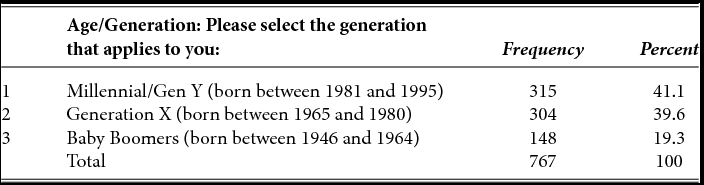
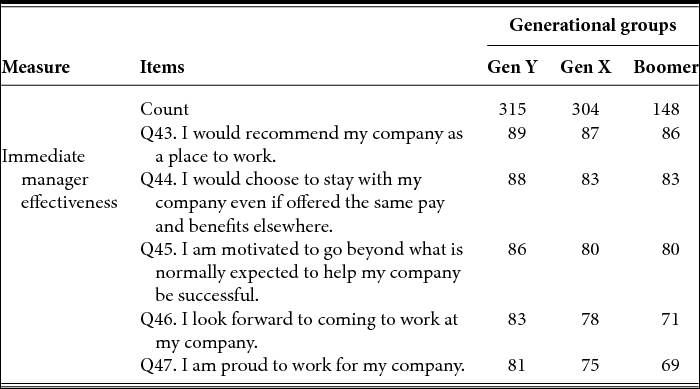
Using data gathered from a sample of 767 employees working in a global medical organization, we explored the quality of LMX—from an employee perspective—based on seven diagnostic items (Chart 2). When we looked at results across generations, we found few meaningful differences between the way Millennial, Generation X, and Baby Boomer employees perceive their immediate managers.
Chart 2.Descriptive Distribution of Nonmanagement Generational Groups
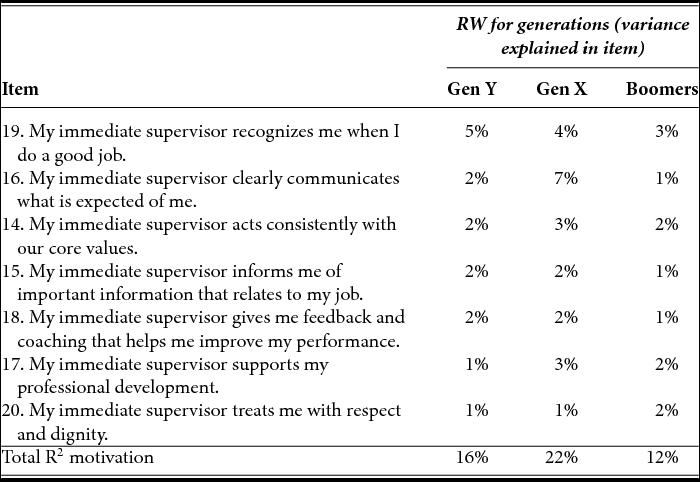
In their article, Chernyak-Hai and Rabenu (Reference Chernyak-Hai and Rabenu2018) also suggest that Millennial employees have different expectations about how they would like to be managed at work. To explore this supposition, we conducted a key driver analysis (using relative weights analysis) with the seven items presented in Table 2 serving as the predictor variables, and an engagement/OCB item (i.e., I am motivated to go beyond what is normally expected to help this organization be successful) serving as the criterion variable. Again, we found very few generation-based differences. Although some findings raise interesting questions (e.g., is clear communication particularly motivating for Generation X employees?), from a practical perspective, results are more similar than different across generations in this research sample (Table 3).
Table 2.Perceptions of Immediate Manager Effectiveness by Nonmanagement Generational Groups
Table 3.Relative Weight Analysis for Nonmanagement Generations
Based on these results, we found little support for Chernyak-Hai and Rabenu's argument that generational factors may impact the quality of LMX. In recent years, some researchers have found that generational differences impact important workplace attitudes like job involvement, work satisfaction, and organizational citizenship behavior (see Shragay & Tziner, Reference Shragay and Tziner2011). Others have cautioned that such thinking could lead to inaccurate stereotyping (see Costanza & Finkelstein, Reference Costanza and Finkelstein2015). Researchers should continue searching for possible generation-based differences regarding LMX and SET.
What New Exchange Variables May Be Increasingly Important to Today's Workforce?
Chernyak-Hai and Rabenu (Reference Chernyak-Hai and Rabenu2018) conclude their article by encouraging researchers to identify new exchange variables that are important in today's workplace. For example, they say that employee perceptions of team climate and work–family conflict could be increasingly important to today's workforce.
In recent years, we have started exploring new constructs that may influence employee engagement and commitment. Traditionally, researchers have focused narrowly on qualities of the job or the work when studying engagement. For example, Kahn (Reference Kahn1990) has argued that people engage in a role, task, or work assignment to the extent that they think the task is meaningful, feel psychologically safe in their role, and have the personal resources available to complete the work. Schaufeli, Salanova, Gonzalez-Roma, and Bakker (Reference Schaufeli, Salanova, Gonzalez-Roma and Bakker2002) have argued that engagement is a “state of mind that is characterized by vigor, dedication, and absorption” (p. 74). From a SET perspective, both of these models suggest that employees will invest themselves in their work if they feel it is interesting and important.
Whereas our research shows that employees are in fact more engaged when they are doing meaningful work in well-designed jobs in a psychologically safe environment, we have also found that other factors influence the extent to which employees invest themselves at work. Based on qualitative data gathered through exploratory interviews, focus groups, and open-ended surveys, we have found that many employees are increasingly mindful of how their current job is impacting their health and wellness, their learning and development, and their future professional development. New academic constructs like thriving (Porath, Spreitzer, Gibson, & Garnett, Reference Porath, Spreitzer, Gibson and Garnett2011) and new research on the psychology of our future selves (see Bryan & Hershfield, Reference Bryan and Hershfield2011; Urminsky, Reference Urminsky2017) seem to be consistent with the emerging workplace questions, concerns, hopes, and expectations we hear from employees.
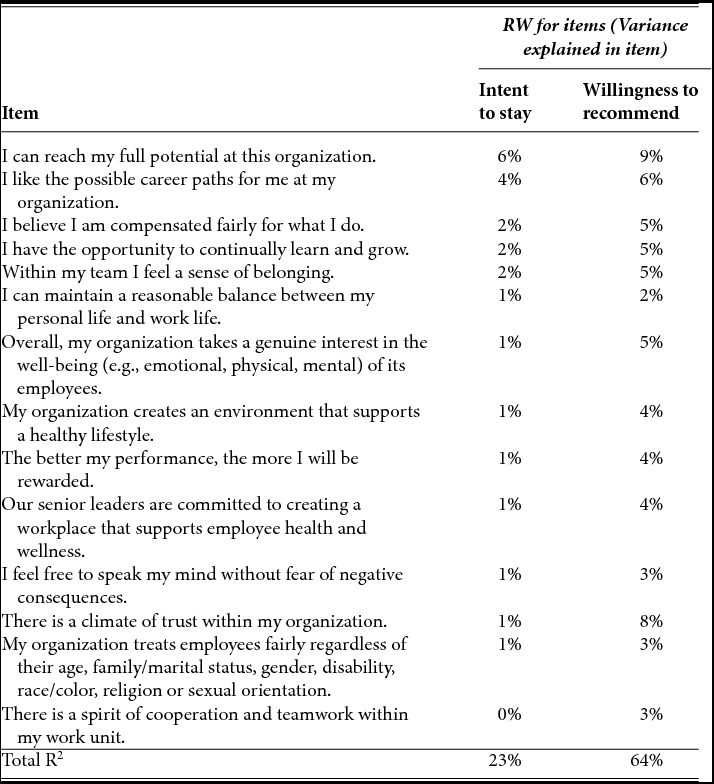
In light of these emerging trends, we have started including new diagnostic items that ask about the extent to which employees feel they are healthy, learning, and making progress toward their desired future at work. In one recent Amazon MTurk–based study of over 1,000 employees working in small, medium, and large organizations in North America, we found that many of these new diagnostic items had a significant impact on commitment levels and social exchange attitudes. For example, key driver analysis (based on relative weights analysis; see Table 4) showed that employees were more likely to intend to stay at their organization and recommend it as a great place to work when they felt they could reach their full potential at work.
Table 4.Relative Weight Analysis
Results like these highlight the need to expand our understanding of the various variables that impact social exchange relationships at work and consider new factors, like wellness and personal development, that may be particularly salient for today's workforce. As Chernyak-Hai and Rabenu (Reference Chernyak-Hai and Rabenu2018) note, the world of work is changing in a number of profound ways. For scientists, practitioners, and leaders seeking to help their organizations attract, engage, and retain top talent, identifying the elements that create compelling exchange relationships is critical.




 You have Access
Exploring SET From an Employee Engagement Perspective
In their focal article, Chernyak-Hai and Rabenu (Reference Chernyak-Hai and Rabenu2018) argue that the foundational assumptions of social exchange theory (SET) should be revisited and revised because of recent changes in the workplace and the workforce. Using employee engagement data from recent research projects conducted in applied settings, we investigated a series of questions based on Chernyak-Hai and Rabenu's working hypotheses.
Using Engagement Data to Explore Social Exchange Relationships at Work
In his review of the engagement literature, Saks (Reference Saks2006) uses SET to provide a theoretical framework for understanding both Kahn's (Reference Kahn1990) original conceptualization of engagement and Maslach, Schaufeli, and Leiter's (Reference Maslach, Schaufeli and Leiter2001) model of engagement. Saks says that “the amount of cognitive, emotional, and physical resources that an individual is prepared to devote in the performance of one's work roles is contingent on the economic and socioemotional resources received from the organization” (2006, p. 603). From a SET perspective, employees’ engagement levels vary depending on the amount of resources they receive from their employer. Although Chernyak-Hai and Rabenu (Reference Chernyak-Hai and Rabenu2018) do not focus specifically on employee engagement in their focal article, engagement data can be used as a limited indicator to investigate, albeit in a partial and tangential way, some of the questions they raise. Here we share findings from three research questions we explored.
Do Engagement Levels Vary Based on Employees’ Relationship to Work?
Chernyak-Hai and Rabenu (Reference Chernyak-Hai and Rabenu2018) posit that employees’ personal values and their relationship with work (e.g., freelancing) may influence the social exchange (e.g., leader member exchange (LMX), organizational citizenship behavior (OCB), organizational support) they experience at work. Consistent with these arguments, we recently explored how employees’ psychological relationship to work impacts their engagement and commitment levels. We based our work on research by Wrzesniewski, McCauley, Rozin, and Schwartz (Reference Wrzesniewski, McCauley, Rozin and Schwartz1997), who found that people relate to their work in three different ways. Some see their job as just a job to do in exchange for money; others see their job as a critical step in their career; others see their job as their calling or vocation.
Building on this research, we developed a single item self-diagnostic question to evaluate the way employees think about their current job. We then administered this question, along with other employee engagement items, to an Amazon MTurk–sourced sample of over 1,700 employees working in small, medium, and large organizations (Chart 1). We found that engagement and commitment levels varied significantly based on the way people viewed their jobs. We also found that employee perceptions of their managers and leaders varied based on their psychological relationship to work (Table 1).
Descriptive Distribution of Overall Relationships to Jobs
Note: n = 1,757.
Attitudinal Results by Overall Relationships to Job
Note: Results by relationship to job are displayed as a percent favorable—the percentage of respondents who agreed or strongly agreed with the corresponding item.
These results may provide preliminary support for Chernyak-Hai and Rabenu's (Reference Chernyak-Hai and Rabenu2018) proposed hybrid model of organizational support. Considered in the context of this model, our results suggest that employees form different exchange relationships with their leaders, managers, and organizations based on the way they think about their jobs. Employees who see their job as just a job invest less of themselves at work (as evidenced by their low engagement and commitment levels), and they also receive lower levels of leader and organizational support in return. Employees who see their job as their vocation—on the other hand—invest a lot of themselves at work, and they also experience a lot of leader and organizational support in return.
Although these results provide possible empirical support for Chernyak-Hai and Rabenu's (Reference Chernyak-Hai and Rabenu2018) hypotheses, it is important to note that we used a single item to measure employees’ psychological relationship to work. Future studies using a more robust assessment of this construct, along with other aspects of the social exchange relationship (e.g., OCBs, performance, retention), should be considered.
Do Generational Differences Impact the Quality of LMX?
Citing a handful of studies, Chernyak-Hai and Rabenu hypothesize that generational factors may impact the quality of LMX, particularly for Millennial employees. Based on research by Myers and Sadaghiani (Reference Myers and Sadaghiani2010), Chernyak-Hai and Rabenu (Reference Chernyak-Hai and Rabenu2018, p. 460) state that “Millennials present a challenge to LMX, as they are likely to have different perspectives on supervisor–employee relationships.”
Using data gathered from a sample of 767 employees working in a global medical organization, we explored the quality of LMX—from an employee perspective—based on seven diagnostic items (Chart 2). When we looked at results across generations, we found few meaningful differences between the way Millennial, Generation X, and Baby Boomer employees perceive their immediate managers.
Descriptive Distribution of Nonmanagement Generational Groups
Note: Sample n = 767.
In their article, Chernyak-Hai and Rabenu (Reference Chernyak-Hai and Rabenu2018) also suggest that Millennial employees have different expectations about how they would like to be managed at work. To explore this supposition, we conducted a key driver analysis (using relative weights analysis) with the seven items presented in Table 2 serving as the predictor variables, and an engagement/OCB item (i.e., I am motivated to go beyond what is normally expected to help this organization be successful) serving as the criterion variable. Again, we found very few generation-based differences. Although some findings raise interesting questions (e.g., is clear communication particularly motivating for Generation X employees?), from a practical perspective, results are more similar than different across generations in this research sample (Table 3).
Perceptions of Immediate Manager Effectiveness by Nonmanagement Generational Groups
Note: Results for generational groups are displayed as a percent favorable—the percentage of respondents who agreed or strongly agreed with the corresponding item.
Relative Weight Analysis for Nonmanagement Generations
Note: Sample n = 1,048. RW = reported raw relative weight (variance explained); Dependent variable = I am motivated to go above and beyond what is normally expected to help this organization be successful.
Based on these results, we found little support for Chernyak-Hai and Rabenu's argument that generational factors may impact the quality of LMX. In recent years, some researchers have found that generational differences impact important workplace attitudes like job involvement, work satisfaction, and organizational citizenship behavior (see Shragay & Tziner, Reference Shragay and Tziner2011). Others have cautioned that such thinking could lead to inaccurate stereotyping (see Costanza & Finkelstein, Reference Costanza and Finkelstein2015). Researchers should continue searching for possible generation-based differences regarding LMX and SET.
What New Exchange Variables May Be Increasingly Important to Today's Workforce?
Chernyak-Hai and Rabenu (Reference Chernyak-Hai and Rabenu2018) conclude their article by encouraging researchers to identify new exchange variables that are important in today's workplace. For example, they say that employee perceptions of team climate and work–family conflict could be increasingly important to today's workforce.
In recent years, we have started exploring new constructs that may influence employee engagement and commitment. Traditionally, researchers have focused narrowly on qualities of the job or the work when studying engagement. For example, Kahn (Reference Kahn1990) has argued that people engage in a role, task, or work assignment to the extent that they think the task is meaningful, feel psychologically safe in their role, and have the personal resources available to complete the work. Schaufeli, Salanova, Gonzalez-Roma, and Bakker (Reference Schaufeli, Salanova, Gonzalez-Roma and Bakker2002) have argued that engagement is a “state of mind that is characterized by vigor, dedication, and absorption” (p. 74). From a SET perspective, both of these models suggest that employees will invest themselves in their work if they feel it is interesting and important.
Whereas our research shows that employees are in fact more engaged when they are doing meaningful work in well-designed jobs in a psychologically safe environment, we have also found that other factors influence the extent to which employees invest themselves at work. Based on qualitative data gathered through exploratory interviews, focus groups, and open-ended surveys, we have found that many employees are increasingly mindful of how their current job is impacting their health and wellness, their learning and development, and their future professional development. New academic constructs like thriving (Porath, Spreitzer, Gibson, & Garnett, Reference Porath, Spreitzer, Gibson and Garnett2011) and new research on the psychology of our future selves (see Bryan & Hershfield, Reference Bryan and Hershfield2011; Urminsky, Reference Urminsky2017) seem to be consistent with the emerging workplace questions, concerns, hopes, and expectations we hear from employees.
In light of these emerging trends, we have started including new diagnostic items that ask about the extent to which employees feel they are healthy, learning, and making progress toward their desired future at work. In one recent Amazon MTurk–based study of over 1,000 employees working in small, medium, and large organizations in North America, we found that many of these new diagnostic items had a significant impact on commitment levels and social exchange attitudes. For example, key driver analysis (based on relative weights analysis; see Table 4) showed that employees were more likely to intend to stay at their organization and recommend it as a great place to work when they felt they could reach their full potential at work.
Relative Weight Analysis
Note: Sample n = 1,048. RW = reported raw relative weight (variance explained).
Results like these highlight the need to expand our understanding of the various variables that impact social exchange relationships at work and consider new factors, like wellness and personal development, that may be particularly salient for today's workforce. As Chernyak-Hai and Rabenu (Reference Chernyak-Hai and Rabenu2018) note, the world of work is changing in a number of profound ways. For scientists, practitioners, and leaders seeking to help their organizations attract, engage, and retain top talent, identifying the elements that create compelling exchange relationships is critical.