INTRODUCTION
Radiation pneumonitis (RP) has always been a concern and a dose limiting factor in patients undergoing thoracic irradiation.Reference Tucker, Liu, Wang, Wei, Liao, Komaki, Cox and Mohan1–Reference Minsky, Pajak, Ginsberg, Pisansky, Martenson, Komaki, Okawara, Rosenthal and Kelsen5 Various researchers have tried to formulate correlations between global lung function and treatment related to morbidities, especially RP.Reference Marks, Munley, Bentel, Zhou, Hollis, Scarfone, Sibley, Kong, Jirtle, Jaszczak, Coleman, Tapson and Anscher6–Reference Hernando, Marks, Bentel, Zhou, Hollis, Das, Fan, Munley, Shafman, Anscher and Lind11 It has been observed that there is an incidence of up to 30% of radiation-induced lung injury following thoracic irradiation.Reference Fay, Tan, Fisher, Mac Manus, Wirth and Ball12–Reference Schraube, Schell, Wannenmacher, Drings and Flentje15 Therefore, it has become essential to evaluate various predictors of radiation-induced lung injury in day to day practice of radiotherapy (RT) planning for thoracic malignancies.
Acute RP manifests as shortness of breath, cough and occasionally mild fever which usually develops 1 to 6 months after thoracic radiation. Late pulmonary toxicity presents several months to years after radiation with progressive chronic dyspnoea and is often associated with fibrosis of the irradiated lung.Reference Miller, Shafman and Marks16
Researchers have correlated the risk of lung injury with various dosimetric parameters, for stratifying patients who are at greater risk of RP in the management lung and oesophageal carcinoma. Six-minute walk test (6MWT) has been an economical, reproducible and prognostic parameter for assessing the overall cardiopulmonary status of patients with parenchymal lung diseases, heart failure, sarcoidosis, chronic obstructive pulmonary diseases (COPDs) etc.Reference Holland, Hill, Conron, Munro and McDonald17–23 It has been seen that even small changes in the walk distance from baseline are evident in patients with a diseased lung.Reference Holland, Hill, Conron, Munro and McDonald17 Some have correlated pulmonary function tests (PFTs) as an assessment tool of lung status whereas others have combined PFT and 6MWT as predictor tool for RP in patients undergoing thoracic irradiation for lung carcinoma.Reference Wang, Liao, Vaporciyan, Tucker, Liu, Wei, Swisher, Ajani, Cox and Komaki4,Reference Tucker, Liu, Wang, Wei, Liao, Komaki, Cox and Mohan24–Reference Lyman26
These useful metrics lack their correlation with RT planning in predicting RP in the management of carcinoma of oesophagus. We herein conducted a prospective study by correlating the 6MWT and PFT with the incidence of acute and chronic pneumonitis while treating patients with conformal RT in oesophageal cancer.
METHODS AND MATERIALS
Patient selection
From February 2008 to April 2009, 45 patients with locally advanced oesophageal cancer were selected to the study protocol at Rajiv Gandhi Cancer Institute and Research Centre, New Delhi, India. The selection criteria for inclusion were: patients with age >18 years of either sex with properly staged histologically proven disease involving thoracic oesophagus only and with no distant metastasis. These patients should not have had prior radiation to thorax and gave an informed consent for their inclusion in the study.
Pre-treatment patient evaluation
Patient evaluation included a complete history and physical examination, performance status, history of co-morbidities like COPD, coronary artery disease, lung infection, previous lung disease/injury or any thoracic surgery, previous history of cancer, chemotherapy or radiation. Smoking habits were also recorded.
Pre-treatment pulmonary function evaluation
A baseline pulmonary function evaluation was done objectively by a chest x-ray (CXR), a 6MWT, PFT including vital capacity (VC), forced expiratory volume in 1 second (FEV1) and diffusion capacity of carbon monoxide (DLCO) and subjectively by symptoms of cough, dyspnoea and fatigue.
Walk test
6MWT was performed in accordance with the American Thoracic Society Guidelines.27 It was performed on a flat surface with a respiratory therapist by the side of the patient. Pre- and post-test heart rate, blood pressure and oxygen saturation were recorded along with patient symptoms of cough, dyspnoea and fatigue in grades as per the common terminology criteria for adverse events version 3 (CTCAE v3).28 This test was performed before radiation as a baseline record and then repeated at 1, 3, 6 and 9 months after treatment. The walk distance changes (WDC) from baseline were correlated with the incidence of RP and also with other patients’ treatment-related parameters. The 6MWT with different PFT variable ratios were also computed as in the literature.Reference Miller, Kocak, Kahn, Zhou, Baydush, Hollis, Folz, Tisch, Clough, Yu, Light and Marks29
Radiation therapy and dosimetric factors
Patients were treated with either fractionated computer-based three-dimensional non-IMRT radiation therapy planning (RTP) on Mevatron KD-2 dual energy linear accelerator (Seimens Medical Solutions) or intensity-modulated radiation therapy (IMRT) on Primus KXE-2 (Seimens Medical Solutions) to a total dose of 50 Gy at 2.0 Gy per fraction. Planning computer tomography (CT) images were taken on a CT simulator (Sensation Open Duo wide bore by Seimens Medical Solutions) after patient immobilization by a cast (Orfit Industries) in supine position with arms raised above head.
Contouring of the target volumes in oesophageal carcinoma and organs at risk (OARs) such as spinal cord, heart, lungs, liver and bilateral kidneys was done on either Oncentra Masterplan (Anatomy Modeling by Nucletron B.V.) or Coherence Oncologist (Seimens Medical Solutions). The inverse treatment planning system (TPS) of Plato Sunrise Fuel (Nucletron B.V.) was used for the purpose of beam designing and obtaining dose-volume histogram (DVH) parameters.
Treatment plan evaluation
IMRT plans usually included five coplanar beams for a total dose of 50 Gy and the RTP plan included an initial phase of 36 Gy with anterior and posterior beams and later by three oblique beams for the remaining 14 Gy treatment.
During treatment planning, besides the target volumes, the following OARs were included: lung parenchyma, heart, spinal cord, liver and bilateral kidneys. Dose constrains to the lung as well as other critical structures like spinal cord and heart were prescribed as in literature.Reference Wang, Liao, Vaporciyan, Tucker, Liu, Wei, Swisher, Ajani, Cox and Komaki4,Reference Tucker, Liu, Wang, Wei, Liao, Komaki, Cox and Mohan24,Reference Tsujino, Hirota, Endo, Obayashi, Kotani, Satouchi, Kado and Takada30
The TPS was used to compute the DVH, which was used to determine the dose received by 5% and 95% of gross tumour volume, clinical target volume and planning target volume, the volume of lung receiving more that 5 Gy, 10 Gy, 20 Gy, 30 Gy and 50 Gy (V5, V10, V20, V30 and V50), the mean lung dose, doses received by heart, liver and kidneys.
The IMRT beams were kept to the minimum so as to increase the dose homogeneity to the target volumes and decreasing doses to the lung.Reference Nutting, Bedford, Cosgrove, Tait, Dearnaley and Webb31–Reference Stein, Mohan, Wang, Bortfeld, Wu, Preiser, Ling and Schlegel33
Chemotherapy
All patients received cisplatin (CDDP)-based chemoradiotherapy. The chemotherapy protocol included either weekly CDDP only regimen or CDDP along with 5-flurouracil (5FU) as a continuous infusion over 5 days in the initial 5 days and the last 5 days of RT (phase I and phase II). The CDDP doses were 50 mg/mReference Bosset, Gignoux, Triboulet, Tiret, Mantion, Elias, Lozach, Ollier, Pavy, Mercier and Sahmoud2 for CDDP alone regimen and 30 mg/mReference Bosset, Gignoux, Triboulet, Tiret, Mantion, Elias, Lozach, Ollier, Pavy, Mercier and Sahmoud2 for CDDP along with 5FU-based regimen. The dose for 5FU was 600 mg/mReference Bosset, Gignoux, Triboulet, Tiret, Mantion, Elias, Lozach, Ollier, Pavy, Mercier and Sahmoud2 of continuous infusion for 96 hours on days 1–4 and days 29–34 plus cisplatin on days 1 and 29.
Surgery
Surgery was performed 4–6 weeks after completion of chemoradiotherapy in patients with resectable disease. The different techniques used were either three-field, Ivor-Lewis, or transhiatal esophagectomy.Reference Hulscher, Sandick, Boer, Wijnhoven, Tijssen, Fockens, Stalmeier, ten Kate, van Dekken, Obertop, Tilanus and van Lanschot34
Post-treatment pulmonary function evaluation
Post-treatment pulmonary function evaluation was done objectively (CXR, PFT and 6MWT) and subjectively (symptoms of cough, dyspnoea and fatigue) at 1, 3, 6 and 9 months after treatment, as was done for pre-treatment baseline evaluations. The grading of the observed toxicity was done as per CTCAE v3.
Statistical analysis
Statistical analysis was done using Statistical Package for the Social Sciences (SPSS) software version 16. χReference Bosset, Gignoux, Triboulet, Tiret, Mantion, Elias, Lozach, Ollier, Pavy, Mercier and Sahmoud2-test was used for calculating the p value.
RESULTS
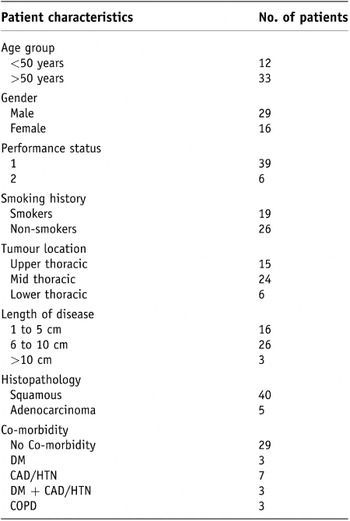
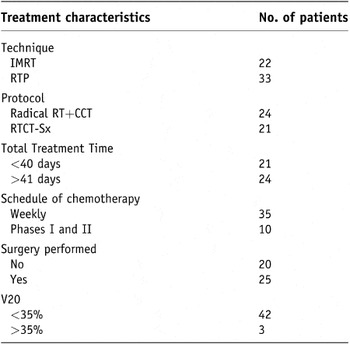
The patient and disease characteristics are shown in Table 1 and the treatment characteristics are shown in Table 2.
Patients and disease characteristics (n = 45)

CAD, coronary artery disease; COPD, chronic obstructive pulmonary disease; DM, diabetes mellitus; HTN, hypertension.
Treatment-related characteristics

CCT, concurrent chemotherapy; IMRT, intensity-modulated radiotherapy; RT, radiotherapy; RTCT-Sx, radiotherapy with concurrent chemotherapy followed by surgery; RTP, non-IMRT computer-based radiotherapy planning.
The baseline walk test values for different patients had a maximum of 163 m and minimum of 74 m. The mean value was 118.50 m.
The WDC characteristics from baseline to 3 and 9 months are shown in Table 3.
WDC characteristics at 3rd and 9th month after radiation

aOne subject was not evaluable at 9 months, as the patient expired at 5th month after RT due to medical reasons not related to the disease or its complications.
The WDC from baseline to 3 months was calculated. It was found that this change significantly correlated with the PFT values of VC (p = 0.02) and DLCO (p = 0.001) done at 3 months after radiation. Change in DLCO values from baseline also had statistical correlation with WDC at 3 months (p = 0.006). Similarly, a change of ≥20 l in FEV1 had a correlation with WDC at 3 months which was statistically significant (p = 0.02). However, these had no significant correlation with incidence of acute RP (p = 0.126).
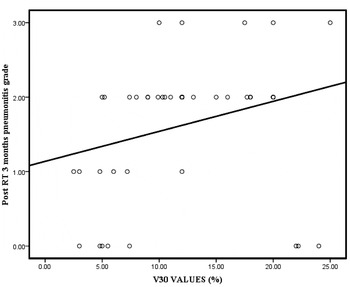
The V5, V10, V20, V30 and V50 calculated from the DVH were divided into various subgroups with cut-off values in the steps of 5%. From this, it was found that when V30 values were ≥20%, it significantly correlated with the incidence of acute pneumonitis (p = 0.007) as shown in Figure 1. The value of WDC at 3 months also had a positive correlation with V5 (p = 0.02), V30 (p = 0.04) and V50 (p = 0.02) but not with V10 (p = 0.128) or V20 (p = 0.259).
Relation between V30 and incidence of acute pneumonitis at 3 months. V30 ≥20% results in more incidence of pneumonitis. V30, volume of the lung receiving 30 Gy or more (%).

Similar correlations were computed for the incidence of chronic pneumonitis at 9 months after RT treatment. The change in DLCO values from baseline to 9 months after RT also had significant correlation with WDC, as was seen at 3 months.
The WDC were then further divided into various cut-off value subgroups. It was seen that a WDC of ≥50 ft correlated significantly with VC and DLCO changes at 9 months. But this correlation was not seen with the incidence of RP at 9 months.
Among the various protocol used for treatment of carcinoma of oesophagus, it was observed that the maximum decrease in walk distance was in patients who received neoadjuvant chemotherapy followed by radical chemoradiotherapy (mean = 60 ft) and this was more so at 9 months (mean = 100 ft) after RT.
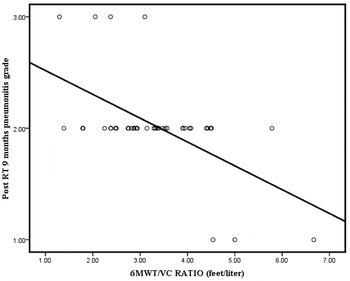
On running a regression analysis using scatter plot between 6MVT and PFT ratios (Figure 2), it was observed that 6MVT/VC values of ≤4 ft/l had a statistically significant correlation with the incidence of clinically symptomatic RP at 9 months. Patients with values more than 4 ft/l either had no or an asymptomatic grade 1 pneumonitis.
Relationship between 6MWT/VC ratio and incidence of pneumonitis at 9 months. Values of 6MWT/VC ≤4 ft/l, results in greater incidence of clinically symptomatic grade 2 or more pneumonitis. 6MWT, six-minute walk test value; VC, vital capacity value.

However, there was no correlation of the incidence of RP or WDC with patient and disease characteristics.
DISCUSSION
Accurate prediction of RP has always been a challenge and various surrogates used for it have been assessed in different studies. Most relevant indications for 6MWT are for evaluating the response to medical interventions in patients having cardiopulmonary diseases. It has also been used as a predictor of morbidity in patients having lung injury due to medical treatment.
It has been observed that the average six-minute walk distance (MWD) reported in literature is between 500 and 580 m.27 In our cohort of patients, it was seen that the value of MWD was in the range of 74–163 m.
Holland et al.Reference Holland, Hill, Conron, Munro and McDonald17 reported a reduction of 29–34 m in MWD in subjects with diffuse parenchymal lung disease who had no improvement after an 8-week exercise program. However, even this minimal change was statistically significant. In our study the mean change at 3 months after RT treatment was ∼20 m and at 9 months, the value was 31 m. However, it did not correlate with incidence of RP.
Mao et al.Reference Mao, Zhang, Zhou, Das, Hollis, Folz, Wong and Marks35 found a weak correlation between PFT and 6MWT and suggested that they both might be measuring different physiological functions. In our study, the WDC correlated significantly with the changes in VC and DLCO values. We also found a statistically significant correlation between ≥20 l change in FEV1 and reduction in WDC at 3 months. This indicates that when FEV1 values reduce by ≥20 l, then there is also a significant reduction in MWD, thus reflecting an overall poor cardiopulmonary status of the patient. This might suggest that they are probably measuring almost the same overall cardiopulmonary functions as far as RP in patients undergoing thoracic irradiation for carcinoma of oesophagus is concerned.
Hernando et al.Reference Hernando, Marks, Bentel, Zhou, Hollis, Das, Fan, Munley, Shafman, Anscher and Lind11 reported a V30 cut-off value of 18% that divided the population into a low and intermediate risk group (i.e., 6% versus 24% observed RP cases). In our study, among all the volumes of lung evaluated we also observed a similar cut off of 20% which resulted in 45% incidence of RP (p = 0.007) at 3 months after RT.
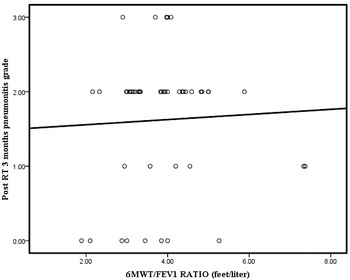
Miller et al.Reference Miller, Kocak, Kahn, Zhou, Baydush, Hollis, Folz, Tisch, Clough, Yu, Light and Marks29 calculated the predictive capacities of 6MVT and PFT for the development of RP but they found no direct correlation among different variables used. In our study, WDC of ≥50 m correlated significantly with VC and DLCO components of PFT. However, these did not correlate with the incidence of RP. These researchers further stated that if the 6MWT/FEV1 ratio was ≤22 ft/l, then there was no increased incidence of RP. However, we could not find a strong correlation among these two variables in assessing the risk of pneumonitis as seen in scatter plot regression analysis (Figure 3).
Relation between 6MWT/FEV1 in predicting the risk of pneumonitis. 6MWT, six-minute walk test value; FEV1, forced expiratory volume in 1 second.

It was observed that only 6MWT/VC values of ≤4 ft/l had a statistically significant correlation with the incidence of pneumonitis at 9 months than in patients with values ≥4 ft/l who suffered a maximum of asymptomatic grade 1 RP. This again might be suggesting that this ratio could probably be used as a predictor of chronic RP.
Our study could not establish any significant correlation of RP with either patient or any of the disease characteristics, suggesting that these parameters might be addressing to different physiologic processes as has been documented in literature in patients undergoing thoracic irradiation for lung carcinoma.Reference Miller, Kocak, Kahn, Zhou, Baydush, Hollis, Folz, Tisch, Clough, Yu, Light and Marks29
CONCLUSION
Prediction of RP is a challenging task and various surrogates used for it have been assessed in different studies. WDC and changes in PFT correlated strongly at both 3 and 9 months. WDC values of ≥50 ft and had statistical significant correlation in change in VC and DLCO values. FEV1 values of ≥20 l resulted in significant reduction in MWD. This signifies that these parameters are supplementary to each other for assessing the lung function status, but their individual role in predicting both acute and chronic RP is weak.
A 6MWT/VC value of ≤4 ft/l can be used to predict the incidence of chronic pneumonitis, thus emphasizing the fact that, both 6MWT and PFT are complementary to each other in assessing the risk of radiation-induced lung dysfunction in the management of carcinoma of oesophagus.
These tools for RP prediction need further studies with more correlations in different ways so that they can effectively be used in clinical practice.