The colonial question in China and ‘the Rest of the West’
This article analyses the participation of peripheral powers in the imperial enterprise in China—a phenomenon largely ignored by historians. China's relations with the major colonial powers during the late Qing dynasty and the Republican period were one of the main areas of interest for historians of China until the 1970s. However, criticism of the approaches of the Harvard School, particularly of the works of J. K. Fairbank, led research into the colonial question in China to a crisis. The resulting shift in the historiography towards what Paul Cohen defined as a ‘China-centered history of China’ reinforced this criticism.Footnote 1 While the actions of imperialism, and the means and strategies it adopted in China, have once again become a major area of study over the last two decades, the role that the peripheral powers played in the imperial enterprise has remained largely unnoticed.
There have been major contributions as part of a renewed effort to provide an appropriate framework for the colonial phenomenon in China.Footnote 2 Scholars have reconsidered the peculiar form of colonial rule that existed in China in the Republican period. In 1916, Lenin defined it vaguely and intuitively as semi-colonialism, which at that time was considered a transitional stage; Sun Yat-Sen's rejection of the concept in favour of that of ‘hypo-colony’ brought another dimension to the debate.Footnote 3 From Sun's perspective, China had endured an economic oppression that was ‘greater even than that of a full colony’. Sun thought that the idea of a ‘semi-colony’ did not do justice to the situation of China because China even lacked the privileges of a formal colony. This is why he preferred to talk in terms of ci zhimindi—a ‘hypo-colony’ or ‘sub-colony’.Footnote 4 While Sun Yat-Sen's proposal was almost forgotten by the 1930s, Lenin's concept of semi-colonialism became more widely accepted and it has been used—sometimes in an uncritical way—to describe a situation in which, without the need for direct control over a country, another nation or group of nations is able to determine its political decision making regarding policy and foreign trade.Footnote 5 Most authors, such as Osterhammel, Barlow, Goodman, and Shih, choose to describe China's situation as semi-colonial.Footnote 6 This implies an asymmetry of power that, in practical terms, leads to the establishment of economic and military bases, forms of financial dependence, and the involvement of collaborative local elites in this semi-colonial framework. This idea is consistent with the concept of an ‘informal empire’, which has been applied on a relatively widespread basis to the Chinese context.Footnote 7
Furthermore, recent historiography has highlighted a basic aspect of the imperial enterprise in China: the diversity and complexity of its colonial formations. In her study of China's modernist literature, Shih emphasizes the ‘multiple layers of domination’ in colonial China in the early twentieth century.Footnote 8 Similarly, Goodman and Goodman discuss ‘multifarious, partial, and discrete constellations of colonial power’, allowing them to claim that ‘early colonial powers such as Britain projected different goals for their China toeholds than latecomers such as Germany, Japan and Italy. [. . .] Different colonial powers responded in different ways to growing challenges to the legitimacy of their hold on pieces of China’.Footnote 9 Bickers and Henriot define the colonial situation in China as a ‘network of overlapping imperialisms’ and discuss an ‘interpenetration of interests’ that has problematized the boundaries between the colonizer and the colonized.Footnote 10
In 1986, Osterhammel argued that ‘only very few authors take note of the diversity which characterized the foreign presence in, and foreign impact on, China’.Footnote 11 Nowadays, despite the acknowledgement of the diverse nature of the colonial formations in China, the vast majority of studies continue to focus on the actions of the major powers—primarily Britain, France, the United States of America, Japan, and, to a lesser extent, Russia and Germany. Thus, while the diversity of colonial formations is widely recognized, few studies have characterized it beyond the case of the powers noted above. The result is a remarkably reified concept of the West.Footnote 12 As argued by van der Putten, ‘if Imperialism in China would only be studied in terms of British, French, American, Russian, German, or Japanese activities, this would possibly result in a far too simplified model of imperialism’.Footnote 13 Specifically, Hevia has highlighted the need for ‘dereifying the West’ in the Chinese context.Footnote 14 In line with these academic approaches, this article participates on the debate about the necessity to challenge an essentialized concept of the West in order to gain a thorough understanding of the imperial enterprise.Footnote 15
This article uncovers the fact that many other nations played a role in the colonial enterprise in China, negotiating and signing treaties, forming companies, engaging in intra- and intercontinental trade, managing concessions, participating in relevant institutions such as the maritime customs, forming part of municipal committees, creating cultural associations, and even taking part in military conflicts. These countries include Portugal, Italy, Belgium, Spain, the Netherlands, Sweden, Norway, and others.Footnote 16 They played a lesser role, in some cases only as witnesses, in the colonization process in China but, at the same time, they provide us perceptions that help to depict colonialism with greater accuracy. Their actions, strategies of representation, and power relations show different colonial formations that challenge some of our ideas about the development of the imperial enterprise and thus complete our understanding of China from the mid-nineteenth century until the Second World War.Footnote 17
Of course, the balance between the centre and the periphery is historically dynamic, and this is also true in the Chinese colonial context. For instance, in the mid-nineteenth century, Germany was on the periphery of colonial action but, within a few decades, it had assumed an undeniably central role, becoming a driving force of the imperial enterprise in China. At the other extreme was the case of Spain—one of the major players in China's relations with the European world in the sixteenth and seventeenth centuries through its colony in the Philippines. However, Spain's influence in the region rapidly declined even before the loss of its Asian colony in the 1898 Spanish-American War. Its status became marginal despite the fact of maintaining a presence in China throughout the first half of the twentieth century.
Spain and other countries that entered the colonial stage as secondary stakeholders make up what Prado-Fonts calls ‘the Rest of the West’.Footnote 18 With a limited economic, military, and/or cultural power, they occupied a peripheral position in the colonial enterprise. At the same time, they were part of the West and identified themselves with Western colonial objectives. In other words, they were countries that participated in the imperial enterprise without having a defined or leading role in it.
The Spanish case challenges some of our ideas, definitions, and conceptions about colonial formations in China, such as the idea that Western countries profited from the open-port system, as Spain suffered severe deficits in its trade with China during the first decades of the twentieth century. This case highlights an empirical bias in the historiography of China, which has silenced and consequently ignored the historical significance of otherwise easily documentable phenomena.Footnote 19
We believe that the Spanish case is extreme, as its trade deficit was one of the highest of all countries that participated in the treaty-port system, but not unique. Despite its historical connections with China, by the early twentieth century, Spain did not have any colony in Asia nor concession on Chinese soil (unlike other similarly peripheral powers such as Italy, Portugal, and Belgium). Moreover, Spain usually refused involvement in armed imperial actions and its trade, even before the loss of its colony in the Philippines, was characterized by its insignificance and marginality.Footnote 20 The Spanish diplomatic presence in China remained precarious and had an acute shortage of resources, in terms of both financial and human resources. Nevertheless, there was an active Spanish community, especially in Shanghai, which conducted business in the sectors of transportation (rickshaws, garages), entertainment (cinema theatres and film distribution), and architecture and real estate. As a result, the case study of Spain enables us to challenge some of the prevailing assumptions in present-day historiography and provides an opportunity to question the colonizer/colonized dichotomy, since Spain was an example of a power on the periphery of the West and the colonizing world that maintained a relationship with China not determined by clear and unequivocal power structures.
With this argument in mind, this article proposes, first, to examine the Spanish community in China, its commercial presence, its dynamics, and its structure, as a counterpoint to more established and more extensively studied foreign communities. Second, it aims to analyse the evolution of trade interactions between China and Spain in the late nineteenth century and the first half of the twentieth century, which were defined by a low volume and a negative balance. It also aims to compare this commercial relationship with other countries’ bilateral trade with China. Finally, this article highlights the extent to which the evolution of peripheral trade allow us to call into question some elements of the representation of the colonial question in China in the early twentieth century and the treaty-port era.
An imagined colonial community in China
Together with the Netherlands, Spain was one of the few treaty nations with a historical presence in China that never had a colony or territorial concession in any of the treaty ports. Nevertheless, a considerable community of Spanish expatriates and emigrants benefited from the privileges of extraterritoriality granted by treaties and a consular presence. With the exception of the Jewish community—a transnational phenomenon with very specific characteristics—the studies on foreign communities in China have focused on the citizens of nations with territorial possessions. Countries without concessions, like Spain, have consequently not been taken into account.Footnote 21 In specific terms, the Spanish case in China shows the paradoxical existence of a community that consolidated itself in a colonial context despite not having a colony or territorial concession.
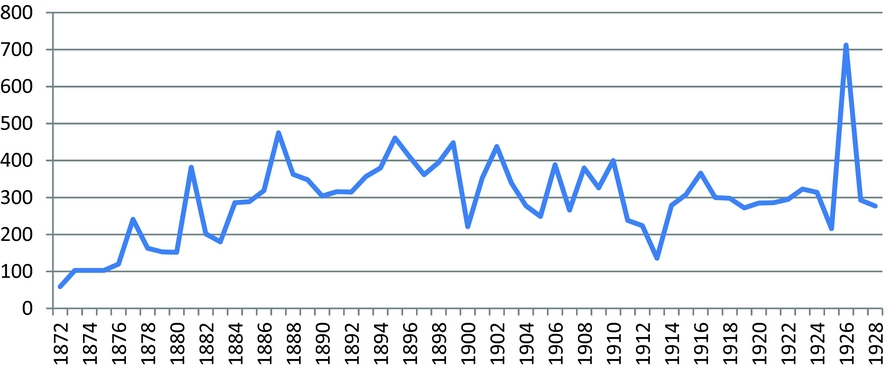
After opening its first consulates in Macao in 1854, Shanghai in 1858, and Xiamen in 1859, Spain maintained a continuous diplomatic presence in China, with official representation in Beijing from 1864 onwards. However, the consular structure was generally precarious and under-funded.Footnote 22 From the 1880s onwards, according to a publication that recorded data from the Chinese Maritime Customs Service (CMCS), the Spanish community in China remained at a relatively stable level of approximately 300 people (Figure 1).Footnote 23 From the mid-nineteenth century onwards, the Spanish population arrived to China mainly from the Philippines and it was mainly composed of Filipino aboriginals who worked as sailors, soldiers, or musicians, numbering in the hundreds in some ports.Footnote 24 During the first decade of the twentieth century, a community of Spanish-speaking Sephardic Jews from the Middle East also established in China, in addition to engineers, architects, artists, lithographers, and seamstresses born in Spain.Footnote 25 Over the next decade, members of religious orders also increased in number and, according to consular sources of the time, they amounted to around 100 people. In the 1930s, a group of Basque pelotaris—players of Basque pelota, a sport that became a global betting game in that era—reached great fame on the cultural life of the city of Shanghai and among the Spanish community in China.Footnote 26 As this brief panoramic view reveals, the Spanish community in China was diverse, dynamic, highly transnational, and involved in a wide range of activities.
Evolution of the Spanish community in China, 1872–1930.

According to Wang Chuifang, there were 16 Spanish companies in Shanghai between 1842 and 1949, of which only one specialized in imports and exports, three worked in local commerce, ten specialized in cultural activities and entertainment (cinema, restaurants, sports, and so on), and one in the production of food items.Footnote 27 Although other Spanish archival sources do not match those figures, Wang's estimates are significant in that they illustrate the limited influence of international trade among the Spanish community. There was no company able to handle the logistics of direct trade between the two countries on a regular and large-scale basis, and there was no financial institution to act as a bridge between the two countries, despite some failed proposals by Spanish consuls.Footnote 28
The Spanish business community, engaged in all kinds of activities in China, was actually one of the most enterprising communities, as has recently been demonstrated, although foreign trade was not its primary activity.Footnote 29 In fact, direct trade with Spain was a very marginal activity—it ranged between 0.01 and 0.2 per cent of total Chinese foreign trade, despite the existence of a network of Spanish companies established in China in the first three decades of the twentieth century. In 1932, 89.02 per cent of Spanish capital in China was invested in rural and urban real estate, while the remainder was invested in business enterprises (8.54 per cent) and industrial enterprises (2.44 per cent).Footnote 30 Religious orders were particularly active in the investments on real estate and managed properties all over China.
There have been few academic studies devoted to this vibrant and cosmopolitan community, although, in recent years, some research has highlighted some of the most prominent figures, especially for the period of the 1910s and 1920s. Among the diplomats of this period, it is worth underscoring the figure of Julio Palencia, who, by all contemporary accounts, gave an institutional dimension to the community of Spanish expatriates who carved a niche in Shanghai in the early twentieth century, and Julio Larracoechea, Spanish consul in Shanghai, and later Spanish ambassador to the Republic of China in Taiwan, who produced an important literary output and contributed to the transmission of the image of China to Spain.Footnote 31
In addition to diplomats, a number of Spanish businessmen and professionals also carved a name for themselves in the treaty ports. Antonio Ramos Espejo was a key figure in the entertainment sector. Ramos, who arrived to China after spending a few years in the Philippines, organized film screenings in Shanghai and built of the first cinema theatres in China. Moreover, his company, Ramos Amusement Co., controlled film distribution in Shanghai until the mid-1920s and had a solid presence in Macao and Hong Kong.Footnote 32 Some of Ramos's cinema theatres in Shanghai were designed by Abelardo Lafuente García-Rojo, a Spanish architect who, along with Hungarian László Húdec, was one of the city's best-known architects. Lafuente's residences and buildings for the most powerful members of Shanghai's Spanish community displayed a characteristic neo-Mozarabic style that attempted to recreate an architectural aesthetic typical of southern Spain. In this sense, Lafuente followed a trend discernible in other foreign concessions of the treaty ports, where streets contained architectural features that recreated the styles of each national context, often in an exercise of self-exotization. Just as some streets in the French Concession contained Parisian-style mansions and examples of Art Deco architecture, and the Italian concession in Tianjin made an effort to build ‘genuinely’ Italian buildings, Lafuente's neo-Mozarabic buildings constitute the most outstanding example of the attempts by the Spanish community to create a unique space within the international community in Shanghai with an aura of ‘Spanishness’.Footnote 33 In fact, Lafuente's buildings are a clear example of colonial architecture and an attempt to exercise symbolic power by Spaniards as members of an imagined colonial community without its own concession.
Lafuente received some of his commissions from Alberto Abraham Cohen—Sephardic merchant from the Middle East nationalized Spanish who controlled a significant part of the rickshaw transport business in Shanghai, in addition to trade interests in leather from China's Northern provinces. Several of Cohen's rickshaw garages were built in this peculiar revival style, which was also reminiscent of the era when Jews were an important part of Spanish society, prior to their expulsion in the late fifteenth century. Other Spanish architects worked in Shanghai during the same period, such as Santiago Lladó y Perpiñá, the owner of the Shanghai Stucco Company, who appears to have been involved in the design of the Shanghai Auditorium, and Modesto Martí de Solá, an engineer who arrived to Shanghai after working as a public works contractor during the final years of Spanish rule in the Philippines. Martí introduced reinforced concrete to China and tried to boost imports of Spanish construction materials.Footnote 34 To that end, he placed advertisements in the specialized Spanish press, apparently to little avail.Footnote 35
As mentioned above, a significant proportion of Spanish residents were involved in the local service sector, such as the well-known lawyer Federico Sardá Mayet, the promoters of the Auditorium—the Basque jai alai, the place where the pelotari ball game was played—as well as the owners of the film-production company Filmos Company Ltd, the Barcelona and Sevilla restaurants, dancehalls, the Español and Alhambra casinos, and the España hatters.Footnote 36 As is evident, some of the names of these companies emphasized the idea of a Spanish identity by projecting a frequently exoticized version of Spanishness.
The few Spaniards who engaged in international trade included Francisco de Sales Aboitiz y Achaval, the owner of the Sino Spanish Trading Co., and his son, Alberto Aboitiz y Onandia, the joint owner of Aboitiz & Company Ltd, which also engaged in imports and exports. There were other trading companies, but of more limited scope, such as the Commercial Trust Companies, which only engaged in the import and export of products as a secondary activity and which was jointly owned by Isaac Joaquín Sánchez, and The China Trade Company, which belonged to Juan Antonio Vallés y Pérez and Juan Lledó Cercós. Two Spanish tobacco companies also had offices in Shanghai and headquarters in Manila—the Insular Cigar & Cigarette Factory and the Compañía General de Tabacos de Filipinas.Footnote 37
Among the Spanish religious community, it is worth mentioning the Augustinians Agustín Melcón, author of an outstanding work about the Chinese revolutionary process, Páginas de la última revolución china (1914), and Gaudencio Castrillo, who accumulated extensive real-estate properties in Shanghai on behalf of the Agustinian Procuration, in addition to writing one of the most comprehensive books about China of the time, El Comercio en el Extremo Oriente (1918), an excellent monograph on the economy and society of treaty-port China. Castrillo's activities as head of the Augustinian Procuration in Shanghai went far beyond religious and missionary tasks, including the management of companies (The China Trust Ltd and Arts and Crafts Ltd) and a large portfolio of stocks (Ziangbe Rubber Co. Ltd, Anglo-Java Estates Ltd, Chempedak Rubber and Gambier Estate Ltd and Senawang Rubber Estates Co. Ltd), according to meeting announcements published in the press.
In addition, the Spaniards working at the CMCS totalled 72 since its establishment in 1854. The most prominent was Juan Mencarini Pierotti, a Spanish merchant and the son of a diplomat who became assistant first-rank chief of the CMCS in 1912.Footnote 38 Mencarini held positions in Guangzhou, Xiamen, Tamsui, Chinjiang, Shanghai, and Fuzhou. The supernumerary assistant, Alfredo E. Blanco, also accumulated an extensive experience of over 25 years in the CMCS, and later played a leading role in the struggle to prohibit opium trade in China as president of the League against Opium Consumption in Beijing, member of the opiates section of the League of Nations, and director of the Anti-Opium Information Bureau.Footnote 39 However, despite highly skilled and experienced personnel who attempted to foster Sino-Spanish relationships in different ways, neither the government nor the Spanish companies took advantage of this human capital, which went completely unnoticed in Spain.Footnote 40 The Spanish government maintained the fiction that the country was in line with the rest of the imperial powers in China. When the nationalists of Chiang Kai-shek and the Communists clashed in Shanghai in 1927, a Spanish warship was sent to guarantee the interests of the Spanish community in China. It was the first Spanish warship to visit the region in 30 years and it did not play any significant role.Footnote 41 Still, Spain showed that it still kept colonial aspirations in China despite not possessing a colonized territory or a profitable trade to defend.
Literary works and reports written by Spaniards in China during this period highlight yet another dimension of the Spanish community in China: a taste for melancholy and decadence.Footnote 42 In their writings, Spaniards complained about the impossibility to compete with the stronger powers, especially the United Kingdom and the United States of America, which had taken economic advantage of China's weakness. However, according to Gaudencio Castrillo, this unusual competitive form of semi-colonial domination was in reality the pretext to justify the Spanish community's failure to adapt to China, since ‘our laziness or neglect made us look with scorn on what did not bear the imprint of conquest, for which we have had exceptional gifts, unsurpassed by any people on earth, leaving for other nations, more adept at profit and speculation, the usufruct of the Chinese markets’.Footnote 43 Interestingly, this feeling of nostalgia and decay brought the Spanish community closer to the situation of China itself, similarly reflecting a glorious past and the obvious weakness when competing with the great powers in the early twentieth century, most notably in the economic field: ‘something similar has happened to both us Spaniards and to the Chinese; we have lived in complete isolation, in a genuine ivory tower that has prevented us from communicating with the rest of the world.’Footnote 44 A proof of that was the incapacity of Spain to profit from the privileges of the treaty-port system—a condition not exclusive to Spain and actually much more common than what previous historiography has acknowledged.
Trade deficits and the peripheries of treaty-port China
Father Castrillo's negative opinion about Spain's role in China had a great deal to do with Spain's failure to develop trade relations or colonies in China. We will now discuss the evolution of Spanish trade, not only in terms of its value in itself, but also, and particularly, in terms of its contrastive value. In what follows, we will put a special emphasis on the Spanish trade deficits and the various products that China exported to Spain, in order to present an alternative scenario that is able to clarify some of our ideas about colonialism in China. We will next compare the Spanish case with those of other nations that should be similarly considered as peripheral in the imperial enterprise in China to show that the Spanish case is not an exception.
Radical changes in the economic and commercial structure of the Philippines in the nineteenth century determined the patterns of commercial relations between Spain and China in the early twentieth century. The galleon that linked the Philippines to America—an institution that had been the basis of the economy of Manila since 1565—sailed for the last time in 1815. Thereafter, the economy of the Philippines was no longer based on the entrepôt trade that had made it an intermediary between China and the West and products from the Philippines began to be standard currency in international markets. An equally important event took place in 1789, with the gradual opening of the port of Manila to international trade. Although this opening was a priori on a temporary and restricted basis, Manila became a free port within a few years and foreign vessels encountered little impediments for trading.Footnote 45 Furthermore, foreign trading companies were able to open offices and establish themselves in the city of Manila from 1814 onwards.
This meant that direct trade from the Philippines with the Chinese coast was no longer controlled by Spanish traders and the presence of British and American merchants grew steadily: in 1818, 70 per cent of imports were shipped to Manila under a foreign flag, reaching 77 per cent by 1825. As for exports, 54 per cent in 1818 and 68 per cent in 1825 were carried on foreign ships. This explains why the presence of Spanish merchants and vessels in China's ports in the treaty-port era was very limited and sporadic.Footnote 46
In the mid-nineteenth century, the focus of the Philippine trade was placed on other targets different from merely re-exporting Asian products. If we look at the Philippine products exported in different periods of the nineteenth century, changes in the economic system become apparent. In the late 1820s, most exports from the Philippines were non-manufactured products, or products requiring a low level of processing, such as birds’ nests, as well as other basic food products (which in total accounted for the 50 per cent of exports) and traditional southern Chinese pharmacopoeia, which was obviously destined to that market.Footnote 47 However, the picture changed completely in the following decades. From 1830 onwards, the Philippines’ main export products were sugar, Manila hemp, coffee, indigo, tobacco, dyes, and rice—products generally sent to other markets, with the exception of rice. The impact of this change in trade relations between China and Spain was obviously significant, and its implications reached the twentieth century.
The consolidation of sugar as the leading export (especially after, and benefiting from, the end of the international slave trade) and the growing demand for tobacco and Manila hemp, in addition to coffee, led to a change in the agricultural structure of the Philippines, shifting from a subsistence to an export-oriented agriculture. All the above explains why, from the 1850s onwards, China's position in the Philippine foreign trade fell until it became secondary. From then on, the new exports that dominated the Philippine foreign trade until the end of the century and were not consumed on such a regular basis in China coincided with the sharp decline in exports of other typically Chinese products, including rice.Footnote 48
The final decades of the nineteenth century presented a bleak scenario for trade relations between the Philippines—and Spain—and coastal China. As a consequence of this situation, the presence of Spanish merchants in China became a mere token. Spain's loss of the Philippines in 1898 simply aggravated the precarious nature of the bilateral trade between the two countries. This explains the marginal nature of the trade between Spain and China since the beginning of the twentieth century, as well as the significant deficits involved, which reached a differential between imports and exports of one to 1,000 in 1905, turning Spain into one of the countries with the highest rate of negative coverage in its relationship with China.
Several factors that help to explain this situation are the lack of Spanish multinational business enterprises and Spanish shipping companies with the capacity to link Spain and China; the Spanish community's specialization in the local-services sector in Shanghai; the excessive concentration of Spanish direct investment in real estate; the limited use of personnel with experience in China to foster direct trade; and the transnational nature of the Spanish community, to a large extent without direct ties with Spain.Footnote 49
Some significant data highlight the nature of the trade between the two countries and the role of the Spanish community in China during the first half of the twentieth century. An analysis of the total value of Sino-Spanish trade between 1905 and 1930 (exports plus imports) shows that this trade never exceeded the threshold of 0.2 per cent of total Chinese foreign trade, not even reaching 0.05 per cent in most annual statistics.Footnote 50 The Spanish population in China remained at between 0.1 and 0.2 per cent of the total foreign population between 1912 and 1930, while the business presence, calculated in terms of the number of companies, accounted for an average of 0.4 per cent of all foreign companies over the same years. These figures suggest that, compared with other communities, the Spanish community in China did little to foster trade with their country of origin despite having a remarkable entrepreneurial spirit.
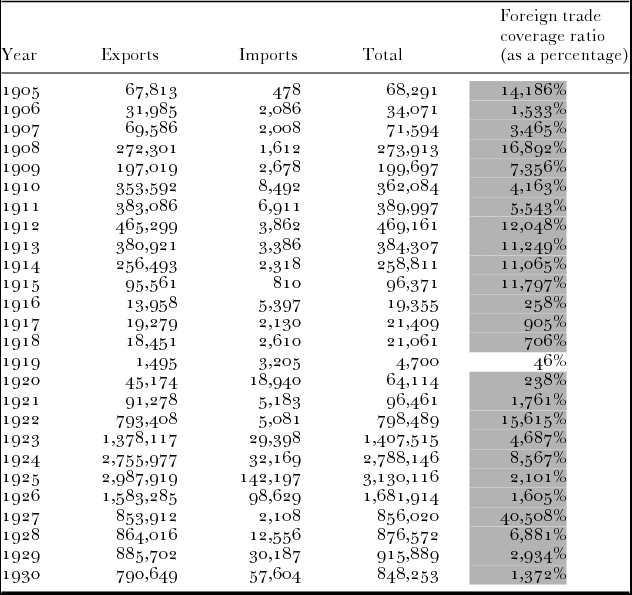
During the first decade of the twentieth century, trade between China and Spain was dominated by Chinese exports of both traditional products, such as silk and tea, and raw materials, such as peanuts and furs. Although bilateral trade grew until the outbreak of the First World War, its volume remained very marginal for both the Chinese and the Spanish economies. Due to the lack of direct shipping lines between the two countries, trade declined to insignificant levels during the First World War, although neither China nor Spain was directly involved in the conflict and both countries benefited economically from the war.Footnote 51 Meanwhile, the low volume of Spanish exports explains the increase in the coverage rate. In 1905, Spain had the highest negative coverage rate of the 31 countries or regions with trade relations with China, with values of 67,813 HKT or Haikwan tael (Chinese exports to Spain) compared to 478 HKT (Spanish imports to China) (Table 1).Footnote 52 One of the most striking aspects of Spanish trade in China was the complete lack of initiatives to export Spanish products to a market that, in population terms, was the world's largest.
Chinese trade with Spain, 1905–30

The shaded area indicates a negative trade balance for Spain (HKT). Source: CMCS Annual Reports, HMACC.
Chinese exports to Spain increased significantly after the First World War, mainly due to the oilseed trade (sesame and peanuts). Sino-Spanish trade reached over 1 million HKT in 1923, 1924, and 1925—a remarkable level of growth that was due in part to the presence of vessels with the Spanish flag in China. In 1925, bilateral trade reached a record high of more than 3.1 million HKT, of which 2.9 were Chinese exports to Spain. In 1926, the Spanish community also reached its peak, with 712 people registered at the Chinese customs administration and the Spanish Consulate. However, this figure is subject to some controversy because of the scandal over the Consulate's illegal sale of passports to non-Spanish citizens, mainly Chinese businessmen.Footnote 53 After this outlier, the Spanish official population in China returned once again to previous levels: around 300 people.
This marginalization of Spanish trade stands in sharp contrast to the eagerness of those industrialized countries who believed—albeit with some degree of exaggeration—that China was the largest consumer market in the world. However, as experts seasoned in the trade and sale of foreign products in China highlighted, conducting business in China was difficult and not always successful.Footnote 54 Indeed, the disparities in China's foreign trade relations during this period give us some idea of these difficulties. The Spanish case was extreme due to Spain's lack of trade and the virtual non-existence of Spanish exports to China, which led to a large trade deficit. However, it is by no means a unique case. CMCS statistics reveal wide disparities among different national contexts. Let us turn our attention to some examples that offer different and complementary perspectives on China's foreign trade during the period: France, Denmark, Sweden, the Netherlands, Italy, and Belgium.
Although the French colonial involvement in China has been extensively studied, the number of publications on its trade is very limited and has had little international impact.Footnote 55 However, the French case significantly reveals that the Spanish case was by no means exceptional. According to CMCS statistics, direct trade between France and China moved between a 2 and 5 per cent of total Chinese foreign trade between 1905 and 1930, which places France only behind the major trading powers in China (Japan, Great Britain and the United States of America). However, and unlike the case of the British and Japanese models, Sino-French trade involved significant trade deficits for France. Direct trade between China and French Indochina by no means compensated for the French deficit (which had a trade coverage rate in 1910 of 1,400 per cent in China's favour), revealing that even a leading colonial power and a major trading partner of China such as France, with a trade volume much higher than Spain's, had a markedly negative trade balance. Behind the façade of the French Concession in Shanghai, one of the cultural centres of the city of Shanghai –where, for example, the jai alai court was located—the reality of bilateral trade was usually negative to French interests.Footnote 56 Furthermore, despite its cultural and political significance, the French population in Shanghai's French Concession remained below 1,000 people until the late 1920s.Footnote 57
Denmark is probably the country most similar to Spain in terms of its trade with China. According to the CMCS, Denmark's direct trade ranged between 0.01 and 0.4 per cent of China's total foreign trade—a volume similar to Spain's. The evolution of Danish trade in China did not follow any clear pattern and there were periods of stagnation when Danish trade in China almost disappeared.Footnote 58 Denmark also had a negative balance of trade with China, with very few years that run counter to this general trend. Furthermore, and just like Spain, Denmark, which signed its first treaty with China in 1863 (just a year before Spain signed its own), never had a concession in Chinese territory and its community remained small (in fact smaller than the Spanish). All these elements make the Danish case very similar to that of Spain.
However, the case of Denmark offers some important differences with Spain. The East Asiatic Company, a private company established in Denmark in 1897, took advantage of the privileges and prospects for Denmark's trade with China, even though Denmark had no colonial presence in East Asia, and opened offices in Shanghai, Dalian, and Port Arthur (1900), Hankou (1902), Qingdao (1922), Weihaiwei and Hong Kong (1934), and Guangzhou (1938). The Company's main import to Denmark was Chinese soy, to which sesame was added in some periods, with tea and cinnamon occupying a very secondary position. Exports were dominated by Danish industrial machinery, but their volume was always very limited.Footnote 59 In addition to the East Asiatic Company, Denmark had other major companies in China: multinational firms specializing in foreign trade and industrial services (engineering), as in the case of the Danes Vilhelm Meyer and Ivan Andersen, and the company Andersen & Meyer & Company Limited.Footnote 60 The latter won major engineering contracts from various Chinese governmental bodies as well as from different international concessions (railroads, electricity, telegraph) while supplying machinery and engineering services to all types of private industrial companies located in China.Footnote 61 However, as most of the machinery imported was British and American, Andersen & Meyer & Company Limited was dominated by investors from the United States of America. The company was subsequently registered as American, even though its headquarters were in Shanghai and its founders were Danish. The existence of companies able to engage in foreign trade was therefore not a sufficient guarantee that countries participating in the colonial enterprise in China would benefit from commerce with China.
The Danish case is relevant for the study of the Spanish case for two reasons: first, because it shows the existence of parallel cases to that of Spain, turning the Spanish case a significant—albeit extreme—case and confirming a new pattern of Western participation in treaty-port China; and, second, because it shows that access to the Chinese market was not as simple as some contemporary sources reported. A very considerable effort, such as the establishment of a firm like the East Asiatic Company, and the presence of Danish multinationals throw a modest yield and did not do enough to foster direct bilateral trade. China appears to be the main beneficiary of trade in all these cases, despite being in a position of inferiority.
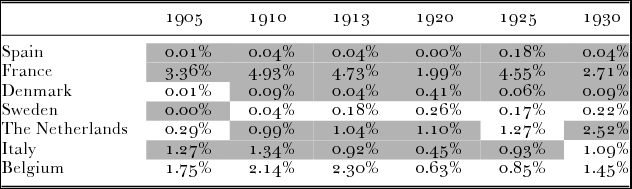
Other peripheral nations had different trade patterns (Table 2). For example, Sweden, which had no territorial concessions in China, presented a positive evolution, with a similarly marginal volume of trade that reached a maximum of 0.26 per cent of the total in 1920, but a positive trade balance from 1910 onwards. For its part, the Netherlands’ trade followed a clearly upward trend, with a meagre volume of trade in the early twentieth century that consolidated starting in the 1920s (reaching a maximum of 2.5 per cent of China's foreign trade in 1930), although with a clearly negative trade balance. When trade between China and the Dutch Indies is added, though, the balance of Dutch trade is positive, with a volume of trade accounting for more than 5 per cent of the total—a very significant figure which reveals that the lack of territorial concessions on Chinese soil was not necessarily a determinant factor as long as a country owned other colonial enclaves in Asia.
Percentage share of total Chinese foreign trade with various European nations, 1905–30.

The shaded area indicates a negative trade balance. Source: CMCS Annual Reports, HMACC.
Finally, two other countries with concessions must be highlighted. Italy had a significant, if uneven, volume of trade, ranging between 1.34 and 0.45 per cent of the total foreign trade in China. However, its positive evolution was significant: early in the century, it was extremely deficient but, in the late 1920s, it began to have a positive trade balance. However, the general impression that emerges from works published at that time was that Italian trade in China had not met the expectations and remained very much below its potential.Footnote 62 The Italian community in China had its own territory—the Italian concession of Tianjin, although it only amounted to half a square kilometre—which hosted about 300 Italian inhabitants in the 1930s of a strong entrepreneurial spirit—together with the Spanish, the Italian was one of the communities with more companies registered per inhabitant in 1913.Footnote 63 Finally, trade with Belgium (with a concession in Tianjin, together with Austria, France, Japan, England, Russia, the United States of America, and Germany, as well as Italy) amounted to between 0.6 and 2.3 per cent of China's foreign trade between 1905 and 1930—a significant and highly beneficial volume, with a trade surplus for Belgian exports greater than that of a big colonial power in East Asia like France.
Conclusion
China's trade balance during the first half of the twentieth century was clearly negative. According to statistics supplied by the Chinese Customs, the volume of imports to China clearly exceeded that of exports, with the latter amounting to between 70 and 80 per cent of the value of imports in most years. The main beneficiaries of this trade were Japan, Britain, and, after the First World War, the United States of America. This provides an image of the colonial situation in China in which the main imperial powers imposed their own interests over those of a weakened Qing state and the Chinese Republic.
However, the number of nations that maintained direct trade relations with China was much larger and the CMCS statistics included over 30 of them. The case study of Spanish trade presented in this article shows a pattern that is diametrically opposed to those prevailing in China's foreign trade with the great imperial powers, not only because of its limited volume, but above all because of Spain's relevant trade deficit. We have shown the case of other countries with a trade deficit, such as France and Denmark, and others with fluctuations that set them apart from the model—determined by the accounts of the great colonial empires in Asia—that has dominated the historiography. In fact, in general terms, between 1905 and 1930, about a third of the countries with trade relations with China ran trade deficits despite a highly favourable colonial context. In addition to France, Italy, and Denmark, the Ottoman Empire (and later Turkey, Persia, Egypt, and Algeria), Mexico, South Africa, Korea, and Siam had chronic trade deficits with China during this period, indicating the extent to which the Spanish was not an isolated case, but part of a pattern.
This highlights the wide variety of colonial formations in China, even calling the term itself into question and suggesting the need to discuss the convenience of using it in an uncritical manner. Through its community in China, Spain did not relinquish its status as a colonizer, despite being barely able to exercise it or benefit from it. Despite the fact that the country did not have a concession in China, the core of Spaniards residing in China, consisting mainly of entrepreneurs in Shanghai, were able to develop a strong sense of national community, somewhere between nostalgia and hope, which they attempted to dress up with artificial but unique colonial trappings, as we have shown with the Mozarabic-inspired architecture of some of the works by the architect Abelardo Lafuente. This imagined community, which was recognized by both diplomats who lived in China for many years and travellers passing by, was simultaneously transnational and dynamic.
Many other Spaniards lived in China during this period, although, in most cases, we do not know their names, as they were excluded from a ‘Spanish community’ defined by the elites: musicians in nightclub bands, employees of foreign companies, chefs, waiters, workmen, porters in ports, security guards, and so on. Many had come from the Philippines and had never set foot in Europe, and did not even have Spanish ancestors, and others were citizens of other countries who had either been nationalized or naturalized. That exclusion, which reinforces the concept of an imagined community through underlying class tensions, is particularly prominent among travellers visiting China.Footnote 64 Without the institutional support that the possession of a territorial concession would have represented and the institutional apparatus that would have articulated the idea of a community, the notion of Spanishness became a sublimation of the nostalgia for the Spanish empire among the most prominent members of those elites. Despite maintaining a trade relationship with China that did not fit the orthodox model of colonization, some of the members of the community preserved Spain's colonial aspirations intact—aspirations that were obviously limited by the absence of an institutional apparatus but that, at the same time, created an environment, a social milieu, for a private non-institutionalized form of colonialism. The Spanish colonial apparatus was not successful in promoting bilateral trade or in claiming territories to China, but the Spanish community in China adapted quite well to the local economy of the concessions, especially in Shanghai. This all points to the argument that we raised at the beginning of this article: the comparative study of the Spanish case, along with that of other nations that were part of the periphery of the colonial action in China, provides a more comprehensive perception of colonial formations in China than the one historiography has passed down to us—so much so that it becomes necessary to question the validity of the colonizer/colonized dichotomy that predominant analyses have taken as a starting point, as it is revealed to be based on a reified conception of the West.
The actions by nations at the periphery of the imperial enterprise in China prompt a rethinking of some of our ideas on colonial formations in China. Through the study of the Spanish case, we have demonstrated that some countries initially benefited from the colonial context but, while they shared the overall colonial discourse that defined the great Euro-American empires, they maintained a relationship with China that was not established on the power structures and paradigms that have defined the colonial model. This casts a shadow over the agency of these peripheral participants of the imperial enterprise. China does not emerge from its relationship with Spain as a victim, or as a necessarily passive colonial subject, nor can Spain be easily defined as a colonial power. Spain—and presumably other peripheral powers—was in a position of in-betweenness that breaks the colonizer/colonized dichotomy. The plurality of colonial formations and experiences in China is undeniable and warrants further examination, not only because the trading systems in the cases we have analysed differ widely, but also because they effectively suggest a plurality in the way in which China's foreign relations took place. The dereification of the West called for by some experts should lead to the integration of the experience of these peripheral countries in China.