


Introduction
I like the people of Fez, truth must be told. I like them, they are intellectuals. God has given them knowledge from long ago. They have a unique cachet. Knowledge came from their city, culture, entertaining, cooking, a manner of speaking, civilization, art; everything came from their city. They have everything. Even though life has changed, no one can ever reach the status of the people of Fez … It is true that today education, culture, and money have civilized everybody, but civilization itself has sprung from Fez.
–Sixty-year-old Fessi womanIt is this perceived elitist uniqueness of the Fessis in Moroccan society—a sense of distinction that confounds notions of time, place, ethnicity, class, and language—that forms the basis of the present article. Yet, what is also interesting about this quote is the fact that the sixty-year-old Fessi woman who made these remarks was born and raised in the metropolis of Casablanca and not Fez, the city whose people she exalts. In Morocco, as I show here, these two cities—Fez and Casablanca—embody very different stories of “urbanity,” and their connected histories provide critical insights into sociolinguistic change today in Morocco. The Fessis have a long tradition of urbanity and a distinctive Moroccan Arabic dialect which, for centuries, has defined urban and prestigious linguistic practice and has acted as a badge for an urbane and bourgeois identity in Morocco. In contrast, Casablanca is a new city: the product of twentieth century French colonial planning, the bulk of its population is a byproduct of urbanization and massive rural migration. Its new-urban koiné has emerged as a result of cross-fertilization among various regional dialects in the city but marked by a dominance of the varieties brought by rural speakers from neighboring villages.
This particular old-urban to new-urban migration in North Africa and the sociohistorical context that gave rise to it, I argue here, can add important insight to the sociolinguistics of mobility (Trudgill Reference Trudgill1986, Reference Trudgill2004; Chambers Reference Chambers2002; Milroy Reference Milroy2002; Auer, Hinskens, & Kerswill Reference Auer, Hinskens and Kerswill2005; Owens Reference Owens2005; Johnstone, Andrus, & Danielson Reference Johnstone, Andrus and Danielson2006). To date, most studies have focused on socially disenfranchised rural groups who bring along “stigmatized” dialects to the host city (e.g. Bortoni-Ricardo (Reference Bortoni-Ricardo1985) in Brasilia, Brazil; Jabeur (Reference Jabeur1987) in Radès, Tunisia; Kerswill (Reference Kerswill1994) in Bergen, Norway; Miller (Reference Miller2005) in Cairo, Egypt). In contrast, people of Fessi extraction in Casablanca offer a rare opportunity for investigating the migration of an elite and dominant group. Furthermore, the indexical meanings of the local variety of the host city of Casablanca itself are still relatively fluid, and raise important questions about the dynamics of social and ideological evaluations and re-evaluations of linguistic varieties and their relation to linguistic accommodation in contact situations.
In making this contribution the article joins the renewed conversation between variationist sociolinguistics and linguistic anthropology, particularly the latter's concept of language ideologies (e.g. Milroy Reference Milroy and Fought2004; Eckert Reference Eckert2008; Johnstone et al. Reference Johnstone, Andrus and Danielson2006; Bucholtz & Hall Reference Bucholtz and Hall2008; Woolard Reference Woolard2008). Simply put, language ideologies are representations about language, ideas about what constitutes good or bad, vulgar or nice, civilized or uncivilized, and so on. It is widely accepted among linguistic anthropologists that although centered around language, language ideologies are never only about language; rather, “they envision and enact ties of language to identity, to aesthetics, to morality, and to epistemology” (Woolard Reference Woolard, Schieffelin, Woolard and Kroskrity1998:3). It is indeed this mediating link between the social and the linguistic (i.e. the system of indexicality) that I am interested in pursuing here.
In particular, I consider the Fessi-Casablancan sociolinguistic encounter in Casablanca in terms of a language ideology of differentiation (Irvine & Gal Reference Irvine, Gal and Kroskrity2000). There are broadly three semiotic processes through which people construct ideological representations of sociolinguistic difference: Iconization (the essentializing process that fuses linguistic forms and their users), recursivity (the co-constitutive contrast that can be reproduced at different levels of opposition) and erasure (the disregard of elements that inconvenience or undermine the ideology of contrast) (Irvine & Gal Reference Irvine, Gal and Kroskrity2000). As Irvine (Reference Irvine, Eckert and Rickford2001) points out, iconization is the most important process to which the other two processes contribute, and old urban/new urban dynamics in North Africa have yet to be studied from the perspective of iconization. By investigating in this context how iconization is enacted either explicitly or through the presuppositions of metapragmatic discourse, I am able to show the reproduction as well as the negotiation of language ideologies in relation to identity positions across two generations of Fessis in Casablanca. More broadly, I argue that the sociolinguistic contrasts involved in this North African setting—a region whose urbanization predates European colonization by well over thirteen centuries—provides an important window onto enduring cultural images that legitimate sociolinguistic distinctiveness. Particularly, it demonstrates that references of sophistication, civilization, and so on are not inherently associated with the West, as has been the emphasis within much work in postcolonial settings.
The place of Moroccan Arabic in multilingual Morocco
A relatively large number of studies have looked at the value and interplay of the linguistic varieties that make up the complex Moroccan linguistic repertoire (e.g. Abbassi Reference Abbassi1977; Bentahila Reference Bentahila1983; Grandguillaume Reference Grandguillaume1983; Boukous Reference Boukous1995; Sadiqi Reference Sadiqi2003; Ennaji Reference Ennaji2005; de Ruiter Reference de Ruiter2006; Benítez-Fernandez Reference Benítez-Fernández2010). At once diglossic and multilingual, this repertoire includes Moroccan Arabic (MA) and Standard/Classic Arabic (or, Fusħa, henceforth SA), which are the respective “low” and “high” varieties in the idealized model of Arabic diglossia (Ferguson Reference Ferguson1959); French, the former colonial language; Tamazight, the indigenous and oldest language in Morocco—commonly known as Berber; and to a lesser extent Spanish, another former colonial language now restricted to some Northern and Southern parts of Morocco.Footnote 1 These languages interact regularly: for instance, code-switching between MA and the other languages can in certain contexts be the unmarked register of interaction. Of course, these languages do not have the same currency in the Moroccan symbolic market. In fact, throughout much of the twentieth century one could summarize the Moroccan multilingual situation as comprising, on the one hand, the superposed varieties (i.e. SA and French) and, on the other hand, the mother tongues which were relegated to orality (i.e. MA and Tamazight). Throughout this period, SA and French have competed as legitimate languages invoking the tropes of authenticity versus modernization, closure versus openness, and East versus West. In turn, MA was seen historically as a deficient form of SA, while Tamazight was perceived as a mere collection of lahajaːt ‘dialects’ that lacked the status of a “real language”; together they were often associated with backwardness and illiteracy.
Today, SA is Morocco's primary official language. Since the 1970s, a postcolonial policy of Arabization (as in North Africa more generally) strived to replace French, which was the official language in Morocco during colonization (1912–1956). SA has therefore become dominant particularly in government-run institutions including primary and secondary schools and national TV and radio. The relative expansion of SA-based education since the 1970s has created what Walters (Reference Walters2003) calls a “postdiglossic situation,” in which diglossic code-switching has become conventionalized to a certain degree, particularly among the young Arabic-educated population (known as al-muʕarrabin or les arabisants). A defining characteristic of SA in the Arabic-speaking world, however, is that it is nobody's first language and, unlike standard varieties in nondiglossic contexts, it is not associated with the speech of the upper (middle) classes.
Despite the mandates of the Arabization project, French maintains a strong hold in contemporary Morocco and remains very much a language of power, prestige, and social mobility. In general, the association of French with the upper classes is guaranteed through French mission schools and other elite private schools in which upper and upper middle class Moroccans, irrespective of their old-urban or new-urban background, tend to enroll their children. In turn, French is the dominant language in the private and service sectors, in finance, in higher education, and among the professional classes. It also has a significant presence in the written and audiovisual media, and in cultural and literary life. It is in these ways that French is a de facto, rather than de jure, official language in Morocco (Boukous Reference Boukous, Maurais, Dumont, Klinkenberg, Maurer and Chardenet2008; on variation in French in Morocco, see Benzakour Reference Benzakour, Bavoux, Prudent and Wharton2008).
It is important to state at this point that, despite the prestige attached to SA and French, MA (known locally as darija) is the most widely spoken language in Morocco. Due to the historical marginalization of Berber and to the twin consequences of language shift or additive bilingualism, MA became shared by Arabophones (who speak it as a first language, estimated at 60%) and Berberophones (who speak it as a second language). Further, MA acts also as a vehicular language among Berberophones who speak different varieties of Berber.Footnote 2 Like any spoken language MA fulfills referential as well as affective functions for its speakers. It has been the vehicle of a large body of oral literature and cultural productions, particularly songs, jokes, the theatre, and films (although the film industry in Morocco is still in its infancy compared to Egypt, for instance). MA is sung in different dialects and registers ranging from the most classicizing poetico-music genres of zajal and malħun to the deepest popular songs of shəʕbi.
In the last decade MA has spread to domains that used to be the preserve of SA and French. Demonstrating its recent transition to literacy, today we see written MA in advertising billboards, political slogans, magazines, and newspaper headlines and editorials. The new media (e.g. SMS, online chats, discussion boards, text messaging, instant messaging, and emails) have also provided an important space for writing MA. Moreover, MA is increasingly heard on Moroccan national TV and radio: in commercials, in entertainment shows, in formal interviews and talk shows, and in dubbed foreign soap operas. A new generation of young performing artists influenced by African-American hip hop, rap, and so on has also turned to MA to express the problems and malaise of Moroccan youth (see Caubet Reference Caubet2005).
Old urban, new urban: Fez and Casablanca
Only a handful of Moroccan cities (e.g. Fez, Tetouan, Rabat, Tangiers, and Salé) and their select elite population are associated with Morocco's old-urban culture. Old urbanites had, in the words of Brown (Reference Brown1976:2), “a style of life which was defined in the Moroccan context as the ideal of sophisticated urbanity.” More than any other old urbanites the Fessis hold a national reputation for having retained the traditions and practices of this urbane past. Stretching as far back as the end of the seventh century, the city of Fez was for centuries the capital of Morocco and the home to a highly acclaimed university, AlQarawiyyin, which was a meeting place for great intellectual exchange and higher education (Le Tourneau Reference Le Tourneau1965; Gaudio Reference Gaudio1982).
So far, I have been talking about Fessis as the people from the city of Fez. However, an understanding of “who counts as Fessi and who does not” is in fact an ethnographic question. Even though Fessis take their reference from the city of Fez—known in Moroccan Arabic as f wassa ‘Fessis’ or həl fas ‘the people of Fez’—it would be misleading to suggest that Fessi includes anybody who is born, raised, and resides in Fez. Quite the contrary: birth and residence in the city even for families who have been there for generations do not confer Fessi identity on citizens. To lay claim to Fessiness one must belong to prominent Fessi families from the old-urban stock. Thus, only a number of long-established bourgeois and aristocratic Muslim families originally from the old Medina (inner city) of Fez are considered bona fide Fessis today, whether they reside in Fez or elsewhere (see Walters Reference Walters, Versteegh, Eid, Elgibali, Woidich and Zaborski2006 on communal dialects). This exclusive claim to the city and to urbanity by its elite, which was common in precolonial North African urban centers generally, speaks very clearly to the importance of investigating what sounding Fessi or Casablancan means and accomplishes in a specific point in time and place (cf. Johnstone Reference Johnstone and Fought2004).
Unlike Fez, Casablanca's rapid urbanization, especially through rural in-migrants, was instigated by French colonial decisions to expand the port and promote manufacturing industries. The city now hosts well over five million people (CERED 2004). Since the early Fessi migrations to Casablanca in the first half of the twentieth century, the Fessis settled in areas (e.g. Dərb Sultan) that were designated by the French for the “indigenous elite.” After independence, the Fessis settled in Anfa, a chic and wealthy area, where most of the interviews took place. Today, the Fessis constitute the third largest ethnolinguistic group in Casablanca after the ʕrubiyya (people of rural origin) and Swassa (Berbers from the Southwestern Sous region also known as ʃluːħ) (Adam Reference Adam1968; Dernouny & Guy Reference Dernouny and Guy1987).
Fessi and Casablancan dialects
Moroccan Arabic dialects have long been distinguished along the sedentary/Bedouin division that is common in Arabic dialectology (e.g. Massignon Reference Massignon1924; Aguadé, Cressier, & Vicente Reference Aguadé, Cressier and Vicente1998). This typological distinction originally related to dialects spoken by those living in towns and their surrounding areas (sedentary) versus those spoken by nomadic tribes known in Arabic as Bedouin. Today, the distinction does not map neatly onto the rural or urban areas of any of the North African countries. Thus there are agricultural areas (that would be characterized as rural in terms of population, life style, and so on) where “urban” or sedentary varieties are spoken and cities where “rural” or Bedouin varieties are spoken. A good example of the latter is the city of Casablanca.
The Fessi dialect is considered urban (known locally as mdini or ħad ʕari) and differs from other sedentary-type Moroccan dialects in its prestige and sociocultural value. It has linguistic features that distinguish it from the most widespread forms of MA on all linguistic levels. For instance, at the phonological level we find the stereotypical post-alveolar approximant [ɹ] for the alveolar trill [r],Footnote 3 and the pharyngealized glottal stop [ʔʕ] or the uvular [q] for [g]. At the morphosyntactic level, we find the second person plural suffix [-iːw] for [-u], the third person singular feminine suffix [-ət] for [-aːt], neutralization of gender distinction in the verbal and pronominal systems in the second person singular (e.g., the verb kul ‘eat’ in the imperative would be rendered as kul (fem./masc.) instead of kul -i (fem.) and kul (masc.); the neutral singular pronoun ntin(a) for nta ‘you, masc.’ and nti ‘you, fem.’). At the syntactic level, we find for example the future particle maːʃ for ɣa(di), and the concomitance marker xa:jə d/a (masc./fem.) that is largely absent in the majority of MA varieties. Lexical differences are abundant, for example, səkkiːn for muːs ‘knife,’ ɣt ʕaːɹ for t ʕəbs ʕiːl ‘plate,’ ʕməl for daːr ‘to do,’ tʕajlli for jmkən ‘I suspect,’ and mʕaːwət ʕ for mətquːn ‘perfectly executed’ (see Hillili (Reference Hillili1979), Caubet (Reference Caubet, Aguadé, Cressier and Vicente1998), and Heath (Reference Heath2002) for more details).
In contrast to the Fessi dialect, it is widely accepted in Arabic dialectology that the Casablanca dialect is characterized by Bedouin features, known locally as ʕrubi ‘rural’ or ‘peasant’ (e.g. Moumine Reference Moumine1990; Elbiad Reference Elbiad and Nelde1992; Heath Reference Heath2002). At the beginning of the twentieth century, when Casablanca had a population of less than 24,000 inhabitants, Kampffmeyer (Reference Kampffmeyer1912) noted that the dialect of Casablanca and that of the rurals of the Chaouia tribes surrounding Casablanca had basically the same rural features. He noted, for instance, the use of [g] instead of its urban counterparts, interdentals instead of stops, and the diphthongs instead of monophthongs. By the 1950s, increased migration to the city from all corners of the country had allowed for contact between different regional dialects, urban and rural, and by this time the Casablanca dialect was described as a “hybrid” and “mixed” dialect (Brunot Reference Brunot1950). Towards the end of the twentieth century, it was described as an “interdialect” that has psychological reality, and shows the usual patterned sociolinguistic stratification found in cities (Moumine Reference Moumine1990).
In general, people in Casablanca often distinguish between hd ʕra bid ʕawiya ʕadiya ‘normal Casablancan speech’ and hd ʕra ʕrubiya ‘rural or broad speech.’ Normal Casablancan speech as understood by its speakers is presumably a levelled variety where one's regional origin would be difficult to guess based on linguistic cues alone, that is, a supralocal variety usually defined in the negative by what it is not rather than by what it is (Hachimi Reference Hachimi, Miller, Al-Wer, Caubet and Watson2007:117). In contrast, ʕrubi speech is often imputed to the city's popular neighborhoods where rural in-migrants have historically settled (known locally as l'aħyaaʔ shəʕbiyya), that is, poor working class areas. Of great importance, it is precisely the linguistic specificities of these popular neighborhoods that have come to index local Casablancan identity: the variant [g] for [q], the diphthong [əw] for [u], the central back [ʌ] for [ə], coronal assimilation (e.g. [tt] for [nt]), the adjunct delimiter [ʕa] for [ɣir], infixing of the negative particle -ʃ (e.g. ma-ngul-ʃ-lək for ma-ngullək-ʃ ‘I won't tell you’), and stress on the penultimate heavy syllable of a word (e.g. djáːlhum for djalhum ‘theirs’). Finally, some stereotypical lexical items include brək for gləs ‘sit,’ ʕa:ʃəq for mʕəlqa ‘spoon,’ and drrijaːt for bnaːt ‘girls,’ most of which are often deployed in parodic performances of local Casablancan speech.
Ethnography in Casablanca
My ethnographic research in Casablanca took place for a concentrated period of fourteen months during 1999–2000 and during annual summer visits from 2003–2010 (I am a non-Fessi Moroccan and most of my family live in Morocco). Data from the Fessis in Casablanca include casual interactions and interviews with ten multigenerational Fessi families. Since endogamous marriages continue to be practiced among Fessi families,Footnote 4 the extended family unit proved to be a rewarding site for analysis both for tracing linguistic change across three or four generations and for investigating circulating language ideologies within the family.
I chatted with participants about a range of topics including their biographies and life histories, their family history, their social networks, and their views on gender and ethnoregional relations in Morocco. Following Preston (Reference Preston1993), who argues that cultural identity is clearly marked in people's metadiscourses about language, I used the following strategies: (i) asked participants to imitate the way people act and sound in Fez, Casablanca, and elsewhere; (ii) probed individuals' overt evaluations of their own dialects and others; and (iii) collected metalinguistic jokes and aphorisms about the different regional-ethnolinguistic groups that make up the population of the city in the hope of unearthing social stereotypes and their embedded meanings. This did not only make transparent the most salient linguistic features in the dialects under investigation but served as a backdrop for speakers' own understanding and rationalization of the link between linguistic forms, social categorization, group boundaries, and self-identification.
Below, I draw on interviews with two women: AB, a woman then in her mid forties who moved from Fez to Casablanca nearly twenty years previously; and KT, her niece, then in her early twenties who was born in Casablanca. Both own similar clothing boutique businesses and interact on a daily basis about business and personal matters. I chose to conduct the interviews in their boutiques to include not only their interactions with me but with their salesgirls, friends, family members, and customers. In both cases, the interviewees began by asking about the language we should use. My answer was “the way you usually talk,” which was MA-French code-switching for both women.
A quick look at AB's sociolinguistic biography reveals her complex linguistic repertoire. Born in 1955, AB grew up in a household where SA, French, and MA were part of daily life. AB received her primary and secondary education in French/Arabic bilingual schools in Fez. She remembers her late father with great fondness as she recalls that he was the one who introduced her to SA poetry and literature in general. He was a graduate of the famous AlQarawiyyin University and instilled in his children the love of SA, which he called “the language of Heaven,” AB said. At the same time he put emphasis on French, which he deemed to be “the language of the future.” AB's own mother, however, like many women of her generation, was not educated and therefore does not know French or SA; access to education for women did not start until the 1940s in Morocco. AB therefore speaks MA without any French code-switching with her mother and other Fessis of her mother's generation, but also with poorer unschooled non-Fessi men and women of different ages like her maids, gardener, and chauffeur). AB left her native Fez at the age of seventeen upon her marriage to a young Fessi businessman and both relocated to Casablanca after living for several years in a town that shares similar linguistic features with Casablanca. AB was a French teacher for several years before she became a businesswoman and owner of an upscale boutique in Casablanca that specializes primarily in ornate hand-embroidered traditional Moroccan clothing like Kaftan and Djellaba, and which she proudly advertises as “made in Fez.”
KT was born in Casablanca in 1980 to migrant Fessi parents. Unlike her aunt, KT grew up in a French-dominant environment. Both her parents are graduates of French mission schools and have an unmistakable elite French accent, as does KT. She attended French primary and secondary schools and her command of SA is rather minimal. Although MA-French code-switching was the norm for KT and her family and friends, she spoke rather disparagingly about the practice. At the time of the research, KT's social network of friends was predominantly Fessi and she was also engaged to a Casablanca-born young Fessi man who was present during parts of the interview. She is passionate about her business career in European-imported prêt à porter ‘ready to wear,’ which she explains has much to do with her love for designers, fashion, travel, and la belle vie or ‘the good life.’ For a twenty-one-year-old, KT is a very savvy businesswoman. When I made the remark, she did not hesitate to say that “business runs in her blood,” making references along the way to the highly successful businesses run by her family.
Discursive representations of Fessi-sounding speech in Casablanca
The following analysis considers both explicit metalinguistic comments and implicit metapragmatics of discourse, which are the “unsaid, unexpressed assumptions that implicitly frame a text and enable its coherence” (Woolard Reference Woolard, Schieffelin, Woolard and Kroskrity1998:9; see Silverstein Reference Silverstein and Lucy1993). These language ideologies reveal complex stances of affiliation and disaffiliation with Fessi and Casablancan dialects.
AB: The in-migrant
Despite mobility and high education, AB maintains a number of stereotypical Fessi linguistic features, hardly showing any signs of the rudimentary leveling usually reported in studies of dialect contact. AB's linguistic conservatism cannot be a function of the tightly knit social network that characterized her mother's generation.Footnote 5 Indeed, her schooling and the nature of her jobs necessitated contact and interaction with non-Fessis on a daily basis.
Although AB maintains a host of Fessi linguistic features, the variable (r) is the object of attention in the following extract, which is part of a metalinguistic discussion about AB's own division of Moroccan dialects and ways of speaking. Below we see that AB uses the iconic Fessi postalveolar approximant [ɹ], in lieu of the alveolar trill [r] which is the most widespread variant in Casablanca and in Morocco in general as well as the standard-like variant.Footnote 6
(1)

AB's metalinguistic comment provides a textbook example of the semiotic process of iconization: the process through which people naturalize the link between whole linguistic varieties or particular linguistic forms and their speakers and provide explanations for such connection. In the case at hand, AB's comment reveals an essentialized link between “politeness,” “refinement,” “femininity,” and sounding Fessi, particularly the use of the Fessi approximant [ɹ]. Furthermore, she naturalizes the link between the Casablancan variant (the trill) and “roughness and toughness.” AB's presuppositions become more evident as soon as we pay attention to the contexualization cues (Gumperz Reference Gumperz, Duranti and Goodwin1992) in this extract. The first striking contrast is the one drawn between women rolling [r] and yet having polite speech. AB used the contrastive discourse markers waxxa ‘even though’ in line 3 and walakin ‘but’ in line 4 to emphasize that the act of trilling [r] did not lead the author, a non-Fessi woman, to sacrifice her politeness. Similarly, AB expresses gratitude and relief through the formulaic expression lħamdullah ‘thank God’ in line 8 that her own daughter's adoption of the Casablancan variant did not alter her good behavior.
Certainly, these cues reveal a presupposed link between the use of the Casablancan variant and socially inappropriate behavior and point, in contrast, to the presupposed ideological link between sounding Fessi and a “larger moral order” (Cameron Reference Cameron, Jaworski, Coupland and Galasiński2004:313). In the same vein, AB's disclaimer in line 5, “I am not saying that she should speak with [r] like mine or something,” has implications for what this woman believes Fessi [ɹ] accomplishes for a woman in Casablanca, namely to be perceived as more feminine, polite, and refined. Taken together, these implicit metapragmatics of discourse suggest that Fessi [ɹ], iconized as sounding Fessi, metacommunicates an idealized femininity that the Casablancan variant, in contrast, apparently fails to accomplish.
Looked at in a different way, this exchange represents a struggle over the meanings of linguistic politeness between AB and the author. The interaction in lines 2–8 shows a negotiation of what constitutes hd ʕra mʔəddba ‘polite speech’ and how the variable (r) figures in such construction. In its vernacular sense, hd ʕra mʔəddba is understood as socially recognized appropriate linguistic behavior, that is, prescriptive linguistic practices of good manners, etiquette, propriety, and respectability. In the haste of acknowledging AB's seeming compliment that my own speech is polite despite its being ħrəʃ ‘rough and tough,’ I overlapped with her in line 6 with a rhetorical question “just that she should not use vulgar words!?” In doing so, I restricted the meaning of “polite speech” to the lack of profanities, that is, the use of taboo words and expressions that I suspected would offend the prevalent morality of Moroccans. However, her subsequent use of a nonchalant and hardly audible French interjection voilà indicates her unenthusiastic uptake of my interpretation. In short, while we both uphold the cultural discourse that celebrates the politeness of Moroccan women, we seem to be operating from different understandings of linguistic politeness by virtue of our different positionalities and biographies. According to AB, a polite woman is almost necessarily a Fessi woman, that is, linguistic politeness has a region and a social class, whereas for me, this is an unnecessary conflation.
The concept of ħrəʃ (adj.) or ħruʃiya (n.) ‘toughness and/or roughness’ is worth dwelling on since it was a recurring theme in my conversations with Fessis. It is in fact central to the contrast between Fessi and Casablancan speech in the sense that the latter has become enregistered (Agha Reference Agha2003) as ħrəʃ, as the second case study below will also make clear. In MA, ħrəʃ refers to a wide range of phenomena from direct or unmitigated speech styles to loudness in one's speech, forcefulness, aggressiveness, and so on. However, the term ħruʃiya also modifies a range of phenomena not only a manner of speaking. Hair can be ħrəʃ referring to its texture as coarse or kinky, or a surface that is not smooth. Similarly, a person can be ħrəʃin reference to his/her mannerisms and behavior if they lack tact and refinement but also if they are tough in a positive sense. Thus, while some of the connotations of ħruʃiya coincide with meanings of impoliteness, for younger Moroccans including me (and KT below) some elements of toughness and roughness can be positive. In sum, from the perspective of AB's ideology, sounding Fessi is inherently polite, refined, and feminine, whereas Casablancan is inherently coarse, lower class and unfeminine.
A further point that I would like to emphasize is how the Fessi approximant has been re-evaluated in gendered terms in Casablanca. While circulating discourses approve of women sounding Fessi, they position men's use of the Fessi approximant as “effeminate,” or “homosexual.” Some even go as far as linking the failure to trill with “erectile dysfunction!” This is one reason why Fessi men in Casablanca tend to abandon the approximant quicker than Fessi women (Hachimi Reference Hachimi2011).
The gendering of these discourses also relates to a wider ethnographic finding from my study: how some non-Fessi women deploy the approximant and other Fessi variants (e.g. lexical items such as ʔas ʕbaːr ‘wait,’ the second person pronoun ntin/a) to project a sophisticated self-image and exaggerate their femininity.Footnote 7 In parodies of Fessi speech, non-Fessis typically combine these stereotypical Fessi speech forms with other prosodic features such as slower speech tempo usually achieved by lengthening vowels, and nonverbal behavior such as changes in body posture and other kinesics. What is striking, however, is that Fessis often comment on and ridicule non-Fessis who deploy these resources in non-stylized or serious interactions, insisting that these non-Fessis have the “Fessi complex,” and in any case they can never “pass” for Fessis because they lack what it takes.Footnote 8 Indeed, AB describes how a wealthy Soussi friend of hers admits that it is impossible to impersonate the Fessi way.
(2)

Here AB is referring to what might, following Bourdieu (Reference Bourdieu1984), be called a Fessi habitus: a set of acquired dispositions or behaviors that are impossible to duplicate by virtue of the fact that the Fessi lifestyle is a sociohistorical product involving centuries of practice. It is through these processes of differentiation in AB's metalinguistic and metapragmatic comments—ones presented as inherently embodied—that we can see old-urban Fessi identity production and reproduction at work: both in AB's continued use of stereotypical features and the ideological links she draws between the use of the linguistic variable (r) and her stance towards non-Fessis.
KT: Fessi of Casablanca
The second case study demonstrates shifting indexicalities/ideologies about sounding Fessi in Casablanca and links these to the evolving stances of affiliation and disaffiliation with Fessi and Casablancan identities. Extract (3) below showcases her stance-taking towards f wassa-d-fas ‘Fessis of Fez,’ f wassa-d-Casa ‘Fessis of Casablanca’ (the identity she claims), and non-Fessis, and reveals how these categories are semiotically linked to the use or nonuse of specific linguistic features, particularly the variables (r) and (qaːl).
(3)
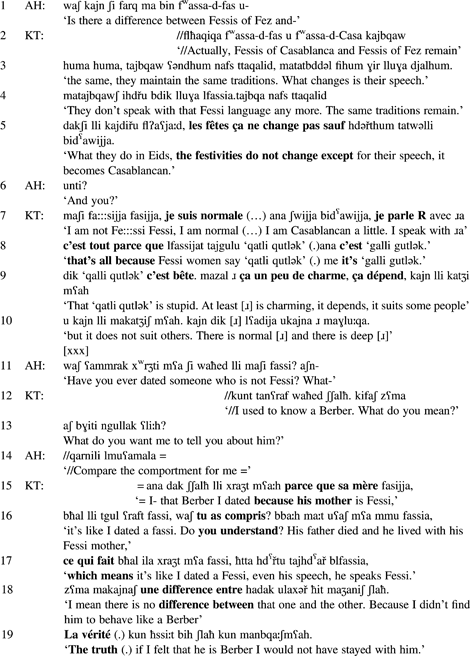
What is striking here and elsewhere in the interview is KT's positive attitude toward Fessi “authenticity” in respect of rituals, festivities, and other sociocultural practices, in contrast with her negative judgments about sounding like an “authentic Fessi,” a construct that is conveyed through exaggerated syllable lengthening and duplication in fa:::sija fasija. Clearly, KT perceives this type of Fessi speech as less than normal (lines 7–9). At the same time, her iconization in lines 11–19 seems to associate Fessiness with refinement and good taste, in contrast to behaving “like a Berber”—which in the ecology of meaning in Morocco has come to index a backward, rural, unsophisticated, and conservative social type. Hence, we can see how, for this young Casablanca-born Fessi, ideologies of differentiation between Fessis and non-Fessis have not been completely abandoned. In fact, Fessi identity for her has been redefined as she positions herself as a different type of Fessi, a Fessi of Casablanca.
What defines KT as a Fessi of Casablanca rather than simply a Fessi in Casablanca is not so much the use of (r) but the (qaːl). The lexical variable (qa:l) ‘he/it said’ concerns the initial consonant and whether it is rendered as a uvular [q] or as a velar [g] in this specific word. It is important to bear in mind that this variation between [q] and [g] occurs in only about 7% of words in Casablancan Arabic (Moumine Reference Moumine1990). Despite this narrow range of variation, the variable (q) is highly salient and ideologically loaded. The uvular [q] is the urban/sedentary variant while the velar [g] is the rural/Bedouin variant. Indeed, part of everyday ways of talking about dialect differences is to distinguish between those who say qalli/ qu(l)tlək ‘he said to me/I said to you’ and galli/ gu(l)tlək. In this case, these pairs generally stand in for the entire range of cases where [q] can or might alternate with [g].
However, KT has not adopted the variation between [q] and [g] characteristic of the dominant Casablanca dialect; the exception is the “pragmatically salient” (Woolard Reference Woolard2008) verb [gaːl] ‘to say.’ In this respect she is similar to many Fessi women and men of her generation (see Hachimi Reference Hachimi2011). This bifurcation becomes clear once we understand the social reallocation (Britain & Trudgill Reference Britain and Trudgill2005) of the variable (q) in Casablanca.
In general, the variable (q) has been refunctionalized in terms of social class. In a quantitative study among natives of Casablanca, Moumine (Reference Moumine1990) shows a statistically significant correlation between [g] and working class groups and between [q] and upper (middle) class groups. In other words, the historically rural and urban variants have been reallocated different social classes in Casablanca. However, Moumine's insightful study did not discuss the lexical variable (qaːl), which has developed a different status. I have shown elsewhere (Hachimi Reference Hachimi, Miller, Al-Wer, Caubet and Watson2007) that while the use of [g] in other lexical items (e.g. in [gbəl] ‘before,’ [gəffa] ‘basket,’ [tʕriːg] ‘road’) is still perceived by the Fessis as under class with imbued meanings of illiteracy, poverty, peasantry, ignorance, immorality, and so on, the verb [gaːl], by contrast, is now perceived as normal, as we clearly see in KT's comment above. Thus, these ideologically mediated re-evaluations of linguistic variables are central to which linguistic features get to be left behind and which ones are taken over in circumstances of sociolinguistic mobility and contact.
An important point to emphasize at this juncture is the difference in the social refunctionalization of (q) in Casablanca compared to other cases of interdialect contact in the Arabic-speaking world where the social reallocation of this variable occurred along gender lines. In Amman, for instance, women irrespective of their Bedouin (East Jordanian) or Palestinian (rural and urban) origin converge towards the historically urban [ʔ] deemed more refined and sophisticated, while men tend to converge towards the historically Bedouin [g] (Abd-El-Jawad Reference Abd-El-Jawad1986; see Al-Wer Reference Al-Wer, Miller, Wer, Caubet and Watson2007 for further nuances among the third generation). A similar gendered reallocation is reported by Amara (Reference Amara2005) in Bethlehem: the urban variant [ʔ], which used to index a Christian Palestinian identity in the city, has become part of the linguistic repertoire of Muslim women, in contrast to Muslim men who tend to use the standard [q] variant instead. In the cases of both Amman and Bethlehem, women tend to converge towards the urban variant. In this study, in contrast, KT is leaving behind an urban variant [qaːl] and pursuing instead its ʕrubi (historically Bedouin) counterpart [gaːl] of Casablanca. The point is that there is no reason to expect Arabic-speaking women to behave in the same way with respect to the urban and prestigious linguistic forms in circumstances of interdialect contact. In line with social constructionist approaches, it is through examining the sociohistorical conditions of particular communities that we can understand how local ideologies of gender that are tied to class, age, region, and so on, and filtered through individual's experiences, affect language evaluation and use.
Indeed, explicit in this extract is the change in the indexical meanings of the Fessi variant and of sounding Fessi in Casablanca in general. For Fessis of Casbalanca such as KT, the Fessi variant [qaːl] has fallen from grace so to speak as it has now acquired the meaning of ‘stupid or naïve’ conveyed by the French expression c'est bête (lines 8–9). Thus, to leave behind [qaːl] for Casablanca [gaːl] seems necessary for projecting a “street smart” self image with its myriad positive connotations of independence, coolness, and the ability to take care of oneself, and for authenticating oneself as distinct from the naïve Fessis of Fez. Here we see a good example of the indexical power of one lexical item. Put differently, naïveté has emerged as an important “second-order index” (cf. Silverstein Reference Silverstein2003) that indirectly links salient Fessi forms with the category Fessis of Fez, and stands in opposition to the socially recognized ħruʃiya of sounding Casablancan via [gaːl] (and the trill as discussed earlier with AB). It is the Casablancans' ħruʃiya that is appealing to this young woman of old-urban origin. Thus, sounding Casablancan by using [gaːl] even if it means sounding coarser and tougher and less than feminine, from the perspective of the older Fessi ideology in particular, is important in constructing distinctiveness from Fessis of Fez and a resource in becoming Fessi of Casablanca. KT, in other words, does not seem to mind trading off traditional understandings of elite femininity for a modern identity, where the pressures and social demands of the metropolis require the projection of an independent and tough persona.
KT's desire for ħruʃiya's positive connotations extends to other cultural practices, for instance, performing ʕrubi dances in weddings. Wedding ceremonies in Morocco are an important site for flaunting wealth among Moroccan women and they are also a site where the contrasts between older urbanity and newer urbanity play out very nicely. Contrary to the poise and restraint often associated with dance performances by Fessi women, in public at least, those who claim to have become ħrʃaːt (fem. pl.) tend to show off their ʕrubi dance know-how to the beats of a ʕrubi music genre known as lʕit ʕa. At a wedding that both KT and I attended, one way KT displayed her gregariousness and coolness was through rrukza, a social dance that involves rhythmic feet stomping, coordinated hair tossing, and use of a much wider space for hand and body movement.
As KT's case shows, the development of linguistic style is part and parcel of identity work (Eckert Reference Eckert2000). Indeed, her linguistic style is a bricolage (Hebdige Reference Hebdige1984, cited in Eckert Reference Eckert2008) of sorts, which includes, but of course is not limited to, the combined use of an intermediate [r] and Casablancan [gaːl] without accommodating the whole range of [q]~[g] variation in Casablanca. The development of this linguistic style of sounding “a little Casablancan” (line 7) and by implication sounding a “little Fessi” is one way of creating distinction in Casablanca. It is in fact expressive and constitutive of the category Fessi of Casablanca: a social type that is positioned as different from, but superior to, both Fessis of Fez and non-Fessis in Casablanca. The Fessi of Casablanca social type, therefore, emerged to meet the new social demands of Casablanca, as a sprawling city where the new-urban lifestyle demands street wisdom and toughness but also requires a level of sophistication and refinement that people of Fessi extraction tend to essentialize as part of their dispositions as old urbanites. It is in fact this relational and ideologically mediated understanding of style that allows it to act as a system of distinctiveness (Eckert Reference Eckert2000; Irvine Reference Irvine, Eckert and Rickford2001; Coupland Reference Coupland2007).
Conclusion
I have attempted in this article to shed light on a lesser-studied case of dialect contact, one that involves the migration of the bona fide older-urban elite to the newer metropolis of Casablanca in Morocco. The two case studies that inform the analysis illustrate the different ways in which metalinguistic and metapragmatic resources are deployed to rationalize, legitimate, and therefore naturalize differentiation and hierarchization.
The first example considered a Fessi in-migrant woman who preserves even the most iconic Fessi linguistic features, which function as a form of distinction in this new-urban setting. She reflects older/traditional Fessi views whereby the Fessi/non-Fessi social boundary is highly ideologized and an inherent link between sounding Fessi and being civilized, polite, well-bred, and feminine is paramount. The second example, with her younger local-born niece, shows how new language ideologies are formed. In this example, the Casablanca-born Fessi also sounds unambiguously Fessi despite her native status in Casablanca. However, she is doing so by creating a new identity category, Fessis of Casablanca, which is formed in relation to “authentic Fessis” and to non-Fessis in Casablanca. Only through this relational identity analysis (Le Page & Tabouret-Keller Reference Le Page and Tabouret-Keller1985) can we understand how KT constructs her linguistic style. In other words, the identity she claims (Fessi of Casablanca) actively shapes and is shaped by specific linguistic variables (e.g. tweaking some iconic variables while losing others). Together, these examples suggest that the Fessi dialect with its stereotypical variants is not likely to simply disintegrate over time in a linear way into the larger metropolitan dialect of Casablanca; nor will it be preserved stubbornly as a prestige form despite social change. Rather, the politics of identity, which ethnographic and interactional studies can best examine, help shape its (re)evaluation and development over time.
In turn, these findings confirm the importance of investigating the shifting indexical meanings of linguistic varieties in the Arabic-speaking world (cf. Holes Reference Holes1995) and elsewhere (e.g. Labov Reference Labov1963; Wassink & Dyer Reference Wassink and Dyer2004). Indeed, the symbolic oppositions encoded in the Fessi and Casablancan features suggest a simultaneous synchronic re-evaluation of the historically urban and prestigious Fessi variety and the historically rural and less valued Casablancan variety from the perspective of the older urban ideology. For instance, we have seen how Fessi variants, to varying degrees, are undergoing a process of devaluation in the new urban environment of Casablanca by the younger speakers in favor of selected Casablancan variants. I argued however that it not the rural connections of the Casablancan features that are becoming valorized per se; it is their second-order indexicalities that are changing; for instance, the variant [gaːl] has come to encode the quality of being “street smart.” Although I am drawing these conclusions based on discussions of only the variables (qaːl) and (r), it is precisely their ideologically loaded nature that gives them this indexical power.
It is worth ending by mentioning that Standard Arabic plays a relatively small part in the social and ideological evaluations and re-evaluations of linguistic varieties and their relation to linguistic accommodation in the Fessi-Casablancan sociolinguistic encounter. It has long been argued that the prestige of SA and that of the urban koiné are by no means synonymous in the Arabic-speaking world (e.g. Ibrahim Reference Ibrahim1986; Haeri Reference Haeri1997). In fact, in cases of interdialect contact, speakers can abandon standard-like dialectal variants of their communal, religious, and ethnoregional varieties to accommodate the locally dominant variety (e.g. Holes Reference Holes1986). The shift from the standard-like [qaːl] to [gaːl] in this study and the evaluations underlying it is a case in point and so are the negative evaluations of the standard-like [r] by the older participant. In other words, the indexical meanings of these linguistic variables are quite fluid and complex and their similarity to or difference from Standard Arabic variants are the least relevant to local meaning-making and social processes.
Appendix: Transcription conventions
The Moroccan Arabic text is transcribed using IPA conventions, but code-switched French words and phrases are written in regular orthography.
- //
beginning of overlapping speech
- (.)
brief pause of one second or less (the number of full stops within the bracket indicates the number of seconds of the pause)
- Reduced font
prosodic de-emphasis and decreased volume or loudness
- ːːːːːː
exaggerated lengthening of a syllable in a word or phrase
- =
instances of latching between turns
- -
unfinished word or phrase
- [xxx]
deleted material (sensitive)
- “ ”
constructed dialogue or reported speech


