INTRODUCTION
Elasmobranchs are apex predators that play an important role in marine ecosystems, exerting a top-down control on the size and dynamics of many species (Cortés, Reference Cortés1999; Wetherbee & Cortés, Reference Wetherbee, Cortés, Carrier, Musick and Heithaus2004). Trophic relationships are fundamental to understand biological interactions in animal communities, and to understand how species respond to human exploitation. Globally, there is a consensus that elasmobranchs are more vulnerable than teleosts to fishing exploitation (Stevens et al., Reference Stevens, Bonfil, Dulvy and Walker2000). For some large shark species, quantitative studies of their diet are scarce due to life characteristics such as low abundance, late maturity, low fecundity and long gestation periods (Holden, Reference Holden and Harden-Jones1974). However, some small-sized cartilaginous fish species (under 150 cm) reach high catch volumes in some of the regions where they occur (Compagno, Reference Compagno1984, Reference Compagno, Pratt, Gruber and Taniuchi1990).
One group of sharks that have these characteristics and are representative of the coastal zone belong to the Mustelus (Triakidae) genus. This genus includes about 25 small benthic species that inhabit the continental shelf of tropical and temperate waters of all oceans (Hamlett, Reference Hamlett1999). Due to this characteristic, they are susceptible to capture by coastal fisheries and trawling (Heemstra, Reference Heemstra1997). In the Gulf of California four Mustelus species have been recorded (M. californicus, M. henlei, M. albipinnis and M. lunulatus). All are important for fisheries, especially for coastal communities that base their catches on species called cazón. In particular, for M. lunulatus, catch volumes represent one of the most important fishing resources in the region (Márquez-Farías, Reference Márquez-Farías2000; Smith et al., Reference Smith, Bizzarro and Cailliet2009).
Species in the Mustelus genus have been reported as feeding mainly on crustaceans, although bony fish, molluscs and polychaetes have also been found in their diet (Russo, Reference Russo1975; Ellis et al., Reference Ellis, Pawson and Eshackley1996; Gelsleichter et al., Reference Gelsleichter, Musick and Nichols1999; Yamaguchi & Taniuchi, Reference Yamaguchi and Taniuchi2000; Navia et al., Reference Navia, Mejía-Falla and Giraldo2007; Saïdi et al., Reference Saïdi, Enajjar, Bradaï and Bouaïn2009). Despite the abundance of M. lunulatus in the Mexican Pacific, information published on its diet is limited. Galván-Magaña et al. (Reference Galván-Magaña, Nienhuis and Klimley1989), Gómez et al. (Reference Gómez, Zapata, Franke and Ramos2003), Navia et al. (Reference Navia, Mejía-Falla and Giraldo2007) and Méndez-Loeza (unpublished data) have reported that the food spectrum of this species is made up mainly of crustaceans and fish. The main objective of this study was to describe the M. lunulatus diet off El Pardito Island, in the southern Gulf of California, and to compare it with results obtained previously by other authors. This information is necessary to understand the role this species plays in the trophic structure of the coastal marine communities of this area.
MATERIALS AND METHODS
Fieldwork
All samples were collected from commercial catches during the summer of 2011 at the El Pardito fishing camp, on the eastern coast of the Gulf of California (24°51′42″N 110°35′22″W). Once landed, sharks were identified, measured and sexed. After taking measurements, stomachs were removed, stored in labelled polystyrene bags, and kept on ice for transferral to the Fish Ecology Laboratory, Marine Sciences Interdisciplinary Centre (CICIMAR) of the Instituto Politécnico Nacional, in La Paz, Baja California Sur, Mexico.
Laboratory analysis
All measured specimens were categorized according to sex and maturity. Juveniles and adults were separated according to the maturity size proposed for our study area by Villavicencio-Garayzar et al. (1996), who found that males can be considered adults at ≥85 cm total length (TL), while females are adults at ≥96 cm TL. Specimens below these sizes (by sex) were considered juveniles. The prey types in each stomach were separated and identified to the lowest taxonomic level possible, using specialized keys according to each taxonomic group. For crustaceans, the guides by Brusca (Reference Brusca1980) and Fischer et al. (Reference Fischer, Krupp, Schneider, Sommer, Carpenter and Niem1995) were used; for teleosts at a low digestion level, the keys by Fischer et al. (Reference Fischer, Krupp, Schneider, Sommer, Carpenter and Niem1995), Allen & Robertson (Reference Allen and Robertson1994), and Thomson et al. (Reference Thomson, Findley and Kerstitch2000) were used; for skeletons and otoliths, material from the reference collection of skeletons and otoliths of the Fish Ecology Laboratory of CICIMAR was used.
If food components were partially digested, prey counts were made based on the number of differentiating parts (Nabs) such as pincers and legs for crustaceans, shells for decapod crabs, complete vertebral columns and otoliths for teleosts. The wet weight (Wabs) was quantified to the nearest gram.
To determine prey importance in the diet of M. lunulatus, the percentage of the prey-specific index of relative importance (%PSIRI) proposed by Brown et al. (Reference Brown, Bizarro, Cailliet and Ebert2011) was used. The frequency of occurrence (FO), the average percentage abundance (%Ai) and the prey-specific abundance (%PAi) were calculated with the following equations:
Prey-specific abundance (%PN i , %PW i ):

Average percentage abundance (%N i , %W i ):

Frequency of occurrence (FO):

where %A ij is the abundance (by counts or weights) of prey category i in stomach sample j, n i is the number of stomachs containing prey i, and n is the total number of stomachs.
The %PSIRI was then calculated:

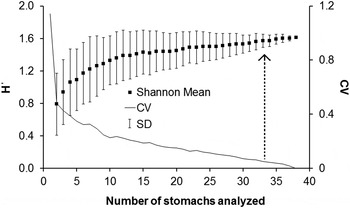
A curve of accumulated diversity (Estimate Swin820) was created to determine whether the number of stomachs analysed was representative enough to characterize the diet of the sicklefin smooth-hound. The Nabs of each prey item in the stomachs was taken into account, estimating the value of the Shannon–Wiener (H′) diversity index for each stomach. The coefficient of variation (CV) was calculated to obtain a quantitative estimation of the number of stomachs that would be representative of the diet. A CV ≤ 5% (0.05) indicates that the number of stomachs examined is adequate to represent the diet.
To determine the trophic niche width, Levin's index (Bi) (Krebs, Reference Krebs1999) was calculated with the following equation: Bi = (1/∑P i 2), where Pi = n i /N; n i = frequency of occurrence of component i, and N = total frequency of components. This index takes values from 0 to 1, where values close to 0 indicate a specialized diet, and values close to 1 represent a generalized diet (Krebs, Reference Krebs1999).
To evaluate diet overlap between sexes (males and females) and sizes (juveniles and adults), the Morisita–Horn index (Smith & Zaret, Reference Smith and Zaret1982) was used. This index ranges from 0 (when diets are completely different) to 1 (when diets are similar). A biologically significant overlap occurs when values are over 0.60; there is no overlap when values are under 0.60 (Langton, Reference Langton1982). To use this index the individuals analysed (by sex and size) have to coincide in time and space, a premise met in the present study.
RESULTS
A total of 40 stomachs were obtained, all containing food. The CV in the cumulative trophic-diversity curve indicated that the curve reached an asymptote at about 33 stomachs (Figure 1), which was sufficient to represent the general diet of the sicklefin smooth-hound shark during the summer of 2011.
Cumulative prey curve for diet of Mustelus lunulatus captured off El Pardito Island, Baja California Sur, Mexico. Vertical lines are standard deviation and CV is the coefficient of variation. Dashed line shows when CV ≤ 0.05.

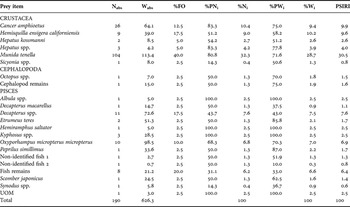
The diet included 21 food components; fish and crustaceans were the most representative taxonomic groups, making up 97% of the M. lunulatus diet. A cephalopod, which made a minimal input to the diet, was also recorded (Table 1). By number as well as by weight, the most important prey were Munida tenella (%N = 32.3; %W = 28.7), Cancer amphioetus (%N = 10.4; %W = 10.2) and Hemisquilla ensigera californiensis (%N = 9.05; %W = 9.04.0%). The remaining food components had values under 8%. The most frequent prey items in the stomachs were M. tenella (%FO = 40), Decapterus spp. (%FO = 17.5), H. ensigera californiensis (%FO = 17.5%) and C. amphioetus (%FO = 12.5%).
Food components of the sicklefin smooth-hound shark Mustelus lunulatus, captured off El Pardito Island, Gulf of California, Mexico. Nabs, absolute number of prey items; Wabs, absolute weight of prey items; %FO, percentage frequency of occurrence; %Ni and %Wi, average percentage abundance; %PNi, %PWi, prey-specific abundance; PSIRI, percentage of the prey-specific index of relative importance; UOM, unidentified organic matter.

Crustaceans were the most important taxonomic group in the diet (PSIRI = 57.4%), followed by prey belonging to the Actinopterigii (PSIRI = 37%) and cephalopods (PSIRI = 3.1%) (Table 1). Individually, M. tenella (%PSIRI = 30.5) was the most important prey, followed by C. amphioetus (%PSIRI = 9.9), H. ensigera californiensis (%PSIRI = 9.6), Decapterus spp. (%PSIRI = 7.6) and O. micropterus micropterus (%PSIRI = 6.9) (Table 1).
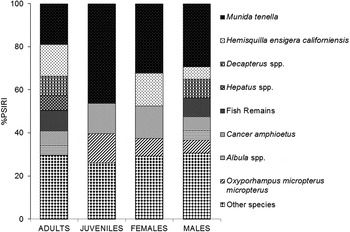
The trophic spectrum of females (N = 16) consisted mainly of M. tenella (%PSIRI = 32.3), H. ensigera californiensis (%PSIRI = 15.2), C. amphioetus (%PSIRI = 15.0%), O. micropterus micropterus (%PSIRI = 8.2) and Decapterus spp. (%PSIRI = 6.1). The same prey items were found in males (N = 24), with variations in the order of importance: M. tenella (71%), Decapterus spp. (12%), O. micropterus micropterus (5%), H. ensigera californiensis (3%) and C. amphioetus (2%) (Figure 2).
Feeding by females, males, juveniles and adults of Mustelus lunulatus, as a percentage of the prey-specific index of relative importance (%PSIRI).

Sharks ranged from 68 to 117 cm TL. Over 50% of collected specimens were adults. Juveniles (N = 17) as well as adults (N = 23) consumed mainly M. tenella (PSIRI = 18.9% for adults and 46.2% for juveniles). The second most important species for adults was H. ensigera californiensis (%PSIRI = 14.8); for juveniles it was C. amphioetus (%PSIRI = 14.1) (Figure 2). The trophic spectrum of adults showed a higher number of fish prey compared to juveniles.
The feeding diversity calculated as the diet width over the Levin's index was relatively low (B i = 0.047). This same feeding amplitude was seen in both sexes (females Bi = 0.16 and males Bi = 0.12) and both maturity stages (juveniles Bi = 0.06 and adults Bi = 0.35).
The Morisita–Horn index showed a high overlap between males and females (Cλ = 0.96), while the overlap between juveniles and adults was intermediate (Cλ = 0.59).
DISCUSSION
In general, the wide variety of feeding strategies employed by elasmobranchs to capture prey would explain the elevated richness of prey reported for several species of cartilaginous fish (Wetherbee & Cortés, Reference Wetherbee, Cortés, Carrier, Musick and Heithaus2004). Based on the results of the present study, the diet of M. lunulatus was made up mainly of epibenthic invertebrates; teleosts were consumed in a lower proportion, and cephalopods were also recorded. The same food groups were found for this species in other geographical areas such as the High Gulf of California (Méndez-Loeza, unpublished data), the entrance to the Gulf of California (Galván-Magaña et al., Reference Galván-Magaña, Nienhuis and Klimley1989) and the Colombian Pacific (Gómez et al., Reference Gómez, Zapata, Franke and Ramos2003; Navia et al., Reference Navia, Giraldo and Mejía-Falla2006, Reference Navia, Mejía-Falla and Giraldo2007). Species of the same genus such as M. californicus, M. manazo, M. canis and M. mustelus present the same feeding spectrum (Gelsleichter et al., 1999; Yamaguchi & Taniuchi, Reference Yamaguchi and Taniuchi2000; Saïdi et al., Reference Saïdi, Enajjar, Bradaï and Bouaïn2009; Méndez-Loeza, unpublished data).
Prey species of M. lunulatus such as M. tenella, C. amphioetus, H. ensigera californiensis, Hepatus kossmanni and Sicyonia spp. live in similar habitats as their predator, being associated with the benthos. However, the sicklefin smooth-hound can also feed on preys that inhabit the water column such as some fish species (Synodus spp., Scomber japonicus, Decapterus macarellus, Hemiramphus saltador and O. micropterus micropterus).
According to the Levin's index, M. lunulatus has a narrow trophic width, since of the 20 prey species, three crustacean species made up 50% of the diet, the most important being M. tenella, a benthic crustacean that is very abundant on the Gulf of California shelf (Fischer et al., Reference Fischer, Krupp, Schneider, Sommer, Carpenter and Niem1995). Predation on the most abundant species in the area has been reported for M. lunulatus in other areas (Navia et al., Reference Navia, Giraldo and Mejía-Falla2006, Reference Navia, Mejía-Falla and Giraldo2007; Méndez-Loeza, unpublished data). For example, Navia et al. (Reference Navia, Giraldo and Mejía-Falla2006) reported that M. lunulatus fed almost exclusively on Squilla panamensis and S. parva, which made up 92% of the diet, and mentioned that both stomatopod species were very abundant on the continental shelf of the Colombian Pacific.
Ontogenetic changes in the diet of M. lunulatus and other species of the genus (M. manazo and M. californicus) have been reported (Yamaguchi & Taniuchi, Reference Yamaguchi and Taniuchi2000; Méndez-Loeza, unpublished data). These changes were not evident in the present work, and if we consider that most galatheid species (e.g. Munida tenella) are very abundant in sub-littoral waters, they do not represent a limiting food resource for fish species, which could be reflected in the scarce differentiation of diet by categories.
Other elasmobranchs present in the study area (M. henlei, Squatina californica and Rhinobatos productus) have a diet similar to that of M. lunulatus, feeding on crustaceans, fish and a small proportion of cephalopods (Fischer et al., 1995; Escobar-Sánchez et al., Reference Escobar-Sánchez, Abitia-Cárdenas and Galván-Magaña2006; Downton-Hoffmann, Reference Downton-Hoffmann2007). This could imply a possible interspecific competition for food. It should be noted that in most cases where there are similar diets among predators, there is also high abundance in food, and where the food is not abundant other factors come into play, such as spatial and temporal segregation (Cruz-Escalona et al., Reference Cruz-Escalona, Abitia-Cardenas, Campos-Dávila and Galvan-Magaña2000). Navia et al. (Reference Navia, Mejía-Falla and Giraldo2007) could not determine resource sharing among several elasmobranch species (M. lunulatus, Dasyatis longa, Rhinobatos leucorhynchus, Raja velezi and Zapteryx xyster). However, they mention that sharing occurred on other axes of the niche, such as time of feeding activity and habitat utilization, which allows a decrease of competition for food, and therefore, coexistence in the ecosystem. In the present study, and under the limitation of having a good representation by category (sexes and sizes) on a spatio-temporal scale, we can conclude that M. lunulatus presents the same feeding pattern independently of the geographical region studied, since it preys mainly on benthic invertebrates and in a lower proportion on fish that inhabit the water column. Although cephalopods were also recorded in the diet, they were considered occasional prey.
ACKNOWLEDGEMENTS
The authors thank the Instituto Politécnico Nacional (IPN) for support received through COFAA and EDI. X.G.M.S. thanks the Consejo Nacional Ciencia y Tecnología (CONACyT) for economic support received through the RETENCIÓN program. O.E.S. thanks the Secretaría de Educación Pública (SEP) and the Instituto Tecnológico de Mazatlán (ITMAZ) for economic support received through a postgraduate scholarship of the Programa de Mejoramiento del Profesorado (PROMEP). We also thank the fishermen of El Pardito Island for their support and hospitality during the sampling months. Thanks to Dr Simon Brown for his help in our data analysis.