Introduction
Iron is the fourth most abundant element in the Earth's crust (~5.1%). It is found in oceans, rivers, lakes, groundwater, rocks and soils, and is an essential element to living organisms (Murad and Fischer, Reference Murad, Fischer, Stucki, Goodman and Schwertmann1988; Cornell and Schwertmann, Reference Cornell and Schwertmann2003). There are 16 Fe-oxides/hydroxides/oxide-hydroxides, which we will call iron oxides (Cornell and Schwertmann, Reference Cornell and Schwertmann2003). Iron is also found in several primary minerals such as olivine, pyroxenes, biotite, pyrite, marcasite, greigite, mackinawite, jarosite, vivianite, siderite and different clay minerals (Murad and Fischer, Reference Murad, Fischer, Stucki, Goodman and Schwertmann1988; Schwertmann and Fitzpatrick, Reference Schwertmann and Fitzpatrick1992). It should be noted that most of these minerals could be found in the prebiotic Earth (Hazen et al., Reference Hazen, Papineau, Bleeker, Downs, Ferry, McCoy, Sverjensky and Yang2008).
The concentration of Fe in minerals ranges from 78% in wüstite (FeO) to traces in clay minerals (Murad and Fischer, Reference Murad, Fischer, Stucki, Goodman and Schwertmann1988). Fe2+ in clay minerals plays several roles such as degradation of pesticides, dichlorination of chlorinated aliphatic and reduction of nitroaromatics (Stucki, Reference Stucki, Bergaya, Theng and Lagaly2006). In addition, there are several other uses for clay minerals, however, one of the most outstanding applications is adsorption of metals and organic molecules (Savic et al., Reference Savic, Stojiljkovic, Savic, Gajic and Wesley2014). Montmorillonite is a 2:1 clay mineral found in prebiotic Earth (Hazen et al., Reference Hazen, Papineau, Bleeker, Downs, Ferry, McCoy, Sverjensky and Yang2008) and, as montmorillonite has a high surface area and interacts with organic molecules, it is the most widely studied mineral in prebiotic chemistry (Zaia, Reference Zaia2004, 2008; Lambert, Reference Lambert2008). However, the role played by Fe2+ present in clay minerals in prebiotic chemistry has not been fully explored and is not yet fully understood. Usually, studies are limited to explaining the adsorption of organic molecules onto clays due to interaction with metals (Lambert, Reference Lambert2008). Fe2+ in clay minerals could have the same role as in olivine; i.e., it could be an electron donator for the synthesis of molecules. Mössbauer spectroscopy studies have shown a decrease in Fe2+ content when adenine, cytosine, thymine and uracil were adsorbed onto montmorillonite, suggesting a reaction between the nucleic acid bases and the metal and not just a sorption process (Carneiro et. al., Reference Carneiro, Berndt, de Souza Junior, de Souza, Paesano, da Costa, di Mauro, de Santana, Zaia and Zaia2011).
Several molecules (haemoglobin, peroxidase, catalase, ferredoxin, cytochrome-C, ferrichrome, enterochelin and ferritin) that participate in the important physiological processes of living beings contain iron (Murad and Fischer, Reference Murad, Fischer, Stucki, Goodman and Schwertmann1988; Curi and Procopio, Reference Curi and Procopio2017). In addition, iron deficiency has been associated with several diseases such as neurodegenerative diseases, anaemias, hemophagocytic syndrome and cardiovascular diseases (Curi and Procopio, Reference Curi and Procopio2017; Svobodova et al., Reference Svobodova, Kosnáč, Tanila, Wagner, Trnka, Vitovič, Hlinkova, Vavrinsky, Ehrlich, Polák and Kopani2020). Thus, iron plays important roles in today's living beings and is relevant to better comprehend the geochemical cycle of iron. Iron participates in several geochemical processes. Nowadays, the high oxygen concentration in the atmosphere favours the hydrolysis of olivine/fayalite (reaction 1) or pyrite (reaction 2) to form goethite (Schwertmann and Fitzpatrick, Reference Schwertmann and Fitzpatrick1992), the most conspicuous iron oxide in soils in the present Earth.


In aerobic environments, iron oxides such as goethite are very stable. However, at a very acidic pH (pH < 4 - reaction 3) or in anaerobic environments (reaction 4) the iron oxides can be dissolved and reduced, respectively (Schwertmann and Fitzpatrick, Reference Schwertmann and Fitzpatrick1992).


Reaction 4 is important in anaerobic environments present in lakes, rivers, swamps and soils (Schwertmann and Fitzpatrick, Reference Schwertmann and Fitzpatrick1992). Other iron minerals, siderite and vivianite are synthesized in anaerobic environments. In addition, in anaerobic environments, the reduction of sulphate to sulphide by the bacteria desulfovibrio sp. favours the formation of pyrite (Schwertmann and Fitzpatrick, Reference Schwertmann and Fitzpatrick1992).
Before 2.5 billion years ago the oxygen in the atmosphere was too low (Kasting, Reference Kasting1987; Reference Kasting, Tze-Fei Wong and Lazcano2009; Shaw, Reference Shaw2016). The main sinks of Fe2+ could be inorganic carbon (CO32−), dissolved silica (SiO2) and sulphide (S2−) (Tosca et al., Reference Tosca, Jiang, Rasmussen and Muhling2019). These three sinks produced siderite (FeCO3), greenalite (Fe3Si2O5(OH)4) and pyrite (FeS2) (Tosca et al., Reference Tosca, Jiang, Rasmussen and Muhling2019). It should be noted that before the biological precipitation of silica from the seawater, the amount of dissolved silica in the seas was much higher than today (Siever, Reference Siever1992). Furthermore, the PCO2 was much higher 3.85 billion years ago than today (Kasting, Reference Kasting, Tze-Fei Wong and Lazcano2009; Shaw, Reference Shaw2016). Another sink for Fe2+ is the formation of green rust (Halevy et al., Reference Halevy, Alesker, Schuster, Popovitz-Biro and Feldman2017). However, for the oxidation of Fe2+ to Fe3+ and the formation of green rust the samples require contact with air for 1.5 h (Halevy et al., Reference Halevy, Alesker, Schuster, Popovitz-Biro and Feldman2017). The oxidation of Fe2+ to Fe3+ could be carried out without the use of oxygen, in environments more similar to the prebiotic Earth (Braterman et al., Reference Braterman, Cairns-Smith and Sloper1983; Liang et al., Reference Liang, Hartman, Kopp, Kirschvink and Yung2006).
It should be noted that most iron hydroxide-oxides are made up of Fe3+ (Cornell and Schwertmann, Reference Cornell and Schwertmann2003). However, due to the reduced atmosphere of Earth, most of the iron on Earth was in the form of Fe2+ in minerals such as olivine, pyroxene, Fe-Ni metal and FeS (Hazen et al., Reference Hazen, Papineau, Bleeker, Downs, Ferry, McCoy, Sverjensky and Yang2008). However, there are several ways in which iron hydroxide-oxides could be formed under the conditions that existed on prebiotic Earth. Here are a few examples of how this could have happened: (a) serpentinization reaction in hydrothermal environments (reaction5) (Martin et al., Reference Martin, Baross, Kelley and Russel2008),

(b) oxidation of Fe2+ into Fe3+ by hydrogen peroxide formed in ice through UV radiation (Liang et al., Reference Liang, Hartman, Kopp, Kirschvink and Yung2006), (c) oxidation of Fe2+into Fe3+ through UV radiation, which was one of the major sources of energy on prebiotic Earth (Braterman et al., Reference Braterman, Cairns-Smith and Sloper1983) and (d) oxidation of Fe2+ to Fe3+ in temperatures ranging from 300 °C to 350 °C, pressures ranging from 10 MPa to 25 MPa and pH values ranging from 9.5 to 14 (Bassez, Reference Bassez2018). All these environments existed on prebiotic Earth or still exist (Holm and Andersson, Reference Holm and Andersson2005; Martin et al., Reference Martin, Baross, Kelley and Russel2008). Thus, in such environments, ferrihydrite could be synthesized and maybe an intermediary for the synthesis of hematite, goethite and lepidocrocite (Rzepa et al., Reference Rzepa, Pieczara, Gawel and Tomczyk2016; Bassez, Reference Bassez2018).
In addition to a number of applications in science and technology (Cornell and Schwertmann, Reference Cornell and Schwertmann2003), several iron oxides have been used in prebiotic chemistry experiments such as sorption of biomolecules or precursors of biomolecules (Matrajt and Blanot, Reference Matrajt and Blanot2004; Vieira et al., Reference Vieira, Berndt, de Souza Junior, di Mauro, Paesano, de Santana, da Costa, Zaia and Zaia2011; Shanker et al., Reference Shanker, Singh and Kamaluddin2013; Canhisares-Filho et al., Reference Canhisares-Filho, Carneiro, de Santana, Urbano, da Costa, Zaia and Zaia2015; Farias et al., Reference Farias, Carneiro, de Batista Fonseca, Zaia and Zaia2016; Zaia et al., Reference Zaia, de Carvalho, Samulewski, de Carvalho Pereira and Zaia2020), catalyzation of the formation of biomolecules (Shanker et al., Reference Shanker, Bhushan, Bhattacharjee and Kamaluddin2011; Bizzarri et al., Reference Bizzarri, Botta, Pérez-Valverde, Saladino, di Mauro and García-Ruiz2018; Barge et al., Reference Barge, Flores, Baum, VanderVelde and Russel2019) and catalysation of the formation of biopolymers (Matrajt and Blanot, Reference Matrajt and Blanot2004; Shanker et al., Reference Shanker, Bhushan, Bhattacharjee and Kamaluddin2012; Georgelin et al., Reference Georgelin, Akouche, Jaber, Sakhno, Matheron, Fournier, Méthivier, Martra and Lambert2017).
SCN− has been found in hydrothermal vents (Dowler and Ingmanson, Reference Dowler and Ingmanson1979) and synthesized from reactions between HCN and S8 (Bartlett and Davis, Reference Bartlett and Davis1958). NH4SCN has been synthesized in experiments simulating prebiotic atmospheres containing H2S (Mukhin L., Reference Mukhin1974; Raulin and Toupance, Reference Raulin and Toupance1977). It should be noted that thiocyanate could play the same role as that of CN− in the Strecker reaction (Perezgasga et al., Reference Perezgasga, Silva, Lazcano and Negrón-Mendoza2003; Wagner and Ofial, Reference Wagner and Ofial2015; Kouznetsov and Galvis, Reference Kouznetsov and Galvis2018). In addition, thiocyanate could replace toxic cyanide as a CN-source for the synthesis of tertiary amines (Wagner and Ofial, Reference Wagner and Ofial2015; Kouznetsov and Galvis, Reference Kouznetsov and Galvis2018). NH3 has been found in comets and could be produced by the reduction of NO2− by Fe2+ (Summers, Reference Summers1999; Shinnaka et al., Reference Shinnaka, Kawakita, Jehin, Decock, Hutsemékers, Manfroid and Arai2016). Thus, SCN− and NH3 were most likely to be found on the prebiotic earth.
Artificial seawater was used in the experiments, with a composition which, unlike modern seawater, has high concentrations of Mg2+, Ca2+ and SO42− (Zaia, Reference Zaia2012). This artificial seawater probably better resembles the seawater of the oceans of the Earth 4.0 billion years ago. Based on the work of Izawa et al. (Reference Izawa, Nesbitt, MacRae and Hoffman2010), Zaia (Reference Zaia2012) suggested this artificial seawater. Izawa et al. (2010) used hot water to extract soluble salts from Tagish Lake meteorites. The authors obtained the following order of cations: Mg2+ > Ca2+ >> Na+ ≈ K+, and anions: SO42− >> Cl−. In the last few years, we have been using this artificial seawater, 4.0 Gy and the results showed that the ion composition of seawater has an effect on the adsorption of nucleic acid bases as well as on the stability of the minerals (Canhisares-Filho et al., Reference Canhisares-Filho, Carneiro, de Santana, Urbano, da Costa, Zaia and Zaia2015; Anizelli et al., Reference Anizelli, Baú, Valezi, Canton, Carneiro, di Mauro, da Costa, Galante, Braga, Rodrigues, Coronas, Casado-Coterillo, Zaia and Zaia2016a,Reference Anizelli, Baú, Gomes, da Costa, Carneiro, Zaia and Zaiab; Carneiro et al., Reference Carneiro, Stabile, Gomes, da Costa, Zaia and Zaia2017; Villafañe-Barajas et al., Reference Villafañe-Barajas, Baú, Colín-García, Negrón-Mendoza, Heredia-Barbero, Pi-Puig and Zaia2018; Zaia et al., Reference Zaia, de Carvalho Pereira and Samulewski2018).
Since iron is one of the most abundant elements in the crust of the Earth, we can suppose that it may have had an important role in the origin of life on Earth. The main goals of this work were to synthesize ferrihydrite under prebiotic chemistry conditions and analyse the products of the reaction. Ferrihydrite was synthesized in the presence of NH4SCN and artificial seawater 4.0 Gy. The products of the reaction were analysed using Fourier-transform infrared (FT-IR) spectroscopy, X-ray photoelectron spectroscopy and X-Ray Diffractometry. In addition, surface area, pore volume, pore size and pH at the point of zero charge were measured.
Materials and methods
Materials
All the reagents were of analytical grade P.A.
Seawater 4.0 Gy
The following substances were weighed and dissolved with ultrapure water until reaching a solution of 1.0 L: Na2SO4 (0.2710 g), MgCl2.6H2O (0.5000 g), CaCl2 2H2O (2.5008 g), KBr (0.0502 g), K2SO4 (0.4006 g) and MgSO4 (15.000 g) (Zaia, Reference Zaia2012).
Syntheses
The syntheses were performed using distilled water or artificial seawater 4.0 Gy. Ammonium thiocyanate was added in two different ways: (a) in the beaker together with ferric nitrate and (b) in the burette together with potassium hydroxide. When ammonium thiocyanate was added in the beaker together with ferric nitrate, we analysed the effect of high ammonium thiocyanate concentration on the products of the synthesis. When ammonium thiocyanate was added in the burette together with potassium hydroxide, we analysed the effect of low ammonium thiocyanate concentration on the products of the synthesis.
2.1.2.1. Syntheses of ferrihydrite-6-lines (Fh-6) in ultrapure water and in artificial seawater 4.0 (Fh-SW-4.0)
Ferrihydrite was synthesized according to the method described by Cornell and Schwertmann (Reference Cornell and Schwertmann2003). For Fh-6 synthesis, the reagents were dissolved in ultrapure water and for Fh-SW-4.0 synthesis in artificial seawater 4.0. Initially, 100 mL of a solution of iron nitrate (Fe(NO3)3.9H2O; 0.20 mol L−1) was added to a plastic box. This solution was kept at a temperature of 75° C with constant stirring. Subsequently, approximately 66 mL of a solution of KOH 1.0 mol L−1 was added. The addition of the potassium hydroxide was performed slowly at a steady flow, during 1 h, until reaching a pH of 7.5. The material was filtered in a vacuum system and washed with ultrapure water 3.0 L in order to remove nitrate excess. The material was lyophilized and the ferrihydrite was characterized by X-Ray diffraction and FTIR. All syntheses were performed in duplicate.
2.1.2.2. Syntheses of ferrihydrite in ultrapure water (Fh-DW-NH4SCN-1) and in artificial seawater 4.0 (Fh-SW-NH4SCN-1): ammonium thiocyanate (NH4SCN) plus ferric nitrate hydrate [Fe(NO3)39H2O] together in the beaker
For Fh-DW-NH4SCN-1 synthesis, the reagents were dissolved in ultrapure water and for Fh-SW-NH4SCN-1 synthesis in artificial seawater 4.0. Synthesis occurred under the same conditions as in 2.1.2, with only one change: NH4SCN and Fe(NO3)39H2O were added to the beaker at the ratio Fe3+ 1 mol:1 mol NH4SCN. After the synthesis, the same treatments were performed as in the 2.1.2. synthesis.
2.1.2.3. Syntheses of ferrihydrite in ultrapure water (Fh-DW-NH4SCN-2) and in artificial seawater 4.0 (Fh-SW-NH4SCN-2): ammonium thiocyanate (NH4SCN) plus potassium hydroxide (KOH) together in the burette
For Fh-DW-NH4SCN-2 synthesis, the reagents were dissolved in ultrapure water and for Fh-SW-NH4SCN-2 synthesis in artificial seawater 4.0. Synthesis occurred under the same conditions as in 2.1.2, with only one change: NH4SCN and KOH were added to the burette and dripped for 1 h into the iron solution. The same amount of NH4SCN was used as in the 2.1.3 synthesis. After the synthesis, the same treatments were performed as in the 2.1.2. synthesis.
Methods
Infrared spectroscopy
After the samples were lyophilized, the spectra were obtained with a resolution of 4 cm−1 in the range 4000 cm−1 to 400 cm−1. In total, 16 scans were performed in a Bruker-Vertex 70 spectrometer equipped with an attenuated total reflectance-ATR accessory with a Ge crystal 45°. A small amount of the solid (≈ 10 mg) was added to the crystal
X-Ray Diffraction
The powder samples were analysed by X-ray diffraction using a Shimadzu D6000 diffractometer. CoKα (40 kV, 30 mA) radiation and an iron filter were used in a step-scanning mode (0.02 ° 2θ/0.6 s). All peak positions were analysed using the software Grams 8.0.
Ph at the point of zero charge
The pH at the point of zero charge (pHpzc) is an important parameter as it could be helpful to elucidate whether adsorption involves physical interaction (electrostatic attraction) or chemical interaction (bonding). In 12 tubes of 50 mL with threads, 20 mL of NaCl0.10 mol L−1 were added. The pH of each solution was adjusted from 1.00 to12.0 using HCl (0.10 mol L−1) or NaOH (0.10 mol L−1) solutions. Next, 20 mg of iron oxide were added to each tube. The suspensions were stirred for 24 h at room temperature. The samples were centrifuged at 9000 rpm for 10 min and the pH of the samples was measured. A graphic of pH measured versus pH adjusted was made, where the pHpzc corresponding to the pH measured was constant in the range of pH adjusted.
Surface analysis
The surface analysis was performed in High Speed Gas Sorption Analyzer equipment, version 11:02. For determination of pore size, volume and surface area, the methods by Dollimore and Heal (DH) Barret-Joyner Halenda (BJH) Brunauer, Emmett and Teller (BET) were used, respectively. The samples were pretreated at 120 °C under vacuum for 3 h. The measurements were performed at the temperature of liquid N2 (77.3 K). The results were analysed using the software NovaWin 11.0.
X-ray Photoelectron spectroscopy
X-ray photoelectron spectroscopy (XPS) spectra were collected with an ESCA 3000 spectrometer equipped with conventional Mg Kα X-ray source and a 250 mm hemispherical energy analyser with an overall resolution of 0.8 eV at an emission angle of 45o and pressures of less than 2 × 10⁻⁸ Torr. The adventitious carbon C 1s peak at 285 eV was used as a reference for charge correction. All samples were prepared by spreading a thin layer of the powdered materials on a metallic holder which was air-dried at ~ 100 °C for 2 h and immediately transferred to a UHV chamber. This thermal treatment reduces the amount of water adsorbed in the samples, improving the pressure in the XPS analysis chamber without causing significant changes in the X-ray diffractograms of the samples.
Results and discussion
X-ray diffraction
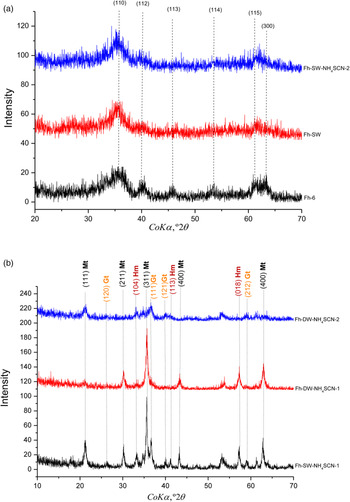
X-ray diffractograms of Fh-6 and Fh-SW-NH4SCN-2, and Fh-SW samples presented six characteristic peaks of 6-line ferrihydrite and two characteristic peaks of 2-line ferrihydrite, respectively (Fig. 1) (Cornell and Schwertmann, Reference Cornell and Schwertmann2003). Artificial seawater 4.0 Gy only had an effect on the crystallinity of ferrihydrite, since instead of 6-line ferrihydrite, 2-line ferrihydrite was obtained. However, Samulewski et al., observed that in the synthesis of magnetite, besides magnetite, goethite (26.9%) and gypsum (19.4%) were also obtained (Samulewski et al., Reference Samulewski, Gonçalves, Urbano, da Costa, Ivashita, Paesano and Zaia2020). The Fh-SW-NH4SCN-2 sample showed lower crystallinity when compared to the Fh-6 sample, probably due to the high quantity of salts present in seawater 4.0 Gy that interferes with the formation of the ferrihydrite structure. It should be pointed out that ammonium thiocyanate was in the burette along with potassium hydroxide and this solution was dripped into the beaker for 1 h. Thus, for most of the time of the synthesis, the ammonium thiocyanate was at a much lower concentration than the ferrous nitrate or the salts of the artificial seawater 4.0 Gy. Therefore, it probably did not have an effect on the synthesis products, because of its low concentration. Since artificial seawater 4.0 Gy contains a high quantity of Mg2+, there is a possibility that this cation is being incorporated into the ferrihydrite structure, causing crystallinity loss (Giovanoli and Schwertmann, Reference Giovanoli and Schwertmann1992). For the Fh-SW-NH4SCN-2 sample, the SCN− anion was added to the burette along with the OH− anion. Since the SCN− anion is dripped into the beaker, its concentration is always much lower than the SO42− anion concentration. Thus, the SO42− anion from artificial seawater interacts with the Fe3+ cation forming complexes and the SCN−anion does not interact with the Fe3+ cation (Broadhurst and Preez, Reference Broadhurst and du Preez1993).
X-ray diffractograms of the samples (a) Fh-6-synthesis of ferrihydrite-6-lines; Fh-SW-4.0-synthesis of ferrihydrite in artificial seawater 4.0 and Fh-SW-NH4SCN-2-synthesis of ferrihydrite in artificial seawater 4.0 being that NH4SCN plus KOH together in the burette and (b) Fh-SW-4.0-NH4SCN-1-synthesis of ferrihydrite in artificial seawater 4.0 being that NH4SCN plus Fe(NO3)39H2O together in the beaker; Fh-DW-NH4SCN-1-synthesis of ferrihydrite in distilled water being that NH4SCN plus Fe(NO3)39H2O together in the beaker and Fh-DW-NH4SCN-2-synthesis of ferrihydrite in distilled water being that NH4SCN plus KOH together in the burette. Mt-magnetite, Hm-hematite, Gt-goethite.

X-ray diffractograms of Fh-DW-NH4SCN-2 and Fh-SW-NH4SCN-1 samples presented characteristic peaks of goethite, hematite and magnetite (Fig. 1). For the Fh-DW-NH4SCN-1 sample, the X-ray diffractogram presented characteristic peaks of hematite and magnetite (Fig. 1). However, the FT-IR spectra of Fh-DW-NH4SCN-2, Fh-SW-NH4SCN-1 and Fh-DW-NH4SCN-1 samples showed bands at 890 cm−1 (O-H bending in plane) and 794 cm−1 (O-H bending out of the plane) which are characteristic of goethite (Table 1) (Cornell and Schwertmann, Reference Cornell and Schwertmann2003). In addition, Samulewski et al. (Reference Samulewski, Gonçalves, Urbano, da Costa, Ivashita, Paesano and Zaia2020) also observed that when magnetite was synthesized in the presence of SCN−anion, goethite was also obtained. For Fh-DW-NH4SCN-1 and Fh-DW-NH4SCN-2 samples, the (hematite, (018)) and (magnetite, (311)) peaks should be the highest intensity, but probably due to orientation, they are not (Fig. 1). The Fh-6 sample showed weak bands at 890 cm−1 and 801 cm−1 (Table 1). These bands could be due to the formation of a small amount of goethite, which was not detected by X-ray diffractometry. For the Fh-SW and Fh-SW-NH4SCN-2 samples these bands were not observed (Table 1).
Assignments of frequencies (cm−1) in FTIR spectra of the samples

Sh-shoulder, w-weak, vw-very weak; Fh-6-synthesis of ferrihydrite-6-lines; Fh-DW-NH4SCN-1-synthesis of ferrihydrite in distilled water being that NH4SCN plus Fe(NO3)39H2O together in the beaker; Fh-DW-NH4SCN-2-synthesis of ferrihydrite in distilled water being that NH4SCN plus KOH together in the burette; Fh-SW-4.0-synthesis of ferrihydrite in artificial seawater 4.0; Fh-SW-4.0-NH4SCN-1-synthesis of ferrihydrite in artificial seawater 4.0 being that NH4SCN plus Fe(NO3)39H2O together in the beaker and Fh-SW-NH4SCN-2-synthesis of ferrihydrite in artificial seawater 4.0 being that NH4SCN plus KOH together in the burette.
a Cornell and Schwertmann, Reference Cornell and Schwertmann2003
b Mazzetti and Thistlethwaite, Reference Mazzetti and Thistlethwaite2002
c Ristić et al., Reference Ristić, de Grave, Musić, Popović and Orehovec2007
d Nakamoto, Reference Nakamoto1978
e Colthup et al., Reference Colthup, Daly and Wiberley1990.
When thiocyanate was added together with Fe3+ (Fh-SW-NH4SCN-1 and Fh-DW-NH4SCN-1), at the beginning of the synthesis the concentration of ammonium thiocyanate was high, so the iron oxides showed good crystallinity (Fig. 1). For the sample Fh-DW-NH4SCN-2, the SCN− anion was added to the burette along with the OH− anion, however, unlike the Fh-SW-NH4SCN-2 sample, goethite, magnetite and goethite were obtained (Fig. 1). Probably, in this case, the SCN− anion is not competing with seawater salts, mainly SO42− anion. It should be noted that ferrihydrite has low stability, so ferrihydrite is an intermediate for the synthesis of other iron oxides (Cornell and Schwertmann, Reference Cornell and Schwertmann2003).
Pearson's theory
For the synthesis of these materials, Pearson's theory could provide information to the interaction between SCN− and the Fe3+ ion on the formation of the M-SCN or M-NCS bond. The SCN− ion can bind metals through the sulphur atom or nitrogen atom. When the metal is a hard acid, SCN− binds through the nitrogen atom and when the metal is a soft acid SCN− binds through the sulphur atom. Since the Fe3+ ion is considered a hard acid, the metal coordinates with the SCN− ion through nitrogen to form isothiocyanate complexes (Pearson, Reference Pearson1963). It is well known that goethite is formed when sulphur compounds interact with the Fe3+ cation (Cornell and Schneider, Reference Cornell and Schneider1989; Cornell et al., Reference Cornell, Schneider and Giovanoli1989; Cornell and Schwertmann, Reference Cornell and Schwertmann2003; Vu and Moreau, Reference Vu and Moreau2015; Carneiro et al., Reference Carneiro, Ivashita, de Souza Junior, de Souza, Paesano, da Costa, di Mauro, de Santana, Zaia and Zaia2013; Samulewski et al., Reference Samulewski, Gonçalves, Urbano, da Costa, Ivashita, Paesano and Zaia2020). Therefore, this may be an indication that Fe3+ interacted with the SCN− ion also by sulphur. In addition, the formation of magnetite could be an indication that the SCN− ion oxidized forming thiocyanogen-(SCN)2 or trithiocyanate ion-(SCN)−3 and the reduction of Fe3+ to Fe2+ (see reactions below) (Broadhurst and Preez, Reference Broadhurst and du Preez1993)


Infrared spectroscopy
The main purpose of using infrared spectroscopy was not to confirm the results of X-ray diffractometry but to verify details in the samples that diffractometry would not show. Using infrared spectroscopy, it was possible to verify that some samples have several substances adsorbed on them.
The Fh-DW-NH4SCN-1, Fh-DW-NH4SCN-2 and Fh-SW-NH4SCN-1 samples showed a band at 2050 cm−1 due to C≡N stretching of SCN− (Table 1, online Supplementary Figure S1) (Nakamoto, Reference Nakamoto1978; Colthup et al., Reference Colthup, Daly and Wiberley1990). It should be noted that SCN− was preconcentrated in all samples where goethite was synthesized (Table 1, Fig. 1). This could be an indication of a mechanism for the preconcentration of SCN−. In addition, for the goethite formation, sulphur of SCN− interacts with Fe3+ (Cornell and Schneider, Reference Cornell and Schneider1989; Cornell et al., Reference Cornell, Schneider and Giovanoli1989; Cornell and Schwertmann, Reference Cornell and Schwertmann2003; Vu and Moreau, 2005; Carneiro et al., Reference Carneiro, Ivashita, de Souza Junior, de Souza, Paesano, da Costa, di Mauro, de Santana, Zaia and Zaia2013; Samulewski et al., Reference Samulewski, Gonçalves, Urbano, da Costa, Ivashita, Paesano and Zaia2020). The Fh-SW-NH4SCN-2 sample showed a band at 880 cm−1, which could be an indication of the interaction of SCN− with Fe3+ by nitrogen. However, the band at 2050 cm−1 due to C≡N stretching of SCN− was not observed for this sample (Table 1). The Fh-SW-NH4SCN-2 sample showed three bands at 2976 cm−1, 2931 cm−1 and 2897 cm−1 due to N–H stretching of NH4+(Table 1, online Supplementary Figure S1) (Nakamoto, Reference Nakamoto1978; Colthup et al., Reference Colthup, Daly and Wiberley1990).
The adsorption of SCN− anion onto ferrihydrite occurs in a very acidic pH (Vu and Moreau, Reference Vu and Moreau2015) or in a neutral pH in the presence of artificial seawater 4.0 Gy, which contains high Mg2+, Ca2+ and SO42− concentrations (Zaia et al., Reference Zaia, de Carvalho, Samulewski, de Carvalho Pereira and Zaia2020). It should be noted that the pH of the oceans 4.0 billion years ago was in the range from 6.3 to 7.2 (Halevy and Bachan, Reference Halevy and Bachan2017; Krissansen-Totton et al., Reference Krissansen-Totton, Arney and Catling2018). Thus, the sorption/precipitation of SCN− and NH4+ onto the samples is very important for prebiotic chemistry, as this is a way to preconcentrate these molecules and they could be used for further reactions in molecular evolution.
Fh-SW and Fh-SW-NH4SCN-2 samples showed bands at 1096 cm−1 and 1096/1050 cm−1, respectively (Table 1). These bands are due to S-O stretching from the SO42− of the artificial seawater (Nakamoto, Reference Nakamoto1978; Colthup et al., Reference Colthup, Daly and Wiberley1990). These samples (Fh-SW, Fh-SW-NH4SCN-2) are ferrihydrites (Fig. 1). It should be noted that when SO42− interacts with one or more oxygen atoms, the change in symmetry alters the number of vibrational modes. Thus, more bands in the 1097 cm−1 region should be observed (Peak et al., Reference Peak, Ford and Sparks1999; Fukushi et al., Reference Fukushi, Aoyama, Yank, KItadai and Nakashima2013; Jonhston and Chrysochoou, Reference Johnston and Chrysochoou2016). Therefore, the interaction of SO42− with the Fh-SW sample is characteristic of an outer-sphere complex and with the Fh-SW-NH4SCN-2 sample an inner-sphere complex (Peak et al., Reference Peak, Ford and Sparks1999; Fukushi et al., Reference Fukushi, Aoyama, Yank, KItadai and Nakashima2013; Jonhston and Chrysochoou, Reference Johnston and Chrysochoou2016).
For all samples, bands were observed at 1472 cm−1 and 1345 cm−1 (Table 1, online Supplementary Figure S1). These bands are due to CO32− adsorbed onto the samples (Mazzetti and Thistlethwaite, Reference Mazzetti and Thistlethwaite2002; Ristić et al., Reference Ristić, de Grave, Musić, Popović and Orehovec2007). The CO32− was from CO2(g) in the air which was absorbed by the synthesis solutions.
Surface analysis
The pore size, volume and surface area are important parameters in material science as well as in prebiotic chemistry, as the material with a high surface area will adsorb more molecules than a low surface area. In addition, pore size is important in prebiotic chemistry because molecules can enter the pores and mimic the walls of a cell. In the pores, the molecules will be protected against UV radiation or hydrolysis and the molecules will be separated from the environment, where reactions could occur (Brasier et al., Reference Brasier, Matthewman, McMahon and Wacey2011; Impey et al., Reference Impey, Lunine and Funes2012). Among the synthesized samples, the Fh-SW sample presented the highest surface area, pore volume and pore size (Table 2). It should be noted that this sample is a 2-line ferrihydrite and showed the lowest crystallinity (Fig. 1). The surface area, pore volume and pore size for the ferrihydrite samples (Fh-6, Fh-SW, Fh-SW-NH4SCN-2) are close to the values obtained by other studies (Schultz et al., Reference Schultz, Benjamin and Ferguson1987; Stanjek and Weidler, Reference Stanjek and Weidler1992; Cornell and Schwertmann, Reference Cornell and Schwertmann2003; Pereira et al., Reference Pereira, Anizelli, di Mauro, Valezi, da Costa, Zaia and Zaia2019). As the Fh-DW-NH4SCN-1 and Fh-DW-NH4SCN-2 samples presented much lower crystallinity than the Fh-SW-NH4SCN-1 sample (Fig. 1), they showed much higher surface areas than the Fh-SW-NH4SCN-1 sample (Table 2). It should be noted that these samples are a mixture of magnetite, hematite and goethite (Fig. 1). Fh-SW and Fh-DW-NH4SCN-2 samples could be classified as mesoporous materials (2 nm −50 nm) and the other samples as microporous materials (< 2 nm) (Table 2) (Cornell and Schwertmann, Reference Cornell and Schwertmann2003).
Results of adsorption/desorption of N2 at 77 K in ferrihydrite synthesis (surface analysis BET) and pHpzc

*BET Brunauer-Emmett-Teller; **BJH Barrett-Joyner-Halenda; #pHpzc = pH at the Point of Zero Charge Fh-6-synthesis of ferrihydrite-6-lines; Fh-DW-NH4SCN-1-synthesis of ferrihydrite in distilled water being that NH4SCN plus Fe(NO3)39H2O together in the beaker; Fh-DW-NH4SCN-2-synthesis of ferrihydrite in distilled water being that NH4SCN plus KOH together in the burette; Fh-SW-4.0-synthesis of ferrihydrite in artificial seawater 4.0; Fh-SW-4.0-NH4SCN-1-synthesis of ferrihydrite in artificial seawater 4.0 being that NH4SCN plus Fe(NO3)39H2O together in the beaker and Fh-SW-NH4SCN-2-synthesis of ferrihydrite in artificial seawater 4.0 being that NH4SCN plus KOH together in the burette.
The pH at the point of zero charge
When the pH is above the pHPZC, the material is negatively charged and when it is below this value, the material is positively charged (Parks and de Bruyn, Reference Parks and de Bruyn1962). For prebiotic chemistry, the pHPZC is an important parameter, since, in general, positively charged molecules will preferably adsorb onto negatively charged minerals; the reverse is also true (Lambert, Reference Lambert2008).
The Fh-6 sample contains only ferrihydrite and its pHPCZ was 8.24, which is in accordance with the data obtained in the literature for ferrihydrite, which vary from 7.0 to 8.8 (Kosmulski, Reference Kosmulski2018). In the case of the Fh-SW sample, which also contains only ferrihydrite (Fig. 1), the pHPCZ was 7.25 (Table 2). This decrease in pHPCZ is probably related to the adsorption of SO42− onto the sample (Table 1, 2). Fh-SW-NH4SCN-2 presented a pHPCZ similar to the Fh-6 sample (Table 2). It should be noted that this sample adsorbed SO42− and NH4+ (Table 1).
Fh-DW-NH4SCN-1, Fh-DW-NH4SCN-, and Fh-SW-NH4SCN-1 samples contain a mixture of goethite, hematite and magnetite (Table 1, Fig. 1), and their pHPCZ values were 6.35, 6.43 and 7.11, respectively (online Supplementary Figure S3). These values are in the range of pHPCZ for these samples (Cornell and Schwertmann, Reference Cornell and Schwertmann2003; Kosmulski, Reference Kosmulski2018). All these samples adsorbed SCN−.
X-ray photoelectron spectroscopy
X-ray photoelectron spectroscopy (XPS) is an excellent tool for probing the electronic structures of Fe-O bonds in Fe1−yO (wüstite), α-Fe2O3 (hematite), γ-Fe2O3 (maghemite), Fe3O4 (magnetite) and FeO(OH) (goethite) compounds (Fujii et al., Reference Fujii, de Groot, Sawatzky, Voogt, Hibma and Okada1999; Yamashita et al., Reference Yamashita and Hayes2008). However, even in the absence of dissolved oxygen, Fe0 can react with water to form soluble Fe2+ and not only iron oxides (Kruger and Calvertm, Reference Kruger and Calvertm1967), but also amorphous black ferric oxyhydroxide (Ding et al., Reference Ding, de Jong, Roosendaal and Vredenberg2000) and ferrihydrite (Fh) (Chernyshova et al., Reference Chernyshova, Hochella and Madden2007), which is an abundant mineral in the terrestrial crust with an ordered form Fe10O14(OH)2 + nH2O where n is close to 1.
Fh is a low-crystalline nanoparticulate and highly defective material containing both tetrahedrally and octahedrally coordinated ferric ions (Chernyshova et al., Reference Chernyshova, Ponnurangam and Somasundaran2010; Michel et al., Reference Michel, Barron, Torrent, Morales, Serna, Boily, Liu, Ambrosini, Cismasu and Brown2010). Metastable iron oxyhydroxides and particularly maghemite with inverse spinel structure denoted as (Fe3+)tet8 [Fe3+Fe2+]oct8O32, where 16 Fe3+ and 8 Fe2+ occupy tetrahedral (tet) and octahedral (oct) interstitial sites of the oxygen anions, forming a closed-packed FCC lattice and can form Fh by dehydration.
Next, comparisons of the XPS measurements of samples with pure Fh and their mixture with iron oxides are performed. The nomenclature of samples includes the first letter of their constituent compounds as identified by XRD measurements; (i.e.), the addition of Gt for goethite, Hm for hematite and Mt for magnetite. Although there is evidence that the binding-energy values of the Fe 2p3/2 and O 1s peak positions can be dependent on the calibration experimentally obtained from C 1s peak position (Yamashita and Hayes, Reference Yamashita and Hayes2008), we observed systematic changes in O 1s peak position with site occupancy and oxidation state of Fe in the samples containing a mixture of iron oxides and oxyhydroxides.
The XPS O 1s spectra from the samples containing Fh with mixtures of compounds are shown in Fig. 2a, whereas the XPS peaks of O 1s for the pure Fh samples prepared with current seawater (w0.0) and proxy seawater from 4 billion years ago (w4.0) are shown in Fig. 2b.
The XPS spectra of O 1s photopeak from the (a) ferrihydrate mixtured with iron (hidr)oxides compounds and (b) pure ferrihydrate samples.

The contributions Fe-O, H-O and adsorbed water are indicated by dashed lines and arrows in the photopeak region of the O 1s core-level. The peak position of O 1s has been investigated by many works and values between 529 and 532 eV have been reported (Ding et al., Reference Ding, de Jong, Roosendaal and Vredenberg2000; Weiss et al., Reference Weiss and Ranke2002; Yamashita and P. Hayes, Reference Yamashita and Hayes2008). It is worth noting that the binding energy of the O 1s peak is almost independent of the oxide phase at 530 eV in the presence of both Fe3+ and Fe2+ species (Schedel-Niedrig et al., Reference Schedel-Niedrig, Weiss and Schlogl1995; Fujii et al., Reference Fujii, de Groot, Sawatzky, Voogt, Hibma and Okada1999; Weiss and Ranke, Reference Weiss and Ranke2002). However, the covalency reduces the number of filled states with O 2p character, so that the strength of the O 1s signal is related to the degree of covalency (Schedel-Niedrig et al., Reference Schedel-Niedrig, Weiss and Schlogl1995; Weiss and Ranke, Reference Weiss and Ranke2002). All XPS O 1s spectra shown in Fig. 2a exhibit broad lines at about 529.5 eV, whereas a broader structure with a peak at about 531 eV is observed for pure Fh samples, as shown in Fig. 2b. Furthermore, strong absorption of water is observed in samples containing Fh mixed with magnetite, hematite and goethite. Particularly, Fh mixed with goethite exhibits a pronounced peak at the position of 533 eV corresponding to water absorption. The water absorption occurs in Fe oxides and a goethite-like phase is reported on the surface of water exposed magnetite samples (Kendelewicz et al., Reference Kendelewicz, Liu, Doyle, Brown, Nelson and Chambers2000). In hematite, O-H, oxygen-containing carbon species and H2O surface spectral features are found around 531, 532 and 533 eV, respectively (Yamamoto et al., Reference Yamamoto, Kendelewicz, Newberg, Ketteler, Starr, Mysak, Andersson, Ogasawara, Bluhm, Salmeron, Brown and Nilsson2010). The chemisorption of water on the iron oxide surfaces occurs initially on defect sites. No significant changes are observed between samples denoted as Fh w0.0 and Fh w4.0, which exhibit much less adsorbed water after the thermal desorption procedure.
The XPS peaks of Fe 2p3/2 and Fe 2p1/2 for the samples containing Fh mixed with iron compounds are shown in Fig. 3a. The peaks Fe 2p3/2 are narrower and stronger than Fe 2p1/2 and the area of the Fe 2p3/2 peak is greater than that of Fe 2p1/2 because Fe 2p3/2 has degeneracy of four states while Fe 2p1/2 has only two from the spin-orbit splitting. The peak position of Fe 2p3/2 is found at 709 eV for FhGHM and FhGH samples, whereas it appears to be dominated by a component positioned at 711.5 eV for the FhG sample. In addition, these values have been reported by many works (Ding et al., Reference Ding, de Jong, Roosendaal and Vredenberg2000; Yamashita and Hayes, Reference Yamashita and Hayes2008). Whereas the Fe2+ species has a spectral component positioned at 709 eV, the Fe3+ species in tetrahedral and octahedral sites are positioned between 710.7 and 711.0 eV (Fujii et al., Reference Fujii, de Groot, Sawatzky, Voogt, Hibma and Okada1999; Weiss and Ranke, Reference Weiss and Ranke2002; Yamashita and Hayes, Reference Yamashita and Hayes2008). For Fe3+, the Fe 2p3/2 peak also has an associated shake-up satellite peak which are located approximately 8 eV higher than the main Fe 2p3/2 peak (Fujii et al., Reference Fujii, de Groot, Sawatzky, Voogt, Hibma and Okada1999; Weiss and Ranke, Reference Weiss and Ranke2002; Yamashita and Hayes, Reference Yamashita and Hayes2008).
The XPS spectra of Fe 2p core level from the (a) ferrihydrate mixtured with iron-oxide-based compounds and (b) pure ferrihydrate samples.

A particular problem in the case of iron oxides is that Fe2O3 can reduce to Fe3O4 not only by Ar+ sputtering but also X-ray exposure in the XPS analysis (Paparazzo, Reference Paparazzo1986; Lad and Henrich, Reference Lad and Henrich1988; Yamashita and Hayes, Reference Yamashita and Hayes2008). Magnetite contains both Fe3+ and Fe2+ species, which also cause a broader Fe 2p signal than that of the hematite (Weiss and Ranke, Reference Weiss and Ranke2002), whereas goethite is an iron (oxy)hydroxide containing ferric iron. Clearly, the contribution from (Fe2+, Fe3+) species are predominant in Fh and FhG samples, conforming to Figs. 3a and 3b. The shake-up satellite line characteristic for the Fe3+ species at 719 eV binding energy is also visible in XPS spectra of pure Fh samples. The Fe 2p3/2 signal in the FhG spectrum is asymmetrically broadened, when compared to the FhGHM and FhGH spectra, which can be attributed to excitations of the Fe2+ species in the Fh compound. The three Fe-oxides in the FhGHM sample led to a sharper Fe 2p3/2 profile, indicating a predominance of Fe2+ species. Direct comparisons between XPS Fe 2p spectra from Fh w0.0 and Fh w4.0 samples again revealed no significant differences. It is worth noticing that the satellite structures in XPS spectra Fe 2p became unresolved which is likely evidence of the reduction in the Fe2O3-Fe3O4 system. This was not only due to the formation of Fe2+ ions, but also to nonhomogeneous changes in the hybridization parameters between octahedral and tetrahedral Fe3+ ions (Fujii et al., Reference Fujii, de Groot, Sawatzky, Voogt, Hibma and Okada1999).
The XPS spectra of Fe 3p for the samples are shown in Figure4a and 4b. Although the Fe 3p core-level consists of both Fe 3p3/2 and Fe 3p1/2, the separation energy of the XPS peaks proportional to the spin–orbit coupling is smaller than the instrumental resolution. Despite the appearance of the Fe 3p peak as a single peak, it is possible to obtain physical parameters from peak position, full width at half maximum (FWHM) and asymmetry of the profile, mainly in Fig. 4a. Peak positions and FWHM of the XPS Fe 3p peak are distinct for samples with Fe only present as Fe3+ and Fe2+ species (Yamashita and Hayes, Reference Yamashita and Hayes2008). The vertical dashed lines in Fig. 4 indicate the Fe 3p peak positions for Fe2+ and Fe3+ ions at 54 and 56 eV, respectively.
The XPS spectra of Fe 3p core level from the (a) ferrihydrate mixtured with iron-oxide-based compounds and (b) pure ferrihydrate samples.

In Fig. 4a it can be observed that the FWHM and asymmetry of Fe 3p profile for Fe2+ are larger than Fe3+ for FhG and FhGH samples compared to the FhGHM sample.
Although the Fe 3p peak enables the quantitative analysis of Fe3+ and Fe2+ using relative areas of each constituent peak assigned to Fe2+ and Fe3+ without the interference of satellite peaks intervening in Fe 2p peaks, the electronic similarities seen in Fe oxides/oxyhydroxides makes this task complex. Essentially, a certain ubiquity for components arises in the oxide/oxyhydroxide compounds involving essentially close-packed arrangements of oxygen ions, with the Fe ions occupying two kinds of interstitial positions. Excitations of the type 3p63dn towards 3p53dn+1 dominate at the Fe 3p threshold and compete with the direct photoemission process 3p63dn decaying 3p63dn‒1 + e‒. Nevertheless, the degeneracy of the five Fe 3d states depend on their different orbital overlaps with the O ligands and ligand-field splitting is inversely shifted in octahedral and tetrahedral sites. Thus, the number of unoccupied 3d states available for mixing with O 2p states (hybridization) is related to either the different local surroundings of the Fe cations and the covalent bonding between Fe 4sp states and O 2p states (Weiss and Ranke, Reference Weiss and Ranke2002).
Among the reasons why Fe 3p peaks were not used in the present study for the quantitative analysis of the Fe2+/Fe3+ ratios in the samples are difficulties in determining linear or Shirley background subtractions, asymmetry factor values and unique Gaussian–Lorentzian ratios in the fitting procedures. High-resolution XPS measurements are required to obtain reliable proportions of iron present in different oxidation states.
Relevance Of this work to prebiotic chemistry
As pointed out in the introduction, NH4SCN and ferrihydrite could be found on the prebiotic Earth. Of the six most common elements (C, H, O, N, S, P) that make up living beings, NH4SCN contains four in its composition. Thus, the NH4SCN/ferrihydrite interaction could be important for prebiotic chemistry. In addition, the composition of the major ions of artificial seawater is close to that of prebiotic Earth (Izawa et al., 2010; Zaia, Reference Zaia2012). There are two important results in this work: (a) the preconcentration of SCN− and NH4+ by sorption/precipitation in the minerals and (b) diversity of iron oxides obtained. There are several ways to preconcentrate biomolecules or precursors of biomolecules: sorption, wetting/drying cycles, freezing/sublimation and natural sorption/precipitation with minerals. In prebiotic chemistry experiments for preconcentration of biomolecules, sorption is the most commonly used method (Zaia, Reference Zaia2004; Lambert, Reference Lambert2008). However, sorption of the SCN−anion onto several materials occurred only in very acidic pH (Namasivayam and Sureshkumar, Reference Namasivayam and Sureshkumar2007; Wu et al., Reference Wu, Sun, Li, Zhang and Lu2011; Vu and Moreau, Reference Vu and Moreau2015; Wang et al., Reference Wang, Han, Li and Wei2017). Although a very acidic pH could be found in hydrothermal vents (Holm and Andersson, Reference Holm and Andersson2005; Martin et al., Reference Martin, Baross, Kelley and Russel2008), the pH of seawater of prebiotic Earth was close to neutral (Halevy and Bachan, Reference Halevy and Bachan2017; Krissansen-Totton et al., Reference Krissansen-Totton, Arney and Catling2018). In addition, in the synthesis of magnetite in the presence of SCN− anion, Samulewski et al. (Reference Samulewski, Gonçalves, Urbano, da Costa, Ivashita, Paesano and Zaia2020) did not observe sorption/precipitation of this anion in the synthesized products. Furthermore, the adsorption of SCN− anion onto magnetite did not occur in a wide pH range (Samulewski et al., Reference Samulewski, Gonçalves, Urbano, da Costa, Ivashita, Paesano and Zaia2020). Although ferrihydrite adsorbs SCN− anion at a neutral pH, high Mg2+, Ca2+ and SO42− concentrations are necessary (Zaia et al., Reference Zaia, de Carvalho, Samulewski, de Carvalho Pereira and Zaia2020). Thus, sorption/precipitation of biomolecules with minerals could be an important mechanism for preconcentration of biomolecules or precursors of biomolecules. It should be noted that preconcentration of CO32−, SCN− and NH4+ molecules is important for prebiotic chemistry, since they could be used for further reactions in molecular evolution. Since SCN− anion could have played the same role as CN− in the Strecker reaction (Perezgasga et al., Reference Perezgasga, Silva, Lazcano and Negrón-Mendoza2003; Wagner and Ofial, Reference Wagner and Ofial2015; Kouznetsov and Galvis, Reference Kouznetsov and Galvis2018), the precipitation/adsorption of thiocyanate by iron oxides is important for prebiotic chemistry. In addition, CO2 is a source of carbon for the synthesis of several molecules using iron oxides/metal sulphides/clay minerals/zeolites (Schoonen et al., Reference Schoonen, Smirnov and Cohn2004; Holm and Andersson, Reference Holm and Andersson2005), thus CO32− sorption/precipitation from CO2 of the atmosphere is also important for the prebiotic chemistry. In addition, a large variety of mineral species could mean much more complex prebiotic chemistry, with more possibilities of catalysts and pre-concentrators for the formation of different molecules.
Conclusion
Due to competition between SCN− and SO42− by Fe3+, the way in which SCN− is added to the reaction medium is probably a determining factor for the formation of iron oxides. Artificial seawater decreased the crystallinity of ferrihydrite synthesized. X-ray diffractograms showed that Fh-DW-NH4SCN-1, Fh-DW-NH4SCN-2 and Fh-SW-NH4SCN-1 samples contain a mixture of goethite, hematite and magnetite. Since goethite was synthesized in these samples, the interaction between Fe3+ and SCN− took place through the sulphur group. In addition, the formation of magnetite is an indication that Fe3+ was reduced to Fe2+ by SCN− forming thiocyanogen-(SCN)2 or trithiocyanate ion-(SCN)−3. FT-IR spectroscopy showed that after the synthesis, SCN− remains adsorbed onto the Fh-DW-NH4SCN-1, Fh-DW-NH4SCN-2 and Fh-SW-NH4SCN-1 samples, which contain goethite, magnetite and hematite. In addition, NH4+ remains adsorbed onto the Fh-SW-NH4SCN-2 sample after the synthesis. The dragging of these compounds, SCN− and NH4+, during the synthesis is very important for prebiotic chemistry, since this is a way to preconcentrate them for further reactions. It should be pointed out that SCN− and NH4+on the prebiotic Earth may have played important roles in the synthesis of amino acids and nucleic acid bases. In addition, CO32− sorption/precipitation by the synthesis products is important for prebiotic chemistry, because CO32− was a source of carbon for several syntheses in the primitive Earth. Fh-SW and Fh-SW-NH4SCN-2 samples adsorbed the SO42− anion. The FT-IR spectra showed that SO42 interacts with Fh-SW as an outer-sphere complex and with Fh-SW-NH4SCN-2 as an inner-sphere complex. Among the ferrihydrites synthesized, the Fh-SW sample presented the highest surface area, the largest pore diameter and lowest crystallinity. Fh-SW and Fh-DW-NH4SCN-2 samples could be classified as mesoporous materials (2–50 nm) and the other samples as microporous materials (< 2 nm). The pHpzc values of all samples were in the ranges expected.
XPS analyses of the ferrihydrite samples in the presence of iron oxides and oxyhydroxides reveal intricate chemistry associated with the balance of free-valued amounts of Fe2+ and Fe3+ species, exhibiting variable charge transfer to ligands nearby, together with the preferential choice for the occupation of the tetrahedral and octahedral sites in the oxygen anion lattices. Ferrihydrates prepared with current seawater and proxy 4-billion-years seawater did not show significant differences in the O 1s, Fe 2p and Fe 3p core-level peaks within our experimental resolution. However, possible impacts on (photo)catalytic and biochemical properties of ferric (hydr)oxides cannot be discarded mainly due to the strong effect of water adsorption induced by the presence of (oxy)hydroxides.
Supplementary material
The supplementary material for this article can be found at https://doi.org/10.1017/S1473550420000245
Acknowledgements
The authors thank CNPq/FundaçãoAraucária (Programa de apoio a núcleos de excelência-PRONEX, protocol 24732) and LCNano/UFPR/ Sisnano for their support in this research.