INTRODUCTION
Market mechanisms are being embraced to curb species loss and sustain the ‘ecosystem services’ provided by biodiversity (MA [Millennium Ecosystem Assessment] 2005; Bayon Reference Bayon2008, p. 124; Bayon & Jenkins Reference Bayon and Jenkins2010). Offset markets, whereby harm in one location is mitigated through trade in conservation credits awarded to a different location, have become popular and profitable choices in conservation, proposed for the entrepreneurial mitigation of environmental damage regionally, nationally and internationally (UNEP/IUCN [United Nations Environment Programme/International Union for Conservation of Nature] 2007; Carroll et al. Reference Carroll, Fox and Bayon2008). These approaches are consistent with the neoliberal orientation to economic policy that has been expanding globally since its inception in the west in the 1970s. Although complex and producing diverse outcomes in different localities (Larner Reference Larner2000), neoliberalism tends to promote private sector solutions to problems through subsidized creation of new markets for new commodities. It is supported by a range of consistent de- and re-regulation policies by government and often enhances inequalities in the distribution of resources and income (Peck & Tickell Reference Peck and Tickell2002; Harvey Reference Harvey2007; Castree Reference Castree2008a, Reference Castreeb; Foucault Reference Foucault and Burchell2008[1979]).
Market-based approaches to conservation management deserve attention in conservation science for a number of reasons. As noted in several recent papers, restrictions in policy and research towards ecological measures amenable to commoditisation may constrain both ecological understanding and conservation outcomes (Peterson et al. Reference Peterson, Hall, Feldpausch-Parker and Peterson2009; Vira & Adams Reference Vira and Adams2009; Walker et al. Reference Walker, Brower, Stephens and Lee2009; Norgaard Reference Norgaard2010). The creation of conservation credits such as species credits as ‘standard, noncontroversial’ units to be sold on conservation markets, for example, requires that complex ecological processes and functions become simplified into ‘proxy indicators’ that can easily be traded (Robertson Reference Robertson2009, p. 4). These may derive from understandings of ecological functions that are incomplete or nascent (Muradian et al. Reference Muradian, Corbera, Pascual, Kosoy and May2010), and may ignore debates in conservation science with respect to the indicators themselves, as well as dismiss less well understood, or unknown but highly relevant indicators (Fleischer & Fox Reference Fleischer, Fox, Bayon and Carroll2008; Kosoy & Corbera Reference Kosoy and Corbera2010). Problems may arise through creating tradable biodiversity indicators that overlook the possible taxonomic distinctiveness and intra-specific genetic variation associated with populations, or the influence of temporal characteristics (for example new growth forests exhibit greater biodiversity than old growth forests; Elswerth & Haney Reference Elswerth and Haney2001). Through making habitats and species populations in different localities commensurable with (Robertson Reference Robertson2004) and substitutable or tradable for each other, place-based geographies of variability, distinctiveness, and temporal characteristics in species populations and habitats are discounted or not even considered. Selected indicators thus may serve not only to conserve ecosystems, but to intentionally or unintentionally drive ecosystems in particular directions, as well as to redistribute ecological character at landscape levels (Robertson & Hayden Reference Robertson and Hayden2008).
In addition, and despite rhetoric to the contrary, offsetting markets for conservation seem likely to tend towards net losses of habitat (Wilcove & Lee Reference Wilcove and Lee2004; Fox & Nino-Murcia Reference Fox and Nino-Murcia2005), as quantified for wetland mitigation banking by Robertson and Hayden (Reference Robertson and Hayden2008). This arises because conservation banking is development dependent. That is, it occurs against the assumption that more development will occur which, under current regulatory contexts, will require purchase of conservation credits so as to offset impacts (Mead Reference Mead, Carroll, Fox and Bayon2008). Indeed, development that produces transformation of habitats is required for conservation credits to attain the prices that will encourage establishment of conservation banks and bankers, thereby generating trade in conservation credits as a funding strategy for conservation management.
Species banking is a form of conservation banking whereby protected species can be lost in one location through development, provided such degradation is offset through purchase of government-awarded species credits in another location managed for conservation (Wilcove & Lee Reference Wilcove and Lee2004; Fox & Nino-Murcia Reference Fox and Nino-Murcia2005). Given the credit-bearing function of the latter locations, they have become termed ‘species banks’, and complement an increasing array of ‘nature banks’, including wetland mitigation banks, biodiversity banks and habitat banks. According to the website www.SpeciesBanking.com, over 200 000 acres (81 000 ha; 1 acre = 0.4047 ha) currently are protected in the USA as ‘species banks’ (for consistency and ease of reference, species banking land areas are referred to in acres here because this is the unit measure used in USA species banking policy, practice, documentation and legislation). Species banks enable landowners to gain economically from conserving rather than ‘taking’ species on their land, through trading government awarded species credits with developers who may damage protected species on land elsewhere. Species banking was estimated to be worth US$ 100–370 million per annum in 2008 (Bayon Reference Bayon2008; Madsen et al. Reference Madsen, Carroll and Brands2010). It is inspired by, and complements, wetland mitigation banking in the USA since the early 1970s, worth over US$ 3 billion annually (Bayon Reference Bayon2008; Madsen et al. Reference Madsen, Carroll and Brands2010).
Species banking allows for ‘off-site’ mitigation that currently is ‘in-kind’, namely based on the same species, although ‘out-of-kind’ mitigation between different species is suggested as a possibility (ten Kate et al. Reference ten Kate, Bishop and Bayon2004, pp. 61–66). Conservation banking operates in the USA, Canada, Australia, New Zealand and Brazil, with programmes in development in countries including Colombia, Paraguay and the UK (Briggs et al. Reference Briggs, Hill and Gillespie2009; Madsen et al. Reference Madsen, Carroll and Brands2010). We use ‘species banking’ to refer specifically to the context of mitigation through purchase of species credits. Mead (Reference Mead, Carroll, Fox and Bayon2008, p. 19) writes that ‘annual reports from conservation managers, easement holders and agency biologists appear to indicate that generally conservation banking is an ecologically successful method for offsetting impacts to many species’, but that ‘detailed biological studies. . . have yet to be conducted’ (see also Robertson & Hayden Reference Robertson and Hayden2008, p. 636). Three data based reviews of USA species banking suggest that ecological success is unclear (Wilcove & Lee Reference Wilcove and Lee2004; Fox & Nino-Murcia's Reference Fox and Nino-Murcia2005; Madsen et al. Reference Madsen, Carroll and Brands2010).
USA species banking developed as a consequence of federal and state legislative frameworks for the protection of endangered and threatened species (Wilcove & Lee Reference Wilcove and Lee2004; Fox & Nino-Murcia Reference Fox and Nino-Murcia2005). We focus here on the federal framework. The Endangered Species Act (ESA) of 1973 (with principal amendments in 1978, 1982, 1988 and 2004) grants the US Fish and Wildlife Service (FWS) authority to designate and protect species as ‘endangered’ or ‘threatened’ (Ruhl Reference Ruhl2004, pp. 421–422; FWS 2010a). Once a species is protected, the FWS identifies critical habitat and recovery plans for that species. Until 1982, the ESA generally prohibited landowners from ‘taking’ threatened or endangered species, where ‘take’ means to ‘harass, harm, pursue, hunt, shoot, wound, kill, trap, capture, or collect, or to attempt to engage in any such conduct’ (LII [Legal Information Institute] no date a; Ruhl Reference Ruhl2004, pp. 421–422). Although the goal of the ESA was (and is) to ‘halt and reverse the trend toward species extinction, whatever the cost’ (Tenn. Valley Authority versus Hill, 437 US 153, 185–185 (1978) cited in Ruhl Reference Ruhl2004, p. 423), it elicited the opposite response from some landowners who sought to remove protected species from their land before discovery by the FWS (ten Kate et al. Reference ten Kate, Bishop and Bayon2004; Wilcove & Lee Reference Wilcove and Lee2004; Bayon Reference Bayon2008). In a situation where ‘[a]pproximately half of listed species have at least 80 percent of their habitat on private lands’ (FWS 2009a, p. 1), the impact of these actions could have been devastating.
To address these possibly perverse outcomes, and balance the economic interests of landowners with species protection, the ESA was amended in 1982 to introduce a permit programme allowing landowners to ‘take’ protected species, provided such takings do not ‘appreciably reduce the likelihood of the survival and recovery of the species in the wild’ (LII no date b; Ruhl Reference Ruhl2004, pp. 430–433; Bayon Reference Bayon2008, p. 130). Landowners are required to show how they will ‘minimize and mitigate’ proposed harm to a protected species, a mitigation possibility being the purchase of species credits from a species bank (Ruhl Reference Ruhl2004, p. 435; FWS 2009b). This mitigation mechanism requires a supply of species banks. Landowners, including those seeking to offset their own harm, can apply to the FWS to establish species banks on their land, thereby converting the presence of protected species from ‘liabilities’ into economic ‘assets’ (Fox & Nino-Murcia Reference Fox and Nino-Murcia2005, p. 997). Approved species banks ‘generate income [through sale of conservation credits, and direct payments], keep large parcels of land intact, and possibly reduce. . . taxes’ (FWS 2009b, p. 1) through government subsidies (Morris Reference Morris2006). The FWS has been authorizing species banks since the early 1990s, and, in 2003, issued formal guidance regarding ‘establishment, use and operation’ of species banks (FWS 2003, p. 1). In terms of number of banks, the industry has been dominated by the company Wildlands Inc., a for-profit habitat development, land management and environmental planning company established in 1991, and creating its first mitigation bank in 1994 (see Bayon et al. Reference Bayon, Carroll, Fox, Carroll, Fox and Bayon2008).
Species banks can be established on privately-owned land or tribal, state or local government land (FWS 2009b, p. 2). To establish a bank, a landowner enters into a legal agreement with the FWS, which sets forth the terms and conditions under which the bank will function, and includes information on the funding and management of the bank, the location and ‘service area’ of the bank, and the methodology for determining credits (FWS 2003, p. 15, 2009b, p. 2). As part of the process, the landowner is required to place a perpetual conservation easement on the land, whereby the landowner agrees with the easement holder, typically a land trust, government agency or non-profit organization, to restrict use of the land to conservation thus prohibiting commercial and real estate development. The easement ‘runs with the land’ such that the holder can enforce the easement against subsequent owners of the land, in perpetuity (Fox & Nino-Murcia Reference Fox and Nino-Murcia2005; FWS 2009b). The landowner must prove able to fund the conservation goals of the bank (FWS 2003). The sale of offset credits is a key part of bank funding strategies (FWS 2003), together with private investment and non-wasting endowments, such as interest bearing accounts where only the interest is made available for use by the bank (FWS 2009b).
Conservation strategy at species banks can be based on ‘preservation, management, restoration of degraded habitat, connecting separate habitats, buffering already protected areas, and creation of habitat’, depending on the species to be protected, as well as the condition of bank habitat (FWS 2003, p. 7). Parties requiring mitigation currently must purchase offset credits in banks that are in the same ‘service area’ as the harm they are intended to mitigate. This should be based on conservation criteria (FWS 2003), but may reflect local government interest in maintaining both harm and mitigation within its ‘local planning area’ (Mead Reference Mead, Carroll, Fox and Bayon2008, p. 25), as well as a bank's need for a large enough area to support sufficient income through credit sales (Bonnie & Wilcove Reference Bonnie, Wilcove, Bayon, Fox and Carroll2008).
Species credits in their ‘simplest form’ are based on acreage, but can also be based on measures such as numbers of breeding pairs or population per acre (FWS 2003; Bonnie & Wilcove Reference Bonnie, Wilcove, Bayon, Fox and Carroll2008). The number of credits awarded by the FWS to a species bank depends on factors including ‘habitat quality, habitat quantity, species covered, conservation benefits, including contribution to regional conservation efforts, property location and configuration, and available or prospective resource values’ (FWS 2003, p. 9). Banks with higher quality habitat are likely to be awarded more credits by acreage and will have higher credit-to-acreage credit ratios (Fox & Nino-Murcia Reference Fox and Nino-Murcia2005). The number of credits a mitigator needs to purchase is determined by the FWS during the incidental taking permit process, and depends upon the intensity of the mitigation required (Fox & Nino-Murcia Reference Fox and Nino-Murcia2005). The basis of a mitigator's harm should reflect the basis of the credit they are purchasing (FWS 2003; Bonnie & Wilcove Reference Bonnie, Wilcove, Bayon, Fox and Carroll2008), and destruction of higher quality habitats requires purchase of a greater number of credits.
A critical recent development in the species banking industry is the establishment of the SpeciesBanking.com website, the evolution of which is detailed in Zwick (Reference Zwick2008). The platform was launched in December 2008 as a project of the Ecosystem Marketplace (www.ecosystemmarketplace.com) to streamline the mitigation process and reduce transaction costs (Fox & Nino-Murcia Reference Fox and Nino-Murcia2005). It was ‘spearheaded’ by Ricardo Bayon, a co-founder of the Ecosystem Marketplace, prior to his leaving to co-found EKO Asset Management Partners, a merchant bank for investing in new environmental markets (www.ekoamp.com). SpeciesBanking.com is intended to be an ‘information hub’ or ‘clearinghouse’ platform for species banking that, through providing ‘[a] comprehensive and current listing of banks and their credit information’ will aid ‘buyers and sellers to conduct transactions at a reduced cost’ (Zwick Reference Zwick2008). SpeciesBanking.com is based on the premise that ‘if species banking is to deliver environmental benefits on a grand scale, it needs to be as transparent, fair, and open as the most advanced equities markets’ (Zwick Reference Zwick2008). In March 2011, SpeciesBanking.com ‘went global’ and now includes information on biodiversity-related offsets initiatives worldwide. It aspires to be the ‘Bloomberg [www.bloomberg.com] of Species Banking’ (Zwick Reference Zwick2008), by acting as a platform to facilitate banking transactions.
In this paper, we analyse material pertaining to species banking in the USA to trace specific mechanisms through which such shifts in conservation management are bound with, and support, broader neoliberal policies. Our intention is to highlight ecological and economic patterns associated with movements towards conservation banking more generally, exemplified here by USA species banking. Mitigation practices that manage environmental degradation through offsetting trades in conservation measures derive from neoliberal conservation principles (McAfee Reference McAfee1999; Sullivan Reference Sullivan2006; Igoe & Brockington Reference Igoe and Brockington2007; Büscher et al. Reference Büscher, Brockington, Igoe, Neves and Sullivan2012). Key to this is the policy decision to solve environmental problems by creating markets for profitable exchange of measures of environmental health and damage as commodities, rather than through punishment for non-compliance or through acknowledging intrinsic value (Hahn Reference Hahn2000; Morris Reference Morris2006). A core proposition of neoliberalism is that, given appropriate pricing mechanisms and private property arrangements, markets are the most efficient means for distributing goods, services and harms in evermore areas of social organization (Peck & Tickell Reference Peck and Tickell2002). We thus analyse ways that species banking appears structured by specific neoliberal policies, namely privatization, de- and re-regulation, marketization and liberalization, as highlighted by Castree (Reference Castree2008a, Reference Castreeb). We also trace how species presence is transformed into tradable species credits so as to illuminate the commodification processes operative in this conservation area (Kosoy & Corbera Reference Kosoy and Corbera2010). The current design of new markets is additionally facilitated and transformed by technological innovations in information and communication technologies (ICTs), particularly the internet (Jackson Reference Jackson2009), hence our attention here to the online species banking clearinghouse, www.SpeciesBanking.com. ICTs permit connectivity and ease of transactions between buyers and sellers, at the same time as shaping the sorts of products that can be marketed and traded via electronic exchanges. Although producing varied engagements and outcomes (Larner Reference Larner2000; Peck & Tickell Reference Peck and Tickell2002; Ferguson Reference Ferguson2010), neoliberalism tends generically towards the movement of public institutional and environmental domains into privatized arenas of profitable exchange. While celebrated as permitting self-organizing and rational allocations of goods and bads and thus reducing government bureaucracy and regulation, neoliberal policies also require considerable work by governments and civil society to create and maintain the regulatory frameworks that support ‘free markets’ (Peck & Tickell Reference Peck and Tickell2002; Castree Reference Castree2008a; Foucault Reference Foucault and Burchell2008[1979]). Extension of these tendencies into the arena of environmental conservation make the documentation and analysis of their structuring effects essential in order to gain traction on relevant influences driving conservation policy and their likely ecological and distributive effects.
METHODS
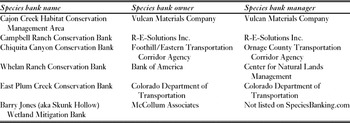
We conducted two surveys of the USA species banking industry, via the industry web platform SpeciesBanking.com. Questions were oriented towards clarifying current bank characteristics, recorded transactions and possible conservation outcomes. In June and July 2010, we manually compiled information from the bank profiles of all 123 species banks then listed on SpeciesBanking.com (hereafter ‘site survey’). This was complemented by a questionnaire emailed to those species banks listed on SpeciesBanking.com for which an address for the bank manager or bank owner was provided (hereafter ‘email survey’). Since bank owners and managers can be different people, we only emailed the bank manager if email addresses for both owners and managers were listed, and emailed the owner only if the bank manager's email was not listed. We gave the banks around six weeks to respond and did not send any reminder emails. Ninety-one banks were sent this survey, of which 14 bounced. For 36 of the species banks contacted, the managers manage only one species bank. For the rest, the managers manage more than one bank. Wildlands, Inc., the company spearheading species banking as a conservation strategy, owns and manages 20 and 31 banks respectively, and received emails for each bank plus an additional email explaining why they were receiving so many requests. They did not respond and it is unclear to us why they chose not to participate with information for any of their banks. This had a disproportionate effect on the response rate for this survey, for which we received completed questionnaires from a total of seven banks (see Table 1, excluding one respondent who wished to remain anonymous). One owner stated explicitly that they did not wish to participate in the survey. Another responded, but did not complete the survey due to the bank being inactive. The full surveys and responses can be viewed by request to the authors. Clearly this second survey should be engaged with as indicative rather than representative. We include the data gathered because they add texture to the figures presented from our complete survey of the species bank data available on SpeciesBanking.com at the time of our survey.
Email survey respondents.

RESULTS
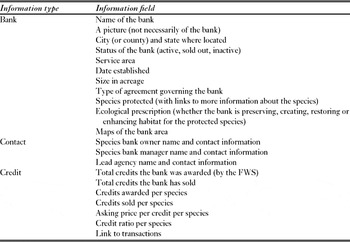
On SpeciesBanking.com there are fields for information on the banks, credits, credit asking prices, credit transactions and the protected species, making it possible to search for information by bank, species, transaction and state. The home page features a ‘Market Snapshot’ of the industry, which, in August 2010 listed 133 USA species banks, 92 species credit types, 51 habitat credit types, 12 states with species banks, and 112 103.50 acres of land area protected by species banks. SpeciesBanking.com is in control of placing content on the site. Information is provided for each bank profile (Table 2).
Information fields for species bank profiles available on SpeciesBanking.com.

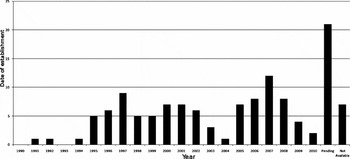
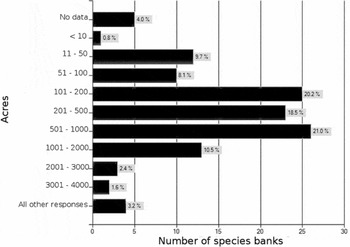
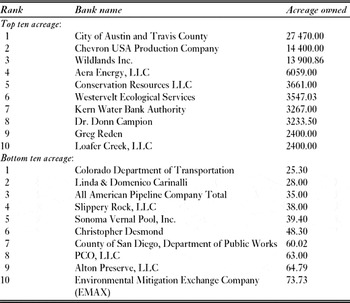
Of the 123 species banks in the site survey, 76 were active, five were inactive, 21 were pending, 19 were sold out of credits and so not trading, and for two banks data were not available. Of the 116 banks for which establishment dates were available, the following were noted: the first species bank was established in 1991; the years when the most species banks were established were 1997 and 2007 (nine and 12 banks, respectively); and an increase in species banking is indicated by the fact that 21 banks were pending at the time of our survey (Fig. 1). Species banks ranged from 8.11 acres to 27 470 acres, the majority being between 100 and 1000 acres (see Fig. 2). Most (107) banks were listed as preserving already conserved habitat. There was a handful of significantly large banks, including the Balcones Canyonlands Preserve owned by City of Austin and Travis County (27 470 acres), the Chevron Lokern Conservation Bank owned by Chevron USA Production Company (14 400 acres) and the Coles Levee Ecosystem Preserve owned by Aera Energy, LLC (6059 acres). We identified the top and bottom 10 bank owners by aggregate acreage, their names providing some indication of the organizations involved with species banking (Table 3). The majority of bank owners own five or fewer banks. For 66 of the species banks no maps are provided, and when they are they tend to be vague or show approximate locations only.
Numbers of species banks established by year, from 1990–2010. Total number of banks = 123 in July 2010.

Size of USA species bankings by land area (given in acres to reflect units used in USA species banking), represented as a percentage of total number of species banks (123 in July 2010) on SpeciesBanking.com.

Top and bottom 10 species bank owners by total acreage.

Few data on credits awarded and exchanged were available on SpeciesBanking.com, despite provision made for these fields in the bank information pages (Table 2). Sixty-four banks posted the total number of credits awarded to the bank and 27 posted total credits awarded per species. Fifty-two banks posted the total number of credits sold, and 33 banks posted the numbers of credits sold per species. Only seven of the surveyed 123 species banks posted their credit asking prices.
We accessed more detail on these aspects through our email survey, albeit for only a small number of banks. Respondents indicated that credits for four (of seven) banks were awarded for bank acres, and for two of the banks were sold as habitat or wetland credits (instead of species credits), also based on acres. For one of the banks credits were based on breeding pairs and plants per acre. One bank in the email survey did not know the basis of the credits, as the bank owner (not the bank manager) sold the credits. For income, three banks relied on species credit sales as their primary source of funding, two relied on endowment payments, one bank was owned by the government and one relied on private investment. All six banks that produced monitoring reports responded that they made them publicly available. Two of the seven banks in the email survey provided public access to the species banks.
DISCUSSION
Our surveys indicate that species banks have increased in number, that total bank area is growing, that the land owned and managed by specific owners is consolidated in a handful of owners, and that publicly available data on actual trade in species credits, accompanied by asking and received prices, is sparse. Most species banks appear to be preservation banks and thus focus on already conserved areas. This suggests that although registration as a species bank might permit access to more tradable monetary value, the new status as a species bank may represent limited additionality in terms of species conservation. We also note that a rationale for bank establishment is legitimization of degradation due to development elsewhere and facilitates development-related species loss. Clarifying the conservation implications of these characteristics will require further in-depth field research.
We engage these data and observations by evaluating contextual tendencies at work in species banking. In particular, we consider how neoliberal policies, as introduced above, are shaping the species banking industry. We draw on the particular diagnostic frameworks of Castree (Reference Castree2008a, Reference Castreeb) and Kosoy and Corbera (Reference Kosoy and Corbera2010). Castree reviewed privatization, de- and re-regulations of state power, and the marketization/commodification nexus in the context of changing natural resource management as critical aspects of a contemporary ‘neoliberalisation of nature’. Kosoy and Corbera (Reference Kosoy and Corbera2010) explained the commodification of ecosystem services in mitigation schemes as a three-step process through which (1) such services are reduced to units for trade, (2) such units are designated single exchange values and (3) market infrastructure is established to permit and publicize trade in these units. We define these disaggregated but interconnected phenomena, and trace their relevance for explaining both the rise of species banking as an approach to biodiversity conservation and the specific patterns observable on SpeciesBanking.com as the industry's authoritative information source and nascent market exchange. We suggest that these processes occur in iterative combination to consolidate particular outcomes and tendencies.
Privatization
Privatization allows formal property rights to adhere to things, thereby supporting their saleability (Castree Reference Castree2008a; Kosoy & Corbera Reference Kosoy and Corbera2010). In the USA, private property rights in land are well-established. As such, species banking is not engaged in initially privatizing or enclosing land, as may occur in conservation efforts elsewhere (Brockington & Igoe Reference Brockington and Igoe2006). USA species banking introduces two different mechanisms of privatization. First, landowners are required to bind land to conservation through perpetual conservation easements (FWS 2009b). These permit landowners to ‘receive direct payment or tax subsidies for selling or donating easements’ without surrendering land titles (Morris Reference Morris2006, p. 1216). Since they ‘privatize and re-scale a great deal of land conservation decision-making authority’, are market-based, ‘provide financial incentives for participation rather than punishment for non-compliance’ and ‘commodify new property rights’, they are deemed to be a paradigmatic, if sometimes contradictory, ‘neoliberal environmental policy’ (Morris Reference Morris2006, p. 1215). Second, the FWS creates a set of ‘alienable, fungible and mobile’ rights (Robertson Reference Robertson2004, p. 369) by awarding species credits that can be sold to those requiring mitigation. Through this dual process of privatization, conserved nature is the aspect that is enclosed to create derived tradable commodity forms of conservation measures, the financial value of which is accessed by owners of credit-bearing conservation stock under formal property structures.
Deregulation, reduction of state power and market-friendly re-regulation
Castree (Reference Castree2008a, p. 148) identified particular regulatory and governance structures associated with neoliberal approaches to environmental management and exploitation. In general, state power is scaled back in favour of markets, which function in part through civil society structures and participation. In the context of USA species banking, the ESA, as originally conceived, generally prohibited and punished removal of protected species by landowners. This shifted in 1982, when the ESA introduced a permit programme allowing incidental taking of protected species (as described above) (Ruhl Reference Ruhl2004). In the 1990s, Bruce Babbit, Secretary of the Interior in the Clinton administration, publicized the permit programme, together with procedures to encourage its use, and permits issued grew from 12 in 1992, to 227 in 1997 (Ruhl Reference Ruhl2004). Following Peck and Tickell (Reference Peck and Tickell2002), this is consistent with the ‘rolling back’ of the state associated in the USA and UK with the Clinton-Blair administrations, and which extended the neoliberal Reagan-Thatcher policies that dismantled the Keynesian institutions upheld by previous governments (see also Robertson Reference Robertson2004, pp. 369–371).
Market friendly re-regulation occurs as state policies and institutions are deployed ‘to facilitate privatisation and marketisation of ever wider spheres of social and environmental life’ (Castree Reference Castree2008a, p. 142). During Babbit's term, species banking was being developed as a logical extension to the incidental taking permit programme and was modelled on the wetland mitigation banking programmes already established under Section 404 of the Clean Water Act (Ruhl Reference Ruhl2004). By approving species banks and authorizing the sale of species credits on one side, and requiring mitigation and the purchase of species credits on the other, the FWS began to operate as a market manager in developing market proxies as incentives in conservation management (Ruhl Reference Ruhl2004; Castree Reference Castree2008a).
Champions of neoliberalism tend to celebrate the diminutions of state regulation with which it is associated. In fact, however, the state's role is transformed so as to provide appropriate regulatory and supportive structures for the existence and functioning of expanding commodity markets (Peck & Tickell Reference Peck and Tickell2002; Castree Reference Castree2008a; Foucault Reference Foucault and Burchell2008[1979]). Instead of being the entity that protects and provides public goods, the state provides legislative and regulatory support for the transfer of previously publicly managed goods to the allocation possibilities deriving from privatized market exchange of newly alienable commodities. This is illustrated by species banking. Through making possible and regulating the conversion of species presence into tradable species credits, the FWS effectively is working to engender new markets in species credits for private gain as the means of ensuring development-led protection of species on private land.
Marketization
The above processes turn ‘previously untradable things into tradable commodities’ (Igoe & Brockington Reference Igoe and Brockington2007, p. 437; Castree Reference Castree2008a). The assumption is that conservation outcomes with the least transaction costs and the greatest efficiency will emerge from the bargaining of market participants (Muradian et al. Reference Muradian, Corbera, Pascual, Kosoy and May2010). For Kosoy and Corbera (Reference Kosoy and Corbera2010), conservation commodification involves (1) reduction of natural processes to standard units of exchange; (2) the assigning of single exchange-values to those units; and (3) the linking of buyers and sellers through market or market-like exchanges. We now discuss our SpeciesBanking.com data in relation to these three processes.
Units of exchange
The transformation of conserved nature into units of exchange requires its disaggregation into standard units of measurement (Robertson Reference Robertson2009). With respect to species banking, the FWS (2003) suggested that the simplest form of species credits is based on acreage, but can also be based on measurements such as numbers of breeding pairs or population per acre. Acreage tends to be the dominant unit of exchange in providing offset credits (Fox & Nino-Murcia Reference Fox and Nino-Murcia2005; Madsen et al. Reference Madsen, Carroll and Brands2010), and our email survey of bank managers confirmed this. In our introduction, we noted that the use of unit land area as the basis for species credits is unlikely to represent or measure the ecological complexities of either habitat destruction or mitigation activities (Bonnie & Wilcove Reference Bonnie, Wilcove, Bayon, Fox and Carroll2008). As these mitigation markets take hold, independent investigation into the overall conservation and ecological implications of such tradable reductions will be essential.
Single exchange value
For units of exchange to become tradable in conservation banking they need to assume prices. Species banking relies on establishment of a single value for species credits, based on monetary prices as reflected in exchanges. Credit prices (that is the monetary exchange value) can include different factors specific to the bank and to the species, but should reflect ‘habitat quality, habitat quantity, species covered [and] conservation benefits’ (FWS 2003, p. 9). Ultimately, however, credit prices reflect the willingness of a bank to sell (supply) and of a buyer to purchase (demand), combined with government subsidies and availability of legitimate species credits at particular moments in time, which in turn are dependent on ecological as well as managerial factors.
In neoliberal theory, more transparency means better price discovery through helping buyers and sellers to find the right price (Muradian et al. Reference Muradian, Corbera, Pascual, Kosoy and May2010). In reality, however, private negotiations, known as over-the-counter (OTC) exchanges, and various forms of lobbying and government subsidies prevail, meaning that whilst the free market is idealized in neoliberal rhetoric it rarely is realized in actuality (R. Fletcher & J. Breitling, personal communication regarding PES schemes in Costa Rica 2011). Species banking appears to be no different. Transactions tend to be privately negotiated, such that banks have the flexibility to charge prices customized to individual circumstances (Zwick Reference Zwick2008). As observed in our site survey, prices tend not to be publicly available, and whether or not credit asking prices become posted on SpeciesBanking.com in the future remains to be seen.
Linking buyers and sellers in market-like exchanges
The linking of buyers and sellers of newly derived units of exchange through market or market-like exchanges is the third step in creating tradable ecosystem services commodities (Kosoy & Corbera Reference Kosoy and Corbera2010), involving construction of ‘institutional structures for. . . ecosystem services’ appropriation and exchange’ (Gomez-Baggethun et al. Reference Gomez-Baggethun, de Groot and Montes2010, p. 1215). The SpeciesBanking.com platform is the key information hub for the USA species banking market and, as such, represents an initial indication of development and yield possibilities for species offset markets. While not yet in itself an exchange, whereby the purchase and sale of species credits can occur through the site, SpeciesBanking.com does provide basic credit information as well as transaction history and bank information from which an exchange may develop.
According to Michael Van Patten, CEO and Founder of Mission Markets (missionmarkets.com) which currently operates a private exchange for social and environmental capital markets, SpeciesBanking.com ‘will create the kind of information flows that could make an electronic exchange for biodiversity markets feasible’ (quoted in Zwick Reference Zwick2008). Indeed, SpeciesBanking.com seems to be becoming an electronic exchange for species credit markets, with the launch in May 2010 of a new registry for bank and credit data, in a collaboration between Markit (a leading global financial information services company expanding into an array of ‘environmental assets’ and sponsor of SpeciesBanking.com), the Ecosystems Marketplace, SpeciesBanking.com and the FWS (Markit 2010a, b; Madsen et al. Reference Madsen, Carroll and Brands2010; Madsen & Percival Reference Madsen and Percival2010). This ‘SpeciesBanking.com Registry Pilot’ would permit credits to be managed electronically and traded in real-time (Markit 2010b). In creating an infrastructure for online market exchange, SpeciesBanking.com thus is bringing forth an expanding market which is intended to become ‘an international approach that can inform the world about best practices – including voluntary initiatives’ (Zwick Reference Zwick2008). The edge of this frontier is constituted by suggestions for international out-of-kind species mitigation trade (ten Kate et al. Reference ten Kate, Bishop and Bayon2004) in which species credits perhaps could be traded for species with little or no taxonomic equivalence.
The above points illustrate ways in which species banking in the USA both upholds and shapes specific neoliberal conservation policy mechanisms, as specified in the diagnostic contributions of Castree (Reference Castree2008a, Reference Castreeb) and Kosoy & Corbera (Reference Kosoy and Corbera2010). Neoliberal approaches to conservation are commoditizing nature itself, translating its value and the value of its individual components into monetary market terms under the justification of conservation. Given the speed at which conservation is being directed towards markets in new conservation products and exchanges, it seems important to engage with the assumption that markets can make the right decisions for conservation. While the goals of markets and of conservation may intersect given the right set of drivers, they are not necessarily synchronized.
At a very basic level, for example, the goal of species banking is not fully aligned with the goal of the ESA. The goal of the ESA is species recovery (Fox & Nino-Murcia Reference Fox and Nino-Murcia2005; Madsen et al. Reference Madsen, Carroll and Brands2010), while the goal of species banking is the mitigation of damage done to species by development (Fox Reference Fox2009). Further research is needed to monitor the expansion and/or enhancing of conserved habitat that thereby occurs, with emphasis placed on documenting possible net loss and additionality issues. Robertson and Hayden (Reference Robertson and Hayden2008), in their case study of entrepreneurial wetland banking in Chicago, also observed a tendency for conservation credits to be sold after sites received protection status but prior to being able to demonstrate ecological performance compliance. Although we are unable to confirm this for species banking, this would imply the accessing of income from trade of species credits before any additional conservation value of species banks is demonstrated. This again is an issue worthy of further investigation.
Research might also be directed towards elucidating ways in which species credits connect with commodity markets and thereby become bound with prevailing market conditions. Species banks relying on credit sales to fund conservation initiatives, for example, may become vulnerable to falls in credit sales associated with broader economic downturns, which in turn reduces development requirements for mitigation at a time when numbers of species banks are increasing. This is noted for 20 species banks in Northern California, which exhibited ‘steady increase’ from 2005–2008, followed by a decrease of almost 20% in 2009, considered related to falls in development requirements for species mitigation credits associated with financial crisis and the collapse of the Californian housing market (Madsen et al. Reference Madsen, Carroll and Brands2010). Species banks relying on interest from a non-wasting endowment may also be affected by periods when interest rates are low, as currently is the case in the USA (FWS 2003).
CONCLUSIONS
In this study we have highlighted the current significance of species banking as an expanding part of the conservation repertoire in the USA and elsewhere. Neoliberal policies are critically transforming environmental conservation through creating markets in commoditized forms of environmental health and damage, with both biophysical and societal outcomes (Castree Reference Castree2008b; Norgaard Reference Norgaard2010). Through reliance on profit maximization they may ‘crowd out’ other motives for conservation including altruism, empathy and a sense of ethical responsibility (Kosoy & Corbera Reference Kosoy and Corbera2010).
Species banks are a key component of these approaches to conservation, providing an illuminating case for studying their form and effects. We have noted the economic incentives that can result in species conservation in species banks to be able to mobilize credits for profitable exchange with developers. We have expressed concerns that such market-based approaches to conservation rely on some significant concealments, including: a possible net loss of habitat to development; an ecologically unintuitive and problematic assumption of equivalence between different species populations and localities; consolidation of emerging conservation land values amongst existing landowners; and dependence on markets for solving conservation problems, thus making environmental conservation vulnerable to other market drivers. We have also made some suggestions for future research. The conservation implications of species banking as a form of offsetting payments for biodiversity services provide a rich area for study and documentation as these approaches become further entrenched in environmental conservation strategy.
ACKNOWLEDGEMENTS
We are grateful to Richard Norgaard, Nicholas Polunin and two anonymous reviewers for their thoughtful engagement with this paper. Any remaining errors of interpretation are ours alone.