1. Introduction
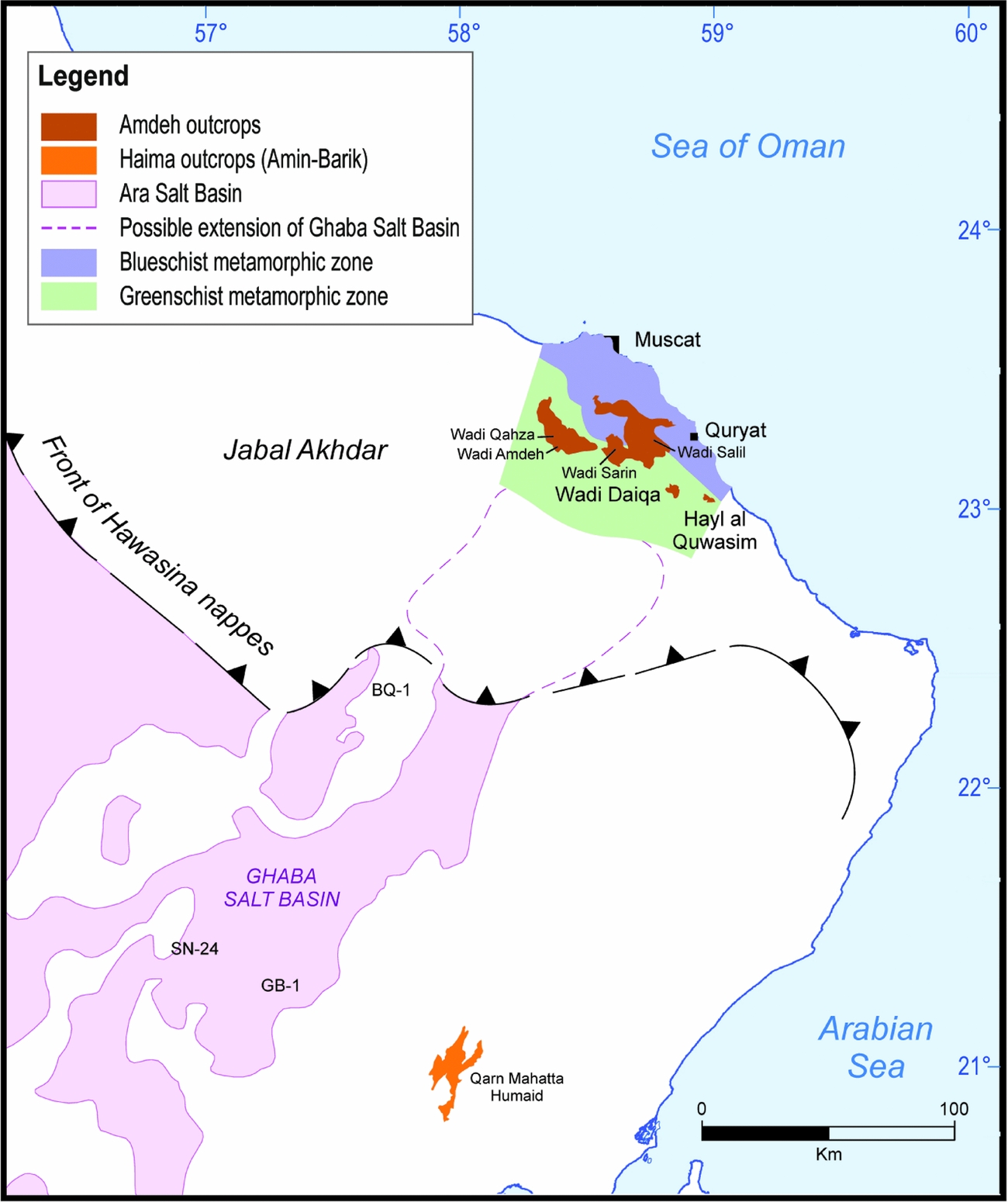
The Amdeh Formation crops out along the southern margin of the Saih Hatat window in the Al Hajar mountains of the Sultanate of Oman (Fig. 1). A paucity of fossils, daunting thickness and an overprint of Late Cretaceous metamorphism have deterred the study of these quartzites and shales of ‘Grès Armoricain’ aspect. Our work began as an attempt to determine the equivalence of these outcrops to intervals of the Haima Supergroup which occur extensively in the Ghaba Salt Basin (Droste, Reference Droste1997; Molyneux et al. Reference Molyneux, Osterloff, Penney and Spaak2006; Forbes, Jansen & Schreurs, Reference Forbes, Jansen and Schreurs2010, pp. 171–203). By doing so, the outcrops have greater interest as lateral equivalents and analogues of reservoir and seal intervals for hydrocarbons in the subsurface of northern Oman.
Outcrops of the Amdeh Formation on the southern rim of the Saih Hatat window of the Al Hajar mountains. Outcrop outlines and metamorphic zones are from BRGM mapping, the extension of the Ghaba Salt Basin from Mount, Crawford & Bergman (Reference Mount, Crawford and Bergman1998), and e.g. GB-1 are petroleum exploration wells referred to in this paper.

We sought to build on the limited biostratigraphic successes of previous workers (Lovelock et al. Reference Lovelock, Potter, Walsworth-Bell and Wiemer1981), sampling extensively for palynomorphs in the inliers of Wadi Daiqa and Hayl al Quwasim, collecting trilobite fragments from near Wadi Sarin, attempting to extract conodonts from sandy shell beds and trialling the dating of zircons from heavy mineral layers. Sampling for palynology and conodonts led to a number of unexpected discoveries from this little known Arabian margin of Gondwana (Sansom et al. Reference Sansom, Miller, Heward, Davies, Booth, Fortey and Paris2009; Donovan et al. Reference Donovan, Miller, Sansom, Heward and Schreurs2011; Heward & Penney, Reference Heward, Penney, Rollinson, Searle, Abbasi, Al-Lazki and Al Kindi2014). Others finds will be described in this paper that suggest the region may hold further insights into the development and dispersal of a number of faunal elements. SHRIMP dating of zircons from heavy mineral enrichments proved imprecise compared to biostratigraphy, but yielded interesting glimpses of sandstone provenance that are in keeping with others from north Gondwana.
2. Materials and methods
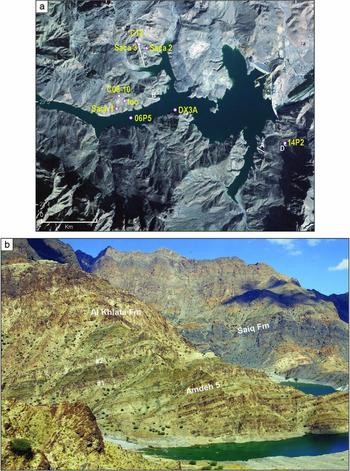
Our original sampling in the Daiqa inlier was mainly in the vicinity of the wadi and the access track at the time. With the completion of a dam project in 2009, the wadi and track were flooded and two of our successful locations for palynology, and that of Lovelock et al. (Reference Lovelock, Potter, Walsworth-Bell and Wiemer1981), now lie submerged beneath a water reservoir (Fig. 2a). Later work has mainly been on the northern flank of the inlier because of ease of foot access and as the section there is relatively un-faulted (Fig. 2b). In early 2014 we logged a number of sections in Wadi Daiqa and Hayl al Quwasim, and identified marker beds which allow our earlier sampling and work on fossil fish and crinoids to be placed in sequence (Figs 2–5). Subsequently, we examined sections of equivalent Amdeh Members in other wadis in the Saih Hatat area for comparison with the composite sequence established from the eastern inliers. To complement work on the Amdeh, we documented outcrops of similar age in the northern Al Hajar mountains of the United Arab Emirates (UAE) that were being lost to quarrying (Rickards et al. Reference Rickards, Booth, Paris and Heward2010; Fortey, Heward & Miller, Reference Fortey, Heward and Miller2011).
Wadi Daiqa (a) locations of measured sections A–D and of palynology samples, e.g. DX3A. C08-10 (C2008–C2010), C12 (C2012) – conodont samples; Ioc – Iocrinus; Saca – Sacabambaspis locations. Quickbird image 1-5-2013 ©Digital Globe. (b) Main measured section C; note the continuity of beds and the two thicker shoreface sandstones labelled #1 and #2.

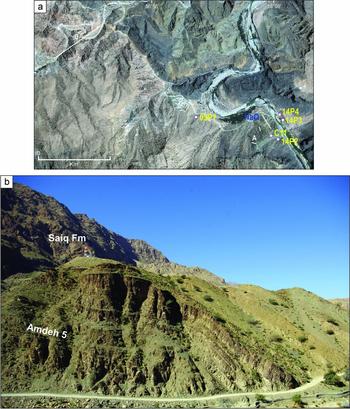
Hayl al Quwasim (a) location of measured sections 0 and A and palynology samples e.g. 05P1. C11 (C2011) – conodont sample; HaQ – village. Quickbird image 1-5-2013 ©Digital Globe. (b) Overview of main section A extending along the main ridge to the right. The 60 m high cliff in the core of the anticline comprises the coarsening-upward deltaic sequence of unit 4.1.


Shale samples for palynological investigation were prepared by standard acid maceration and oxidized with concentrated nitric acid or Schulze's reagent. Sieving of the residues was performed using 15 μm polyester gauzes and residues were mounted using solutions of polyvinyl alcohol and Petropoxy-154 resin. Only about one in ten samples of a favourable grey colour yielded a significant assemblage.
Conodonts were extracted from carbonate nodules and from sandy shell beds using a standard treatment of buffered acetic acid (Jeppsson, Anehus & Fredholm, Reference Jeppsson, Anehus and Fredholm1999) and heavy liquid separation by sodium polytungstate. Samples ranged from less than 1 kg to 5 kg in weight and contained a large proportion of phosphate, some of it secondary, making complete picking of residues from larger samples impossible. As a result, most residues were split into eighths or smaller fractions for picking.
Online Supplementary Material Figure S1 (available at http://journals.cambridge.org/geo) illustrates intraformational deformation affecting units 2.2 and 3 at Wadi Daiqa. Online Supplementary Material Figure S2 (available at http://journals.cambridge.org/geo) records other faunal elements picked from the conodont residues including crinoid ossicles, various mollusca, ostracods and a number of features of unknown affinity. Online Supplementary Material Table S1 (available at http://journals.cambridge.org/geo) provides co-ordinates for fossil locations. A regional overview of published palynomorph assemblages is presented. Preliminary descriptions of some of the more unusual acritarchs and a systematic description of the trilobite Yinpanolithus are also included in this material.
3. Lithostratigraphy
The Amdeh outcrops occur quite close to Muscat (Fig. 1) and initial descriptions were by pioneering geologists investigating the possibilities for oil in Oman. Pilgrim (Reference Pilgrim1908) recorded purple and green quartzites in Wadi Amdeh, and Lees (Reference Lees1928) used the name Amdeh Quartzites, and briefly described their lithology, ripple markings and pre-Permian age. Glennie et al. (Reference Glennie, Boeuf, Hughes Clarke, Moody-Stuart, Pilaar and Reinhart1974) formally defined the formation and Lovelock et al. (Reference Lovelock, Potter, Walsworth-Bell and Wiemer1981) measured a type section in Wadi Qahza of at least 3.4 km. The latter workers divided the formation into five conformable members dominated by either quartzite, siltstone or shale. They also visited Amdeh outcrops in wadis Sarin and Daiqa, and collected fragmentary trilobites and brachiopods, recovered a good assemblage of palynomorphs and recorded a number of trace fossils (Cruziana furcifera, C. rugosa, Daedalus, Phycodes). Collectively these various fauna, flora and trace fossils were interpreted to indicate an Early to Middle Ordovician age.
Geologists of the Bureau de Recherches Géologiques et Minières (BRGM) mapped the Saih Hatat area in the 1980s on behalf of the Ministry of Petroleum and Minerals of Oman (Le Métour, Villey & De Gramont, Reference Le Métour, Villey and De Gramont1986; Villey, Le Métour & De Gramont, Reference Villey, Le Métour and De Gramont1986). The BRGM geologists applied the five lithostratigraphic members in their mapping and, for convenience, labelled them Am1 to Am5. They also discovered a small inlier of Amdeh Quartzites at Hayl al Quwasim and two more fossiliferous locations in wadis Sarin and Salil. Outcrops in the inliers of Wadi Daiqa and Hayl al Quwasim were assigned to the youngest Am5 member (Le Métour, Villey & De Gramont, Reference Le Métour, Villey and De Gramont1986; Upper Siltstone Member of Lovelock et al. Reference Lovelock, Potter, Walsworth-Bell and Wiemer1981).
Most of the Amdeh outcrops on the southern margin of Saih Hatat, and in the inliers of Wadi Daiqa and Hayl al Quwasim, are in the greenschist facies zone of Late Cretaceous regional metamorphism (Fig. 1). Conodont elements recovered in this study have a colour alteration index of 3–4 equating to a palaeo-temperature of 150–200°C. Palynomorphs are also highly carbonized and require careful oxidation to reveal their detail. The quartz schists of the Hulw and Sifah units on the northern margin of the Saih Hatat window may represent an Amdeh protolith at a higher metamorphic grade (Searle et al. Reference Searle, Warren, Waters and Parish2004).
4. Sedimentology
4.a. Studied outcrops
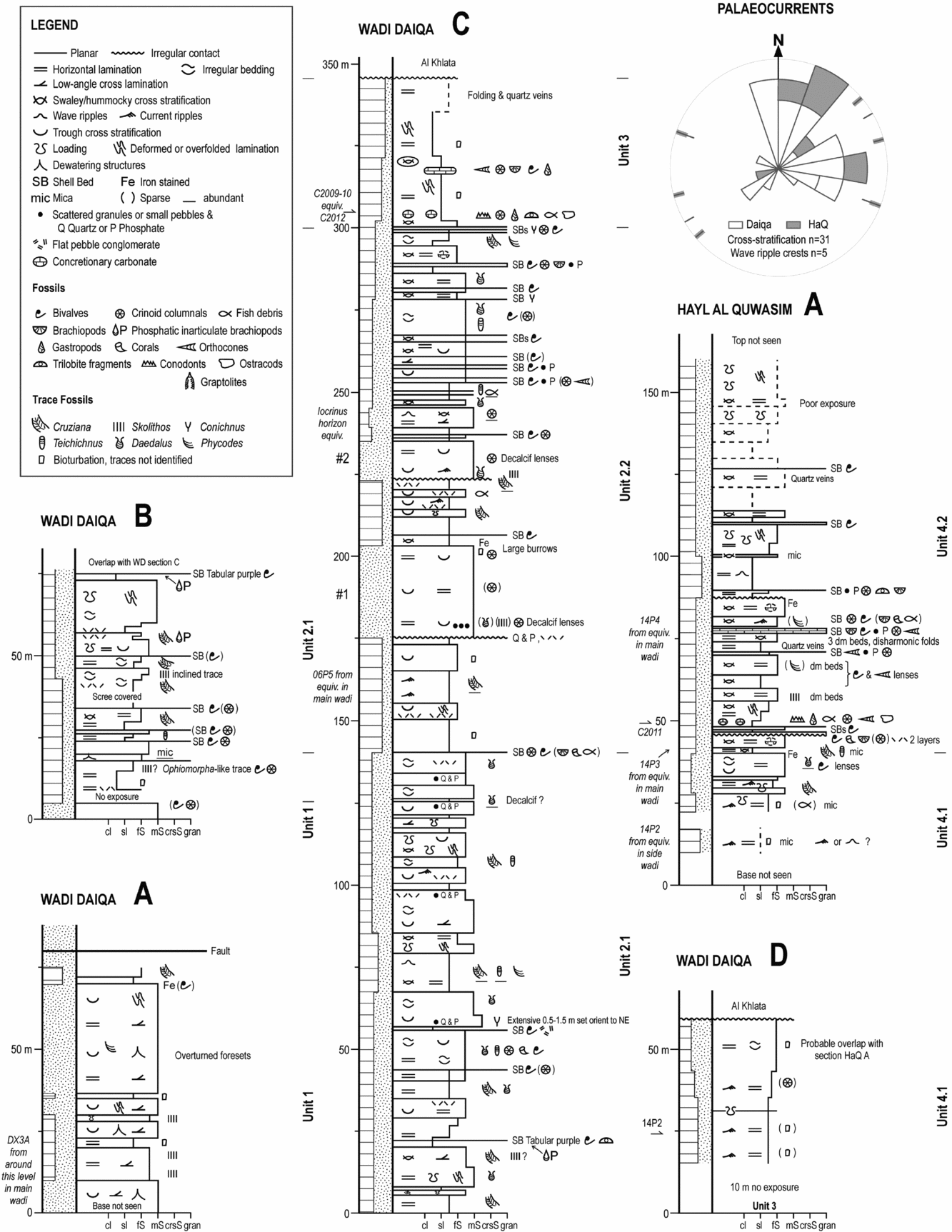
The Am5 successions at Wadi Daiqa and Hayl al Quwasim comprise 690 m of quartzitic sandstones, siltstones, shales and thin shell beds (Figs 2–6). The bulk of the sand is fine to medium grained, though grain size is difficult to estimate in the more cemented quartzitic intervals. Moulds of crinoid ossicles and other shell debris are common in many of the thicker sandstones confirming their marine origin. Shell beds are typically thin (100–200 mm), partly decalcified sandstones with moulds of marine fossils, principally bivalves, on their surface. Shell beds can often be recognized at a distance as they are distinctively orange-brown coloured and more cemented. Granules of quartz and phosphate, and pebble-sized intraclasts occur in some shell beds.
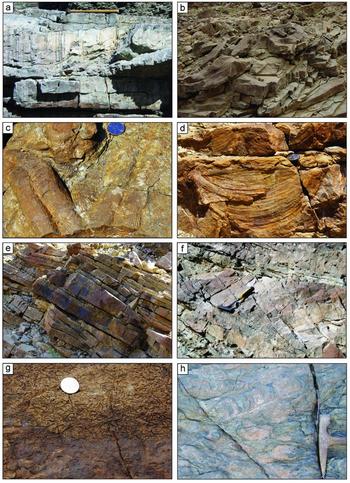
Wadi Daiqa outcrop photographs. (a) Skolithos linearis, unit 1, endorelief. (b) Dewatering structures, unit 1. (c) Cruziana furcifera and C. rugosa, unit 2.2 convex hyporelief on base of overturned slab. (d) Teichichnus rectus, unit 2.2, endorelief. (e) Swaley- and (f) trough-cross stratification, both unit 2.2. (g) Bivalve shell bed, unit 2.2. (h) Nodular carbonate bed packed with large orthoconic nautiloids, unit 3. Scales: hammer handles 400 or 280 mm long, head is 175 mm long, coin is 24 mm across.

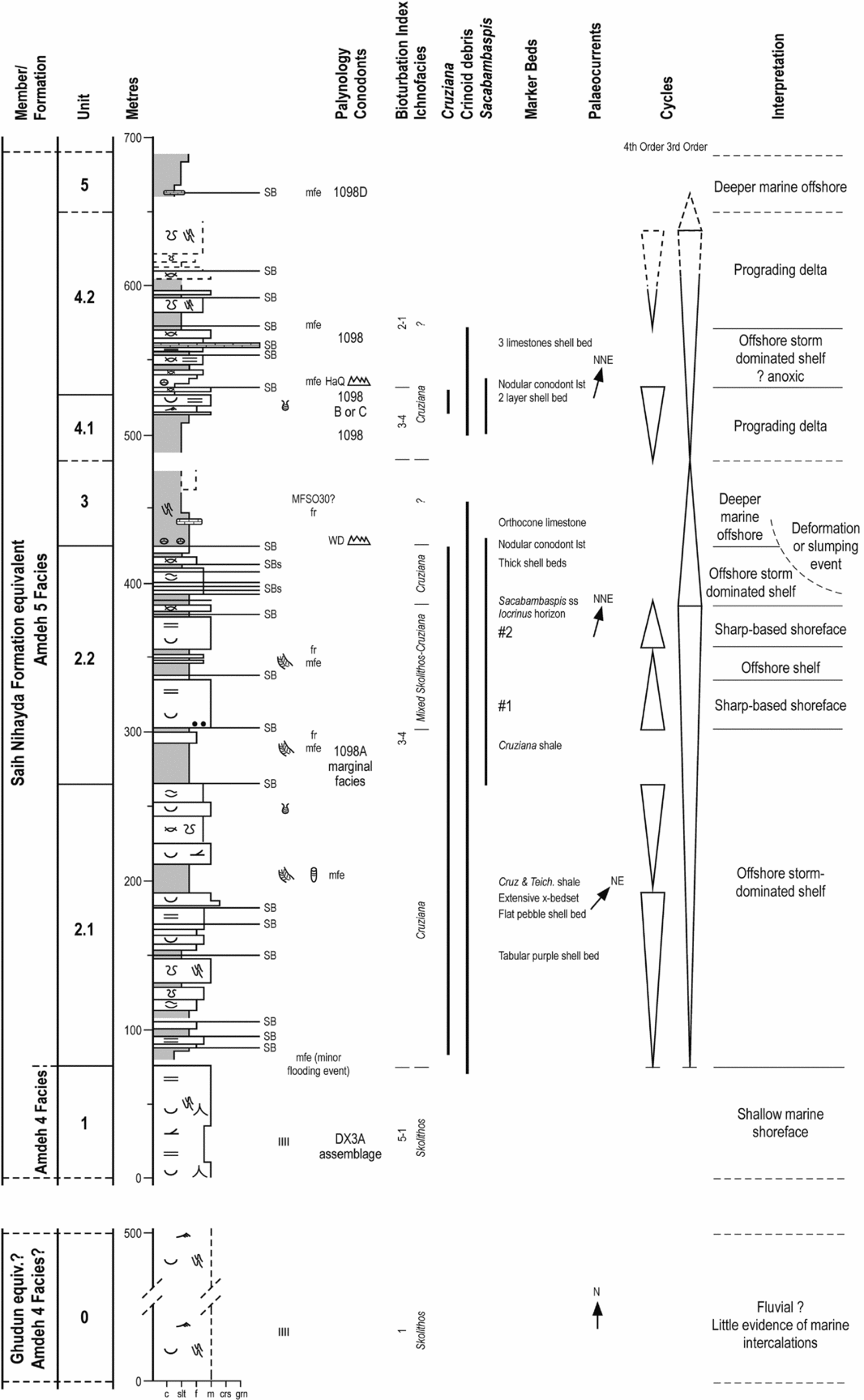
Six units and a number of subunits can be recognized, numbered sequentially from base to top. The units vary from predominantly sandy (units 0 and 1), predominantly shaly (units 3 and 5), to interbeds of sand and shale (units 2 and 4; Fig. 5). The bioturbation index (MacEachern et al. Reference MacEachern, Pemberton, Gingras, Bann, James and Dalrymple2010) varies from ‘sparse’ in some intervals, to ‘common’ through much of units 2–4, to ‘abundant’ in certain Skolithos beds in unit 1. Shell beds are most common in units 2 and 4. Units 1–4.1 are exposed in the Wadi Daiqa inlier, and units 0, 4.1–5 occur around the village of Hayl al Quwasim. Correlation between the two inliers is based on the distinctive characteristics of subunit 4.1 and their limited mid-Darriwilian palynological assemblages (Figs 4, 5).
Unit 0 is the oldest interval investigated, though not studied in detail. It consists of a c. 500 m of quartzites in the Hayl al Quwasim inlier along a wadi towards the village of Fiq az Zamiyan (Figs 3a, 5). The quartzose sandstone packages appear tabular on satellite images. Internally they are trough-cross-bedded in sets 0.25–0.6 m thick with some overturning of foresets. Palaeocurrents are towards the north (range NW–NNE, n = 7). A single 2.5 m interval of sandstone with abundant Skolithos occurs and there are other silty intervals with questionable signs of bioturbation. Finer-grained intervals are uncommon and some may have been thinned tectonically during deformation. One green interval is unusual in consisting of millimetre-sized fragments of shale.
Unit 0 has similarities to the Am4 (Upper Quartzite Member) in Wadi Qahza (Lovelock et al. Reference Lovelock, Potter, Walsworth-Bell and Wiemer1981), but it lacks the common liquefaction structures, the repeated interbedding of marine intervals with Skolithos and Daedalus, and the thicker shales and sparse shell beds that occur towards the top of that section. Based on the sedimentary structures present, the paucity of trace fossils and the absence of shell beds, the unit is provisionally interpreted as a stack of predominantly sharp-based braided fluvial or braid-delta deposits that lacked the high water table required for widespread sediment liquefaction. Only one obviously marine intercalation with Skolithos occurs. The upper boundary with the Am5 (unit 4) is probably faulted.
Unit 1 is again sandy and occurs in the centre of the Wadi Daiqa inlier in faulted outcrops to the north and south of the reservoir. It was well exposed along parts of the main wadi that are now flooded (Figs 2a, 4, 5). It comprises > 75 m of white quartzites, softer green sandstone intervals and thin dark shales (Fig. 6a). The sandstones are trough-cross-bedded with common metre-scale liquefaction structures (Fig. 6b). The greener intervals are burrowed by Skolithos linearis and some intervals also contain Daedalus labechi. An exposure with interbedded dark shales along the main wadi yielded the Lovelock et al. (Reference Lovelock, Potter, Walsworth-Bell and Wiemer1981) and our DX3A palynological assemblages (Figs 2a, 6a). A sparse shell bed caps the uppermost quartzite and contains scattered moulds of bivalves and crinoid ossicles.
These quartzites and intervals with Skolithos are interpreted as shallow-marine shoreface deposits. The dewatering features that characterize some intervals imply rapid sedimentation, fluid-saturated sands, favourable grain size and a common trigger for liquefaction or fluidization (storm or flood-related turbulence, fresh-water springs, seismicity?). The quartzitic nature and maturity of the Amdeh sandstones is probably a reflection of provenance, weathering and aeolian activity on un-vegetated land surfaces (e.g. Davies & Gibling, Reference Davies and Gibling2010), rather than reworking in beach or shelf environments. Heavy mineral separations dominated by zircons imply that the ‘quartzites’ of the Amdeh Formation were largely recycled from older sandstones (Forbes, pers. comm. to APH 2006).
Unit 2 is a marked change in facies to a shale–sandstone sequence with numerous shell beds. There are no indications of an unconformity, a conglomerate, a phosphatic horizon or any prolonged break in sedimentation, just a thicker laminated shale interval that, unfortunately, is too colour-bleached to be worth sampling for palynology. Unit 2 is c. 350 m thick and divided into two parts by another thicker shale (Figs 2b, 4, 5). The lower part, subunit 2.1, is sand-dominated and there are a series of tabular sandstones that can be mapped from satellite images. The upper part, subunit 2.2, comprises two thicker tabular sandstones (#1 and #2), and a further interval of sands and shales with numerous shell beds.
Unit 2 is characterized by abundant trace fossils of the Cruziana ichnofacies, particularly in thin centimetre–decimetre sand beds (Cruziana furcifera, C. rugosa, C. goldfussi, Teichichnus rectus; Fig. 6c, d). Many of the thicker sandstones contain moulds of marine fossils or orange stained, decalcified shelly lenses. Sandstones are parallel-laminated and low-angle, hummocky, swaley or trough-cross stratified (Figs 6e, f). Trough-cross stratification occurs in coarser and thicker sandstones in sets generally less than 0.5 m. The largest set forms part of a laterally extensive coset that in places reaches 1.5 m. Palaeocurrents are predominantly towards the NNE and E (Figs 4, 5). The shell beds mostly contain moulds of the bivalve Redonia and a variety of other fossils (Fig. 6g). Crinoidal debris is common, including the distinctive pentastellate columnals of Iocrinus. A few shell beds contain evidence of current action in the form of convex-upward packing of bivalve shells, cross-bedding or the orientation of elongate fossils. A number of these shell beds are sufficiently distinctive to be used as marker beds to correlate sections around the Wadi Daiqa inlier. One contains a layer of edgewise carbonate flat-pebble conglomerate, a facies more typical of Ediacaran and Cambrian shallow-marine deposits in Oman and elsewhere (Wright & Cherns, Reference Wright and Cherns2015). The upper part of unit 2 is affected by block faulting, small-scale folding and, over some fault blocks, up to 50 m of missing section (online Supplementary Material Fig. S1 available at http://journals.cambridge.org/geo; Heward & Penney, Reference Heward, Penney, Rollinson, Searle, Abbasi, Al-Lazki and Al Kindi2014, fig. 3). This deformation does not affect overlying intervals or formations.
The unit is interpreted to have formed on a storm-dominated continental shelf in water depths of a few to a few tens of metres (see Immenhauser, Reference Immenhauser2009 for the difficulties of estimating palaeobathymetry). There is surprisingly little evidence of tidal sedimentary features, apart from a few possibly bipolar palaeocurrent measurements. There are four minor flooding surfaces represented by the thicker shales and two major regressive shoreface intervals that form the thicker sandstones (Fig. 5). One of these thicker shales yielded the 06P5 palynological assemblage, which is marginal marine in character. Cruziana are particularly abundant in the upper parts of three of the thicker shale intervals where there is an influx of thin sands. The ichnofauna are typical of Upper Tremadoc to Darriwilian sandstones of Gondwana, and represent broadly the shaly, shelfal Cruziana and sandy, shoreface Skolithos ichnofacies (Mángano & Droser, Reference Mángano, Droser, Webby, Paris, Droser and Percival2004; Seilacher, Reference Seilacher2007, pp. 187–95).
The two sharp-based shoreface units are remarkably tabular, internally and in overall geometry, and have mixed Skolithos–Cruziana ichnofaunas. The lower one has lenses of coarser granule to pebble-grade material close to its base (of quartz, phosphate and intraformational shale). This influx of pebble-grade material may correlate with pebbly horizons at a similar level in wadis Qahza and Amdeh (55–40 km distant) and represent a forced regression of regional extent (Posamentier & Morris, Reference Posamentier, Morris, Hunt and Gawthorpe2000). These sharp-based shoreface units possibly reflect mid-Darriwilian falls in sea level due to the growth of polar ice caps and the four shale intervals, containing minor flooding surfaces, corresponding rises in sea level due to the melting of ice caps.
Shell beds are common constituents of Palaeozoic shallow-marine shelf deposits where they have been interpreted as storm coquinas (Kreisa & Bambach, Reference Kreisa, Bambach, Einsele and Seilacher1982; Sepkoski, Reference Sepkoski, Einsele and Seilacher1982). The fossils contained may be shallow infauna that has become exposed by storm currents (e.g. bivalves like Redonia), benthic detritus picked up or broken off and transported shelfwards (brachiopods, algae, crinoids, fish ichthyoliths, conodonts), or the remains of pelagic organisms (orthocones). There is no evidence of abrasion, boring or encrustation of shell material and burial appears to have been rapid, leading to, for example, the preservation of complete crinoid fossils (Donovan et al. Reference Donovan, Miller, Sansom, Heward and Schreurs2011). The interpretation of the blockfaulting, folding and missing section will be discussed later, under unit 3, parts of which are also affected.
Unit 3 is c. 50 m thick and represents a further marked change of facies to one dominated by siltstone and shale (Figs 4, 5). Again there is no sign of an unconformity or a conglomerate. A horizon of nodular carbonate near the base of the shales yields conodonts (C2008–10, C2012) and other phosphatized fossil remains including the small trinucleid trilobite Yinpanolithus. A few carbonate cemented, hummocky cross-stratified sandstones occur along with a thicker (0.35 m), tabular to concretionary, iron carbonate bed that is characterized by large orthoconic nautiloids (Fig. 6h).
The interval is deformed to some extent and the orthocone carbonate and beds in the underlying subunit 2.2 are folded locally. Folds are tight, flat-lying or upright, and fold axes are close to the northeast or north. All appear to have formed at shallow depth and lack quartz veins. This deformation may relate to a further period of forced regression, and rotational sliding and slumping at a shelf edge or the margin of a submarine canyon (Fig. 5, online Supplementary Material Fig. S1 available at http://journals.cambridge.org/geo).
This is the thickest shale interval at Wadi Daiqa, and probably the most marine and deepest water, but still above storm-wave base. It is likely that the mid-Darriwilian maximum flooding surface O30 of Simmons et al. (Reference Simmons, Sharland, Casey, Davies and Sutcliffe2007) occurs here, too. The shale was not sampled for palynology as it appears an unpromising colour. It was repeatedly searched for graptolites, but none were found; nor were deeper-water trace fossils observed.
Unit 4 is more than 160 m thick and divided into two subunits. Subunit 4.1 is c. 60 m thick, and is the only interval that occurs in both the Wadi Daiqa and Hayl al Quwasim inliers. A number of palynological samples from both localities have yielded poor mid-Darriwilian assemblages. On the southern flank of the Wadi Daiqa inlier there is about 10 m of no exposure between deformed unit 3 strata and undeformed laminated silts and fine-grained sandstones of subunit 4.1 (Fig. 4, section D). This sequence is different to any other interval at Wadi Daiqa, and it was a surprise to recognize the same heterolithic, coarsening-upward sequence in the core of Hayl al Quwasim anticline and in water-worn sections in the adjacent wadis (Figs 3a, b, 4, section HaQ A). The top of the sequence is strongly iron-stained, contains lenses of bivalve shell bed and is strongly burrowed by Daedalus (D. labechi and D. halli).
The coarsening-upward sequence is interpreted as possibly a prograding delta mouth-bar deposit (and different from the sharp-based, braid-delta, sheet sandstones that often seem to characterize deltaic deposits within older formations of the Haima Supergroup of Oman; Droste, Reference Droste1997; Millson et al. Reference Millson, Quin, Idiz, Turner and Al-Harthy2008). The greenish and iron-stained colour probably reflects different clay mineralogy and depositional conditions than found previously in the Am5.
Subunit 4.2 is a change back to an alternating shale–sand sequence with numerous shell beds (Fig. 4, section HaQ A). Many of the sandstones show classical features of storm event beds, but contain relatively few traces of the Cruziana ichnofacies. Phycodes circinatum occurs restricted to the tops of sand beds and two sandstones are unusual in being only partly penetrated by Skolithos (to depths of 0.25–0.3 m). The shell beds contain various fully marine fossils (brachiopods, orthocones, corals and cobble-sized clasts of colonial coral) and an abundance of phosphate granules. Several of the shell beds are distinctive in their form and fossil content, one of which yielded the C2011 conodont microfauna (Figs 4, 5). Another bed consists of a stack of three thin limestones packed with ribbed brachiopods. Despite the evidence of open-marine faunas in the shell beds, the overall paucity of traces, restriction of burrowing to the tops of beds and the abundance of phosphate may indicate anoxic conditions at a shallow depth beneath the sea floor (Fig. 5).
The upper part of subunit 4.2 is again noticeably green-coloured and iron-stained, and contains several 5–10 m intervals that are full of load structures, implying rapid sedimentation on an unstable substrate. The loads do not have any preferred asymmetry, as one would expect with slumps, and deformed intervals are overlain by beds that are undeformed. There continue to be a number of shell beds that contain bivalves rather than any more diverse fauna. This interval is interpreted again as possibly a stack of prograding delta deposits.
The contact between subunit 4.2 and unit 5 is not exposed. However, it appears that the latter is higher in the sequence and yields a younger palynological assemblage (Fig. 5). There is a shaly section exposed in the main wadi (Arabiyin) and in outcrops a few 100 m west around the 05P1 locality (Fig. 3a). The section is predominantly of grey shales with evidence of bioturbation, and some thinner rippled and loaded sands. Several shell beds occur with bivalves, small ribbed brachiopods and granules of phosphate. A feature of some of the shales is the presence of yellow-weathered moulds of fossils including orthocones, Neseuretus tristani and a non-asaphid trilobite. One of the shales yielded the 05P1 (late Darriwilian) assemblage. These shales are interpreted to represent a further minor flooding event that led to deeper marine conditions. The top of the sequence is not exposed beneath the outcrops of the Permian Saiq Formation on the northern side of the main wadi.
4.b. Equivalent outcrops in Saih Hatat
In Wadi Qahza, Lovelock et al. (Reference Lovelock, Potter, Walsworth-Bell and Wiemer1981) logged 805 m of Upper Siltstone Member (Am5 equivalent; Fig. 7). The section is relatively poorly exposed, strongly cleaved and quartz veined. It is shaly, thinly bedded, bioturbated and contains a number of shell beds, some of which show a diversity of fauna (bivalves, orthocones, trilobites, and round and pentagonal crinoid columnals, but not pentastellate ones). Fragments of Sacabambaspis and a worn conodont were extracted from one of these beds (Sansom et al. Reference Sansom, Miller, Heward, Davies, Booth, Fortey and Paris2009). Pebbles (<30 mm) of sub-angular quartz and siltstone are present in two, slightly younger beds 0.1–1.0 m thick. They are the most coarsely grained and only extra-formational material present in the member. There are fewer trace fossils seen here than in Wadi Daiqa, but the diversity is comparable. A dark shale near the base of the section yielded fragmentary and carbonized acritarchs attributed to the genera Arkonia, Micrhystridium, Protoleiosphaeridium, Striatotheca and Veryhachium (Lovelock et al. Reference Lovelock, Potter, Walsworth-Bell and Wiemer1981). Our re-sampling of this locality yielded a similar, poorly preserved, assemblage. The base of the Upper Siltstone Member is transitional, without any obvious break in deposition.
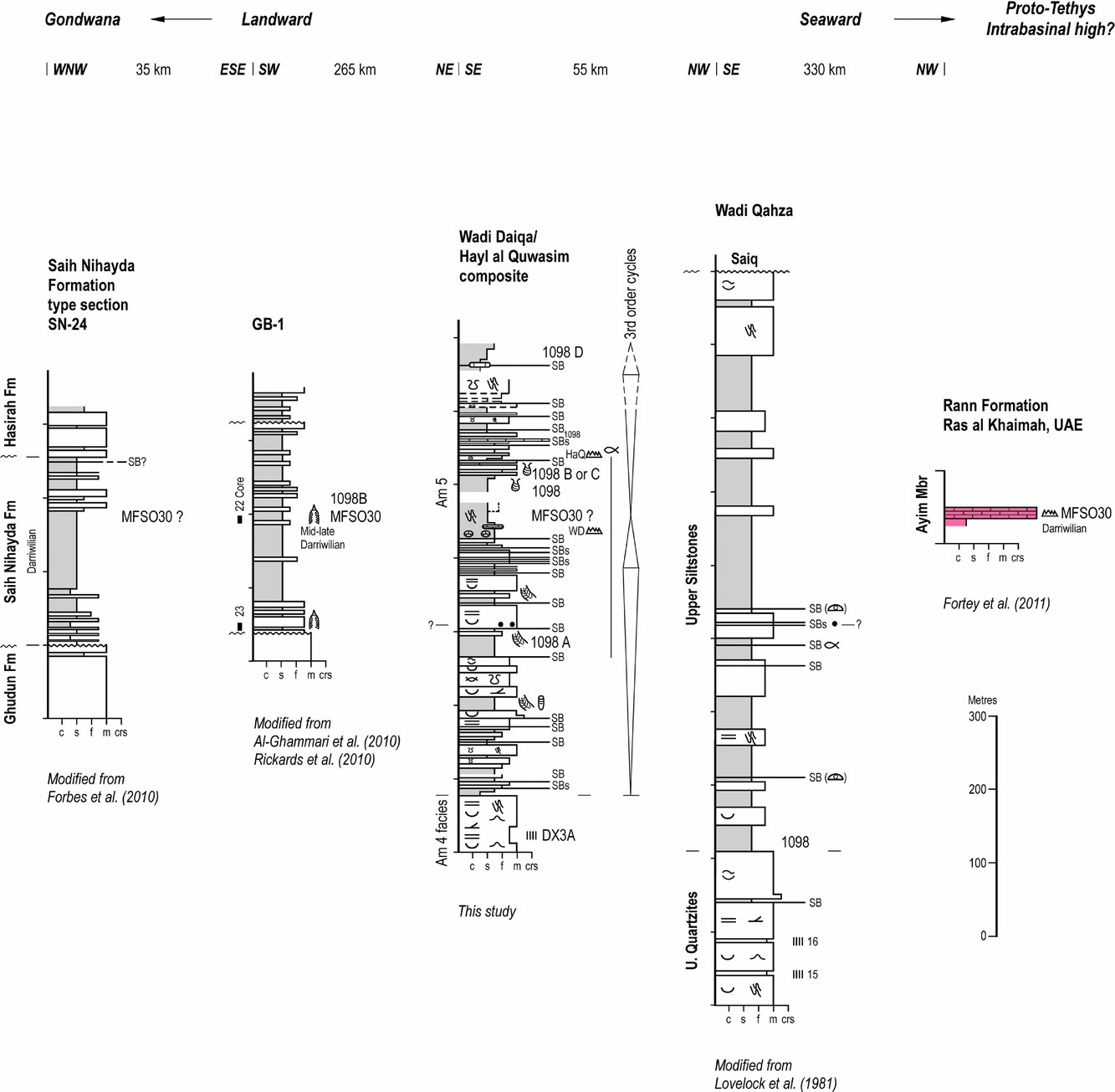
Oman–UAE regional correlation of the subsurface Saih Nihayda Formation and outcrops sections in the Amdeh 5/Upper Siltstone Member and the Ayim Member of the Rann Formation. MFS O30 used as a datum. Legend and abbreviations as in Figure 4.

The underlying Upper Quartzite Member (Am4) is better exposed and notable for the tabular geometry of its units over kilometres between tributary wadis. It is dominated by thick quartzitic sandstones (50–200 m thick) with trough-cross bedding, extensive dewatering features and interbedded thinner (0.5–10 m) intervals with Skolithos and Daedalus (15 recorded by Lovelock et al. Reference Lovelock, Potter, Walsworth-Bell and Wiemer1981 in 1677 m). The overall diversity of trace fossils is low and Cruziana are rare. A number of sparse bivalve shell beds occur towards the top of the member, as do several intervals of dark grey siltstone and shale that are traceable for kilometres on satellite images. The lowest of these was taken erroneously(?) as the base of the Am5 by BRGM geologists. Periods of shallow-water and exposure are indicated by heavy mineral placers, runzel-marked surfaces and possible mudcracks. Zircons from a heavy mineral sample were successfully dated using the SHRIMP technique. An Early Cambrian detrital core carried a Late Ordovician xenotime overgrowth. Detrital zircons of Neoproterozoic, Palaeoproterozoic and Archaean age were also noted (1100–500 Ma, 2000–1600 Ma and > 2400 Ma age; Forbes, pers. comm. to APH 2006). This and other samples from the Am4 are dominated by zircon, with minor rutile, tourmaline, apatite and monazite.
Sixteen kilometres away in Wadi Amdeh the Am5 is better exposed, particularly the basal 100 m that forms southwesterly dipping bedding-plane exposures. BRGM geologists again mapped the base of the member c. 400 m deeper here than the overall change in lithology from thick quartzites with Skolithos interbeds to a decimetre-bedded, siltstone-dominated interval with more diverse trace fossils. There are indications of shallow-water conditions on bedding planes covered with mini wave and interference ripples. Rudimentary shell beds are also present. Skolithos, Cruziana, Teichichnus and several unidentified types of trace fossil occur, including large, vertical, Conostichus-like burrows (also noted in two locations in subunit 2.2 of Wadi Daiqa).
The remaining c. 550 m of Am5 on the opposite side of the wadi is less well exposed. Skolithos continues to be present near the base, and then Cruziana and Teichichnus occur sporadically throughout the remaining succession. A few shell beds are present in the middle of the sequence and contain mainly bivalves, round and pentagonal crinoid ossicles and rod-shaped fragments of calcareous algae. One of the shell beds contains granules and small pebbles of quartz and siltstone, similar to those in Wadi Qahza. Shell debris lenses up to 0.6 m occur in one of the sandstones and broken shells of inarticulate brachiopods are quite abundant at the tops of thicker sandstones higher in the succession.
These sequences of Am5 in wadis Qahza and Amdeh appear to represent less open-marine conditions than present in the Wadi Daiqa and Hayl al Quwasim exposures. Shell beds are less common and hummocky and swaley-cross stratification is not obviously present. The pebble-bearing beds in both wadis are possibly correlated with the sharp-based regressive shoreface #1 in Wadi Daiqa (Fig. 7).
The underlying Am4 are probably an unusually thick stack of braid-delta deposits (Davies & Gibling, Reference Davies and Gibling2010) with shallow-marine intercalations (with Skolithos). The abundance of liquefaction features implies that high water-table conditions prevailed. The Am4 is most probably the seaward continuation and an increasingly marine equivalent of the subsurface Ghudun Formation (Fig. 7). There appear to be lateral variations in the outcrops, between more marine-influenced (Wadi Qahza and Wadi Daiqa unit 1) and more fluvially dominated outcrops (Hayl al Quwasim, unit 0) of this interval.
Le Métour, Villey & De Gramont (Reference Le Métour, Villey and De Gramont1986) measured a > 540 m sandstone-rich section they assigned to the Am5 near the village of Dim, just north of Wadi Sarin. The most notable feature of this section is the presence of a 10 m interval with numerous thin bivalve shell beds in cleaved siltstones. The shell beds also contain trilobite moulds and, less commonly, brachiopods (?dalmanellids, Lovelock et al. Reference Lovelock, Potter, Walsworth-Bell and Wiemer1981; Le Métour, Villey & De Gramont, Reference Le Métour, Villey and De Gramont1986). Overall this sequence is very sandy compared to others of the Am5, and the presence of well-developed Skolithos beds, thick quartzite packages with cross-bedding, dewatering features and heavy mineral placers, and the lack of Cruziana and crinoidal debris are features more in keeping with the Am4.
Le Métour also logged a ~190 m section of ‘Am5’ loosely located in Wadi Salil that is included as the upper part of the Amdeh section of Le Métour, Villey & De Gramont (Reference Le Métour, Villey and De Gramont1986, fig. 4). It is notable for showing two intervals of coarse conglomerate with clasts of quartz, quartzite and volcanic rocks, and a middle interval of shale containing shell beds with fragmentary trilobites (Neseuretus (Neseuretinus) of possible Caradoc age; Béchennec et al. Reference Béchennec, Le Métour, Platel and Roger1993, p. 21).
Sections southeast of Al Habubiyah (23°15′52″N, 58°45′10.7″E) appear of typical Upper Quartzite Am4 facies with quartzites with Skolithos and Daedalus. On the north side of Wadi Salil (23°15′47.39″N, 58°46′38.46″E) there is a series of sparse shell beds in schistose shales. These beds yield bivalves, moulds of round and pentagonal crinoid columnals and possible trilobite fragments. Poor examples of Cruziana, Teichichnus, Phycodes and Skolithos were also found. At the entrance to the Wadi Mijlas gorge (23°15′31.9″N, 58°47′43.1″E) there are a series of purple siltstones, quartz and feldspar-rich sandstones and boulder conglomerates containing quartzite clasts. The presence of boulders of quartzite (Amdeh-like) suggests the conglomerates are younger (Heward & Penney, Reference Heward, Penney, Rollinson, Searle, Abbasi, Al-Lazki and Al Kindi2014). Scrappy exposures south of the old Quryat road (23°13′47.90″N, 58°48′13.40″E) contain outcrops of a brachiopod and bivalve limestone that resemble the ‘3 limestone shell bed’ marker of subunit 4.2 at Hayl al Quwasim (Fig. 4).
There is not an obvious sequence of deposits yielding Late Ordovician faunas comparable with those we have documented from the Rann Formation of the UAE (Fortey, Heward & Miller, Reference Fortey, Heward and Miller2011). However, given the proximity of siltstones and sandstones of that age in several wells in the Ghaba Salt Basin close to the Amdeh outcrops (Mount, Crawford & Bergman, Reference Mount, Crawford and Bergman1998; Molyneux et al. Reference Molyneux, Osterloff, Penney and Spaak2006), such a sequence could be expected in the area.
5. Biostratigraphy
See also online Supplementary Material (available at http://journals.cambridge.org/geo) for locations, regional overview of palynomorph assemblages and systematic descriptions.
5.a. Palynology
Lovelock et al. (Reference Lovelock, Potter, Walsworth-Bell and Wiemer1981) reported microfloral assemblages from two locations in the Amdeh Formation. A shale near the base of the Wadi Daiqa section was the most productive, yielding both acritarchs and chitinozoa. The acritarchs were attributed to Arkonia, Striatotheca, Stelliferidium, Peteinosphaeridium, Veryhachium and other genera, and the rare chitinozoa to Lagenochitina and Conochitina. A less well-preserved assemblage was obtained from a similar stratigraphic level in Wadi Qahza. Both assemblages were highly carbonized, especially from Wadi Qahza, where the chitinozoa were only recovered as fragments. The assemblages were interpreted as being Ordovician, with the presence of Arkonia lending support to a Darriwilian age.
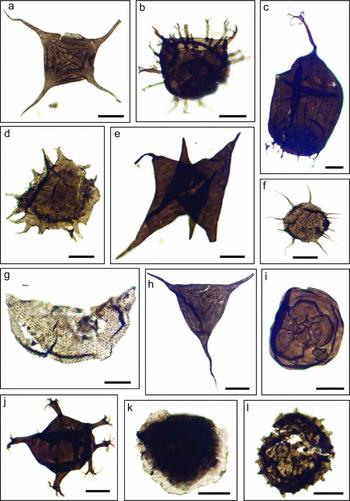
The localities of Lovelock and co-workers were re-sampled during the present study along with many additional sites in other wadis. Organic recovery was obtained from all samples, but those from wadis Amdeh and Sarin and most of the samples from Wadi Qahza failed to yield palynomorphs. Good microfloral assemblages were obtained from Wadi Daiqa and Hayl al Quwasim. The Wadi Daiqa sample DX3A is from the same, or a very similar horizon, to that of Lovelock et al. (Reference Lovelock, Potter, Walsworth-Bell and Wiemer1981), but improved preparation techniques enabled the recovery of a much richer and more informative assemblage (Fig. 8). A sample from a locality 813 m west and up-section (06P5) yielded a quite different acritarch assemblage, while the recovery from the Hayl al Quwasim sample 05P1 differs again, but adds further to our understanding of the depositional system during Middle Ordovician time (Fig. 9). The interpretations we place on these assemblages have been greatly assisted by the study of the Saih Nihayda Formation (Am5 equivalent) in a number of exploration wells drilled by Petroleum Development Oman (PDO) in the Ghaba Salt Basin (Forbes, Jansen & Schreurs, Reference Forbes, Jansen and Schreurs2010, p. 175).
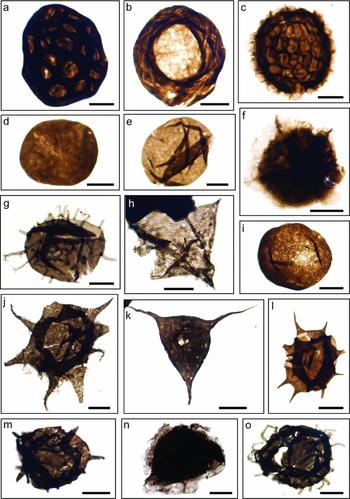
Acritarchs from sample Wadi Daiqa DX3A. Scale bars are 10 μm. All Slide 1, PDO palynological collection. England Finder references bracketed. (a) Striatotheca principalis gp. (M74/1). Abundant in the assemblage. Variable in size, degree of ornamentation and outline. (b) Stelliferidium striatulum (R70/1). The characteristic radiating striae are poorly developed on this specimen. (c) Dicrodiacrodium ancoriforme. (F68/2). The taxon is relatively common in the assemblage, but complete specimens are rare. (d) Pterospermella? sp. (O57/3). The specimens recovered are primarily two-dimensional and exhibit marginal processes with a variable degree of branching. The central area is darker in colour owing to apparent thickening. (e) Picostella turgida (V66/4). The number of broad based processes varies from 6 to 12. Other specimens have a less quadrate appearance. The process surfaces are granulate, grading to smooth proximally. (f) Ferromia filosa (L70/4). The specimens are very similar to those originally described by Vavrdova (Reference Vavrdova1977) from the early Llanvirn, Sarka Shale. The author (GAB) does not accept the synonymization of this taxon with Micrhystridium diornamentum proposed by Martin (Reference Martin1996). (g) Diparifusa sp. aff. D. hystrichosa (V55/4). The asymmetric outline is typical of the genus. (h) Arkonia tenuata (M53/2). The taxon is a common component of the assemblage. The striation on these triangulate acritarchs is variable. (i) Incertae sedis 24 of PDO (W65/1). The taxon, which apparently originally had an umbrella-like form, is a rare component of assemblages from the lower part of the Saih Nihayda Formation. (j) Multiplicisphaeridium sp. 3 of PDO (F71/4). Similar specimens have been recorded from an upper Floian – lower Dapingian interval in Oman. (k) Cymatiosphaera? sp. of Molyneux & Al-Hajri (Reference Molyneux, Al-Hajri, Al-Hajri and Owens2000) (R69/2). The taxon is relatively rare in the assemblage and always poorly preserved. Triangular, rounded and quadrate forms are present. (l) Petaliferidium bulliferum (Q66/3). The processes are rather short on these specimens, but have the characteristic distal rounded profile.

Acritarchs from samples Wadi Daiqa 06P5 (a–f, i, l) and Hayl al Quwasim 05P1 (g, h, j, k, m–o). Scale bars are 10 μm. Slide 1, except where indicated, PDO palynological collection. England Finder references bracketed. (a) Dictyotidium sp. (N31/2). (b) Hilate sporomorph 1 of Le Hérissé et al. (Reference Le Hérissé, Al-Ruwaili, Miller and Vecoli2007). Slide 3 (O44/4). (c) Cymatiosphaera sp. 3 of PDO (V28/3). (d) Cryptospore monad (N30/1). Simple disc-like form, without folds or with only minor folds. (e) Leiosphaeridia sp. (M53/3). (f) Cymatiosphaera? sp. of Molyneux & Al-Hajri (Reference Molyneux, Al-Hajri, Al-Hajri and Owens2000) (U38/4). (g) Stelliferidium striatulum (W35/2). This taxon is common in the Hayl al Quwasim samples, but preservation is generally poor and the radial ornament at the process bases cannot always be seen. (h) Striatotheca quieta (N54/4). (i) Incertae sedis 40 of PDO (M40/2). The taxon is characterized by a fine reticulum on the surface of the body. (j) Stellechinatum celestum (E48/3). This taxon and the related S. helosum are indicative of the upper part of the Saih Nihayda Formation. (k) Arkonia virgata (Q39/3). Shows coarser striation than Figure 8h and is attributed to the species virgata. Intermediate forms are present in the Wadi Daiqa assemblages, where the genus is relatively common. Servais (Reference Servais1997) commented on the existence of similar intermediate forms in his comprehensive review of the Arkonia–Striatotheca acritarch plexus. (l) Polygonium gracile (R48/4). All specimens bearing medium length or long processes in this sample have suffered significant damage. (m) Incertae sedis 27 of PDO (H31/2). (n) Cymatiosphaera? sp. of Molyneux & Al-Hajri (Reference Molyneux, Al-Hajri, Al-Hajri and Owens2000) (J50/3). All specimens are poorly preserved, but are nevertheless recognizable. The presence of this species is an almost certain indication of the Saih Nihayda Formation. (o) Stelliferidium striatulum (U27/4). See (g) above.

The age of the DX3A assemblage was discussed in Sansom et al. (Reference Sansom, Miller, Heward, Davies, Booth, Fortey and Paris2009) owing to its importance in dating the occurrence of fragments of the early fish Sacabambaspis. The combined evidence from chitinozoa (F. Paris unpub. data) and acritarchs (G. A. Booth, pers. obs.) suggested a latest ?Dapingian to early Darriwilian age. Further study has resulted in the identification of additional acritarch taxa providing more certainty as to its stratigraphic position and age. The assemblage contains classic palynological components of the Saih Nihayda Formation, which include Arkonia tenuata, Cymatiosphaera sp. of Molyneux & Al-Hajri (Reference Molyneux, Al-Hajri, Al-Hajri and Owens2000), Ferromia filosa and several undescribed taxa known only from strata of Darriwilian age in Oman (Fig. 8). Through the presence of Arkonia tenuata, Dicrodiacrodium ancoriforme, Stelliferidium stelligerum and Striatotheca principalis gp. the assemblage compares with the VK2 assemblage of Quintavalle, Tongiorgi & Gaetani (Reference Quintavalle, Tongiorgi and Gaetani2000) from the Karakorum of Pakistan, which they associated with the hirundo graptolite zone of the early Darriwilian.
While the Wadi Daiqa DX3A assemblage has palynological characteristics that link it with the Saih Nihayda depositional cycle, it remains unique amongst Saih Nihayda acritarch assemblages. None of the studied well sections in the Ghaba Salt Basin has yet yielded a similar assemblage. In the Ghaba Salt Basin the Saih Nihayda Formation, where present, overlies the Ghudun Formation. In many cases it does so with a clear unconformity, shown by the truncation of the characteristic gamma log trace of the Ghudun Formation, and in core, sometimes by the presence of conglomerate (Droste, Reference Droste1997). The Wadi Daiqa DX3A assemblage differs from the Saih Nihayda assemblages of the Ghaba Salt Basin in possessing an acritarch sub-set with older affinities. These include Picostella turgida, Petaliferidium bulliferum and Disparifusa sp. aff. D. hystricosa (Fig. 8).
The conclusion that may be drawn is that in the area of the Ghaba Salt Basin, deposition of the Saih Nihayda Formation occurred unconformably over the differentially eroded surface of the Ghudun Formation. Sediments of early Darriwilian age are absent in this area. To the northeast in the Amdeh outcrop areas the story is different. The Wadi Daiqa DX3A assemblage is of early Darriwilian age and our fieldwork shows no evidence of a break in deposition between the Am4 (probable equivalent of the Ghudun Formation) and the Am5. Sedimentation was continuous, or near continuous, in this northeastern area.
The Wadi Daiqa 06P5 assemblage is dominated by leiospheres, cryptospore monads and other taxa with low surface ornament. Spinose taxa are present, but rare, and limited to Polygonium gracile, Veryhachium trispinosum, V. lairdi and Disparifusa sp. Relatively common is Cymatiosphaera sp. of Molyneux & Al-Hajri (Reference Molyneux, Al-Hajri, Al-Hajri and Owens2000), which is accompanied by Hilate sporomorph 1 of Le Hérissé et al. (Reference Le Hérissé, Al-Ruwaili, Miller and Vecoli2007), Incertae sedis 24 of PDO and Incertae sedis 27 of PDO (Fig. 9a–f, i, l). In Oman these last-named taxa are all diagnostic of the Saih Nihayda Formation. The 06P5 assemblage is very different from the DX3A assemblage (Fig. 8), but very similar to assemblages obtained from near the base of the Saih Nihayda section in two PDO wells in the Ghaba area. It is tempting to consider these assemblages as representative of the same stratigraphic horizon, but it is perhaps more likely that their character is due to deposition in a similar shallow-water facies. It is interesting that this assemblage, from a Cruziana-rich shelfal shale, contains more apparently marginally marine elements than DX3A, which is from a dark shale interbed within deposits interpreted to be shallower water shoreface (Fig. 5).
Several samples were collected from the small inlier of Hayl al Quwasim, east of the Wadi Daiqa, and studied palynologically. Preservation and yield were relatively poor, but the sample 05P1 proved informative. The acritarch assemblage includes Arkonia tenuata, Cymatiosphaera sp. of Molyneux & Al-Hajri (Reference Molyneux, Al-Hajri, Al-Hajri and Owens2000), Stelliferidium striatulum, Striatotheca principalis gp., S. quieta, Baltisphaeridium spp. and Stellechinatum celestum (Fig. 9g, h, j, k, m–o). The occurrence of several specimens of the latter taxon is significant. In detailed quantitative studies of acritarch occurrences in two Ghaba Salt Basin wells (Booth & Al-Belushi, unpub. PDO XGL lab. note 2007_10, 2007; Booth & Machado, unpub. PDO XGL3 lab. note 2012_20A, 2013), the occurrence of Stellechinatum celestum (and the related form S. helosum) was a key indicator of the youngest Saih Nihayda Formation biozone (Booth & Machado, unpub. PDO XGL3 lab. note 2012_20B, 2014). Consequently, in the Hayl al Quwasim inlier the Am5 unit is at least partially equivalent to the uppermost part of the Saih Nihayda Formation.
Chitinozoans are present in some outcrop samples, but appear sensitive to facies control, and their absence can also be due to metamorphism and deformation, which renders them irrecoverable. They are rare and fragmentary in Wadi Daiqa and difficult to identify owing to the degree of carbonization (Lovelock et al. Reference Lovelock, Potter, Walsworth-Bell and Wiemer1981). The forms Lagenochitina obeligis, Laufeldochitina baculiformis and Belonchitina gr. micracantha were reported by Paris (in Sansom et al. Reference Sansom, Miller, Heward, Davies, Booth, Fortey and Paris2009) from samples from the same level as our DX3A. Richer assemblages of chitinozoans are known from shale samples from cores close to MFS O30 in the equivalent subsurface Saih Nihayda Formation (Al-Ghammari, Booth & Paris, Reference Al-Ghammari, Booth and Paris2010; Rickards et al. Reference Rickards, Booth, Paris and Heward2010).
The palynomorph assemblages derived from Wadi Daiqa and Hayl al Qwasim outcrop samples are similar in composition to the assemblages obtained from the Saih Nihayda Formation, penetrated in wells of the Ghaba Salt Basin and clearly belong to the same depositional sequence. The palynomorph assemblages derived from the overlying Hasirah Formation (Katian) and underlying Ghudun Formation (Floian–Dapingian) in Oman are significantly different.
The VK2 assemblage of Quintavalle, Tongiorgi & Gaetani (Reference Quintavalle, Tongiorgi and Gaetani2000) is a good correlative match to the Saih Nihayda Formation, Wadi Daiqa assemblage DX3A, but other studies within the region (Saudi Arabia, Iran, Iraq and Jordan) have only sufficient detail to enable a broad correlation with the Saih Nihayda Formation of Oman (see online Supplementary Material available at http://journals.cambridge.org/geo). The assemblage described by Rickards et al. (Reference Rickards, Booth, Paris and Heward2010) from the Lower Member of the Rann Formation of the UAE is from an equivalent of part of the Ghudun Formation.
5.b. Conodonts
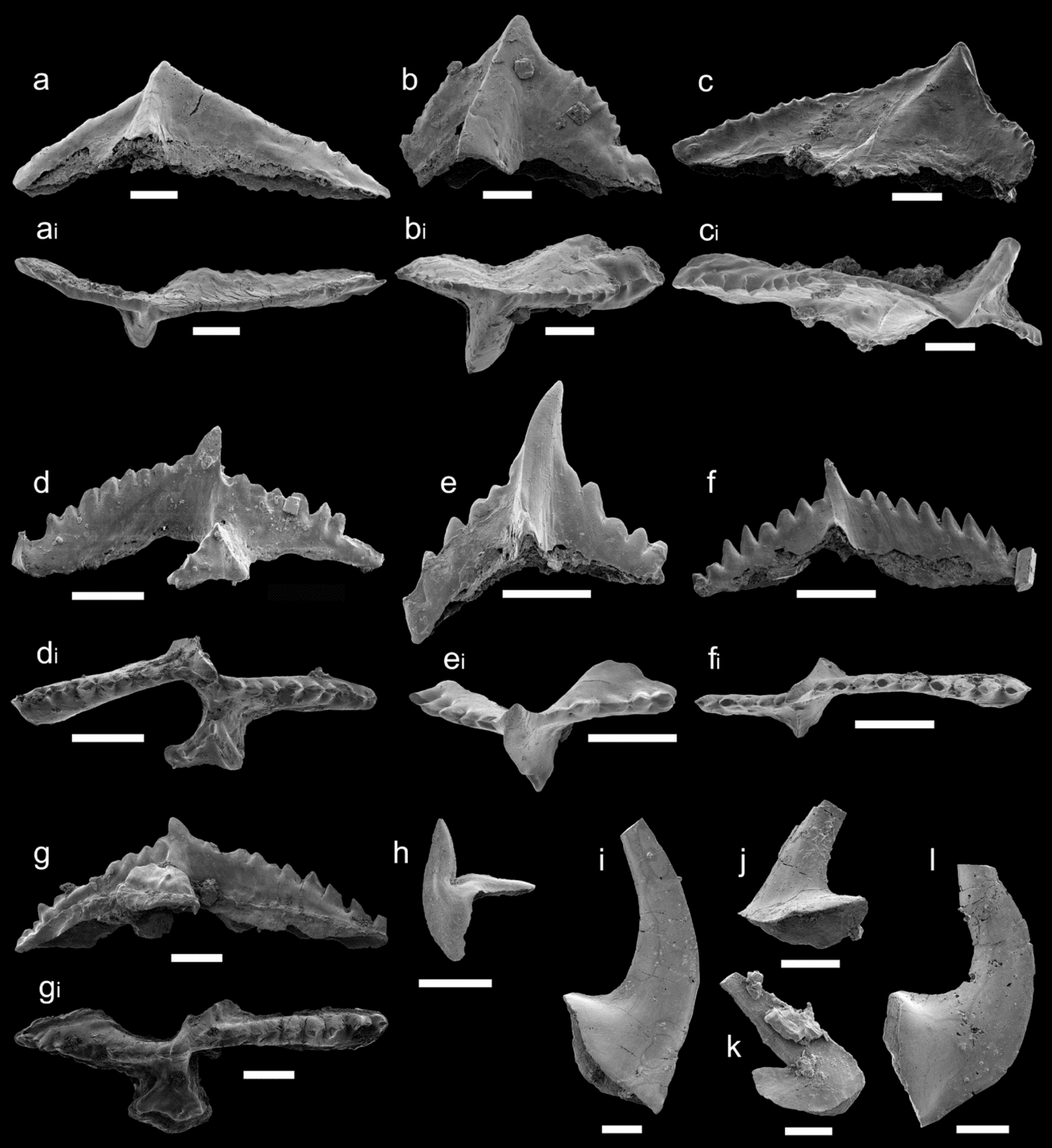
Two nodular carbonate horizons in Wadi Daiqa and Hayl al Quwasim yielded a rich, but low-diversity assemblage of two new genera and long-ranging elements (Figs 5, 10). All samples, WD C2008-10, C2012 and HaQ C2011, contain a similar fauna though the latter is more fragmentary. The fauna is thus of limited biostratigraphical utility when compared to conodont faunas from other regions, but may prove useful when more material from the Arabian margin is described. Its phylogenetic significance is far greater, however, and may help resolve questions about the evolution of early prioniodontid conodont apparatuses.
Conodonts from sample Wadi Daiqa C2009 unless stated, scale bars are 200 μm. (a–c) ?Balognathidae gen. et sp. nov. Pa element, NHMUK PM X 3671, (a) lateral view, (ai) oral view. (b) Pc element, NHMUK PM X 3672, lateral view, (bi) oral view. (c) Pb element, NHMUK PM X 3673, lateral view, (ci) oral view. (d–h) ?Pterospathodontidae gen. et sp. nov. (d) Pa element, C2010, NHMUK PM X 3674, lateral view, (di) oral view. (e) Pc element, NHMUK PM X 3675, lateral view, (ei) oral view. (f) Pb element, C2010, NHMUK PM X 3676, lateral view, (fi) oral view. (g) Pa element, C2012, NHMUK PM X 3677, lateral view, (gi) oral view. (h) M element, NHMUK PM X 3678. (i–k) Drepanoistodus sp., (i) NHMUK PM X 3679, (j) NHMUK PM X 3680, (k) C2010, NHMUK PM X 3681. (l) Drepanodus sp., NHMUK PM X 3682.

Two main conodont apparatuses with sets of three P elements are present and are partly reconstructed based on discrete specimens recovered from all of the Wadi Daiqa samples (Fig. 10). They are not consistent with any previously described Ordovician conodont apparatuses and certainly represent two new genera that are problematic to assign to a particular family. A detailed study reconstructing the whole apparatus of these new taxa will be published separately (Miller et al. in prep).
The larger, more robust set of P elements is found less commonly in the assemblage than the slender and denticulate set, and we assign these robust elements to ?Balognathidae gen. et sp. nov. (Fig. 10a–c). We have assigned Pa, Pb and Pc positions here rather than using the P1–P3 notation of Purnell, Donoghue & Aldridge (Reference Purnell, Donoghue and Aldridge2000) as we currently have no evidence for the relative positions of these elements in the apparatus. The Pb elements of this ?balognathid are icrion-bearing towards the ends of the processes (Fig. 10ci). Denticles on all P elements are variably developed on the processes (Fig. 10b) with some specimens being almost adenticulate (Fig. 10a). Until more material is recovered it is difficult to tell whether these differences in denticulation represent specific or even ontogenetic variations within a species as larger specimens would appear to be less denticulate. Robust S elements with crowded denticles have been found in the Amdeh assemblages, but as yet no M element associated with this apparatus has been recovered.
The apparatus of Notiodella described from bedding-plane assemblages from the Soom Shale, Ordovician of South Africa, by Aldridge et al. (Reference Aldridge, Murdock, Gabbott and Theron2013) contains three discrete P elements. Notiodella was assigned to the family Balognathidae by Aldridge et al. (Reference Aldridge, Murdock, Gabbott and Theron2013) on the basis of the cladistic analysis and subsequent phylogeny presented by Donoghue et al. (Reference Donoghue, Purnell, Aldridge and Zhang2008). Other apparatuses with icrion-bearing P elements such as Icriodella have previously been assigned to the family Icriodontidae by Dzik (Reference Dzik1991), hence our questioning of the balognathid assignment here. As Aldridge et al. (Reference Aldridge, Murdock, Gabbott and Theron2013) noted, the Icriodontidae/Balognathidae family issue may only be resolved when/if further bedding-plane material is uncovered. In the meantime, descriptions of this new ?balognathid genus with 3P elements illustrated here and another newly described conodont with 3P elements, Arianagnathus from the Llandovery of Iran (Männik, Miller & Hairapetian, Reference Männik, Miller and Hairapetian2015), have the potential to resolve some of the relationships between these basal prioniodontid conodonts. Aldridge et al. (Reference Aldridge, Murdock, Gabbott and Theron2013) have suggested that there may well be a distinct clade representing the family Icriodontidae and it would be interesting to see if a rerun of the cladistical analysis of Donoghue et al. (Reference Donoghue, Purnell, Aldridge and Zhang2008), including the new material from Oman and Iran, would recognize this.
The most common P elements recovered in the fauna (Fig. 10d–g) have been loosely placed within the family Pterospathodontidae. A pronounced kink is present mid-blade in Pa elements of ?Pterospathodontidae gen. et sp. nov. (Fig. 10di), whereas the Pb elements look very similar in lateral view but have a straighter blade and less well-developed lateral processes (Fig. 10fi). Almost all elements recovered have broken lateral processes so, at present, the most distinctive marker to tell these two elements apart is the relative straightness of the blade. The Pc element is distinctly pyramidal in shape (Fig. 10e). There are variations in denticulation, some of which may also be due to breakage.
Pa and Pb elements of ?Pterospathodontidae gen. et sp. nov. show similarities with P elements of Pranognathus (Männik & Aldridge, Reference Männik and Aldridge1989), but do not have as well-developed denticles on the supplementary processes and the main denticle row of the Pa element shows a mid-blade kink at the position of the cusp. In oral view they are similar to Complexodus P elements, but they do not possess the distinctive high blade. Small S elements recovered in the fauna are similar to those of the Pranognathus apparatus, but have not been illustrated here. The most common M element recovered, and therefore the element suggested to belong with this apparatus, is a typical Ordovician geniculate element (Fig. 10h). This is unlike the M element assigned to Pranognathus by Männik & Aldridge (Reference Männik and Aldridge1989) or the Notiodella M element. One of the S elements recovered here possesses four processes, again unlike any element in the Notiodella or Pranognathus apparatuses. Another difference from the Notiodella apparatus is the apparent similarity between two of the P elements (assigned Pa and Pb here), whereas in Notiodella all three P elements are different. This is not unusual amongst Ordovician apparatuses and is seen in the bedding-plane assemblage of the balognathid Promissum from the Soom Shale of South Africa where the elements in the P1 and P2 positions are almost identical (Aldridge et al. Reference Aldridge, Purnell, Gabbott and Theron1995; Gabbott, Aldridge & Theron, Reference Gabbott, Aldridge and Theron1995). We tentatively place this new material with the family Pterospathognathidae because of the similarity of the P element to Complexodus and Pranognathus, but again a more complete analysis of the whole apparatus is required in order to properly ascertain its affinities. This apparatus could also have balognathid affinities as suggested by the M element. Dzik (Reference Dzik1991, fig. 17) suggested that the family Pterospathodontidae was derived from the Balognathidae, so this form may represent a basal representative of the former.
Other elements present in this low-diversity conodont assemblage include coniforms of the stratigraphically long-ranging and geographically widespread Drepanoistodus sp. (Fig. 10i–k) and elements of Drepanodus sp. Some small elements of Microzarkodina sp. have also been recovered including a Pa element and an Sb element (see notation of Löfgren & Tolmacheva, Reference Löfgren and Tolmacheva2008).
Shallow-water conodont faunas in the Ordovician are ephemeral and it is not unusual to find taxa that are ‘similar to’ but only identifiable at generic level. Bergström et al. (Reference Bergström, Chen, Gutiérrez-Marco and Dronov2009, p. 101) referred to an ‘almost total absence of conodonts in the Lower and Middle Ordovician’ of the Middle East and subsequent ‘serious difficulties to correlate the successions in this area with the new global chronostratigraphy’. During Ordovician time the Arabian Peninsula probably belonged to the Shallow Sea Realm of Zhen & Percival (Reference Zhen and Percival2003) and this may account for the endemic nature of its conodont faunas. It is interesting to note that apparently coeval, but probably seaward, faunas from the Ayim Member of the Rann Formation in the UAE are dominated by Eoplacognathus with small numbers of Complexodus and are very different to the fauna described here (Fortey, Heward & Miller, Reference Fortey, Heward and Miller2011). Conodonts have also been recovered from the Hanadir Shale of Saudi Arabia (list of Vaslet, Reference Vaslet1990, and illustration in Purnell, Reference Purnell1995), but the assemblage from this formation has yet to be described in detail. Material being worked up from the Zagros of Iran may also be comparable (Ghavidel-Syooki et al. Reference Ghavidel-Syooki, Popov, Álvaro, Ghobadi Pour, Tolmacheva and Ehsani2014, p. 684), although these are slightly older (early Darriwilian) than those described here.
5.c. Trilobites (and Cruziana)
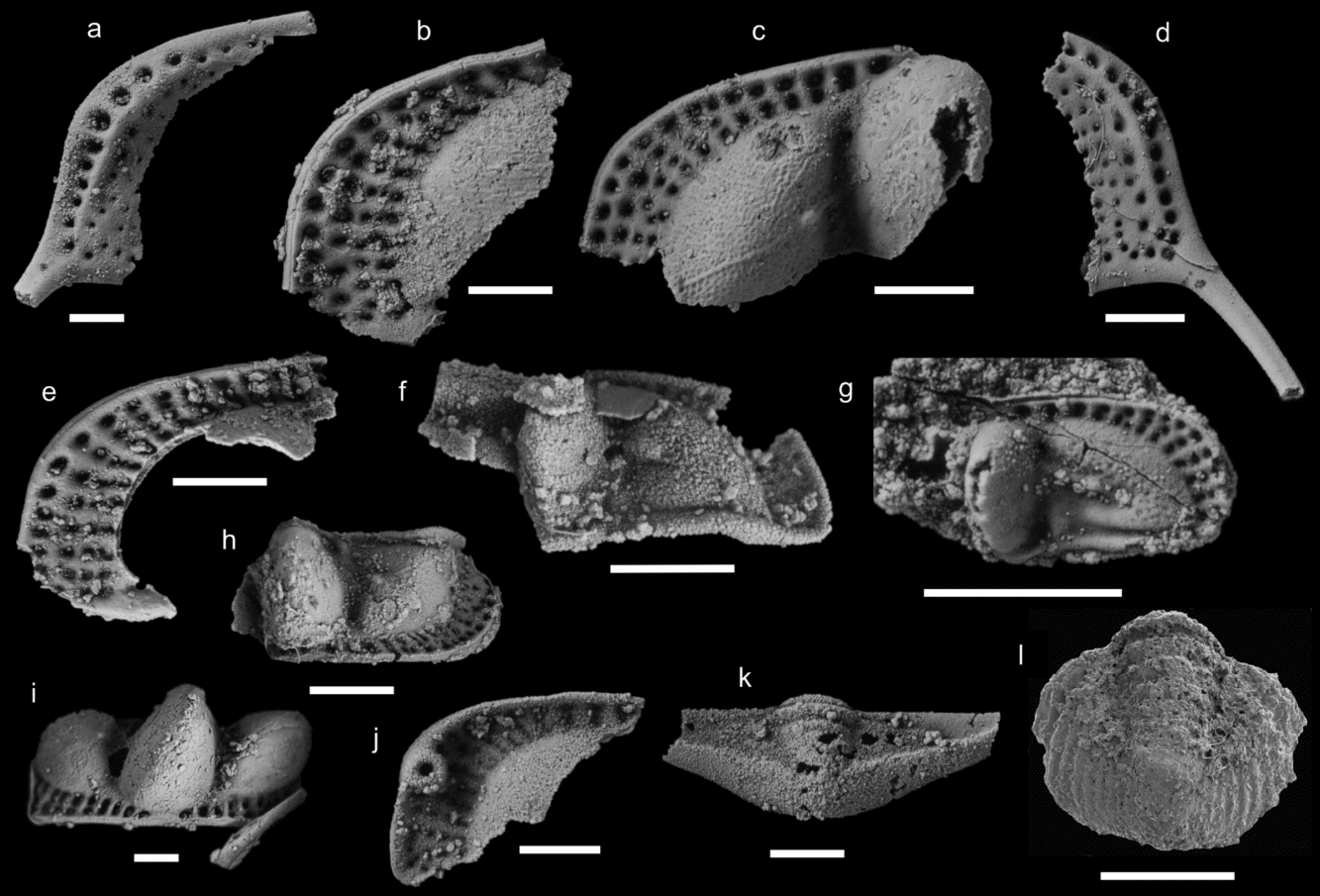
Trilobite body fossils are uncommon in the Am5 outcrops of Wadi Daiqa and Hayl al Quwasim, despite the abundance of Cruziana. This is commonly the case in contemporary clastic inshore sites of Gondwana. A specimen of the asaphid Ogyginus was found in a rotten carbonate in unit 3 on the southern flank of the Wadi Daiqa inlier, and a decalcified tail of Neseuretus tristani and the thorax of a larger non-asaphid trilobite were recorded from shales of unit 5 from Hayl al Quwasim. Phosphatized fragments of small trilobites are also found in the residues of conodont preparations from near the base of unit 3 in Wadi Daiqa (Fig. 4). The majority of these small specimens are of the rare trinucelid Yinpanolithus cf. yinpanensis (Fig. 11a–k; for systematic description see online Supplementary Material available at http://journals.cambridge.org/geo). This trilobite was previously only known from Floian–Dapingian strata in southern China and its occurrence in the Darriwilian of Oman may be an intermediate link to Cryptolithinae that appear suddenly in the Sandbian of Avalonia.
Phosphatized fragments of trilobite picked from Wadi Daiqa conodont residues. Scale bars are 100 μm. (a–k). Yinpanolithus cf. yinpanensis Lu. (a) Part of lower lamella, ventral view, NHMUK PI It 29179. (b) Part of left-hand side of fringe of larger specimen, NHMUK PI It 29180. (c) Incomplete cranidium, NHMUK PI It 29181. (d) Lower lamella showing termination of probably pseudogirder, NHMUK PI It 29182. (e) Fragment of larger fringe, NHMUK PI It 29184. (f) Small incomplete cranidium, NHMUK PI It 29183. (g) Smallest incomplete cranidium, NHMUK PI It 29187. (h) Anterior view of incomplete cranidium, NHMUK PI It 29185. (i) Anterior view of small cranidium showing lack of pits medially, NHMUK PI It 29186. (j) Fragment of fringe showing excrescence possibly due to parasite, NHMUK PI It 29188. (k) Pygidium of trinucleid possibly associated, NHMUK PI It 29189. (l) Pygidium of Neseuretus tristani, NHMUK PI It 29190.

Cruziana are common in the Am5 outcrops studied, in particular C. furcifera, C. rugosa and C. goldfussi, and less commonly C. imbricata and C. rouaulti. The most common forms are 60–120 mm wide (Fig. 6c), whereas C. imbricata is larger, up to 190 mm wide. The bulk of the Cruziana are thought to be the traces of particle feeding trilobites as they worked over the surface of an organic-rich sediment. Fortey & Owens (Reference Fortey and Owens1999) reviewed earlier work and considered that the likely trace maker was Neseuretus, which is often found in beds above or below the trace fossils, though never directly associated with them. However, the 60–120 mm width of the Cruziana measured here when compared with the typical sizes of trilobite remains known from elsewhere in the Amdeh, might imply that the asaphid trilobite Ogyginus is the more likely trace maker, as it grows to comparable widths to the traces, which Neseuretus does not. This differs from the opinion of Fortey & Owens (Reference Fortey and Owens1999) of asaphid life-habits, which were thought to be predatory/scavenging. It remains the case that the vaulted morphology of Neseuretus seems more appropriate to a ploughing habit than the flattened exoskeleton of Ogyginus. It is conceivable that Neseuretus grew larger than the body fossils yet recovered. It also remains puzzling that ploughing traces smaller than 60 mm wide have not been seen in the field. Comparable size classes of trilobites seem to have worked given patches of sediment together. Possibly, smaller trilobites congregated in different habitats, even on sediment surfaces where the grain sizes did not favour the preservation of ichnofossils.
More abundant trilobite fossils are known from shell beds, near Dim, north of Wadi Sarin (Neseuretus tristani, Ogyginus sp. aff corndensis and ?Nobiliasaphus sp.) in a sequence that contains few Cruziana. These shell beds were mapped as Am5 by BRGM geologists, but our re-examination of the section reveals several features more typical of the Am4. The identification of Neseuretus tristani from the Am5 in Wadi Daiqa, Hayl al Quwasim and from (Am4 or 5?) shell beds near Dim, suggests correlation with at least part of the Hanadir Shale of Saudi Arabia and to Darriwilian sections in Iberia and elsewhere in southern Europe (Fortey & Morris, Reference Fortey and Morris1982; El-Khayal & Romano, Reference El-Khayal and Romano1985). The Neseuretus fauna of Gondwana is low in diversity and usually associated with nearshore deposits at high palaeo-latitudes (North Africa, Armorica, South America, northern India and southern China; Fortey & Morris, Reference Fortey and Morris1982).
5.d. Fish
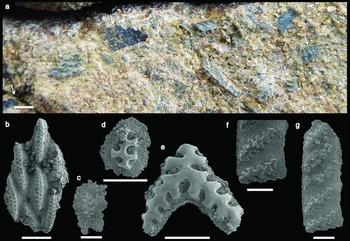
Only fragments of dermal armour, rather than articulated specimens, are known, as yet, from a c. 280 m interval of the Am5 in Wadi Daiqa and Hayl al Quwasim (Figs 5, 12). All of the conodont samples also yielded fish material. The material includes scales and fragments of head shield and flank scales derived from the dermal armour of arandaspid fish genus Sacabambaspis (Sansom et al. Reference Sansom, Miller, Heward, Davies, Booth, Fortey and Paris2009), though, owing to its fragmentary nature, it cannot be identified to species level. Ordovician arandaspids (including Sacabambaspis) have been recovered from sedimentary rocks of similar palaeoenvironment on the margins of Gondwana in Bolivia, Argentina and Australia and it would appear that these fish occupied a similar shallow-water niche in peri-Gondwanan localities during their Ordovician Floian to Sandbian range. Mass-mortality events, which led to articulated specimens being preserved in Bolivia, have been attributed to major influxes of fresh-water and sediment into shallow-marine waters (Davies & Sansom, Reference Davies and Sansom2009). Their absence in the Am5 may suggest that the sequences studied were distant from the mouths of rivers.
Fragments of the dermal armour of the arandaspid fish Sacabambaspis. Scale bar for (a) is 2 mm, (b–g) 500 μm. (a) Abundant fragments (arrowed) in weathered sandstone from unit 2.2, loc. Saca 1, Wadi Daiqa, NHMUK PV P 73830. En échelon ornament clearly visible. (b–g) Fragments picked from residues of conodont preparations from Wadi Daiqa. (b–e) presumed from the headshield region, (b) C2010, NHMUK PV P 73831, (c) C2008, NHMUK PV P 73832, (d) C2010, NHMUK PV P 73833, (e) C2010, NHMUK PV P 73834. (f–g) rhombic specimens with en échelon ornament presumed from the flank scales, C2008, NHMUK PV P 73835.

5.e. Crinoids
Crinoid ossicles are often present as moulds on bedding surfaces in the Am5 outcrops at Wadi Daiqa and Hayl al Quwasim. At one location, capping the regressive shoreface sand #2, they also occur as articulated Iocrinus material (Donovan et al. Reference Donovan, Miller, Sansom, Heward and Schreurs2011). The pentastellate columnals typical of this genus occur through hundreds of metres of section around the horizon where more complete specimens and coiled stem fragments occur (Fig. 5). They have also been recovered from the 75 μm to 2 mm fraction of conodont preparations. These and obvious round, oval and pentagonal moulds in outcrops indicate that further taxa of crinoid are present (online Supplementary Material Fig. S2 available at http://journals.cambridge.org/geo). Ghobadi Pour et al. (Reference Ghobadi Pour, Popov, Kebriaee Zadeh and Baars2011) reported probable columnals of Iocrinus from Dapingian strata in the Alborz Mountains in northern Iran, from a terrane thought marginal to Gondwana. Early and early Middle Ordovician crinoids are comparatively rare in occurrence, and the Iran and Oman material may be some of the oldest evidence of this genus. Iocrinus was previously considered a Laurentian genus that migrated to Gondwana in Middle Ordovician time, but the probable stratigraphic primacy of the Iran and Oman occurrences brings this into doubt, and suggests this may have happened in reverse (Donovan et al. Reference Donovan, Miller, Sansom, Heward and Schreurs2011).
6. Regional evaluation
6.a. Oman
The Darriwilian Saih Nihayda Formation occurs in the subsurface of northern Oman in a trend following the axis of the Ghaba Salt Basin (Droste, Reference Droste1997; Konert et al. Reference Konert, Afifi, Al-Hajri and Droste2001; Molyneux et al. Reference Molyneux, Osterloff, Penney and Spaak2006; Forbes, Jansen & Schreurs, Reference Forbes, Jansen and Schreurs2010, pp. 193–6). At its thickest, c. 650 m, it is similar to the Am5/Upper Siltstone Member of the Amdeh outcrops. The formation is predominantly shaly; it varies in thickness and proportion of sand owing to onlap onto an unconformity below, and differing amounts of erosion beneath younger formations above (Fig. 7). High global sea levels and halokinesis in the salt basin provided the accommodation space to preserve the formation in northern Oman (Partington et al. Reference Partington, Faulkner, McCoss and Hoogerduijn Strating1998), and it is tempting to assume the same controls applied in the area of the Amdeh outcrops (Fig. 1).
The subsurface Saih Nihayda Formation has been characterized as a major transgressive–regressive sequence separated by graptolitic shales (Droste, Reference Droste1997; Forbes, Jansen & Schreurs, Reference Forbes, Jansen and Schreurs2010). The shales in the subsurface are described as dark grey, though locally they can be orange or reddish brown. Sandstones are fine to medium grained and have been interpreted as braid-delta or possibly fluvial, overlain by open-marine shales with thin storm or turbidite sandstones and capped by prograding shallow-marine sandstones (Droste, Reference Droste1997; Forbes, Jansen & Schreurs, Reference Forbes, Jansen and Schreurs2010). No shell beds have been described from the subsurface, but a very dense spike on the well logs of SN-24 is a candidate for one (Forbes, Jansen & Schreurs, Reference Forbes, Jansen and Schreurs2010, p. 190, 2928 m). Cruziana rugosa and parts of an asaphid trilobite are present in samples from core 22 of the GB-1 well (in the Iraq Petroleum Company archive), in keeping with their Amdeh outcrop equivalents.
Rickards et al. (Reference Rickards, Booth, Paris and Heward2010) described the graptolites and palynomorph assemblages from cores close to the MFS O30 interval in the GB-1 and BQ-1 wells of the Ghaba Salt Basin (Figs 1, 7). Didymograptus (D.) cf. murchisoni is present in the former well and Didymograptus (D.) artus in the latter. The mutual exclusivity of these forms is quite normal and may be facies controlled rather than being temporal. The acritarchs also show differences, with those from GB being less diverse, better preserved and interpreted as being more proximal. Those from BQ are more diverse, carbonized and pyritic, and interpreted as representing a more distal, reducing environment below normal-wave base (Rickards et al. Reference Rickards, Booth, Paris and Heward2010). Molyneux et al. (Reference Molyneux, Osterloff, Penney and Spaak2006) also documented an increase in acritarch diversity, graptolite fragments and chitinozoa along the salt basin from southwest to northeast, consistent with a change from more onshore to offshore conditions. Highly carbonized fragments of graptolites are often encountered in palynology preparations of outcrop samples, and the absence of graptolite macrofossils in the outcrops is probably a consequence of metamorphism and cleavage development.
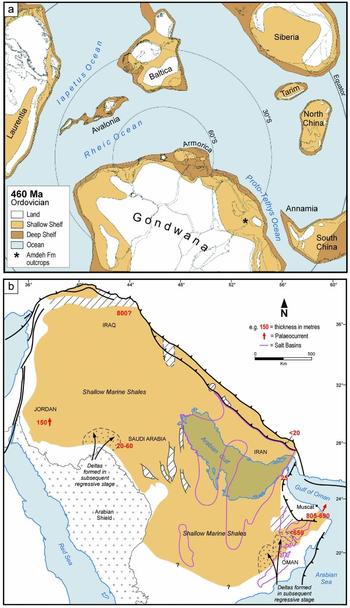
The Ordovician saw the highest sea levels of the Palaeozoic and this, combined with the low relief of the continents, led to wide, low-gradient (< 0.1°), shallow-marine shelves (Fig. 13). Sea levels that had risen through Early Ordovician time, stabilized in Middle Ordovician time, before rising again during Late Ordovician time (Haq & Schutter, Reference Haq and Schutter2008). Sea levels are estimated to have been 50–200 m above present during the Darriwilian and it is unlikely that regional highs in relatively seaward locations remained islands during periods of maximum transgression (e.g. the area of the present Jabal Akhdar, in Oman; Figs 1, 13b). Small changes in sea level could lead to migration of shorelines over long distances. During sea-level falls, coarser-grained, sharp-based shoreface units could be deposited in detached locations way out on the shelf (Posamentier & Morris, Reference Posamentier, Morris, Hunt and Gawthorpe2000).
(a) Reconstruction of the northern margin of Gondwana during Middle Ordovician time (Torsvik, pers. comm. to APH 2015). The connection to Proto-Tethys may have been restricted by external terranes along this part of the margin of Gondwana. (b) Palaeogeographical map of the Arabian Plate during Darriwilian time (MFS O30, based on Konert et al. Reference Konert, Afifi, Al-Hajri and Droste2001). Note the wide shallow shelf and the exceptional thickness of sediment preserved in the Amdeh outcrops and the Ghaba Salt Basin. Thicknesses and palaeocurrents from sources in text. It is unlikely that intrabasinal highs like Jabal Akhdar were not transgressed during periods of the highest sea levels.

The synthesis is of the Saih Nihayda Formation becoming more offshore along the Ghaba Salt Basin towards the Amdeh outcrops and the Proto-Tethys ocean (Figs 1, 7, 13). Given this reconstruction, the sharp-based regressive shoreface sands in the lower half of the sequence in Daiqa outcrops probably represent falls of relative sea level of a few tens of metres and the shale minor flooding events similar rises (Fig. 5). There is also no evidence of an embayment along the Ghaba Salt Basin, which, if it were present, would have amplified any tidal effects.
6.b. Arabian Plate
The Darriwilian spans a period of 8.9 Ma (from 467.3 to 458.4 Ma; Gradstein et al. Reference Gradstein, Ogg, Schmitz and Ogg2012). Typical outcrop thicknesses of deposits of this age on the Arabian Plate vary from < 20–150 m. (Fig. 13b). The Am5 of Oman and the Khabour Quartzite-Shale Formation of northern Iraq (Al-Hadidy, Reference Al-Hadidy2007) are exceptions, though what thickness of the latter formation is Darriwilian is unclear. The Am5, at 690–805 m thick, implies active subsidence and a steady supply of clastic sediment. If 50 to 200 m of the accommodation space is attributable to rising sea level, then more than four times that is probably due to subsidence or halokinesis. The sedimentation rate for the Am5 is comparatively high at around 0.1 m per 1000 years. But decimetre-thick storm event beds would have formed in days, and where the pauses or gaps in this sequence are remains a puzzle. The O30 maximum flooding event is interpreted to occur near the base of outcrops of the Hanadir Shale in Saudi Arabia, at c. 18 m in the outcrops of the Hiswah Formation in southern Jordan and at c. 70 m above the base in an un-named exploration well in central Saudi Arabia (Senalp & Al-Duaiji, Reference Senalp and Al-Duaiji2001; Simmons et al. Reference Simmons, Sharland, Casey, Davies and Sutcliffe2007; Turner et al. Reference Turner, Armstrong, Wilson and Makhlouf2012). It is interpreted to occur at a level of around 150–200+ m in the sections of the Saih Nihayda Formation of northern Oman illustrated in Figure 7 and at 450 m in the Am5 outcrops at Wadi Daiqa (Fig. 5).
Regionally across Arabia, the base of the Darriwilian is often marked by beds of conglomerate or phosphatic sand implying an unconformity or at least a significant break in sedimentation (El-Khayal & Romano, Reference El-Khayal and Romano1988; Vaslet, Reference Vaslet1990; Droste, Reference Droste1997; Fortey, Heward & Miller, Reference Fortey, Heward and Miller2011; Turner et al. Reference Turner, Armstrong, Wilson and Makhlouf2012; Ghavidel-Syooki et al. Reference Ghavidel-Syooki, Popov, Álvaro, Ghobadi Pour, Tolmacheva and Ehsani2014). It would appear that the lowermost Darriwilian was not deposited in many areas. There are no such beds in the Am5 outcrops supporting the palynological evidence of more continuous sedimentation. Similar wave- and storm-dominated, shallow-marine clastic sedimentary rocks and trace fossils are described across Arabia, with little evidence of tides, despite the wide shelf (El-Khayal & Romano, Reference El-Khayal and Romano1988; Senalp & Duaiji, Reference Senalp and Al-Duaiji2001; Turner et al. Reference Turner, Armstrong, Wilson and Makhlouf2012; Ghavidel-Syooki et al. Reference Ghavidel-Syooki, Popov, Álvaro, Ghobadi Pour, Tolmacheva and Ehsani2014). At the present-day, shallow-water seas remain micro-tidal where there is not a free connection to the open ocean (e.g. the Mediterranean Sea with the Straits of Gibraltar), where there is interference between incoming and outgoing tidal waves or where the local coastal geometry does not compress the incoming tidal wave (Dalrymple & Padman, Reference Dalrymple and Padman2015). It may be that external Iranian and Afghan terranes along this margin of Gondwana prevented a free connection with the Proto-Tethys ocean (Torsvik & Cocks, Reference Torsvik, Cocks and Basset2009; Fig. 13). Such terranes may also have affected the dispersal and endemism of faunas.
The orange-red, shaly, bioclastic carbonates of the Ayim Member of the UAE are a sediment-starved contrast to most of the Darriwilian in the region. This, 25 m thick, griotte-like facies, was probably a low-energy shelfal deposit remote from any sand supply. The presence of stromatolites, networks of Thalassinoides burrows and oriented orthocone shells implies deposition in the photic zone above storm-wave base. Cruziana are absent, and there are different trilobite and conodont faunas compared to those of the Am5 (Fortey, Heward & Miller, Reference Fortey, Heward and Miller2011). The Ayim Member occurs as rafts in a mélange and so its original depositional context is uncertain, but it may be typical of deposits that accumulated over intrabasinal highs (Figs 7, 13).
In the Baltic region and the USA, the Middle Darriwilian is marked by an Isotope Carbon Excursion (MDICE) that probably coincides with a climate-induced cooling of the oceans to near present-day temperatures and the presence of ice sheets at the poles (Bergström et al. Reference Bergström, Chen, Gutiérrez-Marco and Dronov2009; Ainsaar et al. Reference Ainsaar, Kaljo, Martma, Meidla, Männik, Nõlvak and Tinn2010; Turner et al. Reference Turner, Armstrong, Wilson and Makhlouf2012; Al-Husseini, pers. comm. to APH 2016). If the third-order cycles of bathymetry for the Middle Ordovician are eustatic changes due to the growth and decay of ice sheets, as interpreted by several authors, there is surprisingly little commonality in the number and character of cycles between the regions (Munnecke et al. Reference Munnecke, Calner, Harper and Servais2010; Videt et al. Reference Videt, Paris, Rubino, Boumendjel, Dabard, Loi, Ghienne, Marante and Gorini2010; Turner et al. Reference Turner, Armstrong, Wilson and Makhlouf2012). In the Am5 outcrops, there are two third-order cycles of coarsening and fining upwards centred around the interpreted location of MFS O30 (Figs 5, 7). In northern Oman, only parts of these cycles are preserved owing to onlap at the base and truncation by unconformities at the top, perhaps helping explain some of the lack of commonality in other regions. Oman and the Arabian shelf were located at mid-latitudes, c. 30–50°S (Fig. 13a). Such latitudes, under present-day ‘Icehouse’ conditions, are characterized by strong winds. Large waves driven by westerly winds possibly affected the 1500 km wide shallow sea covering Arabia. Palaeocurrents from the cross-beds in the Am5 and from Jordan (Middle Member of Dubaydib Formation, Turner et al. Reference Turner, Armstrong, Wilson and Makhlouf2012) are oriented towards the NNE and N and perhaps were caused by the relaxing flows of storm surges.
There are similarities in the regional provenance of Ordovician sandstones in Sinai and Jordan, and the glimpses of provenance obtained from the Amdeh Formation of Oman. The presence of detrital zircons > 0.95 Ga could imply multiple episodes of sand recycling and northward transport by rivers and ice sheets from ancient source cratons on the African and Indian plates (Kolodner et al. Reference Kolodner, Avigad, Mcwilliams, Wooden, Weissbrod and Feinstein2006).
7. Conclusions
A 690 m sequence of Darriwilian siltstone-dominated Amdeh 5 Member crops out in the Wadi Daiqa and Hayl al Quwasim inliers. It comprises quartzitic sandstones, shales and thin shell beds. Several of the shales yield assemblages of acritarchs and chitinozoa. Without this biostratigraphic control, and a framework established from hydrocarbon exploration in interior Oman, our understanding of the sequence would be significantly reduced. A potentially important conodont fauna has been recovered, but this appears to be endemic in a region that has limited coverage for conodonts, thus hampering biostratigraphic correlation.
The Am5 is the equivalent to, spans a wider age range than and is probably the seaward continuation of the Saih Nihayda Formation of the Ghaba Salt Basin of northern Oman. The deposits are interpreted to represent storm-dominated shelf, shoreface and delta environments. There are two third-order coarsening and fining upwards cycles centred around the interpreted location of the MFS O30 (c. 462-3 Ma). Small changes in sea level led to substantial landward or seaward shifts of facies belts owing to the low gradient of the shelf. There is little evidence of tidal influence, despite the extensive shallow sea that covered much of Arabia, perhaps owing to the presence of external terranes at the edge of Gondwana that restricted free circulation with Proto-Tethys. Palaeocurrents in the Am5 are towards the NNE and may reflect the oceanward-flowing currents of relaxing storm surges.
The Am5 outcrops in the Saih Hatat area are thicker than most others of Darriwilian age in the region, implying active subsidence and a steady supply of sediment. There is evidence of earliest Darriwilian palynomorphs and a transition with the underlying Am4 that is not present in the subsurface of the Ghaba Salt Basin or in other outcrops in the region. It seems likely that the Jabal Akhdar area, that lacks Amdeh-equivalent strata, was submerged at the highest sea levels of Ordovician time and that any deposits that accumulated were eroded prior to Permian time. Sand-starved, griotte-like carbonates, like those of the Ayim Member of the Rann Formation of the UAE, may have accumulated over such intrabasinal highs.
The Amdeh Formation is a challenging rock unit to work on and does not yield up its secrets readily. This study, however, resulted in a number of unexpected discoveries which provide evidence of the development and dispersal of faunas (Sacabambaspis, Iocrinus, Yinpanolithus, a new conodont fauna). There is scope for further discoveries in the Am5 (e.g. younger phosphate-rich horizons at Hayl al Quwasim; further taxa of crinoid; undescribed new genera and species of bivalves; unattributed saddle-like and scale-like features in conodont residues, online Supplementary Material Fig. S2 available at http://journals.cambridge.org/geo) and in the other members of the Amdeh Formation.
Acknowledgements
This study began when APH and GAB were employees of Petroleum Development Oman (PDO), and palynological groundwork and preparations continued over several years. The authors are grateful for permission to publish from PDO and from The Ministry of Oil and Gas, Sultanate of Oman. Willie Quizon is thanked for draughting many of the figures, as are the management of Petrogas E&P for allowing him time and facilities to do this. IJS gratefully acknowledges the receipt of NERC grant (NE/B503576/1); CGM acknowledges a NHM collections-enhancement grant, help from Martha Richter in the field in 2007 and Angelo Mossoni with picking. Gordon Forbes is thanked for his contributions during the early stages of this work, Stewart Molyneux for discussions of the palynological taxa, Paul Smith for advice on the identification of the coniform conodonts, Keith Ingham for alerting us to the similarity of our trilobite material and Yinpanolithus, and Noel Morris for comments on the bivalves in the conodont residues. Trond Torsvik kindly supplied a reconstruction of the palaeogeography of Arabia at 460 Ma. Mike Richards of Black and Veatch is thanked for allowing access to the outcrops during the construction of the Wadi Daiqa dams, and George Grabowski of ExxonMobil for arranging viewing of the Iraq Petroleum Company archive samples from GB-1 and the Rann Formation. Reviews by Steve Donovan, Owen Sutcliffe, Iftikar Ahmed, Moujahed al-Husseini and an anonymous reviewer helped shape the final form of the paper.
Supplementary material
To view supplementary material for this article, please visit http://dx.doi.org/10.1017/S0016756816000819.