Introduction
Plants have developed several mechanisms to defend themselves against herbivores, microbial pathogens, and abiotic stress (Price et al., Reference Price, Bouton, Gross, McPheron, Thompson and Weis1980; Turlings et al., Reference Turlings, Tumlinson and Lewis1990; Vet & Dicke, Reference Vet and Dicke1992; Dicke, Reference Dicke1994; De Moraes et al., Reference De Moraes, Lewis, Pare, Alborn and Tumlinson1998; Turlings et al., Reference Turlings, Lengwiler, Bernasconi and Wechsler1998; Dicke & Van Loon, Reference Dicke and Van Loon2000; De Moraes et al., Reference De Moraes, Mescher and Tumlinson2001; Hoballah & Turlings, Reference Hoballah and Turlings2001; Kessler & Baldwin, Reference Kessler and Baldwin2001, Reference Kessler and Baldwin2002; Kessler et al., Reference Kessler, Halitschke and Baldwin2004; Dudareva et al., Reference Dudareva, Negre, Nagegowda and Orlova2009; Mazid et al., Reference Mazid, Khan and Mohammad2011). These defences may involve non-volatile and volatile compounds derived from the secondary metabolism, which can act directly on herbivores as deterrent, repellent, or toxic substances, or indirectly, as cues for natural enemies of the herbivore to locate their hosts, respectively (Dicke, Reference Dicke1994; De Moraes et al., Reference De Moraes, Lewis, Pare, Alborn and Tumlinson1998; Turlings et al., Reference Turlings, Lengwiler, Bernasconi and Wechsler1998; Dicke & Van Loon, Reference Dicke and Van Loon2000; Colazza et al., Reference Colazza, Mcelfresh and Millar2004a ; Moraes et al., Reference Moraes, Laumann, Sujii, Pires and Borges2005, Reference Moraes, Laumann, Pareja, Sereno, Michereff, Birkett, Pickett and Borges2009; Heil, Reference Heil2010). Volatile compounds induced by herbivory and involved in the chemical defence of plants are called herbivore-induced plant volatiles (HIPVs). The majority of these compounds are green leaf volatiles, i.e., C6 compounds, aldehydes, alcohols and esters, terpenoids and aromatics derived from the shikimic acid pathway (Halitschke et al., Reference Halitschke, Stenberg, Kessler, Kessler and Baldwin2008; Arimura et al., Reference Arimura, Matsui and Takabayashi2009). Damage by the brown stink bug, Euchistus heros (Fabricius) (Hemiptera: Pentatomidae) induces the release of a blend of volatile compounds that attracts the bug's natural enemy, Telenomus podisi. The main herbivore-induced volatiles released by soybean are methyl salicylate, (3E, 7E)-4,8,1 2 trimethyl-1,3,7,11 tridecatetraene, (E,E)-α-farnesene, (E)-2-octen-1-ol (Moraes et al., Reference Moraes, Laumann, Sujii, Pires and Borges2005; Michereff et al., Reference Michereff, Laumann, Borges, Michereff-Filho, Diniz, Neto and Moraes2011). Induced defences and the blend of released volatiles depends on plant traits that vary among species or genotypes, i.e., natural enemies may respond to one cultivar damaged by an herbivore but not to a different cultivar injured by the same phytophagous insect (Dicke, Reference Dicke1999; Lin et al., Reference Lin, Shen, Xu, Köllner, Degenhard and Dooner2008; Rasmann & Turlings, Reference Rasmann and Turlings2008; Michereff et al., Reference Michereff, Laumann, Borges, Michereff-Filho, Diniz, Neto and Moraes2011). Another study showed that the natural enemy Trissolcus basalis responded to Vicia faba L. plants that were damaged by both herbivory and oviposition of the green stink bug Nezara viridula (L.) (Hemiptera: Pentatomidae), but did not respond to plants with just one type of damage (Colazza et al., Reference Colazza, Mcelfresh and Millar2004a ). The main compound involved in the response of this natural enemy appears to be the sesquiterpene (E)-β-caryophyllene (Colazza et al., Reference Colazza, Fucarino, Peri, Salerno, Conti and Bin2004b ). In addition, the chemical profile emitted by herbivory or oviposition-damaged plants can be markedly different from those emitted by undamaged and mechanically damaged plants (De Moraes et al., Reference De Moraes, Lewis, Pare, Alborn and Tumlinson1998; Dicke & Van Loon, Reference Dicke and Van Loon2000; Kessler & Baldwin, Reference Kessler and Baldwin2001; Moraes et al., Reference Moraes, Laumann, Sujii, Pires and Borges2005, Reference Moraes, Birkett, Gordon-Weeks, Smart, Martin, Pye, Bromilow and Pickett2008a ; Michereff, Reference Michereff, Laumann, Borges, Michereff-Filho, Diniz, Neto and Moraes2011). Several authors have proposed using plants’ ‘call for help’ strategies in crop systems to manage pests and their natural enemies (Colazza et al., Reference Colazza, Mcelfresh and Millar2004a , Reference Colazza, Fucarino, Peri, Salerno, Conti and Bin b ; Moraes et al., Reference Moraes, Laumann, Sujii, Pires and Borges2005, Reference Moraes, Laumann, Pareja, Sereno, Michereff, Birkett, Pickett and Borges2009; Heil, Reference Heil2010; Blassioli-Moraes et al., Reference Blassioli-Moraes, Borges, Laumann, Wajnberg and Colazza2013). HIPVs could be used in different contexts, including cultivating live plants that release volatiles that attract natural enemies (e.g., push–pull systems), breeding plants that release specific volatiles to manage natural enemies or repel pests (Cook et al., Reference Cook, Khan and Pickett2007) or direct application (spraying or use of slow release dispensers) of synthetic compounds to attract natural enemies (James, Reference James2003, Reference James2005; D'Alessandro & Turlings, Reference D'Alessandro and Turlings2005; Conti & Colazza, Reference Conti and Colazza2012; Kaplan, Reference Kaplan2012).
One of the main rice pests in Brazil is the brown stalk stink bug, Tibraca limbativentris Stal. (Hemiptera: Pentatomidae), which is especially important in irrigated rice crops (Martins et al., Reference Martins, Barrigossi, Oliveira and Cunha2009; SOSBAI, 2012). This stink bug has important natural enemies, such as the egg parasitoids T. podisi and Trissolcus urichi (Maciel et al., Reference Maciel, Lemos, Souza, Costa, Barrigossi and Chagas2007; Riffel et al., Reference Riffel, Prando and Boff2010), but there is no information about the chemical communication involved in this tritrophic interaction between the plant, its herbivore and the herbivore's natural enemy. This study aimed to understand the influence of Oryza sativa volatiles, induced by herbivory of T. limbativentris on the host searching behaviour of the brown stalk stink bug and two different parasitoids, T. podisi, known as T. limbativentris natural enemy (Maciel et al., Reference Maciel, Lemos, Souza, Costa, Barrigossi and Chagas2007; Riffel et al., Reference Riffel, Prando and Boff2010) and T. basalis, not registered to this species.
Materials and methods
Plant cultivation and treatments
Rice (cultivar IRGA-417) seeds were cultivated using an organic substrate (Plantmax treated with NPK 5-20-20) in plastic plots of 500 ml. The plants were kept in a greenhouse and received water daily. They were 20 cm tall after 28–30 days of growth (V8 stage) (SOSBAI, 2012).
Insect cultures
Tibraca limbativentris individuals were obtained from a laboratory colony started from adults collected in rice fields in Eldorado do Sul, Rio Grande do Sul (30°02′S; 51°23′WGR), Brazil. Bugs were reared in a controlled environment at L16:D8 photoperiod, 25±1 °C and 60±10% relative humidity (RH) in 2 l plastic containers made from soft drink bottles, on a diet of rice plants from 30 to 60 days old (O. sativa-cultivar IRGA-417), which was also used by insects as a substrate for egg-laying. The food supply was renewed once a week. The first instar insects were reared in Gerbox-type boxes (11×11×3 cm) covered with filter paper (80 g m−2 grammature, 205 μm thick, 14 μm average pore Qualy J Lab Pro), on a diet of Ligustrum lucidum Ait. and green beans (Phaseolus vulgaris). The food supply was renewed once a week.
Eggs of N. viridula and E. heros parasitized by T. basalis and T. podisi, respectively, were obtained from the Brazilian Agricultural Research Corporation – Soybean, in Londrina, Paraná. The eggs were kept in a controlled environment at L14:D10 photoperiod, 21±1 °C and 60±10 RH until hatched. The wasps were maintained in 500 ml PET bottle cages and fed with a drop of honey, supplied twice a week. The 2–3-day-old naïve females were used in the experiments.
Plant volatile collection system
To identify the chemical profiles of herbivory-damaged and undamaged rice plants (cv IRGA-417), the following treatments were used: (1) rice plants damaged by female stink bugs: five T. limbativentris female insects were placed on the plant; (2) plants damaged by male stink bugs: five T. limbativentris male insects were placed on the plant; and (3) a control with undamaged rice plants. All insects were 30 days old, at most, and mated before the experiment. No oviposition was observed during plant volatile collections. Each plant was placed in an individual glass chamber of 10 l and the pots were wrapped in aluminium foil to minimize contamination by volatiles from the soil. Volatiles were collected each 24 h, during five consecutive days, with nine replicates for each treatment. A glass tube containing the adsorbent Super Q (100 mg, 80–100 mesh, Alltech PA, USA) was connected via a PTFE tube to a vacuum pump at a flow of 0.6 l min−1 and the air entrance was connected to a flow of air filtered with activated charcoal (1.0 l min−1) creating a positive push–pull system (Moraes et al., Reference Moraes, Birkett, Gordon-Weeks, Smart, Martin, Pye, Bromilow and Pickett2008a ). Trapped volatiles were eluted from the adsorbent using 500 μl n-hexane and pre-concentrated to 100 μl under a N2 flow. Extracts were stored at −20 °C until be used in chemical analysis and bioassays.
Y-tube olfactometer and bioassay procedure
To evaluate the response of male and female T. limbativentris to air-entrainment extracts obtained from the rice plants submitted to the different treatments described above, bioassays were carried out using a Y-olfactometer in plural experimental days. The responses of males and females, individually, were evaluated for virgin insects 15–30 days old after the final moult. All insects were placed in individual Gerbox boxes and kept separately without food for 24 h before the bioassays. Behaviour was observed in a Y-olfactometer (17 cm common tube, 22 cm arms, and 4 cm internal diameter). An aliquot of the extracts (20 μl) was applied on pieces (1.5×1.2 cm) of filter paper (80 g m−2 grammature, 205 μm thick, 14 μm average pore Qualy J Lab Pro), which remained at room temperature for 1 min before being inserted into the olfactometer arm, thus allowing the evaporation of the solvent. The insects were placed, individually, in the common tube and their choices observed during 15 min.
The chemotaxis behaviour of 2–6-day-old T. podisi and T. basalis females was evaluated in a Y-olfactometer (15 cm common tube, 17 cm arms, and 1 cm internal diameter). Females were placed, individually, in the common tube and their choices observed during 10 min. The treatments (10 μl) were applied on pieces (1.0×6.0 cm) of filter paper, as described above, following the same procedure for the stink bug bioassays.
Stink bugs were presented with a choice between an aliquot of 20 μl of air-entrainment extracts from plant damaged by female (N=76, females and N=77, males) and by male (N=83, females and N=72, males) collected after 24 h of damage versus 20 μl of air-entrainment extracts from undamaged plants collected at the same condition. Parasitoids were exposed to air-entrainment extracts from plant damaged by female (N=40, T. podisi and N=30, T. basalis) and male (N=38, T. podisi and N=30, T. basalis) collected after 24 h of damage versus volatiles from air-entrainment extracts from undamaged plants, as well as volatiles from air-entrainment extracts from undamaged plants versus n-hexane (N=30, T. podisi and N=30, T. basalis). All bioassays were conducted in an acclimatized room (25±1 °C and 60±10% RH) during the photophase period and under fluorescent lights (60 W, luminance=290 lux). Air was conducted into the Y-olfactometer at 0.8 l min−1. To avoid any bias in the insects responses, the arms through containing the control and treatment odours were inverted every three bioassays. The apparatus was cleaned after six bioassays with fragrance-free liquid soap, rinsed thoroughly with water followed by n-hexane and dried in a convection oven at 150 °C.
A single insect was introduced at the base of the Y-tube olfactometer, observed for 10 min and recorded the first choice in each arm. Stink bugs and parasitoids that moved at least 4 cm into one arm of the Y-tube for stink bugs and 2 cm for parasitoids, and remained there for at least 60 s were recorded as making a choice. If no choice was made in 10 min, the assay was concluded and the insect considered non-responsive.
Chemical analysis
For quantification analysis, the extracts obtained by air entrainment were analysed by GC with a flame ionization detector (FID) at 270 °C (Shimadzu 17A, DB-5 column, 30 m×0.25 mm ID, 0.25 μm film, J&W Scientific, Folsom, CA, USA), using a temperature program of 50 °C/1 min, then 5 °C min−1 to 180 °C/0.1 min, then 10 °C min−1 to 250 °C/20 min. An aliquot of 20 μl of each extract was separated and 2 μl of tetracosane was added as an internal standard (IS), for a final concentration of 9.9 μg ml−1 of the IS. One microlitre of each sample was injected using a splitless mode with helium as the carrier gas. Amounts released by the plant in each 24 h period were calculated in relation to the area of the IS. Data were collected with ClassGC software and stored in Excel (Microsoft Corporation 2003). The other 80 μl of the air-entrainment extracts were mixed with 100 μl of n-hexane and the extracts kept at −20 °C until their use in the bioassays.
For qualitative analysis, selected extracts were analysed using a Shimadzu QP2010 instrument equipped with a quadrupole analyser, a non-polar DB-5 column (30 m×0.25 mm ID, 0.25 μm film, J&W Scientific, Folsom, CA, USA) and a splitless injector, with helium as the carrier gas. Ionization was by electron impact (70-eV, source temperature 200 °C). Data were collected and analysed with GC–MS Solutions 2.4 Software (Shimadzu Corporation, Japan). Identifications were made by comparing spectra with library databases (NIST 2005) or with published spectra and confirmed using retention index and with authentic standards when available.
Chemical
Super Q (80/100 mesh) was purchased from Alltech (PA, USA), n-hexane (95% pesticide residue) from Fisher Scientific (Loughborough, Leicestershire, UK), (E)-2-hexenal from Sigma Aldrich (Gillinghan, Dorset, UK), β-bisabolene and linalool from TCI America (Portland, USA). Methyl salicylate, 6-methyl-5-hepten-2-one, octanal, (E)-2-octen-1-ol, nonanal, decanal, geranylacetone and benzothiazole were purchased from Sigma Aldrich (Steinheim, Germany). α-Curcumene, β-sesquiphellandrene and α-zingiberene were provided by Jocelyn Millar (UCLA-Riverside, USA).
Statistical analysis
The total amount of released volatiles from each treatment over time was compared using a General Linear Model GLM and Deviance Analyses with gamma distribution and inverse as link function using the software R 2.14.1 (R Development Core Team, 2012). When the analyses showed significant effects of the treatments, means were compared using contrast analyses. The data from individual compounds neither follow a normal nor gamma distribution, thus the differences of the amounts of each individual compound between treatments were individually compared by nonparametric univariate statistics using Kruskal–Wallis test and submitted to Dunn test with 95% confidence level. The null hypothesis of equal preference (50% first choice to each odour) of parasitoids and stink bugs in the Y-olfactometer bioassays was tested using χ2 tests (P=0.05). Both tests were performed in Bioestat® 5.0 software.
Results
Tibraca limbativentris Y-tube olfactometer bioassays
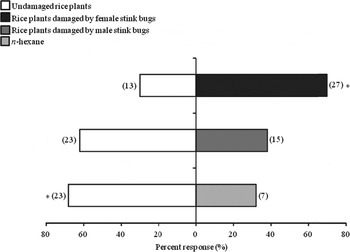
Rice stem bug females preferred volatiles obtained from air-entrainment extracts of undamaged plants compared to volatiles obtained from air-entrainment extracts of rice plants damaged by male (χ2=36.65, P<0.001) and female (χ2=26.94, P<0.001) (fig. 1). Males did not show a preference for any of these treatments (P>0.05) (fig. 1).
Response (% of tested insects) of male and female Tibraca limbativentris to extracts of plants (Oryza sativa) damaged by male and female conspecific herbivory. *Significantly different according to a χ2 test (P<0.05). Numbers in brackets represent the number of responsive insects.

Parasitoid Y-tube olfactometer bioassays
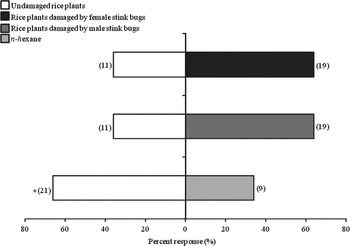
Telenomus podisi females were more attracted to volatiles obtained from air-entrainment extracts of rice plants damaged by female stink bugs then those obtained from undamaged plants (χ2=7.20, P=0.014). No such preference was observed for air-entrainment extracts of rice plants damaged by male stink bugs (χ2=3.36, P=0.108) (fig. 2). Telenomus podisi females also preferred undamaged plants compared to n-hexane (χ2=7.14, P=0.016) (fig. 2).
Response (% of tested insects) of Telenomus podisi females to extracts of plants (Oryza sativa) damaged by herbivory by both genders of Tibraca limbativentris. *Significantly different according to a χ2 test (P<0.05). Numbers in brackets represent the number of responsive insects.

In contrast, T. basalis did not prefer volatiles obtained from air-entrainment extracts of damaged or undamaged plants by both genders of T. limbativentris (χ2=4.26; P=0.071) (fig. 3). However, they preferred volatiles obtained from air-entrainment extracts of undamaged plants to n-hexane (χ2=7.69; P=0.006) (fig. 3).
Response (% of tested insects) of Trissolcus basalis females to extracts of plants (Oryza sativa) damaged by herbivory by both genders of Tibraca limbativentris. *χ2 test (P<0.05). Numbers in brackets represent the number of responsive insects.

Chemical analysis
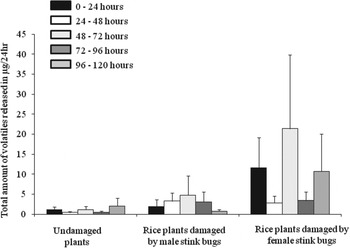
The total amount of volatiles produced by rice plants differed between treatments (ANODEV; χ2=16.87; df=2; P<0.001), but did not change, in the same treatment, along the time (ANODEV; χ2=0.0030; df=2; P=0.95). A contrast analysis showed that the total amount of volatiles from undamaged rice was marginal different from those emitted by female herbivory-damaged plants (t=1.89, df=97.2, P=0.06), but did not differ from those emitted by plants fed by males (t=0.89, df=97.2, P=0.42). There was no difference between the total amount of volatiles released by males and females herbivory plants (t=1.73, df=97.2, P=0.09) (fig. 4).
Total amount of volatiles (mean + SEM) obtained from undamaged plants (control) and damaged rice plants (Oryza sativa) by herbivory of Tibraca limbativentris males and females, in each treatment in each 24 h period, over 5 days of aeration. There is no difference over the 5 days under the same treatment (ANODEV; χ2=0.0030; df=2; P=0.95) but there is an effect among the treatments (ANODEV; χ2=16.87; df=2; P<0.001).

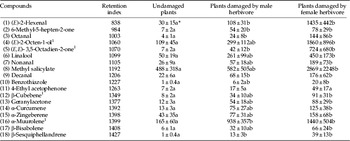
Considering the compounds individually there were quantitative differences between undamaged and damaged plants without considering the time (Kruskal–Wallis, P<0.05) (Table 1). The compounds (E)-2-hexenal (H=15.11; df=2; P<0.05), octanal (H=19.55; df=2; P<0.05), and decanal (H=22.22; df=2; P<0.05), the ketones 6-methyl-5-hepten-2-one (H=13.26; df=2; P<0.05) and (E,E)-3,5-octadien-2-one (H=10.13; df=2; P>0.05), and the terpenoids β-sesquiphellandrene (H=30.53; df=2; P<0.05) and α-muurolene (H=11.06; df=2; P<0.05) were released in greater amounts by rice plants damaged by T. limbativentris males and females than by undamaged plants (Table 1). In addition to these compounds, rice plants damaged by female T. limbativentris also released greater amounts of the following compounds than undamaged rice plants: linalool (H=11.10; df=2; P<0.05), α-zingeberene (H=10.39; df=2; P<0.05), β-bisabolene (H=6.90; df=2; P<0.05), β-cubebene (H=6.97; df=2; P<0.05) e α-curcumene (H=8.45; df=2; P<0.05), (E)-2-octen-1-ol (H=6.80; df=2; P<0.05), benzothiazole (H=12.53; df=2; P<0.05), nonanal (H=8.81; df=2; P<0.05), methyl salicylate (H=6.10; df=2; P<0.05), and geranylacetone (H=6.48; df=2; P<0.05).
Mean (±SE) (ng/24 h spanning from 24 to 120 h) of volatile compounds collected from undamaged and damaged rice plants (Oryza sativa) by herbivory of Tibraca limbativentris males and females. The retention index was calculated using a DB5 column.

* Different letters, in the same row, indicate significantly different means by Kruskal–Wallis test and Dunn contrast, at a 5% confidence level.
1 Tentatively identified compounds.
Discussion
Tibraca limbativentris females and both parasitoids responded to volatiles from undamaged plants, suggesting that these insects use information from plants to locate resources. Many insects are known to use chemical volatiles from plants as cues to find their hosts (Bruce & Pickett, Reference Bruce and Pickett2011; Hare, Reference Hare2011; Fürstenberg-Hägg, Reference Fürstenberg-Hägg, Zagrobelny and Bak2013). In addition, T. limbativentris females did not respond to plants damaged by conspecifics, suggesting that they can avoid previously infested plants, thereby reducing competition for oviposition and feeding sites (Dicke & Van Loon, Reference Dicke and Van Loon2000). Similar results were observed for the stink bug Lygus rugulipennis Poppius (Heteroptera: Miridae) (Frati et al., Reference Frati, Salerno, Conti and Bin2008). Rice stem bug males seem do not use semiochemicals from plants to distinguish damaged from undamaged plants. In general, insects of both sexes use semiochemicals from plants to find feeding and mating sites, whereas females also use them to find adequate sites for oviposition (Metcalf & Metcalf, Reference Metcalf and Metcalf1992). Some studies have shown that when the male is the sex or aggregation pheromone producer they arrive first on plants and attract females using pheromones that may combine with plant volatiles to enhance attractiveness to females (Addesso & Mcauslane, Reference Addesso and Mcauslane2009; Addesso et al., Reference Addesso, Mcauslane and Alborn2011; Zhang et al., Reference Zhang, Ma, Yang, Byers, Klein, Zhao and Luo2011; Sun et al., Reference Sun, Wang, Gao and Chen2012). Tibraca limbativentris males did not respond to air-entrainment extract from undamaged or herbivory-damaged rice plants, but it might respond to host plant volatiles. Additional studies are necessary to confirm this hypothesis.
Telenomus podisi females preferred volatiles of undamaged plants compared to the control (n-hexane) and also showed a significant preference for rice plants damaged by female over undamaged ones. The selection by natural enemies involves, basically, host location and recognition (Vinson, Reference Vinson, Bell and Cardé1984, Reference Vinson, Kerkut and Gilbert1985). These two steps contain several processes where chemical, physical, vibrational, and visual cues are used to identify the appropriate host. Chemical information plays a crucial role in host location and can be produced by the plant, the herbivore or host. In general information from plants, such as herbivory or oviposition-induced volatiles and information from the herbivore are used as medium or long-range cues for locating the host (Price et al., Reference Price, Bouton, Gross, McPheron, Thompson and Weis1980; Turlings et al., Reference Turlings, Tumlinson and Lewis1990; Vet & Dicke, Reference Vet and Dicke1992; Dicke, Reference Dicke1994; Borges et al., Reference Borges, Schmidt, Sujii, Medeiros, Mori, Zarbin and Ferreira1998; De Moraes et al., Reference De Moraes, Lewis, Pare, Alborn and Tumlinson1998; Turlings et al., Reference Turlings, Lengwiler, Bernasconi and Wechsler1998; Dicke & Van Loon, Reference Dicke and Van Loon2000; Hoballah & Turlings, Reference Hoballah and Turlings2001; Kessler & Baldwin, Reference Kessler and Baldwin2002; Moraes et al., Reference Moraes, Laumann, Sujii, Pires and Borges2005; Howe1 & Jander, Reference Howe and Jander2008; Moraes et al., Reference Moraes, Birkett, Gordon-Weeks, Smart, Martin, Pye, Bromilow and Pickett2008a ). Plant volatiles are easily detectable, but less reliable than volatiles from the herbivore. Therefore parasitoids use plant volatiles but also other cues that are more reliable such as footprints and egg composition, as well as texture, colour, and vibrational information from eggs (Borges et al., Reference Borges, Colazza, Ramirez-Lucas, Chauhan, Moraes and Aldrich2003; Laumann et al., Reference Laumann, Aquino, Moraes, Pareja and Borges2009, Reference Laumann, Cokl, Lopes, Ferreira, Moraes and Borges2011; Aquino et al., Reference Aquino, Dias, Borges, Moraes and Laumann2012). Nevertheless, egg parasitoids can gain more reliable information from volatiles induced from plants by oviposition damage (Meiners & Hilker, Reference Meiners and Hilker1997, Reference Meiners and Hilker2000; Colazza et al., Reference Colazza, Mcelfresh and Millar2004a , Reference Colazza, Fucarino, Peri, Salerno, Conti and Bin b ; Hilker & Meiners, Reference Hilker and Meiners2010) or, as shown in this work, from plants damaged by females, which offer a more consistent indication that their host (eggs) will be present.
The generalist parasitoid T. basalis did not show a significant preference to herbivory-damaged plants in this study, but preferred undamaged plants to n-hexane. Although T. basalis did not exhibit a significant preference for the odour of herbivory-damaged plants, there was a tendency that the wasps preferred the odour of infested plants to the odour of non-infested plants and it preferred the odour from non-infested plants compared to hexane.
This species parasitizes eggs of different stink bug species (Colazza et al., Reference Colazza, Salerno and Wajnberg1999, Reference Colazza, Bue, Giudice and Peri2009; Loch, Reference Loch2000), but has not been recorded parasitizing T. limbativentris eggs in natural conditions; only T. podisi and T. urichi have been recorded doing so (Maciel et al., Reference Maciel, Lemos, Souza, Costa, Barrigossi and Chagas2007; Riffel et al., Reference Riffel, Prando and Boff2010). This could explain why T. basalis did not differentiate between herbivory-damaged plants. In another study with T. basalis, the parasitoid did not respond to soybeans injured by another non-preferred host species, the brown stink bug, E. heros (Lopes et al., Reference Lopes, Diniz, Moraes, Borges and Laumann2012).
Rice plants at the V8 physiological stage show an altered chemical profile of volatiles when damaged by male and female T. limbativentris herbivory, and this profile included common volatile plant compounds that have been identified in previous studies in different systems (Turlings et al., Reference Turlings, Lengwiler, Bernasconi and Wechsler1998; Rodriguez-Saona et al., Reference Rodriguez-Saona, Crafts-Brandner, Williams and Paré2002; Scutareanu et al., Reference Scutareanu, Bruin, Posthumus and Drukker2003; Blackmer et al., Reference Blackmer, Rodriguez-Saona, Byers, Shope and Smith2004; Colazza et al., Reference Colazza, Mcelfresh and Millar2004a ; Yan & Wang, Reference Yan and Wang2006; Cheng et al., Reference Cheng, Xiang, Li, Yang, Hu, Wang, Lou and Chen2007; Moayeri et al., Reference Moayeri, Ashouri, Poll and Enkegaard2007; Hu et al., Reference Hu, Shen, Shen, Luo and Su2009; Gomi et al., Reference Gomi, Satoh, Ozawa, Shinonaga, Sanada, Sasaki, Matsumura, Ohashi, Kanno, Akimitsu and Takabayashi2010; Williams et al., Reference Williams, Blackmer, Rodriguez-Saona and Zhu2010). In this study, we observed an induction of the indirect defence of rice plants when damaged by rice stem bug female, and several HIPVs were released in higher amount comparing to undamaged plants. A similar result was observed in a different system with rice injured by Sogatella furcifera (Hovarth) (Hemiptera: Delphacidae), in which the main compounds induced were (E)-2-hexenal, methyl salicylate and β-sesquiphellandrene (Gomi et al., Reference Gomi, Satoh, Ozawa, Shinonaga, Sanada, Sasaki, Matsumura, Ohashi, Kanno, Akimitsu and Takabayashi2010). Several other studies in different systems have shown that the relative composition of the volatiles blends provide the most important information used by insects as host-finding cues (Heil & Ton, Reference Heil and Ton2008; Moraes et al., Reference Moraes, Laumann, Pareja, Sereno, Michereff, Birkett, Pickett and Borges2009; Bruce et al., Reference Bruce, Midega, Birkett, Pickett and Khan2010; Michereff et al., Reference Michereff, Laumann, Borges, Michereff-Filho, Diniz, Neto and Moraes2011).
Plants damaged by T. limbativentris females released greater amounts of specific volatiles such as linalool, methyl salicylate, and sesquiterpenes than undamaged plants. Similar results were observed in soybean plants injured by both sexes of E. heros (Moraes et al., Reference Moraes, Laumann, Sujii, Pires and Borges2005). The differences observed in the chemical compounds released following plant damage by conspecifics of different genders could be associated with the time spent by insects feeding on the plants or with the volume of saliva production (Moraes et al., Reference Moraes, Laumann, Sujii, Pires and Borges2005). Females could require greater amounts of resources to guarantee the viability of their descendants, so they should feed for longer periods than males, and consequently cause greater damage to plants. Further studies are necessary to confirm this hypothesis.
Three substances that were identified as HIPVs, nonanal, decanal and the ketone 6-methyl-5-hepten-2-one are present in the blend of defensive compounds of T. limbativentris (Borges et al., Reference Borges, Birkett, Aldrich, Oliver, Chiba, Murata, Laumann, Barrigossi, Pickett and Moraes2006; Moraes et al., Reference Moraes, Pareja, Laumann and Borges2008b ). We thus cannot determine whether these compounds are from plants or insects, but since other insect defensive compound of the rice stem bug, such as tridecane, which is the major and most common in stink bugs (Borges et al., Reference Borges, Birkett, Aldrich, Oliver, Chiba, Murata, Laumann, Barrigossi, Pickett and Moraes2006; Moraes et al., Reference Moraes, Pareja, Laumann and Borges2008b ; Oliveira, Reference Oliveira, Borges, Andrade, Laumann, José Barrigossi and Blassioli-Moraes2013), was not present in the plant extract, we believe the increase of these volatiles was related to the herbivory, as shown for other HIPVs observed in this work.
The results of this study showed that female T. limbativentris can recognize and prefer rice plants not infested by conspecifics, and also that the indirect defence of rice plants was induced. These results offer additional support for studies using plant semiochemicals to manage natural enemies and pests in field conditions. A further work by using CG-EAD (Coupled Gas Chromatography - Electroantennographic Detection) technique will be conducted to better understand T. limbativentris antennal perception to volatile plant differences.
However, there are still a large number of questions to answer before field studies are undertaken. For example, studies are needed to understand the importance of individual and mixed plant semiochemicals for natural enemy response, and to determine whether induced rice plants can repel T. limbativentris females in the field. Such a strategy could potentially be applied to minimize pest populations in rice crops.