Introduction
The Southern Ocean is peculiar for its relatively short food web (Corbisier et al. Reference Corbisier, Petti, Skowronski and Brito2004, Cornejo-Donoso & Antezana Reference Cornejo-Donoso and Antezana2008); therefore, changes in the structure of phytoplankton assemblages may be rapidly reflected in all trophic compartments (Medlin & Priddle Reference Medlin and Priddle1990, Moline et al. Reference Moline, Claustre, Frazer, Schofield and Vernet2004, Cornejo-Donoso & Antezana Reference Cornejo-Donoso and Antezana2008, Ribic et al. Reference Ribic, Chapman, Fraser, Lawsond and Wiebe2008). Phytoplankton are influenced by chemical (e.g. nutrients, salinity) and physical (e.g. temperature, pH) properties of water masses (Hewes Reference Hewes2009), and by environmental factors such as the wind regime, turbulence and solar radiation. In certain coastal areas of the western Antarctic Peninsula (WAP), winds induce upwellings leading to the resuspension of benthic organisms, such as diatoms, and sediments that carry nutrients to the water column but increase turbidity, reducing light availability for primary production (Brandini & Rebello Reference Brandini and Rebello1994, Schloss et al. Reference Schloss, Ferreyra and Ruiz-Pino2002). Moreover, light availability regulates primary production rates and the taxonomic composition of phytoplankton assemblages, mainly due to the physiological response of each species when exposed to different light intensities (Mills et al. Reference Mills, Kropuenske, van Dijken, Alderkamp, Berg, Robinson, Welschmeyer and Arrigo2010).
Phytoplankton assemblages in surface waters of the WAP are dominated by nanoplankton (2–20 µm) (Montes-Hugo et al. Reference Montes-Hugo, Vernet, Martinson, Smith and Iannuzzi2008). However, microphytoplanktonic (20–200 µm) diatoms contribute significantly to the high biomass in blooms (Moline et al. Reference Moline, Prézelin, Schofield and Smith1997, Schloss et al. Reference Schloss, Ferreyra and Ruiz-Pino2002, Kopczynska Reference Kopczynska2008). During the last 30 years, warming of the WAP northern waters (including Bransfield Strait) has resulted in increased cloud cover (shading) and wind speed (water column mixing), and decreased ice sheet extent (Montes-Hugo et al. Reference Montes-Hugo, Doney, Ducklow, Fraser, Martinson, Stammerjohn and Schofield2009). Although the influence of these processes in coastal areas is still under investigation (Schloss et al. Reference Schloss, Ferreyra and Ruiz-Pino2002, Pichlmaier et al. Reference Pichlmaier, Aquino, Da-Silva and Braun2004, Kopczynska Reference Kopczynska2008), it has been observed that phytoplankton cell size has decreased in open ocean waters. Typically, the largest microalgae (microplanktonic diatoms) are associated with ice field edges, where light becomes available as the mixed layer shoals (Montes-Hugo et al. Reference Montes-Hugo, Doney, Ducklow, Fraser, Martinson, Stammerjohn and Schofield2009). However, changes in the wind regime may have favoured advection of the chlorophyll-poor Weddell Sea waters into Bransfield Strait, as opposed to the productive waters from Bellingshausen Sea (Montes-Hugo et al. Reference Montes-Hugo, Doney, Ducklow, Fraser, Martinson, Stammerjohn and Schofield2009).
In the central waters of Admiralty Bay (AB), King George Island, microphytoplankton generally originates from Bransfield Strait (Kopczynska Reference Kopczynska2008). In the coastal areas of AB, the microphytobenthos is suspended throughout the water column by coastal upwellings (Brandini & Rebello Reference Brandini and Rebello1994, Schloss et al. Reference Schloss, Ferreyra and Ruiz-Pino2002) and advection of water bodies caused by continental ice melt (Pichlmaier et al. Reference Pichlmaier, Aquino, Da-Silva and Braun2004, Nedzarek Reference Nedzarek2008). Physical processes (i.e. water advection) generated by winds and continental freshwater runoff are also responsible for increased water turbidity (Pichlmaier et al. Reference Pichlmaier, Aquino, Da-Silva and Braun2004), which decreases light penetration in the water column and, consequently, limits primary production.
It is possible to detect changes in Antarctic coastal ecosystems by monitoring trends in the successional patterns of phytoplankton populations. Interannual variations in phytoplankton composition are more evident than changes in biomass or productivity, as these represent high short-term variability (Moline & Prézelin Reference Moline and Prézelin1996). At the Antarctic Peninsula, the strong short-term variability of physical processes reflects oscillations in marine primary production (Schloss et al. Reference Schloss, Ferreyra and Ruiz-Pino2002). Consequently, terrestrial biological systems are altered, as marine primary producers are the main energy suppliers for the coastal terrestrial food web (Medlin & Priddle Reference Medlin and Priddle1990, Ribic et al. Reference Ribic, Chapman, Fraser, Lawsond and Wiebe2008).
Considering the temporal variability of climate conditions in the WAP and its influence on the phytoplankton structure, the objective of this study was to associate the temporal and spatial variation in phytoplankton (>15 µm) size structure and species composition with changes in hydrological variables during four summers (2002–03, 2003–04, 2007–08 and 2008–09) in the shallow (<30 m) coastal waters of AB.
Material and methods
Study area
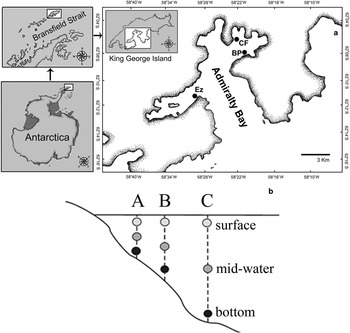
Admiralty Bay is a deep embayment located at King George Island (South Shetland Islands, Antarctic Peninsula) at approximately 62°S and 58°W (Fig. 1a). It covers an area of 122 km2 and the depth exceeds 600 m at the central basin, but at the three inlets (Ezcurra, Mackelar and Martel) does not exceed 150 m (Robakiewicz & Rakusa-Suszczewski Reference Robakiewicz and Rakusa-Suszczewski1999). This fjord-like shape reflects a strong glacial influence, subject to freshwater input and high water column turbidity caused by the suspension of soft sediments (Pichlmaier et al. Reference Pichlmaier, Aquino, Da-Silva and Braun2004). The connection between inner waters and the open ocean (Bransfield Strait) occurs through a wide southward opening. The influence of wind and tidal variations on circulation is more intense in shallow areas, especially at the western side of the bay (Robakiewicz & Rakusa-Suszczewski Reference Robakiewicz and Rakusa-Suszczewski1999) where wind plays an important role as a primary production regulator (Brandini & Rebello Reference Brandini and Rebello1994). Freshwater runoff enriched with guano and fragments of macroalgae are important sources of organic matter and nutrients to the bay (Nedzarek Reference Nedzarek2008).
a. The three sampling sites at Admiralty Bay: Comandante Ferraz (CF; near Comandante Ferraz Station, Brazil), Botany Point (BP) and Ezcurra (EZ; near Arctowski Station, Poland). b. Local depths (A 20 m, B 30 m, C 60 m) and approximate sampling depths at each sampling site.

Sampling methods and phytoplankton analysis
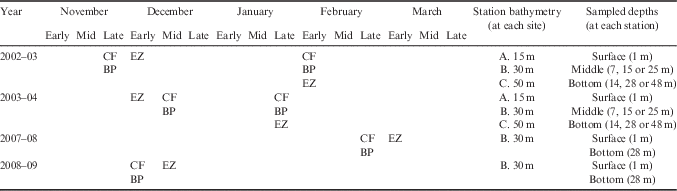
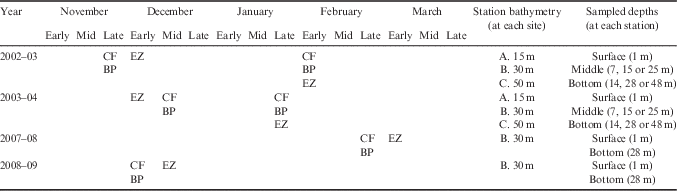
Admiralty Bay was surveyed during six sampling periods: early and late summer in 2002–03 (27 November–10 December 2002 and 3–10 February 2003), early and mid-summer in 2003–04 (1–12 December 2003 and 16–23 January 2004), late summer in 2007–08 (21 February–5 March 2008) and early summer in 2008–09 (8–14 December 2008) (Table I). Samples were collected near the Brazilian Antarctic Station Comandante Ferraz (CF; 62.082°S, 58.385°W) and at two other sites (Fig. 1a): Botany Point (BP; 62.100°S, 58.353°W) and Ezcurra (EZ; 62.157°S, 58.481°W). Botany Point is distant from any anthropogenic activity. At each site, three sampling stations were established following the bathymetries of 20 m (stn A), 30 m (stn B) and 60 m (stn C) (Fig. 1b). At each station, samples were collected from the surface, mid-water and near the bottom (Table I).
Sampling seasons, sites sampled (BP=Botany Point, CF=Comandante Ferraz, EZ=Ezcurra), station bathymetry at each site and sampled depths at each station in Admiralty Bay.
The 164 water samples were collected using 3-l Van-Dorn bottles, stored in 1-l dark polypropylene bottles and mixed with borax-buffered formaldehyde (4%). Phytoplankton was analysed according to the method of Utermöhl (Reference Utermöhl1958), where cells were allowed to settle in 50–100 ml chambers for 48–72 hours depending upon cell concentration. By using an inverted microscope (Olympus® IX70) equipped with phase contrast at a magnification of 200×, organisms >15 µm were analysed in the whole counting chamber. A higher magnification (400×) was used to identify the smallest taxa. Differential interference contrast (DIC) was also used for the identification of diatoms.
Data from remote sensing (MODIS-Aqua, 4-km resolution) of sea surface temperature (SST) and chlorophyll from an adjacent area at Bransfield Strait located near the entrance of AB (62°S to 62.5°S, 57.5°W to 59°W) were acquired from the Giovanni Online Data System (Ocean Color Project, NASA, accessed 18 January 2012, http://disc.sci.gsfc.nasa.gov/giovanni/overview/index.html). The monthly Antarctic Oscillation Index (AAO) was calculated and provided by the Climate Prediction Center, National Oceanic and Atmospheric Administration (NOAA, http://www.cpc.ncep.noaa.gov/products/precip/CWlink/daily_ao_index/aao/aao.shtml2011, accessed 28 December 2011). Data for air temperature, precipitation, solar radiation and wind were acquired from sensors installed at CF, where equipment and datasets are maintained by the Brazilian National Institute for Space Research (http://www.cptec.inpe.br/antartica/antartica.shtml, accessed 15 December 2009). The average wind speed used in the statistical analyses was calculated for the 24 hours prior to sampling.
In situ temperature measurements were performed using protected reversion thermometers, and salinity was measured using a Beckman inductive salinometer. In 2002–03 and 2003–04, nutrient samples were collected using Go-flo bottles (General Oceanic), filtered through Whatman GF/F filters and stored in polyethylene flasks previously washed with HCl 1:1 and rinsed with distilled water. The filtered water samples were frozen (-20°C) for further analysis. Analyses of nitrate and nitrite were performed using an Auto Analyzer II Bran-Luebbe®. Silicate and phosphate analyses were processed by a spectrophotometric method and measured in a Genesys II spectrophotometer (Bausch & Lomb). All analyses followed the recommendations in Grasshoff et al. (Reference Grasshoff, Erhardt and Kremling1999). Chlorophyll a was extracted from 1 litre filtered samples (Whatman GF/F filters), frozen (-20°C) and determined by fluorimetry after extraction in 90% acetone, using a Turner Designs TD-700 fluorometer (Parsons et al. Reference Parsons, Maita and Lalli1984). In 2007–08 and 2008–09, inorganic nutrients were also analysed using the following methods: ammoniacal nitrogen by indophenols, nitrite by diazotation, nitrate by reduction in Cd-Cu column followed by diazotation, total nitrogen by digestion with potassium persulfate following nitrate determination, orthophosphate by reaction with ascorbic acid, total phosphorous by acid digestion to phosphate, and silicate by reaction with molibdate. Chlorophyll a analysis was performed after vacuum filtration (<25 cm of Hg). The filters (cellulose membrane Millipore HAWP 0.45 µm) were extracted overnight in 90% acetone at -20°C, and analysed with a UV-VIS Perkin Elmer Lambda 20 spectrophotometer (Parsons et al. Reference Parsons, Maita and Lalli1984).
Data analysis and statistics
Basic statistics for environmental data (mean, standard deviation, Spearman correlation and cross-correlation r, and p-values) were calculated using Microsoft Excel, Statsoft Statistica 6.0 and Past. Principal component analysis (Statistica 6.0) was used to visualize interactions between abiotic components. The influence of abiotic variables on phytoplankton was evaluated through a canonical correspondence analysis (CCA; CANOCO 4.5).
Although microphytoplankton classically comprises cells ranging from 20–200 µm (Sieburth et al. Reference Sieburth, Smetacek and Lenz1978), 15–20 µm cells were also included in this study as their abundance and main taxonomic groups (diatoms and dinoflagellates) are similar to conventional microphytoplankton in Antarctica (Medlin & Priddle Reference Medlin and Priddle1990, Schloss et al. Reference Schloss, Ferreyra and Ruiz-Pino2002, Kopczynska Reference Kopczynska2008). Therefore, phytoplankton cells >15 µm were identified and quantified in order to assess variations in the microphytoplankton structure. Phytoplankton cells were grouped into three size classes: 15–30 µm, 31–80 µm and >80 µm. These size classes allow a more detailed trophic approach, considering that the food selection by local herbivores depends on the size of particles they can capture with their mouth apparatus (Opalinski et al. Reference Opalinski, Maciejewska and Georgieva1997). Phytoplankton was further divided into four taxonomic groups for statistical analyses: pennate diatoms, centric diatoms, dinoflagellates and cyanobacteria.
In each of the four sampling years, taxa with abundance lower than the mean abundance of all species were considered ‘rare’, and were not included in any species level analyses (cluster analysis and SIMPER routine). In order to normalize distributions and eliminate zero values, phytoplankton abundance data were log-transformed as log10 (x+1). Percentages were normalized using the square root when proportions were compared. Phytoplankton abundance and environmental data from different sampling years and sites were compared using a one-way ANOVA with a Fisher-LSD test (P<0.05) and Spearman correlation (r). Samples were grouped according to the abundance of each species through a cluster analysis using Ward’s Method (Past 1.8). The similarity percentages (SIMPER; Primer 6.0) routine was used to identify the most important species in the groups established by the cluster analysis.
Results
Environmental patterns
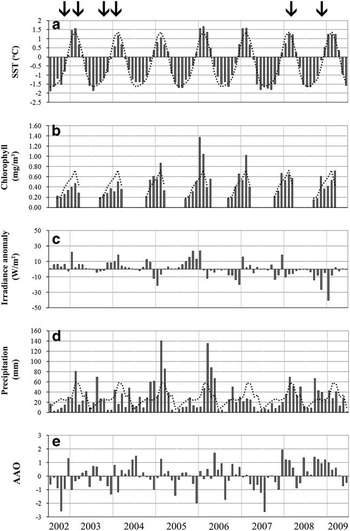
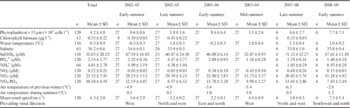
Temporal variations of temperature and chlorophyll in surface waters surrounding King George Island show similar patterns to the shallow coastal waters of AB (Table II). According to satellite data (MODIS-Aqua 4-km), the slight increase in SST from 2002 to 2009 was coupled with a small rise in chlorophyll in the surface waters of Bransfield Strait (Fig. 2a & b). The decrease in solar radiation (Fig. 2c) was indicative of denser or more frequent cloud cover and higher precipitation (Fig. 2d). The AAO went from a predominantly negative to a positive phase from 2002 to 2009 (Fig. 2e). The highest surface chlorophyll values in adjacent open waters (Bransfield Strait) were associated with years when the AAO was in a transition between phases, showing values nearest to zero (i.e. summers of 2004–05, 2005–06 and 2006–07). Therefore, the shallow coastal waters of AB were sampled during the least productive summers (e.g. 2002–03, 2003–04, 2007–08 and 2008–09) in Bransfield Strait, when chlorophyll concentrations were mostly below the climatological average for each month (Fig. 2b).
Climatology from 2002–09 (dashed line) and monthly values. a. Sea surface temperature (SST) and b. chlorophyll estimated from Aqua-MODIS remote sensors (INPE), c. irradiance anomaly and d. precipitation measured in situ, and e. Antarctic Oscillation Index (AAO). Arrows indicate the sampling periods.

Number of samples or measurements (n), mean and standard deviation (SD) of each variable in coastal waters of Admiralty Bay.

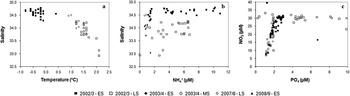
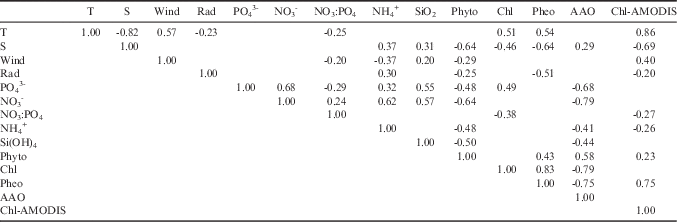
In the shallow waters of AB, the temperature rise observed in the last two sampling periods was associated with a slight decrease in salinity and nutrient concentrations (Table II). However, the N:P ratio (NO3:PO4=11±4) did not vary over time (Table II), being below the Redfield N:P ratio (N:P=16). The terrestrial inputs of nitrogen (mainly ammonium) and phosphorus (phosphate) are very high and occur in locally-concentrated pulses in these shallow areas. Therefore, it is possible that the high variations in the N:P ratio are caused by these input pulses rather than by variations in uptake rates by phytoplankton, which did not vary in abundance. The summer of 2002–03 was characterized by low water temperature and high salinity early in the season, while temperature increased and salinity decreased during late summer (Table II, Fig. 3a). Concentrations of nutrients (ammonium, nitrate, silicate) were lower at the end of summer (Fig. 3b & c), but phosphate concentrations increased (Table II). The same pattern was observed in the summer of 2003–04 (Table II), most evident at EZ. At BP in late summer 2007–08, high water temperatures occurred simultaneously with low salinity and high levels of silicate, phosphate and nitrate (Table II), in contrast to previous years. In the 2008–09 early summer, the negative correlation between ammonium and salinity (Table III) was more evident at BP, where salinity was low (33.5±0.7) and ammonium was high (1.245±0.304 µmol l-1) compared to mean values for this period (Table II).
Relationships between a. temperature and salinity, b. salinity and ammonium (NH4 +), c. phosphate (PO4 3-) and nitrate (NO3 -) in coastal waters of Admiralty Bay during the periods when data of both variables were available. ES=early summer, MS=mid-summer, LS=late summer.

Correlation (Spearman r) between environmental and biological variables in Admiralty Bay, Antarctic Peninsula (only significant r values (P<0.05) are displayed.
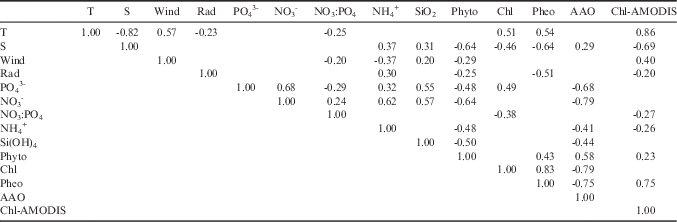
AAO=Antarctic Oscillation Index, chl=in situ chlorophyll biomass, chl-AMODIS=chlorophyll from Aqua-MODIS, NH4 +=ammonium, NO3 -=nitrate, pheo=in situ pheophytin, phyto=phytoplankton abundance, PO4 3-=phosphate, rad=solar radiation, S=in situ salinity, SiO2=silicate, T=in situ seawater temperature, wind=wind speed.
In summary, the summers of 2002–03 and 2007–08 were characterized by a cold preceding winter (-4.9 and -6.3°C, compared to -3.4 and -2.6°C in 2003–04 and 2008–09, respectively) and low AAO indexes (negative values down to -2.5 in 2002 and 2007, compared to predominantly positive values up to 2.1 in 2004 and 2008) (Fig. 2). Consequently, late continental ice melt occurred in 2002–03 and 2007–08, coinciding with high nutrient levels (r >0.41, P>0.05, Table III) (see Table II for nutrient concentrations). In general, water temperature was higher (>1.0°C) and salinity was lower (< 34) in mid- and late summer when compared to early in the season (<1.0°C and >34, respectively) (Table II, Fig. 3a). Ammonium concentrations were associated with high temperatures (r=0.37, P <0.05) and low salinities (r=-0.37, P<0.05) (Table III, Fig. 3b).
Phytoplankton changes over time
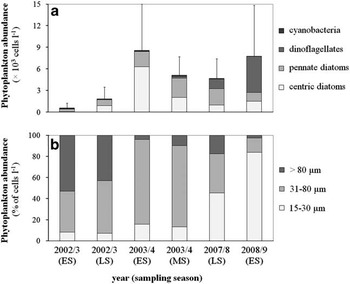
The average abundance of phytoplankton (>15 µm) was generally low (4.2×10³ ± 4.8×10³ cells l-1), and showed high variability over time, with a shift in the dominant taxonomic groups (Fig. 4a) reflected in a decrease in cell size (Fig. 4b). Large diatoms (> 31 µm) represented more than 90% of the phytoplankton abundance in the 2002–03 and 2003–04 summers, while there was a significant increment of small dinoflagellates in 2007–08 (30%) and 2008–09 (65%). Cyanobacteria were represented more during the 2002–03 summer (5%), and their contribution decreased in the following years (Fig. 4a).
Phytoplankton (>15 µm) mean abundance (and standard deviation) showing a. the contribution of taxonomic groups and b. contribution (%) of cell size classes in coastal waters of Admiralty Bay during early (ES), mid-summer (MS) or late summer (LS) of 2002–03, 2003–04, 2007–08 and 2008–09.

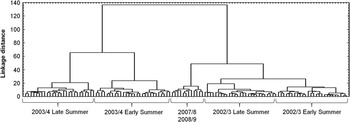
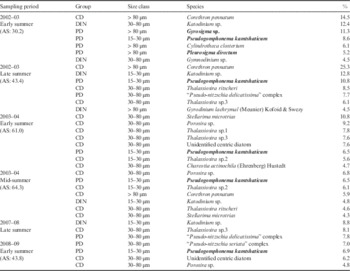
A cluster analysis (Fig. 5) identified five groups, according to the dominant species and their contribution in each period (Table IV). This analysis showed that the spatial variability of phytoplankton populations was negligible when compared to temporal changes. The lowest phytoplankton concentrations occurred in 2002–03 (1.2×10³±1.4×10³ cells l-1, P<0.01), when diatoms >80 µm were the most representative (45%) (Fig. 4b), including species such as Corethron pennatum (Grunow) Ostenfeld, Pleurosigma directum Grunow, Gyrosigma sp., Fragilariopsis ritscheri Hustedt, Navicula directa (Wm. Smith) Ralfs (see Table IV). In the summer of 2003–04, low wind speeds (2.2 m s-1 east in early summer) favoured an increase in phytoplankton abundance (6.8×10³±5.1×10³ cells l-1), characterized by the dominance (80%) of mid-sized cells (31–80 µm) (Fig. 4b) represented mainly by centric (Thalassiosira spp., Porosira sp., Stellarima microtrias (Ehrenberg) Hasle & Sims, Actinocyclus actinochilus (Ehrenberg) Simonsen) and pennate (Pseudogomphonema kamtshaticum (Grunow) Medlin, Achnanthes spp., F. striatula) diatoms (Fig. 5, Table IV). In contrast, small (15–30 µm) dinoflagellates (e.g. Katodinium sp.) became dominant in 2007–08 and 2008–09 (Fig. 4a & b). These dinoflagellates were responsible for the highest abundances in 2008–09 (7.7×10³±7.1×10³ cells l-1), associated with the drop in nutrient levels (Table II & III). The contribution of planktonic diatoms (Thalassiosira spp., Pseudo-nitzschia spp.) and the benthic diatom Pseudogomphonema kamtshaticum was also important in later years (Fig. 5, Table IV). The relative abundance of large cells (>80 µm) was highest in the coldest years (2002–03 and 2007–08) (Table IV, Fig. 4) when continental ice was still present during the summer. However, in 2002–03 these large cells were benthic diatoms, as previously cited, while in 2007–08 these cells were represented by diatoms from the Pseudo-nitzschia seriata complex (Cleve) H.Peragallo, mainly Pseudo-nitzschia cf. heimii Manguin.
Cluster analysis of the abundance of each species in water samples from the shallow coastal waters of Admiralty Bay (Ward’s Method, Euclidean Distance).

Species that most contributed to the similarity of samples within groups identified by the cluster analysis.

%=percentage contribution of each species in the group.
AS=average similarity of the sampling groups at each period, CD=centric diatom, DIN=dinoflagellates, PD=pennate diatom.
Benthic species are indicated in bold.
Seasonal variations in phytoplankton were distinct in the first two sampling years. In early summer 2002–03 a lower phytoplankton abundance was observed (0.5×10³±0.7×10³ cells l-1, Fig. 4a), composed of the centric diatom C. pennatum, chain-forming pennate diatoms such as F. cf. ritscheri, Navicula spp. and F. striatula, and epiphytic species such as Pleurosigma directum, Gyrosigma spp., Pseudogomphonema kamtshaticum and Licmophora spp. (data not shown). During late summer there was a rise in phytoplankton abundance (1.8×10³±1.7×10³ cells l-1, Fig. 4a) due to an increase in the abundance of the epontic centric diatom C. pennatum (Fig. 4b) and planktonic diatoms like Thalassiosira spp. and Pseudo-nitzschia delicatissima complex (Fig. 5, Table IV). In 2003–04 phytoplankton abundance was highest during early summer (8.6×10³±6.4×10³ cells l-1, Fig. 4a) when compared to mid-summer (5.1×10³±2.6×10³ cells l-1, Fig. 4a). High abundances in early summer were driven by planktonic centric diatoms (Fig. 4b) such as Thalassiosira spp., Porosira sp., A. actinochilus and S. microtrias. (Fig. 5, Table IV). Conversely, during mid-summer the drop in centric diatom abundance lead to a higher contribution of large diatoms (e.g. C. pennatum, Thalassiosira ritscheri (Hustedt) Hasle) and the dinoflagellate Katodinium sp. (Fig. 5, Table IV).
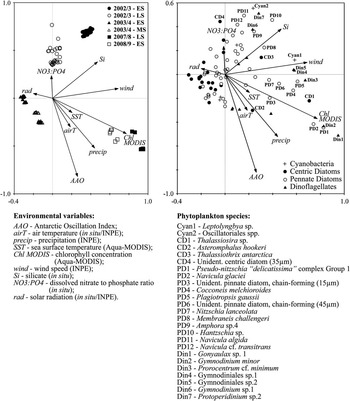
To summarize the influence of environmental variables driving temporal changes on phytoplankton assemblages, a CCA was performed (Fig. 6), which explained 35.7% of the variation of data. The analysis showed that interannual changes were more evident than the interseasonal variability of phytoplankton populations (Fig. 6a), influenced mainly by the AAO (weight=0.196, F=8.97, P<0.01). The AAO reflects (and/or co-varies with) changes in the air temperature (r=0.63) and SST (r=0.43), precipitation (r=0.86), winds (r=0.24) and solar radiation (r=-0.29). Among those environmental parameters, precipitation showed the largest influence (weight=0.165, F=8.04, P<0.01) over phytoplankton populations. High precipitation levels (especially in the summers of 2007–08 and 2008–09) coincided with high chlorophyll a concentrations, associated with the presence of the diatoms N. glaciei Van Heurck, Pseudo-nitzschia delicatissima complex (Hasle) and chain-forming Thalassiosira spp., and the dinoflagellates Gonyaulax sp. and Gymnodinium minor Lebour (Fig. 6b). Benthic pennate diatoms (Hantzschia sp., N. algida Grunow, N. transitans Cleve) and cyanobacteria (Oscillatoriales spp.), an unidentified centric diatom and the dinoflagellates Protoperidinium sp. and Gymnodinium sp. were abundant in negative AAO periods, under low precipitation, low SST (weight=0.165, F=8.04, P<0.01) and low air temperature (weight=0.148, F=8.13, P<0.01), which occurred in 2002–03 (Fig. 6b). The influence of low wind speeds and high solar radiation over phytoplankton in the summer of 2003–04 is projected on axis I (Fig. 6a & b), highlighting the dominance of planktonic centric diatoms, as opposed to the presence of dinoflagellates (e.g. Prorocentrum antarcticum (Hada) Balech/Prorocentrum minimum (Pavillard) Schiller) and benthic pennate diatoms (e.g. Plagiotropis cf. gaussii (Heiden) Kolbe, Cocconeis melchioroides Al-Handal, Riaux-Gobin, Romero & Wulff) under high wind conditions (Fig. 6a).
Canonical correspondence analyses of the abundance of phytoplankton species by environmental variables in the shallow coastal waters of Admiralty Bay.

Spatial variations of phytoplankton populations
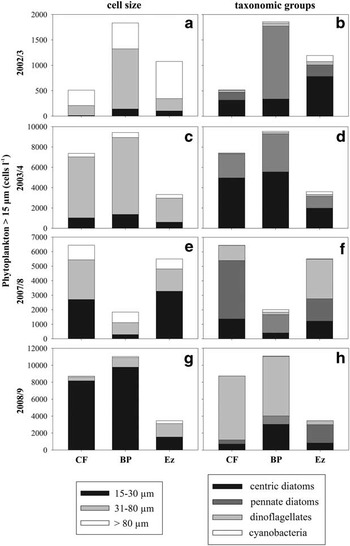
Phytoplankton assemblages and environmental variables did not show significant differences (P>0.05) between sampling depths (surface, mid-water and bottom) at each site, or their local bathymetry (15, 30 and 60 m). Therefore, average values for each site are shown in regard to the spatial variation (comparison between sites) (Fig. 7).
Abundance (cells l-1) of phytoplankton size classes and taxonomic groups in the four sampling seasons: 2002–03, 2003–04, 2007–08, 2008–09.

The site BP was always distinct from the other two sites in terms of phytoplankton abundance (highest concentration, except for 2007–08 when it was the lowest) and taxonomic composition (Fig. 7). In the summer of 2002–03, pennate benthic diatoms prevailed at BP, with the large benthic ones (e.g. Pleurosigma directum, Gyrosigma spp.) during early summer, and the mid-sized (31–80 µm) chain-forming F. ritscheri and F. striatula in late summer (Fig. 7a & b). At the other sites, the centric diatom C. pennatum was dominant, representing most of the large (> 80 µm) cells (Fig. 7a & b). At EZ, filamentous cyanobacteria (e.g. Oscillatoria spp., Leptolyngbya spp.) were more representative (10%) than at the other sites (1%) (Fig. 7b). In 2003–04, mid-sized (31–80 µm) centric diatoms were dominant at all sites (Fig. 7c & d).
The area where the contribution of cyanobacteria was notable changed from EZ in 2002–03 and 2003–04, where Oscillatoria spp., Leptolyngbya spp. and others represented more than 5% of the total phytoplankton abundance (Fig. 7b & d), to BP in 2007–08 late summer (Fig. 7f), where large (>80 µm) benthic diatoms (e.g. Pleurosigma directum and Cylindrotheca closterium (Ehrenberg) J. Lewin & Reimann) were also abundant (Fig. 7e & f). At the other sites, smaller cells (15–30 µm) showed higher abundances (Fig. 7e). At EZ, dinoflagellates (e.g. Protoperidinium defectum Balech) were dominant (50%), contrary to the dominance of diatoms (82%) at the other sites (Fig. 7f). In early summer 2008–09, EZ retained the taxonomic distinction from the previous year as pennate diatoms >31 µm (Pseudo-nitzschia spp.) were the most representative (Fig. 7h), while those >80 µm (pennate benthic diatom Cylindrotheca closterium and planktonic “Pseudo-nitzschia seriata” complex) occurred at the other sites where small dinoflagellates (15–30 µm) were dominant (>89%, Fig. 7h).
Cyanobacteria and large diatoms (except Cylindrotheca closterium and Pseudo-nitzschia spp., dominant large diatoms in 2008–09) were associated with high-temperature/high-ammonium/low-salinity waters (see Table IV) from terrestrial or marine ice melt, except in 2002–03 when the dominant species C. pennatum occurred under these conditions. The genus Pseudo-nitzschia was associated with external (Bransfield Strait) waters with high salinity and low temperature/ammonium concentration, most common at EZ. Nevertheless, some species were typical of each site: large (>80 µm) pennate diatoms (Pleurosigma spp., Gyrosigma spp., Cylindrotheca closterium) were typical of BP, the genus Achnanthes at CF, and the highest abundance of dinoflagellates (except for 2008–09) was found at EZ. The epiphytic Pseudogomphonema kamtshaticum was typically found at CF and EZ (where macroalgae are abundant in the sublittoral).
Discussion
In recent years, interannual changes in environmental conditions at AB’s coastal areas, especially hydrological features, have resulted in a decrease of microphytoplankton prevailing cell size, associated with a shift in the dominance of phytoplankton taxonomic groups from diatoms to dinoflagellates. This may be a result of the rise in summer water temperature from 0.5°C during 2002–03 and 2003–04 to 1.2°C during 2007–08 and 2008–09. This temperature rise was also observed in the neighbouring inlet of Potter Cove (King George Island) during a 19 year study (Schloss et al. Reference Schloss, Abele, Moreau, Demers, Bers, González and Ferreyra2012) and confirmed by satellite data (this study). Kopczynska (Reference Kopczynska2008) also reported a reduction in diatom abundance in AB during a 9 year monitoring study. Furthermore, Montes-Hugo et al. (Reference Montes-Hugo, Vernet, Martinson, Smith and Iannuzzi2008, Reference Montes-Hugo, Doney, Ducklow, Fraser, Martinson, Stammerjohn and Schofield2009) observed similar changes in the phytoplankton assemblages of adjacent areas north of the WAP.
Climate change in this region has led to a rise in the incident radiation and temperature, increasing terrestrial ice melt. Secondary effects of the ice melt (e.g. changes in turbulence leading to changes in suspended inorganic particle concentrations, the turbidity, and therefore in light attenuation) have possibly caused a reduction in diatom abundance. On the other hand, short-term alterations in phytoplankton assemblages are predominantly influenced by changes in the wind pattern and ice cover (Montes-Hugo et al. Reference Montes-Hugo, Doney, Ducklow, Fraser, Martinson, Stammerjohn and Schofield2009, Schloss et al. Reference Schloss, Abele, Moreau, Demers, Bers, González and Ferreyra2012). The AAO, or Southern Annular Mode (SAM), is a useful tool to predict and track climate change regarding cloud and ice cover, solar radiation, precipitation, atmospheric and water temperatures in the WAP (Liu et al. Reference Liu, Curry and Martinson2004). This index has been directly related to the changes in phytoplankton structure observed in this area (Montes-Hugo et al. Reference Montes-Hugo, Vernet, Martinson, Smith and Iannuzzi2008, Schloss et al. Reference Schloss, Abele, Moreau, Demers, Bers, González and Ferreyra2012). In shallow coastal waters of AB (present study), negative AAO values were related to the dominance of diatoms, whereas positive AAO induced an increase in dinoflagellate abundance. Furthermore, based on remote sensing data, the most productive years (highest chlorophyll concentrations in the summers of 2004–05 and 2005–06), not sampled in this work, coincided with transitional AAO values (negative to neutral, see Fig. 2e), with high precipitation in summer (see Fig. 2d). The effects of AAO fluctuations on the circulation of bottom waters of inlets around King George Island (Schloss et al. Reference Schloss, Abele, Moreau, Demers, Bers, González and Ferreyra2012) are apparently reflected in shallow areas, but do not reach surface waters in the inner AB (Kopczynska Reference Kopczynska2008, Lange et al. unpublished data).
A decrease in phytoplankton size associated with changes in the taxonomic structure in relation to climate change (i.e. warming) has also been reported in other polar regions. In the Arctic Ocean the warming of surface waters led to an increased stratification and consequent decline in nutrient supply from deep waters to the euphotic layer (Li et al. Reference Li, McLaughlin, Lovejoy and Carmack2009). These conditions favoured smaller cells (i.e. picoplankton) due to their larger surface-to-volume ratio (higher ability to absorb nutrients). In the present study a decrease in phytoplankton size was observed, although picoplankton and part of the nanoplankton fraction have not been evaluated. However, it is not clear which was the main factor that triggered the increase of small dinoflagellates (<30 μm) and decline of microplanktonic diatoms in the summers of 2007–08 and 2008–09 (positive AAO), compared to 2002–03 and 2003–04 (mostly negative AAO). As the Antarctic coastal waters are presumably high-nutrient, low-chlorophyll (HNLC; Lange et al. Reference Lange, Tenenbaum, Braga and Campos2007, Kopczynska Reference Kopczynska2008, Nedzarek Reference Nedzarek2008), it is unlikely that the lack of macronutrients is the cause of low biomass. In fact, high silicate, ammonium and nitrate concentrations (see Table II) were observed in periods when the land was covered by ice (2002–03 and 2007–08, personal observation) compared to periods with more ice-free zones (2003–04 and 2008–09, personal observation). This supports the idea proposed by Nedzarek (Reference Nedzarek2008) that the continental ice melt leads to terrestrial runoff, being the most important nutrient source to shallow coastal zones of AB. Regarding micronutrients, it has been assumed that iron limitation is not severe in the AB (Brandini Reference Brandini1993) since adjacent areas (e.g. Bransfield Strait) have natural levels of iron always above the limiting concentration for primary production (Martin et al. Reference Martin, Gordon and Fitzwater1990). Furthermore, the intense nutrient runoff carried by continental freshwater into the bay possibly contributes to iron input (Nedzarek Reference Nedzarek2008), although the concentration of this metal has never been measured in AB. Another important consequence of ice melt is the physical environment generated by freshwater flow in acclivitous shores, leading to the suspension of bottom material (Pichlmaier et al. Reference Pichlmaier, Aquino, Da-Silva and Braun2004). This suspended material causes an increase in turbidity, leading to the decrease of light availability in the water column. High turbidity and low light would theoretically favour smaller cells, which need less light to grow, or motile cells (dinoflagellates) that can be retained at surface, where light is available (Mills et al. Reference Mills, Kropuenske, van Dijken, Alderkamp, Berg, Robinson, Welschmeyer and Arrigo2010). Terrestrial ice melt runoff is also indicated by the presence of several tychoplanktonic species (e.g. Pseudogomphonema kamtshaticum, Cocconeis spp, Achnanthes brevipes Agardh, Pleurosigma spp.) observed in our study. In general, freshwater input increases water column stability in AB’s central basin, further promoting phytoplankton growth, but also causes an increase in turbulence and turbidity in coastal shallow zones, which may reduce primary production (Schloss et al. Reference Schloss, Klöser, Ferreyra, Curtosi, Mercuri and Pinola1997, Kang et al. Reference Kang, Kang, Lee and Lee2002).
The dominance of diatoms amongst the microphytoplankton in the northern region of the WAP has been previously reported (Brandini Reference Brandini1993, Brandini & Rebello Reference Brandini and Rebello1994, Moline et al. Reference Moline, Prézelin, Schofield and Smith1997, Schloss et al. Reference Schloss, Ferreyra and Ruiz-Pino2002, Lange et al. Reference Lange, Tenenbaum, Braga and Campos2007, Kopczynska Reference Kopczynska2008, Uitz et al. Reference Uitz, Claustre, Griffiths, Ras, Garcia and Sandronie2009). During the earliest sampling years in the present investigation, diatoms were also the dominant taxonomic group in the coastal waters of AB. The frequent contribution of epiphytic diatoms (Pseudogomphonema kamtshaticum, Achnanthes spp., Licmophora spp., Cocconeis spp.), especially at CF and EZ, indicate the importance of macroalgae as substrates to microalgae (Al-Handal & Wulff Reference Al-Handal and Wulff2008). The epontic centric diatom C. pennatum (> 100 µm), which normally increases in abundance during ice melting seasons (Kang et al. Reference Kang, Kang, Lee and Lee2002), was the most abundant species in the microphytoplankton during the 2002–03 summer, when fast ice remained until mid-summer (January) at AB. Along with C. pennatum, other diatoms were also abundant, such as the benthic pennate Licmophora spp., Pseudogomphonema kamtshaticum, F. striatula, F. spp., and Achnanthes spp., some of which have been regarded as the main phytoplankton species in the krill diet (Ligowski Reference Ligowski2000). However, Opalinski et al. (Reference Opalinski, Maciejewska and Georgieva1997) state that krill reject cells >70 µm (e.g. benthic pennate diatoms such as N. directa, Pleurosigma directum, Gyrosigma sp., also abundant in 2002–03). In the following summer (2003–04), C. pennatum was replaced by Thalassiosira antarctica Comber, S. microtrias, Porosira spp. and other centric mid-sized diatoms (30–80 µm). Mid-sized centric diatoms, which are the most palatable species to krill (Opalinski et al. Reference Opalinski, Maciejewska and Georgieva1997, Ligowski Reference Ligowski2000), were responsible for the highest abundances (104 cells l-1) in the 2003–04 summer, when easterly winds prevailed.
Strong winds on AB drive turbulence in the water column leading to suspension of bottom material along with benthic microalgae in the coastal area (Brandini & Rebello Reference Brandini and Rebello1994, Schloss et al. Reference Schloss, Ferreyra and Ruiz-Pino2002, Lange et al. Reference Lange, Tenenbaum, Braga and Campos2007). When those periods are followed by low speed winds, stability of the water column allows benthic cells to bloom while suspended (Brandini & Rebello Reference Brandini and Rebello1994, Schloss et al. Reference Schloss, Ferreyra and Ruiz-Pino2002). The wind regime is also responsible for the wide circulation pattern in the bay, along with tide dynamics (Robakiewicz & Rakusa-Suszczewski Reference Robakiewicz and Rakusa-Suszczewski1999). Disregarding the role of tide influencing phytoplankton assemblages in these shallow waters, our study indicated that low wind speeds induced high phytoplankton abundance (8.6×10³±6.4×10³ cells l-1) in early summer 2003–04, dominated by the planktonic centric diatom species of Thalassiosira, Porosira, Stellarima and others. This condition was earlier reported by Brandini (Reference Brandini1993) in the central basin of AB during the summer of 1987, when the same species were important during a low wind speed period. However, the abundance of those centric diatoms (103–104 cells l-1) does not amount to a bloom condition like the ones previously recorded for this area (105 cells l-1), which were mainly composed by pennate chain-forming diatoms (Brandini & Rebello Reference Brandini and Rebello1994, Kopczynska Reference Kopczynska2008). Presumably, the relatively low east and north winds in 2003–04 also led to a strong influence from the Bellingshausen Sea waters. It has been reported that Thalassiosira spp., and S. microtrias can be detected in Bransfield Strait (and AB) under the influence of east wind, as opposed to west wind, which advect waters from Weddell Sea with high abundance of Rhizosolenia spp. (Montes-Hugo et al. Reference Montes-Hugo, Doney, Ducklow, Fraser, Martinson, Stammerjohn and Schofield2009). During late summer 2007–08 and early summer 2008–09, when western winds prevailed, dinoflagellates (Prorocentrum antarcticum/Prorocentrum minimum, Protoperidinium defectum) and planktonic diatoms, such as Rhizosolenia truncate G.Karsten, Proboscia alata (Brightwell) Sundstrøm, Chaetoceros socialis H.S.Lauder, Pseudo-nitzschia spp. and Tropidoneis antarctica (Grunow) Cleve, became dominant in the shallow coastal waters at AB. Those species are typical from the Weddell Sea (Kang et al. Reference Kang, Kang, Lee, Chung, Kim and Park2001) and were also registered in the warmer waters northward at Iles Kerguelen (Armand et al. Reference Armand, Cornet-Barthaux, Mosseri and Quéguiner2008). Moreover, they are usually avoided by the Antarctic krill Euphausia superba Dana (Opalinski et al. Reference Opalinski, Maciejewska and Georgieva1997).
The consequences of shifts in phytoplankton size and composition for the food web can be substantial. The diet of E. superba consists of 46% benthic diatoms in coastal zones, such as those at AB (Ligowski Reference Ligowski2000). The Antarctic krill is an important link in the Antarctic food web (Medlin & Priddle Reference Medlin and Priddle1990, Pakhomov et al. Reference Pakhomov, Froneman and Perissinotto2002, Corbisier et al. Reference Corbisier, Petti, Skowronski and Brito2004). Thus, a reduction in benthic microalgae in the water column would cause a shortage in food availability to krill, as much as to other planktonic herbivores and benthic suspension feeders (Gili et al. Reference Gili, Alva, Pages, Kloser and Arntz1996, Corbisier et al. Reference Corbisier, Petti, Skowronski and Brito2004). Small microalgae, which are not palatable to those herbivores, are preferred by salps and other suspension feeders (Moline et al. Reference Moline, Claustre, Frazer, Schofield and Vernet2004, Montes-Hugo et al. Reference Montes-Hugo, Doney, Ducklow, Fraser, Martinson, Stammerjohn and Schofield2009). Therefore, a decrease in phytoplankton cell size in coastal zones could lead to a drastic change in the food web at AB. It is possible that the decrease in penguin abundance (Sander et al. Reference Sander, Balbão, Polito, Costa and Carneiro2007) and shifts in benthic communities (Montes-Hugo et al. Reference Montes-Hugo, Doney, Ducklow, Fraser, Martinson, Stammerjohn and Schofield2009) observed in this region result from these shifts in microphytoplankton assemblages. Although the time scale of the present study is small, the results shown here probably signal large environmental and biological changes, such as those detected in longer-term studies (e.g. Montes-Hugo et al. Reference Montes-Hugo, Doney, Ducklow, Fraser, Martinson, Stammerjohn and Schofield2009, Schloss et al. Reference Schloss, Abele, Moreau, Demers, Bers, González and Ferreyra2012).
In terms of seasonal environmental variations, increases in water temperature and decreases in salinity during late, as compared to the early, summer (as observed in 2002–03 and 2003–04) have been reported in the coastal waters of King George Island (Klöser et al. Reference Klöser, Ferreyra, Schloss, Mercuri, Laturnus and Curtosi1993, Lange et al. Reference Lange, Tenenbaum, Braga and Campos2007). However, differences in microphytoplankton assemblages were distinct in those two years. In 2002–03 there was an increase in abundance during late summer, and in 2003–04 phytoplankton abundance decreased with increases in temperature, possibly due to the early and rapid ice melt observed in the second year. The structure of phytoplankton assemblages was probably influenced by the spatial variations of environmental variables. The cyanobacteria observed in coastal waters (e.g. Leptolyngbya spp., Oscillatoria spp.) are typically found in continental drainage channels, lakes and snow (Komarek Reference Komarek2007), which may indicate the influence of continental runoff (Nedzarek Reference Nedzarek2008) especially at the EZ and BP sites. The highest ammonium concentration is also an indication of freshwater drainage, and was concomitantly found with the highest cyanobacteria contribution. High ammonium concentrations are derived from terrestrial animal faecal matter (Nedzarek Reference Nedzarek2008), and are possibly related to the adjacent glacial melt, e.g. Wanda Glacier at BP and Ecology Glacier at EZ. Robakiewicz & Rakusa-Suszczewski (Reference Robakiewicz and Rakusa-Suszczewski1999) and Nedzarek (Reference Nedzarek2008) proposed that nearshore circulation may induce the northward flow of a large portion of the freshwater runoff from Ecology Glacier through the coastal shallow zone, and consequently over the aforementioned sampling sites.
Therefore, the continental ice melt and wind-induced water column mixing are crucial processes that regulate temporal and spatial changes in phytoplankton assemblages in the coastal waters of AB.
Conclusions
Phytoplankton (>15 µm) assemblages in shallow coastal waters of AB have been reported to be dominated by diatoms. The important contribution of the microphytobenthos, mainly pennate diatoms, to the plankton in coastal waters supports the idea that this compartment may be a significant source of food not only for benthic deposit feeders but also for suspension feeders and planktonic herbivores. The presence of microphytobenthic algae in the water column at the coastal zone in AB is related to weather conditions during the previous winter, indicated by the AAO. Colder winters allow a higher accumulation of continental ice, which melts during summer, causing an intense flow of freshwater runoff and may enhance the suspension of bottom material, including large diatoms from the microphytobenthos and epontic cyanobacteria. Wind speed and direction during summer, which are also related with the AAO phase shift, are associated with the accumulation of biomass of these algae in the water column, and to the intensity of resuspension of bottom material in shallow areas. Summer periods with high terrestrial ice melt and freshwater runoff, indicated by high irradiance and ammonium concentrations, were associated with significant contributions of cyanobacteria and large diatoms (>80 µm) in the coastal zones. Epiphytic diatoms like Pseudogomphonema kamtshaticum, Achnanthes spp., Licmophora spp. and Cocconeis spp. were always present at CF and EZ, where macroalgae are abundant in the sublittoral. Areas most liable to the influence of terrestrial ice melt are EZ and, in more recent years, BP.
The prevailing size of phytoplankton cells decreased and the species composition changed in recent years. Large cells (>80 µm) were more abundant in the summer 2002–03, and their contribution decreased, as smaller cells (15–30 µm) became more abundant in 2008–09. The cell size change in those coastal waters was associated with a rise in SST and a slight decrease in salinity, probably associated with an increase in precipitation. This may be part of a large-scale change in phytoplankton assemblages in the region. In the present study, phytoplankton composition shifted from large benthic pennate diatoms (Licmophora spp., Achnanthes spp., Navicula spp.) to smaller planktonic diatoms (Pseudo-nitzschia spp.) and dinoflagellates. Large centric diatoms (S. microtrias, A. actinochilus, Porosira spp., T. ritscheri) were more abundant in 2002–03 and 2003–04, while small Thalassiosira spp. and other centric diatoms were most abundant in recent years. Those changes were associated with relatively lower precipitation, greater cloud cover and wind pattern influencing water column processes, and may have trophic consequences due to the food selectivity by Antarctic krill.
We reinforce that the AAO, which is directly correlated with the main physical forcings in the WAP, is a strong indicator of changes in the phytoplankton structure. Large diatoms are dominant in periods of transiting AAO phases (from negative to positive), and small dinoflagellates and the diatom Pseudo-nitzschia spp. are more abundant under positive AAO periods. Further studies on the nano- and picophytoplankton structure need to be conducted to understand the importance of microphytoplankton to the primary production in shallow areas of the Antarctic Peninsula.
Author contribution
Priscila K. Lange - water sampling, microscopy analysis of phytoplankton populations, remote sensing data assembly, data processing, statistical analyses, elaboration of manuscript text and figures. Denise R. Tenenbaum - data processing, statistical analyses, elaboration of manuscript text and figures. Virginia M. Tavano - data processing, statistical analyses, elaboration of manuscript text. Rodolfo Paranhos - chlorophyll and nutrients analyses, manuscript review. Lucia S. Campos - sampling strategy design, elaboration of manuscript text.
Acknowledgements
This study first integrated the project “Implementation of a Strategy for Assessment of Environmental Impacts on Coastal Shallow Water Benthic Fauna of AB” (CNPq Process No. 55.0356/2002-9) and later the project “Marine Antarctic Biodiversity in Relation to Environmental Heterogeneity at Admiralty Bay, and adjacent areas” (CNPq Process No. 52.0293/2006-1) in contribution to the South American Consortium on Marine Biodiversity for the Census of Antarctic Marine Life (LA CAML) during the International Polar Year (IPY 2007–08). This work has been supported by the Brazilian Ministry of Environment (MMA), Ministry of Science and Technology (MCT), National Council for Research and Development (CNPq), and Interministerial Secretariat for the Sea Resources (SECIRM) within the framework of the Brazilian Antarctic Programme. We thank Dr Elisabete de Santis Braga for the analyses of salinity, nutrients and chlorophyll during the summers of 2002–03 and 2003–04, and Rafael B. de Moura for the AB figure. We are also very grateful to Dr Irene R. Schloss, Dr Clarisse Odebrecht and Dr Eduardo Secchi for the important advice and suggestions to this manuscript.