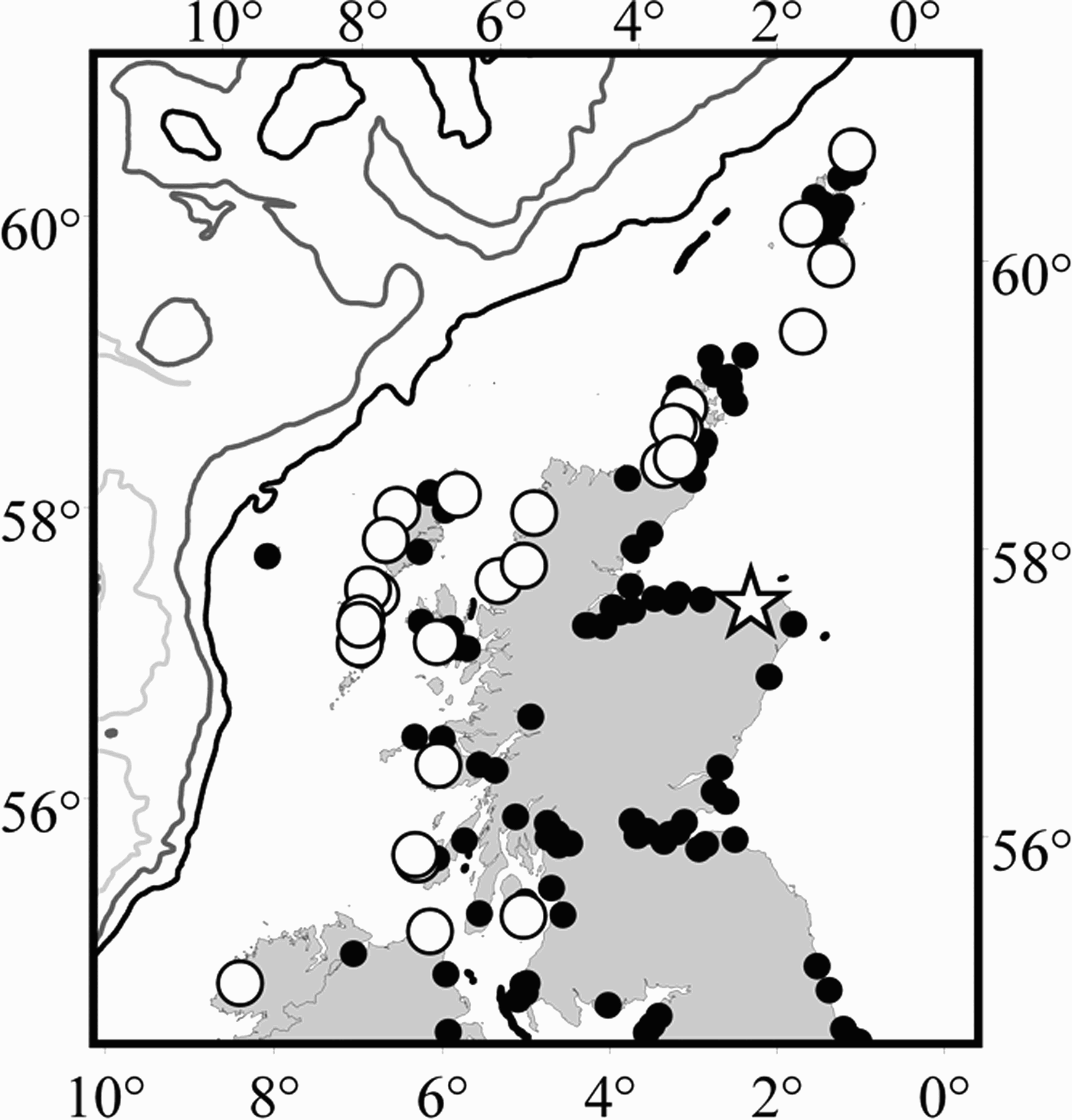
The Cuvier's beaked whale (Ziphius cavirostris Cuvier, 1823) is the most widely distributed member of the 21 currently recognized species of the family Ziphiidae. Like other members of this family, these toothed whales are typically found in deep pelagic waters, often associated with steep canyons and escarpments along the edge of the continental shelf (Heyning, Reference Heyning, Ridgway and Harrison1989; Jefferson et al., Reference Jefferson, Webber and Pitman2008). Records suggest the species has a cosmopolitan distribution in warm temperate to tropical deep oceans, and in Europe it has been recorded from the west coast of Ireland to the Mediterranean Sea (MacLeod, Reference MacLeod2000; Macleod et al., Reference MacLeod, Perrin, Pitman, Barlow, Ballance, D'Amico, Gerrodette, Joyce, Mullin, Palka and Waring2006). It appears to be more common in warmer waters and, while there are frequent sightings of Z. cavirostris in the deep waters of the Bay of Biscay, there have only been six confirmed sightings in UK and Irish waters in recent years (Reid et al., Reference Reid, Evans and Northridge2003). However, strandings of the species are not uncommon around the UK, but these may represent animals that have strayed beyond their usual warm water habitat, or been carried northwards by prevailing currents once dead (MacLeod et al., Reference MacLeod, Pierce and Santos2004). The distribution of strandings is also not equal along all UK and Irish coasts, with the vast majority occurring along the Atlantic coasts to the west of Scotland and Ireland (Klinowska, Reference Klinowska1985; Berrow & Rogan, Reference Berrow and Rogan1997; MacLeod et al., Reference MacLeod, Pierce and Santos2004). Strandings along the North Sea coasts are noticeably rare by comparison, and none have previously been recorded along the north-east coast of mainland Scotland (MacLeod et al., Reference MacLeod, Pierce and Santos2004; Figure 1) although other beaked whale species strand regularly here (MacLeod et al., Reference MacLeod, Pierce and Santos2004; Figure 1).
Strandings of beaked whales in northern UK and Irish waters between 1913 and 2003 (adapted from MacLeod et al., Reference MacLeod, Pierce and Santos2004). Large white circles denote Cuvier's beaked whale strandings and the smaller black circles strandings of all other beaked whale species. The white star shows the location of the present stranding in the outer Moray Firth, on the east coast of mainland Scotland. Contour lines shown are 200 m (black), 1000 m (dark grey) and 2000 m (light grey).

On 25 March 2008, a member of the public reported a large, dead whale along the southern coastline of the outer Moray Firth, on the west beach in Gardenstown, near Banff (57°40.175′N 002°20.823′W). On arrival at the scene, a decomposing carcass of a stranded beaked whale was discovered, whereupon an external examination was carried out in situ and photographs were taken. The extensive decomposition of the animal suggested it might have died one to two months prior to stranding. Consequently, an accurate measurement of the body girth could not be made in this condition, but the length was measured from the tip of the rostrum to the coccyx (in the absence of any tail flukes) at 7.23 m. No necropsy was performed due to the severity of autolysis. However, the lower jaw was removed for examination at the University of Aberdeen to confirm the species identification of this specimen.
Based on the characteristic features and profile of the animal's head, including a smoothly-sloping forehead, stubby, poorly-defined beak, and a mouth-line that was curved along most of its length with an upturn at the rear (Figure 2) (Heyning, Reference Heyning, Ridgway and Harrison1989; Jefferson et al., Reference Jefferson, Webber and Pitman2008), the stranded whale was preliminarily identified as Z. cavirostris. This identification was subsequently confirmed by the position and shape of a single pair of teeth located at the tip of the excised lower jaw. Whilst the maximum length for this species is generally accepted to be just under seven metres (Heyning, Reference Heyning, Ridgway and Harrison1989; MacLeod, Reference MacLeod2006), which is less than that measured in the present specimen, it is likely that the severely decomposed carcass had been ‘stretched’ or distorted by the stranding process. Even so, in view of the large body size and absence of erupted teeth in the lower jaw, this animal was confirmed as a fully-grown adult female.
Photograph of the stranded Cuvier's beaked whale showing the characteristic sloping forehead with short, stubby beak and characteristic curved or ‘S’-shaped jaw-line.

As no necropsy was possible, the cause of death could not be determined. However, this stranding may have been linked to a number of other beaked whale strandings in Scotland a few weeks earlier (Dolman et al., Reference Dolman, Reid, Barley, Deaville, O'Connell, Berrow, Penrose, Jepson, Pinn, Stevick, Calderan, Robinson, Doyle, Browning and Simmonds2008), when at least four other Cuvier's beaked whales were discovered along the Hebridean west coast. This additional record of a stranding from the Moray Firth, shortly after these strandings, may help to illuminate the causes behind these strandings. In particular, the Moray Firth animal could have been carried by prevailing winds and currents from the west coast or even further afield. If this were the case, however, one would expect that the UK strandings data presented by MacLeod et al. (Reference MacLeod, Pierce and Santos2004) for the species would reflect other such incidents along the North Sea coastline, but this does not appear to be the case. Whilst the North Sea is considered an entrapment area for several oceanic whale species (e.g. Smeenk, Reference Smeenk1997), Cuvier's beaked whales are thought to rarely travel north far enough to enter this ‘trap’ (MacLeod et al., Reference MacLeod, Pierce and Santos2004), which would explain the previous absence of strandings in this region. However, the phenology of this and other recent Cuvier's beaked whale strandings would suggest a probable northern range expansion for the species in our UK waters, perhaps as a result of increasing water temperatures along the Atlantic frontier, which may explain the escalating number of incidental stranding events now being observed. The present whale may have become incapacitated, through old age or some other reason, whilst in the northern extreme of this expanding geographical range. Once picked up by the northern currents here, the carcass would have eventually been circulated southwards into the Moray Firth where it was finally deposited along the southern shoreline.
Whatever the case, the present stranding evidently represents an atypical stranding's event for this species. To date, at least 16 species of cetacean have been recorded in the Moray Firth (Robinson et al., Reference Robinson, Baumgartner, Eisfeld, Clark, Culloch, Haskins, Zapponi, Whaley, Weare and Tetley2007), including two species of beaked whale—the northern bottlenose whale (Hyperoodon ampullatus) and the Sowerby's beaked whale (Mesoplodon bidens), both of which are well represented in historical strandings data for this region (MacLeod et al., Reference MacLeod, Pierce and Santos2004). The present stranding, however, provides the very first record of a Cuvier's beaked whale stranding in this North Sea area of mainland Scotland, and an additional species that can now be added to an already extensive list of coastal and pelagic cetaceans currently documented for this important geographical region.
ACKNOWLEDGEMENTS
Many thanks to Dale Edmondson (CRRU) who assisted with the examination of the whale carcass and the recovery of its lower jawbone, and also to the Scottish Agricultural College in Inverness for ongoing support and advice. Financial assistance for the CRRU's marine animal rescue work is gratefully acknowledged from Care for the Wild International.