Scholars of Iranian history have begun turning their attention to the presence of enslaved Africans in Iran. The history of Africans and racial categories and identities has emerged in academic literature as a topic worthy of study.Footnote 1 While there is much yet to be learned, we can recognize now that enslaved Africans in Iran were able to maintain their own religious ceremonies, speak their own Persian dialect, perform their own musical styles and forms of dance, conduct healing practices, and so forth. This African cultural influence has certainly been a factor in shaping all aspects of Iranian society.Footnote 2
While we applaud this new research into the enslaved population of Iran in the nineteenth century, we should note the Afro-Iranian offspring of these enslaved individuals also have a great deal to contribute to understanding the somewhat unique experience of slavery in Iran. This notice shifts our attention to the next generation and the twentieth century. The great majority of Africans brought to Iran as slaves were women, who were destined for service in Iranian households as domestic servants and concubines. Naturally, they bore children by their Iranian masters who became part of the master’s households. The lives of these Afro-Iranian offspring have yet to be studied, or even given a place in Iranian history. They remain invisible.
Racial ambiguities and anti-blackness
As the academic literature on the history of slavery in Iran has grown, the question of race as a factor in enslavement has emerged. Some scholars suggest that Iran developed a distinct racial system and hierarchy based on the legacy of enslaved Africans, but perhaps a system that never crystallized into reified racial categories that mirror those in the Americas. Other scholars argue that the question of race in Iran is more nuanced and complicated, involving the adoption of new racial identities by all Iranians in the Pahlavi era.
Behnaz Mirzai, in her history of slavery in Iran, notes that in nineteenth-century Iran, enslaved Africans were valued differently based on skin color and place of origin. Remembering that most of these enslaved people were women, the fairer skin of the Ethiopians was considered preferable and more valuable than the darker complexions of East Africans. This categorization, however, seems ambiguous and more akin to colorism than to hard racial categories.Footnote 3
The academic literature indicates that blackness became distinctively and exclusively identified with slavery and exclusion only at the end of the nineteenth century. Racial categories were constructed along lines of color, but only tentatively and ambiguously. The hard racial categories found in the Americas were not replicated in Iran. Rather, a more complex and flexible, perhaps unspoken understanding of racial differences emerged; a system not fixed in “race” as a reified category of identity and status, but instead on wealth, kinship, skin color, and social standing.
Reza Zia-Ebrahimi finds a shift in Iranian racial identity in the twentieth century. Reza Shah Pahlavi invented a version of the Aryan myth, defining the Iranian racial identity as “white,” akin to European races.Footnote 4 Beeta Baghoolizadeh also contends that racial categories and anti-black attitudes developed in the twentieth century with the advent of the new technologies of photography and cinema. These images of enslaved Africans identified black skin with enslavement and reinforced notions of whiteness as the true Iranian racial identity. This visibility allowed other enslaved peoples, such as Caucasians, Kurds, and Circassians, to disappear from public consciousness. As a result, blackness became exclusively identified with slavery and racial exclusion. Baghoolizadeh argues that the term “Siyah” as applied to black Iranians emerged during this period as distinctly identified with enslaved people.Footnote 5 As such, Baghoolizadeh argues, blacks became invisible as Iranians, marked as alien and dismissed from Iranian history. She discusses this invisibility generally in the epilogue of her groundbreaking book The Color Black.Footnote 6 However, it is only when the lives of the Afro-Iranian children of masters and enslaved Africans are investigated that historians can begin to understand the history of that first generation of Afro-Iranians.
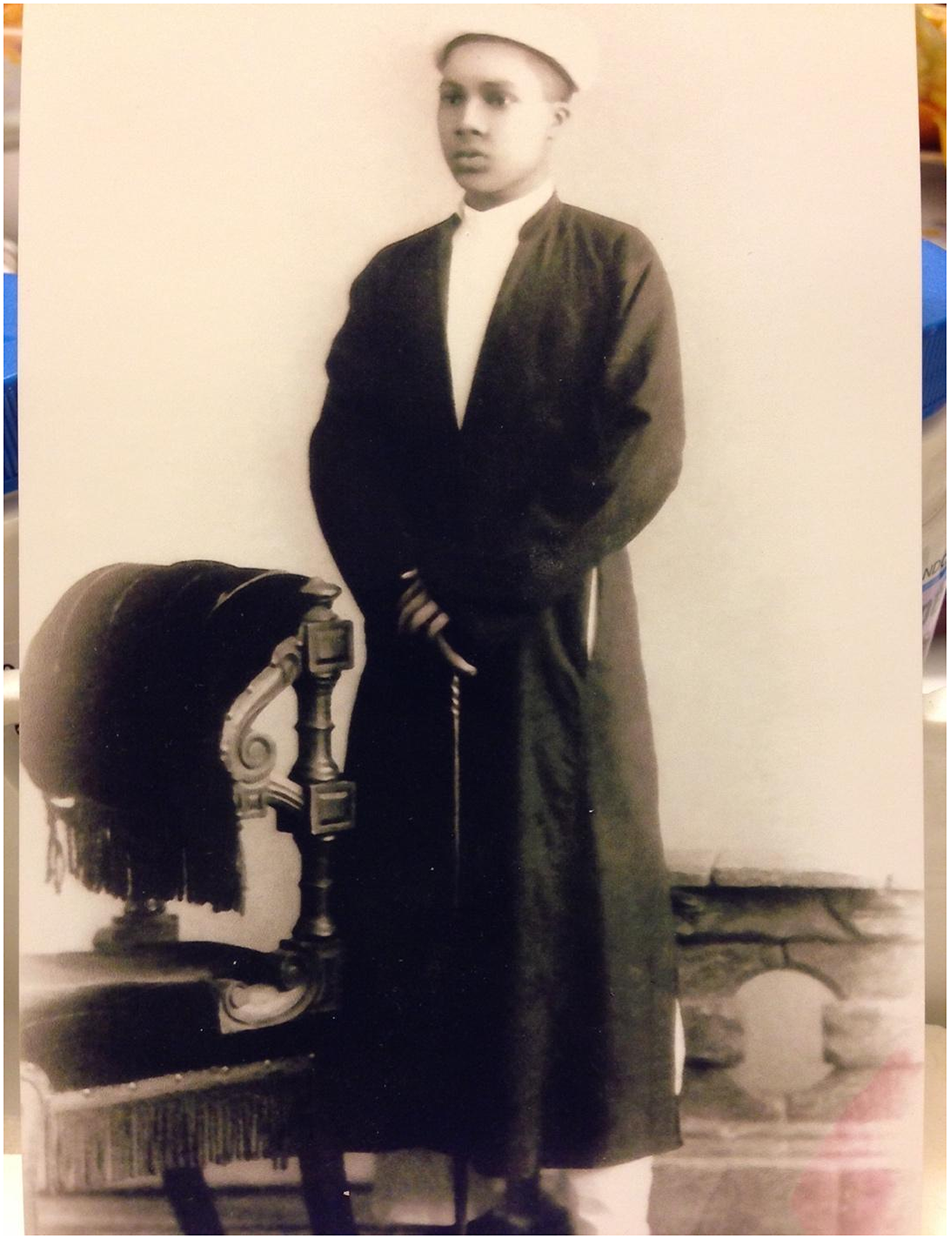
This article focuses on the life of one Afro-Iranian man, Ghulam-‘Ali Siyah Khurasani (1869?–1949) Figure 1, the son of a wealthy Iranian merchant in Yazd and his enslaved African concubine. This is possibly the first examination of the life of an Afro-Iranian actor in Iranian history, at least the first to acknowledge bi-racial ambiguity. Ghulam-‘Ali does not seem to have been the typical son of an enslaved African woman, however. He became quite wealthy and influential, becoming one of the leading notables in Yazd during the mid-twentieth century, and one of the largest landowners in the city. But his status as a black Iranian and Baha’i exposed his social vulnerabilities.Footnote 7 If Ghulam-‘Ali experienced blackness as a form of disability, he would have done so as these twentieth-century racial systems were being constructed.
Ghulam-‘Ali Siyah (Yazdi) Khurasani, at twelve to fourteen years old, c. 1885. The photograph demonstrates his dark skin tone and his obvious African features. His clothing indicates considerable wealth and status for the time.

Ghulam-‘Ali’s biography should be recovered and rescued from invisibility for its own sake, of course, but we also find that his life story has much to contribute to understanding major themes of Iranian history. These include the history of anti-blackness and racial formations in the late nineteenth and early twentieth centuries, the life of the wealthy merchant class during this period, the development of the Baha’i community in Iran, and the functioning of trading networks in Yazd and their connections to the Indian Ocean world. The ease with which the teenaged Ghulam-‘Ali traveled from Yazd to Palestine, and then on to Bombay, surprises us, as does his close association with Baha’i trading networks and his acceptance in these elite circles despite his African ancestry. His intimate association with central Baha’i figures in the household of the Prophet himself also comes as a surprise. His accumulation of great wealth and return to Yazd gives us insight into the profitability and significance of the Indian Ocean trade to the Iranian wealthy classes.
The legal status of black Iranians
Slavery in Iran was distinguished from Atlantic slavery by law in important ways. According to Islamic law (sharia), the children of enslaved women and Iranian masters are born free and entitled to inherit from their father’s estate upon his death at the same rate as children born of his wife or wives. Children of enslaved fathers are born as slaves and belong to their father’s enslaver.Footnote 8 We might note in passing, therefore, that attention to the lives of children of enslaved African women and their masters, who were born free according to sharia, does not account for children of enslaved African fathers, who by law remained in enslavement. More research needs to be done on these enslaved children, as well as on Iranians of African descent in southern Iran who are not the descendants of slaves.
Sources for this article
The authors gathered much of the information about Ghulam-’Ali’s life from interviews with his grandchildren, his daughter-in-law, and other relatives who generously shared their personal reminiscences. Such oral sources are a rich source of Iranian history and invaluable to the study of slavery and blackness in Iran. We urge historians to make more use of such important oral sources.
The memories of Shahnaz Khurasani, who was married to Muhammad Khurasani, the son of Ghulam-‘Ali, are especially valuable. Born in a Baha’i family in Shiraz, she married at age sixteen in 1947 and moved from Tehran to Yazd to live with the Khurasani family. Ghulam-‘Ali built a separate house, just outside the family compound, for his son and new bride to live in. Shahnaz witnessed the family’s life and, after the death of her father-in-law in 1949, became the leading lady of the house. As a teenager, she witnessed the dramatic events surrounding the religious attacks on the Khurasani family in 1948–1949, and was herself the target of some of these attacks.
Jalil Taqizadeh, a grandson of Ghulam-‘Ali, was also an important source of information and family lore. He grew up in the family compound in Yazd, later studied law at Tehran University, and had a practice in Tehran until the 1979 Revolution. He was in touch with his grandfather until the latter died in 1949.
Ghulam-‘Ali’s father
Ghulam-‘Ali’s father, Haji Muhammad-‘Ali Sadiq Khurasani (d. circa 1885?), was a local merchant in Yazd with substantial business dealings and land holdings. His association with Khorasan may indicate his ancestry or trade connections with the region. Muhammad Sadiq was wealthy enough to afford an enslaved servant/concubine, an African woman whom he named Ziba (beautiful) (d. 1932), ostensibly purchased as a nurse for his ailing wife.Footnote 9 We know relatively little about Muhammad Sadiq’s life from the family’s oral tradition, partly because he died early around 1885, when Ghulam-‘Ali would have been in his teens. Muhammad Sadiq seems to have accumulated enough wealth and property to arrange for his elder son, Muhammad-Isma’il, to marry the daughter of Hajji Mirza Muhammad Afshar, a scholar and a leading merchant of Yazd and Bombay.
Yazd was one of Iran’s major trading centers; an important player in Indian Ocean commerce since antiquity. This was in part due to the city’s south-central location, at the crossroad of two major trade routes: from the east, from Khorasan and Central Asia, and to the north, from the Caspian ports through Tehran, both leading to the Persian Gulf.Footnote 10 In the nineteenth century, Yazd benefited from the expansion of local trade, agriculture, and textile industries. The city’s economy also grew due to steady expansion in Indo-Iranian commerce, which was heavily weighted in India’s favor. Iran imports included Kashmiri shawls, dyes, spices, sugar, and Chinese porcelain. Exports included wheat, dried fruit, wine, carpets, silk, tobacco, and precious metals.Footnote 11
A thriving modern print industry made Bombay a center of Persian publications and the spreading of new ideas.Footnote 12 The arrival of the Parsi businessman and philanthropist Manakji Limji Hataria brought a new intellectual dimension to Yazd’s connection to the Indian Ocean, as he worked tirelessly to advance the persecuted Zoroastrian community. Such efforts included the establishment of modern schools for the Zoroastrian community that were relatively immune from clerical opposition, but also served the larger community.Footnote 13
The Khuransani family seems to have followed the familiar pattern of increasingly investing in land and agriculture. Merchants who benefited from expanding trade often used their excess capital to acquire land at, often, meager cost. Given the scarcity of water resources, agricultural development required investment in building new water canals (qanat). Thus, the value of the land increased only after such investments. Land ownership was also a relatively safe and inconspicuous investment area, less subject to confiscation by officials, looting, and theft at times of urban insecurity and chaos.
As can be seen from the career of Ghulam-‘Ali, the merchant networks of Yazd were closely connected to trade routes between Bandar Abbas, Bombay, and beyond, held together by bonds of kinship and religion. Ghulam-‘Ali joined networks of Baha’i merchants through the aforementioned Afshar family of traders, who were related by marriage. The Afshars were connected to the Afnans, another family of Baha’i traders, whose networks stretched from Constantinople to Hong Kong.Footnote 14
Early life of an Afro-Iranian Son of slavery
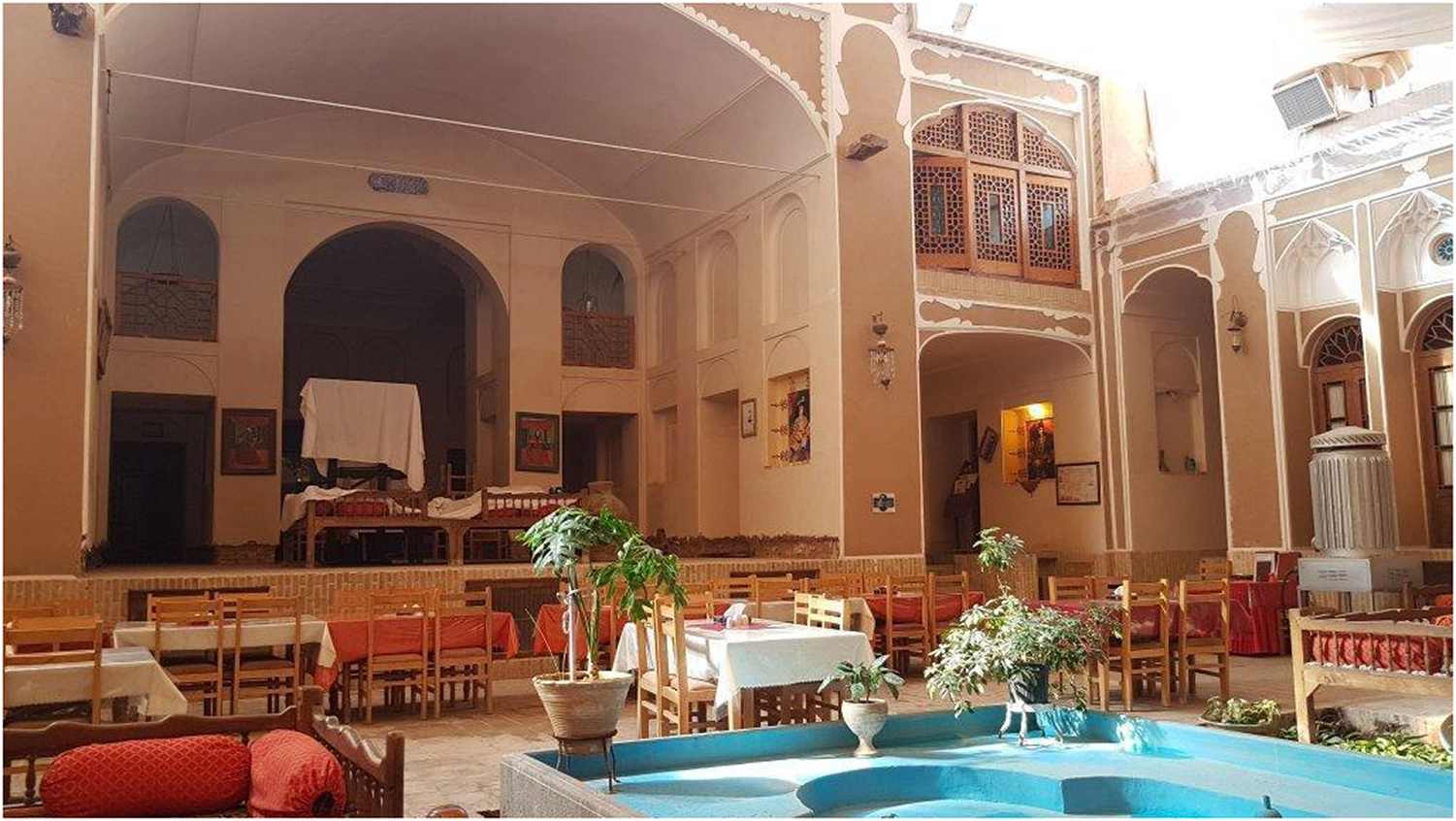
Ziba Khanum’s son by her master was named Ghulam-‘Ali (Slave of ‘Ali). This is a common name in Iran, as Imam ‘Ali is a holy figure in Shi‘a Islam. But perhaps this is where the ambiguities begin. The name has a curious resonance concerning slavery. The boy’s father’s name was ‘Ali. As such, “Slave of ‘Ali” both elevates Ghulam-‘Ali to his father’s station and simultaneously subordinates him to his mother’s master. Ghulam-‘Ali took his father’s surname later in life, calling himself Ghulam-‘Ali Khurasani, but he was known widely in Yazd as Ghulam-‘Ali Siyah (the black one), and possibly just as Siyah. This was not necessarily intended as an insult, though his grandchildren say that no one would call him that to his face. He never applied this tag to himself, nor can one imagine that the designation would have been publicly used later in his life, when he became wealthy and politically influential. He eventually left home and built a career as a merchant in Bandar Abbas. Before that, he first traveled to Palestine and then to India, where he worked as an apprentice in the trading network of the above-mentioned Afshar family. He returned to Yazd a wealthy man and gradually went on to become a person of considerable status in the city. His mansion compound in Yazd still exists and has been turned into a modern hotel in a traditional style (Figure 2).
Inside Ghulam-‘Ali’s Mansion in Yazd, which is now a hotel.

As his Baha’i descendants recall, Ghulam-‘Ali secretly converted to Baha’ism in his early youth. The family claims that he was his father’s favorite son, as he regularly accompanied his father to merchant and landowner social gatherings in which they would conduct business, smoke opium, exchange gossip, etc. There were Baha’is at these gatherings who would find ways to talk about their new faith.Footnote 15 Such gatherings were a normal part of nineteenth-century social life among wealthy men in Iran. Ghulam-‘Ali was introduced and accepted into this network of merchants and landowners very early, despite his obvious African background and the fact that his mother was known to have been enslaved. Later in life, Ghulam-‘Ali continued this social practice in his own wealthy household in Yazd into the mid-twentieth century. His daughter-in-law remembers that he would entertain men with food and conversation in his house every night, almost to the end of his life.Footnote 16
Two merchants from Yazd, Haji Aqa Muhammad Alaqband and Hajji Muhammad Afshar, introduced Ghulam-‘Ali to the Baha’i faith.Footnote 17 Later in life, Ghulam-‘Ali married a pious Baha’i woman, Munavvar Khanum, a daughter of Mirza Yousef, an employee of the wealthy and influential Afnan family. The Afnans were Baha’is who were related to the Alaqband family. Ghulam-‘Ali’s older half-brother from a formal Muslim marriage, Muhammad-Isma’il Khurasani, also known as Gunduli (the fat one, a title he inherited from his father), became a Baha’i as well, through the same Baha’i merchant network. Muhammad-‘Ali Sadiq, their father, seems to have been unaware of or uninterested in his sons’ new faith.
Muhammad-Isma’il, at least later in life, was quite open about his conversion to the new faith, while Ghulam-‘Ali seems to have never publicly professed his religion. Though he was a fervent believer early in life, he never became an important or influential Baha’i. Muhammad-Isma’il, on the other hand, after his father’s death in the early 1900s, used his opulent, walled estate in Yazd as a center for openly held Baha’i gatherings for dawn worship (mashriqu’l-adhkar), which were regularly attended by large crowds. There were other Baha’is in their father’s social circle in Yazd, particularly Ismail’s father-in-law, the aforementioned notable merchant and scholar, Haji Mirza Muhammad Afshar, who was instrumental in converting Ismail sometime in the mid-1870s (around the time Isma’il reached his thirties), and who would later become important in Ghulam-‘Ali’s life.Footnote 18 As such, it appears that Ghulam-‘Ali was fully embedded in his father’s business network and closely connected to several affluent Baha’i merchants in Yazd.
Here, we can observe that Ghulam ‘Ali’s blackness does not seem to have hindered his participation in merchant circles, as class, privilege, and perhaps religious ties trumped racial inequalities, at least in his case. Possible reasons for the mostly well-to-do merchant community’s attraction to a persecuted faith include the fact that merchants in this period maintained important ties to Shi’i mujtahids, which were not always beneficial. Through the payment of alms, various donations, and fees for certifying contracts and adjudicating disputes, merchants were the clerical class’s main support and source of wealth and financial independence, and not always willingly. Merchants maintained some level of political independence, as local governors often turned to them to finance the purchase of offices and fund administration before receiving taxes and fees. Merchants also benefited from a higher level of education and had exposure to the outside world through their transnational ties. These traits may explain the openness of the merchant class to heterodox trends, which often defied the interests of the clerical establishment, including patronage of Sufi orders. Merchants’ openness may also explain the appeal of the new faith, which offered a “modern” religious persuasion and a rationalized, hermeneutic reading of the scripture. The aforementioned Hajji Muhammad Afshar and (to a lesser extent) Hajji Muhammad ‘Alaghband are two examples of educated merchants with unconventional religious views.
In the 1870s and early 1880s, Baha’is were mostly an underground community. Converts to the new faith usually did not make their convictions public. This kind of discretion, at times, provided protection against persecution for the relatively influential merchants. However, on other occasions, such as the anti-Baha’i riots of the 1890s and the 1903 riot in Yazd, the less protected artisan class became the main targets of anti-Baha’i riots, though merchants were also attacked.
Disinherited
Haji Muhammad-‘Ali Sadiq died when his son, Ghulam-‘Ali, was perhaps sixteen or seventeen years old. According to the Sharia, Ghulam-‘Ali should have inherited a portion of his father’s fortune, land, and property.Footnote 19 However, Ghulam-‘Ali’s young age and possibly his social position—as the son of his father’s enslaved African concubine—did not give him access to his inheritance. His older half-brother, Muhammad-Isma’il, seems to have taken control of his father’s estate as the sole trustee of an undistributed estate and endowments.Footnote 20
Haji Muhammad-Isma’il, now a landowner of substantial wealth, enjoyed considerable social status as a prominent merchant and landowner with Baha’i affiliation. Part of his strategy for preserving the family estate was to not distribute it among heirs. This, presumably, protected the estate from family inheritance claims, disagreements, and, more significantly, the usual risk of taxation by local governors and conservatorship by clerics, especially in light of Muhammad-Isma’il’s reputation as a Baha’i.
Journey to Palestine and pilgrimage
Shortly after his father’s passing in Yazd, Ghulam-‘Ali decided to travel to Palestine. According to the family narrative, at one point, his mother Ziba Khanum had been given a jeweled skirt embroidered with gold threads and pearls by her master.Footnote 21 After his father’s passing, Ghulam-‘Ali told his mother about his intention to leave Yazd and travel to Palestine to obtain an audience with Baha’u’llah (1817–1892), the founder of the Baha’i faith, who was living in exile in Ottoman Palestine. His mother was supportive of his plans and gave him her jeweled skirt, which, according to the family narrative, he sold for 700 tumans. In the late 1880s, this was equivalent to about USD 1,400, a considerable amount of money at the time.Footnote 22
As a Baha’i, Ghulam-‘Ali would have regarded Baha’u’llah as a prophet of God, the center of the numinous on earth, and the locus of divine law. The Baha’i faith abrogated the Islamic sharia and substituted Baha’u’llah’s own book of laws, the Kitab-i Aqdas, for the laws of the Qur’an.Footnote 23 This marked the Baha’is as heretics according to the ulama. Baha’u’llah’s other teachings included exhortations to world peace, the abolition of slavery, the abrogation of ritual impurity (nejasat), the emancipation and promotion of women’s rights, the reconciliation of races and religions, and the need for world government.Footnote 24
Ghulam-‘Ali’s rapid departure from Yazd is explained in his family lore as due to religious devotion: the desire to make a pilgrimage to attain the blessings of the Baha’i prophet. However, his departure could also raise suspicions of a conflict or some kind of insecurity that caused him to leave the city. His mother’s willingness to support his departure could reinforce such suspicion, but could also suggest that she may have become a Baha’i or a sympathizer and conceded to her son’s plan to travel to Palestine as an act of faith. It is also possible that Ghulam-‘Ali, after being deprived of his inheritance, intended to seek Baha’u’llah’s support in persuading Muhammad-Isma’il to divide their father’s estate fairly.
Certainly, Ghulam-’Ali must have been aware of the anti-Baha’i tensions, which had reached new heights by 1873, potentially influencing his decision to leave his hometown.Footnote 25 From the founding of the Babi movement in 1844 in Iran, Babis and later Baha’is were regarded as heretics and apostates from Islam. However, the ulama’s attitude in Yazd was complex. Early on, some clerics seemed to be unconcerned about the movement, with a few even showing sympathy or converting. By 1873, however, there was a clear reversal of this trend, as repression and persecution became increasingly prevalent. In 1891, this persecution led to the arrest and execution of seven Baha’i men, widespread harassment, and looting of properties belonging to Baha’is, many of whom were craftsmen, masons, farmers, small shopkeepers, and merchants.Footnote 26
Upon his arrival in ‘Akka, Palestine, Ghulam-‘Ali was received into Baha’u’llah’s house by his eldest son, Abdu’l-Baha (1844–1921). Ghulam-‘Ali lived there for some months, but was never granted an audience with Baha’u’llah. It seems that he arrived in ‘Akka without permission, a requirement of Baha’u’llah, possibly due to restrictions set by the Ottoman authorities on the number of visitors he could receive.
At some point during his stay, Ghulam-’Ali received a tablet (a letter) addressed to him by Baha’u’llah.Footnote 27 In the message, Baha’u’llah said that Ghulam-‘Ali’s name had been mentioned in his presence, lamented that earthy treasures had corrupted most people and caused them to turn away from God, and urged Ghulam-‘Ali not to grieve over the sorrows that came to him in this life or the changes and chances of this world. These remarks certainly reflect general Baha’i teachings of detachment and resignation in the face of adversity. But in the specific case of Ghulam-‘Ali, Baha’u’llah’s words seem to suggest that, in Yazd, Ghulam-‘Ali had lost at least some of his wealth, which he remained in turmoil over. Again, disinheritance, family disputes, and religious persecution might be what Baha’u’llah was alluding to. Furthermore, if Baha’u’llah had been asked to intervene, there is clear indication that he had no intention of getting involved in family inheritance disputes, which may also explain his unwillingness to meet the young Ghulam-‘Ali.
During his months in Baha’u’llah’s house, Ghulam-‘Ali would have been instructed and socialized into fundamental Baha’i beliefs and practices. It appears he was a devoted believer at this time. The family story relates that, upon his arrival in the household of Baha’u’llah, Ghulam-‘Ali gave all of his 700 tumans to ‘Abdu’l-Baha as a donation. This money was returned to him upon his departure from Palestine, except for 100 tumans that he insisted Abdu’l-Baha keep to pay for the months of his room and board in the household.Footnote 28
Ghulam-‘Ali’s upbringing in a well-to-do household seems, however, to have been an uncomfortable fit with the simpler daily life of Baha’i exiles. His relatives tell a funny story about his stay in Akka. At one point, he was given the duty of doing the day’s shopping for the household. While he was instructed to buy a chicken, he saw a whole turkey on sale at the market and, being used to the lavish lifestyle of his father’s house, decided to buy it. When he brought the turkey back to the house, ‘Abdu’l-Baha told him to return it, as the household could not afford such luxuries. When Ghulam-‘Ali explained that he had bought the turkey with his own money, ‘Abdu’l-Baha replied: “Ghulam-‘Ali, you cannot afford such luxuries, either.”Footnote 29
Eventually, Ghulam-‘Ali was told that his stay in the household had come to an end.Footnote 30 He left Palestine intending to travel to Bombay, but, on his first stop in Alexandria, he was unexpectedly called back for an audience with Baha’u’llah. This was the culmination of his pilgrimage and it is a source of great pride for his family today, who boast that he was able to accomplish “two pilgrimages” during his time in Palestine.Footnote 31
Ghulam-‘Ali then traveled on to Bombay, where he became an apprentice or agent in the trading house of the Yazdi merchant Afshar family. Possibly, his mother’s gift gave him the ability to run some of his own transactions or attach himself to the Afshar trading house as a junior partner, led by Haji Mirza Muhammad Afshar. In an undated letter sent to Bombay addressed to “Ghulam-‘Ali Yazdi,” Abdu’l-Baha acknowledges receiving a letter from Ghulam-‘Ali, apparently sent shortly after his arrival in India. ‘Abdu’l-Baha appreciates Ghulam-‘Ali’s expressions of conviction in the new faith and has words of encouragement for him as a steadfast believer. ‘Abdu’l-Baha states that he is happy that Ghulam-‘Ali’s heart is always producing new flowers and fruits of spiritual insight.Footnote 32
In Bandar Abbas
Ghulam-‘Ali remained in India for some years and seems to have accumulated enough wealth to establish his own trading house in Bandar Abbas. He likely remained associated with the Afshar family and Bombay trading networks, importing and exporting goods from Yazd, through Bandar Abbas, to and from India and beyond. Ghulam-‘Ali most likely also benefited from a network of high-ranking Qajar officials on the Persian Gulf coast with Baha’i sympathies or convictions.Footnote 33 In a second letter, also undated, from ‘Abdu’l-Baha sent to Bandar Abbas in response to Ghulam-’Ali’s correspondence, in which he had expressed sorrow and longing on account of his separation from the holy household, ‘Abdu’l-Baha offers more statements of encouragement.Footnote 34 ‘Abdu’l-Baha’s extensive correspondence with Baha’is throughout the world was his main instrument of community building.
A third letter from ‘Abdu’l-Baha sent to Yazd a few years later, sometime around 1920, is addressed to an unknown Baha’i who appears to have been an associate of Ghulam-‘Ali.Footnote 35 ‘Abdu’l-Baha uses his characteristic humor to complain that he has not heard from this person in a while and hopes that material concerns have not distracted him from spiritual matters. Abdu’l-Baha expresses concern for Ghulam-‘Ali and asks this person to look after his welfare. The letter is difficult to interpret without more context, but may well be a sign that Ghulam-‘Ali was distancing himself from the Baha’i community.
Anti-Baha’i pogrom in Yazd, 1903
During Ghulam-‘Ali’s long absence from Yazd, his half-brother, Haji Muhammad-Isma’il, became the victim of an anti-Baha’i pogrom that erupted in Yazd and its surrounding villages in 1903. The pogrom lasted thirty-five days, with over eighty Baha’is killed by mobs in a frenzy in which a wide variety of the city’s population participated. Attacks on Baha’i homes—including those of many artisans, masons, and farmers—by mobs that often included victims’ relatives and neighbors, seminarians, luties, and thieves were frenzies that accompanied music and dancing. Muhammad-Isma’il’s life was miraculously saved, as he managed to hide in an indentation inside his home’s subterranean water canal (qanat) after the mobs entered his walled estate, burning down its otherwise impenetrable fortified gate. The looting of the mansion, down to the doors and windows, lasted all day.Footnote 36 Once he escaped from Yazd, Haji Muhammad-Isma’il lived the rest of his life in Tehran, where he managed the family property from a distance.
Return to Yazd
According to the family narrative, Ghulam-‘Ali returned to Yazd around 1920, after having amassed much of his own wealth. The family lore has it that he returned to Yazd with forty camels loaded with valuables, merchandise, and household goods.Footnote 37 This is, no doubt, an exaggerated estimate meant to demonstrate Ghulam-‘Ali’s wealth. However, the timing of his arrival in Yazd is notable for its proximity to the death of his half-brother Haji Muhammad-Isma’il in Tehran in 1919, and could well have been related to taking over ownership of the family’s “undivided” estate, especially in the absence of other qualified male heirs or contenders. Local mujtahids’ expropriation of the property of a deceased person with no male heir by was fairly common in the Qajar period. Ghulam-‘Ali would have had a valid claim to his father’s estate as a legal heir and son of his father’s enslaved concubine with some wealth and influence. Ghulam-‘Ali also would have had enough money to facilitate the transfer of the inheritance if bribes were required to buy off local officials and clerics.
The 1920s was also the beginning of a period of relative stability, marking the end of the post-constitutional period of insecurity and widespread banditry that had caused much damage to the Iranian economy and the merchant class. The increasingly strong Pahlavi central state not only protected the merchant and, at least initially, the landowning classes from the excesses of Qajar governors, but also the occasional harassment by clerical elements, thus providing these classes with greater amounts of capital. A modern judiciary and property registry rationalized business relations, even though Reza Shah’s land-grabbing habits, primarily in the north, sometimes disrupted this pattern.
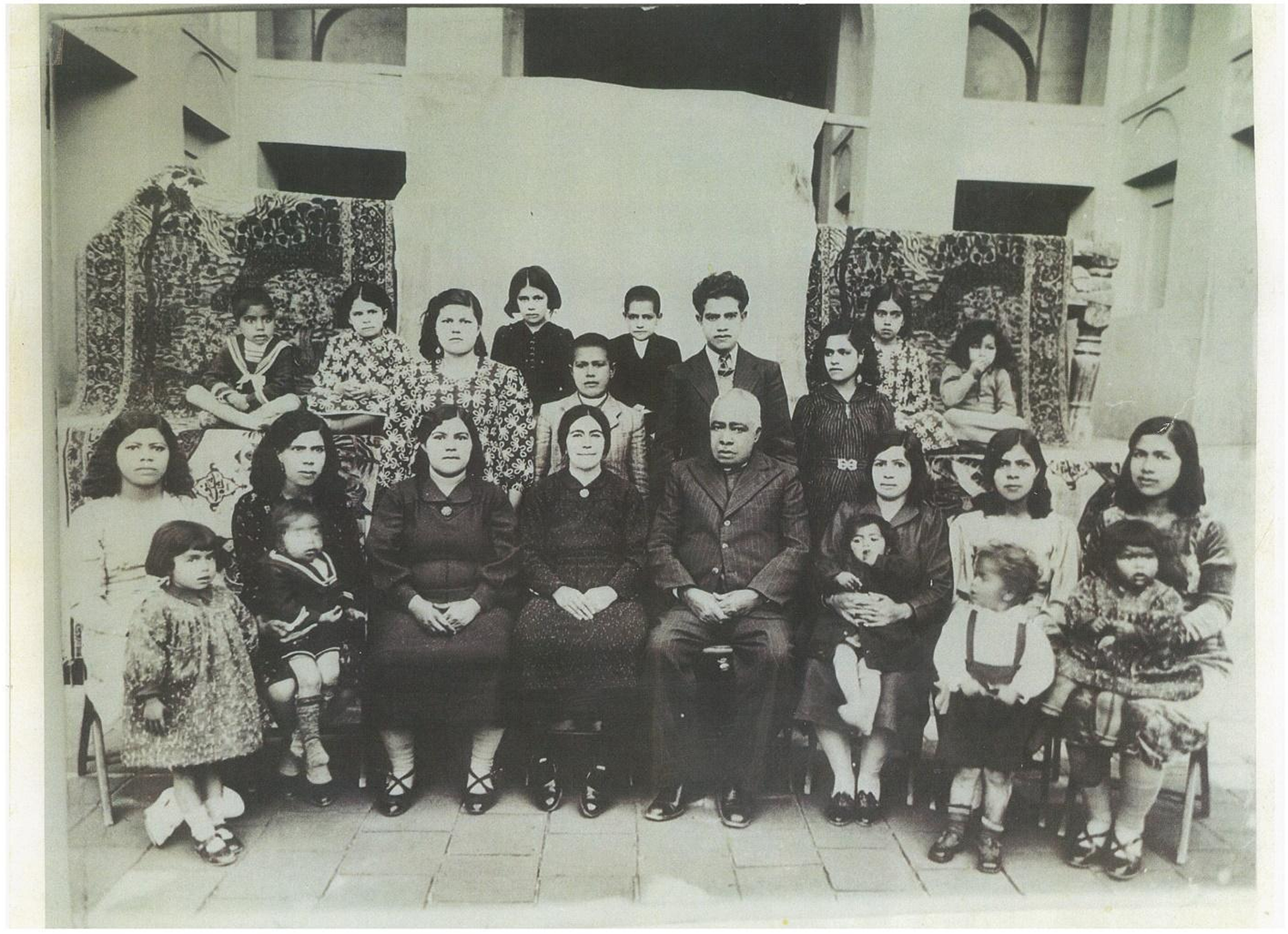
New avenues opened for major landowners, such as Ghulam-‘Ali, to become active in the political sphere. Delivering large numbers of peasant votes in Majles elections allowed landowners to enjoy a good deal of local influence and a limited level of political participation, to the extent tolerable by the Pahlavi regime. In Yazd, Ghulam-’Ali was able to build a large, walled compound where he eventually lived with his mother (Ziba Khanum), his wife, his eight children, their spouses, and his grandchildren (Figure 3). A number of family members in the compound remained Muslims, living among their Baha’i relatives with a level of tolerance.
Ghulam-‘Ali Siyah Khurasani with his wife, Munavvar Khanum (center, front), their children, and grandchildren in their home in Yazd, taken September 1940. Back row (left to right): Iraj Torkzadeh, Paridokht Haghighat, Iran Haghighat, Parvin Haghighat, Hushang Khurasani, Jalil Taghizadeh, Muhammad Khurasani, Forugh Taghizadeh, Turan Turkzadeh, Afaq Taghizadeh. Front row (adults, left to right): Shamsi Khurasani Tadayuni, Nusrat Khurasani Turkzadeh, Sorayya Khurasani Haghighat, Munavvar Khurasani, Ghulam-‘Ali Khurasani, Malekeh Khurasani Taghizadeh, Moluk Khurasani Sarraf, Safa Khurasani (a relative). Front row (children, left to right): Arassa Khurasani, Naser Turkzadeh, Mahvash Taghizadeh, Farhang Sarraf, Mehrbanoo Khurasani. Images identified by MonirArdakani.

Family members were able to maintain their Baha’i identities at least within the home, including: Ghulam-‘Ali’s wife (Munavvar Khanum), his two sons and their wives, and the four daughters who married Baha’i spouses. Two daughters married Muslims. In public, however, the family presented the façade of being Muslim. As Ghulam-‘Ali’s daughter-in-law related, “Everyone knew we were Baha’is, but everyone pretended we were Muslims.”Footnote 38 Of course, this pretense would have included Ghulam-‘Ali and the other family members publicly presenting themselves as Muslims.
Nonetheless, there were tensions within the family concerning the extent and form of Baha’i practice they would adopt. The nature of the Baha’i identity was undergoing change, at least in large cities such as Tehran. While Ghulam-‘Ali had originally adopted the religion as a private conviction, the Baha’i community by the 1940s had developed a formal practice of regular meetings and an outward social life.
Shahnaz Khanum’s arrival in Yazd after her marriage to Ghulam-‘Ali’s son, Muhammad, in 1947 precipitated a major family row that she still remembered vividly seventy years later. Shortly after her marriage, the sixteen-year-old bride demanded that her husband accompany her to the Baha’i Nineteen-Day Feast, held as a regular Baha’i gathering. Apparently, it had been her practice to attend the feast regularly in Tehran. Her husband, on the other hand, was committed to remaining at home to entertain his father’s wealthy guests most nights. An argument erupted during which Shahnaz threatened to go to the evening meeting alone. Muhammad was unable to placate her and called his father to settle the dispute. Ghulam-‘Ali jokingly acknowledged his daughter-in-law’s anger and arranged for a male servant to accompany her to the Baha’i meeting; an arrangement she continued every nineteen days.Footnote 39
While it was certainly a delicate balance, the family was able to maintain this complex dual identity for many years, allowing them to live in peace with their Muslim neighbors. Still, this arrangement eventually came to a dramatic and tragic end.
Wealth and political influence
As noted, Ghulam-‘Ali’s return to his home city of Yazd, after being away for thirty years, coincided with the death of his half-brother, Isma’il. Taking over the family estate made Ghulam-‘Ali, despite being the son of an enslaved woman, his father’s only male heir who could legally claim the family’s land holdings. It appears that he was successful in taking control of these properties and administering them alone. His land holdings, which became known as the Khurasani Belt (Kamarband-e Khurasani), surrounded the city.Footnote 40 As such, he could conveniently deliver votes in local elections to his political ally, Doktor Hadi Taheri, a conservative, pro-British, influential Majles deputy and leader of an important parliamentary faction for over thirty years, beginning in 1925.Footnote 41
Accused of murder
His wealth and power brought Ghulam-‘Ali political enemies. Sometime in the 1930s, when Ghulam-‘Ali served as the head of Yazd’s merchant guild, Utagh-e Tejarat, he was involved in a conflict with a local prosecutor, who unsuccessfully tried to get the guild to collaborate in prosecuting a local tea merchant on charges of customs-related irregularities. Ghulam-‘Ali insisted on the merchant’s innocence and refused to cooperate with the prosecutor.Footnote 42 The grudge reportedly led to the prosecutor bringing new charges in a separate case against Ghulam-‘Ali.
In 1933, Ghulam-‘Ali was the subject of a conspiracy in a murder case in the township of Herat, in the vicinity of Yazd, where he had substantial landholdings. Another merchant-landowner had gotten into a dispute with Ghulam-‘Ali’s agent during an audit. A fierce quarrel led to the agent publicly insulting the landowner, who subsequently shot and killed the agent. While the agent’s pugnacious behavior seems unusual, the landowner’s atrocious act of murder was not rare in the landowning culture of the time. The landowner used his clout with village officials to cover up his crime, getting an ex-gendarme wrongfully accused of the murder. Once the file found its way to Yazd, the vindictive prosecutor used a ten-tuman payment (equivalent to one month’s salary) Ghulam-’Ali had made to the accused gendarme as evidence for implicating and detaining him for murder. Ghulam-‘Ali’s merchant friends and supporters managed to bail him out. The case was referred to the Tehran Ministry of Justice, and after a more thorough investigation, both accused were exonerated, while the culprit landowner escaped prosecution.Footnote 43
Despite these charges, Prime Minister ‘Ali Mansur formally reappointed Ghulam-’Ali to the aforementioned merchant guild in June 1935, serving as one of its twelve members, a position he had held since 1931.Footnote 44 At the time of his death in 1949, he served as head of that body.Footnote 45 Ghulam-’Ali was also on the board of directors of the city’s two main textile industries—the publicly owned Eqbal and privately established Derakhshan—and served as the head of the city’s electoral board (Komiteh-ye Nezarat Entekhabat), was responsible for bringing one of the two electrical power plants to Yazd, and owned one of the city’s two private automobiles, which he used to tour the city and oversee his properties.Footnote 46 However, the same forces that facilitated his political rise also led to his downfall.
Persecution and demise
In 1947 Muhammad Harati, one of Ghulam‘Ali’s relatives, defeated Dr. Taheri in the elections for the fifteenth Majles. The elections followed the passage of a new electoral law and were marred by allegations of irregularities favoring Prime Minister Ahmad Ghavam. A year later in 1948, Dr. Taheri was appointed deputy prime minister in Muhammad Sa’ed’s cabinet. For Ghulam-‘Ali and his family, who had miscalculated the complex political process, this meant losing local influence and protection.
These developments coincided with an anti-Baha’i campaign in Yazd in 1948, which was primarily directed at the Khurasani family, seemingly with the help of Ghulam ‘Ali’s political rivals. The main instigator was the articulate and charismatic cleric Mulla Muhammad Khalesizadeh (1890–1963), who arrived in Yazd around 1947 from a period of exile in Kashan. Born and raised in Iraq, he was an anti-British agitator during the British mandate period, one of the earliest proponents of the clerical takeover of government, and spent much of his life in exile under both British and Pahlavi rule. He also engaged in public debates with Baha’i propagators. Ghulam ‘Ali’s family remembers that Khalesizadeh would mount the pulpit in the mosque every day to denounce the family and their religion.Footnote 47 There were an estimated 4,000 Baha’i residents in Yazd and its vicinity in the 1940s, who were occasionally under threat of persecution.Footnote 48
By 1947, the 1936 dress code was no longer enforced and many traditional women returned to old practices. Ghulam-‘Ali’s daughter-in-law, Shahnaz Khanum, seems to have been one of the few women in Yazd who went out in the street without a full veil, against the advice of her husband. Her street clothing attracted unwanted attention, as people came out of shops to gawk at her. Eventually she agreed to wear a perfunctory veil. She relayed that Khalesizadeh would preach from the pulpit against Ghulam-‘Ali and “his naked daughter-in-law,” who was a blight on the city.Footnote 49 Khalesizadeh aroused considerable public sentiment against the family, which now lacked political support. This is an example of how women became easy targets for instigating anti-Baha’i sentiments. Accusations of Babi and Baha’i women’s unchastity were familiar and had been weaponized against the religion since the earliest days of the faith.Footnote 50
The campaign led to threats against Ghulam-‘Ali’s life; he was under great pressure to at least make an outward show of conviction to Islam. He was refused entry to the public bathhouse, which would have been unthinkable only months before. His daughter-in-law remembered that he had to go out secretly at night to use the Baha’i bathhouse.Footnote 51 The attacks continued and, eventually, it became unsafe for Ghulam-‘Ali to leave his family compound. He remained in self-imprisonment for six months, until his death from pneumonia in January 1949. His family maintains that his illness was related to the stress and anxiety caused by the anti-Baha’i attacks. His daughter-in-law poignantly mused during one interview that it may have been providential that he died when he did. Otherwise, he may have been tempted to deny his faith.Footnote 52
Ghulam-‘Ali’s story also had a posthumous dramatic final chapter. The Khurasani family, both Muslims and Baha’is, arranged for a grand memorial gathering in the city’s main Mir-Chakhmaq Mosque. However, crowds instigated by Khalesizadeh interrupted the service, threatening to murder Ghulam-’Ali’s son, Muhammad, who had to be rescued by his friends. There were also death threats to Muhammad’s wife, Shahnaz Khanum.Footnote 53 The affair ended only after personal intervention by the provincial governor.Footnote 54 A large Baha’i memorial was subsequently held in the family compound.Footnote 55
Before the memorial, the burial was also a scene of conflict, as the deceased’s Baha’i and Muslim relatives disagreed over his burial place. Since he had been a victim of an anti-Baha’i attack, some Muslim relatives were afraid they might become implicated in the matter. As such, they insisted on burying Ghulam-‘Ali in a family mausoleum in the Muslim cemetery with Islamic rites, asserting an Islamic identity for him and minimizing the chance of losing his estate to increasingly powerful clerics during the post-World War I period.
A melee erupted when Muslim relatives appeared at Ghulam-‘Ali’s house, threatened his Baha’i family, and seized his body. His wife, Munavvar Khanum, was distraught. She rushed into the street without her chador on, shouting that she would never allow her husband to be buried in a Muslim cemetery, but there was nothing she could do to stop it.Footnote 56
The abduction of the bodies of converts with ambiguous, fluid, or dual religious identities was common in this period. Perpetrators were usually relatives with a vested interest in purging the deceased’s past nonconformities, thus asserting a pure conviction to the center by insisting on burying the body in a Muslim cemetery. Like the case of Ghulam-‘Ali, the burial site became a cornerstone of the deceased’s past identity, a definitive piece of evidence to use in inheritance disputes, and protection for family property against confiscation.Footnote 57
Anti-blackness and ambiguity
Bagoolizadeh has argued that by the twentieth century, the term siyah had become a pejorative designation that pointed to enslaved ancestry. She uses the example of Sayyid ‘Abdullah Behbahani, one of the most influential clerics of the Constitutional Revolution, who was labeled Shah Siyah (the Black King) by his enemies to lambast his drive for wealth and power, thus demeaning his status. The designation sarcastically referred to his autocratic power in government and to his African background.Footnote 58 He was the son of prominent Tehran cleric Sayyed Esma’il Behbahani and his enslaved African concubine Zarafshan, who was “given” to him by a Qajar official.Footnote 59
The whispered, somewhat disparaging epithet siyah may have also served to diminish Ghulam-‘Ali’s status in Yazd. Ghulam-‘Ali’s grandson tells the story of an incident on the streets of Yazd when his grandfather’s blackness spilled over into public discourse, potentially pointing to the wider issue of racial disability. As we have seen, everyone used the tag siyah after Ghulam-‘Ali’s name, but always privately. On one occasion, however, he was accosted on the street by a sex worker who wanted his help. She was riding a bicycle and had stopped to repair the bike. She called to “Ghulam-‘Ali Siyah,” who was nearby, for help. While others tried to ignore her call, Ghulam-‘Ali responded to her request and helped her by calmly holding on to the bike.Footnote 60 This story indicates that Ghulam-‘Ali was aware of the siyah label used for him and was not very upset about it. The sex worker’s use of the designation to demand help from Ghulam-‘Ali for a menial task could also be seen as a subtle revelation of a mostly hidden social bias by a subaltern less concerned with social conventions and formalities. It is not clear, however, whether this was used as a marker of a reified racial category or what kinds of social exclusion it indicated.
It is worth noting that the term siyah was not attached to the children or grandchildren of Ghulam-‘Ali. His children all had one Iranian parent, Munavvar Khanum, without any known African ancestry, as did his grandchildren. Ziba Khanum’s descendants demonstrate how fully Afro-Iranians were incorporated into Iranian society, especially among the wealthy classes, without regard for race. All of Ghulam-‘Ali’s adult children married into Iranian families, and their children seem indistinguishable from other Iranians. Indistinguishable to us, at least. One of Ghulam-‘Ali’s grandchildren suggested that she had African facial features due to her Afro-Iranian ancestry, but we could not discern them.Footnote 62
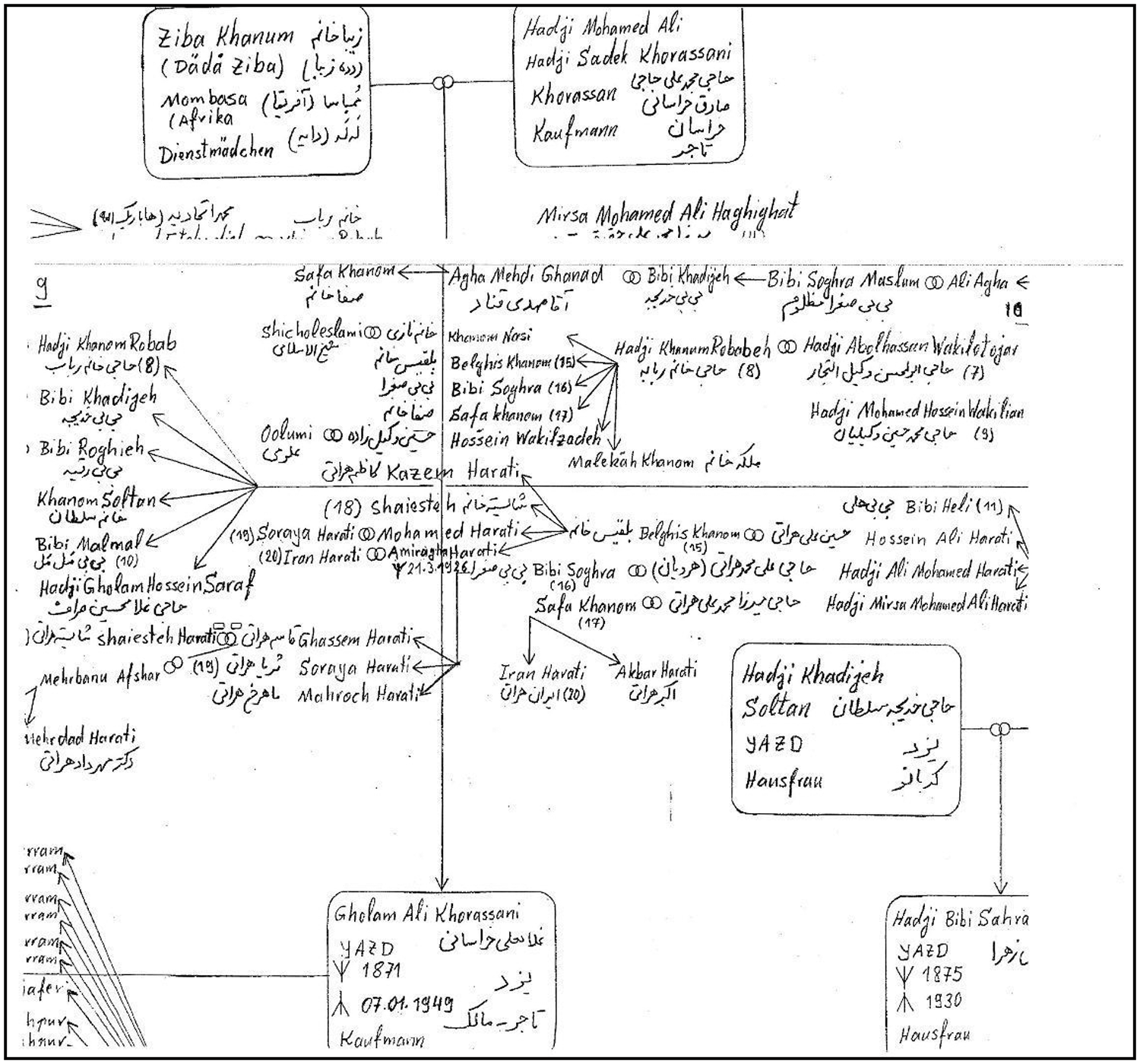
Moreover, none of Ghulam-‘Ali’s family makes any attempt to hide their African heritage or Ziba Khamum’s identity as an enslaved African woman. Similarly, all of her master’s (Haji Muhammad-‘Ali) descendants, including the Muslim children and grandchildren of his Iranian wife, acknowledge Ziba Khanum as a member of the family and a forbearer. A genealogy of the family produced in Germany includes her and her descendants, who make up a large portion of the tableau. After the 1979 revolution, the Khurasani family scattered and now reside in a number of locations, including Los Angeles, New York, London, and Germany (Figure 4).
Details of the Herati–Khurasani family tree in German and Persian, drawn up in Germany by the descendants of Haji Muhammad -‘Ali Sadeq Khurasani. Ziba Khanum (top left) is shown as the mother of Ghulam-‘Ali (bottom center). The document suggests that Ziba was from Mombasa. She is designated with the name “Dadé” (Nanny), as she was known by the family. She is also designated here as laleh (nursemaid) and as dayeh (wetnurse) by occupation (suggesting, perhaps, that the author was unsure of her role in the family). No marker of race is included for her or her descendants.

Figure 4 Long description
The diagram presents a family tree of the Herati–Khurasani lineage, with text in German and Persian. At the top left, Ziba Khanum is identified as the mother of Ghulam-‘Ali, located at the bottom center. The tree includes various names and relationships, with annotations in both languages. The document suggests Ziba was from Mombasa and includes designations such as ′Dadé′ (Nanny), ′nursemaid′ and ′wetnurse′. The tree is structured with lines connecting family members, showing generational links and relationships.
Conclusion
Ghulam-‘Ali’s eventful life story makes one almost overlook the crucial fact that he was, after all, the subaltern son of an enslaved African woman. In a society in which class and privilege often trump race and ethnic distinctions, Ghulam-‘Ali seems to have largely overcome racial obstacles with remarkable ease. At the end of his life, it was his Baha’i affiliation that made him vulnerable, no matter how distant he may have become from his Baha’i identity. Before that, his family connections, elite affiliations, merchant networks, and considerable wealth seem to have protected him from any negative consequences of his African descent.
On the other hand, there is the fact that he was, in effect, disinherited by his half-brother from his father’s Iranian wife. Whether this was the result of Ghulam-‘Ali’s African descent or racial status is not clear. Disputes over family inheritance were common at the time, and Ghulam-‘Ali was only a teenager—perhaps young enough to be ignored—at the time of his father’s death.
The fact that he was universally referred to as siyah, at least behind his back, indicates that he suffered a certain social disadvantage within his community. However, racial distinctions were layered and ambiguous in pre-modern Iran. Other spheres of life—such as religion, sexuality, and gender—were similarly blurred. Such ambiguities provided a cover for non-conformists and racial misfits such as Ghulam-’Ali. An example of this ambiguity is found in the name of the present-day Bazaar named after him, which includes the designation siah without apparent pejuritive internet (Figure 5). However, this protection was diminished with the advent of modern ways and the establishment of the nation-state.Footnote 63
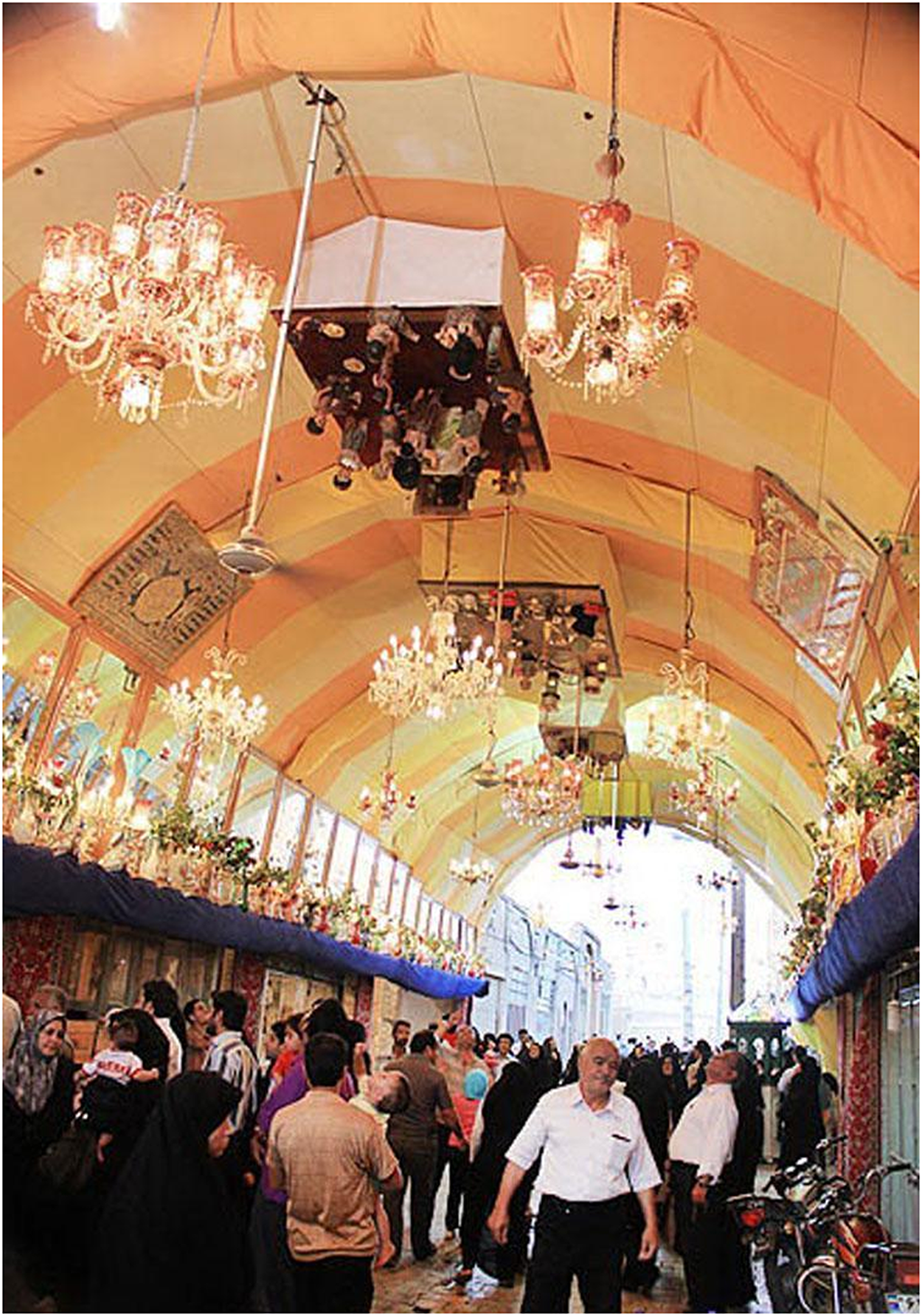
A Memorial to Ghulam-‘Ali The slave child turned merchant-landowner, is the well-known Saray or Bazaar-e Ghulam ‘Ali Siyah. Registered as a historical monument in 2007, locals and tourists frequent it. The innocuous use of the term siyah as part of a well-known urban landmark to this day may be seen as an indication of how racial differences were normalized and accepted by locals. The monument asserts a Muslim identity for Ghulam-‘Ali. In a typical sneer to his Baha’i past, the market is known for its festive decorations on the occasion of the supposed birthday of the Twelfth Imam on the fifteenth of Sha’ban.Footnote 61

By the 1940s, Ghulam-’Ali’s loss of political clout alongside his affiliation with the persecuted Baha’i religion made him quite vulnerable. The arrival of a hostile cleric in Yazd threatened his wealth and property, terrified his Muslim relatives, and put his life in danger. As far as we know, Khalesizadeh’s only complaint against the Khurasani family was that, as Baha’is, they were violating religious norms, including unveiling women. He did not mention race or African descent in his sermons.
It would seem that Ghulam-‘Ali’s life story may have been unusually successful for the son of an enslaved African woman and her master, but perhaps not. Most slave owners were wealthy men. If their Afro-Iranian children were able to inherit a fair portion of their father’s wealth as required by Islamic law, they may have been able to maintain an elite lifestyle, marry into wealthy families, and simply merge into mainstream Iranian society, as Ghulam-‘Ali and his descendants did. The career of the aforementioned Sayyid ‘Abdullah Behbahani may provide another example of this kind of integration, but this can only be confirmed by further research into the lives of the Afro-Iranian children of wealthy masters. Such research is long overdue.