


%20--%3e%3c!DOCTYPE%20svg%20PUBLIC%20'-//W3C//DTD%20SVG%201.0//EN'%20'http://www.w3.org/TR/2001/REC-SVG-20010904/DTD/svg10.dtd'%3e%3csvg%20version='1.0'%20id='Layer_1'%20xmlns='http://www.w3.org/2000/svg'%20xmlns:xlink='http://www.w3.org/1999/xlink'%20x='0px'%20y='0px'%20width='64px'%20height='64px'%20viewBox='5.5%20-3.5%2064%2064'%20enable-background='new%205.5%20-3.5%2064%2064'%20xml:space='preserve'%3e%3cg%3e%3ccircle%20fill='%23FFFFFF'%20fill-opacity='0'%20cx='37.785'%20cy='28.501'%20r='28.836'/%3e%3cpath%20fill='%23595959'%20d='M37.441-3.5c8.951,0,16.572,3.125,22.857,9.372c3.008,3.009,5.295,6.448,6.857,10.314%20c1.561,3.867,2.344,7.971,2.344,12.314c0,4.381-0.773,8.486-2.314,12.313c-1.543,3.828-3.82,7.21-6.828,10.143%20c-3.123,3.085-6.666,5.448-10.629,7.086c-3.961,1.638-8.057,2.457-12.285,2.457s-8.276-0.808-12.143-2.429%20c-3.866-1.618-7.333-3.961-10.4-7.027c-3.067-3.066-5.4-6.524-7-10.372S5.5,32.767,5.5,28.5c0-4.229,0.809-8.295,2.428-12.2%20c1.619-3.905,3.972-7.4,7.057-10.486C21.08-0.394,28.565-3.5,37.441-3.5z%20M37.557,2.272c-7.314,0-13.467,2.553-18.458,7.657%20c-2.515,2.553-4.448,5.419-5.8,8.6c-1.354,3.181-2.029,6.505-2.029,9.972c0,3.429,0.675,6.734,2.029,9.913%20c1.353,3.183,3.285,6.021,5.8,8.516c2.514,2.496,5.351,4.399,8.515,5.715c3.161,1.314,6.476,1.971,9.943,1.971%20c3.428,0,6.75-0.665,9.973-1.999c3.219-1.335,6.121-3.257,8.713-5.771c4.99-4.876,7.484-10.99,7.484-18.344%20c0-3.543-0.648-6.895-1.943-10.057c-1.293-3.162-3.18-5.98-5.654-8.458C50.984,4.844,44.795,2.272,37.557,2.272z%20M37.156,23.187%20l-4.287,2.229c-0.458-0.951-1.019-1.619-1.685-2c-0.667-0.38-1.286-0.571-1.858-0.571c-2.856,0-4.286,1.885-4.286,5.657%20c0,1.714,0.362,3.084,1.085,4.113c0.724,1.029,1.791,1.544,3.201,1.544c1.867,0,3.181-0.915,3.944-2.743l3.942,2%20c-0.838,1.563-2,2.791-3.486,3.686c-1.484,0.896-3.123,1.343-4.914,1.343c-2.857,0-5.163-0.875-6.915-2.629%20c-1.752-1.752-2.628-4.19-2.628-7.313c0-3.048,0.886-5.466,2.657-7.257c1.771-1.79,4.009-2.686,6.715-2.686%20C32.604,18.558,35.441,20.101,37.156,23.187z%20M55.613,23.187l-4.229,2.229c-0.457-0.951-1.02-1.619-1.686-2%20c-0.668-0.38-1.307-0.571-1.914-0.571c-2.857,0-4.287,1.885-4.287,5.657c0,1.714,0.363,3.084,1.086,4.113%20c0.723,1.029,1.789,1.544,3.201,1.544c1.865,0,3.18-0.915,3.941-2.743l4,2c-0.875,1.563-2.057,2.791-3.541,3.686%20c-1.486,0.896-3.105,1.343-4.857,1.343c-2.896,0-5.209-0.875-6.941-2.629c-1.736-1.752-2.602-4.19-2.602-7.313%20c0-3.048,0.885-5.466,2.658-7.257c1.77-1.79,4.008-2.686,6.713-2.686C51.117,18.558,53.938,20.101,55.613,23.187z'/%3e%3c/g%3e%3c/svg%3e)
%20--%3e%3c!DOCTYPE%20svg%20PUBLIC%20'-//W3C//DTD%20SVG%201.0//EN'%20'http://www.w3.org/TR/2001/REC-SVG-20010904/DTD/svg10.dtd'%3e%3csvg%20version='1.0'%20id='Layer_1'%20xmlns='http://www.w3.org/2000/svg'%20xmlns:xlink='http://www.w3.org/1999/xlink'%20x='0px'%20y='0px'%20width='64px'%20height='64px'%20viewBox='5.5%20-3.5%2064%2064'%20enable-background='new%205.5%20-3.5%2064%2064'%20xml:space='preserve'%3e%3cg%3e%3ccircle%20fill='%23FFFFFF'%20fill-opacity='0'%20cx='37.637'%20cy='28.806'%20r='28.276'/%3e%3cg%3e%3cpath%20fill='%23595959'%20d='M37.443-3.5c8.988,0,16.57,3.085,22.742,9.257C66.393,11.967,69.5,19.548,69.5,28.5c0,8.991-3.049,16.476-9.145,22.456%20C53.879,57.319,46.242,60.5,37.443,60.5c-8.649,0-16.153-3.144-22.514-9.43C8.644,44.784,5.5,37.262,5.5,28.5%20c0-8.761,3.144-16.342,9.429-22.742C21.101-0.415,28.604-3.5,37.443-3.5z%20M37.557,2.272c-7.276,0-13.428,2.553-18.457,7.657%20c-5.22,5.334-7.829,11.525-7.829,18.572c0,7.086,2.59,13.22,7.77,18.398c5.181,5.182,11.352,7.771,18.514,7.771%20c7.123,0,13.334-2.607,18.629-7.828c5.029-4.838,7.543-10.952,7.543-18.343c0-7.276-2.553-13.465-7.656-18.571%20C50.967,4.824,44.795,2.272,37.557,2.272z%20M46.129,20.557v13.085h-3.656v15.542h-9.944V33.643h-3.656V20.557%20c0-0.572,0.2-1.057,0.599-1.457c0.401-0.399,0.887-0.6,1.457-0.6h13.144c0.533,0,1.01,0.2,1.428,0.6%20C45.918,19.5,46.129,19.986,46.129,20.557z%20M33.042,12.329c0-3.008,1.485-4.514,4.458-4.514s4.457,1.504,4.457,4.514%20c0,2.971-1.486,4.457-4.457,4.457S33.042,15.3,33.042,12.329z'/%3e%3c/g%3e%3c/g%3e%3c/svg%3e)
Introduction
Rickettsial serology is diagnostically challenging because antibodies may be absent early in illness, whereas a single reactive titer may reflect current infection, prior exposure, or cross-reactivity. Paired immunoglobulin (IgG) serology demonstrating a fourfold rise between acute and convalescent specimens therefore remains important for retrospective serologic confirmation of flea-borne typhus and spotted fever group rickettsioses. Reference Biggs, Behravesh and Bradley1–Reference Stewart and Stewart3 This limitation is particularly relevant in Texas, where typhus group rickettsiosis has reemerged and expanded geographically. Reference Murray, Evert and Mayes4,Reference Ruiz, Valcin, Keiser and Blanton5
The value of paired serology depends on completion of the second specimen. In a recent North Carolina study of patients tested for spotted fever rickettsiosis or ehrlichiosis, only 15% completed convalescent testing. Reference Liao, Hollingsworth and Cassidy6 We evaluated typhus group and spotted fever group serology across an eight-hospital Houston health system to characterize initial testing patterns, timing and completion of repeat serology, and the yield of appropriately timed paired testing.
Methods
We conducted a retrospective cohort study of typhus group and spotted fever group serology performed across eight Houston Methodist hospitals from January 1, 2016, through December 31, 2025. Laboratory records were linked longitudinally across facilities using enterprise-level patient identifiers and analyzed using deidentified study identifiers. The Houston Methodist Institutional Review Board determined that this activity did not constitute research involving human subjects under Department of Health and Human Services (DHHS) and The Food and Drug Administration (FDA) regulations and therefore did not require Institutional Review Board (IRB) review or approval.
Typhus group and spotted fever group serologies were send-out tests performed by ARUP Laboratories (Salt Lake City, Utah) using semiquantitative indirect fluorescent antibody assays for IgG and IgM. Typhus group testing used Rickettsia typhi antigen (ARUP test 0050384), whereas spotted fever group testing used Rickettsia rickettsii antigen (ARUP test 0050371); reactivity to the latter is reported as spotted fever group reactive. For both assays, the reference interval for IgG and IgM was <1:64. For study analyses, reported IgG titers≥1:64 were categorized as reactive.
Orders obtained for the same patient, organism group, and collection time were consolidated into collection events. A new organism-specific case was defined as an event with no same-organism serology during the preceding 70 days, consistent with a published paired-serology framework. Reference Liao, Hollingsworth and Cassidy6 Eligible index episodes were restricted to dates permitting complete 70-day lookback and 70-day follow-up observation. For initial-testing analyses, organism-specific index episodes occurring within 3 days in the same patient were grouped into unique acute clinical testing episodes. Typhus group and spotted fever group serology within 3 days was considered concurrent testing, including an opposite-group test that did not independently qualify as a new organism-specific index case.
The primary convalescent window was 14–70 days after the index specimen; repeat testing at 2–13 days was analyzed separately. The earliest qualifying 14–70-day specimen was used when multiple specimens were available; using the last qualifying specimen did not change response classifications.
Serologic response was assessed using IgG. Seroconversion was defined as an index result <1:64 followed by a reported titer ≥1:64. A definite fourfold rise was counted only when reported titers established an increase of at least fourfold; censored titers were nonevaluable when this could not be confirmed. The composite response was seroconversion or a definite fourfold increase. Three index episodes with multiple same-time orders were excluded from initial-titer analysis because no single unambiguous index titer could be assigned. Results are reported as counts, proportions, medians with interquartile ranges, and Wilson 95% confidence intervals. Analyses were performed in R version 4.3.3 (R Foundation for Statistical Computing, Vienna, Austria).
Results
Among 5,344 serology orders, 4,841 eligible organism-specific index episodes were identified after case and observation-window restrictions (Supplementary Figure S1). These corresponded to 3,218 acute clinical testing episodes; median age was 51 years (IQR, 36–65), with 1,505 females (46.8%) and 1,713 males (53.2%).
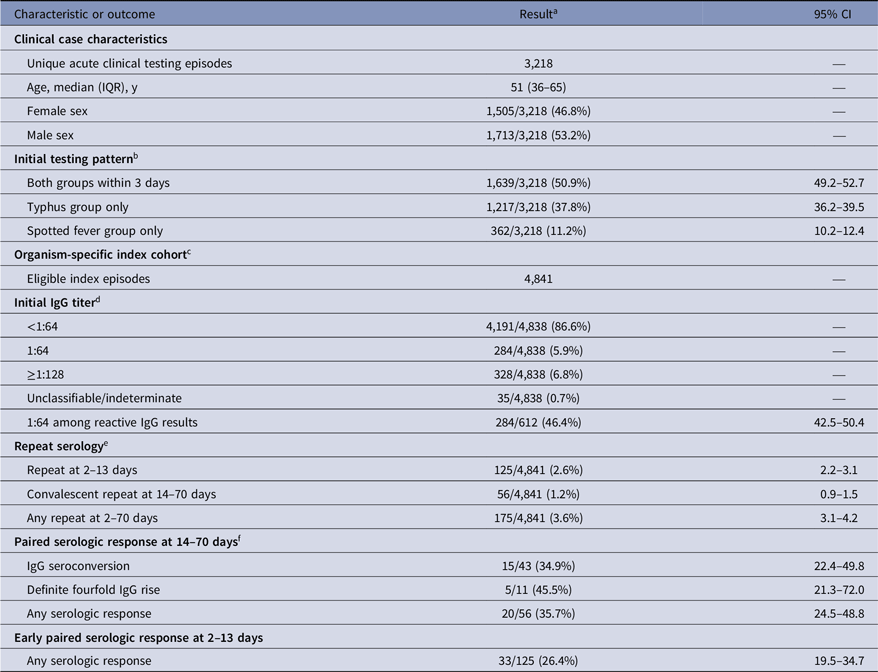
Both serology groups were obtained within 3 days in 1,639 of 3,218 acute clinical episodes (50.9%; 95% CI, 49.2%–52.7%). Typhus group serology alone occurred in 1,217 (37.8%; 95% CI, 36.2%–39.5%), and spotted fever group serology alone in 362 (11.2%; 95% CI, 10.2%–12.4%) (Table 1; Figure 1).
Rickettsial serology testing and follow-up. Panel A shows initial typhus group and spotted fever group testing patterns among 3,218 unique acute clinical testing episodes. Panel B shows completion and serologic response among 4,841 eligible organism-specific index episodes. Convalescent testing was assessed at 14–70 days. Serologic response comprised IgG seroconversion or a definite fourfold increase in IgG titer. CI, confidence interval; IgG, immunoglobulin G.

Rickettsial serology testing patterns, repeat testing, and serologic response

Table 1. Long description
A table comparing rickettsial serology testing patterns, repeat testing, and serologic response. The table has 20 rows and 3 columns. Column headers are Characteristic or outcome, Result, and 95% CI. Row labels include Clinical case characteristics, Initial testing pattern, Organism-specific index cohort, Initial IgG titer, Repeat serology, Paired serologic response at 14–70 days, and Early paired serologic response at 2–13 days. Row 1: Unique acute clinical testing episodes, 3,218, —. Row 2: Age, median (IQR), y, 51 (36–65), —. Row 3: Female sex, 1,505/3,218 (46.8%), —. Row 4: Male sex, 1,713/3,218 (53.2%), —. Row 5: Both groups within 3 days, 1,639/3,218 (50.9%), 49.2–52.7. Row 6: Typhus group only, 1,217/3,218 (37.8%), 36.2–39.5. Row 7: Spotted fever group only, 362/3,218 (11.2%), 10.2–12.4. Row 8: Eligible index episodes, 4,841, —. Row 9: <1:64, 4,191/4,838 (86.6%), —. Row 10: 1:64, 284/4,838 (5.9%), —. Row 11: ≥1:128, 328/4,838 (6.8%), —. Row 12: Unclassifiable/indeterminate, 35/4,838 (0.7%), —. Row 13: 1:64 among reactive IgG results, 284/612 (46.4%), 42.5–50.4. Row 14: Repeat at 2–13 days, 125/4,841 (2.6%), 2.2–3.1. Row 15: Convalescent repeat at 14–70 days, 56/4,841 (1.2%), 0.9–1.5. Row 16: Any repeat at 2–70 days, 175/4,841 (3.6%), 3.1–4.2. Row 17: IgG seroconversion, 15/43 (34.9%), 22.4–49.8. Row 18: Definite fourfold IgG rise, 5/11 (45.5%), 21.3–72.0. Row 19: Any serologic response, 20/56 (35.7%), 24.5–48.8. Row 20: Any serologic response, 33/125 (26.4%), 19.5–34.7.
Abbreviations: CI, confidence interval; IgG, immunoglobulin G; IQR, interquartile range.
aValues are n/N (%) unless otherwise indicated. Confidence intervals are Wilson score intervals.
bInitial testing patterns were evaluated among 3,218 unique acute clinical testing episodes; concurrent testing was defined as typhus group and spotted fever group serology obtained within 3 days.
cLongitudinal analyses included 4,841 eligible organism-specific index episodes with complete 70-day lookback and 70-day follow-up observation.
dInitial IgG distribution excluded 3 eligible index episodes with multiple same-time orders, leaving 4,838 unambiguous episodes. Reactive IgG was defined as a reported titer≥ 1:64.
eSix episodes had repeat testing in both the 2–13-day and 14–70-day windows; therefore, these categories are not mutually exclusive.
fThe earliest qualifying 14–70-day specimen was used. Seroconversion was defined as an index IgG< 1:64 followed by a reported titer≥ 1:64. A definite fourfold rise was counted only when supported by reported titers; censored, non-provable rises were nonevaluable. Any serologic response was defined as either seroconversion or a definite fourfold increase.
Early same-organism repeat testing at 2–13 days occurred in 125 of 4,841 eligible index episodes (2.6%; 95% CI, 2.2%–3.1%), whereas 56 (1.2%; 95% CI, 0.9%–1.5%) had convalescent testing at 14–70 days. Six episodes had testing in both windows, and 175 (3.6%; 95% CI, 3.1%–4.2%) had any repeat within 2–70 days.
Among 4,838 unambiguous index episodes, 612 (12.6%) had reactive IgG ≥1:64; 284 of 612 (46.4%; 95% CI, 42.5%–50.4%) were at the lowest reported titer of 1:64. Among 56 completed 14–70-day pairs, 15 of 43 initially below-threshold pairs demonstrated seroconversion (34.9%; 95% CI, 22.4%–49.8%), and 5 of 11 evaluable pairs demonstrated a definite fourfold rise (45.5%; 95% CI, 21.3%–72.0%). Overall, 20 of 56 pairs demonstrated either response (35.7%; 95% CI, 24.5%–48.8%). Among 125 early 2–13-day pairs, 33 (26.4%; 95% CI, 19.5%–34.7%) demonstrated a serologic response.
Discussion
Across eight hospitals, initial and longitudinal testing were markedly imbalanced. Both serology groups were obtained during approximately half of acute testing episodes, yet only 1.2% of eligible organism-specific index episodes had convalescent testing at 14–70 days. When appropriately timed paired testing was completed, more than one-third demonstrated seroconversion or a definite fourfold rise. These findings identify completion of the diagnostic process, rather than appropriateness of any individual initial test, as a potential diagnostic-stewardship target.
Liao et al reported convalescent testing in 15% of patients tested for spotted fever rickettsiosis or ehrlichiosis. Reference Liao, Hollingsworth and Cassidy6 Although not directly comparable, both studies demonstrate substantial attrition between acute and convalescent testing. Serologic cross-reactivity among rickettsiae can limit species-level interpretation; when both typhus and spotted fever group infections are clinically plausible, testing both groups may help contextualize seroreactivity rather than establish a species-specific diagnosis. Reference Biggs, Behravesh and Bradley1–Reference Stewart and Stewart3 Nearly half of reactive initial IgG results in our cohort were only 1:64, reinforcing the limitations of single titers.
Potential stewardship strategies include interpretive comments, electronic reminders or preplanned convalescent orders, and explicit assignment of follow-up responsibility across care transitions. These approaches align with diagnostic stewardship principles emphasizing test selection, interpretation, and translation of results into clinical management. Reference Patel and Fang7 PCR may complement serology early in illness: R. typhi can be detected during acute illness, whereas whole-blood PCR has limited sensitivity for spotted fever group rickettsioses; negative Polymerase Chain Reaction (PCR) results do not exclude infection. Reference Biggs, Behravesh and Bradley1,2,Reference Mir, Manzoor and Mushtaq8 Efforts to improve paired testing should not delay empiric treatment when rickettsial disease is clinically suspected. Reference Biggs, Behravesh and Bradley1,2
This study has limitations. Laboratory data lacked symptom onset, clinical presentation, epidemiologic exposures, testing rationale, treatment, outcomes, ordering-clinician specialty, and outside-system follow-up; therefore, we could not adjudicate initial-test appropriateness, identify where follow-up opportunities were lost, or classify episodes as confirmed clinical infections. Nonetheless, enterprise-level linkage across eight hospitals permitted longitudinal characterization of testing practices.
Concurrent initial testing was common, whereas appropriately timed convalescent testing was rare, identifying a focused opportunity for longitudinal diagnostic stewardship.
Supplementary material
The supplementary material for this article can be found at https://doi.org/10.1017/ash.2026.10905
Data availability statement
The patient-level data underlying this study are not publicly available because they derive from clinical laboratory records and are subject to institutional data-governance requirements. Aggregated data supporting the findings may be available from the corresponding author upon reasonable request and subject to institutional approval.
Financial support
None.
Competing interests
None.



 Open access

