Introduction
Conflict-related sexual violence and wartime rape are prevalent crimes in violent conflicts all over the world. However, few studies have examined the psychological consequences for women and men with wartime rape experiences. In a study by Swiss (Swiss, Reference Swiss1998), 49% of Liberian women and girls reported having experienced sexual violence during the Liberian civil conflict between 1989 and 1994. In a sample of Congolese women, Johnson et al. found that 40% had experienced sexual violence. Of these, 67% subsequently had major depressive disorder, 76% PTSD, and 37% suicidal ideation (Johnson, Reference Johnson2010). Croatian researchers also report a high prevalence of PTSD (31%) and depression (76%) in women who were raped in the Bosnian civil war (Lončar et al., Reference Lončar, Jovanovic and Hotujac2006).
Sexual violence and mass rapes are a part of World War II (WWII) history as well, even though they are rarely reported or investigated due to taboos and lacking witnesses (Kuwert and Freyberger, Reference Kuwert and Freyberger2007). In Germany, estimated 1.4–1.9 million women experienced wartime rapes at the end of WWII (Johr, Reference Johr1995). But, due to wartime conditions and individual and societal taboos, exact reporting of the facts and prevalence rates is still missing.
Kuwert and colleagues, who examined psychological consequences of the wartime mass rapes at the end of WWII, showed that, decades later, 19% of 27 interviewed women reported symptoms of full PTSD and 30% reported partial manifestation (Kuwert et al., Reference Kuwert2010). Lueger-Schuster reported PTSD-rates of 30% in Austrian women after experiencing sexual violence in WWII (Lueger-Schuster et al., Reference Lueger-Schuster, Glueck, Tran and Zeilinger2012). Both studies highlight the need to identify and treat post-traumatic conditions in the elderly generation of countries exposed to WWII trauma, and in women of current and post-conflict settings worldwide.
According to Moon (Moon, Reference Moon2009), one of the tasks of a post-conflict state is to attend to the mental health of its citizens and the nation as a whole. The importance of acknowledgement and reconciliation for individual coping with collective war traumatization can be seen in several post-conflict settings. Commissions, tribunals, and community courts have been implemented in such situations to acknowledge people and their individual narratives, and to support the dialogue between victims and perpetrators to promote reconciliation (Pham et al., Reference Pham, Weinstein and Longman2004; Field and Chhim, Reference Field and Chhim2008; Brouneus, Reference Brouneus2010). Reconciliation (Shnabel et al., Reference Shnabel, Nadler, Ullrich, Dovidio and Carmi2009), healing, forgiveness (Mukashema and Mullet, Reference Mukashema and Mullet2013), and desire for revenge (Field and Chhim, Reference Field and Chhim2008) are more and more frequently discussed in the context of individual and societal coping with collective violence. Furthermore, it has been shown in several social as well as conflict settings, that openness to reconciliation and a tendency to forgive are associated with lower rates of mental disorders e.g. PTSD, depression, and anxiety (Subkoviak et al., Reference Subkoviak1995; Brown, Reference Brown2003; Pham et al., Reference Pham, Weinstein and Longman2004; Bayer et al., Reference Bayer, Klasen and Adam2007). However, sufficient longitudinal evidence for individuals’ readiness to reconcile, acting either as a predominant resource or consequence of that the victim's psychopathology is still missing. Previous studies report evidence that there is no association between trauma exposure and how ready a person is to reconcile (Bayer et al., Reference Bayer, Klasen and Adam2007; Stammel et al., Reference Stammel, Neuner, Böttche and Knaevelsrud2012). Additionally, Field and Chhim (Field and Chhim, Reference Field and Chhim2008) found that trauma exposure is not predictive for developing feelings of revenge.
Reconciliation, as a key concept for peace activities in post-conflict societies (Stammel et al., Reference Stammel, Neuner, Böttche and Knaevelsrud2012), has to be investigated on the basis of a broader range of traumatized groups from conflict and post-conflict regions. The sample of raped women from WWII is a very special one because, as Kuwert and colleagues (Eichhorn et al., Reference Eichhorn, Klauer, Grundke, Freyberger, Brähler and Kuwert2012; Kuwert et al., Reference Kuwert2014) have shown, these women have barely received any acknowledgement since their traumatization. To our knowledge, our study is the first one examining the degree of readiness to reconcile within German women who underwent conflict-related sexual violence in WW II. We did so by exploring the following question and hypotheses:
-
1. What is the degree of readiness to reconcile within this sample of women raped in wartime?
-
2. Wartime rape survivors report a lower degree of readiness to reconcile than non-sexually traumatized women.
-
3. The degree of readiness to reconcile in wartime rape survivors is higher in those women who report less post-traumatic distress.
-
4. There is no association between readiness to reconcile and the number of experienced wartime rapes.
Methods
Procedure and study sample
Women with war-related sexual traumatic experiences
“All three of them went over me. I was so disgusted. I could not speak, I could not hit, I could not spit, I could not do anything. I was completely defenseless, so shocked was I.” (U.D., 83 years)
“I could not have carried out a child, because I was totally destroyed internally.” (R.S., 82 years)
Participants were recruited in October 2008 via national and international media such as press and radio. We primarily focused on reporting about wartime rape, whereas the call for participation was formulated in a sensitive and non-directive way. Of the 300 people who answered the study call via phone, mail, or email, there were 33 women and one man who reported direct experience of one or more rape episodes. Twenty seven women agreed to being interviewed face-to-face either in their home, in a nursing home, or in a neutral place, such as rooms of a cooperating institution in Berlin (Berlin Center for Torture Victims). Two women later refused to participate, four had to be excluded, and one woman died. In the end, 27 women were interviewed. Two female interviewers conducted the interviews and administered questionnaires. The ethics committee of the University of Greifswald approved this study and all participants gave their informed consent.
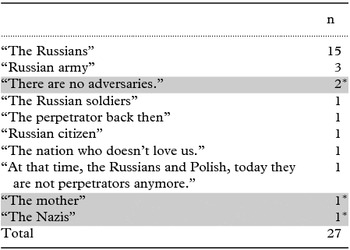
For the present analysis, we excluded four women, whose answers to the question “Who do you mean by ‘the adversaries?’” resulted in non-comparable data concerning their readiness to reconcile. Table 1 shows the distribution of the different answers.
The women's answers to the question “who do you mean by ‘the adversaries’?”

*Excluded from the analyses.
The mean age of the women was 80.6 years (SD = 3.25 years; range = 76–89). A total of 14 (61%) women were widowed; 4 (17%) were married; 4 (15%) had never married, and 1 (4%) was divorced. Sixteen women (70%) were displaced; 2 (9%) were later subject to deportation to the Soviet Union. The mean age at the time of wartime rape was 16 years (median) (mean = 17 years; SD = 3.4; range = 12–25). The women reported total numbers of experienced wartime rapes between 1 and 71 (median = 4.0; mean = 13.0; SD = 16.7).
Although our study call included all of the federal states of Germany, and therefore all former occupied territories, all women in the study were raped by Russian Allies. Three also reported having been abused by Polish soldiers. In nine cases, the perpetrator was alone, 12 women reported being raped by groups of soldiers, and two women reported both.
Women with non-sexual war-related traumatic experiences
To classify the total manifestation of readiness to reconcile within our sample, we compared it to age-matched control participants who were drawn from a larger sample of participants who had experienced WWII-related trauma (e.g. forced displacement, starvation, witnessing extreme violence such as the killing of other people, air raid experience), but no sexual assault during WWII or at any point in their lives. Those participants were recruited from Northern Germany in 2009 by telephone, personal presentations in nursing homes, and newspaper articles in cooperation with the largest expellee organization, “Bund der Vertriebenen.”
The mean age of the women was 80.8 years (SD = 3.75 years; range = 76–89). A total of 14 (61%) women were widowed; 6 (26%) were married; 2 (9%) had never married, and 1 (4%) was divorced. The women reported an average total number of 7 experienced traumata (median) with a range between 4 and 20 (M = 8.0; SD = 3.89).
Measures
Traumatic events and psychopathology:
A modified version of the PDS by Foa and colleagues (Foa et al., Reference Foa, Cashman, Jaycox and Perry1997), a 49-item self-report instrument, was used to detect trauma characteristics and PTSD symptomatology. The items correspond to the criteria A–F of the Diagnostic and Statistical Manual of Mental Disorder, 4th edition. Criterion A1 is covered by a checklist of 12 traumatic events. For our study, the scale was supplemented with war-related events derived from the Harvard Trauma Questionnaire (Mollica et al., Reference Mollica, Caspiyavin, Bollini, Truong, Tor and Lavelle1992). Symptom severity was measured by summing individuals’ responses to the PTSD symptom clusters intrusion (5 items), avoidance (7 items), and arousal (5 items). The symptom frequency is rated on a 4-point Likert scale (0 = not at all or only one time; 3 = five or more times a week/ nearly always) and relates to the four weeks prior to the interview. In the current sample, overall Cronbach's α was 0.84.
Readiness to Reconcile was assessed with the RRI-13, a newly constructed questionnaire by Stammel and colleagues, which was validated on a sample of Cambodian survivors of the former Khmer Rouge. The instrument relies on a former 18-item version, which was designed especially for victims of human rights violations, and was initially validated on a sample of Kurdish refugees from Turkey (Stammel et al., Reference Stammel, Neuner, Böttche and Knaevelsrud2012). RRI-13 consists of three scales, “openness to interaction” (six items; e. g. “I can imagine having friends among the ‘adversaries’.”), “absence of feelings of revenge” (five items; e. g. “I want the ‘adversaries’ to suffer as much as we did.”) and “differentiation ability” between the perpetrators and the nation of the perpetrators in general (two items; e. g. “There were many among the ‘adversaries’ who helped us.”). Each of these scales has good internal consistency (α = 0.83; 0.83, and 0.80). The items are answered on a 5-point Likert scale ranging from 1 (“completely”) to 5 (“not at all”).
An exploratory factor analysis shows a congruence of the factorial structure within our sample and the factorial structure of the Cambodian sample of the RRI-13 construction. Instead of “former Khmer Rouge” we asked about “the adversaries,” who had to be named then by the women. Four women, perceiving groups of people other than the Allies as “the adversaries” had to be excluded from our analyses. Because of its lacking variance within our sample, we eliminated item 4 (“It is my obligation to take revenge on the adversaries”) from our analysis. The total score, as well as the scores of the subscales, were reached by summing individuals’ responses, whereby negative formulated items were re-coded. Internal consistency in our sample was Cronbach's α = 0.77.
In the Results section, we provided some interview quotations from women out of the sexually war-traumatized sample. There's no direct relation between the quotations and the statistical results.
Statistical analyses
To compare our sample of sexually war-traumatized women with a non-sexually war-traumatized sample concerning readiness to reconcile, we conducted a paired samples t-test. Associations between post-traumatic symptomatology and readiness to reconcile in the subsample of sexually war-traumatized women were examined via correlation analyses (Pearson; one-tailed). Sensitivity power analysis with G*Power 3.0 revealed that by using a critical α level of 0.05 in one-tailed t-tests for paired samples, medium effects (dz = 0.53) can be detected with a power of 0.80 in this small sample (N = 23). The analyses were conducted with IBM SPSS Statistics version 20 for Windows (Faul et al., Reference Faul, Erdfelder, Lang and Buchner2007).
Results
“Afterwards, after I have thought about so much, I thought: Should it be, that those people who tormented me, belonged to the same nation of those who later helped us so much?! They had nothing themselves and gave us, begging, a potato. I will never forget this.” (H.R., 82 years)
Readiness to reconcile: manifestation and comparison with a sample of non-sexually war-traumatized women (1, 2)
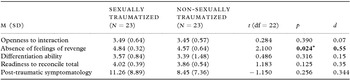
Sexually war-traumatized women reported a higher degree of readiness to reconcile (M = 4.02; SD = 0.39; range: 3.15–4.54) compared to women who had experienced other non-sexual WWII-related trauma (M = 3.86; SD = 0.54; range: 2.46–4.54). The difference was not significant (t = 1.135; p ≥ 0.05; d = 0.35), but showed a small effect nonetheless. Considering the subscales, we found that sexually traumatized women experienced significantly fewer feelings of revenge than women in the other group (t = 2.100; p ≤ 0.05; d = 0.55), a difference showing a medium effect. There were no differences concerning openness to interaction and differentiation ability. PDS sum scores were M = 8.45 (SD = 7.36; range: 0–25) in the non-sexually war-traumatized sample and M = 11.26 (SD = 8.89; range: 0–37) in the sexually war-traumatized sample. The difference between the mean sum scores was not significant, but showed a small effect (t = –1.150; p ≥ 0.05; d = 0.344). Table 2 illustrates the means and test-statistics of the compared samples.
Comparison of readiness to reconcile in sexually and non-sexually war-traumatized women (age-matched)

Notes: *p ≤ 0.05; one-tailed t-test for paired samples.
Association between post-traumatic symptomatology and readiness to reconcile in the sample of sexually war-traumatized women (3, 4)
“You dreamt of, you woke up, you suddenly saw the Russians in front of you, you were in this barn again. Then, in the next moment I thought, no you have just dreamt. That took quite a long time.” (I.T., 79 years)
“I think it catches you up your whole life, always at the bad incident's anniversary.” (B.Z., 81 years)
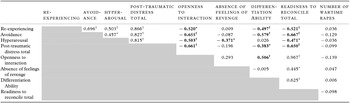
As a main result, we found high, significantly negative correlations between total readiness to reconcile and all PTDS symptom clusters as well as with the sum score of PDS (see Table 3). Considering the single dimensions of readiness to reconcile, openness to interaction appears to be the only scale of RRI-13 with a significant negative relation to every symptom cluster of post-traumatic distress (r = –0.503–r = –0.655; p ≤ 0.05). Moreover, there was a negative association between the absence of feelings of revenge and hyperarousal (r = –0.371; p ≤ 0.05) and between differentiation ability and re-experiencing (r = –0.497; p ≤ 0.01) and avoidance (r = –0.579; p ≤ 0.01).
Correlations (r) between post-traumatic symptomatology, readiness to reconcile and the number of experienced wartime rapes

Notes: *p ≤ 0.05; † p ≤ 0.01 (one-tailed testing).
The reported number of experienced wartime rapes showed no association with post-traumatic symptomatology or with readiness to reconcile or any subscale.
Discussion
Sexually versus non-sexually war-traumatized women
To date, sexual assault and mass rapes in the context of WWII have been poorly investigated. Besides the necessity of acknowledgement and reprocessing, our work shows that those women who experienced wartime rape report a higher readiness to reconcile than those who experienced wartime traumatization but no rapes. This difference occurs with a small but not significant effect, probably due to the small sample size. We suggest that the very high degree of post-traumatic symptomatology in women raped during wartime mediates this association to a large extent, but due to the small sample size, no further (regression-) analyses could be done. The found difference in PDS symptomatology between the samples did not reach significance (see also Kuwert et al., Reference Kuwert2014), presumably for the same reason. In contrast to our expectations, the sexually traumatized sample reported fewer feelings of revenge than the other women. We thought that the physical nearness to the perpetrator as a very close form of man-made traumatization would cause more intense feelings of revenge than committed by a faceless group of enemies. One reason could be a selection bias, insofar as that the women participating in our study might have been more willing to talk about their traumatic experiences linked to the person(s), of the perpetrator(s), because they were freer of feelings of revenge than those who did not participate.
Post-traumatic symptomatology, readiness to reconcile and the number of experienced wartime rapes
More than 60 years after trauma exposure, we found a very high degree of post-traumatic symptomatology in a group of German women who were raped during WWII. Furthermore, there is a negative association between the post-traumatic symptomatology and reported readiness to reconcile. Wartime rape survivors’ reported readiness to reconcile was higher in those women who showed less post-traumatic distress. Openness to interaction with former perpetrators seems to be the most relevant dimension within this association because it is highly related to the dimension of post-traumatic symptomatology. Moreover, feelings of revenge towards former perpetrators are positively related to hyperarousal, which was shown previously in the context of interpersonal traumatization (Orth et al., Reference Orth, Maercker and Montada2003; Reference Orth, Montada and Maercker2006).
According to previous results, we found no association between the number of traumatic experiences and readiness to reconcile in our sample (Biro and Milin, Reference Biro and Milin2005; Bayer et al., Reference Bayer, Klasen and Adam2007; Field and Chhim, Reference Field and Chhim2008; Stammel et al., Reference Stammel, Neuner, Böttche and Knaevelsrud2012), presumably because readiness to reconcile seems to be more closely associated with coping with traumatic experiences than it is with the experiences themselves (Stammel et al., Reference Stammel, Neuner, Böttche and Knaevelsrud2012).
Besides the strengths of our study, several limitations have to be considered. The generalizability of the results is restricted because of the small sample size and a possible participation bias. The women who participated in our study may be less afraid of confronting their traumatic experiences, making them a special subgroup, excluding highly traumatized women, who avoid confrontation (Newman and Kaloupek, Reference Newman and Kaloupek2004) or are not able to participate due to physical morbidity and higher mortality as a possible consequence of traumatic experiences and PTSD (Glaesmer et al., Reference Glaesmer, Brahler, Gundel and Riedel-Heller2011). Furthermore it is not possible to exclude the potential impact of other (wartime or lifetime) traumas on the post-traumatic symptomatology. Moreover, it has to be considered that Germans, when asked about their readiness to reconcile, even with individual perpetrators, might be affected in their responses by the fact that Germany, as the nation of perpetrators of WWII, is still dealing with its historical guilt. Therefore it is possible, that our sample of women raped in wartime, in terms of psychological rationalization, felt and reported a higher degree of readiness to reconcile with their perpetrators than they might have without internalized German guilt. Moreover, because of the long interval in time between WWII and the recently conducted interviews, we have to consider a possible recall bias. Besides this, all measures were based on self-report instruments. All in all, studies with larger samples should be considered when examining for effects of variables mediating post-traumatic symptomatology in survivors of conflict-related sexual violence, even if this is no longer possible among women who survived WWII.
Notwithstanding these limitations, our study is, to our knowledge, the first to investigate the psychologically, socially, and politically relevant paradigm of readiness to reconcile in women who have experienced conflict-related sexual violence. Furthermore, the results of our study show on the special example of WW II generation, that post-traumatic symptomatology can remain over decades after the traumatic event. Despite high prevalence rates in late life (Maercker et al., Reference Maercker, Forstmeier, Wagner, Glaesmer and Brähler2008; Glaesmer et al., Reference Glaesmer, Gunzelmann, Braehler, Forstmeier and Maercker2010), relatively little is known about the manifestation and course of the PTSD in older adults. On the one hand, it has to be pointed out that early trauma treatment is needed to diminish chronification of post-traumatic symptoms. On the other hand, there has to be a greater awareness in general practitioners and other clinicians of post-traumatic symptoms in older adults in Germany. Böttche et al. state, that research on treatment approaches indicates that disorder-specific interventions (i.e. trauma confrontation and cognitive restructuring) can be effectively combined with an age- specific narrative life-review approach (Böttche, Reference Böttche, Kuwert and Knaevelsrud2012).
Moreover, by investigating long-term outcomes of wartime rapes in 1945, the study provides data that will remain unique in history. Because of the strong association between openness to interaction and post-traumatic symptomatology in the sample of wartime rape survivors, we are making the preliminary assumption that readiness to reconcile acts as a psychological resource, helping people cope with their traumatic experiences. Our findings thereby are in line with previous results (Subkoviak et al., Reference Subkoviak1995; Kaminer et al., Reference Kaminer, Stein, Mbanga and Zungu-Dirwayi2001; Pham et al., Reference Pham, Weinstein and Longman2004; Bayer et al., Reference Bayer, Klasen and Adam2007; Field and Chhim, Reference Field and Chhim2008), while still lacking longitudinal evidence. Our results suggest that when considering survivors’ resources, especially readiness to reconcile, it is very important to identify not only long-term but also short-term consequences of conflict-related traumatization. Hence, there is a great need for reconciliation interventions that can decrease post-traumatic, depressive, and other symptomatology, as has been shown in several previous forgiveness intervention studies (Freedman and Enright, Reference Freedman and Enright1996; Waltman et al., Reference Waltman, Russell, Coyle, Enright, Holter and M. Swoboda2009). Future research should continue focusing on these processes in post- conflict settings with the aim of developing and evaluating reconciliation-supporting interventions.
Conflict of interest
None.
Description of authors’ roles
Svenja Eichhorn did a part of the interviews, managed and analyzed the data, wrote the majority of the manuscript and coordinated the co-authors’ contributions. Nadine Stammel and Christine Knaevelsrud constructed the main survey instrument, helped in designing the paper, and provided feedback on the drafts. Heide Glaesmer helped write about the methods, supervised the data analyses, and provided feedback on the drafts. Thomas Klauer helped design parts of the study and did a substantial part of the statistical analyses. Philipp Kuwert and Harald J. Freyberger conceived and designed the study, initiated the data collection, and supervised the data analyses. All authors have contributed to and approved the final manuscript.
Acknowledgments
We thank the “Society for Nervous and Mental Disease Mecklenburg-Vorpommern” (“Gesellschaft für Nervenheilkunde des Landes Mecklenburg-Vorpommern”), who supported our study with 5,000 Euro. Second, we thank Elena Grundke and Sören Günther who collected a part of the data. A further thank you goes to Amber McPherson, who proofread and made linguistic revisions of the manuscript.