Introduction
Maternal depression is a well-known risk factor for adverse child outcomes including internalizing and externalizing problems (Goodman et al. Reference Goodman, Rouse, Connell, Broth, Hall and Heyward2011). This association has often been explained by maladaptive parenting and/or negative maternal cognitions (Silberg & Rutter, Reference Silberg, Rutter, Goodman and Gotlib2002), but also by child exposure to risk factors that associate with depression, such as low social support of the mother or poverty (Goodman & Gotlib, Reference Goodman and Gotlib1999; Pachter et al. Reference Pachter, Auinger, Palmer and Weitzman2006; Barker et al. Reference Barker, Copeland, Maughan, Jaffee and Uher2012; Jensen et al. Reference Jensen, Dumontheil and Barker2014). Unhealthy dietary patterns have been associated with different forms of mental illness (Scott & Happell, Reference Scott and Happell2011), including depression (Akbaraly et al. Reference Akbaraly, Sabia, Shipley, Batty and Kivimaki2013), and with co-occurring risk factors, such as poverty (Moshfegh, Reference Moshfegh2007; Hiza et al. Reference Hiza, Casavale, Guenther and Davis2013). However, the association between the nutritional environment provided to a child and maternal depression has rarely been assessed.
Mental illness is associated with the type of food that is available in a household (Rao et al. Reference Rao, Asha, Ramesh and Rao2008), which may alter the quality of nutrients that are available to a child (Monk et al. Reference Monk, Georgieff and Osterholm2013). Research robustly shows the important influence of dietary patterns (at different developmental stages) on child cognitive, emotional and behavioural outcomes. More specifically, unhealthy diet in pregnancy and early childhood has been associated with child cognitive function, emotional–behavioural difficulties in adolescence, and criminality in adulthood (Raine et al. Reference Raine, Mellingen, Liu, Venables and Mednick2003; Liu et al. Reference Liu, Raine, Venables and Mednick2004; Nyaradi et al. Reference Nyaradi, Li, Hickling, Foster and Oddy2013). Moreover, a recent study showed that unhealthy prenatal diet was associated with poorer child emotional–behavioural development, independent of early postnatal maternal depression symptoms (Jacka et al. Reference Jacka, Ystrom, Brantsaeter, Karevold, Roth, Haugen, Meltzer, Schjolberg and Berk2013). However, this study did not assess the potential developmental inter-relationships between maternal depression symptoms and child nutrition. A recent epidemiological study showed that maternal depression in pregnancy was associated with unhealthy gestational diet, which, in turn, was associated with reduced child cognitive function at the age of 8 years (Barker et al. Reference Barker, Kirkham, Ng and Jensen2013). This study also showed stability in the unhealthy nutritional environment from prenatal periods (i.e. what the mother eats) to postnatal periods (i.e. what the mother feeds her child).
Intervention studies confirm the plausibility of a relationship between maternal depression and dietary patterns during prenatal and postnatal periods, as well as the relationship between poor nutrition and child wellbeing. For example, experimental studies have shown that dietary supplementation with micronutrients may curb depressive symptoms and improve birth outcomes in mothers with perinatal depression (Rechenberg & Humphries, Reference Rechenberg and Humphries2013). Studies have also shown that interventions that focus on healthy eating in childhood reduce aggressive behaviours in adolescence and adulthood (Raine et al. Reference Raine, Mellingen, Liu, Venables and Mednick2003).
The present study sought to assess the extent to which maternal depression and unhealthy dietary patterns might developmentally inter-relate during the prenatal and postnatal periods and be negatively associated with child emotional–behavioural development. Specifically, we examined if prenatal maternal depression symptoms would be associated with child unhealthy dietary patterns, which, in turn, would increase emotional–behavioural dysregulation in childhood. We also examined potential independent associations of both prenatal maternal depression and prenatal unhealthy nutrition with subsequent child dysregulation; that is, the extent to which prenatal maternal depression symptoms and poor nutrition might be prospectively associated with child dysregulation, above and beyond each other (and postnatal assessments).
Method
Design and recruitment procedure
The Avon Longitudinal Study of Parents and Children (ALSPAC) is a prospective study where all pregnant women residing in the former Avon Health Authority in the South West of England and having an expected date of delivery between 1 April 1991 and 31 December 1992 were invited to participate. In total, 14 541 was the initial number of pregnancies for which the mothers were enrolled in the study and had either returned at least one questionnaire or attended a ‘Children in Focus’ clinic by 19 July 1999. Of these initial pregnancies, there was a total of 14 676 fetuses, resulting in 14 062 live births and 13 988 children who were alive at 1 year of age (Fraser et al. Reference Fraser, Macdonald-Wallis, Tilling, Boyd, Golding, Davey Smith, Henderson, Macleod, Molloy, Ness, Ring, Nelson and Lawlor2013). This sample was found to be similar to the UK population as a whole when compared with 1991 National Census Data (Boyd et al. Reference Boyd, Golding, Macleod, Lawlor, Fraser, Henderson, Molloy, Ness, Ring and Davey Smith2013). Ethical approval for the study was obtained from the ALSPAC Ethics and Law Committee and the Local Research Ethics Committees. All participants provided informed consent.
Measures and assessments
During the study, mothers completed questionnaires about themselves, their children and their demographic characteristics. A comprehensive guide to all measurements in all participants can be found on the ALSPAC website (http://www.bris.ac.uk/alspac/researchers/data-access/data-dictionary/). The present study variables and assessment time points are available in online Supplementary Table S1.
Demographics, pregnancy and birth information
Maternal age at the time of childbirth was recorded. Education level, marital status/presence of partner, socio-economic status and ethnicity were recorded at 18 weeks’ gestation from self-report questionnaires. Ethnicity was recorded using the format asked in the 1991 UK Census. This categorized the person as white or non-white [black/Caribbean, black/African, black/other, Indian, Pakistani, Bangladeshi, Chinese and other (specified)]. Mother parity (primiparity versus multiparity) was also recorded. Obstetric complications were dichotomized to contrast mothers with one or more complications (1) versus without any complication (0).
Maternal depression symptoms
Maternal depression symptoms were measured by the Edinburgh Postnatal Depression Scale (EPDS), a 10-item self-report questionnaire that has been validated for its use in the prenatal and postnatal period (Cox et al. Reference Cox, Holden and Sagovsky1987; Murray & Carothers, Reference Murray and Carothers1990), with higher scores reflecting higher levels of depressive symptoms. The EPDS was collected twice prenatally (at 18 and 32 weeks of gestation), and four times after birth (at 8 weeks, 8 months, 2 years and 3 years). For the current analysis, two latent depression scores were created: one for the prenatal period and one for the postnatal period.
Unhealthy diet
A food frequency questionnaire (FFQ) (Rogers & Emmett, Reference Rogers and Emmett1998) was used to assess (i) maternal dietary patterns at 32 weeks’ gestation, and (ii) what the mother reported feeding to the child at 3 and 4.5 years of age. The FFQ contains a set of questions about the frequency of consumption of a wide variety of foods and drinks, with higher scores indicating higher frequency of intake (i.e. never or rarely, once in 2 weeks, 1–3 times/week, 4–7 times/week, more than once daily). An unhealthy diet score had been previously created through the use of confirmatory factor analysis (Barker et al. Reference Barker, Kirkham, Ng and Jensen2013). Specifically, a second-order latent factor, which indicated the level of a general unhealthy diet (higher = worse), was defined by two first-order latent factors: processed food (i.e. fried food, meat pies or pasties, chips) and confectionery (i.e. crisps, chocolate bars, cakes or buns, biscuits). At each age, these models showed acceptable fit to the data: comparative fit index (CFI) = 0.927 to 0.940; Tucker–Lewis index (TLI) = 0.900 to 0.902; root mean square error of approximation (RMSEA) = 0.041 to 0.048.
Child emotional–behavioural dysregulation
As done previously (Barker, Reference Barker2013), at child age of 2 years, four subscales of the Carey Infant Temperament Scale (Carey & McDevitt, Reference Carey and McDevitt1978) – activity, adaptability, intensity and mood – were used for the operationalization of a latent construct of child emotional–behavioural dysregulation (hereafter referred to as child dysregulation). At child age of 4 and 7 years, three subscales of the Strengths and Difficulties Questionnaire (SDQ) (Goodman, Reference Goodman2001) – hyperactivity, conduct problems and emotional difficulties – were used for the operationalization of a latent construct of child dysregulation.
Although the Carey Infant Temperament Scales and the SDQ provide different measures, their subscales are based on maternal reports assessing levels of child internalizing and externalizing symptoms. Moreover, as shown previously (Barker, Reference Barker2013), a coefficient of prediction from latent Carey Temperament Infant Scales (at the age of 2 years) to the latent SDQ (at the age of 4 years) was of a magnitude (b = 0.0.597, s.e. = 0.013, p < 0.0001) suggestive of homotypic stability of the construct.
Control variables were summated into an index and regressed on all study variables, including the child dysregulation outcomes, in the results presented below. Perinatal control variables consisted of parity and birth complications (described above). Prenatal control variables included: (1) mother's involvement with police; (2) substance use; and (3) mother experiencing cruelty from partner. We also controlled for repeated measures of contextual risk factors, via maternal reports, which are known to be prospectively associated with child dysregulation (Barker et al. Reference Barker, Copeland, Maughan, Jaffee and Uher2012; Barker, Reference Barker2013). These assessments spanned pregnancy, child age 0–2 years, and child age 2–4 years. At each time point, seven total risks (scored 1 with indication, 0 without indication) were assessed: (1) inadequate basic living conditions; (2) inadequate housing; (3) housing defects; (4) poverty; (5) being a single caregiver; (6) early parenthood; and (7) low educational attainment. Further details on the prenatal, perinatal and contextual risk factors and the assessment time points are shown in online Supplementary Table S1.
Selected sample of ALSPAC mothers and children
Of the original 14 541 mother–offspring pairs, a total of 7814 singleton mothers who completed the SDQ assessment at child age of 7 years were included in this study. Mother–offspring pairs who had no data on the SDQ at child age of 7 years were excluded. Of the 7814 who were included, 99.3% (n = 7758) had complete data for prenatal depression symptoms, 98.8% (n = 7721) for postnatal depression symptoms, 94.9% (n = 7413) for prenatal unhealthy diet, 92.9% (n = 7260) for postnatal unhealthy diet at 3 years, 91.9% (n = 7184) for postnatal unhealthy diet at 4.5 years, 93.2% (n = 7276) for child dysregulation at the age of 2 years, and 90.1% (n = 7044) for child dysregulation at the age of 4 years.
In a multivariate model, we tested the extent to which the study variables were associated with exclusion. Prenatal depression symptoms [odds ratio (OR) = 1.19, 95% confidence interval (CI) 1.15–1.25], postnatal depression symptoms (OR = 1.17, 95% CI 1.12–1.23), unhealthy diet in pregnancy (OR = 1.12, 95% CI 1.06–1.19) – and at child age of 3 years (OR = 1.34, 95% CI 1 1.26–1.42) and 4.5 years (OR = 0.79, 95% CI 0.73–0.85) – as well as child dysregulation at the age of 4 years (OR = 1.17, 95% CI 1.10–1.24) were all significantly associated with exclusion in the present analysis. We note that inclusion of these variables in the analysis – in conjunction with missing data replacement by full-information maximum likelihood – can help to minimize bias and maximize recoverability of ‘true’ scores (Little & Rubin, Reference Little and Rubin2002).
Analysis
The analysis proceeded in two main steps. In the first step, we performed a path analysis examining inter-relationships between maternal depression symptoms and unhealthy diet, and their independent associations with child dysregulation. In the second step, four indirect pathways that could lead to child dysregulation at the age of 7 years were examined. Pathway 1 examined the degree to which prenatal maternal depression was associated with increased child dysregulation at the age of 7 years indirectly via an unhealthy postnatal diet. Pathway 2 examined the degree to which unhealthy prenatal diet was associated with increased child dysregulation at the age of 7 years indirectly via postnatal maternal depression symptoms. Pathway 3 examined the degree to which prenatal maternal depression symptoms were associated with child dysregulation at the age of 7 years via levels of child dysregulation at the ages of 2 and 4 years. Pathway 4 examined the degree to which prenatal unhealthy diet was associated with child dysregulation at the age of 7 years via levels of child dysregulation at the ages of 2 and 4 years.
Indirect pathways were programmed in model constraint statements in Mplus (Muthén & Muthén, Reference Muthén and Muthén1998–2013). For example, for pathway 1, the indirect associations were defined by the product term of the two pathways of interest (i.e. maternal depression to unhealthy diet BY unhealthy diet to child dysregulation, and so forth). Because standard errors underlying indirect effects (i.e. product terms) are known to be skewed, we bootstrapped all indirect effects 10 000 times with bias-corrected 95% CIs. The indirect pathways reported below are based on the bootstrapped variability around the product of non-standardized path coefficient estimates. An example is shown of the Mplus code used in this analysis with the indirect effect of prenatal maternal depression to child dysregulation at the age of 7 years, via child dyregulation at the ages of 2 and 4 years (i.e. pathway 3):
!auto regression child dysregulation
dysage4 on dysage2 (a2);
dysage7 on dysage4 (a3);
!cross-lag child dysregulation on prenatal maternal depression symptoms
dysage2 on pre_dep (a1);
model constraint: new(indirectdep);
indirectdep = a1 × a2 × a3;.
Model fit was established using RMSEA (acceptable fit ≤0.08), as well as the CFI and TLI (acceptable fit ≥0.90) (Bentler, Reference Bentler1990; Browne & Cudeck, Reference Browne, Cudeck, Bollen and Long1993). Maximum likelihood estimation with robust standard errors was used to estimate the model parameters, and missing data were handled through full information maximum likelihood. All analyses were conducted using Mplus version 7.0 (Muthén & Muthén, Reference Muthén and Muthén1998–2013).
Ethical standards
The authors assert that all procedures contributing to this work comply with the ethical standards of the relevant national and institutional committees on human experimentation and with the Helsinki Declaration of 1975, as revised in 2008.
Results
Descriptive statistics and correlations amongst study variables
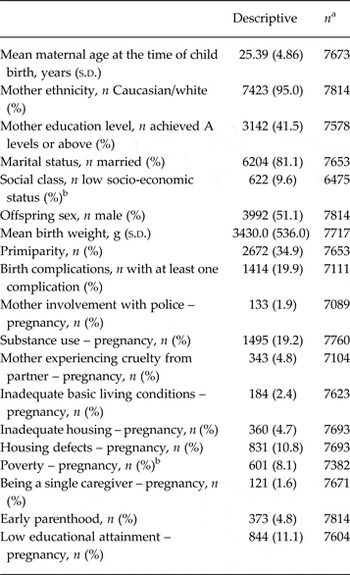
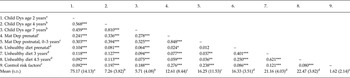
Prior to presenting the overall results, we first show the descriptive statistics. Table 1 contains the demographic, pregnancy and birth characteristics of the mother–child pairs included in this study. Table 2 shows the pair-wise correlation coefficients amongst the study variables – as well as the means and standard deviations. Higher levels of prenatal maternal depression symptoms were associated with higher levels of prenatal and postnatal unhealthy diet, as well as with higher levels of postnatal maternal depression symptoms. Prenatal unhealthy diet scores were not associated with postnatal maternal depression symptoms. Higher levels of child dysregulation (at the ages of 2, 4 and 7 years) were associated with higher levels of (prenatal and postnatal) maternal depression symptoms and unhealthy diet. The control variables were associated with all study variables, particularly with prenatal and postnatal maternal depression symptoms. Of note, there was strong temporal stability within construct (i.e. maternal depression symptoms, unhealthy diet and child dysregulation, respectively).
Sample characteristics: demographics, pregnancy and birth information

s.d., Standard deviation.
a n = Number of mothers with available information from the selected sample of 7814.
b Via the Registrar General's social class scale (Office of Population Censuses and Surveys, 1991).
Correlations and descriptive statistics of the study variables (in n = 7814)

Child Dys, Child emotional–behavioural dysregulation; Mat Dep, maternal depression; s.d., standard deviation.
a By raw means of the activity, adaptability, intensity and mood subscales of the Carey Infant Temperament Scale.
b By raw means of the hyperactivity, conduct problem and emotional difficulty subscales of the Strengths and Difficulties Questionnaire.
c By raw means of the Edinburgh Postnatal Depression Scale. A latent depression score was created for the prenatal and postnatal periods, with higher scores meaning higher levels of depressive symptoms.
d By raw means of a food frequency questionnaire.An unhealthy diet factor was created at each time point through the use of confirmatory factor analysis, with higher scores meaning higher levels of unhealthy diet.
e Control risk factors included in the overall model are displayed in online Supplementary Table 1.
* p⩽0.05, ** p⩽0.01, *** p⩽0.001.
Step 1: autoregressive cross-lagged (ARCL) model
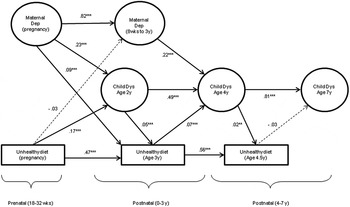
Fig. 1 depicts the ARCL model, which showed acceptable fit to the data (χ2 133 = 3275.632, p < 0.0001, CFI = 0.910, TLI = 0.884, RMSEA = 0.055, 90% CIs 0.053–0.057). Four results are highlighted. First, higher levels of prenatal maternal depression symptoms were prospectively associated with higher levels of postnatal unhealthy diet. Second, higher levels of both prenatal and postnatal maternal depression symptoms and prenatal and postnatal unhealthy diet were associated with higher levels of child dysregulation, with the exception that unhealthy diet at the age of 4.5 years was not significantly associated with child dysregulation at the age of 7 years. Third, higher levels of child dysregulation (at ages 2 and 4 years) were prospectively associated with higher levels of postnatal unhealthy diet (ages 3 and 4.5 years), respectively. Fourth, each construct showed high stability over time.
Path model for maternal depression symptoms, unhealthy diet and child emotional–behavioural dysregulation. Path coefficients: using Cohen's population effect size statistics, 0.10 = small effect, 0.24 = medium effect, 0.37 = large effect. Solid arrow = p < 0.05 (** p⩽0.01, *** p⩽0.001); dashed arrow = p > 0.05. Dep, Depression; Child Dys, child dysregulation; wks, weeks; y, years.

Step 2: indirect pathways
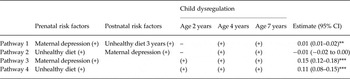
In the second step of the analysis, four indirect pathways that could lead to child dysregulation at the age of 7 years were examined (Table 3). Three results are highlighted. First, as seen in pathway 1, prenatal maternal depression symptoms were associated with unhealthy diet at child age 3 years, which, in turn, was associated with higher levels of child dysregulation at the age of 7 years, via higher levels of child dysregulation at the age of 4 years. Of note, the counterpart indirect pathway (pathway 2) – from prenatal unhealthy diet to postnatal maternal depression symptoms – did not differ from zero (i.e. the 95% CIs crossed zero). Second, with regard to pathway 3, prenatal maternal depression symptoms were associated with higher levels of child dysregulation at the age of 7 years, via higher levels of child dysregulation at the ages of 2 and 4 years. Third, as seen in pathway 4, prenatal unhealthy diet was associated with higher levels of child dysregulation at the age of 7 years, via higher levels of child dysregulation at the ages of 2 and 4 years.
Indirect associations of prenatal and postnatal maternal depression symptoms and unhealthy diet with child emotional–behavioural dysregulation
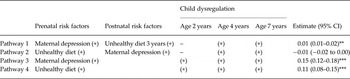
CI, Bias-corrected confidence interval; (+), higher; –, not included in pathway.
** p⩽0.01, *** p⩽0.001.
Discussion
Using a large epidemiological birth cohort study, we tested four indirect pathways – beginning in pregnancy – that could lead to child dysregulation. Study results indicated that higher levels of maternal depression symptoms during pregnancy were associated with higher unhealthy diet of the child provided by the caregiver(s) – in the case of the present study, mothers – during the postnatal period, which, in turn, led to higher levels of child emotional–behavioural dysregulation at the age of 7 years (pathway 1). We did not find evidence that unhealthy diet in pregnancy was associated with postnatal maternal depression, which, in turn, increased child emotional–behavioural dysregulation (pathway 2). The results did indicate that both maternal depression symptoms and unhealthy diet during pregnancy were independently associated with higher levels of child emotional–behavioural dysregulation at the age of 7 years (pathways 3 and 4), via stability of child dysregulation at the ages of 2 and 4 years.
The current study adds to a small but growing body of evidence suggesting that maternal depression and unhealthy dietary patterns are inter-related risk factors that can be synergistically associated with adverse child outcomes (Monk et al. Reference Monk, Georgieff and Osterholm2013). It is worth noting that one of the key diagnostic features of depressive disorders is presenting with changes in appetite (American Psychiatric Association, 1994), and that maternal anxiety and/or depressed mood during pregnancy is associated with unhealthy eating patterns (Hurley et al. Reference Hurley, Caulfield, Sacco, Costigan and Dipietro2005; Barker et al. Reference Barker, Kirkham, Ng and Jensen2013), especially in low-income mothers (Braveman et al. Reference Braveman, Marchi, Egerter, Kim, Metzler, Stancil and Libet2010). The current results extend these studies to show that higher symptoms of maternal depression during pregnancy can be prospectively associated with what a mother feeds her child during the postnatal period.
Prenatal maternal depression symptoms and prenatal unhealthy diet were also independently associated with child dysregulation at the age of 7 years via stability of dysregulation through childhood. Of note, both of these risk factors can affect fetal development by different biological mechanisms. For example, abnormal hormonal and physiological profiles of depressed mothers – such as reduced blood flow and increased levels of cortisol – can have a negative impact on fetal development (Weinstock, Reference Weinstock2008; Glover et al. Reference Glover, O'Connor and O'Donnell2010). Unhealthy (e.g. high-fat) diet has been associated with reduction of neural plasticity and disturbances of fetal serotonergic and dopaminergic systems, independent of nutrient deficiencies (Wu et al. Reference Wu, Molteni, Ying and Gomez-Pinilla2003; Sullivan et al. Reference Sullivan, Grayson, Takahashi, Robertson, Maier, Bethea, Smith, Coleman and Grove2010; Vucetic et al. Reference Vucetic, Kimmel, Totoki, Hollenbeck and Reyes2010). Hence, both maternal depression and unhealthy diet can impair neural fetal developmental and thereby increase the risk and susceptibility for abnormal child dysregulation and cognitive function (Liu et al. Reference Liu, Raine, Venables and Mednick2004; Barker et al. Reference Barker, Kirkham, Ng and Jensen2013; Jacka et al. Reference Jacka, Ystrom, Brantsaeter, Karevold, Roth, Haugen, Meltzer, Schjolberg and Berk2013).
Other relevant findings from this study include the strong stability in maternal depression symptoms from prenatal to postnatal periods, which is congruent with findings from previous studies (Campbell et al. Reference Campbell, Matestic, von Stauffenberg, Mohan and Kirchner2007; Barker, Reference Barker2013; Barker et al. Reference Barker, Kirkham, Ng and Jensen2013). Moreover, there was a strong stability in the unhealthy nutrition factor. That said, the type of analysis employed here does not shed light on the degree to which certain children might be (a) temporarily, (b) intermittently or (c) continuously exposed to unhealthy diet and/or maternal depression during the prenatal and/or postnatal periods.
In addition, family processes may explain some of the effects identified here. For example, child dysregulation may be associated with subsequent parental depression, which could further relate to the nutritional environment, but parental depression might also be at least partially related to the association between early unhealthy diet and subsequent child dysregulation (e.g. Jacka et al. Reference Jacka, Ystrom, Brantsaeter, Karevold, Roth, Haugen, Meltzer, Schjolberg and Berk2013). An interesting (but not hypothesized) result of the present study was that child dysregulation was prospectively associated with higher levels of unhealthy diet of the child (as reported by the mothers). Future research might focus on the degree to which children can demand (from caregivers) unhealthy diets once the pattern is established early in the life course. Indeed, recent studies have identified ‘evocative’ child effects on parenting (Elam et al. Reference Elam, Harold, Neiderhiser, Reiss, Shaw, Natsuaki, Gaysina, Barrett and Leve2014).
Five main limitations should be considered when interpreting the present results. First, this research is correlational in nature; hence no causative relationship can be derived. Moreover, the magnitude of the prospective association between maternal depression, unhealthy nutrition and child dysregulation was not large, so the associations should not be interpreted as deterministic. That said, measurement error might be making an impact on the magnitude of the reported associations. For example, dietary pattern analysis using factor analysis usually only detects a small percentage of the variance in dietary intakes. Also, the assessment of diet is prone to extensive measurement error. Thus, it is quite likely that the ‘true’ association between exposure to unhealthy diet and child outcome are weaker or stronger than those detected in the current study. Second, the key measures were based on maternal self-reports rather than on more thorough clinical observations. Indeed, reliance on a single reporter may artificially inflate the magnitude of associations between constructs considered in the current study. Future studies should incorporate diagnostic interviews, multiple informants and biological indicators (e.g. metabolomics) of the nutritional intake of the mother and/or child (Gow et al. Reference Gow, Vallee-Tourangeau, Crawford, Taylor, Ghebremeskel, Bueno, Hibbeln, Sumich and Rubia2013). Third, although the ALSPAC mother–offspring pairs represent a broad spectrum of ethnic and socio-economic backgrounds, the sample includes relatively low rates of ethnic minorities that can limit generalizability of the findings (Goodman et al. Reference Goodman, Rouse, Connell, Broth, Hall and Heyward2011). Fourth, although this study controlled for many potential confounding prenatal and postnatal factors, we did not assess other relevant potential confounders (e.g. environmental factors such as quality of parenting). Neither did we control for genetic factors. Indeed, in the present study, mothers were biologically related to their children. In such a design it is not possible to account for common genetic influences, such as passive genotype–environment correlations, which may underlie mother-to-child effects. Fifth, this study focused on unhealthy dietary intake of the mother and child. Previous research strongly suggests that that people with depression not only preferentially choose high-fat, sugary foods, but also eat fewer vegetables and fruits. Hence there is a higher intake of unhealthy and an insufficient intake of nutrition-dense foods (i.e. healthy diets). This is important, as high-fat and -sugar foods can be directly noxious to the brain and body, while nutrient and fibre insufficiency impose their own detrimental outcomes, potentially via different pathways (Akbaraly et al. Reference Akbaraly T, Brunner, Ferrie, Marmot, Kivimaki and Singh-Manoux2009; Barker et al. Reference Barker, Kirkham, Ng and Jensen2013; Jacka et al. Reference Jacka, Ystrom, Brantsaeter, Karevold, Roth, Haugen, Meltzer, Schjolberg and Berk2013).
In summary, maternal depression and unhealthy nutrition in pregnancy and early life periods are inter-related and independent risk factors for child dysregulation. As recently proposed by Monk and colleagues, the understanding of the early origins of child and adolescent health and disease needs a developmental framework in which the independent and synergistic influence of early exposures to different environmental risk factors can be assessed at different time points of child development (Monk et al. Reference Monk, Georgieff and Osterholm2013). Results from the present study have the potential to yield important developmental information to inform public policy, and to be used for preventive interventions.
Supplementary material
For supplementary material accompanying this paper visit http://dx.doi.org/10.1017/S0033291714002955
Acknowledgements
The UK Medical Research Council and the Wellcome Trust (grant reference 092731) and the University of Bristol provide core support for ALSPAC. This research was specifically funded by the Eunice Kennedy Shriver National Institute of Child Health & Human Development of the National Institutes of Health (award number R01HD068437 to E.D.B.). The content is solely the responsibility of the authors and does not necessarily represent the official views of the National Institutes of Health. L.P.-C. holds a grant from the Alicia Koplowitz Foundation. We are extremely grateful to all the families who took part in this study, the midwives for their help in recruitment, and the whole ALSPAC team.
Declaration of Interest
None.