1 Introduction
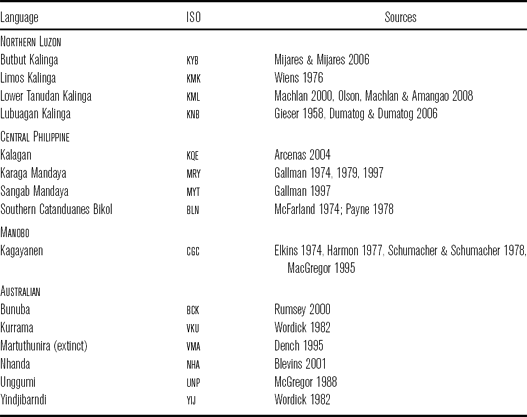
An unusual speech sound often characterized by tongue protrusion occurs in at least nineFootnote 1 Philippine languages and six Western Australia languages, shown in Figure 1 and Table 1. Although mention of the sound goes back as far as Gieser (Reference Gieser, Capell and Wurm1958), it has at times been a challenge for linguists attempting to describe it. The sound has been previously labeled a ‘palatal lateral’, a ‘Kalinga-L’, and a ‘labial flap’, among other things. In Section 2 we document its articulation, showing that its proper description in terms of articulatory parameters is a ‘voiced (inter)dental approximant with egressive pulmonic air’. In Section 3 we provide evidence of its status as a phoneme. It is contrastive in five languages of Western Australia and has recently emerged in the Philippines as a phoneme due to contact. In Section 4 we discuss how best to represent the sound in phonetic transcription, and we provide evidence that it should have its own symbol in the International Phonetic Alphabet (IPA). Finally, in Section 5 we examine cases from other parts of the world where researchers have reported sounds with very similar or nearly identical descriptions, such as the ‘dental approximant’ reported in the Romance languages of Spain.
Geographic distribution of the Dental approximant in the Philippines (left) and Western Australia (right). Outline maps from http://d-maps.com/. Used by permission.

Languages in which the Dental approximant is attested. ISO 639–3 codes (Lewis Reference Lewis2009) and sources are included.

For this paper we collected data from five language consultants in both Kagayanen and Lower Tanudan Kalinga, and one language consultant each in Butbut Kalinga, Limos Kalinga, Lubuagan Kalinga, and Kalagan. We elicited and recorded a substantial number of lexical items and short texts, which we intend to publish separately.
The label ‘dental’ is commonly employed in the phonetics literature in two different ways. First, it can refer to a constriction between the tongue tip and the back of the upper teeth, in contrast with an interdental articulation, which involves a constriction between the tongue blade and the upper teeth. Second, it can refer to a broader category subsuming both the dental and interdental places of articulation. The IPA employs this latter, broader category, because the two places of articulation are not known to contrast in any language. When we intend this broader meaning, we capitalize the word ‘Dental’, and in this paper we generally refer to the sound as a ‘Dental approximant’.
We transcribe the Dental approximant with the ‘eth’ symbol [ð] for the base character to indicate a Dental articulation, modified by the ‘lowering sign’ diacritic [˕] to specify an approximant manner of articulation (IPA 1999: 25, 29, 166, 173; Pullum & Ladusaw Reference Pullum and Ladusaw1996: 43, 236; cf. Ladefoged & Maddieson Reference Ladefoged and Maddieson1996: 322–324). (In Unicode these symbols are called ‘latin small letter eth’ (codepoint 00F0) and ‘combining down tack below’ (codepoint 031E), respectively (The Unicode Consortium 2007: 580, 600).)
2 Articulation
Descriptions of the articulation of the Dental approximant in Western Australia are reasonably consistent: the tongue blade approaches the upper teeth, and the tongue tip either protrudes between the teeth or is located behind the lower incisors (e.g. Wordick Reference Wordick1982: 12; Wrigley Reference Wrigley1991). The sound is usually described as a ‘lamino-dental glide’, and it is consistently transcribed as 〈yh〉. On the other hand, articulatory discriptions of the sound in the Philippines vary widely. In the Guinaang variety of Lubuagan Kalinga, Gieser (Reference Gieser, Capell and Wurm1958: 17) calls the sound a ‘central oral resonant’, employing the articulatory parameters of Pike (Reference Pike1943: 142–144). However, Gieser makes no mention of the place of articulation. Wiens (Reference Wiens1976: 41) considers the sound to be a palatal lateral in Limos Kalinga. Gallman (Reference Gallman1974: 8; Reference Gallman1997: 75) also calls the sound a ‘palatal lateral’ in Karaga Mandaya, but he transcribes it as 〈lʸ〉 suggesting an alveolar lateral accompanied by a secondary articulation of palatalization. Harmon (Reference Harmon1977: 17) calls the sound an ‘L-colored glide’ because in Kagayanen it has a lateral perceptual quality.
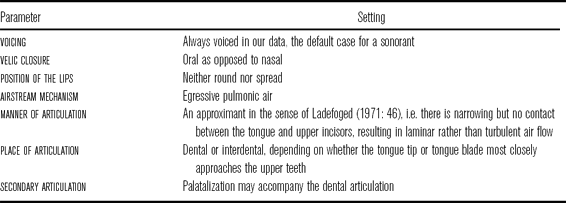
Based on our own observations, the sound is less diverse than these descriptions would suggest. Crosslinguistically, the settings listed in Table 2 hold for the articulatory parameters of the Dental approximant.
Articulatory parameters of the Dental approximant.

Perceptually, the sound is sometimes heard as a lateral by researchers, particularly when there is substantial tongue protrusion. We hesitate to classify it as a lateral, however, for three reasons. First, Ladefoged & Maddieson (Reference Ladefoged and Maddieson1996) define a lateral in articulatory terms as a sound in which the tongue is ‘contracted in such a way as to narrow its profile from side to side’ (p. 182). The Dental approximant shows no evidence of such a contraction. Rather, the tongue blade remains relaxed throughout the articulation. (Longitudinal extension of the tongue during protrusion could have narrowing of the side-to-side profile of the tongue and a lateral perceptual quality as a consequence.) Second, only instances of the sound with substantial tongue protrusion have the lateral perceptual quality. Less protruded instances sound more palatalized. Third, in Nhanda there is contrast between a lamino-dental central approximant [ ] and a lamino-dental lateral approximant [
 ], i.e. [kuɭai] ‘river red gum’ vs. [biida] ‘spear’ and [
 aa] ‘mud, grease’ (Blevins Reference Blevins2001: 6, 11, 148).
Variation in the degree of protrusion appears to be both language-internal and crosslinguistic. One example of language-internal variation is that among our five Lower Tanudan Kalinga language consultants, two produced interdental approximants while three produced dental approximants. For our primary Kagayanen language consultant, the degree of protrusion appeared to be directly related to the quality of adjacent vowels: the least amount of protrusion occurred in the environment [u__u], more occurred with [ə__ə], and the greatest amount occurred with [a__a]. In addition, speaker focus increased tongue protrusion. A detailed study of the Kagayanen case is in preparation (see Olson & Mielke Reference Olson and Mielke2007a).
Crosslinguistic variation might be seen in orthography choices. Speakers of Lubuagan Kalinga and Limos Kalinga represent the Dental approximant with the symbols 〈 〉 and 〈ḻ〉, where the base symbols suggest palatal and lateral sounds, respectively. Consistent with this, our Lubuagan Kalinga language consultant produced a dental approximant with a palatal perceptual quality, while our Limos Kalinga consultant produced an interdental approximant with a lateral perceptual quality. However, since there was only one language consultant for each of these languages, these observations must be considered preliminary.
The video frames in Figure 2 show eight steps in the articulation of an interdental approximant in Limos Kalinga. The word [paad] ‘palm (of hand)’ was produced by a 35-year-old female speaker. In this paper stress in Philippine languages is penultimate unless otherwise specified.
Articulation of the interdental approximant in the word [paad] ‘palm (of hand)’ in Limos Kalinga.

The video recordings were made in April 2006 at the SIL center in Bagabag, Philippines, using a Canon GL1 Digital Video camcorder. The frames are in 29.97 msec intervals (NTSC standard). Frame (a) shows the mouth during the articulation of the first vowel [a]. Frames (b)–(d) show the first stage of the approximant as the tongue blade advances until it reaches its maximum forward position in frame (d). Frames (e)–(h) show the tongue returning to the position for the second vowel [a] in frame (h).
The video frame in Figure 3 shows the maximum forward position of the tongue during the articulation of a dental approximant in the word [paad] ‘palm (of hand)’ in Lubuagan Kalinga. Note that in this case, the tongue reaches the plane between the upper and lower teeth, but does not protrude further. There is also space between the tongue and the upper teeth, so that no turbulence is created.
Maximal forward position of the tongue during the articulation of the dental approximant in the word [paad] ‘palm (of hand)’ in Lubuagan Kalinga.

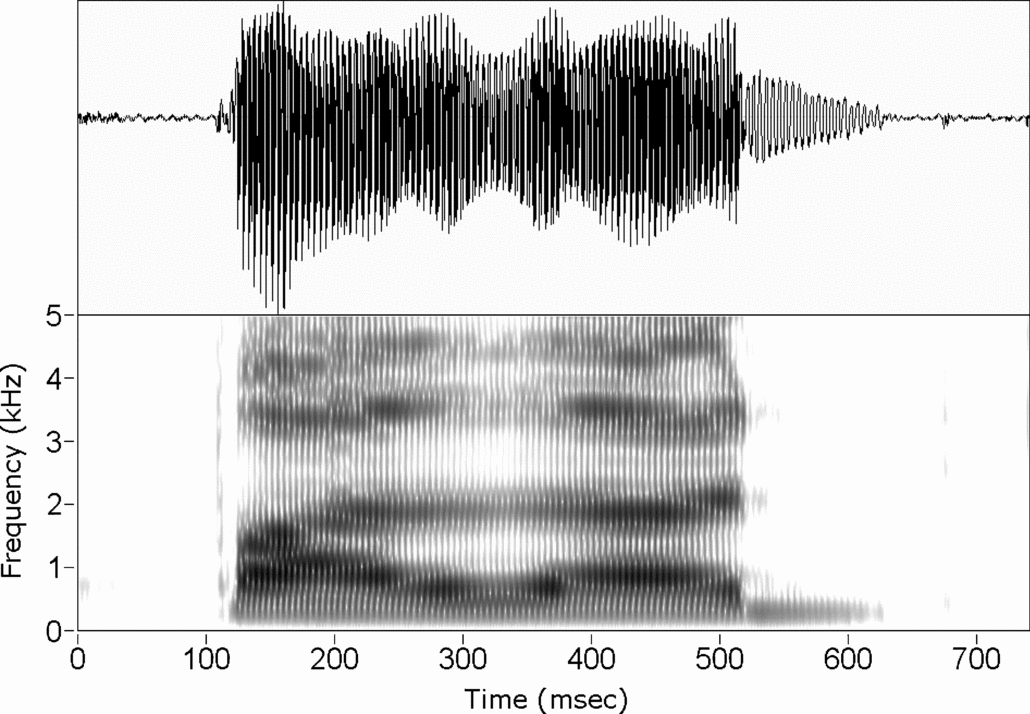
Figure 4 shows a waveform and wide-band spectrogram of the Kagayanen word [paad] ‘palm of hand’ produced by a 27-year-old female speaker. The audio recording of the subject's voice was created using an Audio-Technica PRO 49Q condenser microphone, recording to a computer through a single channel of a Symetrix 302 dual microphone preamplifier. The recording was digitized at 48 kHz, 16-bit and analyzed using Praat version 4.4.16 on a Windows XP computer. We employed the default parameters in Praat, with the exception that the dynamic range was set at 35 dB.
Waveform and spectrogram of [paad] ‘palm (of hand)’ in Kagayanen.

F1 lowers from about 900 Hz during the preceding [a] to about 550 Hz during the articulation of [] in the center of the spectrogram. At the same time, F2 rises slightly from about 1850 Hz to about 1940 Hz. This is evidence against Harmon's (Reference Harmon1977: 16) claim that velarization accompanies the Dental approximant in Kagayanen. If that were the case, we would expect a lowering in the value of F2 rather than a rise (cf. Ladefoged & Maddieson Reference Ladefoged and Maddieson1996: 197).
There is a noticeable attenuation in the formants above F1 during the articulation of [] with respect to the preceding and following vowels. There is no indication of aperiodic noise, and glottal pulses continue throughout the articulation of []. The duration of the transitions and steady state are consistent with those of central approximants.
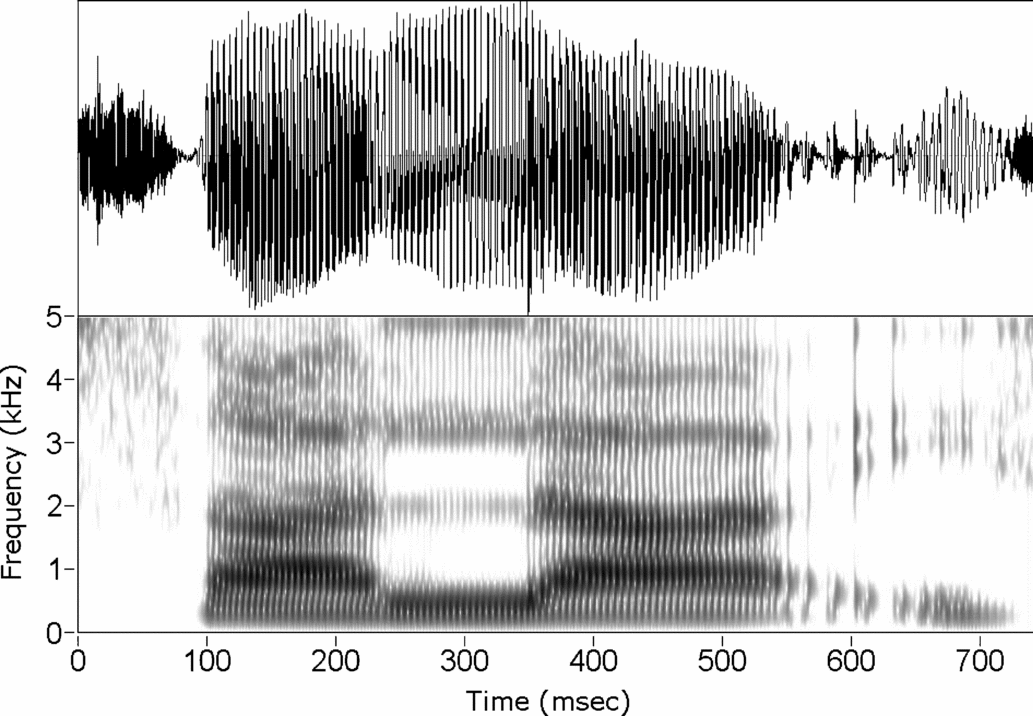
In order to compare [] with [l], Figure 5 shows a waveform and wide-band spectrogram of the Kagayanen loan word [sala] ‘living room’ (same speaker and recording method as in Figure 4). F1 is about 450 Hz during the articulation of [l], slightly lower than for []. F2 is about 1940 Hz during the articulation of [l], about the same as for []. In contrast to [], the formant transitions into and out of [l] are abrupt, and there is a clear steady state during the articulation of [l]. As with [], the formants above F1 are somewhat attenuated, there is no sign of aperiodic noise, and there are glottal pulses throughout the articulation of [l].
Waveform and spectrogram of [sala] ‘living room’ in Kagayanen (loan from Spanish).

A more detailed acoustic description of the Kagayanen case is in preparation (see Olson & Mielke Reference Olson and Mielke2008).
3 Phonological status
3.1 Evaluation of phonemic status
The phonemic status of the Dental approximant in the Western Australia languages Yindjibarndi, Bunuba, Unggumi, and Kurrama is well-established in the literature. In Nhanda, the sound is contrastive, but it only occurs in one lexical item (Blevins Reference Blevins2001: 11). In Martuthunira, the sound is one of several allophones of // (Dench Reference Dench1995: 26–27).
There is good evidence that the Dental approximant has been fully incorporated as a phoneme into Kagayanen as well. Our evaluation below is based on the diagnostics presented in Olson & Hajek (Reference Olson and Hajek2003: 167–168). The inventory of phonemes is shown in (1).
(1) Phoneme inventory in Kagayanen (Harmon Reference Harmon1977: 13; MacGregor Reference MacGregor1995: 365–366; Olson & Mielke Reference Olson, Mielke, Trouvain and Barry2007b)


The sound [h] is marginal to the phonological system, occurring only in loan words, proper names, or ‘in exaggerated pronunciation of words cognate with nearby languages in which an /h/ does occur’ (MacGregor Reference MacGregor1995: 365).
First, the Dental approximant is contrastive in Kagayanen with all coronal and sonorant consonants, in both word-initial and intervocalic positions, as shown in (2).
(2) Contrast with other coronal and sonorant sounds in Kagayanen
The consonant /d/ is realized as [r] intervocalically, except in loan words (MacGregor Reference MacGregor1995: 365).
Second, the sound is well-attested in Kagayanen, occurring in over 100 words of native vocabulary (including core vocabulary), a sampling of which is shown in (3). Third, the sound occurs in all major grammatical categories in Kagayanen, including nouns, verbs, adjectives, and adverbs. Fourth, it occurs in word-initial, word-medial, and word-final positions. Finally, it occurs adjacent to all vowels in the language, although it only occurs contiguous to [i] in one word (see Section 3.2).
(3) Sample lexical items in Kagayanen containing the Dental approximant
3.2 Recent phonemic split
While the Kagayanen sound system presently has separate /l/ and // phonemes, historical-comparative evidence suggests that the Dental approximant was previously in complementary distribution with [l] and that the earlier phoneme comprising the two allophones recently underwent phonemic split. This split was likely due to contact pressure from Tagalog, Spanish, and English.
In some related languages, a single phoneme /l/ with the [l] ~ [] alternation is still present. For example, Gieser (Reference Gieser, Capell and Wurm1958: 16) provides a complementary distribution statement for the [l] ~ [] alternation in the Guinaang variety of Lubuagan Kalinga. In that language, the sound [l] occurs in the following four environments:
(4) Environments for the occurrence of [l]
a. word-initial position
b. geminate cluster
c. word-medially when preceded by a coronal consonant (. . .VC___V. . .)
d. contiguous to [i]
The Dental approximant occurs in all other environments in Guinaang, including intervocalically (but not contiguous to [i]), syllable- or word-finally, and word-medially when preceded by a labial or velar consonant.
All of the Philippine languages in which the Dental approximant occurs either exhibit or show vestiges of this [l] ~ [] alternation. In Kagayanen, the vast majority of words follow Gieser's distribution statement, but there are exceptions. Loan words typically retain [l] rather than employing [] where the latter would be expected. For example, intervocalically one finds [ɡalaŋ] ‘to show respect’ (loan from Tagalog), rather than *[ɡaaŋ]. The word [aa] ‘weave’ has a Dental approximant in word-initial position, and [au] ‘pestle’ has a geminate Dental approximant (MacGregor Reference MacGregor1995: 366, p.c.). The word [sanaɡ] ‘to cook with little or no oil’ has a word-medial Dental approximant preceded by a coronal consonant. The word [kaiŋ] ‘coconut milk curd’ includes a Dental approximant contiguous to [i] (but only for some speakers – others produce [kalliŋ]). Morphophonemic alternations between [l] and [], in which a stem-initial [l] becomes [] with certain prefixes, e.g. [pa- + lutuʔ] ‘cook’ → [pautuʔ] (cf. [lutuʔ] ‘cook’), [ɡa- + ləttaw] ‘float’ → [ɡaəttaw] (cf. [ləttaw] ‘float’), are being lost among some younger speakers (Harmon Reference Harmon1977: 20), with [l] being retained. This situation – in which a large percentage of the data conforms to an alternation but where there are numerous exceptions and much variation between speakers – is precisely what we would expect when a language has recently lost the alternation and begun to exhibit contrast between the two segments.
The other Philippine languages with the Dental approximant are generally more faithful to Gieser's distribution statement. Like in Kagayanen, though, loan words typically retain [l] rather than employing [] (e.g. Gieser Reference Gieser, Capell and Wurm1958: 23; Wiens Reference Wiens1976: 42; Payne Reference Payne1978: 33, 35), and the extent of loan word influence is such that researchers in Lubuagan Kalinga (Dumatog & Dumatog Reference Dumatog and Dumatog2006) and Southern Catanduanes Bikol (McFarland Reference McFarland1974: 29; Payne Reference Payne1978) consider the Dental approximant to be a phoneme separate from [l].
Gieser's distribution statement shows up in additional languages of the Philippines, but in these cases the sound that alternates with [l] is something other than the Dental approximant. Specifically, [l] alternates with the following segments:
- (5)
a. voiced velar fricative [ɣ]
• Aklanon [akl] (Scheerer Reference Scheerer1920, Ryder Reference Ryder1940, de la Cruz & Zorc Reference de la Cruz and Zorc1968, Payne Reference Payne1978, Zorc Reference Zorc1995) (Zorc Reference Zorc1995: 344 considers the sound a velar approximant)
• Buhi'non [bhk] (McFarland Reference McFarland1974)
b. retroflex approximant [ɻ]
• Madukayong Kalinga [kmd] (Magangat Reference Magangat2006)
• Balangao [blw] (Shetler Reference Shetler1976)
• Mansaka [msk] (Svelmoe & Svelmoe Reference Svelmoe and Svelmoe1974)
• Upper Tanudan Kalinga [kgh] (Machlan Reference Machlan2000)
• the Guinaang variety of Central Bontoc [bnc] (Reid Reference Reid1963: 23; Aoyama & Reid Reference Aoyama and Reid2006: 145–146)
c. retroflex lateral approximant [ɭ]
• Southern Kalinga [ksc] (Grayden Reference Grayden1979)
The [l] ~ [] alternation is widely scattered geographically in the Philippines. It is found only in small relic fringe areas within several Philippine subgroups, but the phonological patterning is largely maintained. This evidence suggests that the [l] ~ [] alternation is a retention that can be traced back to a previous stage of the language family. The geographic distribution would argue that the alternation goes at least as far back as Proto-Philippine. Because there is some doubt concerning the integrity of Proto-Philippine (cf. Adelaar Reference Adelaar, Adelaar and Himmelmann2005: 16), we may need to look toward an even earlier date.
3.3 Phonetic rarity?
We have presented evidence that the Dental approximant can be incorporated as a phoneme into the phonological system of a language. As a result, we need to consider how linguistic theory should account for it. Is the Dental approximant properly viewed as a general linguistic phenomenon?
Ladefoged & Everett (Reference Ladefoged and Everett1996) suggest that there are two sets of speech sounds: (i) a central set comprised of widespread sounds that are describable in terms of general phonological features or phonetic parameters – these are the sounds that should be considered part of a universal phonetic alphabet – and (ii) a peripheral set comprised of sounds with unusual articulations that occur only in one or two languages – these Ladefoged & Everett refer to as ‘phonetic rarities’ (p. 799). They give as an example [ ], a ‘voiceless apico-dental plosive [followed by a] voiceless labio-labial trill’ (p. 794), which patterns as a phoneme in two Chapakuran languages of Brazil: Wari’ [pav] and Oro Win [orw]. To which set does the Dental approximant belong?
The Dental approximant does not easily fit into Ladefoged & Everett's category of phonetic rarities. There are three arguments for this. First, extant theories of phonological features or phonetic parameters can describe segments containing a Dental place of articulation and an approximant manner of articulation without difficulty. Second, while the Dental approximant is relatively rare, it is more prevalent than what Ladefoged & Everett envision for phonetic rarities. The Dental approximant occurs in at least fifteen languages, and it is more common than at least two sounds already in the IPA: the bilabial click [ʘ], which is found in perhaps two languages in Southern Khoisan, and the labiodental nasal [ɱ], which is claimed to contrast with the bilabial nasal [m] in only one language – the Kukuya variety of Teke [kkw] (Bantu B) (Paulian Reference Paulian1975). Third, the Dental approximant has arisen independently in two regions of the world.
Sociolinguistic factors may explain the relative rarity of the Dental approximant. Tongue protrusion is known to be a stigmatized gesture in both non-linguistic and linguistic behavior (Key Reference Key1975: 89–90; Ladefoged Reference Ladefoged2007: 164). In the Philippines, speakers tend to avoid using the sound with outsiders (Gieser Reference Gieser, Capell and Wurm1958: 23; Wiens Reference Wiens1976: 42), and this may be due to the fact that it is often stigmatized by outsiders. For example, Andrew Gallman recounts the following story:
[T]here is strong pressure to identify with the Cebuanos and drop this allophone. While I gathered a wordlist from a Mandayan in Sangab, I observed this change. While we were alone, the speaker used the [Dental approximant]. But when several Cebuano speakers gathered around and began to laugh each time he used it, he quickly dropped the allophone where it normally occurred. (Gallman Reference Gallman1997: 75)
With the increasing contact of these language communities with majority cultures, it is possible that this sociolinguistic factor will continue to disfavor the use of the Dental approximant, perhaps leading to its demise (cf. Campbell Reference Campbell2004: 78). We could consider the Dental approximant to be an endangered sound.
4 Phonetic representation
There is good evidence that the Dental approximant should have a unique symbol associated with it in the IPA. The first pertinent principle is:
When two sounds occurring in a given language are employed for distinguishing one word from another, they should whenever possible be represented by two distinct symbols without diacritics. (IPA 1999: 159)
In (2) we saw that the Dental approximant contrasts with the coronal obstruents [t d s] and the sonorants [n r l w j] in Kagayanen. All of these sounds are common crosslinguistically.
The Dental approximant is not known to contrast with the Dental fricative [ð] in any language. However, when speakers of Philippine languages with the Dental approximant speak English (a common bilingual situation), they replace the English Dental fricative [ð] with a voiced dental or alveolar stop [ d] and not with the expected Dental approximant []. This suggests that speakers of these languages consider [] and [ð] to be two distinct speech sounds.
The Dental approximant contrasts with [ɻ] in Yindjibarndi, Bunuba, Unggumi, Kurrama, and Nhanda. English provides evidence for contrast between [] and [ɹ]. Minimal pairs between /ð/ and /ɹ/ exist in English (e.g. then vs. wren). When English /ð/ is pronounced without frication as [] (Carr Reference Carr1999: 10; IPA 1999: 29), it is recognized by native English speakers as /ð/ and is not confused with /ɹ/.
Since the Dental approximant contrasts with the relevant phonetically similar segments, it follows that it should be given a unique symbol in the IPA without diacritics.
The second principle pertinent to our discussion is:
When two sounds are very similar and not known to be employed in any language for distinguishing meanings of utterances, they should, as a rule, be represented by the same symbol. (IPA 1999: 159–160)
As we have seen, there is no known language in which the dental and interdental variants of the sound contrast, so this principle would lead us to represent both sounds with a single symbol rather than employing separate symbols.
If an IPA symbol for the Dental approximant should be introduced, what might it be? On this point, the only criterion that the IPA has given us is that the symbol should ‘harmonize with roman type’ (IPA 1999: 159).
An additional consideration is if there is some precedent in the linguistics literature for a given symbol. On this basis, there is no obvious choice. A variety of symbols 〈 L yh〉 have been employed in the literature to represent the sound. Most of these resort to diacritics or digraphs, and the one exception would be too typographically similar to the small capital l [ʟ] (which is already employed in the IPA) to be considered.
One possibility would be to modify the eth symbol [ð] by employing one of two strategies common to the IPA: turned or small capital characters. The former strategy would result in (6):
(6)
– Latin small letter turned eth
Five IPA characters representing approximant sounds already derive from this strategy: [ɹ ɻ ɰ ʎ ʍ]. However, none of the source characters are fricatives. The latter option results in (7):
(7) Đ – Latin letter small capital eth
One IPA character representing an approximant already derives from this strategy: the small capital l [ʟ]. One advantage of 〈Đ〉 over 〈 〉 is that it is already included in Unicode at code point 1D06 (The Unicode Consortium 2007: 717), so its addition to Unicode fonts would be uncomplicated.
If necessary, the ‘advanced’ [˖] and ‘retracted’ [˗] diacritics can be used to modify the consonant place of articulation (IPA 1999: 16), so when it is necessary to draw a distinction between the interdental and dental approximants, they can be represented (for example) as 〈 〉 and 〈
 〉, respectively.
5 Similar sounds found elsewhere
Researchers have described sounds from other regions of the world that very closely resemble the Dental approximant. At times they have even employed the terms ‘dental approximant’ and ‘interdental approximant’ or the symbol []. This raises the question as to whether these speech sounds are the same as the one found in the Philippines and Western Australia.
English /ð/ is sometimes produced without frication, presumably in casual speech (Carr Reference Carr1999: 10; IPA 1999: 29). Arvaniti (Reference Arvaniti1999: 174) notes that /ð/ is often pronounced as an approximant in Cypriot Greek [ell], and is ‘regularly elided in intervocalic position.’ Bendor-Samuel (Reference Bendor-Samuel1961: 13–14) attests a ‘dental-alveolar frictionless continuant’ in Jebero [jeb] (Peru). Grønnum (Reference Grønnum1998: 100) employs the symbol [] for a narrow transcription of an alveopalatal approximant in Danish [dan] (cf. Ladefoged & Maddieson Reference Ladefoged and Maddieson1996: 144; IPA 1999: 25). Shahin (Reference Shahin2002: 177–181) employs the term ‘dental approximant’ for two sounds (one plain and one ejective) in Lillooet [lil] (Canada), which have either interdental or dental places of articulation. Shahin categorizes them as rhotics, notes that they frequently have frication, claims they have a ‘lateral articulation’, and transcribes them as /ɹ/ and /ɹ'/. Eric Jackson (p.c.) reports a sound from Central Hongshuihe Zhuang [zch], spoken in the Hong Shui He area of Guangxi in China, whose articulatory description is identical to the Dental approximant. Donohue & San Roque (Reference Donohue and Roque2004: 107) report a sound in the Skou language Womo [no ISO code] (PNG) that ‘varie[s] between a laminodental approximant with friction, and a co-articulated palatal-dental approximant, with friction’. Pirahã [myp] (Brazil) has a complex speech sound that involves extreme tongue protrusion in the latter portion of the articulation. Everett (Reference Everett1982: 94) considers this portion of the sound to be a sublaminal-labial flap, referring to the fact that the underblade of the tongue touches the lower lip. This is a novel interpretation for the place of articulation, which is normally construed as the place in the oral cavity where airflow is most constricted (Ladefoged Reference Ladefoged2001: 5).
Of particular note is a dental fricative/approximant allophone of // found in several of the Romance languages of Spain, including Spanish [spa] (Martínez-Celdrán, Fernández-Planas & Carrera-Sabaté Reference Martínez-Celdrán, Fernández-Planas and Carrera-Sabaté2003: 257; Martínez-Celdrán Reference Martínez-Celdrán2004: 203–204; Hualde Reference Hualde2005: 8, 43, 47, 52, 141–144), Catalan [cat] (Carbonell & Llisterri Reference Carbonell and Llisterri1999: 63), Galician [glg] (Regueira Reference Regueira1999: 84), and Chistabino [arg] (Mott Reference Mott2007: 104). Traditionally this allophone has been described as a fricative [ð], but more recent work has argued that the sound in question is an approximant [] based on no observed aperiodic noise in spectrograms of the sound (cf. Martínez-Celdrán Reference Martínez-Celdrán2004: 203; Hualde Reference Hualde2005: 141).
What is interesting is that speakers of Philippine languages containing the Dental approximant do not borrow the Spanish dental fricative/approximant as the Philippine Dental approximant. For example, Kagayanen speakers did not borrow Spanish cada [kaða] ‘every’ as *[kaa], but rather as [kada], employing a dental/alveolar stop instead. The speakers from the Philippines appear to be treating the two sounds as distinct.
What are we to make of this? It is likely not a distinction of place of articulation since both sounds are described as being either dental or interdental. We could perhaps consider it to be a case of the distinction between ‘semi-vowel approximant’ and ‘spirant approximant’ put forth by Martínez-Celdrán (Reference Martínez-Celdrán2004), but the Philippine Dental approximant does not function as part of a diphthong in the way that Martínez-Celdrán's semi-vowel approximant does, so that distinction does not appear to be the pertinent issue. This is an important matter for future research.
A full comparison between the Dental approximant and the similar sounds mentioned above requires further research. Here, we will content ourselves with offering some observations about the differences between them. First, the Dental approximant never exhibits frication, as opposed to most of the similar sounds listed above. Second, the tongue protrusion of the Dental approximant can be quite pronounced, more so than that of the similar sounds found in all of the above languages except Pirahã. Third, we have shown that the Dental approximant can be a distinct phoneme, whereas most of the similar sounds function as a variant of another sound.
6 Conclusion
We have described the articulatory properties of the Dental approximant, demonstrated that it can be incorporated into the phonological system of a language, and discussed how best to represent the sound in phonetic transcription. Of interest is the fact that the language contact situation in the Philippines has had opposing effects on the Dental approximant. On one hand, contact with Tagalog, Spanish, and English has contributed to the recent emergence of the Dental approximant as a distinct phoneme in the Philippines. On the other hand, this same contact has contributed to sociolinguistic pressures which may ultimately lead to the demise of the sound.
This paper scratches the surface with respect to research on the Dental approximant. More work is necessary to provide documentation of the sound, to clarify the factors resulting in the variation of the production of the sound, to explain the palatal and lateral perceptual qualities, and to compare the Dental approximant with similar sounds, especially the dental fricative/approximant found in the Romance languages of Spain. Quantitative acoustic, aerodynamic, and ultrasound projects are all logical follow-on studies to this paper, as is a more detailed assessment of the historical-comparative evidence. We hope that by pinpointing the key issues surrounding the Dental approximant and bringing consistency to its notation, linguists will be aided in carrying out their research on the sound, eventually leading to more complete and accurate documentation.
Recordings of the Yindjibarndi Dental approximant are available from the UCLA phonetics lab archive: http://archive.phonetics.ucla.edu/Language/YIJ/yij.html. Recordings of the Lower Tanudan Kalinga Dental approximant are available from Olson, Machlan & Amangao (Reference Olson and Mielke2008).
Acknowledgments
We are grateful to Rose Andrus, Diana Archangeli, Karen Baertsch, Adam Baker, Rudy Barlaan, Michael Boutin, Gene Burnham, Mike Cahill, Bel Carress, Marjorie Cook, Bus & Jean Dawson, Pamela Day, Greg Dekker, James & Kathleen Dorn, Lito & Vicky Dumatog, William Dunn, Karl Franklin, Andy Gallman, Dick Gieser, John Goldsmith, Bruce Grayden, Ken Gregerson, Pat Hartung, Jacqueline Huggins, Eric Jackson, Eric Johnson, Brad Keating, Michael Kenstowicz, Peter Ladefoged, Louise MacGregor, Glenn & Jewell Machlan, Ian Maddieson, Ignacio Magangat, Lani Mallorca, Steve Marlett, Michael Martens, Alfred & Racquel Mijares, Peter Norquest, John Ohala, Steve Parker, Tom Payne, Lorna Priest, Geoffrey Pullum, Steve Quakenbush, Donna Schumacher, Jo Shetler, Joan Spanne, Pete Unseth, Steve Walter, Chuck Walton, Mary Ruth Wise, David Zorc, JIPA editor Adrian Simpson, and three anonymous reviewers for helpful dialogue and/or comments; to Nelson Amangao, Digna Balanggao, Connie Balutoc, Richard Conde Bonales, Nilo M. Borromeo, Menzie Cayaon Bungalso, Rudy Busway, Merly Magbanua Cayaon, Mary Dunol, Ignacio Gayyaman, Merlyn Goyya, Dindo Langgam, Sarah Gapilango Lopez, and Dominic Wandagan, for their collaboration (these speakers have given their permission to be recognized by name); to Gary DuBois, Judy Kuntz, Marj Liedtke, Dean Salter, Bill Schwenkmeyer, Translators Association of the Philippines, SIL-Philippines, Arizona Phonological Imaging Laboratory (College of Social and Behavioral Sciences, University of Arizona), and ERA Realty (Great Falls) for technical and logistic assistance; and to SIL Asia Area, SIL Academic Affairs, and the James S. McDonnell Foundation grant #220020045 BBMB to Diana Archangeli and Bob Kennedy for funding. A substantial amount of the data for this paper was collected during a Phonetics and Phonology Workshop organized by the Linguistics and Ethnology Department of the Translators Association of the Philippines, April 2006. The first author presented earlier versions of this paper at the Oregon Summer Institute of Linguistics (2005), the Linguistic Society of America annual meeting (Albuquerque, January 2006), the Graduate Institute of Applied Linguistics (2006), and the Summer Institute of Linguistics at the University of North Dakota (2006).