There is no doubt that every irrigated hectare added to the oasis [of urban Mendoza] is a victory for man over the desert […]. The paradox lies in that this victory leads to greater desertification of the rest of the area to the detriment of desert peoples […] Awareness of the desert is made possible by the growing presence of the oasis.Footnote 1
Introduction
In November 1937, over 100 peasants, herdsmen and fishermen from the Guanacache wetlands, an area in a distant corner of the province of Mendoza, arrived at the provincial capital on a trip that had a dramatic impact on the government, the press and intellectuals. According to later accounts by their descendants, they travelled to the city to defend their lands, which were under continual threat from powerful outsiders, and their water, which had been taken by the many vineyards and the growing city upstream. According to the province's largest-circulation newspaper, Los Andes, they had been invited by the province's ministry of tourism to get to know the capital.Footnote 2 Or, according to Governor Guillermo Cano, who met and was photographed with the group, they had been invited to alleviate ‘their ignorance of our progress'.Footnote 3 Activities included the performance of folk dances and a visit to the vast and exuberant General San Martín Park, which paradoxically included a dry area called the Park of the Aborigine with a monument to the American Indian. They also went to the Museum of Natural History, where they were interviewed by the director, Carlos Rusconi. Like many others, Rusconi believed he could see traces of a lost world in the unusual visitors, the world of the ‘last Huarpes’, a local indigenous group considered to be nearly extinct since the beginning of the colonial period. He began extensive research on the surviving Huarpes in Guanacache, which later became the basis for writings on the imminent environmental collapse of the lagoons.Footnote 4
Was this a tourist visit or a protest march? Was it the definitive incorporation of the laguneros into modernity or a desperate demand for lost resources, landscapes and lives? Was this a march by the last of the Huarpes, or simply a protest by those whose lands had dried out by a massive diversion of water?
This article analyses the conflict over water allocation between the lagoon inhabitants, European immigrants, local elites and the state. We show that ideologies of ‘whitening’ and representations of indigeneity during this conflict influenced water policy and landscape configuration. We demonstrate that during the take-off of large-scale wine production, the massive redistribution of irrigation water was legitimised by dividing landscape and society into two dichotomous categories: the European oasis versus the indigenous–criollo desert.
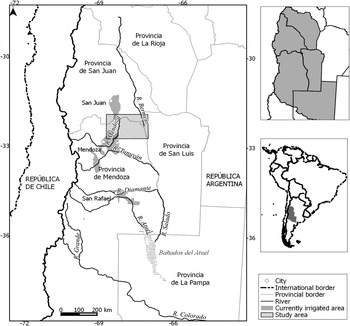
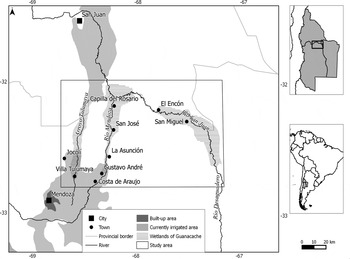
Guanacache was a system of small lakes and estuaries with pockets of dunes and dry forests covering roughly 1 million hectares in the provinces of Mendoza, San Juan, and San Luis. From the heights of the Andes, the Mendoza and San Juan Rivers flowed down into the plains, draining into the Guanacache wetlands. The waters flowed out of Guanacache and down the Desaguadero River, along the provincial border with San Luis, until just before reaching the modern province of La Pampa, where the Atuel wetlands were formed (Figures 1 and 2).
Provinces and Principal Rivers of Western Argentina

The Guanacache Wetlands and Principal Places

Guanacache had been a redoubt for the Huarpes, other indigenous groups, African slaves and criollos on the run from colonial rule, who maintained relative political autonomy until the 1870s. By this point, the population of the Mendoza portion of Guanacache totalled roughly 8,000. Starting in the late nineteenth century, during the consolidation of the modern Argentine state, water from the rivers was gradually concentrated in the urban irrigation network of dams and canals, which dried up Guanacache and other regional wetlands.
The slow drying up of the lakes and wetlands beginning in the eighteenth century accelerated at the turn of the twentieth century due to the massive appropriation of water for the wine industry. With the felling of the native trees, whose wood was used to build the railways and vineyards, most wetlands became drylands and dunes. This was in spite of abundant snow in the Andes, much more abundant than today, which created sporadic floods that partially filled the lakes and lagoons. Beginning in the 1940s there was a sustained drying period in the swamp complex, caused by the expansion of infrastructure, more irrigated land around Mendoza and to a lesser degree in central San Juan, and possibly geological and geographic factors such as the drying up of the soil and erosion that deepened the course of the Desaguadero River.Footnote 5 Later studies used these factors or other natural causes to explain the process.Footnote 6, Footnote 7 They mentioned the existence of political or social factors of the dispossession of water, but did not study them in detail. They did not investigate artificial irrigation systems, local struggles to preserve the lagoons, or the arguments that legitimised their drainage.
As can be seen from the opening quote, the notion of Mendoza as a dichotomy between ‘oasis’ and ‘desert’ (which covers 97 per cent of the province) is tirelessly repeated in academic, journalistic, artistic and state discourse as the central feature of provincial identity. The oases are considered to be the products of enterprising European colonists (specifically Italian immigrants in the early twentieth century), the use of modern technology and a universalist rationality. The desert, on the other hand, is considered to be an unproductive space and disposable in the name of progress. However, the classification into the binary categories of ‘oasis’ and ‘desert’ of a landscape that was originally much more diverse with wetlands, rivers and forests is a product of a barely-studied political history in which provincial and local elites, European immigrants and criollo and indigenous peasants participated. In sum, this environmental representation of Mendoza naturalises the political process of appropriation and unequal distribution of water. This means that even though the oasis is often recognised as artificial, a product of a civilising project, in academic, journalistic and educational discourse, the concomitant fabrication of the desert is quickly forgotten. More frequently, in particular in popular understandings of this binary, this area is represented as the space of brutal and pure nature.
Our argument is that Guanacache was forgotten during the distribution of water as part of local elites' attempts to control the local resources of Cuyo (the region comprising the provinces of Mendoza, San Juan and San Luis) and the arrival of European immigrants between the end of the nineteenth century to the 1930s.Footnote 8 The laguneros (the people of the lagoon) fought this dispossession by appealing to public agencies, officials and the press, in an attempt to persuade the provincial government to preserve or strengthen ancient irrigation systems. But these demands were frustrated by the competition from European immigrants who began settling in the region at the turn of the century, and who enjoyed political influence thanks, to a great extent, to ethno-racial prejudices in the government, the state bureaucracy and public opinion.
Based on the case study of Guanacache's desiccation, we analyse Mendoza's ‘ethno-water policies’ during the consolidation of the modern Argentine state from the end of the nineteenth century to the first half of the twentieth century and their effect on the environment and identity of social groups and spaces.Footnote 9 We show that during times of heightened conflict, pre-existing ethnic prejudices legitimised the appropriation of water used by the laguneros. We also show how the conflict itself contributed to the re-indigenisation of the laguneros and their land.
This article builds on our own ethnographic field studies that began at the end of the 1990s. We have uncovered the remains of irrigation infrastructure, political memories of water struggles, and practices and knowledge of water and environmental management. Additionally, we have analysed archival documents, provincial legislation, government projects and newspaper articles about water distribution and conflicts.
European Immigration and Ethnification of the Landscape
The relationship between the landscape and cultural identities has a long tradition in geography and anthropology, fed by various theories of environmental determinism, from the human geography of Friedrich RatzelFootnote 10 to the cultural ecology of Marvin Harris and less clearly, structuralism.Footnote 11, Footnote 12 We believe that this relationship cannot be adequately understood from a dichotomous perspective that sets society against nature, so we emphasise that the ‘environment’, in addition to its geographic, biological and climatic features, is configured by human action guided by knowledge, power relationships, memories, meanings and general presentations of the society in question.Footnote 13, Footnote 14
In terms of our analysis, we are interested in demonstrating the close relationships between environmental and social configurations from a non-deterministic position, and in particular, to highlight the social factors at play. To do so, we show that ethnic ideologies in Argentina forcefully advocated the racial and cultural superiority of Europeans over the indigenous and criollo populations. Invoked in conflicts over water, these ideologies resulted not only in the distribution of water to the benefit of the immigrants, but also in the ethnification of those environments and populations that lost out.
We understand indigenous identities or identifications, like national or provincial identities, to be historical products that result from a combination of specific situations over time, supported in political perceptions and discourse and material conditions over the medium to long term. In Argentina and in Cuyo in particular, such constructions have strong roots in associations between indigeneity, nature, desert and other political and moral categories, which are the basis for national and provincial ethnic discourse during the colonial and republican periods.
The writings of Cuyo, an intellectual, and the politician Domingo F. Sarmiento are pivotal in the collective imagination of the Argentine nation. They helped to establish the dichotomy between ‘civilisation and barbarism’ and the notion that the desert engendered regressive barbarism and resisted and threatened the progress and civilisation of Argentine society. Barbarism, initially considered to be a product of the moral degeneration of the Spanish or mestizos in the country's earliest-colonised regions, was later associated with the indigenous substrate of these same populations, also called ‘criollos’ or ‘gauchos’.Footnote 15 To explain and de-legitimise peasant uprisings in Cuyo in the 1860s and 1870s (in which the laguneros had a significant role), Sarmiento attributed determining social effects to the ‘desert’ in the mobilisation of its inhabitants as an ‘indigenous peasant movement’ driven by the thirst for ‘Indian vengeance’ against the cities and the colonial expropriation of their agricultural water.Footnote 16, Footnote 17 One of his main examples was indeed the laguneros of Guanacache:
The desert is the space that covers the flatlands of La Rioja, the marshlands of [Guanacache …] At the foot of the Andes lie two cities, San Juan and Mendoza, which with their luxurious agriculture, in fact just a few leagues around, do not affect the desolate look of the flat country, partly occupied by dunes and partly by lakes, in the spiny forests in the north.Footnote 18 […] The struggle will begin as the semi-barbaric populations try to take control of the agricultural and relatively cultured cities that are at the foot of the Andes: Mendoza, San Juan and Catamarca.Footnote 19
To conjure away the threat of the ‘desert’ and create a modern liberal republic, beginning in the middle of the nineteenth century, the principal ideologists of the Argentine nation Domingo F. Sarmiento and Juan B. Alberdi promoted European immigration as a bearer of civilisation. Towards the end of the nineteenth century and the beginning of the twentieth century, after the national state had put down peasant uprisings, conquered the indigenous territory of the Pampas, Patagonia and Chaco regions during the national ‘Desert Campaigns’ and integrated inland markets with railways, the cultural Europeanisation in Argentina was transformed into active policies that encouraged immigration with massive results.Footnote 20 In 1869, the country's population was less than 2 million but by 1914 it was 7,885,237, of which 29.9 per cent (2,357,952) were European immigrants.Footnote 21
Regional histories of Cuyo have analysed the role of immigrants in the impressive development that began in the 1880s, based on intensive agriculture and wine production for a booming domestic market, in contrast to the Pampas region, the wealthiest and most influential in Argentina, which was dominated by extensive production of wheat, sheep and cattle mostly destined for the foreign market. In the first quarter of the twentieth century, the provincial government increased the hydraulic infrastructure with networks of dams and canals that optimised the acquisition of water for areas within the urban oasis. This undertaking was carried out by European engineers such as César Cipolletti, Galileo Vitali and Gustavo André, who were considered to be true ‘tamers of water’ and became part of the booming technocratic elite in the province.Footnote 22
Growing European immigration was associated with the expansion of irrigated areas used for orchards and vineyards. The 1914 wine-making census shows that of the 6,160 rural properties, 76 per cent belonged to European immigrants.Footnote 23 There were two dozen wineries around 1880 and more than 1,500 by the turn of the century.Footnote 24 Many of these immigrants-turned-winery-owners associated with local elites, came to occupy provincial and national public office and collaborated with law-making and hydraulic infrastructure projects.Footnote 25
This created rapid economic growth that the literature generally considers socially progressive, given the proliferation of small wineries.Footnote 26 Others have highlighted that in spite of decades of economic growth (from the late 1870s to 1928), the lifestyles of many producers did not improve due to precarious access to land, contract labour with the owners and unequal commercial treatment by winemakers. This is apparent from data showing marked residential instability and high rates of overcrowding and death.Footnote 27
William Fleming and Ricardo Salvatore have suggested that the Mendoza government favoured immigrants over criollos in the distribution of land, water and loans. They concluded that there was an ‘ethnic division’ of labour that confined the criollos to the lowest social stratum of the labour hierarchy and led to immigrants becoming small landowners.Footnote 28
This argument, which we consider sound, is insufficient because it does not consider ethnic differentiation beyond criollos and immigrants and only takes into the account the practices of the populations and social relationships within the urban oasis. These studies, following the historiography of the region and of the period in general, do not analyse the social, economic and political reality outside the oasis, nor the relationship between the land and peoples' resources, simplifying it as a rural structure of haciendas and peons. Many topics have not been studied, such as the role of peasants, fishers and hunters, their resistance to unequal appropriation of water and resources, their strategies and demands, the validity of indigenous identifications and the process of distributing irrigation water and configuring the regional environment. It would seem that an imagined regional civilisation of the oasis, made up of provincial identities, has erased the ‘desert’ and the historical agency of its inhabitants from the historical record.
Ana María Alonso has illustrated how national ‘imagined communities’ tend to be inscribed or materialised as ‘things’ through their metaphoric association with physical objects and elements such as territories, landscapes and ‘blood’ relatives.Footnote 29 She has insinuated that these materialisations also work to delimit feelings of ethnicity or class belonging based on a type of expanded totemism intrinsically associated with social classifications and physical or ‘natural’ elements. We suggest that through the impact of discursive constructions such as the dichotomies oasis–desert and civilisation–barbarism and massive European immigration, regional space was ethnicised and certain attributes of collective identity were materialised in socio-environmental constructs. Thus, areas under irrigation (previously under the control of the criollos) recognised by the state and classified as oasis, remained associated with the European population and ‘culture’, while those without irrigation or without official legal title were regarded as ‘desert’ and indigenised with their inhabitants.
The binary oppositions that unfold in dichotomous classifications of society–nature create totemic models of representation for each space and population. In this way, the dichotomous pair of ‘identifying metonyms’ oasis–desert was associated with the dyads culture–nature, European–indigenous, progress–regression, rationality–irrationality and good–bad.Footnote 30 This sui generis totemism at the national and provincial scale does not alone explain the construction of the landscape in the region, but we suggest that it was key to legitimising the process of unequal appropriation of water and environmental reconfiguration that even affected the perception of collective identities. The distinction between indigenous–criollo ‘deserts’ and immigrant ‘oases’ also had an inevitable demographic impact. In 1914, European immigrants accounted for 31.8 per cent of the population of Mendoza, but in the department of Lavalle, which includes Mendozan Guanacache, it was only 14.1 per cent. Within Lavalle, almost all of these immigrants were concentrated in the districts near the municipal entity that made up the irrigated oasis (Costa de Araujo, Tulumaya and Jocolí). In these areas the proportion of immigrants was close to the provincial average, but towards the north of Lavalle in the heart of Guanacache (Asunción, San Miguel y Lagunas del Rosario), the future ‘desert’, immigrants represented only 0.9 per cent of the population.Footnote 31
After the Desert Campaigns, one of the crucial instruments of the the administrative and territorial consolidation of the state was the Ley de Aguas (Water Law) of 1884, which today still regulates the principles and criteria of water administration. This law was strongly manipulated by local political elites.Footnote 32
The Ley de Aguas centralised the administration of water and established what later became the Departamento General de Irrigación (DGI), on the basis that water is a public good. According to the federal system water should have been under provincial administration. The DGI was established as an independent organisation but in practice it is subject to the executive branch and the influence of large wineries. The Ley de Aguas also established that irrigation rights would be assigned to properties and not individuals, so that rights could not be sold or transferred separately from the land. Such rights could only be applied to lands with private property deeds, which excluded not only entire social groups but entire regions, including the majority of the province in 1884, when the inhabitants did not have deeds or there was a non-exclusive, communal or semi-communal use of the land and water.
Water rights were ‘permanent’ or ‘occasional’. Permanent rights were given until the first decade of the twentieth century to those who had water rights before the 1884 Ley de Aguas, which included lands and iura regalia water rights granted by the Spanish Crown or by the Argentine state after independence.Footnote 33
Lands were sold by the state or criollo property owners to immigrants, which gave rise to property speculation in the context of the settlement of populations and the provision of irrigation water. Other rights were extended to registered land owners up to the middle of the twentieth century in areas around the oasis. The discretionary fashion in which irrigation rights were assigned by the DGI and approved by the provincial legislature only worsened the inequitable way the Ley de Aguas was implemented, consolidating the appropiation of water rights by existing criollo landowners and the provincial oligarchy.
As the socialist leader Benito Marianetti explained, the distribution was not only ‘irrational’ given the lack of capacity of the rivers at the time for which rights were granted (they were not based on hydrography) but the political influence of the applicant also played a part ignoring the legal principle of water rights being attached to the land. ‘With the stroke of a pen, irrigation rights were granted for thousands of hectares [and] many scandalous plots took place under the ruse of the “transfer” of rights … for example, in Lavalle, irrigation rights were “transferred” in [the Departments of] Luján or Las Heras to the detriment of water users in these departments'.Footnote 34 Lands in these two departments were much more expensive because of their location in the centre of the northern oasis, close to the city, so the transfer of irrigation rights could quickly make the landowner rich. The governor of the province and principal supporter of modernising the city and irrigation, Emilio Civit, declared: ‘the flow of our rivers, unevenly distributed, has created our agricultural area, expanding in accordance with quite improper and surprising irrigation practices, subject to a law that is insufficient for the current necessities.’Footnote 35 Later, additional laws were passed to limit the discretionary granting of water. In parliamentary debates, the great difficulties of small farmers to obtain water rights were discussed as well as the existence of a water lobby that negotiated irrigation rights.Footnote 36
The ‘Last Caciques’, Irrigation Practices and Local Knowledge in Guanacache
Reports about the laguneros' visit to Mendoza in 1937 carefully concealed its larger context: they were desperately trying to convince the government to take measures to provide water to their canals, which had dried up because of growing use upstream and an intense drought across Cuyo and northern Argentina.Footnote 37
Guanacache had large cultivated areas that were irrigated by canals and other irrigation techniques using fluvial, alluvial and pluvial waters. This allowed for productive systems that combined herding, farming, fishing, hunting and gathering based on memories and knowledge of the local ecology.
The wetlands went through cycles in the quantity of water they received from the San Juan, Mendoza and Tunuyán Rivers, which depended on the snowfall in the Andes. In good years, the waters covered a surface of 3,000 hectares.Footnote 38 Corn, squashes, melons and above all wheat were grown along the edges and in the bottoms of the low-lying areas when the waters retreated. The humidity retained in the clay soil made it possible to plant for two years in a row and the silt brought by the rivers ensured very productive harvests. Wheat grew as high as one-and-a-half metres and harvests yielded two to three metric tons per hectare.Footnote 39
Other irrigation techniques redirected floods caused by sporadic rainstorms to the areas beyond normal water courses. The laguneros made ‘dikes’ (with mud) or small dams with branches that were 40–60 cm high to redirect water. This made it possible to ‘irrigate the fields’, that is, provide humidity to uncultivated lands to encourage the growth of wild plants, bushes, trees, and grasses whose stems, leaves and berries were used to feed livestock and people, in addition to providing wood and medicine. There were other plants such as junquillo, a fine grass that was used for weaving. This notably increased the potential size of animal herds. One observer noted ‘the immense quantity of animals that graze in the pastures that grow here’.Footnote 40
This strategy challenges traditional definitions of ‘irrigation’ or ‘cultivation’, concepts that are perhaps inadequate in this case. The environmental interactions are more complex and subtle, true social–natural hybrids, through which the laguneros practised widespread ecological engineering to increase the productive capacity of the environment and maintain wild species. Another technique for managing surface water was the construction of earthen dams to retain rain and irrigate plants in dry periods using canals or in extreme cases, buckets. In order to use them in this way, they were located at high points with clayish soil that worked as an impermeable bottom layer.
Finally, there were canal systems that brought water from the Mendoza River and to a lesser extent the Desaguadero River. They can be found throughout the plains of Guanacache in places such as Asunción, San José, Lagunas del Rosario, Encón, San Miguel and Algarrobo Grande. Some documents mention canals that fed directly from the Mendoza and Desaguadero Rivers and watered nearby pastures. In the mid-nineteenth century Martín de Moussy commented that the laguneros, ‘the majority of which were ancient Huarpes Indians’, used canals to draw water from the Mendoza River to cultivate plants.Footnote 41 Prieto compiled local recollections that indicated the use of these canals until the first half of the twentieth century.Footnote 42 However, despite the variety of irrigation systems, the literature has only mentioned the traditional method of irrigating near flood areas along the edges of the lagoons.Footnote 43
There were extensive irrigation networks that exceeded the family level and required a collective administration of water that included central and secondary canals. These canals, based on our own survey of the lands and local memories, covered 15 to 20 sq. km, and area comparable to the current area covered by urban oases. This is a fact that we have only found mentioned as an aside in a forgotten 1937 DGI report.Footnote 44
The size of these canals may have increased in the early twentieth century in response to the drop in the flow of the Mendoza River and of water that reached the lagoons. At this time the DGI took greater control of the water by building a series of upstream dams, which were opened only sporadically to release extra water downstream towards Guanacache. However, the initial date of these projects in not clear and as we will see, official sources and the press in the 1930s date them to an earlier time. These ‘boosts’ of water only lasted a few days or sometimes a few hours, once every 15 to 30 days, making it necessary to take full advantage of them.
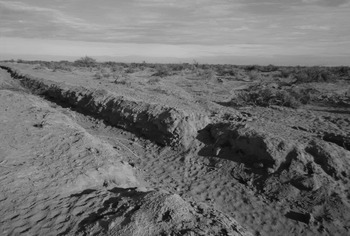
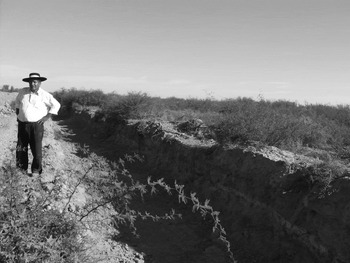
The canals were built by the laguneros themselves with shovels and rakes with a minimum change in elevation, taking advantage of dry sections of the Mendoza River and in some places crossing dunes. The main canals were one metre deep and nearly one-and-a-half metres wide, which in turn fed secondary and tertiary canals (Figure 3).Footnote 45
One of the Canals Built by the Laguneros in the Early Twentieth Century

According to narratives of the laguneros Sixto Jofré, Juan Nylo Reynoso, Fabián Nievas, Luisa Villegas and Felipe Mayorga (and confirmed by the above-mentioned DGI report), more than 100 people including farmers, landowners and rural labourers participated in the construction and coordinated efforts to clean water courses and keep them free of sand. Water was then distributed in cultivated areas, usually contiguous, which were dived by fences made of branches. Neighbours exchanged labour (in events called mingas) to build canals and houses or harvest corn and wheat, among other activities.Footnote 46 Corn and wheat were stored for family consumption; most of the wheat was sold in Mendoza and other provinces after being ground in the province of San Juan.
Most of the laguneros had a small amount of livestock, cultivated areas of less than half a hectare and barely made enough to eat. Many sources indicate that those who built or rebuilt large canals in the early twentieth century were considered ‘rich’. There were marked social differences and many laguneros cultivated areas greater than five hectares, a significant area for local agricultural production, had more than 50 heads of cattle, and in some cases had planted cash crops and hired rural workers.Footnote 47 Some, like Juan Manuel Villegas at San José, had more than 3,000 heads of cattle, houses in the city of Mendoza and fine clothing made by tailors in Mendoza and Buenos Aires with the best imported cloth. Rosario Jofré, for example, had built a large ranch similar to those in the central oasis which included 33 irrigated hectares, large areas of Alamo trees, orchards, six carts and 1,000 heads of cattle. There were others with significant amounts of property such as Rafael Morales, Rosendo González, Juan Manuel Villegas, Juan Díaz and Tadeo Mayorga, among many others.
All of these people made up the local political elite who led the laguneros in the nineteenth and early twentieth century in maintaining their autonomy and keeping their lands. Many of them were descendants of the legal petitioners or peasant rebels who controlled that area until the end of the nineteenth century. Some had originals and copies of manuscripts and legal documents (legal cases, deeds, decrees) that mention claims and recognition of indigenous lands in the eighteenth to nineteenth centuries.Footnote 48 They were recognised as cultivators of local traditions, protectors of the most humble and defenders of the land against the foreign immigrants or the landed gentry of Mendoza. They were feared for their nearly indisputable power and authority which included practices such as loaning rural workers, electoral control, land hoarding, dealing with the lumber industry and physical violence.
Members of the lagunero elite mediated relations with the rest of provincial society, especially urban and bureaucratic elites, and the state in general, for which they had accumulated much prestige, political power and economic capital. They represented national political parties and monopolised government and local ecclesiastical positions such as commissioners, heads of the civil registry and ‘syndicates’ of the chapels which organised the popular celebrations for patron saints.
However, the power they once had in regional and even national politics diminished greatly after the fall of the last peasant rebels in the 1870s and the change in focus from exporting cattle to Chile to large-scale wine production. Mass immigration and the province's water policies sealed their fate and that of the lagoons. Today, they are remembered as the ‘last Huarpe Caciques’.
The Great Drought of 1936–37 and the End of the Guanacache Canals
During the expansion of the wine industry, the laguneros fought an unequal battle against immigrants who had arrived in Lavalle. In southern Lavalle, continuous and later intermittent water rights were granted to the richest farmers and the local political elite.Footnote 49 Many immigrants became owners of large estates and employers, mostly of laguneros, and became the new local political elite. In the towns of Jocolí, Tulumaya, Costa de Araujo and Gustavo André, mayoral and city council candidates from various political parties were selected and local water administrations, water inspectors, elected by landowners and recognised by the DGI.Footnote 50 These public offices were monopolised by immigrant families.Footnote 51
Like the laguneros, these landowners dug canals that drew water from tributaries and channels that drained wetlands which were part of Guanacache. In the first three decades of the twentieth century, including the great drought of 1936–37, the landowners made numerous requests for water that were granted without difficulty, immediately and exponentially increasing the value of their lands. Favouritism towards European immigrants over criollos in the acquisition of water and land materialised in elaborate, unofficial strategies that were difficult to detect in the records. The best explanation was offered by the governor himself, Emilio Civit, in an interview with a French journalist.
Civit: Let's take a case of a hard-working Lombardo who has nothing more than a thousand pesos … but has strong arms for work and wants to become rich. He buys one hundred hectares of land without irrigation rights, but in an irrigated area, at ten pesos per hectare. Now the [province] provides the water necessary for irrigation … and the land's value increases to 100 pesos per hectare … [The province] loans him the 1,000 pesos that he needs for the canals …
Huret: With what as collateral?
Civit: The land, which you know will soon be worth 10,000 pesos.Footnote 52
These opportunities were not available to poor criollos or indigenous people, whose requests were never honoured. The prototypical target of water policy, as Civit himself expressed, was the Italian immigrant, a ‘hard-working Lombardo’ whose capacity for work and progress was implicitly guaranteed by his superior culture and racial supremacy. For immigrants, becoming a landowner with water rights meant not only economic benefits but also symbolic and political ones, making possible participation in municipal government and the DGI, as well as running for the offices of mayor, town councillor and water inspector.Footnote 53
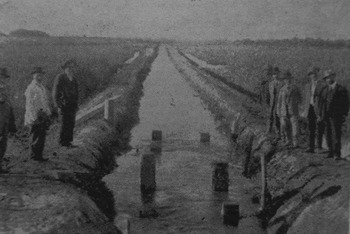
The acquisition of water rights turned relatively poor immigrants in Lavalle into a burgeoning political elite. Simply referred to as ‘landowners’ in the press and political documents, they were portrayed (in contrast to indigenous people) as hard-working harbingers of civilisation, rational and productive investors worthy of government support. They and the DGI reached a consensus on the practices of building the landscape of the great oasis in southern Lavalle and in other parts of Mendoza: drying the wetlands by building drainage canals to create new arable lands and then irrigate them in a controlled way (Figure 4).
The Tulumaya Canal, Built by Land Owners, Mainly European Immigrants, to Drain the Tulumaya Wetlands

The great drought coincided with strong conservative reactions against the populist politics of the previous decade and under the governors José Néstor Lencinas (1918–20), Carlos Washington Lencinas (1921–24) and Alejandro Orfila (1926–28). Conservatives or liberal-conservatives had governed Mendoza during a period of development and consolidation of the province and the nation, beginning at the end of the 1860s and including the expansion of the large-scale wine industry. But this strict hegemony was broken with the emergence of the Lencinas Party, an offshoot of the Radical Party that had toiled in defence of urban and rural workers and small wine producers against the dominance of the winery owners and large wine producers.
Within the government, the Lencinas Party advanced progressive policies such as a minimum wage (the first in the country) and the creation of the ministry of labour, anticipating various reforms later encouraged by Juan Domingo Perón.Footnote 54 Lencinas and his so-called ‘party of alpargatas’ (rope-soled sandals) resonated with the populace and denigrated conservative elites. José Néstor Lencinas harangued, ‘for these representatives of the old regime, “the people” are a gaucho-cracy, ignoble gossips, and the incoherent mob that must tolerate plundering with total impunity’.Footnote 55
The violence with which conservatives had maintained their domination did not stop with the arrival of the Lencinas Party. This party did not treat its enemies any better and received similar treatment from the conservatives and President Hipólito Yrigoyen of the Radical Party. Federal interventions toppled each of the Lencinas governments and Carlos Washington Lencinas was assassinated in 1929. As in the rest of the country, during the ‘infamous decade’ (from the 1930 coup to 1943) that preceded Perón's first term in 1946, Mendoza was dominated yet again by conservatives as a result of electoral fraud. They repealed many of the Lencinas reforms and made a renewed effort to appropriate lands, resources and manual labour. In northern Mendoza, where water from irrigation canals was increasingly sporadic, the struggle for water coincided with a time of very little official sensitivity to criollo farmers.
From the early twentieth century, provincial newspapers promoted immigrants' demands for water in the most distant irrigated areas, characterising them as heroes who were civilising the ‘desert’ and supported the pressure they put on government officials and law makers.Footnote 56 But the great drought in the mid-1930s put an end to the laguneros' demands for water. According to their descendants, they fought fruitlessly for decades for the DGI to recognise their water rights.
Their requests were essentially to maintain or revitalise farmland by restoring old canals or building new ones. Media activity surrounding the laguneros sparked an active debate among elites about whether immigrants or laguneros deserved water rights during dry periods, which meant re-thinking socio-economic models that the state promoted.
There were two arguments in this debate. The first maintained that the laguneros would inevitably die off due to the advance of progress, and proposed centralising irrigation in the existing oasis, which would benefit Lavalle and landowners south of Guanacache. This position was supported by generic notions of progress, economic criteria that prioritised the profits of the large-scale wine industry over rural farmers' mixed economy and low accumulation and ethnic prejudice that maintained that only immigrants, because of their more developed culture, knowledge and work ethic, could create a modern wine industry and effectively use water.
The second was that Mendoza had a debt to the laguneros that could be repaid by incorporating them into modern life as intensive agricultural producers of high-profit crops such as wine, for which irrigation should be provided for their land. The first argument implied that rural and indigenous criollo groups could only be cheap labour for European landowners, while the second supported their conversion to becoming autonomous agricultural producers. This debate was not divided along party lines but rather took place within the government's conservative Democratic Party.
Discrepancies were principally apparent in the press. When the drought began to hit in the second half of 1935, articles were published that demanded the restitution of irrigation to Guanacache. An article in the newspaper La Palabra in July 1935 mentions that the representative Armando Guevara Civit had presented a project to the province's House of Representatives to build a canal from the Mendoza River to the Lagunas del Rosario with the capacity to irrigate 10,000 hectares: ‘to carry out a project so fundamental for the irrigation of the north of Lavalle [the article commented enthusiastically] there is no doubt that the distant inhabitants of this part of Mendoza have received, with uncontainable joy, the news that the province feels inclined to promote a cultivation plan through the extension of the irrigation system’.Footnote 57 This canal would provide water to 4,000 hectares in the districts of San José and Asunción, through which Lavalle would regain ‘the great importance it had some 40 years ago before the irrigation system suffered a serious setback that led to its current decline’ and increase the value of its land.Footnote 58
Five months later, La Prensa published another article that, while supporting water for Guanacache, also blamed its inhabitants of the loss of cultivated areas and irrigation infrastructure.
In this area there is a population that in another time had a significant source of resources, agriculture. The crops began to be lost gradually, given the difficulties in maintaining the irrigation systems, due to the inhabitants' rudimentary means and lack of technical consultation, for which they were unable to carry out the necessary projects to avoid the above-mentioned problems.Footnote 59
The article blamed the laguneros for the final drying up of their lands, exonerating the state for not building or maintaining irrigation infrastructure. Yet at the same time it recognised the existence of an old and prosperous area of irrigated land, without ever explaining how the laguneros had been able to develop it, despite their alleged lack of agricultural ability.
Two days later, the same newspaper proposed a plan to colonise the district of Jocolí by relocating European families to join other European immigrants. The ‘beautiful initiative’ was suggested by a conservative former superintendent of irrigation who promoted the urbanisation of the district by parcelling land in an area where he believed water was abundant.Footnote 60
The following day, another article was published on inhabitants of Lagunas del Rosarios' petitions to the governor ‘to restore canals that were once used to irrigate these lands, which are considered to be very fertile’. According to the article, the canals had been forgotten due to lack of maintenance and neglect by the inhabitants as they began to focus on livestock. It suggested that it was better to restore irrigation to Guanacache because ‘Lavalle would regain the importance it had in a distant era and trade and traffic with the city would increase significantly’.Footnote 61
According to the article, the executive branch had addressed the petition and ordered studies to be done in order to create a budget for the project, even though it was the duty of the provincial legislature to concede new water rights that were not already registered by the superintendent of irrigation. This insinuation of the likelihood of a water concession before the Ley de Aguas is very important because it would have given a decisive legitimacy and legality to the laguneros's demands, insofar as the Ley de Aguas established that canals and water rights prior to the law supported providing continuous water rights.
While the article presents the laguneros as active subjects demanding water from the executive power, it again blames them for the decline of the canals, instead of highlighting the fact that they had built and maintained the canals in the first place. In the same way, the lack of maintenance of their irrigation system and the change to livelihoods based on livestock were not attributed to the progressive lack of water but rather to a ‘cultural’ rejection of productive work.
As the drought progressed, the San Juan press discussed demands for other irrigation canals in Guanacache, but shifted the cause to social factors and local responsibilities.
A picture of desolation emerged: fields of crops lost for lack of water, houses abandoned by inhabitants in the face of unrewarded efforts, lines of dead trees […] and the case of Guanacache reflects what happened in other districts. In these areas more or less abundant water supported an increase in agriculture that led to the formation of population centres that quickly transformed those places.Footnote 62
Meanwhile, the activities of the first people to begin improvement projects were imitated by their neighbours, who owned estates to the west and used up the available water. With more consumers, the amount was insufficient and led to the loss of plantations and the exodus of families.
Three days before the arrival of the laguneros to the capital, during the height of the drought in November 1937, the pro-government newspaper Los Andes published articles on the desperate situation of the rural inhabitants of the region but avoided openly referring to Mendoza or San Juan. An article titled, ‘Caravans of men travel around the province’, for example, did not discuss Mendoza but rather the situation in another province, Santiago del Estero, where there was significant emigration of people in search of water and entire groups that robbed trains for water used by the locomotives.Footnote 63 Three days later, as we mentioned at the beginning of this article, the newspaper covered the arrival of more than 100 laguneros at the city of Mendoza, who were going through a similar catastrophe, without a hint of their troubles or demands.
The naturalist Carlos Rusconi affirmed soon after that the objective of the trip was to protest against the plundering of their resources and demand the return of their lands and above all resolution of the pressing problem of the lack of water.Footnote 64 As we saw at the beginning of this article, the newspaper highlighted that the visit had been the result of a government project of the tourism ministry so that inhabitants of distant rural areas could get to know the provincial capital.Footnote 65 In the same sense, the administrative report of 1935–38 of Governor Guillermo Cano attributed this to a policy of integration and social work with subaltern populations of the province, giving his administration a touch of popularity.Footnote 66
At the request of the executive power, the DGI filed a report on the value of restoring irrigation to the districts of Lagunas del Rosario, Asunción and San José.Footnote 67 Dated 28 December 1937 in Lagunas del Rosario, the text discusses the hydrography and existing irrigation systems, making it the first and only official allusion to the presence of artificial irrigation in the area. ‘In the period in which rivers fed the wetlands, inhabitants of the area maintained appreciable extensions of farmland watered by a primitive irrigation system, which was the only system possible given the characteristics of the terrain’.Footnote 68
Undercutting portrayals of the laguneros' ineptitude, the report mentions the existence of canals and concedes that they were difficult to build, not only because of the presence of dunes, but also because the very slight slope meant they had to draw water from the river well upstream. This was what the inhabitants had done, as the report recognises, based on visible remains of old canalsFootnote 69 that were fed from the Mendoza and Desaguadero Rivers. The text confirms our own field survey that there was a 10-km-long canal that was rehabilitated for the last time in 1925.Footnote 70 However, it only partially reports the extension of the canals, as we measured the principal canal as twice as long, complemented by other canals in a network stretching west, much further from the river than the report suggests.
The report is not ultimately supportive of maintaining irrigation in Guanacache, but its conclusions are contradictory. The first conclusion is that due to lack of water in the Mendoza River (due to the increase of irrigation upstream) it would be pointless to repair canals, which would provide an ephemeral solution at a high cost. But on the same page it says that, however irregularly, water does reach Guanacache. The second conclusion is based on engineering and demography, saying that it is worth adding new irrigated areas near existing ones and population centres. The report assumes that neither factor was true for Guanacache. In spite of this assumption, the report characterises irrigated areas as ‘ancient and vast’ and says ‘these lands had more population than other areas of agricultural colonisation such as Jocolí y Gustavo André’.
It is clear that the fundamental reason for denying the construction (or, as the report correctly says, reconstruction) of the main canal to bring water to Guanacache is a crude statement at the end of the text: the fear that recognising laguneros' water rights would take control away from the DGI to send water to other areas. ‘If it is decided to reconstruct this canal to momentarily alleviate the inhabitants' problem, this would not include recognition of rights to the water in the rivers, as the granting of this right could be very inconvenient for future projects aimed at making a holistic use of the Mendoza River.’Footnote 71
The lack of political will to recognise the laguneros' water right seems to explain another aspect of the report: the vagueness with which the irrigation systems are dated. Although there are abundant allusions to their ‘antiquity’ a date is never mentioned, which is probably a careful avoidance of dates before 1884 when the Ley de Aguas came into effect. As we saw above, the Ley de Aguas requires the recognition of water rights to lands with irrigation prior to the law. In addition, there are sporadic allusions to local irrigation areas as potential ‘new’ areas.
The implicit and recurring denial of the existence of irrigation systems that pre-date the Ley de Aguas cannot be explained without considering the fear of recognising laguneros' water rights and by extension, that the water had been illegally expropriated. On the other hand, in the same year that this report was published, the DGI granted periodic water rights upstream in Jocolí, allowing people there to open a canal which they named, as a synecdoche of their triumph, the ‘Progress’ canal.
The decision to deny infrastructure and water rights in Guanacache took place alongside the barbarisation and indigenisation of its inhabitants by provincial elites. In 1939 the newspaper Los Andes published an article called, ‘The inhabitants of the wetlands of Guanacache scrape out a pitiful existence that deserves the attention of the government.’Footnote 72
The article describes the laguneros' situation as terminal and irreversible given their indigenous origin and ‘ethnic composition’. It begins by recounting that this ‘productive inland sea’ or ‘Egypt in Cuyo’ once supplied the city with large quantities of horses and cattle as well as fish and ‘an innumerable quantity of wheat’. Later it explains the area's decline as the result of other cultivated areas emerging and (beginning in 1885) the arrival of the railway, which promoted the growth of the wine industry that demanded more and more water from the rivers. After explaining these external causes, it ascribes the inevitable failure of the area to the laguneros' ethnic characteristics:
The increasing progress of Mendoza and San Juan deprived [the laguneros] of the water they treasured and considered a gift from heaven. What has been gained with the change is beyond doubt and should be treated as the most splendid victory in the rational work against the blind forces of nature. If they had water, the Guanacache wetlands would be worth more and would produce more material benefits than one thousand hectares of wine grapes in the Department of Luján. Thinking of taking a single drop from the large-scale crops to try to give life to the lagoon area would be bad business, despite the inhabitants' frank opinion to the contrary. Should this interesting socio-economic problem be written off as an unpleasant local expense for a significant overall benefit?Footnote 73
The use of water by the laguneros was attributed to divine providence: ‘the blind forces of nature’ and not to their work, knowledge and irrigation infrastructure, giving way to the association between nature, primitivism and indigeneity.
Unfortunately for all of this extensive work, the area's ethnic composition (Hispano–Huarpe) is incompatible with the habitual rhythms of the rest of the population of Mendoza. There is a true psychological abyss between the lagunero and the active contract vineyard worker in the Department of Maipú, for example […] While it is true that young people who still roam around these fields without water could emigrate and look for work in friendlier places: but it would always be a foreign element, unstable, that would cause more harm than good […] All Laguneros were born to live off raising rustic cattle. It will be that way forever, following their tradition of many centuries, the most backward part of Cuyo, of primitive habits, crystalized in their quiet, routine lives. Today they can be seen in an accentuated state of resignation and abandonment.Footnote 74
When the 100 laguneros arrived at the capital in 1937, Rusconi said that they moved the intellectual and civic sphere and many thought they saw the ‘ancient Huarpes’ in these visitors.Footnote 75 Invoking the supposedly Huarpe condition of the laguneros to explain their decadence and environmental tragedy coincided with the emergence of intellectual debates on the existence of the Huarpe race and its remnants. As we have discussed elsewhere,Footnote 76 between the 1920s and 1940s, scientists, travellers, men of letters and artists turned to imaginary Huarpes either to explain the inadaptability to progress of the rural inhabitants of the lagoons or to glorify them as a folkloric substrate of Cuyo. This was a parallel construction and was contradicted by the supposedly scientific financing of the idea of the extinction of the Huarpes and also the sublimation of an origin myth of the communities of Mendoza and San Juan.
At the end of the 1930s, a well-known DGI official, engineer Galilo Vitali, suggested a way of reinstating water to Guanacache and invoked the ‘necessities that the aboriginal population of this region require, the last remnants of the Huarpe race, are being extinguished due to the progress that has deprived them of the indispensable elements of their lifeways and existence: water’.Footnote 77 Mindful of the hard conservative hegemony of the times, he quickly added that ‘the project should not be considered out of a simple sentiment that would help avoid the aborigines’ final abandonment of the area (the last of the Huarpes) but rather as a means to prevent the dunes from advancing into the most distant irrigated areas, which affects the oasis'.Footnote 78 Pointing to the natural threat of the desert to the oasis was perhaps the only way Vitali thought he could defend the laguneros. Given the opposition of the rest of the officials of the DGI, the proposal was not carried out.
Returning to the ideas presented in the introduction, we see that by the mid-1940s the totemic association between the laguneros–Huarpes had crystalised. In July 1946, the DGI superintendent took office under a Peronist provincial and national government. In his acceptance speech he said:
Water as a part of irrigation should be considered in terms of the land's possibilities, and in turn, the land should be considered in terms of its social value based on a mathematic economic programme […] Without ready farmers and statistics of crops and production of the lands, water is a gift […] It would be useless to water a desert with nobody to cultivate crops.Footnote 79
We have demonstrated how the supposed cultural failure to adapt to progress, a result of the indigeneity or Huarpe-ness of the lagoon people, was used as an argument to delegitimise their demands for irrigation. Making the laguneros invisible by replacing them with the terms ‘desert’ (water would be given to a ‘desert’, not to people) was not naïve rhetoric. The laguneros were subsumed within the term ‘desert’ and characterised as antagonists who would strive for water against the immigrants. The desert, as Vitali indicated, was not a neutral empty space but rather a monster that threatened the integrity of the oasis.Footnote 80
In the middle of the twentieth century, the lagunero population that briefly became visible as ‘Indian’ and then Huarpes, was finally made invisible when they were replaced by their metonymic equivalent, the ‘desert’. Their indigeneity was used to justify, in a narrative of progress, the expropriation of the laguneros and the desertification of their territory. It was the master key for exonerating the province of the obligation to send water to those lands as it explained the expropriation of water as the result of rational decisions, objectives, techniques and ethnicities. The idea of the Huarpe identity of the laguneros befell the same fate as the water in their canals and their irrigation systems. In the same period, they were made visible for a fleeting instant, and then their inexistence, or the need for their timely disappearance, was declared.
Conclusions
We have examined the history of the distribution of water in northern Mendoza from the end of the nineteenth century to the first half of the twentieth century, a crucial period that saw the arrival of European immigration, the consolidation of the provincial state and the development of the wine industry. We analysed the drying up of the Guancache wetlands and the struggle it led to. We discussed perceptions of the environment as a dichotomy between oasis and desert and the notion that geographic distribution is a consequence of natural or rational decisions.
We also explored how these categories and narratives were built around and in fact still help build a legitimising discourse for the unjust distribution of water in Mendoza. In this way, the powerful image of the history of Mendoza as a war between the oasis and desert hides the socially conflictive element of appropriating water and the role of political actors and social groups in imposing, resisting or legitimising its distribution, use and access. The laguneros not only possessed crops and complex water management techniques but also had their own network of canals before the 1884 Ley de Aguas, which is still in effect today, and requires legally recognising pre-existing canal systems.
The decline of these irrigation systems in the late nineteenth and early twentieth centuries did not have fundamentally environmental causes but rather social and political ones. First, there was increased demand for water and natural resources in the Mendoza River basin from the growing wine industry and the growing cities. Second, the development of an immigration policy by state officials materially and symbolically favoured Europeans to the detriment of criollo and indigenous populations. Third, the fundamental factor, the mobilisation of ethnic prejudices worked to legitimise the appropriation of water for European immigrants or criollos that the elite considered ‘white’. As we have seen in the debates and projects surrounding Guanacache during the water crisis of the 1930s, the existence of rights and concrete petitions by the laguneros were opposed by instilling the notion of their technical and cultural inferiority, closely tied to their indigenous condition.
The marking of an indigenous identity, which originated in a romantic discourse of a few local intellectuals and in a territorial and ethnic discourse of the laguneros, was then converted into an implicit argument for denying them water rights. This move made it possible to ‘prevent’ any violation of water rights and the requirement of the Ley de Aguas to legally recognise pre-existing canals and irrigation infrastructure. This ethno-ecological discourse was based not only on the unequal distribution of water and the environmental configuration of the oasis of northern Mendoza but also on the subsequent naturalisation of this process.
Arguments of indigeneity were quickly replaced with the fetishised image of the very desert as a territory–people entity that essentially reflected the attributes and rights of the civilised. The ‘desert’ was established as a natural object set against the oasis as the centre of civilisation, progress and culture. Both spaces were moralised so that the desert reflected the bad, dirty, irrational and monstrous while the oasis represented the good, beautiful, rational and just. This dynamic consolidated the naturalised images of the ‘desert’ not simply as an area without water, but essentially a territory without rights to water, forever forgetting the political nature of this development.
In spite of all this, the memory of the lakes, fish, forests, canals and cultivated fields now inspires the lagoon people to again campaign for the irrigation canals of Guanacache to be re-opened, which is at the same time one of the principal foundations of their collective identity. Rights to water, like the Huarpes themselves, have not been extinguished by rhetoric (Figure 5).
The Wetlands of Guanacache: Current Opening of a Canal at the Mendoza River to Attempt to Irrigate Part of the District of San José