Introduction
The union between biologically related individuals, i.e. those with at least one common ancestor, is known as consanguineous marriage (Bittles, Reference Bittles2001; Saadat, Reference Saadat2007). This type of marriage has been a historically accepted practice in many populations (Rafiee & Saadat, Reference Rafiee and Saadat2010). Recent studies estimate that 10.4% of marriages in the world occur between relatives (Bittles & Black, Reference Bittles and Black2010).
The prevalence of consanguineous marriage depends on demographic, religious, cultural and socioeconomic factors (Bittles, Reference Bittles2001; Saadat, Reference Saadat2007, Reference Saadat2008a, Reference Saadatb). In Brazil, Freire-Maia (Reference Freire-Maia1957) concluded that the cultural pattern, socioeconomic status, migration, population density and degree of ruralization are factors that influence the level of inbreeding. The distribution of inbreeding rates in Brazil is heterogeneous, increasing from the coast to the interior of the country. The southern region is characterized by a relatively low frequency of inbreeding, while the north-east region has the highest coefficient of inbreeding in the country (Freire-Maia, Reference Freire-Maia1957). Some studies have reported significant increases in infertility, abortion, perinatal loss and neonatal death in inbred families. Others have shown that the occurrence of malformations in children of consanguineous marriages is higher than in children of unrelated parents (Al-Awadi et al., Reference Al-Awadi, Naguib, Moussa, Farag, Teebi and El-Khalifa1986; Bittles et al., Reference Bittles, Grant and Shami1993; Dawodu et al., Reference Dawodu, Abdulrazzaq, Bener, Kappel, Liddle and Varghese1996; Al-Abdulkareem & Ballal, Reference Al-Abdulkareem and Ballal1998; Ober et al., Reference Ober, Hyslop and Hauck1999; Al-Rifai & Woody, Reference Al-Rifai and Woody2007; Kerkeni et al., Reference Kerkeni, Monastiri, Saket, Guediche and BenCheikh2007).
However, the main consequence of consanguineous marriages is the increased risk of autosomal recessive diseases (Freire-Maia, Reference Freire-Maia1974; Rafiee & Saadat, Reference Rafiee and Saadat2010), e.g. amelogenesis imperfecta and nephrocalcinosis, increased risk of developing asthma, spastic paraplegia, optic atrophy and neuropathy and schizophrenia at an early age, mucopolysaccharidosis VI (MPSVI), phenylketonuria (PKU) and hearing loss (Khlat & Khoury, Reference Khlat and Khoury1991; Bittles et al., Reference Bittles, Grant and Shami1993; Tuncbilek & Koc, Reference Tuncbilek and Koc1994; Stoltenberg et al., Reference Stoltenberg, Magnus, Skrondal and Lie1999; Bittles, Reference Bittles2001; Macedo-Souza et al., Reference Macedo-Souza, Kok, Santos, Amorin, Starling and Nishimura2005, Reference Macedo-Souza, Kok, Santos, Licinio, Lezirovitz and Cavaçana2009; Paula et al., Reference Paula, Melo, Silva-Guerra, Mestrinho and Acevedo2005; Saadat, Reference Saadat2005, Reference Saadat2007, Reference Saadat2008a, Reference Saadatb; Saadat & Zendeh-Boodi, Reference Saadat and Zendeh-Boodi2006; Tadmouri et al., Reference Tadmouri, Nair, Obeid, Al Ali, AlKhaja and Hamamy2009; Mahdi et al., Reference Mahdi, Mahesh, Mysore, Kumar, Jayaraj and Ramachandra2010; Amorim et al., Reference Amorim2010; Manzoli et al., Reference Manzoli2010; Nafissi et al., Reference Nafissi, Ansari-Lari and Saadat2011; Costa-Motta et al., Reference Costa-Motta, Acosta, Abé-Sandes, Bender, Schwartz, Giugliani and Leistner-Segal2011).
The city of Monte Santo is located in the state of Bahia, in north-eastern Brazil, and genetic clinical observations in the state capital have shown that a high number of patients from this city are affected by MPSVI. Molecular analysis of these patients has shown that the cause of the disease, which is autosomal recessive, is the occurrence of a homozygous allele (Costa-Motta et al., Reference Costa-Motta, Acosta, Abé-Sandes, Bender, Schwartz, Giugliani and Leistner-Segal2011). To analyse affected families, patients were entered in a single pedigree with more than 1000 individuals. It was observed that all of the patients were children of consanguineous marriages (Costa-Motta et al., Reference Costa-Motta, Acosta, Abé-Sandes, Bender, Schwartz, Giugliani and Leistner-Segal2011). In addition, the intragenic polymorphisms study showed that all of the patients shared the same haplotype, thus confirming the relationship among those affected and showing that the mutation had a common origin.
There is an estimated frequency of MPSVI of approximately 1:5000 in the city of Monte Santo; however, in Turkey and Switzerland this incidence is 1:43,261 and 1:1,505,160, respectively (Valayannopoulos et al., Reference Valayannopoulos, Nicely, Harmatz and Turbeville2010; Costa-Motta et al., Reference Costa-Motta, Acosta, Abé-Sandes, Bender, Schwartz, Giugliani and Leistner-Segal2011). This city is also affected by PKU; the frequency of this disease is 1:22,000 in Bahia and 1:16,362 in Monte Santo (Amorim, Reference Amorim2010). Another disease found in this city is hearing loss. According to Morton et al. (Reference Morton1991), 1:1000 live newborns worldwide exhibit hearing loss, while in Monte Santo, the prevalence is increased to 1:622 (Manzoli, Reference Manzoli2010).
Migration, founder effect, genetic drift and consanguineous marriage are risk factors for recessive disease and influence the structure and formation of a population. This paper analyses the association among evolutionary factors and consanguineous marriage with the high frequency of genetic diseases in the city of Monte Santo, Bahia, Brazil.
Methods
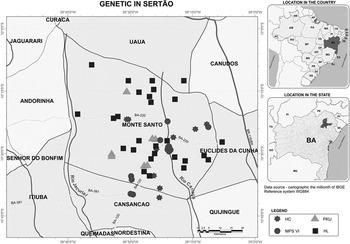
The present study was developed in the city of Monte Santo, located in the state of Bahia, north-eastern Brazil, at a latitude of 10°26′16″S and longitude of 39°19′58″W. The area of the city is 3285 km2, it is subdivided into more than 150 villages and has 52,338 inhabitants (IBGE, 2010). Of these inhabitants, 13% live in the town and 87% live in rural areas. The graphical representation of Monte Santo, the neighbouring cities and the distribution of diseases found and their exact locations in the city are shown in Fig. 1.
Monte Santo city map and locations of patients affected by genetic diseases. Genetic diseases shown on the map are: HC=congenital hypothyroidism; HL=hearing loss; PKU=phenylketonuria; MPSVI=mucopolysaccharidosis type VI.

Consanguineous marriage data were obtained from the marriage records of the parish of Monte Santo. In total, 9858 marriage records were found in three periods as follows: the 1st period (1860–1895), which consisted of the early records of the parish, the 2nd period (1950–1961), which comprised earlier and more consistent reports of MPSVI, and the 3rd period (1975–2010), which consisted of more recent records and exhibited high frequencies of recessive diseases.
A coefficient of inbreeding (F) was calculated for each couple, and the average inbreeding coefficient (Freire-Maia, Reference Freire-Maia1974) for each period was analysed. This coefficient is the probability that an individual has both alleles of a given gene from the same ancestor. Consanguineous marriages were classified by the degree of the relationship between the couples as double first cousins (F=1/8), first cousins (F=1/16), second cousins (F=1/32) and third cousins (F=1/64). For all those whose degree of inbreeding was not specified, the value of F was considered to be 1/32 because since 1983 the dispensation requirement for marriage has been a 4th grade civil relationship (first cousins). All of the degrees of consanguinity were converted from canonical naming to civil naming.
Marital distance was also examined by identifying the birthplace of the couple to evaluate the migration between the spouses. Distances were grouped as follows: 0 km from Monte Santo; up to 250 km from Monte Santo; 251 to 500 km from Monte Santo; and >500 km from Monte Santo. The stratification of these distances was decided based on the proximity of neighbouring cities to Monte Santo in the microregion of sisal (Agave sisalana), where the main economic activities in the region are pole production and industrial and commercial sisal.
The marriages were classified, according to Amorim et al. (Reference Amorim, Gontijo, Falcão-Alencar, Godinho and Toledo2011), as endogamous marriages (both the bride and groom were born in Monte Santo, Bahia, Brazil), exogamous marriages (only one spouse was born in Monte Santo, Bahia, Brazil) and between immigrants (both the bride and groom were born outside of Monte Santo, Bahia, Brazil).
This study was approved by the research ethics committee of the Gonçalo Moniz Research Center, Oswaldo Cruz Foundation (No. 182/2008).
Results
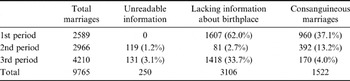
The matrimony records analysed were in reasonable storage conditions, though some had erasures, unreadable information and damaged pages due to a lack of systematic preservation. The data analysed are summarized in Table 1. Monte Santo is subdivided into more than 150 villages with an average population of 341 inhabitants per village and a range from 113 to 582 individuals. This structure promotes endogamic and consanguineous marriages because many villages were founded by family groups.
Number of marriages in Monte Santo and information about the birthplace and consanguinity for the periods analysed

First period: 1860 to 1895
From this period, 2589 weddings were analysed. This period had the most complete marriage records and most readable information on the number of marriages and detailed records of consanguinity. However, 62.0% of the records did not contain information about birthplaces of the couples.
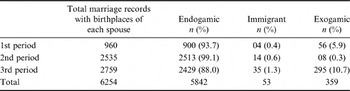
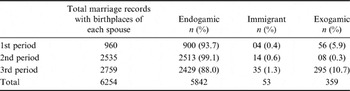
Marriages observed in the 1st period were predominantly endogamic (93.7%), and there was a high frequency of consanguineous marriages (37.1%), ranging from 4.5% to 56.5% per year. The value of F ranged from 0.000016 to 0.001831 per year, and the average F value was 0.0000646. The rates of other types of marriages were 5.9% for exogamic marriage and 0.4% for marriage between immigrants (Table 2).
Types of marriages in the different periods
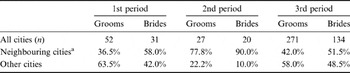
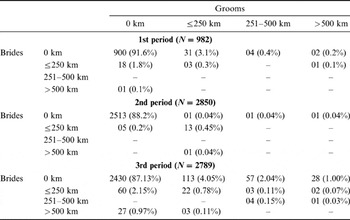
Most migrants came from neighbouring cities (44.5%) (Table 3) and were predominantly male (62.5%). The farthest origin city of a couple was the coast of Africa (5000 km) and the nearest origin city was Euclides da Cunha, BA, Brazil (40 km). Among the brides, the farthest birthplace distance was 1389 km (São João Batista, MA, Brazil) and the nearest was 71.6 km (Queimadas, BA, Brazil). The migrant grooms, whose average distance to Monte Santo was 300 km, were from eighteen different cities (three neighbouring and fifteen distant cities). For migrant brides, the average distance to Monte Santo was 158 km, and they came from seven different cities (two neighbouring and five distant cities).
Distribution of migrant spouses between cities neighbouring and distant to Monte Santo, Bahia, Brazil

a Neighbouring cities include: Serrinha, Conceição do Coité, Tucano, Araci, Itiúba, Santa Luz, Cansanção, Riachão do Jacuípe, Queimadas, Quijingue, Valente, Teofilândia, Pé de Serra, Biritinga, Barrocas, Capela do Alto Alegre, Lamarão, Nordestina, Retirolândia, Candeal, São Domingos, Nova Fátima, Ichu, Gavião.
Second period: 1950 to 1961
Although this period is short, it was chosen due to the occurrence of more consistent oral communication of MPSVI cases in the studied population. The five years before and after the first report of this disease were analysed.
The consanguineous marriage frequency was 13.2%, 61.3% of which were of 4th grade civil (first cousins) and 38.7% of which were 6th grade civil (third cousins). Most marriages were endogamic (99.1%), while only a small percentage (0.3%) were exogamic and 0.6% were marriages between immigrants (Table 2). The F value ranged from 0.000001 to 0.006594. The highest F value was found in 1952, when 98% of marriages were endogamic; of these marriages, 16% were consanguineous. The average F value for the 2nd period was 0.0000183.
The immigrants in this period were mainly from the cities bordering Monte Santo (82.9%) and were predominantly male (53.8%) (Table 3). The largest distance for the groom's origin city was from the state of Ceará (700 km), and the shortest distance was from Cansanção city (32 km). For brides, Cansanção city appears as the shortest distance of birthplace. The largest distance found for a bride was Catolé da Rocha city, Paraíba, Brazil (640 km). The migrant grooms were from eleven different municipalities (six neighbouring and five distant towns), whose average distance to Monte Santo was 146 km. For brides, the average distance to Monte Santo was 147 km, and they came from seven different cities (five neighbouring and two distant cities).
Third period: 1975 to 2010
In this period, the frequency of consanguineous marriage was 4.0%, all of which were classified as 4th or 6th grade civil at a frequency of 66.7% and 33.3%, respectively. The average F value was 0.00000433 and ranged from 0.000025 to 0.000102 per year.
The marital distance analysis (information only from 1983 to 2010) showed that of the unions, 88% were endogamic, 10.7% were exogamic and 1.3% were between immigrants.
In this period, although immigrants came from a greater number of Brazilian cities, 45.2% of them came from neighbouring cities. The nearest town of origin for both spouses was Cansanção, Bahia, Brazil (32 km), and the largest distances travelled were 2506 km (Paranavaí, Paraná, Brazil) and 2210 km (Tatuí, São Paulo, Brazil) for brides and grooms, respectively. In this period, most of the migrants were male (Table 3). For migrant grooms, the average distance to Monte Santo from their birthplace was 324 km, and they came from 76 different cities (sixteen neighbouring and 60 distant cities). For the brides, the average distance to Monte Santo from their birthplace was 481 km, and they came from 45 different cities (nine neighbouring and 36 distant cities).
Discussion
In an evaluation of population structure and marriage dynamics, it is essential to consider socioeconomic, demographic, cultural and religious factors and their influence on the evolution of a population. In this study, the lack of data on the birthplace and degree of consanguinity of couples was due to heterogeneity in the information recorded in parish books during the three periods analysed. The differences in the details of the records can be mainly attributed to the different record book models used; initially, they were free of writing and had predefined text that did not contain the place of birth. Now, standard books have more detailed information and contain information about spouses' birthplaces, place of residence, dates of birth and degree of consanguinity.
The absence of consanguinity records from the 5th grade civil marriages (second cousins) in the last period (1975–2010) is due to a change enacted in 1983 by the Catholic Church in the dispensation requirement for the relationship degree between the spouses (Agostini & Meirelles-Nasser, Reference Agostini and Meirelles-Nasser1986; Beiguelman, Reference Beiguelman1996). Currently, dispensation is only necessary for relatives at the 4th degree: in the other words, first cousins. In the 1st and 2nd periods, consanguineous marriages until the 8th grade (fifth cousins), as seen by the Catholic Church, were found and recorded. In these earlier periods, F statistics were calculated for all consanguineous marriages until 8th grade civil.
The frequency of consanguineous marriages is different for each period; consanguineous marriages were more frequent in the 1st period (37.1%), particularly in 1890 (56.5%). In the other periods, the frequencies were lower. For the 2nd period it was 13.2%, which is much higher than estimates for north-east Brazil (6 to 12%), other regions in Brazil (4.8%) (Freire-Maia, Reference Freire-Maia1954, Reference Freire-Maia1957) and worldwide (10.4%) (Bittles, Reference Bittles and Black2010). The frequency for the 3rd period (4.0%) was lower than estimates reported in the literature, but it may be underestimated because of the change in the dispensation requirement.
The frequency of consanguineous marriages was higher in the 1st and 2nd periods but lower in the 3rd period compared with the frequency reported in the literature for the general population; however, the frequency reported in this study may be underestimated because the data analysed were only from Catholic Church records and did not include informal unions or unions in other religions and civil unions. In addition, there may have been unions whose consanguinity is unknown or not reported due to a lack of mandatory dispensation for unions with consanguinity of the 5th grade.
The high frequencies of endogamic marriages (which had the highest frequency compared with the other types) and low frequencies of exogamic marriages and those between immigrants (Table 2) suggest internal population growth; the growth stems from reproduction of its inhabitants and not from the entry of individuals from other populations, which is supported by the low rate of immigration to the city and the high birth rate (15.5:1000 inhabitants) compared with the mortality rate (4.7:1000 inhabitants) (IBGE, 2010).
The growth of a population depends on three variables: birth, mortality and migration (emigration and immigration) rates (JUSTO et al., Reference Justo, Ferreira, Lima and Martins2009). Migration can influence the marriage dynamics by either reducing or increasing the occurrence of consanguineous marriage (Freire-Maia, Reference Freire-Maia1974). The low rate of migration in Monte Santo can be attributed to a lack of financial attractiveness of the city, which had a municipal human development index that ranged from 0.21 to 0.53 in 1970–2000 (IBGE, 2000). Additionally, approximately 80% of the population has a per capita income that is half of the minimum salary of Brazil (US$141,00) (IBGE, 2010).
There are many factors that determine migration, and one of the most important is difference in income (Justo et al., Reference Justo, Ferreira, Lima and Martins2009). In other words, migration is driven by financial opportunities offered by the location chosen by the migrant. In Brazil, a few studies have focused on migration between smaller geographical units and cities, mainly in north-east Brazil (Justo et al., Reference Justo, Ferreira, Lima and Martins2009). In Monte Santo, it was observed that most migrants moved on average 250 km (Table 4); therefore, even non-endogamic marriages occurred between geographically close individuals, who theoretically are genetically more similar and do not contribute to the increase in genetic variability of the city population (Freire-Maia, Reference Freire-Maia1974; Beiguelman, Reference Beiguelman1996). This perimeter includes the cities of the sisal region, where the movement of individuals is influenced by this economic activity.
Birthplace distance matrix for the spouses

The majority of migrants were men in all of the studied periods; however, the marital distance was largest for males only in the 1st period, which was possibly influenced by the presence of a migrant from the African continent. The greatest marital distance for the bride migrants was the result of male exodus and subsequent return with their brides from distant counties (Table 4). The migration flow described in the Brazilian population shows that 41% of migrants from south-east Brazil moved to north-east Brazil, and among them, some individuals were return migrants (Justo et al., Reference Justo, Ferreira, Lima and Martins2009; Amorim et al., Reference Amorim, Gontijo, Falcão-Alencar, Godinho and Toledo2011). Furthermore, the status of migrants who were children of endogamic marriages from Monte Santo born elsewhere was verified.
The distribution of the Monte Santo population in 150 villages and rural areas, the high frequency of endogamic and consanguineous marriages, the occurrence of recessive genetic diseases (MPSVI and PKU) and the low migration rate can explain the origin and maintenance of genetic diseases found in the city. In addition, characteristics of those affected by MPSVI, which is a serious illness with high mortality and a striking phenotype, may have influenced the pattern of marriages in the villages where the disease occurs, increasing the rate of endogamous marriages.
Acknowledgments
The authors thank the team of the ‘Genética no Sertão’ project who participated in field activities and expeditions to the city. The authors also thank the parish of Monte Santo, Bahia, Brazil, for providing the wedding record books for analysis and scanning. This work was supported by the Brazilian Institute of the Medical Genetics Population (INAGEMP) and the Foundation for Research Support of the State of Bahia (FAPESB).