


Introduction
Skeletonized Asteroidea are first known from the Early Ordovician, and homeomorphic configurations anticipating the exclusively post-Paleozoic crown group have been reported from diverse asteroid occurrences scattered through most of the Paleozoic. Arceoaster hintei n. gen. n. sp. provides a striking, hitherto unknown homeomorphic expression with the crown-group Goniasteridae, the latter exemplified by the familiar Cretaceous European genus Metopaster Sladen, Reference Sladen1893, as well as by a second Cretaceous goniasterid, Fomalhautia Blake and Reid, Reference Blake and Reid1998, the latter's Texas derivation comparatively close to the Oklahoma discovery site of the only known specimen of Arceoaster n. gen. Other extant goniasterids, best represented by the Pentagonasterinae (Mah, Reference Mah2007), share aspects of morphology suggestive of the three fossils, A. hintei n. gen. n. sp., Metopaster, and Fomalhautia.
The monograph of Spencer (Reference Spencer1914–1940) with the index of Owen (Reference Owen1965) provide starting background for evaluation of Paleozoic asteroids, with Schuchert (Reference Schuchert1915), Kesling (Reference Kesling1962, Reference Kesling1969), Shackleton (Reference Shackleton2005), and Blake (Reference Blake2018) contributing later perspectives; Herringshaw et al. (Reference Herringshaw, Thomas and Smith2007) and Gladwell (Reference Gladwell2018) provided important studies of the Hudsonasteridae.
Collection of specimen, geologic setting, and age
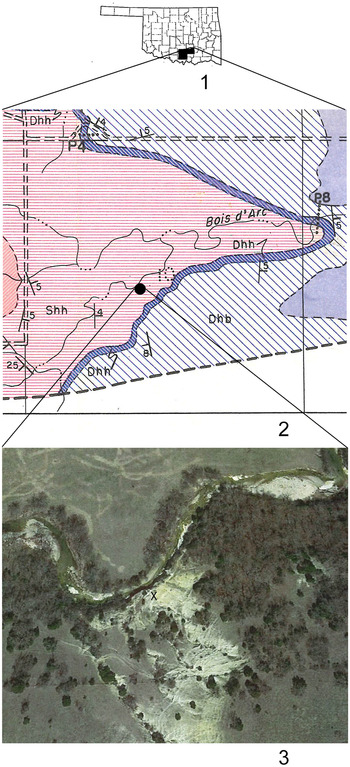
The holotype and only known specimen of Arceoaster hintei n. gen. n. sp. was collected by John Hinte on a Paleontological Society of Austin (PSA) field trip to the Arbuckle Mountains in Southern Oklahoma during April, 2019. The asteroid was found at Yellow Bluff on the lower slope of yellow-weathering marl above Bois d'Arc Creek, southern Oklahoma (Fig. 1). The locality is within the Lawrence Uplift of the northern Arbuckle Mountains. Although not listed as a numbered stratigraphic section in Amsden (Reference Amsden1960), the Yellow Bluff site is listed as Section P18 in Sutherland (Reference Sutherland1965).
Locality data for Arceoaster hintei n. gen. n. sp. (1) Outline map of Oklahoma, Arbuckle Mountains in solid black with Lawrence Uplift at northeast edge; (2) geologic map (modified from Amsden, Reference Amsden1960), section 10, T2N R6E, Lawrence Uplift, showing Bois d'Arc Creek and surrounding roads, Yellow Bluff collecting locality (black dot), Henryhouse Formation (Shh, pink) dipping below thin band of Haragan Formation (Dhh, purple) and higher units; (3) Google Earth© photograph, Yellow Bluff locality, ‘X’ marks A. hintei n. gen. n. sp. discovery site on lower marl slope.

The Hunton Group includes all of the uppermost Ordovician to Lower Devonian rock units exposed in the Arbuckle Mountains, and it is widespread in the subsurface of surrounding areas (Amsden, Reference Amsden1957, Reference Amsden1960, Reference Amsden and Broadhead1981; Amsden and Boucot, Reference Amsden and Boucot1958). Six formational units are recognized, many of which are abundantly fossiliferous shelf carbonates or mixed carbonates and fine clastics. Two formations, the Upper Silurian Henryhouse Formation of Ludlovian to Pridolian age and the overlying Lower Devonian Haragan Formation of Lochkovian age have very similar lithologies, consisting of mud-supported yellowish marl with abundant macrofossils. Because of lithologic uniformity, the precise boundary between the Silurian and Devonian strata at Yellow Bluff has not been unequivocally identified, although it must be high on the bluff or just south of the bluff based on Amsden's (Reference Amsden1960) detailed map (Fig. 1.2). Stratigraphic section P8 (Amsden, Reference Amsden1960), located ~0.6 mi. (0.9 km) ENE of Yellow Bluff (Fig. 1.2), does show a visible unconformity between the thick Henryhouse and the overlying thin Haragan, along with a distinct change in the taxa found in this nearly identical lithology, indicating a moderate time loss at this locality.
The Hunton fauna at this and nearby outcrops consists of abundant and diverse brachiopods, bryozoans, and crinoids, as well as common corals, trilobites, and ostracodes, and uncommon gastropods, nautiloids, and representatives of other groups (Witzke et al., Reference Witzke, Frest, Strimple, Gray and Boucot1979; Amsden, Reference Amsden and Broadhead1981; Frest et al., Reference Frest, Brett, Witzke, Boucot and Lawson1999). Although not commonly used for precise biostratigraphic correlation, crinoids appear to be useful for separating late Silurian and Early Devonian units of the Hunton Group. The small disparid crinoids Pisocrinus and Parapisocrinus are abundant in the Upper Silurian Henryhouse Formation, but absent from the overlying Lower Devonian Haragan Formation (Strimple, Reference Strimple1963, p. 9; Reference Strimple1975, p. 197). The lower and middle intervals of the Yellow Bluff marl slope have produced many specimens of these small pisocrinids, indicating that this part of the section is definitely Silurian Henryhouse.
In addition to abundant crinoids (especially stem segments) in the Hunton Group, other echinoderms found in the Haragan or higher formations include a small asteroid from the Lower Devonian Bois d'Arc Formation figured and tentatively assigned to Salteraster Stürtz, Reference Stürtz1893, by Hansen (Reference Hansen2009, fig. 45.3), this specimen from a quarry near Clarita, Oklahoma. Additionally, Parsley and Sumrall (Reference Parsley and Sumrall2007) reported several recumbent echinoderms from the Cravatt Member of the Lower Devonian Bois d'Arc Formation from another quarry near Clarita. This unusual fauna included four specimens and a thecal plate of the pleurocystitid rhombiferan Turgidacystis graffhami Parsley and Sumrall, Reference Parsley and Sumrall2007, a single specimen of the solute homalozoan Claritacarpus smithi Parsley and Sumrall, Reference Parsley and Sumrall2007, and a single specimen of the stylophoran homalozoan Victoriacystis aff. V. holmesorum Ruta and Jell, Reference Ruta and Jell1999, a species previously known from the Lower Devonian Humevale Formation of Victoria, Australia. Except for the new asteroid reported here, none of these other echinoderm taxa has been found in the Henryhouse Formation at Yellow Bluff or other Henryhouse localities collected by PSA club members in the past.
Late Silurian asteroids are uncommon, and a new, well-preserved genus and species with unusual morphology adds to the asteroid record for this short interval. The limited Henryhouse outcrops in the Arbuckle Mountains of southern Oklahoma are also an outlier, far away from other fossiliferous Silurian outcrops that are much more widespread in the eastern United States, such as the Rochester Shale in upstate New York and nearby Ontario, and the Waldron Shale in southern Indiana and central Tennessee. The occurrence in a soft, yellow marl is also a different lithology than these other dark and more lithified shale units, and might indicate that the depositional environment was more tropical and in shallower water than these other fossiliferous units.
Materials
Repository and institutional abbreviation
Non-vertebrate Paleontological Laboratory (NPL), Jackson School of Geosciences, University of Texas at Austin, holotype NPL 93361.
The single available specimen, holotype NPL 93361, is nearly free of sediment and exposes all surfaces; it suffered some minor distortion, outcrop weathering, and ossicular displacement, but no breakage prior to collection. Ambulacral ossicles are not exposed, and only the ventral surfaces of the adambulacrals are available. The specimen is small, arm radii as preserved ranging between ~7 mm and 10 mm, disk radii between ~5 mm and 7 mm. Many granules remain on the specimen surface, a more extensive granular layer deemed probable in life. A few spinelets remain on the adambulacrals.
Systematic paleontology
Terminology
Terminological usage follows Spencer and Wright (Reference Spencer, Wright and Moore1966).
Class Asteroidea de Blainville, Reference Blainville1830
Order Hadrosida Blake, Reference Blake2018
Remarks
Ordinal assignments of Blake (Reference Blake2018) were based on construction of the ambulacral column, which is not available for Arceoaster n. gen. The genus, however, is readily referred to the Hudsonasteridae (see below), the family assigned to the order Hadrosida.
Family Hudsonasteridae Schuchert, Reference Schuchert1914
Diagnosis
Generally relatively small, robustly constructed hadrosidans. Disk size moderate, dorsum low arched, interbrachial narrowly to moderately rounded; arms short to moderate in length, margins curved. Dorsal skeleton consisting of a carinal series and a well-defined medial primary circlet. Scattered smaller abactinals can occur on arms, but distinct series lateral to carinals not developed. Dorsal disk ossicles can be significantly enlarged. Ossicles within primary circlet relatively few, proportionately enlarged. Madreporite where recognized at primary circlet. Marginal ossicles in two series, ossicles robust; intermarginals not developed. Axillary small to enlarged relative to adjacent inferomarginals; axillary shape varied, reaching disk margin in most species. A small internal apparent odontophore can accompany the external axillary. Actinals lacking from most specimens. Podial basins in two rows; podial pores unknown. Ossicles pustular; granules, spinelets present. Adambulacrals relatively narrow, not forming ventral-abradial arm margin; adambulacrals more numerous to much more numerous than marginals. Neither sunken actinostome nor adoral carina developed. Adjacent pair of MAO abutted to form bud-like configuration around mouth; a torus can occur with each MAO pair.
Remarks
The Hudsonasteridae is comprised of characteristically small Ordovician to Devonian asteroids of comparatively simple construction, which is paralleled by immature specimens of various species of all ages, but also by adults, for example, of extant Tamaria Gray, Reference Gray1840 (see Downey, Reference Downey1971). The name ‘Hudsonaster’ was coined by Stürtz (Reference Stürtz1900) and the familial name is from Schuchert (Reference Schuchert1914). Fundamental treatments of the family include Spencer (Reference Spencer1914) and Schuchert (Reference Schuchert1915); Spencer (Reference Spencer1916) added to the generic listing of the Hudsonasteridae and accepted nearly all of Schuchert's diagnosis. Herringshaw et al. (Reference Herringshaw, Thomas and Smith2007) provided a valuable review of the family and that contribution together with perspectives of Shackleton (Reference Shackleton2005) and Gladwell (Reference Gladwell2018) were important to interpretations of Blake (Reference Blake2018), and retained here.
The ordinal configuration of Paleozoic Asteroidea of Blake (Reference Blake2018) relied on ambulacral column interior construction, which is not available for Arceoaster n. gen. The authors explored a CT–scan option for internal ambulacral furrow evaluation, but technicians were unsure of this approach because of small specimen size and fragility, and because of the mineralogical similarity between any internal marl matrix and the skeleton.
Genus Arceoaster new genus
Type species
Arceoaster hintei n. gen. n. sp., only species, from the late Silurian of southern Oklahoma.
Diagnosis
As for the type species, by monotypy.
Etymology
Latin, arceo, shut in, prevent access to, guard, in reference to the fortress-like construction, including a sturdy marginal frame and the ability to close the ambulacral furrow during life; and aster, star.
Holotype and only known specimen
NPL 93361
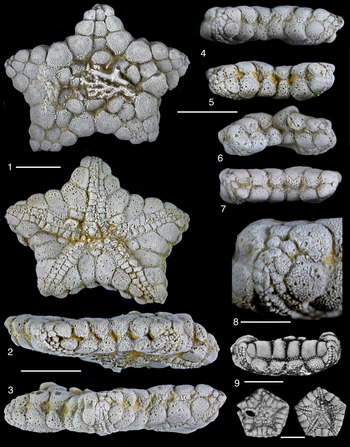
(1–8), Arceoaster hintei n. gen. n. sp., holotype and only-known specimen, NPL 93361; Henryhouse Formation, Upper Silurian, southern Oklahoma. (1) Specimen in dorsal and ventral aspects; bryozoan fragments obscure dorsal central disk; (2) ‘south’ interbrachium of (1), here and below, images stacked to show full width; (3) ‘north’ arm tip of (1); (4) ‘northwest’ interbrachium of (1); (5) ‘northeast’ interbrachium of (1); (6) ‘southeast’ interbrachium of (1), one superomarginal deflected to show part of interossicular tissue pad, the closely fitted marginals do not indicate rigidity in life; (7) ‘southwest’ interbrachium of (1); (8) left arm tip of (4), carinal series extends to terminal and onset of adambulacral series, ossicular addition as crown-group Fomalhautia; (9) Fomalhautia hortensae (Adkins and Winton, Reference Adkins and Winton1920), lateral (above), dorsal, and ventral views showing overall form, granular ornament, depressed central areas similar to those of Arceoaster n. gen.; arm tip curvature in both genera allows extension of terminal sensory tube feet into the water column. (1–7, 9) Scale bars = 5 mm; (8) scale bar = 2 mm.

Diagnosis
Hudsonasterid of low cross-sectional profile (i.e., disk, arms not arched). Arms produced but short, broad at bases, tapering fairly abruptly. Marginal ossicles comparatively few, robust, reduction in ossicular sizes away from disk uniform and gradational. Intermarginal pit-like reentrants present between ossicles of two series. Axillary small, polygonal, deeply enclosed by proximal inferomarginals and displaced from disk margin. Accessory granules abundant, locally differentiated.
Occurrence
Henryhouse Formation (Upper Silurian, Ludlovian to Pridolian Stage), lower Hunton Group, the lower marl slope at Yellow Bluff above Bois d'Arc Creek, NE NE SE, sec. 10, T2N R6E, Ahloso 7.5’ Quadrangle, Lawrence Uplift, northern Arbuckle Mountains, Pontotoc County, southern Oklahoma.
Description
Hudsonasterid, overall cross-section subrectangular, not arched; overall outline subpentagonal; arms short, abruptly tapering, tips rounded, interbrachial arcs rounded. Disk outer ring of 10 ossicles; first radial largest, ossicular outlines subelliptical, margins rounded, separated by slightly smaller, irregular, elongate ossicles; madreporite not identified. Ossicles within outer ring obscured; central area quite large, visible ossicles quite small. Carinal series in line with primary radials. Three larger carinal ossicles in each ray; one small ossicle contacts terminal; ossicular outlines square to elongate parallel to arm axis. No abactinal ossicles present between carinal series and superomarginals.
Marginals in two series, inferomarginal and superomarginal, each series from arm tip to arm tip having six larger ossicles, ossicular sizes diminishing significantly with each more distal ossicle; very small distal marginals occur at arm tip (Fig. 2.8). Superomarginal surfaces more or less planar, evenly rounded at disk edge. Superomarginals nearly aligned with inferomarginals both vertically and at abradial margins, neither series extending laterally beyond other. Junctures of four marginals, two superomarginals, and two inferomarginals, marked by pit-like reentrant. Inferomarginal expression similar to superomarginal, three larger ossicles diminishing significantly in size with each more distal ossicle. Inferomarginal breadth decreasing markedly from wide, polygonal disk ossicle; arm ossicles oblique, outlines square to subrectangular. Axillary proportionately small, separated from disk edge by enlarged proximal inferomarginal pair; axillary probably immediately adjacent to (unexposed) mouth frame. Axillary outlines varying somewhat from interbrachium to interbrachium. Actinals lacking.
Ambulacrals not exposed, mouth angle ossicles obscured. Adambulacrals approximately rectangular in outline, width about twice length, diminishing evenly in size distally; adambulacrals 15 or more in each arm, significantly exceeding marginal number. Spinelets on adambulacrals small, uniform; no apparent enlarged spine bases. Ossicles beyond adambulacrals bearing uniform granular surface, granules weakly spaced, not abutted; scattered pits, especially on ventral face thought to represent positions of lost granules. Remaining granules on dorsal surface approximately three times larger on sutures between ossicles and toward central portion of disk than on ossicular surfaces; ventral granules small on ossicular surfaces, those of sutures, adambulacrals two to three times larger than those on adjacent surfaces.
Etymology
Named for John Hinte, Austin, Texas, who discovered the only known specimen on a PSA field trip, and donated it to the NPL.
Remarks
Because only a single specimen of A. hintei n. gen. n. sp. is available, it is emphasized that the largest physical size attained by this species cannot be established with finality. Significant ontogenetic change within Paleozoic asteroids based on a large specimen suite has been described (Blake and Koniecki, Reference Blake and Koniecki2020), but perhaps most striking of known changes accompanying growth are those of extant Culcita Agassiz, Reference Agassiz1836. Clark (Reference Clark1946, p. 108) pointed out that small individuals of Culcita differ so significantly from the large that “they have been described under three other generic names.” For A. hintei n. gen. n. sp., it is noted that larger specimens or specimen fragments have not be recovered from the heavily collected type locality; additionally, many species of both Hudsonaster and Cretaceous Metopaster are small, and to the extent similarities within taxa, including known intraspecific size ranges, are indicative of adaptive limitations, interpretation of Arceoaster n. gen. as of approximately mature species size is deemed reasonable.
As compared to typical genera of Paleozoic Asteroidea, Arceoaster hintei n. gen. n. sp. is unusual in proportions, the arms of the new genus are comparatively short, and as is common in asteroids with short arms, the interbrachia are comparatively broadly rounded. Because of furrow closure and foreign debris, central disk characters, including possible presence of a madreporite, are largely unavailable, although the first ossicles of the midarm series are exposed. The axillary of Arceoaster n. gen. is very small and deeply enclosed by the proximal inferomarginal ossicles. Raymond (Reference Raymond1921) sought to differentiate hudsonasterid genera based on axillary shape, but the approach has not been followed for hudsonasterids, probably largely because of lack of adequate sample sizes; nevertheless, the small size and positioning of the Arceoaster n. gen. axillary is an important defining character.
The unequal outline of the only known specimen of Arceoaster n. gen. is suggestive of the 2-1-2 mouth-frame configuration of Paleozoic blastozoans and edrioasteroids (Sprinkle, Reference Sprinkle1973), which is tantalizing because of the suggestion by Schuchert (Reference Schuchert1915) that Hudsonaster is stemward among asteroids, thereby perhaps favoring a plesiomorphic condition. Mouth-frame construction is not known for Arceoaster n. gen., but no other known asterozoan has any suggestion of a 2-1-2 configuration. Most likely, the unequal outline results from post-mortem deformational events, but also, or alternatively, shape might reflect early life trauma followed by partial healing; either hypothesis might be tested by recovery of additional specimens.
The Wenlock Limestone Doliaster Herringshaw et al., Reference Herringshaw, Thomas and Smith2007, like Arceoaster n. gen., is small with short, abruptly tapering arms, and like Arceoaster n. gen., Doliaster is known from a single small specimen, the two similar enough in size as to readily enable comparisons. The two genera differ in marginal ossicular shapes and proportions, the proximal-most superomarginals of Doliaster enlarged and barrel-shaped with marginal size diminishing abruptly on the arms; the inferomarginals are of proportionately reduced width (Herringshaw et al., Reference Herringshaw, Thomas and Smith2007, figs. 2C, 2F, 3B); marginal ossicles of Arceoaster n. gen. are of comparatively uniform proportions. Herringshaw et al. (2007, p. 1216) expressed ‘some uncertainty’ as to familial assignment, but emphasized body wall ossicular configuration; like Arceoaster n. gen., arm shape favors a hadrosidan assignment. Late Silurian Coccaster Spencer, Reference Spencer1916, differs from Arceoaster n. gen. in presence of more elongate arms with angular interbrachial angles, presence of much-enlarged primary radials, and presence of enlarged axillaries that edge the disk margin (Gladwell, Reference Gladwell2018, p. 8). Late Ordovician Girvanaster Spencer, Reference Spencer1916, has much-enlarged first superomarginals with centrally directed projections and much-enlarged axillary ossicles (Spencer and Wright, Reference Spencer, Wright and Moore1966; Shackleton, Reference Shackleton2005).
The traditional assignment of Siluraster Jaekel, Reference Jaekel1903 has been to the Hudsonasteridae, whereas Blake (Reference Blake2018) transferred the genus to the euaxosidan Palasterinidae based on ambulacral expression. Spencer and Wright (Reference Spencer, Wright and Moore1966, p. U51) proposed a monogeneric subfamily for Siluraster based on presence of intermediate ossicles between the midarm series and the superomarginals (documented by Shackleton, Reference Shackleton2005, pl. 6.8), whereas absence of intermediate ossicles and space available within the enlarged marginal series dictates a vaulted ambulacral positioning and a hadrosidan assignment for Arceoaster n. gen.
Reported occurrences of the Hudsonasteridae are largely restricted to North America and Europe. The essential body-wall hudsonasterid configuration, however, also has been described from the Australian Silurian (Withers and Keble, Reference Withers and Keble1934), but these specimens are small and not well preserved; restudy is needed.
Arceoaster n. gen. differs from Hudsonaster most strikingly in overall form, the latter arched with proportionately more elongate arms and narrowly rounded interbrachial margins. Ossicular positioning of Arceoaster n. gen. indicates a relatively low cross-section with arms proportionately short. Arceoaster n. gen. is small, and marginal ossicles are robust and comparatively few, with three larger and a single smaller in each arm radius of 7–10 mm. In contrast, 10 superomarginals are present in a Devonian Hudsonaster of arm radius of 4.5 mm (Cramer, Reference Cramer1959), and seven inferomarginals in 5 mm of an incomplete arm of another Devonian exemplar (Webster et al., Reference Webster, Hafley, Blake and Glass1999). Small pit-like indentations between marginal ossicles are found in Arceoaster n. gen., but have not been reported in other hudsonasterids. Similar pitting occurs in an extant species of the Goniasteridae (Mah, Reference Mah2007, fig. 3); however, functional significance of the pitting is unknown.
Homeomorphy of Arceoaster hintei n. gen. n. sp
The crown-group family Goniasteridae encompasses genera ranging in body outline from those that are close to pentagonal (e.g., Cermaster Verrill, Reference Verrill1899) to others in which arms are highly elongate and attenuated, with superomarginal ossicles abutted at the arm midline from near the edge of the disk to the arm tips (e.g., Lithosoma Fisher, Reference Fisher1911; see also Fisher, Reference Fisher1919). Late Silurian Arceoaster hintei n. gen. n. sp. is a striking homeomorph of one goniasterid configuration, that of the Cenomanian through Miocene Metopaster Sladen, Reference Sladen1893. Metopaster has been reported largely from European occurrences, but also from North America and New Zealand (Breton, Reference Breton1992, p. 106), although a cautious generic distribution summary (Breton and Néraudeau, Reference Breton and Néraudeau2008, p. 331) suggests the latter citations might be in need of further evaluation. Metopaster Sladen, Reference Sladen1893, has been widely treated in the literature, references including Brünnich-Nielsen (Reference Brünnich-Nielsen1943), Rasmussen (Reference Rasmussen1950), Schulz and Weitschat (Reference Schulz and Weitschat1971, Reference Schulz and Weitschat1975), Gale (Reference Gale1986), Jagt (Reference Jagt2000), and most comprehensively, Breton (Reference Breton1992, Reference Breton1997). Albian Formalhautia Blake and Reid, Reference Blake and Reid1998 (Fig. 2.9) is a second Cretaceous goniasterid that is homeomorphic with Silurian Arceoaster hintei n. gen. n. sp., the three similar in overall form, presence of a pentagonal outline framed by comparatively few robust superomarginal and inferomarginal ossicles, presence of an ambulacral furrow configuration capable of tight closure in life, and apparent small size. Fomalhautia was described from Texas, a source much closer to the Oklahoma occurrence of the single known specimen of A. hintei n. gen. n. sp.
Aspects of overall homeomorphy among A. hintei n. gen. n. sp., Metopaster, and Formalhautia extend in part to other crown-group goniasterids (e.g., Mah, Reference Mah2007), which collectively raise issues of possible direct phylogenetic linkage between the Silurian A. hintei n. gen. n. sp. and later Goniasteridae, the latter first recognized from Jurassic occurrences. Possible direct phylogenetic linkage takes on some added concern because more traditional earlier views assigned Paleozoic and younger asteroids to surviving ordinal-level taxa (e.g., Spencer and Wright, Reference Spencer, Wright and Moore1966, fig. 38), these interpretations subsequently debated (e.g., Villier et al., Reference Villier, Brayard, Bylund, Jenks, Escarguel, Olivier, Stephen, Vennin and Fara2017; Blake, Reference Blake2018).
Arceoaster hintei n. gen. n. sp. is readily assigned to the Paleozoic Hudsonasteridae rather than the post-Paleozoic Goniasteridae based on the distinctive arrangement of the skeleton above the superomarginals, including presence of relatively few abactinal ossicles and a well-defined arm midline carinal series, and based on presence of a so-called axillary ossicle at the convergence of inferomarginal series and adjacent to the mouth-angle ossicles. As typical among Paleozoic asteroids, accessory ossicles are comparatively simple in A. hintei n. gen. n. sp., but much more complexly differentiated in later Goniasteridae.
A striking feature of both A. hintei n. gen. n. sp. and many goniasterids, including Metopaster, is the double, enlarged marginal series. Adjacent ossicles of the two series are not closely paired in Metopaster, and distal superomarginals can be differentially enlarged in both Metopaster and some extant Pentagonasteridae (Mah, Reference Mah2007). Although configurations of arm tips of the A. hintei n. gen. n. sp. specimen suggests some irregularity, the marginal differentiation found in the younger taxa is not in evidence. Marginal ossicles of species of Metopaster are edged by a depressed margin, which is lacking from Arceoaster n. gen., and the intermarginal pit-like reentrants of A. hintei n. gen. n. sp. are not found in Metopaster. Formalhautia shares aspects of morphology with A. hintei n. gen. n. sp. that are not found in Metopaster. Marginal ossicles are bulbous and surface texture uniform in Formalhautia, marginal surfaces granulate, and the ultimate superomarginal is not enlarged relative to the immediately adjacent more proximal superomarginal.
Likely because the known fossil record of Metopaster is dominated by occurrences of marginal ossicles, the dorsal skeleton of abactinal ossicles within the superomarginal series has received limited exemplification, but Metopaster appearance was extensively documented with the many careful and detailed reconstructions of Sladen (Reference Sladen1893). Abactinal expression is quite uniform among species of Metopaster, consisting of proportionately large areas of many plate-like abactinals, whereas only few such ossicles are found in the small dorsal field of A. hintei n. gen. n. sp. Although incompletely known, abactinals of Formalhautia are comparatively few and appear to have been arranged in well-defined series.
Functional morphology and the selective demands leading to homeomorphy between the Silurian and younger genera ultimately remains unknown; however, among extant asteroids, Blake (Reference Blake1983, Reference Blake1990) proposed a notion of a unifying ‘defensive’ life strategy for broadly comparable robustly constructed skeletal configurations.
Acknowledgments
We thank M. Hill, Fitzhugh, OK, for permission to collect fossils on his property, J. Hinte for collecting the holotype of A. hintei n. gen. n. sp. and donating it to the NPL, E. Elliot, former Paleontological Society of Austin Field Trip Chairman, for arranging and leading the field trip to Oklahoma and for aid in determining the exact location of Yellow Bluff, and L. Boucher and L. Appleton, NPL, for help with photography and illustrations. F.H.C. Hotchkiss and two anonymous reviewers provided many useful suggestions, and S. Zamora provided editorial assistance. We are indebted to all.