INTRODUCTION
This study investigates narrative development from a multimodal perspective of a less-studied language, Zulu, a Bantu language spoken in South Africa, and compares this development to a Romance language, French. We explore similarities and differences of narrative ability from (i) a developmental and (ii) a cross-linguistic perspective in a comparison of these linguistically non-related languages.
Most literature on the development of pragmatic ability usually investigates one modality – speech. Several studies have shown evidence that during face-to-face and verbal communication, a speaker or listener integrates information from both auditory and visual sources into a single message (Beattie, Reference Beattie2004; Beattie & Shovelton, Reference Beattie and Shovelton2002; Kendon, Reference Kendon and Key1980, Reference Kendon2004; Kita & Özyürek, Reference Kita and Özyürek2003, McNeill, Reference McNeill1992). Oral narrative performance includes auditory (linguistic signals and prosody) and visual (gesture) information. However, the way that people integrate speech and gesture into their narrative behaviour is highly dependent on language and culture (Colletta et al., Reference Colletta, Guidetti, Capirci, Cristilli, Demir, Kunene Nicolas and Levine2015).
The oral narrative from a multimodal perspective
Speakers usually organize experiences and memories of human happenings in the form of a narrative (Berman, Reference Berman2008; Bruner, Reference Bruner1991; Peterson & McCabe, Reference Peterson, McCabe, McCabe and Peterson1991). The narrative format is conventional, culturally transmitted, and restricted by each individual user's level of mastery. Fayol (Reference Fayol1997) explains that from a cognitive perspective in order to understand a narrative, a listener must construct a mental model of a situation to facilitate comprehension of that situation. In terms of language production, the construction of an original story is a complex and demanding process involving planning and organizing ideas beyond the sentence level as well as self-regulation of formulation and presuppositional capacities, i.e., pragmatic skills (Hadley & Schuele, Reference Hadley and Schuele1998; Moonsamy, Jordaan & Greenop, Reference Moonsamy, Jordaan and Greenop2009). Thus, to narrate a story requires the integration of several abilities. In addition to linguistic difficulties, it presents a more cognitive challenge of developing the contents in hierarchically ordered sequential structures.
Available research on narrative abilities mainly focuses on one dimension, the verbal dimension (oral or written), and the dimension of gesture is yet to be included to produce a better understanding of the contextualization of language knowledge and development. Over the past thirty years, research on gesture and its relation to speech points to the multimodal nature of language (Calbris, Reference Calbris2011; Kendon, Reference Kendon and Key1980; McNeill, Reference McNeill1992). Daily human communication is mediated by a constant and intertwined flow of auditory speech signals and visual–kinesic gesture signals.
Whilst there is no consensus of what could be a ‘universal’ classification of gestures (for examples see Guidetti, Fibigerova & Colletta, Reference Guidetti, Fibigerova, Colletta, Seyfeddinipur and Gullberg2014), the one proposed by McNeill (Reference McNeill1992, Reference McNeill2012) is a heuristic one. Speakers spontaneously produce gestures that are directly linked to speech and the verbal message content. Co-speech gestures appear to have multiple functions: on the one hand, they convey information to the interlocutor (Alibali, Kita & Young, Reference Alibali, Kita and Young2000; Goldin-Meadow & Butcher, Reference Goldin-Meadow, Butcher and Kita2003; Kendon, Reference Kendon and Key1980, Reference Kendon2004; McNeill, Reference McNeill1992), and on the other hand, they seem to fulfil some cognitive functions; i.e., some studies suggest that gestures also serve a purpose for speakers to access the mental lexicon in spontaneous speech (de Ruiter, Reference De Ruiter2007; Krauss, Chen & Chawla, Reference Krauss, Chen, Chawla and Zanna1996). Some referential gestures (pointing and representational gestures) are used to indicate the referent and represent objects and ideas (Alibali et al., Reference Alibali, Kita and Young2000; McNeill, Reference McNeill1992). Other ‘pragmatic’ gestures help the speaker express his/her immediate intentions, mental states, and feelings (Kendon, Reference Kendon2004). They help frame the utterance by expressing its illocutionary force. They also help to structure the discourse production at various levels from sentence components, such as the syllable or word, to discourse components, such as the thesis and its arguments, or when retelling and commenting during a narrative (see Kendon, Reference Kendon2004, for a comprehensive review of the functions of gesture). All in all, research on gesture has demonstrated the multimodal nature of face-to-face and verbal communication. A speaker or listener integrates auditory and acoustic (linguistic, prosodic) and visual (gesture) information into a single message (Beattie, Reference Beattie2004; Beattie & Shovelton, Reference Beattie and Shovelton2002; Kendon, Reference Kendon and Key1980, Reference Kendon2004; Kita & Özyürek, Reference Kita and Özyürek2003; McNeill, Reference McNeill1992).
Due to their functional polyvalence, co-speech gestures play a large part in the communicative process (Colletta, Reference Colletta2004; Kendon, Reference Kendon2004; McNeill, Reference McNeill1992). The speaker has the opportunity to re-enact, to recount, and to comment while using the correct linguistic devices to ensure coherence and cohesion. For instance, depending on the discourse context, gesticulation can substitute for the verbal message, modulate it, or make it more precise. In a narrative, gesture takes the role of ‘voice’ (i.e., narrative focus) and can thus determine the perspective and level of narration. Gesture has the capacity to highlight what is important in the context of discourse and what is not.
Gesture and speech in narrative development
Consequently, being competent in a narrative requires knowledge of the structural syntactic and semantic properties of that language at the sentential level, as well as knowledge of the pragmatic properties of well-formed discourse (Hickmann, Reference Hickmann2003). The ability to produce coherent narrative texts develops in parallel with the increase in cognitive and linguistic skills of the child (Berman, Reference Berman2004, Reference Berman2008; Berman & Slobin, Reference Berman and Slobin1994). For instance, children younger than five years rarely produce causal chain sequences; rather, they produce script-like stories, i.e., short prototypical action sequences such as the ones children spontaneously act in free play (mummy feeding baby, teacher teaching child, doctor nursing patient, etc.). Older children start to verbalize chained sequences of actions as they appear in the event or story they recount; yet they merely juxtapose facts until the age of nine to ten years (Fayol, Reference Fayol1997). Considering the pragmatic heterogeneity of oral narratives (Labov, Reference Labov1978; Laforest, Reference Laforest1996; McNeill, Reference McNeill1992), telling a story also involves backtracking in the event frame. For example, when retelling a complex event, the narrator may not follow the order of events as they originally appeared and may have to mark every break he is making in the narrative thread during narration. Moreover, narrating can be viewed as a complex discourse behaviour involving ‘metadiscourse’ in the form of personal commentary (explicitation, explanation, and evaluation in the form of personal judgement (Labov, Reference Labov1978; Laforest, Reference Laforest1996; Peterson & McCabe, Reference Peterson, McCabe, McCabe and Peterson1991). In this way, a narrator can incorporate his/her own experience shaped by his/her social and cultural experience, as well as other factors such as literacy.
By the age of ten, the child has not yet fully acquired complex discursive skills such as organizing text on both the ‘narrative’ level and the ‘metadiscourse’, i.e., ‘meta-narrative’ and ‘para-narrative’ levels (Colletta, Reference Colletta2004; McNeill, Reference McNeill1992). Here the narrative level refers to the account of events while the meta-narrative level refers to structuring the story during its narration by the speaker and the para-narrative level refers to the inclusion of personal experience and references linking the narrators to their narratives. Becoming a competent narrator is a prolonged process that extends into the school years due to the multiple, embedded demands which include (i) the mastery of different skills in the cognitive domain (Karmiloff-Smith, Reference Karmiloff-Smith1985) and (ii) knowing about the specific devices each language has “in order to regulate the distinction between new and given information” (Carmiol & Sparks, Reference Carmiol, Sparks and Matthews2014, p. 280).
As they develop their narrative skills, children are faced with several challenges, such as having to produce coherent, cohesive (structured) units of extended discourse; they need to understand that their audience may not share the same knowledge about the events they themselves are speaking about; and children also have to incorporate the possibility that the listener may not interpret the events that are being told in the same way (Hymes, Reference Hymes1972; Ninio & Snow, Reference Ninio and Snow1996). Therefore, the path from becoming a native speaker to a proficient speaker of any given language is a long developmental trajectory (Berman, Reference Berman2004, Reference Berman2008; Berman & Slobin, Reference Berman and Slobin1994; Hickmann, Reference Hickmann2003), and children in primary school would not be expected to have completed the process from emergence to mastery. Most of the literature on the role of gestures and speech focuses either on the early acquisition period from birth to three years old (see Capirci, Iverson, Pizzuto & Volterra, Reference Capirci, Iverson, Pizzuto and Volterra1996; Goldin-Meadow & Butcher, Reference Goldin-Meadow, Butcher and Kita2003; Guidetti, Reference Guidetti2002, Reference Guidetti2005) or on adults (Beattie, Reference Beattie2004; Kendon, Reference Kendon2004; Kita & Özyürek, Reference Kita and Özyürek2003, 2007; Loehr, Reference Loehr2004). Studying the role of gesture in the early acquisition period and the adult competency does not inform us on the development of co-speech gesture, which happens to occur gradually and developmentally. However, some studies (Colletta, Reference Colletta2004; Colletta, Pellenq & Guidetti, Reference Colletta, Pellenq and Guidetti2010; Graziano, Reference Graziano2009; Kunene, Reference Kunene2010) have shown that the production of gesture develops with age: the older the child, the more gesture becomes varied and specialized during discourse as it gradually becomes similar to adult usage.
Cross-linguistic research on oral narratives
There is little or no literature that explores the development of narrative ability in Zulu- speaking children. Current and existing literature on South African Bantu languages focuses on various aspects of linguistic competency, such as the acquisition of the passive construction (Demuth, Reference Demuth and Meisel1992; Suzman, Reference Suzman1991) or the acquisition of the noun class system (Gxilishe, Reference Gxilishe2008) in early language acquisition (until the age of about four years).
Current literature on gesture and narrative development focuses mostly on Romance and Germanic languages, Japanese, and Turkish (Colletta, Reference Colletta2004; Graziano, Reference Graziano2009; Kita & Özyürek, Reference Kita, Özyürek, Duncan, Cassell and Levy2007), so that there is little or no information on gesture development in any African language, including the Bantu language family. This lack of literature motivated the present study.
Several studies have shown that culture places limitations on language forms in many aspects, such as the conventionalized forms of interpersonal interaction and the use and form of speech acts (Gumperz, Reference Gumperz1982; Saville-Troike, Reference Saville-Troike1982). Consequently, in order to use language competently, children have to use the semantic, syntactic, and pragmatic conventions of their communities for social interactions (Carmiol & Sparks, Reference Carmiol, Sparks and Matthews2014). Culture also shapes non-verbal aspects of communication, including ritualized acts (Loehr, Reference Loehr2004), the use of facial expressions (Ekman & Friesen, Reference Ekman and Friesen1969), conventional gestural forms (Brookes, Reference Brookes2001, Reference Brookes2004; Kendon, Reference Kendon2004; Morris, Reference Morris1994), and co-speech gestures (Allen et al., Reference Allen, Özyürek, Kita, Brown, Furman, Ishizuka and Fujii2007; Kendon, Reference Kendon2004; Kita, Reference Kita2009; Kita & Özyürek, Reference Kita, Özyürek, Duncan, Cassell and Levy2007; McNeill, Reference McNeill2000), as well as semantic distinctions in placement verbs depending on the language (Gullberg & Narasimhan, Reference Gullberg and Narasimhan2010). For example, Kendon (Reference Kendon1995, Reference Kendon2004) compared Neapolitan gesture and British gesture practices in which he examined the Neapolitan's preference for using gestures more frequently than the British, as well as using them as an exclusive mode of communication. The strong implication is that through socialization, a child acquires and masters these non-verbal resources along with the verbal in ways that are acceptable in their society.
In a related study by Colletta and colleagues (2015), the authors compared speech and co-speech gestures observed using a narrative retelling task in three different language groups: French, American English, and Italian. Their findings showed that the French children produced longer narratives, while the Italian children gestured more than their French and American counterparts. However, despite other minor differences, the results showed a common developmental trend between the three language groups. In all three languages, older children were found to give more detailed narratives than their younger counterparts: they inserted more comments, tended to gesture more, and used different gestures – specifically, gestures that contribute to the narrative structure. Taken together, the findings helped the authors propose a tentative model of multimodal narrative development in which major changes in later language acquisition occur despite differences in language and culture.
The narrative in Zulu and French
Zulu is an agglutinative polymorphemic language, that is, a language with affixes attached to the root or core of the word and a complex nominal class system (Pretorius & Bosch, Reference Pretorius and Bosch2009). French is a Romance language, and, unlike Zulu, it is an analytic language. French grammar is characterized by a two-way gender distinction: masculine or feminine. In terms of syntactic differences, French requires an explicit subject, whereas Zulu is a null-subject (or pro-drop) language, such as Italian and Spanish, and does not require an explicit subject once the referent has been introduced initially. Does this linguistic feature have an effect on the production of co-speech? Several studies report a higher frequency in the production of representational gestures that seem to disambiguate reference, and to compensate for the absence of explicit anaphora or for an erroneous use of anaphora (Cristilli, Capirci & Graziano, Reference Cristilli, Capirci and Graziano2010; Yoshioka, Reference Yoshioka2008)
The cultural aspects are not the main focal point of this study; however, it is not easy to divorce the manner in which narratives are produced in an oral culture compared with a written culture, as this informs on the narrative strategy a speaker uses. It is important to give a brief overview of the cultural aspects that have a direct link with the narrative performance in this study. Zulu is a language with a long oral tradition that only became a written language in the nineteenth century. Information, culture, and education were transmitted through oral narratives and performance (Groenewald, Reference Groenewald2003; Ramaila, Reference Ramaila2005). The oral tradition is still present, and story-telling plays a very important role in Zulu culture. Children hear tales from their caregivers before going to bed as well as during the day. Suzman (Reference Suzman1991, p. 31) noted “distinctive features of adults speech style in talking to children … were found primarily on the discourse level” amongst the Zulu participants of her study. Oral folklore requires a participative audience, and the story-teller mimics roles to allow the tale to be as imagistic and realistic as possible. This tradition, also shared by other Bantu cultures, can be traced to contemporary South Africa. Oration is still a complex system in which long-term wisdom is transmitted through dramatized, narrated, and sung folklore to children from the early stages of their development (Ramaila, Reference Ramaila2005).
The French language, on the other hand, has a long written history that dates back to the fifteenth century. As the written mode has existed for a long time, reliance on oral story-telling is far less important than for an oral tradition language such as Zulu. In contrast to Zulu society, in most instances when French children go to bed at night, their caregivers will read them a story from a picture-book. The culture of la lecture partagée is favoured especially in middle-class families. Reading a child a night-time story from a book is highly preferred, not only for the images that are pleasing to children, but also to prepare the child for entry to the world of reading and writing (Frier, Reference Frier, Frier, Grossmann and Pons2006). Teachers who narrate from a book mostly concentrate on reading and on showing, as well as commenting on the book's pictures (Grossmann, Reference Grossmann and Grossman1996); few of them actually give an oral narration comparable to story-telling performance in Bantu and other orature-based cultures.
As a result of these differences in cultural practices, narrative production should exhibit culture-specific patterns (Hendriks, Reference Hendriks2005; Hickmann, Reference Hickmann2003).
Aims of the present study
The present study represents the first analysis of Zulu narratives from a multimodal perspective. This investigation seeks first to document differences between children's narratives and adults' narratives among Zulu participants, and second, to ascertain whether the developmental trend found in French, and reported in the above-mentioned studies, also applies to the Zulu language. This comparative study of oral narrative performance in Zulu and French investigates the way linguistic constraints and cultural expectations shape multimodal language behaviour and multimodal narrative development.
Hypotheses and expected outcomes
We hypothesize that for both language groups, (i) in regard to development, narratives will get longer and more complex with age on the pragmatic level, and (ii) with age, there will be increased gesture use, and amongst these gestures we expect to observe more cohesive and framing gestures. These expectations are based on previous results on narratives produced by children and adults (Colletta et al., Reference Colletta, Pellenq and Guidetti2010, Reference Colletta, Guidetti, Capirci, Cristilli, Demir, Kunene Nicolas and Levine2015). We also expect to find a similar developmental trajectory in both language groups, which would confirm the developmental pattern of textual and monologic abilities (Berman, Reference Berman2004; Berman & Slobin, Reference Berman and Slobin1994).
From a cross-linguistic perspective, as a result of oral culture (mentioned above), we expect Zulu children to deliver longer, hence more detailed, accounts of the story than French children. In gestural production, we expect to see more gestures in the Zulu narratives compared to the French narratives: the longer and more detailed the verbal narrative, the more co-speech gestures would be present in the narrative performance.
In the type of gestural production, we expect to see more representational gestures (which are a part of referential gestures as explained above) in the Zulu narratives compared with French, because of linguistic differences. In Zulu, due to its agglutinative nature, the role of chronological connectives has a double function: that of cohesion and coherence (linking clauses), as well as for reference tracking. Given the inter-relationship between utterances and contextual information, gesture introduction and tracking of reference reflect cross-linguistic differences in speech and could lead to a higher level of gesture production.
METHOD
Participants
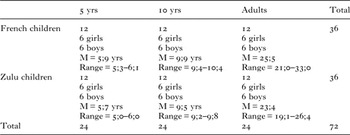
A total of seventy-two mother-tongue Zulu- and French-speaking children aged five and ten years old (see the distribution of participants' ages and ranges in Table 1) and adults participated in this study: thirty-six Zulu and thirty-six French speakers. There was an equal gender split. The child participants were selected from the school grades corresponding to their age, and all the adults were university students who volunteered to participate in the study. Participants came from schools and universities in Grenoble and Toulouse (France) and in Empangeni, Kwa-Zulu Natal (South Africa).
Distribution of participants by language and age (years; months)

Procedure
The participants watched a video extract (2 minutes and 47 seconds) of a wordless cartoon taken from the series Tom & Jerry. They individually watched this same video twice, and were then instructed to tell the story to the interviewer (for more details on this protocol, see Colletta et al., Reference Colletta, Pellenq and Guidetti2010, Reference Colletta, Guidetti, Capirci, Cristilli, Demir, Kunene Nicolas and Levine2015; Reig Alamillo, Colletta & Guidetti, Reference Reig Alamillo, Colletta and Guidetti2013). The participants' narratives were videotaped for later analysis.
The cartoon starts with a mother bird leaving her egg in the nest. The egg accidentally falls out and rolls into Jerry's house. The egg hatches in Jerry's house and a baby woodpecker emerges. The baby bird then starts damaging Jerry's furniture. After a few failed attempts to calm the bird down, Jerry gets angry and decides to put the bird back in its nest.
Filming of the children was conducted at school but out of the classroom environment. Filming of the adults was conducted in university classrooms or students' residences.
Coding
The data transcription and annotation were performed using the linguistic annotation tool ELAN software (tla.mpi.nl/tools/tla-tools/elan/). Coding was done on the verbal and gestural levels. An annotation scheme specially designed for this type of study (Colletta, Kunene, Venouil, Kaufmann & Simon, Reference Colletta, Kunene, Venouil, Kaufmann, Simon, Kipp, Martin, Paggio and Heylen2009) provided information on syntax, lexicon, discourse, and co-speech gesture. Speech turns were transcribed orthographically, including each word, pause, repetition, or hesitation on the software. Hesitations, pauses, and word errors were coded using the coding conventions from the annotation scheme cited above, (for example, if there was a vocalic lengthening, two semicolons /::/ would be placed on the lengthened syllable). Speech transcription for the Zulu was coded by L1 speakers of Zulu and then verified by an independent second coder, also an L1 speaker of that language. For the French speech coding, reliability in transcription of the children's words was established by three independent coders, all L1 speakers of French.
Speech coding
To determine the informational quantity of the narrative, the speech stream was segmented into different linguistic units, such as speech turns, clauses, words, syntactic structures, and macro-structural episodes of the narrative event, to measure discursive ability in line with the stimulus presented to the speaker. Based on Berman and Slobin (Reference Berman and Slobin1994), a ‘clause’ included a predicate matched by one or more arguments. The following were considered single clauses (example from a nine-year-old Zulu boy):
-
(1) kuneqanda lapha phakathi
expl-have-N5-egg here inside
‘There is an egg inside’
-
(2) yase ipopayi … yathatha lela thawula
sbj9-cons-then N9-cartoon.character N9-cons-take PAST that.pos3.cl5 towel
‘and then the cartoon character took that towel’
Using clauses in the analysis provided us with an indication of its informational quantity (“relative length and propositional complexity of the texts”; Berman & Slobin (Reference Berman and Slobin1994, p. 26) across the whole narrative sample. Coded clauses excluded repetitions.
To determine the macrostructure of the narrative, we categorized each clause related to the narrative activity of the stimulus, according to the discourse or pragmatic speech act it expressed. Four types of pragmatic speech acts were identified (for a detailed description of the coding, see Colletta et al., Reference Colletta, Kunene, Venouil, Kaufmann, Simon, Kipp, Martin, Paggio and Heylen2009, Reference Colletta, Pellenq and Guidetti2010, Reference Colletta, Guidetti, Capirci, Cristilli, Demir, Kunene Nicolas and Levine2015) as expressing the part or whole of a speech act: narrating, explaining, interpreting, or commenting:
-
a. Narration (narrative level; McNeill, Reference McNeill1992) – when the speaker tells the event such as it happens in cartoon (e.g., “There was a mother bird in the nest”).
-
b. Explanation (non-narrative level; Reig Alamillo et al., 2013) – when the speaker explains the cause of an event (e.g., “The mother bird left the nest because it was hungry”).
-
c. Interpretation (non-narrative level; Reig Alamillo et al., 2013) – when the speaker presents an inference or an interpretation concerning the situation or the intentions of the characters (e.g., “It looked at the time and realises it's time to fetch food”).
-
d. Commentary (non-narrative level; Reig Alamillo et al., 2013) – when the speaker presents information that is neither explicit nor implicit about the course of the narrative events, but presents either a ‘meta-narrative’ comment relating to a character, an action, or any aspect of the story, or a ‘para-narrative’ comment relating to the action of telling the story, such as a judgement or personal appreciation (e.g., “It is a crazy bird” or “It made me laugh when the little bird destroyed everything in the house”).
Gesture coding
For gesture coding, only the bodily movements maintaining a relation to speech (co-speech gestures) were annotated. Coders first identified a gesture and then attributed a function to it. The coders had to choose among the following categories:
-
a. Representational (corresponds to iconic and metaphoric gestures in McNeill, Reference McNeill1992) – hand or facial gesture, associated or not with other parts of the body, which represents an object or a property of this object, a place, a trajectory, an action, a character, or an attitude (e.g., two hands drawing the form of the referent; hand or head gesture pointing to a spot that locates a virtual character or object in frontal space; hand or head moving in some direction to represent the trajectory of the referent; two hands or body mimicking an action), or which symbolizes, by metaphor or metonymy, an abstract idea (e.g., hand or head movement towards the left or the right to symbolize the past or the future; gesture metaphors for abstract concepts).
-
b. Performative gesture (part of pragmatic gestures; Kendon, Reference Kendon2004) which allows the gestural realization of a speech act (e.g., head nod as a ‘yes’ answer, head shake as a ‘no’ answer), or which co-expresses, together with the verbal utterance, the illocutionary value of a speech act (e.g., head nod accompanying a ‘yes’ answer).
-
c. Framing gesture (part of pragmatic gestures; Kendon, Reference Kendon2004) that expresses an emotional or mental state of the narrator (e.g., face showing amusement to express the comical side of an event; shoulder shrug or facial expression of doubt to express incertitude of what is being asserted).
-
d. Discursive gesture (part of pragmatic gestures; Kendon, Reference Kendon2004; and cohesion gestures in McNeill, Reference McNeill1992) aids in structuring speech and discourse by the accentuation or highlighting of certain linguistic units (e.g., beat gestures: rhythmic movements that do not present an explicit meaning but serve for emphasis accompanying a certain word; repeated beats accompanying stressed syllables), or marks discourse cohesion by linking clauses or discourse units (e.g., brief hand gesture or beat accompanying a connective; pointing gesture with an anaphoric function such as pointing to a spot to refer to a character or an object previously referred to and assigned to this spot).
-
e. Interactive gesture accompanied by gaze towards the listener to express that the speaker requires or verifies his attention, or shows that he has reached the end of his speech turn or his narrative, or towards the speaker to show his own attention (e.g., nodding head while interlocutor speaks).
-
f. Word-searching gestures or ‘Butterworths’ (McNeill, Reference McNeill1992) – a hand gesture or facial expression which indicates that the speaker is searching for a word or expression (e.g., frowning, staring above, and tapping of fingers while searching for words).
Gesture transcription reliability
In order to establish reliability in gesture coding, two separate coders identified the gestures and attributed a function to each one. Gestures were also coded in terms of their relationship to speech. A third coder validated their annotations and settled any disagreements. Inter-rater agreement was 90% on gesture identification and coding.
Data analysis
This narrative elicitation task sought to identify the developmental trajectory of discursive ability of two languages, French and Zulu. This analysis is based on the two types of communicative behaviour, speech and gesture.
The independent variables were language and age, while the dependent variables were narrative length (the number of clauses), type of pragmatic speech act (narration, commentary, interpretation, explanation), and gesture, which included the number of gestures and the type of gesture (representational, discursive, framing). Other types of gestures such as performative, word searching, and interactive were excluded as they had a low frequency of occurrence in this narrative task.
The analysis of gender and the length of narratives failed to reach significance for the combined French and Zulu data. There was also no interaction between language and gender. All subsequent statistical analyses were therefore performed across both genders. To answer the questions on the effect of age and language across the French and Zulu data, we performed ANOVAs with age and language as between-subject factors. For each of our variables we tested for the effect of age, the effect of language, and the interaction between age and language. The following section reports the statistically significant results.
RESULTS
In the presentation of our results, we will first report on the developmental findings for each language, and subsequently present the cross-linguistic findings for each variable analyzed.
Effects of age and language on linguistic measures
To test the effect of language and age across the French and Zulu data, an ANOVA was conducted with age and language as between-subject factors on the data (shown in Table 2). We counted and analyzed the mean number of clauses that the participants in each age group used to tell the story as a measure of the narratives' lengths. Clauses that repeated the same information were excluded.
Mean number (SD) of clauses and pragmatic type of clause per language and age group

The mean number of clauses showed an overall effect of age (F(2,71) = 7·69, p < ·001); however, the effect of language was more a tendency than a significant result (F(1,71) = 3·26, p = ·075); and the interaction between the factors was not significant. The post-hoc Bonferroni test showed that the five-year-old group produced narratives significantly shorter than the ten-years-olds (p = ·02) and the adults (p = ·008), but narratives of the ten-year-olds were not significantly different from those of the adults. A similar pattern was observed across language groups with regard to narrative development: with age, narrative information increases in both French and Zulu.
However, between the ages, there was a cross-linguistic difference; for instance, for the French children, the post-hoc Bonferroni test showed that the five-year-olds produced narratives significantly shorter than the ten-year-olds (p = ·03). The number of clauses in the ten-year-olds' narratives was not significantly different from the French adults. On the other hand, in the Zulu data, there was a significant difference in the mean number of clauses between the five-year-olds and the adults (p = ·02), but there was no significant difference between the five-year-olds' and the ten-year-olds' productions, unlike in the French data. As in the results for French data, the length of the ten-year-olds' Zulu narratives was not significantly different from that of the Zulu adults.
For the narrative complexity measure, we examined the type of clauses in terms of pragmatic speech acts to see how the children were able to navigate through the narrative and meta-narrative levels. The pragmatic speech acts were categorized as narrative, commentary, explanatory, and interpretative (see Table 2 for results).
The results indicate that the pragmatic type of clause with the highest representation is the narrative clause, which is consistent with the language task. Clauses categorized as commentary, explanatory, and interpretative were fewer in number, but their distribution over the two languages was different.
An ANOVA was conducted with two between-subject factors to test for the effect of language and age as well as to determine if there was an interaction of the pragmatic type of clause between the two variables. There was an effect of age (F(2,71) = 7·11, p = ·002) as well as of language (F(1,71) = 6·12, p = ·02), but there was no interaction between the two factors. This means that the association of the two independent variables of language and age did not affect the development of the narrative type of clause.
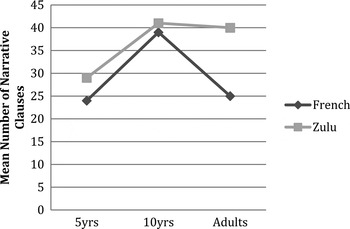
Post-hoc Bonferroni tests showed that the age effect for the narrative clauses reflected the difference between the five-year-olds to the ten-year-olds (p < ·001) for the combined groups (French and Zulu): the younger children produced fewer narrative clauses than the ten-year-olds in both languages (Table 2). The ten-year-olds' narrative clause results were different per language. For the French children, the ten-year-olds had a higher mean number of narrative clauses than the French adults by 21% (Table 2), whereas for the Zulu data, the ten-year-olds produced fewer narrative clauses (mean number 45·16) than the Zulu adults (mean number 48·97).
While the highest frequency was, naturally, the narrative clause for both language groups, there is a cross-linguistic difference in the distribution of the type of clause. The Zulu speakers had a higher frequency of narrative clauses than the French speakers, and conversely, the French speakers had a higher number of non-narrative clauses (or clauses that moved away from the narrative level or relating the event as it occurred) which were characterized by more commentaries, explanations, and interpretation during the narrative task (see Table 2), than their Zulu counterparts.
Furthermore, closer inspection of the two language groups showed that the development of the narrative type of clause happens in parallel in both languages, French (F(2,35) = 4·96, p = ·01) and Zulu (F(2,35) = 3·68, p = ·04), but was not similar in every respect. The post-hoc Bonferroni tests showed that for the French corpus, the five-year-olds produced fewer narrative clauses than the ten-year-olds (p = ·02), and the ten-year-olds were significantly different from the adults (p = ·04), producing more narrative clauses. In the linguistic analysis, the number of narrative clauses for the older children and the adults revealed fewer blow-by-blow accounts of the story (detailed accounts that try to enact the narrative as seen from the stimulus), as they summarized more than the younger children, who tended to give a more of an event-by-event recounting of the narrative.
A similar trend was observed in both language groups between younger children, older children, and adults.
In the Zulu data, the post-hoc Bonferroni tests showed that the five-year-olds produced fewer narrative clauses than the ten-year-olds (p = ·05), and the ten-year-olds produced a similar number of narrative clauses to the adults, or rather the ten-year-olds' production was not statistically different from that of the Zulu adults. While the developmental trajectory is similar for the two languages (see Figure 1), it was noted that there was a difference in its distribution. For the French speakers, there was an inverse shaped curve, with the ten-year-olds producing more narrative clauses than the five-year-olds, but also more than the adults. For the Zulu speakers, the adults produce about a similar number of clauses as the ten-year-olds, with detailed narratives, in contrast to the French adults, who gave shorter and more synthetic narrative clauses compared with the Zulu accounts.
Mean number of narrative clauses per language and age group.

Thus, narrative information was not distributed similarly in the two languages. French adults tended to give brief, synthesized reports compared to the Zulu adults, who tended to give elaborate details of the narrative. The following results elucidate this point.
Non-narrative clauses
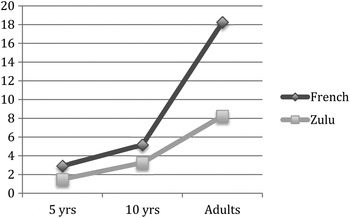
The non-narrative clauses were grouped together (commentary, interpretation, and explanation) because of their infrequent production in both languages. Figure 2 illustrates that the non-narrative clauses had a higher proportion in the adults' productions than in the children's. We found a significant effect of language (F(1,71) = 16·07, p < ·001) and age (F(2,71) = 37·54, p < ·001), as well as an interaction between the two factors (F(2,71) = 6·29, p = ·003). The French groups produced more non-narrative clauses in comparison to the Zulu groups. The interaction between these factors suggests that there is a language factor that comes in to play, so this task was not performed similarly by French and Zulu speakers, particularly in the adult groups.
Mean number of non-narratives clauses per language and age group.

In the French narratives, the adult speakers produced a higher number of clauses, or clauses that were not giving an event-by-event account of the narrative but rather a higher percentage of non-narrative clauses (commentary, explanations, and interpretations, e.g., je pense ‘I think’, à mon avis ‘in my opinion’), revealing a higher frequency of navigating between the meta- and para-narrative levels compared to the Zulu speakers, who predominantly used the narrative level. The Zulu speakers produced a higher number of narrative type of clauses (e.g., ‘in the beginning there was a bird’), and fewer non-narrative type of clauses or clauses that add personal evaluations or commentary (see Table 2) for this type of narrative task.
Effects of age and language on gesture analysis
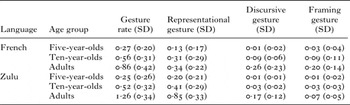
Gesture rate. The Zulu speakers produced more clauses and gesture strokes than their French counterparts. Comparing the mean numbers of gesture strokes for the two languages did not give an accurate reflection of the similarities or differences because some people produced a lot of gestures and others did not. Consequently, we calculated the gesture rate or the number of gestures per clause to give a clearer picture of the gestural results with respect to speech. The gesture rate was calculated by counting the number of gestures and dividing it by the number of clauses used per participant (see Table 3).
Mean number (SD) of gesture rate and gesture type rates per language and age group

Gesture rate showed an effect of age (F(2,71) = 38·80, p < .001). The post-hoc Bonferroni tests were similar to our gesture stroke results; i.e., in the French data, the adults gestured significantly more than the five-year-olds (p = ·003). However, the rate of gestures of ten-year-olds and adults did not differ significantly.
In contrast, a slight difference was observed for the Zulu group. The Zulu adult speakers produced significantly more gestures than both the five- and ten-year-olds (p < ·001 for both groups).
In terms of cross-linguistic differences, as predicted, the Zulu speakers produced more gestures than the French speakers. The Zulu speakers produced 19·5% more clauses than the French, which resulted in 55% additional gestures (see Table 3). There was an interaction between language and age (F(2,71) = 3·54, p = 0·04) between the two language groups as the narrative behaviour was not similar: Zulu adults produced more gestures than their French counterparts.
Type of gesture. The types of gesture produced were analyzed according to age and language, with a focus on representational and non-representational gesture types, i.e., framing, interactive, word searching, and discursive gestures. Of the non-representational gestures, the two most frequently produced types were the discursive and the framing gestures. These types of gesture are directly involved with the narrative activity in their role as discourse cohesive and framing devices, whereas the interactive and word-searching gestures aid with the performance of dialogue (see Table 3).
These gestures were higher in the Zulu data, whereas the non-representational gestures (i.e., gestures helping to structure speech or mark cohesion) had a higher frequency in the French data. This result is consistent with the analysis of the types of clauses, and suggests that the Zulu speakers place a lot more emphasis on the narrative type of clause than the non-narrative type of clause.
Representational gesture. Taking all groups together, there was an age effect (F(2,71) = 16.73, p < ·001), a language effect (F(1,71) = 13.67, p < ·001), and an interaction between the two factors (F(2,71) = 5.35, p = ·007) for all representational gestures. Post-hoc Bonferroni tests showed that the adults produced significantly more representational gestures than the five- and ten-year-olds (p < ·001 and p = ·007, respectively). There was also a significant difference between the groups of children, with the ten-year-olds producing significantly more representational gestures (p = ·03) than the five-year-olds. The interaction between the two factors showed that Zulu adults performed more representational gestures than all other groups.
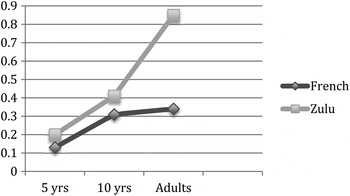
The trend is a bit different when the two language groups are examined separately: a between-subjects analysis of the French data did not reveal an effect of age (F(2,35) = 2·81, p = ·075). The post-hoc Bonferroni tests showed that there was no significant difference between the groups in their production of representational gestures. In contrast, in the Zulu data, there was a significant effect of age (F(2,35) = 16·59, p < ·001), with a post-hoc Bonferroni test showing that the adults produced significantly more representational gestures than the five- and ten-year-olds (p < ·001 and p = ·002, respectively) (see Figure 3).
Mean number of representational gesture rates per language and age group.

The adults, and especially the Zulu adults, produced a higher number of representational gestures than the groups of children (see Figure 3). This development is better understood when the non-representational gestures are also considered, as in the following section.
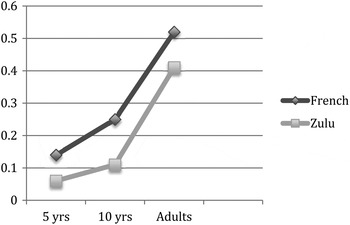
Non-representational gestures. French gesture production includes a higher number of discursive (cohesive) and framing gestures when compared to the Zulu speakers. When these non-representational gesture rates (discursive and framing) are regrouped, it provides a clearer picture of how cohesive and framing discourse cues were represented in the two languages and across the different age groups (see Figure 4).
Mean number of non-representation gesture rates per language and age group.

On all non-representational gesture rates, the ANOVA revealed an age effect (F(2,71) = 30·82, p < ·001), a language effect (F(1,71) = 7·34, p < ·001), and an interaction between the two factors (F(2,71) = 6·29, p = ·003). The post-hoc Bonferroni test showed that the adults from both language groups produced significantly more non-representational gestures than the five- and ten-year-olds (p < ·001 and p < ·001, respectively). French speakers produced more than Zulu speakers.
GENERAL DISCUSSION
Our study investigated the developmental trajectory of multimodal oral narratives of Zulu and French speakers. Our hypotheses were that, with age, narratives increase in length and complexity irrespective of language. We also hypothesized that there is a parallel increase of co-speech gesture use, which also becomes more complex as the child gets older. Amongst these co-speech gestures, we expected to observe more cohesive and framing gestures increasing with age.
From the cross-linguistic comparison of Zulu and French, (i) we expected Zulu children to deliver longer, hence more detailed, accounts of the story than French children, on gestural production, (ii) we expected to see more gestures in the Zulu narratives compared to the French narratives, and on the type of gestural production, (iii) we expected to see more representational gestures in the Zulu narratives compared to the French. Our findings support our hypotheses, as shown in the following sections.
Effects of age on narratives
Similar differences occurred in both language groups between younger children, older children, and adults. Interestingly, these differences appeared in the gesture aspects of narrative behaviour as well as in the length and the pragmatics of narratives.
Adults and older children produced longer narratives with a higher number of narrative and non-narrative clauses than the younger children in both languages (Zulu and French); the five-year-olds would give longer and more detailed narratives as they tried to give a full account of the event sequence, trying to recount all they remembered, while the adults used several pragmatic devices to produce a more compact narrative. This comparative study provides further evidence to support the previous findings of Colletta (Reference Colletta2004) for French and Graziano (2009) for Italian, that narrative development improves gradually with age, irrespective of the language.
Previous studies on the development of summary and implicit language abilities have showed that children do not fully master the ability of summarizing stories until later than nine years of age (Colletta et al., Reference Colletta, Pellenq and Guidetti2010; Fayol, Reference Fayol1997). Yet the summarizing pattern appeared in the group of French adults, but not in the group of Zulu adults. To further explore this difference, more child data is required, such as a twelve-year-old cohort in both Zulu and French to observe when the child's production is closer to adult narrative production.
Effects of age on gestural production
In both language groups, the adults produced more gestures than the two groups of children, and the groups of older children produced more gestures than the groups of younger children. However, both language groups differed in the type of gestures they used. The ten-year-old Zulu children's gesture production was significantly less than the adults'. Yet the type of gestures they produced was more representational, which showed that the Zulu children are developing their ability to make their interlocutor visualize what is said during the narrative event. The ten-year-old French children's gesture production was also significantly less than the adults' performance. Yet they produced more pragmatic gestures than the group of younger children, and the adults produced a significantly higher number of non-representational gestures than both the groups of children. For age differences and language differences (see end of section ‘Effects of language on narrative production’), the consistency we report here between tendencies in the pragmatics of the verbal narrative (narrating vs. commenting on and adding to the narrative) and tendencies in co-speech gesture production (representing characters and events vs. framing and marking discourse structure and cohesion) directly supports McNeill's postulate – gesture and speech are but one system – which also extends to language development.
Moreover, despite the language and culture differences we report here, our findings also support the modelling of multimodal narrative development outlined in Colletta et al. (Reference Colletta, Guidetti, Capirci, Cristilli, Demir, Kunene Nicolas and Levine2015). Whatever the language, the co-speech gesture system evolves in later language acquisition in order to fulfil new specific functions or new communicative aims, such as, in our case, narrating fictitious events – or real events (as found in the Colletta et al., Reference Colletta, Kunene, Venouil, Kaufmann, Simon, Kipp, Martin, Paggio and Heylen2009, study). In other words, language development and gesture development are tightly related during childhood.
Young children in the first year of primary school, who are typically more at ease with dialogue and interactive language formats, find the monologue production of narrating a story a difficult task, and produce short narratives with no great detail. When they do gesture, they try to represent characters and events.
Older children on the way to secondary school have developed narrative abilities that can be seen in the length of their linguistic production as well as in their linguistic and gesture content. They perform the narrative production task from the start until the end, and deliver longer and more detailed accounts. This greater complexity in linguistic information goes along with an increasing use of co-speech gesture to represent and track the characters from the story and to enliven the events. Their gesture repertoire includes discursive gestures that mark discourse progression and framing gestures that express personal feelings towards the story and connote the content of speech.
Although the narrative performance of a ten-year-old child remains drastically different from that of an adult, it begins to show some of the same features and particularities grounded in cultural expectations and norms regarding oral story-telling, and this is where culture and socializing come into play. As this study shows, the narratives of older children, heading towards secondary school, clearly introduce orientations that reflect – in terms of both gesture and speech – specificities of literacy, which are embedded in social practice and representations of story-telling. Their narrative performance, although not yet comparable to an adult's, seems in line with the usual narrative performance displayed by adults who belong to the same language group.
Effects of language on narrative production
As predicted, the Zulu participants produced longer narratives compared to the French participants. The Zulu speakers favoured a detailed and an event-by-event account, whereas the French speakers produced a higher number of non-narrative clauses and favoured more synthetic and summarized accounts in their story-telling. In our view, the difference in the narrative performance of the two language groups has to do with culture and literacy acquisition, and may be attributed to the perception of the task. In the Zulu language, telling a story entails performing a story in line with the oral tradition, i.e., telling all events as they occurred, enriched with depictions of characters and situations, and with little or no digression into commentary, explanation, or interpretation. Conversely, in the French language, the narrator relies on the notion that oral story-telling does not necessarily require a blow-by-blow account. The French speaker navigates through the different narrative levels by including a considerable number of comments and additional explanations.
Effects of language on gestural production
The Zulu participants produced a higher number of co-speech gestures during the narrative task than the French participants. This finding confirms the common idea that the longer the language production, the more co-speech gesture there is (Colletta et al., Reference Colletta, Pellenq and Guidetti2010). The Zulu participants mainly produced representational gestures (i.e., iconic gestures representative of the objects and events in the story), whereas the French participants produced comparatively fewer representational gestures.
This result is consistent with the finding that Zulu subjects, especially adults, favour a detailed and exhaustive account of the story in line with the oral tradition. The more the speakers remained on the narrative level, the more representational gestures appeared. For the French speakers, who had more non-narrative clauses, their gestures were more pragmatic (discursive gestures that mark structure and cohesion within the narrative, framing gestures that help reinforce, connote, or supplement a verbal utterance), and tended to alleviate the load of expressive, connotative, and cohesive properties from the verbal level. This result clearly adds to McNeill's postulate that gesture and speech are one system (for new and provocative arguments, see McNeill, Reference McNeill2014). Furthermore, this suggests an extension of this postulate to non-representational aspects of language and gesture: the type of co-speech gesture one produces while speaking not only depends on representational properties of hand and head gestures, it also depends on the type of speech act one is actually verbalizing, as preliminary observations of French children's narratives (Colletta, Reference Colletta2004; Colletta, Kunene, Venouil, Kaufmann, & Simon, 2009) have tended to show.
To conclude the language comparison, French and Zulu narratives showed differences in speech as well as in gesture, as the Zulu ten-year old children and adults produced more detailed narratives, used a lot more representational gestures, and rarely interrupted the telling of the events to insert a personal comment. We think cultural specificities in conceptions of literacy can help to explain these differences.
Limitations
The limitations of this study should be acknowledged. An older cohort of child data from pre-adolescents throughout the adolescent stage would help us to refine the developmental model. An in-depth analysis of the frequently produced type of gesture – representational gesture in this case – would show us the cultural, linguistic, and age differences by examining the shape and the meaning (as seen in Graziano, Reference Graziano2009), as this will help track the cognitive changes in how children represent events, characters, and actions in a narrative. Other types of gestures that have a pragmatic or expressive framing function, or a discursive or cohesive function, also need to be investigated to help understand when and how pragmatic and discourse constraints evolve during childhood. As for methods, the way people respond to data-collection methods also has an effect on narrative and gesture production. A previous study on French spontaneous narratives produced by children aged six to eleven years (Colletta et al., Reference Colletta, Kunene, Venouil, Kaufmann, Simon, Kipp, Martin, Paggio and Heylen2009) showed advanced social abilities in the ten- and eleven-year-olds that were not found in the children's narratives collected for these studies. Data-collection methods may have effects on results in cross-linguistic and cross-cultural investigations and should be given more consideration.
Future directions
This study sheds new light on some previously unstudied aspects of oral narrative development in two cultural and linguistic groups never compared before. First, a developmental shift towards complex narrative production was noted. It appears that the age-related tendency to enrich oral narratives with various types of comments may be analyzed both from the perspective of cognitive development, insofar as it reveals cognitive decentring, and from the perspective of social development, insofar as it reveals new social conversational abilities. Second, this development can be influenced by language or cultural belonging, in which each cultural group has a different distribution of salient features that mark the target discourse competency level.
The results of this study suggest an exciting future direction to expand the research into the multimodality of discourse, in particular as it sheds new light on a less studied language with an oral tradition. To ignore the study of gesture in language use and development is a loss to understanding the human mind.