Introduction
In the past, the grey wolf (Canis lupus L.) was one of the world's most widespread species. Because of human activity and the decreasing area of forest, as well as the diminishing number of potential prey, the range of the grey wolf has shrunk to Alaska, Canada, northern states of the USA, southern Europe (e.g. Romania, Greece, Albania, Croatia), eastern Europe (e.g. Poland, Slovakia, Belarus, Latvia), Siberia, and small areas of Scandinavia and Asia. In Poland, wolves occur mainly in south-eastern, eastern and north-eastern parts of the country and in some isolated localities in western Poland (Jędrzejewski & Bereszyński, Reference Jędrzejewski, Bereszyński, Adamski, Bartel, Bereszyński, Kapel and Witkowski2004). The grey wolf occurs frequently in many zoological gardens and it is reared in several other scientific research centres.
In lowland Poland the average territory of a grey wolf pack covers 150–350 km2, while it is around 100 km2 in the mountains (Okarma, Reference Okarma1997). The territory is marked by wolves with their urine and faeces. In this way, dispersive forms of parasites are deposited in the environment, which can spread the infection over a wide area. The main source of infection for wolves is from their food (cysts and larvae in bodies of consumed prey) or the environment infected with faeces containing eggs and invasive larvae. Some parasites utilize vertical transmission, e.g. transferred from the infected female to her offspring through the placenta or via milk, which significantly increases the number of infected individuals in the population (Kloch & Bajer, Reference Kloch and Bajer2003).
Investigations of parasites occurring in wild carnivores in Poland began in the first half of the 20th century (Furmaga & Wysocki, Reference Furmaga and Wysocki1949; Sołtys, Reference Sołtys1964). In recent years, four packs of wolves have been investigated for their helminth fauna. The wolves originated from the southern part of the Mazurian Lakeland (Kloch & Bajer, Reference Kloch and Bajer2003), the Beskidy Mountains (Popiołek et al., Reference Popiołek, Szczęsna and Hildebrand2003, Reference Popiołek, Szczęsna, Nowak and Mysłajek2007), the Białowieża Primeval Forest (Górski et al., Reference Górski, Zalewski and Łakomy2006) and the Bieszczady Mountains (Szczęsna et al., Reference Szczęsna, Popiołek and Śmietana2007). In order to get information about the helminth fauna of wolves, studies were also carried out in other European countries: in Italy (Guberti et al., 1993), Greece (Papadopoulos et al., Reference Papadopoulos, Himonas, Papazahariadou and Antoniadou-Sotiriadou1997), Belarus (Shimalov & Shimalov, Reference Shimalov and Shimalov2000), Slovakia (Martinek et al., Reference Martinek, Kolarova, Hapl, Literak and Uhrin2001), Spain (Segovia et al., Reference Segovia, Torres, Miquel, Llaneza and Feliu2001, Reference Segovia, Guerrero, Torres, Miquel and Feliu2003) and Latvia (Bagrade et al., Reference Bagrade, Kirjusina, Vismanis and Ozolins2009).
The objective of the present work was the investigation of the helminth fauna of grey wolves (Canis lupus L.) in Poland, both in captivity and in the wild.
Materials and methods
In the period from 2005 to 2007, faecal samples from a total of 31 reared wolves and two packs of free-roaming wolves were studied. Faeces originated from 11 wolves from the Experimental Station in Stobnica, eight wolves from Bydgoszcz Zoo, eight wolves from Wrocław Zoo and four wolves from Cracow Zoo. Faecal samples of wild wolves originating from two wolf packs living near Zielona Góra and Piła were also studied.
In the Experimental Station in Stobnica, wolves were kept in especially adapted cages. Cages were of different dimensions, from 150 to 540 m2. The total area occupied by wolves covered about 2500 m2. Six wolves were kept in one cage, while the remaining five were kept in separate individual cages. Wolves were fed once a week on beef and horsemeat originating from a slaughterhouse. In addition, wolves also received wild boar, and roe deer found dead or hunted. It was observed that wolves consumed only a part of their supplied food, while they buried the remaining part for later consumption. The ground in the cages consisted of soil from the surrounding forests. Wolves from Bydgoszcz Zoo were kept in one compound covering 1500 m2. The substrate consisted of compacted earth in which the wolves dug numerous hollows. The compound included trees, mainly pines. Wolves were fed with beef and poultry from a slaughterhouse. The eight wolves in Wrocław Zoo lived in a 2 ha run on the edge of the zoo. These wolves were fed every second day with meat from a slaughterhouse. In Cracow Zoo, four grey wolves were kept in a large run (about 1500 m2) which was divided into two parts connected by a passage. The substrate consisted of compacted earth and it was overgrown with trees. Wolves were fed five times each week with meat from a slaughterhouse.
Parasitological studies included two packs of free-roaming wolves. Faecal samples originating from one pack were collected in February and May 2007 in the area belonging to the Regional Management of State-Owned Forests (RDLP) in Piła (Forest Divisions: Borne Sulinowo, Czarnobór, Jastrowo). Faecal samples of the second pack were collected in the area of the RDLP in Zielona Góra (Forest Divisions: Torzym and Krosno Odrzańskie) in May 2007.
For parasitological studies, samples (2–4 g) of fresh faeces were collected, placed in separate containers and preserved in 4% formalin. Faeces of wild wolves were collected by experienced workers of the Institute of Zoology. To avoid confusion between faeces of fox or other carnivores (domestic or feral dogs) and wolf faeces, only scats that were typical of wolf (more than 3 cm in diameter, containing large pieces of bones, hooves and hair, of characteristic smell) were collected, or faeces found near other evidence of wolf presence, e.g. wolf tracks or wolf prey (Szczęsna & Popiołek, Reference Szczęsna and Popiołek2007). In the laboratory, the samples were examined for the presence of parasite oocysts, cysts and eggs by the coprological method. Because of the selective character of the commonly applied techniques, eggs were isolated by two methods: decantation, with tap water as the decanting liquid (Zajac & Conboy, Reference Zajac and Conboy1994) and the flotation technique of Fülleborn with a saturated solution of sodium chloride (NaCl; specific gravity 1.20) as the flotation liquid (Fülleborn, Reference Fülleborn1920; Foreyt, Reference Foreyt2001; Gundłach & Sadzikowski, Reference Gundłach and Sadzikowski2001). Egg identification was based on morphological characters (shape and shell structure) and measurements. In order to determine eggs and adult forms of internal parasites, the keys of Thienpont et al. (Reference Thienpont, Rochette and Vanparijs1986), Zajac & Conboy (Reference Zajac and Conboy1994) and Foreyt (Reference Foreyt2001) were used. The prevalence and intensity of infection was calculated according to Bush et al. (Reference Bush, Lafferty, Lotz and Shostak1997).
Results and discussion
For many years studies of wolf helminth fauna, based on coprological analysis or necropsy, have been carried out. Internal parasites of wolves have been investigated in the majority of European countries. The helminth fauna of wolves has been well studied in Canada, the USA and Greenland (Craig & Craig, Reference Craig and Craig2005). The type and degree of infection depends on the parasite species, on geographical location and on many ecological factors (Okarma, Reference Okarma1997). In the scientific literature, information about 72 species of internal parasites has been published and 93% of these helminth species were detected on the basis of necropsy (Craig & Craig, Reference Craig and Craig2005). The known helminthofauna of the grey wolf is represented by 28 species of nematodes, 27 species of tapeworms, 16 species of trematodes and 1 species of acanthocephalan.
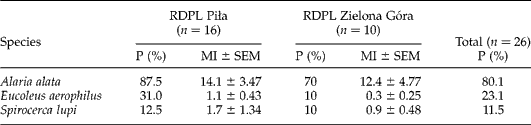
Parasites identified in our study: Ancylostoma caninum, Trichuris vulpis, Toxocara canis, Eucoleus aerophilus, Spirocerca lupi and Alaria alata have been detected in the majority of studies carried out in Poland and elsewhere. Our study in the years 2005–2007 based on 103 faecal samples from 31 reared wolves detected parasites in 81 samples (78.6%; table 1). In 26 faecal samples originating from two free-roaming wolf packs, parasites were found in 23 faecal samples (88.4%; table 2). In Poland, the prevalence of parasitic infection from the southern part of the Mazurian Lakeland was 28.8% (Kloch & Bajer, Reference Kloch and Bajer2003); from Żywiec Beskids, 79.1% (Popiołek et al., Reference Popiołek, Szczęsna and Hildebrand2003); and from southern Poland, 56.2% (Popiołek et al., Reference Popiołek, Szczęsna, Nowak and Mysłajek2007). The prevalence of infection based on necropsy ranged from 80% in Belarus (Shimalov & Shimalov, Reference Shimalov and Shimalov2000), through 88.5% in Canada (Choquette et al., Reference Choquette, Gibson, Kuyt and Pearson1973), to 95.7% in Spain (Segovia et al., Reference Segovia, Torres, Miquel, Llaneza and Feliu2001). In our captive grey wolves, the most frequently occurring parasite was Ancylostoma caninum. This nematode species was most frequent and numerous in the wolves from Bydgoszcz Zoo (11/25 samples) (table 1). In faeces of free-living grey wolves, the most frequent and numerous parasite was the trematode, Alaria alata, which was found in 21 of 26 faecal samples (table 2).
Prevalence of infection (P (%)) and mean intensity (mean number of eggs per sample; MI) of helminths in the captive grey wolves, Canis lupus L.

Prevalence of infection (P (%)) and mean intensity (mean number of eggs per sample; MI) of helminths in the free-roaming grey wolves, Canis lupus L.
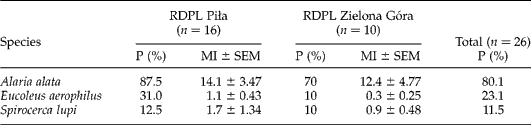
Alaria alata is the most common trematode reported in free-roaming animals. Sołtys (Reference Sołtys1964), in his paper based on necropsy from the Lublin area, found A. alata in 14 of 18 wolves (78%). This trematode has also been detected in wolves from Spain (Segovia et al., Reference Segovia, Guerrero, Torres, Miquel and Feliu2003), Belarus, where the prevalence of infection with this parasite was substantially lower (17.3%; Shimalov & Shimalov, Reference Shimalov and Shimalov2000) and Latvia, where a high prevalence (85.3%) of infection was detected (Bagrade et al., Reference Bagrade, Kirjusina, Vismanis and Ozolins2009). No infection by this parasite was found in wolves studied in Italy (Guberti et al., Reference Guberti, Stancampiano and Francisci1993) or Greece (Papadopoulos et al., Reference Papadopoulos, Himonas, Papazahariadou and Antoniadou-Sotiriadou1997). Alaria alata was also detected in the USA in wolves living in the forests of south-eastern Minnesota (Byman et al., Reference Byman, Van Ballenberghe, Schlotthauer and Erickson1977). In Poland, the analyses of the faeces of carnivorous mammals living in the Białowieża Forest showed that A. alata most frequently occurred in wolves (26.3%). Furthermore, it was also detected in red foxes (Vulpes vulpes, 13.6%), in American mink (Mustela vison, 12.5%) and in otters (Lutra lutra, 2.6%) (Górski et al., Reference Górski, Zalewski and Łakomy2006). Our studies have shown that this parasite occurred in 81% of examined faecal samples of wolves from two packs living near Piła and Zielona Góra (table 2). Alaria alata is a cosmopolitan parasite whose developmental cycles are characterized by the presence of two indirect hosts: snail and tadpole or frog. In the case where tadpoles or frogs are consumed by intermediate hosts, such as wild boar, polecat, marten or birds, the mesocercariae of A. allata are encysted in the host's muscles (Gundłach & Sadzikowski, Reference Gundłach and Sadzikowski2004). Studies carried out in Spain showed the presence of mesocercariae in the muscles of wild boar, which suggests this to be the more likely source of wolf infection (Segovia et al., Reference Segovia, Torres, Miquel, Llaneza and Feliu2001).
In Poland, Eucoleus aerophilus occurs in wolves living in the Białowieża Forest, where the prevalence of this parasite was up to 5.2% (Górski et al., Reference Górski, Zalewski and Łakomy2006). Studies on wolves in southern Poland showed the presence of this nematode in 14.6% of the studied population of grey wolves (Popiołek et al., Reference Popiołek, Szczęsna and Hildebrand2003, Reference Popiołek, Szczęsna, Nowak and Mysłajek2007). On the other hand, this particular nematode was not found in Italy, Russia or Spain (Craig & Craig, Reference Craig and Craig2005). Holmes & Podesta (Reference Holmes and Podesta1968) detected E. aerophilus in Canada (Alberta region) where only 1 of 98 examined grey wolves were infected by this parasite. This nematode has also been found in the mucosa of the respiratory system of wolves in Greenland (Marquard-Petersen, Reference Marquard-Petersen1997) and Latvia (Bagrade et al., Reference Bagrade, Kirjusina, Vismanis and Ozolins2009). Our study showed the presence of E. aerophilus in free-roaming wolves in 6 (23.1%) of 26 faecal samples (table 2). This parasite was detected more often in the pack of wolves living near Piła (5/16 samples), than in the pack near Zielona Góra (only one positive sample). The life cycle of E. aerophilus can be either primarily direct or, less commonly, indirect, involving earthworms as an intermediate paratenic host. Wolves could have been infected by consumption of earthworms (the genera Lumbricus, Allobophora and Bimestus) containing invasive larvae (Anderson, Reference Anderson2000).
Another nematode found in free-roaming grey wolf packs was Spirocerca lupi. The presence of this parasite has been recorded in Canada (Ontario) (Craig & Craig, Reference Craig and Craig2005), in Belarus (Shimalov & Shimalov, Reference Shimalov and Shimalov2000) and occasionally in Poland (Szczęsna & Popiołek, Reference Szczęsna and Popiołek2007). In wolves living near Zielona Góra, eggs of this nematode were found in 1 of 10 faecal samples, and in 2 of 16 faecal samples from wolves near Piła (table 2). Thus S. lupi occurred in 3 (11.5%) of 26 analysed faecal samples of wild grey wolves. The transmission of this species may be further facilitated by a wide range of intermediate hosts (coprophagous insects) and especially paratenic hosts (e.g. lizards, newts, mice, hedgehogs) which form part of the diet of wild canids and thus increase the possibility of wolf infection (Anderson, Reference Anderson2000; Szczęsna & Popiołek, Reference Szczęsna and Popiołek2007).
Ancylostoma caninum was found in wolves from Żywiec Beskids (Popiołek et al., Reference Popiołek, Szczęsna and Hildebrand2003) and in the southern part of the Mazurian Lakeland (Kloch & Bajer, Reference Kloch and Bajer2003), while it was not found in the Lublin region (Sołtys, Reference Sołtys1964) or the Białowieża Forest (Górski et al., Reference Górski, Zalewski and Łakomy2006). Studies carried out in the years 2002–2004 near Silesia Beskids and Żywiec Beskids showed the prevalence of infection by A. caninum at a level of 12.3% (Popiołek et al., Reference Popiołek, Szczęsna, Nowak and Mysłajek2007). In Europe, A. caninum occurs in Spain and Italy (Segovia et al., Reference Segovia, Guerrero, Torres, Miquel and Feliu2003), in Belarus, where the prevalence of wolves infected by this parasite was 13.5% (Shimalov & Shimalov, Reference Shimalov and Shimalov2000) and Latvia, with a prevalence of 2.9% (Bagrade et al., Reference Bagrade, Kirjusina, Vismanis and Ozolins2009). Ancylostoma caninum has not been detected in wolves in Greece, in spite of the presence of this nematode in foxes, jackals and wildcats (Papadopoulos et al., Reference Papadopoulos, Himonas, Papazahariadou and Antoniadou-Sotiriadou1997). The prevalence of infection by A. caninum in captive wolves was up to 36.1%. This parasite was detected in captive grey wolves in all four locations (table 1). However, A. caninum was not found (either in the mature form, or as eggs) in any faecal samples of the two wild wolf packs. In the developmental cycle of this nematode, there are no intermediate hosts. An invasion can take place through the skin, digestive tract, lactogenically or in utero (Stefański, Reference Stefański1963). Wolves that live in Stobnica and in zoos are kept in an enclosed space. Soil in the cages and the runs has become a reservoir of the invasive forms of parasites and is probably the source of infection. Invasiveness of parasites in breeding conditions depends on the size of the cages or runs and on the number of wolves they contain. The smaller the available area, the quicker and higher the infection by the parasite. In Bydgoszcz Zoo, eight wolves occupied a compound of about 0.15 ha and the mean number of A. caninum eggs in studied samples (10.5) was significantly higher than in the faecal samples from Wrocław Zoo, where eight wolves occupied an area of about 2 ha and the mean number of eggs was 2.6. Furthermore, in Stobnica and in the zoos, the keepers could also transfer invasive forms of A. caninum between cages during their contact with the animals. Wolves could be infected by consuming wild animals (wild boar, roe deer) provided from nearby forests, or from small rodents infected by larvae. The animals mentioned above, especially rodents, could have been the paratenic hosts of A. caninum, but their role in the life cycle of this nematode is still unclear.
Another parasite that was detected in grey wolves was Trichuris vulpis. In Poland, this nematode species has been found in wolves living in the Białowieża Forest (15.8% of the studied population; Górski et al., Reference Górski, Zalewski and Łakomy2006), in the southern part of the Mazurian Lakeland (7.7%; Kloch & Bajer, Reference Kloch and Bajer2003) and in Żywiec Beskids (Popiołek et al., Reference Popiołek, Szczęsna and Hildebrand2003). In Europe, T. vulpis has been detected in Belarus (3.9%; Shimalov & Shimalov, Reference Shimalov and Shimalov2000), in Italy (4.0%; Guberti et al., Reference Guberti, Stancampiano and Francisci1993) and in Spain (10.6%; Segovia et al., Reference Segovia, Torres, Miquel, Llaneza and Feliu2001). Trichuris vulpis was not detected in Greece (Papadopoulos et al., Reference Papadopoulos, Himonas, Papazahariadou and Antoniadou-Sotiriadou1997) nor in Latvia (Bagrade et al., Reference Bagrade, Kirjusina, Vismanis and Ozolins2009). This nematode was found in faeces of reared grey wolves in Stobnica, Bydgoszcz, Wrocław and Cracow (table 1). Faecal samples in which eggs of T. vulpis were detected usually contained single eggs of this parasite. Trichuris vulpis has a direct life cycle and matures in a single host. Wolves become infected by ingesting contaminated soil or water. Unembryonated eggs have a strong resistance to environmental conditions and can retain an invasive ability for many years (Gundłach & Sadzikowski, Reference Gundłach and Sadzikowski2004). Therefore, in particular, soil in the cages and runs and the water supplied directly by the keepers can be a reservoir of numerous eggs with invasive larvae of this nematode. Keepers can probably also disperse the invasive form unwittingly by bringing in soil or water contaminated with eggs from the outside.
Toxocara canis, as for A. caninum and T. vulpis, was detected in reared grey wolves. Toxocara canis has also been found in free-roaming wolves in Belarus, where the prevalence of infection by this parasite was up to 21.2% (Shimalov & Shimalov, Reference Shimalov and Shimalov2000), in Greece (16.6%; Papadopoulos et al., Reference Papadopoulos, Himonas, Papazahariadou and Antoniadou-Sotiriadou1997), in Latvia (5.8%; Bagrade et al., Reference Bagrade, Kirjusina, Vismanis and Ozolins2009) and in Spain (6%; Segovia et al., Reference Segovia, Guerrero, Torres, Miquel and Feliu2003). In Poland, the prevalence of wolves infected by T. canis in the Mazurian Lakeland was up to 7.7% (Kloch & Bajer, Reference Kloch and Bajer2003) and in southern Poland, 5.6% (Popiołek et al., Reference Popiołek, Szczęsna, Nowak and Mysłajek2007). Our study showed the presence of T. canis eggs in 4 (3.9%) of 103 examined faeces from captive grey wolves: in two samples from the Experimental Station in Stobnica and in one sample from Cracow Zoo (table 1). Toxocara canis does not require any intermediate host during its developmental cycle. Eggs of the worms may be consumed by small mammals, birds or invertebrates in which larvae become encysted in tissues and survive for a long time (Gundłach & Sadzikowski, Reference Gundłach and Sadzikowski2004). Wild wolves mainly become infected by consuming occasional hosts. However, in captive wolves one cannot exclude the possibility that infection was caused by consumption of infected meat.
Most papers on the internal parasites of wolves are based on necropsy and rarely on coprological analysis (Craig & Craig, Reference Craig and Craig2005). According to the other papers based on faecal analysis of material originating from Polish populations of wolves (Kloch & Bajer, Reference Kloch and Bajer2003; Popiołek et al., Reference Popiołek, Szczęsna and Hildebrand2003, Reference Popiołek, Szczęsna, Nowak and Mysłajek2007; Górski et al., Reference Górski, Zalewski and Łakomy2006; Szczęsna et al., Reference Szczęsna, Popiołek and Śmietana2007) we also expected to find taeniid eggs in the samples. We did not detect tapeworm eggs in samples that originated from captive wolves. In free-roaming wolves we observed different types of eggs (than in table 2) but, because the eggs were substantially macerated, the typical features normally used for diagnosis (size, egg capsule, thickness of embriophore) were useless. Therefore, unequivocal classification of these eggs as taeniids was too risky.
Differences in the prevalence of infection and the different composition of helminth species between wolves kept in captivity and those in the wild probably result from the different availability of intermediate hosts. In comparison with free-roaming wolves, those living in captivity become infected mainly from soil in the cages and runs, which are reservoirs of the invasive forms of parasites. Therefore, there exists a close connection between the intensity of infection by the parasite, size of the cage and the number of wolves living therein.
Acknowledgements
The authors would like to thank J. Więckowski and I. Jindra for their technical support in collecting samples. We thank T.H. Sparks for his constructive criticism and linguistic corrections on this manuscript.