John Carter's polemical journalism established him as one of the keenest promoters of Gothic architecture in England. Much has been written on his controversial views, his contribution to the Gothic revival and his dispute with the architect, James Wyatt.Footnote 1 Less has been written about his long career as a draughtsman and the important commissions he received from a small but wealthy and influential group of antiquaries, notably Richard Gough and Sir Henry Englefield. They were the prime movers behind efforts to improve the standard of visual evidence from medieval buildings, their sculpture and monuments, as exemplified by Carter's surveys for the Society of Antiquaries’ cathedral series of engravings. Though dismissed by the art historian Martin Hardie as ‘dull but faithful’,Footnote 2 these are nevertheless rightly celebrated and have been placed by several writers in the context of the increasing accuracy of visual recording in the late eighteenth century.Footnote 3
Important new evidence concerning Carter's survey methods, his regular tours, his patrons and his stormy relationship with the Society of Antiquaries has recently come to light in the archives of King's College London (see J Mordaunt Crook's postscript, ‘John Carter Revisited’, below). Two unfinished memoirs, vividly illustrated with sketches, are of particular value. Persuits of Antiquaries was written around 1800 in the form of an account in verse of his dealings with the Society in the 1790s, when he was engaged in producing the drawings for the cathedral series.Footnote 4 Occurrences (fig 1) was written in 1817, when he was putting in order his vast collection of sketches during the last months of his life, but unfortunately only covers the period up to 1788.
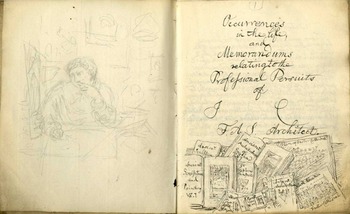
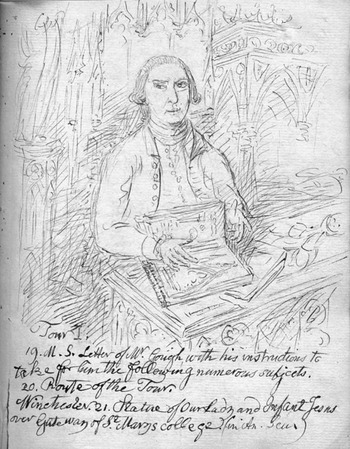
John Carter at his desk and the title page to Occurrences, by John Carter (Reference Carter1817). Source: KCL, Leathes 7/4, i, fols 1v–2

Patrons were of crucial importance, as Carter acknowledged in typically forthright fashion in the introduction to Occurrences:
The principal purpose … of the present Memoir is to give a full list of the Sketches and Drawings as they were made year by year, in which detail the names of each gentleman his patrons who encouraged such labors [sic] are brought forward. Indeed characters of this class should not sink into oblivion, but be held up as an example to excite others to emulate the same laudable endeavours for the advancement of the arts, one great bulwark of the taste, learning and history of the country, when it is considered how many men in affluent possessions dissipate them in enjoyments centred in the actions of the lowest and basest of society.Footnote 5
Although Carter often described patrons in his memoirs as friends, his correspondence shows him more in the role of a paid servant when he was carrying out commissioned work, receiving instructions on subjects to draw, places to visit and people to see, always anxious to please, apologizing when work took longer than estimated and looking for further employment. He was also conscious of his lack of social standing and noted proudly, when attacking the architect James Wyatt, that ‘he who was but plain Mister/ should dare to stand up ’gainst a squire’.Footnote 6
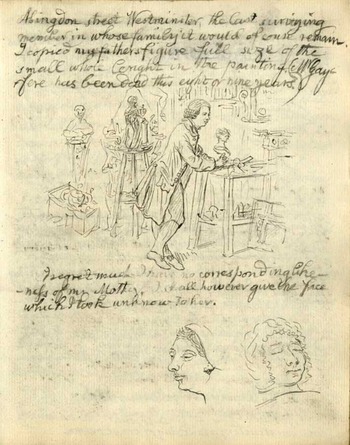
Carter had no private means but came from an accomplished family of marble carvers and sculptors, specializing in church monuments and chimney-pieces (fig 2).Footnote 7 He practised drawing from an early age and used his skills to assist the workmen in the statuary of his father, Benjamin. He had no formal education after the age of twelve, and never learnt any foreign language.Footnote 8 In 1766, when his father died young, his cousin Thomas took over the business; John was left to support himself and was apprenticed to the surveyor and mason, Joseph Dixon. He gained valuable experience with Dixon, going to Exeter, for example, to work on the new bridge in 1770 and 1771, and was also able to make drawings for others, notably the builder, Henry Holland senior (1712–85) (fig 3).
John Carter's father, Benjamin, in his sculptor's yard, Piccadilly, with sketches of his mother, by John Carter (Reference Carter1817). Source: KCL, Leathes 7/4, i, fol 9

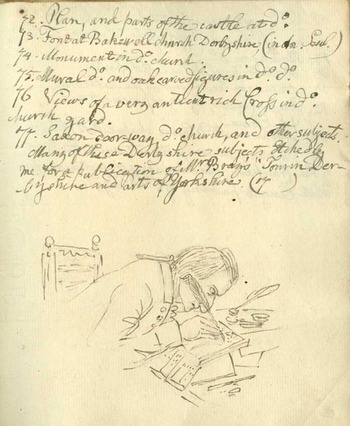
A side view of John Carter at his desk, by John Carter (Reference Carter1817). Source: KCL, Leathes 7/4, i, fol 26

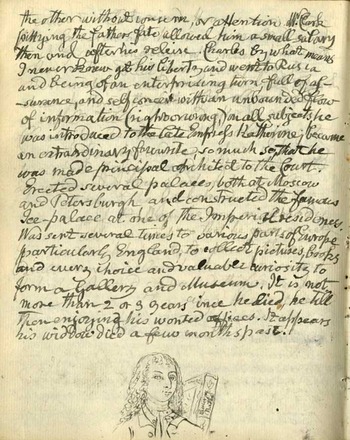
Receiving payment for work could frequently be a cause of conflict. Carter recalled that his first experience of trouble was with the neo-classical architect, Charles Cameron (1745–1812). Cameron employed him in 1772 to colour several sets of his lavish publication on Roman baths, ‘for which I with great difficulty obtained money; of course he became my inveterate enemy as some of his writings sufficiently manifested’ (fig 4).Footnote 9 Four years later, a dispute with a client led to arbitration. By then, Carter was producing all the drawings and most of the designs engraved for the Builder's Magazine, published by Francis Newberry between 1774 and 1778. John Fenwick of Bywell Hall, Northumberland, first insulted him by offering a ham or piece of salmon for his design for a villa published in the magazine.Footnote 10 However, always anxious to develop an architectural practice and ‘eager to catch the opportunity for such employ’, the following year Carter completed sixteen more designs in detail as a private commission. For these, Fenwick eventually offered five guineas after four requests for payment. At arbitration, Adams and Pain, architects, awarded Carter twenty-five guineas, and the issue clearly rankled in his mind sufficiently for him to record it forty years after the event.Footnote 11
Charles Cameron, by John Carter (Reference Carter1817). Source: KCL, Leathes 7/4, i, fol 12v

The final part of the Builder's Magazine was issued in October 1778, the same year that the Dixon Brothers firm of builders went bankrupt. Carter earned some income making drawings for booksellers, but was paid so little for his work ‘that he vowed he would never do any thing more for a bookseller, but would get into something that would set him above the power of such people’.Footnote 12 Where possible, in the future, he published his drawings himself and learned etching to avoid having to pay engravers. He must have found it difficult to earn a living during this period, but his enthusiasm for recording medieval sculpture and architecture and his exceptional abilities as a draughtsman brought Carter to the attention of several influential antiquaries. He had been drawing buildings since the age of sixteen, when he made a sketch of the ‘Herald's Tower’, Windsor Castle, in 1764, and had been exhibiting drawings at the Society of Artists from 1765.Footnote 13 While working for the Builder's Magazine, he had travelled the home counties as far as Hampshire (1774), Gloucester (1775) and Peterborough (1777). In 1777 and 1778 he was making drawings in Westminster Abbey; and according to one obituary, ‘the dignitaries there saw his talents and introduced him to the world of antiquaries’.Footnote 14
Patrons
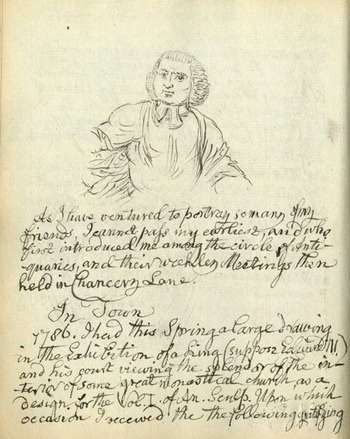
Carter claimed in his Occurrences that it was the Revd Michael Lort (1724/5–90) to ‘whose attention and patronage I owe the first insight and encouragement to follow the study of Antiquity’. Lort ‘first introduced me among the circle of Antiquaries and their weekly meetings then held in Chancery lane … during his life I ever continued to receive notice, and had every recommendation to gentleman amateurs, for employ and notice’ (fig 5).Footnote 15 Lort was chaplain to the Archbishop of Canterbury from 1779 to 1783 and librarian from 1785, a Council member and Vice-President of the Society of Antiquaries and in touch with many scholars and collectors.Footnote 16 The Society's minutes note that Carter was introduced by Lort as a visitor on 13 April 1780, showed examples of his work and was directed to draw exhibits produced at the previous meeting for publication in Archaeologia.Footnote 17 The Society was then preoccupied with the move to Somerset House and Carter did not receive any more commissions until a few years later. More important at the time were the introductions to Richard Gough (1735–1809) and Horace Walpole (1717–97), both close friends and correspondents of Michael Lort.
The Revd Michael Lort, by John Carter (Reference Carter1817). Source: KCL, Leathes 7/4, ii, fol 18v

1780 proved to be the turning point in Carter's career, when his abilities were first recognized by a range of wealthy patrons. From this year, and for the next twenty years, he was employed by Richard Gough to illustrate his own publications and chiefly for his privately published Sepulchral Monuments of Great Britain (1786–96) (fig 6). Gough paid handsome tribute to Carter in the preface: ‘nor must I forget how many specimens are contributed to this Collection by Mr. John Carter, whose rising talents I had hailed with predictive applause, and to whose merit I am always ready to do justice’.Footnote 18 Gough was a tireless crusader for raising the standard of the visual recording of Britain's medieval past, arguing that Gothic architecture could not be understood without close observation of its remains, as well as documentary records. His support and encouragement were crucial in the Society of Antiquaries, as he held the key position of Director for twenty-six years and was thus responsible for publications from 1771 to 1797. Carter kept him informed of the good progress he was making on his 1780 tour, which took in St Albans, Stamford, Bedfordshire, Rutland and, most productively, Peterborough and Croyland, Lincolnshire, writing on 5 September:
I arrived at Stamford last monday week, Tuesday I spent in taking St. Leonard's Hospital, Grey-fryers gate, two porches and an antique archway – wednesday, thursday and Friday I was at Tickencote … Saturday morning early I set off for Peterborough waited the same morning upon the Bishop who treated me in the kindest manner and has with the Dean give'n me orders to make some designs for a screen and an altar piec [sic] … I had the honour to Breakfast with his Lordship on Sunday morning who then gave me a letter of Recommendation to the Earl of Exeter. I intend when I have finished here which will be by fryday or saturday to go to Croyland and Thorney …Footnote 19
Richard Gough (from memory, as he was ‘ever averse to having his likeness drawn’), by John Carter (Reference Carter1817). Source: KCL, Leathes 7/4, ii, fol 6

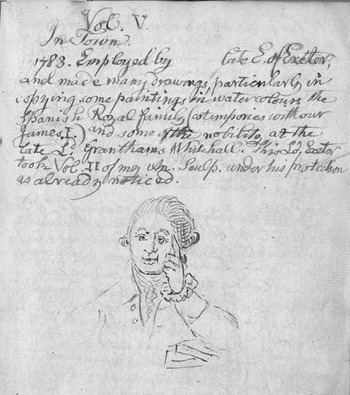
Carter's tour proved a great success. His drawings and measured plan of Tickencote Church, Rutland, with its Romanesque chancel show a remarkable ability to distinguish Gothic from earlier styles of architecture as well as to record medieval polychromy.Footnote 20 His designs for screens at Peterborough Cathedral were accepted.Footnote 21 In Peterborough he met Dr Palmer, who owned a head of Henry iii, carved in oak, from Barnwell, Northamptonshire. Carter was able to tell Horace Walpole, via Lort, that Palmer wanted to dispose of it, and to send him a drawing. Walpole subsequently purchased the head for the Armory at his Gothic Revival house at Strawberry Hill.Footnote 22 The introduction to Brownlow Cecil, 9th Earl of Exeter (1725–93), was also fruitful (fig 7). Carter did a series of views of Burghley House for him and was able to dedicate the second volume of his Specimens to the earl.Footnote 23 His recording of medieval buildings became more ambitious at Croyland Abbey. He sent Gough a finished drawing of the west front, the quality of which so impressed Gough that he organized a subscription to have it engraved. Gough had a particular affection for Croyland as ‘the spot whence my career of antiquarian pursuits literally began in 1756’, and praised Carter's work in the preface to his history of the abbey:
The desire to do justice to those almost Grecian figures that decorate its splendid front suggested the idea of prompting Mr. John Carter to make a sketch of it when he was in those parts the summer before last. This industrious young man, into whom I thought the spirit of Vertue was passed … executed his commission, and produced what, at the distance of near twenty years, seemed a very faithful drawing and deserving to be engraven as the surest mode of preserving these elegant morceaux.Footnote 24
Brownlow Cecil, 9th Earl of Exeter, by John Carter (Reference Carter1817). Source: KCL, Leathes 7/4, ii, fol 1

Carter's industry, however, had a serious effect on his health. Lort told Walpole that he was brought close to death by a ‘Crowland ague’, and the fever was still troubling him three months later. The two powerful purgatives he took – scammony and calomel – probably made him feel worse.Footnote 25
After Croyland, Gough employed Carter frequently, often sending him detailed instructions as to which monuments to draw and, in the case of St Joseph's Chapel at Glastonbury, for example, suggesting he removed the ivy from the south door so as to make a complete drawing of the mouldings.Footnote 26 Removing ivy was not popular with owners of ruins, as visitors preferred the picturesque view. Carter was told by one proprietor: ‘I value my ivy more than this my antient building, and had rather behold this luxuriant state of Nature's beauteous foliage, than all those architectural features which you seem to hold as possessing the greater claim’.Footnote 27 Carter's method was to take sketches in pencil on the spot and work them up later into finished drawings in pen and ink or watercolour as required. Although he claimed the sketches ‘are generally in such an unfinish'd state, that they can be of no use but to me, to make drawings from at home, for engraving from or otherwise’, the detail they provide can be of greater use to researchers than the finished work.Footnote 28 John Chessell Buckler, the son of his friend and fellow artist, John Buckler, said his style of drawing was ‘peculiarly his own’. Some he thought ‘admirably executed’, and he often preferred ‘their boldness and character’ to the more elaborate copy.Footnote 29
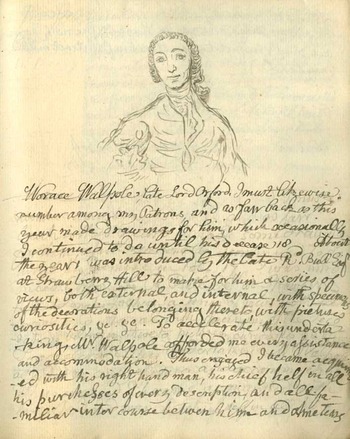
Once the fieldwork had been carried out, Carter was able to supply finished drawings on request. The 1780 tour brought him over thirty commissions in the next five years, in addition to his work for Gough and as well as providing material for his own publications.Footnote 30 Lort's connection with Walpole and his circle of collectors outside the Society of Antiquaries was especially useful.Footnote 31 Carter said he made drawings for Walpole from 1781 and continued until the latter's death (fig 8). It was because of Walpole's patronage that he was able to finish the first volume of his Specimens (1780–94).Footnote 32
Horace Walpole, by John Carter (Reference Carter1817). Source: KCL, Leathes 7/4, i, fol 22

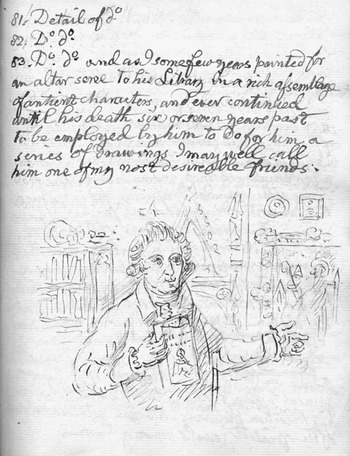
One friend of Walpole's, the wealthy landowner, Thomas Barrett (c 1744–1803), of Lee Priory, Kent, was influenced by him to employ James Wyatt to remodel his house in the Gothic Revival style, ‘a child of Strawberry Hill prettier than the parent’.Footnote 33 He became to Carter ‘one of my most desireable friends’ (fig 9).Footnote 34 Carter had previously supplied Barrett with finished drawings and, in 1785, was asked to visit while in Canterbury to make some views of the house.Footnote 35 Carter was less approving of Wyatt's work when commenting in his Occurrences thirty years later, describing the house as ‘lately modernised or mongrelized in imitation of our Architectural styles’, but he remained on good terms with Barrett.Footnote 36
Thomas Barrett in his library, by John Carter (Reference Carter1817). Source: KCL, Leathes 7/4, ii, fol 16

Barrett's library was much admired by Walpole for having the air of one occupied by a medieval abbot and Carter took immense trouble over painting an altar screen for it, supplying eight paintings between 1789 and 1791 featuring a king, a queen, St George, St Katharine, a priest and a nun. More than most history painters of the time, Carter took considerable care to use genuine medieval examples to provide exact details of costume and architecture, setting out the sources in his letters and revealing a great depth of knowledge of medieval art. The nun, for example, was based on brasses at Elstow, Bedfordshire, and Westminster Abbey, and on an illumination in a missal belonging to Francis Douce and a sculpture in the undercroft of St Stephen's Chapel, Palace of Westminster.Footnote 37 Barrett also used him in 1792 to purchase a major early Flemish painting from Bruges, now in the National Gallery, at a time when these were not yet fashionable. Carter recorded the purchase in his memoirs:
At the beginning of the French revolution, an almost total despersion [sic] of church ornaments took place … the most inestimable performance that has yet to come under my inspection was a painting for an altar by Mabuse, of a bishop and a saint in converse and a monastery in the distance: it was perfect and so highly and elaborately finished that the art of man seemed expended thereon. It was sold at a sale in Charles St Berkeley Sq 17. [the last two digits of the year are missing in the ms] for 10 guineas to me as purchaser for Mr Barret who in his Collection pictures etc at Lee esteemed it one of the greatest jewels among them.Footnote 38
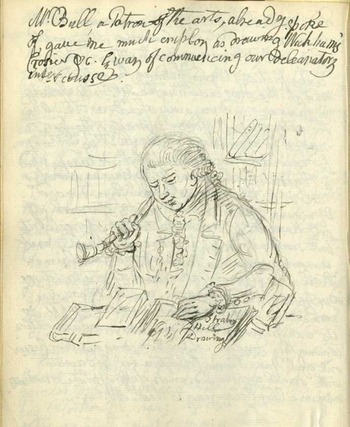
Another patron from Walpole's circle was Richard Bull (1721–1805), one of the most active collectors of the period, who is credited with starting the fashion for extra-illustrating books (fig 10). When he was unable to find the engravings he wanted, he ordered watercolours from a number of artists.Footnote 39 He commissioned Carter to make a series of over fifty views of Walpole's house at Strawberry Hill, with its contents, in about 1788.Footnote 40 Walpole provided him with ‘every assistance and accommodation’; and Carter became acquainted with the ‘honest, friendly’ Thomas Kirgate, Walpole's printer and ‘right-hand man’ (fig 11).Footnote 41
Richard Bull with ear trumpet, by John Carter (Reference Carter1817). Source: KCL, Leathes 7/4, ii, fol 17v

Thomas Kirgate, Horace Walpole's printer and ‘right-hand man’, by John Carter (Reference Carter1817). Source: KCL, Leathes 7/4, i, fol 22v

Also outside the Society's Fellowship at the time was Dr John Milner (1752–1826), ‘my greatest friend and patron’ (fig 12). After studying for the priesthood in France, Milner came to London in 1777; one of the first Catholics he attended was Carter's maternal grandfather, John Jameson. Carter felt ill-equipped to write the notes to the etchings published in his Specimens and persuaded Milner to provide several sections of text in the parts published between 1781 and 1794. At this time, Carter was more concerned not to upset people of importance and less agitated by changes to medieval fabric than he later became. Milner complained to Gough in 1790 that his account of St Cross Hospital in Winchester had been mutilated by Carter, even substituting a kind of approval of the destruction of the south end of the building instead of the polite censure Milner had passed on it, ‘merely from an apprehension of giving offence to the present Master’. Milner, on the other hand, said he was happy to follow Gough in opposing those who were giving ‘a modern air to the monuments of antiquity’.Footnote 42
Dr John Milner, by John Carter (Reference Carter1817). Source: KCL, Leathes 7/4, i, fol 20

Milner proved a strong influence on Carter; and the two of them became the fiercest advocates of the belief that Gothic architecture originated in England. Carter, for his part, claimed his requests for historical accounts had given Milner ‘a strong propensity’ to the pursuit of antiquities and Milner was eventually elected a Fellow in 1798 after writing a history of Winchester. Milner was also an uncompromising campaigner for orthodox Catholic views and opposed the opinions of liberal Catholics such as Sir Henry Englefield (c 1752–1822), another ‘old and firm friend’ of Carter's.Footnote 43
Whereas Milner seems to have encouraged Carter's more extreme views, Englefield's help was more practical. He was an amateur artist himself, a patron of several artists and a polymath (fig 13). They seem to have met when Carter was working for Leigh and Sotheby's, booksellers, shortly after Englefield's election to the Society in 1779. His patronage became increasingly important as Englefield's position in the Society rose. Carter acknowledged both his ‘kind civilities’, his encouragement of others to give him work and his willingness always to allow him admittance as a visitor to the Society, until securing his election in 1795.Footnote 44
Sir Henry Englefield, by John Carter (Reference Carter1817). Source: KCL, Leathes 7/4, i, fol 21

Apart from Lort, Gough and Englefield, three other antiquaries were particularly important in supporting Carter's work of recording in his early years: William Bray, Thomas Strong and William Seward. William Bray (1735/6–1832) was a lawyer and future Treasurer of the Society who, in 1782, employed Carter to copy monuments in Eaton Bray Church, near Dunstable, as well as views for the second edition of his Sketch of a Tour into Derbyshire and Yorkshire (1783). Bray sent him detailed instructions on what to look for, including prehistoric sites, as well as how to get to their often remote locations:
A mile on the right of Newhaven, towards Winster is a Druidical circle, the stones which composed it are all thrown down – a Barrow joins it on one side take a plan and view … A mile from it, at a place called Bircher [Birchover] is Router a remarkable heap of immense stones, a rocking stone on the top. An old man in the place will act as a guide …he will also show you a circle of stones on Hastlemoor called the 9 Ladies [Stanton Moor]. From Hathersage get a guide for the day as otherwise you may find bogs in the way.Footnote 45
Bray in turn seems to have helped Carter with legal matters.Footnote 46
Another lawyer, Thomas Strong (1736–94), had a particular interest in church monuments, wrote notes for Carter's Specimens and commissioned him to provide finished drawings of St Bartholomew the Great, which Carter had visited in 1781. Strong then gave the drawings to the Society, which had two of them engraved for Vetusta Monumenta, according to Carter ‘with alterations and mistakes’.Footnote 47 Carter frequently complained about the quality of engravings, noting, for example, that the drawing he had made for A C Ducarel's History… of St Katharine near the Tower (1782) ‘as well as others which gentlemen have had engraved, have none been executed to my satisfaction’.Footnote 48 Strong exhibited and presented to the Society other drawings by Carter which he had purchased, of monuments in Hitchin Church, praising his abilities as ‘the ingenious and very accurate draughtsman’ in a letter to the Secretary.Footnote 49
William Seward (1747–99), a friend of Samuel Johnson, was acknowledged by Carter as ‘one of the first patrons of my labours’ (fig 14). He was one of those wealthy gentlemen approved of by Carter for using their fortunes to patronize the arts. Carter supplied him with a drawing of the bust of Alexander Pope by Rysbrack, which he owned, as well as views of monuments in Peterborough Cathedral and Westminster Abbey.Footnote 50 He was also a member of the Society's Council on 26 February 1784, with Michael Lort and Richard Gough, when it was proposed that Carter should be elected as Draughtsman. This was an important recognition of his talents, and he became the first in a series of draughtsmen employed by the Society who copied antiquities with a skill rarely seen in England before this time.Footnote 51
William Seward, by John Carter (Reference Carter1817). Source: KCL, Leathes 7/4, i, fol 23v

The Society of Antiquaries
The Society's Council had decided in 1777 that exhibits at meetings could be retained with the consent of the owner, so that they could be drawn at the discretion of the President with a view to publication in Archaeologia. The idea was taken further by Edward King in 1784, after he had replaced Dean Milles, who had died in office, as President. King proposed, among other reforms, that a draughtsman should be present at every meeting to draw ‘whatever fragments of Antiquity should be put into his hands’. Carter was appointed on 19 March, having already been given a few subjects to work on, but he must have indicated that he could not always be present and John Sanders (1750–1825) was appointed joint draughtsman on 2 April.Footnote 52 At the Anniversary meeting, the Earl of Leicester was elected President and Sir Henry Englefield was elected to Council for the first time. Carter's relationship with the Society began well, with Council agreeing to his costs for recording monuments at Winchester Cathedral during the summer and commissioning several other drawings of antiquities.Footnote 53 He completed at least nine subjects in the following twelve months, including such major finds as the Bronze Age shield from Moel Siabod, near Capel Curig, Conwy, exhibited on 9 December and now in the British Museum, and the Romanesque bronze plaques known as the ‘sleeping soldiers’, now in the Burrell collection.Footnote 54
However, the honeymoon period did not last long and Carter appears to have become an early victim of the disputes between rival factions that afflicted the Society over the next thirty years. He also displayed the personality traits that were to make him many enemies: a tendency to over-react, a determination to speak out whatever the consequences and an unwillingness to compromise. The issue on this occasion concerned whether he should have been given the major commission to copy the wall painting in Cowdray House, Sussex, depicting the coronation procession of Edward vi. The work was given to ‘the very modest, well-behaved’ artist, S H Grimm (c 1733–94), who was paid £52 10s – far more than Carter had ever received from the Society. Grimm was a reasonable choice, as he had worked for the Society before and was making sketches in Sussex for Sir William Burrell.Footnote 55 Nevertheless, Carter was clearly upset by the decision and wrote to the Secretary that, as Draughtsman, he had the right to expect the employment. The minutes recorded that he ‘thought himself injured and disgraced; & therefore had not begun the subjects proposed by the Council to be executed by him, nor does he ever intend it; & further mentions, that he will neither attend the Council's nor the Weekly Meetings of the Society any more’.Footnote 56
Carter claimed in his Occurrences that he believed Edward King ‘taking umbrage at some observations of mine ever after during his lifetime shewed a hostile disposition towards one … Mr King … made much ill will prevalent in the body, forming a kind of two parties, which in fact have never since intirely united’.Footnote 57 These were perceptive remarks, echoed by other commentators. The Presidential election of 1785, in which King lost to Lord Leicester, was the first to be contested in the Society. It has been suggested that deeper political reasons underlay the conflict, and quite possibly the hand of Sir Joseph Banks, President of the Royal Society and elected to Council in 1785.Footnote 58 The reason for employing Grimm rather than Carter is not given in the minutes, as the decision was made during the summer recess. After receiving Carter's letter, Council merely accepted his resignation and recommended that Dr Lort should speak to him on the subject. Banks and King were present at that meeting, as were Gough and Lort of his supporters, but Gough did not approve of the series of historical prints for which the drawing was intended, because the subjects were not medieval and he thought the cost of producing the prints too expensive. The outcome was that Carter received no more work from the Society for the next five years. In this period, Sanders, Grimm and Schnebbelie were paid about £400 for drawings, although Sanders was dismissed for over-charging in 1787.Footnote 59
Carter's private patrons provided him with plenty of work, however, and to encourage even more he began publishing an inventory of past subjects that he had sketched and from which finished drawings could be supplied. By 1785 he had a stock of nearly 700, which were all listed (accompanied by 119 small etchings) in his series of Views of Ancient Buildings, issued in parts between 1786 and 1793. The first edition of this work gave the names of the patrons for whom he had already provided fair copies. He was also occupied with publishing Specimens of Ancient Sculpture, and one reason he gave in 1786 to the collector, Richard Bull, for not finishing all the drawings requested of him was that he was working on the frontispiece of the first series, which was nearing completion, for exhibition in the Royal Academy.Footnote 60 This was the large drawing of Edward iii and his court viewing the splendour of some great monastic church. Gough wrote to him afterwards to compliment him.Footnote 61 He continued with a second series, publishing etchings of numerous of his drawings, but found it increasingly difficult to rely on other contributors for the text and publication ceased, with the work incomplete, in 1794.
Carter's annual sketching tours were continuing to supply material for Richard Gough. The 1784 tour took in Hampshire, where he drew monuments in Winchester Cathedral, as well as Glastonbury and Hereford, where he drew the Mappamundi while it was still displayed as a triptych.Footnote 62 He also witnessed the ‘extraordinary sight’ of Edward Jenner's unmanned hydrogen balloon ascending from Berkeley Castle, while he happened to be there sketching. Earlier in the year, he had recorded the scene at Westminster Abbey during the Handel Commemoration festival.Footnote 63 In 1787, he went to Ashridge House, Hertfordshire, the residence of the Duke of Bridgewater, and made drawings ‘very slyly taken not being permitted to make any regular or necessary sketches’.Footnote 64 The same year he toured East Anglia and copied, for Sir John Fenn, three fine fourteenth-century painted panels (since lost) from Ingham, Norfolk.Footnote 65 In 1788, he was back in Gloucestershire and visited Fairford: ‘no church that I have seen is in such good presentation or kept so neat’.Footnote 66 In 1789, he was in Hampshire and the Isle of Wight and the following year went further north than before, to Yorkshire, sketching at Fountains Abbey and York Minster, where he was able to record the choir stalls and screen before they were destroyed by fire.
However, it was London, and particularly their concerns over the state of the Palace of Westminster, that enabled his friends to bring Carter back into employment within the Society of Antiquaries. Proposals had been made to demolish the old buildings and the Society responded in June 1790 by commissioning Carter to make ‘drawings of such parts of the Palace of Westminster and its dependencies as shall appear to them worthy of preservation’.Footnote 67 It may be no coincidence that Gough (as Director) and Englefield were on the Council at the time and that Banks and King were not. Carter's efforts became focused on St Stephen's Chapel after it became apparent that there were no plans or sections available. By July 1791, the decision to publish had been made. As a model of what could be achieved, the architect, James Murphy, had made detailed drawings of the Dominican monastery at Batalha, Portugal, in 1789 and several of these were exhibited to the Society in January 1792 and later engraved.Footnote 68 In July, additional drawings were ordered from Carter. Despite the difficulty of seeing the medieval features behind interior wainscoting and exterior additions, Carter was able to produce fifteen finished drawings by 1793. Englefield claimed later that it was John Topham, the Society's Treasurer, who proposed their publication, thus making available more measured and detailed drawings of St Stephen's than were extant for any other medieval building in Britain at the time.Footnote 69
It was Englefield, however, who was the prime mover behind the larger scheme to provide similar engravings for cathedrals and abbeys. He was a member, and later Secretary, of the Society of Dilettanti, which had published large and detailed surveys of ancient Greek sites.Footnote 70 The Surveyor General, Sir William Chambers, FSA, had argued for ‘a correct publication of our own cathedrals … before they totally fall into ruin’; and in April 1792, the Society agreed to commission artists ‘to make architectural drawings of the different Cathedrals and other religious houses in the Kingdom’.Footnote 71 At the same time, Thomas Underwood was appointed draughtsman (replacing Jacob Schnebbelie, who had died) with permission to attend meetings, but it was made clear that the Society could employ any other artist it saw fit. Three months later, Englefield presented Council with a plan for the direction of the artists that he had drawn up with Joseph Wyndham, another member of the Society of Dilettanti.Footnote 72 Having seen what the Dilettanti had been able to achieve in the eastern Mediterranean, Murphy in Portugal and Carter for St Stephen's, Englefield proposed the same degree of accuracy and detail for England's major ecclesiastical buildings. The Antiquaries had previously published James Essex's plans, elevations and sections of the Round Church in Cambridge and Englefield's own plans and sections of Reading Abbey.Footnote 73 What was now projected was far more ambitious, if only for the size and complex architectural history of the buildings concerned.
The Society ordered 750 copies of Englefield's ‘Report on the proper methods of measuring and drawing antient buildings’ to be printed. The author went into a considerable amount of detail for the benefit of gentlemen ‘whose pursuits had not before led them to this species of drawing’, though ‘superfluous to a professed architect’. He emphasized the need for accurate measurements for ground plans, sections and elevations, showing the differences in doors, windows and columns and the profiles of mouldings. Particular attention should be paid to the curvature of arches and the carpentry of roofs. ‘Everything which is beautiful or peculiar should be collected in the ornamental part’; the more wall paintings, sculptured friezes and capitals recorded, the better. Tombs should also be measured and drawn in utmost detail. In a concession to eighteenth-century taste, Englefield admitted ‘that architectural drawings alone will not suffice to preserve, as they ought to be preserved, our Gothic buildings’ without external and internal views. His strong scientific and practical interests are evident in the two pages of advice on which instruments it were best to use: as well as the usual tapes, weights and rules to measure angles, he recommended a small camera obscura, a sliding 10× pocket telescope with a square of wires and the largest bored fishing rod for measuring inaccessible vertical heights.Footnote 74
Englefield clearly had publication of the cathedrals by the Society as the eventual aim. He formed, with Wyndham, ‘The Committee for superintending the publication of drawings of the ancient ecclesiastical buildings of this country’ and, in 1817, claimed full responsibility for the project:
I can assert with truth that the surveys of Bath, Durham, Gloster, Exeter & Wells, were solely owing to my proposal & influence in the Council of the Soc. of Antiquaries. I drew up the accounts of these Churches & superintended the publication: for the late Mr Windham who was appointed my associate in that business left it entirely to me.Footnote 75
Carter was the obvious choice as artist. He had a passionate interest in medieval subjects, the aspiration to be an architect and the technical skills required. That same year, 1792, he was commissioned to go to Exeter, the first cathedral in the series, taking over 100 sketches. He wrote twice to Richard Gough with accounts of his progress. Hampered by continuous rain, unable to take a north-west view because of the number of lofty trees in the churchyard and quarrelling with people while trying to work on the statues, he nevertheless completed the task by mid-September. One discovery provoked indignation: the state of Bishop Grandison's Chapel (used as ‘The Engine House’ and full of buckets, oil and filth) appalled him so much that he complained to the church authorities. The cathedral Chapter immediately agreed to have a new engine house.Footnote 76
He developed his way of working to take a large number of pencil sketches and measurements, which were then used to provide whatever finished drawings the Society required for engraving. His collections of drawings, now in the British Library, distinguish between views and geometrical elevations. Views were commonly taken by topographical artists, drawn from nature and showing more sides than one in perspective. In geometrical elevations, only one side was shown and measurements were taken, something which was rarely undertaken by others but in which Carter excelled, as far as access and eighteenth-century surveying instruments allowed.Footnote 77 He estimated that finishing the Exeter drawings took him 152 days, not counting mounting them and writing the descriptions. Although only ten plates were engraved for Exeter Cathedral, as against fourteen for St Stephen's, the size and level of detail included were far greater. Plate vii, the West Front screen, for example, and plates v and vi, the two sections, mark a huge advance on anything previously published for an English cathedral.Footnote 78
In 1794 he was at Bath and Wells, in 1795 in Durham and in 1796 at Gloucester. With remarkable energy, he took in Glastonbury and Bristol between Wells and Bath, and visited Stonehenge on his way back from Somerset. There he made eight pencil drawings, giving detailed measurements of individual stones.Footnote 79 Meanwhile, he was also recording monuments for Gough and provided a substantial group of finished drawings for a publication on Dorchester Abbey that was never issued.Footnote 80 By the time he reached Gloucester, where he had to contend with preparations for the triennial music festival, the effort was taking its toll on his eyesight and his state of mind. In a remarkably emotional letter, he apologized to Gough for not replying sooner:
I went up yesterday evening to see an ancient bath in a field beyond Lanthony abbey … a gentle stream runs from it into a stone coffin … where I bathed my eyes three times, I thought of former days when … the old monks & fryers used to wash themselves at this spring, however Sir, if the water did not clear my sight, it refresh'd my memory, and I thought of you Sir, and indeed dream'd of you Sir last night … these fancies natural enough to me whose whole attention is now taken up with objects which forcibly present the manners of old times … I am generally so exhausted in the evening that I am glad to take some refreshment and hurry to bed …
I have much plague to combat with the people of the church who are preparing for the music meeting they throw much hindrance in my way – the dignitaries unlike those of Exeter & Wells – walk afar off and see me notFootnote 81
The work was time-consuming and expensive. Gough asked in 1797 if he would undertake to make drawings of St Albans for him in the same manner as the cathedrals and finished as Dorchester. Carter replied that he received £140 for his drawings of Exeter, and that St Albans would require as much work or more. He would ‘need a month or so. I could not promise to finish in less than two years having to work on Durham, Wells and Gloucester etc’.Footnote 82
Some years later in his comic verse, Persuits of Antiquaries, Carter (‘Retrac’ in the verse) wrote of the trials he faced in the course of his work at Bath, the crowds around the abbey that hampered his progress, the dangers of climbing the tower to measure the different parts and the necessity of lying on his back to record the tracery and enrichments in the ceilings and groins with care and precision:
He sketches this, he sketches that,
Some wondre'd what the man was at,
To see him staring ‘like at naught’
And then he falls! In trap he's caught,
Which wicked boys had sett for owls …
He heed not broken bones or shines,
So he can draw the various lines
That ‘fore him stand in magic guise
All ills he scorns, all jeers defys …
Bath's abbey church he did attack it
Bath's a place for noise and racket …
Retrac now is star'd at, flouted
And from his labours oft is routed,
But when he finds the rabble gone
Again he draws the sculptured stone
Now view him clime the tower high
Now on his back behold him lye!Footnote 83
Carter's dedication to the task and support from influential members of the Society nevertheless brought him election as a Fellow in 1795; again, Persuits records his evident pleasure and surprise:
Retrac was when least expected
Of the Society made a member
And to shew how I remember
One black ball alone was countedFootnote 84
His testimonial was read on 29 January 1795, as ‘late Draftsman’ and ‘well known by many curious and valuable works on the antient Architecture, Painting & Sculpture of this Kingdom’. He had an impressive list of supporters, beginning with the President, Lord Leicester, and including Sir Henry Englefield (Vice-President), John Topham (Treasurer), John Brand (Secretary), Joseph Wyndham and P H Leathes.Footnote 85 He was elected on 5 March ‘through the influence of Sir Henry Englefield’, according to his Occurrences, and claimed to have attended every Thursday meeting thereafter.Footnote 86 As a professional draughtsman, he was always described by the Society as Mr John Carter, the only Fellow not to be given his title, or Esq., until another professional artist and non-Academician, John Buckler, was elected in 1810.
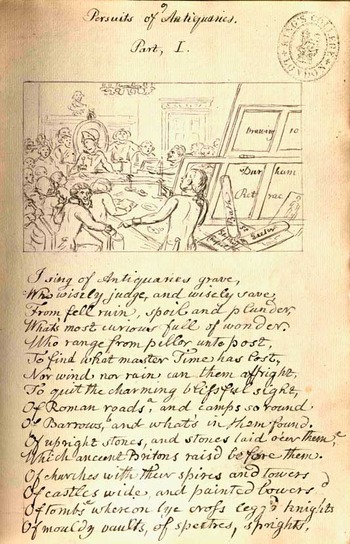
The commissions to record English cathedrals enabled Carter to witness changes to the ancient fabrics that horrified him; election to the Society gave him a platform for his views and the confidence to speak out. In particular, he was incensed by alterations taking place at Durham, discovered during his visit in the summer of 1795. His report to the Society later that year was received quietly. In 1796 he spent the summer at Gloucester, however, and while he was there he had an argument with one of the dignitaries from Durham and suggested mischievously that ‘for the good of trade, it might be necessary to have a little downfall’, as had happened at Hereford, where the towers had collapsed a few years earlier.Footnote 87 The controversy erupted the following year when he began exhibiting his finished drawings of Durham over a number of successive meetings at the same time as the architect for the cathedral, James Wyatt, was being proposed for election (figs 15 and 16). After Carter had shown his drawing of the Galilee Porch at the West Front and attacked Wyatt for demolishing it, Wyatt was blackballed.
John Carter exhibiting drawings in the meeting room of the Society of Antiquaries, Somerset House, in 1797, and Part i of his Persuits of Antiquaries (c 1800). Source: KCL, Leathes 7/5, fol 9

Carter at Salisbury, Romsey and Durham, by John Carter (c 1800). Source: KCL, Leathes 7/5, title page

Carter gave his side of the story in his Persuits. Using the image of the Society's emblem, the lamp of knowledge, he claimed it had been blown out by discord but he could light it again and save the Society from disaster (fig 17). He accused Samuel Lysons – ‘this angry boy’ – of launching a torrent of abuse at him after the meeting:
Twas your damn't drawing, you'll repent it
You'll wish to old Nick you'd sent itFootnote 88
The lamp of the Society of Antiquaries, by John Carter (c 1800). Source: KCL, Leathes 7/5, fol 7v

Carter discovered later that this part of the cathedral had not been demolished; the roof had been taken down on his last day there, and he had assumed the rest would follow. He admitted at a November meeting that he had been wrong, although he argued that other parts had been removed, or were threatened, by Wyatt's proposals. The President, Lord Leicester, ‘pale and much agitated’, condemned Carter's conduct and ‘lamented that he had given a vote to make a servant of the Society, by electing him a Member, an opportunity to dictate to his Masters’. Wyatt was elected by a large majority at a later meeting, although his plans for further demolitions at Durham were abandoned. The issue divided the Society: on one side, Banks was reported as wanting Carter expelled, while on the other, Gough resigned as Director.Footnote 89
Samuel Lysons, Gough's successor as Director, was no friend of Carter nor of Englefield. Conflict flared up again during the disputed presidential election of 1799. According to Carter, those who wished to protect antiquities were named the ‘Popish Party’; elsewhere they were branded as the ‘Gothic’ or ‘Catholic’ party. He described their opponents, who were willing to see ancient buildings knocked down, as the ‘Presbyterian clan’, supported by ‘money bags’ and organized by Lysons. Carter was firmly on the ‘Popish’ side but, as he declared in the Gentleman's Magazine, was not a Roman Catholic, and neither was Richard Gough, who held similar views on preservation.Footnote 90 However, it soon became apparent that religious prejudices and party factions would affect both Carter's freedom to exhibit drawings of his choice and the progress of the cathedral series. At the end of 1799, he tried to show a series of examples of ancient English dress taken from monumental sculptures. Officers objected:
I was told that my Essays and Drawings tended to the encouragement of Popery, and that I was aiming to interest a Protestant Society in affairs relative to so odious and detestible a religion and further I was entering into a league with men from whose necks the halter had been just taken, men whom good Protestants ought to fly from as pests to Society.Footnote 91
Council resolved on 6 December that drawings should first be delivered to the Secretary. The President undertook to reprimand Carter for his impertinence and Lysons attributed his conduct to madness. Finally, on 7 February 1800, by Carter's own account, he was ordered to remove his easel and box from the meeting-room table and, when he complained, the Treasurer (Topham) said ‘let the popish dog go’ and the Secretary (the Revd John Brand) attacked him in language ‘most violent and indecent’. After this incident, Carter decided to give up advancing any opinion in the Society and not to deal with these officers again.Footnote 92
The breakdown in relations meant that Carter received no new commissions from the Society after Gloucester in 1796. He was not allowed access to St Stephen's, Westminster, for more recording when the wainscoting was removed in the summer of 1800. When a series of engravings was published later to show the newly discovered wall paintings, Englefield carefully pointed out in his notes that, despite the greater difficulty of access, Carter had been more accurate in his drawings than John Dixon, one of the artists employed in 1800.Footnote 93
Englefield and Wyndham remained determined to continue with the cathedral series, despite the growing cost of engraving and publication, and persuaded Council that Carter should be paid to finish off the work he had started. In May 1799, they presented Council with a report on progress. Exeter and Bath were already published and Durham was ready for engraving. They recommended that Carter make additional sections ‘as more particularly necessary from the circumstance of many intended alterations’. On the thorny issue of the accompanying text, they recommended that ‘especial care will be taken to avoid anything which can give offence or be considered as of a personal nature’. As for Gloucester and Wells, Carter had made measured sketches for which he had received no payment ‘but the notes and measurements … would be of very little, if any, use to any other person, from the difficulty of understanding the meaning of the numerous notes and marks made by the artist’. They therefore proposed that he be paid the agreed rate of 15 shillings a day for the time already spent and the same rate for finishing the drawings at home. Council would determine which drawings were required for publication.Footnote 94
Durham was duly published in 1801. When the issue of raising subscriptions came up in 1802 to pay for continuing the series, Carter claimed that some opposed the ‘great work of the Cathedrals’ as ‘not of that importance … (insinuations flying about the room that to encourage such subjects were to encourage the cause of Popery etc)’, that there was a ‘“Popish Plott” of bringing into notice once more those “relicts of superstition” the Cathedrals of this Kingdom’.Footnote 95 Englefield's committee nevertheless asked him to finish Gloucester in 1803 and Wells in 1806. Gloucester was published in 1809 and the drawings for St Albans, given by Gough in 1805, were finally published in 1813. Only seven drawings for Wells were completed by 1808 and they remained unpublished for two centuries.Footnote 96
Afterwards, Carter attended meetings, and drew exhibits for himself and details of costumes from the paintings loaned by George iii.Footnote 97 However, he took no further part in Society affairs until his main supporter, Englefield, became President in 1811. A few months later, he read a paper and exhibited drawings on Steyning Church, Sussex, which the two of them had visited in 1807.Footnote 98 Englefield was Acting President from 6 August 1811 to 23 April 1812 and believed his support for Carter was one reason for his failure to be elected in 1812. Later, he expressed his feelings privately in a letter to James Hore, who was writing Carter's obituary:
My constant support for Mr Carter when the unhappy dissension arose in the Society which terminated in my expulsion from the office of President & the utter decay of the Society & the abolition of the plan of publishing those great works [the cathedral series] which as you truly say were an honour to the Society, was no small cause of the enmity of the persons professing themselves the friends of Mr. Wyatt, bore to me … As the papers I writ in the Gentleman's Magazine in defence of Mr Carter [had?] not my name perhaps it would be better not to mention them. To you I will say that the letters signed ‘A new correspondent’ were mine.Footnote 99
Later Patrons
Englefield was not the only one to continue to support Carter. Gough was still suggesting places for him to visitFootnote 100 and other patrons were keen to employ him, even if the Society of Antiquaries was not. His most active patron in this period was Sir Richard Colt Hoare (1758–1838), a Fellow of the Society from 1792 and, like Englefield, a member of the Society of Dilettanti.Footnote 101 Between 1799 and 1807, Hoare paid Carter £781 for drawings of Wiltshire and south Wales, in the process forming the largest private collection of his finished drawings.Footnote 102 Hoare was a competent amateur artist himself and gave precise instructions. On Malmesbury for example:
I do not wish to have any distant views taken of the abbey as I mean to do them myself … as the sketches of this work will probably take you a considerable time, I should wish you to attack them when you are fresh and before you go into Wales … for I know by experience after a long tour of much drawing both the mind and hand are not so free as first starting … [I request] fine wove paper … to bind them in album not mount them … have an aversion to Indian ink … prefer a bister [sic, ie bistre/sepia] for more pleasing effect.Footnote 103
Carter's summer tours from 1801 to 1803 were devoted to work for Hoare and resulted in a substantial number of drawings of Malmesbury, Lacock, the monuments in Salisbury Cathedral and south Wales.Footnote 104 In London, in 1801, he was able to record the wall paintings discovered that year on the east wall of Westminster Abbey Chapter House. His watercolour shows much detail that is no longer visible.Footnote 105 His 1802 sketches of the Salisbury Chapter House show all the glass that survived in each window at the time, little of which survives.Footnote 106 In 1806, he also designed an ornamental cottage for Hoare.Footnote 107
Carter's last commission for architectural drawings resulted in his most ambitious project for a single building, but its progress reflected the essential problems of time and cost behind the cathedral series. This was the order from the book collector and MP for York, Sir Mark Masterman Sykes (1771–1823),Footnote 108 for measured drawings of York Minster on the same scale as the cathedral series, but in a greater quantity. Carter spent five months in York in 1806 measuring and making sketches, for which he was reputed to have been advanced £500. The finished drawings must have taken a considerable time to complete. John Britton described them as ‘unique, elaborate and beautiful’. The sale catalogue of his effects claimed that ‘this matchless and truly magnificent work is considered the CHEF-D'OEUVRE of the late Mr Carter, and consists of 24 drawings with 12 sheets of the MS. Description, uniform size on the largest Elephant Paper’.Footnote 109 According to Britton, Carter demanded too high a price for the finished work, which was sold after his death to Sir Gregory Page Turner and then to the Yorkshire collector, John Broadley. Britton was unable to trace them in 1851 and unfortunately their present location is unknown.Footnote 110
At the same time as working for Hoare and Sykes, finishing off the cathedrals he had started and etching large numbers of drawings for The Ancient Architecture of England (issued in twenty-seven parts, 1795–1814), Carter was turning his attention to the study of costume.Footnote 111 This combined his love of the theatre with his interest in church monuments, sculpture and other works of art in an attempt to identify authentic costume, especially from the Middle Ages. He saw the value of tapestries as a source of information at a time when they were becoming increasingly unfashionable as wall coverings, recording, for example, those in the Painted Chamber, Palace of Westminster, in 1799 and protesting against their removal.Footnote 112 A volume of 114 drawings illustrating English costume was compiled over three years from 1809 to 1811 for Thomas Lister Parker, FSA (1779–1858), another Yorkshire collector and a patron of British artists.Footnote 113 Carter concluded modestly that ‘artists more skilled in drawing the human form would no doubt have performed their task with more correctness, but none with more zeal’.Footnote 114 He is said to have intended to publish a book on the subject himself based on monumental effigies; but he gave up the idea when the first part of Charles Stothard's Monumental Effigies of Great Britain was issued in 1811. His only publication on the subject was a short contribution on English ecclesiastical costume to the second edition of Fosbrooke's British Monarchism (1817).Footnote 115 His sketches of historic buildings become less frequent and end around 1809.Footnote 116 It is possible that his sight was deteriorating in his later years. He made an oblique reference to this in 1816, the year before he died, when he expressed the hope of ‘a continued flow of health, and a renewal, within these two years, of my early sight (the greatest of all earthly blessings)’.Footnote 117
Carter was one of many artists in the early nineteenth century who provided illustrations of historic buildings and monuments for wealthy collectors. John Buckler (1770–1851), in particular, followed Carter's meticulous approach to accuracy. They came from similar backgrounds, both beginning their careers working for builders, showing early promise in drawing skills and turning to antiquarian subjects with encouragement from wealthy antiquaries.Footnote 118 They toured together, worked for Sir Richard Colt Hoare and both had trouble with the Society of Antiquaries. Buckler was proposed three times by Englefield between 1808 and 1810 before he was finally elected with the help of Hoare and against the opposition of Banks and Lysons.Footnote 119 Carter's exact archaeological methods, besides making him a poor architect, turned him away from the growing demand for topographical illustrations in popular publications, where artistic effects were important. Introduced to Carter by Hoare, John Britton asked him in 1802 if he would contribute ‘correct drawings’ to his Beauties of England series of volumes and said he should not be put off by the title: ‘we must sometimes flatter in order to instruct … Doctors sometimes gild the health-restoring pi[ll]’. Carter replied that ‘I … cannot be a means to help your efforts in the gilding part of the business … being so unfashionable … where the case of Antiquities is at stake’.Footnote 120
After Carter's death, Buckler's son, John Chessell Buckler (1793–1894), paid tribute to the older man's outstanding abilities as a draughtsman, generously acknowledging his achievements:
By natural genius, invariable perseverance and ready comprehension; scrupulous attention to the principles of the art, and zeal which no threat, no promise, no expectation of profit, no fear of poverty, or opposition, could control, he arrived at the head of his profession, rejecting the stiff unnatural works of former Artists and making those improvements in architectural drawing which have been since followed, and in some respects never perhaps equalled … in copying any portion of an old building, it was not sufficient that every moulding and ornament should agree, but the proportion and place of every stone must follow.Footnote 121
As a result, Carter left a legacy of drawings of immense value to later generations. During the last twenty years of his life, Carter's concerns became less with recording medieval remains and more towards arguing the case for retaining historic features. The eighteenth-century view was that little could be done to save buildings if the owners did not want to and they were best preserved by recording them. Carter and his supporters helped change this attitude, anticipating the preservation movement of the later nineteenth century and earning Carter Buckler's accolade as ‘Antiquity's most resolute friend’.
John Carter Revisited
A postscript by J Mordaunt Crook
Since the publication of John Carter and the Mind of the Gothic Revival in 1995,Footnote 122 new material has come to light relating to Carter's journalism, drawings, patrons and private life. One archive in particular – King's College London (KCL) – has supplied some more specific information about a career that had previously been subject to a good deal of conjecture.Footnote 123 Only a few references to these papers could be included in the brief biography of Carter that appeared in the Oxford Dictionary of National Biography soon after their re-discovery,Footnote 124 so while the main body of this paper deals in detail with Carter's role as an antiquarian draughtsman, his relations with patrons, his achievements as an architectural archaeologist and his importance in the emergence of what might now be termed the conservationist ethic, the opportunity has been taken in this postscript to provide additional information relating to Carter's patrons, drawings, writings, religious attitudes and personal finances.
Buried in the Leathes Papers are several intriguing details relating to Carter's financial circumstances and religious attitudes. Although much of his life consisted of a desperate struggle against insolvency, Carter died comparatively rich. At his death in 1817, he left at least £1,400 in addition to his drawings, which fetched £1,527 at auction in 1818. He might have left much more: only a few months before his demise, he had purchased an annuity for £4,000, money that was forfeited at his death. He had previously starved himself, on the grounds of imagined poverty.Footnote 125
Several letters from Sir Henry Englefield dispose of the legend that Carter was Irish and Catholic.Footnote 126 This was true, however, of his maternal grandfather, John Jameson, to whom Carter seems to have been very close; indeed, he died in Carter's arms aged ‘c 102’, having been ‘a confidential servant’ to ‘Catholic families’. Apparently Jameson ‘assisted’ at the funeral of Sir Christopher Wren. He assured Carter that Wren was ‘a Catholic’: hence, he claimed, the placing of Wren's memorial on the very site of the High Altar of Old St Paul's, and the enclosing of the great architect's ‘heart … in the centre’ of the cross on the dome.Footnote 127 Jameson, apparently, said nothing about Wren's supposed Freemasonry. All his life, Carter was noticeably sympathetic to the plight of Roman Catholics (during the Gordon Riots of 1780, for example), and he supported attempts (by Sir Henry Englefield and Lord Grenville in 1812, for example) to ameliorate their lot. In his quarrel with the Society of Antiquaries in 1800, he was actually referred to as a ‘Popish dog’.Footnote 128 In fact, John Carter seems to have remained an Anglican all his life, and was buried, according to his will, near the south-western corner of Hampstead parish churchyard, close to his mother, Mrs Ann Parker.Footnote 129
Two additions to Carter's architectural oeuvre emerge from the Leathes Papers: ‘a small oratory’ with ‘decorations’ for James Moore, FSA, constructed in 1794–5, and a chapel near Sevenoaks, said to be ‘now completing’ in 1817, with a ‘very curious roof … a genuine specimen of the ancient mode of framing timberwork’.Footnote 130
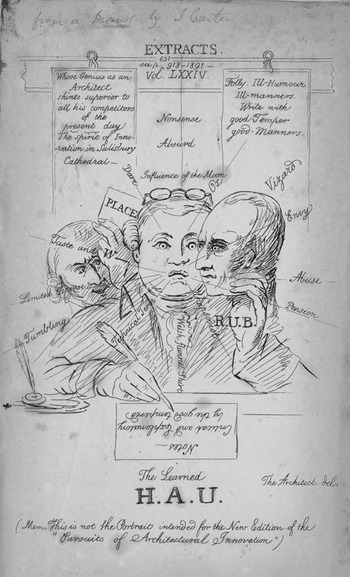
Finally, a previously unpublished cartoon (1804) by Carter has been included here (fig 18), showing his arch-enemy, Dean Vincent of Westminster, unmasked – stripped of the obscure noms de guerre ‘H.A.U.’ and ‘R.U.B.’ that he used when writing in the Gentleman's Magazine. Vincent was a major patron of the architect, James Wyatt, ‘The Destroyer’ (he was even married to a Wyatt), and this cartoon holds the key to Carter's multi-pseudonymous polemics.Footnote 131 The cartoon was found tipped in to the Nichols File of the Gentleman's Magazine, now in the Folger Shakespeare Library, Washington DC.
Ink drawing of ‘The Learned H.A.U.’ (ie Dean Vincent of Westminster), by ‘The Architect’ (ie John Carter), 1804. Source: reproduced by permission of the Folger Shakespeare Library: Call Number AP4.G3 Cage v74, pt 2, 1025, Gentleman's Magazine

ABBREVIATIONS AND BIBLIOGRAPHY
- Abbreviations
- Ashmolean
Ashmolean Museum, Oxford
- BL
British Library, London
- Bodleian
Bodleian Library, Oxford
- GM
Gentleman's Magazine
- KCL
King's College London
- NG
National Gallery, London
- NMR
National Monuments Record
- SAL
Society of Antiquaries of London
Appendix 1: John Carter and the Mind of the Gothic Revival (1995): addenda and corrigenda
pl 2: Carter in his library, Upper Eaton Street, Pimlico (BM, Prints and Drawings 1886, 1012.534).
pl 7:Bingham [recte Martival] Monument, Salisbury.
p 47:Keen was not responsible for the Deanery doorway, Westminster.
pl 29:St George's Chapel, Windsor, looking east.
p 58:Gough was not a Roman Catholic.
Appendix I: Writings in the Gentleman's Magazine; additions and further amendments to Kuist (Reference Kuist1982), The Nichols File of the… Gentleman's Magazine and Lorraine de Montluzin (Reference Lorraine de Montluzin1993 and Reference Lorraine de Montluzin1994) ‘Attributions of Authorship … a supplement to Kuist’:
By Carter:
72 (1802), ii, 1200 (as ‘JC’)
77 (1807), i, 24 (as ‘An Architect’)
79 (1809), i, 136 (as ‘A True Englishman’)
Not by Carter:
62 (1792), ii, 603 [by Carter of Lincoln]
72 (1802), i, 309–11 [unlikely style]
73 (1803), ii, 1176 [unlikely material]
75 (1805), i, 122–3, 304 [by Dean Vincent as ‘R.U.B.’]
79 (1809), i, 405–7, and ii, 827–9 [by Sir Henry Englefield as ‘New Correspondent’]
87 (1817), ii, 311–12 [by Carter of Lincoln]
Appendix 2: John Carter's tours in England and Wales 1770–1809

Carter's sketches in BL, Add mss 29925–41 were re-ordered and bound after the index (BL, Add ms 31113) was compiled. Many of the drawings are undated and some have been misplaced. The correspondence has been extracted and bound as Add ms 29944; the larger drawings have been extracted and bound as Add ms 29943. There are very few topographical drawings after 1803.
Carter's Views (Carter Reference Carter1786–93) list his drawings up to Canterbury 1785. Carter's Occurrences (KCL, Leathes 7/4) finish with Fairford, Gloucs, in 1788.