

Introduction
In 2021, Hong Kong's electoral system underwent its most significant reform since the People's Republic of China (PRC) resumed the exercise of sovereignty over Hong Kong on July 1, 1997. By a decision adopted on March 11, 2021 to “improve the electoral system of the Hong Kong Special Administrative Region and develop a democratic system suited to the actual situation of the Hong Kong Special Administrative Region” (HKSAR), the National People's Congress (NPC) decided to amend the methods of selecting the Chief Executive of the HKSAR and forming the Legislative Council of the HKSAR (LegCo).Footnote 1 The existing Election Committee would be reformed and given a pivotal role in the elections of the Chief Executive and LegCo members. A new candidate qualification review committee would be established to qualify all candidates. The Standing Committee of the National People's Congress (NPCSC) was empowered to amend the first two annexes of the Basic Law of the Hong Kong Special Administrative Region of the People's Republic of China (Basic Law), which specify the methods for selecting the Chief Executive and forming the LegCo.Footnote 2 The HKSAR would amend local election laws to implement the reforms and organize future elections in accordance with the law. The Chief Executive would submit timely reports to the Central People's Government. The NPC Decision was adopted with 2,895 votes in favor and one abstention.Footnote 3
After consulting the Committee for the Basic Law of the HKSAR (Basic Law Committee) and the Constitution and Law Committee of the NPC, the NPCSC unanimously adopted the finalized revisions to Annex I and Annex II of the Basic Law on March 30, 2021.Footnote 4 By Presidential Order, both amended annexes came into force on March 31, 2021.Footnote 5 The new annexes specify the election methods in greater detail than the previous ones. They state that the NPCSC has the power to amend the election methods and the LegCo procedures for voting on Bills and motions, but prior to any amendment, the NPCSC “shall solicit views of various sectors of Hong Kong by appropriate means.”
On April 13, 2021, the HKSAR government gazetted the Improving Electoral System (Consolidated Amendments) Bill 2021, to implement the reforms in relevant local legislation.Footnote 6 The substantial Bill proposed numerous legislative changes, including the delineation of eligible corporate voters in the Election Committee and LegCo election systems, the delineation of LegCo geographical constituencies, and changes to the nomination and voting methods. On May 27, 2021, the LegCo passed (40–2) the 697-page Improving Electoral System (Consolidated Amendments) Ordinance 2021, with most provisions coming into operation on the date of gazettal (i.e., May 31, 2021) and other provisions (or the same provisions for future events) coming into operation on October 22, 2021, May 1, 2022, or the day on which the seventh term of office of the LegCo begins.Footnote 7 This unprecedented passage of a major piece of legislation in such a short time was possible because of the absence of opposition legislators, who either had been disqualified from office or had resigned en masse in protest against the disqualifications.Footnote 8 Elections for the Election Committee subsectors, LegCo members, and Chief Executive were scheduled to take place on September 19, 2021, December 19, 2021, and March 27, 2022 respectively.
Background
The 1984 Sino-British Joint Declaration on the Question of Hong Kong did not specify how the Chief Executive and LegCo members would be selected after 1997, stating only that the Chief Executive would be “appointed by the Central People's Government on the basis of the results of elections or consultations to be held locally,” and the legislature would “be constituted by elections.”Footnote 9 In 1990, when the Basic Law was promulgated, the methods for selecting the Chief Executive and forming the LegCo in the period of the first decade after 1997 were specified in the first two annexes. In addition, Articles 45 and 68 stipulated that both methods would be “specified in the light of the actual situation in the [HKSAR] and in accordance with the principle of gradual and orderly progress.” The articles promised the “ultimate aim” of selecting the Chief Executive “by universal suffrage upon nomination by a broadly representative nominating committee in accordance with democratic procedures” and “the election of all the members of the [LegCo] by universal suffrage.” The 2021 reforms changed only the specifications in the two annexes and left Articles 45 and 68 unaltered.
In April 2004, the NPCSC clarified that any reforms to the electoral methods in or after 2007 would need to follow a five-step procedure: (1) the Chief Executive submits a report to the NPCSC on whether there is a need to amend the two electoral methods; (2) the NPCSC determines whether there is a need; (3) resolutions moved by the Hong Kong government in the LegCo are endorsed by two-thirds majority of all LegCo members; (4) the Chief Executive consents to the motions endorsed by the LegCo; and (5) proposed amendments are reported by the Chief Executive to the NPCSC for approval or for the record.Footnote 10 For the 2021 reforms, a more top-down, two-step procedure was adopted, known as “decision plus amendment.”Footnote 11 In the first step, the NPC makes the decision on improving the electoral system and authorizes the NPCSC to amend the two annexes. In the second step, the NPCSC amends the annexes. The HKSAR then amends the relevant local laws accordingly. The Basic Law Committee approved the change in procedure, noting that it would shorten the time between decision and amendment.Footnote 12
Since 1997, the Chief Executive has been selected on the basis of nomination of candidates by an election committee, and election by the same committee.Footnote 13 Nomination by at least one-eighth of the membership of the Election Committee was required for candidacy, and the successful candidate required the support of more than half of the membership to be elected. Originally consisting of 800 members, the size of the Election Committee was increased to 1,200 members for the 2012 Chief Executive election. Membership was divided equally across four sectors, covering: (1) industrial, commercial and financial subsectors; (2) the professions; (3) labor, social services, religious, and other subsectors; and (4) persons in political office, such as LegCo and District Council members. Most of the subsectors mirror the functional constituencies introduced in 1985 to give the LegCo some elected members.Footnote 14 For example, there are separate functional constituencies and Election Committee subsectors for lawyers and for corporate members of the Hong Kong General Chamber of Commerce. In the 2016 Election Committee subsector elections, there were 230,073 registered individual voters and 16,367 corporate voters.Footnote 15
The first term of the LegCo of the HKSAR was elected in 1998 with ten members returned by the Election Committee, thirty by functional constituencies, and twenty by geographical constituencies by direct elections. By 2004, only functional and geographical constituencies were used to return an equal number of thirty members each. In 2012, LegCo's size increased to seventy members, again with an equal number coming from the functional and geographical constituencies. The same process was repeated in the 2016 election. In 2012, a significant reform introduced five ‘super-seat’ functional constituencies, the electorates of which consisted of the 3.2 million registered voters without a second vote in the traditional functional constituencies. Candidates were drawn from District Council members.Footnote 16 With the five super-seats, added to the 35 elected by geographical constituencies, the proportion of legislators elected by popular vote was 57 percent. In the 2016 LegCo functional constituency elections, not including the super-seats, there were 223,972 registered individual voters and 15,752 corporate voters.Footnote 17
In 2004, the NPCSC decided that neither the 2007 Chief Executive elections nor the 2008 LegCo elections would be by universal suffrage, but appropriate amendments that conformed to the principle of gradual and orderly progress were possible.Footnote 18 Similarly, in 2007, the NPCSC decided that the 2012 Chief Executive and LegCo elections would not be by universal suffrage.Footnote 19 However, in the preamble to the same decision, it was held that the 2017 election of the Chief Executive could be implemented by universal suffrage, and only after the Chief Executive was elected by universal suffrage could all LegCo members be elected by universal suffrage. In August 2014, it was decided that selection of the Chief Executive starting from 2017 could be by universal suffrage, but candidates would need the support of more than half of all the members of a nominating committee (akin to the Election Committee) to be nominated.Footnote 20 In June 2015, a proposal for universal suffrage of the Chief Executive in the 2017 election failed to obtain the two-thirds approval of LegCo members because opposition pro-democracy legislators felt the proposal did not establish genuine democracy.Footnote 21
Major Changes to the Electoral System
The reforms bring about six major changes to Hong Kong's electoral system.Footnote 22 First, there is the increase in membership size of the Election Committee and the LegCo. The Election Committee is increased to 1,500 members with a new fifth sector for Hong Kong members of national political bodies and organizations. Twenty more seats are added to the LegCo, bringing the total to ninety members. Second, the proportion of directly elected legislators has shrunk to its smallest proportion ever: 22 percent of all legislators compared with 30 percent when first introduced in 1991. Third, the Election Committee has a more significant role in nominating candidates and electing LegCo members. Chief Executive candidates now require at least fifteen nominations from members in each of the five sectors, although the total one-eighth threshold for nomination remains unchanged. The Election Committee will now elect 57 percent (forty seats) of all the LegCo members, although any LegCo voter who meets the nomination requirements is eligible to run for these elections. Candidates running for any LegCo seat must have two to four nominations from each of the five Election Committee sectors to be validly nominated. This requirement will be a hurdle for opposition candidates as the newly constituted Election Committee will comprise mostly pro-government supporters.
Fourth, there are major changes to the electorate of Election Committee subsectors and LegCo functional constituencies. District Council members are now removed from both electoral systems, as many of them were believed to be carrying out “anti-China and destabilizing activities.”Footnote 23 Corporate voting has replaced a significant degree of individual voting. More members are selected by virtue of their office (ex officio) or by nomination of specified bodies. More officially recognized national and local bodies have been specified as umbrella organizations, whose members are conferred voting rights. Fifth, LegCo geographical constituencies are redrawn with ten instead of five constituencies, and only two members are elected in each constituency by first-past-the-post voting, instead of the previous method of proportional representation.
Sixth, a new Candidate Eligibility Review Committee is established to review and confirm the eligibility of candidates for Election Committee members, the office of Chief Executive, and LegCo members. The committee receives advice and information from the Committee for Safeguarding National Security of the HKSAR and the department for safeguarding national security of the Hong Kong Police Force on whether candidates meet the oath requirements of upholding the Basic Law and swearing allegiance to the HKSAR of the PRC.Footnote 24 Decisions of the committee when made on the basis of such national security advice cannot be subject to judicial review. The Chief Secretary for Administration chairs the committee, which also includes the Secretary for Constitutional and Mainland Affairs, Secretary for Home Affairs, Secretary for Security, and three non-official members.Footnote 25
Objectives of Reform
According to Mr Wang Chen's official explanations of the NPC's Draft Decision, the aim of the reform is to “uphold the principle of ‘patriots administering Hong Kong’,” and the main objectives are to ensure “the administration of Hong Kong by Hong Kong people with patriots as the main body and provide institutional safeguards for this purpose.”Footnote 26 The speech referred to Deng Xiaoping's definition of a “patriot” as “one who respects the Chinese nation, sincerely supports the motherland's resumption of exercise of sovereignty over Hong Kong, and wishes not to impair Hong Kong's prosperity and stability.”Footnote 27 Patriots are not to be parachuted in from the Central People's Government to hold political office in the HKSAR, but should be selected locally in accordance with the “One Country, Two Systems” policy, with Hong Kong people administering Hong Kong with a high degree of autonomy.
According to Wang, upholding the “fundamental principle” is “crucial to the sovereignty, security and development interests of our country and crucial to the sustained prosperity and stability of Hong Kong.”Footnote 28 The “rioting and turbulence” seen in 2019 and 2020 revealed that “the existing electoral system in the Hong Kong SAR has clear loopholes and deficiencies, which the anti-China, destabilizing elements jumped on to take into their hands the power to administer the SAR.”Footnote 29 The LegCo brief to the reform Bill referred to the “opposition forces and radicals” who entered the political structure through elections and
paralysed the operation of the LegCo and obstructed governance by HKSAR Government in accordance with the law; supported and glorified violence outside the Council; and orchestrated plans to gain dominance in the LegCo in order to achieve ‘mutual destruction’, all of which seriously jeopardised Hong Kong's constitutional order and challenged national sovereignty.Footnote 30
The reforms were a response to “remedy the situation.”Footnote 31
Neither the official explanations nor the LegCo brief mentioned whether the reforms would bring Hong Kong closer to realizing universal suffrage. Wang referred to the “imperative” to “guarantee in accordance with the law the right to vote and the right to be elected which are lawfully enjoyed by Hong Kong's permanent residents.”Footnote 32 The LegCo brief contained a bare assertion that the proposals were “in conformity with the Basic Law, including the provisions concerning human rights.”Footnote 33 In future cases, the courts in Hong Kong may need to consider whether the new reforms and reform process are in conformity with Article 21 of the Hong Kong Bill of Rights, which constitutionally protects the right and opportunity of every permanent resident to take part in the conduct of public affairs and to vote and be elected without unreasonable restrictions or distinctions, including one's political or other opinion or other status.Footnote 34
The Fourth Session of the 13th National People's Congress considered a motion by the Standing Committee of the National People's Congress to submit for consideration the Decision of the National People's Congress on Improving the Electoral System of the Hong Kong Special Administrative Region (Draft). The Session was of the view that after Hong Kong's return to the motherland, it was reincorporated into the country's governance system, and the Constitution of the People's Republic of China and The Basic Law of the Hong Kong Special Administrative Region of the People's Republic of China jointly form the constitutional basis of the Hong Kong Special Administrative Region. The electoral system implemented in the Hong Kong Special Administrative Region, including the methods for selecting the Chief Executive and forming the Legislative Council, is an important component of the political structure of the Hong Kong Special Administrative Region, and shall conform to the “one country, two systems” policy, meet the realities in the Hong Kong Special Administrative Region, serve to ensure that Hong Kong is administered by people who love the country and love Hong Kong, and be conducive to safeguarding China's national sovereignty, security, and development interests and maintaining Hong Kong's long-term prosperity and stability. To improve the electoral system of the Hong Kong Special Administrative Region and develop a democratic system suited to the actual situation of the Hong Kong Special Administrative Region, the National People's Congress has made the following Decision in accordance with Articles 31 and 62(2), (14) and (16) of the Constitution of the People's Republic of China, and the relevant provisions of The Basic Law of the Hong Kong Special Administrative Region of the People's Republic of China and The Law of the People's Republic of China on Safeguarding National Security in the Hong Kong Special Administrative Region:
I. To improve the electoral system of the Hong Kong Special Administrative Region, it is necessary to fully and faithfully implement the policy of “one country, two systems”, “Hong Kong people administering Hong Kong” and a high degree of autonomy, uphold the Hong Kong Special Administrative Region's constitutional order as established by the Constitution of the People's Republic of China and The Basic Law of the Hong Kong Special Administrative Region of the People's Republic of China, ensure the administration of the Hong Kong Special Administrative Region by Hong Kong people with patriots as the main body, effectively raise the governance efficacy of the Hong Kong Special Administrative Region, and safeguard the right to vote and the right to stand for election of permanent residents of the Hong Kong Special Administrative Region.
II. The Hong Kong Special Administrative Region shall establish an Election Committee which is broadly representative, suited to the Hong Kong Special Administrative Region's actual situation, and reflects the overall interests of society. The Election Committee is responsible for such matters as electing the Chief Executive designate and some of the members of the Legislative Council, as well as nominating candidates for the office of the Chief Executive and for members of the Legislative Council.
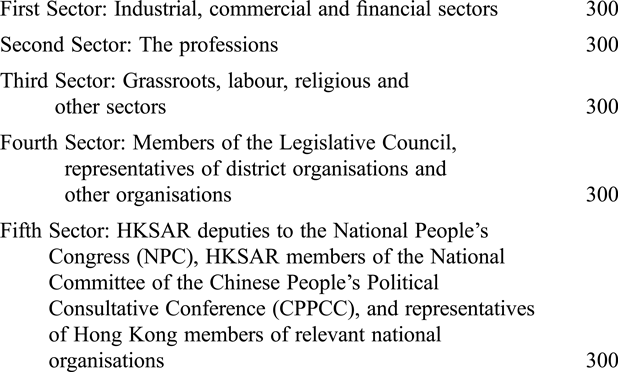
The Election Committee is composed of 1,500 members from the five sectors of industrial, commercial, and financial sectors; the professions; grassroots, labour, religious, and other sectors; members of the Legislative Council, representatives of district organisations, and other sectors; and Hong Kong delegates to the National People's Congress, Hong Kong members of the National Committee of the Chinese People's Political Consultative Conference, and representatives of Hong Kong members of the relevant national organisations.
III. The Chief Executive of the Hong Kong Special Administrative Region shall be elected by the Election Committee and appointed by the Central People's Government.
Candidates for the office of the Chief Executive shall be nominated jointly by not less than 188 members of the Election Committee, among whom the number of members of each sector shall not be less than 15. The Election Committee shall elect the Chief Executive designate by secret ballot on a one-person-one-vote basis, and the Chief Executive designate must receive a simple majority vote of all members of the Election Committee.
IV. The Legislative Council of the Hong Kong Special Administrative Region shall be composed of 90 members in each term. They are to be respectively elected through elections by the Election Committee, elections by functional constituencies, and direct elections by geographical constituencies.
V. A candidate qualification review committee of the Hong Kong Special Administrative Region shall be established to review and confirm the qualifications of candidates for Election Committee members, the Chief Executive, and Legislative Council members. The Hong Kong Special Administrative Region shall perfect and improve the system and mechanisms relating to qualification review, to ensure that the qualifications of candidate conform to the provisions of The Basic Law of the Hong Kong Special Administrative Region of the People's Republic of China, The Law of the People's Republic of China on Safeguarding National Security in the Hong Kong Special Administrative Region, the Standing Committee of the National People's Congress's Interpretation of Article 104 of The Basic Law of the Hong Kong Special Administrative Region of the People's Republic of China and Decision on Issues Relating to the Qualifications of the Members of the Legislative Council, and the provisions of relevant local laws of the Hong Kong Special Administrative Region.
VI. The Standing Committee of the National People's Congress is authorised to amend, in accordance with this Decision, Annex I: Method for the Selection of the Chief Executive of the Hong Kong Special Administrative Region and Annex II: Method for the Formation of the Legislative Council of the Hong Kong Special Administrative Region and Its Voting Procedures to The Basic Law of the Hong Kong Special Administrative Region of the People's Republic of China.
VII. The Hong Kong Special Administrative Region shall amend the relevant local laws of the Hong Kong Special Administrative Region in accordance with this Decision and Annex I: Method for the Selection of the Chief Executive of the Hong Kong Special Administrative Region and Annex II: Method for the Formation of the Legislative Council of the Hong Kong Special Administrative Region and Its Voting Procedures to The Basic Law of the Hong Kong Special Administrative Region of the People's Republic of China as amended by the Standing Committee of the National People's Congress, and organise and regulate the relevant election activities in accordance with the law.
VIII. The Chief Executive of the Hong Kong Special Administrative Region shall submit in a timely manner reports to the Central People's Government on relevant important situations including the institutional arrangements for the elections of the Hong Kong Special Administrative Region and the organisation of the elections.
IX. This Decision takes effect as of the date of promulgation.
Annex I – Method for the Selection of the Chief Executive of the Hong Kong Special Administrative Region
(Adopted at the Third Session of the Seventh National People's Congress on 4 April 1990, amended, as approved at the Sixteenth Meeting of the Standing Committee of the Eleventh National People's Congress on 28 August 2010, and amended at the Twenty-Seventh Meeting of the Standing Committee of the Thirteenth National People's Congress on 30 March 2021)
1. The Chief Executive shall be elected in accordance with this Law by an Election Committee which is broadly representative, suited to the actual situation of the Hong Kong Special Administrative Region (HKSAR), and represents the overall interests of society, and shall be appointed by the Central People's Government.
2. The Election Committee shall be composed of 1,500 members from the following sectors:
Members of the Election Committee must be permanent residents of the HKSAR.
The term of office of the Election Committee shall be five years.
3. The delimitation of and the number of seats allocated to each sector of the Election Committee are as follows:
The First Sector shall be composed of the following 18 subsectors:

The Second Sector shall be composed of the following 10 subsectors:

The Third Sector shall be composed of the following five subsectors:

The Fourth Sector shall be composed of the following five subsectors:

The Fifth Sector shall be composed of the following two subsectors:

4. The Election Committee shall be constituted in the following manner:
(1) HKSAR deputies to the NPC, HKSAR members of the CPPCC National Committee, Hong Kong members of the Committee for the Basic Law of the HKSAR under the NPC Standing Committee, members of the Legislative Council, university presidents or chairpersons of the board of governors or the council of universities, and responsible persons of statutory bodies, advisory bodies and relevant associations of the subsectors of engineering (15), architectural, surveying, planning and landscape (15), education (5), medical and health services (15) and social welfare (15) shall be Election Committee members of the corresponding subsectors.
An HKSAR deputy to the NPC or an HKSAR member of the CPPCC National Committee may choose to register as an Election Committee member in a subsector other than one in the Fifth Sector with which he or she has a substantial connection. If an HKSAR deputy to the NPC or an HKSAR member of the CPPCC National Committee is registered as an Election Committee member in a subsector other than one in the Fifth Sector, his or her seat shall be counted as one in that subsector and the number of members to be returned by that subsector in accordance with paragraph (3) of this subsection shall be reduced accordingly. After the registration of HKSAR deputies to the NPC and HKSAR members of the CPPCC National Committee as Election Committee members of the relevant subsectors, the number of members to be returned by those subsectors in accordance with paragraphs (1), (2) and (3) of this subsection, as determined by the provision in this sub-paragraph, shall remain unchanged within the term of office of the Election Committee.
(2) Election Committee members of the religious subsector shall be nominated:
15 members of the technology and innovation subsector shall be nominated from among Hong Kong academicians of the Chinese Academy of Sciences and the Chinese Academy of Engineering;
15 members of the accountancy subsector shall be nominated from among Hong Kong Accounting Advisors appointed by the Ministry of Finance;
9 members of the legal subsector shall be nominated from among Hong Kong members of the Council of the China Law Society;
15 members of the sports, performing arts, culture and publication subsector shall be nominated respectively by the Sports Federation and Olympic Committee of Hong Kong, China, China Federation of Literary and Art Circles Hong Kong Member Association and Hong Kong Publishing Federation;
15 members of the Chinese medicine subsector shall be nominated from among Hong Kong members of the Council of the World Federation of Chinese Medicine Societies; and
The 27 members of the subsector of representatives of associations of Hong Kong residents in the Mainland shall be nominated by such associations.
(3) Election Committee members of a subsector, except for those specified in paragraphs (1) and (2) of this subsection, shall be elected by eligible corporate voters for the corresponding subsector. Eligible corporate voters for subsectors shall be composed of institutions, organisations, associations or enterprises which are representative and specified by law. Unless specified in the electoral law of the HKSAR, an association or enterprise may become a corporate voter for a subsector only if it has been operating for not less than three years after acquiring relevant qualifications for that subsector. Election Committee members of subsectors – the Heung Yee Kuk, representatives of members of Area Committees, District Fight Crime Committees, and District Fire Safety Committees of Hong Kong Island and Kowloon, and representatives of members of Area Committees, District Fight Crime Committees, and District Fire Safety Committees of the New Territories in the Fourth Sector and representatives of Hong Kong members of relevant national organisations in the Fifth Sector may be elected by individual voters. A candidate for Election Committee member of a subsector shall be nominated by five voters for the subsector. The number of candidates each voter for a subsector may nominate shall not exceed the number of seats allocated to the subsector. Voters for a subsector of the Election Committee shall elect Election Committee members of that subsector from the list of nominations by secret ballot.
The specific method for returning the Election Committee members referred to in the preceding subsection, including the definition of statutory bodies, advisory bodies, relevant associations and eligible corporate voters for relevant subsectors, the method for nomination of candidates and the method for voting shall be prescribed by the electoral law of the HKSAR.
5. There shall be a system of conveners for the Election Committee. The conveners shall be responsible for convening meetings of the Election Committee as necessary and handle relevant matters. A chief convener shall be an Election Committee member who holds an office of state leadership. The chief convener shall designate a number of conveners for each sector of the Election Committee.
6. A candidate for the office of Chief Executive shall be nominated by not less than 188 members of the Election Committee, with not less than 15 members from each of the five sectors. Each Election Committee member may nominate one candidate only.
7. The Election Committee shall elect the Chief Executive designate from the list of nominations by secret ballot on a one-person-one-vote basis. The Chief Executive designate must obtain more than 750 votes. The specific election method shall be prescribed by the electoral law of the HKSAR.
8. The Candidate Eligibility Review Committee of the HKSAR shall be responsible for reviewing and confirming the eligibility of candidates for Election Committee members and for the office of Chief Executive. The Committee for Safeguarding National Security of the HKSAR shall, on the basis of the review by the department for safeguarding national security of the Police Force of the HKSAR, make findings as to whether a candidate for Election Committee member or for the office of Chief Executive meets the legal requirements and conditions of upholding the Basic Law of the Hong Kong Special Administrative Region of the People's Republic of China and swearing allegiance to the Hong Kong Special Administrative Region of the People's Republic of China, and issue an opinion to the Candidate Eligibility Review Committee of the HKSAR in respect of a candidate who fails to meet such legal requirements and conditions.
No legal proceedings may be instituted in respect of a decision made by the Candidate Eligibility Review Committee of the HKSAR on the eligibility of a candidate for Election Committee member or for the office of Chief Executive pursuant to the opinion of the Committee for Safeguarding National Security of the HKSAR.
9. The HKSAR shall, in accordance with the law, take measures against acts of manipulating or undermining election.
10. The NPC Standing Committee exercises in accordance with the law the power to amend this Method. Prior to making any amendment, the NPC Standing Committee shall solicit views of various sectors of Hong Kong by appropriate means.
11. The term of office of the Election Committee constituted under the Method previously in force shall terminate upon the commencement of term of office of the Election Committee constituted under this Method.
12. This Method shall come into force on 31 March 2021. Annex I and its amendment previously in force shall cease to apply.
Annex II – Method for the Formation of the Legislative Council of the Hong Kong Special Administrative Region and Its Voting Procedures
(Adopted at the Third Session of the Seventh National People's Congress on 4 April 1990, amended, as recorded at the Sixteenth Meeting of the Standing Committee of the Eleventh National People's Congress on 28 August 2010, and amended at the Twenty-Seventh Meeting of the Standing Committee of the Thirteenth National People's Congress on 30 March 2021)
1. The Legislative Council of the Hong Kong Special Administrative Region (HKSAR) shall be composed of 90 members for each term. The composition of the Legislative Council shall be as follows:

The above-mentioned Election Committee refers to the one provided for in Annex I to this Law.
2. Candidates for members of the Legislative Council returned by the Election Committee shall be nominated by at least 10 but no more than 20 members of the Election Committee, with at least 2 but no more than 4 members from each sector. Any eligible voter in an election of the Legislative Council may be nominated as a candidate. Each Election Committee member may nominate one candidate only.
The Election Committee shall elect members of the Legislative Council from the list of nominations by secret ballot. A ballot paper is valid only if the number of candidates voted for is equal to the number of members of the Legislative Council to be returned. The 40 candidates who obtain the highest numbers of votes shall be elected.
3. There shall be 28 functional constituencies for election of members of the Legislative Council:
Agriculture and fisheries
Heung Yee Kuk
Industrial (first)
Industrial (second)
Textiles and garment
Commercial (first)
Commercial (second)
Commercial (third)
Finance
Financial services
Insurance
Real estate and construction
Transport
Import and export
Tourism
Catering
Wholesale and retail
Technology and innovation
Engineering
Architectural, surveying, planning and landscape
Accountancy
Legal
Education
Sports, performing arts, culture and publication
Medical and health services
Social welfare
Labour
HKSAR deputies to the National People's Congress (NPC), HKSAR members of the National Committee of the Chinese People's Political Consultative Conference (CPPCC), and representatives of relevant national organisations
Three members shall be returned by the labour functional constituency, and one member shall be returned by each of the other functional constituencies.
Members of the Legislative Council returned by the following functional constituencies shall be elected by individual voters:
Heung Yee Kuk
Engineering
Architectural, surveying, planning and landscape
Accountancy
Legal
Education
Medical and health services
Social welfare
HKSAR deputies to the NPC, HKSAR members of the CPPCC National Committee and representatives of relevant national organisations
Members of the Legislative Council returned by the other functional constituencies shall be elected by eligible corporate voters. Eligible corporate voters for functional constituencies shall be composed of institutions, organisations, associations or enterprises which are representative and specified by law. Unless specified in the electoral law of the HKSAR, an association or enterprise may become a corporate voter for a functional constituency only if it has been operating for not less than three years after acquiring relevant qualifications for that functional constituency.
A candidate for a functional constituency shall be nominated by at least 10 but no more than 20 voters for the functional constituency as well as at least 2 but no more than 4 members from each sector of the Election Committee. Each Election Committee member may nominate one candidate only for the election of members of the Legislative Council returned by functional constituencies.
Voters for a functional constituency shall elect Legislative Council member for that functional constituency from the list of nominations by secret ballot.
The delimitation of corporate bodies and the definition of eligible corporate voters for functional constituencies, and the election method shall be prescribed by the electoral law of the HKSAR.
4. There shall be 10 geographical constituencies for returning members of the Legislative Council through direct elections. Two members shall be returned by each geographical constituency.
A candidate for a geographical constituency shall be nominated by at least 100 but no more than 200 voters for the geographical constituency as well as at least 2 but no more than 4 members from each sector of the Election Committee. Each Election Committee member may nominate one candidate only for direct election of members of the Legislative Council returned by geographical constituencies.
For each geographical constituency, a voter may vote for one candidate on the list of nominations by secret ballot. The two candidates who obtain the highest numbers of votes shall be elected.
The delineation of geographical constituencies and the voting method shall be prescribed by the electoral law of the HKSAR.
5. The Candidate Eligibility Review Committee of the HKSAR shall be responsible for reviewing and confirming the eligibility of candidates for members of the Legislative Council. The Committee for Safeguarding National Security of the HKSAR shall, on the basis of the review by the department for safeguarding national security of the Police Force of the HKSAR, make findings as to whether a candidate for member of the Legislative Council meets the legal requirements and conditions of upholding the Basic Law of the Hong Kong Special Administrative Region of the People's Republic of China and swearing allegiance to the Hong Kong Special Administrative Region of the People's Republic of China, and issue an opinion to the Candidate Eligibility Review Committee of the HKSAR in respect of a candidate who fails to meet such legal requirements and conditions.
No legal proceedings may be instituted in respect of a decision made by the Candidate Eligibility Review Committee of the HKSAR on the eligibility of a candidate for member of the Legislative Council pursuant to the opinion of the Committee for Safeguarding National Security of the HKSAR.
6. The HKSAR shall, in accordance with the law, take measures against acts of manipulating or undermining election.
7. Unless otherwise provided for in this Law, the Legislative Council shall adopt the following procedures for voting on bills and motions:
The passage of bills introduced by the government shall require a simple majority of votes of the members of the Legislative Council present.
The passage of motions, bills or amendments to government bills introduced by individual members of the Legislative Council shall require a simple majority of votes of each of the two groups of members present, i.e. members returned by the Election Committee, and those returned by functional constituencies and by geographical constituencies through direct elections.
8. The NPC Standing Committee exercises in accordance with the law the power to amend this Method and the procedures for voting on bills and motions. Prior to making any amendment, the NPC Standing Committee shall solicit views of various sectors of Hong Kong by appropriate means.
9. This Method and the procedures for voting on bills and motions shall come into force on 31 March 2021. Annex II and its amendment previously in force shall cease to apply.


