





Introduction
Given the loss and degradation of habitat through anthropogenic climate and environmental change, conservation efforts are increasingly seeking to protect species ex situ through living collections and seed banking. The latter is the more efficient and cost-effective approach (Offord and Meagher, Reference Offord and Meagher2009), and as such, a substantial amount of research has been directed toward improving and refining methods. Much of this research has focused on seeds from drier habitats, which are generally able to cope with the drying required for storage (Tweddle et al., Reference Tweddle, Dickie, Baskin and Baskin2003; Wyse and Dickie, Reference Wyse and Dickie2017). Conversely, species from higher moisture environments (e.g., rainforest) often lack these desiccation-tolerant characteristics (Vázquez-Yanes and Orozco-Segovia, Reference Vázquez-Yanes and Orozco-Segovia1993) and are thus less likely to tolerate the drying required for seed banking (Tweddle et al., Reference Tweddle, Dickie, Baskin and Baskin2003; Hamilton et al., Reference Hamilton, Offord, Cuneo and Deseo2013; Lan et al., Reference Lan, Xia, Wang, Liu, Zhao and Tan2014). Emerging evidence, however, suggests this characteristic is not uniform across plant types, with woody species more likely to demonstrate desiccation sensitivity than herbaceous species (Wyse and Dickie, Reference Wyse and Dickie2017; Sommerville et al., Reference Sommerville, Errington, Newby, Liyanage and Offord2021). Ultimately, the lack of data and generally lower desiccation tolerance means that species from wetter environments are underrepresented in seed banks (Sommerville et al., Reference Sommerville, Clarke, Keppel, McGill, Newby, Wyse, James and Offord2018). Given that (sub)tropical environments are most affected by anthropogenic activity (Newbold et al., Reference Newbold, Hudson, Phillips, Hill, Contu, Lysenko, Blandon, Butchart, Booth, Day, De Palma and Harrison2014; Lewis et al., Reference Lewis, Edwards and Galbraith2015; IPBES, 2019), work is urgently needed to address this imbalance. Understanding the implications of drying on early life history (e.g., germination success) for species from higher-moisture environments can also help us to understand how these species may respond to greater aridification predicted by climate change scenarios (Daws et al., Reference Daws, Garwood and Pritchard2005; Walck et al., Reference Walck, Hidayati, Dixon, Thompson and Poschlod2011; Wyse and Dickie, Reference Wyse and Dickie2018).
Island ecosystems are especially threatened by climate and environmental change, for example through reduced rainfall, rising sea levels, and invasive species (Fernández-Palacios et al., Reference Fernández-Palacios, Kreft, Irl, Norder, Ah-Peng, Borges, Burns, de Nascimento, Meyer, Montes and Drake2021). Lord Howe Island (LHI), a remote Australian oceanic island in the South Pacific, is one such example. It is home to a unique flora, with five of its vascular plant genera and around 50% of its vascular plant species endemic to the island (Auld and Leishman, Reference Auld and Leishman2015). Multiple factors – including invasive weeds (e.g., Bower, Reference Bower2016), the soil-borne pathogen Phytophthora (IUCN World Heritage Outlook, 2025), and increased drought (Auld and Leishman, Reference Auld and Leishman2015; IUCN World Heritage Outlook, 2025) – act together to threaten these species. An exemplar taxon with remarkable diversity on LHI is Coprosma J.R.Forst. & G.Forst. (Currant Bush), a genus in the madder or coffee family (Rubiaceae). With two new species recently described (Brook et al., Reference Brook, Hutton, Papadopulos, Elkan, Wilson, Bower, Bidartondo and Savolainen2026), there are now seven Coprosma species endemic to LHI, a surprisingly large number given the island’s small size (<16 km2) and isolation (ca. 580 km from any other vegetated landmass). These species evolved from two independent colonization events, one resulting in a small radiation comprising C. huttoniana P.S.Green, C. inopinata I.Hutton & P.S.Green, C. lanceolaris F.Muell., C. ptotopetra T.S.Brook & A.S.T.Papadopulos, C. putida C.Moore & F.Muell., and C. savolainenii I.Hutton (Papadopulos et al., Reference Papadopulos, Baker, Crayn, Butlin, Kynast, Hutton and Savolainen2011, Reference Papadopulos, Price, Devaux, Hipperson, Smadja, Hutton, Baker, Butlin and Savolainen2013). The other colonization resulted in only one species, C. prisca W.R.B.Oliv. (Papadopulos et al., Reference Papadopulos, Baker, Crayn, Butlin, Kynast, Hutton and Savolainen2011).
Although the specific threats these species of Coprosma face on LHI have not been fully quantified, reduced rainfall has already resulted in the death of several individuals of the Critically Endangered LHI endemic Coprosma inopinata (Rowell, Reference Rowell2023). Furthermore, Phytophthora is known to negatively affect a congeneric species from New Zealand (C. lucida; McKenzie et al., Reference McKenzie, Buchanan and Johnston2002; Auld and Hutton, Reference Auld and Hutton2004), and we recently observed three individuals of C. ptotopetra in the lowlands (Transit Hill) that we suspect have died from this plant pathogen (pers. obs.). Of particular concern is C. huttoniana – a characteristic species of the island’s ‘Gnarled Mossy Cloud Forest’ – because climate change is predicted to raise cloud base height, reduce the frequency and duration of cloud immersion, and lower soil moisture content through such reduced cloud cover (IUCN World Heritage Outlook, 2025). These processes are projected to cause severe habitat loss for cloud-dependent flora across Australia, with suitable habitat for endemic cloud forest species predicted to decline by a mean of 81% by 2040 and 95% by 2080 (Costion et al., Reference Costion, Simpson, Pert, Carlsen, John Kress and Crayn2015). We therefore predict that all Coprosma species on LHI will be impacted to some extent by multiple threats, with cloud forest-associated species facing the additional risk of complete habitat loss driven by a warming climate.
Although the genus Coprosma has been relatively understudied given its size, previous work has revealed interspecific variation in germination and dormancy. Research on Hawaiian species showed that four tropical montane species of Coprosma could germinate across a range of temperatures, with germination patterns varying by species and changing over the course of experiments (Chau et al., Reference Chau, Chambers, Weisenberger, Keir, Kroessig, Wolkis, Kam and Yoshinaga2019). Germination trials on Tasmanian species similarly revealed that some species like C. moorei achieved higher germination at warmer temperatures, while others such as C. quadrifida germinated best under cold stratification at much lower temperatures (Royal Tasmanian Botanical Gardens, 2026). Much of this variation is likely underpinned by differences in dormancy. For example, many plant species have physiological dormancy, whereby seeds have fully developed embryos but a physiological mechanism inhibiting germination (Baskin and Baskin, Reference Baskin and Baskin2004, Reference Baskin and Baskin2014). This constraint can often be alleviated through the application of gibberellic acid (GA3), a useful tool for both investigating dormancy type and promoting germination in some species (e.g., C. kauensis: Wolkis et al., Reference Wolkis, Saling, Baskin and Baskin2023). This variation also extends to storage behaviour. For example, Chau et al. (Reference Chau, Chambers, Weisenberger, Keir, Kroessig, Wolkis, Kam and Yoshinaga2019) found that seeds of some Hawaiian species generally remained viable after freezing (e.g., C. longifolia, C. rhynchocarpa, and C. kauensis), while others had more variable responses (e.g., C. foliosa). Together, these findings suggest that Coprosma species have diverse germination requirements and storage behaviour, specifically freezing tolerance. Empirical studies integrating germination responses with desiccation tolerance, however, remain limited, particularly for species from the Australasian-Pacific region.
In this study, we investigated the germination requirements and desiccation tolerance of three species of Coprosma endemic to LHI (C. huttoniana, C. lanceolaris, and C. ptotopetra). By testing germination responses across seasonal temperature regimes, with and without the germination promoter GA3, we aimed to assess dormancy characteristics and the most suitable conditions for germination ex situ. Moreover, by evaluating the effects of partial and full desiccation on seed viability, we aimed to assess the suitability of these species for conventional seed banking protocols for conservation.
Methods
Seed collection
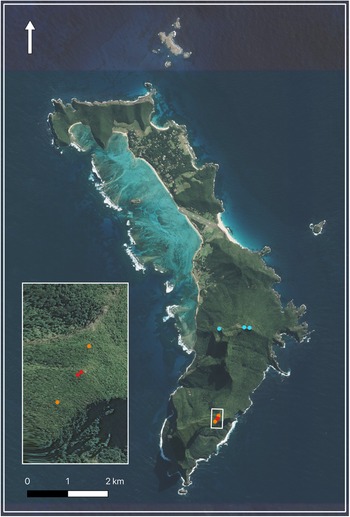
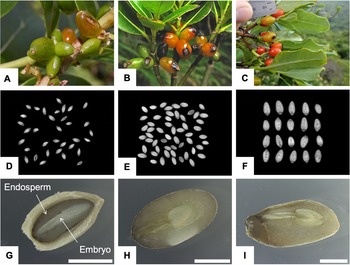
We collected fresh fruits of the three species tested here – Coprosma lanceolaris, C. huttoniana, and C. ptotopetra – between 2 and 7 March 2025 from wild populations in the southern mountains of LHI, New South Wales, Australia (Figure 1). The fruits of all three species are fleshy drupes containing two pyrenes, hereafter referred to as seeds for simplicity (Green, Reference Green1990, Reference Green and Wilson1994; Brook et al., Reference Brook, Hutton, Papadopulos, Elkan, Wilson, Bower, Bidartondo and Savolainen2026) (Figure 2). We did, however, very occasionally find fruits with three smaller pyrenes (pers. obs.). Although we sampled mature whole fruits from multiple individuals, collections were only possible for a small number of individuals for each species (Figure 1; Table S1).
Sampling locations of fresh fruit of Coprosma ptotopetra (orange), C. lanceolaris (blue), and C. huttoniana (red) collected in March 2025. Coordinates for each sampling location are provided in Table S1. Image taken from Bing Maps for Enterprise (Microsoft, Redmond, USA).

Images of fruit and seed of Coprosma lanceolaris (A, D, G), C. huttoniana (B, E, H), and C. ptotopetra (C, F, I). The first row (A–C) are photographs of fresh fruit (green = unripe; red/orange = ripe; and black = overripe); the middle row (D–F) are X-ray images to assess seed fill; the bottom row (G–I) are photographs of longitudinally cut seeds depicting the testa (seed coat), endosperm (darker interior) and embryo (whitish centre). Besides (A) and (B), the remaining images are some of the collections of C. lanceolaris, C. huttoniana, and C. ptotopetra used in this study (T.S.Brook 223, 228, and 240, respectively). The white scale bars in (G)–(I) equal 4 mm. Collection details are available in Table S1.

We collected fruits directly from the plant when ripe (e.g., bright red/orange and easily removable from the pedicel). After collection, we stored fruits within plastic zip-lock bags filled to approximately a third capacity at ca. 5°C. We included a paper towel in the bag, which we replaced regularly, to absorb condensed moisture, and we periodically opened the bag to release any built-up gases. We also collected a herbarium specimen for each individual plant from which we collected seed, all of which we lodged at the National Herbarium of New South Wales (Table S1).
Passage through animal guts and dispersal, either via defecation or regurgitation, may stimulate or inhibit germination through chemical or mechanical means (Samuels and Levey, Reference Samuels and Levey2005). Given the red colouration of Coprosma fruit from LHI (Figure 2A–C), alongside the observation of birds consuming and regurgitating the seed of C. ptotopetra (Brook et al., Reference Brook, Hutton, Papadopulos, Elkan, Wilson, Bower, Bidartondo and Savolainen2026), we opportunistically collected any regurgitate we found to test whether ingestion improved or inhibited germination compared to manually extracted seeds. We obtained two collections of regurgitate for C. ptotopetra and one for C. huttoniana (Table S1), which we identified as such based on the seed shape and size of these species. We collected and stored these samples in a paper bag with a paper towel at ca. 5°C and then processed them in the same way as the fresh collected seed.
Processing
We transported the fruits to the Australian PlantBank, Botanic Gardens of Sydney, at ambient temperature in a polystyrene box. On 20 March 2025, we extracted seeds by hand, rinsed them with deionized water and wiped them dry with a paper towel. We stored the processed seeds briefly at 15°C prior to commencing imbibition, germination, and drying experiments. We performed X-ray imaging on one sample per species to assess seed fill using a Kubtec PARAMETERTM Cabinet X-ray System (Figure 2D–F; Medilink, Silverwater, Australia). We viewed internal seed structures by dissecting seeds longitudinally and imaging under a Leica M60 microscope with an IC80 HD camera (Figure 2G–I; Leica Microsystems, Lane Cove West, Australia).
We also placed subsamples of seeds to dry in environments set to 15°C with relative humidities of ca. 60% or ca. 15% to achieve moisture contents of 10–12% (hereafter ‘partially dried’) and 3–7% (hereafter ‘fully dried’), respectively. As the seeds we placed in the 15°C/60% relative humidity environment rapidly drove the relative humidity up to ca. 90%, we moved these to a walk-in incubator (20°C and ca. 60% relative humidity) with greater airflow. Before sowing (see below), we rehydrated partially and fully dried seeds over tap water for 24 hours.
Imbibition trial
Given that the seeds for each species had either a leathery or woody endocarp, we conducted imbibition trials on fresh seeds (stored at 15°C for 1 week, 20–27 March 2025) to determine whether the endocarp was impermeable and whether scarifying would promote water uptake (i.e., to determine whether the seeds had physical dormancy). We scarified 10 seeds from 1 collection per species (Table S1) by removing a portion of the endocarp and testa with a scalpel, at the opposite end to the radicle emergence point, to expose the endosperm. We included an additional 10 non-scarified seeds from the same collection as a control. We placed the scarified and non-scarified seeds on 0.9% water agar (WA) at room temperature and then removed them, blotted them dry, and weighed them individually at intervals of 0, 1, 2, and 3 days. We assessed any change in weight between scarified and non-scarified seeds using a Wilcoxon rank-sum test implemented in rstatix version 0.7.2 (Kassambara, Reference Kassambara2019).
Determination of moisture content and dry weight
We measured seed moisture content (SMC) for fresh, partially dried, and fully dried seeds from one collection per species (Table S1). We weighed seeds, dried them at 103°C for 17 hours (International Seed Testing Association, 2021) in open foil trays, cooled them to room temperature over silica gel in an airtight container, and then re-weighed them. We calculated average SMC from 10 replicates of a single seed (C. huttoniana and C. ptotopetra) or 3 replicates of 5 seeds (C. lanceolaris), randomly selected from the subsamples used for germination experiments. We cut larger seeds (C. huttoniana and C. ptotopetra) in half to aid drying. We calculated SMC based on weight lost on drying as a percentage of the starting weight.
Germination testing
To assess seed dormancy and the effect of seasonal temperatures on germination, we sowed fresh seeds on agar, with and without GA3, and incubated them under a 12/12 hour light/dark cycle at four temperature treatments: (1) spring/autumn (22.5/17°C ± 0.5°C); (2) summer (25/20.5°C ± 0.5°C); (3) winter (19.5/14°C ± 0.5°C); and (4) a modified move-along experiment in which we cycled seeds through seasonal temperatures consecutively, commencing with autumn temperatures (the season of dispersal) and then progressing through winter, spring, and finally summer (Table S2). Note that we ran only a single series for the move-along experiment rather than four parallel series (i.e., each beginning in a different season) due to constraints on seed availability. We calculated the alternating temperatures for each treatment from the mean monthly maximum and minimum temperatures recorded at the Bureau of Meteorology’s LHI weather station (station ID = 200839; latitude = −31.54; longitude = 159.08; elevation = 5.0 metres above sea level (m a.s.l.); available at https://www.bom.gov.au/nsw/lord_howe/, last accessed 19 January 2026), averaged across the relevant months for each treatment (spring/autumn = September to November and March to May; summer = December to February; and winter = June to August).
To assess the response to desiccation, we incubated the partially and fully dried seeds at the overall best-performing temperature combination determined from the germination experiments on fresh seeds across all species. As the number of regurgitated seeds available was limited (Table S1), these collections were only tested under the move-along and spring/autumn temperature treatments without GA3 (Table S2).
We pooled seeds for each of the germination experiments from three individuals for C. huttoniana and C. ptotopetra, and two individuals for C. lanceolaris (Table S1). Prior to sowing, we soaked fresh and rehydrated seeds for 15 minutes in a solution of 4 mL L−1 Path-X Agricultural Disinfectant (Nutri-Tech Solutions, Yandina, Australia) to minimize fungal growth. We then sowed 3 replicates of 15 seeds per treatment onto 0.9% WA in glass Petri dishes and sealed them with plastic wrap. We sowed the fresh seeds on 21 March 2025, and the partially rehydrated and fully dried seeds on 17 April 2025 and 22 May 2025, respectively. For treatments with GA3, we added a 1 mL overlay of 250 ppm GA3 (Sigma-Aldrich G7645-5G, Merck, Rahway, USA; pH 6.5) to the agar surface prior to sowing the seeds. We then incubated seeds in LABEC temperature cycling chambers (LABEC, Marrickville, Australia) under the temperature treatments described above.
We scored seeds for germination success at least every 7 days initially and then less frequently if germination was prolonged and sporadic. We considered seeds to have germinated when 2 mm of the radicle had emerged. We terminated experiments 180–182 days after first sowing, except for the move-along treatment, which we continued until all four ‘seasons’ (i.e., autumn, winter, spring, summer) were cycled through for 12 weeks each. On termination of each experiment, we dissected the non-germinated seeds to identify any empty seeds and adjusted the final germination proportions. We also visually assessed the viability of non-germinated seeds (i.e., firm seeds that are not discoloured or mushy) and, for the replicates of the seed experiments run for 180–182 days (i.e., excluding the move-along experiment), calculated the total proportion of non-germinated seeds that remained viable at the end of the experiment.
Alongside scoring radicle emergence, we also scored shoot emergence for the fresh seeds (excluding the move-along experiment). As we did not track individual seeds post-radicle emergence, we recorded the first day on which shoot emergence was observed per replicate and compared this to the date of the first radicle emergence for the same replicate, to document the temporal relationship between the two events.
Statistical analysis of germination data
We conducted all statistical analyses in R version 4.2.2 (R Core Team, 2022), using ggplot2 version 4.0.1 (Wickham, Reference Wickham2016) for data visualization. For the non-parametric analyses described below, the unit of replication was the Petri dish (each dish containing a maximum of 15 seeds; Table S2), with sample sizes reported in the relevant tables and figure legends. For the survival analyses described below, the unit of replication was the individual seed.
Non-parametric analyses
Given the non-normal distribution of germination data and limited sample sizes, we used non-parametric statistical tests in rstatix to compare germination percentage (all temperature treatments) and time to first germination (excluding the move-along experiment) across treatment combinations. To assess differences among three or more groups, we used the Kruskal–Wallis rank sum test (Kruskal and Wallis, Reference Kruskal and Wallis1952). Where overall tests indicated significance (p < 0.05), we conducted post hoc pairwise Wilcoxon rank-sum tests (Wilcoxon, Reference Wilcoxon1945) with Benjamini–Hochberg (BH) correction for multiple comparisons to control the false discovery rate (Benjamini and Hochberg, Reference Benjamini and Hochberg1995). For comparisons between only two groups, we used the Wilcoxon rank-sum test without correction. We calculated effect sizes – eta-squared (η 2) for the Kruskal–Wallis tests and the Wilcoxon effect size (r) for the Wilcoxon tests – for all tests to quantify the magnitude of treatment effects.
Survival analysis
To account for the time-to-event nature of germination data and to appropriately handle censored observations (i.e., seeds that did not germinate by the end of the experiment), we also used non-parametric survival analysis methods in the package survival version 3.7.0 (Therneau, Reference Therneau2026). We excluded the move-along experiment from these analyses as it was run for a longer period and cycled through seasonal conditions, making it incomparable with the other tests.
We constructed Kaplan–Meier survival curves (Kaplan and Meier, Reference Kaplan and Meier1958) to estimate the germination time distribution and account for the censored data. We used log-rank tests (Mantel, Reference Mantel1966) to compare survival curves among treatment groups, testing the null hypothesis that there was no difference in survival (germination) functions among groups. Log-rank tests are appropriate for survival data as they compare the entire survival curves rather than single time points, providing greater statistical power when groups separate progressively over time. For cross-species comparisons, we applied a BH correction for multiple pairwise tests. We also extracted median germination times (i.e., the time at which 50% of viable seeds had germinated) from the Kaplan–Meier curves along with 95% confidence intervals. Note that the Kaplan–Meier curves shown in the figures and compared using these tests are calculated directly from the data and are not derived from the models described below.
To quantify treatment effects while controlling for other factors, we also fitted Cox proportional hazards regression models (Cox, Reference Cox1972). These models estimate hazard ratios (HRs), which represent the instantaneous rate of germination in one group relative to a reference group. An HR greater than 1 indicates faster germination (i.e., an increased hazard of a germination event), while an HR less than 1 indicates slower germination. We report HRs with 95% confidence intervals and Wald test p-values. We assessed the fit of these models using the concordance index, which ranges from 0.5 (i.e., no predictive ability) to 1.0 (i.e., perfect prediction), and where values above 0.7 indicate acceptable discrimination. We also evaluated the proportional hazards assumption (i.e., that HRs remain constant over time) using Schoenfeld residuals tests (Schoenfeld, Reference Schoenfeld1982). Significant deviations from proportional hazards (p < 0.05 in these tests) indicate time-varying effects and potential model violations. Where violations occurred, we report them but also note that Cox models can provide useful estimates of effects even when minor assumptions are violated. Where larger violations occur, the reported HR represents a weighted average of time-varying HRs across the study period rather than a true constant instantaneous effect.
Alongside fitting single-factor models for each predictor variable (temperature treatment, medium treatment, and drying treatment), we also fitted two-factor additive models and models with interaction terms for the experiments on fresh seeds. For model selection, we compared nested models using likelihood ratio tests and Akaike information criterion (AIC). While lower AIC values indicate better model fit, we considered ΔAIC > 2 a meaningful difference between models.
Cross-species comparisons
To minimize the confounding effects of treatment conditions, and thus allow robust assessment of interspecific differences, we restricted comparative analyses between species to fresh seeds germinated under the best-performing fresh conditions (overall across all species). To strengthen our cross-species comparisons, we used three complementary approaches: (1) Kruskal–Wallis tests on final germination percentage and time to first germination, (2) log-rank tests comparing Kaplan–Meier survival curves across species, and (3) Cox proportional hazards models with species as the predictor variable and C. huttoniana as the reference category.
Results
Imbibition trials
There were no significant differences in weight change between whole and scarified seeds for all three species tested, indicating there is no barrier to water uptake: C. huttoniana (p = 0.16), C. lanceolaris (p = 0.24), and C. ptotopetra (p = 0.08).
Seed moisture content (SMC)
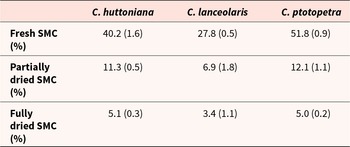
The mean fresh weight of one seed of C. huttoniana and C. ptotopetra seeds was 48.0 mg (SD = 4.6 mg) and 125.5 mg (SD = 15.1 mg), respectively. The weight of C. lanceolaris seeds was smaller, with the mean weight of five seeds amounting to 45.1 mg (SD = 5.0 mg), or ca. 9.0 mg (SD = 0.8 mg) per seed. Fresh SMC followed a pattern consistent with differences in seed size, ranging from 27.8% in C. lanceolaris to 51.8% in C. ptotopetra. Partial drying reduced SMC to between 6.9% and 12.1%, while full drying reduced SMC further to between 3.4% and 5.1% (Table 1).
Mean seed moisture content (SMC) ± standard deviation (in brackets) for three Coprosma species from LHI when fresh and after equilibration to ca. 60% relative humidity (partially dried) and ca. 15% relative humidity (fully dried)

Table 1 Long description
Mean seed moisture content is reported as percent, with standard deviation given in parentheses, for Coprosma huttoniana, C. lanceolaris, and C. ptotopetra at fresh, partially dried, and fully dried states. For fresh seeds, seed moisture content values are 40.2 with standard deviation 1.6 for C. huttoniana, 27.8 with 0.5 for C. lanceolaris, and 51.8 with 0.9 for C. ptotopetra. For partially dried seeds, seed moisture content values are 11.3 with 0.5 for C. huttoniana, 6.9 with 1.8 for C. lanceolaris, and 12.1 with 1.1 for C. ptotopetra. For fully dried seeds, seed moisture content values are 5.1 with 0.3 for C. huttoniana, 3.4 with 1.1 for C. lanceolaris, and 5.0 with 0.2 for C. ptotopetra.
Germination of fresh seeds
For all three species, winter temperatures resulted in the fastest time to the first germination and highest final germination percentage. Shoot emergence followed radicle emergence within 5 weeks in all replicates of C. lanceolaris, but was slower and less consistent in C. huttoniana and C. ptotopetra, occurring in only a subset of replicates and taking 6 weeks or more. After 180 days, most ungerminated seeds remained largely viable for C. huttoniana and C. lanceolaris but not for C. ptotopetra.
Germination percentage
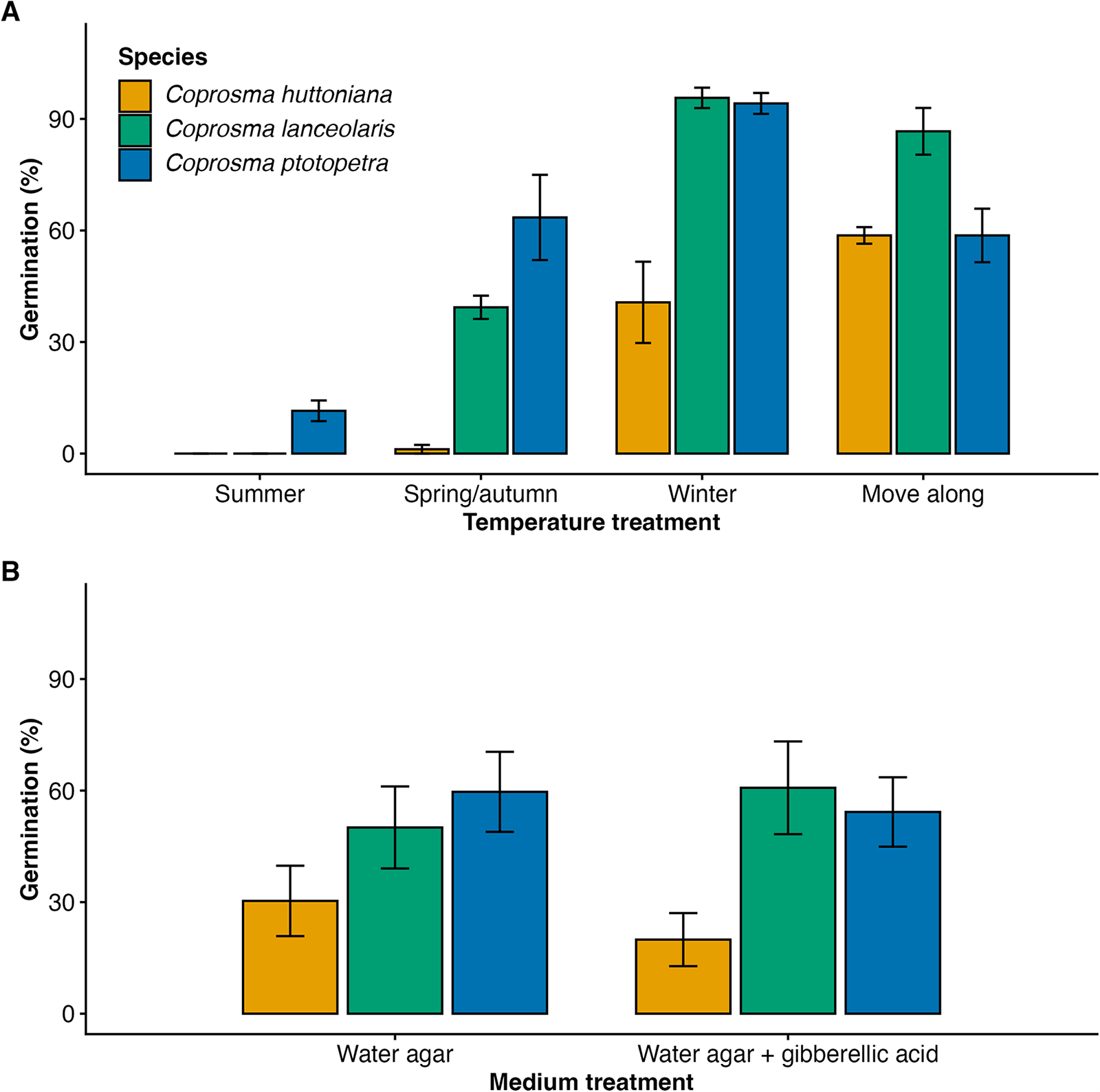
Summarizing across medium treatments (N = 6 per treatment), germination of fresh seeds differed among treatments for all species (Figure 3A). We found a significant temperature effect for all species (all p < 0.001; Figures S1A, S2A, and S3A), with large effect sizes (η 2 = 0.76–0.87). Of the non-move-along experiments, the pairwise Wilcoxon tests showed that winter temperatures produced the highest germination for all three species (Table S3). These results are supported by summary statistics, where median final germination was lower in spring/autumn (0%, 41.5%, and 70%) and summer (0%, 0%, and 13.5%) temperatures compared to winter temperatures (36.5%, 100%, and 96.5%) for C. huttoniana, C. lanceolaris, and C. ptotopetra, respectively (Figure 3A). The move-along treatment produced lower germination for C. lanceolaris and C. ptotopetra (median germination 92.5% and 62%, respectively) but higher germination for C. huttoniana (58.5%).
Comparison of final germination percentages for three Coprosma species across (A) seasonal temperature treatments (pooled across medium treatments with and without GA3; N = 6 per treatment) and (B) medium treatments (pooled across temperature treatments; N = 12 per treatment). WA = 0.9% water agar; GA3 = 250 ppm gibberellic acid; N = number of replicates, each with 15 seeds. Error bars represent standard error.

Figure 3 Long description
The grouped bar graph A has y axis label, Germination left parenthesis percent right parenthesis, with tick labels 0, 30, 60, 90. The x axis label is Temperature treatment. The x axis categories are Summer, Spring slash autumn, Winter, and Move along. A legend, titled, Species, lists Coprosma huttoniana, Coprosma lanceolaris, Coprosma ptotopetra. For Summer, Coprosma huttoniana is at 0, Coprosma lanceolaris is at 0, Coprosma ptotopetra is at 10. For Spring slash autumn, Coprosma huttoniana is at 1, Coprosma lanceolaris is at 40, Coprosma ptotopetra is at 65. For Winter, Coprosma huttoniana is at 40, Coprosma lanceolaris is at 95, Coprosma ptotopetra is at 95. For Move along, Coprosma huttoniana is at 60, Coprosma lanceolaris is at 85, Coprosma ptotopetra is at 60. Each bar has an error bar. The grouped bar graph B has y axis label, Germination left parenthesis percent right parenthesis, with tick labels 0, 30, 60, 90. The x axis label is Medium treatment. The x axis categories are Water agar, Water agar plus gibberellic acid. The same legend titled, Species, lists Coprosma huttoniana, Coprosma lanceolaris, Coprosma ptotopetra. For Water agar, Coprosma huttoniana is at 30, Coprosma lanceolaris is at 50, Coprosma ptotopetra is at 60. For Water agar plus gibberellic acid, Coprosma huttoniana is at 20, Coprosma lanceolaris is at 60, Coprosma ptotopetra is at 55. Each bar has an error bar. Bar heights are approximate, read from the graph.
Germination of fresh seeds did not differ significantly between medium treatments with and without GA3 when temperature treatments were pooled (N = 12 per medium) (Figures S1B, S2B, and S3B). We did, however, identify a significant interaction between temperature and medium treatments (N = 3 per temperature-medium combination) for all three species (all p < 0.01; Figures S1C, S2C, and S3C; Table S4). Effect sizes were similarly large for each species: C. huttoniana (η 2 = 0.881), C. lanceolaris (η 2 = 0.942), and C. ptotopetra (η 2 = 0.913). The temperature-medium combination that produced the highest germination success varied by species: winter temperature with GA3 for C. lanceolaris (median = 100% versus 87% on WA), and winter temperature without GA3 for C. ptotopetra (100% versus 86% with GA3) and C. huttoniana (71% versus 20% with GA3).
Since winter temperatures without GA3 produced consistently high germination across all species, we used these conditions to compare germination among species using fresh seeds only. Final germination success differed significantly between species (χ 2 = 6.2, df = 2, p = 0.045, η 2 = 0.70), with C. ptotopetra achieving the highest germination (median = 100%), followed by C. lanceolaris (87%) and C. huttoniana (71%). As described below, we used the same conditions to test the germination of partially and fully dried seeds.
Time to first germination
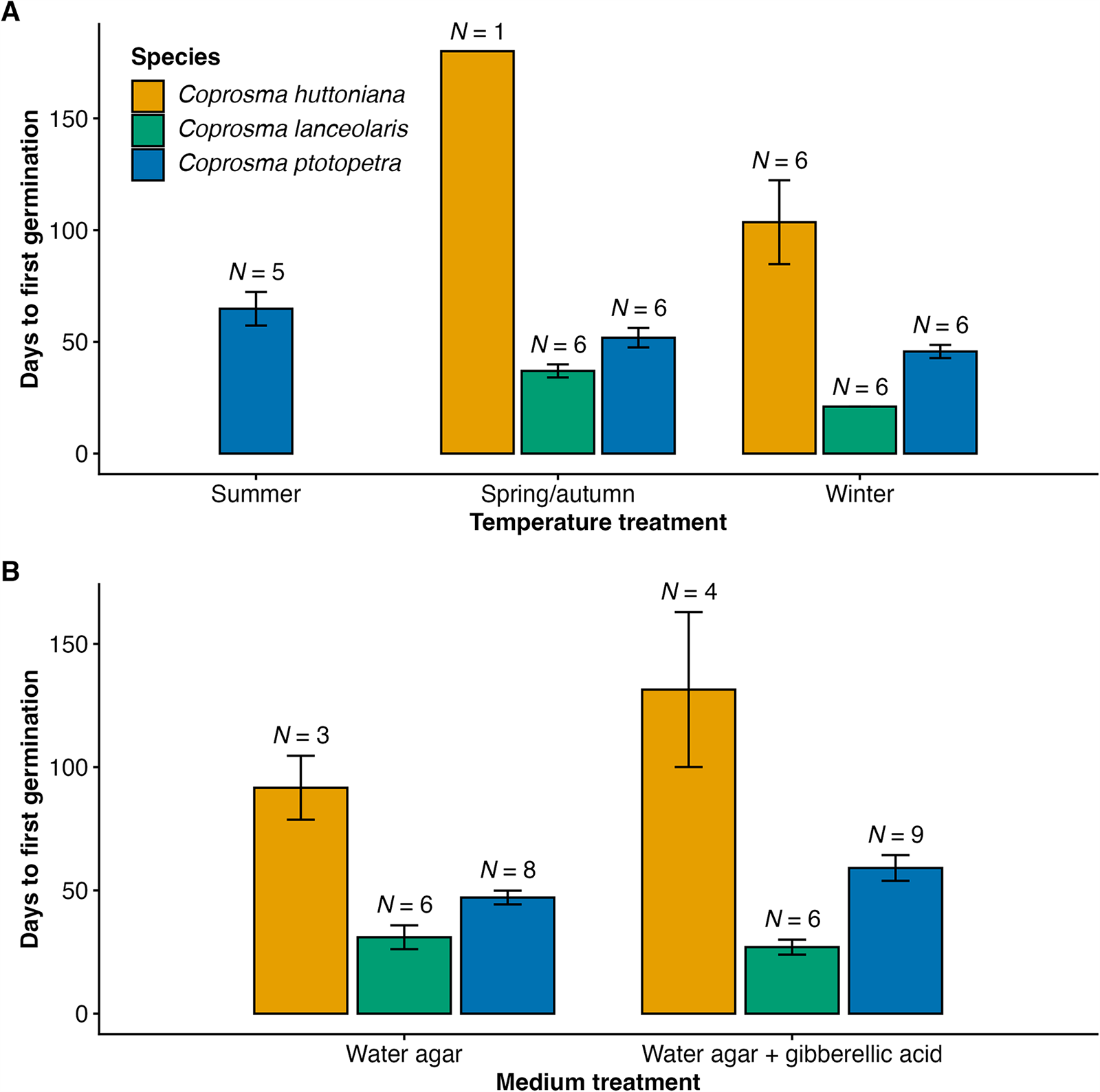
To assess differences in germination rate, we compared the time to first germination across temperature treatments (excluding the move-along treatment) and medium treatments (Figure 4). Because replicates with no germinants could not be included, sample sizes were small and uneven for some treatment groups (see Figures S4–S6 for exact N per group). This was most notable for C. huttoniana under spring/autumn conditions (N = 1) and for C. huttoniana and C. lanceolaris under summer conditions (N = 0, excluded). As such, non-significant results for these groups should be interpreted with caution rather than as evidence of no effect. We found no significant effect of temperature on time to first germination for C. huttoniana (Figure S4A) or C. ptotopetra (Figure S6A). Coprosma lanceolaris germinated significantly faster under winter than spring/autumn conditions (p < 0.01; median 21 versus 36 days; Figure S5A).
Comparison of time to first germination for three Coprosma species across (A) seasonal temperature treatments (pooled across media with and without GA3) and (B) medium treatments (pooled across temperature treatments). WA = 0.9% water agar; GA3 = 250 ppm gibberellic acid; N = number of replicates (each with 15 seeds) in which germination occurred. Error bars represent standard error.

Figure 4 Long description
A grouped bar graph with the y axis label, Days to first germination and tick labels 0, 50, 100, 150. The x axis label is Temperature treatment, with category labels Summer, Spring slash autumn, Winter. A legend label reads, Species, with three entries, Coprosma huttoniana, Coprosma lanceolaris, Coprosma ptotopetra. At Summer, Coprosma ptotopetra has a bar at about 65 with an error bar and the label N equals 5, Coprosma huttoniana and Coprosma lanceolaris have no bars. At Spring slash autumn, Coprosma huttoniana has a bar at about 180 with no error bar and the label N equals 1, Coprosma lanceolaris has a bar at about 35 with an error bar and the label N equals 6, Coprosma ptotopetra has a bar at about 50 with an error bar and the label N equals 6. At Winter, Coprosma huttoniana has a bar at about 105 without a visible error bar and the label N equals 6, Coprosma lanceolaris has a bar at about 20 with an error bar and the label N equals 6, Coprosma ptotopetra has a bar at about 45 with an error bar and the label N equals 6. The image B showing a grouped bar graph with the y axis label, Days to first germination and tick labels 0, 50, 100, 150. The x axis label is Medium treatment, with category labels Water agar, Water agar plus gibberellic acid. At Water agar, Coprosma huttoniana has a bar at about 90 with an error bar and the label N equals 3, Coprosma lanceolaris has a bar at about 30 with an error bar and the label N equals 6, Coprosma ptotopetra has a bar at about 45 with an error bar and the label N equals 8. At Water agar plus gibberellic acid, Coprosma huttoniana has a bar at about 130 with an error bar and the label N equals 4, Coprosma lanceolaris has a bar at about 30 with an error bar and the label N equals 6, Coprosma ptotopetra has a bar at about 60 with an error bar and the label N equals 9.
While no effect of medium treatment was found for any species (Figures S4B, S5B, and S6B), a significant temperature x medium interaction was found for C. lanceolaris (p = 0.018; Figure S5C; Table S5), though all winter-treatment replicates first germinated at 21 days regardless of medium treatment, indicating GA3 had no effect under winter conditions. No interaction was observed for C. huttoniana (Figure S4C) or C. ptotopetra (Figure S6C).
The three species also differed between each other significantly in time to first germination under the winter temperature treatment without GA3 (χ 2 = 7.4, df = 2, p = 0.024, η 2 = 0.91). Coprosma lanceolaris showed the fastest germination (median = 21 days), followed by C. ptotopetra (41 days), while C. huttoniana germinated most slowly (97 days).
Survival analysis
Temperature treatment had highly significant effects on germination survival curves across all three species (all p < 0.001; Figures S7A, S8A, and S9A; Table S6). Winter temperatures significantly increased germination hazard in all species, with the strongest effect in C. huttoniana (HR = 46), followed by C. lanceolaris (HR = 6.3) and C. ptotopetra (HR = 4.0). The summer treatment’s effect could not be reliably estimated for C. huttoniana or C. lanceolaris because no seeds germinated under summer conditions in any replicate of either species. In C. ptotopetra, which did germinate under summer conditions, the summer treatment significantly reduced the germination hazard (HR = 0.13). We could only calculate median germination times where germination was at least 50%: C. lanceolaris under the winter treatment showed a median of 34 days (95% CI: 34–38 days), while C. ptotopetra showed medians of 132 days for spring/autumn (95% CI: 118–174 days) and 69 days for winter (95% CI: 67–83 days) treatments. In contrast to the non-parametric analysis discussed above, survival analysis also showed a significant effect of medium treatment for C. huttoniana (p = 0.002; although this violated model assumptions, see below) and C. ptotopetra (p = 0.03). GA3 reduced germination in C. huttoniana (HR = 0.33; Figure S7B) and C. ptotopetra (HR = 0.69; Figure S9B), but not in C. lanceolaris (Figure S8B; Table S7).
Combined survival models including both temperature and medium treatments (without an interaction) showed improved fit over single-factor models for most comparisons (ΔAIC > 2; Figures S7C, S8C, and S9C; Tables S8 and S9). The only exception is the addition of medium treatment compared to the temperature treatment-only model for C. lanceolaris (ΔAIC < 2), suggesting that medium adds little beyond temperature in that species (Table S9). Relative to the spring/autumn treatment, the winter treatment remained highly significant in all three species (HR range = 4.2–53). While the summer treatment’s effect could still not be assessed in C. huttoniana or C. lanceolaris (for the same reasons as above), it significantly reduced germination hazard in C. ptotopetra (HR = 0.12). GA3 supplementation significantly reduced germination hazard in C. huttoniana (HR = 0.25) and C. ptotopetra (HR = 0.55), whereas it marginally significantly increased germination hazard in C. lanceolaris (HR = 1.5). The interaction models performed similarly to or worse than the additive model in all cases (Table S9).
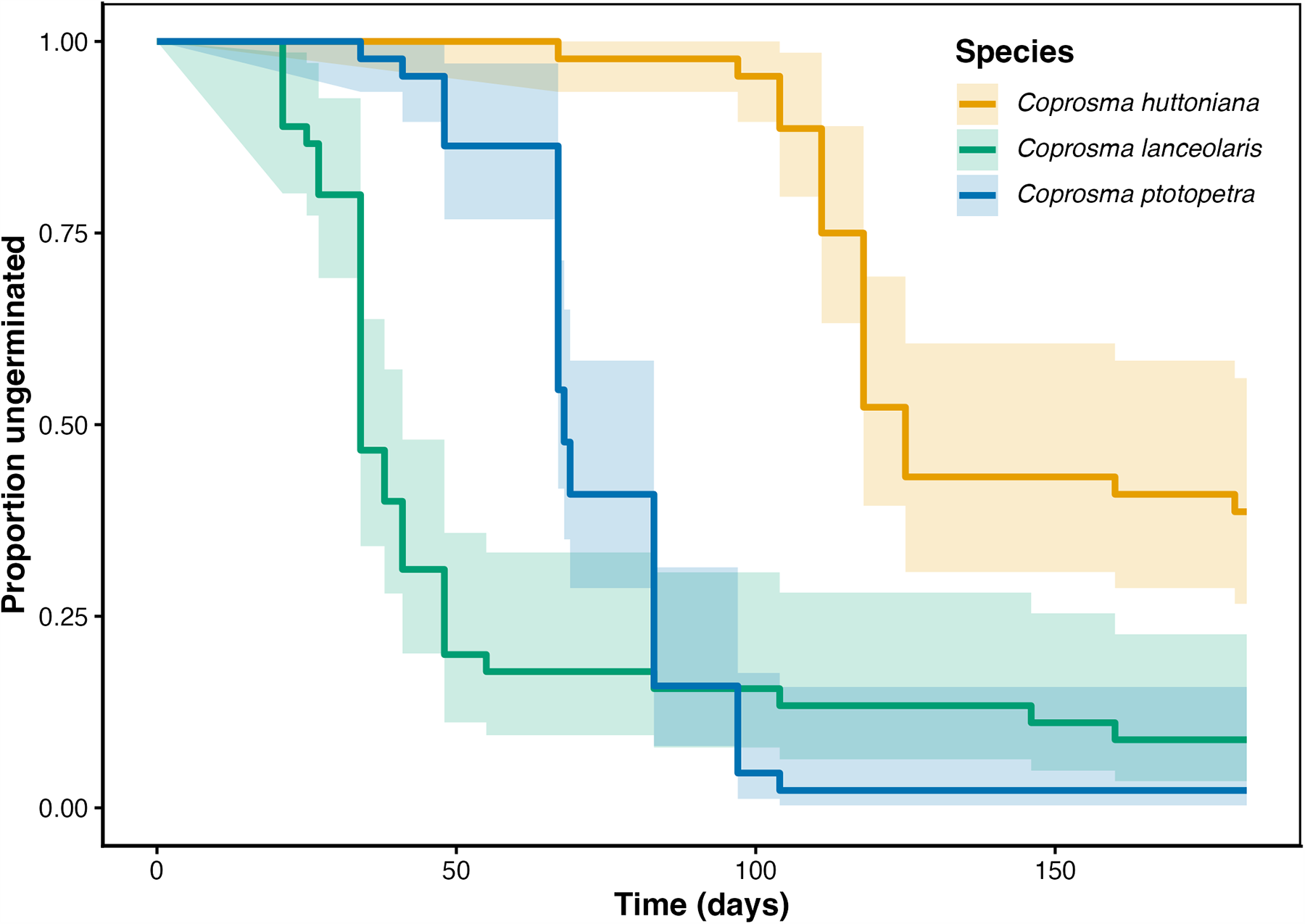
Looking only at winter conditions without GA3, germination timing differed significantly among the three Coprosma species (log-rank χ 2 = 65.7, df = 2, p < 0.001; Figure 5; Table S10). Coprosma lanceolaris germinated fastest (median = 34 days), followed by C. ptotopetra (68 days) and C. huttoniana (125 days; Table S10). Pairwise log-rank tests revealed that all three species differed significantly from each other (all p < 0.01; Table S11), and Cox models further confirmed these patterns (Table S12). The HRs indicate that seeds of C. lanceolaris were around six times more likely to germinate at any given time point compared to C. huttoniana, while C. ptotopetra seeds were almost five times more likely (Table S12).
Kaplan–Meier survival curves comparing germination timing across three Coprosma species. Survival curves show the proportion of seeds remaining ungerminated over time for C. huttoniana (orange), C. lanceolaris (green), and C. ptotopetra (blue). All seeds were sown fresh and germinated on water agar under a winter treatment (19.5/14°C day/night temperatures). Lines represent Kaplan–Meier estimates and shaded regions represent 95% confidence intervals for each survival curve.

Figure 5 Long description
The x-axis is labeled, Time (days), with tick labels at 0, 50, 100 and 150. The y-axis is labeled, Proportion ungerminated, ranging from 0.00 to 1.00 with tick labels at 0.00, 0.25, 0.50, 0.75 and 1.00. A legend titled, Species, lists Coprosma huttoniana, Coprosma lanceolaris, and Coprosma ptotopetra. Coprosma lanceolaris is a step curve that starts at 1.00 at day 0 and drops in several steps before day 50 to about 0.20, then stays near 0.20 until about day 85, then drops to about 0.15 and continues with small steps to about 0.10 by about day 160, remaining there until the end of the test, about day 180. Coprosma ptotopetra is a step curve that starts at 1.00 at day 0, stays near 1.00 until around day 45, then drops in steps to about 0.85 by around day 50 and holds there until around day 65, then drops in steps to about 0.40 by around day 70, then drops to about 0.15 around day 85, then to near zero by around day 100 and remains near zero until around day 180. Coprosma huttoniana is a step curve that starts at 1.00 at day 0, stays near 1.00 until around day 100, then drops in steps to about 0.75 near day 110, to about 0.50 near day 120 and to about 0.45 by around day 125, and then remains near 0.40 through about day 180. Each curve has a surrounding shaded 95 percent confidence band.
Shoot emergence
Shoot emergence was recorded in two of seven replicates with radicle emergence for C. huttoniana (both winter treatment), with first shoot emergence occurring 49 and 84 days after first radicle emergence, respectively. For C. lanceolaris, shoot emergence was observed in all 12 replicates with radicle emergence, with first shoot emergence occurring 14–34 days after first radicle emergence (spring/autumn: 14–28 days; winter: 34 days across all 6 replicates). For C. ptotopetra, shoot emergence was recorded in 9 of 17 replicates with radicle emergence, with first shoot emergence occurring 42–98 days after first radicle emergence (summer: 77 days; spring/autumn: 42–59 days; winter: 42–98 days across 6 replicates).
Viability of non-germinated seeds
At the termination of the germination experiments on fresh seeds that ran for 180–182 days (i.e., excluding the regurgitated samples and ‘move-along’ replicates), most non-germinated seeds remained viable for C. huttoniana (94.3%) and C. lanceolaris (93.6%), whereas this proportion was lower for C. ptotopetra (12.6%).
Impact of ingestion and regurgitation
At spring/autumn temperatures, 0% and 40% of ingested and regurgitated seeds germinated for C. huttoniana and C. ptotopetra, respectively. Under the move-along temperature treatment, the single regurgitated C. huttoniana seed lot achieved a final germination percentage of 17%, while the two C. ptotopetra replicates achieved final germination percentages of 75% and 67%. Although no statistical analyses are possible given the small sample sizes of regurgitated seeds (N = 1–2 per temperature treatment), these can be compared with median values for fresh seeds under the same conditions (i.e., spring/autumn or move-along temperature treatments without GA3) (Figures S1 and S3). Median germination of regurgitated seeds did not differ from fresh seeds for C. huttoniana under the spring/autumn treatment (0% in both cases) but was 43% lower under the move-along treatment (17% versus 60% for fresh seeds). For C. ptotopetra, germination was 46% lower under spring/autumn conditions but 18% higher under the move-along treatment. We also observed visibly greater mould growth on regurgitated seeds compared to manually extracted seeds.
Germination of partially and fully dried seeds
Partial and full drying markedly reduced final germination percentages for C. huttoniana and C. ptotopetra but not for C. lanceolaris, which maintained high levels of germination regardless of drying treatment. Around half of the non-germinated seeds from the partially dried C. huttoniana treatment remained viable, whereas non-germinated seeds from both drying treatments for C. ptotopetra, and fully dried seeds for C. huttoniana, were almost entirely inviable (i.e., discoloured and/or mushy).
Germination percentage
As the winter temperature treatment without GA3 produced high germination across all species, we selected it as the best combination to test germination of partially and fully dried seeds.
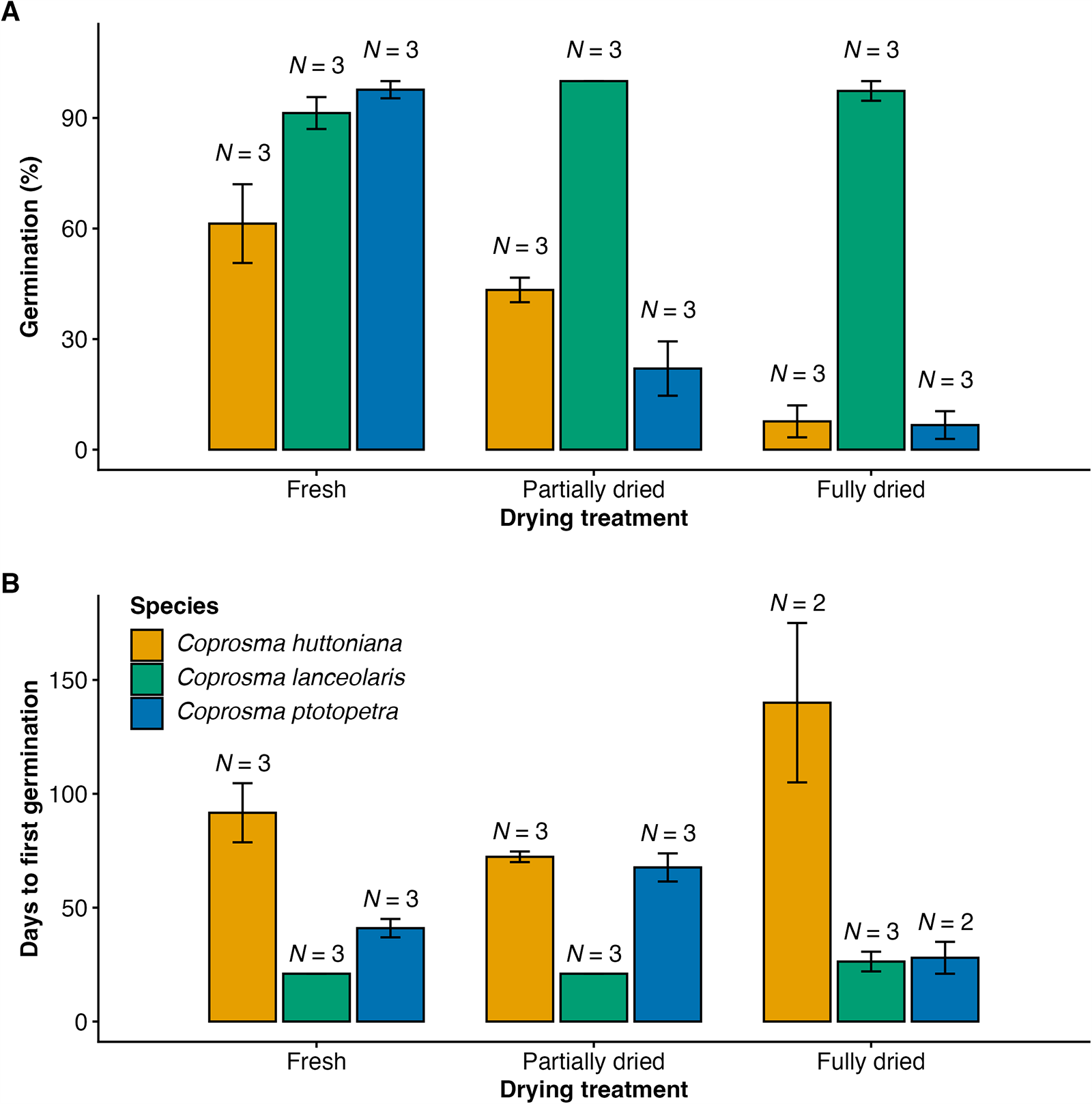
Partial and full drying significantly reduced final germination percentages in C. huttoniana and C. ptotopetra (both p < 0.05; Figures 6A, S1D, and S3D), with germination declining from fresh seeds (median 71% and 100%, respectively) to partially dried (40% and 25%) and fully dried (8% and 7%) seeds. Although individual pairwise comparisons were not significant after correction for multiple testing (Table S13), large effect sizes (η 2 = 0.69–0.76) and consistent declines across treatments indicate substantial desiccation sensitivity in both species. In contrast, C. lanceolaris showed no effect of drying (Figure S2D), maintaining high germination across all treatments (87–100%).
Comparison of (A) germination percentage and (B) time to first germination across fresh, partially dried, and fully dried seeds for three Coprosma species. Seeds were germinated on 0.9% water agar at alternating temperatures of 19.5/14°C and a 12/12 hour light/dark cycle. N = number of replicates, each with 15 seeds. N includes all three replicates per treatment for (A) but only replicates in which germination occurred for (B). Error bars represent the standard error.

Figure 6 Long description
A grouped bar chart with the vertical axis labeled, Germination percent and tick labels at 0, 30, 60 and 90. The horizontal axis is labeled, Drying treatment, with categories Fresh, Partially dried and Fully dried. Each category contains three bars for Coprosma huttoniana, Coprosma lanceolaris and Coprosma ptotopetra, with error bars and labels above bars showing N equals 3. Fresh: Coprosma huttoniana 60, Coprosma lanceolaris 90, Coprosma ptotopetra 95. Partially dried: Coprosma huttoniana 45, Coprosma lanceolaris 100 with no visible error bar, Coprosma ptotopetra 25. Fully dried: Coprosma huttoniana 10, Coprosma lanceolaris 95, Coprosma ptotopetra 10. The image B showing a grouped bar chart with the vertical axis labeled, Days to first germination and tick labels at 0, 50, 100 and 150. The horizontal axis is labeled, Drying treatment, with categories Fresh, Partially dried and Fully dried. A legend labeled, Species, lists Coprosma huttoniana, Coprosma lanceolaris and Coprosma ptotopetra. Each category contains three bars with error bars and labels above bars showing N equals 3 on most bars and N equals 2 on two bars in the Fully dried category. Fresh: Coprosma huttoniana 90 with N equals 3, Coprosma lanceolaris 20 with N equals 3 and no visible error bar, Coprosma ptotopetra 40 with N equals 3. Partially dried: Coprosma huttoniana 70 with N equals 3, Coprosma lanceolaris 20 with N equals 3 and no visible error bar, Coprosma ptotopetra 65 with N equals 3. Fully dried: Coprosma huttoniana 140 with N equals 2, Coprosma lanceolaris 30 with N equals 3, Coprosma ptotopetra 30 with N equals 2.
Time to first germination
There was no significant effect of drying on time to first germination for either C. huttoniana (Figure S4D) or C. ptotopetra (Figure S6D). Although there was a significant effect for C. lanceolaris (p = 0.021, η 2 = 0.95; Figure S5D), median time to first germination differed by only 1 day between treatments (21 days for fresh and partially dried seeds, and 22 days for fully dried seeds). Given the small number of replicates producing any germinants under some drying treatments (Figure 6B), we treat some of these results as inconclusive and instead rely on the survival analysis (see below) for a more robust assessment of how drying affects germination timing.
Survival analysis
Drying treatment had significant effects in all three species (Figures S7D, S8D, and S9D; Table S14), but with contrasting patterns. In C. lanceolaris, partially dried seeds showed increased germination hazard relative to fresh seeds (HR = 2.35, p < 0.001), while fully dried seeds showed no significant difference from fresh seeds. Aligning with the previous analyses, drying markedly reduced germination hazard in C. huttoniana and C. ptotopetra. In C. huttoniana, partially drying seeds significantly reduced germination hazard (HR = 0.50, p = 0.027), while full drying produced an even stronger reduction (HR = 0.067, p < 0.001). In C. ptotopetra, both drying treatments strongly and significantly reduced germination hazard (partially dried: HR = 0.097; fully dried: HR = 0.028, both p < 0.001).
Viability of non-germinated seeds
At the termination of the partially and fully dried replicates, the viability of non-germinated seeds varied among species: C. huttoniana (partially dried: 56.0%, 14/25; fully dried: 0.0%, 0/37), C. lanceolaris (fully dried: 100.0%, 1/1; all partially dried seeds germinated), and C. ptotopetra (partially dried: 0.0%, 0/29; fully dried: 0.0%, 0/41).
Assumption testing of proportional hazard models
Testing of proportional hazards assumptions indicated that all single-factor models for C. huttoniana adequately met the assumptions (all p > 0.05), except for the medium-only model, which showed a significant violation that disappeared once temperature was included in the combined model (Tables S15 and S16). In C. lanceolaris and C. ptotopetra, we detected violations in the drying-only models (p = 0.012 and p < 0.001, respectively), indicating time-varying drying effects (Tables S15 and S16). The assumptions were also significantly violated for the species comparison model (χ 2 = 70.02, df = 2, p < 0.001; Figure 5), indicating HRs change over time between species. Where assumptions are violated, HRs therefore represent the average effects across the study period and should be interpreted alongside the Kaplan–Meier survival curves (Figures 5 and S7–S9).
Discussion
Understanding seed germination requirements and storage behaviour is essential for the ex situ conservation management of threatened island floras. In this study, we examined dormancy, temperature sensitivity, and desiccation tolerance in three species of Coprosma from LHI. We found evidence of physiological dormancy, strong temperature-mediated control of germination, and interspecific differences in desiccation tolerance. Notably, seed size emerged as a potential predictor of storage behaviour in Coprosma, with larger seeds showing greater moisture content at maturity and increased sensitivity to desiccation. These findings have implications for seed banking strategies of these (and related) species and provide insights into how closely related species can diverge significantly in their seed physiology.
Germination requirements
None of the three species tested showed evidence of morphological or physical dormancy, due to the differentiated and fully developed embryos (Figure 2) and the ability to imbibe water without scarification (Baskin and Baskin, Reference Baskin and Baskin2004, Reference Baskin and Baskin2014). While the delay in germination for C. huttoniana and C. ptotopetra (Figure 4) is consistent with physiological regular dormancy, the limited and delayed shoot emergence in these species suggests this may extend to physiological epicotyl dormancy in these two species (Baskin and Baskin, Reference Baskin and Baskin2004, Reference Baskin and Baskin2014). On the other hand, C. lanceolaris germinated more rapidly, and radicle emergence followed this more closely, which might suggest non-dormancy. The strong temperature-dependent germination in C. lanceolaris discussed below is, however, also consistent with physiological dormancy, leaving its dormancy status unclear.
All three species also showed the greatest germination under the winter temperature treatment, with strong effect sizes indicating temperature is a prime driver of germination. This suggests that these species need cooler temperatures to germinate, consistent with their submontane ranges (Figure S10; Brook et al., Reference Brook, Hutton, Papadopulos, Elkan, Wilson, Bower, Bidartondo and Savolainen2026). This was initially surprising as we collected these viable seeds in March (early autumn), when they might be expected to germinate naturally (consistent with Figure S11 and Brook et al., Reference Brook, Hutton, Papadopulos, Elkan, Wilson, Bower, Bidartondo and Savolainen2026). The temperature data we used were, however, collected from a weather station at 5 m a.s.l., where temperatures would be warmer than in the submontane habitats of some of these species. Our ‘winter’ temperature treatment may therefore have been more consistent with autumnal temperatures at higher elevations where temperatures are consistently several degrees lower. For example, maximum winter temperatures at 400 m a.s.l. are around 4°C colder in winter compared to the lowland data we use in this study (Denham, A. 2025. pers. comm.). This could explain why the species with the broadest elevational range, C. ptotopetra (15–767 m a.s.l.) (Brook et al., Reference Brook, Hutton, Papadopulos, Elkan, Wilson, Bower, Bidartondo and Savolainen2026; Figure S10), was the least affected by germination temperature in this study. Although we could have estimated submontane seasonal temperatures, we argue that the temperature treatments used in this study were useful as they covered the range of the widespread C. ptotopetra. Furthermore, they allowed us to show that the absence of C. huttoniana and C. lanceolaris in lowland habitats (Figure S10) could be due, at least in part, to temperature-specific germination requirements.
This strong temperature dependence – combined with delayed germination in C. huttoniana and C. ptotopetra, and high viability of ungerminated seeds in the former – is consistent with physiological dormancy and perhaps seasonal dormancy cycling in those species. The faster germination but similarly strong temperature dependence of C. lanceolaris may indicate non-deep physiological dormancy. Further experiments applying stratification or other dormancy-breaking treatments would be required to classify the level and type of physiological dormancy of each of these species (Baskin and Baskin, Reference Baskin and Baskin2004, Reference Baskin and Baskin2014).
Passage through an animal’s gut often increases the rate of seed germination (Samuels and Levey, Reference Samuels and Levey2005); however, this is not always the case, and there are sometimes interactions with seed characteristics, such as seed size (e.g., Jones et al., Reference Jones, Hunts, Dolan, Murphy, Ripa, Schultz, Shastry, Sklarczyk, Thornton and Boudreau2023). Although some seeds of both tested species (C. huttoniana and C. ptotopetra) successfully germinated after ingestion, suggesting they could be viably dispersed by birds, we found little to no evidence that regurgitation enhanced germination compared to manually extracted seeds. We note, however, that we could not test this statistically due to the small sample sizes, and the greater mould growth relative to the manually extracted seeds could have reduced germination. In addition, the age of the regurgitated seeds at the time of collection was unknown and could have resulted in some level of viability loss through drying before collection. We also found that the addition of GA3 did not improve the final germination percentages for most species except C. lanceolaris, with evidence that this compound actually hinders germination in C. huttoniana and C. ptotopetra. We speculate that this points to the absence of GA3-responsive dormancy mechanisms in these species across most conditions, in contrast to what was found in C. kauensis from Hawai’i (Wolkis et al., Reference Wolkis, Saling, Baskin and Baskin2023), and recommend that these latter species should be germinated ex situ without the use of GA3.
A further consideration for germination management is the fate of non-germinating seeds. For both C. huttoniana and C. lanceolaris, the mean proportion of ungerminated seeds from the fresh experiment that remained viable after 180 days was high (mean 94% for both species), suggesting that ungerminated seeds retain the capacity to germinate beyond the test period and may contribute to a soil seed bank. In contrast, for C. ptotopetra, most non-germinating seeds were inviable at test termination, indicating that seeds of this species either germinate within approximately 6 months of dispersal or lose viability entirely. This contrast may reflect differences in dormancy depth or longevity among the three species. It also has practical implications: ex situ germination tests for C. lanceolaris and C. huttoniana may underestimate total germinability if terminated at 180 days. This was supported by the move-along experiment, which produced a higher (albeit not significantly) germination percentage for C. huttoniana, confirming that 6 months was insufficient to fully assess germinability.
Desiccation tolerance: size matters
We found species-specific responses to seed desiccation within Coprosma, with implications for understanding seed storage behaviour in these taxa. The progressive decline in viability with increasing drying observed in C. huttoniana and C. ptotopetra represents a dose-dependent response suggestive of intermediate and recalcitrant behaviour, respectively (Hong and Ellis, Reference Hong and Ellis1996). The large effect sizes indicate that desiccation explains a considerable proportion of variance in germination success, supported by the finding that non-germinated seeds were almost entirely inviable for both drying treatments in C. ptotopetra and the full drying treatment in C. huttoniana. This indicates that drying caused seed death rather than inducing secondary dormancy, consistent with intermediate/recalcitrant seed behaviour documented in other (sub)montane and (sub)tropical forest species (e.g., Sommerville et al., Reference Sommerville, Errington, Newby, Liyanage and Offord2021). The partially dried C. huttoniana seeds were an exception, with 56% of non-germinated seeds remaining viable, warranting further investigation into whether this represents a threshold drying response or genuine dormancy induction. Conversely, the desiccation tolerance exhibited by C. lanceolaris, with high germination maintained in both dried treatments, suggests a potentially orthodox classification (Hong and Ellis, Reference Hong and Ellis1996) and possible protective biochemical mechanisms.
Although our study does not allow for statistical analysis of the relationship between seed size and desiccation tolerance, we observed a general pattern of increasing sensitivity to drying for seeds with greater moisture content on dispersal. Seeds of C. huttoniana and C. ptotopetra are larger and have a substantially higher fresh SMC compared to C. lanceolaris. This pattern of greater recalcitrance in larger seeds (e.g., Ellis et al., Reference Ellis, Mai-Hong, Hong, Tan, Xuan-Chuong, Hung, Ngoc-Tam and Le-Tam2007) and seeds with higher SMCs (e.g., Sommerville et al., Reference Sommerville, Errington, Newby, Liyanage and Offord2021) is well-established, likely reflecting less effective cellular protection methods (Leprince et al., Reference Leprince, Hendry and McKersie1993) and perhaps indicating adaptation to more stable/consistently moist environments. This can, to some extent, explain the variation in storage behaviour reported in Hawaiian (Chau et al., Reference Chau, Chambers, Weisenberger, Keir, Kroessig, Wolkis, Kam and Yoshinaga2019) and Tasmanian (Royal Tasmanian Botanical Gardens, 2026) Coprosma species and supports the use of seed weight and moisture content as predictive tools for assessing desiccation tolerance.
Interspecific variation in storage behaviour and its consequences for seed banking
Although storage behaviour within a genus can often be used to predict untested congeneric species (Wyse and Dickie, Reference Wyse and Dickie2018), we highlight that closely related species can differ substantially in behaviour. The interspecific differences in storage behaviour we observed were not readily explained by broad habitat differences. The habitats of C. huttoniana, and to some extent C. ptotopetra, are similar to those of C. lanceolaris, suggesting that environmental conditions alone do not account for the greater sensitivity to drying of the former species. This supports increasing evidence that desiccation tolerance can vary substantially even among species occupying comparable habitat types (Sommerville et al., Reference Sommerville, Errington, Newby, Liyanage and Offord2021).
Instead, intrinsic biological differences are likely to be more important in determining storage response. Seed characteristics, such as SMC as discussed above, may underlie some of the observed variation, consistent with reports of intrageneric differences driven by seed traits in other taxa, such as Syzygium (Sommerville et al., Reference Sommerville, Errington, Newby, Liyanage and Offord2021). Plant habit may also provide an indication of desiccation response. Coprosma huttoniana and C. ptotopetra are generally larger and often more tree-like, whereas C. lanceolaris occurs primarily as a shrub (Green, Reference Green1990, Reference Green and Wilson1994; Brook et al., Reference Brook, Hutton, Papadopulos, Elkan, Wilson, Bower, Bidartondo and Savolainen2026). Growth form has been linked to desiccation sensitivity in other studies, with tree species tending to exhibit greater sensitivity than shrubs (Sommerville et al., Reference Sommerville, Errington, Newby, Liyanage and Offord2021). Differences associated with life-history strategy and plant architecture may therefore help explain the greater desiccation sensitivity observed in C. huttoniana and C. ptotopetra relative to C. lanceolaris.
In terms of seed banking, C. lanceolaris is potentially suitable for conventional seed banking since it can be dried to less than 5% SMC whilst maintaining viability. Planned experiments to test germination after short-term storage (e.g., 3 months) will confirm whether it is also tolerant of conventional storage temperatures. Conversely, C. huttoniana and C. ptotopetra will be more problematic to bank given the substantial viability loss on drying. Partial drying does not, however, result in complete viability loss and so could be used in combination with cryopreservation (Walters et al., Reference Walters, Berjak, Pammenter, Kennedy and Raven2013). Alternatively, tissue culture could be attempted for ex situ conservation of these species (see review Jaganathan, Reference Jaganathan2026), in combination with in situ conservation.
Broader implications
Our results have implications beyond seed banking as they can help us make predictions of the impacts of anthropogenic climate change on these species. Firstly, our temperature trials suggest that the warmer temperatures predicted with climate change in the South-West Pacific region (World Meteorological Organization, 2025) may inhibit germination of these species. Furthermore, reduced rainfall and associated drought – which has been observed and is predicted to worsen for LHI (Auld and Leishman, Reference Auld and Leishman2015; IUCN World Heritage Outlook, 2025) and Australia more broadly (Costion et al., Reference Costion, Simpson, Pert, Carlsen, John Kress and Crayn2015) – could result in increased seed desiccation, either in situ before dispersal or after dispersal prior to germination. Regardless, this could reduce the germination success for desiccation-sensitive species (e.g., C. huttoniana and C. ptotopetra), reducing rates of reproduction and/or limiting regeneration to remaining sites with sufficient moisture. These factors, combined with climate threats to adult survival (Rowell, Reference Rowell2023) and other drivers of population decline (e.g., invasive weeds and Phytophthora), will likely increase extinction risk for these species. Key questions remain regarding whether populations are genetically diverse enough to adapt to warmer germination conditions and, if so, whether assisted gene flow from populations at different elevations could help ensure their survival (Prieto-Benítez et al., Reference Prieto-Benítez, Morente-López, Rubio Teso, Lara-Romero, García-Fernández, Torres and Iriondo2021; Sacristán‐Bajo et al., Reference Sacristán‐Bajo, Lara‐Romero, García‐Fernández, Prieto‐Benítez, Morente‐López, Rubio Teso, Torres and Iriondo2025).
LHI exhibits remarkable diversity within a small geographic area (<16 km2), with seven endemic Coprosma species now formally described (Brook et al., Reference Brook, Hutton, Papadopulos, Elkan, Wilson, Bower, Bidartondo and Savolainen2026). Whilst there is a taxonomic basis for seed desiccation sensitivity (Wyse and Dickie, Reference Wyse and Dickie2018), the variation in storage behaviour among congeneric species assessed in this study highlights that genus-level generalizations can be misleading, even when species share recent common ancestry through adaptive radiation (Papadopulos et al., Reference Papadopulos, Baker, Crayn, Butlin, Kynast, Hutton and Savolainen2011, Reference Papadopulos, Price, Devaux, Hipperson, Smadja, Hutton, Baker, Butlin and Savolainen2013). We propose that, when assessing seed storage behaviour of threatened island floras, a species-specific approach is more relevant, especially given that island biodiversity faces increased anthropogenic pressures compared to continental biodiversity (e.g., Kier et al., Reference Kier, Kreft, Lee, Jetz, Ibisch, Nowicki, Mutke and Barthlott2009; Caujapé-Castells et al., Reference Caujapé-Castells, Tye, Crawford, Santos-Guerra, Sakai, Beaver, Lobin, Vincent Florens, Moura, Jardim, Gómes and Kueffer2010) and seed availability is likely to be limited.
Future directions
Several research priorities emerge from this work. Firstly, as access to seed in the field was limited and collection occurred within a short period of time, we were unable to investigate any seasonal variation in seed quality (Hay and Probert, Reference Hay and Probert2013). Larger sample sizes are also needed to confirm the level of desiccation sensitivity in C. huttoniana and C. ptotopetra, which our analyses showed to be weaker in the former. Regardless, alternative ex situ conservation protocols should be investigated, as conventional seed banking approaches are likely not appropriate for these species. Secondly, this limited seed access also prevented us from fully understanding the depth of physiological dormancy of all three species (Baskin and Baskin, Reference Baskin and Baskin2004, Reference Baskin and Baskin2014). Our assessment of physiological epicotyl dormancy in C. huttoniana and C. ptotopetra was potentially further complicated because cotyledon expansion of some seeds could have failed due to fungal growth after the radicle emerged, and some shoots had difficulty emerging where they contacted the dish lid. Larger Petri dishes could be used to confirm physiological epicotyl dormancy over physiological regular dormancy in these species. Thirdly, for the desiccation-tolerant C. lanceolaris, longitudinal studies testing germination success at regular intervals (e.g., 6 months, 2 years, 5 years, and so on) would allow us to understand the long-term viability and storage behaviour of this species in the seed bank (Probert et al., Reference Probert, Daws and Hay2009; De Vitis et al., Reference De Vitis, Hay, Dickie, Trivedi, Choi and Fiegener2020).
Alongside these practical considerations, several broader ecological and evolutionary questions also remain. For example, the integration of genomic and germination data across species in the Coprosma genus could allow us to identify the genetic basis of storage behaviour (e.g., Yuan et al., Reference Yuan, Fan, Xia, Ding, Tian, Sun, He and Yu2019). Phylogenetic comparative analyses could also be used to confirm whether there is any phylogenetic signal in seed germination and storage behaviour (Wyse and Dickie, Reference Wyse and Dickie2017) and thus increase our confidence in predicting these behaviours based on phylogeny, at least at the genus- or tribe-level. Studies in other systems, such as a prairie restoration system (Barak et al., Reference Barak, Lichtenberger, Wellman-Houde, Kramer and Larkin2018), have shown evidence for phylogenetic signal in germination traits, but we find no examples of similar studies for storage behaviour. In addition, germination studies that more accurately reflect microhabitats could be used to validate the coarse-scale findings of this study (e.g., Espinosa del Alba et al., Reference Espinosa Del Alba, Fernández-Pascual and Jiménez-Alfaro2025), and climate envelope modelling incorporating germination data could be used to more accurately predict recruitment under different anthropogenic climate change scenarios (Collette et al., Reference Collette, Sommerville, Lyons, Offord, Errington, Newby, von Richter and Emery2022; Stevens et al., Reference Stevens, Lautgier, Hoyle, Guja, Worboys, Crayn and Sommerville2026).
This study reveals substantial variation in seed biology among closely related endemic species of Coprosma on LHI, providing clear conservation outcomes: conventional seed banking may be appropriate for C. lanceolaris but is unsuitable for the more desiccation-sensitive C. huttoniana and C. ptotopetra, both of which require alternative approaches. The requirement for cool temperatures for germination, combined with documented drought-related mortality in C. inopinata, suggests considerable vulnerability under climate change. More broadly, our stepwise methodology provides a useful, replicable approach for assessing the seed biology of threatened island taxa – enabling a range of germination temperatures to be tested even when seed supply is limited – supporting more effective conservation planning.
Supplementary material
The supplementary material for this article can be found at https://doi.org/10.1017/S0960258526100282.
Acknowledgements
We thank the New South Wales Government and the Lord Howe Island Board, in particular Liam Murphy and Nicola Fuller, for permitting this research. We would also like to thank the team at the Australian PlantBank and the National Herbarium of New South Wales at the Botanic Gardens of Sydney for all their support. We also thank the two anonymous referees and the editor for their comments.
Funding statement
This work was supported by the NERC Science and Solutions for a Changing Planet Doctoral Training Partnership (grant number NE/S007415/1) (to T.S.B.), the Botanical Research Fund (to T.S.B.), the Mohamed bin Zayed Species Conservation Fund (to T.S.B.), the Royal Society (Leverhulme Trust Senior Research Fellowship to V.S.), and the Oak Spring Garden Foundation (sabbatical award to V.S.).
Competing interests
The authors declare none.
Data availability statement
The germination data are available at https://github.com/theobrook/Brook_et_al_Coprosma-seed-germination-and-storage-data.


 Open access

