- BBL
Horst-Rüdiger Jarck and Günter Scheel (eds), Braunschweigisches biographisches Lexikon: 19. und 20. Jahrhundert, Hanover 1996
- DNVP
Deutschnationale Volkspartei
- KPD
Kommunistische Partei Deutschlands
- KuK
Kunst und Kirche
- LKA
Landeskirchenamt
- NSDAP
Nationalsozialistische Deutsche Arbeiterpartei
- SA
Sturmabteilung
- SPD
Sozialdemokratische Partei Deutschlands
Since 1945 the history of the German Protestant Church under the National Socialist regime has been characterised by the term Kirchenkampf (‘church struggle’), a term which emerged as early as 1933 or 1934. Many accounts of the German Church under National Socialism focus on those who resisted, including Dietrich Bonhoeffer, Paul Schneider and Martin Niemöller. Sometimes the impression has been given that a significant proportion of Protestants were part of the opposition: that the ‘church struggle’ was widespread and prevalent. The reality was far more complex, and this article explores that complexity by considering what the building and reordering of churches under National Socialism reveals about the interactions between National Socialist ideology and Christian life. The motivation for embarking on building projects, the mood in which they were received, and the architecture and decoration that resulted, all shed interesting light on the inter-relationships between the German Churches and the National Socialist state. The focus here is on the Lutheran Regional Church or Landeskirche of Braunschweig (sometimes known in English as Brunswick).
In the short-lived Free State of Braunschweig (1919–46), the Nationalsozialistische Deutsche Arbeiterpartei (NSDAP) achieved early political success. From 1 October 1930 Braunschweig's Landeskirche related to a coalition of right-wing parties, most significantly the Deutschnationale Volkspartei (DNVP: German National People's Party) and the NSDAP, which appointed a National Socialist minister for culture (Volksbildung) and the interior: initially the lawyer Anton Franzen (1896–1968), and from 15 September 1931 the former teacher Dietrich Klagges (1891–1971).Footnote 1 After Hitler was named as Reichskanzler on 20 January 1933 (the so-called National Socialist Machtergreifung), measures were taken in Braunschweig against trades unionists, social democrats and Communists; although the SPD and KPD still polled 19 per cent of the votes in the Landestag election on 5 March, it resulted in a DNVP/NSDAP coalition. However, this coalition was short-lived: on 29 April 1933, after all elected representatives of the DVNP had ‘voluntarily’ joined the NSDAP and the party had been dissolved, Klagges reported to Hitler that Braunschweig had ‘the first purely National Socialist’ government in Germany. On 6 May, Klagges was appointed premier of Braunschweig.
Klagges was a convinced National Socialist, who saw a fundamental connection between Christianity and German-ness and expected Braunschweig's Landeskirche to reflect his views.Footnote 2 Braunschweig's church elections on 23 July 1933 resulted in an exclusively German Christian Synod, which in August 1933 elected Wilhelm Beye (1903–75) as the Landeskirche's second Landesbischof.Footnote 3 Beye was ‘young, blond, enthusiastically committed to the Volk, and a member of NSDAP’.Footnote 4 In 1934 he resigned, facing trial for fraud;Footnote 5 his successor, elected on 15 November 1934, was Helmuth Johnsen (1891–1947), also a German Christian, although more moderate, who would lead the Landeskirche until shortly before his death.Footnote 6 Throughout this period, therefore, Braunschweig's synod and bishop held that National Socialism was not incompatible with Christianity, although not all pastors and church members concurred.Footnote 7 Braunschweig offers a good example of the ways in which German Protestants lived with the demands, restrictions and expectations of the National Socialist state.
The response of the German Protestant Churches to National Socialism
It has long been recognised that not all Christians in Germany were opposed to National Socialism. Manfred Gailus' study of Protestant pastors in Berlin concludes that between forty and fifty per cent were broadly sympathetic to the German Christians.Footnote 8 The attraction of National Socialist ideas for some Protestant theologians is well documented in the work of Robert Eriksen, Kurt Meier and Susannah Heschel.Footnote 9 Moreover, as Dietrich Kuessner observes, ‘the Hitler dictatorship, even in its own National Socialist understanding, was certainly not an atheist state, but at least a religious, if not a Christian, dictatorship’.Footnote 10 Richard Steigmann-Gall demonstrates the multiplicity of ways in which aspects of National Socialist ideology and ritual not only rejected but also drew on Christian ideas and practices,Footnote 11 and Doris Bergen explores how German Christians integrated their faith with their political views.Footnote 12 Many German Protestants believed, as Steigmann-Gall comments, that ‘Weimar's very existence [had] signalled a profound assault on God's order’.Footnote 13 It was not difficult for them to find a modus vivendi with a state which they did not necessarily like, but which they saw as withstanding that assault: indeed, there was, Christoph Strohm notes, broad Protestant support for the rhetoric of a ‘national reawakening’.Footnote 14 In the 1932 election the percentage of votes cast for the NSDAP in Protestant areas was more than double that cast in Catholic areas (56·2 per cent compared to 22·8 per cent).Footnote 15 As Gailus observes, but Klaus Scholder long ago demonstrated, ‘in 1933, no force was needed … Protestantism opened the doors to National Socialism voluntarily, often fascinated by it’.Footnote 16
Johannes Tuchel argues that official Protestant responses to National Socialism were driven by the desire to retain the structures of the Landeskirchen, and maintain, or improve, the relationship between Church and State. Individuals were often swayed by ‘national enthusiasm’ and ‘fascinated by the prospect of participating in the Volksgemeinschaft and of the restoration of Germany's greatness’.Footnote 17 As Heschel notes, many German Christians ‘were influenced by the völkisch traditions and mood of cultural pessimism that … were crucial in shaping Nazi ideology and that drew adherents from across the political spectrum, from reactionaries to liberals’.Footnote 18 However, this interest was not confined to those who self-identified as German Christians: Strohm points out that, although the paganising tendencies of Alfred Rosenberg and his followers were generally seen as problematic, ‘many pastors and church-members were receptive to the anti-western and anti-democratic slogans of National Socialist agitators’.Footnote 19 Widespread acceptance of nationalist – and, significantly, of antisemitic and anti-Communist – ideas amongst the Protestant middle class increased the credibility of Article 24 of the NSDAP Party Manifesto: ‘The party holds the standpoint of positive Christianity, without binding itself to a particular confession.’Footnote 20 Armin Nolzen observes that members of Protestant Churches were statistically over-represented amongst the membership of the NSDAP,Footnote 21 but church membership statistics also indicate that after the National Socialist Machtergreifung in January 1933, church membership, which during the 1920s had undergone significant decline, began to increase again.Footnote 22 Although some National Socialists did call for de-confessionalisation and the rejection of Christianity,Footnote 23 what in fact happened was a re-Christianisation of Germany and a rejection of the principles of the Weimar Republic.
Moreover, distinctions between the Confessing Church and the German Christians were not always as clear-cut as might be expected. Although the Barmen Declaration warned that the German Evangelical Church ‘is threatened by the teaching methods and actions of the ruling church party of the “German Christians” and of the church order they support’,Footnote 24 significant numbers of the pastors and congregations who identified themselves as belonging to the Confessing Church also wished to retain their allegiance to the Volkskirche, and particularly to the inclusiveness of its parish system. Gailus identifies four categories of parishes in Berlin: nazified, assimilated, divided and resisting; calculating that thirty-four parishes (26 per cent) were nazified, twenty-one (16 per cent) assimilated, sixty-eight (52 per cent) divided, while ‘at the most’ eight (6 per cent) resisted.Footnote 25 Kurt Dietrich Schmidt observes that a pastor in the Confessing Church not infrequently held a ‘red card’ signifying membership of the Confessing Church and loyalty to the Regional Council of Brethren (Landesbruderrat), whilst at the same time being willing to baptise all the babies born in his parish and to officiate at the funerals of all the members of his congregation, regardless of their political allegiance.Footnote 26 The Confessing Church also ‘compromised with the heretical church order’ in matters of administration and finance. Continuing disagreements within the Confessing Church over questions of loyalty and resistance served to complicate the situation still further.Footnote 27
In addition, National Socialists often regarded themselves as pious and praying Christians.Footnote 28 After the war, Johannes Leistikow, Propst in Braunschweig from 1935, testified at Dietrich Klagges's trial, ‘that he himself had experienced … that in [Klagges's] home grace was said before meals’.Footnote 29 Equally, when the Second World War broke out, leading representatives of the Confessing Church offered intercessions for ‘the Führer and the Reich’, and Martin Niemöller, interned in the concentration camp Sachsenhausen, wrote to Hitler volunteering to rejoin the navy.Footnote 30 Prayer-books and works of popular piety included prayers for the Führer.Footnote 31 The 1940 edition of Ewiges Deutschland: ein deutsches Hausbuch (‘Eternal Germany: a German housebook’), offered a poem by Hermann Claudius:
Such prayers reflected the understanding that Hitler was the legitimate leader of Germany, set in place by God.Footnote 33 Sermons for Easter and Christmas might herald Hitler as the modern saviour of the German nation,Footnote 34 and the church calendar was amended to include the anniversary of the National Socialist Machtergreifung and Hitler's birthday.Footnote 35 Such intertwining of religious motivations and interests in daily life makes it difficult to distinguish clearly between opposition and assimilation. A similar mingling of factors and interests played out in the building and renovation of churches after 1933.
Building churches under National Socialism
On 14 July 1933, the National Socialist state attempted to introduce Gleichschaltung into the German Protestant Landeskirchen and to unite them into an imperial Protestant Church or Reichskirche. Axel von Campenhausen lists the far-reaching consequences: the dissolution of Christian youth organisations, unions and academic societies; the de-confessionalisation of confessional schools and the banning of school worship; the reorganisation of church hospitals and social services as secular organisations; a reduction in the size – and indeed the number – of theology faculties; transfer of responsibility for church graveyards to local councils; and the forbidding of the construction of new church buildings.Footnote 36 In practice, however, whilst Gleichschaltung significantly reduced, and in some cases prevented, the work of the churches, and the campaign against the churches continued under such catchphrases as ‘de-politicisation of the churches’ and ‘de-confessionalisation of public life’, these measures were not as effective as von Campenhausen claims. In particular, although stringent rules against the construction of new churches were enforced in some areas, the building of churches did not cease: as Beate Rossié shows, more than one thousand churches or church halls were either built or remodelled under National Socialism.Footnote 37 There were areas without churches: Braunschweig was home to the National Socialist model estate of Mascherode, which had, not a church, but a ‘community house’ at its centre. In the expansion and redesigning of Salzgitter and Wolfsburg, which, as the locations of Salzgitter Steel and Volkswagen respectively, were important centres of National Socialist industrialisation, the building of churches was indeed forbidden, although even there churches seem to have been included in the original plans.Footnote 38 However, elsewhere the (re-)building of churches and investment in church art was regarded as a contribution to the National Socialist programme for the reduction of unemployment.Footnote 39 Churches and congregations had significant resources with which to support this work: in Braunschweig, the Landeskirche's budget grew from 900,000 Reichsmark (RM) in 1933 to 1·6 million RM in 1942,Footnote 40 and the financial situation was similar elsewhere. Across Germany between 1933 and 1937 there was a significant increase of expenditure on church buildings and ecclesiastical art. However, the introduction of the four-year rearmament plan in 1936 meant that from 1937 building materials became less available and building activity decreased; the last new church to be built under National Socialism was completed in 1944.Footnote 41
These new church buildings took many different forms. The Martin Luther Memorial Church (the ‘Luther Church’) in Berlin-Mariendorf, begun in 1933 and consecrated on 22 December 1935, offers an example of symbiosis between Christian theology and National Socialist ideology which has been well documented by Beate Rossié, Stephanie Endlich and Monica Geyler-von Bernus.Footnote 42 The parish included a powerful group of German Christians, as well as a group of Confessing Christians; two of its three pastors were neutral and one a German Christian.Footnote 43 The Luther Church was designed by Curt Steinberg (1880–1960), head of the board of works of the Church of Berlin-Brandenburg from 1915 until 1953.Footnote 44 It is unusual, although certainly not unique,Footnote 45 in that almost all its decoration presents nationalist – and often National Socialist – symbolism integrated with Christian imagery.
In the entrance hall, a relief of President Hindenburg, flanked by iron crosses, commemorates the laying of the foundation stone. A portrait of Hitler originally faced it; in 1945 this was replaced by an image of Luther. A frieze reproduces the first verse of Luther's famous hymn ‘Ein feste Burg ist unser Gott’ (‘A mighty fortress is our God’), which in National Socialist rhetoric became ‘today's German hymn against bolshevism’.Footnote 46 The lobby is lit by a cast-iron ceiling light in the form of a large iron cross: a heroes’ lamp, drawing on the symbolism of the Wilhelmine Reich and the First World War as well as the Third Reich.Footnote 47
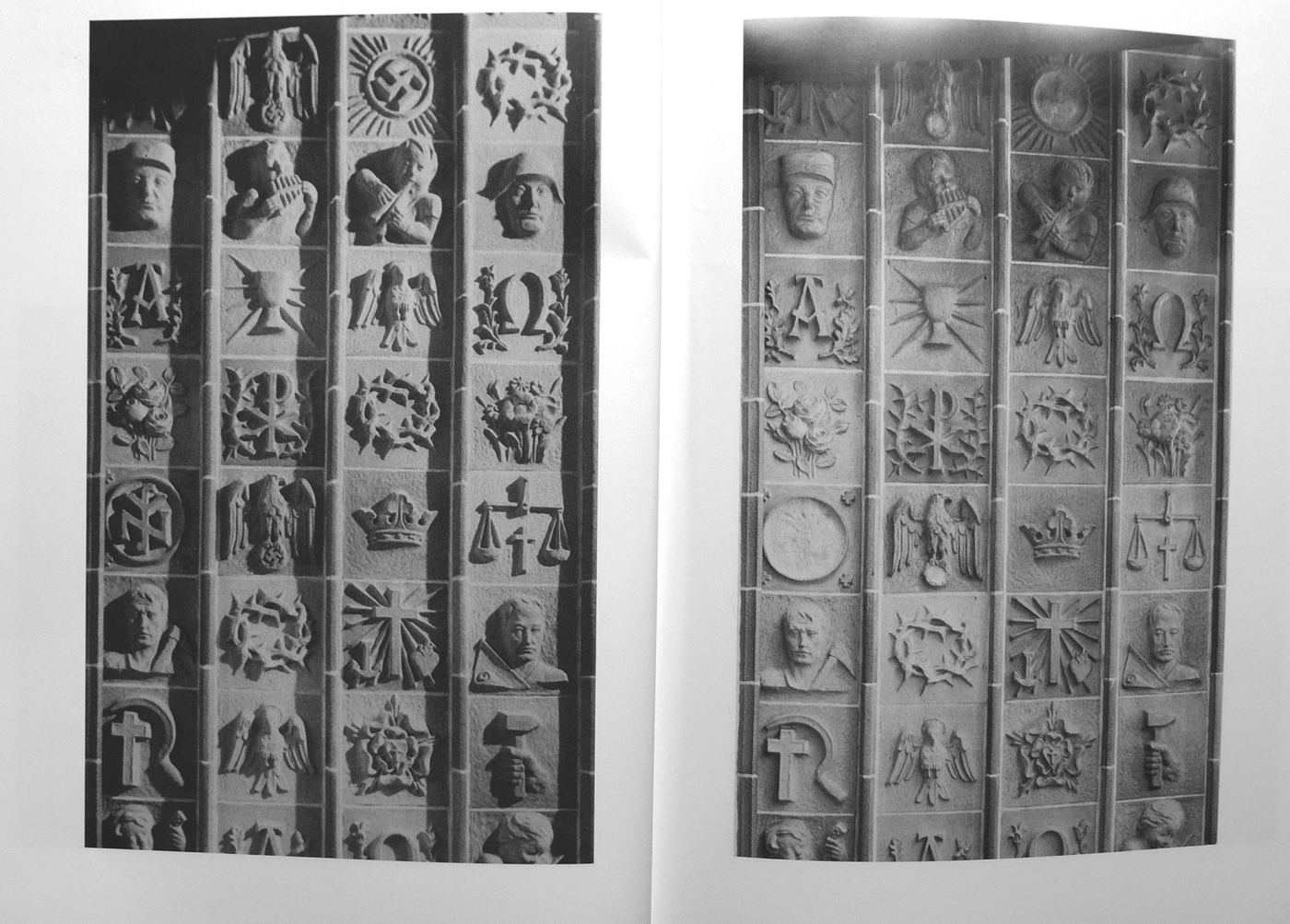
In the church itself, the transition from nave to chancel is marked by a triumphal arch which is decorated with terracotta motifs including not only Christian symbols but also those of the German state and of National Socialism (see fig. 1).Footnote 48 The swastikas and other National Socialist symbols were removed after 1945, but the imperial eagles and other nationalist imagery remain.
Terracotta motifs before and after 1945: left © Evangelisches Landeskirchliches Archiv in Berlin; right © Mechthild Wilhelmi/Aktives Museum für Faschismus und Widerstand e.V.

The font, one of three pieces carved by the sculptor Hermann Möller (1870–1949), presents a combination of National Socialist and Christian images. Its figures are in oak, widely regarded as a national symbol, ‘inseparably bound to the creation of Germanic and German art’.Footnote 49 The column of the font depicts Christ accompanied by the ideal German family: two children, a mother with an infant, and a man wearing the uniform of the Sturmabteilung (SA).Footnote 50 The crucifix, also by Hermann Möller, shows a gilded Christ figure presented as Christus victor with a posture and figure which are entirely consistent with the sportsmen and warriors depicted in National Socialist art. This is the living Christ, victor over death, and at the same time a symbol of the new age brought in by National Socialism (see fig. 2).Footnote 51
The final piece by Hermann Möller is the pulpit which depicts Christ preaching to the National Socialist Volksgemeinschaft. On the left, is a group of men surrounded by women – mothers – each accompanied by several children. Behind Jesus is a soldier in uniform. Amongst those listening to Christ's words is an SA man, recognisable by his party shirt and his jackboot (see fig. 3). The face suggests that this depicts Horst Wessel, the author of the so-called ‘Nazi hymn’ (originally published as by ‘An unknown SA man’), who was widely perceived as a Nazi martyr. Horst Wessel's hymn was sung at the roofing ceremony of the Luther Church in 1934.Footnote 52 In the interior of this church, and in some aspects of the liturgical life of its congregation, Christianity and National Socialism are entirely at one. And yet this was the church in which, in 1938, Johanna Klepper, the Jewish wife of the poet and hymn-writer Jochen Klepper, was baptised and the couple had their church wedding.Footnote 53
Crucifix. © Mechthild Wilhelmi/Aktives Museum für Faschismus und Widerstand e.V.
Pulpit with the unknown SA man. © Mechthild Wilhelmi/Aktives Museum für Faschismus und Widerstand e.V.
Even in this type of National Socialist church building, however, there is evidence of a trend in church architecture, strongly influenced by Otto Bartning (1883–1959), which reflected the rethinking of the role of the Church from the late nineteenth century onwards.Footnote 54 Bartning regarded church buildings not as holy spaces but rather as secular buildings in which the Word could be preached to the gathered congregation. His church buildings were a realisation of the ideas of theologians such as Emil Sulze (1832–1914), who wanted churches in which the congregation was not separated from the preacher or the choir and all the spaces necessary for the life of the congregation were integrated into one space,Footnote 55 and Friedrich Naumann (1860–1919), whose ‘social’ theology, explored in writings such as Jesus als Volksmann (‘Jesus as a man of the people’),Footnote 56 convinced him that ‘magnificent churches are simply un-Protestant’.Footnote 57 Naumann's ‘church of the future’ was a building ‘set in a garden, without a tower and accessible to everyone … constructed mainly of glass and iron, so that no-one is plagued by any gothic; a hall with side rooms, decorated only with a cross’.Footnote 58 Bartning's emphasis on simplicity reflected this vision. As Horn affirmed in 1929, ‘the underlying cultic-sacral concept of Protestantism is the idea of the congregation’.Footnote 59 This conviction was taken up by the Hamburg architect Gerhard Langmaack (1898–1986), who was also influenced by the Berneuchener movement and its exploration of the relationship between liturgy and space. Bartning and Langmaack experimented with the use of glass and steel in the building of churches.Footnote 60 Whilst their daring application of new materials and of Bauhaus-type architecture succumbed in the 1930s to ideas of what was truly German and the consequent reaffirmation of the romanesque, the medieval fortress and of Heimatstil (regional architecture), only to re-emerge in the 1950s and 1960s,Footnote 61 their simplifying approach to church interiors and their rejection of gothic found parallels in – and drew inspiration from – the increasingly dominant rhetoric of the Volk.Footnote 62
The search for true German-ness in art was not confined to German Christians. In 1935 an article appeared in the journal Junge Kirche, usually seen as an organ of the Confessing Church, entitled ‘Bekennende Kirche als kunstschöpferische Macht’ (‘The Confessing Church as a creative force in art’). Much of its rhetoric could be as easily attributed to National Socialist ideology of art as to the theology of the Confessing Church:
A German work of art does not seek to please the observer or demand a response of enjoyment; it fulfils a religious, moral mission. Therefore German art is first and foremost Christian art … In its materials and techniques, German art demonstrates national characteristics … The use of wood is characteristic for German art. Woodworking is inseparably bound to the creation of Germanic and German art.Footnote 63
Countering the idea that the only ‘truly German’ architectural style was romanesque, the article made a claim for the German roots of Gothic architecture, and, ‘against all neo–pagan endeavours’ the truly German nature of medieval Christian figures:
The statues of the twelve founders of the cathedral in Naumburg show powerful, noble princes of German blood, nourished on German ground. Indeed, are not the Veit Stoß apostles on the altar at Krakow, Adam Kraft's self portrait, Dürer's images of knights, all born from a race and lineage befitting to values of blood and soil, family and community?Footnote 64
Although the value of Christian Germanic traditions is here asserted, the underlying ideology is not questioned. Hans Prolingheuer argues provocatively that the Protestant Churches and the National Socialist state had a shared interest in the expunging of ‘entartete’ Kunst (‘degenerate’ art):
Prepared by their struggle against ‘godless modernity’ and ‘the degenerate spirit of the artistic age’, churches and Christians armed themselves for a wave of iconoclasm against all that was ‘un-German’ or Jewish in ecclesiastical art and symbolism … The German churches played an important role in Goebbels’ Imperial Commission for Fine Arts. In the ‘Third Reich’, the ‘new German church art’ saw itself as the avant garde of Nazi art; in exhibitions abroad it was an ambassador for Hitler's Germany.Footnote 65
The growing popularity of religious art and the consequent inclusion of Christian imagery in exhibitions of art was one aspect of the process of re-Christianisation under National Socialism.Footnote 66 Those Protestants who saw in National Socialism a counter to the decadence and uncertainties of the Weimar Republic and a return to true German-ness often regarded church art as one means to that end.
Church building(s) in Braunschweig's LandeskircheFootnote 67
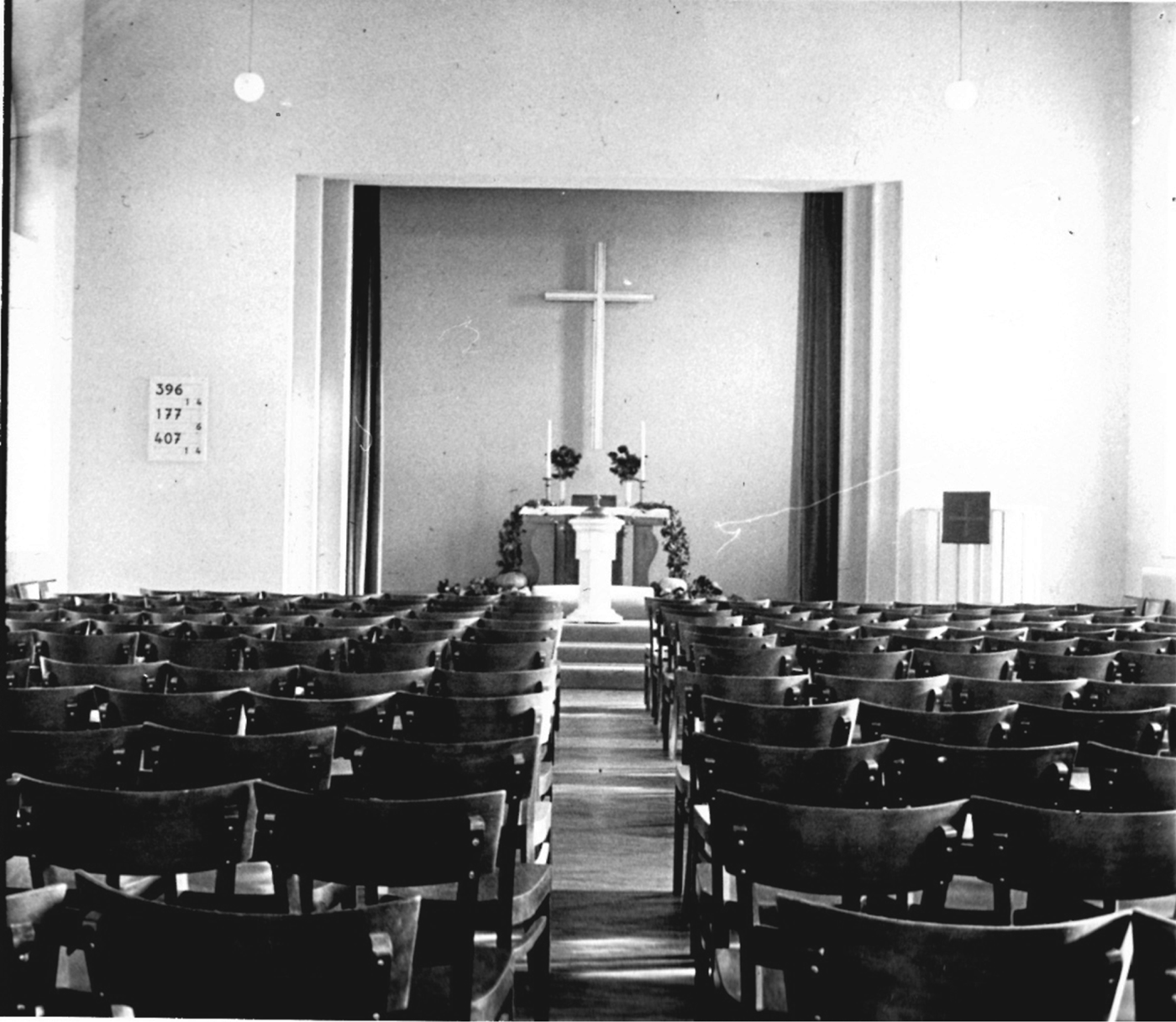
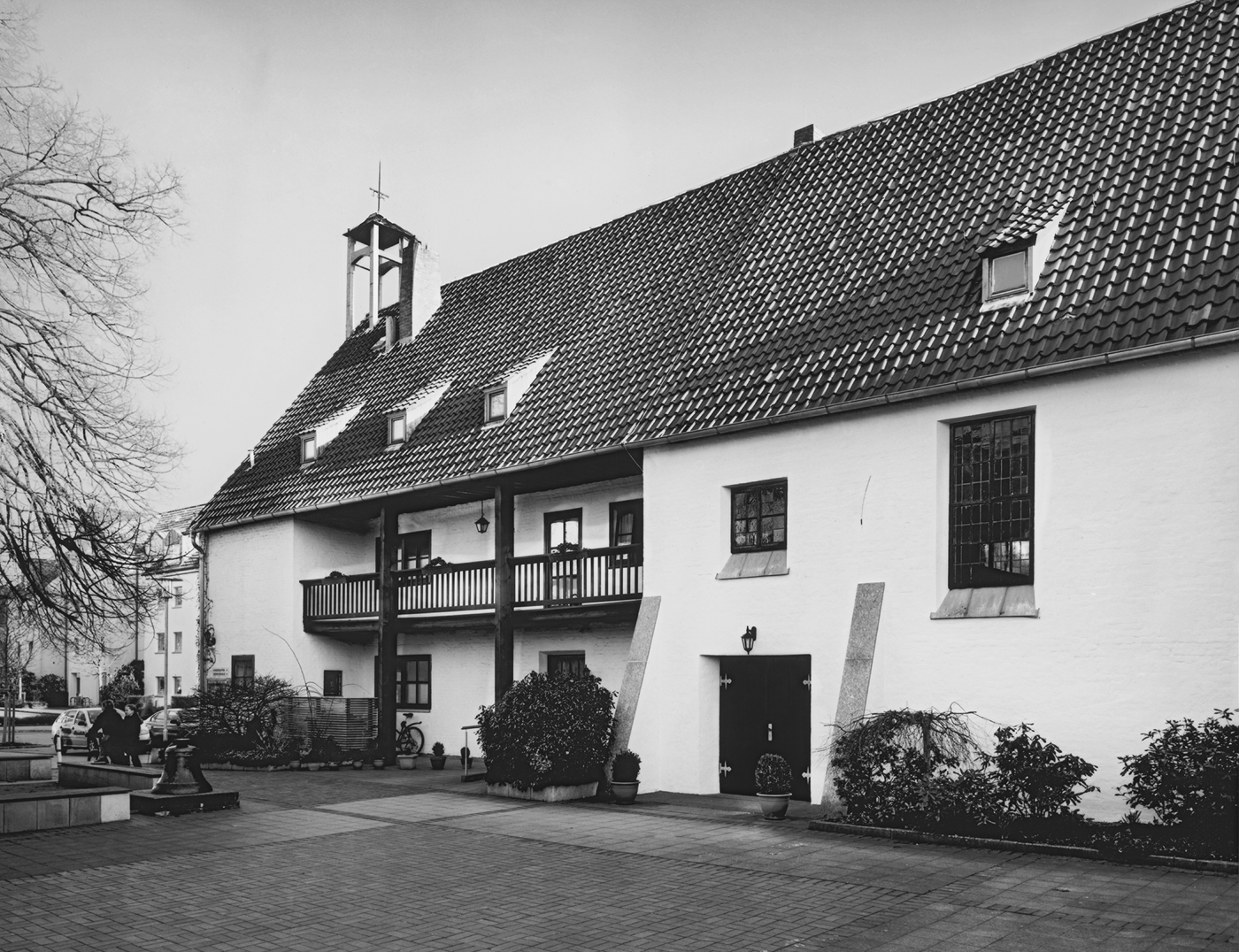
Externally, the six new churches built in Braunschweig in the period 1933 to 1940 are all quite different; however, their interiors show striking similarities. Of these six churches, four were designed by the architect August Pramann (1887–1951), surveyor in charge of the churches in Braunschweig.Footnote 68 The first was the Martin-Luther-Haus in Braunschweig, planned in 1932 and consecrated in 1934 (see fig. 4).Footnote 69 This building is integrated into a row of houses; only on closer approach does it become apparent that it is a church. Services are held in a large multi-purpose hall (see fig. 5). The architect seems to intend his building to offer a spiritual home to all members of the Volksgemeinschaft. The Martin-Luther-Haus manifests the conviction of Naumann and Bartning that a church is a multifunctional room, and its decoration is as simple as Naumann would have desired. The account of the opening service offers a vision for the church's relationship to the community: the consecration of Martin-Luther-Haus was well attended, and the congregation included a good number of SA men who had just returned from the Reichsparteitag in Nuremberg. They were explicitly addressed by their pastor, Johannes Leistikow: ‘My good SA comrades, you already know this: above all our concerns about food and clothing and health must stand our concern about how we can live together and stand together, how we become a community.’Footnote 70 Leistikow's words imply that once the external shape of a new community has been constructed, the church has an important part to play in shaping the internal values of the community, although the SA must be integrated into this.Footnote 71 Leistikow's understanding of the church seems strikingly similar to Naumann's vision for the church of the future: it may no longer have a defining public role, but it should contribute to the deepening of community values.
Martin-Luther-Haus Braunschweig: front cover of the dedication service. © LKA, Evangelisch-Lutherische Kirche in Braunschweig.
Interior of the Martin-Luther-Haus. © LKA, Evangelisch-Lutherische Kirche in Braunschweig.
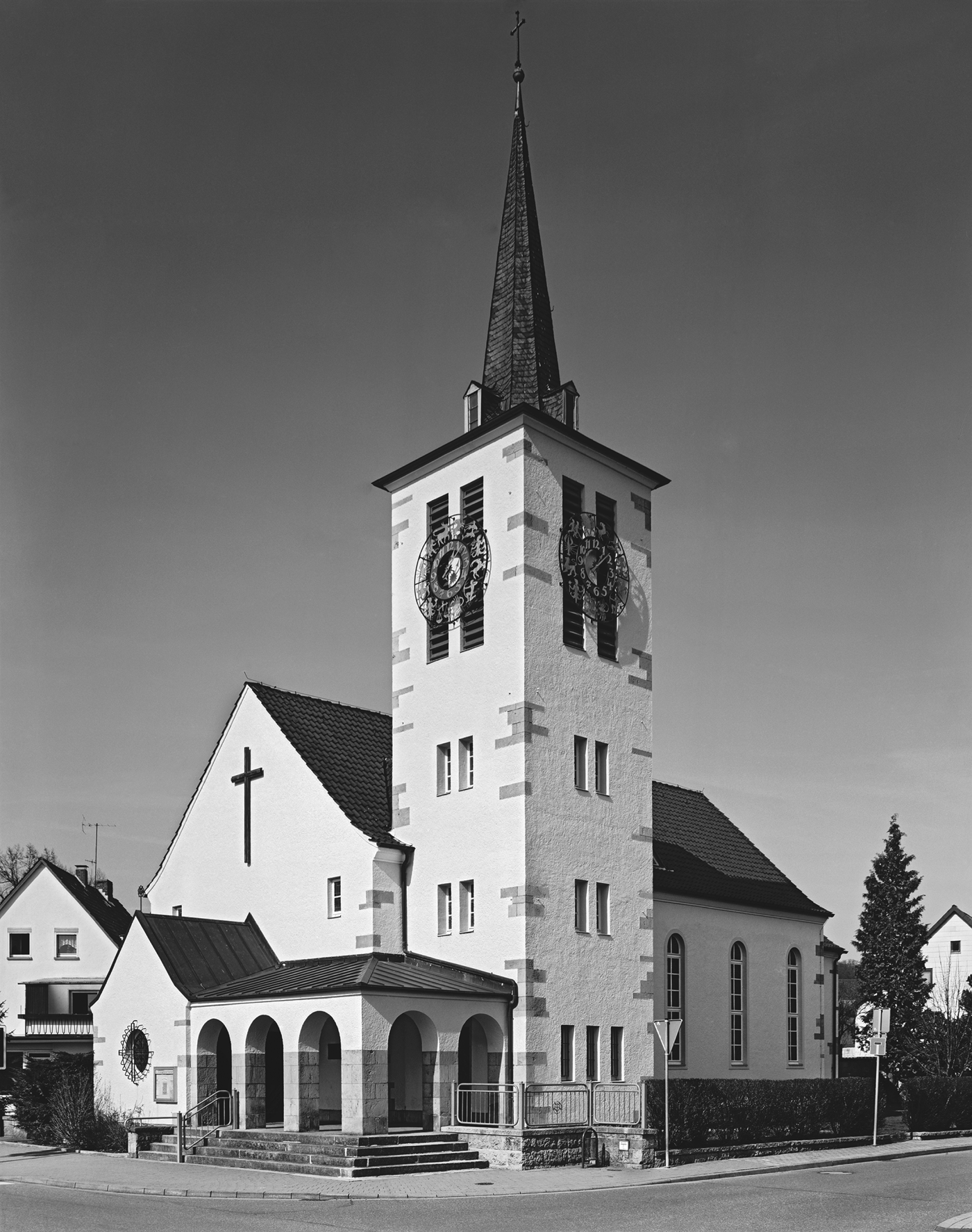
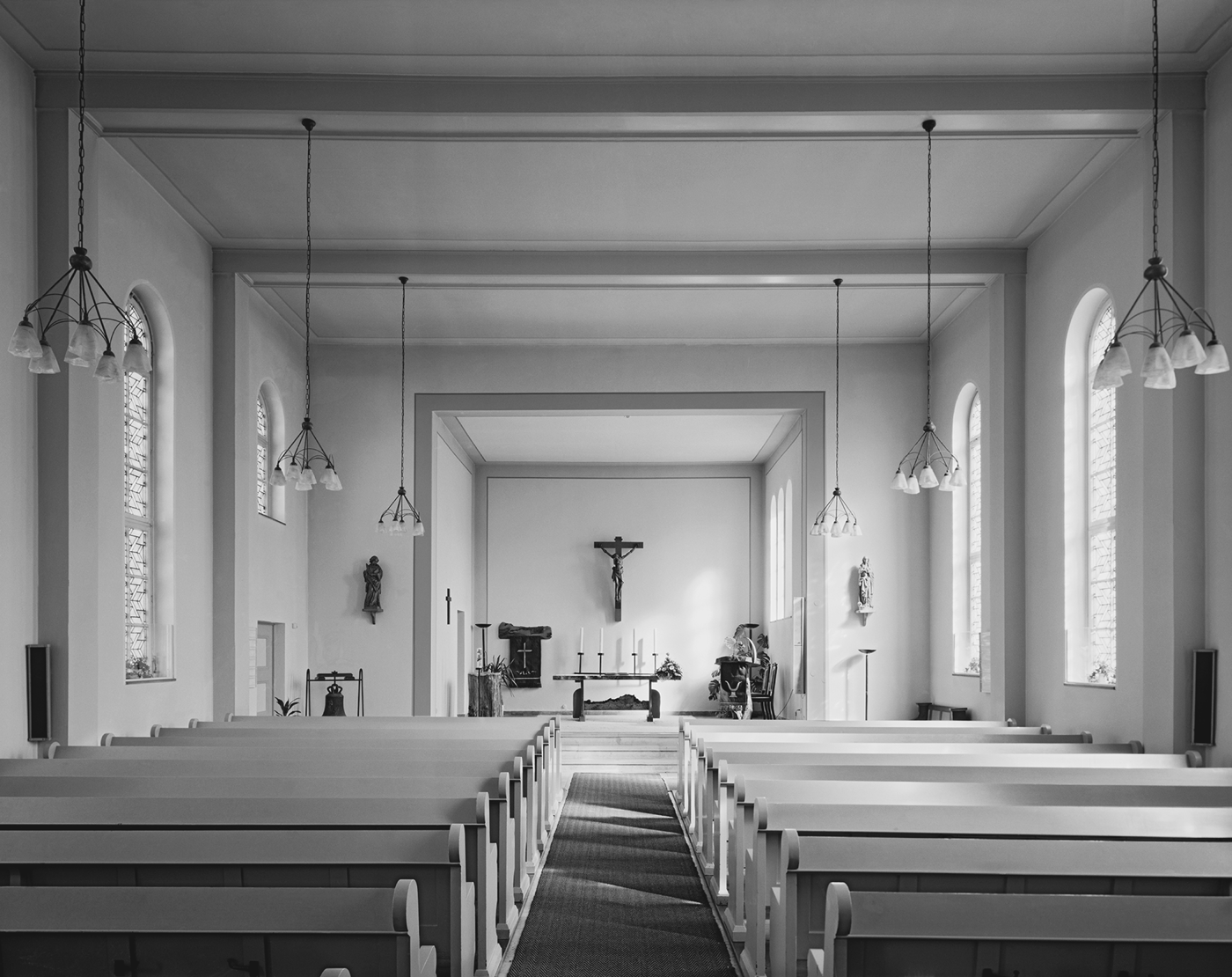
The church in Kreiensen makes a quite different impression, although it too was designed by August Pramann.Footnote 72 This church, built in the traditional, monumental style of the nineteenth century, with strong romanesque elements, stands in the town centre. However, its interior is a simple hall, with little imagery or decoration (see figs 6 and 7). Kreiensen church was consecrated by the bishop of Braunschweig, Helmuth Johnsen, on the fourth Sunday of Advent 1935. In his address, Johnsen refuted rumours in the foreign press that Christian faith and the churches were being suppressed in Germany, affirming that ‘this building and this celebration prove that the opposite is the case’. The Church, he said, was set on the unvarying foundation of true Christian faith, calling together the whole congregation to be God's holy people.Footnote 73 The emphasis on the Volk is clear.
Kreiensen Church. © Jutta Brüdern.
Interior of Kreiensen Church. © Jutta Brüdern.
The third church designed by Pramann was the Bugenhagenkirche in Gliesmarode.Footnote 74 From the outside, this church with its square tower appears somewhat like a medieval fortress, as though offering a defence against hostile influences (see fig. 8). Again, the worship space has the form of a large hall, with a panelled ceiling. Smaller side rooms provide space for meetings and other activities. In 1934 Robert Brandes, mayor and former regional master-builder of Cologne and a strong proponent of German cultural art, wrote with reference to Bartning's Gustav-Adolf-Kirche in Berlin, that such churches represented a new approach to building which ‘by means of an intentionally modest utilitarianism’ had achieved ‘simplicity and clarity in its interior space and design’, and which ‘with true sincerity breathed the spirit of the emotional riches contained in the sense of Volk.’Footnote 75 This analysis could well be applied to the Bugenhagenkirche.
Bugenhagenkirche Gliesmarode. © LKA, Evangelisch-Lutherische Kirche in Braunschweig.
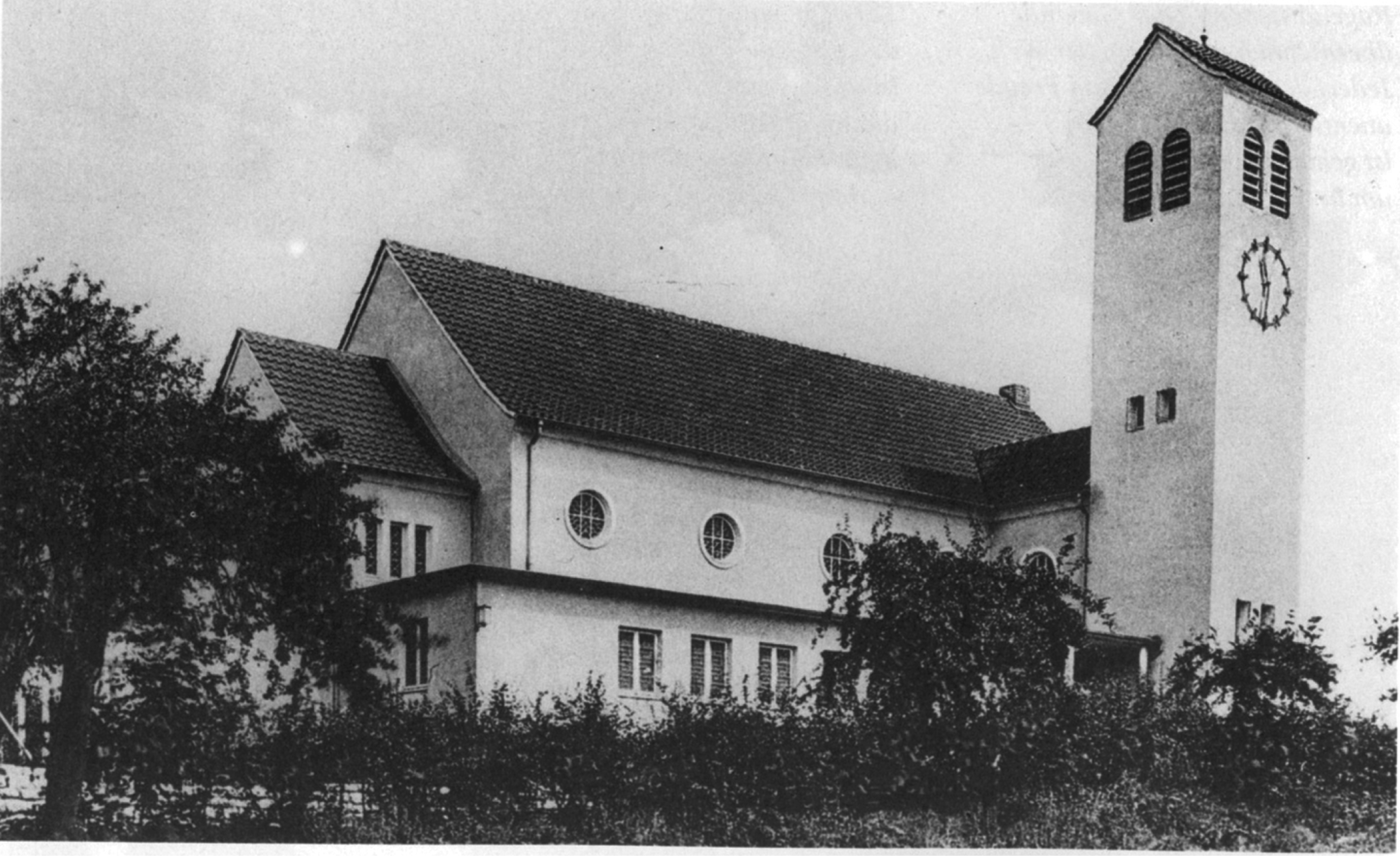
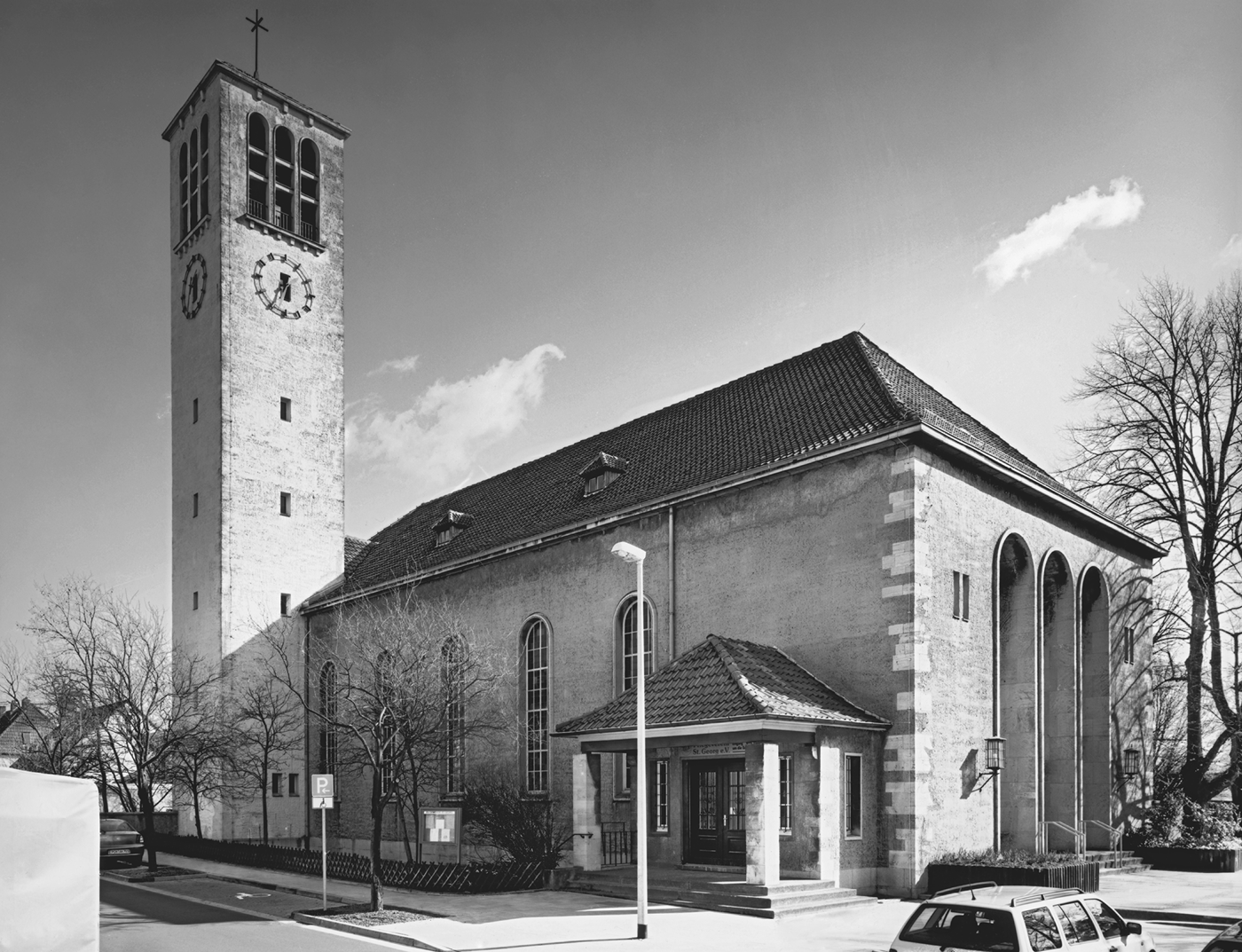
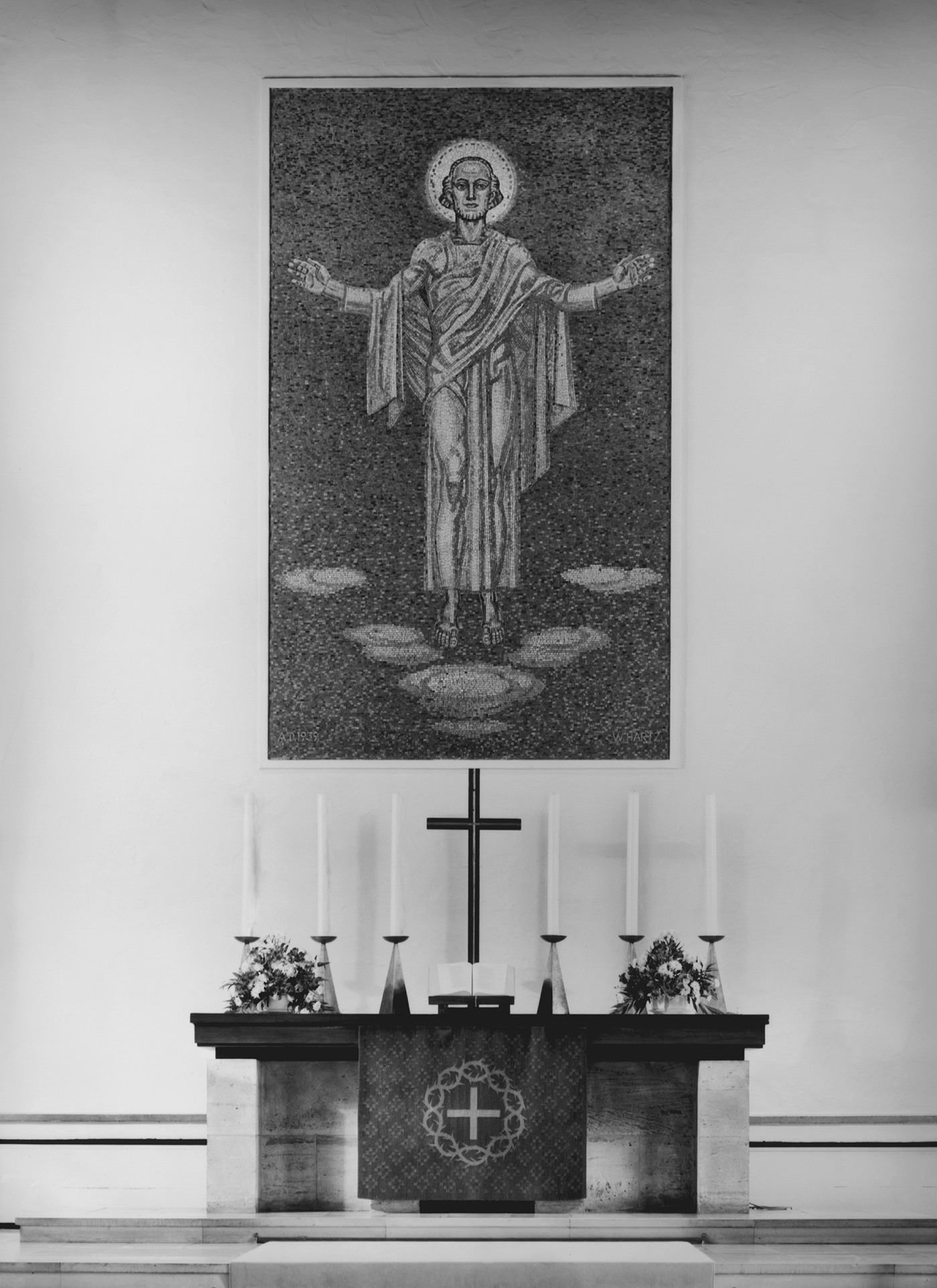
Pramann's fourth church was the St Georgskirche in Braunschweig.Footnote 76 In 1936 the foundation stone was laid for a church which could seat 600 and a church hall with a capacity of 250. The building costs ran to 257,000 RM. The entrance to the church is designed in heroic style, rather like a mausoleum (see fig. 9). In contrast, the interior is again a simple rectangular hall. Its only decoration is a mosaic by Wilhelm Hartz (1883–1947) above the altar, which shows Jesus enthroned on a cloud, with a raised hand, teaching the congregation (see figs 10 and 11). Jesus is represented in accordance with the National Socialist Aryan ideal as blond and blue-eyed, and without stigmata.Footnote 77 The church's deed of foundation explicitly affirms the National Socialist context:
This is the fourth year of the National Socialist Revolution. Our Führer, Adolf Hitler, has brought work and bread to six million of our unemployed brothers, and has restored to our German people their freedom and honour. Whilst in Russia the Christian churches are being eradicated and in Spain the churches burn, we in the Third Reich may give thanks to God, who is visibly blessing the work of our Führer, that for the fourth time since the National Socialist revolution we are laying the foundation stone of a house of God in Braunschweig, and that we in this way are doing our part to support the programme for the provision of jobs created by the Führer.Footnote 78
The building of the St Georgskirche is clearly to be understood, at least in part, as a contribution to the National Socialist programme for the reduction of unemployment.
St Georgskirche. © Jutta Brüdern.
Mosaic of Christ. © Jutta Brüdern.
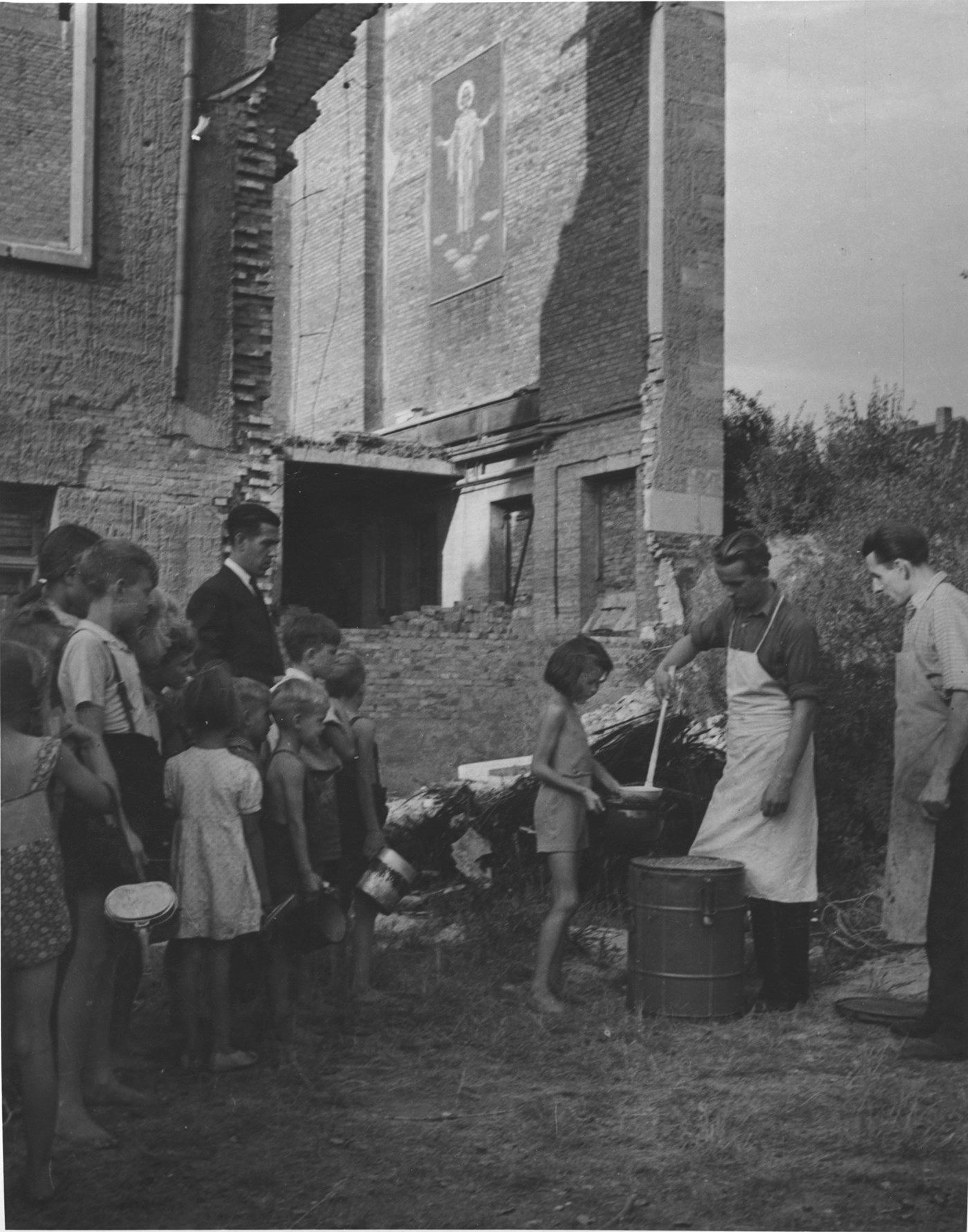
Soup kitchen in the ruin of St Georgskirche, 1949 (photograph Pastor Erwin Bosse (1905–87). © LKA, Evangelisch-Lutherische Kirche in Braunschweig).
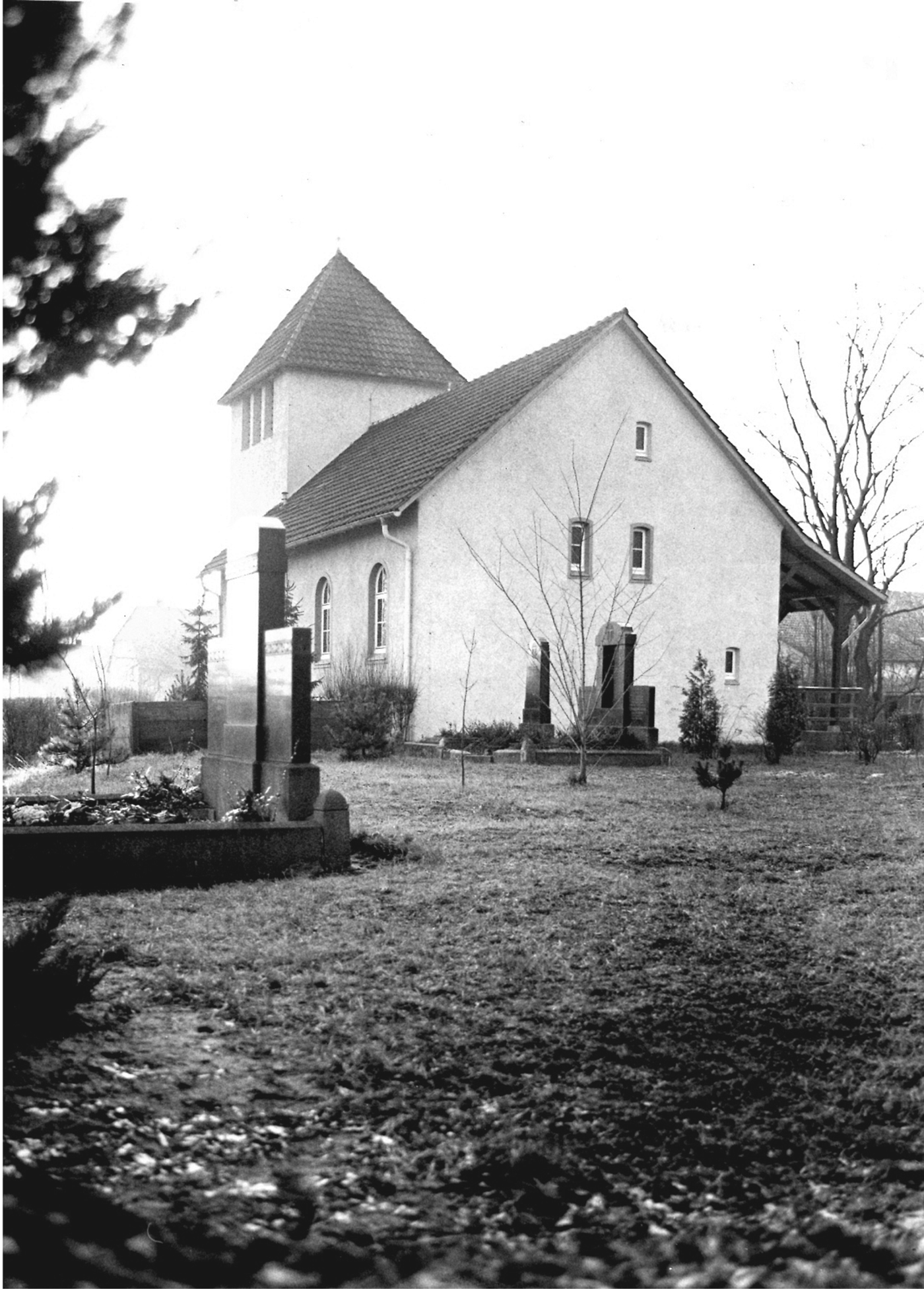
At Rühme, the original intention was to build a small cemetery chapel, but the building plans were adapted to provide a larger village church, with a very plain interior (see fig. 12).Footnote 79 At the ceremony to mark the laying of the foundation stone, the swastika was prominent (see fig. 13). At the consecration in 1936 Bishop Helmuth Johnsen emphasised that the Protestant Church was ‘contributing joyfully and consciously to the Third Reich’, which he saw as ‘the source of a rich stream of grace’, and expressed his continuing hope for a mutually beneficial coexistence between church and National Socialism.Footnote 80 Johnsen regarded the building of new churches as both a benefit of and a contribution to this coexistence.
Rühme Chapel. © LKA, Evangelisch-Lutherische Kirche in Braunschweig.
The laying of the foundation stone for Rühme Chapel. © LKA, Evangelisch-Lutherische Kirche in Braunschweig.
The final church to be built in Braunschweig was in Lehndorf,Footnote 81 a suburb of Braunschweig which had been developed according to National Socialist principles as a model estate with 900 units of housing. This church was designed by the Munich architect Gustav Gsaenger; it united under one roof the rectory, the worship space and the church hall; and was integrated into the street front with only a small turret on the roof to identify it as a church. The building shows the clear influence of the return to Heimatstil: its entrance even looks rather like a stable door (see fig. 14).
Wichernkirche in Lehndorf. © LKA, Evangelisch-Lutherische Kirche in Braunschweig.
The churches built in Braunschweig during the Third Reich represent a variety of types of church building: the multifunctional church space, integrated into the streetscape and scarcely distinguishable from houses amongst which it stands; the traditional church with a spire and nave; the adapted village church; and the heroic type, with a prominent portal, high nave and an imposing tower.Footnote 82 Despite these differences in external appearance, it is notable that the interiors of all these new churches reflected the reforms introduced by Bartning and Langmaack: these were simple parish centres, adapted to a society in which the Church was being encouraged to play a less public role. Their decoration is not permeated with the symbolism of National Socialism, as was the Luther Church in Mariendorf, although some of their imagery does represent the influence of Aryan values. They do not represent a symbiosis of National Socialism and Christianity. However, they do represent – at the least – a form of assimilation. The leadership of the Landeskirche, and in some cases also the pastors and the congregations, understood their building projects as a contribution to the National Socialist regime's measures against unemployment. These are churches which seem explicitly intended to deepen a sense of Volksgemeinschaft. However, against calls for the ‘de-confessionalisation of public life’, they also affirm that the Landeskirche, as the Volkskirche, has a role to play in achieving that end.
The reordering of Braunschweig CathedralFootnote 83
Unlike the interiors of the new churches in Braunschweig, the reordering of the cathedral in Braunschweig offers an archetypal example of the combination of Christian and National Socialist symbolism – or even of the suppression of Christianity altogether. Renovations and reordering began long before 1933: in the course of the nineteenth century the cathedral's baroque decoration was removed, its medieval wall-paintings uncovered and the cathedral decorated with stencilled murals by Braunschweig's court painter, Adolf Quensen (1851–1911). However, more radical changes took place after the National Socialist Machtergneiung. In 1933 Bishop Wilhelm Beye dismissed the cathedral preacher from his post, and from then on sermons preached in the cathedral, especially on significant national occasions, were supportive of the regime. None the less, in January 1936, Klagges instructed that the nave should be ‘kept entirely free of church services’, before announcing on 29 April that no services would take place in the cathedral until spring 1937; regular services actually resumed only in 1945.Footnote 84 The pews, pulpit, high altar and other liturgical furniture were removed – only the twelfth-century altar, candelabrum and Imervard cross were retainedFootnote 85 – and in December 1938 Klagges advised that ‘for conservation and heritage reasons’ they might not be replaced: the cathedral was to be seen as a ‘national memorial’ to Heinrich der Löwe (Henry the Lion). Despite the protests of Bishop Helmuth Johnsen, on 25 April 1939 the Imperial Minister for Church Affairs, Hanns Kerrl, requisitioned Braunschweig cathedral for the use of the state.
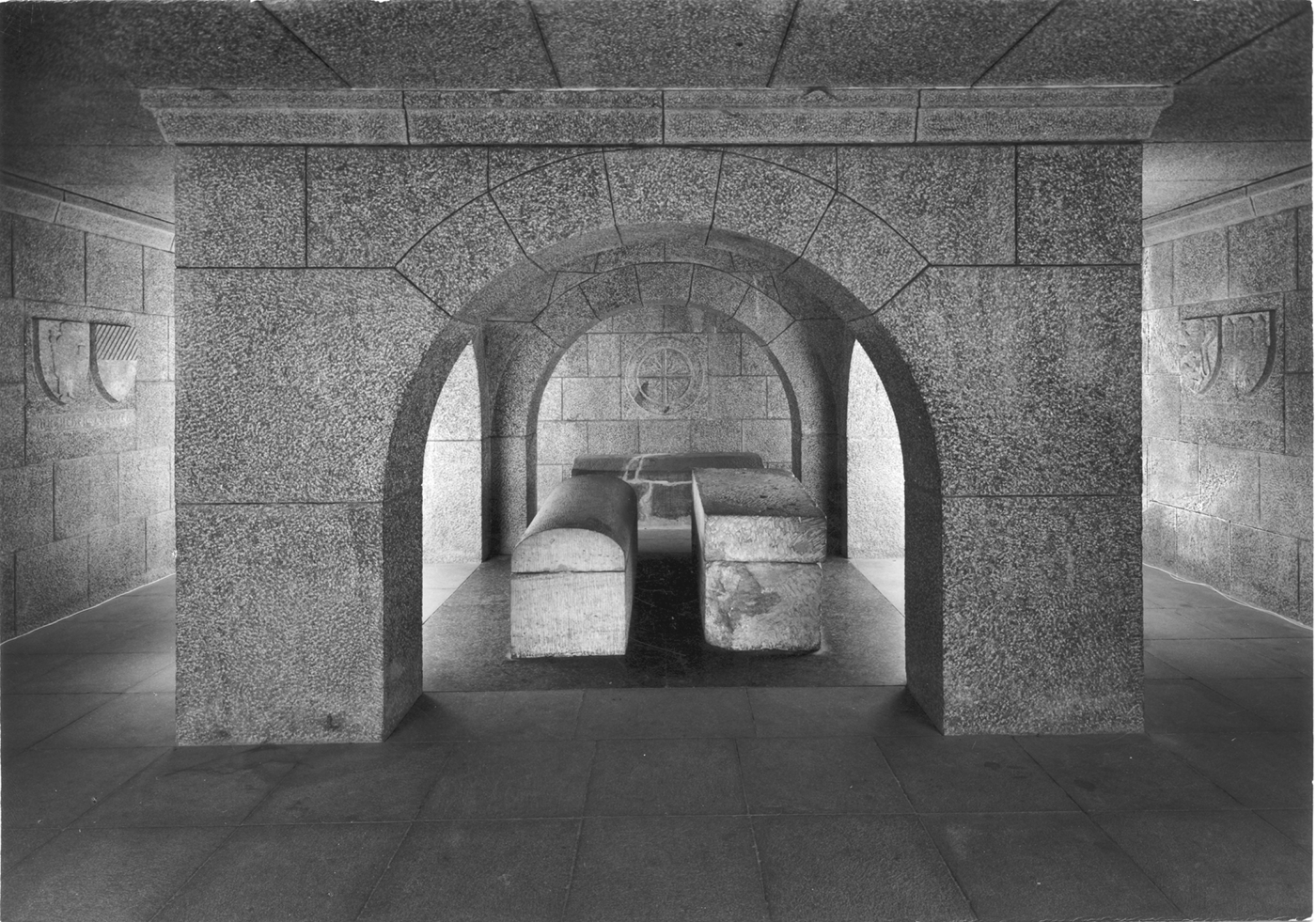
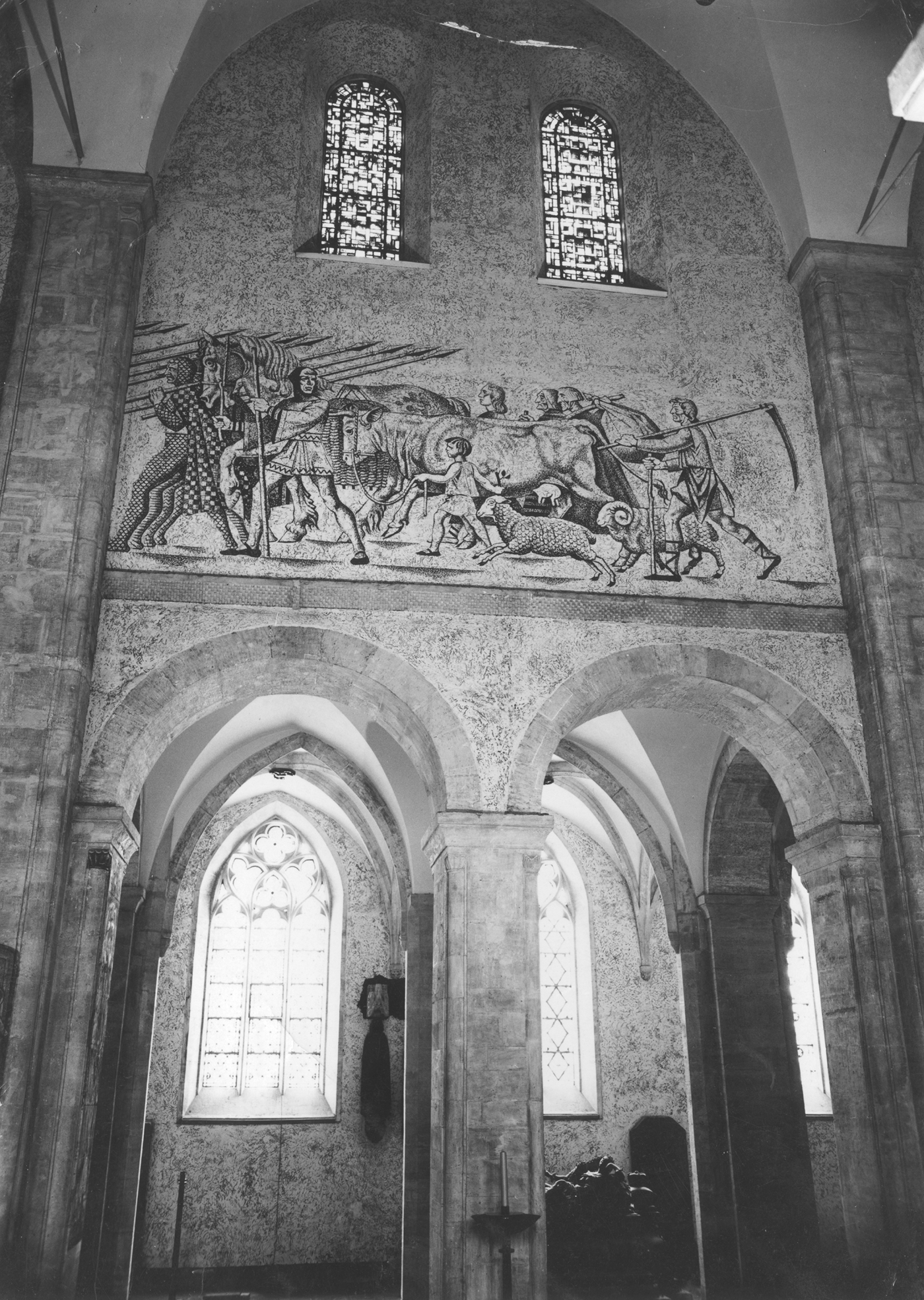
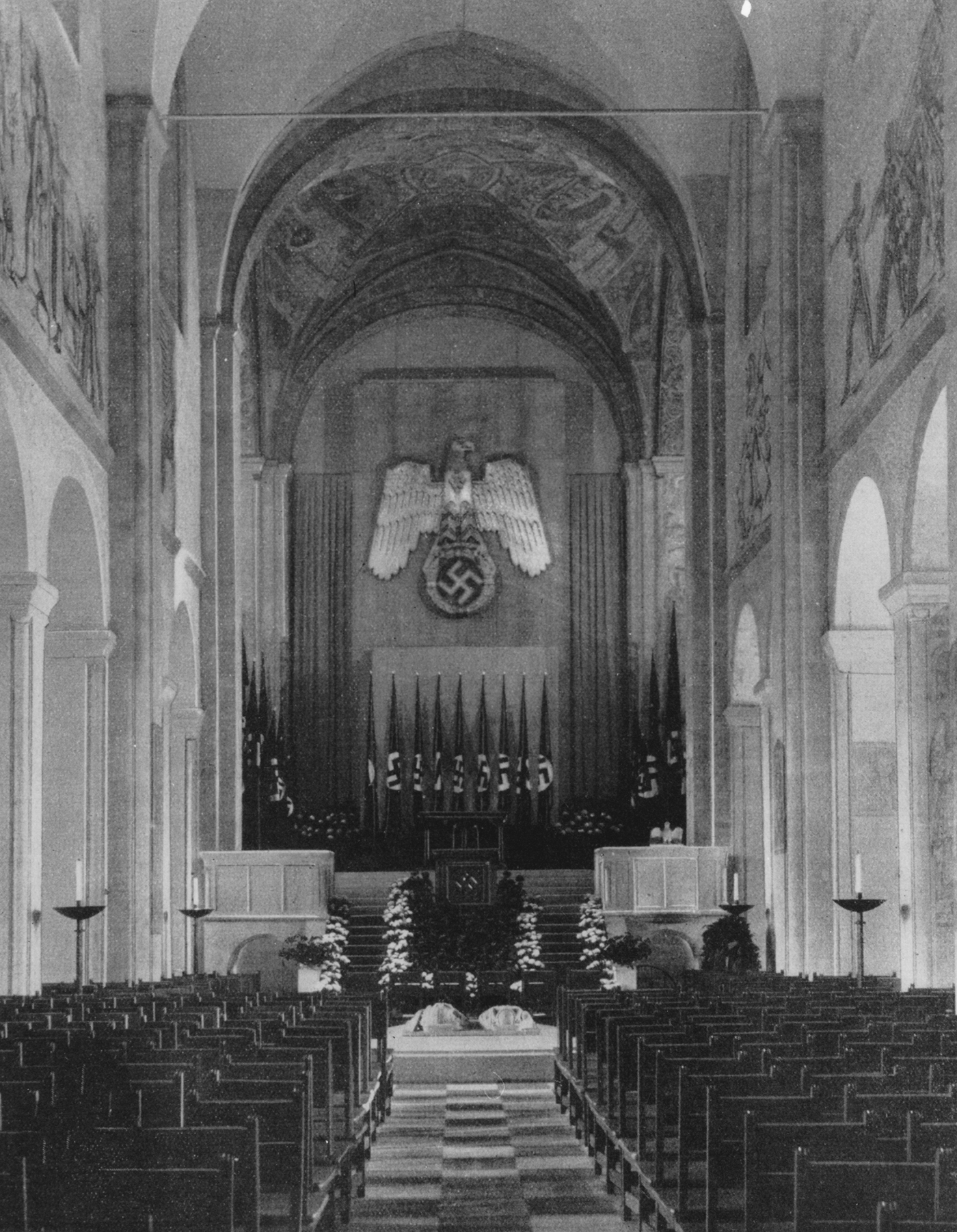
From 1935 a phase of rebuilding began. Beneath the memorial stone for Heinrich der Löwe and his English wife Mathilda, which was deemed insufficiently imposing a memorial for a figure whom the National Socialists viewed as an early champion of German interests and a precursor of Hitler's eastern policy of Lebensraum, a burial vault was excavated, which considerably destabilised the cathedral fabric (see fig. 15).Footnote 86 The interior of the cathedral was entirely cleared and the inner walls of the nave adorned with depictions of Heinrich der Löwe's eastern campaigns (see fig. 16)Footnote 87 The floor of the nave was re-paved, and the Imervard cross moved to a side aisle. Medieval Christian and National Socialist art were juxtaposed, and the building effectively became a National Socialist shrine to Heinrich der Löwe. Cast-iron lamps were introduced into the nave, and the apse closed off by full length draperies, hiding most of the medieval paintings; in front of them a huge imperial eagle and swastika were placed. This created a space which was well-suited for propaganda events; the ecclesiastical character of the building virtually disappeared (see fig 17).Footnote 88 Braunschweig cathedral had undergone a process of almost complete de-Christianisation, much more extreme than the co-existence of Christian and National Socialist imagery found in the Luther Church in Berlin-Marienberg.
Burial vault constructed for Heinrich der Löwe and Mathilda c. 1936. Photograph: Willy Birkner.
S'graffiti in Braunschweig Cathedral. © LKA, Evangelisch-Lutherische Kirche in Braunschweig.
Braunschweig Cathedral as a National Socialist monument, Braunschweigische Heimat i (1941), p. 17. Photograph Meisterklasse.
However, the ‘purification’ of the cathedral, and the purging of all ‘superfluous’ decoration, cannot be attributed solely to the interests of National Socialism. It was presented also as an attempt to preserve – or to reintroduce – the true romanesque character of the cathedral. The aesthetic sense which underlay these changes was in part a rejection of the ‘extravagances’ of the nineteenth century. Thus, the leader of the Berneuchener movement, Karl Bernhard Ritter, wrote in 1938:
In many sacral spaces, the removal of all the kitsch which has been collected over the course of the past decades is still an urgent task. You find cheap prints of oil paintings, dreadful plaster busts, terrible stained glass windows which witness to nothing except the incompetence of their makers, walls covered with dreary stencil paintings. Better a clean, empty room, painted in an unostentatious manner, without any ornament, than a space in which any sensitive soul will be oppressed by the artificial, ostentatious decoration.Footnote 89
In Braunschweig, as Lorentzen has observed in relation to Quedlinburg, ‘the original [was] identified with the healthy, the strong, the unspoilt, whereas later alterations, such as the building of the gothic choir, [were] understood to be degenerate, and thus a weakening or decline’.Footnote 90 The return to the ‘simplicity’ of romanesque architecture was an important aspect of the National Socialist programme of reordering Braunschweig Cathedral.
It is clear that under National Socialism, the building of churches continued. Architects such as Bartning and Langmaack went on designing and building simpler churches, although they ceased to use iron and glass and the exteriors of their churches showed more traditional, ‘Germanic’ influences.Footnote 91 The new churches built in Braunschweig in this period witness to cooperation between State and Church: if the mayor had not wanted the churches, he could have prevented them from being built; if the Landeskirche had not wanted to build them, it would not have done so. The Landeskirche's building programme may represent an attempt to affirm that the Church had a continuing role to play in the National Socialist state, standing against the example of Braunschweig Cathedral, which demonstrates the extent to which the church was potentially subject to the influences of neo-paganism and ‘ideological usurpation’. Here the Christian building was appropriated for National Socialist interests – but in a way which was guided also by contemporary interests in church renovation, and particularly the attempt to reconstruct the original, romanesque interior. This return to the pure, unspoilt past was a feature of national Socialist ideology, but it resonated with the developments in art and architecture which rebelled against the nineteenth-century fascination with the gothic and the medieval. Braunschweig Cathedral is an extreme example, but as a whole the building programme in Braunschweig testifies to the extent to which the aesthetic interests of the National Socialist regime were at one with those of the majority of German Protestants.
There is a real lack of research in this neglected – perhaps even suppressed – area. There are many questions about how congregations experienced the coexistence of Church and State, and how they lived out their Christian faith in these churches with their ideologically informed symbols and architecture.Footnote 92 Systematic research into church life under National Socialism is a task which still lies before us.