Introduction
Fruit flies (Diptera: Tephritidae) of the subfamily Dacinae are a miscellaneous and swiftly evolving group with more than 700 described species, which are a constant threat to tropical agricultural production (Metcalf, Reference Metcalf1990). One dacine species, the peach fruit fly Bactrocera zonata (Saunders), is native to tropical Asia, but is spreading to other regions of the world. This pest is known to attack more than 50 fruit host plants, e.g. mango Mangifera indica L., peach, guava, apricot and citrus, and vegetable host plants (El-Akhdar and Afia, Reference El-Akhdar and Afia2009; Sarwar et al., Reference Sarwar, Hamed, Rasool, Yousaf and Hussain2013). Mohyuddin and Mahmood (Reference Mohyuddin and Mahmood1993) reported that mango fruits in central Punjab are attacked in July; the maximum injury occurs in August when 35% of the fruits are damaged by B. zonata or the oriental fruit fly Bactrocera dorsalis (Hendel).
Current control methods for this pest rely heavily on the aerial application of pesticides. These chemicals have a negative impact on the environment, specifically on beneficial organisms. Thus, environmentally friendly methods of control are much in need (Roessler, Reference Roessler, Robinson and Hooper1989). Biological control is increasingly being recognized as a safe and economical means of fruit fly control, and its importance is growing as pesticide use is becoming more restricted. Consequently, recent studies have used various approaches to select biological control agents that are safe and effective.
Several infestations of Bactrocera species have been eradicated using a combination of control methods including the male annihilation technique, foliar and soil pesticide treatments, and fruit removal (Marwat et al., Reference Marwat, Hussain and Khan1992). The male annihilation technique is based on males being attracted to methyl eugenol, a component of the female pheromone on which males feed usually only once in their lifetime (Shelly, Reference Shelly2000).
Wong et al. (Reference Wong, Mochizuki and Nishimoto1984) contended that fruit flies are still very serious pests of a wide range of fruits and vegetables. They suggested that inundative releases of laboratory-reared parasitoids might be an appropriate control option. These parasitoids belong to the families Braconidae, Chalcididae and Eulophidae. Ovruski et al. (Reference Ovruski, Aluja, Sivinski and Wharton2000) discussed the diversity of fruit fly parasitoids (Hymenoptera) and provided information on the following: parasitoids attacking flies, analysis of parasitoid guilds, parasitoid assemblage size, fly host profiles, distribution patterns, taxonomic status, biological control of pestiferous tephritids, the most pressing needs related to fruit fly biological control, and the effectiveness of the chalcidid Dirhinus giffardii Silvestri (Podoler and Mazor, Reference Podoler and Mazor1981).
To successfully rear fruit flies (and their parasitoids), the rearing technique must be improved by developing a low-cost diet. The ingestion of protein has been reported to increase the egg production of various insects (Cangussu and Zucoloto, Reference Cangussu and Zucoloto1995; Khan et al., Reference Khan, Shahjahan and Wadud1999). Furthermore, in sterile insect releases of this pest, to ensure good-quality biological parameters, mass-rearing of insects with effective ingredients and production of competitive adults that successfully suppress the field population are prerequisites (Saha et al., Reference Saha, Khan, Nahar and Yesmin2007).
The effective exploitation of host-rearing for parasitoid production as a tool for fruit fly control needs to be improved. Simultaneously, this can be a major contribution to population suppression when using the sterile insect technique. Furthermore, combining effective control tactics could be a very important aspect of a practical action plan for fruit fly population suppression in the field. Therefore, a coordinated project was initiated. In this study, we investigated the effects of various diet ingredients on the rearing of B. zonata and also the efficacy in mango orchards of biological control agents and male annihilation in managing this pest that is a widely distributed fruit fly in Pakistan.
Materials and methods
Fruit fly colony
The stock laboratory colony of B. zonata at the Nuclear Institute of Agriculture, Tando Jam, Pakistan, was reared at 25 ± 2 °C, 60–65% relative humidity (RH) and 16L:8D photoperiod. The fruit flies were originated from a population collected from infested guava and mango orchards, and rearing has been carried out for several generations to improve laboratory adaptation. Pupae from this colony were used to obtain fresh specimens of adult male and female B. zonata. Eggs were collected from adult flies in the colony. Adults were kept in cages (45 × 30 × 35 cm) with nylon mesh covers and given a food supplement containing sugar and yeast placed in Petri dishes. Water was supplied using cotton wicks in conical flasks; the wicks and water were changed regularly to avoid microbial contamination, especially moulds. Before testing, larvae were reared in the laboratory on the standard artificial diet consisting primarily of wheat bran, sugar and yeast and also bacterial and fungal inhibitors. Sawdust, present below larva-holding boxes, was sifted weekly to collect pupae. Pupae were transferred to smaller plastic containers and held until the emergence of flies.
Effects of dietary protein on the rearing of Bactrocera zonata
A total of 30,000 eggs of B. zonata were seeded on diets containing proteins in various forms and allowed to develop into larvae, pupae and adults. The dietary protein ingredients – protein hydrolysate, Nu-Lure®, brewer's yeast and torula yeast – were each added separately to the standard diet. The insects were kept in a laboratory under controlled temperature and RH conditions.
The biological parameters of B. zonata (pupal recovery, pupal weight, adult emergence, flying ability and egg hatch) were assessed. Two weeks after adult emergence, eggs were collected twice a week using plastic egg-laying receptacles (vials perforated with 50 1 mm-diameter holes). Newly matured larvae were kept individually in small plastic containers until pupation. Newly formed (24 h) pupae were counted and weighed, and subsequent adult emergence was recorded. Adults that emerged from each diet were considered as the F1 generation and kept in similar cages. The flight ability (percentage of fliers) of adults reared on each diet was also recorded. This experiment was extended to quantify pupal quality and adult emergence in the F2 generation.
Effects of biological control agents and other management techniques on the infestation of Bactrocera zonata in mango orchards
Measures to manage the flies included, separately and in combination, the male annihilation technique and releases of larval and pupal hymenopteran parasitoids (Aganaspis (Trybliographa) daci (Weld) and D. giffardii) throughout the mango fruiting season. All treatments, replicated five times, were applied to five separate blocks of mango orchard, each with an area of 2 ha. The field efficacy of the treatments was compared with that of the control.
Parasitoids were obtained from a colony that had been reared at 28 ± 2 °C, 60–80% RH and 16L:8D photoperiod and maintained for several generations in the same laboratory. Parasitoids eclosed from pupae inside cages (25 × 25 × 25 cm). The wasps were fed a solution of honey and 40% sugar. About 500 wasps were held inside each cage until their release. Usually, parasitoids from the cages were transferred to small containers with screen tops (about 1000 parasitoids per container) and placed under host fruit trees. The containers were opened gently and parasitoids allowed to disperse to nearby trees. Parasitoids left inside the containers were removed with a small brush and carefully placed on nearby vegetation. Every 2 weeks, from fruit-setting to ripening, approximately 2470 adults of each parasitoid species were released into each hectare.
The male annihilation technique was applied through traps baited with methyl eugenol at the rate of about 15 traps per ha. These traps were freshly baited every month.
The infestation level and population density of fruit flies were recorded every week. About 100 fruits were collected either from the soil or randomly from the trees and placed in plastic containers. The fruits were held in a laboratory under uncontrolled temperature and humidity conditions until full decomposition. Once a week, larvae and pupae were collected and placed in Petri dishes until adult emergence. The number of larvae or pupae that had been parasitized, and the parasitoid species involved, were recorded.
To measure the density of the fly population, plastic traps baited with chemicals (10% sugar solution, 85% methyl eugenol and 5% insecticide) on cotton wicks inside the traps were hung on mango trees to attract females and males.
Statistical analyses
The data were statistically analysed using a computer package, and an analysis of variance was carried out. Analyses were carried out at the P <0.05 level of significance.
Results
Effects of dietary protein on the rearing of Bactrocera zonata
Torula yeast, brewer's yeast and Nu-Lure® were found to be good food sources for rearing B. zonata. The highest mean values for all the tested parameters were obtained with the diet containing torula yeast and the lowest values with the diet containing protein hydrolysate. Torula yeast and brewer's yeast were found to be better for rearing B. zonata than Nu-Lure® and protein hydrolysate (Table 1). Thus, the inclusion of torula yeast or brewer's yeast provided a good source of protein in the standard larval diet. Brewer's yeast is more economical than torula yeast and is available locally, and therefore brewer's yeast can be used instead of torula yeast, which is an expensive and imported product. In future, additional diet ingredients will be evaluated to standardize the artificial diet for rearing B. zonata in the laboratory.
Effects of diet ingredients on the rearing parameters of Bactrocera zonata

Mean values within a column followed by the same letter are not significantly different at P< 0.05.
Effects of various biological control agents and other management techniques on the infestation of Bactrocera zonata in mango orchards
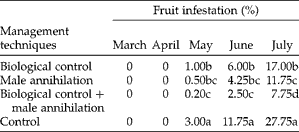
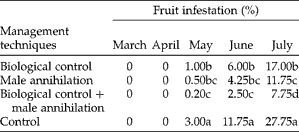
Based on fruit samples from an untreated orchard, both males and females were found to be present from the first week of fruit-setting during March–April, with the maximum infestation being observed during the ripening stage in July. Infested fruits were found both on trees and on the ground. The low fruit infestation early in the season resulted from a low adult population, probably due to the low temperature or a very low overwintering adult population. Thus, the mean percentage of fruit infestation per week by B. zonata was zero in March and April. There were low captures in traps late in the infestation period because fruits were available to the pest only then.
Fruit infestation was significantly lower in the treated blocks than in the untreated one. In July, fruit infestation was lower in the biological control plus male annihilation treatment block than in either of the separate treatment blocks (Table 2).
Fruit infestation by Bactrocera zonata in mango orchards under various management techniques
Mean values within a column followed by the same letter are not significantly different at P< 0.05.
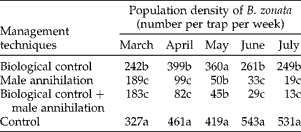
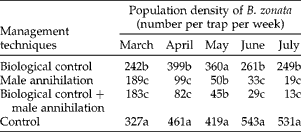
The population build-up in April and May was high, possibly due to optimum temperature or to the emergence of adults from overwintering pupae. The population densities of B. zonata during April were at a maximum level. From May to July, the population density of fruit flies declined sharply in the biological control plus male annihilation treatment block; this treatment was more effective at controlling the fruit flies than the separate treatment with biological controls (Table 3). Evidently, male annihilation was a more effective control measure than the release of parasitoids (Tables 2 and 3).
Population density of Bactrocera zonata in mango orchards under various management techniques
Mean values within a column followed by the same letter are not significantly different at P< 0.05.
The results showed that the male attractant was highly selective for males; for each female captured, 20 males were captured.
Based on samples of mangoes taken after successive releases of parasitoids, the number of B. zonata flies emerging in all the treated blocks was found to have decreased. Increases in parasitization from parasitoids and decreases in fruit infestation were observed in all the treated blocks, when compared with the control.
Good pest control was achieved through the biological control plus male annihilation treatment. However, in this trial, the release of parasitoids evidently played only a minor role in pest control, and the major controlling factor was male annihilation (Table 3). Nevertheless, combining biological control with male annihilation reduced the level of fruit damage in July more than that achieved by either control method alone (Table 2).
Discussion
Based on pupal recovery, torula yeast was found to be the best protein ingredient for the mass-rearing of B. zonata in the laboratory. Protein hydrolysate led to significantly lower recovery, with high mortality of late-instar maggots, compared with other sources. This is because of the quick depletion of food material or the presence of fewer dietary nutrients in protein hydrolysate required for larval development. Torula yeast and brewer's yeast were more promising than Nu-Lure® and protein hydrolysate. The differences in recovery can be explained by the higher content of protein in torula and brewer's yeasts and consequently the increased number of ovarioles in female flies. In concurrence with this, other workers have observed successful egg production after ingestion of protein food. Saha et al. (Reference Saha, Khan, Nahar and Yesmin2007) evaluated the effects of various adult diets on pupal quality, adult emergence, ovariole number and longevity in Bactrocera cucurbitae (Coquillett). Pupal quality and percentage of adult emergence were found to be slightly higher in the F2 generation than in the F1 generation. Larval feeding is known to have a significant influence on the ovariole number in adult flies. The total egg production of B. dorsalis depends basically on two interdependent variables: the number of ovarioles present in the ovaries and the quality of nutrients consumed by the larvae and adults (Khan et al., Reference Khan, Shahjahan and Wadud2000). In this species, Shelly et al. (Reference Shelly, Edu and Pahio2005) found that inclusion of protein in the diet enhanced male mating performance.
Biological control is an important part of integrated pest management (IPM). In the present study, the successful release and establishment of parasitoids resulted in significant parasitization and some suppression of the field population of the fruit fly. As little research has been conducted on the use of A. daci and D. giffardii for the control of B. zonata, little is known about this pest and its natural enemies. In agreement with the present findings in the field, other workers have reported successful control of fruit flies of the Bactrocera spp. Waterhouse (Reference Waterhouse1993) commented that, under favourable conditions and with a suitable fruit fly host, parasitization levels of up to 70% can be achieved. Releases of a suite of parasitoids have been found to result in reductions in the populations of fruit flies of up to 95%. Peters (Reference Peters, Allwood and Drew1997) reported that the release of parasitoids was successful, the parasitoids became established on the fruit fly, and the level of parasitization was 78% on most of the favoured fruits. Of the at least 82 species of parasitoids that have been reared from tephritids during exploration programmes, only 44 have been released and only 20 have become established (Wharton, Reference Wharton, Robinson and Hooper1989). Several factors might account for past failures to establish parasitoids, including a lack of information on the biology and ecology of the target fruit fly pest and natural enemies associated with it. In the present study, a low population level was observed during the early fruiting stage, whereas at the ripening stage, the level of fruit infestation was higher. The same trend was observed in captures of females and males during all the treatments. Such dissimilar patterns are probably due to climatic variations over time. Environmental factors such as rain and temperature have been reported to affect trap captures (Miranda et al., Reference Miranda, Alonso and Alemany2001).
Finally, numerous studies have demonstrated the feasibility of parasitoid augmentation for fruit fly population suppression (Harris et al., Reference Harris, Bautista, Spencer and Tan2000). In the present study, fruit damage caused by B. zonata was found to be reduced and a biological base for further improvement of an IPM programme was developed. In conjunction with sanitation, protein bait sprays and male annihilation treatments, the release of parasitoids can reduce the fruit fly risk (Vargas et al., Reference Vargas, Jang and Klungness2003).
Conclusion
The techniques described herein for rearing B. zonata and its parasitoids are relatively simple. Natural enemies help to some extent to reduce fruit fly populations. It is important to examine further the practical advantages that might be obtained from establishing fruit fly parasitoids that parasitize B. zonata and other pest species. Parasitoids that oviposit into the puparium, e.g. D. giffardii, and into the larva, e.g. A. daci, have been neglected mainly because of sampling difficulties, but they deserve more attention. Nevertheless, there is no evidence that establishing parasitoids in orchards would cause adverse effects. Research on biological control agents should continue, e.g. the major hosts of the target fruit flies, the suitability of the flies for the candidate parasitoids and the level of parasitization already achieved by native or introduced parasitoids. Reduction of pest infestations through parasitoids is likely to be of greatest value to the traditional farmer, but they should not be exclusively relied upon to control a pest population; but complementary control methods should be applied together.
Acknowledgements
The Joint FAO/IAEA Division supported this study through an IAEA Coordinated Research Contract, No. PAK-13913/R0. The authors thank the IAEA collaborators Jorge Hendrichs and Andrew Jessup for technical advice and assistance.