Significant outcomes
The monoaminergic stabiliser (−)-OSU6162 caused a significant improvement in mental energy for patients suffering from mental fatigue, following TBI or stroke.
Adverse reactions were mild and could largely be avoided by dose adjustment.
Limitations
The number of patients studied here is small, and the results should therefore be interpreted with caution.
This study does not permit any conclusions regarding lowest active dose.
The reported results regarding therapeutic effects and tolerability pertain to outcome following 4 weeks of treatment and cannot be extrapolated to treatment periods of a duration beyond that.
Background
Mental fatigue is a common and disabling residual symptom after a stroke or traumatic brain injury (TBI) Reference Chaudhuri and Behan1Reference Deluca2Reference Rödholm, Starmark, Svensson and Von Essen3Reference Rönnbäck and Hansson4Reference Lindqvist and Malmgren5. It is included in and defined within the diagnoses Mild cognitive impairment (F067), Neurasthenia (F480) and Post-traumatic brain syndrome (F072). The person suffering from mental fatigue is able to exert mental effort for short periods only, and notably, it takes longer than normal to regain energy after reaching the level of exhaustion. The afflicted person is also unable to handle large quantities of information at the same time or during longer time periods. Accompanying symptoms are irritability, emotional instability and headache.
Mental fatigue and the accompanying symptoms have considerable influence on work and social activities. It is difficult to estimate how common fatigue is, especially mental fatigue, due to varying definitions and methodologies between studies, but in follow-up studies the frequency of prolonged fatigue after TBI and stroke ranges from 30 up to 70% Reference Staub and Bogousslavsky6Reference Belmont, Agar, Hugeron, Gallais and Azouvi7.
After a TBI or a stroke mental activities with high demands on ability to focus appear, to judge from imaging studies, to involve a higher degree of brain activation engaging larger brain areas, presumably resulting in a higher degree of cerebral ‘effort' and, hence, a greater mental fatigue Reference Kohl, Wylie, Genova, Hillary and Deluca8. In consequence, subjects can in many cases solve acute cognitive problems, but become exhausted if the activity continues for several hours. Needless to say, this fatigability severely hampers work capacity, especially if work requires sustained attention to tasks of higher complexity.
It has been difficult to relate mental fatigue to objective assessments, and in many studies cognitive tests have been close to normal, despite a high degree of subjective fatigue Reference Belmont, Agar, Hugeron, Gallais and Azouvi7. However, cognitive functions such as complex selective attention Reference Ziino and Ponsford9 and information processing speed Reference Ashman, Cantor and Gordon10 appear to be associated with mental fatigue. Subjects on sick leave due to mental fatigue after a mild TBI diverged from healthy controls in displaying a higher degree of mental fatigue and decreased information processing speed Reference Johansson, Berglund and Rönnbäck11Reference Johansson, Rönnbäck and Agrawal12.
Cognitive functions are dependent on a well-functioning prefrontal cortex, which in turn is dependent on a well-balanced catecholaminergic input. Catecholamines have an inverted U influence on prefrontal cortex function, whereby either too little or too much noradrenaline or dopamine impairs prefrontal cortex cognitive abilities Reference Brennan and Arnsten13. Catecholamine-releasing agents are well known to be effective in the treatment of attention deficit hyperactivity disorder, but also after brain injury there are studies showing beneficial effects on cognitive functions - for instance methylphenidate was observed to improve information processing speed and, to some extent, working memory and attention Reference Posner and Rothbart14.
Besides potential dysfunction of catecholamines, those of other modulators, e.g. serotonin and acetylcholine, might be involved in mental fatigue. Among these, serotonin certainly needs to be considered in this context, given its well-documented role in neuroplasticity Reference Azmitia15.
The monoaminergic stabiliser (−)-OSU6162 has been shown to have a stabilising effect on rodent behaviour Reference Rung, Rung and Helgeson16. The molecule, which interacts with both dopaminergic and serotonergic systems, appears to act as a pure antagonist on a binding site of the D2 receptors, which is identical with the ordinary (orthosteric) binding site for dopamine itself, although with preference for presynaptic autoreceptors and low affinity to postsynaptic receptors. In addition, (−)-OSU6162 has been proposed to act on an additional (allosteric) binding site on the dopamine D2 receptor, which leads to a stimulation of the receptor Reference Lahti, Tamminga and Carlsson17. (−)-OSU6162 has been found to inhibit l-3 4-dihydroxyphenylalanine (DOPA)-induced dyskinesias in a monkey model of Parkinson's disease Reference Ekesbo, Andrén, Gunne and Tedroff18 and in patients suffering from Parkinson's disease Reference Tedroff, Ekesbo, Rydin, Sonesson, Waters and Carlsson19, without interfering with the therapeutic effects of l-DOPA, and in patients suffering from Huntington's disease there was an alleviation of chorea Reference Tedroff, Ekesbo, Sonesson, Waters and Carlsson20 (Tedroff et al. unpublished data). It has also been found to affect both positive and negative symptoms in patients with schizophrenia. More recent research has showed that (−)-OSU6162 exerts a stabilising effect also on serotonergic neuronal circuits, acting as a partial 5-hydroxytryptamine 2A receptor (5-HT2A) agonist Reference Burstein, Carlsson and Owens23.
The primary objective of this study was to evaluate the effect of (−)-OSU6162 on long-term mental fatigue after TBI or stroke.
Materials and methods
The study persons were recruited from an advertisement in a daily local newspaper or were referred to the Department of Neurology at Sahlgrenska University Hospital in Gothenburg. Both men and women were included. The study was performed according to a protocol approved by the Swedish Medical Products Agency, Dno 151:2009/76672 and the Ethical Review Board, Gothenburg, Sweden, Dno 684-09.
Inclusion criteria
1 Subjects were essentially healthy before they suffered a stroke or TBI. They had recovered from neurological symptoms, but suffered from pathological mental fatigue for at least 1 year before inclusion. At the start of the study, each person had reached a steady-state level with respect to social and occupational performance.
2 Subjects, who >12 months earlier, but not more than 10 years ago, suffered a stroke (n=6) or TBI (n=6). Age 30–65.
3 Glasgow Outcome Scale-(extended) (GOS-E), moderate disability (5) or better recovery.
4 Patients should have at least high-school competence and speak fluent Swedish.
Exclusion criteria
1 Significant comorbidity including psychiatric or neurological disorder.
2 Cognitive impairment of significance (−2 SD on two or more cognitive tests included in this study).
3 Women of child-bearing age who are not on contraceptives.
4 Pregnant women.
5 Alcohol or drug abuse.
Medication permitted
Stable therapies were allowed, defined as having started at least 6 months before inclusion and continued to be unchanged during the study period. Stroke patients were treated with drugs reducing blood pressure and lipids. Low-dose antidepressants as well as drugs for sleep improvement were allowed for both categories of patients.
Description of study
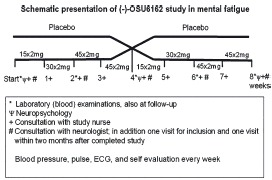
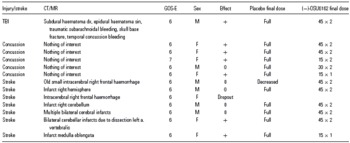
A randomised crossover, double-blind and placebo-controlled design was used. Half of the patients started on active substance and the other half on placebo according to the schedule below. The start dose of 15 mg × 2 was given during the first week, with dose increase to 30 mg × 2 during the second week and 45 mg × 2 during the third and fourth weeks (Fig. 1). (−)-OSU6162 is rapidly absorbed and the half-life is about 3 h Reference Rodríguez, Azie and Adams25. The tablets were taken in the morning and at noon, with the intention to cover the most active hours of the day. The dosage was individually flexible, meaning that if a person experienced alleviation of mental fatigue on a specific dose, but a dose increase resulted in decreased therapeutic effect and/or adverse reactions, the lower dose would be resumed and could be the final dose for that patient (Table 1, final dosage). This strategy was used to avoid missing a probable therapeutic window. After 4 weeks, those patients who initially received active drug were changed to placebo for another 4 weeks, and vice versa. Assessment was done before start and on active drug treatment after 4 and 8 weeks. There was no wash-out period. In case of dropouts, new participants were included in order to obtain six TBI and six stroke subjects. Both the participants and all the study staff members were blinded. The code was broken only after all participants had terminated the study.
Presentation of the study design.

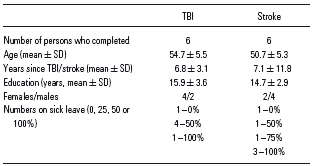
Demographic background of the participants
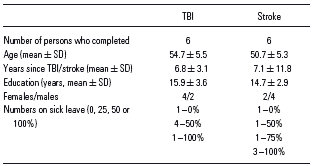
One woman with stroke who dropped out after 6 weeks is not included in the table.
Randomisation was done externally. Measures were taken to guarantee blinding. The packaging, labelling and coding were carried out by Galenica AB, Lund, Sweden.
Data collection and efficacy parameters
Self-report:
1 Mental Fatigue Scale (MFS)
2 Depression and anxiety according to the Comprehensive Psychopathological Rating Scale (CPRS)
3 Frenchay Activity Index
Performance in neuropsychological tests:
1 Trail Making Test (TMT)
2 Digit symbol coding
3 Digit span
4 Letter verbal fluency
5 Reading speed
6 Computer test measuring the simultaneous capacity of attention and speed
Observation of the study persons:
During the whole study period, participants were interviewed once a week about their health with focus on the degree of mental fatigue.
Endpoints
Primary endpoint was to investigate the therapeutic effects of (−)-OSU6162 as measured by the MFS.
Secondary endpoints were the results from neuropsychological tests (with specific focus on information processing speed and attention), depression and anxiety, and level of activity at home and socially.
Measures
Self-assessment scales. The MFS is a multidimensional questionnaire containing 15 questions. It incorporates affective, cognitive and sensory symptoms, duration of sleep and daytime variation in symptom severity. The questions concern fatigue in general, lack of initiative, mental fatigue, mental recovery, concentration difficulties, memory problems, slowness of thinking, sensitivity to stress, increased tendency to become emotional, irritability, sensitivity to light and noise, decreased or increased sleep as well as 24-h symptom variations Reference Johansson, Starmark, Berglund, Rödholm and Rönnbäck26. At the 15-point level on the MFS, the effects of mental fatigue become apparent. In healthy control persons, a score of on average 4.5 points on the scale is typical and never above 10 Reference Rönnbäck and Johansson27. There is no observed connection between age and mental fatigue among people of working age Reference Rönnbäck and Johansson27. The construction of the questionnaire resembles the questionnaire CPRS, which was used here for depression and anxiety Reference Svanborg and asberg28Reference asberg, Montgomery, Perris, Schalling and Sedvall29. Social activity was measured with Frenchay Activity Index Reference Holbrook and Skilbeck30.
Neuropsychological tests. It has been difficult to relate mental fatigue to outcome in cognitive tests Reference Belmont, Agar, Hugeron, Gallais and Azouvi7, possibly because in general the complexity level of the tests is too low. With the intention to increase the sensitivity, new tests with a higher demand on cognitive capacity were included in this study.
The neuropsychological tests measured information processing speed, attention and working memory. The tests included were digit symbol coding from the WAIS-III Reference Wechsler31, measuring information processing speed; the Digit-Span Reference Wechsler31, measuring working memory; the FAS verbal fluency test Reference Ellis, Kaplan and Kramer32; the TMT A and B measuring visual scanning, divided attention and motor speed Reference Reitan and Wolfson33. Also, a series of new TMTs were constructed to evaluate higher demands such as dual tasks. The tests were constructed with three and four factors, respectively Reference Johansson, Berglund and Rönnbäck11. Months were added in part C, and both months and days of the week in chronological order in part D. In the latter, the order of letters and digits was switched. Further, reading speed was measured with a test used for dyslexia screening Reference Madison34. Finally, a new computer test was constructed in our department including a simple and a complex subtest; hence, it was possible to measure the difference in speed between a single and a complex task, variability over time and errors made on counting digits Reference Johansson and Rönnbäck35.
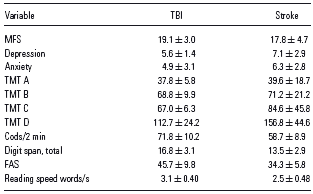
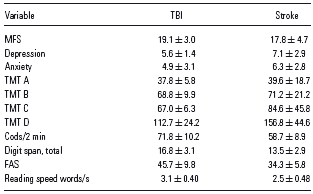
Participants. Demographic data are presented in Table 1 and Table 2. No significant differences between stroke and TBI participants at inclusion regarding age, gender, education and time since they were injured or got a stroke were detected. TBI and stroke participants did not differ on the primary endpoint level of mental fatigue on the pretest. Among secondary endpoints on the pretest, the stroke participants were significantly slower on digit symbol coding and reading speed and generated fewer words on FAS (all p<0.05, Table 3). This indicates a slight difference between the diagnostic groups from the beginning, although within the normal variation according to test norms. The only gender difference in the pretest was the total sum in the MFS, where women reported a significantly higher score (20.6±2.5) than men (16.3±3.8). However, the influence of confounding covariates is reduced as each patient serves as his or her own control.
Description of individual injuries, severity and also dosage during the treatment

CT/MR, computed tomography /magnetic resonance imaging.
Pretest levels (means and SEM) on primary and secondary endpoints for TBI and stroke, respectively
Tests and examinations performed before start, after 4 and 8 weeks: physical examination, weight and height, blood pressure and pulse, electrocardiography (ECG), blood sampling for chemistry and haematology safety labs: hemoglobin (Hb), number of leucocytes, number of trombocytes, erythrocyte volume fraction (EVF), serum-sodium (S-Na), serum-potassium (S-K), serum aspartate aminotransferase (S-ASAT), serum-alanine aminotransferase (S-ALAT), serum-alkaline phosphatase (S-ALP), serum-lactate dehydrogenase (S-LD), serum-thyroid stimulating hormone (S-TSH), serum-thyroxin (S-T4). No alterations were seen over time.
Statistics
The cross-over analysis with a Latin square design for primary and secondary endpoints was performed Reference Senn36. The analysis was done with a General Linear Model analysing treatment and order of treatment as main effects, using the difference between placebo and (−)-OSU6162 in a two-period two-treatment design. Comparisons between TBI and stroke groups were done with t-test. Fisher's exact test was used for categorical variables. SPSS 16.0 for Windows was used for data analysis.
The multivariate evaluation of data was performed by principal component analysis (PCA) using Simca-P 11, Umetrics AB (Umeä, Sweden). The significance of components was evaluated by means of cross-validation. To take into account that the observations in a cross-over design are paired, the analysis was performed on values of the difference between placebo and (−)-OSU6162 treatment for each individual. Preprocessing of data consisted of univariate scaling without mean centring.
PCA is a multivariate projection method that extracts and highlights the systematic variation in a data matrix. The original set of variables are reduced into a smaller set, commonly referred to latent variables or principal components, where the first principal component coincides with the maximum variance direction in the data. The analysis gives an overview of trends and patterns and uncovers relationships among observations and variables. The result of the PCA analysis is presented as low-dimensional projections, score and loading plots. Score plots give an overview of relationships among the observations, and the corresponding loading plot adds information about which variables are responsible for the pattern seen.
To facilitate interpretation of plots, the signs on the responses of some variables were inverted so that decreased values always were associated with a positive treatment effect. Thus, the signs on the responses of Frenchay Activity Index and neuropsychological tests (except for the TMT and computer test) were changed.
Results
Analysis of differences between treatments
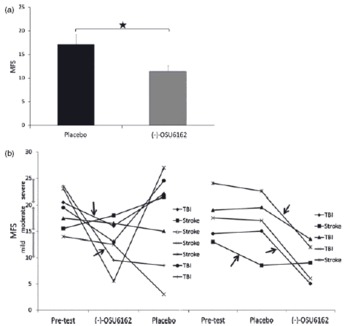
A significant difference was detected between the treatment with (−)-OSU6162 and placebo in the primary endpoint, according to MFS (Latin square analysis, F=5.37, p=0.031, Fig.a Fig. 2a and b). No significant effect was found with respect to order of treatment with active substance versus placebo. No significant effect was detected for the secondary endpoints, i.e. the neuropsychological tests assessing processing speed, attention and working memory, CPRS subscales depression and anxiety and daily activity (Frenchay). However, there was a trend towards improvement in processing speed and attention.
(a) Effect of (−)-OSU6162 and placebo on MFS, irrespective of treatment order, mean±SEM. (b) Individual self-reports on the MFS at pretest and after placebo treatment followed by (−)-OSU6162 treatment and vice versa. Arrows indicate dose reduction. Mental fatigue level is indicated on the Y-axis.

Beneficial responses on mental fatigue were seen already during the first few days of what was later found to be active drug treatment. Increasing dosage caused no further improvement. Adverse reactions consisted of short-lasting mild nausea and attenuated appetite. These adverse reactions disappeared upon dose reduction, including adjustment for one participant who was later found to have been on placebo treatment. One stroke subject discontinued treatment after 5 weeks because of adverse reaction. A new participant was then included, and this resulted in an unbalance in the treatment model as seven subjects started with (−)-OSU6162 and five with placebo (Fig. Fig. 2).
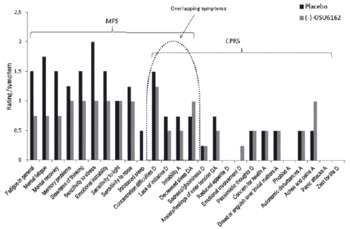
Most of the specific items in the MFS showed a decreasing trend after (−)-OSU6162 treatment compared with placebo (Fig. Fig. 3). Low levels on depression and anxiety items were reported for the subjects in this study (Fig. 3).
Median ratings of specific items from MFS and CPRS (D, depression; A, anxiety) after placebo and (−)-OSU6162 treatment (the treatment order is not indicated here). Overlapping items from MFS and CPRS are shown. Higher scores reflect more severe symptoms. A rating of 0 corresponds to normal function, 1 indicates a problem, 2 indicates a pronounced symptom and 3 a more severe symptom.

When comparing responders and non-responders, we were not able to detect a significant effect of diagnosis (stroke vs. TBI), age, time since the TBI or stroke event or work capacity. However, there was a significant effect of sex, with more females being responders (p<0.05).
Multivariate evaluation of data
To get an overview of the study result and detect trends in the material, a PCA was performed. Twelve observations and 53 x-variables were included (all separate questions for the three assessment scales and the neuropsychological tests). The analysis yielded a significant two-component model, explaining 44% (R 2X(cum)=0.439) of the variance in the material with a validity of 7% (Q 2(cum)=0.067). The low predictive validity of the model probably indicates a high level of variables that do not contribute to explaining the effect of treatment. After exclusion of variables with a predictive validity (Q 2VX(cum)) below 0, another significant two-component model was obtained explaining 62% of the variation in x-variables with a validity of 36% (n=12; x=29; R 2X(cum)=0.621 and Q 2(cum)=0.362). Excluded variables involved mainly anxiety-related items and activities of daily living.
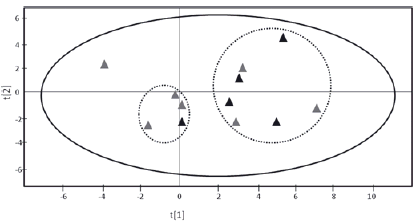
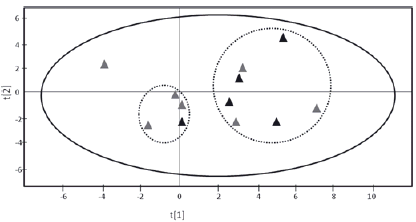
Figure Fig. 4 shows a score plot from the second PCA where each number represents an individual. If there were no treatment effect all individuals would cluster around the centre of the score plot. Here, however, a spreading along the first component (the x-axis; t[1]) can be seen, most likely reflecting treatment effect. Seven patients have clearly shifted to the right, indicating a positive treatment effect with the strongest effect in patient no 25. Four individuals around origo (0,0) do not seem to have benefitted from the treatment, and one patient, no 24, seems to have an inverted or placebo effect during treatment.
Score plot based on differences between placebo and (−)-OSU6162 treatment. The principal component analysis was based on 12 observations and 29 variables. Location far from origo indicates a stronger treatment effect. Each number represents an observation. Individuals with a grey rectangle received (−)-OSU6162 followed by placebo and a black rectangle vise versa.
In multivariate analysis, all variables are considered at the same time and the correlation structures among these are interpreted. This means that those subjects who responded best to (−)-OSU6162 treatment mainly were characterised by improvements on the items concentration difficulties, lack of initiative, sensitivity to stress, coding, slowness of thinking and mental fatigue. Fractions of explained variation for the six most important items along component 1 were 85–70% with a validity of 80–60%.
Discussion
To our knowledge, this is the first double-blind controlled study showing clearly beneficial, statistically significant effects of a drug, in this case (−)-OSU6162, on mental fatigue after a stroke or TBI. Admittedly, the number of patients in this study was small (n=12), but with the present crossover design, where each individual served as his/her own control in the comparison between active drug and placebo, statistical significance was reached on the primary endpoint. Obviously, more studies are needed with an increased number of patients and treatment periods longer than 4 weeks. Moreover, it will be necessary to find the lowest active dose, using doses below the lowest dose used in this study, i.e. 15 mg twice daily. Clinical improvement showed up already after that dose, with no further improvement following higher doses. Adverse reactions were mild and could be avoided by dose adjustment, and several patients expressed the wish to receive continued treatment with the drug. Statistical significance was not detected for secondary endpoints in this small study, but improvement in processing speed and attention was noticed for those subjects who experienced beneficial effects according to ratings on the MFS.
Not until a few years ago did we know that (−)-OSU6162, which we have thus far called a ‘dopamine stabiliser', also exerts a stabilising action on serotonergic functions by acting as a partial agonist on a number of serotonergic receptors, notably the 5-HT2A subtype. These recent observations are based on detailed in vivo as well as in vitro observations Reference Carlsson, Burstein and Kloberg24. Thus, the question may be asked to what extent the present observations showing improvements of the different symptoms specified in Fig. Fig. 3 might be related to dopaminergic and/or serotonergic mechanisms. In fact, nearly all of the improvements could very well have a relationship to at least one of these two neurotransmitters. The regulations of these neurotransmitters are known to be closely correlated to each other, and thus there can be a considerable overlap and synergy.
Conclusion
Mental fatigue is one of the most common complaints associated with head injury or stroke, and it keeps people from returning to the full range of activities they pursued prior to their injury. However, mental fatigue is also often neglected as a target for treatment. If these observations with (−)-OSU6162 can be confirmed in future studies, it could very well open up for more sophisticated, e.g. imaging and biomarker studies, and thus increase our insight into the nature of mental fatigue phenomena and lead to new therapeutic strategies.
Acknowledgements
This research was supported by the Arvid Carlsson Foundation and the Foundation for Neuropharmacological Research and Education.